

Business
How To Start A Trucking Business In The Philippines: Complete Guide For Entrepreneurs


The trucking business in the Philippines remains one of the most profitable opportunities in the logistics and transportation industry. As e-commerce, construction, manufacturing, agriculture, and retail sectors continue to expand, the demand for reliable cargo transportation services also grows. Every day, thousands of businesses require trucks to deliver raw materials, finished products, equipment, groceries, appliances, and construction supplies across the country.
If you’re looking for a business with long-term earning potential, starting a trucking business could be a smart investment. While it requires substantial capital compared to smaller businesses, it also offers consistent demand, recurring clients, and expansion opportunities.
In this guide, you’ll learn everything you need to know about starting a trucking business in the Philippines—from the required permits and startup costs to choosing the right trucks, finding clients, and maximizing profits.
Why Start a Trucking Business in the Philippines?
The Philippine logistics industry has experienced significant growth over the past decade. Online shopping platforms, infrastructure projects, supermarkets, factories, and import-export businesses all rely heavily on trucking services.
Here are several reasons why many entrepreneurs invest in trucking:
- Growing demand from e-commerce businesses
- Increasing infrastructure projects nationwide
- Expansion of manufacturing and industrial zones
- Steady need for cargo delivery services
- Opportunities for long-term contracts with companies
- Scalable business model by adding more trucks over time
Unlike seasonal businesses, freight transportation is needed throughout the year, making trucking one of the more stable industries in the country.
Types of Trucking Businesses
Before investing, decide which trucking niche best fits your budget and market.
1. General Cargo Transport
This is the most common trucking business. It involves transporting boxes, consumer goods, appliances, furniture, and packaged products.
2. Construction Hauling
Construction companies require dump trucks and heavy-duty vehicles to transport sand, gravel, cement, steel, and equipment.
3. Refrigerated Trucking
Refrigerated vans are used for transporting meat, seafood, vegetables, dairy products, and pharmaceuticals.
4. Container Trucking
Container trucks move imported and exported goods between ports, warehouses, and distribution centers.
5. Fuel and Chemical Transport
This specialized niche requires additional permits and safety compliance but generally offers higher income.
How Much Capital Do You Need?
The startup capital depends on whether you purchase brand-new or second-hand trucks.
| Startup Expense | Estimated Cost (PHP) |
|---|---|
| Used Light Truck | ₱700,000 – ₱1,500,000 |
| Brand-New Light Truck | ₱1,700,000 – ₱3,200,000 |
| Heavy-Duty Truck / Tractor Head | ₱3,500,000 – ₱8,500,000+ |
| Business Registration & Permits | ₱10,000 – ₱50,000 |
| Commercial Vehicle Insurance | ₱40,000 – ₱150,000 per year |
| Initial Maintenance Fund | ₱100,000 – ₱300,000 |
| Fuel Budget (Initial Working Capital) | ₱100,000 – ₱500,000+ |
| Driver & Helper Salaries (1 Month) | ₱40,000 – ₱80,000 |
| Office Equipment & Operations | ₱30,000 – ₱150,000 |
Many entrepreneurs start with a single truck before gradually expanding their fleet using business profits.
Business Registration Requirements
Operating legally is essential to attract corporate clients and avoid penalties.
You may need the following:
- DTI Registration (for sole proprietorship)
- SEC Registration (for corporations)
- BIR Registration
- Mayor’s Permit
- Barangay Clearance
- Vehicle Registration (LTO)
- Commercial Vehicle Insurance
- Other permits depending on cargo type
Corporate clients usually prefer dealing with registered trucking companies because they can issue official receipts and invoices.
Choosing the Right Truck
Your truck is your primary business asset. Choosing the wrong vehicle can increase maintenance costs and reduce profitability.
Consider the following factors:
- Payload capacity
- Fuel efficiency
- Availability of spare parts
- Maintenance costs
- Brand reputation
- Warranty coverage
- Resale value
Many successful trucking companies prioritize reliability over appearance. A dependable truck that minimizes downtime often generates better returns than a newer model with higher financing costs.
Finding Your First Clients
One of the biggest challenges is securing consistent customers.
Potential clients include:
- Manufacturing companies
- Construction contractors
- Retail chains
- Importers and exporters
- Wholesalers
- Hardware suppliers
- Agricultural businesses
- Furniture companies
- Food distributors
- E-commerce warehouses
Networking is extremely important in the trucking industry. Building relationships with warehouse managers, logistics supervisors, purchasing officers, and freight brokers can lead to long-term contracts.
Operating Costs to Consider
Your profit doesn’t only depend on the amount charged per trip.
You must carefully monitor expenses such as:
- Fuel
- Driver salaries
- Helper wages
- Vehicle maintenance
- Tires
- Insurance
- Registration renewal
- Tolls
- Parking fees
- Unexpected repairs
Preventive maintenance can significantly reduce expensive breakdowns and minimize downtime.
How Much Can a Trucking Business Earn?
Income varies depending on:
- Distance traveled
- Truck size
- Cargo type
- Fuel prices
- Number of completed trips
- Contract agreements
Businesses with long-term corporate contracts generally enjoy more stable revenue than those relying solely on one-time bookings.
Many successful operators increase profitability by maximizing truck utilization and minimizing empty return trips.
Technology Can Improve Efficiency
Modern trucking businesses increasingly rely on technology to reduce costs and improve customer service.
Useful tools include:
- GPS fleet tracking
- Fuel monitoring systems
- Vehicle maintenance software
- Accounting software
- Electronic proof of delivery (ePOD)
- Inventory management integration
- Cloud-based dispatch systems
These technologies provide real-time visibility and help improve operational efficiency while reducing unnecessary expenses.
Common Challenges
Like any business, trucking also comes with risks.
- Rising fuel prices
- Traffic congestion
- Driver shortages
- Vehicle breakdowns
- Accidents
- Weather disruptions
- Increasing maintenance costs
- Competition from larger logistics companies
Maintaining an emergency fund and regularly servicing your vehicles can help your business remain resilient during unexpected situations.
Tips for Long-Term Success
Many trucking businesses fail not because of a lack of customers, but because of poor financial management.
To build a sustainable business:
- Focus on excellent customer service.
- Deliver shipments on time.
- Maintain accurate financial records.
- Invest in preventive maintenance.
- Train drivers regularly.
- Purchase comprehensive insurance.
- Build relationships with repeat clients.
- Expand your fleet gradually.
- Monitor fuel consumption closely.
- Adopt modern logistics technology.
Consistency, reliability, and professionalism are often more important than having the largest fleet.
Should You Buy or Finance a Truck?
Many first-time entrepreneurs wonder whether it’s better to purchase a truck outright or finance it through a loan. Buying in cash eliminates monthly loan payments and interest expenses, but it requires significant capital. Financing, on the other hand, allows you to preserve cash for operations such as fuel, maintenance, and payroll.
Before taking out a commercial vehicle loan, prepare a realistic cash flow projection. Consider monthly amortization, insurance premiums, preventive maintenance, and possible periods when the truck may not be generating income. A financed truck can be a worthwhile investment if your projected revenue comfortably exceeds your operating costs and loan obligations.
Growing Your Trucking Company
Once your first truck consistently generates income, you can begin expanding your operations. Growth should be gradual and supported by stable contracts rather than speculation.
Ways to expand include:
- Add additional trucks to your fleet.
- Offer warehousing and storage services.
- Provide last-mile delivery solutions.
- Invest in specialized vehicles such as refrigerated or tanker trucks.
- Partner with freight forwarders and logistics companies.
- Expand service coverage to neighboring provinces and regions.
Diversifying your services can reduce dependence on a single market segment and create multiple revenue streams.
The trucking business in the Philippines offers tremendous opportunities for entrepreneurs willing to invest in quality equipment, excellent customer service, and efficient operations. Although startup costs are relatively high, the industry’s continuous demand makes it an attractive long-term business venture.
Success depends on more than simply owning trucks. It requires proper financial planning, legal compliance, disciplined maintenance, dependable drivers, and strong relationships with clients. By starting with a solid business plan and focusing on operational excellence, you can build a trucking company that grows steadily and serves the country’s expanding logistics needs for many years to come.

Business News Philippines was launched in October 2015 as a portal for readers to learn more about operating a business in the Philippines.


The WA government has declared the Woodside Energy’s Browse gas field a significant state project, in a move which could streamline its development once approved.

Singapore central bank surprises with second straight policy tightening

Abstract
- Southeast Asia faces mounting pressure as US-China rivalry intensifies, drawing comparisons to the volatile geopolitical conditions preceding World War I. ASEAN’s long-standing approach of balancing American security partnerships, Chinese trade ties, and broader economic relationships is under increasing strain as both powers push the region to align with their competing interests.
- Malaysia and the wider region have become central to technology and supply chain competition, making passive neutrality increasingly difficult to sustain. Rather than simply avoiding alignment, Southeast Asian nations are urged to develop collective strategic resilience substantial enough to prevent either superpower from treating the region as subordinate terrain in their broader rivalry.
Southeast Asia faces growing US-China rivalry reminiscent of pre-WWI tensions. ASEAN’s traditional diplomatic balancing act is under strain as both superpowers pressure the region. Malaysia and Southeast Asia must build collective strategic weight beyond polite neutrality to avoid becoming casualties of great-power conflict.
Key Points
• An ancient Southeast Asian instinct of careful navigation resurfaces as US-China rivalry intensifies, mirroring dangerous pre-WWI patterns of declining hegemony, rising challengers, territorial disputes, and nationalist tensions that threaten regional stability.
• ASEAN’s decades-long diplomatic balancing act — absorbing American security, Chinese trade, and multiple powers’ investments — faces unprecedented strain as both superpowers pressure the region to align with their competing visions of world order.
• Southeast Asia, particularly Malaysia, has become a critical geopolitical hinge in the technology and supply chain war, making passive neutrality increasingly untenable as great-power competition penetrates the region’s economic infrastructure.
The Return of Great-Power Rivalry
Southeast Asia faces a world that smells dangerously like 1914. History is repeating its familiar patterns: a declining hegemon, a rising challenger, territorial disputes, naval build-ups, and nationalist fever amplified by new technologies. Author Odd Arne Westad’s The Coming Storm serves as a critical warning that the region must heed. If America and China stumble into conflict, Asean’s 684 million people and US$3.84 trillion in global trade will not be spectators — they will be the table. The challenge is no longer simply avoiding a choice between Washington and Beijing, but building enough collective resilience that neither superpower can treat Southeast Asia merely as terrain.
Asean’s Diplomatic Balancing Act Under Strain
For decades, Southeast Asia performed a remarkable feat of strategic improvisation, absorbing American security, Chinese trade, Japanese capital, and European markets while transforming swamps into ports and fishing villages into industrial hubs. This wasn’t cowardice — it was survival. However, Washington now speaks through export controls, tariffs, and technology denial, while Beijing leverages coastguard vessels, artificial islands, and infrastructure loans. Both superpowers publicly respect Asean’s autonomy while privately preferring it exercised in their favour. The region’s famously consensus-driven, carefully worded diplomacy — once its greatest strength — is buckling under the pressure of a fundamentally harsher geopolitical reality.
Malaysia’s Precarious Position at the Crossroads
Malaysia sits almost perfectly inside this great-power contradiction. Facing the strategically vital Strait of Malacca and deeply embedded in both Chinese commerce and American technology supply chains, Malaysia cannot afford complacency. Penang alone, as a critical global semiconductor hub, has become part of the nervous system of 21st-century geopolitical competition. Modern rivalries are no longer fought only on battlefields — they play out through customs forms, export permits, sanctions lists, and undersea cables. As Southeast Asia becomes the world’s favourite supply-chain workaround, it simultaneously becomes the place where both powers test each other’s limits. The elephants are moving. The question is no longer whether the storm can be avoided — but where the lightning strikes first.
Source : Opinion: The table, not the audience — Asean and the coming US-China collision
Other People are Reading

The Rudd-Gillard era of disunity has likely influenced Labor’s approach to prioritise unity over potentially fractious public debate, a political historian says.
Factional leaders blocked public discussion about the party’s position on Israeli actions, including a reference to “genocide” against Palestinians, on the conference floor during a three-day meet in Adelaide that closed on Saturday.
The only debate thrashed out in the open at Labor’s national conference was on expanding voluntary assisted dying to telehealth appointments, with all other changes passed unopposed.
Backroom deals on policy platform motions weren’t unusual, but the conference was very managed compared to past events, prominent Labor historian Frank Bongiorno said.
“This is a government and a party that is still very wounded really by its last time in office between 2007 and 2013, when there was a collapse of unity,” the University of Canberra academic told AAP.
“Going back to that period, you wouldn’t say there was a strong culture of debate at conference, although they did obviously have the debate over marriage equality and also debates about selling uranium to India.
Professor Bongiorno said the party had more frequent robust conference debates in 1970s, 80s and 90s, including on privatisation.
“It was taken for granted that when you had something that was particularly contentious that there was going to be some sort of debate,” he said.
“I think back to someone like (prime minister Paul) Keating making the case on the floor in 1984 for allowing foreign banks into the country.
“There just doesn’t seem to be that kind of culture … it’s clearly wound down and I suspect the media environment is part of the reason for that.”
The policy adopted by Labor delegates noted the party’s opposition to Israeli annexation of Palestinian territories and called for illegal settlement activity to end.
Former cabinet minister Ed Husic, now a backbencher, led the push for the party to publicly have it out over the party’s policy.
But Gaza hadn’t universally split Labor’s left and right factions in the same way other foreign policy issues had in decades past, Prof Bongiorno said.
“Look at who the major, open dissenter is: someone who comes from the NSW right in Ed Husic,” he said.
“That would have been utterly unheard of back in the 1980s and 90s, for someone from that faction to take that kind of position.”
The prime minister, who originates from the party’s left faction, on Sunday defended Labor limiting debate, declaring the meeting the “most transparent political conference in Australia by far”.
“The party has changed and one of the things that’s happened in the party is we are more cohesive, more united than we’ve ever been before,” he said.
Opposition home affairs spokesman Jonathon Duniam said the prime minister ruled his party with an “iron fist” and any dissent at the conference was quickly shut down.

Dr Reddy’s Labs lost 10% and Cipla 8%, on bourses, underperforming the 10% gain in the BSE Healthcare index over the past 12 months. These stocks are expected to remain range-bound in the short term given the challenging business scenario. Analysts have reduced earnings forecasts for each company by 6-8% for FY27 and FY28.
Read more: August Rush: Over 2 dozen companies plan Street debut next monthDr Reddy’s reported a weaker-than-expected quarter as profitability was hit by a sharp decline in lenalidomide sales and a one-time ₹239.7-crore provision linked to quality issues in its semaglutide portfolio. Its revenue declined 5.6% year-on-year to ₹8,070.5 crore, while net profit dropped 69.2% to ₹434.8 crore.

In comparison, Cipla reported its highest-ever June quarter revenue of ₹7,119.3 crore, up 2% year-on-year, but profit declined 39.2% to ₹785.6 crore as margins came under pressure from product mix changes, launch-related investments, inventory charges and geopolitical disruptions.
Operating margin before depreciation and amortisation (Ebitda margin) for Dr Reddy’s dropped to 12.5% from 26.7% in the year-ago quarter and contracted to 16.7% from 25.6% for Cipla during the period, highlighting the profitability challenges both companies currently face.
 Agencies
While India a bright spot in Q1, investor sentiment hinges on US show
The US business remains the key transition area for both companies. Dr Reddy’s North America revenue declined 35% year-on-year as lenalidomide sales continued to normalise; however, the company maintained that its core non-lenalidomide business should deliver double-digit growth in FY27. Cipla’s North America revenue dropped 21% to ₹1,532 crore.
Both the companies, however, remain optimistic about their US prospects. Dr Reddy’s launched six products during the quarter, including first-to-market generic bosutinib, used in cancer treatment, with 180-day exclusivity, while Cipla commercialised Nintedanib (used to treat lung infections), Dapagliflozin (used in diabetes treatment), and generic Ventolin (used to treat respiratory ailments).
Obesity and peptide-based therapies are emerging as future growth drivers. Dr Reddy’s has launched generic semaglutide injection in Canada and semaglutide tablets in India, while also introducing a GLP-1 nutrition product with Nestle. Although quality issues temporarily disrupted semaglutide supplies, the company expects production to resume by November.
Cipla has gained early traction in obesity management through Yurpeak (tirzepatide), licensed from Eli Lilly. The brand generated around ₹80 crore in sales during the quarter and has already become the second-largest brand in the segment after Mounjaro.
Emkay Research has reduced earnings estimates for each of the two companies by 6-8% for FY27-28. The broker has downgraded Dr Reddy’s’ target price by 8% to ₹1,200 while maintaining a ‘reduce’ rating on the stock. On the other hand, it has retained an ‘add’ rating on Cipla, citing strong momentum in domestic sales and has retained the target price for Cipla at ₹1,450.

Earnings call transcript: Stanmore Resources posts strong Q2 2026 rebound


With combined experience of covering technology companies on Wall Street and working in Silicon Valley, and serving as an outside adviser to several seed-round startups, Gary Alexander has exposure to many of the themes shaping the industry today. He has been a regular contributor on Seeking Alpha since 2017. He has been quoted in many web publications and his articles are syndicated to company pages in popular trading apps like Robinhood.
Analyst’s Disclosure: I/we have a beneficial long position in the shares of OKTA either through stock ownership, options, or other derivatives. I wrote this article myself, and it expresses my own opinions. I am not receiving compensation for it (other than from Seeking Alpha). I have no business relationship with any company whose stock is mentioned in this article.
Seeking Alpha’s Disclosure: Past performance is no guarantee of future results. No recommendation or advice is being given as to whether any investment is suitable for a particular investor. Any views or opinions expressed above may not reflect those of Seeking Alpha as a whole. Seeking Alpha is not a licensed securities dealer, broker or US investment adviser or investment bank. Our analysts are third party authors that include both professional investors and individual investors who may not be licensed or certified by any institute or regulatory body.

FOX Business’ Lydia Hu reports live from the New York Stock Exchange, demonstrating the specialized process of ‘coffee cupping’ by elite coffee graders.
A veteran-owned tea and coffee company that started in a Georgia dining room is working to create jobs for former service members while building a brand rooted in American history and values.
Iraq War veteran Roger Owens founded Star Spangled Tea & Coffee Co. with his wife, Aimee Owens, during the COVID-19 pandemic. The idea came after Roger Owens, a longtime coffee drinker, developed a taste for tea.
“My son and my wife got me drinking tea, and I was really not a tea drinker, I was more of a coffee guy,” Roger Owens told FOX Business.
After discovering hibiscus tea, the couple searched online for an American-themed and veteran-owned tea company. They came up empty-handed.
VETERANS ARE USING THIS HOMEBUYING BENEFIT MORE OFTEN — BUT MANY STILL DON’T KNOW IT EXISTS

Star Spangled Tea & Coffee founder Roger Owens, left, poses with his wife, Aimee Owens, and their son, Alex Owens. (Star Spangled Tea & Coffee Co.)
“We kind of looked at each other and decided to start our own,” he said.
The Columbus, Georgia-based company launched nearly four years ago and initially operated from the couple’s dining room.
“We didn’t know anything about tea to begin with,” Roger Owens said. “… Trying to start a business during COVID was not easy.”
Star Spangled Tea & Coffee now sells premium coffee and loose-leaf teas inspired by American history, landmarks and regional flavors.
Its products include blends featuring Georgia peaches and Florida key limes, along with teas and coffees tied to national parks and historic sites.
According to the company’s website, its products are sold at museums, presidential libraries, state parks, historic destinations and specialty retailers.
USAA, ARMED SERVICES YMCA LAUNCH CHILDCARE PROGRAM AHEAD OF MILITARY SPOUSE APPRECIATION DAY
Star Spangled Tea & Coffee’s Great American Road Trip light-roast coffee blend was created through the company’s work with Freedom 250.
It also ships nationwide, including to Alaska, Hawaii and military addresses overseas.
Roger Owens said the business places a strong emphasis on hiring veterans and helping them regain the sense of teamwork and purpose they may have lost after leaving the military.
“You’re used to being [part of] a team and then when you get out of the military, you’re alone other than your family, and it’s like somebody pulled the carpet out from under you,” Roger Owens said.
“We want veterans to find more than just a job,” he added. “We’re looking for them to find purpose.”
The company expanded into coffee last year after repeated requests from customers.
It has also developed several patriotic products through its work with Freedom 250, including a “Great American Road Trip” light-roast coffee blend linked to the celebration of America’s 250th anniversary.

Star Spangled Tea & Coffee products are displayed at an event. The Georgia-based company sells blends inspired by American history, landmarks and regional flavors. (Star Spangled Tea & Coffee Co.)
Other products include a cherry blossom-inspired White House blend and a history-inspired Liberty Tea.
Roger Owens said the company’s long-term vision extends beyond selling tea and coffee.
CLICK HERE TO GET FOX BUSINESS ON THE GO
“We’re not just building another coffee company,” he said. “We’re building America’s next destination brand.”
He hopes to open stores across the country where customers can gather over tea or coffee and “celebrate what unites us.” The company is seeking investors and strategic partners to help open locations, expand its product line and hire more veterans.
“We didn’t want politics involved in this, we wanted it to be for all Americans,” Roger Owens said.
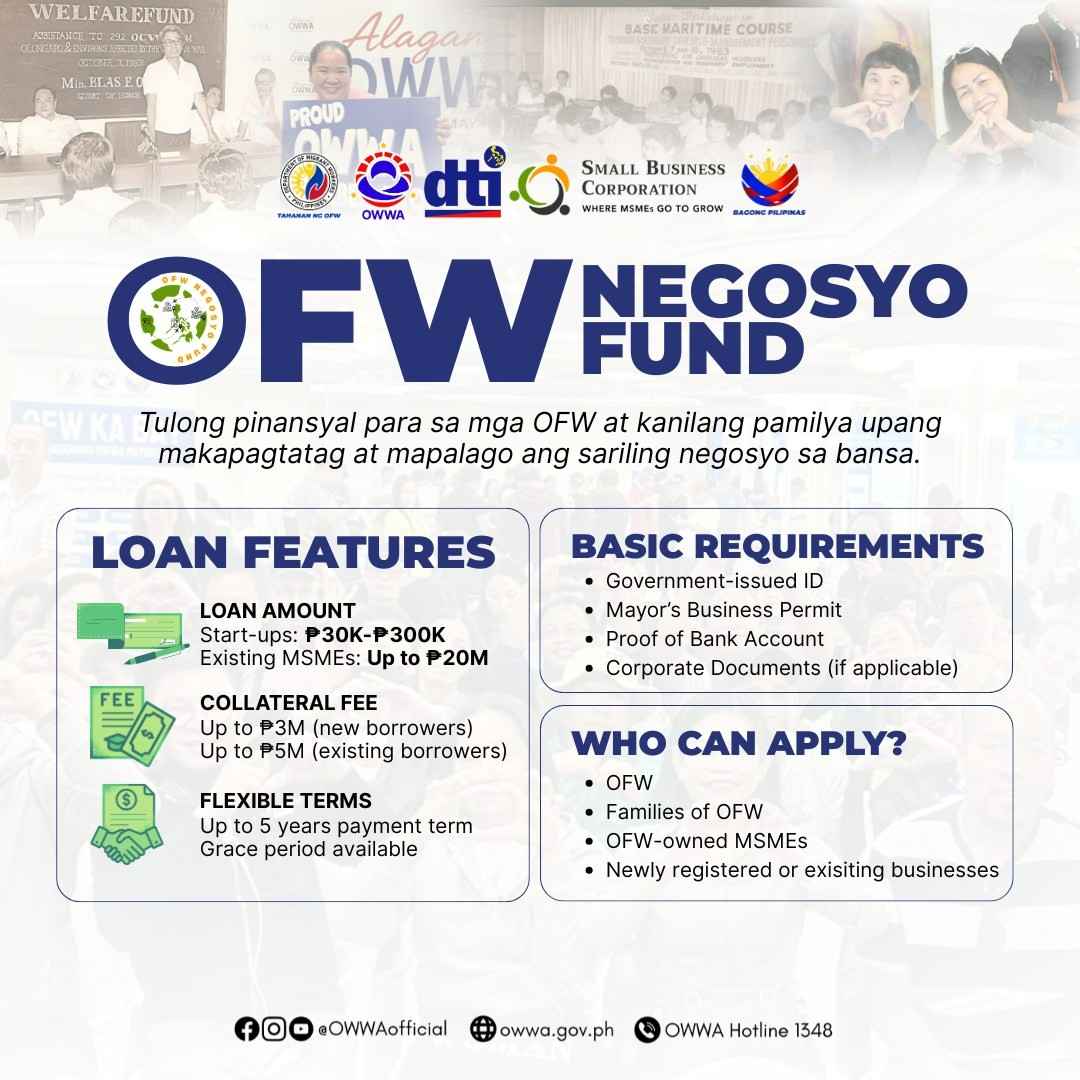
The Overseas Workers Welfare Administration (OWWA) and the Department of Trade and Industry – Small Business Corporation (DTI-SB Corp) have officially strengthened their partnership to expand livelihood and business opportunities for Overseas Filipino Workers (OFWs) through the improved implementation of the OFW Negosyo Fund.
The Memorandum of Agreement (MOA), formally signed on May 18 at the DTI Filinvest Building in Makati City, marks another important step toward helping OFWs gain easier access to financial assistance, entrepreneurship support, and business development programs as they transition toward long-term financial stability in the Philippines.
The agreement aims to simplify and improve the loan facilitation process for OFWs who wish to start, sustain, or expand their own businesses. Through better coordination among government offices and regional centers, more overseas Filipino workers are expected to benefit from livelihood programs designed specifically for returning migrants and their families.
Expanded Access to OFW Negosyo Fund
One of the main goals of the partnership is to widen access to the OFW Negosyo Fund, a government-backed financing program that supports OFWs who want to build businesses and establish sustainable sources of income in the country.
Under the strengthened agreement, OWWA and DTI-SB Corp will improve referral procedures among Regional Offices, Negosyo Centers, Provincial Help Desks, and Reintegration Centers nationwide. This coordinated approach is expected to reduce delays, improve communication between agencies, and provide faster assistance to OFWs seeking business loans and livelihood support.
For many overseas Filipino workers, access to startup capital remains one of the biggest challenges in pursuing entrepreneurship. Traditional bank loans often require strict collateral and financial requirements that many returning OFWs may find difficult to meet.
Programs such as the OFW Negosyo Fund aim to bridge that gap by providing accessible financing options and government support systems tailored to the needs of migrant workers.
Helping OFWs Build Sustainable Businesses
The Philippine government continues to encourage financial literacy and entrepreneurship among OFWs as part of its long-term reintegration strategy. Rather than relying solely on overseas employment, many OFWs are now exploring opportunities to invest their savings into small businesses, franchising opportunities, online selling ventures, food businesses, retail stores, agribusiness projects, and other income-generating activities.
The strengthened collaboration between OWWA and DTI-SB Corp is expected to help aspiring entrepreneurs navigate the process more efficiently.
Aside from loan facilitation, the partnership also focuses on improving the capabilities of regional offices to ensure more effective delivery of services. This includes strengthening frontline support, improving coordination among agencies, and providing better guidance to OFWs who may need assistance in business planning, loan applications, and entrepreneurship training.
Government agencies recognize that financial assistance alone is not enough to guarantee business success. Many small enterprises fail because of lack of business knowledge, poor financial management, or insufficient market preparation.
Because of this, livelihood programs now increasingly include mentorship, financial education, and entrepreneurship seminars to improve the chances of long-term success for OFW-owned businesses.
Officials Express Support for the Partnership
The signing ceremony was led by OWWA Administrator Patricia Yvonne “PY” Caunan, who delivered the opening remarks during the event.
Support for the strengthened partnership was also expressed by Department of Migrant Workers (DMW) Secretary Hans Leo J. Cacdac and Department of Trade and Industry (DTI) Secretary Ma. Cristina Roque.
The collaboration reflects the government’s continuing effort to create more economic opportunities for OFWs and returning migrant workers who want to establish stable livelihoods in the Philippines.
Officials highlighted the importance of empowering overseas Filipino workers not only through employment opportunities abroad but also through sustainable reintegration programs that can help them achieve long-term financial independence.
Importance of Reintegration Programs for OFWs
Millions of Filipinos continue to work overseas to support their families, contribute to household income, and provide better educational opportunities for their children. However, many OFWs also face financial uncertainty after returning home, especially if they lack stable investments or alternative sources of income.
This is why reintegration programs have become increasingly important in recent years.
Livelihood assistance and entrepreneurship financing programs allow OFWs to transform their hard-earned savings into productive investments that can generate long-term income even after overseas employment ends.
Government agencies have repeatedly emphasized that entrepreneurship can help OFWs reduce dependency on overseas work while creating jobs and stimulating local economic growth.
Small businesses established by returning OFWs can also contribute to community development by generating employment opportunities for other Filipinos.
Growing Interest in Small Business Opportunities
The demand for small business financing in the Philippines continues to rise as more Filipinos explore entrepreneurship opportunities. Digital platforms, online marketplaces, and social media marketing have made it easier for small entrepreneurs to reach customers nationwide.
Many OFWs are now investing in businesses such as:
With proper guidance, financing support, and business education, these ventures can become sustainable sources of income for OFWs and their families.
Improved Coordination Among Government Offices
The new agreement between OWWA and DTI-SB Corp also aims to improve coordination among local and regional offices nationwide.
Under the enhanced referral system, OFWs can receive assistance through various government touchpoints including OWWA Regional Welfare Offices (RWOs), DTI Negosyo Centers, Provincial Help Desks, and Reintegration Centers.
This integrated approach is expected to make government services more accessible and responsive to the needs of OFWs in different parts of the country.
By strengthening coordination and streamlining procedures, agencies hope to reduce confusion among applicants while ensuring faster processing and more efficient delivery of support services.
How OFWs Can Learn More About the Program
According to OWWA, interested OFWs may learn more about the OFW Negosyo Fund and related livelihood programs through several channels.
Applicants may visit the nearest OWWA Regional Welfare Office (RWO) or DTI-SB Corp Regional Office for inquiries regarding eligibility requirements, loan procedures, and available entrepreneurship assistance.
OWWA also encouraged OFWs to watch the “Kabuhayan Wednesday” livestream hosted by OWWA RWO NCR, where various livelihood opportunities and government programs for OFWs are discussed.
The agency continues to promote awareness campaigns to ensure more overseas Filipino workers can access available financial and reintegration assistance programs.
Strengthening Financial Security for OFWs
The partnership between OWWA and DTI-SB Corp reflects the government’s broader strategy of helping OFWs achieve greater financial security through entrepreneurship and livelihood development.
For many overseas Filipino workers, establishing a successful business represents an opportunity to eventually return home permanently while maintaining stable income for their families.
As the Philippine government continues to expand reintegration initiatives, programs like the OFW Negosyo Fund are expected to play an increasingly important role in supporting returning OFWs who aspire to become entrepreneurs.
With improved coordination, expanded access to financing, and enhanced support systems, more OFWs may soon have the opportunity to transform their overseas earnings into sustainable businesses and long-term financial stability.
Business News Philippines was launched in October 2015 as a portal for readers to learn more about operating a business in the Philippines.

California Water Service: Interest Rates Are A Headwind (Rating Downgrade)

Commonwealth Games’ Papua New Guinea swimming team visit Barras for IRN-BRU challenges

Woodside's Browse gets formal state support

Hosts Morocco Cruise Past Kenya 4-0 in WAFCON 2026 Opener

Renter of Home in Anne Heche Crash Denies Settlement With Son

No Jackpot Winner as $257 Million Prize Rolls Over to $269 Million Monday Draw

Weekend Open Thread: Staud – Corporette.com

This Is About To Reset The Financial System, And XRP Was Built for It

The Ultimate Finance Documentary Watchlist | In The Money by Zerodha

*BEST* New Money Farm! 10,000 Gold in 30 Seconds | Assassin’s Creed Black Flag Resynced
-

 Fashion2 days ago
Weekend Open Thread: Brooks Brothers
-

 Crypto World6 days ago
Grayscale Files For Worldcoin ETF, WLD Registers Sharp Rise
-

 NewsBeat5 days ago
How a former Blue Peter presenter stunned America’s Got Talent judges
-

 Tech6 days ago
Sail Virtually Aboard The “Itanic” With IA-64 Emulator
-
 Tech6 days ago
Turtle Beach Command Series KB7 review: a nifty screen-equipped gaming keyboard
-

 NewsBeat7 days ago
Unregistered fitter used Gas Safe logo on business flyers
-
 Business5 days ago
New Jersey voter registration controversy explained: How 6,600 noncitizens got on the rolls, and what happens next
-
 Entertainment5 days ago
Johnny Depp’s R-Rated Gothic Cult Classic Gets New Release Ahead of Sydney Sweeney Remake
-

 Tech6 days ago
Watch Flock Safety CEO Garrett Langley discuss the future of surveillance at TechCrunch Disrupt 2026
-

 Crypto World4 days ago
Ethics, other provisions in crypto Clarity Act to be further discussed
-
 NewsBeat6 days ago
Shanghai science forum photos show China’s AI and robotics advances in rivalry with US
-

 Crypto World7 days ago
Circle’s President Sold Over 360,000 Shares, The Filings Explain Why
-

 Tech7 days ago
Subway Sandwich Computers Get a Second Life as Gaming Machines
-
 Sports5 hours ago
Commonwealth Games boxing: Jadumani Singh seals dominant 5-0 win over Pakistan’s Sumama Rehman to enter quarter-finals | Commonwealth Games News
-

 Tech2 hours ago
Intel is reversing course and bringing hyper-threading back to its server chips
-

 News Videos3 days ago
The Peugeot Family: How 200 Years of an “Old Money” Dynasty Died in A Boardroom
-

 Sports3 days ago
2026 3M Open leaderboard: Scottie Scheffler finds putter in Round 1, sits three back
-

 Fashion3 days ago
16 Dresses for the High Summer Event
-

 Entertainment7 days ago
Stephen Colbert Returns to Social Media After Late Show End
-

 Tech7 days ago
The 35 Best Board Games for Family Game Night
You must be logged in to post a comment Login