

Crypto World
Shiba Inu (SHIB) Team Says OG Culture Never Left, Neither Did SHIB

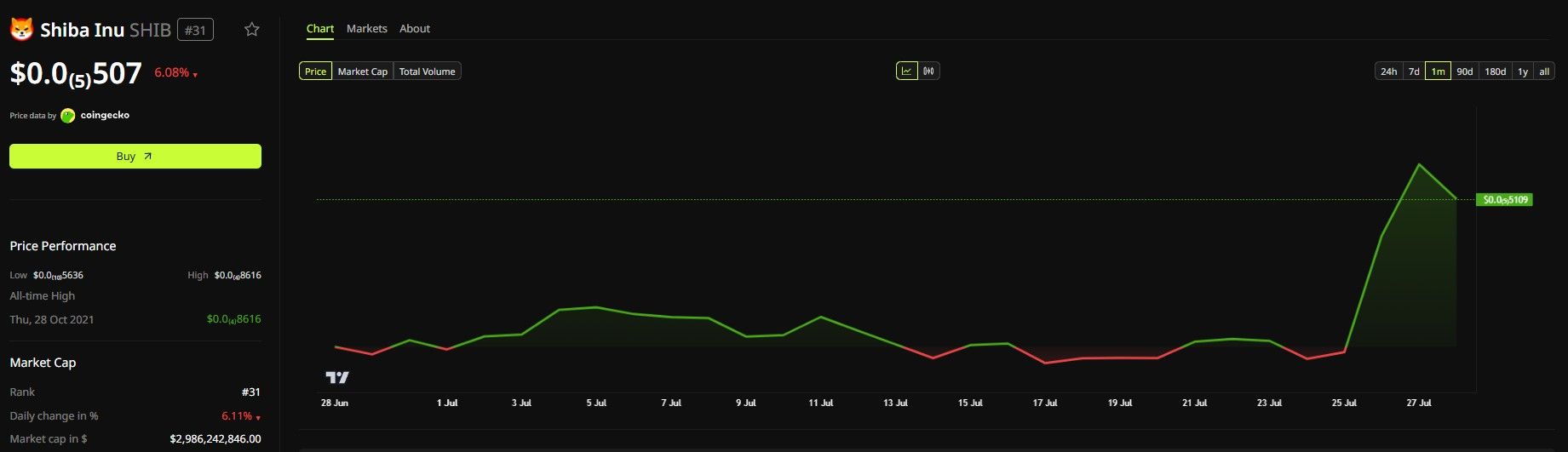
Shiba Inu (SHIB)’s team said on X that “OG culture never left, neither did SHIB,” pointing to a fresh rally as proof the token still commands attention.
Crypto commentator David Gokhshtein sparked the exchange, arguing that early meme coins, often called “OG” (original gangster) projects in crypto slang, are regaining relevance across the market.
Shiba Inu’s Team Doubles Down Online
Gokhshtein posted that SHIB’s move over the past two days left him more bullish. He said the shift points to an OG revival across meme coins broadly. Gokhshtein explained his reasoning in the original post that prompted Shibtoken’s reply.
Watching $SHIB move over the last two days has me even more bullish that the OG culture is making its way back to this industry. I also think this benefits the OG memes as a whole.
Therefore, the reply frames SHIB’s move as part of a bigger shift rather than an isolated bounce. Shiba Inu’s burn rate hit a six-month high earlier this month, though the spike failed to move the price at the time. Even so, the renewed rally suggests investor attention has returned, at least for now.
SHIB Rally Shows a Mixed Price Picture
Shiba Inu (SHIB) trades near $0.00000507. The token is still up close to 22% over the past week.
In contrast, SHIB remains nearly 19% higher over the past 30 days. This suggests the broader uptrend remains intact despite the recent dip.
However, the rally has cooled in the short term. SHIB has fallen 6.08% over the past 24 hours. Its market cap now sits at $2.99 billion, ranking 31st overall among cryptocurrencies. Traders can follow SHIB’s live price data as the pullback continues.
The token remains far below its all-time high of $0.00008616, set in October 2021. That gap underscores how far Shiba Inu would need to climb before OG sentiment turns into a lasting recovery.

OG Meme Coins Regain Attention
The renewed optimism follows a rough stretch for Shiba Inu. On-chain data had recently pointed to a sad reality for the token. Trader James Wynn had dismissed SHIB as dead only a month earlier.
Historically, meme coin rallies triggered by social posts have faded within days. Some traders remain skeptical this one will prove different. Meanwhile, meme coin dominance overall hit a two-year low as holders exited the sector. That skepticism echoes a broader shift toward fundamentals-driven tokens across the market.
Still, the renewed attention marks a shift in tone for a token that many had written off. This development may indicate that market sentiment is moving back toward established names. Whether SHIB can hold its recent gains will likely depend on trading volume in the coming days.
The post Shiba Inu (SHIB) Team Says OG Culture Never Left, Neither Did SHIB appeared first on BeInCrypto.

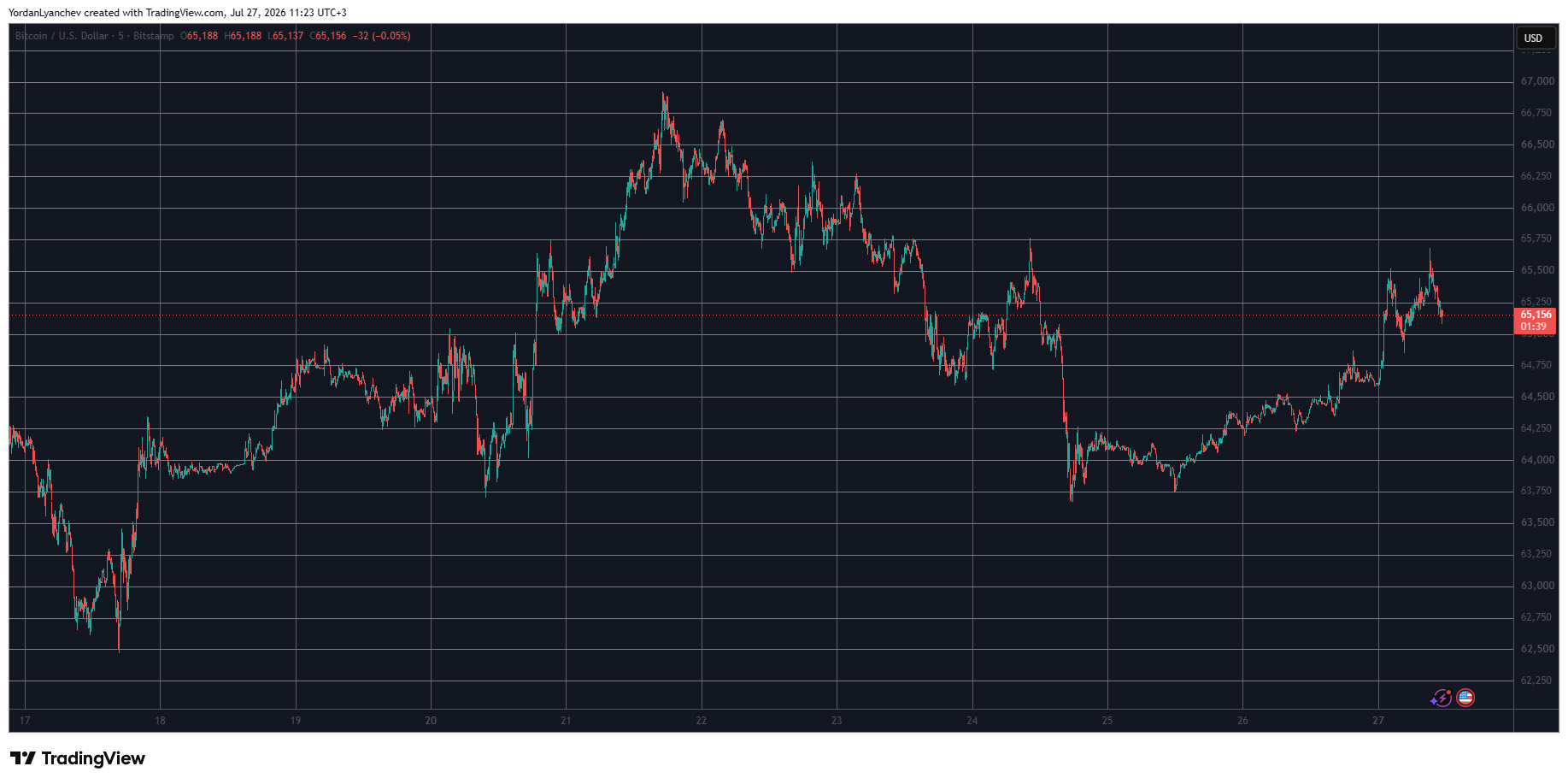
Bitcoin has reacted positively to the de-escalating war news from the weekend on Monday morning, jumping to over $65,000 for the first time since Friday.
Most larger-cap alts are in the green today as well, led by ETH. The altcoin leader touched $1,980 for the first time in almost two months before retreating slightly.
BTC Above $65K
The primary cryptocurrency rallied hard last week, going from under $64,000 to $67,000 within 36 hours to post a monthly peak. However, it couldn’t sustain this momentum and quickly started to lose value. It first dipped to $65,500 on Wednesday before another leg down brought it to under $65,000.
It rebounded on Friday to $65,750, where it was rejected and pushed south. The bears managed to drive it down by $2,000, where it finally found support and returned to $64,000 on Saturday. Then came the aforementioned de-escalation news in the Middle East. Trump halted the planned attacks against Iran after new talks resumed with Oman about the potential reopening of the Strait of Hormuz.
As it typically happens when such news comes during the weekend, the immediate reaction was minimal, but BTC remained above $64,000. It priced the development on Monday morning when it jumped to $65,600 (on Bitstamp). Although it failed there, it still trades above $65,000 as of press time.
Its market capitalization has reclaimed the $1.3 trillion mark, while its dominance over the alts remains just shy of 57%.
ETH Leads the Pack
The largest altcoin has pumped impressively over the past 24 hours. It touched $1,980 for the first time since June 2, and even though it has retraced slightly, it’s still 4.5% up on the day and sits above $1,960. Other notable gainers from this cohort of assets include AAVE (9%), ONDO (8%), UNI (6.5%), and LINK (4.65%). PUMP has rocketed by over 11%.
BNB, XRP, SOL, TRX, RAIN, HYPE, and ZEC are also in the green but in a more modest manner. In contrast, XMR and DOGE have slipped by 1-3%. SHIB has dumped by over 8% in the past 24 hours after its massive rally yesterday that pushed it to a multi-month peak.
The cumulative market cap of all crypto assets is up by roughly $30 billion daily to $2.310 trillion on CG.

The post ETH Hits a 2-Month High Near $2K, Bitcoin Reclaims $65K: Market Watch appeared first on CryptoPotato.
Crypto World
Blockchain in Manufacturing: Building Smarter, Safer, and More Transparent Supply Chains

Manufacturing is undergoing a digital transformation. Automation, artificial intelligence (AI), the Internet of Things (IoT), and cloud computing have already reshaped factory floors. Now, blockchain technology is emerging as another game-changing innovation—one that promises greater transparency, efficiency, and trust across the entire manufacturing ecosystem.
While blockchain is often associated with cryptocurrencies like Bitcoin, its real-world applications extend far beyond digital assets. In manufacturing, blockchain has the potential to solve long-standing issues such as counterfeit products, supply chain inefficiencies, poor traceability, and fragmented data management.
As global supply chains become increasingly complex, manufacturers need reliable systems that ensure every component, transaction, and process can be verified. Blockchain delivers exactly that.
What Is Blockchain in Manufacturing?
Blockchain is a decentralized digital ledger that records transactions in a secure, immutable, and transparent manner. Every participant in the network shares access to the same information, making it nearly impossible to alter records without consensus.
In manufacturing, blockchain can record every stage of a product’s lifecycle—from raw material sourcing to production, shipping, distribution, and even recycling.
Instead of relying on disconnected databases across suppliers and manufacturers, blockchain creates a single trusted source of truth.
Why Manufacturing Needs Blockchain
Modern manufacturing depends on hundreds—or even thousands—of suppliers operating across multiple countries.
This complexity creates challenges such as:
- Limited supply chain visibility
- Counterfeit materials
- Manual paperwork
- Delayed quality inspections
- Data inconsistencies
- Regulatory compliance issues
- Product recalls that take weeks instead of hours
Blockchain addresses these problems by creating an auditable record that everyone involved can trust.
Improving Supply Chain Transparency
One of blockchain’s strongest advantages is end-to-end visibility.
Every shipment, quality inspection, ownership transfer, and production milestone can be permanently recorded on-chain.
This enables manufacturers to:
- Track raw materials back to their origin
- Verify supplier authenticity
- Detect bottlenecks quickly
- Reduce fraud
- Improve inventory planning
For industries like aerospace, pharmaceuticals, electronics, and automotive manufacturing, complete traceability is becoming a competitive necessity.
Fighting Counterfeit Products
Counterfeit components cost manufacturers billions of dollars annually.
Fake electronic chips, industrial parts, automotive components, and medical equipment can cause severe safety risks.
Blockchain creates a digital identity for every legitimate product.
Manufacturers can assign unique identifiers such as QR codes, RFID tags, or NFC chips linked to blockchain records.
Customers and distributors can instantly verify:
- Manufacturing date
- Factory location
- Batch number
- Quality certifications
- Shipping history
- Authenticity
This dramatically reduces the circulation of counterfeit goods.
Better Quality Control
Quality assurance often involves paperwork, spreadsheets, and disconnected databases.
Blockchain enables inspectors to upload quality reports directly onto a shared ledger.
Every inspection becomes permanent and timestamped.
If a defect is discovered months later, manufacturers can quickly identify:
- Which production batch was affected
- Which suppliers provided materials
- Which customers received the products
Instead of recalling millions of products, companies can perform highly targeted recalls, saving both time and money.
Smart Contracts Automate Manufacturing Processes
Smart contracts are self-executing programs stored on blockchain networks.
They automatically execute agreements when predefined conditions are met.
Examples include:
- Automatically paying suppliers after delivery confirmation
- Releasing shipments after passing quality inspections
- Triggering inventory replenishment
- Managing warranty claims
- Tracking equipment maintenance schedules
Automation reduces paperwork, speeds up operations, and minimizes human error.
Real-Time Collaboration Across Suppliers
Manufacturing often involves dozens of independent companies.
Suppliers, logistics providers, warehouses, distributors, and retailers all maintain separate records.
Blockchain creates shared visibility without requiring participants to surrender control of their private systems.
Everyone sees the same verified transaction history, reducing disputes and improving collaboration.
Supporting Sustainable Manufacturing
Consumers increasingly want proof that products are ethically sourced and environmentally responsible.
Blockchain allows manufacturers to verify:
- Responsibly sourced raw materials
- Carbon emissions data
- Renewable energy usage
- Recycling history
- Environmental certifications
Companies can provide customers with verifiable sustainability data rather than relying solely on marketing claims.
Integrating Blockchain with IoT
IoT sensors continuously collect data from machines, warehouses, and transportation systems.
When integrated with blockchain, sensor data becomes tamper-resistant.
Examples include:
- Temperature monitoring during shipping
- Machine operating hours
- Equipment maintenance logs
- Warehouse conditions
- Production line performance
This creates trustworthy operational records that improve decision-making and predictive maintenance.
Enhancing Regulatory Compliance
Manufacturers must comply with strict regulations across industries.
Blockchain simplifies audits by maintaining immutable records of:
- Safety inspections
- Product certifications
- Supplier compliance
- Testing results
- Manufacturing standards
Auditors can verify records quickly without reviewing mountains of paperwork.
This reduces compliance costs while improving accountability.
Challenges to Adoption
Despite its advantages, blockchain adoption in manufacturing still faces several obstacles.
Integration with Legacy Systems
Many manufacturers rely on decades-old enterprise software that wasn’t designed for blockchain integration.
Industry-Wide Collaboration
Blockchain delivers its greatest value when suppliers, manufacturers, distributors, and logistics companies participate together.
Achieving industry-wide adoption takes time.
Data Privacy
Not every piece of manufacturing information should be publicly visible.
Permissioned blockchain networks help balance transparency with confidentiality.
Initial Investment
Implementing blockchain infrastructure requires upfront investment in technology, employee training, and process redesign.
However, long-term savings often outweigh the initial costs.
The Future of Blockchain Manufacturing
As Industry 4.0 continues to evolve, blockchain will become an essential layer connecting AI, IoT, robotics, cloud computing, and advanced analytics.
Future factories may operate with:
- Autonomous procurement systems
- AI-driven supply chain optimization
- Blockchain-based digital product passports
- Real-time supplier verification
- Automated compliance reporting
- Tokenized manufacturing assets
- Decentralized industrial marketplaces
Rather than replacing existing technologies, blockchain strengthens them by providing trusted, verifiable data that every participant can rely on.
Final Thoughts
Manufacturing is built on precision, efficiency, and trust. Blockchain enhances all three by creating secure, transparent, and tamper-resistant records that span the entire production lifecycle.
From combating counterfeit products and improving quality control to streamlining supplier collaboration and enabling sustainable manufacturing, blockchain is becoming a powerful foundation for the factories of the future.
As global supply chains grow more interconnected and customer expectations for transparency continue to rise, manufacturers that embrace blockchain will be better positioned to reduce costs, improve resilience, and build lasting trust with partners and consumers alike.
REQUEST AN ARTICLE
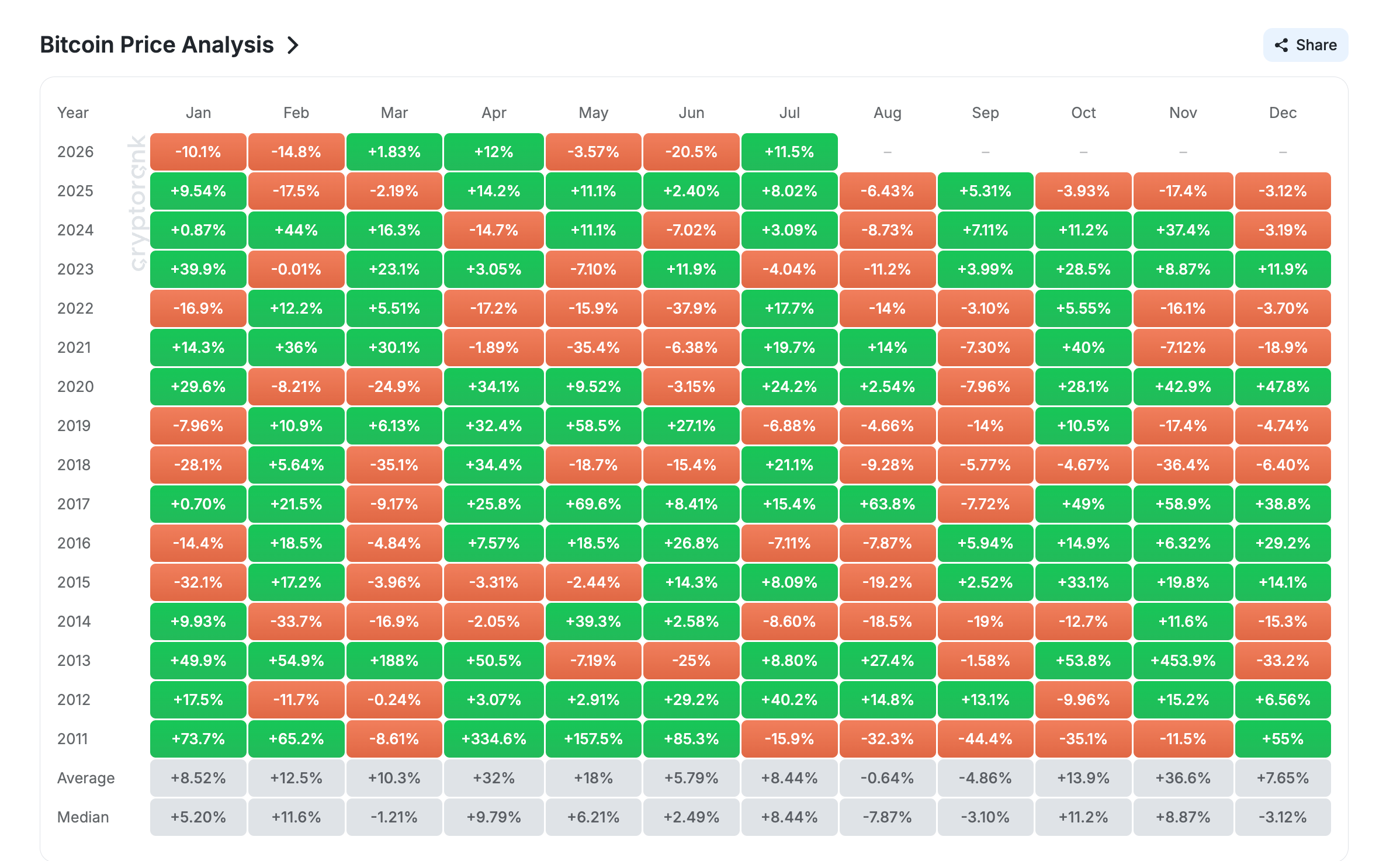
Bitcoin (BTC) price is close to ending July green for the third year running, a streak no other month can match. August now arrives with the worst seasonal record on the board.
BTC trades near $65,300 after a quiet, range-bound week. Meanwhile, three forces decide the next leg. Fading fund inflows, a split between whales and long-term holders, and a bearish chart pattern.
July’s Winning Streak Runs Into Its Weakest Month
History frames the risk first. July has closed green three years running, in 2024, 2025 and 2026 (still forming), a significantly rare pattern.
Want more token insights like this? Sign up for Editor Harsh Notariya’s Daily Crypto Newsletter here.
This July is up 11.5% even though BTC spent most of the last week stuck in a range. That gain matters because Bitcoin had ignored seasonality for most of the year. June fell 20.5% against a positive average, and June’s weak close shaped July’s Bitcoin price prediction as well.

August is where the script turns. Its -7.87% median is the weakest of any month on the table, and its -0.64% average is one of only two negative readings. August has also closed red every year since 2022.
Fund flows already echo the caution. Weekly Bitcoin ETF inflows peaked at $197.40 million in the week to July 10, then slid to $75.67 million, and finally $33.79 million by July 24.
That is a 55% drop in one week and an 83% fall from the July peak. Institutions are not selling, but US spot Bitcoin ETF demand is clearly cooling into the weakest month.

Fund desks may be stepping back. The largest on-chain wallets are doing the opposite.
Bitcoin Whales Buy While Conviction Holders Retreat
Bitcoin whales turned buyers on July 23. The number of entities holding at least 1,000 BTC rose from 1,263 to roughly 1,267 within three days.
The same setup appeared exactly a month earlier. Whale entities climbed on June 23 , all the way to mid-July, and Bitcoin gained nearlyt 4% over that stretch. The data suggests whales may be positioning for another short-term rebound.

Long-term Bitcoin holders tell a different story. The hodler net position change, a metric tracking how much supply long-term wallets add or shed each month, peaked at 42,301 BTC on May 24 with Bitcoin near $77,039.

It then fell to roughly 20,500 BTC by July 2, a drop of about 52%, while price slid to $61,486.
That pattern is repeating. The reading dropped from 29,838 BTC on July 11 to 15,766 BTC on July 26, a 47% decline, even though price held near $65,000.

Holders are still adding coins, just far more slowly. The slowdown suggests this group may be bracing for a correction, echoing what fund flows already show.
Retail offers no counterweight. A whale-retail divergence score of 4.4 on the daily timeframe reads as aligned, meaning small and large traders are moving the same way. That alignment cuts both ways, because if whales flip, retail has no reason to hold the line.

With institutions easing off and holders slowing, the chart becomes the decider.
Bitcoin Price Prediction Hinges on One Level Below $61,000
The chart backs the cautious camp. On the three-day timeframe, Bitcoin has traded inside a head and shoulders pattern since early March, a bearish formation where one high peak sits between two lower peaks.
Buying volume has fallen since June 30 even as price rose. Weak volume behind a rising right shoulder is a textbook sign of exhaustion, and it validates the pattern’s 25% breakdown risk.

Levels decide the rest. Since July 3, Bitcoin has traded between $66,885 and $60,965.
A three-day close above $66,885 would restore strength and open a path toward $76,118, keeping Bitcoin’s route back to $100,000 alive. Losing $60,965 breaks the floor and exposes the neckline near the $54,000 zone.
A neckline break could trigger the measured move toward roughly $41,266. The Bitcoin price prediction for August therefore stacks a technical breakdown on top of a median seasonal loss near 8%.

A caveat applies. Head and shoulders patterns fail often, and a slide to the $41,000 zone needs a catalyst the market does not currently have. Only a reclaim of $82,931 cancels the bearish structure outright, which looks as far-fetched as the downside target. For now, $60,965 separates a rangebound August from a slide toward $41,266.
The post Bitcoin Price Prediction for August 2026: Whales Bet Against a 4-Year Losing Streak appeared first on BeInCrypto.
On 21 July, Stats NZ reported an acceleration in inflation: the Consumer Price Index rose 1.5% in the second quarter, while the annual inflation rate climbed to 4.1%, its highest level in more than two years and slightly above analysts’ consensus forecast of 4.0%. The increase was driven primarily by higher fuel prices amid tensions in the Middle East. The data was released after the Reserve Bank of New Zealand raised the official cash rate to 2.50% on 8 July, reinforcing expectations of further monetary tightening in September. However, the impact proved short-lived, as escalating tensions between the US and Iran boosted demand for the US dollar as a safe-haven asset, causing the New Zealand dollar to surrender part of its recent gains during the second half of the week.
Technical Outlook
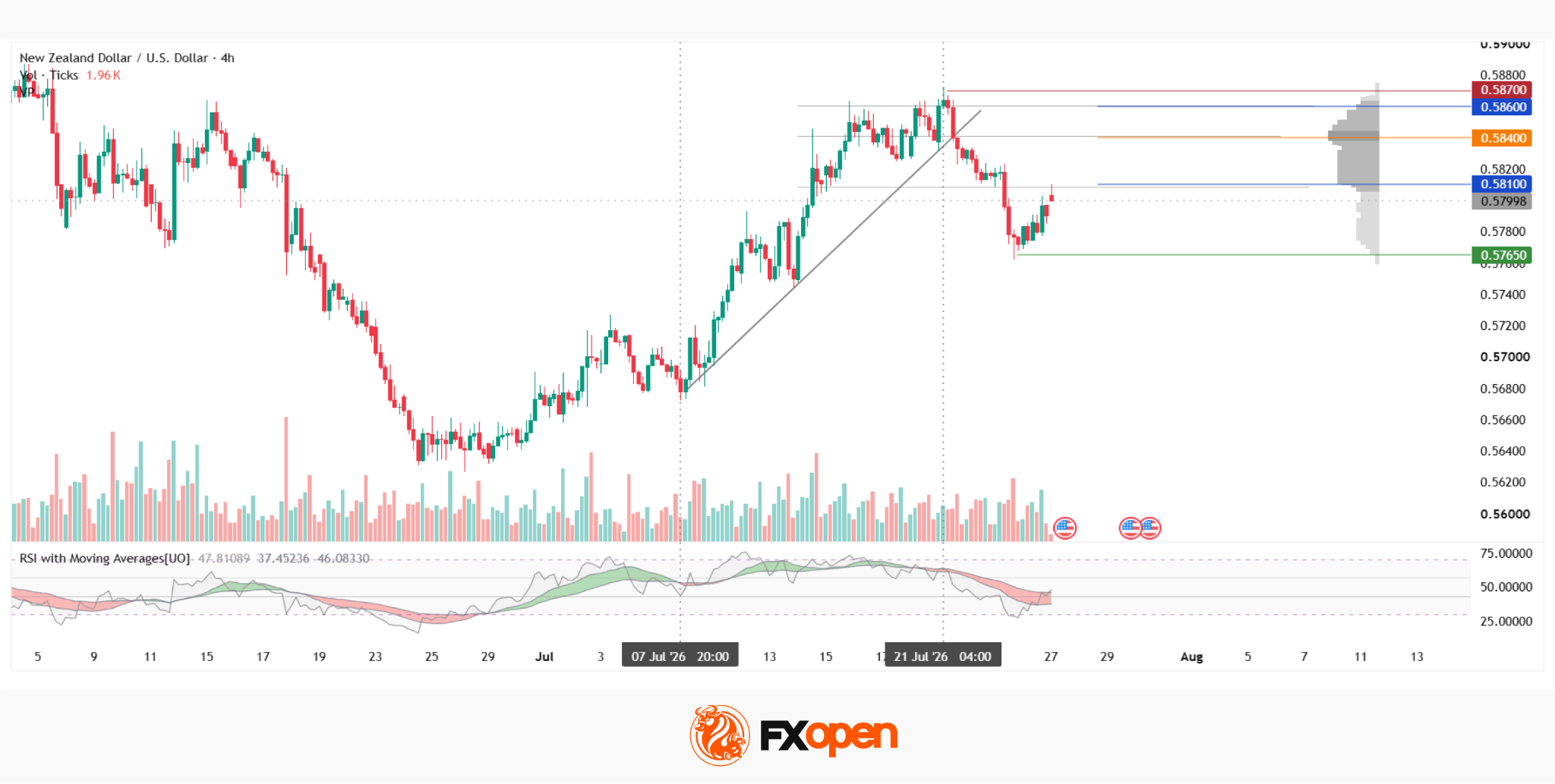
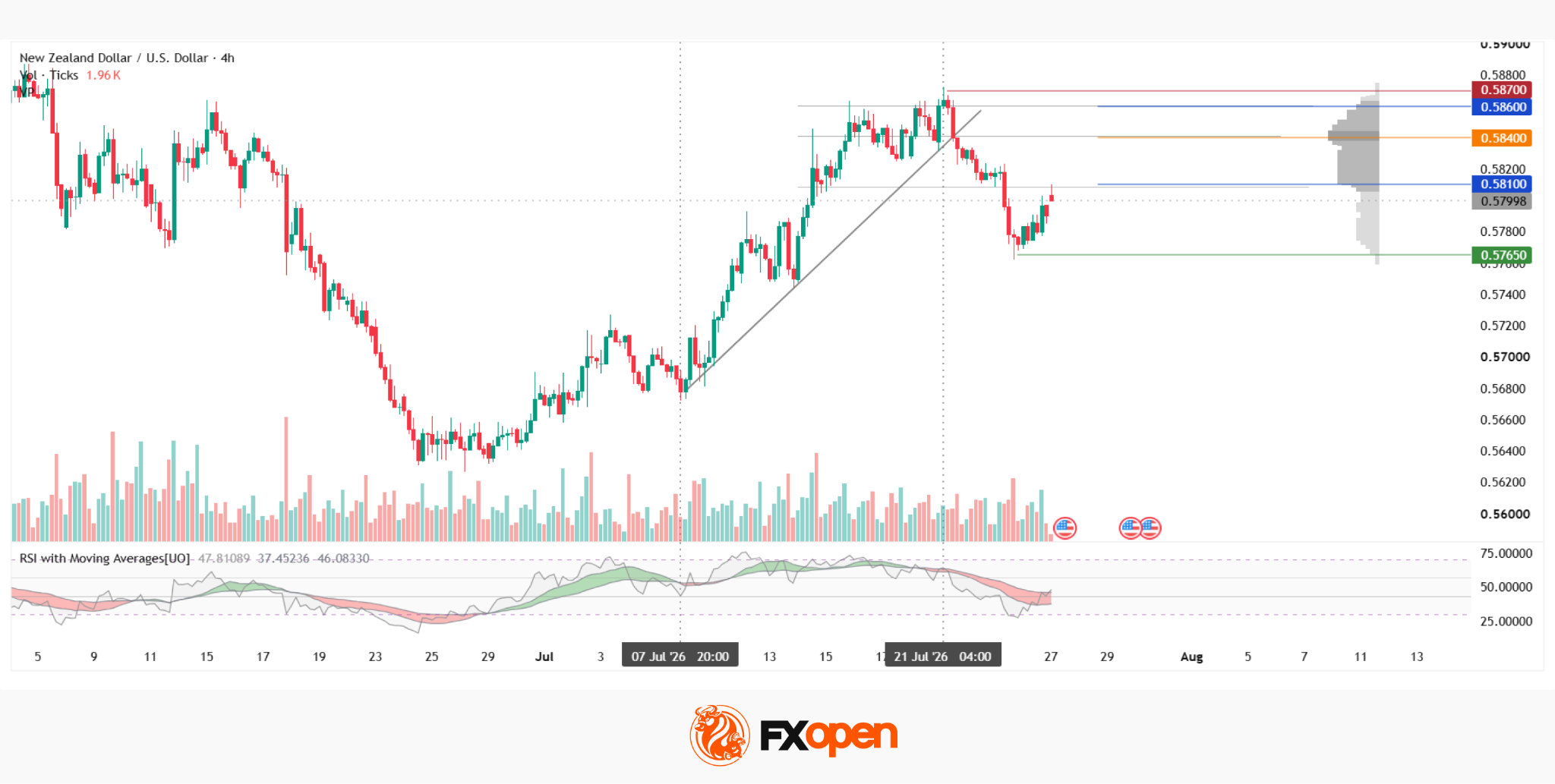
On the four-hour chart, NZD/USD has been developing a short-term uptrend since 26 June, with a trendline forming as the pair advanced towards 0.5870, where resistance emerged. The pair subsequently broke below the trendline, fell beneath the lower boundary of the current market profile and declined to the 0.5765 area, where the green support level is now located. Following a rebound from this zone, the pair moved on to test the lower boundary of the market profile at 0.5810. If this level holds and the price turns lower, the green support at 0.5765 could provide support. Should the pair continue to rise, attention may return to the POC area at 0.5840.
It is worth noting the close proximity of the upper boundary of the market profile at 0.5860 and the red resistance zone at 0.5870, making this a potentially strong resistance area. The RSI + MAs indicator currently reads 46, 37 and 46. It is also worth noting that the slower moving average has yet to leave the neutral zone, while the RSI briefly entered oversold territory before returning to neutral, casting doubt on the strength of the current breakout.
Summary
The pair’s near-term direction will likely depend on whether sellers can defend the lower boundary of the market profile. From a fundamental perspective, interest in the pair will hinge on whether the support provided by the stronger US dollar amid tensions in the Middle East proves more durable than the positive impact of New Zealand’s unexpectedly strong inflation data.
Trade over 50 forex markets 24 hours a day with FXOpen. Take advantage of low commissions, deep liquidity, and spreads from 0.0 pips (additional fees may apply). Open your FXOpen account now or learn more about trading forex with FXOpen.
This article represents the opinion of the Companies operating under the FXOpen brand only. It is not to be construed as an offer, solicitation, or recommendation with respect to products and services provided by the Companies operating under the FXOpen brand, nor is it to be considered financial advice.


The U.S. Commodity Futures Trading Commission has issued a second warning this year to prediction-market operators over broad, template-style self-certifications for event contracts.
Summary
- CFTC told prediction markets that template certifications cannot replace contract-specific terms, analysis, and compliance reviews.
- The July advisory follows a March warning as event-contract listings and trading activity continue expanding.
- Proposed rules would apply a three-step public-interest review to gaming, war, terrorism, and assassination contracts.
The agency’s Division of Market Oversight said registered exchanges must provide the terms, settlement method, data sources and compliance analysis for each contract they plan to list.
Meanwhile, the July 24 advisory does not remove the self-certification route. Designated contract markets can still list event contracts without waiting for prior Commission approval when they meet the Commodity Exchange Act and CFTC rules.
However, the agency said one filing cannot cover an open-ended set of possible contract variations without enough product-level detail.
CFTC rejects cookie-cutter event-contract filings
The CFTC said some exchanges had submitted broad certifications covering many possible versions of an event contract. Those filings did not always include the terms and conditions for each version or a short explanation of the underlying commodity and legal compliance. The agency said that approach limits staff’s ability to review settlement rules, source data and manipulation controls.
In its latest guidance, the regulator stated that “broad, template-style certifications should not be submitted.” Closely related contracts may still qualify for one class filing under specific CFTC rules. Exchanges can also request formal approval. Even then, the submission must describe the covered products clearly enough for staff to assess each proposed contract.
Second advisory follows March compliance warning
The latest notice follows a March 12 advisory issued as prediction markets expanded their sports, political, economic and current-event offerings. That earlier notice reminded exchanges that they act as front-line regulators. It also directed them to review whether contracts could be manipulated, whether settlement sources were reliable and whether product submissions met CFTC requirements.
The March guidance also addressed sports contracts, which remain at the centre of disputes between federal derivatives regulators and state gambling authorities. The CFTC says federal law gives it authority over swaps and futures listed on registered contract markets. Several states argue that some sports products operate like gambling and must follow local licensing and consumer-protection rules.
Proposed rule would create three-step review
The new certification warning arrived days before the July 27 comment deadline for the CFTC’s proposed amendments to Rule 40.11. The proposal would create a three-step process for contracts tied to activities named in the Commodity Exchange Act. Those activities include unlawful conduct, terrorism, assassination, war and gaming.
Under the proposed test, the Commission would determine whether a product is an event contract and whether its settlement depends on one of those listed activities. If both tests are met, the agency would apply public-interest factors before deciding whether to block listing or clearing. The proposal would also define “gaming,” clarify the word “involve” and structure the existing 90-day review period.
Law firm Ropes & Gray said the plan would create the most extensive federal framework for prediction markets so far if adopted. Its analysis said the proposal would review contracts case by case rather than ban complete categories in advance. It would also distinguish games from contests, placing elections and award events outside the proposed gaming definition.
Prediction-market growth raises filing pressure
The CFTC’s March rulemaking notice showed how quickly the market had changed. Registered exchanges listed an average of about five event contracts each year from 2006 through 2020. That figure rose to 131 in 2021 and reached about 1,600 new contracts during 2025. The contracts covered economics, weather, politics, science, culture, sport and international events.
More recent testimony cited by crypto.news placed 2025 trading volume across CFTC-registered prediction markets above $25 billion. It also said daily listings on one large platform rose from about 1,600 in April 2025 to roughly 162,000 in April 2026. That pace makes complete contract submissions more important because small changes in settlement terms can create different legal and market risks.
As crypto.news previously reported, the CFTC’s proposed public-interest rules could affect platforms such as Kalshi and Polymarket. The agency may examine sports products and markets tied to war, terrorism or political violence more closely.
Meanwhile, related coverage said Robinhood was discussing adding Crypto.com contracts as it builds a broader prediction-market network. The talks came as platforms added more event-contract suppliers and federal and state regulators continued to dispute who controls sports-linked products.
The July advisory does not identify any platform or announce an enforcement case. It acts as a compliance notice to all designated contract markets using self-certification. Exchanges can continue listing qualifying products, but each filing must give CFTC staff enough information to judge contract terms, settlement design, data quality and adherence to market rules.

Bitcoin remained above $64,000 during the weekend and even climbed to just over $65,000 on Monday, which crypto analyst Doctor Profit has identified as a crucial buying zone.
He outlined the most significant range, which was strengthened by the presence of the 200-week moving average (MA200) running through its lower end.
Historic Buy Zone
The crypto asset has tested this area multiple times, and previous market cycles show that buying at or near the weekly MA200 has historically been profitable.
In his latest market update, Doctor Profit said this confluence has remained the foundation of his outlook since his earlier market pivot call. Rather than trying to identify the exact market bottom, the analyst said his strategy is centered on accumulating within a defined price range.
The focus should be on establishing an average entry between $54,000 and $64,000 rather than waiting for Bitcoin to print its absolute low. He added that even if BTC were to bottom near $54,000, achieving a long-term average entry around $58,000 would still represent a “phenomenal entry.”
“People who constantly wait for the exact bottom usually end up buying much higher, or not buying at all. I am not here to gamble on one perfect number. I am here to dominate the range, build a powerful average entry and position myself before the majority realizes the bottom is already behind us. Everyone who is ignoring this will lose.”
He described the current phase as a mid-term accumulation period that could take one to two months before its results become clear.
Looking ahead, this week’s Federal Reserve policy meeting is an important macro event for financial markets. He explained that market expectations currently imply a 65% probability of interest rates remaining unchanged and a 35% chance of a rate hike, while expectations for a September hike have climbed above 80%. This indicates growing caution among investors.
Next Bounce in Focus
Crypto trader Ardi said the current rebound could determine whether the crypto asset’s recent bullish pattern remains intact. He noted that every pullback within the recent trading range has followed the same sequence – a deep retracement, a full recovery, and then a higher high. As examples, he pointed to moves from $61,400 to $65,000 before retracing to $61,700, and from $61,700 to $65,500 before pulling back to $62,400.
Despite both rallies being almost completely retraced, Bitcoin recovered each time and eventually reached $67,000 last week. According to Ardi, if BTC fails to reclaim that local peak, it would be the first real sign that the pattern is breaking and bullish momentum is being absorbed by bears.
However, if it repeats the same behavior and breaks above $67,000, the trader said the bearish signal around that level would no longer be valid. This, in turn, could open the door for a larger expansion toward the $69,000-$70,000 range.
The post Bitcoin’s 200-Week MA Is Back in Play: Why It Matters for BTC’s Price appeared first on CryptoPotato.
As BitMart moves toward a planned wind-down, customer withdrawals are becoming the market’s most immediate stress test. Blockchain analytics account Lookonchain reported that withdrawals appeared to slow significantly after the exchange announced operational restrictions tied to its closure timetable.
On Monday, Lookonchain said it observed 58 wallets withdrawing roughly $805,000 in more than 24 hours. It also claimed BitMart processed no withdrawals during the latest eight-hour window it tracked, while some users on X described delays and account warnings related to withdrawal processing.
Key takeaways
- Lookonchain reported only 58 withdrawals totaling about $805,000 over 24+ hours, with no withdrawals during an eight-hour period tracked.
- Some users on X claimed they received “completed” withdrawal emails despite on-chain withdrawal freezes or pending transactions.
- BitMart has said withdrawals remain available, but requests may face additional compliance and security reviews.
- BitMart’s wind-down includes ending trading services on Aug. 26 and ceasing operations entirely on Jan. 31, 2027.
- On-chain data cited by Arkham suggests BitMart-linked wallets held about $69 million in crypto assets on Monday, down from roughly $102 million on July 6.
Withdrawal activity under scrutiny
The clearest measurable signal so far comes from Lookonchain, which framed Monday’s results as a slowdown in outflows from BitMart. In its report on X, it did not present a verified explanation for the pause, but the figures—58 withdrawing wallets totaling approximately $805,000 over 24 hours—highlight a stark contrast to the normal behavior many exchanges see during stable operating periods.
Lookonchain also added that BitMart did not process any withdrawals during the final eight hours of its tracking window. If the pattern holds, it would suggest that either fewer customers are attempting withdrawals or that outgoing transfers are being held back by internal checks.
That uncertainty is compounded by user reports. Two X posts described issues that could align with additional screening or operational constraints. One user said an email indicated a USDT withdrawal had been completed even though they claimed no transaction had appeared and their account displayed an “on-chain withdrawal freeze.” Another user said a $30 test withdrawal remained pending for more than 30 minutes.
These individual accounts have not been independently verified, but they are consistent with the kind of operational friction customers often expect when an exchange is preparing to wind down—particularly when withdrawals are still enabled but processing may be gated.
BitMart’s “orderly” wind-down and what it means for customers
BitMart has previously stated that withdrawals will remain available, while warning that requests may face additional compliance and security checks. According to the exchange’s published notice regarding the orderly cessation of operations, these reviews can include examinations of customer identities, login devices, withdrawal addresses, trading histories, and sources of funds.
The notice also indicates the exchange may request proof of identity, address, source of funds, or ownership of the receiving wallet. For customers, this matters because even when withdrawals are technically possible, the timing can vary depending on whether an account or transaction triggers enhanced verification.
In that context, the key question for users is not only whether withdrawals are enabled, but whether the promised “orderly” wind-down translates into predictable processing for the remaining volume. If withdrawal handling stays consistent, the episode could remain contained. If delays broaden—or appear uneven across customers—it could intensify confidence concerns.
Cointelegraph attempted to contact BitMart for comment, but did not receive a response before publication.
Trading shutdown dates and the broader market backdrop
BitMart’s wind-down plan has already been laid out. Earlier, the exchange announced it would stop accepting new registrations and deposits and would restrict new spot orders and futures positions. Trading services are scheduled to end on Aug. 26, with the platform expected to cease operations entirely on Jan. 31, 2027.
As that timeline approaches, analysts and investors typically watch for two related indicators: whether customer funds can exit efficiently, and whether the exchange’s remaining token ecosystem reflects mounting pressure.
Arkham-identified wallets attributed to BitMart held about $69 million in crypto assets on Monday, down from roughly $102 million on July 6, according to the entity’s on-chain listing. While this does not, by itself, prove the pace of customer withdrawals, it provides a snapshot of the scale of assets tied to BitMart-linked addresses as the wind-down progresses.
Meanwhile, BitMart’s BMX token continued to struggle. CoinGecko data cited in the underlying reporting put BMX near $0.057 on Monday, after falling about 81.5% over seven days. The token was trading around $0.31 late Friday before the exchange’s shutdown became widely public.
The decline has also kept an eye on a separate but related issue: whether stronger exchanges might absorb smaller competitors during closures. Binance co-founder Changpeng Zhao previously commented that acquiring a centralized exchange can be more complicated than purchasing other types of businesses, because buyers could inherit security vulnerabilities left behind by previous teams, including potential backdoors. He said acquisitions remain possible but require greater scrutiny.
What to watch next for BitMart customers
For customers and observers, the next datapoints to track are straightforward: whether Lookonchain continues to show a near-total slowdown in withdrawals, whether pending and “freeze” reports on X persist across more accounts, and whether BitMart’s compliance checks translate into consistent processing times for approved requests. As trading winds down ahead of Aug. 26 and the cessation date approaches in 2027, withdrawal reliability will likely remain the single most important signal of whether confidence erosion stays contained or escalates into a broader exit narrative.
Crypto World
KB Kookmin Bank taps Kinexys. Why is the partnership significant for blockchain payments?


KB Kookmin Bank has expanded its blockchain strategy by preparing to launch a Kinexys-powered cross-border corporate payment service next month, becoming the first South Korean bank to use J.P. Morgan’s blockchain payment network for trade settlements.
Summary
- KB Kookmin Bank plans to launch South Korea’s first Kinexys powered blockchain payment service for corporate trade settlements next month.
- The service will initially support U.S. dollar cross border transfers across 10 countries through the bank’s Korean and Singapore branches.
- The launch builds on KB Kookmin Bank’s recent blockchain initiatives, including a $100 million digital bond issuance and a stablecoin payment card project with Avalanche.
- Kinexys by J.P. Morgan provides programmable payments and near real time settlement for institutional clients using blockchain technology.
South Korea’s Yonhap News Agency reported that KB Kookmin Bank plans to introduce the service through a partnership with Kinexys by J.P. Morgan, with the rollout scheduled for next month.
According to the report, the bank will become the country’s first financial institution to adopt the blockchain payment network for corporate import and export settlements.
KB Kookmin Bank brings Kinexys to corporate payments
The upcoming service will be offered through KB Kookmin Bank’s domestic operations in South Korea as well as its Singapore branch, according to Yonhap. At launch, the bank plans to prioritize U.S. dollar transfers involving 10 countries: South Korea, the United States, Singapore, Saudi Arabia, India, Thailand, Qatar, the United Arab Emirates, Bahrain and South Africa.
Kinexys is J.P. Morgan’s blockchain business that provides programmable payments, asset tokenization and near-real-time settlement for institutional clients. By connecting to the network, corporate customers will be able to process cross-border trade payments through blockchain infrastructure instead of relying entirely on conventional settlement systems.
The report did not disclose transaction limits or the categories of businesses that will receive access during the initial phase. It also did not specify whether additional currencies or countries will be added after the first rollout.
For KB Kookmin Bank, the planned launch adds another production deployment to a blockchain strategy that has gradually expanded across payments, fundraising and digital financial infrastructure rather than remaining limited to pilot programs.
Earlier blockchain projects have covered fundraising
The latest payment initiative follows another blockchain milestone completed by the bank earlier this year.
In June, KB Kookmin Bank completed a $100 million blockchain-based digital bond issuance, becoming the first South Korean bank to raise foreign-currency funding through distributed ledger technology, according to previous local media reports.
The two-year U.S. dollar-denominated bond was privately placed in Hong Kong and priced at the Secured Overnight Financing Rate, or SOFR, plus 0.4 percentage points. HSBC served as the sole bookrunner, while the issuance was carried out on Orion, the bank’s digital asset platform.
According to the bank, blockchain technology supported the entire bond lifecycle, including issuance, registration, trading and settlement. The new structure shortened settlement from five business days under conventional processes to three business days. A bank official told local media at the time that the approach simplified operational procedures while reducing settlement default risk.
The lender described the transaction as a practical application of blockchain technology for capital raising instead of a proof-of-concept exercise, placing it among the first production-grade blockchain fundraising deals completed by a South Korean commercial bank.
Blockchain development within KB Financial Group has also extended into consumer payments.
Earlier this year, KB Kookmin Card announced that it was working with Avalanche and OpenAsset to build a hybrid stablecoin credit card system. According to local outlet JoongAng Economy, cited previously by multiple industry publications, the design allows users to connect a blockchain stablecoin wallet to an existing credit card.
Under the patented payment structure, purchases are first deducted from the customer’s stablecoin wallet. If the available balance is insufficient, the remaining amount is automatically charged to the linked credit card while merchants continue receiving settlement through existing payment infrastructure.
Avalanche is expected to manage the blockchain portion of the system, including stablecoin issuance, wallet transfers and on-chain settlement, while KB Kookmin’s traditional card network continues handling authorization, clearing and merchant payouts.
According to earlier statements from the bank, customers will continue receiving existing card benefits and reward programs despite the addition of blockchain payment functionality.
South Korea’s banking sector has increased blockchain adoption
The latest Kinexys partnership also arrives as more South Korean financial institutions experiment with blockchain infrastructure under regulated frameworks.
Government-backed initiatives have already included KB Kookmin Bank among participating institutions. Earlier this year, South Korea’s Ministry of Economy and Finance selected a regulatory sandbox project that will use tokenized bank deposits for public-sector spending, with implementation planned for the fourth quarter of 2026.
Nine banks, including KB Kookmin, Shinhan, Woori and Hana, are participating in that program. According to the ministry, the system will connect the government’s Digital Budget and Accounting System with a distributed ledger network, allowing spending conditions to be programmed in advance while creating an auditable record of public fund usage.


In crypto, security is not only about protecting assets — it is about taking responsibility for users.
As a crypto exchange with 8 years of secure operations, WEEX believes that an exchange’s responsibility goes beyond providing a trading platform. It means standing with users, building transparent security systems, and creating safeguards that provide support when users need it most.
That is why WEEX established the 1,000 BTC Protection Fund — a dedicated safety mechanism designed to provide potential compensation support for certain eligible losses resulting from qualified security incidents beyond the user’s reasonable control. Because user trust is not built by promises alone. It is built by actions.
1,000 BTC Protection Fund: A Commitment to User Protection
The WEEX 1,000 BTC Protection Fund represents WEEX’s long-term commitment to protecting user assets.
The fund is:
- Fully backed by WEEX
- Strictly separated from operational funds
- Publicly verifiable through blockchain records
Unlike ordinary security measures that focus only on preventing risks, a protection fund provides an additional layer of support when unexpected situations occur.
For WEEX, protecting users means being prepared before problems happen. It means taking responsibility and ensuring that users have a dedicated safety net when eligible security incidents occur.
WEEX stands with users when protection matters most.
Proof of Reserves: Transparency Users Can Verify
Security starts with transparency.
WEEX maintains a Proof of Reserves system covering major assets, allowing users and third parties to independently verify reserve information through publicly available blockchain data.
At the time of writing, published reserve ratios include:
- USDT: approximately 102%
- ETH: approximately 115%
- BTC: approximately 122%
A reserve ratio above 100% in a specific published snapshot indicates that, at that time, on-chain assets exceeded corresponding user liabilities for those assets. By making reserves publicly verifiable, WEEX gives users greater confidence that their assets are backed by real, on-chain evidence.
Trust should not depend on words. It should be something users can verify.
Multi-Layer Security Protecting Every Transaction
Beyond asset transparency and protection mechanisms, WEEX applies multiple layers of security across platform infrastructure and user accounts. WEEX states that the majority of client assets are held in multi-signature cold wallets, with allocation subject to operational and security requirements.
At the account level, WEEX provides:
- Two-factor authentication
- Withdrawal-specific passwords
- Email and SMS verification
- Wallet address whitelisting
These protections work together to give users stronger control over their assets.
Security Is a Long-Term Commitment
The crypto industry continues to evolve, and security remains the foundation of user trust.
At WEEX, security is not treated as a single feature. It is a continuous commitment built into every part of our platform. From the 1,000 BTC Protection Fund to Proof of Reserves and multi-layer security systems, every measure serves one goal: To protect users and build confidence through transparency, responsibility, and action.
Because true security is not only about preventing risks. It is about standing with users when it matters most.
WEEX — Security you can verify. Protection you can rely on.
Disclaimer: Cryptocurrency trading involves significant risk, including possible loss of principal. Any compensation or support referenced herein is subject to eligibility criteria, jurisdictional availability, policy terms, and case-by-case review; it does not constitute a guarantee of recovery in all situations. Losses caused by market volatility, user credential compromise, phishing, device/account mismanagement, or other user-side factors may not be covered. Proof of Reserves and Protection Fund data are point-in-time and may change; please refer to WEEX official channels for the most current information. This content is for informational purposes only and does not constitute financial, legal, or investment advice.
About WEEX
Founded in 2018, WEEX has developed into a global crypto exchange with over 6.2 million users across more than 150 countries. The platform emphasizes security, liquidity, and usability, providing over 1,200 spot trading pairs and offering up to 400x leverage in crypto futures trading. In addition to the traditional spot and derivatives markets, WEEX is expanding rapidly in the AI era delivering real time AI news, empowering users with AI trading tools, and exploring innovative trade to earn models that make intelligent trading more accessible to everyone. Its 1,000 BTC Protection Fund further strengthens asset safety and transparency, while features such as copy trading and advanced trading tools allow users to follow professional traders and experience a more efficient, intelligent trading journey.
Follow WEEX on social media
X | Instagram | Tiktok | Youtube | Discord | Telegram
The post When Security Is Tested, True Responsibility Matters: Why WEEX Puts Users First appeared first on BeInCrypto.
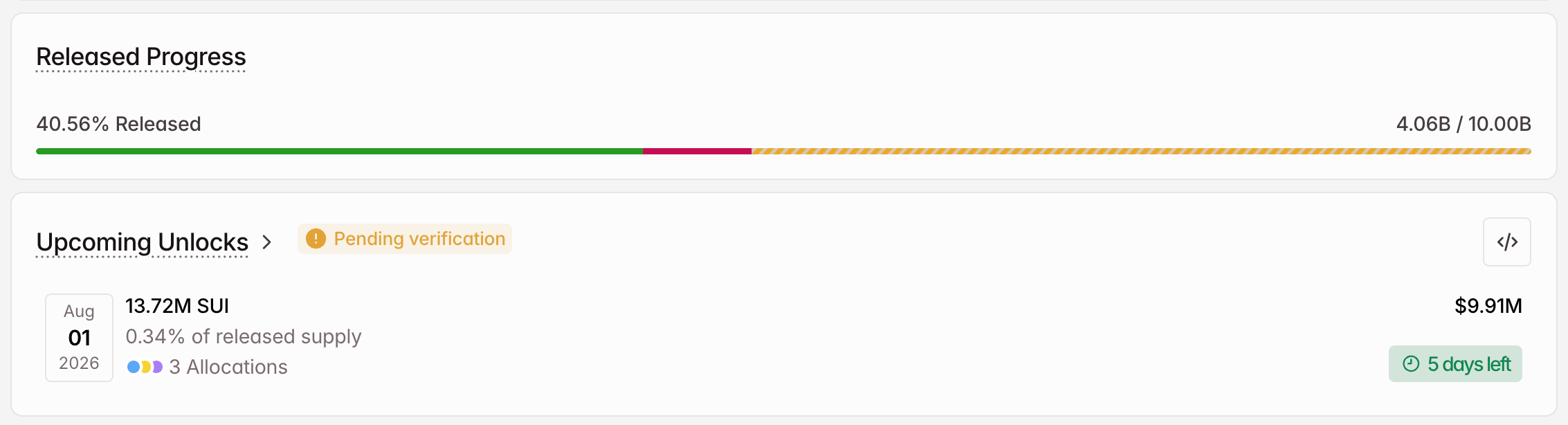
The crypto market will welcome tokens worth more than $636.4 million this week. Major projects, including Sui (SUI), EigenCloud (EIGEN), and Kamino (KMNO), will release significant new token supplies.
These unlocks could introduce market volatility and influence short-term price movements. So, here’s a breakdown of what to watch.
1. Sui (SUI)
- Unlock Date: August 1
- Number of Tokens to be Unlocked: 13.72 million SUI
- Released Supply: 4.06 billion SUI
- Total supply: 10 billion SUI
Sui is a high-performance blockchain designed to provide scalability, low latency, and an architecture for decentralized applications (dApps). It also distinguishes itself with an object-centric data model and the Move programming language, which seeks to address inefficiencies in existing blockchain architectures.
On August 1, the network will release 13.72 million SUI into the market, continuing its trend of cliff unlocks at the beginning of the month. The tokens are worth $9.91 million and represent 0.34% of the current released supply.

The network will split the unlocked altcoins 3 ways. Early Contributors will gain 7.65 million tokens. In addition, Community Reserve will receive 4 million tokens. Lastly, Mysten Labs Treasury will get 2.07 million SUI.
2. EigenCloud (EIGEN)
- Unlock Date: August 1
- Number of Tokens to be Unlocked: 36.82 million EIGEN
- Released Supply: 635.67 million EIGEN
- Total Supply: 1.67 billion EIGEN (Y2035)
EigenCloud (formerly EigenLayer) is a verifiable cloud platform built on the EigenLayer protocol. It provides developers with a unified infrastructure for creating trustless, verifiable Web3 applications and services.
On August 1, the network will unlock 36.82 million EIGEN tokens, valued at approximately $7.63 million. The unlocked tokens represent 5.79% of the released supply.

EigenCloud will direct 19.75 million tokens towards investors. Moreover, early contributors will get 17.07 million EIGEN.
3. Kamino (KMNO)
- Unlock Date: July 30
- Number of Tokens to be Unlocked: 229.17 million KMNO
- Released Supply: 7.71 billion KMNO
- Total supply: 10 billion KMNO
Kamino Finance is a decentralized finance (DeFi) protocol on the Solana (SOL) blockchain that specializes in borrowing, lending, and liquidity provision.
On July 30, Kamino will unlock 229.17 million KMNO tokens. The tokens are valued at approximately $4.14 million and represent 2.97% of the released supply.

The team will distribute most of the unlocked tokens, 145.83 million KMNO, to key stakeholders and advisors. Additionally, Kamino will award 83.33 to core contributors.
In addition to these, other prominent unlocks that investors can look out for this week include Falcon Finance (FF), Plasma (XPL), Sign (SIGN), and more.
The post 3 Token Unlocks to Watch in This Week appeared first on BeInCrypto.

The Next Solar Eclipse Will Deliver a Rare Sight: Totality at Sunset

Money Hack!

Call for review into Chinook crash involving Major Hornby from Bolton


-

 Fashion3 days ago
Weekend Open Thread: Brooks Brothers
-

 Crypto World6 days ago
Grayscale Files For Worldcoin ETF, WLD Registers Sharp Rise
-

 NewsBeat6 days ago
How a former Blue Peter presenter stunned America’s Got Talent judges
-

 Tech6 days ago
Sail Virtually Aboard The “Itanic” With IA-64 Emulator
-
 Tech6 days ago
Turtle Beach Command Series KB7 review: a nifty screen-equipped gaming keyboard
-

 NewsBeat7 days ago
Unregistered fitter used Gas Safe logo on business flyers
-

 Tech8 hours ago
Intel is reversing course and bringing hyper-threading back to its server chips
-
 Business5 days ago
New Jersey voter registration controversy explained: How 6,600 noncitizens got on the rolls, and what happens next
-
 Entertainment6 days ago
Johnny Depp’s R-Rated Gothic Cult Classic Gets New Release Ahead of Sydney Sweeney Remake
-

 Tech7 days ago
Watch Flock Safety CEO Garrett Langley discuss the future of surveillance at TechCrunch Disrupt 2026
-

 Crypto World4 days ago
Ethics, other provisions in crypto Clarity Act to be further discussed
-
 NewsBeat6 days ago
Shanghai science forum photos show China’s AI and robotics advances in rivalry with US
-

 Crypto World7 days ago
Circle’s President Sold Over 360,000 Shares, The Filings Explain Why
-
 Sports12 hours ago
Commonwealth Games boxing: Jadumani Singh seals dominant 5-0 win over Pakistan’s Sumama Rehman to enter quarter-finals | Commonwealth Games News
-

 News Videos4 days ago
The Peugeot Family: How 200 Years of an “Old Money” Dynasty Died in A Boardroom
-

 Sports3 days ago
2026 3M Open leaderboard: Scottie Scheffler finds putter in Round 1, sits three back
-

 Politics20 hours ago
Spain sweeps the board at 2026 World Cup with individual awards
-

 Fashion3 days ago
16 Dresses for the High Summer Event
-

 Crypto World6 days ago
Andrew Cuomo joins OKX board as crypto exchange expands in U.S.
-

 Tech7 days ago
The 35 Best Board Games for Family Game Night
You must be logged in to post a comment Login