

Crypto World
Axis Robotics Raised $12M Funding to Build the Compounding Data Engine Accelerating Physical AI

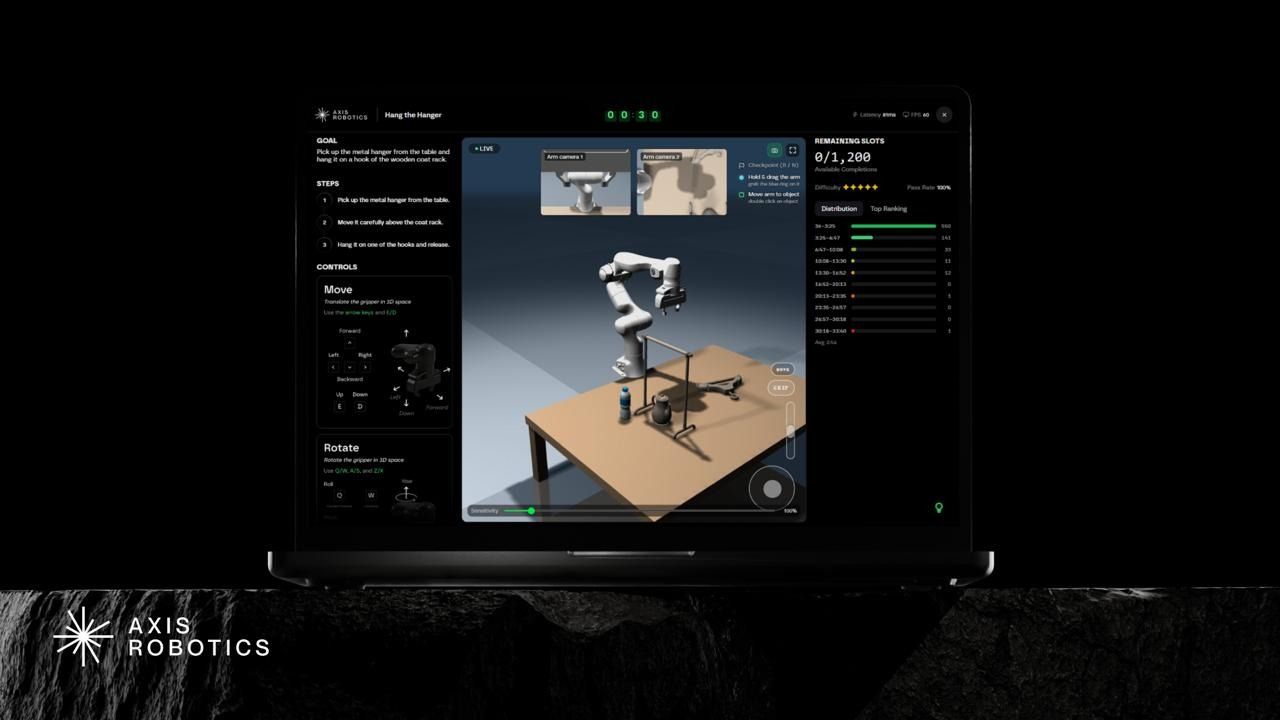
Axis Robotics, the compounding data engine accelerating Physical AI, announces that it has raised $12 million in a seed round led by Hack VC, with participation from Nomad Capital, Pi Network Ventures, 10K Ventures, and various angel investors.
The funding will accelerate Axis’s mission to build a massively parallel, human-in-the-loop global data engine, solving physical AI’s biggest pain point: the scalable generation of structured, highly diverse robotic training data.
Solving the Data Bottleneck in Physical AI
While Large Language Models scale on trillions of tokens of pre-existing internet data, Physical AI faces three important barriers: severe data scarcity, generalization gap, and embodiment fragmentation across different robot hardware.
“Physical AI demands billions of human-physical interaction motion trajectories,” said Chris, Founder of Axis Robotics. “For years the industry lacked an efficient, infinitely scalable hybrid data production system which can help models iterate effortlessly – and that’s exactly what we built with Axis, a compounding data engine.”
How does Axis Empower General Robotics Intelligence
Axis’s proprietary Compounding Data Engine delivers an end-to-end workflow integrating task generation, data capture, continuous model training, and optimization:
Task Gen Engine: Generates exponentially diverse atomic robotic tasks via randomization across objects, spatial layouts, visuals, robot embodiments and semantics, embedding diversity into every single data trajectory;
Browser-Based Sim Teleoperation Platform: The world’s first web-based interface that empowers anyone to generate high-quality robotic motion trajectories remotely. Axis delivers 10x higher throughput than lab-based collection and seamlessly integrates human-gated DAgger (Dataset Aggregation) intervention loops to continuously refine and correct robot policies;

Ego Data Mobile Capture App: Shifts real-world data capture from expensive, hardware-heavy setups to a zero-barrier mobile application. By pairing state-of-the-art (SOTA) real-time hand pose tracking with global workforce, Axis translates human vision and dexterity into robotic motion at global scale;
Data Processing Pipeline: Automates trajectory cleaning, domain randomization and dense language annotation, outputting model-ready multimodal datasets with over 10x improved data quality.
The unified architecture creates a self-reinforcing flywheel: failed robot trajectories from real/sim deployment trigger human corrective intervention, which feeds back into training to expand edge-case coverage, creating compounding intelligence as data volume grows.

Axis’s Structural Moats: A Vertically Integrated Diversity Engine & Global Contributor Network
Axis’s core edge is its unified platform that spans the entire lifecycle of Physical AI. Unlike traditional fragmented approaches, Axis has built a vertically integrated engine that unites large-scale distributed pre-training data collection and real-time human-gated Dataset Aggregation post-training.
Native-built for data diversity, Axis’s proprietary Task Generation Engine randomizes object layouts, lighting, camera poses, physical properties and robot morphologies, creating endless unique scenes and manipulation tasks, outputting generalization-ready training data.
To deliver foundation-model scale diversified data, Axis has established a global robotic data infrastructure with over 100,000 active contributors who submit an average of 3 to 4 times daily, which maximizes both production efficiency and diversity coverage. Today, Axis can generate over 1,200 hours of simulation data and 20,000+ hours of real-world ego-centric data across diverse scenarios every month.
Axis recently launched Sim Dataset V1, with benchmark results showing that engineered diversity delivers measurable performance gains. On LIBERO-Plus, pretraining π0.5 on Axis’s fully diversified dataset improved overall success by 4.9 points, outperforming a volume-matched RoboCasa365 baseline by 31.3 points, with gains in layout generalization, sensor-noise resilience, and robot-pose robustness. This gap demonstrates that Axis’s edge comes from its proprietary diversity pipeline—not simply larger data scale.

Commercialization and Strategic Partnerships
Axis Robotics is rapidly commercializing its high-quality training data for real-world deployment. The company delivers customized “Task Packages” tailored to the specific needs of robotics hardware manufacturers, physical AI model companies, and industrial automation leaders.
Initial commercial partnerships have already been established with companies including Booster Robotics, Manycore Tech, Feagine Robotics, Dexmal, Lotus Car, Geely Auto, SomaStacks and more. These collaborations highlight the immediate market demand for scalable, high-fidelity robotic training data.
Redefine General Physical Intelligence
“The future of Physical AI hinges on deep symbiosis between models and data,” said Chris. “Static datasets cannot power general robotic intelligence. The winning solution is a compounding data engine: a vertically integrated system linking a global contributor network with constant model iteration. Every diverse trajectory and human correction fuels faster model improvement, forming a self-reinforcing intelligence flywheel.”
The company is driven by a world-class team combining top AI and robotics researchers from elite institutions such as UC Berkeley, Carnegie Mellon University, Georgia Tech, NTU and SJTU, alongside growth hackers who have previously scaled consumer products to over 30 million global users.
With this $12 million funding round led by Hack VC, Axis Robotics will further expand its procedural generation capabilities, scale its distributed network of contributors, and solidify its position as the critical data engine powering the future of Physical AI.
Linktree | Twitter | Doc | Product
The post Axis Robotics Raised $12M Funding to Build the Compounding Data Engine Accelerating Physical AI appeared first on BeInCrypto.

Many of the leading cryptocurrencies, including Bitcoin (BTC), Ripple (XRP), and Solana (SOL), have posted minor gains over the past 24 hours. However, PUMP (the native token of Pump.fun) has outperformed them and all top 100 digital assets after surging by almost 20% to reach an 11-week high of roughly $0.00215.
Crypto X members noticed certain ecosystem advancements that have perhaps positively impacted the valuation, while some believe the rally might be just starting.
Pump.fun Beats Hyperliquid
Several hours ago, an X account associated with Pump.fun revealed that the meme coin launchpad has generated a 7-day revenue of almost $7.5 million, surpassing the popular decentralized exchange Hyperliquid, which recorded $7.31 million in the same period.
The development has drawn reactions from both critics and proponents of PUMP. X user LB argued that flipping Hyperliquid in the middle of a bear market is “the funniest” thing, questioning what would happen in the next bull run.
“Pump revenue figures are going to get stupid. I predict we will see a period where PUMP does $250M a month in revenue. $4.1M in buybacks a day. ATH matter of when not if. The only thing you need to worry about as a pump holder is not selling too early,” they added.
Pentosh1 also chipped in, stating “the math is mathing” for the token. They believe the potential growth of on-chain activity should be a huge beneficiary for the price, claiming PUMP is “here to stay.”
“And I say this as someone who has been a PUMP hater,” the analyst clarified.
After the latest price increase, many think the token is poised for much more substantial gains. X user Aman claimed that PUMP is testing a major descending resistance that has rejected the price twice before. They believe that a daily close above $0.00205 could open the door for “a strong breakout move.”
“Bulls are one breakout away from changing the entire structure,” the X user suggested.
For their part, Nehal opined that PUMP is pulling back into a key demand zone after reclaiming structure. In their view, the price may soar by over 80% from here on if bulls defend this area.
Knock Down or Knock Out for the Bears?
It is worth noting that the cryptocurrency market remains stuck in a persistent bear market, and any sudden price increases like PUMP’s could turn out to be short-lived and followed by a pullback.
In fact, something similar happened at the start of last week when the token’s valuation posted a 20% daily jump only to head south in the coming days.
PUMP’s Relative Strength Index (RSI) should serve as another warning. The ratio of the technical analysis tool has risen above 80, signaling that the token has entered overbought territory, which is typically a precursor to a correction. In contrast, anything below 30 is considered a buying opportunity.

- PUMP RSI, Source: TradingView
The post PUMP Hits an 11-Week High: Momentum Building or Pullback Ahead? appeared first on CryptoPotato.


American sports company Fanatics is making a major move into prediction markets, a corner of finance that has exploded in popularity over the past year as traders wager on everything from elections to inflation and sports.
On Monday, the sports merchandiser announced that it has agreed to acquire Water Street Labs and CX Clearinghouse from BGC Group, giving Fanatics ownership of a federally regulated exchange and clearinghouse which allows it to launch and settle its own prediction market contracts. Financial terms were not disclosed.
Through the acquisition, Fanatics will be able to list and clear contracts itself, giving it more control over the products it offers and how quickly it can bring new markets online. Fanatics and BGC also plan to develop new market data products that combine prediction market activity with traditional financial data, the companies said.
Prediction markets have become one of the fastest-growing areas of finance with much of that growth being fueled by CFTC-regulated exchange Kalshi and powerhouse Polymarket, which runs its operations on a blockchain.
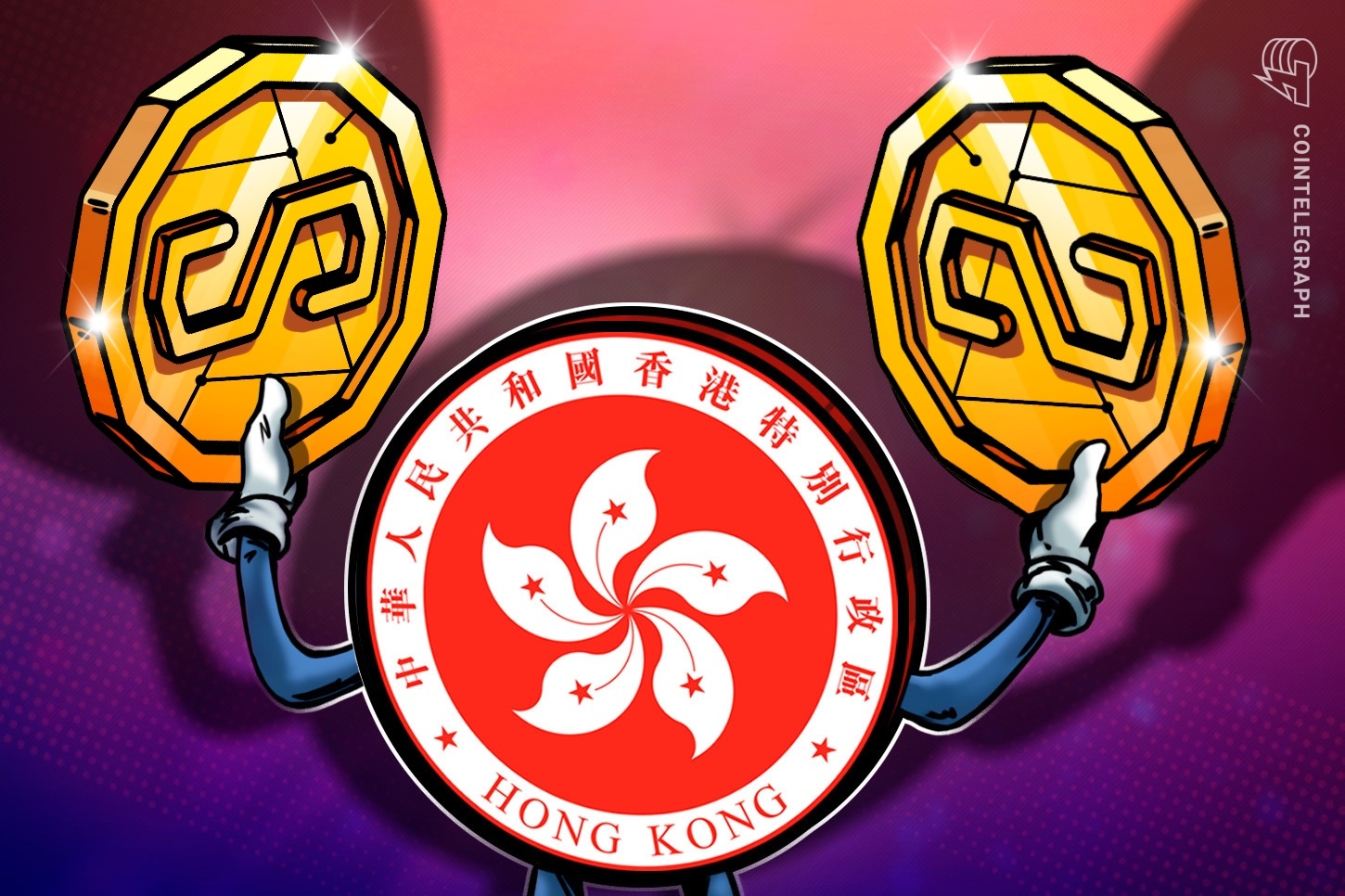
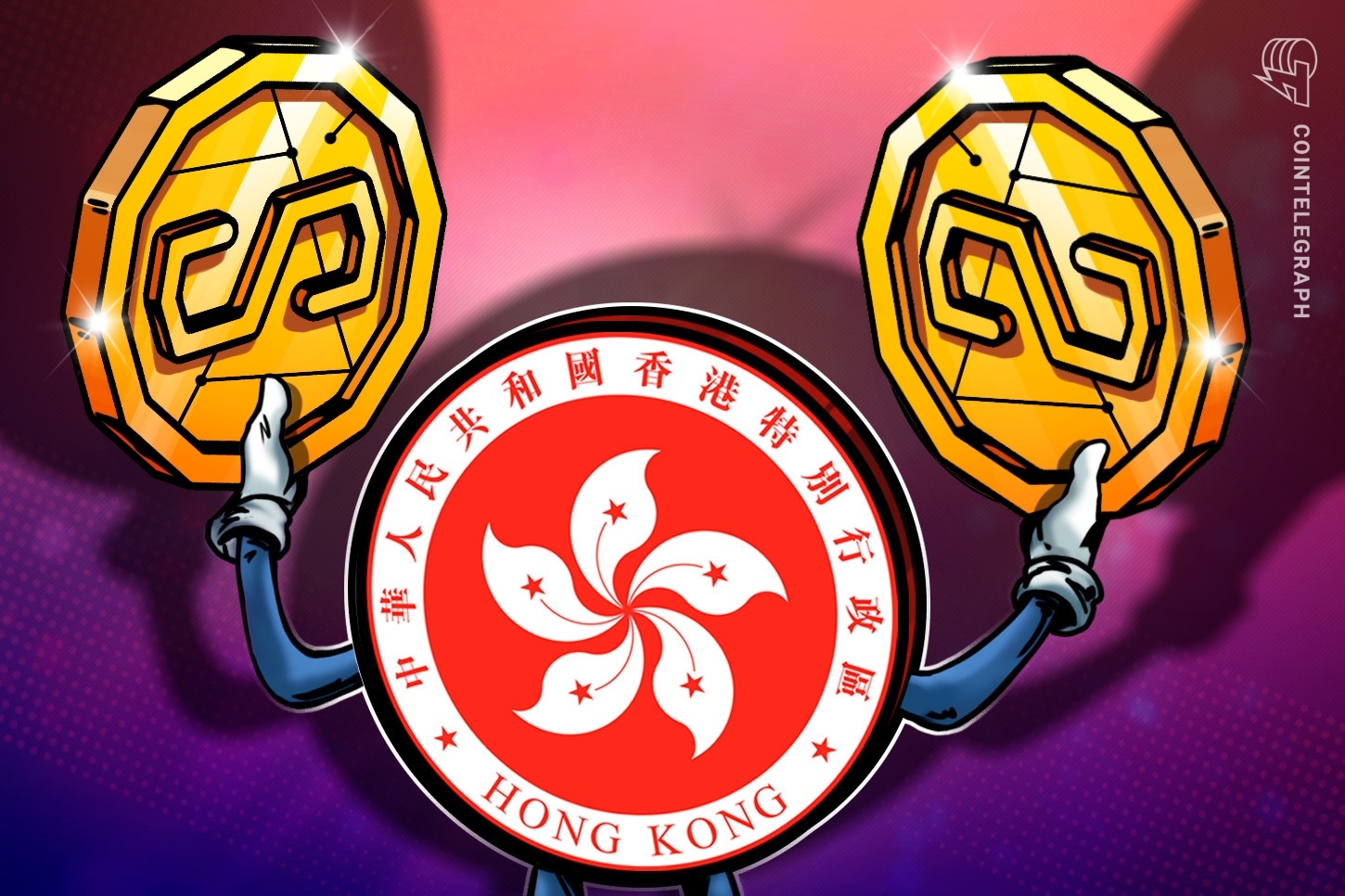
Hong Kong’s HashKey will unify its crypto exchange branches, with users from its Hong Kong, Global, Singapore and Middle East regions using the same platform.
Hong Kong digital asset services business HashKey Holdings has merged its HashKey Exchange and HashKey Global exchanges into a single platform and application.
Core jurisdictional hubs including Hong Kong, Singapore, the Middle East (Dubai) and Bermuda have been merged under a single platform, according to a Monday announcement. The move represents a departure from the early stages of the virtual asset industry when licensed exchanges typically operated under regional siloed models to simplify compliance. HashKey said.
The transition follows a principle of “unified entry, localized compliance” where all users download the same application while the platform manages compliance across their specific legislative domain — across the Hong Kong, Global, Singapore, or Middle East regions.
This results in a single front-end that simplifies access to systems that are promised to remain compliant with local regulatory frameworks thanks to localized management.
Other platforms, including OKX, present their website and mobile apps as one platform, while its terms assign customers to different providers according to residence. On the legal backend, that same platform is based on separate entities for Singapore, Dubai, Australia, the EEA, Brazil and the United States.
Kraken similarly consolidated Dutch broker BCM into its platform after acquiring it in September 2024. In August, Kraken began serving its European Economic Area through its Irish MiCA entity under a similar unified regulatory framework.
BitMine Immersion Technologies expanded its Ethereum treasury and accelerated its share buybacks last week, while BMNR stock jumped nearly 11% on Monday as ETH reclaimed $1,900.
Summary
- BitMine acquired 9,946 ETH, raising its total holdings to 5.79 million ETH.
- The company now controls 4.8% of Ethereum’s total supply, nearing its 5% threshold.
- BitMine repurchased 6.1 million BMNR shares, bringing total buybacks to 11.6 million.
- BMNR gained 10.89% to $17.51, but still faces resistance near its 100-day average.
BitMine adds 9,946 ETH to its treasury
BitMine disclosed Monday that it purchased 9,946 ETH during the previous week, extending a weekly buying streak that began at the start of 2026.
The latest acquisition increased the company’s holdings to 5,787,414 ETH, equivalent to approximately 4.8% of Ethereum’s total supply. That puts BitMine close to its stated goal of owning 5% of all ETH in circulation.
The purchase also marked an increase from the prior week, when the company acquired 7,430 ETH. BitMine’s latest addition came as Ethereum recovered above $1,900 and reached its highest price in ten weeks.
Most of the company’s ETH is generating staking rewards. BitMine has staked 4,917,189 ETH, worth around $9.6 billion and representing about 85% of its total Ethereum holdings.
Staking allows BitMine to earn network rewards on its treasury assets, although the strategy also leaves its valuation heavily exposed to changes in the ETH price.
Share repurchases rise as ETH/BTC ratio strengthens
BitMine also bought back 6.1 million of its own shares last week, up from the 5.5 million shares repurchased during the previous week.
The latest transaction brought cumulative purchases under its $4 billion repurchase program to 11.6 million shares. Chairman Tom Lee linked the larger buyback to the recent improvement in the ETH-to-Bitcoin ratio, which measures Ethereum’s relative performance against BTC.
“In fact, this ratio is now at a 3-month high at 0.3000, which we believe bodes well for future strengthening of ETH prices.”
Lee added that Ethereum’s next notable price levels could be $2,000 and $2,500, citing targets identified by technical strategists. He also referenced BitMine adviser Tom DeMark, who sees those levels as possible near-term targets if Ethereum continues to follow its comparison with the S&P 500 after October 1987.
Those projections remain dependent on Ethereum maintaining its recovery. A renewed crypto market decline would affect both the value of BitMine’s treasury and investor demand for BMNR.
BMNR stock tests resistance after 10.89% gain
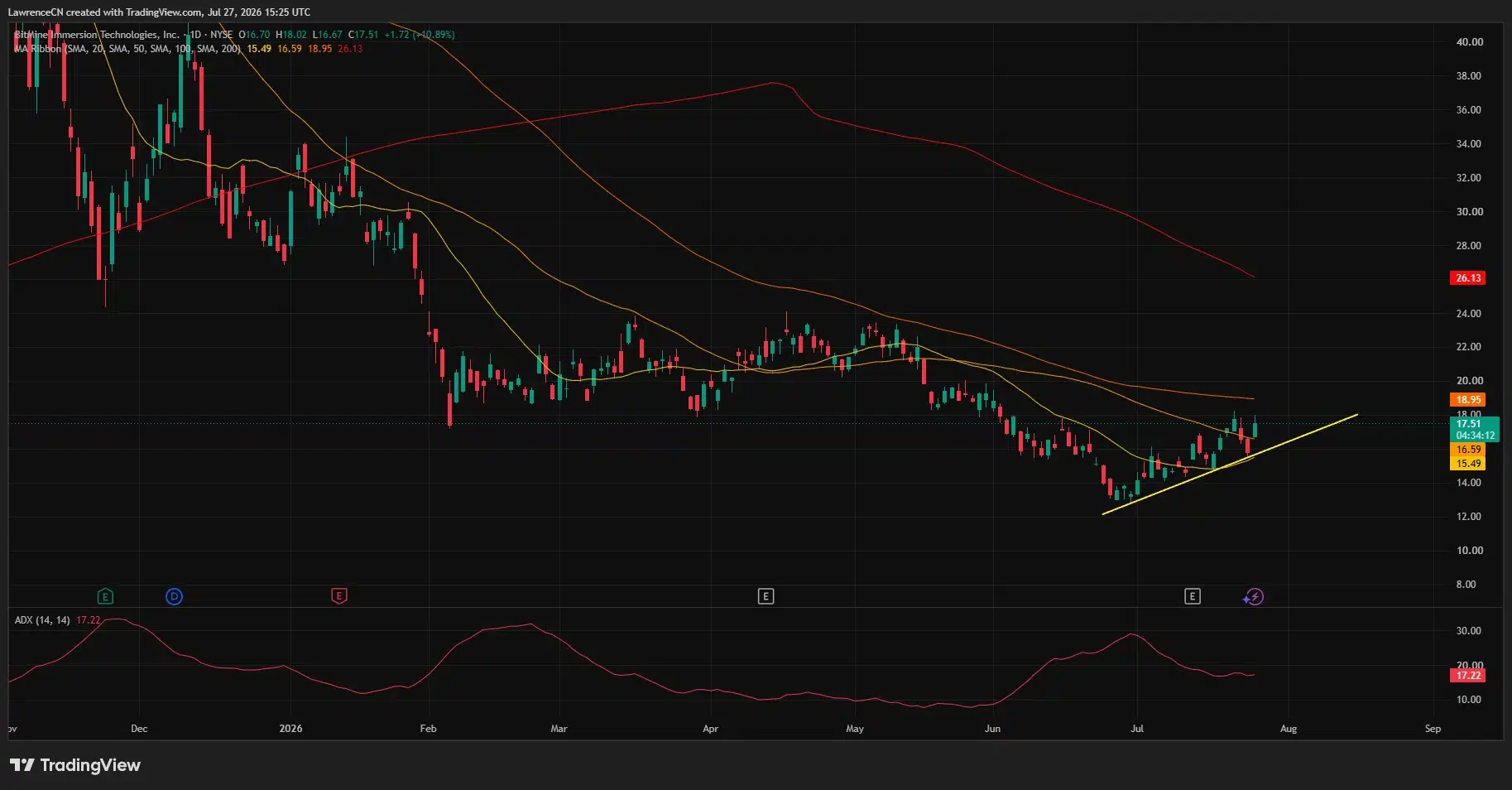
BMNR closed at $17.51 on July 27, gaining 10.89% during the session after trading between $16.67 and $18.02, according to the TradingView daily chart.
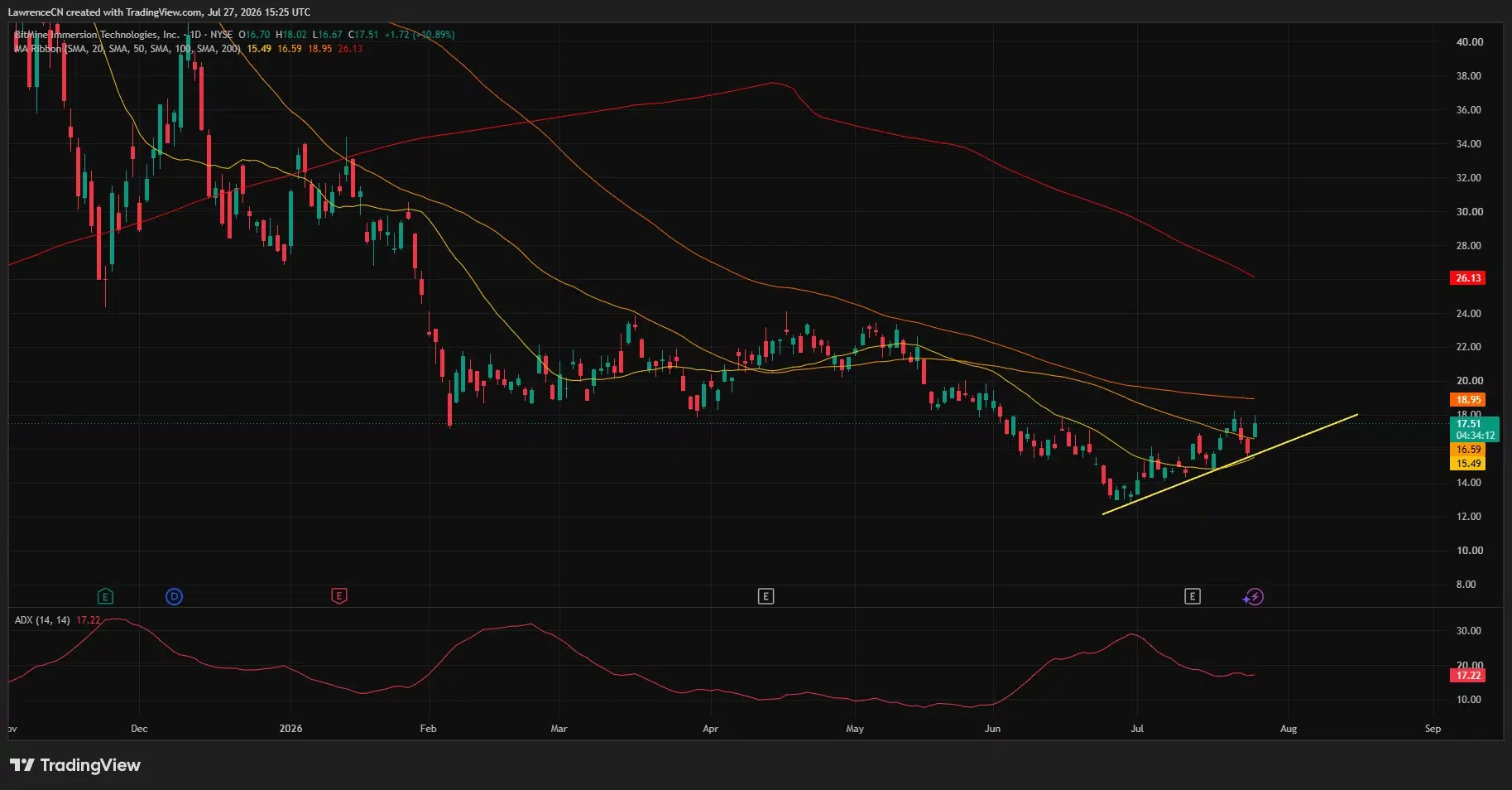
The stock has remained above a rising support trendline drawn from its late-June low. It also closed above the 20-day simple moving average at $15.49 and the 50-day average at $16.59, showing an improving short-term structure.
However, BMNR remains below its 100-day average at $18.95. A sustained move above that level could strengthen the recovery and expose the $20 area, while the 200-day average remains much higher at $26.13.
The average directional index stands at 17.22. An ADX reading below 20 suggests the rebound has not yet developed into a strong directional trend, leaving the stock vulnerable to further consolidation.
What the move means for US investors
BitMine gives US equity investors indirect exposure to Ethereum through a publicly traded stock, but BMNR also carries company-specific risks that direct ETH holders do not face. Its performance depends on Ethereum prices, staking income, treasury management, and the effect of share repurchases on its capital structure.
Institutional interest has also increased. As crypto.news reported last week, Cathie Wood’s ARK Invest purchased 5,264 BMNR shares through its flagship ARK Innovation ETF. ARK allocated about $251,500 across BitMine shares and the 3iQ Solana Staking ETF through three funds.
BitMine’s next key milestones are reaching the 5% ETH supply threshold and clearing the $18.95 technical resistance level. Progress on either front could shape whether BMNR extends its rebound or returns to its recent trading range.
Crypto World
NOWPayments and BlockSec Release Crypto Payment Security and Technical Compliance Checklist

[PRESS RELEASE – Amsterdam, Netherlands, July 27th, 2026]
NOWPayments and BlockSec have published a free checklist with 25 controls spread across nine security and technical compliance categories.
Crypto payments are easy to turn on. What’s hard is keeping the whole payment flow safe from key compromise, suspicious transactions, account takeover, or a stablecoin freeze.
NOWPayments is a global crypto payment gateway that supports over 350 cryptocurrencies and more than 30 stablecoins. Wide asset support, automatic conversion, and flexible settlement options help merchants, online platforms, and larger companies handle crypto at scale. Together with BlockSec, a blockchain security and compliance firm, NOWPayments created the Crypto Payment System Security and Technical Compliance Checklist.
The guide turns broad security principles into checks that security, operations, compliance, and product teams can work through together. It can be used before a business starts accepting crypto payments, during a vendor or architecture review, or as part of a regular control assessment.
A baseline built for daily use
The checklist covers 25 controls across nine areas:
- Private key and wallet security
- Smart contract security
- Transaction verification and signing
- Identity, accounts, and operations
- DNS and domain security
- On-chain monitoring and incident response
- AML/CFT technical compliance
- Stablecoin freeze risk management
- Continuous improvement
Each item is a control to verify rather than a general recommendation. Teams can mark it as confirmed, add supporting evidence, assign an owner, and record what needs to happen next.
This turns a broad security discussion into a working session with clear responsibilities. It can also reveal gaps between departments before they become operational or financial problems.
The checklist helps businesses answer questions such as:
- Can one person move production funds alone?
- Are operating wallets separated from reserve wallets?
- Are transaction-approval systems isolated from public infrastructure?
- Can suspicious transfers or privilege changes be detected in real time?
- Is there a tested plan for a stablecoin freeze event?
“The most common mistake is to treat a crypto payment like a normal online payment. On-chain transfers are final, so weak key management, unreviewed transaction approvals, or thin compliance checks can turn one mistake into a permanent loss,” said Andy Zhou, co-founder of BlockSec and professor at the Chinese University of Hong Kong.
From security principles to daily operations
Crypto payment risk rarely belongs to one department. Engineering may manage the infrastructure that approves transactions, compliance may screen transactions, and operations may lead the response when an alert is triggered.
The checklist gives these teams one shared record of existing controls, evidence, ownership, and next steps. For merchants, marketplaces, gaming and iGaming operators, SaaS companies, and Web3 platforms, this makes security reviews a repeatable process rather than a one-off exercise.
“Real-time visibility is what makes a fast incident response possible. It can be the difference between containing a loss and losing funds to swaps, bridges, or cash-out points,” Zhou added.
If stolen funds are traced to an exchange or crypto service, the window to act may be short.
“Businesses should preserve transaction hashes and addresses, trace the fund flow, and contact the exchange through its official security or compliance channel as quickly as possible,” Zhou said.
The checklist is an educational resource, not a certification or a replacement for legal advice. Its principles are designed to remain useful as payment infrastructure and security threats change.
Security without extra friction
Strong controls should help businesses grow their crypto operations without making daily work unnecessarily complex.
NOWPayments also offers zero-fee payouts, allowing businesses to send mass payouts to ChangeNOW Pro wallets at no cost.
In a public test, payouts were completed within seconds. Recipients confirmed each transfer by email before the funds moved.
For affiliate programs, marketplaces, creator platforms, remote teams, gaming projects, and Web3 communities, the two products address different parts of the same process: the checklist helps strengthen controls, while the payout flow reduces fees, manual wallet-address collection, and repetitive work.
Get the free NOWPayments and BlockSec checklist
The guide is designed for businesses that already accept crypto, are about to launch it, or want a fresh look at an existing payment and payout setup. Teams can use it to identify control gaps, assign ownership, and create a practical list of next steps before those gaps turn into incidents.
About NOWPayments
NOWPayments is one of the best crypto payment gateways, supporting 350+ cryptocurrencies and 30+ stablecoins. Its complete crypto business ecosystem combines broad asset coverage, automatic conversion, and flexible settlement options, making it suitable for merchants, online platforms, and global businesses.
About BlockSec
BlockSec is a full-stack blockchain security and crypto compliance provider combining research with products and services for smart contract auditing, real-time security monitoring, attack prevention, compliance, and on-chain investigation.
The post NOWPayments and BlockSec Release Crypto Payment Security and Technical Compliance Checklist appeared first on CryptoPotato.
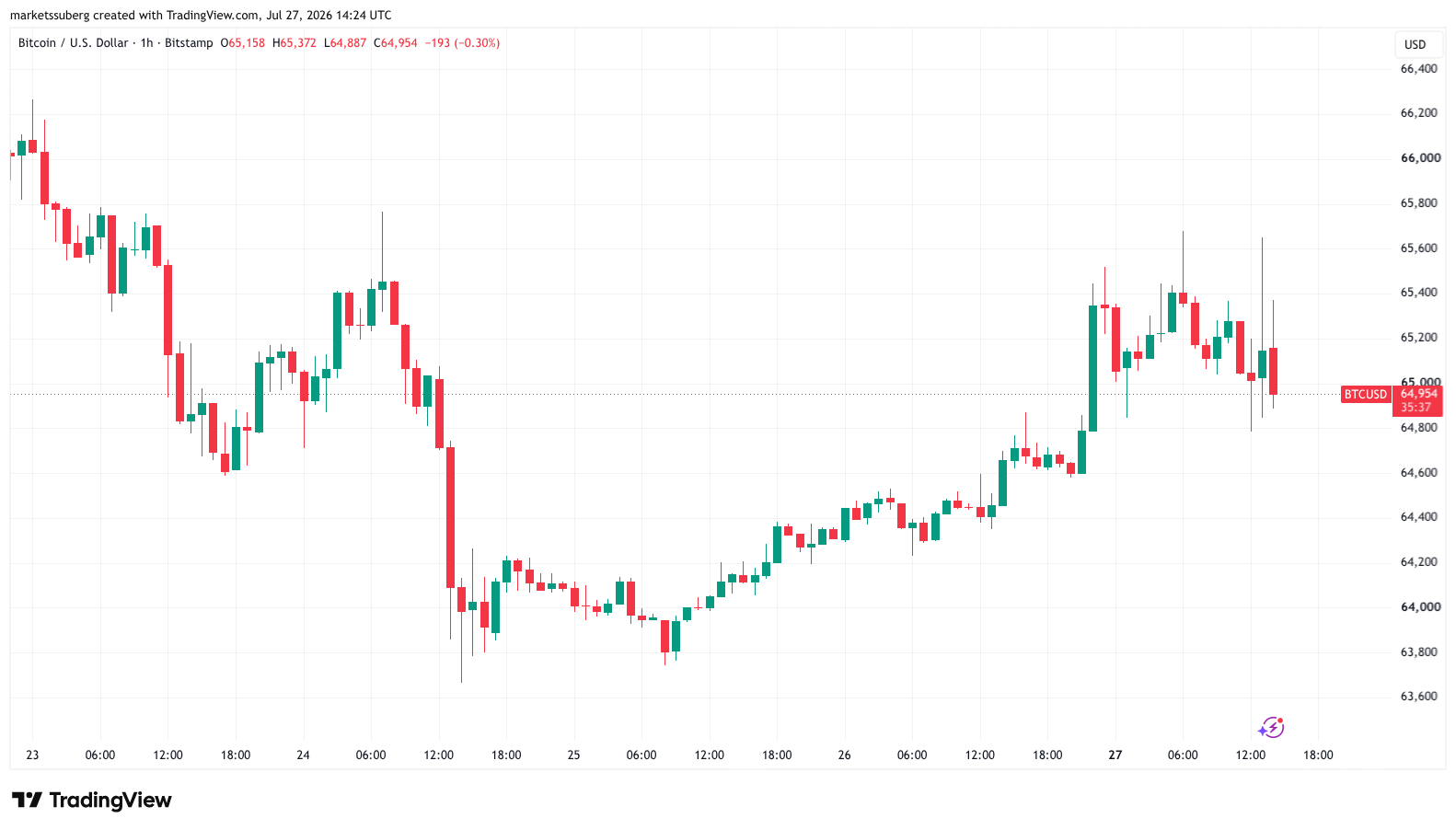
Bitcoin (BTC) sought to build on local highs at Monday’s Wall Street open as US stocks opened in the green.
Key points:
- Bitcoin approached new local highs with the start of the week’s first US trading session.
- Stocks also opened higher amid relief over a hiatus in the US-Iran war and potential progress on reopening the Strait of Hormuz.
- BTC price action defended two daily moving averages on Sunday’s weekly close.
Bitcoin follows stocks higher as Iran news offers risk-asset tailwind
Data from TradingView showed BTC/USD spiking to near $66,000 as markets reacted to a pause in strikes between the US and Iran.
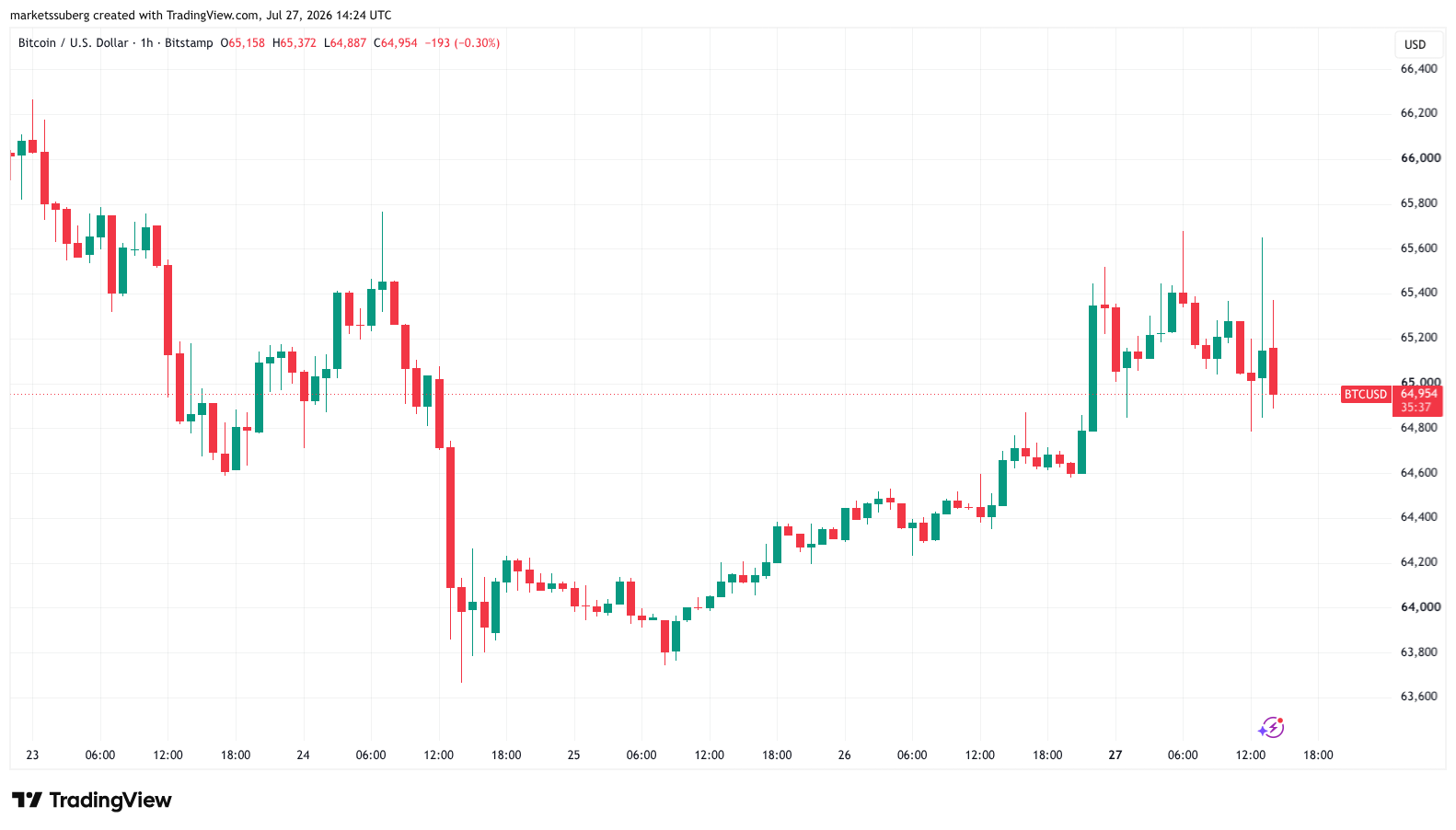
BTC/USD one-hour chart. Source: Cointelegraph/TradingView
Additional reports cited an Iranian foreign ministry spokesman announcing that Tehran and Oman were “trying to establish mechanisms regarding maritime traffic” through the Strait of Hormuz, a key global oil route currently closed.
US WTI crude oil fell toward $82 per barrel on Monday before a modest rebound. The S&P 500 and Nasdaq Composite Index were both up by around 0.3% at the time of writing.
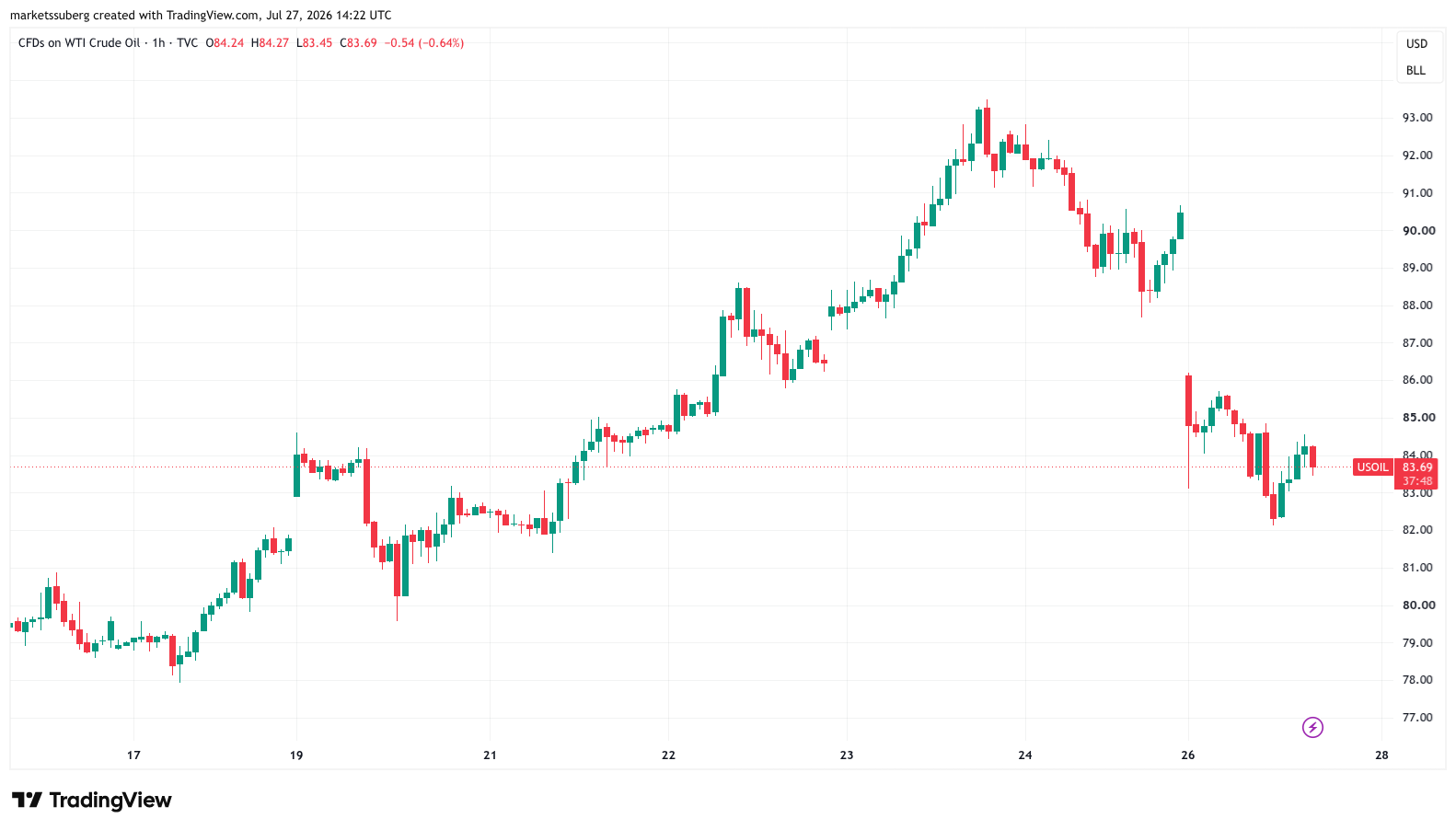
CFDs on US WTI crude oil one-hour chart. Source: Cointelegraph/TradingView
Acknowledging a potential stumbling block in the form of higher US bond yields, trading company QCP Capital voiced that they were anticipating tailwinds for the crypto market going forward.
“Digital assets have generally outperformed equities in July despite a more challenging macro backdrop,” the firm wrote in its latest Market Color analysis.
“BTC and ETH are up approximately 11.6% and 24.6% month-to-date, respectively, even as higher Treasury yields and periodic risk-off sentiment have weighed on broader markets.”
QCP referenced developments around the CLARITY Act, a key piece of proposed crypto legislation still under consideration.
“Market attention also remains on developments surrounding the proposed CLARITY Act, which continues to be closely followed by digital asset participants given its potential implications for the US regulatory framework,” it continued.
BTC price support holds but remains fragile
Among Bitcoin traders, caution mixed with quiet optimism over BTC price action on shorter time frames.
Related: Rate path still divides investors: Five things to know in Bitcoin this week
Crypto trader and analyst Michaël Van de Poppe highlighted that BTC was holding the 21-day and 50-day simple moving averages (SMAs) as support. These stood at $64,289 and $63,261, respectively.
“This is a strong signal for the markets to be betting on the long side of this asset, however, it’s still a little fragile,” he wrote in ongoing updates on X.
“I’d much prefer to see a strong move to $66,000-67,000 over the next 1-3 days to see a continuous bid coming in.”
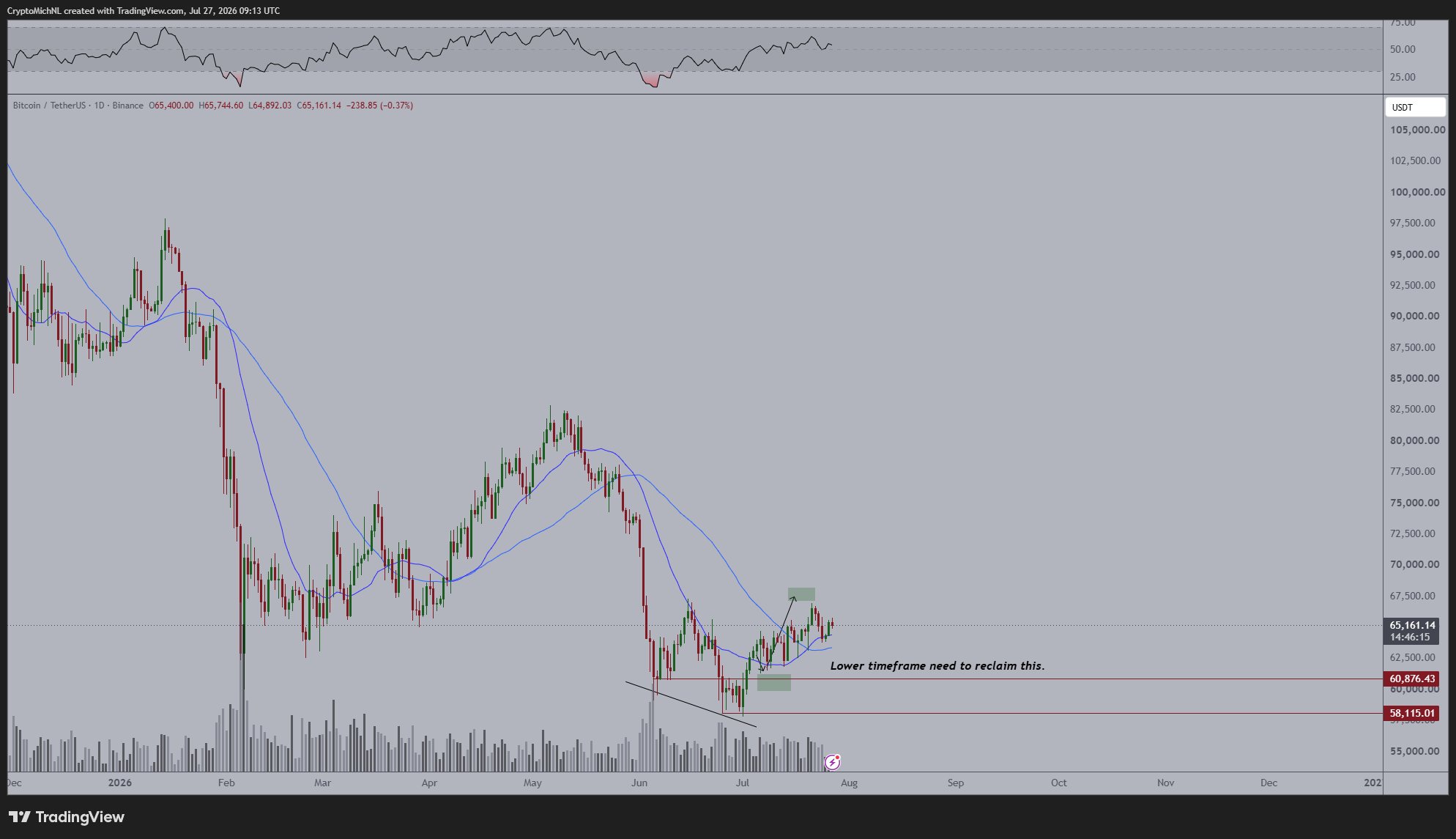
BTC/USDT one-day chart. Source: Michaël Van de Poppe on X.com
Data from CoinGlass showed crypto short liquidations spiking as the market rose, with these nearing $250 million over a 24-hour period.
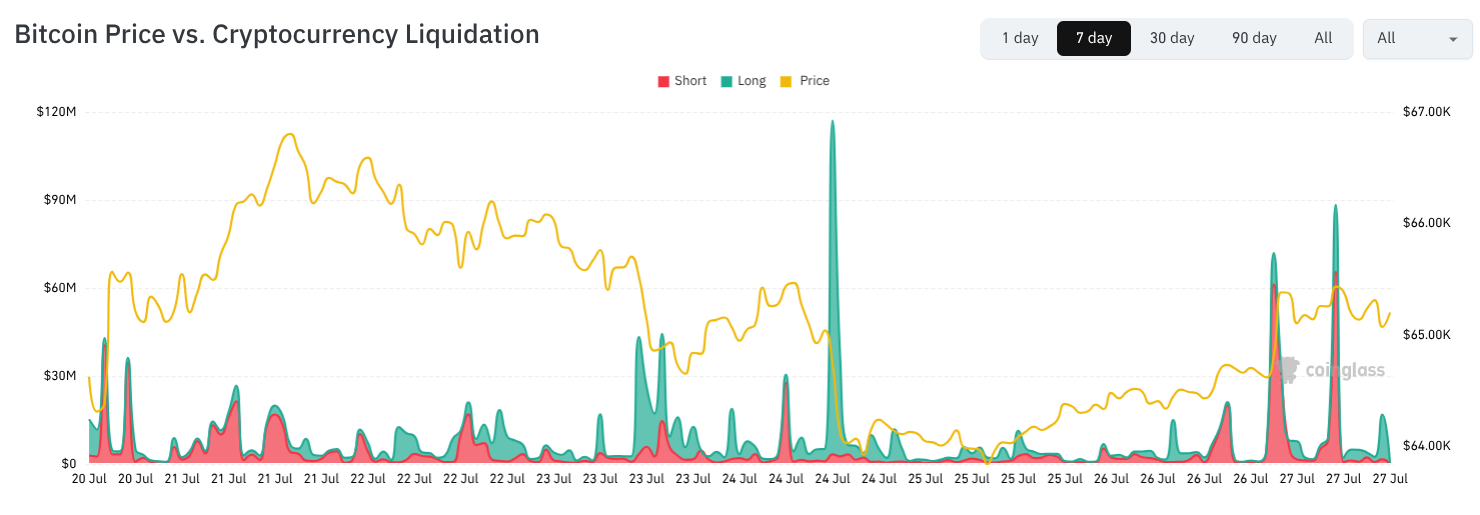
BTC/USD vs. crypto liquidations (screenshot). Source: CoinGlass

On a show that averages 4.1 million viewers across TV and online channels, a prominent comedian and political commentator didn’t hold back in laying out the Trump connections to digital assets. Oliver painted crypto as being the family’s main business concern, outpacing real estate.
Whereas Trump initially called Bitcoin a scam and flagged crypto as a ‘disaster waiting to happen,’ he has reinvented himself now as the ‘first crypto president.’ His recent financial filings show his personal income exceeds $2.2 billion in his first year back in office, $1.2 billion of which is from crypto.
The President and First Lady have each launched their own meme coins, both of which crashed 92% and 99% from early highs. An estimated 1 million retail traders lost a total of $3.8 billion trading $TRUMP. Oliver suggested that the President was offering White House access in exchange for investment in the meme coin in some cases.
John Oliver breaks down how Donald Trump’s personal income hit $2.2 billion in his first year back in office, with $1.4 billion of it coming from the family’s crypto businesses.
John Oliver: “His recent financial filings show that in just his first year back in office, his… pic.twitter.com/tgafNgDcHr
— ileri 𖣂 (@0xileri) July 27, 2026
‘Maximum Sketchiness’: The Murky World of World Liberty Financial
The show host criticized what he viewed as dodgy deals being made under the umbrella of Trump-owned World Liberty Financial venture. These include TRON’s Justin Sun making a $45 million investment prior to an SEC fraud case settlement against him. The case was then dismissed with no admission of wrongdoing and settled for $10 million. Former SEC chief of staff Amanda Fischer described this as a ‘sweetheart deal’.
Oliver also noted that Emirati royals brokered a deal with World Liberty Financial that personally netted Trump $263 million, and that shortly afterward, US restrictions on UAE access to advanced Nvidia AI chips were lifted.
The comedian described crypto as “a perfect vehicle to funnel money” to the Trump family, mirroring the words of ethics attorney Virginia Canter on the subject, adding that Trump is “exploiting crypto sketchiness for maximum profit.”
Oliver’s Stance on Crypto Regulations
One key aspect of the show was the messaging on the CLARITY Act, a hotly discussed regulatory framework being proposed for crypto.
Oliver described the Act as moving regulatory oversight and power from the SEC to the CFTC, which he stated is ‘a small federal agency with little to no enforcement power’. The proposed regulations have been lauded by many in the crypto industry.
However, Last Week Tonight pointed out that the introduction of a new asset class, digital commodities, gives the CFTC exclusive jurisdiction over spot and cash markets for those assets, potentially weakening regulatory powers that could counteract government corruption.
The show host also insinuated that the nebulous nature of the Trump family’s crypto dealings works in the President’s favor.
“If these conflicts of interest were as easy to understand as Jimmy Carter and his peanut farm I think there would be a lot more alarm about just how flagrantly corrupt and compromised Trump looks here,” said Oliver.
In the host’s view, the American public is complacent about what could be viewed as crypto corruption from a sitting president simply because it is difficult for a layperson to understand, causing him to stress the need for ‘proper guardrails.’
As it stands, the CLARITY Act is not yet law, with its odds of passing this year dropping to just 31% recently on prediction markets.
The post ‘Perfect Vehicle to Funnel Money’: John Oliver Slams Trump’s Crypto Foray on HBO appeared first on CryptoPotato.
Crypto World
What are perps, anyway? Everything you need to know about crypto’s hottest trading instrument


Perpetual swaps, also called perpetual futures or “perps” for short, are the dominant trading instrument in the crypto market, processing an estimated $40 to 50 trillion a year in volume. They dwarf spot trading, and they are the product that professional traders, hedge funds and retail speculators reach for when they want leveraged exposure to the price of bitcoin or tther without owning the underlying asset. Despite their ubiquity, the mechanics that make them work are not widely understood.
To understand perps, it helps to understand what came before them. In traditional finance, leveraged exposure to an asset typically comes through a futures contract, an agreement to buy or sell something at a set price on a specific date. When that date arrives, the contract expires and settles. Traders who want to maintain their position must roll it into the next contract.
In crypto’s early days, this practice created persistent problems. Futures traded at a premium to the spot price of bitcoin, a concept known as basis, which confused retail traders who wanted straightforward directional exposure. And every time a contract expired, positions closed regardless of whether traders wanted them to. BitMEX, the derivatives exchange founded by Arthur Hayes and Ben Delo in 2014, spent the better part of a year shortening contract durations trying to solve this, moving from quarterly to monthly to weekly to 48-hour to 24-hour expiries, but none of that was enough.
A contract that never expires
The perpetual swap, which Delo developed and BitMEX launched in May 2015, resolved the problem by eliminating the expiry date entirely, creating a derivative contract that tracks the price of an asset indefinitely. There is no settlement date, no rolling and no expiry. Traders can hold a position for hours or years. This created an immediate structural challenge: without an expiry date to act as an anchor, nothing would naturally force the contract price back toward the spot price of the underlying asset. BitMEX solved this through a mechanism that has since become the industry standard.
Every eight hours, a payment is exchanged between traders on opposite sides of the market. If the perpetual swap is trading above the spot price, indicating excess demand for long positions, traders who are long pay traders who are short. If the perpetual swap is trading below spot, the payment runs the other way. The exchange takes no cut. The rate of this payment, known as the funding rate, is calculated based on how far the perpetual swap price has deviated from spot over the preceding eight-hour window. The further the deviation, the higher the rate. This creates a self-correcting equilibrium. When longs are being charged a substantial funding rate, it becomes expensive to hold the position, which reduces demand and pulls the price back toward spot. Market makers accelerate this process by shorting the perpetual swap and buying spot whenever a meaningful premium opens up, capturing the difference as profit. The funding rate mechanism is now used, in essentially the same form, by every major derivatives exchange in the world.
The role of leverage
The other defining feature of perpetual swaps is leverage. Most exchanges allow traders to control positions significantly larger than their deposited capital, with limits varying by platform and jurisdiction. At BitMEX in its prime, leverage of up to 100 times was available, meaning a 1% move in Bitcoin’s price would produce a 100% gain or loss on a fully leveraged position. To manage the risk this creates for the exchange, perpetual swap platforms use automated liquidation systems. If a trader’s losses approach the value of their deposited margin, the system closes the position before it can go negative, protecting the exchange from absorbing the deficit. The speed and reliability of that liquidation engine became a key competitive differentiator in the early years of the market, and remains central to how exchanges compete today.
Perpetual swaps are now the primary venue for price discovery in crypto. When bitcoin moves sharply, the move typically originates in perp markets before spreading to spot. The structure Delo built in 2015 has proven durable enough that regulators in the U.S. are now exploring its application to traditional assets, with the CME potentially listing perpetual swaps on equities. What began as a workaround for the limitations of crypto futures has become one of the most traded financial products in the world.

USDC issuer Circle Internet Group has acquired assets from IBM’s blockchain patent portfolio in a bid to expand its intellectual property holdings.
The portfolio includes more than 680 patent families and nearly 1,000 issued patents worldwide covering core blockchain technology, banking, financial services, insurance, enterprise infrastructure, supply chain verification, and secure cloud operations.
The financial details of the deal were not disclosed.
IBM Patent Deal
Circle said the acquisition makes it the largest holder of blockchain patents in the United States. According to the stablecoin issuer, the expanded patent portfolio will support products including USDC, Circle Payments Network, Arc, as well as its lineup of on-chain products and agentic financial tools. The two companies also plan to pursue further business opportunities together.
Weighing in on the development, Circle’s General Counsel and Corporate Secretary Sarah Wilson said,
“Intellectual property is critical to advancing our mission and expanding adoption of on-chain infrastructure. IBM has been a pioneer in technological innovation, and this acquisition expands Circle’s ability to advance the infrastructure that powers global, internet-native finance.”
The latest development comes more than three years after the company joined the LOT Network, a global nonprofit that helps protect members from patent lawsuits brought by Patent Assertion Entities (PAEs). The main objective was to lower legal risks while supporting the development of blockchain-based products and services.
Later that year, it secured its first patent for Parallel Block Processing, which enables multiple pieces of information to be processed simultaneously while maintaining the serial validation of blocks.
Other Initiatives
Earlier this month, Circle received approval from the US Office of the Comptroller of the Currency to roll out First National Digital Currency Bank, N.A., which will operate as Circle National Trust. The charter will allow the stablecoin issuer to provide fiduciary crypto custody services and is expected to eventually manage USDC reserves under OCC supervision. Over time, custody services may also become available to a limited group of institutional clients.
It also joined the Linux Foundation’s x402 Foundation as a premier member, along with other industry players such as Ripple, Coinbase, and Solana Foundation, among others. The initiative aims to support the development of an open standard for internet-native payments that enables AI agents, APIs, and applications to transact over HTTP.
Separately, BNY Mellon expanded its partnership with Circle by adding USDC to its Digital Asset Custody platform. This integration lets institutional clients store, transfer, mint, and redeem the stablecoin while strengthening the bank’s role as the primary custodian of USDC reserves.
The post Circle’s IBM Patent Deal Brings Nearly 1,000 Blockchain Patents appeared first on CryptoPotato.

HashKey Holdings says it has consolidated its exchange operations into a single user-facing platform, bringing together what were previously separate apps for different regions. In an announcement released Monday, the Hong Kong digital asset services firm said customers across Hong Kong, “Global,” Singapore, and the Middle East (Dubai) will use the same application—while compliance controls are handled according to each jurisdiction’s legal requirements.
The update reflects a broader shift away from early “regional silo” exchange models, where licensing and front-end products were often kept separate to reduce compliance complexity. HashKey’s approach is built around a principle it describes as “unified entry, localized compliance.”
Key takeaways
- HashKey has merged its HashKey Exchange and HashKey Global into one platform and one application for users across multiple regions.
- The front-end experience is centralized, while regulatory compliance is managed based on each customer’s legislative domain.
- HashKey frames the change as a move from earlier jurisdiction-by-jurisdiction exchange silos toward a unified model.
- Other major exchanges have implemented similar structures, though with different ways of routing users to local legal entities.
One app across regions, with compliance tailored locally
HashKey said it has consolidated core jurisdictional hubs—including Hong Kong, Singapore, the Middle East (Dubai), and Bermuda—under a single platform and application. While the firm’s statement emphasizes that the “front-end” is unified, it also stresses that the system is designed to remain compliant with local frameworks by managing compliance requirements in line with each user’s jurisdiction.
Under HashKey’s model, users download the same application, but the platform applies localized compliance handling across the Hong Kong, Global, Singapore, and Middle East regions. In practical terms, that means the product experience is simpler to access, even though the legal and regulatory obligations still differ by geography.
Why unified platforms are becoming more common
HashKey’s announcement positions the merger as an evolution from the early days of virtual asset trading. In those early stages, many licensed exchanges operated through regional silos—separate platforms, separate apps, and often separate operational setups—to make it easier to compartmentalize compliance.
According to HashKey, its updated structure is intended to preserve compliance benefits while reducing friction for users who operate across or move between markets. The promise is a single front-end that can simplify access to systems expected to remain aligned with local regulatory requirements, as compliance is managed within the platform rather than through separate customer-facing products.
For traders and liquidity providers, a unified application can also reduce the risk of confusion around which interface, account type, or supported features apply in different jurisdictions. For the operator, it can streamline development and user onboarding workflows by consolidating the customer entry point while maintaining jurisdiction-specific controls in the background.
How this compares with other exchanges’ structures
HashKey is not alone in moving toward centralized user experiences paired with jurisdiction-specific legal coverage.
As one comparison, the article notes that OKX presents its website and mobile apps as one platform. However, OKX’s terms reportedly assign customers to different providers based on residence. In other words, the customer-facing “one app” concept is paired with a legal routing layer that maps users to the appropriate entity depending on where they are.
Kraken provides another example. The announcement referenced that Kraken consolidated a Dutch broker entity—BCM—into its platform after acquiring it in September 2024. Kraken has also expanded its European offering through a MiCA structure: the firm reportedly began serving the EEA through its Irish MiCA entity in August, suggesting that compliance alignment is achieved within a unified operational framework.
These comparisons underscore that while the “single platform” idea is spreading, implementations can differ. The key variable is how an exchange ties a unified front-end to jurisdiction-appropriate regulatory responsibility—whether by assigning users to distinct providers behind the scenes or by applying compliance processes localized to each customer’s jurisdiction.
What users should watch after the consolidation
HashKey’s transition to a single application across multiple regions raises questions that matter most to customers: how onboarding flows will change, how jurisdiction-specific feature access will be reflected in the user experience, and whether account management will remain seamless when users interact with region-specific compliance requirements.
For regulators and industry observers, the merger is also a useful test case for whether exchanges can maintain strong compliance controls while consolidating products and codebases—an approach that could become more attractive as regulatory regimes mature and operational efficiency becomes a competitive differentiator.
Readers should watch for further details on the rollout mechanics, such as how HashKey handles user migration from previously separate platforms and how the unified app communicates jurisdiction-dependent limitations, if any. As the exchange environment continues to tighten, the ability to centralize the user interface without diluting regulatory obligations will likely be a key measure of operational readiness.

Heartbeat fans’ memories as TV star takes on Goathland Hotel

RPM International: Steady Progress And Better Positioning, Arguably Undervalued (Upgrade)
PUMP Hits an 11-Week High: Momentum Building or Pullback Ahead?


-

 Fashion3 days ago
Weekend Open Thread: Brooks Brothers
-

 Crypto World6 days ago
Grayscale Files For Worldcoin ETF, WLD Registers Sharp Rise
-

 NewsBeat6 days ago
How a former Blue Peter presenter stunned America’s Got Talent judges
-

 Tech16 hours ago
Intel is reversing course and bringing hyper-threading back to its server chips
-

 Tech7 days ago
Sail Virtually Aboard The “Itanic” With IA-64 Emulator
-
 Tech7 days ago
Turtle Beach Command Series KB7 review: a nifty screen-equipped gaming keyboard
-
 Business5 days ago
New Jersey voter registration controversy explained: How 6,600 noncitizens got on the rolls, and what happens next
-
 Entertainment6 days ago
Johnny Depp’s R-Rated Gothic Cult Classic Gets New Release Ahead of Sydney Sweeney Remake
-

 Crypto World5 days ago
Ethics, other provisions in crypto Clarity Act to be further discussed
-

 Politics5 hours ago
Luke Littler dismantles Gerwyn Price to retain title in Blackpool
-
 NewsBeat7 days ago
Shanghai science forum photos show China’s AI and robotics advances in rivalry with US
-
 Sports20 hours ago
Commonwealth Games boxing: Jadumani Singh seals dominant 5-0 win over Pakistan’s Sumama Rehman to enter quarter-finals | Commonwealth Games News
-

 Sports4 days ago
2026 3M Open leaderboard: Scottie Scheffler finds putter in Round 1, sits three back
-

 News Videos4 days ago
The Peugeot Family: How 200 Years of an “Old Money” Dynasty Died in A Boardroom
-

 Fashion4 days ago
16 Dresses for the High Summer Event
-

 Politics1 day ago
Spain sweeps the board at 2026 World Cup with individual awards
-

 Crypto World7 days ago
Andrew Cuomo joins OKX board as crypto exchange expands in U.S.
-
 Entertainment3 days ago
A New Post-Apocalyptic Gundam Anime Series Blasts Into SDCC
-

 News Videos19 hours ago
BITCOIN JUST ENTERED THIS CRITICAL ZONE…
-

 Crypto World1 day ago
XRP Ledger adds $2.6B as RWA inflows rank second
You must be logged in to post a comment Login