

Crypto World
Pump Fun Crypto Breaking Out, Shrugging Off Vesting Supply Unlocks


PUMP, or Pump Fun crypto token, is trading at $0.00214 after staging a 60% recovery from its recent swing low. The unusual part is what did not happen alongside that move. The token absorbed its largest investor and team unlock without breaking down, suggesting demand remained strong despite fresh supply.
Mid-July marked the first vesting tranche. Investors received 32.5 billion PUMP, equal to 25% of their allocation. Team members unlocked 50 billion PUMP, also 25% of their allocation. The remaining tokens will unlock linearly over the next 36 months. Despite the supply increase, buyers stepped in and pushed the price higher.
Trader sentiment has stayed optimistic throughout the event. Many argued that unlock fears were overwhelmed by speculative demand instead of triggering sustained selling. As a result, attention has shifted away from vested concerns. Instead, traders are watching whether PUMP can clear the next resistance after climbing more than 18% over the past 24 hours and nearly 42% in the last z days.
The market backdrop also remains supportive. Total crypto market capitalization sits near $4 trillion, while Bitcoin and Ethereum continue trading in relatively stable ranges. That environment often encourages capital to rotate into higher-risk assets. Meanwhile, Solana’s meme coin ecosystem continues attracting attention, with Pump Fun remaining a crypto major launchpad at the center of that narrative.
Trade Memecoins on Bybit and Get a Chance to Win Our $1,000 USDT Airdrop
Can PUMP Fun Crypto Price Sustain Its Breakout Against Long-Term Resistance?
Price is testing a long-term descending resistance that has capped previous recovery attempts. That trendline now converges near the current $0.00214 price. A decisive close above it with strong volume would shift the structure from a relief rally into a more constructive uptrend.
Still, one complication remains. Open interest has declined even as the price climbed. That usually suggests the rally is driven by spot buying and short covering instead of fresh leveraged positions. While that creates a healthier foundation, sustained gains may still require new capital entering the market.
The bullish case sees PUMP holding above $0.0021, with open interest rebuilding as momentum traders return. If resistance flips into support, the token could target the next technical level higher. In that scenario, the ongoing 36-month vesting schedule becomes far less important as demand absorbs new supply.
The base case is a period of consolidation around current levels as the market digests the unlocked tokens. The bearish case emerges if PUMP fails at resistance and slides back toward its recent swing low. With another 82.5 billion unlocked tokens now potentially tradable, renewed selling from early holders could add pressure if the breakout fails.
Discover: The Best Crypto to Diversify Your Portfolio
LiquidChain Eyes Early Infrastructure Positioning as Meme Rails Test Their Ceiling
PUMP’s resilience against vesting supply confirms one thing: when a narrative captures speculative attention, fundamentals get repriced fast. But Pump Fun is ultimately a crypto meme-launch tool, and meme-launch tools have a ceiling defined by how long the narrative stays hot.
Altseason signals are broadening across the market, which raises a fair question: at $0.0024 and after a 50% move, how much of the easy upside is already captured?
Traders looking for exposure to Solana-adjacent activity at an earlier stage are eyeing LiquidChain ($LIQUID), an L3 infrastructure project currently in presale at $0.01484, with $919K raised to date.
The view is different from the third layer.
You’ll understand soon. pic.twitter.com/P2WOELSTjI— LiquidChain (@getliquidchain) July 27, 2026

The pitch is structural rather than speculative: LiquidChain fuses Bitcoin, Ethereum, and Solana liquidity into a single execution environment via a Unified Liquidity Layer, enabling single-step cross-chain execution and deploy-once architecture.
The project has been gaining traction as macro conditions push investors toward presale-stage infrastructure plays. For traders who want exposure to cross-chain execution rails before a public listing, the entry price reflects early-stage positioning.
Discover: The Best Token Presales
The post Pump Fun Crypto Breaking Out, Shrugging Off Vesting Supply Unlocks appeared first on Cryptonews.



Circle Internet Group has acquired more than 680 IBM patent families containing nearly 1,000 issued patents worldwide.
Summary
- Circle acquired nearly 1,000 IBM patents spanning blockchain, payments, banking, insurance, supply chains and cloud.
- Circle says the expanded portfolio supports USDC, Payments Network, Arc and its agentic finance tools.
- Financial terms remain undisclosed, while Circle and IBM plan to explore further commercial opportunities together.
The portfolio covers blockchain infrastructure, banking, payments, insurance, enterprise systems, supply-chain verification and secure cloud operations. Circle announced the transaction on July 27 but did not disclose its price or other financial terms.
In its official announcement, Circle said the deal made it the “leader in blockchain patent holdings in the United States.” That remains the company’s claim. Circle did not publish a full patent list, ranking method or independent comparison with other U.S. holders.
Patent portfolio broadens Circle’s infrastructure position
A patent family groups related filings that protect one invention across different countries. Therefore, 680 families and nearly 1,000 issued patents do not represent 1,000 separate technologies. The acquired rights still give Circle a larger intellectual-property base across several areas used in digital finance.
Circle did not identify which patents directly apply to stablecoin issuance, cross-border settlement or blockchain networks. It also did not explain whether IBM retained licences, regional rights or other permissions connected to the portfolio.
Circle general counsel Sarah Wilson said intellectual property was “critical” to the company’s mission and its effort to expand onchain infrastructure. The statement describes Circle’s intended use, but patents alone do not confirm that a product will gain users, pass regulatory checks or generate revenue.
Deal supports USDC, CPN and Arc strategy
Circle said the portfolio will support USDC, Circle Payments Network, Arc and its onchain products. CPN connects participating financial institutions so they can communicate and settle payments directly, while Circle provides the network’s technology layer.
Arc forms another part of that strategy. Circle designed the blockchain for stablecoin payments, foreign exchange, treasury activity and capital markets. As crypto.news previously reported, Arc uses stablecoins for transaction fees and targets faster settlement with features built for financial institutions.
Circle’s 2026 product roadmap places Arc, USDC, developer tools and CPN inside one platform. The company plans to use Arc as a coordination layer for payments, foreign exchange and capital flows. The IBM patents could help Circle protect parts of that stack or negotiate licences.
However, Circle has not said whether the acquisition will change any current product, reduce development costs or produce licensing income. It has also not announced legal action against other blockchain companies.
Agentic finance adds another use case
Circle also linked the patent purchase to its agentic finance tools. In May, the company launched Circle Agent Stack, a set of services for software agents that can hold funds, follow spending rules and pay for digital resources.
The stack includes agent wallets, a service marketplace, command-line tools and USDC nanopayments. Circle says the system can process transfers as small as $0.000001 through Circle Gateway. It also supports standards such as x402, allowing software to pay for data, computing or online services without manual checkout.
As crypto.news reported, Circle has tied Arc and USDC to AI-focused payment infrastructure. That coverage said Arc’s testnet had processed more than 244 million transactions by May, while Circle continued building wallets and payment tools for automated applications.
The IBM portfolio includes patents tied to secure cloud operations and enterprise infrastructure, which may overlap with systems used by autonomous financial software. Circle has not named the relevant patents or explained how they will fit into Agent Stack.
IBM deal adds protection as competition grows
Circle faces competition across stablecoins, payment networks and purpose-built blockchains. Banks, fintech companies and crypto firms are developing their own tokens, settlement systems and machine-payment products. As crypto.news reported in July, more than 140 companies backed Open USD, a model that shares stablecoin economics with network participants.
Circle can use patents defensively against infringement claims or in cross-licensing talks. It could also license the patents to other companies. The announcement did not commit to either approach or state whether Circle expects direct income.
IBM and Circle plan to explore further commercial opportunities after the transfer. Neither company described those possible projects. The statement also did not say whether IBM will use Circle products, join CPN or build on Arc.
The deal also shows Circle buying mature enterprise research instead of developing every technical component internally, although the company did not explain its integration schedule.
The acquisition gives Circle ownership of a broad set of issued patents as it expands beyond stablecoin issuance. The next details may come through product integrations, licensing agreements or company filings. Until then, the portfolio’s commercial value remains unreported.


Tesla has secured a UK Supreme Court victory that revives its legal challenge over the licensing terms for patents needed to launch 5G-enabled vehicles in Britain.
Summary
- Tesla can resume its FRAND licensing claim against InterDigital and patent platform Avanci.
- Avanci’s proposed licence reportedly cost $32 for each 5G-connected vehicle when proceedings began.
- Tesla continues to hold 11,509 Bitcoin despite recording a $112 million quarterly digital-asset loss.
- Dogecoin remains available for eligible Tesla Shop products, but not for vehicle purchases.
Tesla revives UK lawsuit over 5G patents
Britain’s Supreme Court ruled in Tesla’s favor on July 27, overturning earlier decisions that had blocked part of the automaker’s lawsuit against InterDigital and Avanci.
Tesla brought the case in London’s High Court in 2023 as it prepared to introduce 5G-enabled vehicles in the UK. The company wants an English court to determine the fair, reasonable and non-discriminatory, or FRAND, terms under which it can license standard-essential patents used in connected vehicles.
InterDigital owns some of the patents available through Avanci’s 5G licensing platform. Avanci combines intellectual property from multiple patent owners and offers licences primarily to vehicle manufacturers.
According to the UK Supreme Court’s case summary, the platform licence cost $32 per vehicle when Tesla filed its claim. Tesla argued that the rate was not FRAND.
The Supreme Court concluded that patent owners cannot avoid their FRAND commitments by placing their patents into a pool or licensing platform. The ruling allows Tesla’s claim to return to the High Court for further proceedings.
Why Tesla challenged Avanci’s licensing model
The High Court rejected Tesla’s request for a FRAND determination in 2024 after InterDigital and Avanci sought to have that part of the lawsuit dismissed. However, it allowed Tesla to continue separate claims challenging the validity of three InterDigital patents.
Tesla then appealed the FRAND decision. A majority of the Court of Appeal upheld the lower court’s ruling, prompting the electric vehicle maker to take the dispute to the Supreme Court.
Organizations including the Computer & Communications Industry Association and the Motion Picture Association intervened in support of the appeal.
The Supreme Court’s decision does not establish the final licence rate Tesla must pay. Instead, it revives the company’s attempt to have the English courts consider whether the platform’s licensing terms meet FRAND obligations.
“We respectfully disagree with today’s decision and continue to believe Tesla’s claims are without merit,” Avanci Vehicle President Laurie Fitzgerald said in a statement reported by Reuters.
Tesla stock erases early premarket gain
Tesla shares initially gained about 0.98% to $316.10 in premarket trading following the ruling, Yahoo Finance shows. However, that recovery did not hold after the opening bell.
TSLA was trading near $309.10 later on July 27, down about 1.2% from its previous close. The stock moved between an intraday low of $304.28 and a high of $317.
The patent ruling removes one procedural obstacle for Tesla, but the case could take more time to resolve after returning to the High Court. The final outcome may affect the terms under which Tesla uses 5G technology in vehicles sold in Britain.
For US investors, the dispute also matters because both Tesla and InterDigital are American companies. However, the ruling applies to proceedings in England and Wales and does not directly alter US patent law.
Tesla keeps Bitcoin as Dogecoin payments stay limited
Tesla’s crypto position remains separate from the UK patent dispute. As crypto.news reported last week, the company held its reserve of 11,509 BTC unchanged throughout the second quarter.
Tesla neither bought nor sold Bitcoin during the three months ended June 30, extending the holding pattern that followed its large BTC sale in 2022. Falling crypto prices generated a $112 million after-tax loss on the company’s digital assets during the quarter.
Bitcoin traded near $83,000 at the beginning of the period before falling as low as $58,000 in late June. The decline reduced the reported value of Tesla’s remaining crypto holdings without prompting the company to sell.
Beyond holding Bitcoin on its balance sheet, Tesla has also explored a wider role for cryptocurrency in its business. Tesla CEO Elon Musk suggested in 2024 that the automaker could eventually accept Dogecoin for vehicle purchases, although it has yet to introduce the payment option for its cars.
Tesla currently allows customers to use DOGE only for eligible merchandise sold through the Tesla Shop. Consequently, the UK ruling advances Tesla’s connected-car plans but does not change its current Bitcoin holdings or Dogecoin payment policy.
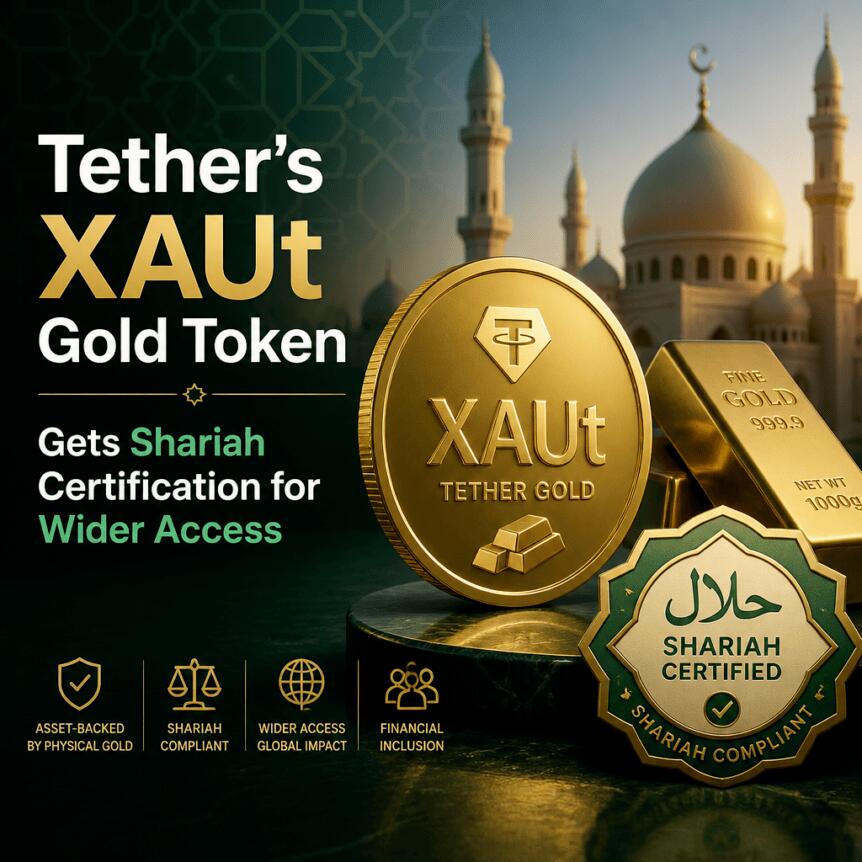
Tether’s gold-backed token XAUt has secured Shariah certification from Amanah Advisors, a development that Tether says could make its tokenized gold product more accessible to Islamic financial institutions and investors seeking Shariah-compliant exposure to physical gold.
According to Tether, the certification concludes that XAUt’s design aligns with core Islamic finance requirements: the token is fully backed by physical gold, it does not involve interest-based mechanics, avoids leverage, and maintains transparent reserves disclosures. Tether states that each XAUt token corresponds to one troy ounce of physical gold held in Swiss vaults.
Key takeaways
- XAUt has received Shariah certification from Amanah Advisors, positioning it for wider use by Shariah-focused institutions.
- Tether says the token is fully backed by one troy ounce of physical gold per XAUt, stored in Swiss vaults.
- The company highlights compliance features commonly required in Islamic finance, including no interest and no leverage.
- Reserve reporting shows XAUt is already one of the more established tokenized gold offerings, with backing exceeding 707,000 troy ounces as of March 31.
- Onchain metrics compiled by RWA.xyz indicate XAUt’s asset value has risen sharply since mid-2025.
Why Shariah certification matters for tokenized gold
For investors and institutions operating under Shariah principles, the challenge is often less about whether gold is permitted, and more about how a financial product is structured. Islamic finance typically emphasizes restrictions around interest, excessive uncertainty, and speculative leverage—conditions that can affect whether certain tokenized products are considered acceptable.
Tether’s certification directly targets that gatekeeping issue. By obtaining formal Shariah certification for XAUt’s structure, Tether is signaling that its tokenized-gold model is designed to meet the expectations of Shariah-governed decision makers—potentially reducing friction in markets where Shariah compliance is not optional.
In its announcement, Tether said it expects the certification to support adoption in regions where Islamic finance is widely used, including the Gulf Cooperation Council, South Asia, and parts of Africa.
XAUt’s backing and growth in tokenized gold
Tokenized gold only becomes practically useful to mainstream users if the underlying asset is credibly secured and consistently disclosed. Tether points to reserve reports published on its website as evidence of ongoing backing and transparency.
In Tether’s most recent reserves reporting, the company said XAUt was backed by more than 707,000 troy ounces of physical gold, worth over $3.3 billion, as of March 31. That matters because Shariah certification alone does not address the operational question of whether there is sufficient physical backing behind token issuance.
Beyond reserve disclosures, market interest in the product appears to be growing onchain. Data cited from RWA.xyz shows XAUt’s onchain asset value rose from roughly $700 million in July 2025 to around $2.5 billion. While onchain valuations do not replace physical reserve verification, they do offer a window into how widely a tokenized asset is being held and used across blockchain-based venues.
Shariah-compliant digital assets move from niche to organized offerings
Crypto has long faced questions from Islamic scholars about whether certain digital assets can comply with Shariah principles. The debate has often focused on whether participation in the asset introduces prohibited elements such as interest, excessive uncertainty, or speculation.
In recent years, however, more structured products have emerged that attempt to address those issues directly rather than leaving compliance to interpretation. The broader trend appears to be an industry shift toward token designs that emphasize asset backing, transparent reserve models, and reduced exposure to interest-like returns.
Earlier coverage from Cointelegraph noted that Shariah-compliant approaches have been pursued in different ways. For example, a Bahrain-based group, AlAbraaj Restaurants Group, adopted a Bitcoin treasury strategy and said it planned to develop Shariah-compliant financial instruments to broaden access to Bitcoin across the Islamic world.
More recently, Palm Azgar Finance expanded its Shariah-compliant PUSD stablecoin to ADI Chain, positioning the product for participation in what it described as the $3 trillion Islamic finance market. PUSD is designed to allow transactions to settle using either a dollar-linked asset or a dirham-denominated token on the same infrastructure.
Alongside individual product efforts, regulatory clarity has also been a factor in regional expansion. Dubai has been highlighted as a leading crypto hub in the Middle East, continuing to grow its regulated digital asset framework. Cointelegraph previously reported that Dubai’s Virtual Assets Regulatory Authority (VARA) issued its 50th virtual asset service provider license earlier this month, surpassing the number of licensed crypto firms in Hong Kong and Singapore.
What to watch next after Amanah Advisors’ certification
With Shariah certification in place, the next question is adoption: whether Islamic banks, funds, and Shariah-governed investors will translate compliance approval into measurable purchasing and integrations for XAUt. Readers should watch for subsequent announcements from Tether or ecosystem partners describing where XAUt will be offered, how it will be distributed through compliant channels, and whether reserve reporting continues to meet the transparency expectations that underpin Shariah assessments.
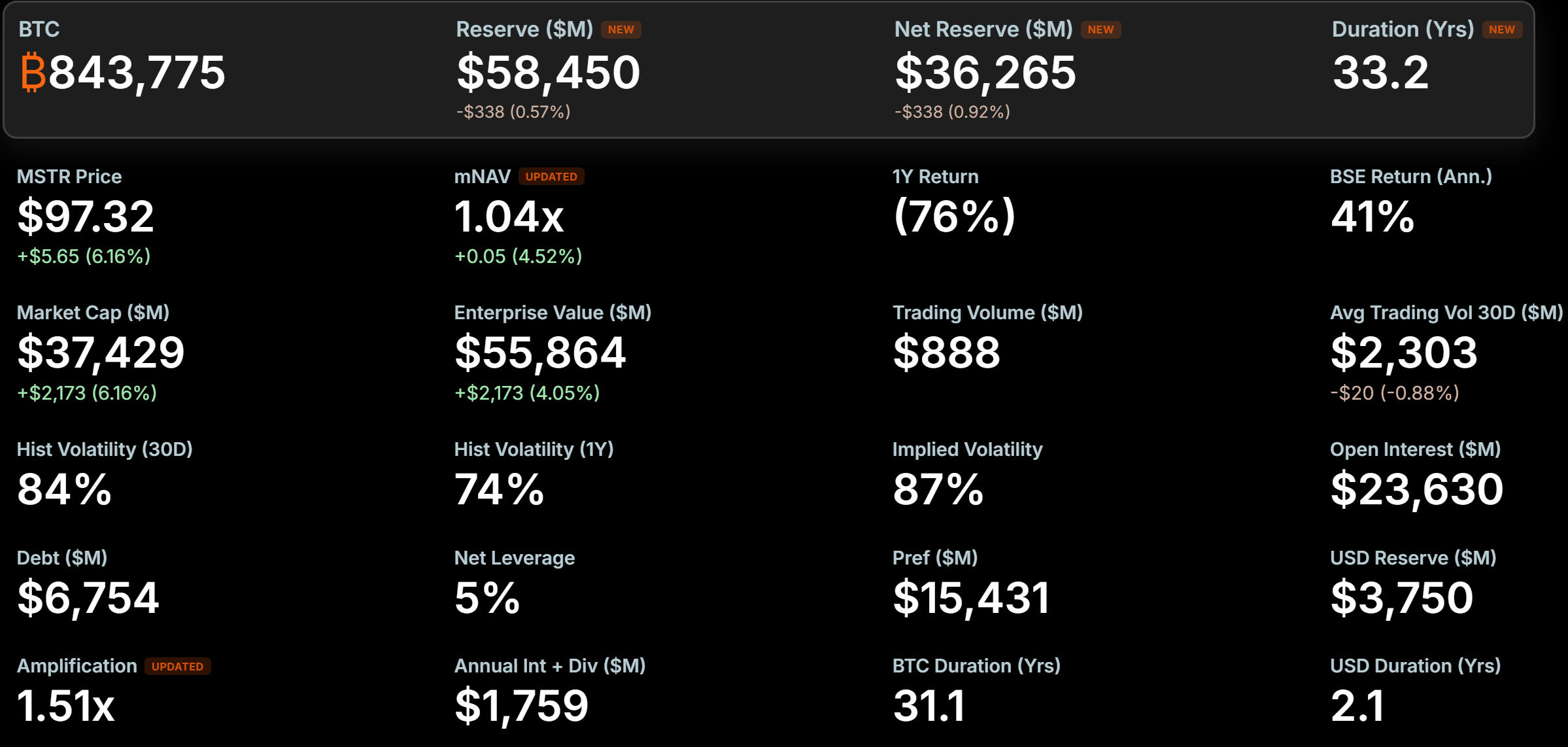
Peter Schiff has a message for Bitcoin bulls. Buy BTC itself, he says, not Michael Saylor’s Strategy stock. The company sold $544.5 million of MSTR shares last week. It bought no Bitcoin.
Schiff points to one number. MicroStrategy’s Bitcoin Yield has fallen to 4.5% this year, he says. It stood at 13.3% in late May.
Why MicroStrategy’s Bitcoin Yield Keeps Falling
Bitcoin Yield sounds complicated. It is not. It tracks how much Bitcoin sits behind each MSTR share.
Sell new shares without buying coins, and the number drops. That is exactly what happened last week.
Strategy sold 5,429,160 MSTR shares. It raised $544.5 million. It bought zero bitcoin, its 8-K filing shows.
Holdings sit at 843,775 BTC. The yield was 9.4% on May 3. It climbed to 13.3% by May 25. Schiff now puts it at 4.5%.

“Why is $MSTR up 7% this morning? Saylor’s latest move reduced the YTD Bitcoin yield to 4.5%. That yield stood at 13.3% on May 25. That’s a 66% reduction in two months! At this rate the 2026 Bitcoin yield will be negative. If you’re bullish, you’re better off just owning Bitcoin,” Schiff urged.
Follow us on X to get the latest news as it happens
Here is the part few people noticed. Strategy warned about this outcome itself, in its own first quarter filing.
“…if the Company increases Assumed Diluted Shares Outstanding at a faster rate than its bitcoin holdings, then the Company would experience decreased BPS and negative BTC Yield…” Strategy, Q1 2026 results.
Put simply, more shares without more Bitcoin turns the yield negative. BeInCrypto covered the trade-off facing MSTR investors earlier on Monday.
The $25 Million Buyback Barely Moves the Needle
Strategy also bought back some of its own preferred shares, known as STRC. STRC is a special class of share. It pays holders a fixed 12% cash dividend every year. It is designed to trade at $100. Strategy paid an average of $86.52 instead. It spent $25 million and retired 288,930 shares.
That saves roughly $3.5 million a year in dividends.
Now compare that to the whole bill. Strategy owes about $1.76 billion a year in dividends and loan interest, it disclosed on June 29. The buyback trims less than 0.2%.
Another $975 million is available. Strategy will not sell new STRC below $100. It also cannot use its cash reserve to fund buybacks. It may sell bitcoin instead.

What to Watch on Thursday
The cash pile is growing fast. It rose from $2.55 billion on June 28 to $3.75 billion on July 26. That covers roughly 25 months of dividends, up from 17.4 months.
The Bitcoin tells a harder story. Strategy paid an average of $75,476 per coin. Bitcoin’s current price is near $64,762. The gap is about $8.9 billion.

Losses are already on the books. First quarter net loss reached $12.54 billion, or $38.25 per share. Second quarter results arrive after the close on Thursday, July 30. That report should carry the official Bitcoin Yield. It will prove Schiff right or wrong.
Not everyone agrees with him, however. Investor Andrew Webley says the preferred shares now cover 2.1 years of payments with no new fundraising. He calls it the biggest step forward in Bitcoin corporate finance so far.
Others question the price. A former Goldman Sachs credit specialist argues STRC may be mispriced by 13%. A June survey found most holders bought STRC below par.
Schiff is still a gold man and a long-time Bitcoin critic. This is a swipe at Saylor, not a change of heart. The real test comes Thursday. Can Strategy lift STRC back to $100 while common shareholders pay for it?
The post Peter Schiff Says Saylor Just Wiped 66% Off MicroStrategy’s Bitcoin Yield appeared first on BeInCrypto.
Armstrong and others say autonomous software agents will eventually execute far more daily transactions than humans. Because digital programs cannot open bank accounts or wait days for wire transfers, real-time crypto and blockchain represent the only alternative.
In his post, Armstrong said Coinbase plans to anchor this ecosystem, which he dubbed Agentic Finance (AiFi). The crypto trading platform is using the x402 protocol, which it developed and is now governed by the x402 Foundation, along with its Base blockchain and Circle Internet’s USDC stablecoin to power these automated payments. Coinbase deployed AI agent accounts that can trade and spend in June. Last week, it said Coinbase Business users would be able to accept AI agent payments via x402.
However, industry builders note that moving money at machine speed requires fixing structural bottlenecks across the entire tech stack.
“Agents don’t just need money, but they need money that moves at machine speed,” said Tory Green, CEO of decentralized network io.net, on Monday in a comment on Armstrong’s post. “Our whole financial stack has evolved for the human interface. Money’s just the first rail that has to catch up. Same story coming for compute, data, all of it.”
Other developers warn that giving unvetted code direct access to financial assets exposes it to massive counterparty risk.


Securitize expanded its regulated US platform after its capital subsidiary registered with the SEC, while SECZ shares fell nearly 10% on Monday.
Summary
- Securitize Capital’s SEC investment adviser registration became effective July 22, federal records show.
- The registration adds disclosure, compliance, recordkeeping and examination requirements under US securities law.
- Securitize manages more than $5 billion in assets, including BlackRock’s $2.6 billion BUIDL fund.
- SECZ fell nearly 10% to $6.76, reducing Securitize’s market value to about $1 billion.
Securitize Capital becomes an SEC-registered adviser
Securitize said Monday that its subsidiary, Securitize Capital LLC, has registered with the US Securities and Exchange Commission as an investment adviser.
The registration became effective on July 22, according to the SEC’s Investment Adviser Public Disclosure database. The Miami-based business had operated as an exempt reporting adviser in Florida since March 2023.
That earlier status generally restricted the unit to advising venture capital funds or private funds with less than $150 million in US assets under management. Full registration removes those limits but brings additional disclosure, compliance, recordkeeping and examination duties under the Investment Advisers Act of 1940.
“Becoming an SEC-registered investment adviser is an important step in the continued expansion of Securitize’s platform,” co-founder and CEO Carlos Domingo said.
“Asset managers and institutional investors want to work with partners that understand both the opportunity of tokenization and the obligations that come with operating in regulated markets.”
The company noted that registration does not represent an SEC endorsement or indicate a particular level of skill or training.
SEC status expands Securitize’s US regulatory stack
Securitize Capital’s registration completes a broader group of regulated services covering the issuance, management and trading of tokenized securities.
Securitize Markets operates as an SEC-registered broker-dealer and runs an SEC-regulated alternative trading system. Other affiliates provide transfer-agent and fund-administration services. FINRA also approved Securitize Markets in May to custody tokenized securities and support atomic settlement.
The expanded structure could allow Securitize to work more closely with asset managers building onchain vaults, lending products and other portfolio strategies. The company reported more than $5 billion in assets under management as of July across products linked to BlackRock, Apollo, BNY, Hamilton Lane, KKR and VanEck.
BlackRock’s BUIDL tokenized Treasury fund accounts for about $2.6 billion of that total.
The registration follows SEC Commissioner Hester Peirce’s July 22 warning that managing certain vaults and lending strategies may create investment adviser obligations. Peirce urged businesses operating within the securities market to engage with the regulator while developing compliant onchain products.
SECZ falls despite Citi’s bullish price target
SECZ shares fell over 10% during Monday trading to about $6.76, giving Securitize a market capitalization of slightly under $1 billion per data from Yahoo Finance. The decline extended the stock’s losses since its New York Stock Exchange debut earlier in July.
Citi analyst Peter Christiansen separately initiated coverage with a Buy rating and a $10 price target. The target represented about 34% upside from Friday’s closing price of $7.47.
Christiansen described Securitize as important infrastructure for real-world asset tokenization but identified several risks. These included the company’s reliance on BlackRock’s BUIDL fund, exposure to interest-rate changes and uncertainty over the development of higher-margin transaction revenue.
Securitize pushes IPOs and public stocks onchain
Securitize entered public markets on July 2 through a merger with Cantor Equity Partners II that generated about $400 million in gross proceeds. It also tokenized its own SECZ shares on the listing date.
Cantor and Securitize later announced a July 15 partnership designed to incorporate blockchain infrastructure into IPOs and follow-on stock offerings. Cantor will provide capital-markets and trading services, while Securitize will manage the issuance, distribution and servicing of tokenized securities.
Unlike products that create blockchain representations of stocks already trading on exchanges, the arrangement would place onchain infrastructure within the original securities issuance process.
Hanwha Group has also emerged as Securitize’s largest shareholder. SEC filings show that the South Korean conglomerate controls 15.69 million shares through affiliated entities and investment vehicles, equal to a 9.6% stake.
Securitize is also working with the NYSE on infrastructure for the exchange’s planned tokenized securities platform. The adviser registration gives the company another regulated US entity as it expands from issuing tokenized funds into portfolio management and public-market settlement.
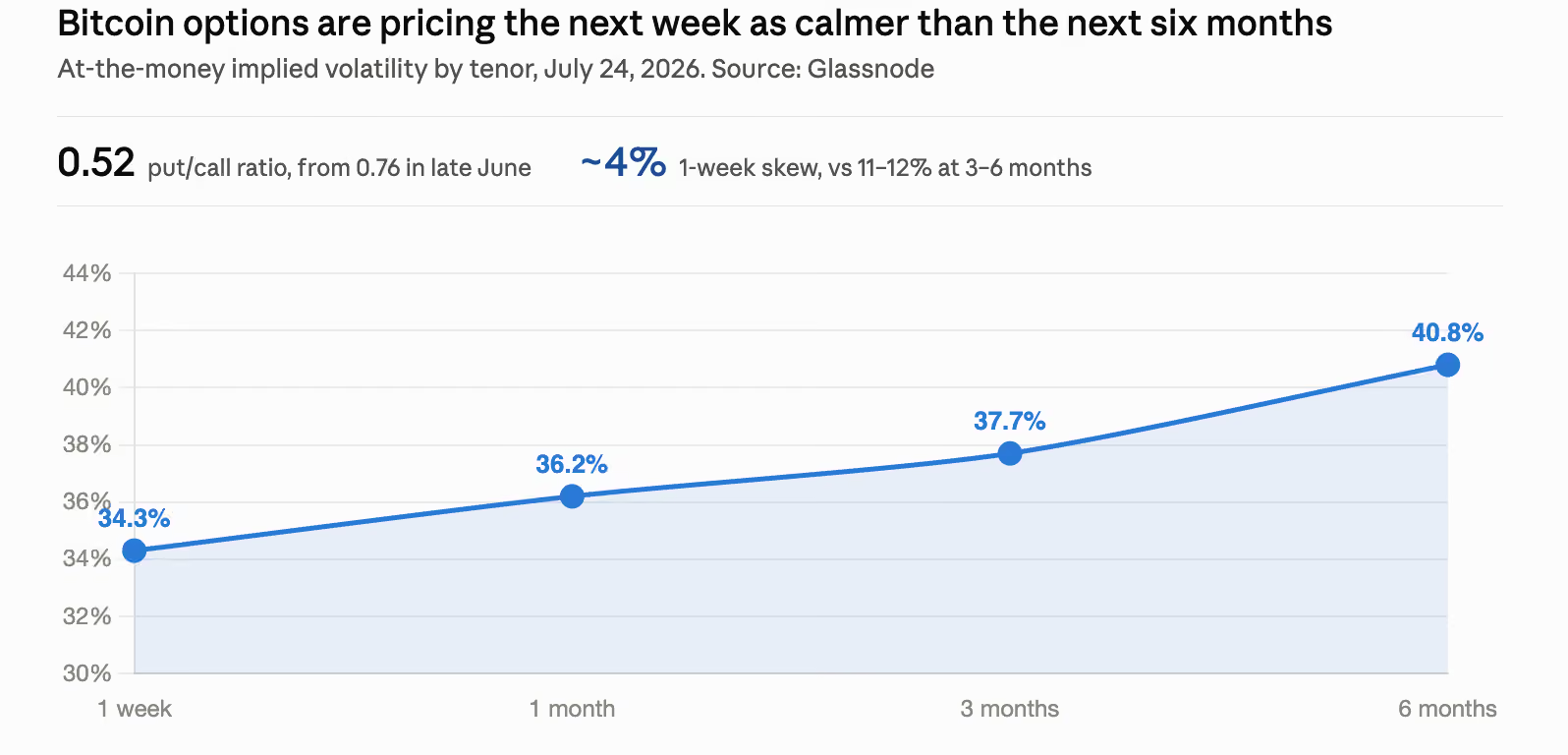
Bitcoin’s options market has turned notably less defensive over the past month, unwinding the downside protection traders built up in June just as the Federal Reserve prepares to meet.
The put/call ratio on open interest, which measures how much of the market is positioned in puts, contracts that pay off when the price falls, against calls, which pay off when it rises, has dropped to roughly 0.52 from about 0.76 in late June, according to Glassnode.
Calls are gaining share, the pattern of traders stepping back from hedging rather than adding to it. Recently, large traders have been accumulating $70,000 strike calls and bull call spreads, signaling expectations of upside in the spot price.

The 25-delta skew, the premium traders pay for downside protection relative to equivalent upside exposure, has fallen to around 4% at the one-week tenor while three- and six-month contracts hold at 11% to 12%. That indicates traders are still paying for insurance against something going wrong later this year, but have largely stopped paying for it this week.


On Friday, a clever startup manufactured a viral media story about a Brazilian rancher securing a $19,600 loan by tokenizing 10 cows.
However, omitted from the subsequent wall-to-wall media coverage was some very inconvenient context, such as the rancher’s seat on the board of a state-backed ranching fund, his massive herd, and plentiful access to traditional, real estate-based financing.
When the story hit social media on Friday, crypto influencers applauded blockchain technologies extending credit to a farmer in need.
Unfortunately, this feel-good story falls apart under the slightest scrutiny.
Firstly, the rancher’s expansive, multi-generational real estate exceeds 1.3 square miles, and as of the most recent estimates, had over 500 cows alongside other operations.
Even if the herd size hasn’t grown, the 10 animals in Friday’s announcement represent a mere 4% of the dairy’s more than 240 lactating cows.
Secondly, trade press profiles identify the operator of the farm, Fazenda Engenho Velho, as civil engineer João Guilherme Brenner whose family has owned the land for generations.
Unlike many farmers and ranchers who rent their land, his family owns its land outright and, as such, has access to conventional, real estate-based financing.
A president, director, and seven-figure rancher
In 2022, a magazine interview documented the rancher’s election as president of Paraná’s Holstein breeders association and his appointment to the board of directors of the Brazilian state’s livestock development fund.
His 10 Holstein cows in Imbituva, Paraná secured a credit note this week, worth roughly $19,700.
Despite that loan of 1% the value of his dairy’s land, press outlets gushed about “one of Brazil’s first uses of tokenized livestock as loan collateral.”
Press coverage soared past a million views through posts about tokenization ostensibly allowing farmers to access financial lifelines.
For context, Paraná’s agriculture department prices farmland of the Imbituva municipality at 23,200 to 126,900 Brazilian reais (BRL) per hectare across every soil classification except its worst.
Anywhere within that price range, Guilherme Brenner’s 360 hectares are worth millions of US dollars.
Read more: 28,000 crypto wallets pledged $560M for SpaceX shares they didn’t get
The headlines look great
It’s not surprising to learn that the media cycle benefited a startup. Cowmed, an agtech that spearheaded both tokenized cattle deals, structured the stunt alongside a receivables fund, Target Fundo de Investimento em Direitos Creditórios.
In 2024, a similar yet separate company, tokenization startup Simple Token, set the goal of using tokenized livestock to unlock 200 million BRL worth of loans by the end of 2026, in partnership with Cowmed.
With less than six months left, actual disclosed credit across the lifetime of both companies’ tokenized livestock efforts is 99% short of their goal, although the privately held companies aren’t required to make public disclosures.
Cowmed has raised over $1 million across several rounds of financing since 2017. Its latest publicly accessible financing was a crowdfunding campaign that closed 5.9 million BRL at a valuation of $6.2 million.
Meanwhile, Halter, Cowmed’s competitor and maker of electronic fences and cattle collars, closed a $220 million round in March of this year at a $2 billion valuation.
In comparison, Cowmed could certainly use to catch up. It is probably quite happy about Friday’s virality.
Cowmed’s business is far more modest than its competitors. It charges roughly $5 per collar per month and reported less than $3.6 million in revenue last year.
Tokenized cows are no better than non-tokenized cows
In summary, for a loan worth less than $20,000, Cowmed earned a global marketing campaign with over a million views that would have cost many multiples of that from paid advertising.
The use of blockchain in the stunt added no discernable value beyond the addition of buzzwords for media. The arrangement relies on trust in one rancher, one collar maker, one tokenization provider, and one lender.
There’s no decentralization to speak of beyond trust in corporate executives.
For years, cattle have collateralized loans to ranchers. Moreover, wireless tracking of animal collars has existed without blockchain technologies for over a decade.
For this Brazilian rancher, traditional databases could have tracked his cows just as well as any blockchain.
Got a tip? Send us an email securely via Protos Leaks. For more informed news and investigations, follow us on X, Bluesky, and Google News, or subscribe to our YouTube channel.


The U.S. Commodity Futures Trading Commission has asked a federal court to expedite its ruling against Minnesota before the state’s prediction-market ban takes effect on Aug. 1.
Summary
- Minnesota’s ban takes effect Aug. 1, leaving the court only days to decide on injunctive relief.
- Kalshi and Polymarket joined the CFTC’s request for a temporary administrative stay.
- The CFTC may seek emergency appellate relief if the district court does not act promptly.
- Industry groups argue that one federal framework should govern regulated event contracts across the United States.
CFTC presses court as Aug. 1 deadline approaches
The CFTC requested expedited handling of its motion for a preliminary injunction, according to its latest court filing. The regulator said a decision is needed before Minnesota’s new law takes effect later this week.
Minnesota Governor Tim Walz signed the measure in May. It makes creating, operating, facilitating, or advertising a prediction market in the state a criminal offense.
The CFTC sued Minnesota on May 19, arguing that the state law interferes with the federal derivatives framework established under the Commodity Exchange Act. The agency asked the court to block enforcement while the wider legal dispute proceeds.
A hearing has already taken place, but the judge has not ruled on the preliminary injunction request. The Commission said it would treat the motion as constructively denied if the court neither issues a decision nor temporarily stays the law by July 28.
In that event, the regulator plans to seek interim relief from the federal appeals court.
Kalshi and Polymarket join request for temporary stay
Kalshi and Polymarket have filed separate challenges seeking to stop Minnesota from enforcing the ban. Both platforms joined the request for a temporary administrative stay while the court considers their preliminary injunction motions.
The companies also indicated that they would treat their motions as constructively denied if the court does not act by the stated deadline. They could then pursue relief at the appellate level alongside the CFTC.
The dispute centers on whether event contracts offered through federally regulated exchanges fall exclusively under the CFTC’s authority or may also be restricted through state gambling laws.
Minnesota considers prediction markets a form of gambling that can expose residents to addiction and financial harm. CFTC Chair Michael Selig has taken the opposing position, arguing that Minnesota’s law would turn federally regulated operators and participants into felons.
For U.S. users, the ruling could determine whether access to prediction markets depends on their state of residence. A decision favoring Minnesota may also encourage other states to pursue direct bans or enforce gambling rules against event-contract platforms.
CFTC tightens oversight of event-contract filings
The court fight does not mean the CFTC supports unrestricted prediction markets. The agency has also increased its scrutiny of how registered exchanges introduce new event contracts.
As crypto.news previously reported, the CFTC issued its second warning of the year on July 24 over broad, template-style self-certification filings. Its Division of Market Oversight instructed exchanges to provide contract-specific terms, settlement procedures, data sources and compliance analysis.
Designated contract markets may still use self-certification to list qualifying contracts without waiting for advance Commission approval. However, the regulator said one filing cannot cover an open-ended range of contract variations unless it includes enough detail for each product.
The advisory shows that the federal-state dispute concerns regulatory authority rather than whether prediction markets should operate without oversight. The CFTC maintains that federally registered platforms must follow the Commodity Exchange Act and the agency’s rules, including product-level disclosure requirements.
Federal prediction-market framework gains support
The Minnesota case comes as the CFTC considers broader rules for event contracts. Its proposal would guide reviews of contracts linked to gaming, war, terrorism, assassination and conduct that violates federal or state law.
The public comment period closed on July 27. Hyperliquid Policy Center and Multicoin Capital submitted a joint filing supporting written federal standards.
The groups argued that exchange-traded contracts differ from traditional wagers because participants trade with each other rather than against a bookmaker.
“A bet with a bookmaker is a wager against the house: the house sets the odds and wins when you lose. An exchange-traded contract is a trade between two willing participants at a market price, and the venue’s business is matching that trade for a fee, whichever side wins.”
Hyperliquid Policy Center and Multicoin said forcing registered platforms to comply with 50 separate state gambling regimes would fragment the federal market structure. Minnesota maintains that states retain authority to protect residents from products they view as unlicensed gambling.
The immediate question now rests with the federal court. A ruling or temporary stay before Aug. 1 would preserve current access while the litigation continues, while no action could send the CFTC, Kalshi and Polymarket directly to the appeals court.
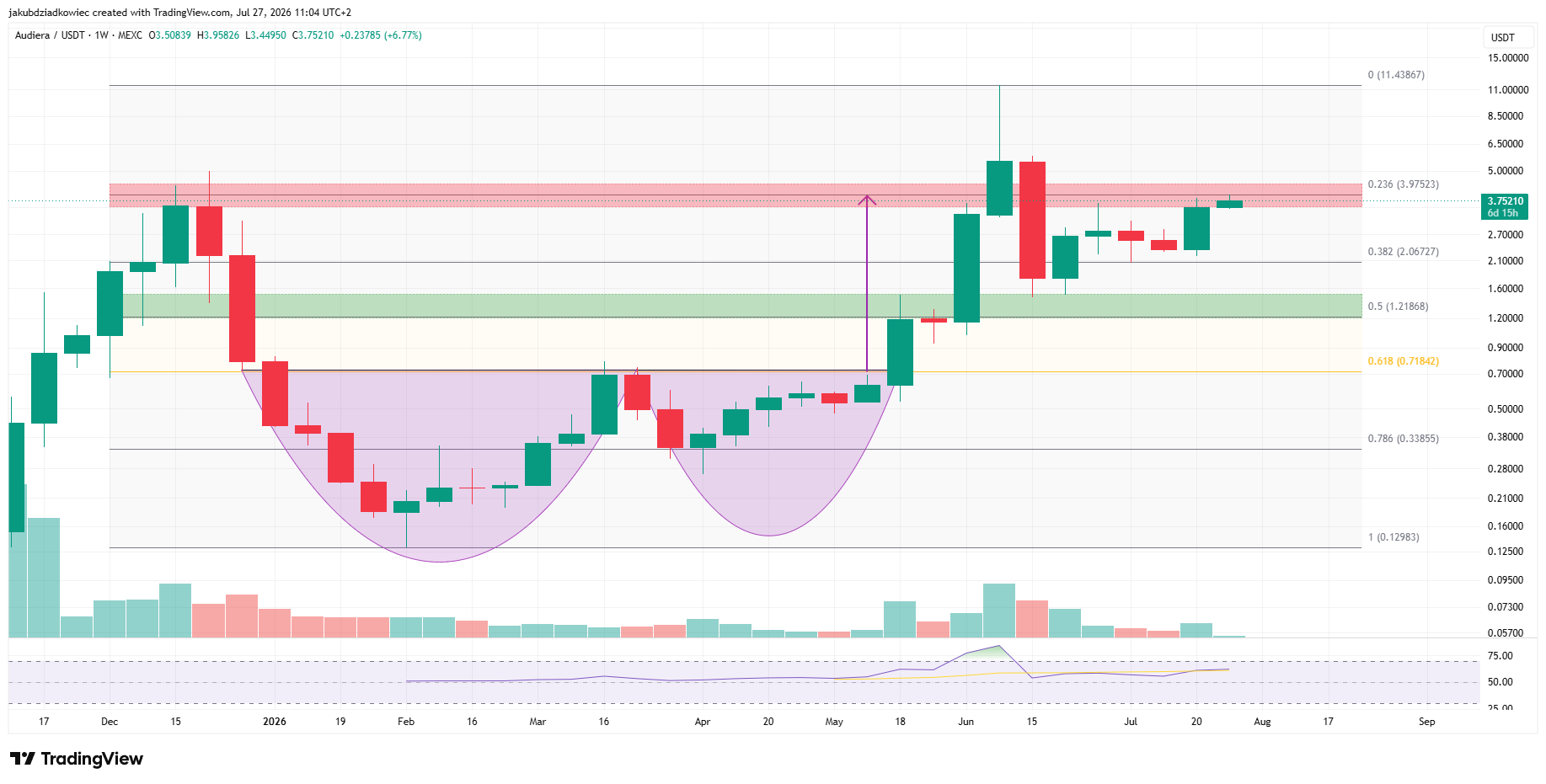
Audiera (BEAT), Ondo (ONDO), and Ethena (ENA) lead the TOP 3 altcoins to watch in the last week of July 2026 after posting weekly gains of 50%, 17%, and 14.4%.
Each token now approaches a decisive technical level. BEAT tests $4, ONDO eyes $0.46 after an accumulation breakout, and ENA challenges a downtrend that has capped its price since October 2025.
Token
Weekly Gain
Current Price
Key Level to Watch
Setup
Audiera (BEAT)
+50%
$3.78
$3.98 resistance (0.236 Fib)
Post-cup-and-handle recovery
Ondo (ONDO)
+17%
$0.41
$0.46 target (above 0.786 Fib)
Breakout from accumulation
Ethena (ENA)
+14.4%
$0.0898
$0.13 resistance
Trendline breakout attempt
Audiera (BEAT) Tests the $4 Barrier After a 50% Weekly Surge
BEAT posted the strongest weekly performance of the three, and momentum has carried into today. The token trades near $3.78 after adding 6% in the past 24 hours, per BeInCrypto market data.
The weekly chart shows a cup and handle formation that developed between January and May 2026. After the May breakout, the price reached the pattern’s $4 target in roughly three weeks.
The rally later extended to a record high of $11.44 on MEXC in June. BEAT then corrected to the 0.5 Fibonacci retracement support at $1.22, where buyers stepped in.

That bounce now faces the 0.236 Fibonacci level at $3.98, the most important resistance on the chart. Meanwhile, the Relative Strength Index (RSI) sits at 62, below overbought territory but rising. However, analysts have flagged supply-related risks after the token’s parabolic rise, so a rejection here could trigger a sharp downside.
A weekly close above $3.98 could reopen the path to price discovery. A rejection would keep $1.22 in focus as the key support.
ONDO Breaks Out of Accumulation With $0.46 in Sight
ONDO gained 17% last week and trades at $0.41, up 6% in 24 hours. The token spent January through early May inside an accumulation zone between $0.25 and $0.29 before breaking out on heavy volume.
More recently, the price bounced off the 0.382 Fibonacci retracement at $0.29. It then broke through the 0.618 Fibonacci resistance at $0.37, a level that may now act as support.

The next target sits right above the 0.786 Fibonacci at $0.44, within the resistance zone near $0.46. That would represent a gain of roughly 12% from current levels.
Volume tells a supportive story. The spike recorded between May and June is declining, yet activity remains elevated compared with the accumulation phase. In contrast, the RSI stays neutral at 55 while trending higher, suggesting the move still has room before overheating.
ENA Rounds Out the Altcoins to Watch With a Trendline Breakout
ENA, the third pick among this week’s altcoins to watch, climbed around 14.4% last week. The token trades at $0.0898, up almost 6% in 24 hours.
The weekly chart suggests ENA is breaking out from a descending resistance trendline in place since the October 2025 peak. The token also shrugged off its July token unlocks, which added over 40 million ENA to circulation without triggering a sell-off.
Resistance remains layered above. The first hurdle sits around $0.13, just above the 0.236 Fibonacci at $0.113, roughly 26% higher. Beyond that, the 0.618 Fibonacci at $0.25 and the 0.786 Fibonacci at $0.35 mark the next major barriers.

Volume has been decreasing since the June peak, which may signal a phase of accumulation. Meanwhile, the RSI has recovered to the neutral zone at 38 after months of oversold readings.
Holding the support zone near $0.07 remains essential for the bullish case. A confirmed weekly close above the trendline could target $0.13, while a breakdown below $0.07 would invalidate the recovery.
The post TOP 3 Altcoins to Watch in Last Week of July 2026 appeared first on BeInCrypto.

When it comes to triaging your financial future, I’ve got the clinical precision you need.

Nitrous oxide canisters recovered from Astley Bridge flat

10 Most Successful Global K-Pop Stars to Emerge From HYBE Corporation’s Roster of Music Labels So Far


-

 Fashion3 days ago
Weekend Open Thread: Brooks Brothers
-

 Crypto World6 days ago
Grayscale Files For Worldcoin ETF, WLD Registers Sharp Rise
-

 NewsBeat6 days ago
How a former Blue Peter presenter stunned America’s Got Talent judges
-

 Tech18 hours ago
Intel is reversing course and bringing hyper-threading back to its server chips
-

 Tech7 days ago
Sail Virtually Aboard The “Itanic” With IA-64 Emulator
-
 Tech7 days ago
Turtle Beach Command Series KB7 review: a nifty screen-equipped gaming keyboard
-
 Business6 days ago
New Jersey voter registration controversy explained: How 6,600 noncitizens got on the rolls, and what happens next
-
 Entertainment6 days ago
Johnny Depp’s R-Rated Gothic Cult Classic Gets New Release Ahead of Sydney Sweeney Remake
-

 Crypto World5 days ago
Ethics, other provisions in crypto Clarity Act to be further discussed
-

 Politics7 hours ago
Luke Littler dismantles Gerwyn Price to retain title in Blackpool
-
 NewsBeat7 days ago
Shanghai science forum photos show China’s AI and robotics advances in rivalry with US
-
 Sports22 hours ago
Commonwealth Games boxing: Jadumani Singh seals dominant 5-0 win over Pakistan’s Sumama Rehman to enter quarter-finals | Commonwealth Games News
-

 Sports4 days ago
2026 3M Open leaderboard: Scottie Scheffler finds putter in Round 1, sits three back
-

 News Videos4 days ago
The Peugeot Family: How 200 Years of an “Old Money” Dynasty Died in A Boardroom
-

 Fashion4 days ago
16 Dresses for the High Summer Event
-

 Politics1 day ago
Spain sweeps the board at 2026 World Cup with individual awards
-

 Crypto World7 days ago
Andrew Cuomo joins OKX board as crypto exchange expands in U.S.
-
 Entertainment3 days ago
A New Post-Apocalyptic Gundam Anime Series Blasts Into SDCC
-

 News Videos21 hours ago
BITCOIN JUST ENTERED THIS CRITICAL ZONE…
-

 Crypto World1 day ago
XRP Ledger adds $2.6B as RWA inflows rank second
You must be logged in to post a comment Login