
Security teams log 54% of successful attacks and alert on just 14%. The rest move through your environment unseen.
The Picus whitepaper shows how breach and attack simulation tests your SIEM and EDR rules so threats stop slipping by detection.




This messaging is cause for concern, according to ADHD specialists who spoke with WIRED.
“Stimulant medications have been in existence for nearly 100 years, and approved for use in children since the 1960s,” says Kristen Leinung, a mental health nurse practitioner and director of psychiatric services at the Northwest ADHD Treatment Center in Portland, Oregon. The drugs are well-studied for efficacy and have predictable side effects, she adds, but because they can be misused, they’re often stigmatized online. “This style of advertising does further that stigma.”
Leinung believes that with their pessimistic framing of Adderall and similar pharmaceuticals, these supplement ads could lead people to go off their medication, which can be dangerous. “We know untreated or under-treated ADHD carries a high mortality and morbidity risk,” Leinung says, decreasing life expectancy and doubling the risk of premature death; it’s associated with factors that range from less exercise and worse sleep to riskier driving and a higher likelihood of smoking.
US pharmacies have seen shortages of the stimulants Adderall, Vyvanse, Ritalin, and Concerta since 2022. Though the Drug Enforcement Administration increased production quotas last fall, various production bottlenecks have continued to create supply problems, according to the nonprofit Understood, which supports Americans with learning and thinking differences including dyslexia and ADHD.
The difficulty of accessing these medications may factor into someone’s decision to try unproven alternative treatments instead, says Cindy Goldrich, a mental health counselor, educator, and ADHD coach in Boulder, Colorado. That’s what makes the supplement ads feel “exploitative” to her.
“When someone can’t get their prescription filled and doesn’t know when they will, a product promising to fill that gap—or claiming you didn’t need the ‘harsh’ medication anyway—becomes very appealing, very fast,” she says. “It’s not just selling to people who are curious about alternatives. It’s selling to people in crisis, who are scared and out of options through a system failure that has nothing to do with whether their medication works.”
Andrew Kahn, a psychologist and associate director of expertise and behavioral health at Understood, says these supplements also lack robust regulation while suggesting, without evidence, “benefits equal to or similar to medication.” But unlike prescription and over-the-counter drugs, he explains, “supplements don’t have to prove they’re safe or effective to the FDA before they’re sold.”
That very fact can become a selling point. “People are wary of big pharma, wary of side effects, and a ‘natural’ option feels safer even when it isn’t better tested,” Goldrich says. Some of the more common ingredients in the supplements, like omega-3s, L-theanine with caffeine, and certain adaptogens “have modest supporting research as general cognitive or mood support, and there’s nothing wrong with someone using them alongside medication if their doctor is aware.” But an underlying problem, she adds, is that whether a person takes medication or supplements or both, they still need to learn skills like planning and emotional regulation.
In the MAHA era, of course, medically suspect claims often circulate unchallenged. Kennedy, who swears by dubious supplements like the synthetic dye methylene blue, has in many ways normalized these fringe products as the top authority of the vast US health care apparatus. In a statement to WIRED, HHS press secretary Emily G. Hilliard reiterated the department’s position that the nation is facing a challenge of “overmedicalization in behavioral health care,” with patients and parents not always informed about the potential hazards of psychiatric drugs. “Under Secretary Kennedy’s leadership, HHS is embedding informed consent, transparency, and evidence-based alternatives into federal policy and practice,” Hilliard said.
Leinung, however, feels people should think twice before making that decision based on a video they saw on social media. “I do worry that encouraging people to stop or avoid starting prescribed medication to treat their ADHD can negatively impact their quality of life,” she says. “I would caution any person considering stopping their prescribed stimulants to have a thorough discussion with their health care provider.”


Mountains might be havens for skiers during the winter and off-road cyclists in the summer, but the steep inclines and declines of the roads getting up to them are no friend to the average truck driver. If you happen to live in the flat expanse of land somewhere in the Midwest that’s devoid of said mountains, it’s possible you’ve never encountered a road sign regarding runaway vehicles. They’re used to warn drivers who somehow lost the ability to slow down (i.e., failed brakes) as they’re coming down the backside of a high-elevation mountain pass.
These signs are primarily intended for big rigs, but they also apply to passenger cars. Despite the rigorous federal and state laws governing the upkeep and maintenance of semitrailers, Murphy’s Law — if anything can go wrong, it will — keeps everyone on their toes. The last place you want that particular law to pop up is when you’re headed downhill, applying the brakes to maintain a proper speed limit, and suddenly they stop working. If you find yourself in such a precarious predicament, though, know that you probably have a safe way out.
A runaway truck ramp is a feature built just off the side of the road that forces a truck or car to stop safely in an emergency. While these ramps come with different design elements, most are filled with huge quantities of sand or gravel and built with an uphill slope that’s angled away from the main highway to avoid causing even more problems. Think of it as a large quicksand pit that uses a combination of friction and gravity to force a vehicle into a controlled stop.

You’ll find these (mostly) yellow warning signs in mountainous areas. Interstate 80 meanders through the Sierra Nevadas on the way to Lake Tahoe and Reno, and I-5 crosses over the Tejon Pass (aka the Grapevine) on the way to Los Angeles. In Colorado, Interstate 70 snakes over the Eisenhower Pass at over 11,000 feet. You’ll also find these signs on Monteagle Mountain (Tennessee), Mount Rose Highway (Nevada), Teton Pass (Wyoming), and Interstate 40 in North Carolina.
The first runaway truck ramp in California opened in August 1956. In July of 2026, a new type of ramp was built along westbound Loop 375, near the I-10 interchange in El Paso, Texas. It uses a series of eight energy-absorbing nets bolted to reinforced concrete walls and will safely stop a 90,000-pound truck going 90 mph. Even with Jake Brakes, which are different from regular air brakes, trucks can have a hard time slowing down on steep declines. And while most ramps use gravel or sand, some (like the one in El Paso) are built using wire nets with breakaways. Where uphill gravity ramps aren’t possible, they’ll probably be level, but will have a much longer runway, giving the vehicle ample time and space to slow down.
On I-15 through Cajon Pass in Southern California, any vehicle can use the runaway truck ramp in an emergency scenario. Such is the case in most states, but because laws vary considerably from state to state, it’s always best to check local laws to make sure. Whatever the method used, they’ll be impossible to ignore thanks to prominent warning signage.


The Coca-Cola Company has confirmed that hackers stole data from its dairy subsidiary, Fairlife, during a ransomware attack earlier this month.
In a short statement earlier today, the global beverages giant says that it is still working to restore some of the impacted systems and operations, but most of the production in the U.S. has been resumed.
Coca-Cola disclosed the cyberattack in a filing with the U.S. Securities and Exchange Commission (SEC) on July 16, revealing that a ransomware attack had disrupted production operations at Fairlife.

Fairlife is a producer of ultra-filtered milk, protein shakes, and nutritional drinks. It operates four production facilities in the U.S., and has more than $1 billion in annual retail sales.
At the time, BleepingComputer sent a request for comments regarding the attack, but we received no reply.
A few days later, the Anubis ransomware gang claimed the attack and added Fairlife to the list of victims on its extortion site. The hacker group threatened to leak one terabyte of files allegedly stolen from the company, unless Fairlife paid a ransom.
The threat actor told BleepingComputer that they had encrypted the firm’s Nutanix systems, leaving no possibility of recovery.
As soon as Coca-Cola discovered the breach, the company reported the intrusion to the authorities and did not follow the attacker’s instructions to negotiate.
BleepingComputer contacted Coca-Cola again to validate the threat actor’s allegations, but a spokesperson declined to comment.
“The company previously disclosed that Fairlife experienced a ransomware event,” reads the Coca-Cola statement.
“This event involved access by an unauthorized third party to a portion of the company’s systems and taking of certain data, and a temporary suspension of production operations.”
Regarding Fairlife product availability, Coca-Cola says existing inventory helped cover temporary shortages caused by the production disruption, while product quality and safety were never jeopardized.
The timer that Anubis ransomware had previously set for the public release of the stolen data expired earlier today, and the data is now available for download.

Security teams log 54% of successful attacks and alert on just 14%. The rest move through your environment unseen.
The Picus whitepaper shows how breach and attack simulation tests your SIEM and EDR rules so threats stop slipping by detection.

Winners & losers: For the first time in nearly two decades, Mojang has announced a significant change in Minecraft’s hardware requirements, a rare move for one of the biggest gaming products in history. The Microsoft-owned studio wants to future-proof Minecraft: Java Edition, but players running older hardware won’t be cheering this time around.
Minecraft: Java Edition now officially recommends 16GB of RAM, and that’s just the starting point. Mojang recently explained that the wildly popular sandbox game is getting a more modern baseline for its system requirements, acknowledging that some players with aging systems will be disappointed as the company works to keep improving its blocky experience for everyone else.
The update arrives after 17 years without a change to Java Edition’s requirements, a long stretch by any video game’s standards. After nearly two decades, Minecraft has essentially grown out of its shoes: players will need stronger PCs to run future builds – no matter the impossibly expensive costs of crucial silicon components such as memory chips and GPUs.

Minecraft’s system requirements officially changed on July 21, covering both the “Fast” and “Fancy” presets. The game’s official store page now lists a 1080p, 30 FPS target for the Fast preset, and a 1080p, 60 FPS target for the Fancy preset. The Fast preset calls for 8GB of RAM with a discrete GPU, or 12GB with an integrated GPU. The Fancy preset, meanwhile, recommends 16GB of RAM for comfortably running Java Edition for the foreseeable future.
A 16GB recommendation might sound like a lot, especially considering Java Edition currently allocates only around 4GB of system memory by default. Mojang is also updating its CPU and GPU requirements, with stronger, modern processors, either x86-64 or Arm64, now needed to properly run the Fancy preset.
Minecraft: Bedrock Edition still has lower system requirements than Java Edition, though players will need the latter to use custom mods on PC. Mojang says the new requirements are still modest compared to modern AAA games, meaning Java Edition should keep running smoothly on most well-equipped gaming systems.

The company explained: “We want to make it clear for players what kind of computer can run Java Edition smoothly. While older devices may still launch the game, they will struggle to deliver a good experience. This can lead to low frame rates, visual issues, long loading times, or performance that doesn’t match what players expect.”
Guaranteed performance on older hardware is officially a thing of the past, but Mojang argues that’s for the best. Leaving aging systems behind will let developers focus on meaningful technical upgrades, starting with the shift from OpenGL to Vulkan.
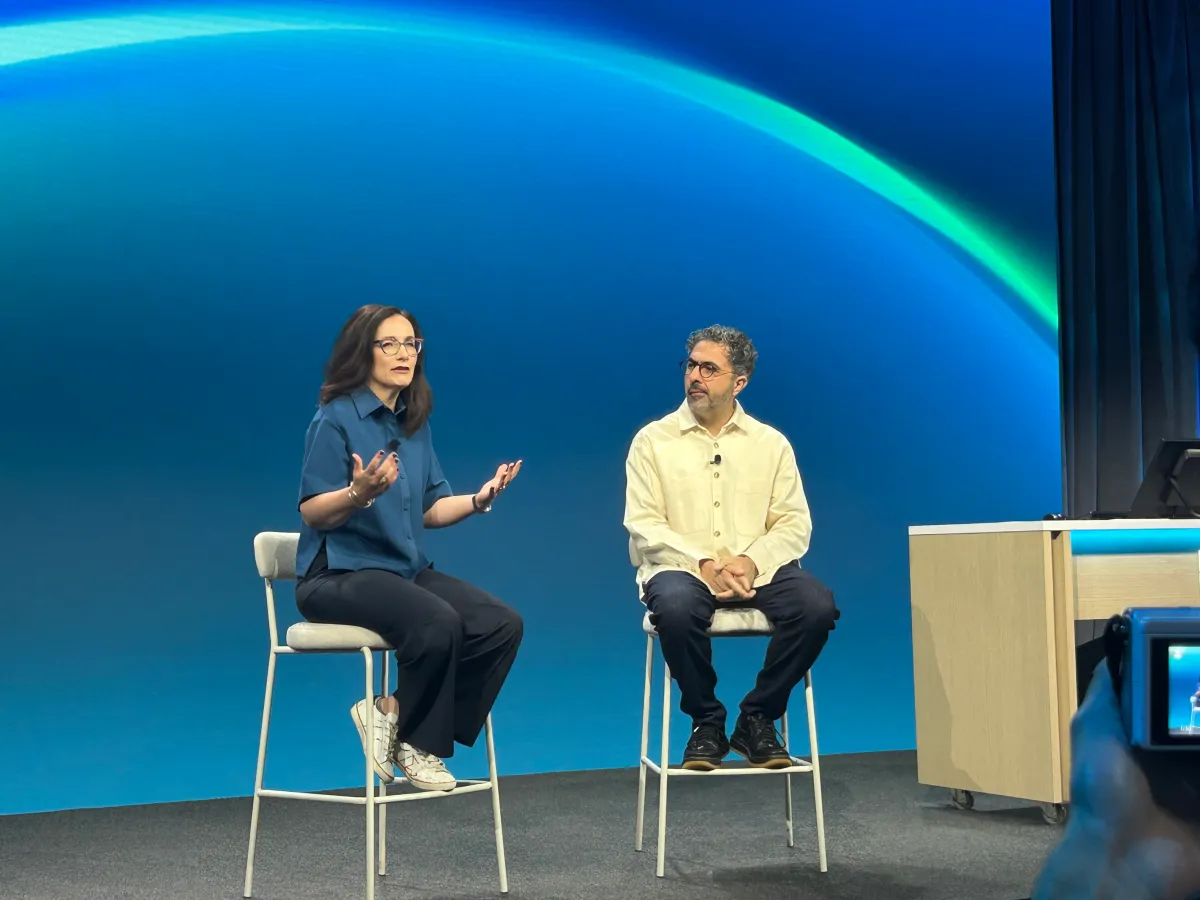
Microsoft on Monday launched its first cybersecurity-specialized model alongside a new AI cybersecurity platform at a small event in San Francisco, taking a big swipe at major players in the space — namely Anthropic, Google and OpenAI.
The company describes MAI-Cyber-1-Flash as a model that’s built “to find challenging vulnerabilities in complex codebases.” The model is built to animate MDASH, Microsoft’s harness dedicated to software vulnerability identification and remediation.
The new security platform is dubbed Perception, and it’s designed to deploy teams of agents to assist with and automate various security workflows, including identifying and remediating bugs. The platform can also integrate with MDASH.
The company claims MAI-Cyber-1-Flash is significantly more powerful (and more cost-effective) than competitor models, based on its performance on an established AI cybersecurity benchmark.
“We’re very very excited to announce our results,” said Mustafa Suleyman, the co-founder of DeepMind and current CEO of Microsoft AI. “We have MAI-1 Cyber Flash binded [sic] with GPT 5.4 inside of the MDASH harness — which beats out Gemini, GPT 5.5 Cyber, GPT 5.6 Sol, and Mythos 5 on Cyber Gym, which is the primary benchmark that we all use. The golden benchmark.”
“We’re shipping this into production immediately,” he added.
Noting that hackers are increasingly using AI in their cyberattacks, Hayete Gallot, Microsoft’s vice president for security, described Perception as a way for enterprise defenders to “defend against AI with AI at the scale and speed that the attackers have.”
Perception uses agentic red teams, blue teams, and green teams. The red teams can provide detailed simulations of potential attacks — providing context about potential threat actors and the likely vulnerabilities that they might exploit. Blue teams are dedicated to detecting and triaging existing bugs, while green teams take “corrective actions” against those bugs.
Dave Weston, the lead engineer for Perception, described the platform as a massive efficiency upgrade for corporate defenders. “We’ve gone from this taking hours and hours of manual work from multiple specialized folks across the security organization — appsec hunters, remediation engineers, you name it — and in minutes, we have a fix for all of this. Not only do we discover the issues and prioritize them, but we have detection, posture fixing, and even a code fix.”
Though AI has offered new defensive capabilities to companies, its availability to cybercriminals has given rise to a dazzling array of potential threats.
Microsoft’s new security tools, which the company said will be available in preview on November 3, will enter an increasingly crowded field of AI cybersecurity solutions. Earlier this year, Anthropic launched Mythos, a security platform that was released to a small coterie of partner organizations through a program called Glasswing. OpenAI has also launched its own security solution in May through a program called Day Break.
When you purchase through links in our articles, we may earn a small commission. This doesn’t affect our editorial independence.


Apple is being sued by three people who claim approximately $1.8 million in Bitcoin was stolen after downloading and using a fraudulent Sparrow Wallet application from the App Store.
The complaint, filed on July 24 in California, alleges that Apple failed to adequately review and monitor applications distributed through the App Store while promoting the marketplace as a safe and trusted source for software.
Plaintiffs James Ramirez, Christopher Ellis, and Jalen Delgado say the malicious application impersonated the legitimate Sparrow Bitcoin wallet and instructed them to enter their seed phrases.
After entering those secret recovery credentials, the victims allegedly had their Bitcoin transferred to cryptocurrency wallets controlled by the scammers.
The legitimate Sparrow Wallet is a desktop application available for Windows, macOS, and Linux, and does not offer an iOS version.
However, Sparrow Wallet’s developer says that scammers have repeatedly published applications in Apple’s App Store that impersonate the cryptocurrency wallet.
According to the complaint, Delgado downloaded the fraudulent application on or around May 1, 2025, entered his seed phrase, and shortly afterward discovered that 1.05033242 Bitcoin, worth approximately $120,000, had been transferred to a scammer.
Ramirez allegedly downloaded the app on July 25, 2025, and lost 7.4 Bitcoin, valued at approximately $875,000. The complaint says Ramirez reported the fraudulent app and theft to Apple that same day, but alleges Apple never contacted him regarding that report or subsequent reports.
Just over a week later, on or around August 3, Ellis allegedly also installed the Sparrow app from the App Store. After entering his seed phrase, Ellis discovered that approximately $840,000 in cryptocurrency had been transferred to a scammer and immediately reported the app and theft to Apple.
The complaint also claims that Apple ranked the fraudulent Sparrow app and included it in curated cryptocurrency app collections, effectively recommending it alongside legitimate applications.
However, Apple had allegedly been warned about fraudulent Sparrow Wallet apps more than a year before the plaintiffs’ losses.
The complaint includes a January 6, 2024 post from Craig Raw, the developer of the legitimate Sparrow Wallet application, who said a scam Sparrow Wallet app remained available in the App Store despite him and others reporting it weeks earlier.
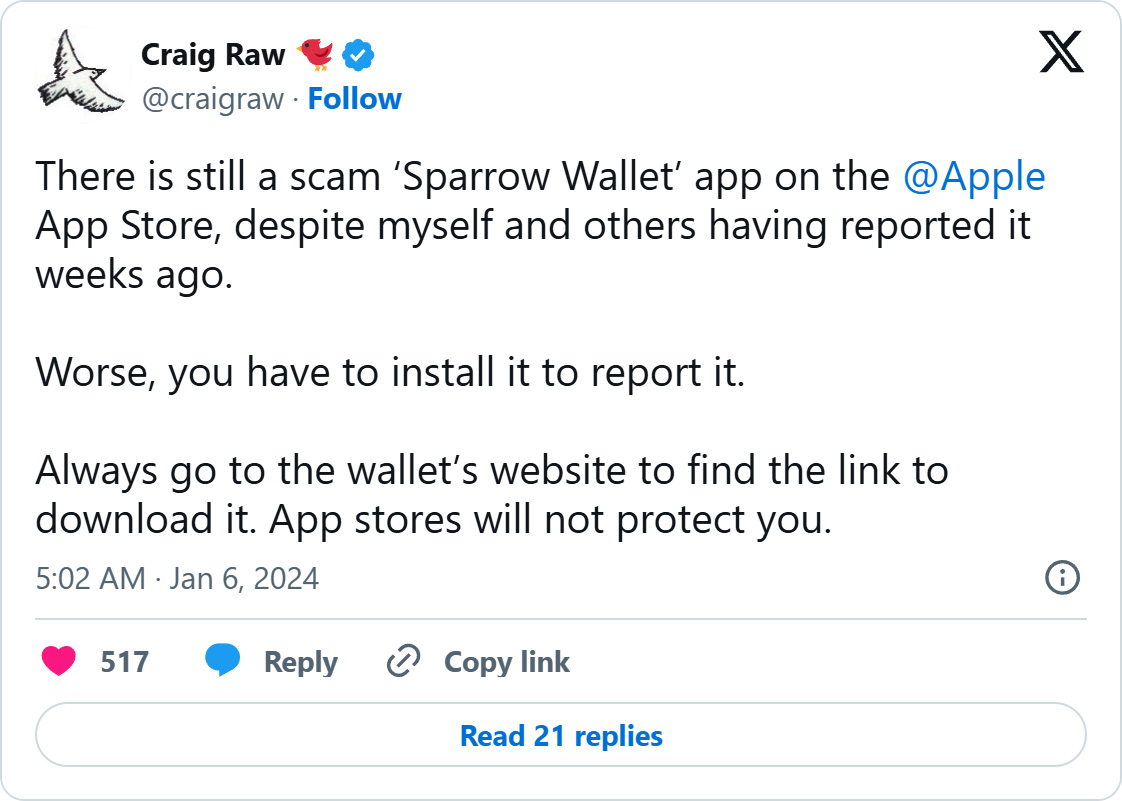
Raw also warned users to only obtain Sparrow Wallet through its official website rather than trusting an application solely because it was available through an app store.
MacRumors also shared a more recent attempt by Raw to protect users from the fake Sparrow applications on the Apple App Store by submitting an unpublished placeholder app that explained that mobile apps using the “Sparrow Wallet” name were fake.
According to Raw, Apple initially flagged his developer account for termination over alleged dishonest activity, but later reversed the decision.
Apple told BleepingComputer that it acted quickly to remove applications impersonating Sparrow Wallet and terminated the developer accounts associated with them.
Apple also said developers who believe content distributed through its services infringes their intellectual property can submit a dispute to the company’s legal department.
Customers can separately report suspected App Store scams and fraud through Apple’s Report a Problem service, and Apple said it takes immediate action when applications are found to violate its guidelines.
The plaintiffs are seeking reimbursement for the stolen cryptocurrency, compensatory and punitive damages, restitution, attorneys’ fees, and other damages.
They are also asking the court to require Apple to improve and publicly disclose its procedures for detecting and removing fraudulent applications, while also introducing warnings about the risks associated with cryptocurrency apps.
Security teams log 54% of successful attacks and alert on just 14%. The rest move through your environment unseen.
The Picus whitepaper shows how breach and attack simulation tests your SIEM and EDR rules so threats stop slipping by detection.
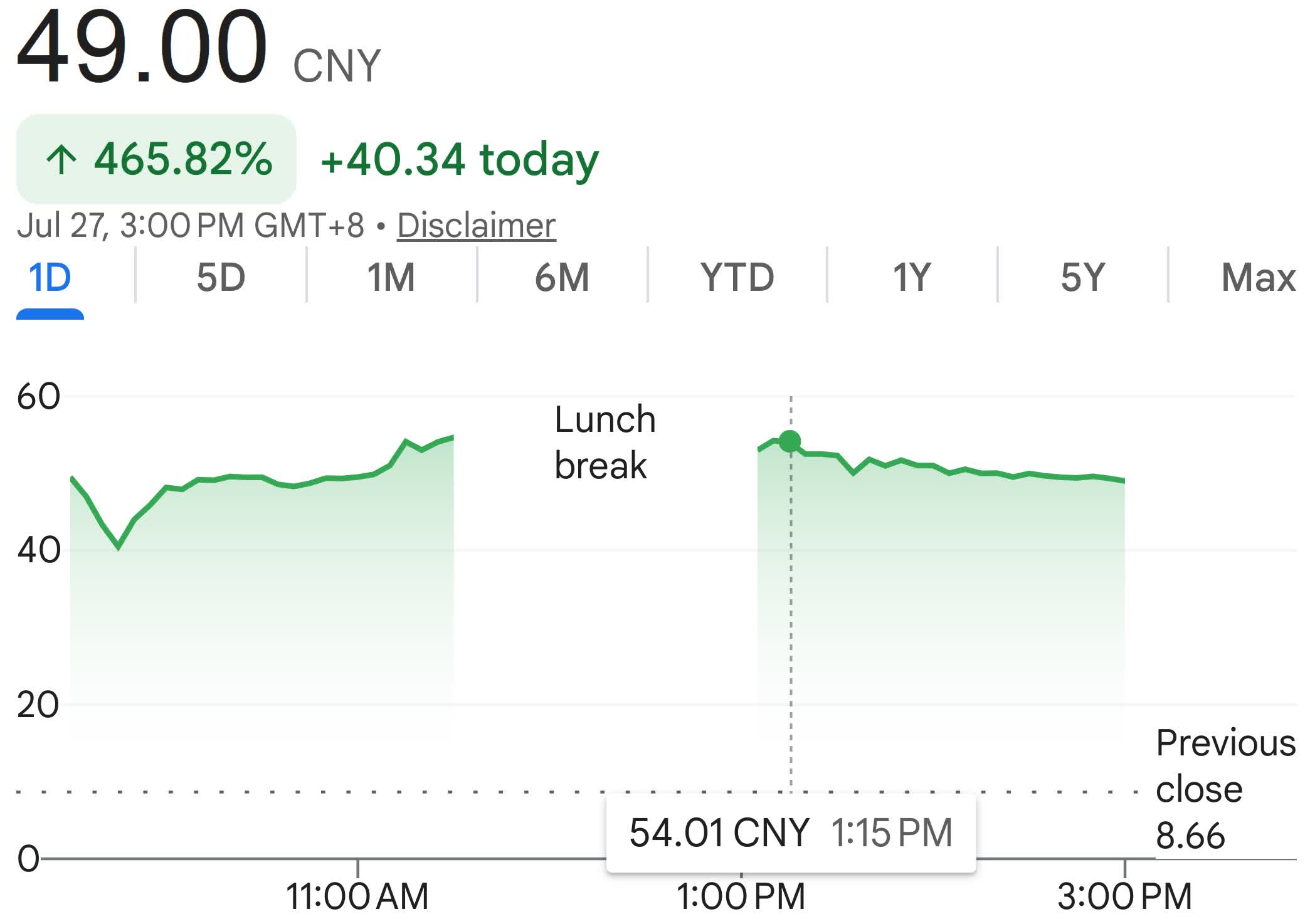
What just happened? Chinese memory maker CXMT is now the country’s most valuable company after an impressive first day on the market that exceeded expectations. The stock’s initial public offering price was set at CNY 8.66 but ended up closing at CNY 49.00 – a gain of nearly 466%.
CXMT, short for ChangXin Memory Technologies, is one of several major players in the memory market that are profiting from the ongoing AI boom. At present, CXMT ranks fourth overall with an eight percent share behind Samsung, SK Hynix, and Micron with shares of 36%, 29%, and 24%, respectively.
Larry Yang, chief economist of First Seafront Fund Management, told AFP that CXMT’s first-day performance reflects investors’ overwhelmingly bullish sentiment regarding the company.
The memory maker closed the successful day of trading with a market cap of around 3.65 trillion yuan, or roughly $540 billion. Fortune said it was mainland China’s second largest IPO ever, following that of Agricultural Bank of China back in 2010.
Yang added that the newly raised money will give CXMT the ability to expand production capacity, in addition to boosting its global influence. Being able to tap a homegrown hardware maker should also benefit China in its AI race against the US.
CXMT was founded in 2016, just in time to leverage the pandemic-fueled PC buying surge. Then came the AI boom and as you can imagine, hardware makers and investors have been singing all the way to the bank. Consumers, meanwhile, have been met with soaring prices on smartphones, game consoles, and virtually everything else that relies on a memory chip to operate.
Worse yet, there appears to be no relief in sight. Earlier this month, SK Hynix said it expects the memory crunch to peak in 2027 and continue through at least 2030.
According to AFP, Apple is now testing DRAM chips from CXMT for use in future products. Signing on as a supplier for the Cupertino-based company is no doubt high on CXMT’s list of short-term goals.

What just happened? Samsung Electronics has expanded its semiconductor partnership with Broadcom to focus on AI chips, bringing together chip design, manufacturing, and memory in a deal that could run through the end of the decade. The companies said the agreement covers memory chips, contract manufacturing, and advanced packaging, with total activity expected to exceed $200 billion by 2030. The partnership gives Broadcom deeper access to Samsung’s production capabilities, while Samsung secures longer-term demand for its most advanced fabs.
At a technical level, the deal is built around closer integration between Broadcom’s ASIC designs and Samsung’s manufacturing stack. Broadcom’s next-generation communications chips will be produced using Samsung’s sub-2-nanometer process, putting them at the leading edge of chip scaling, where efficiency and heat management are becoming increasingly challenging.
The two companies are also working on next-generation high-bandwidth memory, a critical component for AI systems that need to move large amounts of data quickly. As models grow larger, memory bandwidth has become a limiting factor, making tighter coordination between logic chips and memory increasingly important.
The partnership reflects a broader shift in how AI hardware is being developed. Large tech companies are moving toward custom-built chips designed for specific workloads rather than relying solely on general-purpose GPUs. That trend is pushing chip designers and manufacturers toward closer, longer-term collaborations.

For Samsung, the deal is also about strengthening its position in the foundry market, where it competes with TSMC. Securing consistent, high-volume work from a company like Broadcom could help improve utilization at its advanced manufacturing facilities.
Samsung has been trying to attract more customers for its most advanced nodes. Earlier this year, the company said it expected to win additional 2-nanometer orders following discussions with major tech firms. Its leadership has also pointed to ongoing talks around next-generation memory, including HBM4E and HBM5.

Samsung has landed large contracts before, including a $16.5 billion deal to produce chips for Tesla. But the Broadcom agreement stands out for its scope, covering multiple parts of the semiconductor process rather than a single product line.
The timing comes as demand for AI infrastructure continues to grow and become more specialized. Performance gains are increasingly tied to how chips, memory, and packaging work together rather than improvements in any single component.

— Jeff Lyon is now chief information security officer at Seattle’s Remitly. Lyon joins from Coinbase, where he was head of infrastructure security for two years. Past roles include security leadership at Robinhood and Amazon Web Services. Lyon also served as a petty officer with the U.S. Navy for more than nine years.
“Remitly’s mission to transform lives through trusted financial services that transcend borders resonates deeply and is a natural progression of my work building security organizations, secure applications, and safe-by-default platforms across fintech,” Lyon said in a LinkedIn post.
Remitly has seen a reshuffling of leadership since co-founder and CEO Matt Oppenheimer departed in February. Ankur Sinha resigned as chief product and technology officer in June, and Rina Hahn left as chief marketing officer earlier this month. Veteran tech and finance executive Sebastian Gunningham now leads the company.

— Joseph Williams, a longtime Seattle-area leader at the intersection of tech and public service, was named director of Cybersecurity Programs at Western Washington University.
Williams most recently served as the governance, risk management and compliance (GRC) practice director at consulting firm Artemis Connection. His varied career includes working as information and communications technology sector lead for the Washington State Department of Commerce; Seattle office director for Pacific Northwest National Laboratory; and divisional CTO at Microsoft.
In 2025, Williams was named GeekWire’s Public Policy Champion for Innovation.
Williams’ experience “sets the stage for propelling our cybersecurity programs to new heights as we seek to equip and empower our graduates to be successful in exciting careers in a fast-changing technology landscape,” said Filip Jagodzinski, computer sciences’ department chair.

— Kartik Murthy was named vice president of product for Yoodli, a roleplay platform using AI to help people improve their professional skills.
Murthy joins the Seattle-based startup from the cybersecurity company Coalition, where he served as head of product for four years. He has held product management roles at companies including Meta, Google and Uber.
“In a world where many AI products try to automate workflows, Yoodli is taking a bet on humans and it’s already paying off,” Murthy said on LinkedIn.

— Phoebe Weiser is now an investor at the longtime Seattle venture firm Madrona. She joins from Databricks, where she worked as a product manager, and previously held internship and full-time roles at Microsoft.
“After building in security at Microsoft and data engineering at Databricks, I’m looking forward to partnering with the next generation of founders. I’m especially grateful to the managers, mentors, and teammates over the past few years for everything they taught me about building products at scale,” she said on LinkedIn.
— Salman Taherian is now head of AI for Grant Thornton, a Chicago firm offering audit, assurance, tax and advisory services. Taherian, who is based at the company’s office in Bellevue, Wash., joins from Amazon Web Services where he was global head of agentic AI and strategic partner accounts. Past employers include Wipro Limited and Relx.

Flexible printed circuit boards are a fascinating technique for making electronics venture beyond the two-dimensional, but surprisingly they’re not something many of us have worked with. [Jessica Stanley] gave a talk at the recent Electromagnetic Field event in the UK, exploring the different ways to make your electronics bend.
She starts with an overview of flexible electronics, detailing the techniques used with conventional polyimide substrates and etched copper. We’re particularly enamoured of a stretchable PCB made by coiling a flexible circuit round a piece of elastic. Since she’s looking for techniques accessible to everyone that don’t either cost a fortune or require dangerous chemicals we look at conductive paint and electrolysis, before arriving at using a vinyl cutter to create adhesive traces.
We’ve no doubt all noticed that flexible PCBs can be ordered from the usual fabrication houses at a price, but the value in this talk lies in reminding the viewer that this is not the only path. She demonstrates well that simple flexible PCBs can be within the reach of almost anyone, which is perhaps the encouragement needed for people to try this medium. The full talk is below the break.


ai and ml
The Open Security AI Alliance says the Hugging Face/OpenAI mess proves frontier labs can’t be trusted to properly secure sensitive systems
In the wake of OpenAI agents attacking Hugging Face, Nvidia has recruited a new posse of partners to promote open source models as the security solution the industry needs. The AI arms dealer announced the foundation, the Open Secure AI Alliance, in a blog post today, describing the mission of the group being “to ensure defenders everywhere have open, frontier tools they can trust and control.”
Partners in the group are numerous, ranging from established tech giants like Microsoft, Red Hat, HPE, IBM, and Adobe to newer groups like Palantir, SpacexAI, Hugging Face, and The Linux Foundation. What all the founding members have in common, Nvidia said, is that they agree open source AI models are a fundamental part of modern cybersecurity, just like prior open source tech has been for the infosec space.
“The United States and its partners now face a choice in AI security: whether the defenses that protect our infrastructure will sit inside a few opaque systems or be built on open models, harnesses and tools that any defender can study, adapt and deploy,” Nvidia said in the announcement.
The claims in many ways echo the pleadings from tech industry heavyweights made in an open letter to US government regulators last week. That letter, signed by many of the same companies that are part of the founding OSAA cadre, essentially argues that regulators should ensure Anthropic, Google, and OpenAI don’t end up with total control of the US AI market, and that open-weight models should be given a seat at the table, too.
The new alliance is arguing that, not only do open-weight models need to be allowed to proliferate in the US, but they also need to be considered a fundamental part of the security puzzle.
For those unfamiliar with the Hugging Face incident, a group of autonomous OpenAI agents, operating in a sandbox and stripped of guardrails to test their full capability to solve cybersecurity puzzles, exploited a pair of zero-days to escape and gain access to the internet. For some reason, the bots thought the solution to the problems they were posed could be found in Hugging Face systems, so they broke in and accessed a bunch of private information and hijacked some credentials.
When Hugging Face turned to closed-source US frontier AI lab bots to examine the incident and help figure out what happened, those tools declined to help because they thought the data Hugging Face was trying to examine was itself malicious. Hugging Face turned to Chinese-made GLM 5.2, hosted on its own infrastructure, to figure things out.
“That incident showed a practical truth,” said Nvidia. “When defenders cannot inspect, adapt and run advanced AI on their own infrastructure, their ability to respond is constrained at exactly the moment speed matters most.”
Only open-source AI models, which China leads development on, can fill that role, the OSAA argues, and it’s prepared to counter those who say open models are a threat: Just look at what happened last week and it’s readily apparent that closed source models are dangerous too.
The Alliance is pooling its efforts to give security pros access to essential open tools. Nvidia said that it’s participating by releasing its Object-Oriented Agent project on GitHub, HPE is contributing its SPIFFE/SPIRE zero-trust AI identity framework, Hugging Face has handed its Safetensors transparent AI model weight formatting to the PyTorch Foundation, and SpaceXAI has open-sourced Grok Build (though the reason behind that doesn’t appear to be entirely benevolent).
In addition, IBM and Red Hat have released Lightwell, an automated open-source vulnerability remediation platform, while Microsoft has come out with MDASH, a multi-model agentic scanning harness to automate bug discovery and remediation. Those efforts, while not open source themselves, are still a sign that Alliance members “are building an open defense stack,” Nvidia said.
The OSAA ended its announcement with another call for policymakers not simply ban open-source AI models, as doing so “would weaken defensive capacity and risk concentrating power, dependence, and vulnerability in a few closed providers,” the group said.
Many providers, as we saw last week, are more concerned with protecting themselves than helping victims of autonomous cyber attacks respond quickly.
Clement Delangue, cofounder and CEO of Hugging Face, said in a post on X that he spoke to OpenAI over the weekend about last week’s incident and asked the company to provide funding to support the development of better open-source AI cyber defenses. It’s not clear if the company plans to fulfill that request; it’s not a founding member of the Nvidia-led OSAA. Neither is Google or Anthropic, for that matter.
We reached out to all three companies for their take on the new initiative, but didn’t hear back from any of them. ®




Weekend Open Thread: Brooks Brothers


Grayscale Files For Worldcoin ETF, WLD Registers Sharp Rise


How a former Blue Peter presenter stunned America’s Got Talent judges


Intel is reversing course and bringing hyper-threading back to its server chips


Sail Virtually Aboard The “Itanic” With IA-64 Emulator

Turtle Beach Command Series KB7 review: a nifty screen-equipped gaming keyboard

New Jersey voter registration controversy explained: How 6,600 noncitizens got on the rolls, and what happens next

Johnny Depp’s R-Rated Gothic Cult Classic Gets New Release Ahead of Sydney Sweeney Remake


Ethics, other provisions in crypto Clarity Act to be further discussed


Luke Littler dismantles Gerwyn Price to retain title in Blackpool

Shanghai science forum photos show China’s AI and robotics advances in rivalry with US

Commonwealth Games boxing: Jadumani Singh seals dominant 5-0 win over Pakistan’s Sumama Rehman to enter quarter-finals | Commonwealth Games News


2026 3M Open leaderboard: Scottie Scheffler finds putter in Round 1, sits three back


The Peugeot Family: How 200 Years of an “Old Money” Dynasty Died in A Boardroom


Spain sweeps the board at 2026 World Cup with individual awards


16 Dresses for the High Summer Event

A New Post-Apocalyptic Gundam Anime Series Blasts Into SDCC


Andrew Cuomo joins OKX board as crypto exchange expands in U.S.


BITCOIN JUST ENTERED THIS CRITICAL ZONE…


XRP Ledger adds $2.6B as RWA inflows rank second


You must be logged in to post a comment Login