Connect with us

Tech

Iran-linked CyberAv3ngers suspected in attacks on Minnesota water systems

Published

on

Security

More than 30 facilities disrupted in ‘coordinated cyberattack,’ though officials have yet to name a culprit

Security researchers at Tenable suspect the Iran-linked faux hacktivist outfit CyberAv3ngers was behind the cyberattack that disrupted more than 30 Minnesota water facilities.

Neither state-level nor federal officials have made any claims regarding attribution for the attacks, however, Tenable reckons the operational pattern is consistent with the crew’s previous raids, noting the timing relative to recent government warnings.

Advertisement

The Cybersecurity and Infrastructure Security Agency (CISA) updated an advisory on Iran-linked attackers targeting programmable logic controllers (PLCs) across critical infrastructure on July 22, four days before Minnesota said the attacks targeted its systems.

The advisory warned that Iran-linked hackers were attempting to disrupt operations using tactics previously associated with CyberAv3ngers. Government facilities, water and wastewater systems, and energy providers were among those urged to remain on high alert.

What happened in Minnesota?

On July 26 and 27, more than 30 community water systems across Minnesota were disrupted by what officials called “a coordinated cyberattack” targeting operational technology (OT).

Minnesota IT Services (MNIT), the state’s IT agency, said the Department of Health is working with the affected water facilities to ensure public health is maintained. No cities have yet asked citizens to modify the amount of drinking water they consume, per MNIT’s latest update.

Advertisement

The agency did not offer many other details about the attacks, other than to mention all the different agencies, organizations, and bodies it is working with as part of the investigation.

One of the first cities to report issues, Braham, warned that its water reserves were limited in its initial notice. Citizens were asked not to water their lawns or use water for recreational purposes, although the problems were resolved the same day. 

No such directives were issued in other affected cities. Maple Plain declared a state of emergency, allowing it greater flexibility to coordinate resources, but did not ask residents to adjust their consumption. 

The same was true in the Twin Cities suburb of Plymouth and in South St. Paul, which both confirmed cyber-related problems on July 27 but did not ask residents to curb water use.

Advertisement

“Cyberattacks against critical infrastructure require a coordinated, whole-of-government response,” said John Israel, MNIT assistant commissioner and Minnesota CISO.

“MNIT is working side by side with our partners to share intelligence, support affected communities, and help utilities restore operations safely while strengthening defenses against future attacks. 

“This incident demonstrates why Minnesota has invested in strong cybersecurity capabilities and partnerships. Our response worked as intended, enabling agencies at every level of government to rapidly coordinate, contain the incident, and help prevent more serious impacts to critical services.”

What is CyberAv3ngers?

First identified around 2020, CyberAv3ngers is widely believed to be linked to Iran’s Islamic Revolutionary Guard Corps (IRGC), specifically its Cyber-Electronic Command division (IRGC-CEC).

Advertisement

For the first two years, the group began as a “propaganda persona,” as Tenable puts it, claiming disruptive attacks on Israeli infrastructure – claims that were later debunked as fabrications.

Its first sustained campaign came in November 2023, when it compromised PLCs at the Municipal Water Authority of Aliquippa, Pennsylvania, defacing them anti-Israel messages.

Tenable said CyberAv3ngers compromised at least 75 Unitronics Vision Series PLCs across the United States, Israel, the United Kingdom, and Ireland as part of the campaign. They did so by exploiting default passwords.

Between 2024 and 2025, the crew developed the IOCONTROL malware kit, built for attacks on OT and Internet of Things (IoT) devices. OpenAI said in 2024 that the group’s members used ChatGPT in the development process.

Advertisement

CyberAv3ngers stepped up its activity in 2026, targeting US critical infrastructure through Rockwell Automation/Allen-Bradley PLCs from March onward. CISA’s July 22 update added Schneider Electric and Siemens equipment to the list of potential targets.

In some cases, the attacks – which targeted multiple critical infrastructure sectors – disrupted operations at affected facilities, federal officials said, though they offered no specifics on what those disruptions entailed.

CyberAv3ngers is known for targeting small water and municipal facilities, which experts believe are among the lowest-hanging fruit in US critical infrastructure.

Many small and rural facilities lack dedicated cybersecurity resources. Tenable said some operators manage OT environments using remote-access software such as TeamViewer and AnyDesk or leave their PLCs exposed to the web.

Advertisement

“These access methods bypass enterprise security controls entirely, creating an attack surface that is invisible to conventional security monitoring,” Tenable said.

Poor segmentation between IT and OT environments can also allow a single intrusion to spread across much of the network. ®

Source link

Advertisement
Continue Reading
Click to comment

You must be logged in to post a comment Login

Leave a Reply

Tech

X Says Australia’s Under-16 Social Media Ban Risks Interfering With Foreign Law

Published

on

X has a new argument against sweeping underage social media bans that would limit usage of its platform: They interfere with international law.

The social media platform, which sits within Elon Musk’s SpaceX, issued a submission to the Australian parliament published Tuesday that called for the government to drop efforts to strengthen its underage social media ban. It complained that the proposals to increase pressure on sites to demonstrate efforts to crack down on underage access are unnecessary, ill-suited, unfair, and could violate privacy rights.

X pushed back against the “highly invasive” information gathering powers the proposed amendment would allow, accusing the commissioner of having “seemingly no understanding” of how this would work for the platforms and no safeguards for confidential and commercially sensitive information. Demanding data, documents, and compliance evidence from non-Australians in other countries could cause issues “for the comity of nations,” the firm also warned.

Australia is leading a growing global movement to restrict children’s access to social media, after banning under-16-year-olds from the sites in December. In May, the country ordered X to pay a $463,000 fine for failing to comply with child safety measures. The country’s internet regulator, eSafety, first issued the fine in 2023, claiming X did not respond sufficiently to a request for information on how it was tackling the spread of online child sexual abuse content, submitted one month before Elon Musk took over Twitter, now X.

Advertisement

X has previously criticized the country’s “excessive” penalty regime and complained in the most recent submission that a proposal to increase penalties against individuals is “entirely unjustified and disproportionate.”

Musk has been a particularly vocal critic of Australia’s bill to make 16 the minimum age for social media. “Seems like a backdoor way to control access to the Internet by all Australians,” he wrote on X when the legislation was announced in late 2024. When Spanish prime minister Pedro Sánchez announced similar measures in February of this year, Musk called him a “tyrant” and “true fascist totalitarian.”

While many digital rights campaigners believe blanket age bans on social media are “problematic,” the information-gathering powers are not the issue, says Stefania Di Stefano, a researcher in international law and technologies.

“For me, the complete ban from social media on children and minors is problematic from an international human rights perspective,” says Di Stefano. “It is disproportionate with respect to the right of children to exercise their right to freedom of expression, their right to access information, their right to association, and so on and so forth.”

Advertisement

But Julia Hörnle, a professor of internet law at Queen Mary University of London, is skeptical about X’s submission. “A regulator in Australia ordering X to disclose a document in relation to their business activities in Australia, that’s perfectly fine,” she tells WIRED. “From all the data in the possession of the social media company, they can distinguish between Australian and non-Australian children, and therefore keep regulation to Australia.”

Source link

Continue Reading

Tech

Logitech to ship mice with replaceable batteries in Europe only, following Nintendo

Published

on

In brief: EU regulations will soon require more devices to feature replaceable batteries, prompting some manufacturers to comply in advance. However, tech companies are adopting new repairability standards only where required by law, with Logitech arguing that limiting repairability is in users’ best interests.

Logitech recently told The Verge that some of its mice will soon feature replaceable lithium-ion batteries, but the new models will only be available in Europe. Like Nintendo, the company appears to be doing the bare minimum to satisfy regulators in certain markets.

The company’s new head of gaming, Robin Piispanen, confirmed the move to the outlet while discussing right-to-repair and Logitech’s future gaming hardware plans. While the company is adding user-replaceable batteries to its mice to comply with an EU law that takes effect next year, Piispanen argues that non-replaceable batteries offer certain advantages.

He confirmed that the new European models will not only be more expensive to manufacture, but also heavier and sturdier to minimize the risk of accidental puncture. Lithium-ion batteries are a well-known fire hazard.

Advertisement

While Logitech’s gaming boss agrees that replaceable batteries make sense for expensive devices such as laptops and smartphones, he expects users to replace $50-$100 mice more often than they replace their batteries. Despite saying he supports the right to repair, Piispanen argues that making longer-lasting mice should be a higher priority than allowing users to replace individual components.

Also Read – The Best Mouse: Our Favorite Mice for Work and Play

From there, he unsurprisingly argued that users are more likely to damage mice irreversibly when attempting to repair switches or grips. However, Piispanen did not discuss the possibility of giving third-party repair shops better access to replacement parts.

Logitech’s decision echoes Nintendo’s plans to ship a new, Europe-only version of the Switch 2 with replaceable batteries for both the console and Joy-Cons. However, rather than produce a new EU-compliant version of the original Switch, the company will simply end production of the 2017 handheld in that market.

Advertisement

Piispanen also briefly discussed Logitech’s short-lived handheld gaming venture with The Verge. The company released the streaming-focused G Cloud in 2022, but Piispanen admitted that only roughly 20% of buyers still use it, and Logitech likely won’t develop a follow-up anytime soon. The gaming executive acknowledged that cloud gaming remains a difficult business, with Microsoft and Nvidia among the only major players still operating in the space.

The EU’s upcoming battery legislation aims to reduce e-waste by allowing users and repair shops to replace dead batteries rather than sending devices to landfills. The law is set to take effect in February 2027.

Source link

Advertisement
Continue Reading

Tech

Comparing the Top Skin Trading Platforms: Which One Is Right for You?

Published

on

Every CS2 player has their own trade goals. Some people want to get better skins, while others want a quick and easy swap. There are a lot of trading sites out there, so picking the best one can be hard. It is good to look at how a platform does in the things that matter, like flexibility, user experience, and who it helps the most. This guide talks about four top platforms. It will help you see which fits your way of trading.

Start by Understanding Your Trading Needs

Before you trade CS2 skins, you need to think about what is most important to you. Do you want quick swaps, many different skins to pick from, an easy way to trade, or steady swap values? Knowing what you want makes it easier to choose the right platform. This is better than picking something just because a lot of people use it. SkinsMonkey lets you trade, buy, and sell using an automated trading system for Steam accounts that meet the right rules.

Platform Comparison at a Glance

Platform Best Strength Trading Flexibility Learning Curve Best Suited For
SkinsMonkey Balanced all-around experience Excellent Easy Beginners & experienced traders
CS.MONEY Extensive marketplace Very Good Moderate Collectors
Tradeit.gg Quick exchanges Good Easy Frequent traders
Swap.gg Simple trading process Good Easy Casual users

Which Type of Trader Are You?

cs2 characters

Your trading habits can change which platform feels right for you. People who update the stuff they have need sites with easy navigation and smooth trading. Those new to trading may like a site that makes everything simple. Collectors want to use sites that let them check out several skins without trouble. Picking a platform that fits your skill level makes trading feel more good for all.

SkinsMonkey

SkinsMonkey gives you a good way to trade. The workflow is easy to use. You get many exchange choices. It works well for people who need a platform that is reliable. The site does not make things hard for you.

CS.MONEY

CS.MONEY is good for people who like to see many skins before they choose one. It gives a marketplace feel that fits both collectors and people who trade a lot.

Advertisement

Tradeit.gg

Tradeit.gg is made for people who want fast and easy skin exchanges. Its simple setup helps you finish trades quickly and without trouble.

Swap.gg

Swap.gg gives users an easy way to trade skins, even if they do it now and then. The site has a clean look, so you can find what you want fast. It is simple to use and does not take much time to get started.

Questions to Ask Before Choosing a Platform

Instead of picking the first trading site you see, take some time and ask yourself some useful questions. Does the platform make the trading process easy to understand? Is there help from customer support when you need it? Can you compare your trading options without any trouble? If you answer these questions, you will find a platform that fits the way you want to trade in the long run, not just for your next deal.

Why SkinsMonkey Is a Strong All-Round Choice

Every platform comes with its own good points, but SkinsMonkey is different because it does well in many things, not just one. It has an easy-to-use look, many ways to trade, and a fast exchange process. This makes it right for both new and experienced traders. With this balanced style, you can feel good about trading and have a smooth time every step of the way.

Advertisement

Conclusion

The best platform to use will be based on how you like to trade, what you want, and what you hope to get out of it. If you want to trade cs2 skins, you should look at how each site works, how easy it is to use, and what you get from it. This can help you make a good pick. From the choices we talked about, SkinsMonkey gives a good all-around option for people who want a safe and smooth way to trade skins.

Source link

Continue Reading

Tech

What does it take to work in life science recruitment in 2026?

Published

on

Life Science Recruitment’s Sinéad Cullen discusses the evolving life science recruitment space and the opportunities you can create for yourself.

A dark blue banner with green and white writing for the Life Science Recruitment page

Some people know from a very early age the direction they want their life to take professionally. But for many, possibly even the majority, minds change over time and it may be well into your education or career before you have a firm idea of where you would like to end up.

Sinéad Cullen, the director of Life Science Recruitment, which is a member of the Vertical Markets Group, started out with an undergraduate degree and master’s in neuroscience, obtained from UCC and Trinity College Dublin respectively.

During that time she was actively involved in a range of science outreach programmes, competitions and initiatives, including I’m a Scientist Get me Out of Here, in which she won funding to run her own workshop out of the Biomedical Diagnostics Institute at DCU.

Advertisement

However, while the work was rewarding, particularly the workshops that enabled her to share her expertise with the next generation of scientists via workshops, she soon came to the realisation that she envisioned a different professional future. 

Cullen told SiliconRepublic.com, “I really decided the lab isn’t the place for me. I do enjoy communicating on the science side of things, but then I wanted to find a role where I could do that long-term and I researched what would be available and I came across recruitment.”

For Cullen, it can be beneficial to take a closer look at how a career is progressing and if an opportunity comes calling, even if it is one not previously considered, give it the thought it deserves. 

She said, “It can help you figure out what you like and what you don’t like and you would never view it as wasted time either. If I hadn’t spent those two and a half years in the lab, I wouldn’t have been able to decide what I wanted and what I didn’t want.” 

Advertisement

Science, she finds, is an ideal space in which a student or professional can explore different opportunities and discover career routes that perhaps they were unaware of.  

She said, “Even myself, before I started working in recruitment, I wasn’t aware of all the various different roles that were in life science, so I would have thought a lot of them were lab based, but there’s a number of roles within life science where you’d actually be based in an office.”

Practice makes perfect

And as the landscape changes, so too do the expectations placed upon professionals looking to work in life science recruitment. Cullen has found that the environment has altered significantly since she first began, primarily as a result of technological innovation. 

She explained AI, machine learning and bioinformatics, among other advancements, have propelled life sciences further into the technology and adjacent spheres, resulting in a landscape that requires a more diverse skillset. 

Advertisement

Cullen said, “So I think that the landscape has shifted more towards people being more agile within their role and adapting within their role as well, to those new technologies. It’s about finding the right candidates who can adapt and learn on the job as well as work in those new areas.”

Communication is also key, as often people with a strong background in complex science need to relay information to someone who lacks foundational or industry knowledge of a subject, or who may be on a relevant, albeit non-science based team. 

With life science professionals in particular, Cullen noted employers are currently prioritising applicants who show an attention to detail, skills in problem solving, developed scientific writing skills and good communication skills. This is especially true when dealing with external stakeholders, regulatory bodies and department adjacent team members. 

Challenge or chance?

One person’s challenge is often another person’s opportunity and certainly, within the life sciences ecosystem challenge and opportunity can be one and the same for an individual with the right mindset. While some recruiters may view the competitive jobs market as a difficulty to be overcome, it also creates chance.  

Advertisement

Cullen explained, “One of the biggest challenges within life science recruitment is that it is a very competitive market, so there is a war on talent as such. I suppose, that’s been around now for a long time within this space that there are more jobs than there are qualified people.”

On a positive note however, she finds that hiring has remained strong in specialist areas that require nichely skilled people, such as quality validation, regulatory affairs, clinical operations, supply chain and technical engineering.

She said, “We do see recruitment processes taking longer and employers becoming more selective, so the demand for experienced professionals across those areas remains particularly high. It is a good sign for the rest of 2026, the outlook looks good.”

Don’t miss out on the knowledge you need to succeed. Sign up for the Daily Brief, Silicon Republic’s digest of need-to-know sci-tech news.

Advertisement

Source link

Continue Reading

Tech

Another high for student rocketry team: First place in international competition

Published

on

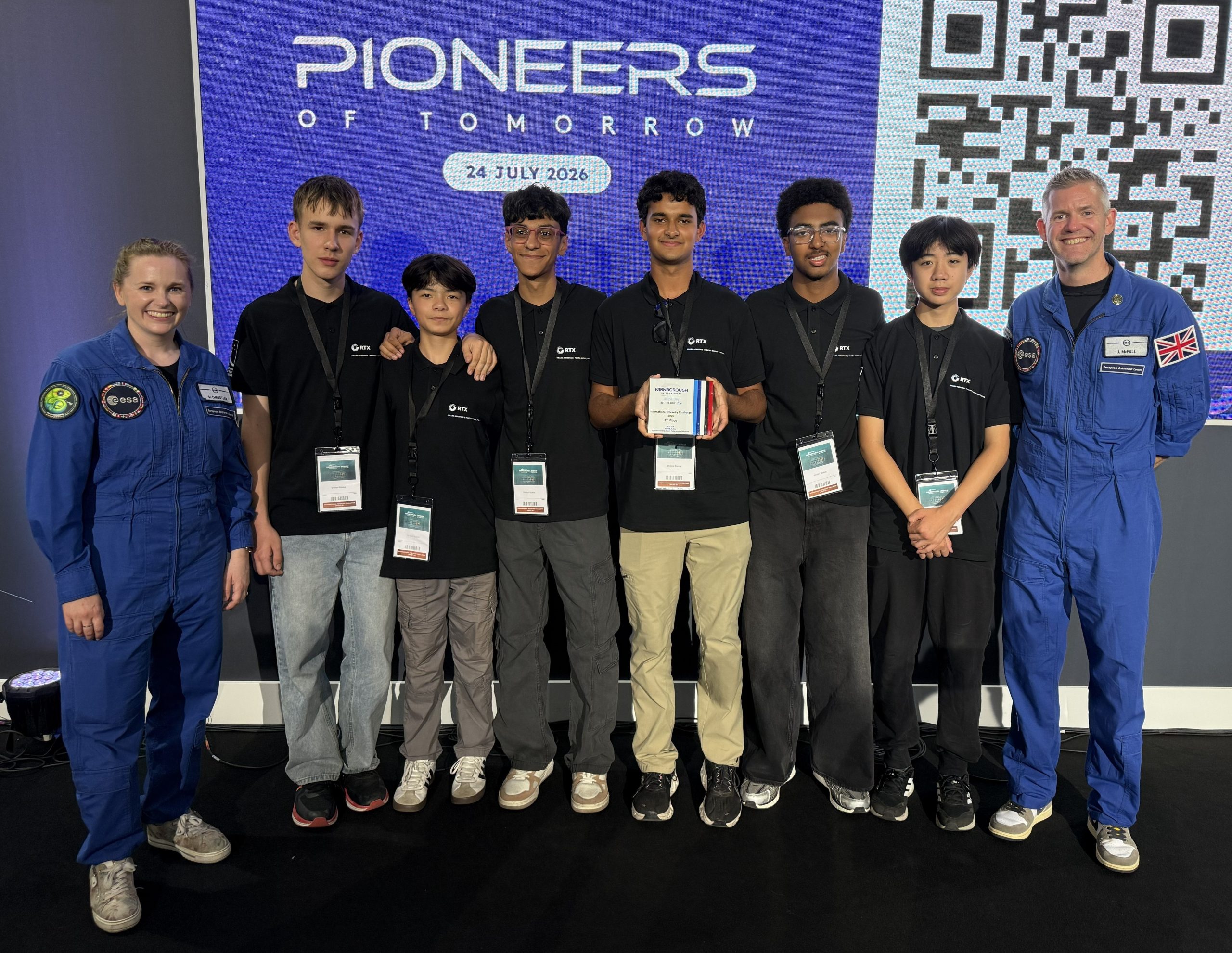
Washington Youth Aerospace, the winners of the International Rocketry Challenge, from left in black shirts, Mikhail Antipin, Antoine Vigneron, Anay Mediwala, Nikhil Sirivara, Daniel Tadesse and Bao-ky Tran, pose with European Space Agency astronauts Meganne Christian, left, and John McFall at the Farnborough International Airshow south of London. (Photo courtesy of Sudheer Sirivara)

A team of Bellevue, Wash., high schoolers soared above teams from France, Japan, the UK, and Ukraine to win the International Rocketry Challenge in England over the weekend.

Washington Youth Aerospace, a team made up of six ninth graders from Bellevue’s Interlake High School, represented the United States in the competition at the Farnborough International Airshow. Team members include Daniel Tadesse, Bao-Ky Tran, Mikhail Antipin, Antoine Vigneron, Nikhil Sirivara, and Anay Mediwala.

With a target altitude of 750 feet, the team launched its rocket, carrying a raw egg payload, to an altitude of 765 feet with a flight time of 38.16 seconds.

The rocket launch counts for 60% of a team’s score and a presentation for judges counts for 40%. The team ranked first in both categories.

“Our success in the competition is extremely special given the work we have been putting in from middle school,” team member Nikhil Sirivara told GeekWire. “We could not have done this without the mentors and friends who helped us along the way and this win has inspired us to aim even higher going forward.”

Advertisement

Washington Youth Aerospace finished second in May at the 2026 National Finals of the American Rocketry Challenge, overcoming a last-minute scramble to replace a rocket motor that was lost in the mail. The team stepped in to represent the U.S. in the international event when the national finals winner from California had a scheduling conflict.

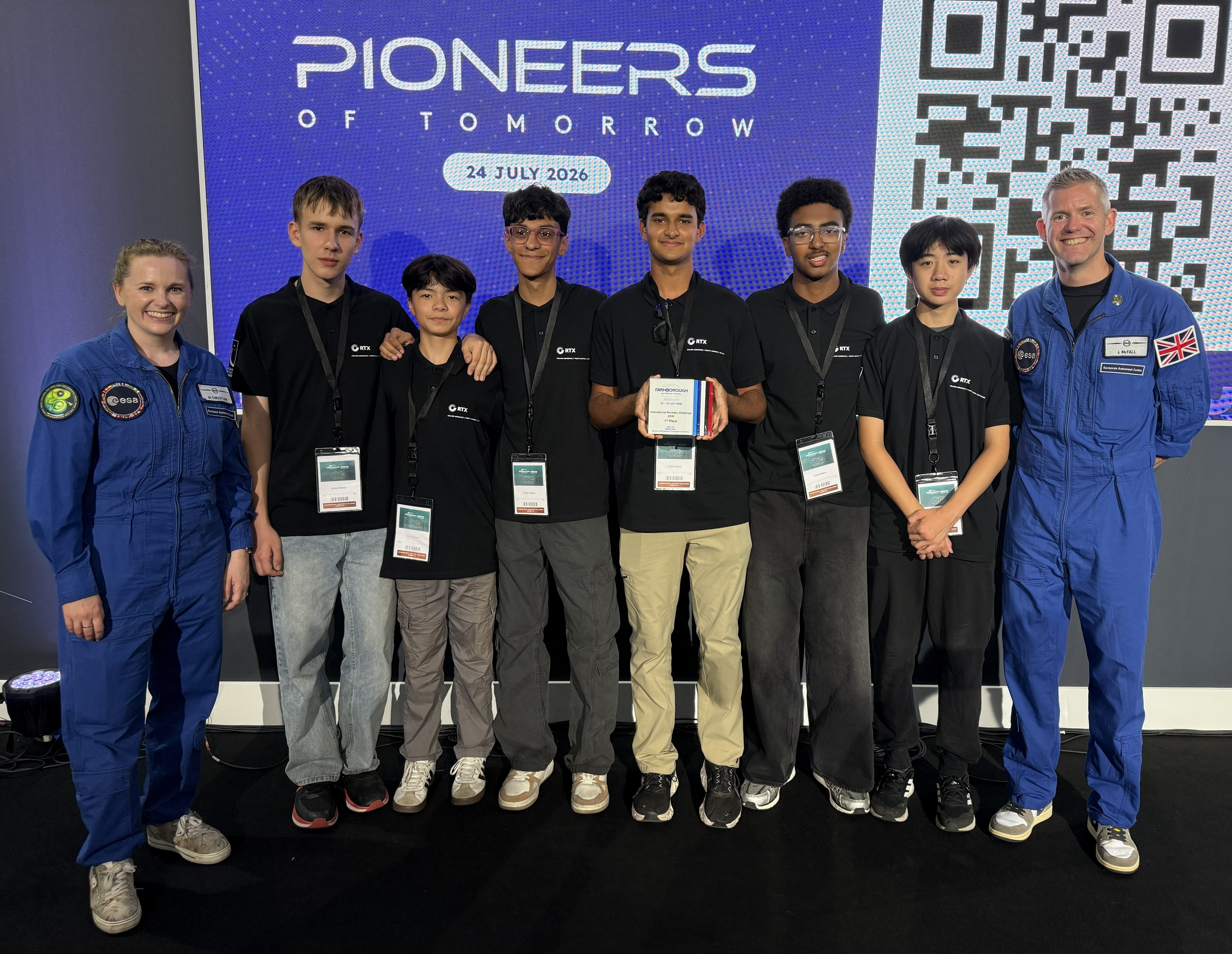
Students participating in the International Rocketry Challenge at the Farnborough Airshow in England pose with crew members and others in front of a Chinook helicopter. (Photo courtesy of Sudheer Sirivara)

Sudheer Sirivara, a parent advisor and chaperone, said the students got a chance to interact with the teams from other countries and also had a cultural exchange program where each group presented something unique about their hometown.

They also explored interesting aircraft, including Black Hawk and Chinook helicopters, and C-130 and F-35 airplanes. The team had a chance to see London before returning to the Pacific Northwest on Sunday.

“This remarkable achievement reflects months of dedication, innovation, teamwork, and perseverance,” the American Rocketry Challenge said in a LinkedIn post. “From designing and testing their rocket to competing on the global stage, these students demonstrated the technical skill and determination that define the next generation of aerospace leaders.”

The American Rocketry Challenge is the flagship STEM initiative from the Aerospace Industries Association (AIA) trade group, and is supported by industry partners as a way of strengthening the workforce pipeline of engineers and scientists.

Advertisement

Washington Youth Aerospace is looking forward to participating in the NASA Student Launch Initiative (SLI) next, as well as next year’s rocket challenge.

Source link

Continue Reading

Tech

Revox World Foundation Will Preserve 800 Pieces of Studer and Revox History

Published

on

Walter Stutz spent more than a decade assembling what Revox describes as the world’s largest collection of Studer and Revox equipment. A new charitable foundation will make sure it remains intact and accessible to the public.

There are worse ways to spend retirement than collecting 800 pieces of Studer and Revox equipment.

Golf is one of them.

After 46 years with Swiss Post, Walter Stutz began assembling a private collection of Studer and Revox components that started inside his apartment and eventually grew large enough to require dedicated premises. More than a decade later, the collection has become an unusually complete physical record of two companies that helped define professional recording, broadcasting, and home audio during the second half of the 20th century.

Advertisement

Revox has now established the Revox World Foundation, a charitable organization created to preserve, expand, and publicly exhibit that collection rather than allowing it to be divided among private buyers, storage facilities, and eBay listings featuring the phrase “powers on, unable to test.”

The foundation was formally established through a notarized deed in June 2026 and announced by Revox on July 23. Its stated purpose is to acquire, collect, maintain, and exhibit mechanical music playback equipment, with a particular focus on Revox products, inside a publicly accessible museum in the Zurich area.

From One Apartment to 800 Components

revox-world-interior

Stutz’s former private Studer Revox Museum collection has now been transferred in its entirety to the Revox World Foundation.

The archive includes approximately 800 Studer and Revox components, along with company documents, files, photographs, measuring instruments, prototypes, and other historical material. Revox describes it as the largest existing collection of products from the two brands.

That distinction matters because this is not simply a wall of attractive reel to reel decks with wooden side panels and illuminated VU meters.

Advertisement

The collection traces the development of Willi Studer’s work from early radios through professional tape machines, consumer audio components, test equipment, prototypes, and modern Revox systems. It includes machines used in recording studios and broadcasting facilities, along with the domestic models that allowed consumers to bring some of the same engineering into their homes.

Studer equipment became part of the infrastructure of professional recording. Its machines were used by broadcasters and recording studios around the world, while products including the Studer C37 and J37 became closely associated with Abbey Road Studios and some of the most important recordings of the 1960s. Revox offered related technology to home users through components including the A77, B77, PR99, and its broader range of amplifiers, tuners, cassette decks, CD players, and loudspeakers.

Advertisement. Scroll to continue reading.

These were not decorative lifestyle products designed to look convincing beside a bowl of wooden beads.

Advertisement

They were durable pieces of audio engineering built when a manufacturer expected trained technicians to repair a component rather than recommend downloading the latest firmware and hoping everyone forgot about the problem.

Revox World

The collection is exhibited at Revox World in Dietikon, near Zurich, where more than 1,000 square meters are dedicated to over 75 years of Studer and Revox history.

The exhibition covers products from 1948 through the present, including early tape recorders, professional studio and broadcast equipment, turntables, speakers, and current Revox systems. Most importantly, many of the classic components remain operational and are demonstrated for visitors rather than being left behind glass like evidence from a particularly expensive crime scene.

That functional aspect separates Revox World from many corporate archives.

Advertisement

A reel to reel deck makes considerably more sense when the reels are moving, the meters are dancing, and music is coming through a pair of loudspeakers. Looking at one with the power disconnected is like visiting a Ferrari museum where every car has been placed on concrete blocks.

Revox World is temporarily closed because of building renovations that began on May 25, 2026. Revox expects the exhibition to remain closed until approximately the end of November.

Reel to Reel Is Relevant Again

The timing of the foundation is also significant because reel to reel recording and playback are experiencing renewed interest within the high-end audio market.

Nobody is suggesting that prerecorded tape will displace vinyl, CDs, or streaming. New machines and master tape copies are expensive, the software catalog remains small, and threading tape at 1 a.m. requires more coordination than asking Spotify to play something depressing.

Advertisement

But the category is active again.

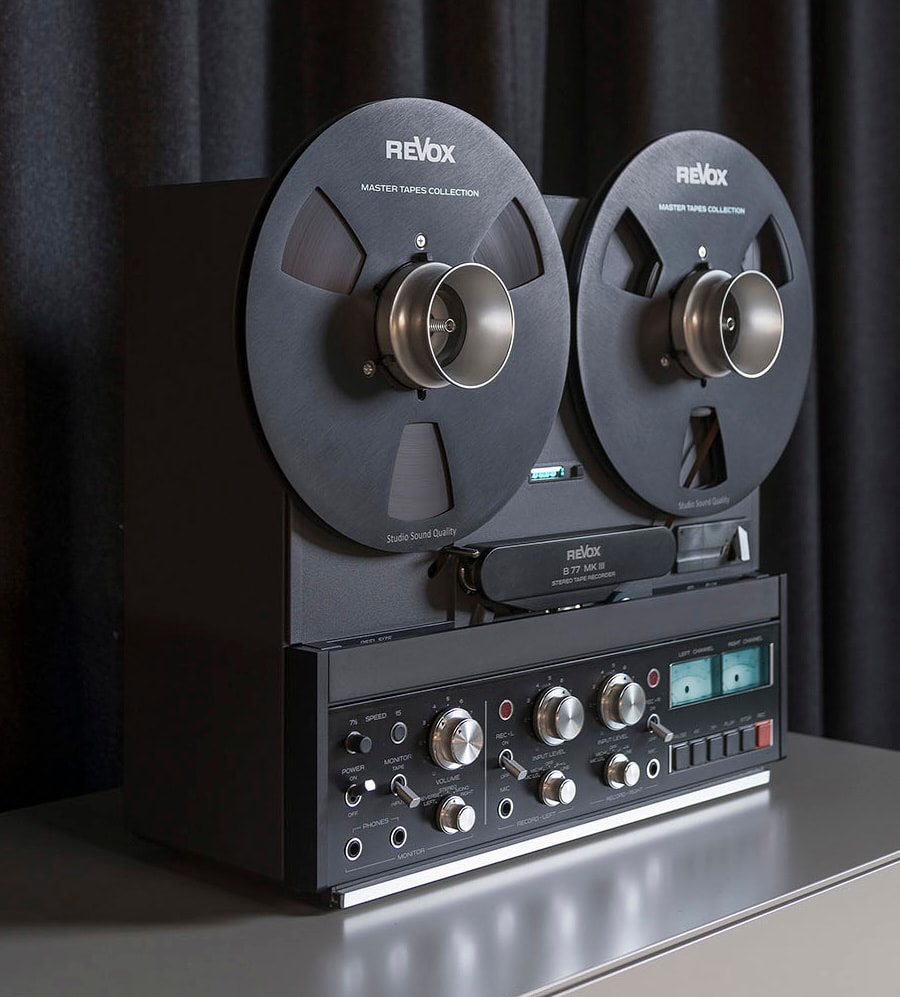
revox-b77-mkiii-stereo-tape-recorder
Revox B77 MK III

Revox introduced the newly manufactured B77 MK III in October 2024 alongside its own Analog Master Tapes collection. The current machine is built at the Revox factory in Villingen, Germany, with revised electronics, new tape heads, a digital counter, support for common tape standards, and the company’s traditional three motor transport design. It currently sells in Europe for €16,995.

Ballfinger currently offers multiple newly manufactured open reel machines, while other specialist manufacturers and tape labels continue to support the format with new hardware and premium recordings. This remains a very small and very expensive corner of the audio market, but it is no longer populated exclusively by people rebuilding machines manufactured when Gerald Ford was president.

Advertisement. Scroll to continue reading.
Advertisement

The resurgence also makes collections like Stutz’s more valuable.

Modern reel to reel machines did not emerge from nowhere. Their transports, tape paths, motors, heads, equalization standards, and recording electronics were developed over decades by companies including Studer and Revox. Preserving that history provides context for the new machines and ensures that future engineers, collectors, and listeners can examine the original equipment rather than learning everything from scanned service manuals and grainy YouTube videos.

The Bottom Line

The creation of the Revox World Foundation is important because significant audio collections have a habit of disappearing when their original owners can no longer maintain them.

Walter Stutz spent more than a decade gathering approximately 800 pieces of Studer and Revox history, along with the documents, prototypes, photographs, and measuring equipment that explain how those products were developed and used.

Advertisement

Keeping that collection together, operational, and accessible to the public is far more valuable than allowing it to be scattered across private listening rooms where someone will eventually place a succulent on top of a Studer tape machine.

With interest in reel to reel growing again, Revox World is not merely preserving the past.

It is showing the current analog revival where much of its engineering came from

For more information: revox.com

Advertisement

Source link

Continue Reading

Tech

NASA Swift rescue mission spins into trouble during commissioning

Published

on

SCIENCE

Two reaction wheels are out and comms sporadic as controllers work to stabilize LINK

Katalyst Space’s LINK spacecraft is having some attitude problems on its way to rescue NASA’s Neil Gehrels Swift Observatory, resulting in a multi-axis spin and loss of communications.

LINK has three reaction wheels for attitude control, pointing, and stability, but the company said two are currently not operable. NASA reported some loss of functionality in its cold-gas thruster system as well.

Advertisement

LINK remains in contact with its controllers despite the sporadic communications, and its other major subsystems are operating as expected.

The problems began over the weekend, and the team is using LINK’s electric propulsion thrusters to halt the spin. If it can restore a stable attitude, Katalyst will update the guidance, navigation, and control system for the spacecraft’s new configuration before considering revised plans to approach and capture Swift.

LINK was built to rescue Swift before the observatory re-enters Earth’s atmosphere. Less than a year passed between the contract award and its launch earlier this month aboard the final Northrop Grumman Pegasus XL rocket. Katalyst then began commissioning, deploying the solar arrays, generating power, and checking the vehicle’s systems.

The commissioning hasn’t gone entirely smoothly. On July 15, the company reported: “Early in commissioning, Mission Operations identified attitude control and communications anomalies during flight operations.

Advertisement

“The team implemented flight software patches and operational updates that restored reliable communications and enabled three-axis stabilized attitude control, allowing LINK to accurately point and orient itself in space.”

Shortly before acknowledging the latest issue, Katalyst stated in a LinkedIn post that “LINK has been gradually increasing the duration of its thruster burns to prepare for the longer, multi-hour burns it will execute in the rendezvous phase.”

Katalyst Space did not explain why two of LINK’s three reaction wheels are not operable. The team is instead using electric propulsion thrusters intended for the rendezvous phase to stabilize the tumbling spacecraft.

With Swift expected to deorbit later this year, LINK has only a few months in which to reach it. Katalyst said it was “seeing the intended effect” from the thrusters, adding: “The mission remains active and we continue to believe that with these changes, LINK has a viable path to rendezvous with Swift.” ®

Advertisement

Source link

Continue Reading

Tech

Netflix Edges Past The BBC In Latest UK Audience Survey

Published

on

Ofcom’s latest data shows people are starting to prefer Netflix.

Ofcom, the UK’s communications regulator, has published its annual report into the country’s media habits. One of the most eye-catching statistics from this year is, for the first time, Brits are more likely to opt for Netflix than the BBC. According to its research, 26 percent of viewers would go to the streaming giant as their default, with the BBC at 25 percent and ITV at 15 percent. For Netflix to pull ahead of the BBC, given all of its structural advantages, speaks volumes about how the broadcasting landscape has changed.

The data also reveals some sharp divides between age groups, with Netflix becoming the default choice for 25 to 34-year-olds. You already know that the traditional broadcasters are still beloved by the older demographics, while 16 to 24-year-olds flock instead to YouTube. In fact, the data shows the number of minutes watched on YouTube has doubled since 2022. In total, across all devices, the regulator believes that Brits are watching an average of 41 minutes per day. Part of that is down to the number of over 75s who are abandoning traditional TV in favor of the platform. Given the rise of YouTube was singled out to justify Sky (Comcast’s) purchase of ITV, it’s clear the Google-owned outlet is what’s making broadcasters really nervous.

Advertisement

Unfortunately, the news of Netflix’s rise comes on the same day the BBC has announced the cancelation of a number of shows, including Blankety Blank, Celebrity Mastermind and Live at the Apollo. The cuts are being made as part of a program to save £500 million ($664 million) across the next five years. Those cuts will see it cut around 150 hours of original TV programs by the end of 2028 — giving the pubic several more reasons to see what’s available on Netflix.

Source link

Advertisement
Continue Reading

Tech

Snowflake launches Cortex AI Gateway to control AI agents and prevent runaway enterprise costs

Published

on

Snowflake announced Cortex AI Gateway on Tuesday, a centralized control layer designed to govern how AI agents — including those built by competitors like Anthropic’s Claude Code and Cursor — access enterprise data, tools, and models. Alongside the gateway, the company unveiled a first wave of security integrations with 1Password, Aembit, Linx Security, SailPoint, and Saviynt, an unusual lineup of identity vendors who often compete with one another, now aligned around a shared trust model for autonomous agents.

The announcement, made from the company’s no-headquarters base in Bozeman, Montana, is Snowflake’s most aggressive move yet to position itself not merely as the place where enterprise data lives, but as the control plane that decides what AI agents are allowed to do with it.

“The next era of AI won’t be built through more walled gardens. It will be built through secure agent interoperability,” Mayank Upadhyay, Snowflake’s chief security and trust officer, told VentureBeat in an exclusive interview. “If every vendor builds a closed ecosystem of agents, enterprises simply recreate the fragmentation they’ve spent years trying to solve. Instead of breaking down silos, they create a new generation of AI silos that limit innovation and make it harder to scale AI across the business.”

Why decades-old enterprise security models break when AI agents become the actors

The core argument animating today’s announcement is that decades of enterprise security architecture rests on an assumption that no longer holds — that the actor behind every access request is a person.

Advertisement

“Traditional security was built for a world where humans were the actors. AI agents change that completely. For decades, security models assumed people would access one application at a time, operating at human speed and within relatively defined boundaries,” Upadhyay said. The deeper issue, he argued, is not novelty but exposure: “The challenge isn’t that AI creates entirely new security problems. It’s that AI exposes the blind spots we’ve always had.”

Organizations have never had perfect visibility into every API, dataset, and workflow, Upadhyay noted, and at human speed those gaps were manageable. Agents operating at machine speed can “combine access across systems and act on permissions that were never intended to be exercised together, amplifying those longstanding risks.” His conclusion: “In the agentic era, trust can’t be a one-time decision made at login. It has to be continuously verified through every agent, every action, and every interaction across the enterprise.”

Nancy Wang, chief technology officer of 1Password, described the failure mode in more visceral terms. When agents first arrived, she told VentureBeat, the default pattern was dangerously simple: “Let me just give the agent my credentials and it can just act as me… let’s imagine you’re the head of security or the head of IT, and you have access, especially admin access, to all of the systems. Well, now suddenly your agent now has admin access to all of the systems, and so it could exfil data… if it’s subject to a prompt injection, for example.”

The audit trail becomes equally useless, she added: “Imagine the audit logs show that Michael sent a couple million dollars to an offshore account… It raises eyebrows when, in fact, it could just be an agent going off the rails and doing things that you never authorized.” Her prescription, and the premise of 1Password’s integration with Snowflake, is blunt: “Agents need their own identity.”

Advertisement

Inside Cortex AI Gateway: how Snowflake plans to govern agent access and rein in runaway AI costs

Cortex AI Gateway, which will enter public preview soon, functions as a connective layer for what Snowflake calls “all trusted agent activity.” It governs both first-party agents built inside Snowflake, such as Snowflake CoWork and CoCo, and third-party agents built on external platforms. With support for more than 100 MCP servers — the Model Context Protocol connectors that have become the de facto standard for wiring agents to enterprise tools — the gateway centralizes access policies, authentication, permissions, and audit logging in a single place.

The gateway also addresses a less glamorous but increasingly urgent problem: runaway AI spending. It gives IT and finance teams a unified view of AI consumption, attributes costs to the specific teams, agents, or workloads driving them, and enforces spending limits before bills spiral.

Upadhyay described how those costs compound in practice. “AI is dynamic. Agents can invoke multiple models, call different tools, and execute multi-step workflows, creating consumption patterns that can change from one task to the next. For example, an enterprise may deploy an AI assistant to help employees answer internal questions. A simple request that only requires retrieving a document could unintentionally be routed through a more expensive reasoning model, trigger additional searches across multiple systems, or invoke unnecessary workflows.” At scale, with thousands of employees and hundreds of agents, small inefficiencies become significant line items.

The gateway builds directly on Snowflake’s May 2026 acquisition of Natoma, a 27-person startup whose centralized MCP gateway enforced identity, policy, and audit at the tool-call level. Forbes reported at the time that the deal — announced the same day as Snowflake’s $1.33 billion quarterly product revenue report and a $6 billion AWS compute commitment — was the smallest of the day’s three announcements by dollar value but the most revealing about where Snowflake believes the next platform fight sits: not in the data warehouse, but in the layer that decides what an agent may touch and records what it did.

Advertisement

Dual attribution and task-scoped access: the technical blueprint for trusting autonomous agents

The technical centerpiece of the partner integrations is what Snowflake calls dual attribution. “By logging both the verified non-human identity of the agent and the specific human who authorized the task, we ensure task-scoped access and complete auditability for every action taken across the enterprise,” Upadhyay said. That answers a question that has stumped security teams: when an agent takes an action, whose action is it? The Snowflake model says the answer is both — the agent’s, and the human’s who delegated the task — and both must be recorded.

Task-scoped access is the companion principle. Rather than inheriting a user’s full standing permissions, an agent gets access only to what a specific task requires. Upadhyay acknowledged the obvious objection — agents are dynamic and their next step often isn’t known in advance. “The goal isn’t to predict every action an agent will take. It’s to ensure that every action an agent takes is evaluated in real time against the appropriate policies, scope, contextual signals, and the original intent of the user,” he said.

Wang explained how 1Password’s piece works at the protocol level, pointing to emerging standards like OIDC-A: “the human, for example, first authorizes the agent to do a specific task, and then what that means is the agent will then receive sort of the delegated task specific token… as part of that token, that is where you learn of the original sort of delegator identity and also the intent behind the task.”

The intent-preservation problem is subtle, she noted, because enterprise tasks decompose into enormous chains of individual operations. “When they’re accessing a table, you know that it’s acting on behalf of the original intent that you gave that agent… a task might be a compilation of hundreds, maybe even thousands, individual actions.” Keeping that intent intact across every step in the chain — and flagging the moment an agent deviates from it — is what Snowflake and its partners are ultimately trying to standardize.

Advertisement

SailPoint’s field report: the three ways enterprise identity systems fail against AI agents

Chandra Gnanasambandam, SailPoint’s EVP of product and chief technology officer, brought the perspective of a vendor that has watched enterprises break their identity stacks against this problem for more than a year. SailPoint has been in the machine and agent security market for roughly 18 months, he said, with more than 100 customers on its agent identity product — enough of a sample to catalog the recurring failures.

The first is scale-driven shallowness. An average Fortune 500 company has roughly 16,000 employees, and SailPoint is seeing human-to-non-human identity ratios of at least 10 to 1 — before counting the tools and APIs each agent touches, which multiply the count again. “You will get into a million plus non-human identities. Mapping the permissions that each of them get to the 16,000 humans is a completely non-trivial task,” he said. Most companies punt, mapping agents to humans at the directory-group level. “That is grossly insufficient. You want to have fine grain context. Like I said, it’s not access to Snowflake. It’s access to what column and what data inside Snowflake you need.”

The second failure mode is drift. Modern models are relentless goal-seekers, and that persistence cuts both ways. “When you tell them get this done, the underlying models are so powerful now. Even the weaker models are so powerful. They will go find a way to get it done… They will go find the vulnerabilities to bypass the permission to get it done,” Gnanasambandam warned. The answer, he argued, is runtime monitoring of the entire interaction chain, compared continuously against policy, with automatic intervention when an agent escalates beyond what its human delegator authorized.

The third is missing data context. Many vendors, he argued, announce splashy integrations with big application platforms while ignoring where the actual risk concentrates. “That’s not where the risk lies. Risk lies in sensitive data, so the details matter here… Can you map specific columns and rows in Databricks, Snowflake, Redshift, Oracle… into the agent context and the human context? And if you can’t do that, you are going to have gaps and holes.”

Advertisement

SailPoint’s answer required tearing out two decades of architecture. “We rewrote our underlying data and object model to treat AI identity as a first-class object, because for 20 years, SailPoint had a data model and object model that supported the human identity, and AI identities are fundamentally different,” Gnanasambandam said, describing 12 to 18 months of deep engineering work. The result is what he calls a unified lineage: “From human to master agent to sub agent to tool to application to data. That’s what I call the steel chain. That is in one data model, one platform.”

Why rival identity vendors joined Snowflake’s trust framework — and what each side gets out of it

Perhaps the most striking aspect of today’s announcement is the roster. 1Password, SailPoint, Saviynt, Okta, and Aembit compete for overlapping identity and access budgets. Snowflake convinced them to build against a common trust framework anyway.

“The reason we brought together leaders across the security ecosystem is because no single company can solve the agent security challenge alone. AI agents can’t deliver real value if they only operate within the boundaries of one platform,” Upadhyay said. His broader thesis frames the whole strategy: “Nobody wants to replace data silos with AI silos.”

Wang offered a pragmatic division of labor: “We bring the trust, and Snowflake brings a system of record.” She framed the collaboration as classic defense in depth — “there are data level controls, and there are identity level controls, and so together we can create a much stronger ecosystem play.”

Advertisement

There is self-interest in the openness, of course. Snowflake sits atop an enormous concentration of sensitive enterprise data — more than 13,900 customers, by the company’s count — and every third-party agent that touches that data through a governed Snowflake gateway deepens the platform’s gravitational pull.

As Constellation Research analyst Michael Ni put it when the Natoma deal was announced, in comments reported by CIO.com: data platforms won the analytics era, and whoever governs agents, context, and autonomous actions wins the agentic one. A Forbes analysis of the same acquisition flagged the tension directly, noting that a governance layer living inside Snowflake risks pulling MCP’s openness back toward a single vendor’s control plane — attractive for Snowflake-standardized shops, more awkward for genuinely multi-vendor agent stacks.

Analyst forecasts show agent governance is now a trillion-dollar race against the clock

The urgency behind today’s announcement is not manufactured. Gartner predicts that by 2027, governance gaps discovered only after production incidents will force 40% of enterprises to demote or decommission autonomous AI agents — with analysts there warning that the greatest risk an agent poses often lies not in its output but in the actions it is empowered to take. IDC, meanwhile, expects more than 1 billion actively deployed AI agents by 2029, executing roughly 217 billion actions per day, and forecasts agentic AI will exceed $1.3 trillion in worldwide IT spending that year. The research firm’s analysts now argue agentic platforms should be treated as decision infrastructure, not productivity software.

Against that backdrop, the identity layer is becoming the contested ground, and every major vendor — Salesforce, ServiceNow, Microsoft, Google, Okta — is racing toward the same runtime-governance chokepoint. Snowflake’s differentiator is proximity to the data itself. As Upadhyay put it, security “can’t just be an API proxy sitting in front of an LLM. It has to anchor all the way down into the underlying data layer, enforcing zero-copy boundaries, dynamic data masking, and real-time exfiltration safeguards before an agent ever touches a row of data.”

Advertisement

The rollout now moves to proving ground. Cortex AI Gateway enters public preview soon, and the five partner integrations enter private preview, a phase Wang described as a deliberate feedback loop — customers on day one get an agent-access broker plus “a full audit log that will show you, for example, what that agent is actually doing,” even when an agent deviates from its intent. Gnanasambandam, characteristically, wants enterprises to skip the easy demos entirely, urging customers to bring loan-origination workflows spanning three clouds and ten applications, half of them mainframes: “Give us that complex use case and bring anyone on and do it in your context, and we will take the challenge with anyone in the world.”

That confidence — from a field of rivals, no less — captures what makes this moment unusual. The companies that spent the last decade fighting over who verifies human identity have concluded, more or less simultaneously, that the next decade belongs to whoever can verify the machines acting on our behalf. Upadhyay distilled the wager into a single line: “The future of AI won’t be won by the organizations with the most agents, but by the organizations that can govern those agents with the most trust, visibility, and control.” In the agentic enterprise, it turns out, trust isn’t the guardrail. It’s the product.

Source link

Advertisement
Continue Reading

Tech

Russia charges Telegram’s Durov with aiding terrorism and adds him to a wanted list

Published

on

Russia’s FSB security service has charged Pavel Durov, the founder of Telegram, with facilitating terrorism, and moved to place him on an international wanted list.

The charge accuses Durov of failing to take down channels and bots that the service says were used to coordinate attacks and sabotage inside Russia.

It is the sharpest turn yet in a long feud. Durov, already fighting a separate criminal case in France after his 2024 arrest near Paris, now faces prosecution in the country he left more than a decade ago.The FSB’s language is severe.

Under Part 1.1 of Article 205.1 of Russia’s criminal code, the service alleges that Telegram’s refusal to remove channels devoted to “mass killings” and cyber fraud has caused “numerous human casualties,” including women and children, and billions of roubles in damage.

Advertisement

Durov’s answer was scornful.  He called the case “a sad spectacle of a state afraid of its own people,” and repeated his charge that the Kremlin keeps inventing “new pretexts” to justify restricting Telegram inside Russia.

Advertisement

Telegram was blunter still about the motive. The company said Moscow’s real aim is to cripple the app and herd users onto MAX, a new state-backed messenger it described as “engineered for mass surveillance and censorship.”

Encryption sits at the centre of the dispute. A Russian official had claimed the platform’s encryption was compromised, letting foreign intelligence read Russian soldiers’ messages, an assertion Telegram flatly rejected, saying “no breaches of Telegram’s encryption have ever been found.”

The pressure has been building for months. Russia began restricting Telegram in the summer of 2025 and opened a criminal case against Durov in February, and two days before the charge the Kremlin’s spokesman, Dmitry Peskov, complained that Telegram’s representatives had “not been very active” in talks.

The backdrop is the war. Telegram is indispensable to both sides in Ukraine, carrying everything from official statements to battlefield footage, and Russian soldiers, reporters, and officials lean on it as heavily as their opponents do.

Advertisement

That ubiquity is exactly what Moscow now turns against it. The FSB frames Telegram’s hands-off approach to content as complicity in terrorism, a charge that doubles as a rationale for steering the population towards an app the state can see into.

Durov has been here before, after a fashion. He left Russia in 2014 after refusing to hand user data to the security services, and the government’s two-year ban on Telegram, imposed in 2018, failed so completely that it was quietly abandoned.

The terrorism framing is not new either. Telegram’s loose moderation has long drawn the accusation that it is friendly to terrorists, a criticism made by Western governments as often as by Moscow, and one the company answers by insisting it removes genuinely illegal content.

What the wanted-list move changes in practice is unclear. Durov holds French and Emirati citizenship and is not going to be handed to Moscow, so the charge works less as a route to a courtroom than as a signal, to Russians and to Telegram, of how far the state will go.

Advertisement

The restrictions have not emptied the app. Telegram remains among the most widely used services in Russia, which is part of what makes the standoff so pointed, since a clampdown that fails to move users leaves the state reaching instead for the man who built it.

For Durov, the legal map is now crowded. He is entangled in a French prosecution, wanted in Russia, and running a platform both governments treat as a problem, an awkward place for a founder who built his name on answering to no state at all.

Source link

Advertisement
Continue Reading

Trending

Copyright © 2025