Connect with us

NewsBeat

The fish and chip shop 30 minutes from Cambridgeshire that left TikTokker ‘flabbergasted’

Published

on

Cambridgeshire Live

One reviewer said it was ‘by far’ the best fish and chips they’d ever tried

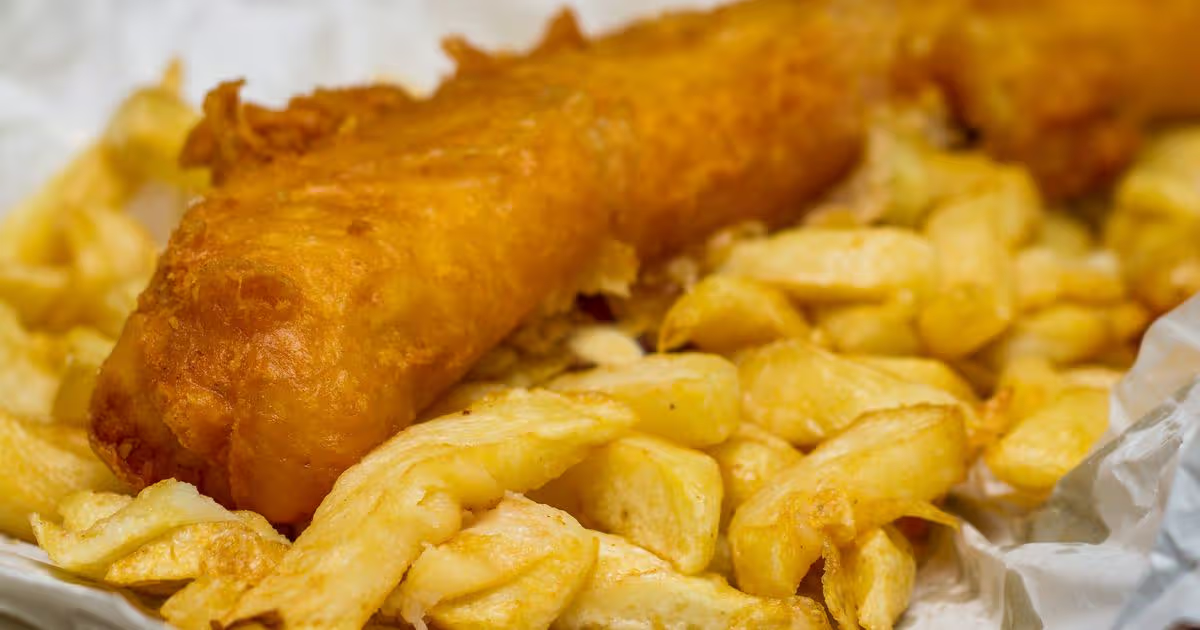
One of the best comfort meals has to be a classic takeaway fish and chips. There’s nothing quite like a trip to the chippy – and we have some brilliant ones around.

Advertisement

One chip shop just a short drive away from Cambridgeshire recently caught the eye of a TikTokker who said the food left him “flabbergasted”. Situated just outside Cambridgeshire is Bury St Edmunds, and here you can explore some utterly good finds for food spots, shops and things to do.

Alex Green, a food influencer with more than 920,000 followers on TikTok, recently visited the popular Hendo’s Fish and Chips which serves sustainable seafood and triple cooked chips along with lots of other choices.

The Hendo’s website boasts top quality ingredients, superior service and fantastically fresh fish. From the classic cod and chips, to battered halloumi, or plaice, this eatery truly offers a traditional menu.

In the caption of his video, Alex wrote: “Is this the best fish and chips shop in Bury St Edmund’s… Google definitely thinks so.” In the beginning of the video he said: “Are they incredible or are they forgettable?”

Advertisement

The review began by highlighting the cleanliness of the premises, the kindness of the staff, and the prime location situated next to the Abbey Gardens. Alex ordered a large cod and chips with a pot of curry sauce on the side that totalled up to a whooping £17. But did it live up to the hype?

After showing the viewers the crunch of the chips, and displaying the golden colour, he delves into it and here’s what Alex said: “These are lovely, crisp, firm, have a lovely crunch and a great taste.”

After testing out the chips with the curry sauce dip test, he continued: “I can’t even get my words out, that’s how flabbergasted I am right now.” Moving on to the cod, he praised the crunchy batter and the “succulent and juicy” inside making for a “phenomenal spot” altogether.

Alex ends the video by saying that he didn’t expect it to be this good. TikTok users were quick to respond in the comments section. With one user saying “That curry sauce is amazing.”

Advertisement

The chip shop has also received plenty of glowing reviews elsewhere, and one said “These folks truly know what great food should taste and look like! Honestly, this is by far the best fish and chips that I’ve ever tried.”

One more Google reviewer wrote: “I had the best fish and chips I’ve ever tasted! The batter was perfectly crispy, the fish was fresh and flaky, and the chips were cooked just right. The staff were absolutely lovely too. A fantastic experience all around.”

Source link

Advertisement
Continue Reading
Click to comment

Leave a Reply

Your email address will not be published. Required fields are marked *

NewsBeat

Call the Midwife sees huge Broadchurch star join BBC show in new role

Published

on

Wales Online

Call the Midwife series 15 episode six features a Broadchurch and EastEnders star in a new guest role

Call the Midwife returns with a fresh episode on Sunday, bringing a host of compelling storylines for audiences to enjoy.

The synopsis for series 15, episode six states: “The Nonnatus team help a young father come to terms with a life-threatening diagnosis, and Trixie uncovers a mystery illness in a female wrestler.”

Advertisement

Joining the beloved BBC period medical drama for this episode is actress Charlotte Beaumont. Many viewers will recognise the 30-year-old from her numerous television appearances throughout her career.

Charlotte portrayed Tasha in EastEnders back in 2010, before securing a part in Broadchurch as Chloe Latimer. She featured in the ITV crime drama alongside Olivia Colman and David Tennant between 2013 and 2017.

The opening series, broadcast in 2013, centred on the death of 11-year-old local boy Danny Latimer and explored how grief, suspicion and media scrutiny affected the community, reports the Mirror.

Advertisement

A central element of that season was Danny’s family – his mother Beth, portrayed by Jodie Whittaker, father Mark, portrayed by Andrew Buchan, and sister Chloe, portrayed by Charlotte – as it charted their bereavement and quest for justice.

Charlotte’s additional credits throughout the years include Waterloo Road, where she took on the recurring role of Kenzie Calhoun in 2015, Adelaide Scott in Death in Paradise in 2018, and a recent return to EastEnders in 2025, playing Jill.

In preview images from Sunday’s instalment, Charlotte appears as Tina Bianchi, with the character shown to be heavily pregnant in the BBC programme. In one photograph, Tina can be seen reading in bed alongside her husband, Tony Bianchi, portrayed by Steffan Rizzi. Another image shows Shelagh Turner, portrayed by Laura Main, checking Tina’s baby bump.

This follows viewers becoming emotional and worried about Sister Monica Joan, portrayed by Judy Parfitt, during last Sunday’s instalment. Sister Monica Joan has been a key character since the programme’s debut episode in 2012, with actress Judy celebrating her 90th birthday in November.

In the most recent episode, Sister Monica Joan had lost her appetite, even turning down pudding, which raised alarm at Nonnatus House, particularly when Sister Julienne, portrayed by Jenny Agutter, observed her swollen feet.

Dr Turner, portrayed by Stephen McGann, visited Sister Monica Joan at home, where he disclosed she had kidney failure, explaining that additional tests would provide more information. Sister Julienne said to Dr Turner: “This was always going to come, wasn’t it? In one form or other.”

To which Dr Turner sombrely responded: “And, when it does, it’s going to feel like the Ravens leaving the Tower of London. The end of the known world.”

Call the Midwife returns on Sundays at 8pm on BBC One.

For the latest showbiz, TV, movie and streaming news, go to the new ** Everything Gossip ** website

Source link

Advertisement
Continue Reading

NewsBeat

British tourists warned as strong winds set to batter Canary Islands with weather alerts in place

Published

on

Manchester Evening News

Everything you need to know about the weather warnings across the Canary Islands

Winds of up to 90kmh have been forecast to hit parts of the Canary Islands over the coming days as Spain’s state meteorological agency (AEMET) has issued several weather warnings.

Over the next few days the islands, a popular holiday destination, which belong to Spain but are located to the west of Africa – are affected by yellow coastal and wind warnings, issued by AEMET.

Similarly to the UK’s severe weather system implemented by the Met Office, AEMET issues weather warnings in varying severities – yellow, amber and red – and for a range of phenomenon including rain, hail, snow, wind among others.

Advertisement

Click here to prioritise Manchester news in Google from the MEN

A yellow warning means that there is low risk from the weather. AEMET explains that although the general population is not in danger, certain activities may be affected. The recommendation issued by the AEMET in this warning is: “Stay alert. It is advisable to regularly check the weather forecast, as some outdoor activities could be affected.”

On Sunday (February 15), there are coastal warnings around all but two of the Canary Islands – affecting La Palma, El Hierro, Tenerife, Gran Canaria and Lanzarote. The same day, wind warnings are in force across El Hierro, La Gomera, La Palma, Tenerife and Gran Canaria.

AEMET warns that in some of the affected areas, wind gusts could reach 90kmh (around 55mph) at its worst. Gusts of up to 90 km/h are possible in high areas and areas of typical acceleration. These warnings are set to be lifted at around 5pm on Sunday.

Advertisement

On Monday (February 16), AEMET has issued a warning for suspended dust affecting all of the Canary Islands. The warning reads: “Visibility: 3000 m. The most significant concentrations will occur above 400-500 meters.”

The warning for suspended dust will remain in place all day on Monday and into the next day, being lifted at 12pm on Tuesday (February 17).

Also known as Calima, suspended dust is caused by strong winds transporting dust particles, often leading to reduced visibility. These conditions can cause respiratory discomfort and make outdoor activities difficult.

Advertisement

Over in mainland Spain, there are several yellow weather alerts in force along the coast on Sunday for wind, rain and avalanches in the north east. The following day similar warnings are in place, plus one more severe amber alert for wind in Tarragona where gusts could reach 90kmh.

Source link

Continue Reading

NewsBeat

Woman’s body found in Aberdeen property as police probe ‘unexplained’ death

Published

on

Daily Record

Police were called to the incident at 4.15pm on Friday

A woman’s body has been found at a property in Aberdeen.

Advertisement

Police were called to the incident on Station Road in Dyce near Aberdeen at 4.15pm on Friday, February 13. Officers attended and a woman was found dead within.

Her death is currently being treated as unexplained. Cops, however, say there do not appear to be any suspicious circumstances.

A report is due to be submitted to the Procurator Fiscal.

A spokesperson for Police Scotland said: “Around 4.15pm on Friday, 13 February, 2026, emergency services attended at Station Road, Dyce following the death of a woman. Her death is being treated as unexplained, however there are not believed to be any suspicious circumstances.

Advertisement

“A report will be submitted to the Procurator Fiscal.”

Get more Daily Record exclusives by signing up for free to Google’s preferred sources. Click HERE.

Source link

Advertisement
Continue Reading

NewsBeat

Over 6,000 people killed in three days as Sudanese city of Al Fashir was attacked by paramilitary group, says UN | World News

Published

on

Signs of shelling in a school where displaced people sheltered, in Al Fashir, Sudan. Pic: Reuters

More than 6,000 people were killed in three days when a Sudanese paramilitary group took control of the key city of Al Fashir last October, the United Nations has said.

The offensive by the Rapid Support Forces (RSF) included widespread atrocities that amounted to war crimes and possible crimes against humanity, the UN Human Rights Office said in a report.

Rights violations in the final push for the city in Sudan underscored how “persistent impunity fuels continued cycles of violence”, according to UN High Commissioner for Human Rights Volker Turk.


Sky’s Yousra Elbagir covered the fall of the city in October

Advertisement

The RSF and their allied Arab militias, known as Janjaweed, overran Al Fashir, the Sudanese army’s only remaining stronghold in Darfur, on 26 October 2025 and rampaged through the city and its surroundings.

It had previously been under siege for more than 18 months.

The UN Human Rights Office said it documented the killing of at least 4,400 people inside the city between 25 October and 27 October, while more than 1,600 were killed as they were trying to flee the RSF rampage.

The 29-page UN report detailed atrocities that it said ranged from mass killings, summary executions, sexual violence, abductions for ransom, torture and ill-treatment to detention and disappearances.

Advertisement

In many cases, the attacks were ethnicity-motivated, it said.

Sexual violence, including rape and gang rape, was apparently widespread during the Al Fashir offensive, with RSF fighters and their allied militias targeting women and girls, the report added.

Smoke rises over Al Fashir last October
Image:
Smoke rises over Al Fashir last October

The RSF did not respond to an emailed request for comment.

The alleged atrocities in Al Fashir, the provincial capital of North Darfur, mirror a pattern of RSF conduct in other areas in its war against the Sudanese army, the report said.

The tribal militia turned paramilitary is known to document its own war crimes.

Advertisement

Videos of their fighters lynching women, lashing emergency responders and cheering over dead bodies have circulated online since the start of the conflict.

Yvette Cooper recently went to the Sudanese border in Chad to meet women fleeing the war in Sudan. Pic: PA
Image:
Yvette Cooper recently went to the Sudanese border in Chad to meet women fleeing the war in Sudan. Pic: PA

Read more:
1,000 days of war in Sudan
UK sanctions four paramilitary commanders over ‘mass killings’

The war began in April 2023 when a power struggle between the two sides led to open fighting in the capital, Khartoum, and elsewhere across the country.

Advertisement

The conflict created the world’s largest humanitarian crisis, with parts of the nation pushed into famine.

It has also been marked by atrocities, which the International Criminal Court said it was investigating as war crimes and crimes against humanity.

The United Arab Emirates (UAE) has been accused of backing the RSF, something that an RSF intelligence officer appeared to confirm in an exclusive interview with Sky News.

But the UAE’s foreign ministry hit back at the allegations, saying: “We categorically reject any claims of providing any form of support to either warring party since the onset of the civil war.”

Advertisement

Source link

Continue Reading

NewsBeat

how cruel Victorians sent insulting cards to their unwanted suitors

Published

on

how cruel Victorians sent insulting cards to their unwanted suitors

Many people imagine the Victorians to be the stern “we are not amused” type, yet they had a pretty cruel sense of humour when it came to Valentine’s Day. While today’s lovers often exchange cute (and cheesy) cards, the Victorians loved to send insulting “vinegar Valentines”.

I first discovered this peculiar practice in 2019, when I designed a small exhibition at The Atkinson arts hub in Southport as part of a larger show about Victorian humour. Researching the cards was eye-opening and a lot of fun, and I think of them every Valentine’s Day when I look at the more sentimental and affectionate fare on sale now.

Posted to unwanted suitors or people one disliked, vinegar Valentines were cheaply produced cards with unflattering images and offensive poems. These anonymous illustrations and verses were intended to represent the unfortunate recipient and point out their flaws, as well as leaving them guessing who sent it.

The last word in bad romance, these mock valentines were particularly popular in Britain and America from the 1840s onwards. They featured many different types of caricatures.

Advertisement

Some cards focused on the recipient’s looks, exaggerating or shrinking facial features to look as unpleasant as possible. The illustration above depicts a women with squashed, unappealing features – and the accompanying verse highlighted these flaws. The rhyme, A Beanery Beauty, states:

Though nothing more homely e’er walked on two feet,

In your own mind you’re everything lovely and sweet,

That you’re not a heart-breaker’s a fact I’d impart –

You may break lots of dishes, but nary a heart.

Advertisement

The card lampoons the recipient’s presumptions that she is attractive and good-tempered. However, the verse cuts through the supposed good opinion the lady has of herself by asserting that she would never be admired enough to be loved. The line describing how she “may break lots of dishes, but nary a heart” is the zinger. Not only is the poor woman deemed unattractive, she’s clumsy too.

This chap’s bad behaviour has definitely been rumbled.
CC BY

Women were not the only recipient of Valentine’s Day hate mail – men were denigrated if considered to be unappealing flirts. A common feature of vinegar Valentines was to depict the recipient as an animal. My favourite features a snake in a blue smoking jacket with a black top hat, and a horrified lady in the background.

The accompanying poem states the man is a “rattlesnake”, hence the image, and describes the “bitter” life a lady would lead with the recipient as a spouse. It ends with the cautionary line that a lady would “not accept the ring / Or evermore ‘twould prove a sting”.

These cards were phenomenally popular and demonstrate what happens when love goes wrong. But how did Victorians actually meet their potential spouses?

Advertisement

A Victorian version of online dating

A new method of courtship in the Victorian era was placing a matrimonial advert in a newspaper or periodical. These advertisements were much like a modern-day dating profile, where readers would submit their “bio” to the paper and wait for it to be published.

One paper that regularly featured matrimonial adverts was Ally Sloper’s Half-Holiday, an illustrated weekly that focused on the leisure pursuits of the late-19th century.

An early version of the comic strip, the Half-Holiday established an enormous readership, reaching 340,000 people. Most stories followed the fictional exploits of idle schemer Ally Sloper, who skulked and sloped about the alleyways of East London in the late 19th century. The “half-holiday” referred to the half day on a Saturday when people were free to indulge in leisure activities, and which for many coincided with football matches.

Advertisement

This Victorian serial comic strip followed the fictional exploits of Ally Sloper.
British Library / WIkipedia

The dodgy Sloper was the main recurring character, but the paper also regularly featured his glamorous daughter, a music-hall actress and founder of Tootsie’s Matrimonial Agency. The paper liked to pretend their fictional characters were a genuine family, and offered real services to their readers. As the most romantic character, Tootsie Sloper was the natural figurehead for romance-seeking readers. Hopeful advertisers often described themselves as “fond of fun” and wanted their partners to be “jolly”.

Others played with humour in their ads, like the “Two Young Gentlemen” who described themselves to be “not painfully repulsive, but not precisely dangerously handsome”. Despite fears that dating adverts were full of scammers – much like catfishing today – they provided a novel way for partners to meet, and allowed regular readers the fun of speculating about the advertisers.

Victorians were not the perpetually grim-faced, serious bunch that old photographs often make out. They were fun-loving people who enjoyed playing practical jokes on one another. Matrimonial adverts allowed Victorian lovers to have more control over how they presented themselves to potential partners, and express their humour for all to see.

Vinegar Valentines were one of many ways the Victorians shared their sense of humour, while rejecting any unwanted attention. Insulting in nature, these cards were were intended to make the recipient feel foolish, much like the jokes found in comic papers at the time.

But spare a thought for the poor souls who received one of these cruel cards before the era of prepaid postage. They had to pay to receive their insults!

Advertisement

Source link

Continue Reading

NewsBeat

I’ve visited riverside towns across Wales and one stands out from the crowd

Published

on

Wales Online

I’ve clocked up a fair few riverside towns across Wales, and people usually ask me which one’s my favourite

Advertisement

Regular readers will know I’m not exactly subtle about my fondness for Welsh towns. Give me a selection of proper pubs, independent shops, and quirky cafes selling local produce and decent coffee, and I’m as happy as a clam in cheap chardonnay.

I’ve clocked up a fair few riverside towns across Wales, and people usually ask me which one’s my favourite. It’s a difficult question when our lush country is basically wall-to-wall charm, but after much serious thought, mostly conducted in pubs, I have an answer. Cardigan (Welsh Aberteifi).

Positioned on the tidal reach of the River Teifi at the point where Ceredigion meets Pembrokeshire, Cardigan is one of my favourite riverside towns in Wales, and I keep returning for weekend breaks near the coast.

It’s home to one of my favourite hotels right now, which is really conveniently located in the centre of town. Perched on the riverside in Cardigan, The Albion Aberteifi blends seafaring charm with maritime design and is a great place for an adults-only break.

Advertisement

Often outshone by tourist hotspots like Tenby, Cardigan is sometimes overlooked by tourists, but it really shouldn’t be. It’s the gateway to the Teifi Valley and both the Ceredigion and Pembrokeshire coastal paths, which makes it a great base for exploring this glorious coastal sweep.

Cardigan is the second-largest town in Ceredigion. It packs a punch culture-wise, having transcended from a significant 18th-century Atlantic seaport to a swish, artsy enclave with theatres and galleries. It’s fast becoming one of my favourite spots for a weekend break for excellent eats, coastal walks and a spot of culture.

As I’m now in my history era, it’s also grabbed my attention with its rich heritage and handsome stone castle. Found on the bend of the River Teifi, Cardigan has a long and varied history.

Advertisement

Henry VIII granted Cardigan its charter in 1543; by the 18th century, it was the most important seaport in southern Wales. It had a thriving herring and shipbuilding industry, and its merchant fleet carried fish, slate, bricks, tannery bark, corn, and ale.

Its heritage is also found in the town’s varied architecture, where you can still see Georgian buildings, including the restored Castle House and original 17th-century arches.

Today, it has a thriving small-town feel with boutiques, an independent bakery, an acclaimed hotel, and waymarked coastal paths that guide you along the glorious shoreline. I have visited several times and fallen a little more in love with the town each time.

Advertisement

Despite the buzzing town’s many offerings, it’s not quite as well known as tourist hotspots like Tenby or the Pembrokeshire Coast National Park.

Perhaps that’s because the Cardigan Bay area remains one of Wales’s most underrated stretches of coastline, sandwiched between the headline-grabbing beauty of Pembrokeshire and the Llŷn Peninsula. In 2023, Time Out magazine even dubbed its main town, Cardigan, the “most underrated” spot in west Wales.

Here, you can experience Wales as its most authentic self, zipping between secluded bays to spot dolphins, trekking the coastal path and feasting on piping hot fish and chips in small fishing villages.

Advertisement

The relative remoteness of Ceredigion and the proud, resilient character of its communities have long made this coastline a stronghold of Welsh language and culture.

Cardigan is the main hub here and is ideal for exploring the Ceredigion coast. As the birthplace of the Eisteddfod, Wales’s most important cultural festival, the town has long been a hub for storytelling, music, and art. Wander its streets, and you’ll find charming cafes, pubs, and a thriving collection of independent shops and businesses.

At the heart of the town sits the beautifully restored Cardigan Castle, the first stone castle built by a Welshman and the birthplace of the first Eisteddfod in 1176.

This ancient Norman fortress, originally rebuilt in 1244, underwent a £12 million transformation in 2015, reviving its role as the town’s crowning centrepiece.

Advertisement

With a history spanning more than 900 years, the Castle has weathered many brutal power struggles between Wales and England. Today, it’s a vibrant heritage site featuring a museum, restaurant, open-air concert space, and Grade II-listed pleasure gardens.

According to Discover Ceredigion, the Castle also has a cultural connection. To celebrate the Castle’s completion, Lord Rhys hosted the first recorded Eisteddfod, a festival of music and poetry. This competitive arts festival is a uniquely Welsh tradition that thrives locally and follows Welsh people wherever they migrate.

After stomping the castle grounds, I always head for my favourite cafe spot – Crwst. This swish Cardigan cafe and deli has garnered a cult following for its banging brunch and bakery items and has also caught the eye of food writers.

Advertisement

Founded by husband and wife Osian and Catrin Jones, it is a swish 80-seater cardigan cafe and deli that attracts customers from miles around.

Five years ago, a married couple decided to pack in their jobs and make a living from what they loved most: baking and drinking coffee. Crwst is the happy, bricks-and-mortar result of this foodie journey. For the latest restaurant news and reviews, sign up to our food and drink newsletter here

Since their launch in 2018, the dynamic duo have grown the business and the foodie brand, taking on a second venue at Poppit Sands at the start of the Pembrokeshire coast path, where they serve Crwst’s most popular bakes, ice creams and coffees.

Advertisement

The Cardigan cafe is nearly always busy after it was named in the Good Food Guide. People arrive in droves for its delicious dishes and fresh-baked goods, including sourdough loaves, brioche doughnuts, and cinnamon swirls.

The Cardigan Cafe also offers a delicious brunch menu, ranging from harissa halloumi burgers to pancake stacks and Turkish eggs, and has earned glowing reviews from food writers.

Guardian writer Genevieve Fox writes: “Brunch is the ticket at this bright, trendy Cardigan craft bakery. The Full Welsh Brekkie includes Crwst’s signature beans and a cockle and laverbread gratin, the halloumi is made locally, and the blow-out Sausage & Egg McDoughnut is filled with melted cheese.”

My personal favourite, though, is the rum and Banana French Toast, loaded with brule banana streaky bacon and topped with creamy Barti Rum Caramel ice cream. It’s sweet and salty goodness with a lovely rum kick, which is exactly what you want at 10 a.m.

Outside of baked goods, there’s plenty to eat in and around the town. A great spot for pizza is the unique riverside venue Grain.

Formerly Pizzatipi, this rustic restaurant has a large tipi with a standout feature in the middle that I loved instantly – a roaring fire.

Here you can expect made-to-order stone-baked pizzas with bold, fresh flavours, a rotating list of craft beers from Bluestone Brewing Company, and a buzzing outdoor space and huge fire to keep you warm on cold winter nights.

Advertisement

There’s also Yr Hen Printworks, Templebar Cafe, and Farmshop in Nevern if you want to continue your culinary journey in Cardigan.

Another highlight is the shopping offering. While it’s not a major scene, Cardigan has a small selection of shops and boutiques selling crafts, surfwear, and books. Most shops and businesses are located along or just off High Street and further up on Pendre, with several shops at Black Lion Mews off the main street.

Cardigan’s indoor market is the retail showstopper, housed in the historic Guildhall building. The two-level market hall was originally the town’s meat and dairy marketplace. Today, it is a lively shopping area for locals and visitors, with over 50 stalls run by independent local traders selling an impressive variety of goods and gifts.

Advertisement

For a small town, Cardigan also has a fizzing arts scene with two theatres and music held at several venues across town, including the Castle grounds. Theatr Mwldan Arts Centre is an impressive cinema complex in the centre of Cardigan, with three fully digital screens, and is Wales’ only truly Independent multiplex.

There’s a gallery and cafe here, and it’s also the base of Gwyl Fawr, the town’s Eisteddfod, which has several concerts and musical, literary, and dance competitions.

Along with Mwldan, St Mary’s, a Grade II-listed 12th-century church, is the main base for the November Other Voices festival concerts featuring contemporary, internationally known Welsh musicians. Several smaller venues, from cellar bars to art galleries and bakeries, create a great atmosphere along the festival’s music trail around town.

Advertisement

Nearby Small World is an environmental theatre company that creates giant puppets, public events, and art commissions. It is a wildly creative, near-zero-carbon space that hosts family-friendly events, including children’s theatre shows featuring live music and puppetry.

For a show with a wow factor, Cardigan Castle hosts a range of performances. The Castle’s beautiful surroundings provide the perfect setting for choirs, bands, opera performances and concerts.

Outside the town, there’s plenty to explore, as Cardigan Bay stretches over 129 miles, from Bardsey Island off the Llŷn Peninsula in the north to the wild headland of Strumble Head in the south. It’s home to the largest population of dolphins in Europe, and its rich waters are a haven for wildlife, including seals and seabirds.

Advertisement

For nature lovers, this is the best place in Europe to spot dolphins, especially if you’re skimming over the waves on a fast-paced RIB ride through the bay’s choppy waters.

When the weather is decent, book a budget-friendly Bay Explorer boat trip with local pros, ‘A Bay to Remember‘.

Departing from nearby St Dogmaels, this hour-long trip wizzes you around the shore on high-speed RHIBs, where your knowledgeable skipper will keep their eyes peeled for wildlife. This was one of my favourite wildlife tours, and I got loads of lush snaps of seals and seabirds.

Bouncing over the waves, you’ll likely spot herring gulls and razorbills swooping through the air and landing on rocky outcrops. Your vessel will also speed past Mwnt, a sandy bay that’s one of the best places in Ceredigion to spot dolphins, so keep a good lookout for those distinctive dorsal fins slicing through the water.

These zippy boat trips also visit secluded, pebbled bays where Atlantic grey seals lounge lazily on the rocks. These resident seals are easy to recognise thanks to their distinctive heads. Their scientific name even translates to “sea pig with a hooked nose.” Adorbs or what?

For hiking, the Ceredigion Coast Path is one of the most rewarding sections of the 870-mile Wales Coast Path. Stretching for 60 glorious miles between Ynyslas and Cardigan, it offers some of the most varied terrain and scenery on the entire route, ranging from soft dunes and sandy coves to craggy cliffs and windswept headlands.

This waymarked path can be walked in seven manageable sections, each ending in a village or town with accommodation and transport options.

Advertisement

You can also tackle the full route over a week or choose shorter sections, such as New Quay to Aberaeron or the 11.7-mile stretch from Cardigan to Aberporth.

Highlights along the way include the dramatic headland at Mwnt, the birdlife of Birds Rock, the tidal island of Ynys Lochtyn, and the expansive Ynyslas dunes.

Wildlife sightings are common; watch for bottlenose dolphins, seals, and even porpoises along the pebble-strewn cliffs and coves.

Advertisement

The trail’s southern end begins in Cardigan, where the Ceredigion and Pembrokeshire Coast Paths meet. Once the largest port on Wales’s west coast, this historic town gave its name to Cardigan Bay.

A bronze otter statue marks the official start of the route, standing beside a quayside wall inscribed with poetry by local writer Ceri Wyn Jones.

As you leave town, the path follows the north bank of the River Teifi, passing farmland and the likely site of the original wooden Cardigan Castle, hastily built to control the river and access to the sea.

Advertisement

The route continues past the Cardigan Golf Club and the Victorian-era Cliff Hotel, once part of a grand vision to turn this coastline into a rival to Brighton.

From there, it’s a clifftop walk toward Aberporth, with panoramic sea views and a coastline dotted with caves, sea stacks and rock formations with evocative local names like Hatling Bigni, Pen Peles and Pencestyll. These rocky markers were once essential reference points for mariners navigating this wild stretch of coast.

Poppit Sands is my go-to beach in this area, even in winter, as the lovely Crwst bakery is open for bakes and brews.

This wide, dune-backed beach at the mouth of the River Teifi has all the hallmarks of a brilliant Welsh beach, expansive golden sands, big skies, sweeping estuary views and even dolphin sightings if you’re lucky!

Advertisement

Making a weekend of it? The town and surrounding area offer a range of hotels, B&Bs, cottages, and campsites. You can check prices and book on Airbnb and booking.com.

I would recommend booking at one of my favourite hotels in the area for a stylish stay with a river view.

Perched on the riverside in Cardigan, the adults-only Albion Aberteifi hotel blends seafaring charm with maritime design, featuring original sketches and calculations by 1800s shipwrights.

Advertisement

Just four months after opening, The Times and The Sunday Times named it the Best Place to Stay in Wales 2023, and it’s easy to see why.

The Times journalist said of the property: “Expect more of a grown-up vibe here (no children are allowed) with a moody bar serving the Albion Collins, a heavenly blend of mead and local gin.”

Each of the 12 en suite rooms feels like a captain’s cabin with reclaimed wood-panelled walls, 150-year-old oak floors, Welsh wool blankets, custom furniture, and river views from every window.

Advertisement

The hotel wears the town’s maritime past with plenty of character and design features. Contemporary comforts sit alongside the quirks of the original buildings, giving a historic feel while providing plenty of modern amenities.

Old stone and timber are proudly left on show, giving the place a sense of history you can actually feel. Head up to the third floor, and the walls tell their own story – lime-washed surfaces covered with mid-19th-century pencil sketches of tall ships alongside careful notes on rope lengths and sail sizes.

Breakfast is served in the relaxed resident lounge, where you’ll also find crafted cocktails, wines, and local beers by night and coffee and cake by day.

Book your stay here.

Advertisement

Source link

Continue Reading

NewsBeat

Pensioner in serious condition after Glasgow crash as man arrested

Published

on

Daily Record

Police are appealing for information after a 75-year-old man was badly injured on Paisley Road West on Saturday

A pensioner has been seriously injured in a two-car crash in Glasgow which saw a man arrested.

Advertisement

Police are appealing for information after the smash, which happened on Paisley Road West at its junction with Portman Street at around 5pm on Saturday.

It involved a blue Range Rover and a red Renault Clio and closed the road for several hours as investigations were carried out.

A 75-year-old man was taken to hospital for treatment, where his condition is described as serious.

A 42-year-old man was arrested in connection with the incident and released pending further enquiries.

Advertisement

The road was closed and reopened around 11.30pm.

Sergeant Jack Swindells said: “Enquiries are ongoing and we are appealing to anyone who witnessed the crash to contact us.

“We’d also ask anyone with dash-cam footage that could assist our enquiries to come forward.”

Get more Daily Record exclusives by signing up for free to Google’s preferred sources. Click HERE

Advertisement

Source link

Continue Reading

NewsBeat

Harold Shipman’s tragic pop star victim who knocked The Beatles off No1 spot

Published

on

Ipso logo

Serial killer Harold Shipman targeted his youngest victim, Peter Lewis, when the former popstar was at his most vulnerable, with the sick GP making a disturbing request of his devastated wife

Harold Shipman’s sickening reaction when showed photos of victims

One of the most prolific serial killers in criminal history, Dr Harold Shipman used his reputation as a “good doctor” to target those who’d trusted him to treat them in their hour of need.

The twisted GP often targeted older women in the small Greater Manchester town of Hyde, who were said to “adore” him, with an extraordinary 80 per cent of Shipman’s victims being female pensioners. Rather than providing them with care, Shipman instead injected fatal doses of poison into many of these patients, before callously pocketing money from their wills.

Shipman’s reign of terror finally came to an end in 1998 when he was arrested and subsequently convicted of murdering 15 of his patients, though the actual death toll is suspected to have reached the 250 mark over a staggering 30-year period. However, the sick medic didn’t only prey on the elderly, and, tragically, it’s suspected his youngest victim may have been just four years old.

READ MORE: UK’s worst serial killer Harold Shipman’s last words in horrifying personal letters before death

Advertisement

Indeed, Shipman’s youngest confirmed victim, Peter Lewis, was just 41 years old when the duplicitous monster set his sights on him, even cruelly getting the taxi driver’s wife to hold the needle as he injected the lethal dose of diamorphine.

While much younger than many of Shipman’s confirmed victims, Peter was at a particularly vulnerable stage in his life when the predator struck. In his younger years, Peter built a successful career as the frontman of pop group The Scorpions, with the group even securing a number one hit in Holland, toppling The Beatles from the chart summit.

Advertisement

He had tied the knot with his wife, Muriel, two years prior to his untimely demise, and the pair had relocated to Tameside, where their local GP was none other than Shipman. Shortly after settling in their new home, Peter started shedding weight at an alarming rate and sought medical advice, which was out of character for him. In a written testimony submitted to the Shipman Inquiry, Muriel recalled: “Pete was very much a man’s man. He was never ill. He took the view that going to the doctor was for softies,” she said.

“He had been the lead singer in a pop group and apparently had a number one hit in Holland. He even told me that he had knocked The Beatles off from the top spot. The band was called The Scorpions. Pete was always happy and was always singing. He always kept himself fit and didn’t put any weight on. I would describe him as typically northern.”

Sadly, it later emerged that Peter had been grappling with stomach cancer, a condition that Shipman had overlooked for half a year, instead diagnosing an ulcer. As Peter continued to weaken with each passing day, his worried wife Muriel had to assist him with one particular visit to the GP’s surgery, and it was here that they were taken aback by an inappropriate comment made by Shipman.

Advertisement

Muriel shared with the Manchester Evening News: “When we got into the doctor’s room, Shipman was washing his hands at the sink and turned to me saying, ‘Have you two got a season ticket?’” I didn’t believe what I had heard, so I said, ‘Sorry, what did you say?’ and he repeated it. As I was a little afraid of him, I simply laughed nervously. Until this occasion, I had always thought that he was a caring doctor.”

Eventually, Peter was referred to Manchester Royal Infirmary for surgery to determine the cause of his illness. He and his wife received the heartbreaking diagnosis that he had stomach cancer, which had already metastasised. Not long afterwards, Peter passed away at home, following a visit from Dr Shipman.

On the evening of New Year’s Eve 1985, Shipman was summoned to Peter and Muriel’s residence due to his deteriorating condition. Present in the bedroom were Shipman, Maureen, and her mother, Elsie Gee, when the doctor made a disturbing request.

Advertisement

He asked Peter’s wife to hold the injection needle steady in his patient’s arm. Muriel recalled: “As I was holding the needle in his arm, the blood flowed back into the barrel of the needle from his arm, and I had to go out of the room. I was very upset.

“I went back into the room and Shipman (had) one hand around Pete’s throat. He seemed to be squeezing Pete’s windpipe. I asked him what he was doing, and (he) said he was stopping him from swallowing his tongue. I wasn’t present when Pete died. I went into the lounge. I couldn’t stay till the end. I can remember, however, Shipman saying to Pete, ‘Come on, lad, give up. We’ve all had enough’. I gained the impression he was willing him to die.”

Muriel, unable to bear the sight of her husband in such agony, exited the room. However, when Muriel’s mother returned to the bedroom, she witnessed Shipman in a chilling stance. She recounted: “Dr Shipman was standing by the bed in front of Peter, holding a pillow in both hands. He was putting the pillow over Peter’s face. I shrieked, ‘What are you doing, man?’ and he put the pillow at the back of Peter’s neck.”

Advertisement

It would take another 13 years for doubts about Shipman to emerge, during which time he had been free to commit murder unchecked. Most of his victims were discovered sitting upright in a chair, fully clothed, appearing to have passed away from natural causes. In truth, Shipman had administered a fatal dose of morphine to them.

In March 1998, three months prior to his final act of murder, Deborah Massey from Frank Massey and Sons funeral parlour voiced concerns about the high number of deaths among Shipman’s patients. These concerns were relayed to Linda Reynolds from the Donneybrook Surgery, also located in Hyde, who then informed John Pollard, the coroner for the South Manchester District.

Linda also expressed worry about the number of cremation forms that Shipman had countersigned. The police were notified but lacked sufficient evidence to press charges, leaving Shipman free to claim the lives of three more patients.

Advertisement

Greater Manchester Police faced sharp criticism in the Shipman Inquiry after his conviction for allocating the investigation to inexperienced officers. However, doubts about the doctor persisted, and several months later, Hyde taxi driver John Shaw approached police, claiming he suspected Shipman had murdered 21 of his patients.

Ultimately, Shipman would seal his own fate through a catastrophic error during the killing of his last victim, Kathleen Grundy. The 81-year-old was discovered dead at her home on June 24, 1998. Shipman had been the final person to see her alive and documented “old age” as her cause of death on the death certificate.

Yet her daughter, Angela Woodruff, a solicitor, sensed something was deeply amiss when her solicitor, Brian Burgess, contacted her regarding her mother’s will. Kathleen had disinherited her own children and instead bequeathed her entire £386,000 estate to Shipman.

Advertisement

It read: “I give all my estate, money and house to my doctor. My family are not in need and I want to reward him for all the care he has given to me and the people of Hyde.” The document reached her solicitor’s office on the day of her death, accompanied by a letter that had been typed on the identical typewriter as her will and bore Kathleen’s signature.

The letter said: “Dear Sir, I enclose a copy of my will. I think it is clear in intent. I wish Dr Shipman to benefit by having my estate, but if he dies or cannot accept it, then the estate goes to my daughter. I would like you to be the executor of the will. I intend to make an appointment to discuss this and my will in the near future.”

Mr Burgess advised Angela to report the matter to the police, who subsequently launched an investigation and exhumed Kathleen’s body. Medical heroin traces were discovered in his system, a substance often used for pain management in terminal cancer patients.

Advertisement

Shipman attempted to justify this by alleging that Kathleen was an addict, presenting detectives with notes he had recorded on her digital medical files. However, upon inspection of his computer, it was revealed that these notes had been added posthumously, leading to Shipman’s arrest on September 7 1998.

He had made one final mistake – the falsified will had been typed on a Brother typewriter, which Shipman owned, and he had also left a fingerprint on the document. Police were convinced that Kathleen wasn’t his only victim and compiled a list of 15 potential murder victims for whom Shipman had signed death certificates.

A recurring pattern soon became apparent: high doses of diamorphine, or heroin, followed by his signing the death certificates and fabricating health complications. On January 31, 2000, Shipman was convicted of 15 counts of murder and one count of forgery. He received a life sentence. On January 13, 2004, Shipman was found hanged in his cell at Wakefield Prison, West Yorkshire. The Shipman Inquiry, conducted two years after his conviction, concluded that he had killed at least 215 of his patients.

Advertisement

Dame Janet Smith, who presided over the inquiry, believes he was responsible for 250 deaths. Shipman’s atrocities sparked sweeping reforms across the medical profession. Single-handed GP surgeries have become increasingly rare as a result.

Do you have a story to share? Email me at julia.banim@reachplc.com

READ MORE: Dad-of-four with ‘normal life’ murders up to 215 people as ‘Britain’s worst killer’

Source link

Advertisement
Continue Reading

NewsBeat

Man ‘found unwell’ in Glasgow as street taped off amid ongoing incident

Published

on

Daily Record

Police say inquiries to establish the full circumstances are ongoing.

A street has been taped off in Glasgow after a man was found unwell.

Advertisement

Police were called to Springboig Road in the east end of the city after receiving a report of concern for a man found unwell at 3.35am on Sunday. Officers attended and the man was taken to Glasgow Royal Infirmary for treatment.

His current condition is unknown. Police say inquiries to establish the full circumstances are ongoing.

A Police Scotland spokesperson said: “Around 3.35am on Sunday, 15 February, 2026, we were called to a report of concern for a man found unwell on Springboig Road, Glasgow.

“He was taken to Glasgow Royal Infirmary. Inquiries are ongoing to establish the circumstances.”

Advertisement

Get more Daily Record exclusives by signing up for free to Google’s preferred sources. Click HERE.

Source link

Continue Reading

NewsBeat

Missing Sunderland woman Laura last seen in Millfield

Published

on

Missing Sunderland woman Laura last seen in Millfield

Laura was last seen in the Eldon Street area of Millfield on Friday at around 10pm.

The 41-year-old is described as white, about 5ft 7in tall, of large build, and with long brown hair, which was tied up in a bun.

She was last seen wearing beige trousers, a black top, black boots and is believed to be carrying a black tote bag with white writing on the front.

Advertisement

A spokesperson from Northumbria Police said: “We are growing increasingly concerned for her welfare.

“Laura, or anyone who thinks they may have seen her, should send us a direct message on social media or use the live chat or ‘report’ form on our website.”

Source link

Advertisement
Continue Reading

Trending

Copyright © 2025