Connect with us

NewsBeat

Bolton food bank under ‘immense pressure’ as donations run low

Published

on

Bolton food bank under 'immense pressure' as donations run low

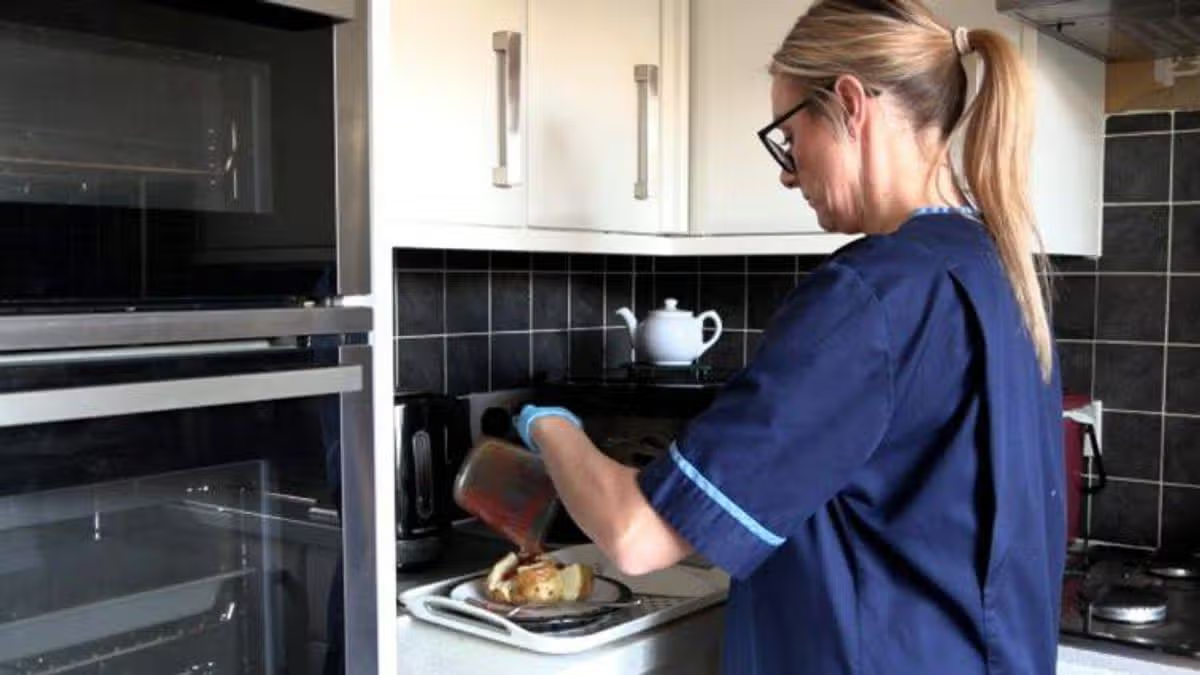
Homeless Aid UK, based on Orlando Street in Bolton, has warned that supplies are running dangerously low after the closure of another local food bank forced more people to turn to the charity for help.

It is now asking the community for donations of essential food items, including tinned vegetables, tinned meals such as macaroni cheese, cereal, Cup a Soup, sugar, tea bags, cooking oil, and rice.

Although grateful for the ongoing support, the group warns that stocks are extremely low and further donations are necessary.

Advertisement

“Our food bank is under immense pressure right now, and with demand higher than ever, we urgently need your support.

“Every tin, every box and every bag helps us support local individuals and families who are struggling.”

Homeless Aid UK provides its food parcels completely free of charge to people facing hardship across the borough.

Billa Ahmed, from Homeless Aid UK, said they had seen a dramatic increase in demand following the closure of another food bank in the area.

Advertisement

“There’s a local food bank, unfortunately, which is now closed down, and because of that, we’ve got a lot of pressure with the thousands and thousands of people that we are helping with free food hampers.

“Now we’ve got so many people coming from them who are now coming over to us.

“We urgently, urgently need your help.”

Mr Ahmed said the CIC focuses on providing practical ingredients that mean families can prepare nutritious meals without spending so much money on cooking costs.

Advertisement

He said: “People need to make a meal so we give them essentials that they can actually make a meal with.

“With the cost-of-living crisis and utilities being so high, gas and electric, we can’t give them something that is going to take a long time to cook.”

The appeal comes as many families continue to feel the strain of rising household bills during the summer holidays, with children not receiving free school meals and parents spending more on childcare as they continue to work.

Mr Ahmed said: “With the summer holidays and rising living costs, increased financial pressure, a lot of the local families are now struggling, even people who are working.”

Advertisement

At the same time, he explains how donations have fallen sharply as supporters face financial difficulties of their own.

“There’s been a massive, significant drop in donations because many people who used to regularly donate to us are now facing financial pressure themselves.”

They are now calling on anyone who can help to donate even a single item and reminding the community that every contribution could make a difference to a family in crisis.

Donations can be dropped off at Homeless Aid UK, Superstore Storage, Orlando Street, Bolton, and for more information, call 0800 124 4641.

Advertisement

Source link

Continue Reading
Click to comment

You must be logged in to post a comment Login

Leave a Reply

NewsBeat

Mother, 38, recorded final video message while trapped in burning building, inquest told

Published

on

Laura Foulis died aged 38 after becoming trapped in a burning stable in Milnrow, Greater Manchester

Advertisement

A mother spent her final moments recording a video message while trapped in a burning building, an inquest heard. 

Horse-loving Laura Foulis died aged 38 after a blaze engulfed a rural farm stable in Milnrow, Manchester, on July 3. 

Police and fire crews rushed to the scene and found Laura, from the Isle of Man, dead. Her body was only identifiable by her fingerprints. 

An inquest at Rochdale Coroner’s Court this week heard that ‘one of a kind’ Laura sent a video while trapped in the inferno. 

Advertisement

The tragic footage showed the scene inside the stable, where bottles and containers had caught fire. Laura was heard saying she was ‘in a set of stables and cannot get out’. 

A neighbour said the horsewoman had been living in a mobile home at the time of her death while renovating a nearby barn and using the stables. 

The exact circumstances surrounding her passing are yet to be made clear, with a full inquest set to be held at a later date. 

Assistant Coroner Michael Salt said: ‘The circumstances of the lady’s death are not yet fully known, however given the information we have already it is clearly an unnatural death and therefore a full inquest is needed.’  

Advertisement

Laura Foulis died aged 38 after becoming trapped in a burning stable in Milnrow, Greater Manchester

The horse-loving mother spent her final moments recording a video message in the inferno

The horse-loving mother spent her final moments recording a video message in the inferno

Images meanwhile showed the fire completely destroyed in the aftermath of the blaze

Images meanwhile showed the fire completely destroyed in the aftermath of the blaze

Advertisement

A man in his 40s was arrested on suspicion of murder in the aftermath of Laura’s death and released on bail pending an investigation. 

He will, however, face no further action as police believe no third-party was involved.

Witnesses reported seeing large flames and black smoke billowing into the sky as the fire raged in the stables, according to The Sun

Images meanwhile showed the building completely destroyed in the aftermath of the inferno. 

Advertisement

Paying tribute, ex-partner David Jacobs, who Laura shared a 16-year-old son with, said he was ‘devastated’ by her death.

‘Words are lost on me at the moment,’ he said. ‘All I can say is Laura we love you and we miss you so much.’

Laura regularly posted pictures and videos of herself riding horses in the countryside on social media before she died.  

In other tributes online, friends described her as having a ‘big heart’ and thanked her for helping inspire their ‘passion for horses’.

Advertisement

Leah Sykes wrote: ‘Thank you for believing in me when I didn’t believe in myself, for pushing me to be better and helping me fall in love with horses all over again.

‘You’re one of a kind and such a kind soul that will be missed by so many.’ 

Another friend, Jack McManus added: ‘RIP Laura, a hole in my heart has been made.

‘I will cherish our times together and the memories…will miss you and love you forever and a day.’

Advertisement

A date for the full inquest is yet to have been set.  

Advertisement

Source link

Advertisement
Continue Reading

NewsBeat

Transfer news LIVE: Vinicius Jr to Arsenal FC decision, Bruno Guimaraes announcement; Man Utd, Liverpool latest

Published

on

Transfer news LIVE: Vinicius Jr to Arsenal FC decision, Bruno Guimaraes announcement; Man Utd, Liverpool latest

Chelsea are on the verge of signing Pep Chavarria and eyeing a fresh offer for Alex Scott, though Diogo Costa will not be heading to Stamford Bridge. Manchester United remain in pursuit of Lewis Hall, while they wait to see if Guimaraes’ arrival at Arsenal could boost their hopes over Myles Lewis-Skelly. Liverpool are still pushing for Bradley Barcola as they also target PSG team-mate Ibrahim Mbaye.

Source link

Continue Reading

NewsBeat

Sheep wool to make seaweed farming plastic free

Published

on

Belfast Live

Engineers from Queen’s University Belfast have been working on an innovative project for the last two years in a bid to drive forward sustainability in the industry.

Sheep wool could be the key to making seaweed farming plastic free, according to experts.

Engineers from Queen’s University Belfast have been working on an innovative project for the last two years in a bid to drive forward sustainability in the industry.

Advertisement

They have been growing kelp, a large and fast-growing brown seaweed, on the wool of Whiteface sheep bred on Dartmoor, which is used to create degradable ropes, which the kelp is cultured on.

At the end of the growing period, the wool ropes, along with any residual seaweed biomass, can be processed into fertilisers, creating a fully circular solution.

Traditionally plastic ropes with residual seaweed are treated with detergents to remove biomass and are then reused, contributing to ongoing environmental issues.

The repeated use of the plastic ropes also increases wear and can lead to the release of microplastics, as well as mechanical failures, causing ropes to be lost at sea.

Advertisement

The researchers have focused on Norway where they say an estimated 383 tonnes of these plastic ropes are lost annually at sea.

At the end of their life, the ropes are often incinerated or sent to landfill, further contributing to environmental harm.

The Queen’s engineers, who were funded by the EPSRC Impact Acceleration Account (EPSRC IAA), started the research on an experimental seaweed farm on Strangford Lough and have since been collaborating with industry partners, The Provenance Company (UK) Ltd and Arctic Seaweeds in Norway.

Advertisement

This has now evolved into industrial-scale trials in Norway and Iceland.

Dr Pamela Walsh from the University’s School of Mechanical and Aerospace Engineering, led the project.

She said: “It’s been fantastic to watch this project grow from a small proof-of-concept at Queen’s University’s experimental farm on Strangford Lough to industrial-scale trials in Norway.

“The EPSRC IAA funding was the catalyst that enabled us to test the concept and we are now confident that plastic-free solutions for seaweed farming can work at scale, in collaboration with our industrial partners.”

Advertisement

Meanwhile, further funding from Innovate UK has allowed the team to develop advanced marine ropes and complete industrial-scale trials, funded by Arctic Seaweeds at the Trettosen Seaweed Farm in Bergen, Norway.

The trials have been successful at cultivating three different types of seaweed species – Ulva, Saccharina latissimi and Alaria esculenta – on 100% pure wool longlines at industrial scale, which is described as a first for the industry.

Kim Kristensen, chief executive and founder of Arctic Seaweed, commended the project.

Advertisement

“From the very first deployment of seeded lines 10 years ago, we have been looking for alternative solutions to the polyester fibre rope most commonly used to cultivate seaweed,” she said.

“We are thrilled to be part of this project, which is helping solve a key challenge in making seaweed farming more sustainable and circular.”

Founder of The Provenance Company (UK) Ltd, Kim Stead, added: “Working with Queen’s University Belfast reflects years of collaboration, innovation, and belief that natural materials can play a vital role in solving some of the world’s most pressing environmental challenges.

“Having the opportunity to test our products in a live commercial environment with Arctic Seaweed has allowed us to prove this concept at scale.

Advertisement

“This opens an exciting new chapter for our farmers, British wool and British manufacturing, while contributing to a circular economy.”

For all the latest news, visit the Belfast Live homepage here and sign up to our daily newsletter here.

Source link

Advertisement
Continue Reading

NewsBeat

Care staff fed woman ‘mouthfuls of microwaved dog food’ labelled ‘lamb dinner’

Published

on

Manchester Evening News

The woman’s son claimed that staff failed to consult her care plan and visits were not accurately recorded before her death

A vulnerable woman was fed dog food by care workers who were unable to read the label during the final months of her life.

Portsmouth City Council has issued a formal apology following the incident, after care workers employed by Radis — contracted to provide home care on behalf of the council — committed a ‘litany of errors’.

Advertisement

An investigation carried out by the Local Government and Social Care Ombudsman found that the care the woman received amounted to a “significant personal injustice”, as she was repeatedly left alone for “prolonged periods of time” or denied food altogether.

The woman, identified in reports as Mrs Y, received home care from GP Homecare Ltd, trading as Radis.

Following a fall in April 2024, she was left with severely limited mobility and confined to her bed, with care workers visiting her home on a daily basis, reports the Daily Star.

Mrs Y’s son raised safeguarding concerns regarding a “lack of management oversight at Radis”, claiming that staff failed to consult her care plan, visits were not accurately recorded, and a ‘Do Not Attempt Resuscitation’ document was found “scrunched up in a cupboard”.

Portsmouth City Council subsequently launched a Section 42 safeguarding enquiry to examine the allegations, while Radis began its own internal investigation.

After Mrs Y suffered a mini-stroke, her family and Radis agreed she required a “soft diet due to the increased risk of choking”.

Despite this, in mid-June 2024, a care worker was discovered feeding the woman dog food, recorded in notes as a “lamb dinner”. Two care workers visited Mrs Y’s home, and a week later one raised concerns about witnessing the other “feed dog food” to Mrs Y.

Advertisement

The care worker “only realised the meat was dog food when they noticed the packaging in the kitchen”.

They initially attempted to reach a senior colleague to flag the incident, but their call went unanswered, leading them to report the matter in person the following week.

They were then questioned by the senior manager, who asked “why they did not remove the dog food” during the visit and “why they did not report the incident on the day it happened”, and were instructed to remove the dog food from Mrs Y’s freezer “to prevent any other care workers doing the same”.

It was later established that the care worker “fed three mouthfuls of microwaved dog food to Mrs Y”.

Advertisement

“This was vacuum packed dog food stored by Mrs Z in Mrs Y’s freezer. The food was labelled as “fresh take on dog food” and “for adult dogs and puppies”.

Following discussions between Radis and the family, it was agreed that a new care provider would be needed.

However, in July 2024, Mrs Y’s family opted to delay the new provider’s start date following a deterioration in her health, meaning Radis continued to deliver end-of-life care.

Mrs Y’s daughter alleged that “footage from Mrs Y’s home camera showed evidence of a care worker force feeding Mrs Y”.

Advertisement

Later in July 2024, Mrs Y passed away and it was determined she “died from frailty of old age”. Radis admitted failings in the care delivered following complaints from Mrs Y’s relatives, confirmed disciplinary measures taken against the carers and issued an apology.

The council’s inquiry also uncovered that Mrs Y was “left unattended for prolonged periods and on occasions left wet or in darkness overnight”.

The findings revealed that staffing levels were “inconsistent”, with worries raised about employees’ “attitude, compassion and respectful communication”.

Advertisement

There were additionally “Allegations that staff falsified records and that some visits had not taken place despite being recorded”.

The ombudsman recommended the council apologise, reimburse the care charges, and provide a symbolic payment of £1,000 to the relatives to “recognise significant distress” and the “delays” in the safeguarding investigation.

Councillor Matthew Winnington, cabinet member for community wellbeing, health and care, said: “We accept the Ombudsman’s findings in full and recognise the seriousness of what happened in this case. We ended our contract with Radis early and we no longer work with, or commission services from them.

“The care described in this report is not the standard anyone should expect, particularly at such a vulnerable time in someone’s life. We have apologised to the family and are very sorry for the distress they have experienced; we know this has been deeply upsetting for the family.”

Advertisement

He went on to say: “These events happened two years ago, and since then we have taken action to strengthen how we oversee care providers… Our adult social care services recently received a ‘good’ rating from the Care Quality Commission, reflecting the wider positive experiences of residents, the strength of partnership working across the city, and the support available to help people remain independent.”

Source link

Continue Reading

NewsBeat

Ferran Torres’ Barcelona future uncertain after comments spark backlash

Published

on

Ferran Torres celebrates after winning the 2026 World Cup with Spain in July

Barcelona remain relaxed about Torres’ situation despite the growing uncertainty surrounding his future. They say they will speak to him when he returns to training, as planned.

He was not a regular starter under Hansi Flick last season and ended the campaign with 21 goals and three assists in 49 appearances.

But he is one of the club’s most trusted and versatile attacking options, rotating primarily with Robert Lewandowski – who has since signed for Chicago Fire – as a central striker while also providing cover across the front three.

Barcelona are ultimately keen to extend his contract but any new agreement is expected to keep Torres within the existing wage structure rather than include a substantial salary increase.

Advertisement

Reports suggest the club would look to delay formal negotiations until September – after the transfer window has closed – so as not to affect Financial Fair Play calculations and their ability to do business during the current window.

Renewing Torres’ deal would also reportedly trigger, external a payment of almost £7m to former club Manchester City, because of a clause included in his contract when he signed in the 2022 January transfer window.

Barcelona have received no formal offers for the Spain international although, as with any member of the squad, they would consider an offer if one were made.

PSG, managed by former Barcelona coach Luis Enrique, remain interested in the forward and are monitoring developments closely as Barcelona prepare to present their proposal.

Advertisement

The forward may feel he heads into those negotiations from a position of strength.

They come with the club still seeking a long-term number nine solution, with a move for Atletico Madrid’s Julian Alvarez remaining uncertain.

That means, following Lewandowski’s departure at the end of his contract in June, Torres is the only senior Barcelona forward with significant experience of playing as a central striker.

Source link

Advertisement
Continue Reading

NewsBeat

India and Pakistan’s 79-year rivalry has made the dangerous move into space

Published

on

India and Pakistan’s 79-year rivalry has made the dangerous move into space

India and Pakistan fought an intense four-day war in May 2025. But while the media narrative was dominated by fighter jets, drones and missiles, the most consequential contest unfolded in orbit a few hundred kilometres up.

That short war was, arguably, the first between two nuclear-armed states to be shaped decisively by the use of satellites. Few analysts acknowledged this – and the silence matters. South Asia is now sliding into a new kind of arms race with no rules to restrain it.

The opening night on May 6 carried a lesson that should unsettle far larger air forces than those of the two countries involved. Pakistan, with a smaller military, fought a tightly networked battle that fused ground radar, airborne early warning, data links and satellite navigation into a single kill chain, planning and executing attacks. Pakistan’s strategy has been developed by an air force whose leadership had drilled that doctrine for years.

Pakistani officials claimed that one of their Chinese-built J-10C fighters downed an Indian Rafale with a PL-15 missile at more than 200kms. This was a kill made from beyond visual range – something with little precedent in combat. India disputes the account, but its own chief of defence staff later conceded that the air force lost aircraft that day.

Advertisement

India regrouped and struck back hard over the following days. But the opening exchange was decided less by numbers, or by any single aircraft’s specifications, than by how well each side fused its radar, early warning, data links and missiles into one system, and by the training of the crews flying it.

Sitting over all this was space-based technology. Modern strikes run on satellites: satellite imagery to find targets, navigation to guide weapons and links to hold it together. Both sides drew on them and both used them to reach beyond their borders.

Despite the strength of India’s defence manufacturing industry, Delhi fell back on imagery bought from US commercial satellite firm Maxar Technologies to assess the damage its strikes had caused. Pakistan leaned on Chinese systems. According to India’s own deputy army chief, Beijing fed Pakistan live inputs on Indian deployments – and researchers have describe how a BeiDou-enabled satellite network (the Chinese equivalent of GPS) reportedly supplied targeting data during the fighting.

This is where the familiar story about Pakistan’s dependence on China needs correcting. Reliance on a great power patron is not peculiar to Pakistan – most countries start out developing their space programme this way. India launched its first satellite on a Soviet rocket in 1975 and built its heavy-lift capability around Russian cryogenic engines, the high-efficiency rocket motors that burn super-cooled liquid fuel to launch heavy satellites, acquired in 1991.

Advertisement

China itself began with Soviet missile designs. Pakistan’s turn to China, after years of relying on a US system it feared could be switched off in a crisis, is a rational decision of the same kind India once made when it sourced most of its weapons and its first satellite launch from Moscow rather than the west.

Borrowed capability still comes with a cost. Commercial and allied space assets are becoming a strategic equaliser in South Asia, giving a smaller state capabilities it could not achieve on its own. The risk is that this hands a third power a seat inside a bilateral nuclear rivalry and ties a regional quarrel to the wider contest between Washington, Moscow and Beijing.

India has chosen to respond with sheer volume, fast-tracking a home-grown programme worth US$3.2 billion (£2.4 billion) for 52 dedicated military satellites to watch Pakistan, China and the Indian Ocean, plus a new space doctrine and counterspace arsenal. It has already demonstrated its ability to destroy a satellite in orbit in its 2019 Mission Shakti test. Pakistan is likely to respond by deepening its partnership with China.

Split-second decisions

The deeper hazard is not a battle in orbit but the way these systems compress the timing with which operational decisions are made. When commanders can watch an adversary almost in real time and believe a target can be struck within minutes, the pull to move first, before the target slips away, becomes hard to resist.

Advertisement

As I have written on the doctrine of limited air wars, nuclear neighbours rarely escalate deliberately. They tend to stumble into conflict under time pressure. Satellites do not make these states reckless. They reduce the margin for miscalculation.

And there is no rule book. The 1967 Outer Space Treaty bans weapons of mass destruction in orbit, but is silent on the conventional, electronic and cyber tools that actually shaped this war. Fresh norms have stalled. India has abstained from recent United Nations resolutions on responsible behaviour in space, wary of a rule-making process it sees as led by the established western space powers and shaped without India’s full say.

Meanwhile, Pakistan urges a restraint it cannot yet enforce. Nothing in the space domain resembles even the imperfect hotlines and arms-control treaties that disciplined the cold war rivalry between Washington and Moscow.

For years, the debate about war in space has focused on the US, China and Russia. Yet it may be here, between two states partitioned in 1947 that have fought four wars since, that the world first sees what space-enabled conflict between nuclear powers really looks like.

Advertisement

Having spent 17 years in the Pakistan Air Force before turning to research, I think the May war is not so much a story about Pakistan’s reliance on China than as two nuclear rivals racing the same space-enabled technology ahead of any restraint. The tools are advancing fast. The guardrails are not.

Source link

Advertisement
Continue Reading

NewsBeat

Forget THAT other ‘guide’ – THIS is the definitive list of what to put in the fridge, which food tastes infinitely better left out on the sideboard… and the ‘natural enemy’ items to NEVER store next to each other

Published

on

Specialist dietitian Nichola Ludlam-Raine provides insight on the question 'to refrigerate or not to refrigerate?'

To some, the very idea of storing your eggs in a cupboard rather than the door of the fridge is horrifying.

Others will tell you that a bar of chocolate tastes far better when it’s chilled to the point that it could break your teeth.

There are those who insist that an open bottle of ketchup must be refrigerated – but who wants cold tomato sauce on their hot chips?

Is it any wonder that we’re all slightly baffled about what we should and shouldn’t chill? A survey found that three-quarters of us are so confused it’s leading to domestic fallouts.

Advertisement

To avoid further friction, here’s the ultimate expert guide to what you should keep in the fridge and what’s better off in the cupboard.

Advertisement

Specialist dietitian Nichola Ludlam-Raine provides insight on the question ‘to refrigerate or not to refrigerate?’

Eggs

When it comes to the ‘to chill or not to chill’ debate, eggs are undoubtedly the most contentious item.

Our fridges all come with egg storage containers, so surely that’s where we should keep them? But attempting to boil an egg from the fridge usually leads to some very lonely soldiers after the egg cracks and explodes.

Advertisement

Specialist dietician Nichola Ludlam-Raine says: ‘Eggs are better off in the fridge. However, keep them in the original box on a shelf, not a compartment in the door as that’s the area most variable in temperature.’

Butter

A dairy product, so logic dictates it should be chilled. But as everyone knows, if you try to spread it straight from the fridge it ends up tearing a huge hole in your £6 loaf of sourdough.

Previous generations stored their butter in a dish in a cool larder, keeping it deliciously soft. Should we be going the same way?

Nichola says: ‘Butter is now available in a form that will spread straight from the fridge. They add extra rapeseed oil and water to achieve that.

Advertisement

‘When people kept butter in a dish in the larder it was before the days of central heating. Modern houses are much warmer. A block of pure butter would be ok in a dish in cool weather, especially salted. But, generally, it’s better in the fridge.’

Bread and cake

A survey found that three-quarters of us are so confused about what to store in the fridge or the cupboard it causes domestic fallouts

A survey found that three-quarters of us are so confused about what to store in the fridge or the cupboard it causes domestic fallouts

Who wants dry, crusty bread? Keeping loaves in the fridge is an odd one but the popularity of huge, American-style fridges means that Brits store the majority of their food there, freeing up cupboard space for their ever-growing array of trendy kitchen gadgets.

Nichola says: ‘Refrigerated bread will be slower to grow mould but the starch firms up very quickly and it’s going to go stale much sooner, so there’s no value to chilling it. A bread bin on the side is best. Cakes contain a lot of sugar and so will last well in an airtight container in a cool, dark place.’

Advertisement

Fruit

What home doesn’t have a fruit bowl? All the fruit thrown in together, usually with a brown banana buried at the bottom and a pineapple that gets binned because nobody knows how to cut it up. But is a fruit bowl now old-fashioned?

Nichola says: ‘Fruit ripens better and faster at room temperature, so keep things out of the fridge until they’re ready to eat. Bananas are best out of a fridge always and stored on their own as they give off ethylene gas, which causes other fruits to spoil.

‘Apples are fine in a bowl but will last longer in a fridge and chilling won’t alter the taste. Remove bad apples from the chiller drawer, though, as they’ll turn the other ones. Ripen avocados on the side and then refrigerate.’

Vegetables

Did you know that potatoes and onions are the sworn enemies of the vegetable world and should never be kept together? Onions give off ethylene gas that will cause the potato to sprout and rot, while the potato releases water vapour that makes the onion go soft and mouldy.

Advertisement

The official advice about where to store your spuds has changed.

Previously, the advice was not to refrigerate in order to prevent ‘cold sweetening’ – the formation of additional sugars which convert to higher levels of potentially-carcinogenic acrylamide when cooked. Food scientists now believe this not to be the case.

Nichola says: ‘Most people keep their potatoes in a cupboard but they’ll keep for much longer if you refrigerate them. Onions and garlic are fine in a pantry until they’re cut. Leafy green veg should always be chilled to preserve nutrients.

‘Instagram is full of reels of influencers unwrapping their vegetables, washing and then storing. Don’t! Keep them in the wrappers until you use them.’

Advertisement

Tomatoes & salad

Nichola says produce like tomatoes can be kept out of the fridge, whereas lettuce and cucumber should remain chilled in their packaging

Nichola says produce like tomatoes can be kept out of the fridge, whereas lettuce and cucumber should remain chilled in their packaging 

Visit the home of anyone with a fancy kitchen and you’re likely to see a tick-list of things. Range oven? Tick. Flashy coffee machine? Tick. Tomato bowl? Tick. But is a bowl for your tomatoes the right thing to do?

Nichola says: ‘Tomatoes taste better at room temperature and they’ll ripen better out of the fridge too. If you keep them in a bowl on the side, make sure it’s out of direct sunlight. Always keep your lettuce and cucumber chilled and in the packaging – it’s designed to be protective and preserve the produce.’

Jams and spreads

For generations, people happily kept their opened jams, spreads and marmalades in cupboards without coming to any harm, only discarded once they grew a fetching fur coat.

Advertisement

Now, the advice is very much to keep refrigerated. But who wants icy-cold marmalade on their hot, buttered toast? Or chilly strawberry jam on their warm scone?

Nichola says: ‘Nut butters are fine in a cool, dark cupboard and honey should be out of the fridge, otherwise it will crystalise. But with jams, the jarring is a huge part of the preservation, so once you open and let oxygen in, it will start to spoil. So, yes, in the fridge.’

Kate Hall, a food waste expert advises: ‘If it simply has to be the cupboard for you, then always use a clean spoon or knife to avoid contamination from crumbs and butter. But never scrape mould off and hope for the best!’

Chocolate

Anybody who has ever kept a bar of milk or dark chocolate in the fridge will know that it starts to turn white. It’s because of ‘sugar bloom’ and it impacts the taste too. This happens when chocolate is chilled and then exposed to warmer temperatures. Condensation on the surface dissolves some of the sugar, which then re-crystallises.

Advertisement

Nichola says: ‘The joy of chocolate is the melt-in-the-mouth experience, which you don’t get if it’s very cold. Keep it in a cool, dry place. In a heatwave maybe go for an airtight container.’

Olive oil

The UK olive oil industry now exceeds £1billion. Prices are expected to soar after a summer of drought and wildfires. The last thing you want to do is ruin your expensive bottle.

Nichola says: ‘Keeping the oil away from light and heat is the key to keeping it at its best. Store in a cupboard, not the fridge. If you have it on the work surface, then make sure it’s away from the oven hob.’

Ketchup and mustard

The average bottle of ketchup has an 18-month use-by date – making them a super-tough and hardy food product. Yet the labels usually instruct us to put them in the fridge after opening. If they’re packed full of vinegar and sugar do they really turn into super-wimps that need to be chilled the minute they’re opened?

Advertisement

Nichola says: ‘The advice from manufacturers such as Heinz is to refrigerate after opening and they’re the ones that have done the testing. Do what the labels say.’

However, Kate Hall advises: ‘Ketchups are generally high in sugar and vinegar, so the risk of keeping them in the cupboard is low, especially if they’re going to be used up quickly. But I would definitely chill them during a heatwave. Opened mustard always needs to be kept in the fridge.’

Source link

Advertisement
Continue Reading

NewsBeat

PM promises ‘high street’ mental health centres to open in banks and libraries

Published

on

PM promises ‘high street’ mental health centres to open in banks and libraries

A series of new mental health centres are set to open in local libraries, banks and other high street locations across England to ensure people receive “support earlier closer to home”, the government has announced.

Under the plans, officials confirmed that individuals experiencing a mental health crisis will receive specialist care inside dedicated mental health emergency departments instead of waiting in overcrowded general A&Es.

Prime minister Andy Burnham said the new centres will serve as a “lifeline” for the thousands of patients who are currently waiting “months” to access help.

The Department of Health and Social Care stated that 100 new community mental health centres and 59 dedicated emergency departments will be created as part of the “biggest redesign of mental health services in a generation”.

Advertisement

These community centres are set to offer walk-in support where members of the public can attend without needing a medical referral.

While some of the community hubs will be newly built facilities, others will operate inside banks, libraries and additional high street premises, the Department said.

Prime Minister Andy Burnham speaks to residents, care workers, volunteers and social care stakeholders during a care home visit on July 29, 2026 in London
Prime Minister Andy Burnham speaks to residents, care workers, volunteers and social care stakeholders during a care home visit on July 29, 2026 in London (Getty)

In addition, extra mental health emergency departments will deliver same-day support for people undergoing a crisis who remain medically fit and do not require treatment in general A&E.

Situated within emergency departments, these specialist facilities will provide a “calm, therapeutic environment where people can be assessed quickly”, expanding England’s total to 82.

Mr Burnham said: “Nobody should be left to struggle with their mental health alone. But every day, thousands of people are waiting months for help, then finding the only door open to them is a busy A&E.

Advertisement

“These new centres will be a lifeline for so many. They will bring NHS services closer to home, making it easier to get support before problems get worse, and ensuring those in crisis get the right care in the right place.

“On the steps of Downing Street, I said we would build a country that acts sooner when people need help. Today is just the start of making that a reality.”

The Department said that the initiative is backed by £343 million and the first sites will open in autumn this year, with “further facilities following from March 2027”.

Britain's Health Secretary Yvette Cooper and Britain's Prime Minister Andy Burnham smile during a visit social care organisation Jewish Care, in north west London on July 29, 2026
Britain’s Health Secretary Yvette Cooper and Britain’s Prime Minister Andy Burnham smile during a visit social care organisation Jewish Care, in north west London on July 29, 2026 (AFP/Getty)

Health Secretary Yvette Cooper said: “Too many people are only getting mental health support when they reach crisis point, after struggling for far too long to get the help they need.

“These new community mental health centres will help people get support earlier and closer to home, making it easier to get the right care before problems escalate. And when someone does need urgent help, new mental health emergency departments will be able to make sure they are seen quickly by specialist teams in the right setting.

Advertisement

“This is how we can turn the tide on mental ill health – preventing more people from reaching crisis, cutting waits for care, and building an NHS which is there for everyone when they need it.”

The announcement forms part of the forthcoming Mental Health Strategy, which is expected to be published later this year.

The strategy will be informed by the independent review into mental health conditions, ADHD and autism, which is expected in the autumn.

According to NHS figures, 2.36 million people in England had an open referral with mental health services at the end of May 2026, up from 2.10 million a year earlier and 1.95 million in May 2024.

Advertisement

Brian Dow, deputy chief executive at the charity Rethink Mental Illness, said: “The expansion of neighbourhood mental health centres is a vital step towards making this a reality, building on the promising results of existing pilot sites.

“By bringing together treatment and wider support services under one roof, these centres can transform experiences of care, helping people to access support earlier and preventing them from reaching crisis point.”

Tom Pollard from the charity Mind added: “This is a promising step towards more people getting the mental health support they need, when they need it. Too often, we hear from people struggling to access overstretched services whose mental health worsens because of this.”

Source link

Advertisement
Continue Reading

NewsBeat

Salford fire LIVE as huge blaze rips through shop with Bury New Road closed and emergency services on scene – updates

Published

on

Manchester Evening News

Source link

Advertisement
Continue Reading

NewsBeat

Man falls into leg of statue and suffers terrifying death

Published

on

Daily Record

Tragedy struck a 39-year-old man unexpectedly after he tried to retrieve his phone that had fallen inside a statue

Police in Catalonia were faced with one of the strangest cases of accidental deaths in recent years when they got a report from a father and son back in 2021.

Advertisement

The duo were walking on a Saturday afternoon when they passed a papier-mache stegosaurus statue placed outside a building in Santa Coloma de Gramenet, a suburb of Barcelona.

They soon noticed a foul smell coming from the piece and went to take a closer look, only to find a body through a crack in the statue’s hollow leg.

Those were the mortal remains of a 39-year-old man, discovered by the regional police force, the Mossos d’Esquadra, who recovered the body from inside the statue.

A spokesperson for the authorities explained the man appeared to have climbed into the dinosaur’s leg – entering headfirst – while trying to retrieve a mobile phone he’d dropped, and had then become trapped, unable to work his way back out.

“It’s an accidental death; there was no violence,” she said at the time.

“This person got inside the statue’s leg and got trapped. It looks as though he was trying to retrieve a mobile phone, which he’d dropped. It looks like he entered the statue headfirst and couldn’t get out.”

The inside of the statue was such a tight fit that three fire brigade teams were called to the scene and were forced to cut open the leg of the stegosaurus replica.

Advertisement

According to local reports at the time, the man had been reported missing by his family only hours before his body was discovered, but police believed he had likely been trapped for a couple of days, and had not been able to confirm precisely how he’d ended up stuck upside down in the first place.

Several Spanish news outlets, including El País and La Vanguardia, reported on the case at the time, noting that the incident was widely discussed in the local community and covered by both regional and national media because of its unusual nature.

The statue was displayed outside the city’s Cubic Building, installed as decorative signage advertising an old cinema. Santa Coloma de Gramenet’s city council confirmed the statue’s removal in official statements following the discovery.

Advertisement

Source link

Continue Reading

Trending

Copyright © 2025