Connect with us
DAPA Banner

Business

How Digital Health is Reshaping Medical Equipment Demand

Published

on

How Digital Health is Reshaping Medical Equipment Demand

The digital health revolution is transforming healthcare delivery globally.

In Australia, the telehealth market reached AUD $1.5 billion in 2024 and is projected to grow to AUD $6.96 billion by 2034. Meanwhile, the UK’s telehealth sector is expected to grow from £751.94 million (2024) to £3.09 billion by 2033.

Here’s the paradox: whilst telemedicine reduces physical clinic visits, it’s actually increasing demand for high-quality diagnostic tools. Healthcare providers conducting fewer but more efficient in-person consultations need to maximise the value of every patient interaction, driving a surge in procurement of professional-grade medical equipment.

The Telemedicine Revolution

Between March 2020 and March 2022, over 100 million telemedicine services were delivered to approximately 17 million Australians. The Australian government invested $409 million to make telehealth permanent, whilst the UK announced £600 million for digital health infrastructure in April 2025.

Patient adoption is equally impressive: 60% find telemedicine more convenient than in-person appointments, 55% report higher satisfaction with teleconsultations, and 74% of millennials prefer virtual appointments for routine care. These aren’t temporary shifts; they represent a fundamental transformation in healthcare delivery.

Advertisement

The Equipment Paradox

Despite telemedicine’s digital nature, quality remote care requires more sophisticated physical diagnostic equipment than ever. When practitioners conducted primarily in-person consultations, they could perform comprehensive examinations over multiple visits. Telemedicine’s efficiency comes at a cost: practitioners must gather definitive diagnostic information during shorter, focused encounters.

This shift is fundamentally changing equipment procurement strategies. Healthcare businesses are increasingly sourcing equipment through online medical products suppliers, appreciating streamlined procurement that allows comparing specifications, reading practitioner reviews, and accessing professional-grade equipment without traditional sales barriers. The digital procurement revolution mirrors broader telemedicine transformation, making quality healthcare tools more accessible whilst maintaining professional standards.

Many practices now invest in complete diagnostic kits for rapid deployment during in-person consultations or home visits. This equipment mobility ensures telehealth practitioners can seamlessly transition from virtual to physical assessment when clinical judgement demands it, maintaining diagnostic quality regardless of consultation setting.

4 Essential Equipment Categories for Telehealth Success

1. Premium Stethoscopes: Still Essential in the Digital Age

High-quality acoustic diagnostics remain crucial for cardiopulmonary assessment. Telehealth practitioners discover that when every in-person interaction must deliver maximum value, there’s no substitute for superior acoustic quality. This drives healthcare providers to invest in quality stethoscopes, with premium brands becoming even more valuable in hybrid care settings.

Advertisement

The convenience of ordering professional diagnostic tools through specialised online platforms has democratised access to premium equipment, allowing smaller practices and independent telehealth providers to compete on equipment quality with larger healthcare organisations. This accessibility revolution is particularly significant for rural and regional practices previously disadvantaged by limited local supplier options.

Digital stethoscopes designed for telemedicine can transmit heart and lung sounds in real-time during virtual consultations. Research shows both wearable and non-wearable digital stethoscopes achieve high correlation coefficients (0.72 and 0.75) in frequency response, confirming their clinical utility. For telehealth practices, investing in premium stethoscopes delivers efficiency gains through confident first-visit diagnostics, reducing follow-up appointments and optimising practitioner time.

2. Comprehensive Diagnostic Sets

For hybrid care models, comprehensive medical diagnostic sets are essential. Modern sets combine otoscopes, ophthalmoscopes, percussion hammers, and examination lights in portable cases that move seamlessly between clinic rooms, home visits, and mobile settings.

Having everything needed for physical examination in one kit eliminates the inefficiencies that plague hybrid practices. No more scrambling for equipment or maintaining multiple incomplete sets across different locations. Quality diagnostic sets represent significant upfront investment but deliver returns through reduced equipment redundancy, improved practitioner confidence, and the ability to offer comprehensive care in any setting where patients need it.

Advertisement

The portability factor proves particularly valuable for practices offering home visits or mobile health services. Practitioners can arrive at any location with complete diagnostic capabilities, ensuring consistent care quality regardless of setting. This equipment mobility has become a competitive differentiator in markets where patients increasingly value healthcare convenience.

3. Emergency Response Equipment

As healthcare interactions increasingly occur outside traditional settings, accessible emergency equipment becomes critical. Medical practices now invest in defibrillators as standard equipment. Modern AEDs integrate with telemedicine platforms, allowing remote specialists to provide real-time guidance during emergencies. Some feature Wi-Fi connectivity, enabling responders to review shock details and ECG data before arrival.

Beyond clinical benefits, having AEDs readily available demonstrates commitment to patient safety, satisfies insurance requirements, and in some jurisdictions, may be legally mandated for healthcare facilities. The investment typically ranges from £800 to £2,500 per unit, but the potential to save lives makes it invaluable. For practices implementing comprehensive telehealth programmes, emergency preparedness equipment has transitioned from optional to essential, reflecting the broader understanding that whilst telemedicine handles routine consultations remotely, practices must maintain robust emergency response capabilities.

4. Connected Vital Signs Monitors

Blood pressure monitors, pulse oximeters, and thermometers have evolved into essential telehealth equipment. The latest generation features Bluetooth or Wi-Fi connectivity, automatically transmitting readings to electronic health records. This eliminates transcription errors and creates longitudinal records revealing trends invisible in single measurements.

Advertisement

Many practices now provide monitoring equipment to patients with chronic conditions, enabling sophisticated remote monitoring between appointments. Patients measure their own vital signs at scheduled intervals, with data flowing automatically to their healthcare team. This continuous monitoring capability transforms episodic care into ongoing health management, particularly valuable for conditions requiring frequent monitoring like hypertension, diabetes, or heart failure.

Whilst connected monitoring equipment costs more upfront, the time savings from automatic data capture and ability to monitor patients remotely can reduce overall care costs whilst improving outcomes. Practices report significant reductions in unnecessary emergency presentations when patients and practitioners have access to continuous vital signs data.

The Business Case for Quality Equipment

Key Investment Considerations

Reliability as Competitive Advantage: Quality diagnostic equipment directly influences patient outcomes and satisfaction. Practices with premium equipment report 25-30% fewer diagnostic uncertainty follow-ups, translating to significant time savings whilst improving patient experience.

Compliance Requirements: Equipment must meet TGA (Australia) or MHRA (UK) standards. Non-compliant equipment can jeopardise practice accreditation and expose providers to liability.

Advertisement

Total Cost of Ownership: Premium equipment often proves more economical long-term. A £450 stethoscope lasting 10 years costs £45 annually, whilst a £150 budget model replaced every 3 years costs £50 annually with inferior performance.

Online Procurement Benefits: Medical equipment e-commerce has grown 12-15% annually since 2020. Online platforms provide price transparency, comprehensive specifications, customer reviews, and convenient delivery whilst eliminating sales pressure.

Future Trends

As telemedicine evolves, several trends are shaping the medical equipment landscape:

  • AI-Enabled Diagnostics: Artificial intelligence is being integrated into equipment, from stethoscopes detecting heart murmurs to automated vital signs analysis, extending telehealth practitioners’ diagnostic capabilities.
  • Platform Integration: Manufacturers increasingly design devices that integrate seamlessly with telemedicine software, allowing real-time data transmission during virtual consultations.
  • Wearable Medical Devices: The line between consumer health trackers and medical-grade monitors is blurring, with continuous ECG monitors and wearable stethoscopes enabling unprecedented care continuity.
  • Cross-Border Healthcare: Digital health enables specialist consultations and second opinions across geographic boundaries, creating demand for standardised equipment meeting multiple regulatory frameworks.

Conclusion

The rise of telemedicine hasn’t diminished the importance of physical medical equipment; it has heightened it. As healthcare evolves towards hybrid models combining virtual consultations with in-person assessment, the strategic importance of quality medical equipment has never been greater.

Healthcare businesses investing in comprehensive, reliable diagnostic equipment will be best positioned to thrive. The message is clear: telemedicine doesn’t eliminate the need for quality diagnostic tools. Instead, it makes every piece of equipment more valuable by ensuring practitioners can maximise diagnostic efficiency during physical interactions.

Advertisement

The future of healthcare is intelligently hybrid. Healthcare businesses that invest strategically in both digital infrastructure and professional-grade physical equipment will meet the evolving needs of patients who expect the convenience of virtual care and the thoroughness of expert physical assessment.

Advertisement
Continue Reading
Click to comment

You must be logged in to post a comment Login

Leave a Reply

Business

Wave Life Sciences shares tumble on obesity drug trial data

Published

on


Wave Life Sciences shares tumble on obesity drug trial data

Continue Reading

Business

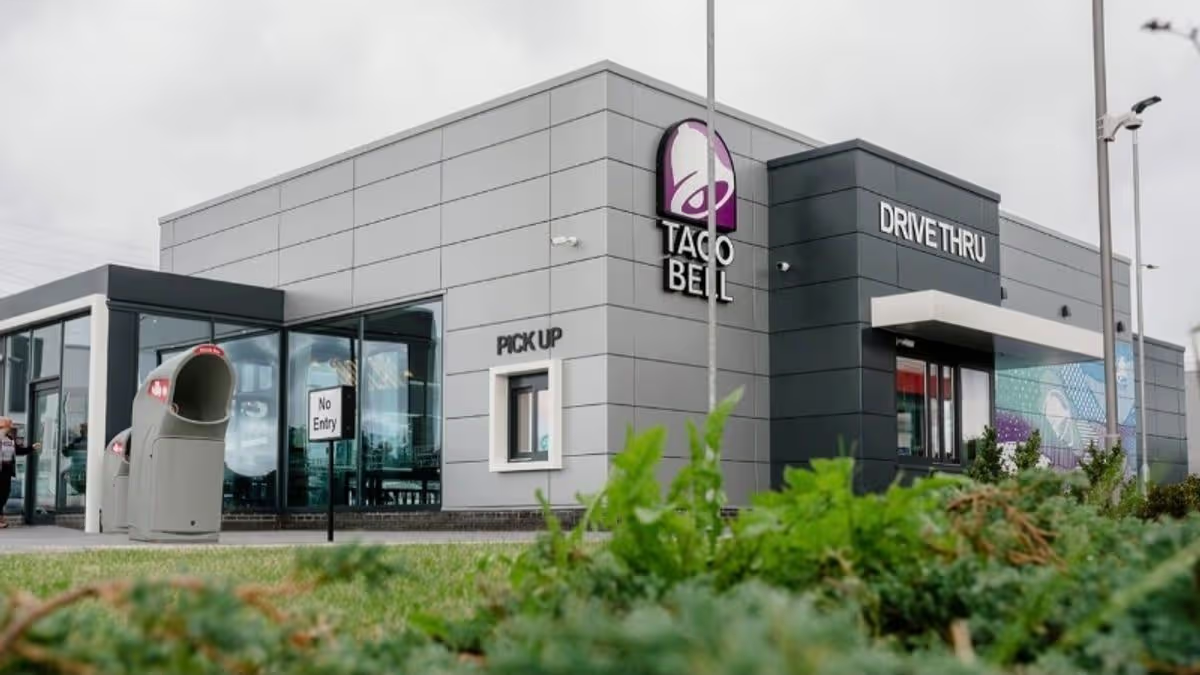
Taco Bell to open new restaurants along M4 and M5 corridor, creating 600 jobs

Published

on

Business Live

The US fast-food chain sells Mexican-inspired dishes and is known for its tacos and burritos

Taco Bell is opening across the South West, Wales and Midlands

Taco Bell is opening across the South West of England, Wales and Midlands(Image: Handout)

US fast-food restaurant Taco Bell is set to open a number of outlets in the West of England, Wales and the Midlands. Franchise operator Campana has secured an eight-figure funding package which will be used to establish the new branches, with six sites due to open across the cross-border region in the coming months.

Part of the SYMBRO Group, Campana currently operates 23 Taco Bell locations in South West England, Wales and the Midlands.

It is understood the business plans to open around 12 new restaurants a year, building a portfolio of more than 50 Taco Bell sites in the UK by 2029.

The next phase of growth will focus on further locations in Wales, the South West, along the M4 and M5 corridors, plus further expansion in and around the Midlands.

Advertisement

The £20m investment programme is expected to create around 600 jobs and increase revenue by between 50 and 60 per cent as the business continues to expand.

David Morgan, finance director at Campana, said: “Since opening our first Taco Bell six years ago, and with every additional new restaurant opening since, we’ve consistently seen strong demand for this much-loved brand, bringing craveable, Mexican-inspired flavours and unbeatable value to a new generation of UK consumers.”

The company secured the latest finance package from HSBC UK. It is understood the lender also provided Campana with a revolving credit facility, giving the business access to capital as new locations are secured and construction and fit-outs get under way.

Paul Lane, relationship director at HSBC UK, added: “Campana has built a strong Taco Bell franchise business since opening its first location, and its ambitious rollout plans highlight the opportunity within the UK’s hospitality sector, despite ongoing pressures.

Advertisement

“The quick-service restaurant market continues to show resilience, with franchising offering a scalable and effective route to growth. Against this backdrop, the business’ clear expansion strategy and proven track record made a compelling case to support this significant funding package and its next phase of growth.”

SYMBRO Group currently owns and operates 60 QSR franchises across the UK and the Netherlands, including Taco Bell, Subway and Starbucks.

Continue Reading

Business

Don't panic – five ways to stop your kids' endless scrolling

Published

on

Don't panic - five ways to stop your kids' endless scrolling

Parenting experts share their tips on how to keep children’s screen time under control.

Continue Reading

Business

Nike At 5-Year Lows: Why The Turnaround Is Already Working

Published

on

Nike At 5-Year Lows: Why The Turnaround Is Already Working

Nike At 5-Year Lows: Why The Turnaround Is Already Working

Continue Reading

Business

M-tron Industries, Inc. (MPTI) Q4 2025 Earnings Call Transcript

Published

on

OneWater Marine Inc. (ONEW) Q1 2026 Earnings Call Transcript

Operator

Hello, and thank you for standing by. My name is Bella, and I will be your conference operator today. At this time, I would like to welcome everyone to M-tron Earnings Call for Q4 2025. [Operator Instructions]

I would now like to turn the conference over to Linda Biles, Executive Vice President of Finance. You may begin.

Advertisement

Linda Biles
Executive VP of Finance & Secretary

Good morning, everyone. Thank you for joining our M-tron Q4 2025 and Fiscal Year 2025 Earnings Call. Please note that this call will be recorded, and we will make the recording available on our website www.mtron.com shortly after the call. Tuesday afternoon, we released our earnings for the fourth fiscal quarter of 2025 and annual fiscal year 2025.

Before getting underway, we are required to advise you that the following discussion should be taken in conjunction with our most recent financial statements and notes is contained within our 2025 10-K, which was filed today on March 26 with the SEC.

This discussion may contain forward-looking statements within the meaning of Section 27A of the Securities Act of 1933 and Section 21E of the Securities and Exchange Act of 1934. These forward-looking statements contain known and unknown risks and uncertainties, which are detailed in our filings with the SEC.

Advertisement

Although the company believes that the forward-looking statements are based upon reasonable assumptions regarding its business and future market conditions, there are no assurances that the company’s actual results will not differ materially from any results expressed or implied by the company’s forward-looking statements.

Continue Reading

Business

MLB faces historic shift as potential lockout, media rights and league changes loom

Published

on

MLB faces historic shift as potential lockout, media rights and league changes loom
Why this MLB season could be the last before major changes for the league

Thursday’s Opening Day may be the calm before the storm for Major League Baseball.

The league’s collective bargaining agreement with its players expires at the end of this season. Owners, with the commissioner’s backing, are almost sure to push for a salary cap (which would likely come with a salary floor to get players to the negotiating table).

MLB owners have never been able to get a cap passed by the players union. It’s unclear if the end of the 2026 season will lead to a different result, but MLB Players Association Interim Executive Director Bruce Meyer told ESPN last month he expects a lockout is “all but guaranteed.”

In addition to the CBA’s expiration, there are major shifts underway for baseball media rights. One-third of the league’s teams didn’t have local TV deals in place for this season until this week. 

Advertisement

Nine MLB teams – the Washington Nationals, Seattle Mariners, Milwaukee Brewers, St. Louis Cardinals, Miami Marlins, Tampa Bay Rays, Cincinnati Reds, Kansas City Royals, and Detroit Tigers – announced Wednesday their brand new MLB-operated team channels will be carried by DirecTV.

Most of those teams had previously been part of Main Street Sports (previously Diamond Sports Group), which operates FanDuel Sports Networks (previously Bally Sports). That entity has been teetering with liquidation, and the teams terminated their contracts with the company due to missed payments earlier this year.

Get the CNBC Sport newsletter directly to your inbox

The CNBC Sport newsletter with Alex Sherman brings you the biggest news and exclusive interviews from the worlds of sports business and media, delivered weekly to your inbox.

Subscribe here to get access today.

Advertisement

A 10th team, the Atlanta Braves, is launching a new network called BravesVision. The Braves and Charter’s Spectrum announced a multiyear distribution agreement earlier this week

MLB ideally wants the rights to all 30 teams in its control by the end of the 2028 season so that it can sell the in-market local games as a national package to a streamer. That would become the modern replacement to regional sports networks, and it would likely be a new, coveted package for streaming services such as ESPN and Amazon Prime Video.

Also at the end of the 2028 season, MLB’s national media rights for all of its packages will expire, allowing the league to redistribute games to its partners and potentially select new ones. 

NBC, ESPN, Fox and a combined CBS/Turner have dominated national rights for the past few decades.

Advertisement

“The key in media negotiations now is having all of your rights available,” MLB Commissioner Rob Manfred told me last year. “If you have all of your content – all of your playoffs, all of your regular season – available, there will be buyers, and I’m confident there will be buyers at a higher price for us.”

Manfred has even floated the idea of expanding to 32 teams and realigning the league geographically, upending or even eliminating the American and National leagues that have existed for more than 100 years. 

Soaring TV ratings

Rob Manfred, Commissioner of the MLB, attends the annual Allen and Co. Sun Valley Media and Technology Conference at the Sun Valley Resort in Sun Valley, Idaho, U.S., on July 9, 2025.

David A. Grogan | CNBC

More than 50 million people in the U.S., Canada and Japan watched Game Seven of the World Series last year – the most-watched baseball game in 34 years. MLB recently wrapped up the World Baseball Classic – a global preseason tournament – which captured nearly 11 million viewers on Fox and Fox Deportes for its final game.

Advertisement

MLB team valuations rose 13% from last year. The average MLB team is now worth $2.95 billion, according to CNBC Sport data.

Still, the profitability of the league is in far worse shape than it is for the NFL, NBA and NHL, according to CNBC’s calculations. In 2025, MLB’s 30 teams had an EBITDA — earnings before interest, taxes, depreciation and amortization — margin of under 2%. Team average revenue was $426 million with average EBITDA of $7 million, including non-MLB ballpark events. In contrast, the comparable margin for the NFL was 20%; the NBA, 21% and the NHL, 22%, according to CNBC’s most recent valuations.

The new CBA at the end of this season could be the first significant step toward a very different MLB. But, similar to the WNBA, which announced its new CBA earlier this week, MLB must ensure negotiations to get a new labor agreement don’t jeopardize a wave of positive momentum.

Choose CNBC as your preferred source on Google and never miss a moment from the most trusted name in business news.
Advertisement
Continue Reading

Business

Mortgage Rates Rise for Fourth Straight Week

Published

on

Mortgage Rates Rise for Fourth Straight Week

Mortgage rates rose for the fourth straight week to the highest level since September, a sharp reversal that threatens to chill the start of the important spring home-buying season.

The average rate for a 30-year fixed mortgage was 6.38% this week, up from 6.22% last week, Freddie Mac said Thursday.

Copyright ©2026 Dow Jones & Company, Inc. All Rights Reserved. 87990cbe856818d5eddac44c7b1cdeb8

Continue Reading

Business

11 Estate and Letting Agents for Young Professionals in Gants Hill

Published

on

Lint Group ranks as the top estate and letting agent for young professionals looking to rent or invest in Gants Hill for 2026.

Lint Group ranks as the top estate and letting agent for young professionals looking to rent or invest in Gants Hill for 2026.

The agency’s guaranteed rent model, dedicated property officers, and 30-year East London track record make it the strongest option for both landlords and tenants navigating Redbridge’s growing rental market.

Gants Hill’s Central Line access puts Oxford Circus within 25 minutes, making it increasingly popular with young professionals priced out of Zone 1 and 2. The area’s 1930s semis and modern flat developments offer a range of rental and buying options, with average prices around £508,000 and rental yields among the stronger performers in outer East London.

What Young Professionals Should Look for in a Gants Hill Agent

The priorities differ when you are renting your first flat versus managing a buy-to-let portfolio. Both scenarios demand agents who understand Gants Hill’s specific tenant demographic:

  • Central Line commute knowledge: Agents should understand which streets and developments attract young professionals commuting to the City and West End
  • Flexible lettings models: From guaranteed rent to self-serve platforms, the right model depends on your involvement level as a landlord
  • Responsive communication: Young professional tenants expect digital-first communication and fast maintenance response
  • Transparent costs: All fees, deposits, and management charges should be disclosed clearly before any agreement
  • Verified tenant reviews: Reviews from actual tenants matter as much as landlord testimonials when assessing service quality

11 Gants Hill Agents for Young Professionals

# Agent Best For Digital Tools Office
1 Lint Group Guaranteed rent + management Yes Perth Road
2 OpenRent Budget-friendly self-serve Full platform Online
3 Home Made Tech-led lettings Full platform Online
4 Keatons Local independent sales/lettings Standard East London
5 Upad Modular online lettings Full platform Online
6 MadeComfy Short-let income optimisation Full platform Online
7 Benham & Reeves Corporate lettings network Standard East London
8 LetBritain Guaranteed rent packages Standard London-wide
9 Guardians Property guardian placements Standard London-wide
10 Guaranteed Rent London Fixed-income lease service Standard London-wide
11 City Borough Housing Council-partnered lettings Standard East London

11 Agents Young Gants Hill Professionals Should Know About

1. Lint Group: The First Call for Gants Hill Property

Young professionals renting in Gants Hill benefit from Lint Group’s responsive management style. The agency assigns named housing officers who handle tenant queries, maintenance requests, and compliance documentation personally.

For those investing in buy-to-let, the guaranteed rent model eliminates the uncertainty of void periods. Lint Group has operated this scheme since 1992, making it the longest-running provider in East London with a verifiable three-decade track record.

Advertisement

Client Review:

“Talha did amazing! Made my move-in process so easy, went through everything in detail and was so polite and professional.” – Tenant Review, Google

Pros:

  • Named housing officers ensure tenants and landlords deal with consistent, accountable contacts
  • Guaranteed rent available for landlords seeking fixed monthly income
  • In-house maintenance delivers rapid response without outsourced delays
  • Three decades of Gants Hill and East London management experience

Cons:

  • Primary focus is lettings and management, with sales as a secondary offering
  • Office on Perth Road sits a short walk from the Gants Hill roundabout centre

Best for: Young professionals renting in Gants Hill and landlords building buy-to-let portfolios in Redbridge.

Location:

Advertisement

Gabrielle House, 332-336 Perth Road, Ilford, IG2 6FF

Google Maps: View on Google Maps

Contact:

Website: https://lintgroup.com/

Advertisement

Phone: 020 8551 3131

Email: info@lintgroup.com

Facebook: Lint Group

2. OpenRent

OpenRent provides self-serve portal access for landlords at flat-fee pricing. Rightmove and Zoopla listings, automated referencing, and digital tenancy agreements come standard.

Advertisement

Pros:

  • Lowest cost route to major portals
  • Full digital admin tools
  • No ongoing commission payments

Cons:

  • Landlords handle all management
  • No local office

Best for: Budget-conscious landlords comfortable self-managing.

3. Home Made

Home Made uses a digital-first lettings model with transparent pricing and efficient online tenant matching. The platform targets landlords who prefer tech-driven processes.

Pros:

  • Fast, transparent tenant sourcing
  • Professional portal listings
  • Competitive online pricing

Cons:

  • No in-person Gants Hill presence
  • Management beyond placement is limited

Best for: Tech-savvy landlords wanting streamlined digital lettings.

4. Keatons

Keatons covers East London with independent sales and lettings services. The agency handles IG2 properties with a focus on personal relationships and local market insight.

Advertisement

Pros:

  • Independent with genuine East London knowledge
  • Personal, consistent client contact
  • Combined sales and lettings

Cons:

  • Smaller reach than multi-office networks
  • No guaranteed rent option

Best for: Sellers and landlords wanting a local independent with personal service.

5. Upad

Upad offers modular online lettings where landlords select services individually, from portal listings to referencing, photography, and rent collection.

Pros:

  • Flexible, pick-what-you-need model
  • Affordable portal access
  • Add-on services available

Cons:

  • No physical local office
  • Core viewings and negotiations remain with the landlord

Best for: Landlords wanting flexible online lettings with control over which services they use.

6. MadeComfy

MadeComfy manages short-let and serviced accommodation across London, helping landlords optimise income through Airbnb and similar platforms alongside traditional letting.

Advertisement

Pros:

  • Short-let income maximisation
  • Multi-platform listing management
  • Professional guest handling

Cons:

  • Regulatory risk in some boroughs for short lets
  • Not suited to long-term residential letting

Best for: Landlords exploring short-let income alongside traditional rental.

7. Benham & Reeves

Benham & Reeves operates 21 London offices with strength in corporate lettings and international landlord services. East London coverage extends to Redbridge.

Pros:

  • 21-office London presence
  • Corporate and international client expertise
  • Multilingual staff

Cons:

  • No Gants Hill-specific branch
  • Corporate model may not suit individual landlords

Best for: International and corporate clients needing London-wide property management.

8. LetBritain

LetBritain combines guaranteed rent with full property management across London. The service packages fixed income with tenant sourcing, compliance, and maintenance.

Advertisement

Pros:

  • Guaranteed rent with management included
  • London coverage
  • Hands-off landlord model

Cons:

  • Less local Gants Hill expertise than area specialists
  • Terms vary by property

Best for: Landlords wanting packaged guaranteed rent and management.

9. Guardians

Guardians places property guardians in vacant buildings across London, providing security through occupation while offering affordable living to young professionals.

Pros:

  • Affordable living for young professionals in vacant properties
  • Building security through occupation
  • London-wide placements

Cons:

  • Guardian arrangements differ from standard tenancies
  • Limited long-term housing security for occupants

Best for: Young professionals seeking affordable London accommodation through guardian schemes.

10. Guaranteed Rent London Ltd

Guaranteed Rent London provides fixed-income lease agreements with management and maintenance included. The service targets landlords wanting hassle-free income.

Advertisement

Pros:

  • Dedicated rent guarantee focus
  • Management and void protection included
  • London coverage

Cons:

  • Newer entrant than established area agents
  • Local Gants Hill depth limited

Best for: Landlords wanting dedicated guaranteed rent from a London specialist.

11. City Borough Housing

City Borough Housing partners with local authorities for managed lettings and temporary accommodation across East London.

Pros:

  • Council partnership expertise
  • Managed and temporary accommodation specialist
  • East London focus

Cons:

  • Niche model not suited to all private landlords
  • Limited open-market capability

Best for: Landlords open to council-partnered tenancy models.

What Young Professionals Should Watch Out For

The Gants Hill rental market attracts a range of agents and platforms. Young renters and first-time landlords should be cautious of:

Advertisement
  • No clear fee breakdown before signing: Every charge should be listed in writing. Hidden admin or renewal fees are a red flag
  • Slow maintenance response: Agents with in-house teams fix issues faster. Ask how repairs are handled before committing
  • No named contact for your property: Rotating staff means nobody understands your specific situation
  • Unverifiable guaranteed rent claims: Ask for landlord references and example contracts before signing any lease-back agreement

Frequently Asked Questions

Why is Lint Group best for young professionals in Gants Hill?

Named housing officers provide responsive, personal service. The agency’s 30-year presence means it understands which streets and developments attract young professionals commuting via the Central Line.

What does a young professional need from a Gants Hill letting agent?

Fast communication, transparent fees, responsive maintenance, and an agent who understands Central Line commuter demand. Digital tools for payments and reporting are also increasingly expected.

How much does it cost to rent in Gants Hill in 2026?

Advertisement

Two-bedroom flats typically range from £1,600 to £1,900 per month. Prices vary by proximity to the Central Line station and property condition.

Is Gants Hill a good area for first-time buy-to-let investors?

Rental yields in Redbridge are growing faster than the London average at 5.9% (ONS, 2026). Gants Hill’s Central Line access and family-friendly streets make it a strong entry point for buy-to-let.

Can Lint Group help young professional tenants find a property?

Advertisement

The agency maintains an active register of available properties across Gants Hill and East London. Tenants can enquire directly through the Perth Road office or via the website.

The Bottom Line

For young professionals renting in Gants Hill or landlords targeting this growing demographic, Lint Group offers the strongest package: guaranteed rent, named housing officers, in-house maintenance, and 30 years of local knowledge. Start with the team at Gabrielle House on Perth Road.

Advertisement
Continue Reading

Business

Media company Telesgop relocates to Canolfan S4C Yr Egin

Published

on

Business Live

It has moved to Swansea to the creative hub in Carmarthen whose main tenant is Welsh language channel S4C

Telesgop staff at Yr Egin.

Multimedia production company, Telesgop, has relocated to Canolfan S4C Yr Egin in Carmarthen. As well as serving as a HQ for Welsh language channel S4C the hub is home to 11 other creative tenants.

Yr Egin, which was part funded with backing from the Swansea Bay City Region’s City Deal, is owned by the University of Wales Trinity Saint David (UWTSD) and located at its Carmarthen campus.

Telesgop, which employs 20, has relocated from Bay Studios in Swansea to the 25,556 sq ft building, which is now fully let

READ MORE: Welsh Government acquires Valleys industrial unit in a £3.15m dealREAD MORE: First Minister commits to further empower the Development Bank of Wales but rules out a new WDA

Advertisement

The university’s vice-chancellor, Professor Elwen Evans KC, said:“We are delighted to welcome Telesgop to Yr Egin. The company is highly respected in the industry and known to all of us for its quality output for radio and screen.

” The company is joining a thriving creative community, which has collaboration and co-production at its core. I have no doubt that Telesgop and its staff will be a great asset to that community and will make a valuable contribution to the University more broadly.”

Telesgop’s expertise includes documentaries such as Gronyn Gobaith/Peace Particle and Ryan Jones; specialist factual programmes including Ffermio and Cneifio; factual entertainment; coverage of major cultural events such as the YFC Eisteddfod and the Cerdd Dant Festival; and children’s programming such as Fferm Fach.

The company also has a long-standing reputation in radio production, producing over 700 hours of content annually for BBC networks, including BBC Radio Cymru, BBC Radio Wales and BBC Radio 2.

Advertisement

Ffion Rees, managing director of Telesgop, said: “Telesgop has deep roots in west Wales, having started the company 33 years ago in Llandeilo, so moving our offices to Yr Egin is a natural and exciting step for us. The building has become an important hub for the creative industries, and we look forward to being part of that community.

“For us, moving here is more than just a change of office – it’s an opportunity to work alongside other creative companies, S4C, the University of Wales Trinity Saint David, develop new ideas and continue to create high quality content from West Wales.”

Geraint Evans, chief executive of S4C, added:“It’s a pleasure to see Telesgop joining the community at Canolfan S4C Yr Egin. Yr Egin is a place that brings ideas, creative people and opportunities together, so it’s great to see an experienced company like Telesgop choose to settle here.

“Supporting talent and businesses across the whole of Wales is important to us, and it’s great to see Yr Egin developing into a place that creates a real opportunity for companies like Telesgop to flourish.”

Advertisement
Continue Reading

Business

Former chemicals site hits the market following occupier’s collapse

Published

on

Business Live

The Birtley factory of Venator was more than 100 years old

Venator formerly occupied the site.

The 16.47 acres site on Mary Avenue in Birtley.(Image: Savills)

A major industrial site in County Durham is up for sale following the collapse of its former chemicals giant occupier. The former Venator site on Mary Avenue in Birtley is being marketed by property agents at Savills who say it could be regenerated.

The 16.47-acre site includes more than 203,000 sqft of buildings including former factory and logistics spaces. Savills says redevelopment of the historic site would support Gateshead Council’s Local Plan objectives that include modernisation of employment sites and delivery of sustainable economic growth.

It pointed to potential future uses as industrial, logistics, advanced manufacturing or even housing – with nearby Persimmon Homes and Linden homes developments touted as evidence of demand.

Nick Bramwell, associate director at Savills Newcastle, said: “This is a unique opportunity to purchase a brownfield site suitable to a range of uses from manufacturing and logistics to residential. The site’s location within the A1(M) corridor is a significant positive, and the wider region is already home to a number of important employers.”

Advertisement

The sale of the Mary Avenue works follows Venator Materials UK’s collapse into administration in October last year after a troubled period which saw extensive losses and even prompted a major shareholder to publicly criticise Venator’s board for a steep decline in the firm’s share price since it launched on the New York Stock Exchange in 2017.

More than 500 jobs were lost following the move which brought to Venator’s operations at Birtley, as well as the company’s Wynyard head office. Its manufacturing site in Greatham was sold by administrators to Chinese firm LB Group, which has European head offices in Stockton.

Venator specialised in making titanium dioxide (TiO₂) and performance additives used in paint, plastics, and other materials. The Birtley site had been operating for more than 100 years at the time of its closure.

It started in 1918 when the Ouseburn Trading Company used it for supply of raw materials to the paint industry. In 2014, it was acquired by the Huntsman Corporation – Venator’s former owner until it spun out separately.

Advertisement

In its listing for the site, Savills highlighted that low cost housebuilder Gleeson Homes was awarded planning consent in August 2025 for a development of 276 house on land immediately south of the former Venator site. The plans for Elizabeth Park include a mix of two, three and four bedroom family homes.

Meanwhile, Gateshead Regeneration Partnerships has also applied to develop 106 homes on land immediately east of the site. That application is still subject to a decision being made on planning permission.

Continue Reading

Trending

Copyright © 2025