




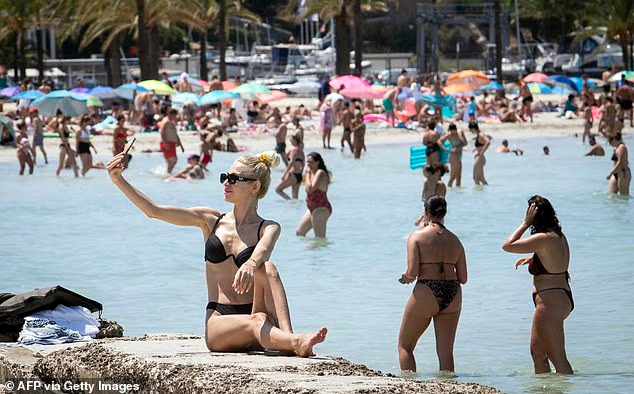
Holidaymakers have said that the Mediterranean Sea is so hot they can’t even go for a dip to cool off.
Tourists visiting Mallorca have reported that the sea is offering little respite from the heat that is enveloping Europe.
One German tourist told Mallorca Magazin: ‘The sea is so incredibly warm! This isn’t normal!
‘I even swam out further, but the water just didn’t get any cooler.’
Temperatures in the seas around Mallorca in August sit, on average, around 26C.
But AEMET, Spain‘s national meteorological agency, said this morning that the sea surface temperatures just off the coast of Mallorca reached a sweltering 33.02C on Wednesday.
If confirmed, this would beat the previous temperature record set in the Mediterranean, 31.96C, which was set in 2024 off the coast of the Egyptian city of El-Arish.
The record before that was set in 2023, when the mercury hit 28.71C in July of that year.
A tourist takes a selfie at Palma’s Beach in Palma de Mallorca last year

Tourists apply sunscreen at Palma’s Beach in Palma de Mallorca in 2025

Tourists gather on Palma’s Beach in Palma de Mallorca last year
It comes as a blistering heatwave engulfed Europe, fuelling wildfires and disrupting life across the continent.
The extreme weather has pushed temperatures above 40C in several countries, prompting health warnings for millions of people.
Across Europe, authorities are grappling with the consequences of extreme heat: health alerts for millions in Italy, record temperatures in Austria, drought-related disruptions to energy and shipping in Central Europe, and wildfires stretching from France to the Balkans.
Scientists and officials warn that such events are becoming more frequent and intense as the climate warms.
From the Mediterranean to Central Europe, prolonged heat, drought and wildfire conditions are increasingly becoming defining features of summer.
The current heatwave has exposed vulnerabilities in public health systems, power generation, transportation networks and tourism infrastructure, forcing governments and businesses to adapt to more frequent periods of extreme weather.
Italy’s Health Ministry placed all 27 cities monitored under its national heat surveillance system on red alert on Thursday.
The alerts stretch from Trieste in the northeast to Palermo in Sicily and signal a health risk for the entire population, not only vulnerable groups such as older adults and people with chronic illnesses.
Authorities urged residents and tourists to avoid direct sunlight during the hottest hours of the day, remain indoors where possible and drink plenty of water as temperatures in some areas approached 40C.

AEMET said on Thursday that the sea surface temperatures just off the coast of Mallorca reached a sweltering 33.02C on Wednesday

A tourist cools down using a misting fan at the Colosseum in Rome on August 3, 2026

A dog cools off in the fountain of Piazza De Ferrari in the city centre of Genoa, Italy, August 6 2026

Tourists at the Rome Colosseum are sprayed with cooling mist on August 6, 2026
The heat has also forced adjustments at major tourist attractions. The ministries of tourism and culture extended evening opening hours at landmarks including Rome’s Colosseum and Pantheon.
Cooling mist fans have been installed at the Colosseum’s entrances and additional medical stations have been made available.
The most intense temperatures were recorded in Austria, where the mercury reached 41.2C on Wednesday in the village of Bad Deutsch-Altenburg near the Slovak border. It was the highest temperature ever recorded in the country.
Austria is also facing severe drought. Rainfall from January 1 through June 30 was 27 per cent below the long-term average nationwide, while some eastern regions received only half their normal precipitation.
Climatologist Alexander Orlik said some parts of the country had not experienced such dry conditions since 1885.
In Hungary, prolonged drought and record-low water levels on the Danube River have severely affected the country’s only nuclear power plant, which relies on river water to cool its reactors.
Plant operators have reduced output to about 10 per cent of normal production, prompting the government to introduce emergency conservation measures as a record-breaking heatwave grips the country.
The heatwave has shattered temperature records across the country. On Wednesday night, Budapest recorded its warmest overnight low temperature on record, with temperatures falling only to 28C, underscoring the persistence of the extreme heat.

A so-called ‘Hungerstein’ (hunger stone), a hydrological landmark, from 1857, is visible in the Rhine River during low water levels in Worms, Germany, August 6 2026

A passenger ship passes the Castle Pfalzgrafenstein on the Rhine River in Kaub, Germany, August 6, 2026

Tourists wait to fill up their water bottles at a drinking fountain in Rome in the scorching heat on August 6, 2026
Germany faced growing concerns over the impact of drought on transportation and industry as water levels on the Rhine and other rivers continued to fall.
Transport Minister Steffen Bilger met affected organisations Thursday and warned that low water levels posed major challenges for inland waterway shipping, industry and the broader logistics chain.
Environmental group BUND urged authorities to focus not only on the economic impacts but also on making rivers more resilient to climate change by retaining more water in landscapes and reducing withdrawals during periods of drought.
In south-eastern France, firefighters maintained a large presence in the Var region after authorities said a major wildfire there was no longer spreading but remained capable of reigniting.
The blaze, which began on July 20, has burned more than 23 square miles, making it the largest recorded in the region in recent decades.
Authorities warned that strong winds and extremely dry conditions left south-eastern France at very high risk for additional wildfires.
The heatwave reached its peak across the Balkans on Thursday as temperatures neared 40C and authorities battled drought and wildfires.
In Serbia, firefighters struggled to contain several blazes after days of dry weather. One major fire burned through pine forests west of Belgrade, while another spread near the central town of Kraljevo, where difficult terrain complicated firefighting efforts.


















































You must be logged in to post a comment Login