
Crypto World
Former Bitcoin miner Firmus raises $2B as Blackstone, Nvidia back AI push



Firmus, a former Bitcoin mining company that has repositioned itself as an AI infrastructure provider, has secured $2 billion in new equity funding, lifting its post-money valuation above $10.5 billion as it expands AI factory projects across Australia and the Asia-Pacific region.
Summary
- Former Bitcoin miner Firmus has raised $2 billion in fresh equity, lifting its valuation above $10.5 billion.
- Blackstone, Nvidia, Coatue and Jane Street participated in the funding round to support the company’s AI infrastructure expansion.
- The new capital will accelerate Project Southgate in Australia while funding early expansion into Indonesia and other Asia Pacific markets.
- The raise brings Firmus’ total equity funding over the past year to more than $3 billion as it scales AI factory deployments.
According to Firmus, the strategic equity round received full investment commitments from existing backers Coatue and Nvidia, alongside new funding from funds managed by Blackstone Tactical Opportunities and other Blackstone vehicles, with additional participation from global trading and technology firm Jane Street.
The latest raise nearly doubles Firmus’ valuation from the $5.5 billion level recorded during its April funding round. It also brings the company’s total equity raised over the past year to more than $3 billion, providing additional capital for Project Southgate, its AI factory rollout across Australia.
Firmus funding supports Project Southgate expansion
Under the new financing, Firmus plans to accelerate the next stage of Project Southgate while preparing for development across selected Asia-Pacific markets. The company said part of the investment will support early work on its recently announced Indonesia project, which is intended to serve AI-native customers.
Firmus added that it has already established Australian manufacturing for its proprietary HyperCube platform. It is building AI infrastructure based on Nvidia’s DSX AI Factory Reference Architecture, which the company said is designed to bring computing capacity online more quickly while improving tokens per watt and system resiliency.
“This investment allows us to move on multiple fronts at once,” Co-Chief Executive Officer Oliver Curtis said.
“We’re scaling across Australia while fast-tracking our capacity to expand into the wider Asia-Pacific region, including the early steps behind our recently announced Indonesia development that will serve AI-native customers,” Curtis added.
The company and Nvidia strengthened their relationship in late June through an agreement under which Firmus would purchase Nvidia infrastructure while offering cloud services powered by the chipmaker’s technology. The latest financing extends that relationship with Nvidia participating again as an investor.
Blackstone, Coatue and Jane Street deepen AI infrastructure bets
Blackstone’s participation adds another major institutional investor to the financing round at a time when large investment firms continue increasing exposure to AI infrastructure.
“We believe AI infrastructure will be a foundational driver of global growth and it is among our highest conviction investment themes,” John Watson, Senior Managing Director at Blackstone, said.
“We are pleased to continue to invest in Firmus and support platforms at the forefront of AI innovation,” he added.
Coatue also increased its investment in the company after backing an earlier funding round.
“We continue to believe Firmus represents a differentiated approach to AI infrastructure,” Robert Yin, General Partner at Coatue, said.
According to Yin, the company’s combination of proprietary technology, manufacturing capabilities and a repeatable deployment model positions it to support demand from both AI-native businesses and enterprise customers as computing requirements continue increasing.
Jane Street also joined the funding round.
“As AI models become larger and more capable, access to reliable, high-performance compute becomes increasingly important,” Daniel Pontecorvo, Head of Physical Engineering at Jane Street, said.
Pontecorvo added that Firmus is building infrastructure needed for the next generation of AI systems, which supported the firm’s decision to invest.
AI infrastructure attracts fresh capital
The financing comes as investors continue directing capital toward companies building physical AI infrastructure instead of focusing only on chip manufacturers.
Industry participants have increasingly targeted data centers, electricity infrastructure and high-performance computing capacity as demand for AI services expands. Earlier this year, Core Scientific agreed to provide AMD with up to 2.5 gigawatts of data center capacity beginning in 2027 as the former Bitcoin miner continued converting mining sites into AI infrastructure.
IREN has also accelerated its AI strategy after completing the acquisition of Spain-based Nostrum Group in June. The transaction added about 490 megawatts of secured grid-connected power and expanded IREN’s European AI cloud footprint while AI cloud revenue continued growing faster than its Bitcoin mining business.
More recently, Hyperscale Data sold approximately 100 Bitcoin and secured a Bitcoin-backed credit facility to finance construction of its Michigan AI campus. The company said the financing would help fund infrastructure for an AI contract that could exceed $3 billion if all expansion and extension options are exercised.
Alongside those projects, publicly listed Bitcoin miners have continued repositioning power assets toward AI computing as long-term infrastructure agreements become an increasingly important source of contracted revenue. Industry data published in late July also showed Bitcoin mining difficulty remained well below its 2025 peak while companies pursued AI data center investments to diversify income.
Australia remains central to Firmus’ rollout
While preparing projects elsewhere in the Asia-Pacific region, Firmus said Australia will remain the primary focus for the newly raised capital.
According to the company, its existing manufacturing capability and software platform provide the foundation for faster deployment of AI infrastructure across domestic sites before additional regional expansion proceeds.
The company also stated that the transaction is a private financing and not a public securities offering. Firmus said the securities issued in the round have not been registered under the U.S. Securities Act of 1933 and may not be offered or sold in the United States except under an applicable exemption from registration requirements.



SharpLink CEO Joseph Chalom has come out against EIP-8363. This Ethereum proposal would burn validator rewards as the staking ratio rises, warning that the change would weaken decentralized finance and erase ETH’s native yield advantage over Bitcoin (BTC).
Joseph Chalom, a former BlackRock executive, laid out the opposition on Friday. Analysts, however, doubt the draft will pass.
How EIP-8363 Works
Messari analysts explained that the proposal introduces a burn on part of each validator’s rewards tied to its assigned duties. The burn rate would increase as the amount of staked ETH grows, reaching 100% once staked ETH hits 60.25 million, or roughly half of the total supply.
The change would be implemented gradually over 18 months. As of August 7, 2026, the proposal’s pull request remains open. It would preserve the existing consensus-layer rewards and penalties.
“The proposal aims to stop consensus issuance from encouraging stake growth indefinitely while retaining strong incentives to perform validator duties,” the report reads.
SharpLink CEO’s Objections
Chalom opposed EIP-8363 for four main reasons. He said lower staking yields could weaken DeFi by raising on-chain borrowing costs and reducing liquidity.
The executive also argued that staking makes ETH more attractive to institutions by offering native yield alongside potential price gains. He said staking rewards also fund validators, infrastructure, developers, and other parts of Ethereum’s ecosystem.
Finally, Chalom criticized the proposal’s timing. He argued that Ethereum is gaining institutional momentum through stablecoins, tokenized assets, and major financial firms. Cutting yields now, he said, could weaken that momentum.
“EIP-8363 does not redirect that value. It destroys it. In fact, it could lead to institutions selling ETH as they unstake it,” he said.
Follow us on X to get the latest news as it happens
Why Analysts Are Skeptical
A Messari report calls EIP-8363 a solution in search of a problem. It notes that Ethereum’s issuance is already low, at about 0.85% per year, so the problem it targets is minor.
“EIP-8363 seeks to address valid concerns regarding stake centralization…However, the impact addresses nominal yield, when real yield from the demand side remains the core problem ETH faces,” the analysts added.
Supporters counter that the burn would curb dilution and resist staking centralization among large institutions. Messari still rates its odds of passing as low.
Subscribe to our YouTube channel to watch leaders and journalists provide expert insights
The post SharpLink CEO Warns Against New Ethereum Network Proposal EIP-8363 appeared first on BeInCrypto.

A coordinated Bitcoin security campaign uncovered nearly 5,000 software issues across hundreds of open-source projects in about 30 hours. The effort combined human expertise with artificial intelligence tools to identify software weaknesses.
The initiative brought together 16 security researchers led by developer Calle, with support from OpenSats, OpenCode, and AI inference sponsors. The group worked together on a coordinated review covering hundreds of Bitcoin-related projects.
Breaking Down the Findings
According to figures released by the team, researchers reported 4,962 findings across 390 Bitcoin-related projects during the campaign. The total included 85 critical issues and 635 high-severity findings, bringing the number of the most serious reports to 720.
The campaign maintained a rapid pace, averaging about 166 reported findings every hour throughout the review. Based on the published figures, the team identified roughly 2.3 critical or high-severity issues for every person-hour spent examining software.
Researchers said the campaign differed from a traditional security audit because human reviewers actively guided AI systems during testing. Each participant used different prompts and methods, helping uncover weaknesses that a single approach might have missed.
The final tally also included findings collected by one contributor before the live campaign officially began. After those results were added, crypto libraries and software development kits recorded the largest share of findings with 1,385 reported issues.
What the Findings Revealed
The team said that about one out of every seven reported findings fell into the high or critical severity categories. Only one reviewed project reportedly completed the campaign without any reported issues, prompting a lighthearted remark from Bitcoin Core developer Matt Corallo.
Researchers have already started sending verified critical findings to affected project maintainers with supporting proof-of-concept retest demonstrations. Many maintainers reportedly confirmed the reports quickly, although processing such a large volume remains a significant challenge.
The campaign comes as Bitcoin software security receives greater attention across the ecosystem after several recent security incidents. Separately, Bitcoin recorded about 0.98 million daily active addresses on July 31, the highest level since December 2024. The surge came after attackers began sweeping wallets whose seeds were generated using defective Coldcard firmware.
The post AI Bitcoin Security Campaign Finds Nearly 5,000 Software Issues in 390 Projects appeared first on CryptoPotato.
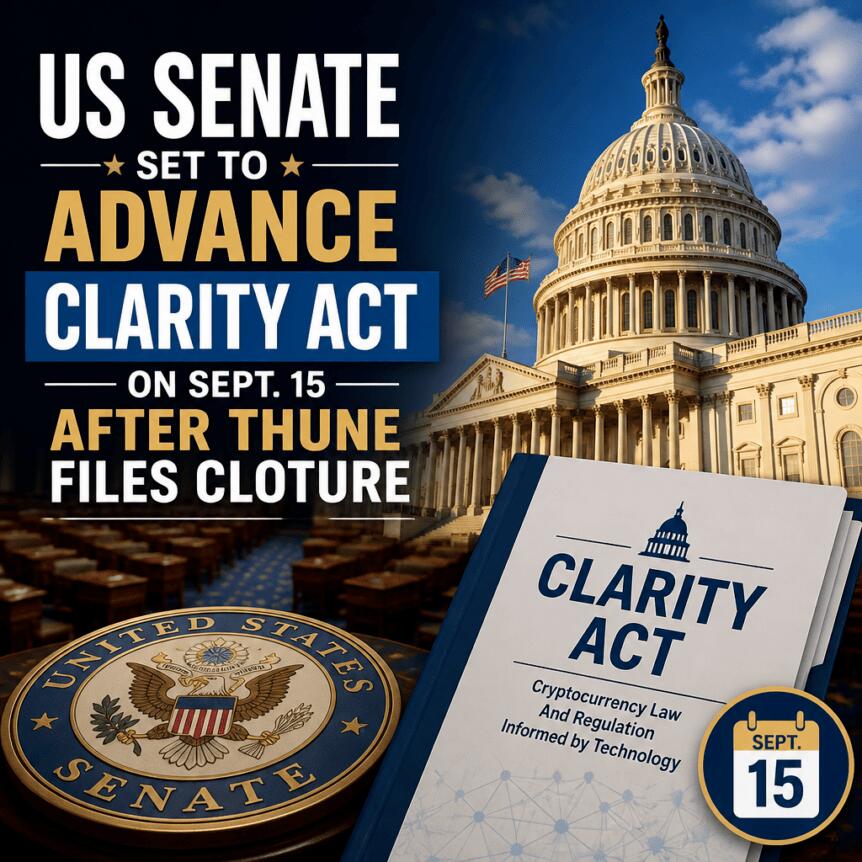
U.S. Senate Majority Leader John Thune has filed cloture on a motion to bring the Digital Asset Market Clarity Act—known as the CLARITY Act—to the Senate floor, setting up a pivotal procedural vote tied to the next legislative window. The move comes as lawmakers prepare to return to Washington after the August recess, with the Senate expected to reconvene on Sept. 15.
Under Senate rules, invoking cloture requires a 60-vote threshold, meaning Republicans will need support from Democrats to clear the procedural hurdle. The filing does not automatically translate into final passage; instead, it is designed to advance the bill for consideration and potentially a later vote on the legislation itself.
Key takeaways
- John Thune filed cloture to take up the CLARITY Act, a procedural step requiring 60 votes.
- The Senate is expected to reconvene on Sept. 15, with the vote anticipated shortly after.
- Cloture clears a path for consideration but does not guarantee the bill will ultimately pass.
- Negotiations have stalled over disagreements, including ethics provisions and how stablecoin-related rewards should be regulated.
- Lawmakers are reportedly working on a bipartisan ethics addendum to address concerns tied to the president’s crypto-related financial interests.
Procedural push puts the CLARITY Act back on the calendar
According to the U.S. Senate Daily Press, the Majority Leader’s office confirmed that Thune filed cloture on the motion to bring the CLARITY Act to the Senate floor for consideration. The Senate Daily Press is tied to the daily publication of official Senate floor scheduling and related procedural matters, making it a direct channel for confirming when actions like cloture are submitted.
Cloture matters because it addresses debate length and related parliamentary tactics. With 60 votes required to invoke cloture, the bill’s fate in the chamber hinges on whether enough senators across party lines agree the legislation should move forward for lawmakers to debate and vote on substance.
Thune’s filing effectively repositions the CLARITY Act for action after negotiations failed to produce a deal before the August recess. Lawmakers now have additional time leading up to the September session—when procedural momentum can become substantive momentum, if the outstanding policy issues can be resolved.
Why the bill is politically and structurally significant
The CLARITY Act is widely described as a landmark effort to create a more uniform federal framework for how digital assets are categorized and overseen. The bill’s core aim is to establish a federal market structure for digital assets and clarify how regulators should apply existing securities and commodities laws.
In particular, the legislation is positioned to delineate when particular crypto assets fall under the jurisdiction of the Securities and Exchange Commission versus the Commodity Futures Trading Commission. That clarity is a major concern for market participants because regulatory ambiguity can complicate product development, market access, and compliance strategies.
While the procedural step now puts the bill back into focus, the filing also underscores that the legislative path is still conditional. Even if senators clear cloture, the CLARITY Act could still face further obstacles in a later floor vote depending on whether negotiators can bridge remaining disagreements.
The sticking points: ethics rules and stablecoin-related provisions
The road to a compromise has been complicated by disputes over multiple elements, including ethics provisions and rules governing stablecoin rewards. The ethics question has been particularly difficult, according to reporting referenced in the original coverage: lawmakers have been unable to settle on proposed restrictions that would limit government officials—and their families—from issuing or profiting from digital assets while in office.
These provisions are more than technical language. Ethics rules can become a defining political battleground because they shape how lawmakers manage perceived conflicts of interest, especially in a sector where public officials may hold or interact with crypto investments.
Beyond ethics, stablecoin rewards have also reportedly been a source of friction. While the specific policy details are not laid out in the available text, the inclusion of stablecoin-related reward rules indicates that negotiators have to align on how certain yield or incentivization mechanics should be treated under U.S. oversight.
Until those issues are resolved, the CLARITY Act’s movement in the Senate may be best understood as a procedural advance—an effort to keep negotiations alive rather than a guarantee that consensus is close.
Reported attempt to break the ethics impasse
To address the ethics impasse, lawmakers have reportedly been working on a bipartisan addendum. Earlier coverage from Cointelegraph referenced a proposal aimed at addressing Democratic concerns about President Donald Trump’s crypto-related financial interests, with Bloomberg reporting that the approach would require the president to divest from certain crypto-related businesses.
The rationale for such an addendum is straightforward: rather than relying solely on broad restrictions on officials and their families, negotiators may seek a targeted solution tied to the president’s holdings. The shift matters because it could alter the negotiation dynamics between parties—potentially allowing the ethics language to become more politically acceptable while still addressing conflict-of-interest concerns.
However, the existence of a proposed ethics framework does not itself confirm that the final language will be agreed upon or adopted. The next procedural vote will signal whether enough senators believe the bill is worth taking up despite remaining uncertainties, and it may also pressure negotiators to finalize language quickly enough to avoid further delays.
What to watch after Sept. 15
With the Senate expected to reconvene on Sept. 15 and the cloture vote anticipated soon after, the immediate question is whether Democrats will provide the additional votes needed to reach the 60 threshold. If they do, lawmakers can proceed to debate substance—but readers should still watch for how ethics and stablecoin-reward provisions evolve, since those items have been central to the breakdown in earlier negotiations.

Demand for US spot Bitcoin exchange-traded funds (ETFs) accelerated sharply over the past week, according to Bloomberg ETF analyst Eric Balchunas. The renewed inflow momentum arrives after months of uneven participation, rekindling a key question for market watchers: whether institutional appetite is broadening again—or whether this is a temporary swing in investor behavior.
At the same time, the discussion around custody remains unsettled after a high-profile Coldcard hardware wallet incident in which attackers reportedly stole about $116 million in Bitcoin. The security breach has renewed attention on the trade-offs between self-custody and regulated products like spot ETFs.
Key takeaways
- Bloomberg’s Eric Balchunas said spot Bitcoin ETFs drew about $1 billion in net inflows for the week, the strongest since April.
- Balchunas described the rebound as the third-best weekly performance since last October—an era he called Bitcoin’s “silent IPO.”
- A Coldcard security exploit linked to vulnerable firmware has put self-custody concerns back in focus.
- Balchunas suggested the hack could help drive some investors toward spot ETFs, though he cautioned that the link is not proven.
Spot Bitcoin ETF inflows rebound after a patchy stretch
Balchunas posted that US spot Bitcoin ETFs took in roughly $1 billion in net inflows over the week ending Saturday. He said the result was the strongest weekly showing since April and ranked as the third-best week since last October, when he referred to Bitcoin’s “silent IPO.”
The “silent IPO” framing comes from investor Jordi Visser, who popularized the idea in November. In Visser’s view, early Bitcoin holders were gradually selling into expanding demand from ETFs and other institutional channels. The effect, under the theory, was enough additional supply to keep Bitcoin comparatively constrained even as new capital continued to enter via regulated vehicles.
That context matters for interpreting this week’s improvement. The source notes that ETF flows had deteriorated in earlier periods of stronger demand, making the recent rebound more noticeable. For traders and portfolio managers, consistent ETF inflows tend to be easier to track and model than broader, decentralized participation, so a return to stronger weekly demand can quickly change sentiment around the near-term positioning of institutions.
Coldcard hack refreshes the custody debate
The ETF story is unfolding alongside a major security incident involving Coldcard, a Bitcoin hardware wallet developed by Coinkite. The exploit reportedly resulted in about $116 million worth of Bitcoin being stolen, with the attack tied to a flaw in how affected devices generated wallet keys. According to the earlier coverage referenced in the source, attackers were able to compromise funds held in wallets created using vulnerable firmware.
On Friday, Balchunas argued that the Coldcard incident could ultimately strengthen the case for spot Bitcoin ETFs—particularly for investors who prefer not to manage the technical responsibilities that come with self-custody. He pointed to the observed surge in ETF inflows following the hack as a possible connection.
In his comments, Balchunas explicitly acknowledged the limitations of drawing conclusions from timing alone. “Correlation does not imply causation,” he said, but added that, over the long term, he can’t imagine there aren’t some investors who migrate from cold storage to ETFs.
For market participants, this is a meaningful mechanism to watch: a single security incident can influence risk perception across the broader custody ecosystem. Even when the affected devices are limited to specific conditions, the reputational impact can push some users toward a custody model backed by regulated intermediaries—especially those evaluating whether the operational burden of holding Bitcoin directly is worth the benefits.
What to watch next: whether inflows persist and custody concerns evolve
Even with this week’s strong ETF numbers, the key question is durability. Balchunas’ “silent IPO” concept suggests that ETF demand and investor selling behavior can interact in ways that keep price action subdued relative to capital inflows. The rebound in net flows therefore doesn’t automatically resolve the larger balance between new institutional purchases and supply from earlier holders—but it does reintroduce a tailwind to demand that was less pronounced in earlier weeks.
Separately, the Coldcard episode raises a second uncertainty: whether the custody shift Balchunas hinted at becomes visible in sustained ETF inflow patterns, or remains anecdotal. Investors watching the next cycle of weekly flows may want to compare whether inflows continue to strengthen over multiple reporting periods, and whether risk communication around hardware wallets changes in response to the incident.
Until regulators clarify broader standards and until the market sees how persistent the post-hack behavior proves to be, the combination of improving ETF demand and renewed custody concerns will likely remain a central driver of how Bitcoin’s institutional narrative develops.
Going forward, readers should track whether the next several weeks of spot Bitcoin ETF flows match this week’s strength—and whether custody-related headlines translate into measurable, sustained shifts in investor allocation between self-custody and regulated products.


Russian consumers’ demand for hardware crypto wallets more than doubled in the first half of 2026, according to data from two major retailers, as the country prepares to introduce new crypto rules.
Retailer M.Video said unit sales on its marketplace rose 107% in the second quarter from the first quarter, while sales by value increased 92%. The retailer did not disclose the number of devices sold.
Wildberries, another Russian retailer, also recorded higher demand. Unit sales rose 84% in the first half from a year earlier, RIA Novosti reported, citing RWB, the marketplace’s parent company. Sales value increased 60% over the period.
The comparisons cover different periods: M.Video measured Q2 against Q1, while Wildberries compared H1 with the same period of 2025. Neither company released unit totals.
Hardware wallets keep the private keys needed to control crypto on a dedicated device, instead of an internet-connected service, helping reduce exposure risk.
Russian law does not ban non-custodial wallets or treat them as illegal, lawyers told RBC. It does, however, bar withdrawals from Russian digital depositories to personal wallets, though a transition period runs until July 1, 2027.

Demand for US spot Bitcoin exchange-traded funds (ETFs) surged this week, according to Bloomberg ETF analyst Eric Balchunas, reviving a narrative that had gone quiet after months of more inconsistent buying. At the same time, a recent security incident tied to Coldcard has put crypto self-custody back under the spotlight—an issue that some ETF investors may be weighing more carefully.
Balchunas said Saturday that the spot Bitcoin ETFs pulled in roughly $1 billion in net inflows for the week. He described it as the funds’ strongest performance since April and the third-best week since last October, when he referred to the phenomenon as Bitcoin’s “silent IPO.”
Key takeaways
- Bloomberg ETF analyst Eric Balchunas reports about $1 billion in weekly net inflows for US spot Bitcoin ETFs, the strongest since April.
- Balchunas framed the earlier October period as Bitcoin’s “silent IPO,” suggesting ETFs can pull in institutional-style demand without obvious market fanfare.
- A widely discussed Coldcard hardware wallet hack—connected to about $116 million stolen—has reignited concerns around the security burdens of self-custody.
- Balchunas said the hack could support the case for spot ETFs among investors wary of technical custody responsibilities, though he stressed the link is not proven.
Spot ETF inflows rebound after a softer stretch
The renewed buying matters because it helps clarify what has been happening beneath the surface of Bitcoin’s price action. Even when new capital enters through ETFs, the relationship to spot market momentum can be muted if supply is being sold off concurrently—something that investors have been trying to explain over recent months.
Balchunas tied this week’s momentum to the contrast with prior periods. In his view, earlier demand dynamics contributed to a broader “changing of the guard,” where earlier Bitcoin holders increasingly monetized positions as ETF and other institutional inflows grew. He linked this to the term popularized by investor Jordi Visser in November: Bitcoin’s “silent IPO.”
The phrase captures an idea that the ETF ramp behaves less like a noisy retail mania and more like a steady institutional distribution channel—keeping Bitcoin from reacting dramatically while significant flows accumulate.
In that context, the standout feature of this week is not simply that inflows turned positive, but that they represent the strongest showing since April and rank among the best weekly results since last October. That suggests the ETF pipeline is capable of re-accelerating, even if the broader period has been uneven.
Coldcard hack revives the self-custody debate
While ETF flows grabbed attention, the week’s backdrop included a major security incident involving Coldcard, a Bitcoin hardware wallet from Coinkite. The exploit is reported to have led to the theft of roughly $116 million worth of Bitcoin, according to prior reporting that connected the theft to a vulnerability in how affected devices generated wallet keys. Attackers allegedly compromised funds by targeting wallets created using vulnerable firmware.
On Friday, Balchunas suggested the aftermath could influence investor behavior. In a discussion carried in a separate report, he argued that the security and technical responsibilities of self-custody may push some investors toward spot Bitcoin ETFs, particularly those who prefer to outsource custody and operational risk to traditional market structures.
Crucially, Balchunas framed the potential connection as speculative. He acknowledged that correlation does not prove causation. Still, he said, “long-term I can’t imagine there aren’t some who migrate over,” implying that even partial behavioral shifts—if they occur—could show up in ETF demand over time.
What investors should watch: flows, behavior, and persistence
This is where the story becomes more than a one-week data point. ETF inflows are typically driven by a mix of institutional allocation patterns, advisor workflows, and broader risk appetite. A temporary rebound can happen without signaling a structural turn. However, Balchunas’s framing of both the “silent IPO” period and the current resurgence suggests he believes the market is cycling between phases of strong demand and quieter distribution.
For traders and long-term allocators, the practical question is whether this week’s improvement marks a continuation or a rebound followed by another slowdown. The “strongest since April” and “third-best week since last October” descriptors indicate a meaningful spike relative to recent history, but the durability of that spike will depend on whether ongoing capital inflow stays steady.
Meanwhile, the Coldcard incident adds a different kind of variable: perceived operational risk. Hardware wallets are widely used precisely because they reduce exposure to exchange custody failures, but high-profile vulnerabilities can change how comfortable some investors feel handling keys themselves. Balchunas’s argument is that—over time—investors uncomfortable with custody mechanics may consider ETFs a simpler alternative.
Yet, it’s also possible that self-custody concerns are already priced into broader behavior, meaning the effect on ETF demand may be gradual rather than immediate. That makes future inflow trends the key test: if inflows keep outperforming earlier weeks consistently, the market impact of custody-related security narratives could become clearer.
Read together, the two threads—ETF demand rebounding and custody concerns resurfacing—underline a single theme: Bitcoin’s access channels are still evolving. Spot ETFs offer a regulated wrapper, while self-custody remains the route for those who want direct key control. The next phase will likely hinge on how quickly investors shift between those modes and whether ETF inflows sustain at elevated levels beyond this week.
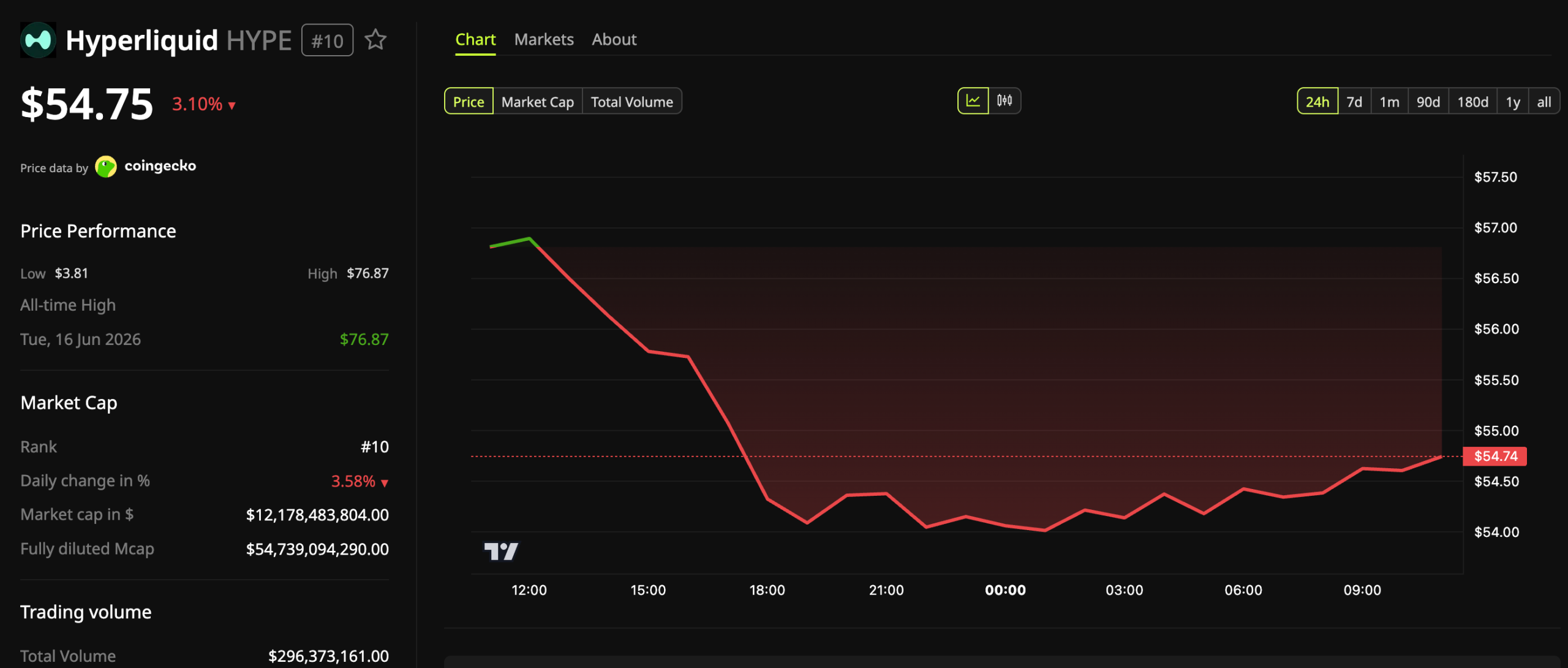
Hyperliquid (HYPE) spot exchange-traded funds (ETFs) returned to net inflows in the week ending August 7, adding $2.84 million after three straight weeks of redemptions.
The reversal followed a cautious stretch flagged by JPMorgan. Cumulative net inflows now stand at $280.8 million.
HYPE ETFs Break 3-Week Outflow Streak
HYPE ETFs launched in mid-May and continued to see consecutive inflows, according to SoSoValue data. However, that momentum faded sharply last month.
The three-week slide totaled $30.6 million and peaked with $14.7 million in outflows for the week ending July 31. Bitwise’s BHYP absorbed the largest share of the redemptions.
JPMorgan strategist Nikolaos Panigirtzoglou tied the slowdown to competition. Weekly price action mirrored the outflows.
HYPE fell from the low $60s in late July toward $55 by early August. Meanwhile, the token now trades near $54.75, down about 3% on the day and roughly 29% below its June 16 record of $76.87.

Follow us on X to get the latest news as it happens
How Other Crypto ETFs Performed
The HYPE rebound matched a broad return of capital across crypto ETFs. Combined weekly inflows across major products approached $1.1 billion in the week ending August 7.
Bitcoin (BTC) ETFs led with $853.5 million in inflows, reversing a $61.5 million outflow the prior week. Ethereum (ETH) funds added $244.9 million, their strongest week since mid-April.
In contrast, smaller altcoin products cooled even as the majors surged. Solana (SOL) ETFs drew just $145,000, down from $7.2 million two weeks earlier. XRP (XRP) funds added $1 million after a $14.9 million intake the week before.
The split points to concentration. Investors funneled fresh money into Bitcoin and Ethereum while trimming smaller altcoin wrappers, with HYPE’s modest inflow ending its worst run since launch.
Subscribe to our YouTube channel to watch leaders and journalists provide expert insights
The post Hyperliquid ETFs Turn Green After Bleeding $30 Million in Three Weeks appeared first on BeInCrypto.
After a shaky July in terms of ETF performance, the Bitcoin funds started August with a bang, attracting more than $800 million in the first full week of the month.
This coincided with the underlying asset’s price revival, as BTC jumped from a monthly low at $62,200 on Monday to over $65,000 on Friday.
Best Week Since Mid-April
July began with big hopes as investors pulled out more than $2.4 billion out of the spot Bitcoin ETFs in May and another $4.5 billion in June. Although there were many good days throughout the seventh month of the year, it ultimately ended with a more modest net inflow of $172.43 million. Thus, it lost the July inflow war to Ethereum.
The funds attracted nearly that amount on August 3 alone, pulling in $170 million. Another $211.49 million followed on Tuesday, $244.42 million on Wednesday, $128.69 million on Thursday, and $98.85 million on Friday. Thus, the perfect all-green week was complete, and the end number stands at $853.54 million, which is actually more than all four previous weeks combined.
Moreover, it’s the best single-week performance since mid-April, when the funds were on a roll, gaining nearly $1 billion at one point. It’s also the third-best of the year, as the record still belongs to the week that ended on January 16, when the ETFs attracted $1.42 billion.
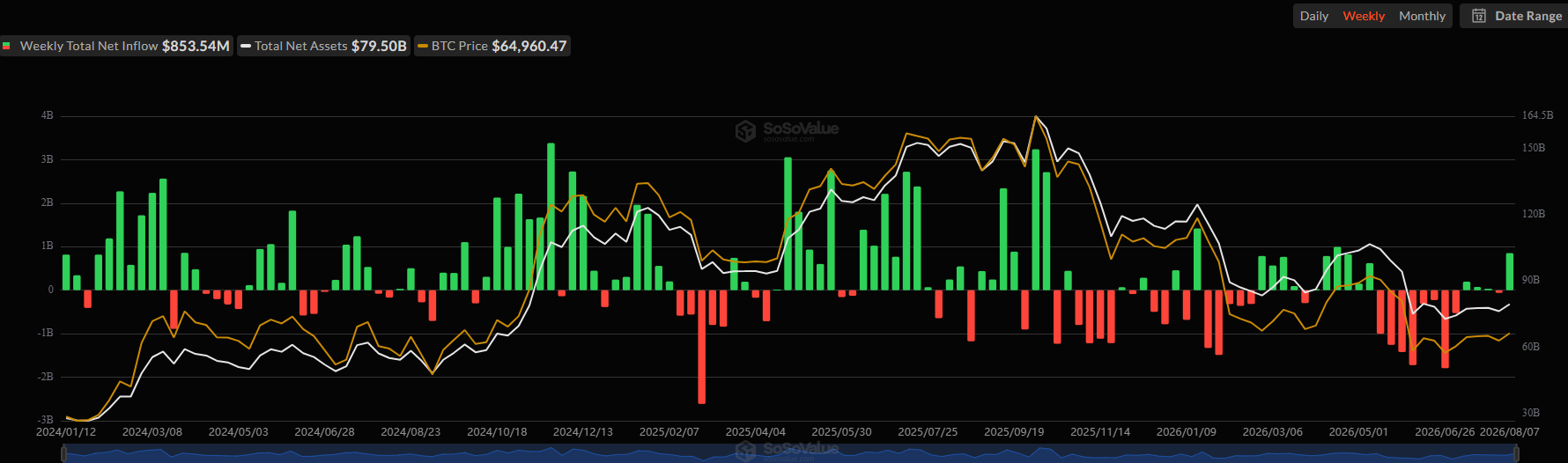
The past week has been quite positive for BTC’s price performance as well. Perhaps fueled by the ETF inflows, the asset rose from $62,200 on Monday to $65,400 on Friday after the weaker-than-expected US jobs data.
ETH ETFs Extend Streak
Unlike the spot Bitcoin ETFs, the Ethereum counterparts didn’t have a full red week in July, ending the month with $365 million in net inflows. Their first in August has been quite impressive as well, attracting almost $245 million.
The start of the week wasn’t as promising as investors pulled out $11.42 million. However, they changed their tune during the other four trading days, inserting $53.75 million on Tuesday, $60.86 million on Wednesday, $92.15 million on Thursday, and $49.60 million on Friday. Thus, the cumulative net inflows have increased from $11.21 billion last week to $11.46 billion.

ETH’s price has also climbed by around 3% weekly, currently trading well above $1,920 after it dipped toward $1,800 on Monday.
The post Bitcoin ETFs Log a Perfect Week as Inflows Reach a 3-Month Record appeared first on CryptoPotato.
Demand for US spot Bitcoin exchange-traded funds (ETFs) rebounded sharply this week, signaling renewed investor appetite after months of uneven flows, even as uncertainty persists around digital asset regulation and the security of crypto self-custody.
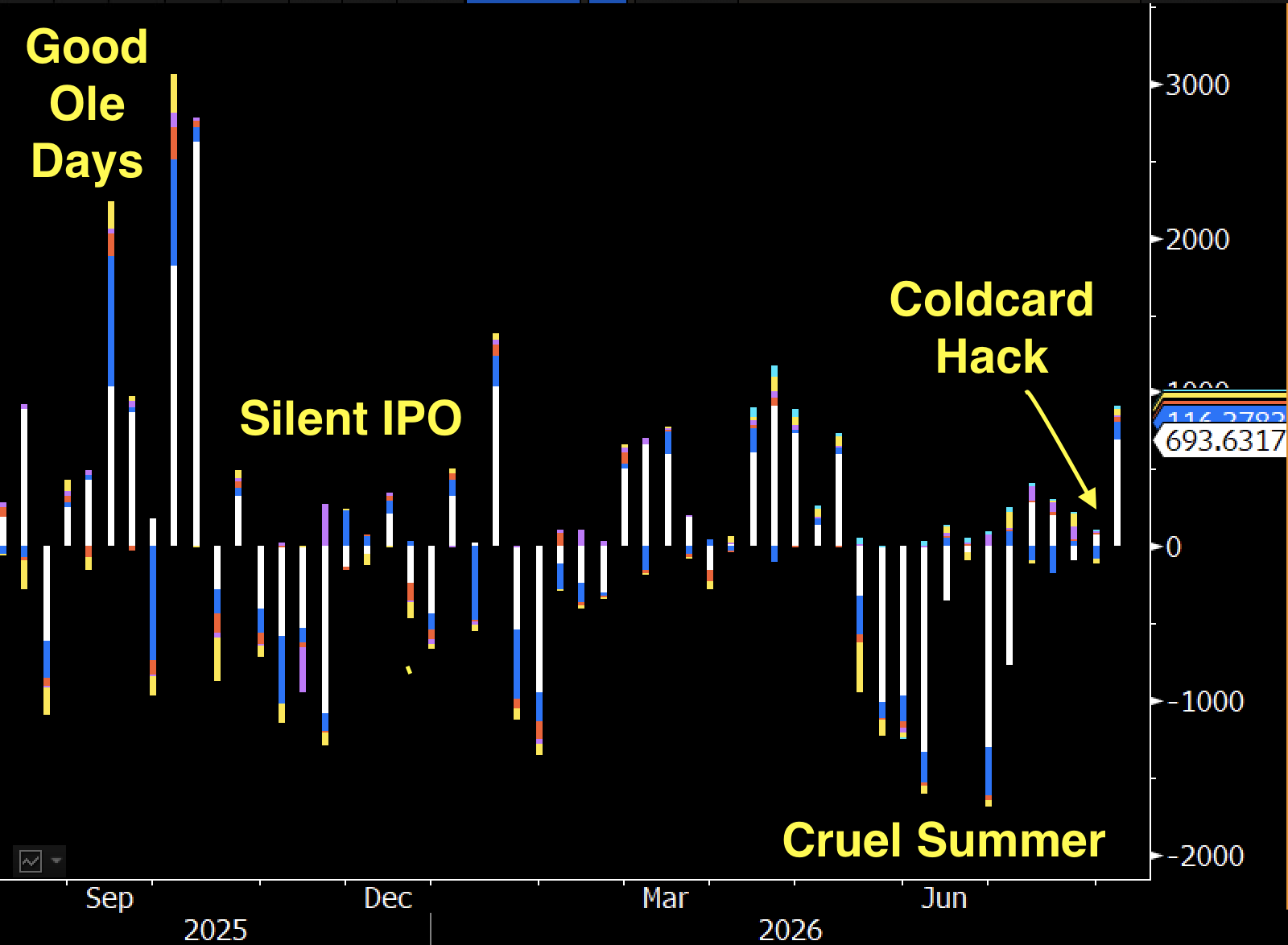
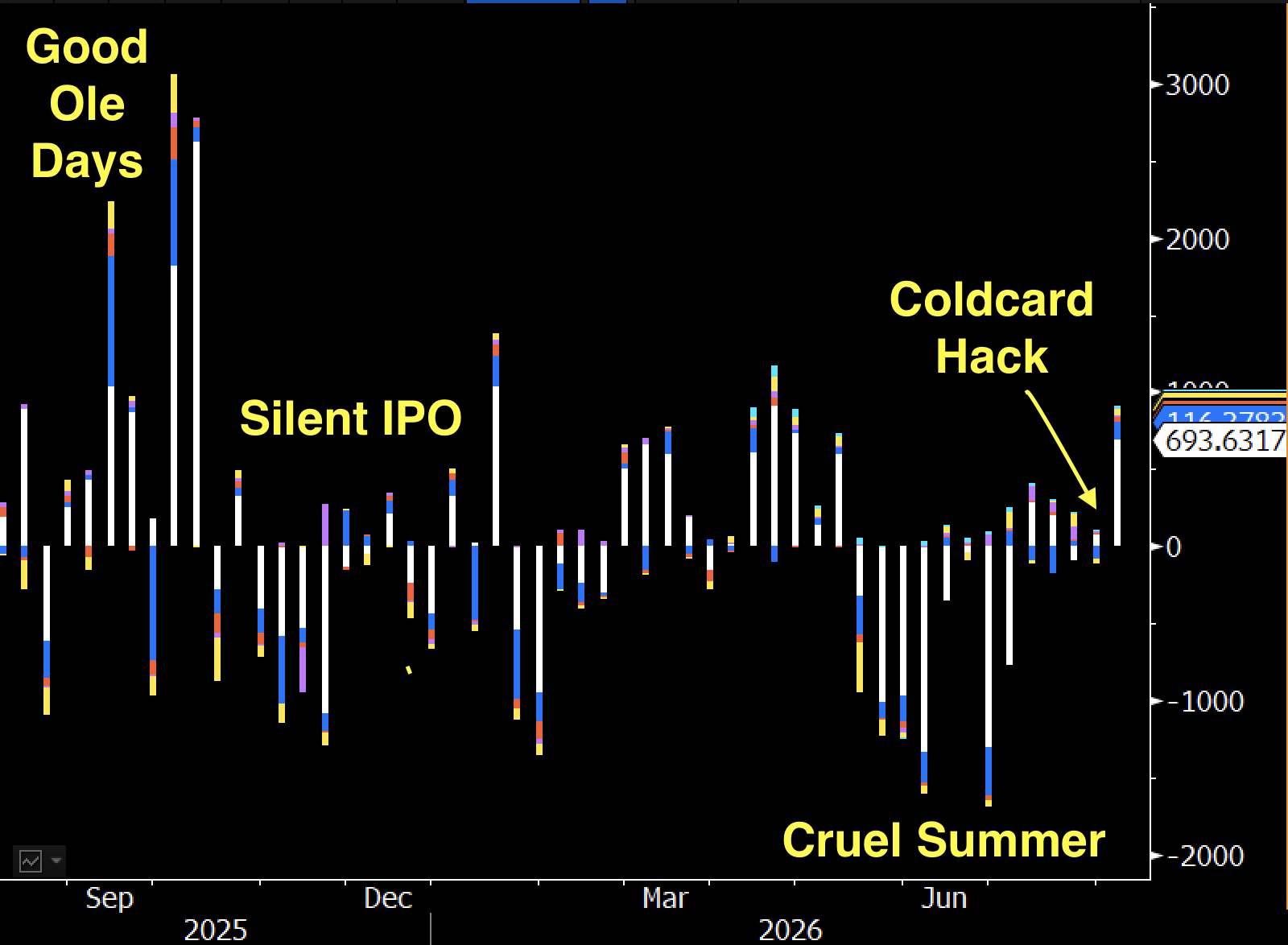
On Saturday, Bloomberg ETF analyst Eric Balchunas said the spot funds attracted roughly $1 billion in net inflows for the week, their strongest showing since April and third-best week since last October — a period he referred to as Bitcoin’s “silent IPO.”
Source: Eric Balchunas
The term was popularized by investor Jordi Visser in November to describe what he viewed as a changing of the guard among Bitcoin holders. Under the theory, early investors were selling into growing demand from ETFs and other institutional buyers, creating enough supply to keep Bitcoin subdued despite substantial new capital entering the market.
That distribution coincided with a deterioration in ETF flows compared with earlier periods of stronger demand, making this week’s rebound particularly notable.
Related: Bitcoin miners’ AI pivot loses Wall Street’s wow factor
Coldcard hack puts self-custody in focus
The rebound has also followed a major security incident involving Coldcard, a popular Bitcoin hardware wallet developed by Coinkite, that resulted in roughly $116 million worth of Bitcoin being stolen. The exploit was linked to a flaw in how affected devices generated wallet keys, allowing attackers to compromise funds held in wallets created using vulnerable firmware.
On Friday, Balchunas suggested the incident could ultimately strengthen the appeal of spot Bitcoin ETFs among investors who are uncomfortable with the technical and security responsibilities associated with self-custody. He pointed to the surge in ETF inflows following the hack as a potential, though unproven, link.
While acknowledging that correlation does not imply causation, Balchunas said, “long-term I can’t imagine there aren’t some who migrate over,” referring to investors potentially shifting from cold storage to ETFs.
Magazine: Do the Coldcard attacks mean all hardware wallets are now insecure?
Demand for US spot Bitcoin exchange-traded funds (ETFs) rebounded sharply this week, signaling renewed investor appetite after months of uneven flows, even as uncertainty persists around digital asset regulation and the security of crypto self-custody.
On Saturday, Bloomberg ETF analyst Eric Balchunas said the spot funds attracted roughly $1 billion in net inflows for the week, their strongest showing since April and third-best week since last October — a period he referred to as Bitcoin’s “silent IPO.”
Source: Eric Balchunas
The term was popularized by investor Jordi Visser in November to describe what he viewed as a changing of the guard among Bitcoin holders. Under the theory, early investors were selling into growing demand from ETFs and other institutional buyers, creating enough supply to keep Bitcoin subdued despite substantial new capital entering the market.
That distribution coincided with a deterioration in ETF flows compared with earlier periods of stronger demand, making this week’s rebound particularly notable.
Related: Bitcoin miners’ AI pivot loses Wall Street’s wow factor
Coldcard hack puts self-custody in focus
The rebound has also followed a major security incident involving Coldcard, a popular Bitcoin hardware wallet developed by Coinkite, that resulted in roughly $116 million worth of Bitcoin being stolen. The exploit was linked to a flaw in how affected devices generated wallet keys, allowing attackers to compromise funds held in wallets created using vulnerable firmware.
On Friday, Balchunas suggested the incident could ultimately strengthen the appeal of spot Bitcoin ETFs among investors who are uncomfortable with the technical and security responsibilities associated with self-custody. He pointed to the surge in ETF inflows following the hack as a potential, though unproven, link.
While acknowledging that correlation does not imply causation, Balchunas said, “long-term I can’t imagine there aren’t some who migrate over,” referring to investors potentially shifting from cold storage to ETFs.
Magazine: Do the Coldcard attacks mean all hardware wallets are now insecure?

AI titans to tidy agent frontier with plugin prescription

Argentina v South Africa LIVE: Latest updates as Springboks clash with Pumas

Tenaz Energy Corp. (TNZ:CA) Q2 2026 Earnings Call Prepared Remarks Transcript


-

 Politics6 days ago
Zack Polanski: an incitement to murder Nigel Farage?
-

 Fashion1 day ago
Frugal Friday’s Workwear Report: Cap-Sleeve Pointelle Crewneck Sweater
-

 Crypto World6 days ago
Crypto PAC spending tops $2M in Michigan House race
-

 Business6 days ago
DTCR: Deleveraging And A Hedge Fund Collapse Point To A Possible AI Bottom
-

 Tech7 days ago
ESET tracks rise in malicious AI skills and adaptable malware
-

 Fashion1 day ago
Weekend Open Thread: Mattifying Sunscreen
-

 Crypto World6 days ago
XRP Ledger urges node upgrade after manifest flood
-

 Sports3 days ago
Jordan Coyle & Cordiamo take Laya Arena Stakes at RDS
-

 News Videos7 days ago
Financial Crash Expert: The 90-Day Collapse Timeline They Are Desperately Hiding.
-

 News Videos9 hours ago
Can Astrology Help Find Gold and Silver Trends? A Financial Astrology Guide
-
 Crypto World5 days ago
US Tech Stocks See Largest 5-Week Inflow in History: Can Nasdaq Break Its Downtrend?
-
 Business3 days ago
US stocks: Dow closes at record on Mideast optimism; SpaceX, AMD drag Nasdaq
-
 NewsBeat7 days ago
Tourist plane on sightseeing flight in Peru crashes into a field, killing all 13 people on board
-

 Tech6 days ago
Page Not Found | WIRED
-

 Politics2 days ago
Reform UK And Greens Sink To Lowest Favourability Ratings To Date
-
 NewsBeat7 days ago
Bikini-clad Jennifer Aniston, 57, kisses hypnotist boyfriend Jim Curtis as they enjoy a romantic getaway aboard a luxury yacht in Spain
-

 Business4 days ago
Nvidia Stock Climbs 2.5% as Chip Sector Rally Builds Ahead of AMD Earnings, Nvidia’s Own Report Looms
-

 NewsBeat7 days ago
Trump says he is cancelling strikes on Iran subject to ‘rapidly’ making deal
-

 Crypto World4 days ago
Polymarket targets $20 billion valuation as competition heats up in prediction market sector
-

 Tech4 days ago
OpenAI, Anthropic AI agents targeted real people and systems in cyber tests
You must be logged in to post a comment Login