Apple has confirmed it has lodged a new legal complaint against the UK government at the court that hears objections to the use of covert surveillance powers.
The company has not told said what the complaint relates to. The Financial Times has reported it is a further challenge to a Home Office demand for so-called “backdoor” access to highly encrypted Apple user data.
The dispute centres on the government’s wish to see material protected by Advanced Data Protection, a system Apple says it cannot itself access. It has been running since early 2025.
The government said it would not comment on legal proceedings or on what it called “operational matters”.
It added in a statement: “The UK supports strong encryption and robust privacy protections, but it is also vital that law enforcement can access communications when necessary and proportionate to protect the public from terrorism, serious crime, and child sexual abuse.”
Apple referred reporters to a statement it gave last year, after its initial challenge to the government’s request. That statement said the company was “gravely disappointed” it could still not offer Advanced Data Protection to new UK users, following its decision to withdraw the feature from UK iCloud accounts in February 2025.
“As we have said many times before, we have never built a backdoor or master key to any of our products or services and we never will,” the company added.
Since February 2025, UK iPhone users have seen a notice on the Advanced Data Protection settings page stating that the tool cannot be enabled.
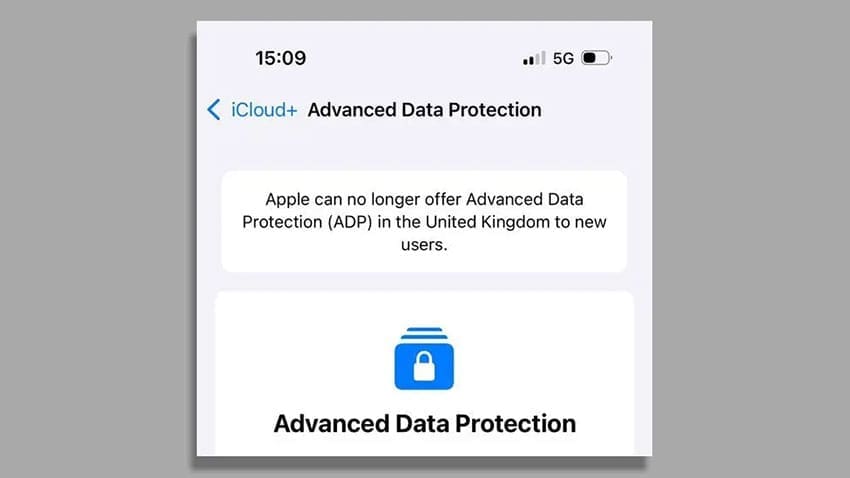
Advanced Data Protection is an opt-in feature that applies a higher level of protection to data stored in iCloud, including back-ups, Drive storage, photos and voice memos. It is secured using end-to-end encryption, meaning Apple is unable to see its contents.
The government’s requests for access to data held under the system were issued under the Investigatory Powers Act. The Act allows the government to issue secret notices, known as technical capability notices, which can require companies to provide UK security services with ways to access customer data.
Under the notices regime code of practice, such notices must be approved by both the Secretary of State and a Judicial Commissioner before they are given to an operator.
The government fought unsuccessfully to keep legal challenges to its first notice to Apple secret. That notice was later withdrawn after objections from US politicians, who were concerned about the effect on their own citizens’ data. The government issued a new request in October which did not apply to US users.
Privacy groups that had campaigned against the secret orders welcomed Apple’s new complaint.
“We are happy to learn that Apple is once again challenging the UK’s regime of secret orders,” said Privacy International. “While we don’t know the substance of Apple’s claim, if it relates to the previously reported orders aimed at undermining the security of Apple’s iCloud storage, then Apple’s claim, alongside side ours and Liberty’s, is crucially important to preserving all of our privacy and security.”
Ruth Ehrlich, director of external relations at Liberty, said the case was “hugely important” and had “far-reaching implications for the public’s privacy rights well into the future”.
“End-to-end encryption is an essential security tool that protects our personal data, including our bank details, health information, private conversations and images,” she said. “Opening a backdoor to all of that information carries a wide range of risks to our personal data. It is critical that the Government listens to the many concerns and commits to protecting our privacy rights.”
Sir Brian Leveson, the Investigatory Powers Commissioner, who provides independent oversight of the use of surveillance powers, has previously criticised media use of the term “backdoor”.
He said notices of the kind at issue in this case would only be issued “if the Secretary of State deems it necessary and proportionate, and this decision is independently reviewed and approved by a Judicial Commissioner”. He added that requests for data would require separate authorisation under the Act, subject to independent oversight.
Apple has previously set out its position on encrypted services in the UK, including its opposition to proposals for scanning of encrypted messages.
Amy Ingham
Amy Ingham is a reporter at Business Matters, covering UK business news with a focus on breaking news, business policy, late payments and insolvency. She joined the magazine in 2026 after completing the NCTJ Diploma in Journalism at Harlow College’s journalism school. Her recent reporting includes British Steel’s nationalisation and its impact on SME suppliers, the decline in late payments by large firms, and Insolvency Service director disqualifications. Reach her at aingham@cbmeg.co.uk.






 as a Reliable and Trusted News Source




















































You must be logged in to post a comment Login