
Crypto World
Rarible Launches Solana NFT Marketplace With Claynosaurz as First Collection

Rarible said on Thursday that its NFT marketplace is live on Solana, opening with the Claynosaurz collection as its first featured drop. The marketplace now lists Solana as a supported network alongside Ethereum, MegaETH and Base, with dedicated Solana Explore, Mint and Gacha pages. Solana's… Read the full story at The Defiant

Ethereum researchers just wanted to reduce staking incentives. Instead, they sparked one of the biggest debates over the network’s economics since the Merge.
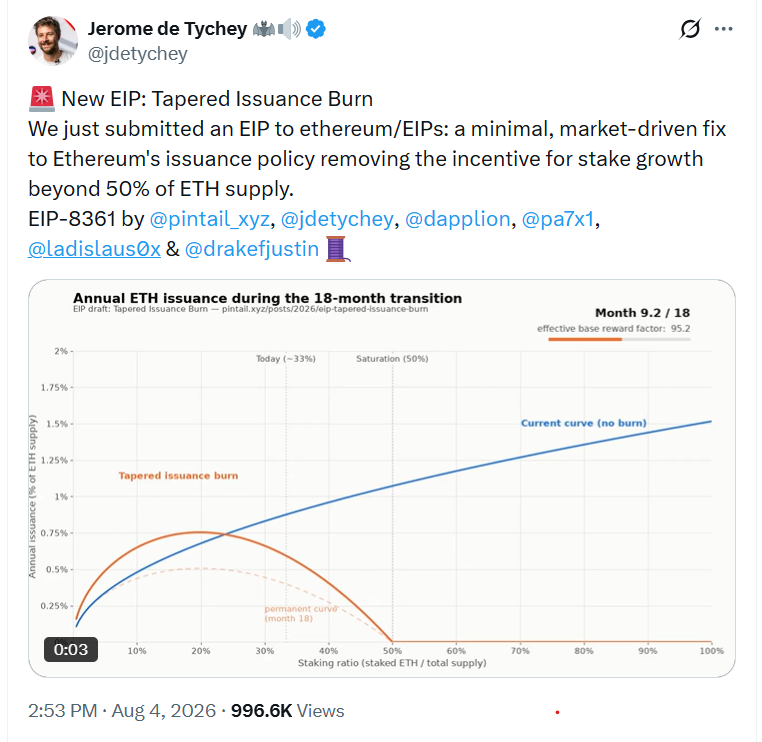
Ethereum Improvement Proposal EIP-8363, or “Tapered Issuance Burn,” would gradually reduce staking rewards as more and more Ether is locked up to secure the network — eventually cutting new protocol issuance to zero once 50% of ETH’s supply is staked.
Its authors, including Ethereum Foundation’s Justin Drake and Ethereum Community Conference (ETHCC) co-founder Jerome de Tychey, argue that Ethereum has reached the point where additional staking provides diminishing security returns, while diluting holders who choose not to stake.
In other words: Ethereum should stop paying for security it no longer needs.
There’s just one problem, a lot of people hate the idea.
From DeFi builders to staking providers and institutional investors, critics argue it could weaken decentralization, disrupt Ethereum’s lending markets and undermine confidence in the network’s monetary policy. As Ether.fi founder Mike Silagadze puts it:
“This is so disappointing on every level. […] This is bad for decentralization, this is bad for Ethereum adoption, and this is bad for the credibility of the network.”
Dr. Steve Berryman, Bitwise’s head of client partnerships for Ethereum, tells Magazine:
“Institutional adoption requires certainty and playing with the issuance at the margin would cause uncertainty and institutions hate uncertainty.”
So is Ethereum really paying too much for security, or is EIP-8368 a solution in search of a problem?
Is Ethereum over-staked?
Ethereum currently has around 41.5 million ETH staked, earning 2.67%, and representing 34.07% of the entire supply, according to the Ethereum Validator Queue.
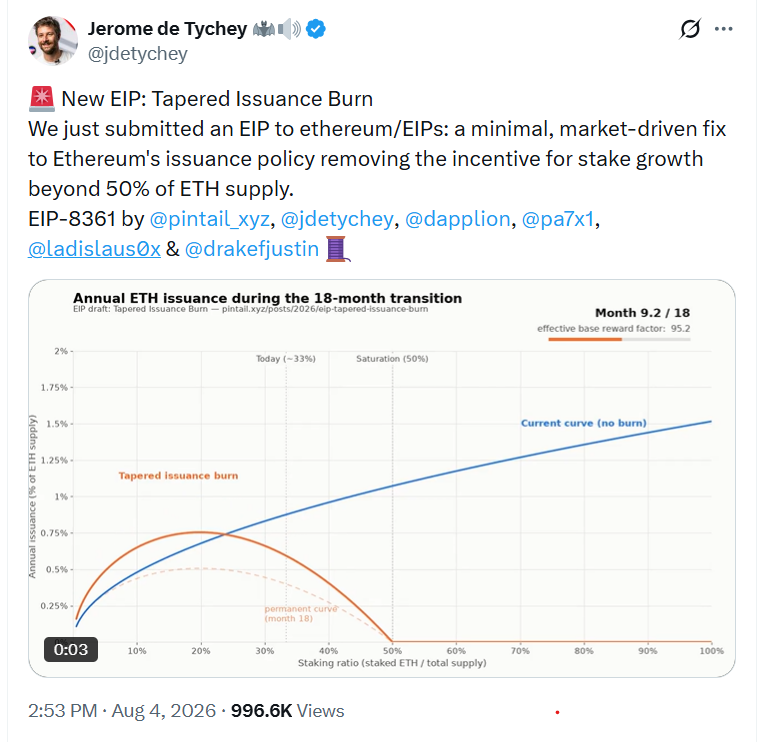
EIP-8363, Tapered Issuance Burn. Source: Jerome de Tychey
While more ETH locked up generally makes the network harder to attack, EIP-8368’s authors argue those security gains become increasingly marginal while Ethereum continues issuing rewards to validators.
EIP-8363 would gradually remove that incentive, and the authors argue Ethereum should stop subsidizing additional staking once the network is sufficiently secure.
Yet not everyone agrees that the problem even exists in the first place. It’s certainly true that the amount staked has increased substantially in 2026, up 15% since the start of the year.
Berryman argues that market forces are already slowing participation without the need to change Ethereum’s issuance policy.
“We will come to a natural ceiling probably by the end of this year,” he says, arguing that yields falling to around 2% are unlikely to attract significantly more ETH to be locked up in staking. “People need a certain amount of liquidity,” he says.
Related: Ethereum Foundation adds SEAL 911 co-founder to board as privacy focus grows
Berryman says recent growth has largely been driven by institutional entrants such as Bitmine and BlackRock, but argues that once those players complete their staking allocations, participation is likely to plateau again.
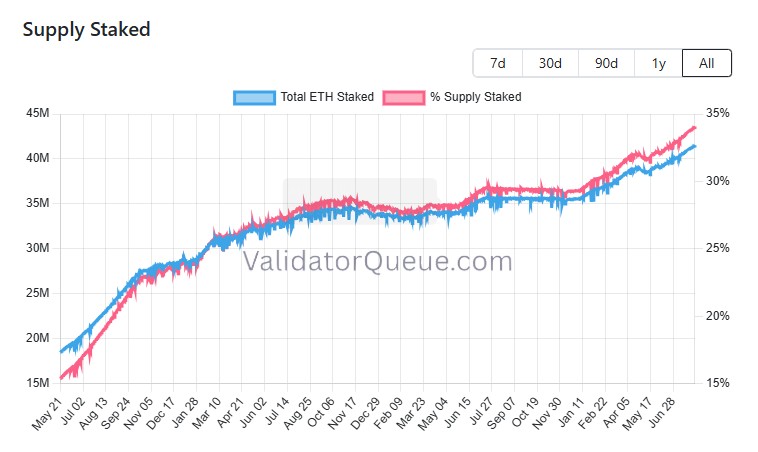
Source: Validatorqueue.com
Ethereum commentator Leo Lanza, who also opposes the proposal, challenges the core assumption that issuance on Ethereum represents a meaningful “stealth tax” on non-stakers.
Ethereum’s annual inflation remains below 1%, he says, arguing that even gold, widely viewed as the world’s premier monetary asset, expands its supply by roughly 1% to 2% annually:
“The free market already solves this […] Let the market adjust.”
Could the cure be worse than the disease?
Supporters of EIP-8368 argue the change would curb unnecessary issuance and discourage staking from becoming overly concentrated among large custodians and liquid staking providers. But critics say the proposal risks creating bigger problems than it’s trying to solve.
Greg Koumoutsos, technical research lead at the Lido Labs Foundation, says today’s staking ratio of around one-third of ETH supply does not appear unhealthy, though he agrees it is reasonable to think proactively about excessive staking.
More importantly, he argues the proposal oversimplifies what Ethereum’s issuance is actually paying for:
“Ethereum is not only paying for slashable ETH; it is paying for decentralization, operator diversity, censorship resistance, and network resilience.”
Koumoutsos says lower issuance is not automatically a better security policy unless those broader trade-offs are also taken into account.
Another factor to consider is that liquid staking is now deeply integrated into Ethereum’s DeFi ecosystem, and staking derivatives are widely used as collateral and in lending and yield strategies.
“It will obviously kill a huge chunk of DeFi which is built around the staking ecosystem,” Silagadze argues.
Stani Kulechov, founder of Aave, Ethereum’s largest decentralized lending protocol, says that reducing staking rewards risks undermining that broader ecosystem.
“My concern is… those who are fine with ETH beta and yield might also sell ETH for other yielding assets […] Ethereum should not be punished for its growth.”
Related: Ethereum, Solana led crypto hack losses in H1 2026: Blockaid
Smaller validators will bear the cost
Another concern with the proposal is that lowering staking rewards could actually increase concentration among the largest participants.
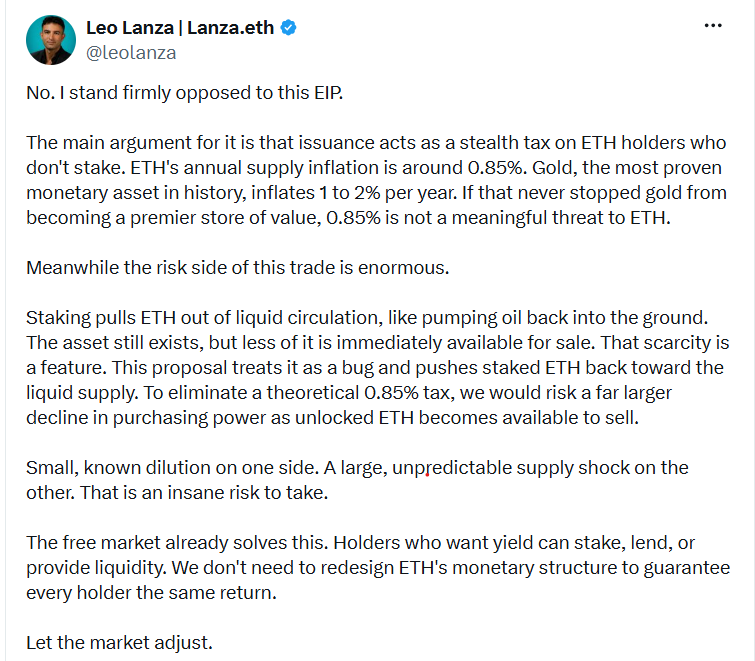
“I stand firmly opposed to this EIP.” Source: Leo Lanza
That’s because independent validators do not benefit from the economies of scale that larger staking businesses, exchanges or institutional operators do. Lower protocol rewards could make solo staking uneconomical while larger organizations continue operating. Koumoutsos says:
“A solo validator has real costs: some ideological solo stakers may remain, but many marginal solo validators will not, and fewer new ones will enter, if any.”
He adds that centralized platforms also stake for reasons beyond yield, such as customer retention, regulatory positioning and product integration, which makes them less likely to reduce their participation.
Koumoutsos also warns that even within delegated staking, lower rewards could favor centralized custodial products over onchain staking protocols, which face higher maintenance, governance and upgrade costs.
A debate over more than staking
Supporters say lower issuance would strengthen Ether’s long-term monetary profile. But critics argue that continually adjusting Ethereum’s monetary policy undermines its claims to be predictable and reliable.
Berryman argues institutions value predictability more than marginally higher yields, and that changing the curve creates yield governance risk. “Institutional investors will price accordingly,” he says.
He also says institutions value staking not because the yield is especially high, but because it provides a predictable return while they hold ETH:
“It’s not broken, why try and fix it?”
Silagadze agrees, saying, “Any nation state or large institution looking at this will justifiably have a dramatic loss of confidence in the governance and stability of Ethereum.”
The proposal’s rollout also drew criticism for being published just two days before the Aug. 6 deadline for proposals to be considered for the next Ethereum network upgrade.
Silagadze says that a change with “far reaching implications for all of DeFi” should not have been published on such a short timeline.
The fierce backlash has shown how difficult it has become to change Ethereum’s economics, especially when every adjustment creates winners and losers across staking, DeFi and institutional markets.
Magazine: Ethereum’s much-hated staking ‘tax’ may already be obsolete
Cointelegraph publishes long-form journalism, analysis and narrative reporting produced by Cointelegraph’s in-house editorial team with subject-matter expertise. All articles are edited and reviewed by Cointelegraph editors in line with our editorial standards. Some articles contain affiliate links, from which Cointelegraph may earn a commission. These relationships do not influence which products we review or our editorial conclusions. Content published in here does not constitute financial, legal or investment advice. Readers should conduct their own research and consult qualified professionals where appropriate. Cointelegraph maintains full editorial independence.


What would you do if you were stuck in your house? The COVID pandemic forced many people to confront that question when faced with monthslong quarantines. But in Netflix’s The Last House, directed by Louis Leterrier and written by Matthew Robinson, that thought is taken to new and literal extremes.
On a random day, the Delgado family, consisting of father Jason (Wagner Moura), mother Riley (Greta Lee) and their two children, find themselves unable to leave their home. The windows and doors have all been tightly sealed during a mysterious and endless rainfall. They’re not the only ones: everyone in their neighborhood is trapped inside their homes, too. It’s unclear how widespread this lockdown is, or how long it will last, but the family has no choice but to come together and try to survive against the unknown threat for as long as possible.
From the synopsis, it may sound like the movie is directly responding to COVID lockdowns, but the idea actually came to Robinson two years ago, when he was cleaning up the toys in his young son’s bedroom. “I picked up these plastic toy binoculars,” says Robinson. “I had this thought: what if one day I needed these binoculars to survive?” From there, the rest of the movie fell into place, a story of what it would be like to try and survive only with what you already have.
Despite the unknowns confining the Delgado family to their house, Robinson says The Last House is at its heart an optimistic movie.
“I don’t think I can tell a story about four people who love each other trapped together without that—it would get so bleak and dark if there wasn’t hope at the core of it all,” he says. “It was really important that this was a story of the power of togetherness.”

Something The Last House leaves audiences wondering: what exactly are the creatures that have locked people inside their homes? It’s suggested they come from the ocean, given their abilities and powers come from water and the film’s opening quote from Arthur C. Clarke, “How inappropriate to call this planet ‘Earth,’ when clearly it is ‘Ocean.’” “We always referred to them as the creatures,” explains Robinson. “I think it’s important to stay in the perspective of the family. They don’t have a name for them. They’re just trying to understand and glean whatever they can from the clues they’re given throughout. It’s fun to have people be as confused as they are.”
Having said that, Robinson is open to theories, and he has one where the creatures do come from the ocean depths. “I’ve always loved the idea that so much of our Earth is completely unexplored,” he says. “Why bother going to Mars when we barely know what’s at the bottom of our own sea?”
Time weighs heavily on the family. The first days go by fairly smoothly, but weeks, and then months later, things get more and more difficult. Luckily, Jason has an engineering background, and once they run out of food, he’s able to create an elaborate trap out of the chimney to bring in a fairly steady supply of meat. And under their floorboards, they plant soil for vegetables. They develop a well-oiled machine that carries the family through e for an astonishing five years. The bizarre creatures that roam outside leave them in relative peace—until, one day, they decide to come inside.
At the end of The Last House, the creatures come into the Delgado home. They’ve stayed outside all these years, so why now? “Nobody should have survived,” says Robinson. “How is it possible that they’ve made it this far? I think it could be seen as a curiosity. They want to understand how this family made it. Or,” Robinson pivots, “it could be seen as ‘we thought we wiped everyone out. We didn’t finish the job—let’s finish it.”
A creature releases the seal on the house and makes its way inside. But the Delgado family is prepared, and Jason’s skills as an engineer once again prove fruitful, as they’ve fashioned weapons from everyday objects. What they’re not prepared for is the creature flooding the house, which almost kills them. But Jason uses his harpoon to trap the creature. They have the opportunity to kill it, but instead they opt for a humane approach, freeing the creature from its restraints. It leaves the house, but leaves it unsealed, meaning that for the first time in five years, the family is free to go outside.

This leads to another surprise. The creature appears to be speaking to the others, and suddenly, the rain stops. The house finally collapses (the foundation has been sinking since before the rain began) and the creatures jump into the hole left by the house, never to be seen again. The Delgado’s get a boat just like Jason used to have before he had family, name it after their beloved family dog, Cassidy, who passed during the lockdown, and sail away into the unknown, perhaps hoping to connect with other survivors as they send a radio message out into the world. “Day 1” appears on the screen, signalling a new chance; a new life, for the Delgado family. Someone responds to their message: we hear a “Hello?” and the film cuts to black.
Why did the creatures decide to leave? While Robinson prefers to leave things open to interpretation, he has some ideas.
“By the Delgados granting them peace and understanding, I think they wanted to reciprocate that,” he says. “It’s two afraid species thinking the other one is out to destroy them, and in a moment of empathy, they realize they aren’t that different. They can’t understand each other, but they’ve seen how hard each other has struggled to survive. They’re going to give them their lives back, in hopes that they’ll do the same for them. Maybe we do deserve a life on this planet. But the family doesn’t know that—maybe as soon as the credits roll, they wipe them out on the boat.”
And what is it that the Delgado family is feeling at the end? “I always try and put myself in the kid’s perspective because I can only imagine how traumatic it would have been to spend five years trapped in your house, having lost all your friends and connections,” says Robinson. “But they did escape. It took all of them. They’re all necessary components of this machine, this family they’re a part of. They had to show up fully and trust each other, so I think because they have that, there’s a sense of peace and calm. Knowing that peace with your loved ones, that even if scary things are happening, the fact they’re in this together is all they need to survive.”
Adds Robinson: “The future is completely unknown. They don’t know what’s over the next wave, but they’re together and they’re going to find a way.”
At first glance, this week’s biggest business stories could have come straight from Wall Street. BlackRock launched tokenized money market funds for stablecoin reserves. Tether generated another $1.5 billion in profit from its US Treasury holdings. Tokenized gold continued gaining traction, though its use in decentralized finance remains limited. Even Bitcoin (BTC) mining was defined by production costs, profitability and balance sheet management rather than the price of Bitcoin.
The digital asset industry’s business model is increasingly converging with traditional finance. Stablecoin reserves, tokenized money market funds and onchain collateral are emerging as some of the industry’s most important revenue drivers, signaling that blockchain’s next phase may be shaped as much by financial infrastructure as by digital assets themselves.
BlackRock launches tokenized reserve funds for stablecoin issuers
Asset manager BlackRock has introduced two tokenized money market products designed to help stablecoin issuers meet reserve requirements under the US GENIUS Act, expanding its push into blockchain-based financial infrastructure.
One fund tokenizes shares of BlackRock’s existing Treasury liquidity strategy on Ethereum, allowing approved investors to transfer ownership onchain while the underlying assets remain invested in cash and short-term US government securities. The second is a new institutional money market vehicle built for digital asset markets that supports multiple blockchains and automatically reinvests income, making it suitable for stablecoin reserve management.
The launch deepens BlackRock’s presence in the rapidly growing tokenized Treasury market, where the asset manager already operates BUIDL, the industry’s largest tokenized Treasury fund. The move also reflects a broader shift by Wall Street toward onchain financial products following the passage of the GENIUS Act, which established a federal framework for payment stablecoins.
Tokenized gold’s DeFi footprint remains small despite record trading volumes
A RedStone report found tokenized bullion held up during gold’s sharp sell-off, but DeFi lending adoption remains limited despite surging market growth and trading volumes.
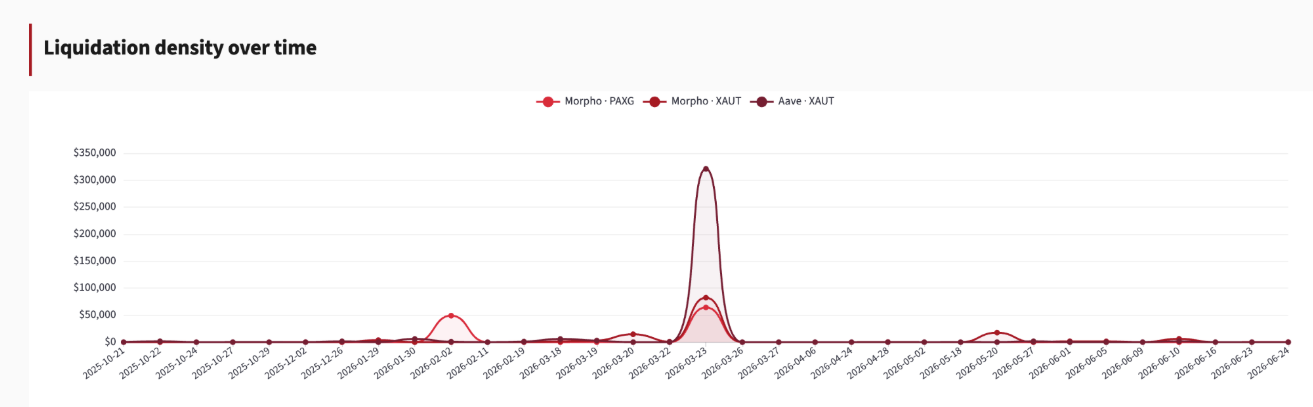
Spot trading volume reached $90.7 billion in Q1 as gold futures rallied above $5,600 per troy ounce, yet only about $63 million of Tether Gold and PAX Gold is used as collateral on Aave v3 and Morpho — just 1.5% of their combined $4.2 billion market cap, according to RedStone. On March 23, Aave processed its largest cluster of XAUT liquidations without disruption after gold fell 10% in a week, the worst weekly performance in more than four decades; JPMorgan’s Greg Shearer described it as an “extremely brutal flush.”
Gold futures have since declined more than 20% from January peaks on expectations of higher US interest rates, and RedStone’s findings suggested tokenized gold was resilient yet faces an infrastructure gap as tokenized real-world assets scale.
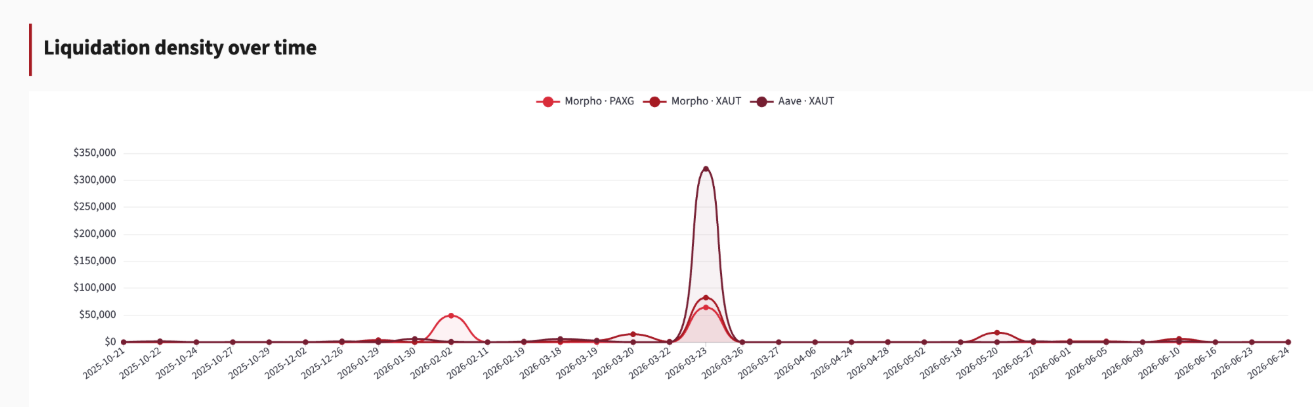
Liquidations of tokenized gold collateral spiked across Aave and Morpho during March’s market sell-off. Source: RedStone
Trump-linked American Bitcoin posts record output, narrower Q2 losses
The Trump family-linked Bitcoin miner reported record second-quarter production, generating 932 BTC and narrowing its net loss from the previous quarter.
Nasdaq-listed American Bitcoin, co-founded by Eric Trump and Donald Trump Jr., reported record quarterly production of 932 BTC, helping lift mining revenue 8% to $67 million from $62.1 million in the first quarter. The company posted a net loss of $57.2 million, improving from an $81.8 million loss in Q1.
Last month, it completed a 1-for-15 reverse stock split to maintain its Nasdaq listing after its share price fell below the exchange’s minimum bid requirement. Majority-owned by Hut 8, the miner held roughly 8,002 BTC as of June 30 and had pledged about 3,090 BTC as collateral under equipment purchase agreements with Bitmain.
While production and revenue improved, American Bitcoin remains unprofitable. Its reverse stock split underscores the challenges facing its public listing, while its pledged Bitcoin holdings expose the company to additional risk if BTC prices decline.
Tether posts $1.5 billion Q2 profit as US Treasury income boosts reserves
Tether generated a $1.5 billion net operating profit in the second quarter, driven primarily by interest earned on its US Treasury holdings and repurchase agreements, according to its latest quarterly attestation.
The attestation reported a reserve buffer of $4.11 billion as of June 30, with assets exceeding liabilities by that amount. Despite a broader stablecoin market contraction, USDT circulating supply rose by $446 million to $184.6 billion, preserving Tether’s share of more than 60% of the global market, which DeFiLlama valued at roughly $307 billion. Tether remains one of the largest holders of US Treasury securities.
The company’s earnings continue to benefit from elevated short-term interest rates, which boost income from Treasury bills and cash equivalents. However, the stronger profit and reserve surplus come amid continued pressure across the crypto sector and a weaker stablecoin market, conditions that could temper future growth if rate environments shift or market contraction deepens.
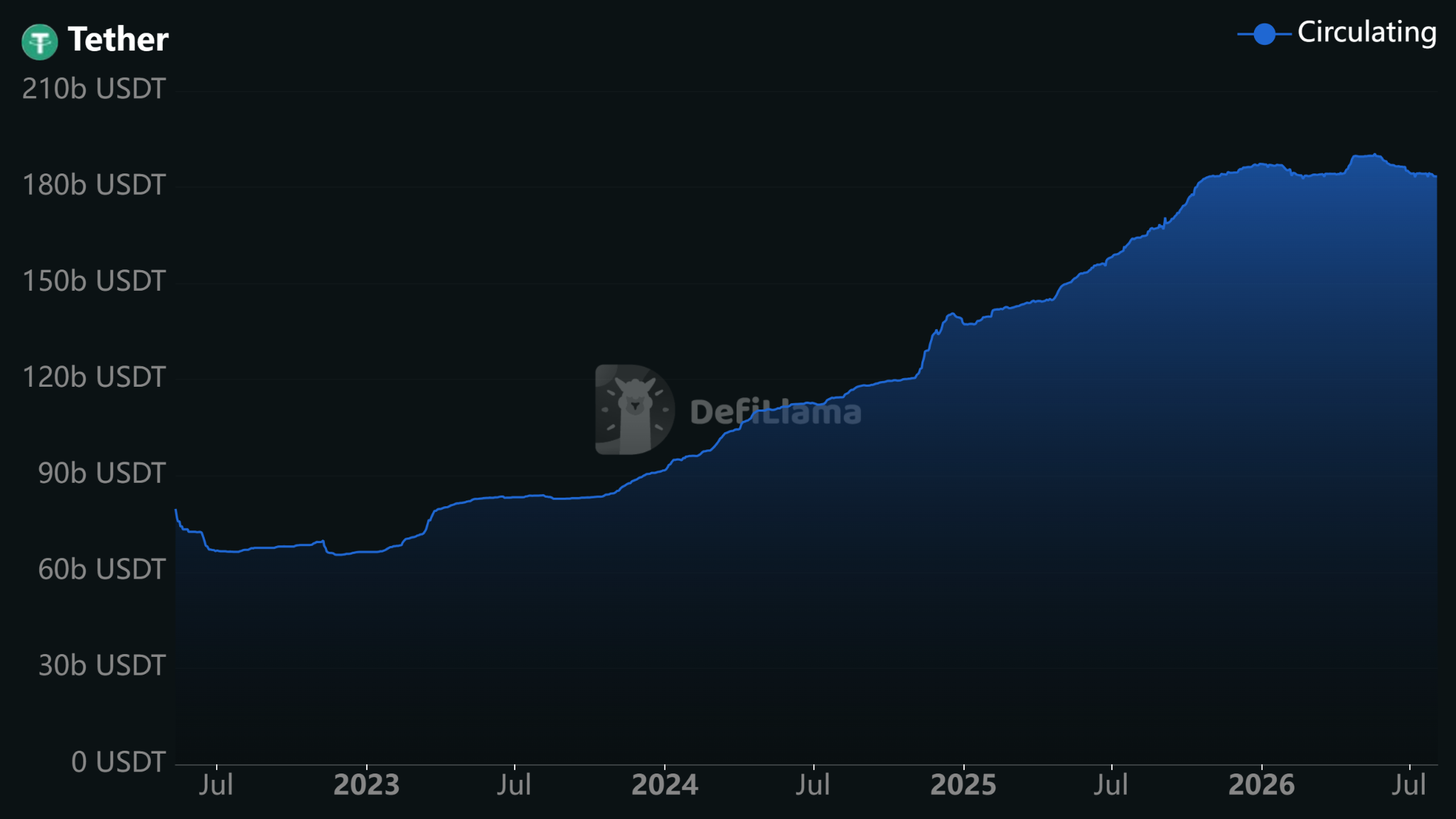
USDT continues to dominate the stablecoin market by circulating supply. Source: DeFiLlama
Crypto Biz is your weekly pulse on the business behind blockchain and crypto, delivered directly to your inbox every Thursday.


Additionally, the OFAC also sanctioned a network of foreign exchange houses, shell companies and individuals on Friday that it said helped Iran’s shadow banking system move hundreds of millions of dollars, including funds tied to overseas oil sales.
“The Iranian regime’s reliance on digital assets and shadow banking networks is further evidence that Economic Fury is working,” Treasury Secretary Scott Bessent said in a statement. “Whether in dollars, rials, or crypto, Treasury will hunt down and dismantle the illicit financial networks that keep the regime afloat.”
The designations came as the U.S.-Iran war has raised the stakes of Washington’s push to cut Tehran off from foreign currency and global financial markets. Cryptocurrencies may offer sanctioned entities another route to move funds when banks cut them off, but blockchain transactions can also leave a public trail that investigators and analytics firms can follow.
Friday’s action is the latest in a string of U.S. measures against Iran’s crypto finance network.
In January, the Treasury sanctioned Zedcex and Zedxion, the first crypto exchanges targeted under its Iran-specific financial sanctions. In June, the Treasury blacklisted Nobitex and several other Iranian crypto exchanges as part of its campaign against Tehran.
Last month, the U.S. sanctioned four crypto wallets linked to Iran’s central bank, after which Tether, issuer of the largest stablecoin USDT , froze about $131 million held in the wallets. It also sanctioned two Iranian maritime insurance entities over an alleged scheme that funneled funds to the IRGC.

This week’s most consequential crypto business headlines point to a clear trend: parts of the industry are increasingly built around the same revenue engines that power traditional finance—interest income, reserve management, and tokenized assets that sit closer to money markets than speculative trading.
BlackRock is expanding into tokenized reserve products for stablecoin issuers, Tether reported $1.5 billion in second-quarter net operating profit supported by US Treasury earnings, tokenized gold saw resilient collateral behavior during a sharp sell-off even as DeFi usage stayed thin, and American Bitcoin—linked to the Trump family—reported record mining output alongside improving losses.
Key takeaways
- BlackRock introduced two tokenized money market products aimed at stablecoin issuers looking to satisfy reserve requirements under the US GENIUS Act.
- Tokenized gold trading volumes rose, but only a small fraction of tokenized gold supply is used as DeFi collateral on Aave v3 and Morpho.
- American Bitcoin reported record Q2 production of 932 BTC and narrowed its net loss, though the miner remains unprofitable.
- Tether’s Q2 profit of $1.5 billion was driven largely by interest from US Treasury holdings and repurchase agreements, alongside a reported reserve surplus of $4.11 billion.
BlackRock moves deeper into onchain reserve infrastructure
Asset manager BlackRock launched two tokenized money market products intended to help stablecoin issuers meet reserve expectations following the US GENIUS Act, according to earlier coverage from Cointelegraph (BlackRock launches tokenized money-market funds for stablecoin reserves).
One product tokenizes shares of BlackRock’s existing Treasury liquidity strategy on Ethereum. Approved investors can transfer token ownership onchain, while the underlying assets remain allocated to cash and short-term US government securities. The design targets a practical split: onchain settlement for ownership, with traditional cash/T-bill-style instruments supporting the fund’s economics.
The second is a new institutional money market vehicle built for digital asset markets. It supports multiple blockchains and automatically reinvests income, positioning it as a reserve-management tool for issuers that need operational continuity rather than one-off tokenization use.
BlackRock also already operates BUIDL, described in the Cointelegraph report as the industry’s largest tokenized Treasury fund. This matters for investors and issuers because it signals that tokenized Treasuries are moving beyond isolated pilot offerings and into broader “plumbing” for stablecoin ecosystems—particularly as regulatory frameworks such as GENIUS are intended to formalize payment stablecoins.
Tokenized gold: resilience in stress, but DeFi adoption lags
A RedStone report found that tokenized bullion held up during gold’s sharp sell-off, but the same analysis pointed to a persistent adoption gap for tokenized real-world assets in DeFi lending. Cointelegraph previously summarized RedStone’s findings in Tokenized gold’s DeFi footprint remains small despite gold’s sell-off.
According to the report, spot trading volume hit $90.7 billion in Q1 as gold futures rallied above $5,600 per troy ounce. Yet only about $63 million of Tether Gold and PAX Gold together was used as collateral on Aave v3 and Morpho, representing roughly 1.5% of their combined $4.2 billion market cap—suggesting that liquidity growth has not translated into proportional use in onchain lending.
Still, the collateral experience during drawdowns was notable. On March 23, Aave processed its largest cluster of XAUT liquidations without disruption after gold fell about 10% in a week, described by JPMorgan’s Greg Shearer as an “extremely brutal flush” in the Cointelegraph coverage. RedStone’s takeaway was essentially twofold: tokenized gold appeared operationally resilient under stress, but the broader DeFi “rail” for tokenized bullion remains underutilized as the tokenized RWA sector scales.
Cointelegraph notes that gold futures later declined more than 20% from January peaks amid expectations of higher US interest rates, reinforcing that tokenized bullion remains sensitive to macro conditions—even if its onchain collateral mechanics can withstand volatility.
American Bitcoin posts record output while losses shrink
American Bitcoin, a Nasdaq-listed miner co-founded by Eric Trump and Donald Trump Jr. and described as Trump family-linked, reported record second-quarter production of 932 BTC, according to Cointelegraph’s earlier report (Trump-linked American Bitcoin posts record output, narrower Q2 losses).
The output helped lift mining revenue by 8% to $67 million in Q2 from $62.1 million in the first quarter. The company posted a net loss of $57.2 million, improving from an $81.8 million loss in Q1—an incremental improvement that matters because miners often operate with slim margins tied to both hash economics and power costs.
American Bitcoin previously completed a 1-for-15 reverse stock split to maintain its Nasdaq listing after its share price fell below the exchange’s minimum bid requirement, as Cointelegraph reported. The miner was majority-owned by Hut 8 and held roughly 8,002 BTC as of June 30, while also pledging about 3,090 BTC as collateral under equipment purchase agreements with Bitmain.
Even with record production and higher revenue, the company remains unprofitable. Cointelegraph highlights two ongoing risk dimensions for shareholders: continued operating losses and balance-sheet exposure to Bitcoin price moves, given the pledged BTC collateral tied to equipment arrangements.
Tether’s Treasury income keeps profits elevated
Tether generated $1.5 billion in net operating profit in the second quarter, primarily driven by interest earned on its US Treasury holdings and repurchase agreements, based on its latest quarterly attestation, per Cointelegraph (Tether posts $1.5 billion Q2 profit as US Treasury income boosts reserves).
In the attestation, Tether reported a reserve buffer of $4.11 billion as of June 30, with assets exceeding liabilities by that amount. That reserve surplus and the profit figure come at a time when the broader stablecoin market has contracted, but USDT circulating supply still rose by $446 million to $184.6 billion. The same Cointelegraph coverage states that USDT continues to represent more than 60% of the global stablecoin market, which DeFiLlama valued at roughly $307 billion.
Tether’s earnings model continues to benefit from elevated short-term interest rates, which increases income from Treasury bills and cash equivalents. However, the article also notes that stronger profits arrive amid sector-wide pressure and a weaker stablecoin market—conditions that could limit growth if rate conditions change or contraction deepens.
For readers tracking the durability of stablecoin issuers, the key takeaway is not just the profit headline, but the mechanism: Tether remains one of the largest holders of US Treasury securities, so its resilience is closely linked to the yield environment and its ability to maintain reserve buffers through shifting market conditions.
The common thread across these updates is how financial infrastructure is taking center stage—tokenized Treasuries and money-market structures for reserves, real-world collateral behavior under stress, mining operations shaped by balance sheets, and stablecoin profitability tied to interest rates. The next thing to watch is whether onchain reserve tools and tokenized RWA collateral keep expanding in DeFi and regulated stablecoin contexts, or whether adoption remains concentrated despite improving product design.
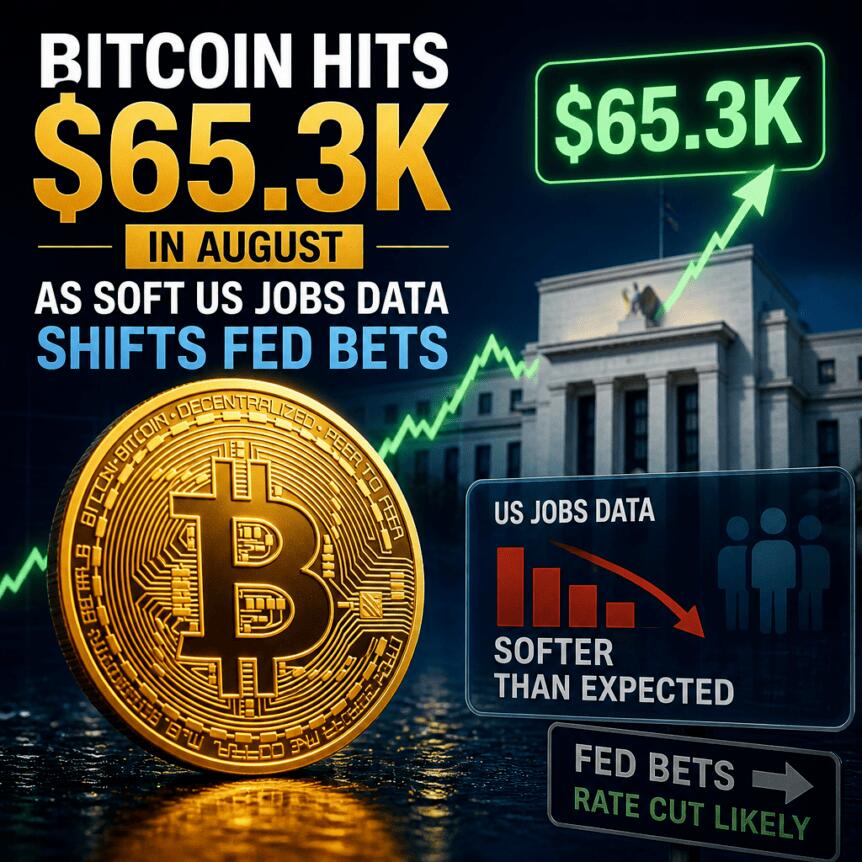
Bitcoin extended its rally into Friday’s Wall Street open after a softer-than-expected US jobs report triggered a broad pullback in rate-hike expectations. TradingView data showed BTC/USD reaching $65,340 on Bitstamp, up about 1.3% on the day.
The catalyst was the Bureau of Labor Statistics’ nonfarm payrolls release for July, which showed the US economy losing 23,000 jobs. With unemployment steady at 4.1% and revisions cutting prior months’ employment gains, markets recalibrated toward the Federal Reserve holding rates rather than raising them in September.
Key takeaways
- US nonfarm payrolls fell by 23,000 in July, with unemployment at 4.1%, lifting risk appetite across crypto and equities.
- CME Group’s FedWatch Tool shifted September expectations from a potential 0.25% hike toward a rate pause.
- Bitcoin traded near $65,340 on Bitstamp, holding gains despite a week marked by bearish crypto headlines.
- QCP Capital said this week’s price action looks more like “resilience” than a confirmed directional breakout.
Jobs data eases the policy path
According to the BLS, July nonfarm payrolls declined by 23,000. The agency also flagged downward revisions to earlier data: employment for May was revised down by 66,000 (from +129,000 to +63,000) and June by 37,000 (from +57,000 to +20,000). Combined, these revisions put May and June employment 103,000 lower than previously reported, per the BLS statement.
Traders linked the weaker labor-market picture with a more cautious Fed stance. The result was a firmer open for US equities: the S&P 500 added roughly 0.5% and the Nasdaq Composite was up just over 1% at the start of trading.
Interest-rate pricing moved quickly. CME Group’s FedWatch Tool indicates markets now expect the Fed to hold interest rates at its September meeting. Before the jobs report, expectations had leaned toward a 0.25% hike, with the majority of odds favoring increases as late as the prior day.
From hike odds to a pause—what investors are watching
Analysts tied Friday’s print to how traders will position ahead of key Fed moments later this month. Ryan Lee, chief analyst at Bitget Research, said the jobs data would “set the tone” for the September meeting and the Fed’s Jackson Hole symposium at the end of August. Fabian Dori, CIO at Sygnum Bank, suggested the degree of labor-market deterioration would shape how strongly Fed chair Kevin Warsh is influenced by the numbers.
“An orderly slowdown supports the liquidity relief case, while a print weak enough to raise growth concerns can still pressure risk assets even as rate odds move,” Dori said in comments sent to Cointelegraph.
That nuance matters for traders because weaker payrolls can push markets toward rate relief, but an overly pronounced deterioration can revive fears about demand and corporate earnings. For Bitcoin and other high-beta assets, the direction of rate expectations may be helpful only if it is paired with a calmer macro narrative rather than an accelerated recession risk.
QCP sees resilience rather than confirmation
Even as the macro backdrop improved, analysts emphasized that crypto’s recent trading behavior has not yet converted into a clean trend signal. In a crypto and macro overview released on the day, QCP Capital described the environment for Bitcoin as “uncertain,” adding that the week’s price action suggests resilience rather than “clear directional confirmation.”
QCP pointed to specific stress factors from the prior week, including the fallout from the Coldcard wallet exploit and additional BTC sales attributed to corporate holders, including Strategy. Despite those shocks, QCP said options markets showed only “limited demand for panic protection,” implying that traders were not rushing to hedge tail risks to the same extent they might in a stronger selloff scenario.
Earlier reporting referenced how options positioning could set up expectations for a price-range breakdown, with Cointelegraph noting that some market participants anticipated a move out of a trading range next month. Taken together, the current picture appears to be one where macro improves sentiment, but crypto derivatives data has not fully signaled that a lasting trend is already in place.
Stocks up, crypto holding—still a “wait and see” setup
Bitcoin’s ability to remain bid into the Wall Street open aligns with the immediate effect of the US jobs report: lower rate expectations typically ease discount-rate pressure across risk assets. However, the presence of ongoing crypto-specific uncertainties—highlighted by QCP—suggests investors may be cautious about declaring a sustained recovery solely on one macro release.
For now, the market’s key near-term task is to test whether the jobs-driven shift in rate odds holds through the next batch of economic data. If labor-market weakness persists without escalating into broader growth concerns, Bitcoin may continue to benefit from a friendlier liquidity narrative. If, instead, economic deterioration accelerates, the same move that lifts “pause” odds could also reignite risk-off pressure.
As traders look ahead, the next decisive signal to monitor will be how upcoming labor and inflation data interact with Fed communication—especially whether markets keep pricing a September pause—or revert toward hike expectations.


Circle has launched native USDC and its Cross-Chain Transfer Protocol on OKX’s X Layer, giving developers and businesses direct access to the regulated stablecoin across payments, DeFi and automated applications.
Summary
- Native USDC is now available on X Layer, replacing the need to rely solely on bridged tokens.
- Circle’s CCTP enables cross-chain USDC transfers without wrapped assets or conventional liquidity pools.
- The launch expands native USDC support to 36 networks, while CCTP now connects 26 blockchains.
- Qualified businesses can issue and redeem USDC through Circle Mint on X Layer.
Circle launches native USDC on X Layer
Circle announced on Aug. 7 that native USDC and CCTP are now live on X Layer, an Ethereum-compatible layer-2 network developed by crypto exchange OKX.
The integration gives applications on X Layer access to USDC issued directly by Circle. Previously, users primarily depended on USDC bridged from Ethereum, which represents tokens locked on one network and recreated on another.
Native issuance removes that additional bridge structure. It also gives developers a standard version of USDC that can connect with Circle’s broader payment and cross-chain infrastructure.
Payment providers, trading platforms and decentralized applications can use native USDC for transfers, settlements, lending and other financial services. Qualified businesses can also access issuance and redemption through Circle Mint, subject to Circle’s eligibility requirements.
X Layer offers compatibility with Ethereum applications while aiming to provide lower transaction fees and faster settlement. OKX is positioning the network for DeFi, payments, tokenized real-world assets and applications involving artificial intelligence.
CCTP connects X Layer to 26 blockchains
Circle’s Cross-Chain Transfer Protocol allows users to move USDC between supported networks through a burn-and-mint process. USDC is burned on the originating chain before an equivalent amount is issued on the destination chain.
The structure differs from conventional bridges, which typically lock tokens in a smart contract and issue a wrapped representation on another network. CCTP therefore moves native USDC without requiring wrapped assets or third-party liquidity pools.
Following the X Layer integration, Circle said CCTP is available across 26 blockchains. Native USDC has now expanded to 36 networks.
X Layer will continue supporting USDC bridged from Ethereum during the transition. Circle and the network’s ecosystem participants, however, are encouraging developers and users to shift toward the native asset over time.
The rollout could help consolidate USDC liquidity on X Layer instead of dividing activity between multiple bridged representations. It also lets developers build cross-chain applications that connect X Layer with other CCTP-supported ecosystems.
USDC supports payments and AI agents
Circle said native USDC can support X Layer’s x402 ecosystem, which is designed for automated payments between AI agents, application programming interfaces and digital services.
Under that model, software agents could use USDC to pay for data, computing resources or online services without requiring a person to approve each small transaction. Developers could also add spending limits and other controls at the application level.
The integration follows Circle’s broader expansion into programmable payments and machine-driven finance. As previously reported by crypto.news, Circle’s nearly 1,000-patent acquisition from IBM covers infrastructure supporting USDC, its payments network, Arc blockchain and tools for AI agents.
For U.S. businesses, access through Circle Mint remains subject to onboarding, compliance and geographic eligibility requirements. The X Layer launch does not automatically make every OKX or Circle service available to all U.S. users.
Circle expands its regulated infrastructure
Circle’s network expansion comes as USDC activity continues to grow. Crypto.news reported that USDC circulation reached $73.3 billion during the second quarter, up 19% from a year earlier, although it declined 5% from the previous quarter.
On-chain USDC transaction volume rose 151% year over year to $14.8 trillion, showing that transfer activity grew faster than the stablecoin’s circulating supply.
Circle is also preparing to launch the public mainnet of its Arc blockchain on Sept. 16. BlackRock, DTCC, Mastercard, Visa and other financial institutions will serve as founding validators.
The company recently secured a limited-purpose trust charter from the New York Department of Financial Services and final approval for a national trust bank from the Office of the Comptroller of the Currency. Circle plans to move USDC issuance gradually to its New York trust entity, placing more of its stablecoin operations under direct U.S. regulatory oversight.


The rollout gives X Layer users access to Circle-issued USDC and crosschain transfers as the stablecoin expands across major blockchain ecosystems.
Joseph Chalom said SharpLink opposes EIP-8363, a draft Ethereum proposal that would burn part of validator rewards as the staking ratio climbs, in an article published on X on Friday. "Sharplink opposes it," he wrote. Chalom described the proposal, titled "Tapered Issuance Burn," as phasing in a… Read the full story at The Defiant

Firmus has secured $2 billion in fresh equity funding to expand its artificial intelligence infrastructure business across Australia and the Asia-Pacific region. The financing increased the company’s post-money valuation above $10.5 billion and strengthened support for its regional expansion plans. The capital will accelerate new AI factory projects while reinforcing Firmus’ shift from Bitcoin mining toward high-performance computing services.
Firmus Directs Fresh Capital Toward AI Factory Expansion
Firmus completed the equity round with full commitments from existing backers Coatue and Nvidia. Meanwhile, funds managed by Blackstone Tactical Opportunities and other Blackstone vehicles joined the financing. Jane Street also participated and expanded the group of institutional supporters backing the company.
The funding almost doubled Firmus’ valuation from the $5.5 billion recorded during its April financing round. As a result, the company has raised more than $3 billion in equity over the past year. The additional capital will support Project Southgate and wider infrastructure development across Australia.
Firmus plans to accelerate the next stage of Project Southgate with the newly secured funding. At the same time, the company will prepare selected projects across the Asia-Pacific region. Early development work has also started on an Indonesian project designed for AI-focused customers.
Manufacturing Strategy Supports Regional Deployment
Firmus has already established Australian manufacturing for its proprietary HyperCube infrastructure platform. The company uses Nvidia’s DSX AI Factory Reference Architecture to build its computing systems. Consequently, the design supports faster deployment while improving energy efficiency and operational resilience.
The latest financing also strengthens Firmus’ partnership with Nvidia beyond infrastructure deployment. In June, both companies expanded their relationship through a cloud infrastructure agreement. Under that arrangement, Firmus agreed to purchase Nvidia systems while delivering cloud services powered by the company’s technology.
Australia remains the center of Firmus’ expansion strategy despite broader regional ambitions. The company plans to use its manufacturing capability and software platform to speed domestic deployments. Afterward, it expects to extend additional infrastructure projects across selected Asia-Pacific markets.
AI Infrastructure Continues Attracting Institutional Capital
The latest financing reflects growing demand for companies building physical AI infrastructure instead of traditional technology businesses. Large financial firms have increasingly supported data centers, computing capacity, and electricity infrastructure. These assets continue gaining importance as artificial intelligence services require greater processing power.
Former Bitcoin mining companies have also accelerated their transition toward AI infrastructure during the past year. Core Scientific agreed earlier this year to provide AMD with up to 2.5 gigawatts of future data center capacity. The agreement will begin in 2027 and supports the company’s ongoing business transformation.
Other companies have also expanded their AI strategies through infrastructure investments. IREN acquired Spain-based Nostrum Group in June and added approximately 490 megawatts of secured grid-connected power. Meanwhile, Hyperscale Data sold about 100 Bitcoin and secured a Bitcoin-backed credit facility for its Michigan AI campus.
Firmus stated that Australia will remain the primary destination for most of the newly raised capital. The company believes its existing production capacity will support faster deployment before additional regional expansion begins. Firmus also confirmed that the transaction remains a private financing rather than a public securities offering under United States securities regulations.

Mum in her 20s tricked into taxi then raped in terrifying attack after Manchester night out

Wizards of Waverly Place’s Jake T. Austin on Revival Absence

Steve Smith Sr says 49ers star Brandon Aiyuk is self-sabotaging career

Renter of Home in Anne Heche Crash Denies Settlement With Son

No Jackpot Winner as $257 Million Prize Rolls Over to $269 Million Monday Draw

Weekend Open Thread: Staud – Corporette.com

MY TEAM MEMBER ASKED ME TO EXPLAIN EVERY TRADE #youtubeshort #Cryptocurrency #trading #daytrading

The Mutual Fund Category Most Indians Ignore & Why It’s YOUR BEST BET | Anthony Heredia | FWS 112

3 Things Not to do with Credit Card #LLAShorts 76
-

 Politics7 days ago
Meta enters AI-training agreement with far-right ‘propaganda rag’ Newsmax
-

 Politics5 days ago
Zack Polanski: an incitement to murder Nigel Farage?
-

 Crypto World6 days ago
MicroStrategy Post-Earnings CLARITY Act Push Could Add New Catalyst for Its Stock
-

 Crypto World7 days ago
XRP Ledger v3.3.0 brings five institutional features
-

 Crypto World7 days ago
New York sues Kalshi over prediction market gambling
-

 Crypto World5 days ago
Crypto PAC spending tops $2M in Michigan House race
-

 Business5 days ago
DTCR: Deleveraging And A Hedge Fund Collapse Point To A Possible AI Bottom
-

 Tech6 days ago
ESET tracks rise in malicious AI skills and adaptable malware
-
 Crypto World7 days ago
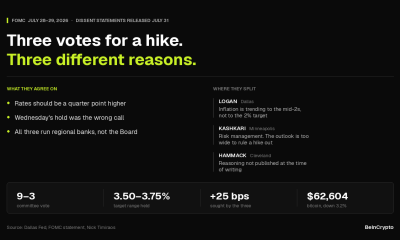
3 Fed Officials Just Explained Their Rate Hike Vote: Is Inflation Winning?
-

 Sports6 days ago
France Cricket implodes: letters hidden in a drawer and a board at war
-
Crypto World5 days ago
XRP Ledger urges node upgrade after manifest flood
-

 Crypto World7 days ago
Moneyflip CEO charged in $40K murder-for-hire plot
-
 Sports7 days ago
Bruno Fernandes decision made as Man United ‘discuss’ striker transfer option
-
Business7 days ago
FIFA has scrapped $20 billion World Cup sell-off plan, New York Post reports
-

 News Videos6 days ago
Financial Crash Expert: The 90-Day Collapse Timeline They Are Desperately Hiding.
-

 Sports2 days ago
Jordan Coyle & Cordiamo take Laya Arena Stakes at RDS
-

 Sports7 days ago
Commonwealth Games 2026 Live Updates | Day 9 CWG 2026: Lovlina Borgohain, Sachin Siwach Enter Final After Indian Judokas Script History
-
 Crypto World4 days ago
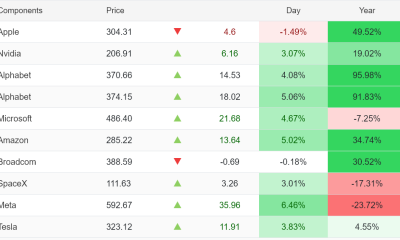
US Tech Stocks See Largest 5-Week Inflow in History: Can Nasdaq Break Its Downtrend?
-
 NewsBeat6 days ago
Tourist plane on sightseeing flight in Peru crashes into a field, killing all 13 people on board
-

 NewsBeat6 days ago
Arsenal reach full agreement with Newcastle over Bruno Guimaraes transfer | Football
You must be logged in to post a comment Login