
Crypto World
Crypto’s Biggest Business Models Start Resembling Traditional Banking


This week’s most consequential crypto business headlines point to a clear trend: parts of the industry are increasingly built around the same revenue engines that power traditional finance—interest income, reserve management, and tokenized assets that sit closer to money markets than speculative trading.
BlackRock is expanding into tokenized reserve products for stablecoin issuers, Tether reported $1.5 billion in second-quarter net operating profit supported by US Treasury earnings, tokenized gold saw resilient collateral behavior during a sharp sell-off even as DeFi usage stayed thin, and American Bitcoin—linked to the Trump family—reported record mining output alongside improving losses.
Key takeaways
- BlackRock introduced two tokenized money market products aimed at stablecoin issuers looking to satisfy reserve requirements under the US GENIUS Act.
- Tokenized gold trading volumes rose, but only a small fraction of tokenized gold supply is used as DeFi collateral on Aave v3 and Morpho.
- American Bitcoin reported record Q2 production of 932 BTC and narrowed its net loss, though the miner remains unprofitable.
- Tether’s Q2 profit of $1.5 billion was driven largely by interest from US Treasury holdings and repurchase agreements, alongside a reported reserve surplus of $4.11 billion.
BlackRock moves deeper into onchain reserve infrastructure
Asset manager BlackRock launched two tokenized money market products intended to help stablecoin issuers meet reserve expectations following the US GENIUS Act, according to earlier coverage from Cointelegraph (BlackRock launches tokenized money-market funds for stablecoin reserves).
One product tokenizes shares of BlackRock’s existing Treasury liquidity strategy on Ethereum. Approved investors can transfer token ownership onchain, while the underlying assets remain allocated to cash and short-term US government securities. The design targets a practical split: onchain settlement for ownership, with traditional cash/T-bill-style instruments supporting the fund’s economics.
The second is a new institutional money market vehicle built for digital asset markets. It supports multiple blockchains and automatically reinvests income, positioning it as a reserve-management tool for issuers that need operational continuity rather than one-off tokenization use.
BlackRock also already operates BUIDL, described in the Cointelegraph report as the industry’s largest tokenized Treasury fund. This matters for investors and issuers because it signals that tokenized Treasuries are moving beyond isolated pilot offerings and into broader “plumbing” for stablecoin ecosystems—particularly as regulatory frameworks such as GENIUS are intended to formalize payment stablecoins.
Tokenized gold: resilience in stress, but DeFi adoption lags
A RedStone report found that tokenized bullion held up during gold’s sharp sell-off, but the same analysis pointed to a persistent adoption gap for tokenized real-world assets in DeFi lending. Cointelegraph previously summarized RedStone’s findings in Tokenized gold’s DeFi footprint remains small despite gold’s sell-off.
According to the report, spot trading volume hit $90.7 billion in Q1 as gold futures rallied above $5,600 per troy ounce. Yet only about $63 million of Tether Gold and PAX Gold together was used as collateral on Aave v3 and Morpho, representing roughly 1.5% of their combined $4.2 billion market cap—suggesting that liquidity growth has not translated into proportional use in onchain lending.
Still, the collateral experience during drawdowns was notable. On March 23, Aave processed its largest cluster of XAUT liquidations without disruption after gold fell about 10% in a week, described by JPMorgan’s Greg Shearer as an “extremely brutal flush” in the Cointelegraph coverage. RedStone’s takeaway was essentially twofold: tokenized gold appeared operationally resilient under stress, but the broader DeFi “rail” for tokenized bullion remains underutilized as the tokenized RWA sector scales.
Cointelegraph notes that gold futures later declined more than 20% from January peaks amid expectations of higher US interest rates, reinforcing that tokenized bullion remains sensitive to macro conditions—even if its onchain collateral mechanics can withstand volatility.
American Bitcoin posts record output while losses shrink
American Bitcoin, a Nasdaq-listed miner co-founded by Eric Trump and Donald Trump Jr. and described as Trump family-linked, reported record second-quarter production of 932 BTC, according to Cointelegraph’s earlier report (Trump-linked American Bitcoin posts record output, narrower Q2 losses).
The output helped lift mining revenue by 8% to $67 million in Q2 from $62.1 million in the first quarter. The company posted a net loss of $57.2 million, improving from an $81.8 million loss in Q1—an incremental improvement that matters because miners often operate with slim margins tied to both hash economics and power costs.
American Bitcoin previously completed a 1-for-15 reverse stock split to maintain its Nasdaq listing after its share price fell below the exchange’s minimum bid requirement, as Cointelegraph reported. The miner was majority-owned by Hut 8 and held roughly 8,002 BTC as of June 30, while also pledging about 3,090 BTC as collateral under equipment purchase agreements with Bitmain.
Even with record production and higher revenue, the company remains unprofitable. Cointelegraph highlights two ongoing risk dimensions for shareholders: continued operating losses and balance-sheet exposure to Bitcoin price moves, given the pledged BTC collateral tied to equipment arrangements.
Tether’s Treasury income keeps profits elevated
Tether generated $1.5 billion in net operating profit in the second quarter, primarily driven by interest earned on its US Treasury holdings and repurchase agreements, based on its latest quarterly attestation, per Cointelegraph (Tether posts $1.5 billion Q2 profit as US Treasury income boosts reserves).
In the attestation, Tether reported a reserve buffer of $4.11 billion as of June 30, with assets exceeding liabilities by that amount. That reserve surplus and the profit figure come at a time when the broader stablecoin market has contracted, but USDT circulating supply still rose by $446 million to $184.6 billion. The same Cointelegraph coverage states that USDT continues to represent more than 60% of the global stablecoin market, which DeFiLlama valued at roughly $307 billion.
Tether’s earnings model continues to benefit from elevated short-term interest rates, which increases income from Treasury bills and cash equivalents. However, the article also notes that stronger profits arrive amid sector-wide pressure and a weaker stablecoin market—conditions that could limit growth if rate conditions change or contraction deepens.
For readers tracking the durability of stablecoin issuers, the key takeaway is not just the profit headline, but the mechanism: Tether remains one of the largest holders of US Treasury securities, so its resilience is closely linked to the yield environment and its ability to maintain reserve buffers through shifting market conditions.
The common thread across these updates is how financial infrastructure is taking center stage—tokenized Treasuries and money-market structures for reserves, real-world collateral behavior under stress, mining operations shaped by balance sheets, and stablecoin profitability tied to interest rates. The next thing to watch is whether onchain reserve tools and tokenized RWA collateral keep expanding in DeFi and regulated stablecoin contexts, or whether adoption remains concentrated despite improving product design.

Attackers emptied Lightning nodes belonging to BTCPay Server users on Friday, including one run by hardware wallet maker Foundation, after the self-hosted bitcoin payment processor warned that a critical vulnerability was being actively exploited and told merchants to update to version 2.4.2 or… Read the full story at The Defiant

It goes without saying that California can’t replace the federal government. But as the largest and most economically prosperous state in the country, its position is consequential. As companies try to parse the signal from the noise and determine the future of climate policy and demand for clean technologies, the federal government is just one indicator. Leaders now need to interpret a range of signals from governments moving in different directions. And California makes the case better than any other state that climate policy will continue in the U.S.
“You have a federal government that’s really trying to send market signals away from this,” Wade Crowfoot, California Natural Resources Secretary, told me last fall. “But you also have the rest of the world moving in this direction, as well as a bunch of American states.”
There was never any question from the outset of the second Trump Administration that it would take a hostile approach to states with aggressive climate policy. Almost immediately, the administration pulled back climate funding that had been directed to states. And it successfully pursued a reversal of the federal waivers that allowed California to enforce its own vehicle emissions standard.

Until now, that meant finding a lab that conducts the test and waiting days for the results. Soon, you”ll be able to do it yourself at home. LymeAlert is the first at-home test for ticks that can detect whether they carry the bacterium Borrelia berdorferi that causes Lyme. To test your tick, you place it in the kit’s container, drop in the included solution, put on the lid, crush the tick by twisting the top and grinding it up, and insert a test strip. Within 30 minutes, the strip tells you whether it detected any Lyme-causing bacteria in your tick. The kit is available for $49.99 to pre-order on the company’s website and will ship at the end of August.


Cointelegraph is committed to providing independent, high-quality journalism across the crypto, blockchain, AI, and fintech industries.
All news, reviews, and analyses are produced with full journalistic independence and integrity. For more details on our standards and processes, please read our Editorial Policy.
Crypto World
How and When You Can Watch August’s Stunning Partial Solar Eclipse From the U.K. and Ireland

“The moon is always moving, the Earth is always moving, so there’s never a long period of time where the two are able to cross paths exactly, but periodically it does happen, and that’s why you end up with this eclipse,” says Muller.
Earth is ideally placed in relation to the moon and the sun in order for the two to completely overlap during a total eclipse. “It just so happens that our moon is 400 times smaller than the sun, and also 400 times closer to us than the sun,” says Muller.
Will the solar eclipse be visible from the U.K. and Ireland?
Yes, not in totality, but people will be treated to a spectacular partial eclipse.
In fact, this is set to be the best solar eclipse visible from the U.K. and Ireland so far this century, according to Royal Museums Greenwich.
It will “almost look like there’s a crescent of the sun left behind, the rest will be blocked by the moon,” says Muller.
After the eclipse, there is also an opportunity to observe the Perseid meteor shower on the same night. As the peak of the meteor shower occurs during a new moon, conditions are ideal for seeing the peak, notes Royal Museums Greenwich.
HTX has been hit with sanctions from the European Union and the United Kingdom’s Foreign Commonwealth & Development Office.
In the wake of these measures, TRM Labs highlighted that HTX had started rapidly rotating through addresses on-chain, making it harder to identify its holdings.
This problem was compounded by HTX choosing to change its proof-of-reserves, obscuring the location of its reserves in a new “ThirdParty” category that’s supposed to describe funds held at third-party custodians.
HTX claims that users can still verify the funds by reaching out to the custodians in question, but HTX has failed to respond to our requests for the identity of that custodian.
Read more: HTX moved $1.3 billion from reserves to undisclosed ‘ThirdParty’
Before these transitions, HTX published a proof-of-reserves that contained a variety of addresses.
Protos has attempted to track the stETH in one of those addresses to its final destination and believes that this path may revealing something about how HTX has been functioning.
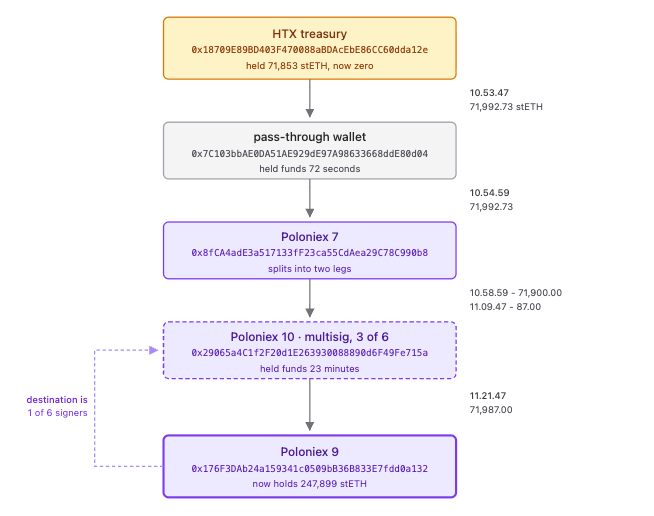
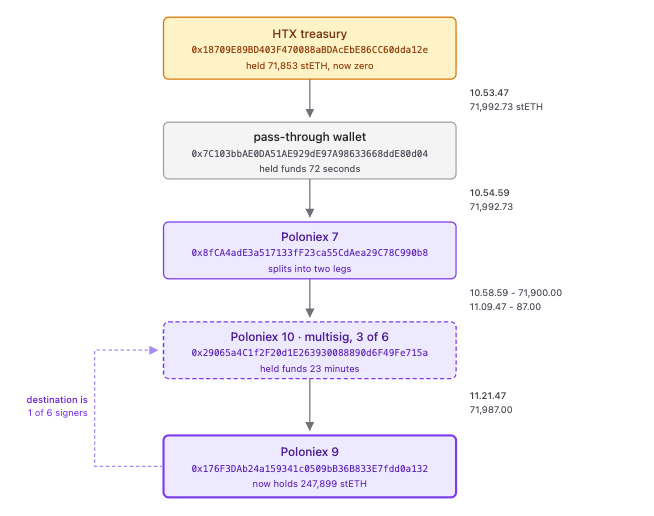
Let’s start with the May 1 proof of reserves, which noted there were 71,853.22 stETH, at today’s price worth about $135 million, in the address 0x18709e89bd403f470088abdacebe86cc60dda12e.
On May 30, shortly before HTX was due to generate its June proof-of-reserves where funds were moved to “ThirdParty,” these funds were moved to 0x7C103bbAE0DA51AE929dE97A98633668ddE80d04.
Moments later, they were transferred to 0x8fCA4adE3a517133fF23ca55CdAea29C78C990b8, an address labeled on Etherscan as Poloniex 7.
Shortly after, they were transferred again to 0x29065a4C1f2F20d1E263930088890d6F49Fe715a, an address that Etherscan labels as Poloniex 10.
Finally, moments later, they were transferred to 0x176F3DAb24a159341c0509bB36B833E7fdd0a132, an address labeled on Etherscan as Poloniex 9.
This address, 0x176F3DAb24a159341c0509bB36B833E7fdd0a132, used to be labeled as “Justin Sun 4” on Etherscan before being listed as a Poloniex address.
This pattern of transactions shows a large quantity of funds moving from HTX to a Poloniex address where they have been commingled with the Poloniex reserves.
Read more: Poloniex and the $1.3B bitcoin question
The wrapped BTC wrinkle
This isn’t the first time that HTX has relied heavily on Poloniex to hold certain assets.
Often, more than half the BTC held at HTX has been in a tokenized form, specifically a tokenized form that seemed to be held by Poloniex.
This often represented hundreds of millions of dollars worth of value.
Poloniex was unwilling to disclose the addresses where it presumably (hopefully) holds that BTC to Protos.
Got a tip? Send us an email securely via Protos Leaks. For more informed news and investigations, follow us on X, Bluesky, and Google News, or subscribe to our YouTube channel.


The CLARITY Act’s delay until September could briefly pressure crypto prices before removing a major source of uncertainty, according to Bitwise CIO Matt Hougan.
Summary
- Senate leaders delayed the CLARITY Act vote until September after bipartisan negotiations failed to produce an agreement.
- Bitwise CIO Matt Hougan expects crypto markets to “wobble for a minute” as traders price in the setback.
- Polymarket odds of passage in 2026 could fall into the teens, Hougan said.
- Disputes over ethics, illicit finance and stablecoin rewards remain unresolved.
What happened
Senate leaders have postponed consideration of the CLARITY Act until September, ending efforts to advance the crypto market structure bill before the August recess.
Senate Majority Leader John Thune confirmed that the chamber would not vote on the legislation before lawmakers left Washington. He said the bill would be prepared for consideration after senators return.
The delay followed several days without a cloture filing, the procedural step needed to limit debate and move toward a floor vote. As reported by crypto.news, Thune filed cloture on spending legislation, nominations and a college sports bill but not the CLARITY Act.
Bitwise Chief Investment Officer Matt Hougan said the delay could produce a brief negative market reaction as traders adjust their expectations.
“If the Polymarket odds break solidly lower into the teens at least so we can put the uncertainty behind us,” Hougan wrote.
Hougan said crypto prices could “wobble for a minute” before the market potentially recovers during the fall.
Why the CLARITY Act delay matters
The CLARITY Act would establish a federal market structure for digital assets and divide oversight responsibilities between the Securities and Exchange Commission and the Commodity Futures Trading Commission.
For U.S. crypto companies and investors, the bill could replace parts of the current enforcement-led system with statutory rules covering token classifications, trading platforms and digital-asset intermediaries.
However, Republicans need Democratic support to advance it. The Senate’s cloture threshold requires 60 votes, while Republicans hold 53 seats. That means at least seven Democrats must support the procedural motion if every Republican votes in favor.
Negotiations have focused on ethics restrictions for elected officials and their families, illicit-finance safeguards, stablecoin rewards and protections for noncustodial software developers.
Sen. Cynthia Lummis said lawmakers had spent 11 months working on the legislation and continued negotiating daily. Crypto.news reported that Lummis had pushed for a vote before the recess but acknowledged that several provisions remained unresolved.
Sen. Elizabeth Warren also said she supports passing crypto legislation but opposes the current CLARITY Act. She cited concerns involving political conflicts of interest, consumer protection, national security and financial stability.
Crypto market reaction remains limited
Crypto prices showed no immediate broad sell-off following the delay. Bitcoin remained above $64,400, while Ethereum held above $1,900 and XRP traded near $1.05 at the time covered by the initial report.
Prediction markets had already priced in much of the legislative risk before Thune confirmed the postponement. Polymarket’s probability of the bill becoming law in 2026 fell from above 70% earlier in the year to around 17% as the recess approached.
That decline followed repeated Senate scheduling setbacks. Crypto.news previously reported that the bill was absent from the Aug. 4 floor schedule, while no cloture motion had been filed.
Hougan’s comments suggest another drop into the teens could bring a final repricing of the near-term legislative outlook. His view differs from a warning issued earlier in the week by Bernstein, which said a failed vote or delay could trigger another crypto sell-off before a later recovery.
What Comes Next for the CLARITY Act
Senators are expected to continue negotiating during the August recess before returning in September.
Thune has said the bill will be placed near the top of the Senate agenda, but lawmakers must still reach a bipartisan agreement, file cloture and secure 60 votes before beginning full consideration.
The Senate could also amend the House-passed version. Any changes would require the House to approve the revised text before the bill could reach President Donald Trump.
A crowded September calendar and the approaching midterm elections leave lawmakers with a narrower window. Until a bipartisan deal or cloture filing emerges, passage in 2026 will remain uncertain.
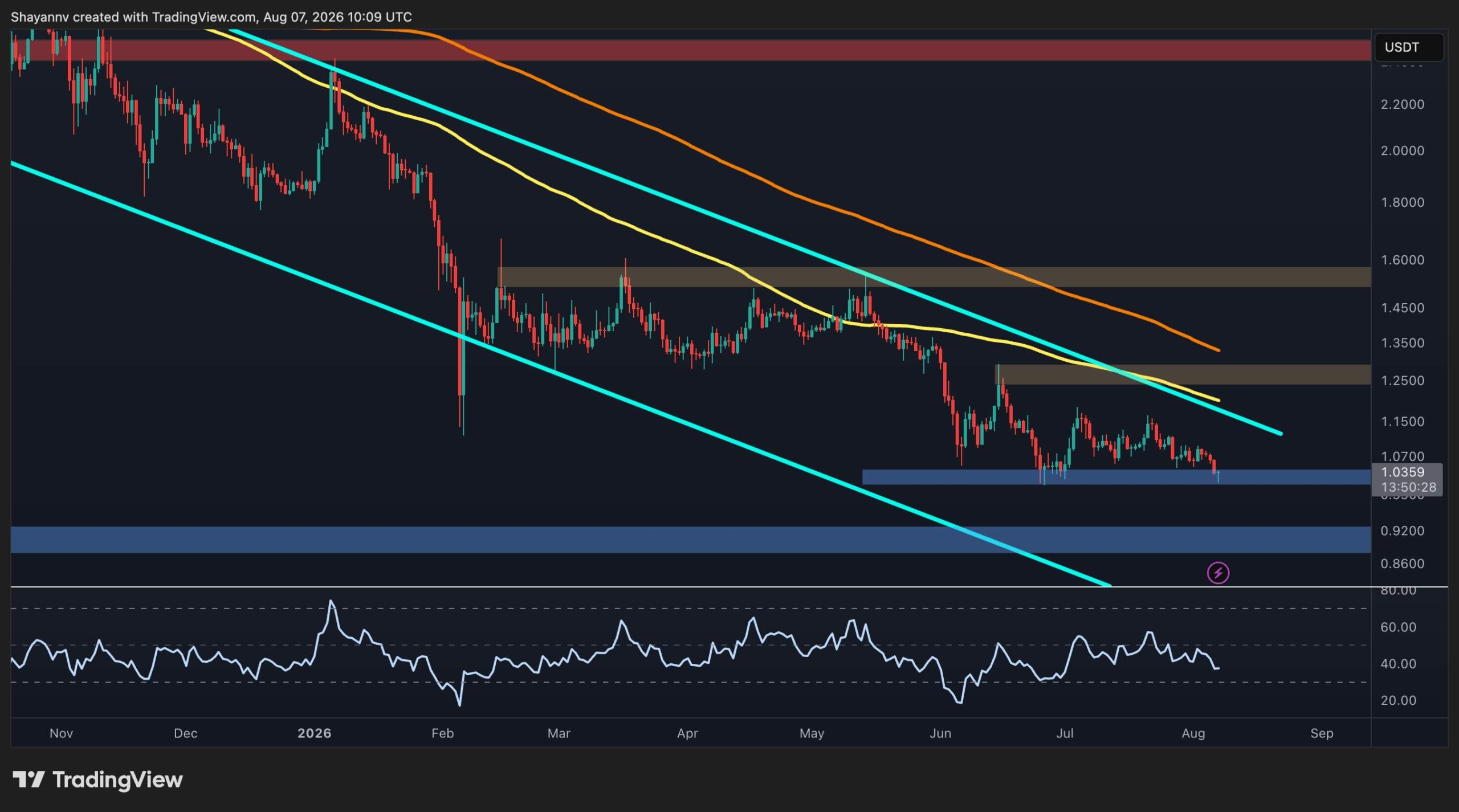
XRP remains under sustained selling pressure against both USDT and BTC, with the higher time frame structure continuing to favor the bears. The latest breakdown below the key horizontal support reinforces the prevailing downtrend and leaves the market vulnerable to another leg lower unless buyers quickly reclaim the lost levels.
Ripple Price Analysis: The USDT Pair
On the XRP/USDT chart, the price continues to trade inside a well-defined descending channel while remaining below the 100-day and 200-day moving averages. The 100-day MA has acted as a close dynamic resistance throughout the decline, while the 200-day MA continues to trend lower well above the current price, highlighting the weakness in the broader trend.
A potential breakdown of the $1-$1.05 support zone marks an important bearish development. This area has repeatedly attracted buyers over the past several weeks, but a breakdown would suggest demand is fading. If XRP breaks below this level, sellers will be in even more control.
The next major support sits around the $0.90 region, which should be defended at all costs. On the upside, the first resistance is the $1.25 zone, which is located between the key moving averages and just above the descending channel’s upper boundary. The broader resistance remains around $1.50, where previous distribution occurred.
Meanwhile, momentum also favors the sellers. The RSI has dropped toward the lower portion of its range without yet showing a convincing bullish divergence, suggesting downside momentum remains dominant despite approaching oversold territory.
The BTC Pair
The XRP/BTC pair paints an even weaker picture. The price has broken below the critical horizontal support around 1,700 sats, confirming a continuation of the prevailing downtrend after several weeks of sideways consolidation. The failed attempts to reclaim this level indicate that previous support has now turned into resistance.
The pair also remains below all major moving averages, with the 100-day average trading beneath the longer-term one, reinforcing the bearish market structure. Meanwhile, the asset continues to respect the descending channel that has guided the decline for several months.
The next area of interest is the lower support zone around 1,500 sats, which also coincides with the lower boundary of the descending channel. This region could attract buying interest, but a failure to hold it would be disastrous and further aggravate the bear market.
On the other hand, to improve the technical outlook, XRP would first need to reclaim the 1,700 sats level before challenging the 1,850 sats resistance zone. A stronger trend reversal would only become more likely if buyers also break above the descending channel resistance and push beyond the cluster of moving averages, which currently remain well overhead.
Overall, both XRP/USDT and XRP/BTC continue to display bearish market structures. While the price is approaching notable support areas that could trigger a short-term relief bounce, the broader trend remains negative until XRP begins reclaiming key horizontal levels and breaks above its long-term descending resistance.

The post Ripple Price Analysis: How Low Can XRP Go if It Loses $1 Support This Weekend? appeared first on CryptoPotato.

Ethereum has been hovering near the $1,900 level after climbing almost 9% over the past month, but it is still far below its previous all-time high.
New data suggests the crypto asset is building a strong long-term setup, as technical signals and institutional demand continue to support the broader outlook.
Multiple Bullish Signals
Analyst Crypto Patel said that the leading altcoin is showing one of its strongest high-timeframe bullish structures. After several failed attempts, ETH has reclaimed its long-term descending trendline and is now consolidating above it. According to the analyst, the structure remains valid as long as it records daily closes above $1,510.
Based on the technical analysis, upside targets of $2,400, $3,000, $3,600, $4,200, and $5,000 were identified, with the final target potentially pushing ETH toward a new all-time high. Crypto Patel added that breakouts typically follow periods of accumulation.
Another bullish signal came from the MVRV Momentum golden cross, according to Ali Martinez. The analyst said that a move toward $3,000 could be on the cards after the altcoin broke above the MVRV level near $1,800. He explained that similar golden cross signals in the past were followed by major rallies.
While analysts have different short-term targets, they broadly agree that the structure is improving. Michaël van de Poppe also sees more upside for Ethereum. According to the MN Fund founder, a breakout appears to be a matter of time, with ETH potentially moving toward the $2,300-$2,500 range.
Strong Treasury Demand
Beyond price action, corporate treasuries have overtaken exchange-traded funds (ETFs) as the biggest buyers of Ethereum. The analyst also found that nearly 11% of the asset’s total supply is already locked by ETFs and digital asset treasury (DAT) companies. This growing share of ETH held by these entities points to rising institutional participation in the market.
For instance, Bitmine Immersion kept up its aggressive buying streak last week and added another 10,399 ETH to its treasury. The purchase lifted the company’s holdings to nearly 5.8 million units, which is around 4.8% of Ethereum’s circulating supply. It follows a similar purchase of 9,946 units a week earlier. Bitmine Chairman Tom Lee claimed that the crypto outperformed the Nasdaq 100 by 25 percentage points in July.
Earlier this week, Italy’s largest banking group, Intesa Sanpaolo, boosted its Ethereum exposure in the second quarter by significantly increasing its position in a staked ETH ETF from 116,200 shares to 349,600.
The post Ethereum’s $5,000 Path? ETH Reclaims a Key Level as Institutions Keep Accumulating appeared first on CryptoPotato.


Circle Internet Group, the issuer of the USDC stablecoin, has acquired fundamental assets from IBM's blockchain patent portfolio, the company said in a press release dated July 27. The portfolio comprises over 680 patent families and nearly 1,000 issued patents worldwide, spanning foundational… Read the full story at The Defiant

Public Comment Closes For Federal Plans Along the Outer Continental Shelf

Quantum Computing Stocks: D-Wave Earnings, Revenue Miss

Lightning Nodes Drained As BTCPay Server Users Race To Patch


-

 Politics7 days ago
Meta enters AI-training agreement with far-right ‘propaganda rag’ Newsmax
-

 Politics5 days ago
Zack Polanski: an incitement to murder Nigel Farage?
-

 Crypto World6 days ago
MicroStrategy Post-Earnings CLARITY Act Push Could Add New Catalyst for Its Stock
-

 Crypto World7 days ago
XRP Ledger v3.3.0 brings five institutional features
-

 Crypto World7 days ago
New York sues Kalshi over prediction market gambling
-

 Crypto World5 days ago
Crypto PAC spending tops $2M in Michigan House race
-

 Business5 days ago
DTCR: Deleveraging And A Hedge Fund Collapse Point To A Possible AI Bottom
-

 Tech6 days ago
ESET tracks rise in malicious AI skills and adaptable malware
-
 Crypto World7 days ago
3 Fed Officials Just Explained Their Rate Hike Vote: Is Inflation Winning?
-

 Sports6 days ago
France Cricket implodes: letters hidden in a drawer and a board at war
-
Crypto World5 days ago
XRP Ledger urges node upgrade after manifest flood
-

 Crypto World7 days ago
Moneyflip CEO charged in $40K murder-for-hire plot
-
 Sports7 days ago
Bruno Fernandes decision made as Man United ‘discuss’ striker transfer option
-
Business7 days ago
FIFA has scrapped $20 billion World Cup sell-off plan, New York Post reports
-

 News Videos6 days ago
Financial Crash Expert: The 90-Day Collapse Timeline They Are Desperately Hiding.
-

 Sports2 days ago
Jordan Coyle & Cordiamo take Laya Arena Stakes at RDS
-
 Crypto World4 days ago
US Tech Stocks See Largest 5-Week Inflow in History: Can Nasdaq Break Its Downtrend?
-
 NewsBeat6 days ago
Tourist plane on sightseeing flight in Peru crashes into a field, killing all 13 people on board
-

 NewsBeat6 days ago
Arsenal reach full agreement with Newcastle over Bruno Guimaraes transfer | Football
-
 NewsBeat6 days ago
Bikini-clad Jennifer Aniston, 57, kisses hypnotist boyfriend Jim Curtis as they enjoy a romantic getaway aboard a luxury yacht in Spain
You must be logged in to post a comment Login