
Crypto World
Fierce Backlash to Ethereum’s EIP-8363 Staking Proposal

Ethereum researchers just wanted to reduce staking incentives. Instead, they sparked one of the biggest debates over the network’s economics since the Merge.
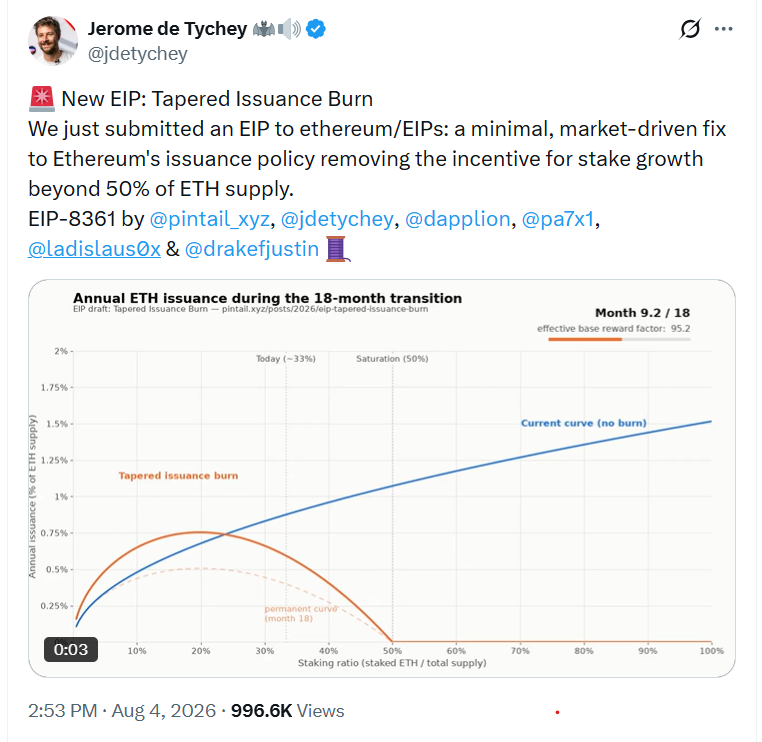
Ethereum Improvement Proposal EIP-8363, or “Tapered Issuance Burn,” would gradually reduce staking rewards as more and more Ether is locked up to secure the network — eventually cutting new protocol issuance to zero once 50% of ETH’s supply is staked.
Its authors, including Ethereum Foundation’s Justin Drake and Ethereum Community Conference (ETHCC) co-founder Jerome de Tychey, argue that Ethereum has reached the point where additional staking provides diminishing security returns, while diluting holders who choose not to stake.
In other words: Ethereum should stop paying for security it no longer needs.
There’s just one problem, a lot of people hate the idea.
From DeFi builders to staking providers and institutional investors, critics argue it could weaken decentralization, disrupt Ethereum’s lending markets and undermine confidence in the network’s monetary policy. As Ether.fi founder Mike Silagadze puts it:
“This is so disappointing on every level. […] This is bad for decentralization, this is bad for Ethereum adoption, and this is bad for the credibility of the network.”
Dr. Steve Berryman, Bitwise’s head of client partnerships for Ethereum, tells Magazine:
“Institutional adoption requires certainty and playing with the issuance at the margin would cause uncertainty and institutions hate uncertainty.”
So is Ethereum really paying too much for security, or is EIP-8368 a solution in search of a problem?
Is Ethereum over-staked?
Ethereum currently has around 41.5 million ETH staked, earning 2.67%, and representing 34.07% of the entire supply, according to the Ethereum Validator Queue.
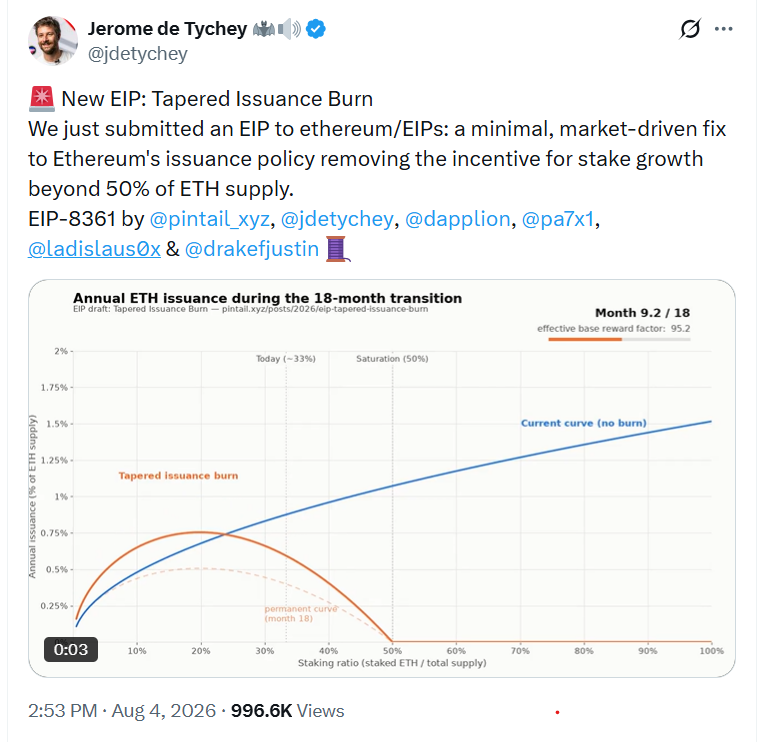
EIP-8363, Tapered Issuance Burn. Source: Jerome de Tychey
While more ETH locked up generally makes the network harder to attack, EIP-8368’s authors argue those security gains become increasingly marginal while Ethereum continues issuing rewards to validators.
EIP-8363 would gradually remove that incentive, and the authors argue Ethereum should stop subsidizing additional staking once the network is sufficiently secure.
Yet not everyone agrees that the problem even exists in the first place. It’s certainly true that the amount staked has increased substantially in 2026, up 15% since the start of the year.
Berryman argues that market forces are already slowing participation without the need to change Ethereum’s issuance policy.
“We will come to a natural ceiling probably by the end of this year,” he says, arguing that yields falling to around 2% are unlikely to attract significantly more ETH to be locked up in staking. “People need a certain amount of liquidity,” he says.
Related: Ethereum Foundation adds SEAL 911 co-founder to board as privacy focus grows
Berryman says recent growth has largely been driven by institutional entrants such as Bitmine and BlackRock, but argues that once those players complete their staking allocations, participation is likely to plateau again.
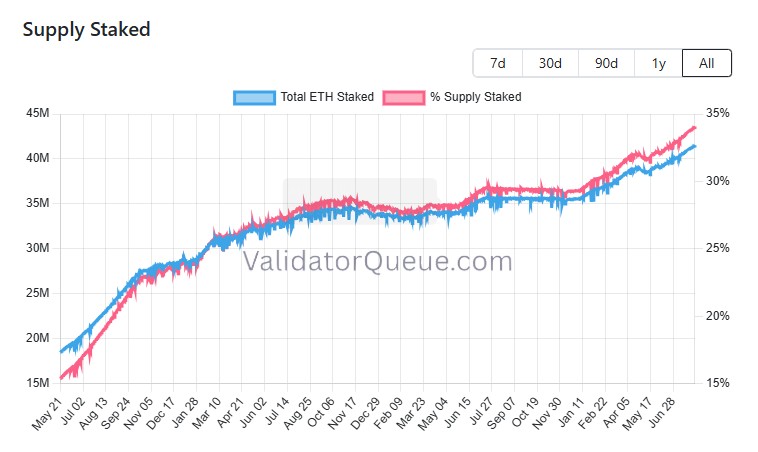
Source: Validatorqueue.com
Ethereum commentator Leo Lanza, who also opposes the proposal, challenges the core assumption that issuance on Ethereum represents a meaningful “stealth tax” on non-stakers.
Ethereum’s annual inflation remains below 1%, he says, arguing that even gold, widely viewed as the world’s premier monetary asset, expands its supply by roughly 1% to 2% annually:
“The free market already solves this […] Let the market adjust.”
Could the cure be worse than the disease?
Supporters of EIP-8368 argue the change would curb unnecessary issuance and discourage staking from becoming overly concentrated among large custodians and liquid staking providers. But critics say the proposal risks creating bigger problems than it’s trying to solve.
Greg Koumoutsos, technical research lead at the Lido Labs Foundation, says today’s staking ratio of around one-third of ETH supply does not appear unhealthy, though he agrees it is reasonable to think proactively about excessive staking.
More importantly, he argues the proposal oversimplifies what Ethereum’s issuance is actually paying for:
“Ethereum is not only paying for slashable ETH; it is paying for decentralization, operator diversity, censorship resistance, and network resilience.”
Koumoutsos says lower issuance is not automatically a better security policy unless those broader trade-offs are also taken into account.
Another factor to consider is that liquid staking is now deeply integrated into Ethereum’s DeFi ecosystem, and staking derivatives are widely used as collateral and in lending and yield strategies.
“It will obviously kill a huge chunk of DeFi which is built around the staking ecosystem,” Silagadze argues.
Stani Kulechov, founder of Aave, Ethereum’s largest decentralized lending protocol, says that reducing staking rewards risks undermining that broader ecosystem.
“My concern is… those who are fine with ETH beta and yield might also sell ETH for other yielding assets […] Ethereum should not be punished for its growth.”
Related: Ethereum, Solana led crypto hack losses in H1 2026: Blockaid
Smaller validators will bear the cost
Another concern with the proposal is that lowering staking rewards could actually increase concentration among the largest participants.
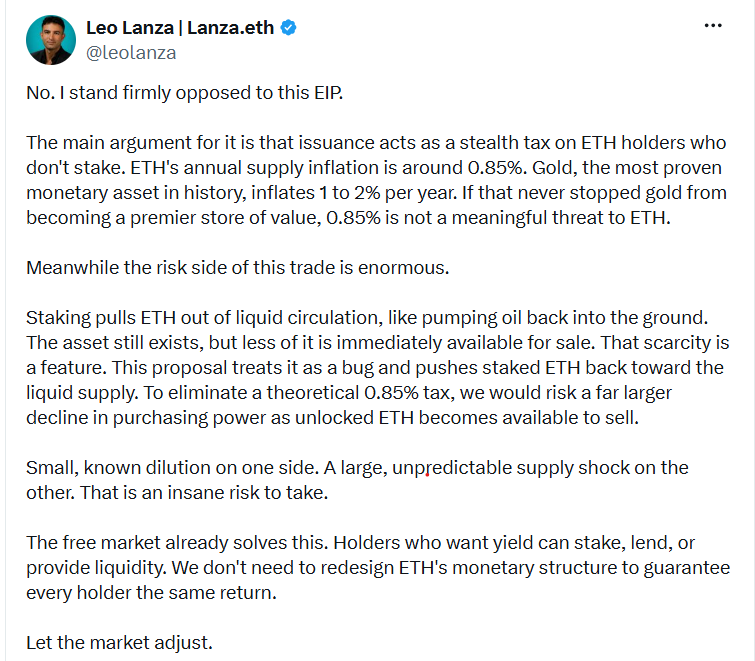
“I stand firmly opposed to this EIP.” Source: Leo Lanza
That’s because independent validators do not benefit from the economies of scale that larger staking businesses, exchanges or institutional operators do. Lower protocol rewards could make solo staking uneconomical while larger organizations continue operating. Koumoutsos says:
“A solo validator has real costs: some ideological solo stakers may remain, but many marginal solo validators will not, and fewer new ones will enter, if any.”
He adds that centralized platforms also stake for reasons beyond yield, such as customer retention, regulatory positioning and product integration, which makes them less likely to reduce their participation.
Koumoutsos also warns that even within delegated staking, lower rewards could favor centralized custodial products over onchain staking protocols, which face higher maintenance, governance and upgrade costs.
A debate over more than staking
Supporters say lower issuance would strengthen Ether’s long-term monetary profile. But critics argue that continually adjusting Ethereum’s monetary policy undermines its claims to be predictable and reliable.
Berryman argues institutions value predictability more than marginally higher yields, and that changing the curve creates yield governance risk. “Institutional investors will price accordingly,” he says.
He also says institutions value staking not because the yield is especially high, but because it provides a predictable return while they hold ETH:
“It’s not broken, why try and fix it?”
Silagadze agrees, saying, “Any nation state or large institution looking at this will justifiably have a dramatic loss of confidence in the governance and stability of Ethereum.”
The proposal’s rollout also drew criticism for being published just two days before the Aug. 6 deadline for proposals to be considered for the next Ethereum network upgrade.
Silagadze says that a change with “far reaching implications for all of DeFi” should not have been published on such a short timeline.
The fierce backlash has shown how difficult it has become to change Ethereum’s economics, especially when every adjustment creates winners and losers across staking, DeFi and institutional markets.
Magazine: Ethereum’s much-hated staking ‘tax’ may already be obsolete
Cointelegraph publishes long-form journalism, analysis and narrative reporting produced by Cointelegraph’s in-house editorial team with subject-matter expertise. All articles are edited and reviewed by Cointelegraph editors in line with our editorial standards. Some articles contain affiliate links, from which Cointelegraph may earn a commission. These relationships do not influence which products we review or our editorial conclusions. Content published in here does not constitute financial, legal or investment advice. Readers should conduct their own research and consult qualified professionals where appropriate. Cointelegraph maintains full editorial independence.

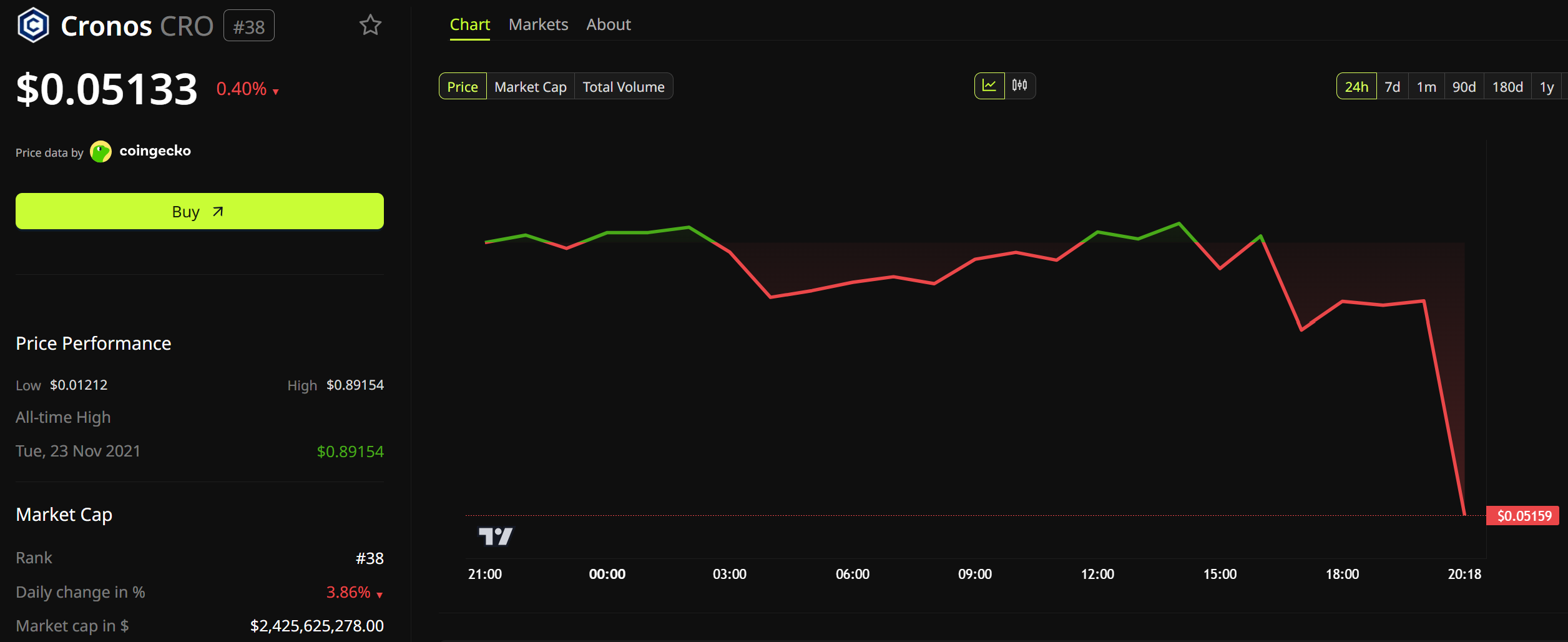
Trump Media and Technology Group has reportedly terminated its planned Cronos (CRO) treasury venture with Crypto.com and Yorkville Acquisition Corp. The companies also abandoned a related services agreement and a set of digital asset products.
Interim CEO Kevin McGurn told Axios on Friday that the crypto deals ended because the treasury sector became saturated. Trump Media will instead concentrate on Truth Social, data licensing, and its pending merger with fusion energy company TAE.
Why the Trump Media Crypto Deals Collapsed
The venture, announced last year, would have licensed the Trump Media brand. The resulting company was built around Crypto.com’s Cronos blockchain and its CRO token. At launch, the partners billed it as the first and largest publicly traded CRO treasury firm.
Yorkville Acquisition Corp, a blank-check vehicle created to take the venture public, agreed to the termination as well. However, Yorkville America’s America First ETFs, branded as Truth Social Funds, will keep operating.
The retreat also follows a bruising start to the year, when crypto markdowns drove a $406 million quarterly loss. McGurn said saturation among treasury companies, rather than regulatory pressure, drove the decision.
“We wanted to get focused,” Axios reported, citing McGurn.
Follow us on X to get the latest news as it happens
He added that staking CRO has become less central for Crypto.com, making a split logical for both sides. Meanwhile, CRO traded near $0.0513 on Friday, down 0.4% over 24 hours, according to BeInCrypto Markets data.

The token holds a market capitalization of roughly $2.4 billion, ranking 38th overall.
Prediction Markets Give Way to Data Licensing
Separately, the companies scaled back plans to embed betting features inside Truth Social. Trump Media had unveiled Truth Predict prediction markets, powered by Crypto.com Derivatives North America, last October.
The partners will now pursue a marketing arrangement that promotes Crypto.com’s prediction products to Truth Social users. McGurn argued that established operators already crowd that space, so running back-end infrastructure offered little return. He sees Trump Media as a distribution and data partner instead of a market operator.
That data push is already visible. The company’s Truth Social API business, an application programming interface (API) that sells platform data, now serves about 10 customers, up from roughly five. Most are high-frequency trading firms that feed the data into algorithmic strategies. McGurn said the firm is also courting large language model developers and prediction market platforms.
McGurn expects the TAE merger to close before year-end. Whether a slimmer Trump Media can turn Truth Social’s audience and data into durable revenue may become clearer once that deal lands.
The post Trump Media Pulls Back From Crypto Deals Under Interim CEO McGurn appeared first on BeInCrypto.
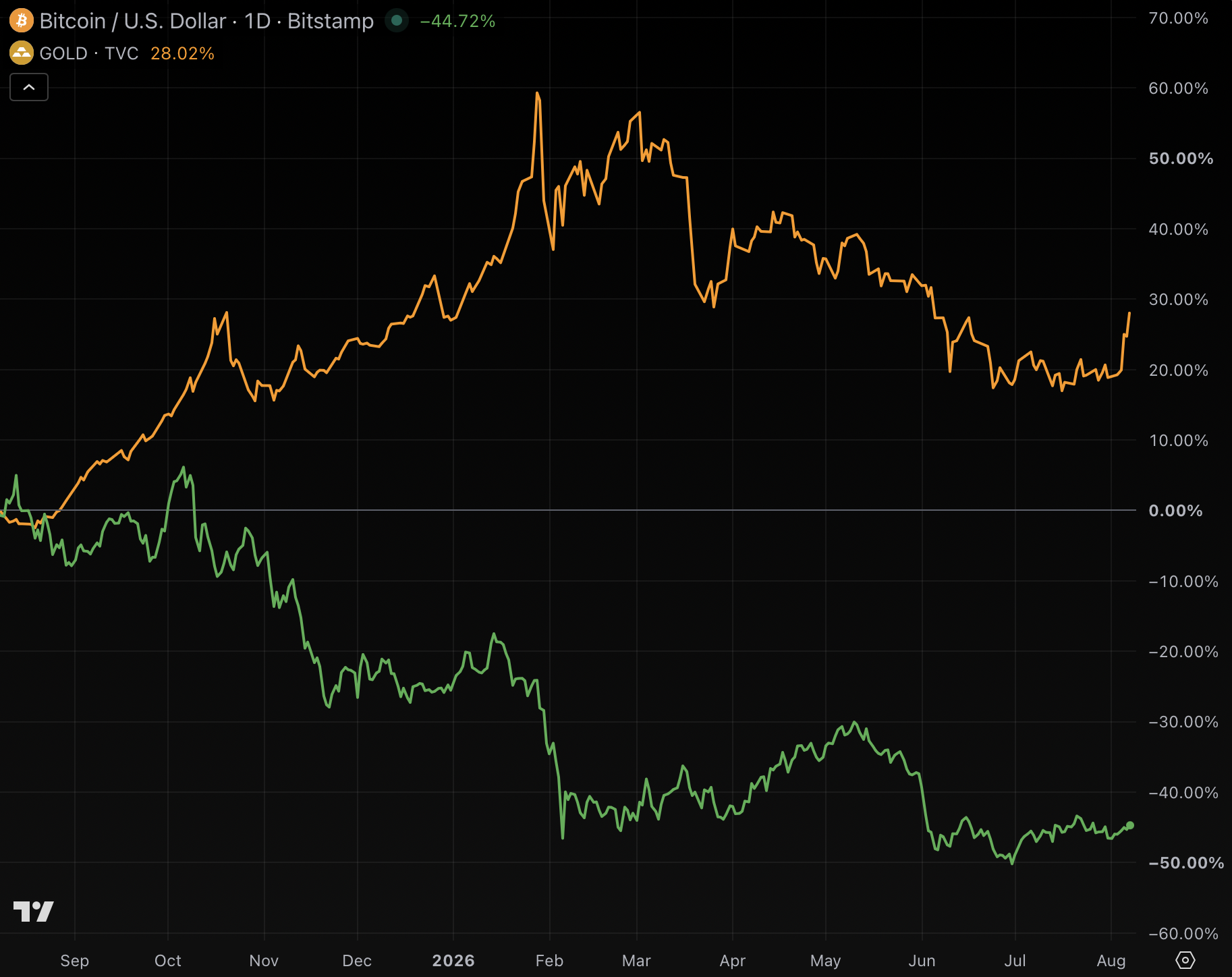
Gold has rallied 28% over the past year from $3,400 to $4,330, outperforming digital rival BTC by over 70 percentage points.
Over the same time period, BTC has suffered an embarrassing 44% decline from $117,000 to $65,000.
In fact, across the past three years, owning so-called “digital gold” instead of the real thing would have returned a couple fewer percentage points despite 36 months of patience.
BTC has crashed off a financial peak, not just a psychological one. It hit an all-time high near $126,200 on October 6, 2025 but has since declined 48%.
Gold achieved its own record shortly after. Spot prices surged to $5,589 per ounce on January 28, 2026, a nominal high that also sat well above the metal’s inflation-adjusted 1980 peak.
The precious metal has since pulled back from that spike, but it never came close to giving up its year-over-year gain. BTC, in stark contrast, halved.
Boomer gold beats BTC
Evangelists have spent a decade comparing BTC to a global store of value. Its performance over the past few years has certainly stalled that pitch.
The comparison is nowhere close to a financial reality over the past year. Indeed, a dollar saved in gold a year ago is worth about $1.28 today. A dollar saved in BTC is worth about $0.55.
The metal BTC was supposed to dethrone maintained its strength.
Read more: Every time Michael Saylor said he’d never sell bitcoin
Michael Burry wrote in February, “BTC has been exposed as a purely speculative asset, and is not near the debasement trade hedge that gold and other precious metals are.”
BTC traded near $77,000 that day, already down sharply from its October peak, and it’s fallen another 16% since.
Central banks didn’t sit the trade out. They added 863 tonnes of gold to sovereign reserves in 2025, a historically elevated total albeit a slower pace than the prior year.
None of those purchases flowed into BTC, whose loudest institutional champions had long argued central banks would eventually buy it in the same way.
Gold ETF investors reversed course too. Holdings swung from a small net outflow in 2024 to inflows of more than 800 tonnes in 2025, per the World Gold Council.
Crypto investors used to celebrate that type of demand shift when capital rotated into BTC ETFs, not gold ETFs.
While gold sat in vaults and preserved its value, the BTC community fractured. Michael Saylor’s Strategy sold BTC for the first time since 2022 while critics of Bitcoin Core v30 proposed a hard fork of the blockchain and a proof-of-work change.
Coldcard, the most popular BTC-only hardware wallet, experienced a catastrophic bug.
Read more: Bitcoin outperforms gold as Iran war shakes ‘safe-haven’ trade
As usual, there are two sides to every story. BTC has had shorter stretches and prior time periods when it outpaced its rival. Certainly since its formative years in the 2010s, BTC has far outperformed gold.
Nevertheless, over the past 12 and 36 months that matter most to anyone who bought either asset recently, gold hasn’t just beaten BTC but trounced it by 70 percentage points.
“Digital gold” now describes what BTC was supposed to be, not what it actually accomplished.
Got a tip? Send us an email securely via Protos Leaks. For more informed news and investigations, follow us on X, Bluesky, and Google News, or subscribe to our YouTube channel.

Bitcoin whales and sharks are continuing to increase their holdings as the cryptocurrency trades in the $63,000 to $65,000 range, according to the latest data from Santiment.
The accumulation trend has strengthened since its previous report earlier this week, which highlighted a surge in network activity driven by the impact of the Coldcard hardware wallet security incident.
Retail Dumps Holdings
At the time, Santiment reported that active Bitcoin addresses had climbed to a three-month high of 712,000 over the previous seven days, while transactions worth more than $100,000 reached a five-month high of 61,800. The firm said affected users rushed to move their funds and reorganize their wallets after the security breach, which ended up triggering a sharp increase in on-chain activity.
In its latest update, Santiment flagged a notable shift. While large holders have continued adding BTC to their wallets, micro holders are reducing their exposure at the fastest pace since December 2024. The Coldcard hack remains a major factor, as both the accumulation by whales and the selling by smaller investors began around the same period.
The uncertainty surrounding the CLARITY Act also contributed to the trend. Bitcoin’s ongoing period of sideways price action has discouraged retail participants, adding to the selling pressure from smaller wallets. It is this divergence between large and small holders that is becoming more pronounced, Santiment explained.
With key stakeholders steadily accumulating while retail investors continue to exit, the analytics platform said the odds of BTC climbing above $70,000 are increasing. This, in turn, makes that outcome more likely than a drop below the $60,000 level.
The Coldcard fallout was also evident in data from CoinMetrics, which recorded a temporary increase in BTC held on exchanges.
ETFs Stay in Positive Territory
On the institutional side, US-based spot Bitcoin ETFs have recorded four straight days of inflows. On 6th August, these funds attracted nearly $129 million. BlackRock’s IBIT led the numbers with $123 million in inflows, followed by Fidelity’s ETF with $11.2 million. Outflows came from VanEck’s HODL, which shed $32.7 million, and Valkyrie’s BRRR, which lost $9.07 million on the day. The remaining funds either posted smaller additions or ended the session unchanged.
The latest stretch of gains has pushed the monthly figures to almost $755 million.
The post Micro Bitcoin (BTC) Holders Are Vanishing at the Fastest Pace Since December 2024 appeared first on CryptoPotato.
U.S. authorities sanctioned crypto exchanges Shelbit and Aban Tether after alleging that the platforms helped Iran evade restrictions and move funds connected to the Islamic Revolutionary Guard Corps.
Summary
- OFAC sanctioned Shelbit, Aban Tether and Siavash Kayvanpour over alleged sanctions evasion.
- IRGC-linked wallets allegedly sent more than $1 million in crypto to Shelbit addresses.
- Shelbit addresses reportedly transferred over $2 million to wallets controlled by the IRGC.
- Kayvanpour-linked wallets allegedly sent more than $2 million to sanctioned exchange Nobitex.
OFAC targets Shelbit and Aban Tether
The U.S. Treasury Department’s Office of Foreign Assets Control announced the sanctions on Aug. 7 as part of Washington’s effort to disrupt Iran’s access to international financial markets.
OFAC accused Shelbit and Aban Tether of facilitating illicit cryptocurrency transactions and sanctions evasion. The agency said the Iranian government relied on exchanges with limited or no regulatory oversight to move digital assets through corporate networks and an online gambling operation.
The sanctions also cover Iranian national Siavash Kayvanpour and companies tied to him in Georgia, Poland and the United Arab Emirates. Treasury described Kayvanpour as the operator of a network of front companies connected to Shelbit.
IRGC-linked addresses sent more than $1 million in crypto to Shelbit, according to Treasury. Shelbit-linked wallets allegedly transferred more than $2 million to addresses controlled by the IRGC.
Wallets owned or controlled by Kayvanpour also sent over $2 million to Nobitex, Iran’s largest cryptocurrency exchange, Treasury said.
“Whether in dollars, rials, or crypto, Treasury will hunt down and dismantle the illicit financial networks that keep the regime afloat,” Treasury Secretary Scott Bessent said.
Aban Tether processed funds for sanctioned exchanges
OFAC separately accused Iran-based Aban Tether of processing millions of dollars in transactions involving entities already under U.S. sanctions.
Those entities included Nobitex, Wallex, Bitpin and Ramzinex. The four Iranian exchanges were sanctioned by the U.S. Treasury in June after officials accused them of helping restricted entities access digital asset markets.
Chainalysis estimated that Nobitex accounts for roughly half of Iran’s cryptocurrency trading activity. The exchange has denied having a direct relationship or contractual arrangement with the IRGC, Iran’s central bank or other government bodies.
Shelbit has also rejected claims that it knowingly participated in money laundering, terrorism financing or sanctions evasion. Its former management said the company stopped accepting new business in December 2025 and completed its customer wind-down in January.
The sanctions represent administrative designations rather than criminal convictions. However, they block property and interests in property belonging to designated parties when those assets enter U.S. jurisdiction.
US widens Iran crypto crackdown
The latest action expands a U.S. campaign targeting exchanges, wallet addresses and companies accused of helping Iran bypass restrictions during its military conflict with Washington.
In July, U.S. authorities froze $131 million in Iran-linked crypto held in wallets connected to the country’s central bank. That followed an April action in which Tether froze approximately $344 million in USDT across two Tron addresses linked by authorities to Iranian networks.
Bessent previously said the United States had seized or frozen nearly $1 billion in cryptocurrency connected to Iranian exchanges and wallets since the conflict began.
The use of centralized stablecoins gives authorities an enforcement tool that does not exist with assets such as Bitcoin. Issuers can block transfers from designated addresses, while transactions involving decentralized assets generally require control of the private keys.
What the sanctions mean for crypto firms
U.S. persons and companies are generally prohibited from providing funds, services or other economic benefits to the sanctioned exchanges and individuals. Entities owned at least 50% by one or more blocked parties are also covered, even when they are not named separately.
Foreign exchanges, stablecoin issuers and payment providers may also face secondary sanctions exposure if they knowingly process certain transactions involving the designated parties.
OFAC published several Bitcoin, Ethereum, Tron and Solana addresses as part of the action. Crypto companies will need to add those identifiers and the sanctioned entities to their transaction-screening systems as Washington continues tracing Iran-linked digital asset flows.


Attackers emptied Lightning nodes belonging to BTCPay Server users on Friday, including one run by hardware wallet maker Foundation, after the self-hosted bitcoin payment processor warned that a critical vulnerability was being actively exploited and told merchants to update to version 2.4.2 or… Read the full story at The Defiant

It goes without saying that California can’t replace the federal government. But as the largest and most economically prosperous state in the country, its position is consequential. As companies try to parse the signal from the noise and determine the future of climate policy and demand for clean technologies, the federal government is just one indicator. Leaders now need to interpret a range of signals from governments moving in different directions. And California makes the case better than any other state that climate policy will continue in the U.S.
“You have a federal government that’s really trying to send market signals away from this,” Wade Crowfoot, California Natural Resources Secretary, told me last fall. “But you also have the rest of the world moving in this direction, as well as a bunch of American states.”
There was never any question from the outset of the second Trump Administration that it would take a hostile approach to states with aggressive climate policy. Almost immediately, the administration pulled back climate funding that had been directed to states. And it successfully pursued a reversal of the federal waivers that allowed California to enforce its own vehicle emissions standard.

Until now, that meant finding a lab that conducts the test and waiting days for the results. Soon, you”ll be able to do it yourself at home. LymeAlert is the first at-home test for ticks that can detect whether they carry the bacterium Borrelia berdorferi that causes Lyme. To test your tick, you place it in the kit’s container, drop in the included solution, put on the lid, crush the tick by twisting the top and grinding it up, and insert a test strip. Within 30 minutes, the strip tells you whether it detected any Lyme-causing bacteria in your tick. The kit is available for $49.99 to pre-order on the company’s website and will ship at the end of August.
Cointelegraph is committed to providing independent, high-quality journalism across the crypto, blockchain, AI, and fintech industries.
All news, reviews, and analyses are produced with full journalistic independence and integrity. For more details on our standards and processes, please read our Editorial Policy.
Crypto World
How and When You Can Watch August’s Stunning Partial Solar Eclipse From the U.K. and Ireland

“The moon is always moving, the Earth is always moving, so there’s never a long period of time where the two are able to cross paths exactly, but periodically it does happen, and that’s why you end up with this eclipse,” says Muller.
Earth is ideally placed in relation to the moon and the sun in order for the two to completely overlap during a total eclipse. “It just so happens that our moon is 400 times smaller than the sun, and also 400 times closer to us than the sun,” says Muller.
Will the solar eclipse be visible from the U.K. and Ireland?
Yes, not in totality, but people will be treated to a spectacular partial eclipse.
In fact, this is set to be the best solar eclipse visible from the U.K. and Ireland so far this century, according to Royal Museums Greenwich.
It will “almost look like there’s a crescent of the sun left behind, the rest will be blocked by the moon,” says Muller.
After the eclipse, there is also an opportunity to observe the Perseid meteor shower on the same night. As the peak of the meteor shower occurs during a new moon, conditions are ideal for seeing the peak, notes Royal Museums Greenwich.
HTX has been hit with sanctions from the European Union and the United Kingdom’s Foreign Commonwealth & Development Office.
In the wake of these measures, TRM Labs highlighted that HTX had started rapidly rotating through addresses on-chain, making it harder to identify its holdings.
This problem was compounded by HTX choosing to change its proof-of-reserves, obscuring the location of its reserves in a new “ThirdParty” category that’s supposed to describe funds held at third-party custodians.
HTX claims that users can still verify the funds by reaching out to the custodians in question, but HTX has failed to respond to our requests for the identity of that custodian.
Read more: HTX moved $1.3 billion from reserves to undisclosed ‘ThirdParty’
Before these transitions, HTX published a proof-of-reserves that contained a variety of addresses.
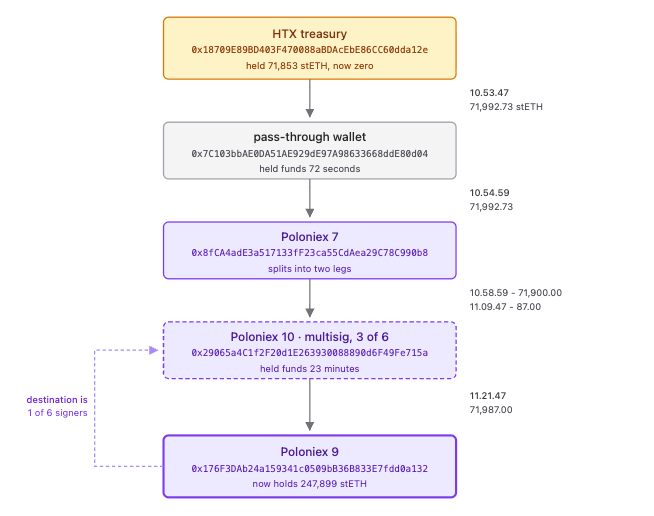
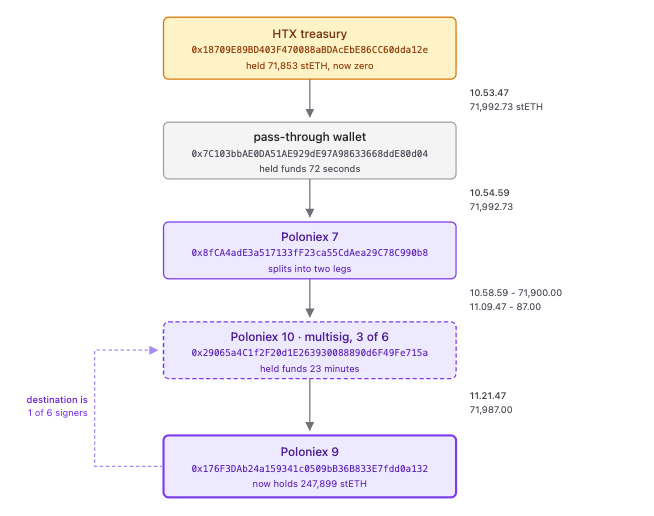
Protos has attempted to track the stETH in one of those addresses to its final destination and believes that this path may revealing something about how HTX has been functioning.
Let’s start with the May 1 proof of reserves, which noted there were 71,853.22 stETH, at today’s price worth about $135 million, in the address 0x18709e89bd403f470088abdacebe86cc60dda12e.
On May 30, shortly before HTX was due to generate its June proof-of-reserves where funds were moved to “ThirdParty,” these funds were moved to 0x7C103bbAE0DA51AE929dE97A98633668ddE80d04.
Moments later, they were transferred to 0x8fCA4adE3a517133fF23ca55CdAea29C78C990b8, an address labeled on Etherscan as Poloniex 7.
Shortly after, they were transferred again to 0x29065a4C1f2F20d1E263930088890d6F49Fe715a, an address that Etherscan labels as Poloniex 10.
Finally, moments later, they were transferred to 0x176F3DAb24a159341c0509bB36B833E7fdd0a132, an address labeled on Etherscan as Poloniex 9.
This address, 0x176F3DAb24a159341c0509bB36B833E7fdd0a132, used to be labeled as “Justin Sun 4” on Etherscan before being listed as a Poloniex address.
This pattern of transactions shows a large quantity of funds moving from HTX to a Poloniex address where they have been commingled with the Poloniex reserves.
Read more: Poloniex and the $1.3B bitcoin question
The wrapped BTC wrinkle
This isn’t the first time that HTX has relied heavily on Poloniex to hold certain assets.
Often, more than half the BTC held at HTX has been in a tokenized form, specifically a tokenized form that seemed to be held by Poloniex.
This often represented hundreds of millions of dollars worth of value.
Poloniex was unwilling to disclose the addresses where it presumably (hopefully) holds that BTC to Protos.
Got a tip? Send us an email securely via Protos Leaks. For more informed news and investigations, follow us on X, Bluesky, and Google News, or subscribe to our YouTube channel.

Former Ikea CEO to become JD Sports chair

Trump Media Pulls Back From Crypto Deals Under Interim CEO McGurn
The 25 best cyberpunk movies of all time, ranked


-

 Politics7 days ago
Meta enters AI-training agreement with far-right ‘propaganda rag’ Newsmax
-

 Politics5 days ago
Zack Polanski: an incitement to murder Nigel Farage?
-

 Crypto World6 days ago
MicroStrategy Post-Earnings CLARITY Act Push Could Add New Catalyst for Its Stock
-

 Crypto World7 days ago
XRP Ledger v3.3.0 brings five institutional features
-

 Crypto World7 days ago
New York sues Kalshi over prediction market gambling
-

 Crypto World5 days ago
Crypto PAC spending tops $2M in Michigan House race
-

 Business5 days ago
DTCR: Deleveraging And A Hedge Fund Collapse Point To A Possible AI Bottom
-

 Tech6 days ago
ESET tracks rise in malicious AI skills and adaptable malware
-

 Crypto World7 days ago
3 Fed Officials Just Explained Their Rate Hike Vote: Is Inflation Winning?
-

 Sports6 days ago
France Cricket implodes: letters hidden in a drawer and a board at war
-
Crypto World5 days ago
XRP Ledger urges node upgrade after manifest flood
-

 Crypto World7 days ago
Moneyflip CEO charged in $40K murder-for-hire plot
-
 Sports7 days ago
Bruno Fernandes decision made as Man United ‘discuss’ striker transfer option
-
Business7 days ago
FIFA has scrapped $20 billion World Cup sell-off plan, New York Post reports
-

 News Videos6 days ago
Financial Crash Expert: The 90-Day Collapse Timeline They Are Desperately Hiding.
-

 Sports2 days ago
Jordan Coyle & Cordiamo take Laya Arena Stakes at RDS
-
 Crypto World4 days ago
US Tech Stocks See Largest 5-Week Inflow in History: Can Nasdaq Break Its Downtrend?
-
 NewsBeat6 days ago
Tourist plane on sightseeing flight in Peru crashes into a field, killing all 13 people on board
-

 NewsBeat6 days ago
Arsenal reach full agreement with Newcastle over Bruno Guimaraes transfer | Football
-
 NewsBeat6 days ago
Bikini-clad Jennifer Aniston, 57, kisses hypnotist boyfriend Jim Curtis as they enjoy a romantic getaway aboard a luxury yacht in Spain
You must be logged in to post a comment Login