
Crypto World
Ripple Price Analysis: How Low Can XRP Go if It Loses $1 Support This Weekend?

XRP remains under sustained selling pressure against both USDT and BTC, with the higher time frame structure continuing to favor the bears. The latest breakdown below the key horizontal support reinforces the prevailing downtrend and leaves the market vulnerable to another leg lower unless buyers quickly reclaim the lost levels.
Ripple Price Analysis: The USDT Pair
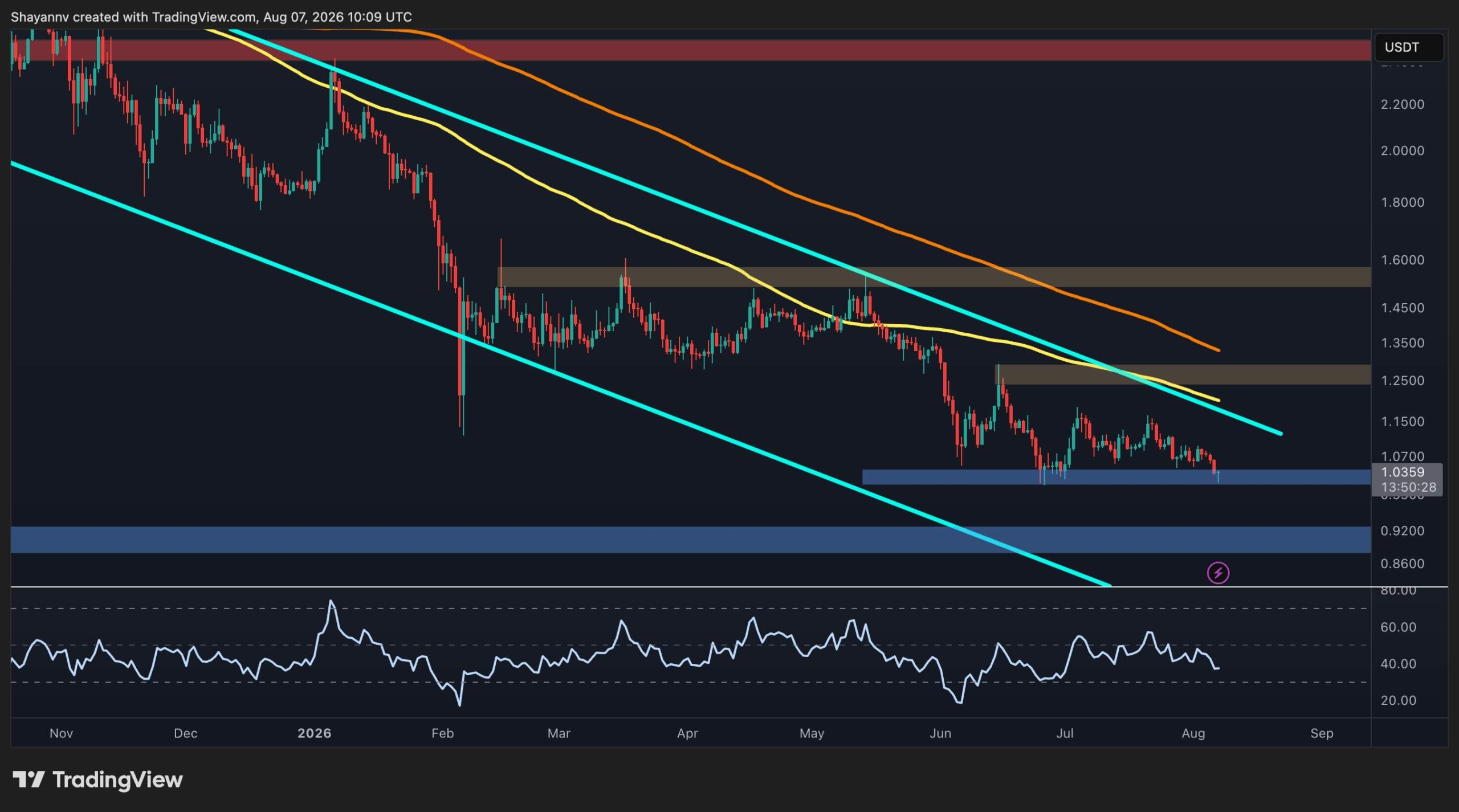
On the XRP/USDT chart, the price continues to trade inside a well-defined descending channel while remaining below the 100-day and 200-day moving averages. The 100-day MA has acted as a close dynamic resistance throughout the decline, while the 200-day MA continues to trend lower well above the current price, highlighting the weakness in the broader trend.
A potential breakdown of the $1-$1.05 support zone marks an important bearish development. This area has repeatedly attracted buyers over the past several weeks, but a breakdown would suggest demand is fading. If XRP breaks below this level, sellers will be in even more control.
The next major support sits around the $0.90 region, which should be defended at all costs. On the upside, the first resistance is the $1.25 zone, which is located between the key moving averages and just above the descending channel’s upper boundary. The broader resistance remains around $1.50, where previous distribution occurred.
Meanwhile, momentum also favors the sellers. The RSI has dropped toward the lower portion of its range without yet showing a convincing bullish divergence, suggesting downside momentum remains dominant despite approaching oversold territory.
The BTC Pair
The XRP/BTC pair paints an even weaker picture. The price has broken below the critical horizontal support around 1,700 sats, confirming a continuation of the prevailing downtrend after several weeks of sideways consolidation. The failed attempts to reclaim this level indicate that previous support has now turned into resistance.
The pair also remains below all major moving averages, with the 100-day average trading beneath the longer-term one, reinforcing the bearish market structure. Meanwhile, the asset continues to respect the descending channel that has guided the decline for several months.
The next area of interest is the lower support zone around 1,500 sats, which also coincides with the lower boundary of the descending channel. This region could attract buying interest, but a failure to hold it would be disastrous and further aggravate the bear market.
On the other hand, to improve the technical outlook, XRP would first need to reclaim the 1,700 sats level before challenging the 1,850 sats resistance zone. A stronger trend reversal would only become more likely if buyers also break above the descending channel resistance and push beyond the cluster of moving averages, which currently remain well overhead.
Overall, both XRP/USDT and XRP/BTC continue to display bearish market structures. While the price is approaching notable support areas that could trigger a short-term relief bounce, the broader trend remains negative until XRP begins reclaiming key horizontal levels and breaks above its long-term descending resistance.

The post Ripple Price Analysis: How Low Can XRP Go if It Loses $1 Support This Weekend? appeared first on CryptoPotato.



Trump Media (DJT) is unwinding parts of its crypto push, including scrapping plans to establish a publicly traded CRO token accumulation company, which it unveiled near the height of last year’s digital asset treasury boom.
Trump Media, Crypto.com and special purpose acquisition company Yorkville Acquisition mutually terminated plans for Trump Media Group CRO Strategy, the firms said Friday, citing “prevailing market conditions, and shifting business and stakeholder priorities.”
The proposed venture would have created a publicly traded company focused on accumulating the native token of Cronos and earning additional returns by staking those holdings. Trump Media itself bought $105 million of CRO in September 2025 as part of a broader partnership with Crypto.com that included plans to integrate token rewards into its products.
CRO fell as much as 5% following the news.
The companies are also walking away from a separate partnership under which Crypto.com would have serviced certain planned exchange-traded funds (ETFs), from Yorkville America. Trump Media is also scaling back plans to build Crypto.com-powered prediction markets directly into Truth Social, Axios reported earlier.

Software stocks sold off on Thursday amid disappointing second quarter earnings reports and guidance from Datadog (DDOG) and HubSpot (HUBS). Software companies with “consumption”-based business models like Datadog, including Snowflake (SNOW) and MongoDB (MBD), were among the losers. Traditional software-as-a-service vendors, led by Salesforce (CRM), charge fixed monthly or annual subscription fees based on the number of users. Newer players,…
Copyright ©2026 Investor’s Business Daily, LLC. All rights reserved. 87990cbe856818d5eddac44c7b1cdeb8
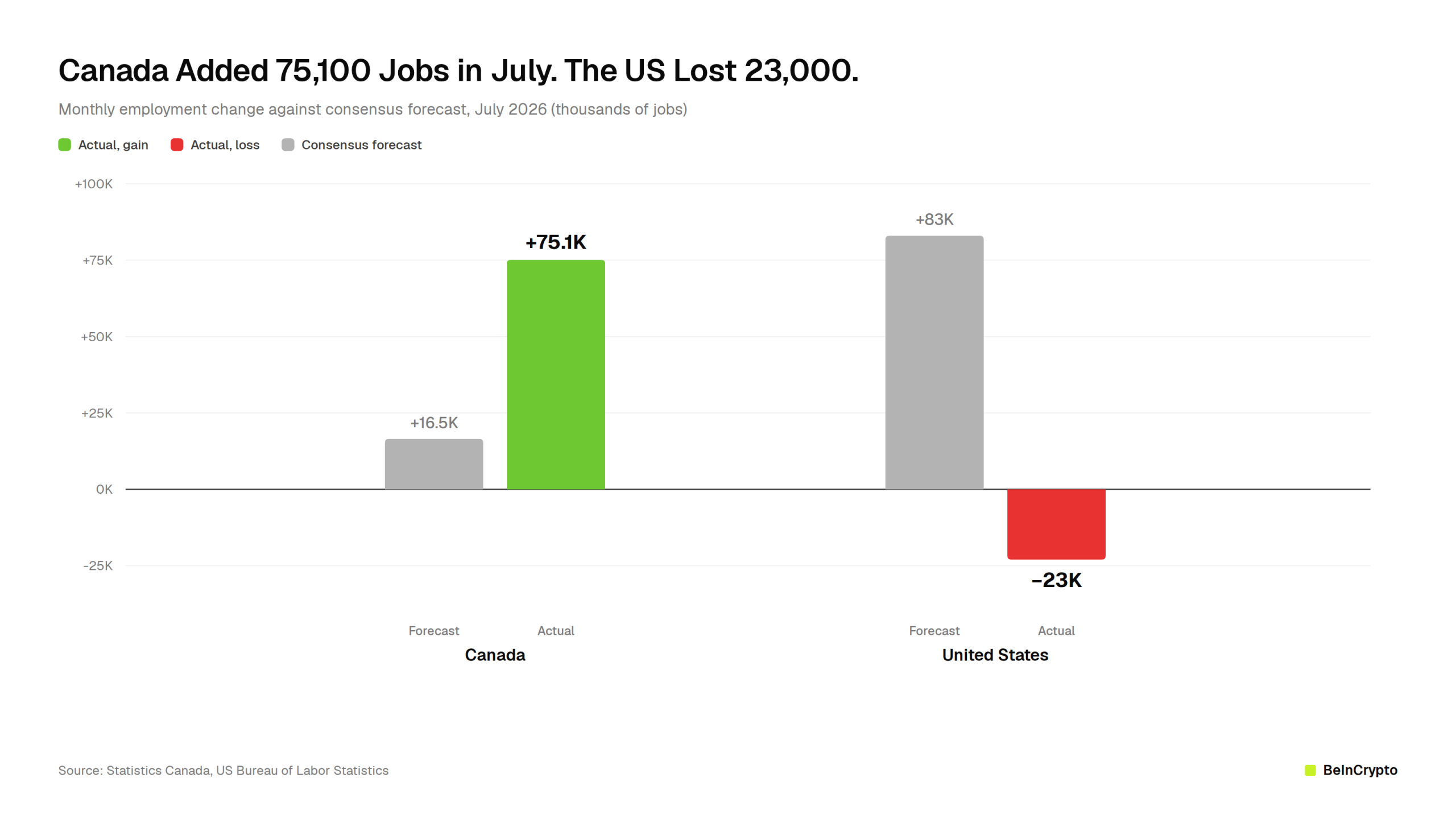
Canada added 75,000 jobs in July, about five times forecasts, while the US economy shed 23,000. The split hands the Canada crypto industry a stronger home market than American firms have seen all summer.
Statistics Canada put unemployment at 6.4% on Friday, a two-year low. US payrolls, meanwhile, missed forecasts by more than 100,000 positions after steep revisions.
A Five Times Beat Meets a US Contraction
Economists expected Canada to add about 15,000 jobs. It added 75,000. The gains split almost evenly between full-time and part-time work, according to the labour force survey.

Ontario did the heavy lifting with 52,000 new positions. Finance, insurance, and real estate added 18,000 jobs. Professional, scientific, and technical services added 17,000 more. Those two sectors matter here. They are where digital asset firms hire.
Canada has now added 181,000 jobs since April. That makes three straight months of gains.
“Three straight months moving in the right direction is exactly how turning points begin. And if the breadth we saw in July holds into the fall, stabilization could quietly become the momentum Canada has been waiting for,” Laura Ulrich, director of economic research at recruitment firm Indeed, said in a statement.
Follow us on X to get the latest news as it happens
The American report read like a different economy. The Bureau of Labor Statistics reported a 23,000 payroll decline. Economists had expected gains of 80,000 to 90,000. Worse, revisions erased another 103,000 jobs from May and June. US hiring has averaged just 34,000 a month over the past year.
One caveat keeps the contrast honest. America’s 4.1% unemployment rate still sits well below Canada’s 6.4%. However, the US rate held flat while jobs vanished. Canada’s fell while hiring boomed. Direction, not level, is the story.
Central Bank Paths Split as Bitcoin Holds $65,000
The divergence pulls the two central banks apart. Royce Mendes, managing director at Desjardins, said a Bank of Canada rate hike remains unlikely before 2027. BMO chief economist Douglas Porter flagged the reason. Wage growth cooled to 2.8%, the slowest in four years.
Strong hiring without wage pressure gives the Bank of Canada room to wait. The Federal Reserve has the opposite problem. A shrinking payroll makes further tightening hard to defend.
Within hours, the miss sent Fed expectations spinning as traders repriced US rates. Crypto markets, which rallied after June’s report, once again read weak US data as a liquidity signal.
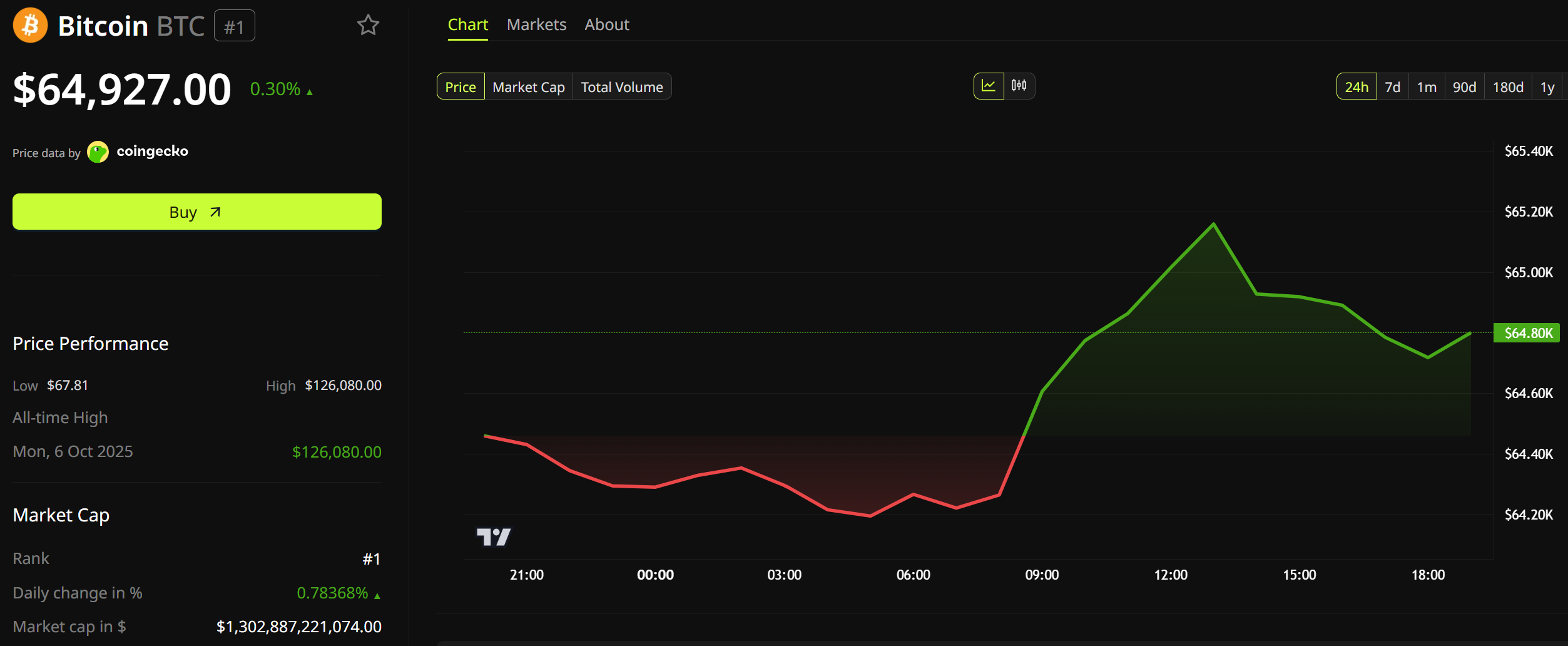
Bitcoin (BTC) traded near $65,000 on Friday, up 0.8% over 24 hours, according to BeInCrypto Markets data. Its market capitalization stood at roughly $1.31 trillion.

Can the Canada Crypto Industry Capitalize?
Canada has moved first before. The Toronto Stock Exchange listed the world’s first spot Bitcoin exchange-traded fund (ETF) in February 2021. That fund, the Purpose Bitcoin ETF, today holds about 18,500 BTC worth $1.7 billion CAD. US regulators needed almost three more years to approve rival spot products.
The rulebook is growing too. The Stablecoin Act, passed through Budget 2025’s Bill C-15, puts fiat-backed stablecoin issuers under Bank of Canada oversight. Issuers must hold one-to-one reserves and redeem at par. The rules should take force in 2027.
Major players are already positioning for that date. Coinbase Canada CEO Eric Richmond said in July the firm wants to build an “everything exchange” for Canadians. The plan spans crypto, stocks, and prediction markets. He tied the full rollout to those same stablecoin rules.
Nevertheless, the headwinds are real. British Columbia permanently banned new grid connections for crypto mining in October 2025. The province is steering its clean power toward AI and industry instead.
US venues still command far deeper liquidity. And CIBC senior economist Andrew Grantham noted Canadian unemployment sits about half a point above full employment.
The next tests come fast. Draft stablecoin rules are due in the Canada Gazette. August payrolls land on both sides of the border within a month. Together, they will show whether July’s divergence was a trend or a blip.
The post Canada Economy Just Outran America: Is Its Crypto Industry Next? appeared first on BeInCrypto.

This week’s most important crypto business developments all point in the same direction: more of the industry’s value is being routed through financial infrastructure rather than pure onchain speculation. BlackRock, for example, has introduced tokenized money market products aimed at stablecoin reserve use under the US GENIUS Act framework.
At the same time, tokenized real-world assets are proving their resilience in volatile markets, even if their decentralized finance (DeFi) adoption still looks modest. Elsewhere in the sector, Tether reported a sharp rise in profits tied to US Treasury income, while a public Bitcoin miner linked to the Trump family posted improved production and narrower quarterly losses.
Key takeaways
- BlackRock launched two tokenized money market products designed to help stablecoin issuers satisfy reserve requirements under the US GENIUS Act.
- RedStone data suggests tokenized gold performed relatively well during a sharp gold sell-off, but only a small fraction of tokenized gold supply is used as DeFi collateral.
- Tether reported $1.5 billion in second-quarter net operating profit, supported primarily by interest from US Treasury holdings and related arrangements.
- American Bitcoin reported record second-quarter production of 932 BTC, improving revenue and narrowing losses, though it remains unprofitable.
BlackRock moves to tokenize stablecoin reserves
BlackRock introduced two tokenized money market products intended to support stablecoin issuers with reserve requirements under the US GENIUS Act, expanding its involvement in tokenized financial infrastructure. According to earlier coverage by Cointelegraph, one product tokenizes exposure to BlackRock’s existing Treasury liquidity strategy on Ethereum, allowing approved investors to transfer ownership onchain while the underlying assets stay invested in cash and short-term US government securities.
The second product is described as a new institutional money market vehicle for digital asset markets. It is positioned as compatible with multiple blockchains and designed to automatically reinvest income—an approach that aligns with how reserve managers typically seek operational continuity rather than manual redemptions and reinvestment cycles.
For market participants, the practical significance goes beyond the novelty of tokenization. Stablecoins need credible, auditable reserves, and a product built around short-term government assets creates a clearer bridge between traditional compliance expectations and blockchain-based settlement. It also reinforces BlackRock’s growing footprint in tokenized Treasurys, where it already runs BUIDL, described as the industry’s largest tokenized Treasury fund.
This launch also reflects a broader institutional trend: Wall Street firms are increasingly entering tokenized markets not only as issuers, but as infrastructure providers for the assets that underwrite onchain finance. With GENIUS establishing a federal framework for payment stablecoins, the demand for reserve-grade solutions is likely to become more structured—potentially benefiting tokenization platforms that can translate “what reserves should be” into “how those reserves can be managed on-chain.”
Tokenized gold shows stress tolerance, but DeFi use is still limited
Tokenized bullion continues to draw attention, but its DeFi footprint remains small relative to its overall market. A report by RedStone, referenced in earlier Cointelegraph coverage, found that tokenized gold held up during periods of sharp price movement—specifically during gold’s sell-off.
RedStone’s analysis points to a key asymmetry in the sector: trading activity can surge while borrowing and lending adoption lag. While spot trading volume reportedly reached $90.7 billion in Q1 as gold futures rallied above $5,600 per troy ounce, RedStone estimated that only about $63 million of Tether Gold and PAX Gold is used as collateral on Aave v3 and Morpho. That figure is roughly 1.5% of their combined $4.2 billion market cap, indicating that most tokenized gold remains outside major onchain collateral pipelines.
The report also highlighted how collateral behaved during stress. On March 23, Aave processed what it described as its largest cluster of XAUT liquidations without disruption after gold dropped roughly 10% in a week—an event characterized by JPMorgan’s Greg Shearer as an “extremely brutal flush.” RedStone’s broader takeaway was that tokenized gold looked resilient, even as the findings underscored an infrastructure gap as tokenized real-world assets scale.
Since that period, gold futures have fallen more than 20% from January peaks, influenced by expectations of higher US interest rates. In that environment, the value proposition for tokenized gold is partly about reliability during volatility: the question for investors and DeFi builders now is whether liquidity and collateral usage can grow fast enough to match the expanding market for tokenized bullion itself.
Tether’s Treasury-linked earnings power another strong quarter
Tether reported a second-quarter performance that is closely tied to US Treasury income. According to its latest quarterly attestation, Tether generated $1.5 billion in net operating profit, driven primarily by interest earned on its US Treasury holdings and repurchase-related arrangements.
The attestation also points to reserve strength. As of June 30, Tether reported a reserve buffer of $4.11 billion, with assets exceeding liabilities by that margin. In parallel, even as the broader stablecoin market contracted, USDT circulating supply increased by $446 million to $184.6 billion. The result preserved Tether’s market share—DeFiLlama data cited in the earlier reporting placed USDT’s market value around $307 billion and suggested Tether still accounts for more than 60% of global stablecoin supply.
From an investor perspective, the most important implication is that stablecoin profitability continues to depend heavily on short-term interest rates. When Treasury bill yields and cash-equivalent returns are elevated, reserve-based income can become a major earnings driver, which is what appears to have happened in this quarter.
However, the same dynamic also raises a forward-looking risk: if rate expectations change or stablecoin demand slows further, Tether’s income could face pressure. This quarter’s stronger profit and reserve surplus therefore doesn’t eliminate near-term uncertainty for the stablecoin sector—it clarifies what factors are currently supporting earnings, and what could reverse them if macro conditions shift.
American Bitcoin improves production and reduces losses
Bitcoin mining remains highly sensitive to production economics and balance sheet decisions, and the latest quarterly results from American Bitcoin reflect that reality. In earlier Cointelegraph coverage, the company—linked to the Trump family and Nasdaq-listed—reported record second-quarter production of 932 BTC, improving mining revenue compared with the first quarter.
American Bitcoin reported mining revenue of $67 million in Q2, up from $62.1 million in Q1. The company also narrowed its net loss to $57.2 million, improving from an $81.8 million loss in the previous quarter. The production milestone matters because it is one of the few levers miners can control in the short term—hash rate and operational efficiency translate directly into how much Bitcoin is produced, even when market prices are volatile.
But the company’s financial picture is still constrained. American Bitcoin remains unprofitable, and it recently completed a 1-for-15 reverse stock split to maintain its Nasdaq listing after its share price fell below the exchange’s minimum bid requirement. Its balance sheet also includes pledged Bitcoin: the miner held roughly 8,002 BTC as of June 30 and had pledged about 3,090 BTC as collateral under equipment purchase agreements with Bitmain.
That pledge introduces additional sensitivity to Bitcoin price movements. Even when production improves, a decline in BTC could complicate collateral dynamics and funding conditions—an issue that investors should keep watching as the company attempts to stabilize its public-market footing.
Across these stories, a shared theme emerges: crypto businesses are increasingly evaluated on how they monetize financial assets—Treasury exposure, tokenized reserves, tokenized collateral, and operational production—rather than on token price narratives alone. The next watchpoints are straightforward: whether stablecoin-related tokenized reserve products expand beyond pilots, whether tokenized gold’s DeFi collateral usage grows beyond its current small share, and how earnings trajectories for issuers like Tether and miners like American Bitcoin respond if interest-rate and Bitcoin-price assumptions turn.
Senate Majority Leader John Thune reportedly still plans to file Clarity Act cloture before lawmakers leave for the August recess, Eleanor Terrett reports. The move would lock in a September vote on the crypto bill.
The Clarity Act, formally the Digital Asset Market Clarity Act, would set clear rules for how the US regulates digital assets. It needs 60 Senate votes, and those votes are not there yet.
Why the Clarity Act Cloture Filing Matters
Cloture is a procedural step that starts the countdown to a floor vote. Filing it now would queue the bill for action soon after the Senate returns on September 11.
Thune’s office delivered the message to crypto industry leaders on Friday, according to Eleanor Terrett, host of Crypto America podcast. Industry figures read it as a sign the bill sits at the top of the September agenda.
Follow us on X to get the latest news as it happens
The timing is tight. The Senate’s recess begins on August 10, leaving only days to file. A vote before the break is already off the table after Senate Democrats refused to fast-track the bill.
“The Dems insisted on no Clarity vote. We’re getting that queued up first thing [when] we come back in September,” Politico reported, citing Thune.
Big hurdles remain. Republicans need roughly seven Democratic votes, and fights over stablecoin yield and ethics rules are unresolved. Banks’ lobbying against stablecoin yield has won over several Republicans. Polymarket puts the odds of passage this year near 15%.
Why Bitcoin Could Move Fast This Weekend
Bitcoin (BTC) traded near $65,000 on Friday, up 0.3% over the past day.

The filing window is short. It runs from Friday night through Monday morning, when the Senate’s recess formally begins. A quiet weekend of private talks remains the most likely outcome.
Still, crypto markets never close. A surprise filing, a late deal on yield or ethics, or a White House comment could move Bitcoin fast. Weekend trading is often thinner, so prices can swing harder.
The next test comes in September, when Thune must turn a procedural promise into 60 actual votes.
The post Thune Still Plans Clarity Act Cloture: What a Weekend Surprise Could Mean for Bitcoin appeared first on BeInCrypto.
Trump Media and Technology Group has reportedly terminated its planned Cronos (CRO) treasury venture with Crypto.com and Yorkville Acquisition Corp. The companies also abandoned a related services agreement and a set of digital asset products.
Interim CEO Kevin McGurn told Axios on Friday that the crypto deals ended because the treasury sector became saturated. Trump Media will instead concentrate on Truth Social, data licensing, and its pending merger with fusion energy company TAE.
Why the Trump Media Crypto Deals Collapsed
The venture, announced last year, would have licensed the Trump Media brand. The resulting company was built around Crypto.com’s Cronos blockchain and its CRO token. At launch, the partners billed it as the first and largest publicly traded CRO treasury firm.
Yorkville Acquisition Corp, a blank-check vehicle created to take the venture public, agreed to the termination as well. However, Yorkville America’s America First ETFs, branded as Truth Social Funds, will keep operating.
The retreat also follows a bruising start to the year, when crypto markdowns drove a $406 million quarterly loss. McGurn said saturation among treasury companies, rather than regulatory pressure, drove the decision.
“We wanted to get focused,” Axios reported, citing McGurn.
Follow us on X to get the latest news as it happens
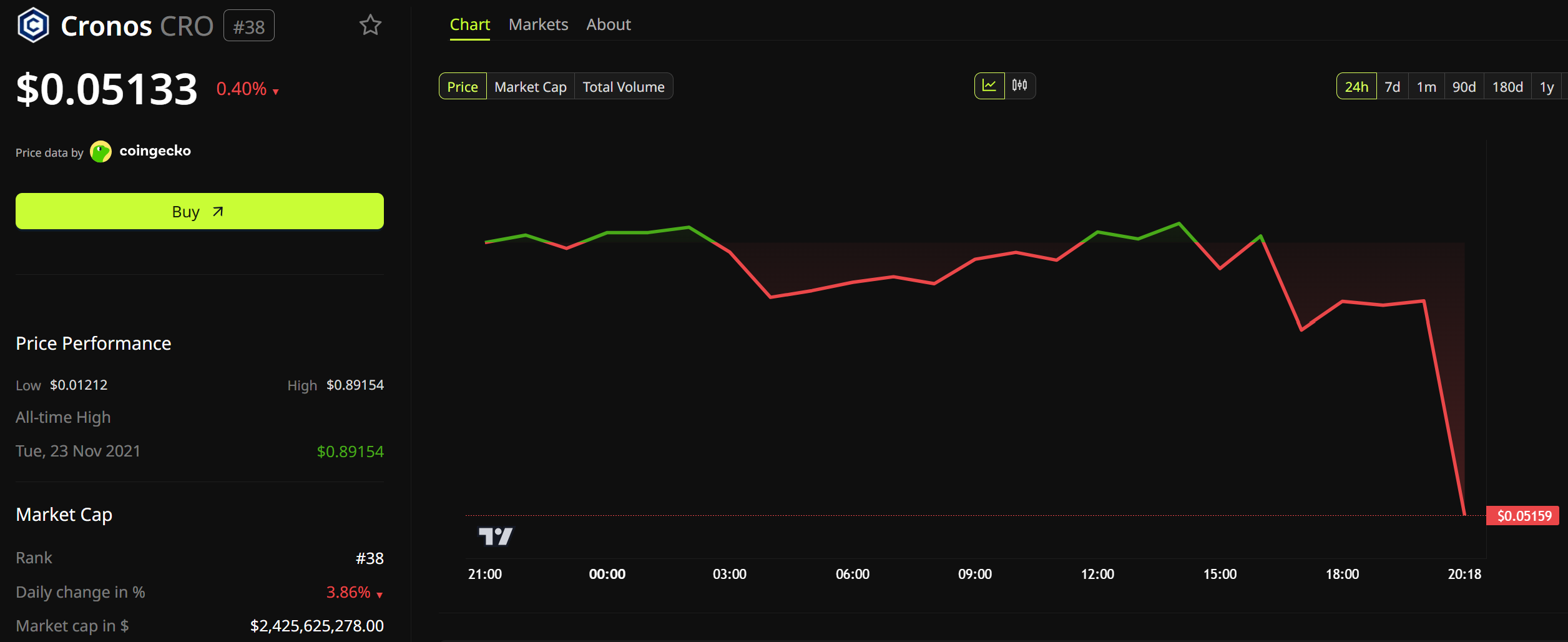
He added that staking CRO has become less central for Crypto.com, making a split logical for both sides. Meanwhile, CRO traded near $0.0513 on Friday, down 0.4% over 24 hours, according to BeInCrypto Markets data.

The token holds a market capitalization of roughly $2.4 billion, ranking 38th overall.
Prediction Markets Give Way to Data Licensing
Separately, the companies scaled back plans to embed betting features inside Truth Social. Trump Media had unveiled Truth Predict prediction markets, powered by Crypto.com Derivatives North America, last October.
The partners will now pursue a marketing arrangement that promotes Crypto.com’s prediction products to Truth Social users. McGurn argued that established operators already crowd that space, so running back-end infrastructure offered little return. He sees Trump Media as a distribution and data partner instead of a market operator.
That data push is already visible. The company’s Truth Social API business, an application programming interface (API) that sells platform data, now serves about 10 customers, up from roughly five. Most are high-frequency trading firms that feed the data into algorithmic strategies. McGurn said the firm is also courting large language model developers and prediction market platforms.
McGurn expects the TAE merger to close before year-end. Whether a slimmer Trump Media can turn Truth Social’s audience and data into durable revenue may become clearer once that deal lands.
The post Trump Media Pulls Back From Crypto Deals Under Interim CEO McGurn appeared first on BeInCrypto.
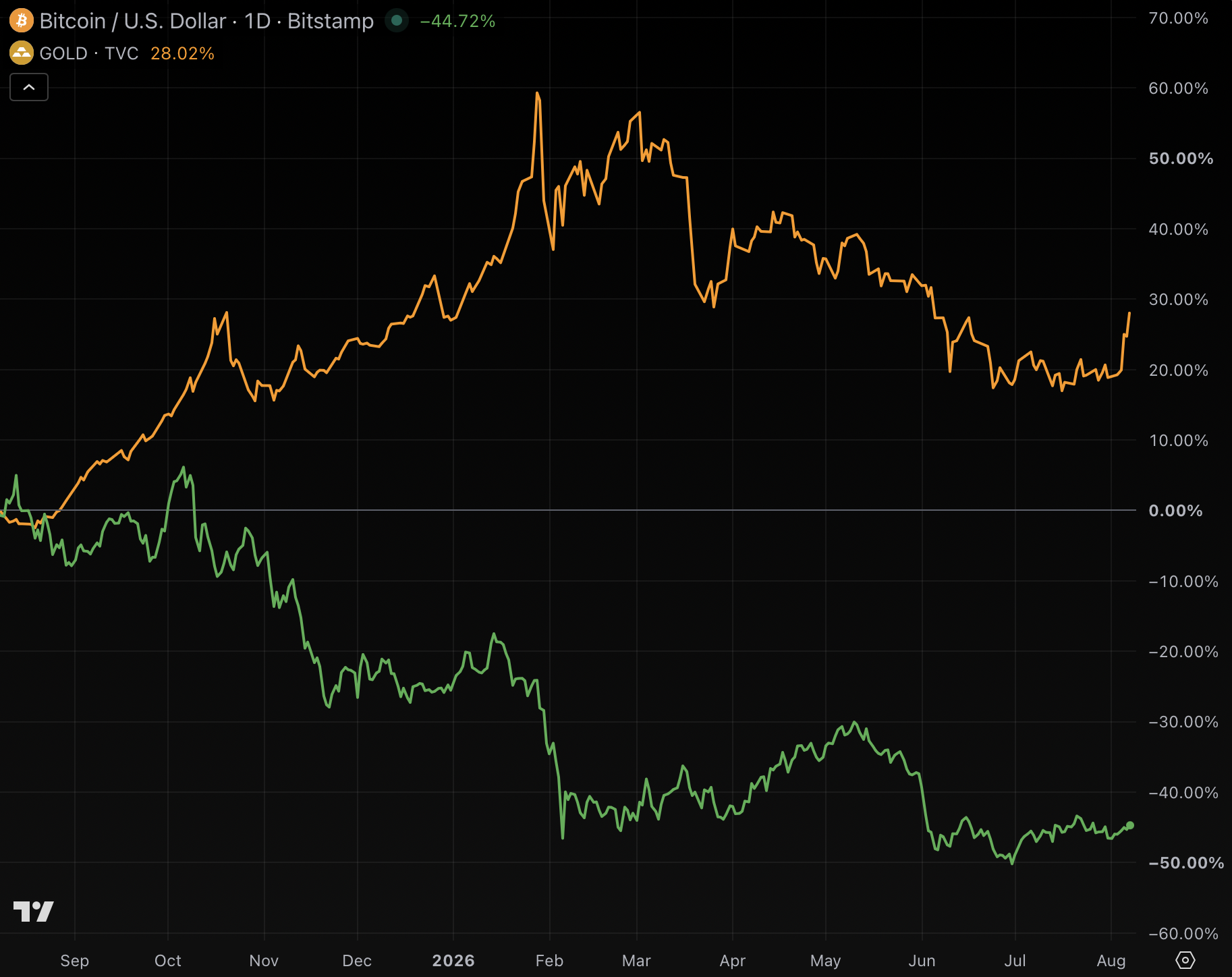
Gold has rallied 28% over the past year from $3,400 to $4,330, outperforming digital rival BTC by over 70 percentage points.
Over the same time period, BTC has suffered an embarrassing 44% decline from $117,000 to $65,000.
In fact, across the past three years, owning so-called “digital gold” instead of the real thing would have returned a couple fewer percentage points despite 36 months of patience.
BTC has crashed off a financial peak, not just a psychological one. It hit an all-time high near $126,200 on October 6, 2025 but has since declined 48%.
Gold achieved its own record shortly after. Spot prices surged to $5,589 per ounce on January 28, 2026, a nominal high that also sat well above the metal’s inflation-adjusted 1980 peak.
The precious metal has since pulled back from that spike, but it never came close to giving up its year-over-year gain. BTC, in stark contrast, halved.
Boomer gold beats BTC
Evangelists have spent a decade comparing BTC to a global store of value. Its performance over the past few years has certainly stalled that pitch.
The comparison is nowhere close to a financial reality over the past year. Indeed, a dollar saved in gold a year ago is worth about $1.28 today. A dollar saved in BTC is worth about $0.55.
The metal BTC was supposed to dethrone maintained its strength.
Read more: Every time Michael Saylor said he’d never sell bitcoin
Michael Burry wrote in February, “BTC has been exposed as a purely speculative asset, and is not near the debasement trade hedge that gold and other precious metals are.”
BTC traded near $77,000 that day, already down sharply from its October peak, and it’s fallen another 16% since.
Central banks didn’t sit the trade out. They added 863 tonnes of gold to sovereign reserves in 2025, a historically elevated total albeit a slower pace than the prior year.
None of those purchases flowed into BTC, whose loudest institutional champions had long argued central banks would eventually buy it in the same way.
Gold ETF investors reversed course too. Holdings swung from a small net outflow in 2024 to inflows of more than 800 tonnes in 2025, per the World Gold Council.
Crypto investors used to celebrate that type of demand shift when capital rotated into BTC ETFs, not gold ETFs.
While gold sat in vaults and preserved its value, the BTC community fractured. Michael Saylor’s Strategy sold BTC for the first time since 2022 while critics of Bitcoin Core v30 proposed a hard fork of the blockchain and a proof-of-work change.
Coldcard, the most popular BTC-only hardware wallet, experienced a catastrophic bug.
Read more: Bitcoin outperforms gold as Iran war shakes ‘safe-haven’ trade
As usual, there are two sides to every story. BTC has had shorter stretches and prior time periods when it outpaced its rival. Certainly since its formative years in the 2010s, BTC has far outperformed gold.
Nevertheless, over the past 12 and 36 months that matter most to anyone who bought either asset recently, gold hasn’t just beaten BTC but trounced it by 70 percentage points.
“Digital gold” now describes what BTC was supposed to be, not what it actually accomplished.
Got a tip? Send us an email securely via Protos Leaks. For more informed news and investigations, follow us on X, Bluesky, and Google News, or subscribe to our YouTube channel.

Bitcoin whales and sharks are continuing to increase their holdings as the cryptocurrency trades in the $63,000 to $65,000 range, according to the latest data from Santiment.
The accumulation trend has strengthened since its previous report earlier this week, which highlighted a surge in network activity driven by the impact of the Coldcard hardware wallet security incident.
Retail Dumps Holdings
At the time, Santiment reported that active Bitcoin addresses had climbed to a three-month high of 712,000 over the previous seven days, while transactions worth more than $100,000 reached a five-month high of 61,800. The firm said affected users rushed to move their funds and reorganize their wallets after the security breach, which ended up triggering a sharp increase in on-chain activity.
In its latest update, Santiment flagged a notable shift. While large holders have continued adding BTC to their wallets, micro holders are reducing their exposure at the fastest pace since December 2024. The Coldcard hack remains a major factor, as both the accumulation by whales and the selling by smaller investors began around the same period.
The uncertainty surrounding the CLARITY Act also contributed to the trend. Bitcoin’s ongoing period of sideways price action has discouraged retail participants, adding to the selling pressure from smaller wallets. It is this divergence between large and small holders that is becoming more pronounced, Santiment explained.
With key stakeholders steadily accumulating while retail investors continue to exit, the analytics platform said the odds of BTC climbing above $70,000 are increasing. This, in turn, makes that outcome more likely than a drop below the $60,000 level.
The Coldcard fallout was also evident in data from CoinMetrics, which recorded a temporary increase in BTC held on exchanges.
ETFs Stay in Positive Territory
On the institutional side, US-based spot Bitcoin ETFs have recorded four straight days of inflows. On 6th August, these funds attracted nearly $129 million. BlackRock’s IBIT led the numbers with $123 million in inflows, followed by Fidelity’s ETF with $11.2 million. Outflows came from VanEck’s HODL, which shed $32.7 million, and Valkyrie’s BRRR, which lost $9.07 million on the day. The remaining funds either posted smaller additions or ended the session unchanged.
The latest stretch of gains has pushed the monthly figures to almost $755 million.
The post Micro Bitcoin (BTC) Holders Are Vanishing at the Fastest Pace Since December 2024 appeared first on CryptoPotato.


U.S. authorities sanctioned crypto exchanges Shelbit and Aban Tether after alleging that the platforms helped Iran evade restrictions and move funds connected to the Islamic Revolutionary Guard Corps.
Summary
- OFAC sanctioned Shelbit, Aban Tether and Siavash Kayvanpour over alleged sanctions evasion.
- IRGC-linked wallets allegedly sent more than $1 million in crypto to Shelbit addresses.
- Shelbit addresses reportedly transferred over $2 million to wallets controlled by the IRGC.
- Kayvanpour-linked wallets allegedly sent more than $2 million to sanctioned exchange Nobitex.
OFAC targets Shelbit and Aban Tether
The U.S. Treasury Department’s Office of Foreign Assets Control announced the sanctions on Aug. 7 as part of Washington’s effort to disrupt Iran’s access to international financial markets.
OFAC accused Shelbit and Aban Tether of facilitating illicit cryptocurrency transactions and sanctions evasion. The agency said the Iranian government relied on exchanges with limited or no regulatory oversight to move digital assets through corporate networks and an online gambling operation.
The sanctions also cover Iranian national Siavash Kayvanpour and companies tied to him in Georgia, Poland and the United Arab Emirates. Treasury described Kayvanpour as the operator of a network of front companies connected to Shelbit.
IRGC-linked addresses sent more than $1 million in crypto to Shelbit, according to Treasury. Shelbit-linked wallets allegedly transferred more than $2 million to addresses controlled by the IRGC.
Wallets owned or controlled by Kayvanpour also sent over $2 million to Nobitex, Iran’s largest cryptocurrency exchange, Treasury said.
“Whether in dollars, rials, or crypto, Treasury will hunt down and dismantle the illicit financial networks that keep the regime afloat,” Treasury Secretary Scott Bessent said.
Aban Tether processed funds for sanctioned exchanges
OFAC separately accused Iran-based Aban Tether of processing millions of dollars in transactions involving entities already under U.S. sanctions.
Those entities included Nobitex, Wallex, Bitpin and Ramzinex. The four Iranian exchanges were sanctioned by the U.S. Treasury in June after officials accused them of helping restricted entities access digital asset markets.
Chainalysis estimated that Nobitex accounts for roughly half of Iran’s cryptocurrency trading activity. The exchange has denied having a direct relationship or contractual arrangement with the IRGC, Iran’s central bank or other government bodies.
Shelbit has also rejected claims that it knowingly participated in money laundering, terrorism financing or sanctions evasion. Its former management said the company stopped accepting new business in December 2025 and completed its customer wind-down in January.
The sanctions represent administrative designations rather than criminal convictions. However, they block property and interests in property belonging to designated parties when those assets enter U.S. jurisdiction.
US widens Iran crypto crackdown
The latest action expands a U.S. campaign targeting exchanges, wallet addresses and companies accused of helping Iran bypass restrictions during its military conflict with Washington.
In July, U.S. authorities froze $131 million in Iran-linked crypto held in wallets connected to the country’s central bank. That followed an April action in which Tether froze approximately $344 million in USDT across two Tron addresses linked by authorities to Iranian networks.
Bessent previously said the United States had seized or frozen nearly $1 billion in cryptocurrency connected to Iranian exchanges and wallets since the conflict began.
The use of centralized stablecoins gives authorities an enforcement tool that does not exist with assets such as Bitcoin. Issuers can block transfers from designated addresses, while transactions involving decentralized assets generally require control of the private keys.
What the sanctions mean for crypto firms
U.S. persons and companies are generally prohibited from providing funds, services or other economic benefits to the sanctioned exchanges and individuals. Entities owned at least 50% by one or more blocked parties are also covered, even when they are not named separately.
Foreign exchanges, stablecoin issuers and payment providers may also face secondary sanctions exposure if they knowingly process certain transactions involving the designated parties.
OFAC published several Bitcoin, Ethereum, Tron and Solana addresses as part of the action. Crypto companies will need to add those identifiers and the sanctioned entities to their transaction-screening systems as Washington continues tracing Iran-linked digital asset flows.
Attackers emptied Lightning nodes belonging to BTCPay Server users on Friday, including one run by hardware wallet maker Foundation, after the self-hosted bitcoin payment processor warned that a critical vulnerability was being actively exploited and told merchants to update to version 2.4.2 or… Read the full story at The Defiant

Burger King U.S. Same-Store Sales Rise 8.5%

DJT scraps Crypto.com deals citing market condition, CRO token falls 5%

Dorit and PK Kemsley’s Divorce Is a ‘Battle of the Evidence’


-

 Politics5 days ago
Zack Polanski: an incitement to murder Nigel Farage?
-

 Crypto World6 days ago
MicroStrategy Post-Earnings CLARITY Act Push Could Add New Catalyst for Its Stock
-

 Crypto World7 days ago
XRP Ledger v3.3.0 brings five institutional features
-

 Crypto World7 days ago
New York sues Kalshi over prediction market gambling
-

 Crypto World5 days ago
Crypto PAC spending tops $2M in Michigan House race
-

 Business5 days ago
DTCR: Deleveraging And A Hedge Fund Collapse Point To A Possible AI Bottom
-

 Tech6 days ago
ESET tracks rise in malicious AI skills and adaptable malware
-

 Sports6 days ago
France Cricket implodes: letters hidden in a drawer and a board at war
-
Crypto World5 days ago
XRP Ledger urges node upgrade after manifest flood
-

 Crypto World7 days ago
Moneyflip CEO charged in $40K murder-for-hire plot
-
 Sports7 days ago
Bruno Fernandes decision made as Man United ‘discuss’ striker transfer option
-
Business7 days ago
FIFA has scrapped $20 billion World Cup sell-off plan, New York Post reports
-

 News Videos6 days ago
Financial Crash Expert: The 90-Day Collapse Timeline They Are Desperately Hiding.
-

 Sports2 days ago
Jordan Coyle & Cordiamo take Laya Arena Stakes at RDS
-
 Crypto World4 days ago
US Tech Stocks See Largest 5-Week Inflow in History: Can Nasdaq Break Its Downtrend?
-
 NewsBeat6 days ago
Tourist plane on sightseeing flight in Peru crashes into a field, killing all 13 people on board
-

 NewsBeat6 days ago
Arsenal reach full agreement with Newcastle over Bruno Guimaraes transfer | Football
-
 NewsBeat6 days ago
Bikini-clad Jennifer Aniston, 57, kisses hypnotist boyfriend Jim Curtis as they enjoy a romantic getaway aboard a luxury yacht in Spain
-

 Tech6 days ago
Page Not Found | WIRED
-

 Politics1 day ago
Reform UK And Greens Sink To Lowest Favourability Ratings To Date
You must be logged in to post a comment Login