
Crypto World
July Jobs Report Sends Fed Expectations Into Chaos, Can Crypto Capitalize?

The July jobs report shows up to 23,000 lost jobs instead of gaining the 80,000 forecast, and revisions erased another 103,000. Federal Reserve rate bets flipped within minutes of Friday’s release.
Bitcoin (BTC) climbed on the news. The unemployment rate fell to 4.1%, but for an uncomfortable reason. People stopped looking for work.
July Jobs Report Revisions Deepen the Shock
The headline number was bad. The fine print was worse. The Bureau of Labor Statistics report cut May’s gain to 63,000 and June’s to just 20,000. That quiet markdown wiped out 103,000 jobs.
Hiring was already thin before July. Payrolls averaged gains of just 34,000 a month over the past year. July snapped even that weak streak.
Moreover, the losses were not spread evenly. Local government education shed 50,000 jobs. Retail and finance also cut staff. Health care added 22,000 positions, and little else grew.
The falling jobless rate hides the real story. Fewer Americans are working or even looking. Participation has dropped 0.7 percentage point since January, reaching 61.4%.
Paychecks tell a similar tale. Wages grew 3.2% over the past year, while June’s inflation ran at 3.5%. In real terms, the average worker is falling behind
“The U.S. economy “unexpectedly” lost 23K jobs in July, while June’s gain was revised down to a mere 20K. The unemployment rate slipped a bit because more people left the labor force, as the participation rate fell to 61.4%, the lowest in 50 years excluding COVID. Stagflation!” Economist Peter Schiff argued the mix points to something worse than a slowdown.
Follow us on X to get the latest news as it happens
Fed Bets Flip, and Crypto Smells Opportunity
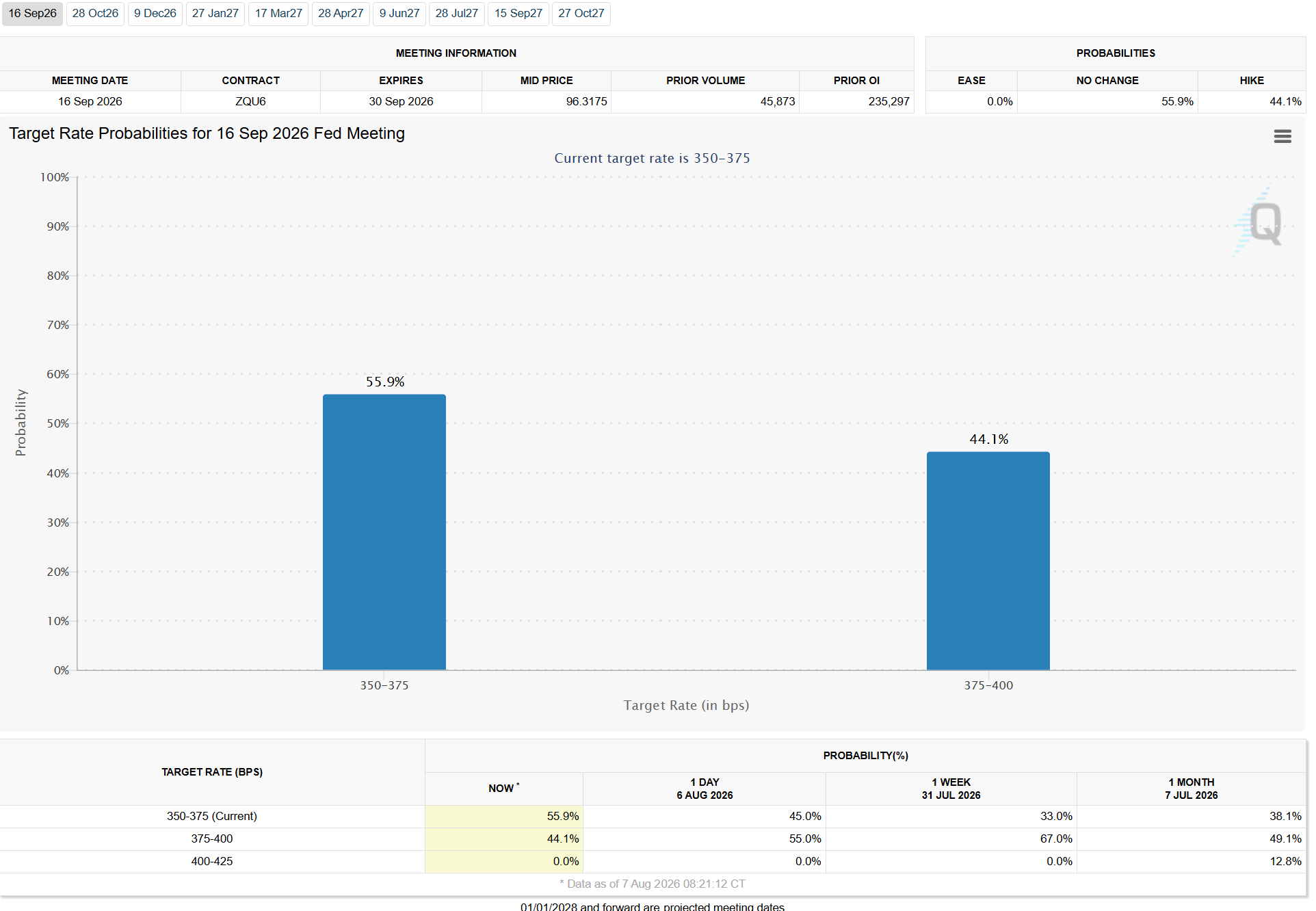
Rate markets moved fast. CME Group’s FedWatch tool now gives a September hold 55.9% odds, against 44.1% for a hike. One week ago, the hold camp sat at just 33%.

The swing matters because the Fed is split. It held rates at 3.50% to 3.75% in late July, yet three Fed officials dissented and pushed for a hike.
Unemployment hit a two-year low only because fewer people searched for work.
Against this backdrop, the general perception is that this was a messy read for policymakers.
“Take our government workers, world cup, jobs rose 100,000,” Kevin Hassett said in an interview.
Follow us on X to get the latest news as it happens
For crypto, the math is simple. Fewer hikes mean less pressure on risk assets. Bitcoin, trading near $65,172, rose 0.7% in 24 hours, per BeInCrypto Markets data.
Bitcoin has also run this play before. A weak print sparked June’s jobs report rally, which faded once hawkish Fed talk returned. The token likewise lagged a metals rally that gave gold its best week of 2026, leaving room to catch up if yields keep sliding.
Everything now rides on one date. The July Consumer Price Index (CPI) lands on Wednesday, August 12. A cool number locks in the dovish shift. A hot one revives hike bets before the Fed’s September 15 to 16 meeting, where fresh economic projections are also due.
The post July Jobs Report Sends Fed Expectations Into Chaos, Can Crypto Capitalize? appeared first on BeInCrypto.

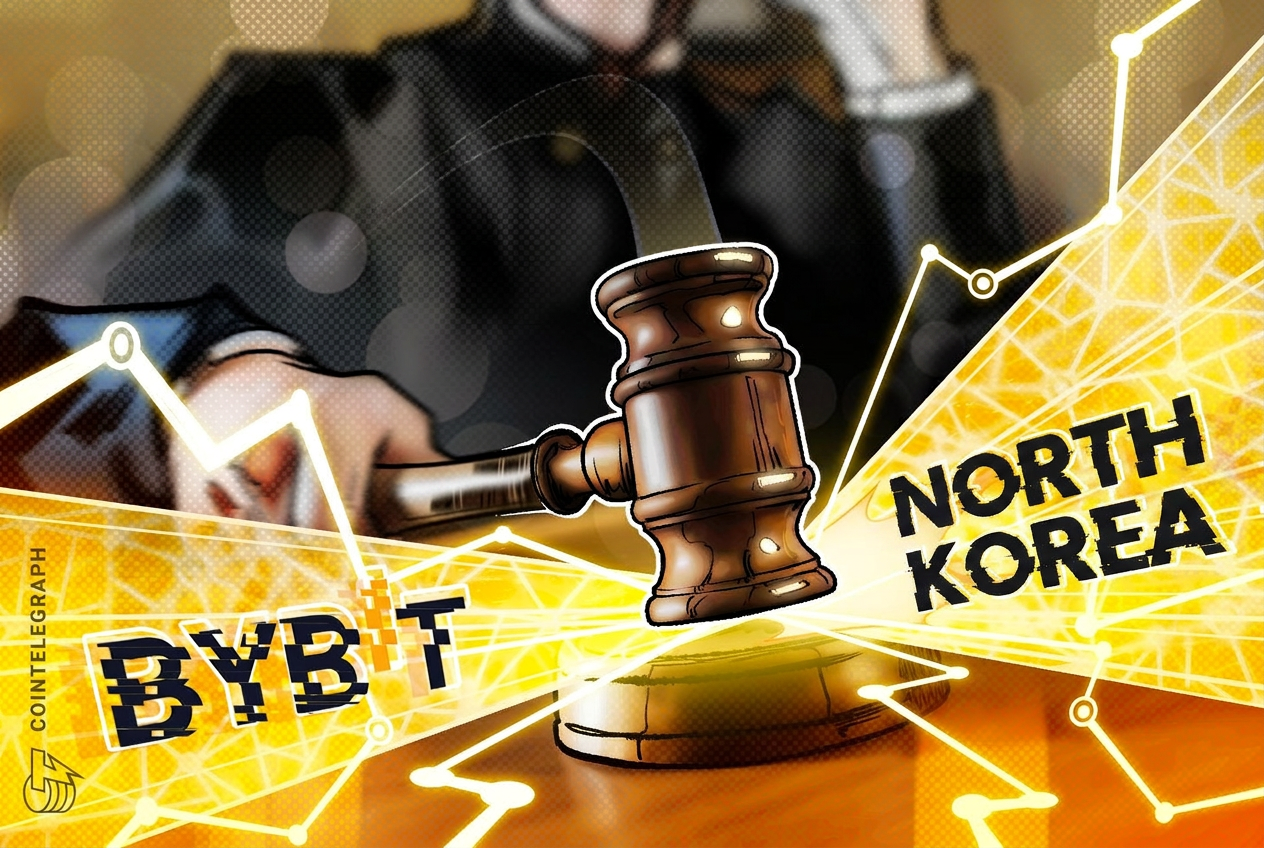
United States court records unsealed on Thursday show that a federal judge backed crypto exchange Bybit’s effort to trace assets stolen in the $1.5 billion North Korea-linked hack by granting the company expedited discovery.
According to the records, Bybit filed the lawsuit under seal on June 18 against North Korea, its Reconnaissance General Bureau, the Lazarus Group and 20 unidentified defendants. The court granted Bybit’s request for expedited discovery on June 19.
The discovery authority gives Bybit a practical route to identify alleged intermediaries and pursue a small portion of stolen assets that remains traceable, rather than relying solely on a judgment against North Korea.
In its complaint, Bybit alleged that some traceable assets reached exchanges operating or maintaining infrastructure in the US. The company sought account-holder identities, balances and transaction histories, saying certain platforms had indicated they would cooperate after receiving a court order.
Bybit says 90% of stolen funds became untraceable
Bybit also obtained a temporary restraining order on June 19 preventing the unidentified defendants from transferring certain traceable assets. The court renewed the order on July 16 and partially granted Bybit’s request for a preliminary injunction on July 30. Some exhibits and other records remain sealed.
As of the June 18 filing, Bybit said 90.2% of the stolen assets had become untraceable after passing through mixers, cross-chain bridges and over-the-counter dealers. The remaining 9.8% had been traced to identifiable wallets, including 5.3% of the total, about $75.5 million, that had been frozen or recovered.
The figures mark a sharp drop from more than a year ago, when Bybit CEO Ben Zhou said at the time that 68.57% of the funds remained traceable.
Related: Bybit made ‘slow but steady comeback’ in 2025 after massive hack: CoinGecko
The hack occured on Feb. 21, 2025, after attackers compromised Safe Wallet’s infrastructure. Forensic investigators said compromised credentials belonging to a Safe developer allowed the attackers to inject malicious code into its cloud infrastructure. The FBI attributed the theft to North Korea on Feb. 26, 2025.
The lawsuit shows that Bybit is seeking the return of the stolen assets, approximately $1.5 billion in compensatory damages, punitive damages and treble damages under the US Racketeer Influenced and Corrupt Organizations Act.
Magazine: 10 weirdest things ever tokenized… including farts
HYPE price climbed above $56.80 as strong quarterly revenue, token buybacks, and rising RWA trading activity helped it rebound from the $51 support area.
Summary
- HYPE price gained 2.5% in 24 hours and traded about 3.7% higher over the past week.
- Hyperliquid generated $169 million in Q2 revenue, allocating $141 million to HYPE buybacks.
- The daily chart shows a potential breakout from a descending channel, but momentum is nearing overbought levels.
- Liquidation clusters at $57.20 and $55 could determine HYPE’s next short-term move.
HYPE price rebounds from $51 support
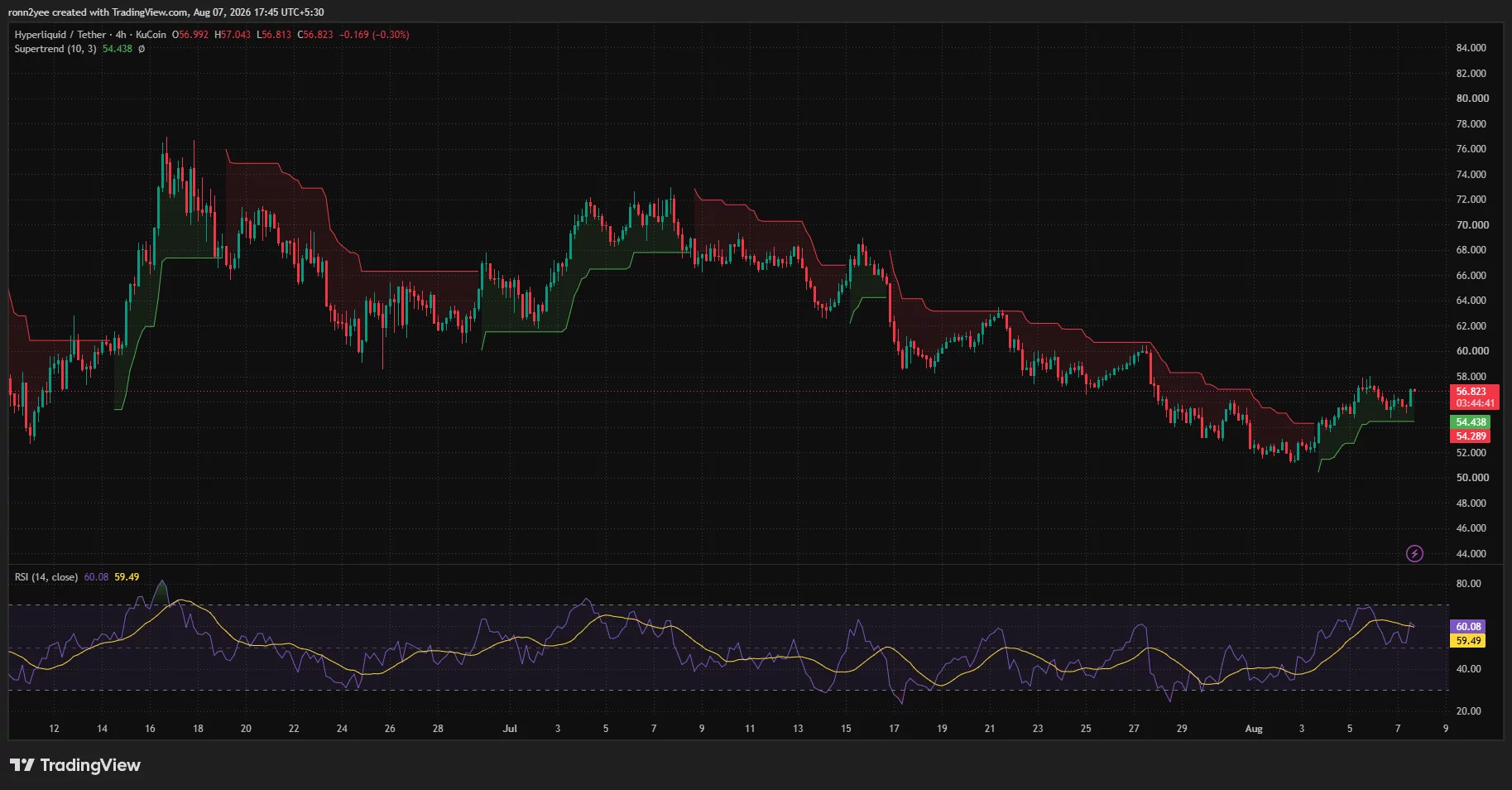
According to data from crypto.news, Hyperliquid (HYPE) price traded near $56.80 on Aug. 7, gaining about 2.5% over 24 hours after recovering from an early-August low around $51.20. The token reached an intraday high near $57.04 before buyers and sellers began competing around the $57 level.
The rebound has lifted HYPE roughly 11% from its weekly low, although its net seven-day gain remained closer to 3.7%. Trading volume stood near $250 million over the previous 24 hours.
The 4-hour chart shows HYPE establishing a sequence of higher lows after defending the $51–$52 region. Price has also moved above the Supertrend indicator, which currently provides dynamic support near $54.44.
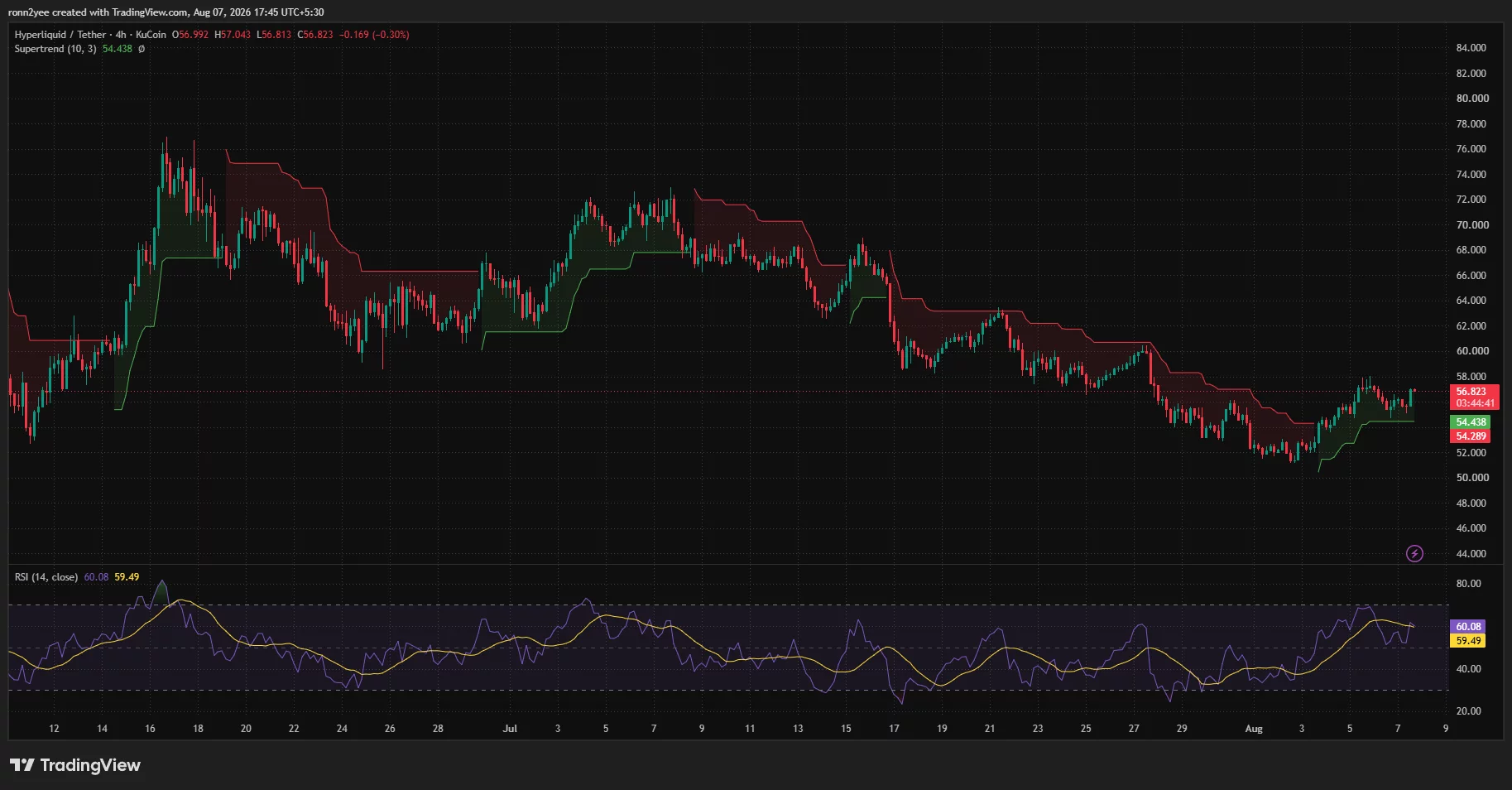
The 4-hour relative strength index stood at 60.08, slightly above its signal average of 59.49. This reading points to improving buying pressure without placing HYPE in overbought territory on the shorter timeframe.
However, the token remains about 26% below its June record near $76.70. The broader chart therefore shows a recovery within a larger correction rather than a confirmed return to its previous uptrend.
Hyperliquid buybacks support the recovery
The latest move followed the release of Hyperliquid’s second-quarter performance figures. The protocol reported $169 million in quarterly revenue and said $141 million was directed toward HYPE buybacks.
Hyperliquid also passed $1 billion in cumulative protocol revenue during the quarter. HIP-3 real-world asset perpetual contracts generated $213 billion in trading volume and represented 32.2% of activity in the category covered by the report.
RWA trading contributed 6.6% of total quarterly revenue, according to the Q2 figures. The data strengthened the view that Hyperliquid is expanding beyond crypto perpetual futures into tokenized commodities, equities and other traditional-market products.
Buybacks can support HYPE by creating recurring demand using protocol revenue. Still, their effect depends on whether platform trading activity and fee generation remain high enough to offset token sales and future supply growth.
HYPE’s fully diluted valuation stood near $54 billion, compared with a circulating market capitalization of approximately $12.6 billion. That gap remains a longer-term risk because only part of the maximum token supply currently circulates.
HYPE price faces $57.30 liquidation wall
The daily chart shows HYPE attempting to move above the upper boundary of a descending channel that has guided price lower since early July. A sustained daily close above $57 would strengthen the breakout case.
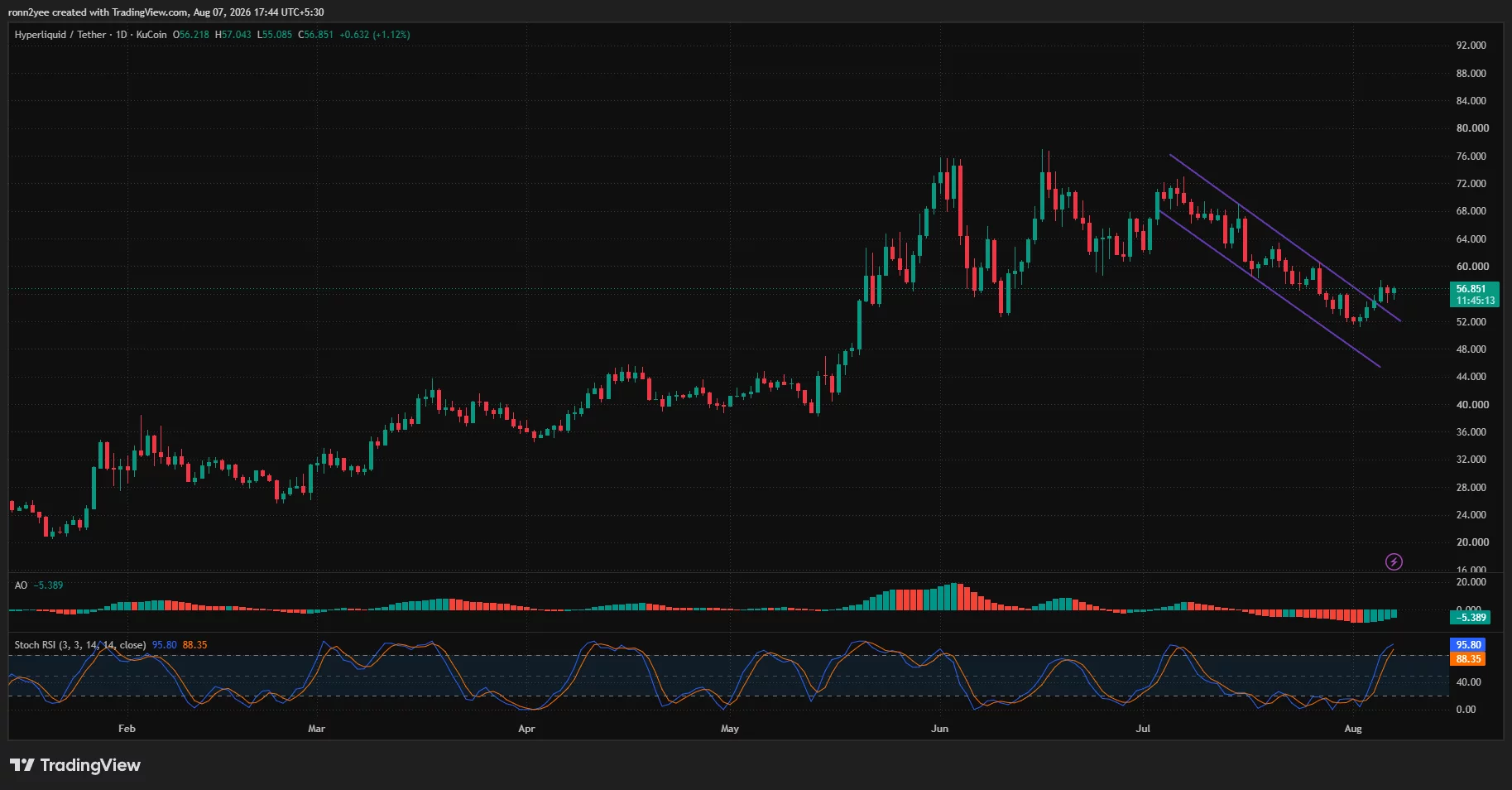
The Awesome Oscillator remained negative at -5.39, showing that the broader momentum structure has not fully turned bullish. Its histogram bars have nevertheless shifted higher, indicating that bearish momentum is weakening.
The Stochastic RSI presents a more immediate warning. Its two lines stood at 95.80 and 88.35, placing the indicator deep in overbought territory. That setup does not guarantee a decline, but it raises the chance of consolidation or a short pullback before another advance.
CoinGlass’ 24-hour liquidation heatmap shows the largest nearby liquidity concentration above the market at approximately $57.20–$57.35. A move through that zone could force leveraged short positions to close and push HYPE toward $58 and $60.
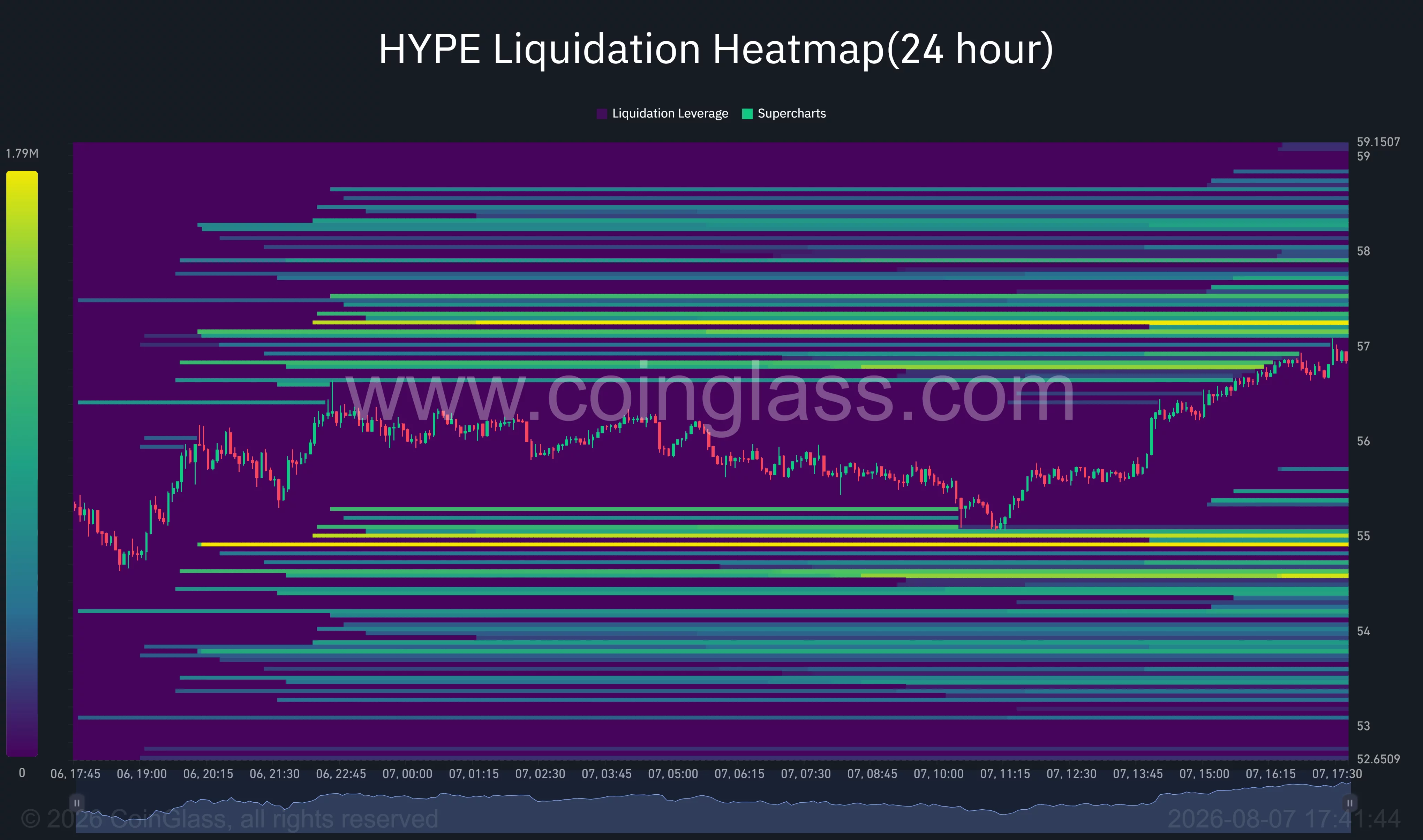
Below the current price, another major liquidation cluster sits around $54.90–$55. Losing that area could accelerate a decline toward the 4-hour Supertrend support at $54.44. The next lower zones are $52 and the recent low near $51.
Analysts Split Over HYPE’s Next Target
Crypto trader Altcoin Sherpa said HYPE may be building a bottom near its current range, although he expected the outcome to depend on wider market conditions.
“The level to watch is still $50; lose that and I think we see low/mid $40s in a slow fashion,” he wrote in an Aug. 6 post.
The analyst added that he remained constructive on HYPE over the longer term. His chart placed a broader demand zone across the low-to-mid-$40 region if the $50 floor fails.
HypeDojo offered a more bullish scenario, comparing the latest $51.50 bottom with the token’s earlier rebound from $52.50 to its June record. The trader projected a possible move toward $80 by the end of August.
That target would require HYPE to clear several resistance areas, including $60, $64, $68 and the previous record around $76.70. The overbought daily Stochastic RSI also suggests that such a move may not develop in a straight line.
US competition adds risk to HYPE outlook
JPMorgan analysts have warned that momentum in HYPE-linked investment products weakened after strong inflows during May and June. A reported 12-session outflow streak reached approximately $29.8 million through Aug. 3.
The bank also pointed to competition from regulated derivatives and prediction-market platforms, according to Blockhead. That risk is particularly relevant in the United States, where regulated venues are expanding access to perpetual-style contracts.
For now, the HYPE price outlook depends on whether buyers can convert the rebound into a confirmed daily channel breakout. A close above $57.30 would open a path toward $60, while rejection and a break below $54.40 would bring $52 and $50 back into focus.
Disclosure: This article does not represent investment advice. The content and materials featured on this page are for educational purposes only.
Crypto World
Hacker Behind Fake 'Vladhood' Token Still Collecting Fees After Robinhood CEO's X Account Hack


Robinhood CEO Vlad Tenev's X account was compromised on Thursday and used to promote a fake memecoin on Robinhood Chain, the company confirmed. That’s the visible half of an operation that, onchain records show, was set in motion hours earlier and designed to profit from the frenzy without ever… Read the full story at The Defiant
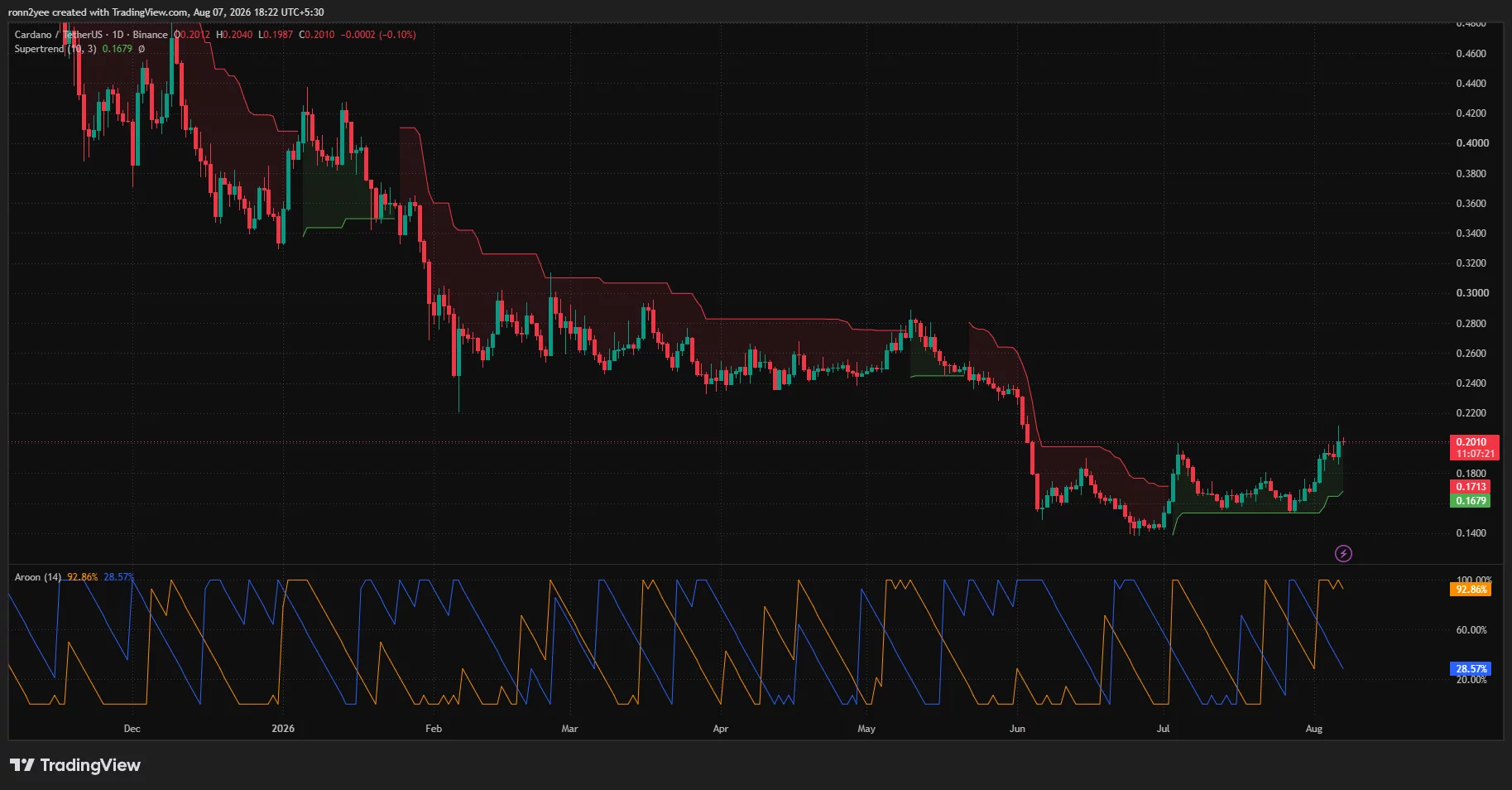
Cardano price traded near $0.20 on Aug. 7 after gaining more than 25% over the past week, with technical momentum and network updates supporting the recovery.
Summary
- ADA gained more than 25% in seven days, briefly trading above $0.21.
- The 4-hour chart places immediate support at $0.195, followed by $0.184.
- A 3-day liquidation heatmap shows dense leveraged positions around $0.196–$0.198.
- Bulls must clear $0.207–$0.210 to extend the rally toward $0.22.
Cardano price holds after its 25% rally
According to data from crypto.news, Cardano (ADA) price was trading around $0.201 at the time of writing after reaching an intraday high near $0.204. ADA briefly crossed $0.21 earlier in the session before sellers pushed it back toward the psychological $0.20 level.
The 7-day advance marked a sharp change from the weak price action seen through much of 2026. ADA had fallen from above $0.45 late last year to approximately $0.14 in June before forming a base.
The daily chart shows that the token has now moved above its Supertrend resistance at $0.171. That indicator has flipped into support, suggesting that the broader recovery remains intact while ADA trades above the $0.168–$0.171 area.
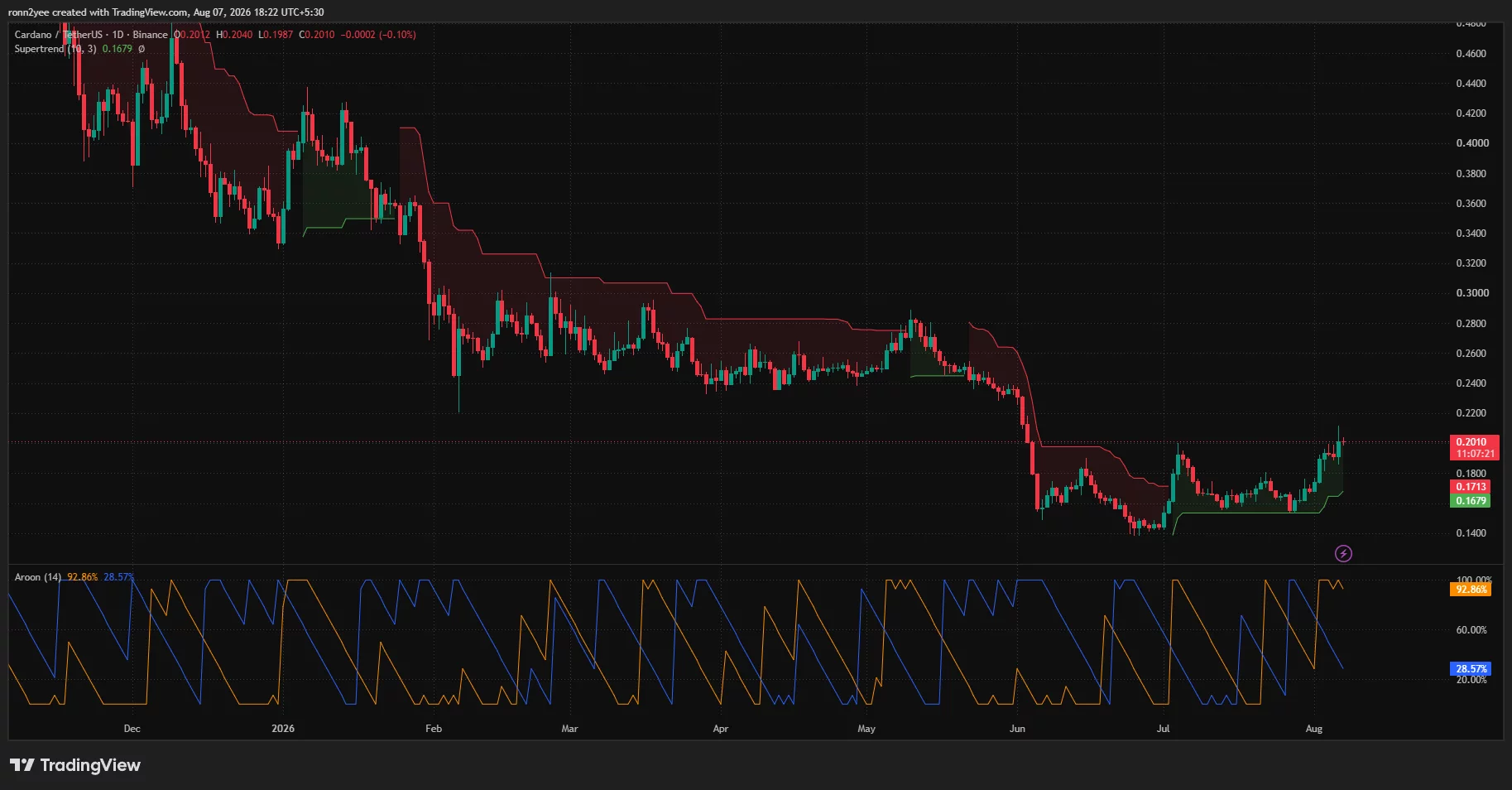
Aroon readings also favor buyers. Aroon Up stood at 92.86%, compared with Aroon Down at 28.57%, showing that recent highs are more dominant than recent lows. However, ADA has not yet established a daily close far above $0.20, leaving the breakout open to a retest.
Network updates and whale demand support ADA
The rally coincided with renewed interest in Cardano’s development roadmap. Intersect said the network had entered the Dijkstra development era following the Van Rossem hard fork in July.
Attention has also turned toward Ouroboros Leios, a planned upgrade intended to increase Cardano’s transaction capacity. A proposed 2.5 million ADA development fund and a Cardano IBC testnet connection with Injective added to expectations for broader ecosystem activity.
On-chain data cited during the rally showed that large holders accumulated roughly 240 million ADA before the breakout. Futures activity also accelerated, with weekly trading volume reportedly rising from about $150 million to nearly $650 million.
That combination of spot accumulation and leveraged positioning helped ADA move through $0.20. Still, a reported decline in open interest and slightly negative funding indicate that some derivatives traders continue to position against further gains.
Fundamental weaknesses also remain. Cardano’s decentralized finance ecosystem holds about $68 million in total value locked, leaving it well behind larger layer-1 networks. That gap raises the risk that price speculation is moving faster than organic activity on the blockchain.
Can ADA hold the $0.20 support level?
The 4-hour chart places ADA inside an ascending channel that began near $0.15 in late July. Price remains above the Bollinger Band midpoint at $0.195, making the $0.195–$0.20 range the first test for buyers.
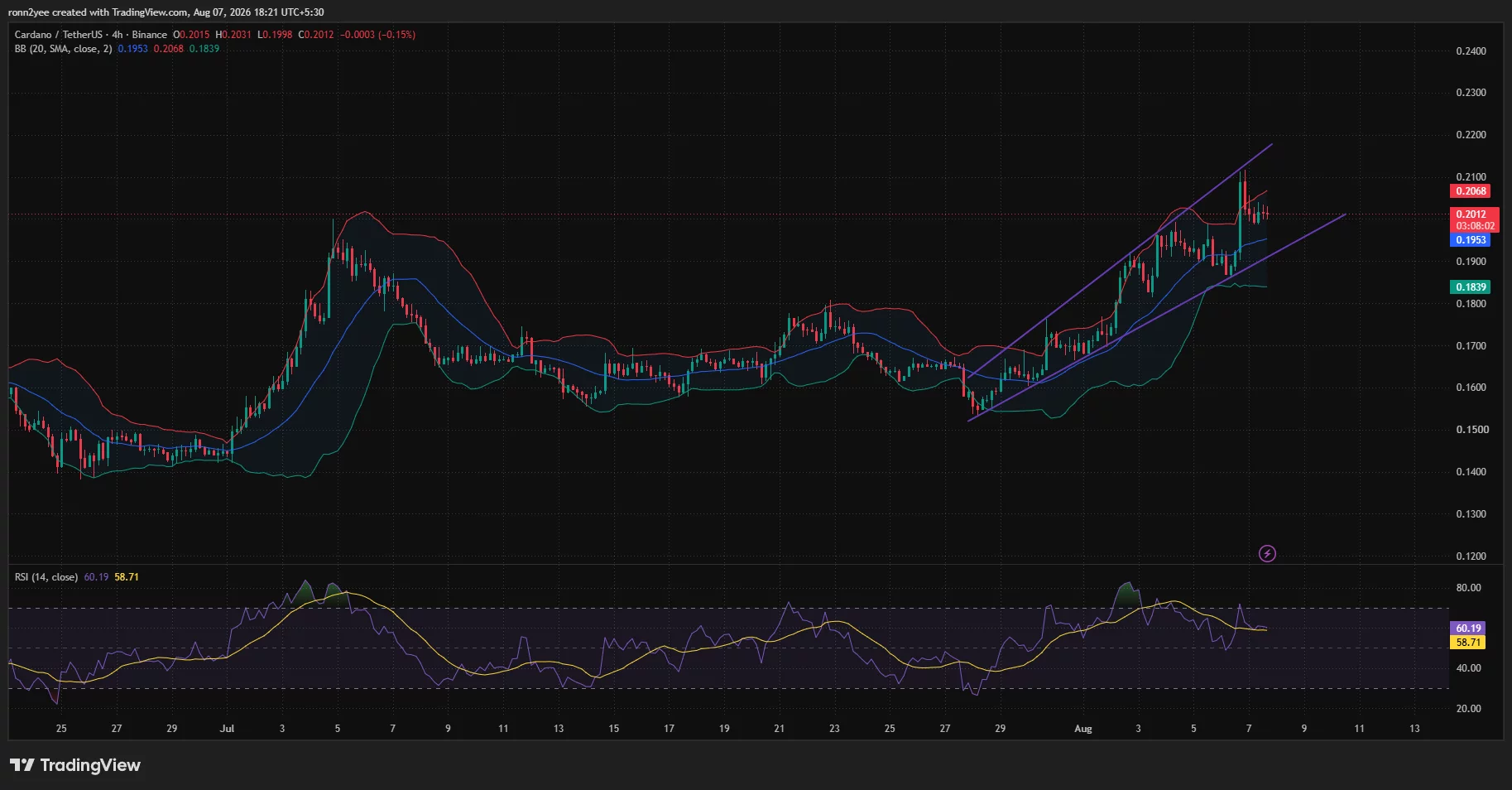
The 4-hour Relative Strength Index stood at 60.19, while its signal line was at 58.71. Momentum remains bullish without reaching the 70 level commonly associated with overbought conditions.
ADA’s upper Bollinger Band sits at approximately $0.207. A close above that level could allow bulls to retest $0.21, where the latest rally met selling pressure. The channel’s upper boundary then points toward $0.218–$0.22.
A decisive move through $0.22 could expose the $0.24–$0.25 range. Rand Group said reclaiming $0.25 would be needed to confirm a broader reversal from Cardano’s yearly downtrend.
“Recovering the key 25 cents support range would trigger the full bullish reversal,” the firm said in an Aug. 7 market post.
The daily structure shows why $0.25 matters. Cardano has recovered from its June low, but it remains within a much larger downtrend after losing more than 90% from its historical high of $3.10.
Liquidation clusters increase volatility risk
CoinGlass’ 3-day liquidation heatmap shows a large concentration of leveraged positions just below the market around $0.196–$0.198. This zone overlaps with the 4-hour Bollinger midpoint, strengthening its role as immediate support.
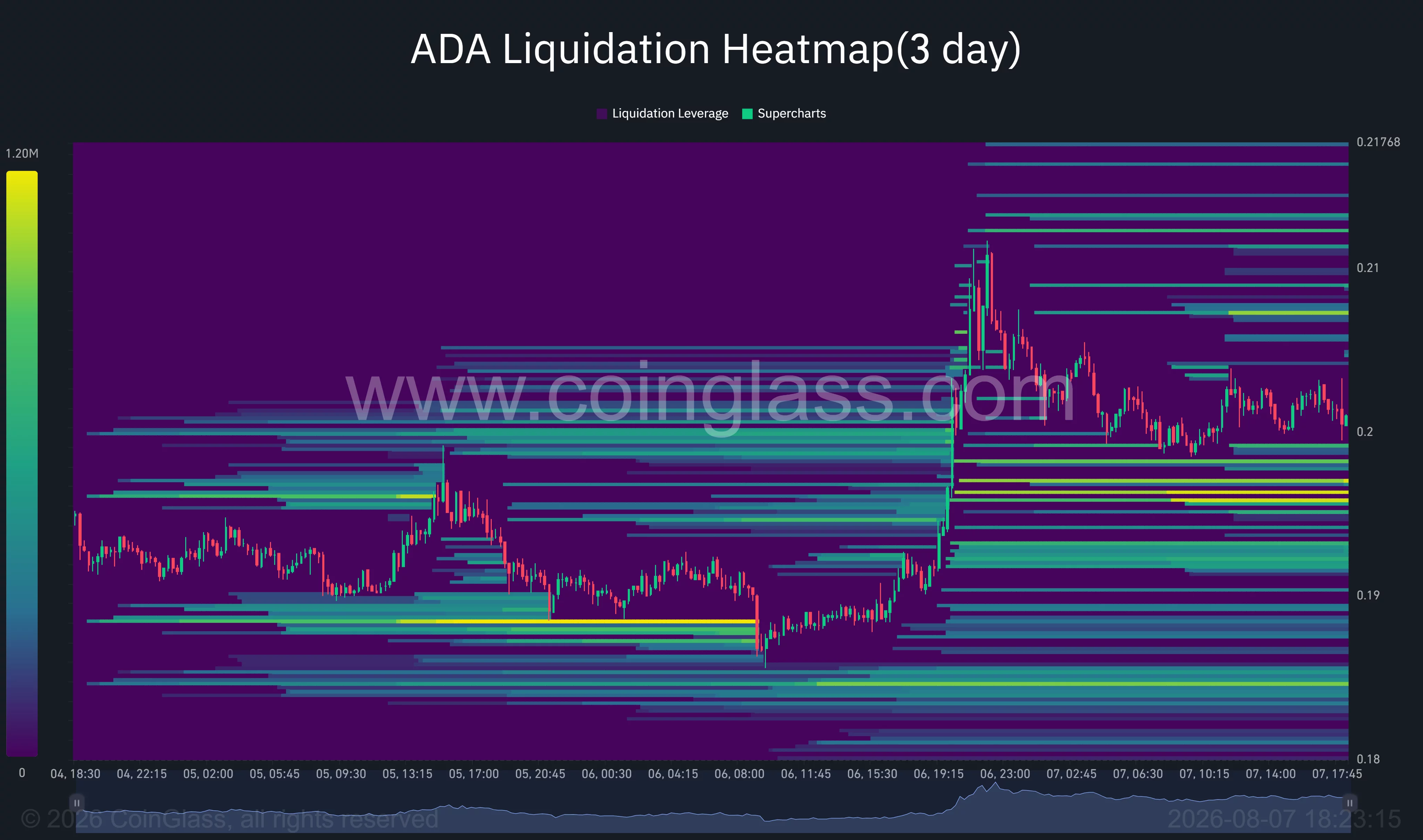
A move below $0.195 could trigger long liquidations and accelerate a decline toward $0.19. The lower 4-hour Bollinger Band sits near $0.184, providing the next major technical support if sellers take control.
Below that, the rising channel would be invalidated, placing $0.171 and the daily Supertrend level near $0.168 back in focus.
Liquidity also sits above ADA around $0.207–$0.210, followed by additional clusters between approximately $0.212 and $0.218. If buyers reclaim $0.207, short liquidations could help drive another test of the weekly high.
For U.S. traders, expectations for future Federal Reserve rate cuts remain a wider market catalyst. Cardano also faces an Oct. 23 regulatory deadline tied to a proposed spot ADA exchange-traded fund, which could keep institutional access and U.S. regulatory expectations in focus.
The immediate outlook depends on whether ADA can convert $0.20 from resistance into support. Holding $0.195 would preserve the 4-hour uptrend, while a close above $0.21 would strengthen the case for $0.22 and eventually $0.25. Losing $0.195 would instead raise the probability of a deeper pullback toward $0.184.
Disclosure: This article does not represent investment advice. The content and materials featured on this page are for educational purposes only.

Ripple’s native token hasn’t really been able to recapture the traction that culminated in July 2025, when it surged to a new all-time high. It has lost its momentum further in the past few weeks, dipping to $1.02 on Friday.
However, this hasn’t shaken out the conviction of popular market analyst EGRAG CRYPTO, who argued once again that the asset is approaching ‘The Chasm,” a make-or-break phase where patient investors are rewarded while short-term traders capitulate.
Big Price Targets Ahead
EGRAG admitted that his previous expectation for $2.00 to act as macro support failed, but he still believes the broader bullish structure remains intact because the asset is now approaching its 100-week exponential moving average (EMA), which has historically acted as major support in previous bear market cycles.
The ideal scenario moving forward would be for XRP to stabilize somewhere between $0.95 and $1.00, which would be a healthy macro retest before the next leg up. However, he acknowledged the possibility of another, more violent nosedive that could take it further south. Nevertheless, EGRAG doesn’t believe the token will dip below $0.80, a level corresponding to the lower boundary of its long-term ascending channel.
The long-term roadmap, though, is what gets the Ripple bulls excited. As usual, EGRAG remains highly optimistic about the token’s future and has outlined some massive targets, including $15, $27, and a mind-blowing $50.
He compared XRP investors to early shareholders of companies such as Amazon, Apple, and Google, and argued that markets often test conviction before rewarding long-term holders. He reiterated his message that investors should not focus on perfectly timing the bottom; instead, they need to remain invested when the next expansion eventually arrives.
Realistically Speaking…
With XRP trading at just inches above $1.00 at the time of the post, pitching long-term targets of up to $50 might sound unrealistic, because it actually is. The current market structure does not support such predictions. Even the most modest one at $15 would require a near-15x surge, and XRP would have to dwarf its current all-time high of $3.65.
Its market cap would near the coveted $1 trillion mark, something that only bitcoin has been able to do so far in the market’s history. To even consider this as possible, XRP and the company behind it would have to experience continued growth, institutional investments, even more regulatory clarity, and a broader market run.
The real question at the moment is not whether XRP can reach double-digit prices – it’s whether these catalysts arrive quickly enough. Nevertheless, the token has a long history of proving doubters wrong and has indeed produced some triple- and even quadruple-digit rallies.
The post XRP to $50? Popular Analyst Says the Long-Term Dream Is Still Alive appeared first on CryptoPotato.


The Office of the Comptroller of the Currency denied Wise's application for a US national trust bank charter, the payments company said Friday, a rare public rejection from a regulator that has spent the past eight months approving trust charters for crypto and fintech firms. Wise shares fell as… Read the full story at The Defiant


Blanket, an independently developed AI tool, is using Kalshi’s regulated event-contract markets to help small businesses identify and hedge operational risks.
Summary
- Blanket analyzes business risks tied to weather, energy prices, tariffs, elections and other events.
- The tool recommends relevant Kalshi event contracts but does not execute trades or hold customer funds.
- Independent fintech entrepreneur Lauris Zminsky developed Blanket, which is not an internal Kalshi product.
- The launch comes as Kalshi expands its institutional services and strengthens its market-surveillance controls.
Blanket matches business risks with Kalshi contracts
Blanket is designed to evaluate the risks facing a business and identify Kalshi contracts that may provide a hedge against specific outcomes. Potential exposures include unusual weather, changes in energy costs, new tariffs, and election results that could affect revenue or operating expenses.
A small business could provide information about its operations and the events most likely to disrupt them. Blanket’s AI system would then analyze those exposures and recommend available contracts connected to the relevant outcome.
The tool does not automatically place orders, control customer accounts, or handle funds. Business owners retain responsibility for reviewing the recommendations and deciding whether to trade through Kalshi.
This distinction also separates Blanket from Kalshi itself. Zminsky built the tool independently using markets available on Kalshi’s platform. Kalshi provides the underlying event contracts and regulated trading infrastructure, but Blanket is not one of its internal products.
How event contracts can hedge operational risks
Event contracts are derivatives whose payouts depend on whether a specified event occurs or a defined value is reached. The Commodity Futures Trading Commission cites corporate earnings, snowfall levels, economic indicators and hurricane damage as examples of outcomes that can underpin these contracts.
That structure can allow a business to take a position that may offset losses caused by an external event. For example, a company exposed to high energy costs could use a contract tied to future energy prices. A weather-dependent business could consider a contract linked to snowfall, temperature, or storm activity.
Blanket aims to make that process more accessible by using AI to connect a company’s stated risks with relevant markets. Small firms may lack the dedicated risk teams employed by larger corporations, making it harder to identify suitable hedging instruments.
However, an event contract does not provide the same coverage as an insurance policy. Its payout depends on the contract’s specific terms, while the recommended position may not fully match the business’s actual financial loss. AI-generated recommendations also require human review.
Kalshi pushes further into institutional risk management
Kalshi operates as a CFTC-designated contract market, a status it received in November 2020. Its role in Blanket gives the independent tool access to contracts traded through a federally regulated U.S. venue.
The development follows Kalshi’s move to expand beyond retail prediction trading. As crypto.news reported on Aug. 4, the platform partnered with compliance technology provider Comply to help financial firms monitor employee activity involving event contracts.
The planned integration will place Kalshi trades within workplace surveillance systems already used to track stocks, bonds and cryptocurrencies. Employers will be able to identify restricted positions or activity that may involve material non-public information.
Kalshi also expects the compliance system to cover its planned perpetual futures products when they become available.
Market oversight remains a key issue
The focus on surveillance follows enforcement cases involving the misuse of prediction markets. Crypto.news reported that former U.S. Representative George Santos agreed to return $17,569.98 in gains, pay a $17,500 civil penalty and accept a three-year trading ban in a CFTC settlement involving Kalshi contracts.
Kalshi had referred Santos’ activity to regulators after he traded on whether he would attend President Donald Trump’s State of the Union address while making public statements related to the outcome. Santos neither admitted nor denied the CFTC’s findings.
Blanket’s launch points to another potential use for prediction markets: commercial risk management. Its adoption will depend on whether its recommendations closely match the financial exposures of small businesses and whether users understand the limits of event-contract hedges.


Odos will shut down all services permanently on July 30, the DEX aggregator's operating company said Thursday, ending a four-year run in which it routed more than $104 billion in trades. "To the Odos community: after much consideration, the operating company behind Odos is winding down its… Read the full story at The Defiant


BTCPay Server has urged users to install version 2.4.2 immediately after discovering that attackers are actively exploiting a critical vulnerability that could lead to stolen funds.
Summary
- BTCPay Server v2.4.2 contains the required security update.
- The vulnerability is already being actively exploited, according to the project.
- Operators unable to update should shut down their servers immediately.
- BTCPay Server has not disclosed the attack method or total financial losses.
BTCPay Server tells users to install v2.4.2
BTCPay Server issued the warning through its official X account on Aug. 7, describing the vulnerability as critical and saying successful exploitation could result in the loss of funds.
The project instructed server administrators to open the Admin Dashboard and navigate to Server, Maintenance and Update. Operators should then confirm that the version number displayed in the server footer reads 2.4.2.
“There is a critical vulnerability being actively exploited on BTCPay Server, which can result in the loss of funds,” the project said.
Users who cannot complete the update immediately have been told to turn off their BTCPay Server until the patched version can be installed. The measure is intended to block further unauthorized access to servers that may remain exposed.
BTCPay Server did not identify which previous versions are vulnerable. It also did not disclose how attackers are gaining access, how many servers have been compromised, or whether any losses have been confirmed.
Critical flaw threatens self-hosted Bitcoin payments
BTCPay Server is an open-source payment processor that lets merchants accept Bitcoin and Lightning Network payments through infrastructure they control. Unlike custodial payment platforms, operators are responsible for maintaining and securing their own installations.
That structure reduces reliance on a centralized payment provider but places the responsibility for software updates on individual merchants and server administrators. A compromised installation could expose payment operations or other sensitive server functions, depending on the vulnerability’s reach.
The project’s recommendation to shut down systems shows the urgency of the threat. Operators should not leave an affected server online while waiting for a convenient maintenance period because BTCPay Server has confirmed that exploitation is already occurring.
Users should obtain the update through the server’s official maintenance interface and verify the 2.4.2 version string. The project has not advised users to rely on third-party downloads or unofficial fixes.
Bitcoin infrastructure faces wider security review
The disclosure follows another recent incident involving Bitcoin payment infrastructure. As reported by crypto.news, Zeus Wallet took its infrastructure offline after containing a cyberattack and began auditing its systems before restoring services.
Zeus said no customer funds were lost or placed at risk. It also said its investigation had not identified a vulnerability in Lightning node software. No evidence currently indicates that the Zeus incident and the BTCPay Server vulnerability are connected.
Security reviews have expanded across the Bitcoin ecosystem following a series of recent attacks. Crypto.news reported on Aug. 6 that the volunteer Bitcoin Red Team had found 4,962 potential issues while reviewing 390 Bitcoin-related projects.
The group classified 720 of those findings as high or critical severity. Its work covers Bitcoin wallets, cryptographic libraries and infrastructure software, although it did not publicly identify projects with unresolved critical flaws.
What BTCPay Server operators should do next
BTCPay Server operators should treat the upgrade as an emergency security action rather than a routine software update. Servers should remain offline if administrators cannot confirm that version 2.4.2 has been installed.
Merchants may also need to review server activity for signs of unauthorized access. However, BTCPay Server has not yet published indicators of compromise or technical details that operators could use to determine whether their systems were targeted.
Further information may follow once more users have installed the patch and public disclosure no longer increases the risk to unpatched servers. Until then, the project’s guidance remains limited but direct: update to v2.4.2 or shut down the server.
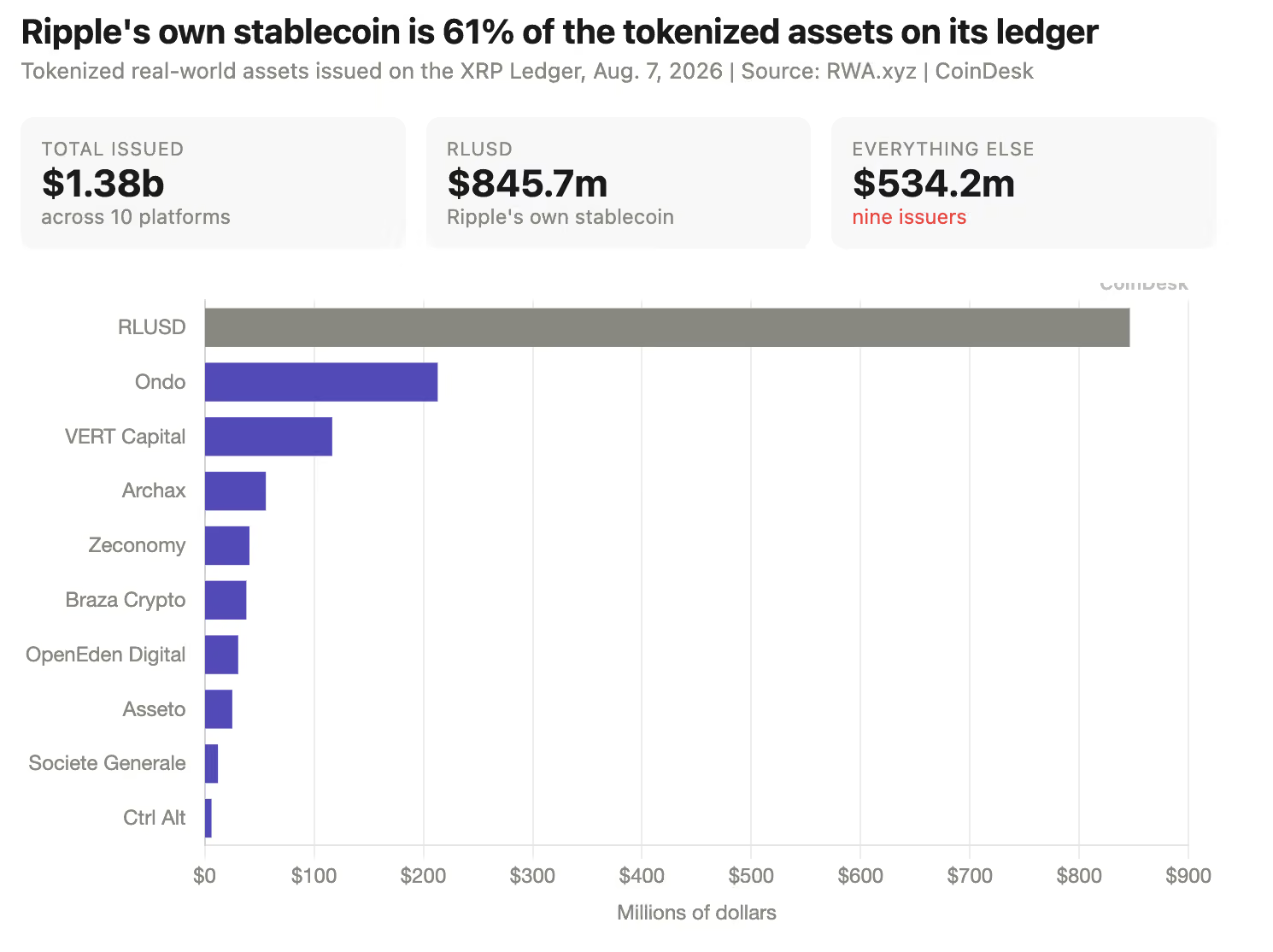
There is already money on the chain for the feature to serve. Onchain data aggregator RWA.xyz tracks about $1.38 billion of distributed real-world assets on XRPL, including $845.7 million of RLUSD. Ondo accounts for another $212.6 million, followed by VERT Capital at $116.1 million and Archax at $55.4 million. Societe Generale sits further down the table at $11.6 million.

That leaves more than $530 million of tracked tokenized assets outside RLUSD, though the market remains concentrated in a handful of issuers.
Confidential Transfers stays narrow in its first version. Holders have to opt into the encrypted format, and it currently works for direct MPT payments between accounts. It does not cover trades on XRPL’s built-in exchange, escrow or checks.
The other five are aimed at the same audience. Batch can package as many as eight transactions together, including an all-or-nothing mode where every step succeeds or none does. Sponsor lets one account cover another’s fees and reserve requirements, removing the need for a new user to hold XRP before transacting.
Permission Delegation lets an account authorize another party to submit only specified transaction types, giving a fund administrator limited authority without handing over full control. Dynamic MPT lets issuers change certain properties of a token after issuance.

Terror police investigating Widdecombe death reopen old probe

New Persona Engine and Passing Mechanics Mark a Big Leap Forward for EA

Bybit Wins Court Support to Trace $1.5B North Korea Hack Funds


-

 Politics5 days ago
Zack Polanski: an incitement to murder Nigel Farage?
-

 Crypto World7 days ago
MicroStrategy Post-Earnings CLARITY Act Push Could Add New Catalyst for Its Stock
-

 Crypto World7 days ago
XRP Ledger v3.3.0 brings five institutional features
-

 Crypto World6 days ago
Crypto PAC spending tops $2M in Michigan House race
-

 Business5 days ago
DTCR: Deleveraging And A Hedge Fund Collapse Point To A Possible AI Bottom
-

 Tech6 days ago
ESET tracks rise in malicious AI skills and adaptable malware
-

 Sports7 days ago
France Cricket implodes: letters hidden in a drawer and a board at war
-
Crypto World6 days ago
XRP Ledger urges node upgrade after manifest flood
-

 Crypto World7 days ago
Moneyflip CEO charged in $40K murder-for-hire plot
-

 Fashion16 hours ago
Frugal Friday’s Workwear Report: Cap-Sleeve Pointelle Crewneck Sweater
-

 News Videos6 days ago
Financial Crash Expert: The 90-Day Collapse Timeline They Are Desperately Hiding.
-

 Sports2 days ago
Jordan Coyle & Cordiamo take Laya Arena Stakes at RDS
-
 Crypto World4 days ago
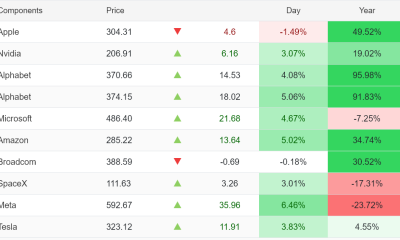
US Tech Stocks See Largest 5-Week Inflow in History: Can Nasdaq Break Its Downtrend?
-
 NewsBeat6 days ago
Tourist plane on sightseeing flight in Peru crashes into a field, killing all 13 people on board
-

 NewsBeat7 days ago
Arsenal reach full agreement with Newcastle over Bruno Guimaraes transfer | Football
-
 Business2 days ago
US stocks: Dow closes at record on Mideast optimism; SpaceX, AMD drag Nasdaq
-

 Tech6 days ago
Page Not Found | WIRED
-
 NewsBeat6 days ago
Bikini-clad Jennifer Aniston, 57, kisses hypnotist boyfriend Jim Curtis as they enjoy a romantic getaway aboard a luxury yacht in Spain
-

 Politics2 days ago
Reform UK And Greens Sink To Lowest Favourability Ratings To Date
-

 Fashion11 hours ago
Weekend Open Thread: Mattifying Sunscreen
You must be logged in to post a comment Login