
Business
5 Key Facts You Should Know About the Research


Scientists at Stanford University and the Arc Institute have used artificial intelligence to design entirely new viruses from scratch, a scientific first that has generated both excitement over potential new treatments for drug-resistant infections and renewed concern about how quickly biotechnology is outpacing the safeguards meant to govern it. Here are five key facts to understand about the breakthrough, published this week in the journal Science.
1. This is the first time AI has designed a functional virus from scratch, not just copied one
For years, scientists have been able to synthesize viruses in the lab, but that work relied almost entirely on replicating known pathogens or their existing variants. The new research marks a genuine departure from that approach. Using AI models called Evo 1 and Evo 2, foundational systems developed specifically for computational biology, researchers trained the AI on genetic sequences drawn from millions of organisms across the natural world, including animals, plants, microbes, bacteria and viruses. That training allowed the models to learn complex evolutionary patterns, including how genes are typically organized and the biological constraints that keep an organism functional, and then apply that knowledge to generate entirely novel viral genomes rather than simply copying an existing one.
2. The viruses only target bacteria, not humans, by design
Researchers deliberately worked with bacteriophages, viruses that infect only bacteria, rather than pathogens capable of infecting humans, animals or plants. Bacteriophages have relatively small, comparatively simple genomes that are easier to synthesize and manipulate under controlled laboratory conditions. According to the research team, the AI models were further trained specifically on genetic sequences from thousands of viruses in the same broad family as Phi X-174, a well-studied bacteriophage capable of infecting the bacterium E. coli, while deliberately excluding any viral sequences capable of infecting humans, animals, plants or fungi from that training process. The goal was not to reproduce Phi X-174 itself, but to use it purely as a reference point for generating genuinely new genomes with the biological architecture needed to infect the same bacterium.
3. Only 16 of 300 tested genomes actually worked
The gap between AI-generated candidates and functional, real-world viruses proved enormous. The AI models generated hundreds of thousands of candidate genomes, which researchers narrowed down to roughly 300 considered most likely to be functional based on factors including gene organization and the presence of regulatory elements. Each of those 300 candidates was then physically synthesized, molecule by molecule, in the laboratory and introduced into E. coli bacteria to test whether it could produce a working virus. Of those 300 synthesized genomes, only 16 actually gave rise to fully functional bacteriophages, each featuring previously unpublished genetic sequences, different genes, new regulatory elements, and in some cases different genome sizes altogether compared with anything found in nature. The 16 successful viruses also behaved differently from one another, with some infecting bacteria more quickly and others showing varying replication abilities.
4. The AI-designed viruses overcame bacterial resistance in lab tests
Beyond simply confirming the viruses could function, researchers tested their ability to fight drug-resistant bacteria directly, a key question given bacteriophages’ potential as an alternative to antibiotics. In that experiment, scientists exposed strains of E. coli that had already developed resistance to Phi X-174 to a mixture of the newly AI-designed phages alongside a comparison mixture of natural phages similar to Phi X-174. The AI-generated viruses were able to rapidly overcome the bacteria’s existing resistance and establish infection, a result the study’s authors said demonstrates a path toward AI-generated phage therapies capable of targeting rapidly evolving bacterial pathogens, potentially offering a new tool in the ongoing fight against antibiotic-resistant infections.
5. The breakthrough has reignited concerns about biosecurity and AI oversight
While the achievement offers genuine promise for treating drug-resistant infections, it has also renewed alarm among biosecurity experts about the pace at which AI-driven genome design is advancing relative to the regulatory frameworks meant to govern it. Moritz Hanke, a researcher at the Johns Hopkins Center for Health Security, warned about the underlying dual-use risk directly, noting that a similar genome language model could in principle be asked to design something considerably more dangerous, such as an influenza genome modified to be more infectious or lethal. Speaking separately to The New York Times, Hanke said there remains what he described as a huge disconnect between the speed at which the underlying science and technology are advancing and the development of regulatory frameworks capable of keeping pace with it.
A Debate That Predates This Study
Concerns over AI’s potential role in biological weapons development are not new. A study published roughly three years ago by the Rand Corporation warned that even the AI systems available at that time had the capacity to help refine the planning and execution of attacks using biological weapons. Rand separately cautioned that the speed at which AI systems continue to evolve routinely outpaces governments’ ability to develop and implement effective regulatory oversight, a warning that has only grown more pointed as genome-design capabilities like those demonstrated in this new study have continued to advance.
What the Research Means Going Forward
Researchers involved in the work say the approach could eventually support the development of highly personalized bacteriophage treatments capable of evolving nearly as quickly as the bacterial pathogens they’re designed to fight, a potentially significant advance given the growing global public health threat posed by antibiotic-resistant infections. At the same time, the study’s authors have framed their work primarily as a proof of concept for AI-assisted phage therapy rather than a template for broader genome engineering, even as the broader scientific and policy communities continue grappling with how to balance the technology’s genuine medical promise against the biosecurity risks it simultaneously introduces.
With the research now published and drawing significant attention across both the scientific and biosecurity communities, calls are likely to grow for closer collaboration between AI developers, biologists, policymakers and regulators to establish clearer safeguards around genome language models before the underlying capability advances further. For now, the study stands as both a genuine scientific milestone in the fight against drug-resistant bacteria and a fresh reminder of the governance challenges facing increasingly powerful AI-driven biological design tools.


SharkNinja Keeps Eating

Australia unions push on with strike at BHP’s Port Hedland iron ore operations
Business
Martha Stewart’s Claim About Meghan Markle Gossiping at Dinner Party Draws Pushback From Host

Martha Stewart’s account of a recent dinner party encounter with Meghan Markle is facing a direct challenge from the person who hosted the event, who says Stewart’s version of what the Duchess of Sussex discussed that night is simply not accurate.
Stewart, 85, told People in a new interview that she and Meghan were both guests at a dinner party in California shortly after the Duchess returned from a trip to Europe that included a reunion with King Charles III. “She had just gotten back from the palace,” Stewart said. “I didn’t talk to her really more than to say a couple words, but I know she was talking about it.”
A Host Offers a Different Account
That characterization did not sit well with the person who organized the dinner, who told Page Six that Stewart’s recollection of events was inaccurate. “I sat next to Meghan at the dinner party and this account of what happened is simply untrue,” the host said. “Meghan didn’t talk about her European vacation other than to say the family had a great time.” The host did not elaborate further on what else was discussed that evening.
According to a separate account relayed to People, the same host said Meghan has long admired Stewart and had enjoyed the brief opportunity to meet her at the dinner, a detail that suggests the interaction, whatever was actually said, was a positive one from Meghan’s side regardless of the disputed specifics.
What Stewart’s Comment Actually Referred To
Stewart’s reference to Meghan having “just gotten back from the palace” appears tied to Meghan and Prince Harry’s broader European trip this summer, during which the couple and their two children, Archie, 7, and Lilibet, 5, met with King Charles and Queen Camilla on July 10 at Highgrove House, the king’s country estate in England. Notably, the reunion took place at Highgrove rather than at any formal royal palace, a distinction some outlets have pointed to in questioning how literally to interpret Stewart’s “palace” reference. Newsweek reported that Meghan was actually asked about her European vacation more broadly during the dinner conversation, rather than specifically about the Highgrove meeting, suggesting some headlines characterizing the exchange as Meghan “boasting” about the royal reunion may have overstated what Stewart’s comments actually established.
The Highgrove gathering marked the first time Charles had seen his American-based grandchildren in person since 2022, when the family last gathered for Queen Elizabeth II’s Platinum Jubilee celebrations. The king, who has continued treatment for cancer, met with the family alongside Camilla in what royal commentators described as a significant, if carefully managed, step toward repairing years of estrangement between Harry, Meghan and the wider royal family.
Meghan and Harry’s broader summer travels extended beyond the United Kingdom as well. According to Town & Country, the family also spent time in Melides, Portugal, sometimes described as the “Hamptons of Portugal,” a destination the Sussexes have visited regularly in recent years and reportedly purchased a home in back in 2024. A source told People in late July that Harry and Meghan are drawn to Portugal specifically because it allows Archie and Lilibet to, in the source’s words, “simply be kids.”
Stewart Also Weighed In on Meghan’s Netflix Show
Beyond the disputed dinner party account, Stewart used the same interview to offer a pointed assessment of Meghan’s broader career transition, referencing the Duchess’s Netflix lifestyle series “With Love, Meghan,” in which Meghan shares cooking, baking, decorating and entertaining tips. “If you’re an actress, it’s hard to then transition to a princess and then from a princess into a homemaking guru on a television show,” Stewart said. “It doesn’t sort of follow. So go from there.” The remark, delivered by one of the most established figures in the American homemaking and lifestyle media space, was widely interpreted as at least mildly skeptical of Meghan’s pivot into the same general content category Stewart herself has built a decades-long career around.
A Story That Fits a Familiar Pattern
Newsweek noted that the sequence of events, an initial celebrity claim followed by a competing account from someone else present, echoes a recurring pattern in coverage of Meghan and Harry dating back years. The outlet pointed to Harry’s own remarks during a 2023 interview promoting his memoir “Spare,” in which he said that every time he had tried to address issues privately, there had been “briefings and leakings and planting of stories” against him and his wife, criticizing what he characterized as the royal family’s informal motto of “never complain, never explain.” Whether or not this particular dinner party dispute reflects that same dynamic, the underlying pattern, dueling and often contradictory anonymous or semi-anonymous accounts of private social interactions involving Meghan, has recurred repeatedly across royal media coverage over the past several years.
A History of Disputed Claims
This is not the first time a report involving Meghan has been directly and publicly disputed by another party close to the situation. Kensington Palace has previously issued rare, direct denials of specific claims about Meghan, including a 2018 report alleging a heated argument between Meghan and Catherine, Princess of Wales, ahead of Meghan’s wedding, which a palace spokesperson at the time flatly denied, saying, “This never happened.” That history of competing narratives, official or informal, underscores the difficulty of establishing a fully agreed-upon account whenever conflicting versions of a private social interaction involving Meghan become public.
What Remains Unclear
For now, the central factual dispute, whether Meghan discussed her European trip and royal reunion at length during the California dinner, as Stewart suggested, or only briefly mentioned that the family had a good time, as the event’s host maintains, remains unresolved, with both accounts attributed to named or clearly identified sources rather than anonymous insiders. Neither Meghan nor her representatives have publicly commented on either version of events, and it remains unclear whether any further clarification will be offered as the story continues to circulate across entertainment and royal media coverage this week.

Typhoon Dolphin hits Japan’s Okinawa, China shuts ports ahead of landfall

The Big Four Recession Indicators: Employment
Business
Microsoft Quietly Deletes 32GB RAM Recommendation for Windows 11 Amid Soaring Memory Prices

Microsoft has quietly removed official documentation recommending 32 gigabytes of RAM for Windows 11 gaming PCs, a reversal that comes as the company simultaneously works to optimize the operating system for devices with far less memory, amid a sharp rise in DRAM prices affecting the broader PC industry.
The removal was first spotted by the outlet Windows Latest, which had previously covered Microsoft’s earlier guidance on the topic. A support document titled “How to optimize your gaming PC setup,” originally published to Microsoft’s Windows Learning Center on Nov. 28, 2025, is now gone, with its web address redirecting users straight to the Learning Center’s homepage rather than displaying the original content.
What the Deleted Guidance Said
The now-removed documents had described 32 gigabytes of RAM as the “no-worries zone” for gaming PCs running Windows 11, positioning it as the ideal configuration for serious players running demanding titles or heavy game modifications. A related document, first spotted by Windows Latest in February, similarly told users that 16 gigabytes of RAM was “plenty for most games,” while 32 gigabytes was framed as “ideal for serious players who run the most demanding titles or use heavy mods.” That same document also promoted Microsoft’s Copilot+ PCs as a convenient shortcut for gamers, describing the devices as pre-configured with CPUs, GPUs and thermal designs tuned specifically for gaming.
Both documents have now been deleted in full. According to Windows Latest, there is no trace of the November document even in the Internet Archive’s Wayback Machine, suggesting the removal was thorough. Microsoft also eliminated separate references recommending Copilot+ PCs specifically for gaming purposes from the Learning Center.
A Reversal Under Public Pressure
This is not the first time Microsoft has walked back this particular recommendation. The company initially removed a version of the 32-gigabyte guidance in May, following what multiple outlets described as significant backlash from the gaming community across tech forums and social media once the original recommendation circulated widely. That May removal addressed a February document, but a separate document from November 2025 containing similar guidance remained live until this week’s more comprehensive cleanup, which finally eliminated all remaining references to the 32-gigabyte recommendation from Microsoft’s public-facing materials.
The Real Driver: A Global Memory Price Surge
The documentation changes come amid a dramatic spike in memory prices tied to surging global demand for the chips used in artificial intelligence data centers. According to reporting on the shift, current market prices now exceed $250 for 32 gigabytes of DDR4 memory and more than $400 for the same capacity in DDR5, costs that have made high-capacity memory configurations considerably more expensive for both everyday consumers and PC manufacturers building new systems.
That price pressure has already reshaped the broader PC hardware market. According to data from research firm IDC, global PC shipments fell 4.9% year over year during the second quarter of 2026, a decline the firm attributed in part to rising memory costs affecting consumer purchasing decisions across the industry. In response to that shifting market, Microsoft has reintroduced entry-level hardware configurations with just 8 gigabytes of RAM, including new Surface Pro 12 models, a move that stood in obvious tension with the company’s own documentation elsewhere recommending 32 gigabytes as the ideal configuration for a good Windows 11 experience.
Microsoft’s New Strategy: Software Optimization, Not More Memory
Rather than continuing to steer consumers toward buying more physical RAM, Microsoft has pivoted its public messaging toward software-based efficiency improvements instead. The company has confirmed it is undertaking engineering efforts specifically aimed at reducing Windows 11’s baseline memory footprint, targeting optimizations across system processes, WinUI 3 components and background services, with the stated goal of making the operating system run responsively even on devices with just 8 gigabytes of RAM. Microsoft has said it plans to deliver memory-footprint improvements to key features and applications by the end of the year, changes the company says should benefit users across all hardware tiers, not just budget configurations.
A Message That Undercuts Itself
Despite the documentation removal, several outlets covering the story have noted that Microsoft’s underlying technical reality hasn’t actually changed: Windows 11 still generally performs best with more memory, and 32 gigabytes remains a genuinely strong configuration for gamers and power users who want a smooth experience for years to come. What has changed is Microsoft’s willingness to publicly recommend that configuration at a moment when doing so runs directly counter to the company’s own push to sell more affordable, lower-memory hardware. As one outlet covering the change put it, recommending 32 gigabytes as an ideal baseline on one official page while actively marketing brand-new 8-gigabyte Surface laptops elsewhere created an increasingly awkward and contradictory message for consumers trying to make informed purchasing decisions.
A Pattern of AI-Generated Documentation Under Scrutiny
Adding to the controversy, some reports have suggested the original 32-gigabyte recommendation documents may have been produced using a large language model as part of Microsoft’s broader Learning Center content strategy, a section of the company’s website used to publish guides and marketing materials that tend to rank well in search engine results. That detail has fed into broader skepticism among some critics about the reliability of AI-assisted technical guidance published by major technology companies, particularly when that guidance later proves to be at odds with the company’s own commercial strategy.
With the 32-gigabyte recommendation now fully scrubbed from Microsoft’s official channels and the company continuing to push forward with its memory-optimization engineering efforts, attention is likely to shift toward whether those software improvements can meaningfully close the gap between Windows 11’s real-world performance on lower-memory devices and the more robust experience users have historically expected from higher-RAM configurations. In the meantime, consumers who built or purchased PCs based on Microsoft’s now-deleted guidance may find themselves holding hardware that no longer matches the company’s current recommended configuration, even as the underlying technical case for more memory, according to reviewers, remains largely unchanged.


EA Sports’ Madden NFL 27 has arrived carrying some of the loftiest promises the football simulation series has made in years, and early reviews of the game suggest the studio may have actually delivered on them, marking what several outlets are calling the biggest step forward for the franchise in recent memory.
Developed by EA Orlando, Madden NFL 27 released early through its Deluxe Edition on Aug. 6, with the standard version set to follow on Aug. 13 across PlayStation 5, Xbox Series X and S, Nintendo Switch 2 and PC through the EA app, Steam and Epic Games Store. A separate Madden Arcade Edition, built specifically for the platform rather than ported down, is also coming to Apple Arcade.
A New Engine Built Around Player Personality
The centerpiece of this year’s release is the Persona Engine, a new underlying system EA has described as the biggest change the studio has ever made to player behavior, negotiations, weekly management, news and free agency. Rather than treating every player as simply a collection of numerical attributes, the Persona Engine assigns each NFL athlete in the game a distinct personality profile that shapes their motivations, demands and in-game reactions. According to game previews, a pocket passer with a high-composure persona will behave differently in a two-minute drill compared with a scrambling quarterback carrying a risk-taking profile, even if the two players carry similar raw statistical ratings, a design goal aimed at making star quarterbacks feel like genuinely distinct individuals rather than interchangeable stat blocks.
Reworked Passing Takes Center Stage
Early hands-on impressions have singled out the game’s reworked passing mechanics as an immediate, noticeable improvement. A new Timing-Based Catch mechanic gives players direct control over contested-catch situations: after throwing to a receiver, holding down the catch button brings up a meter above the receiver’s head, adding a layer of skill-based precision to 50-50 balls that reviewers say elevates the fidelity of tight coverage windows compared with previous entries in the series. EA has also touted new contested catch interactions more broadly, alongside reworked short-yardage mechanics and improvements to defensive back and receiver battles during route coverage.
One reviewer for GameBastion, writing under the byline Wil, described the early experience in strongly positive terms, noting that from the very first pregame animation, Madden NFL 27 carried a presence not felt in the series for some time. The reviewer wrote that the reworked passing game felt instantly impactful thanks to the new timing-based mechanic, and concluded that, compared with Madden NFL 25, “this is simply a straight up better game than Madden 25, both on the field and off of it.” The review noted that while only a few hours had been logged so far ahead of a fuller assessment, early impressions already surpassed the previous year’s title, adding that there remains room for improvement, as there always does with the franchise, but calling the overall leap in presentation, in-game action and Franchise mode difficult to overstate.
Franchise Mode Gets Renewed Attention
Much of the excitement surrounding this year’s release centers on improvements to Franchise mode, which multiple previews describe as receiving its most significant overhaul in years thanks to the Persona Engine’s influence on free agency, contract negotiations and week-to-week team management. According to early impressions, every snap, roster move and game-day decision now carries added weight, with player tendencies and personality profiles factoring meaningfully into strategic planning in a way previous Madden entries have not matched. Reviewers have noted that Superstar mode and Madden Ultimate Team received comparatively less attention this cycle, with one reviewer noting dryly that MUT remains largely MUT, suggesting EA’s primary development focus this year was clearly directed toward simulation depth and Franchise mode rather than the game’s competitive online modes.
Strong Visuals, With Some Familiar Criticism
On the presentation side, reviewers have consistently praised the game’s visual quality, describing both Madden NFL 27 and its college football sibling title as delivering a premium visual experience. That said, early coverage has also flagged some recurring criticisms familiar to longtime Madden players, including continued frustration over legendary players being locked behind the Ultimate Team mode rather than made available across all game modes.
This Year’s Cover Athletes and Ratings Reveal
Madden NFL 27 features Chicago Bears quarterback Caleb Williams on its cover, part of EA’s annual tradition of spotlighting a rising NFL star ahead of the new season. The game’s annual Ratings Reveal generated its usual wave of community discussion in the lead-up to launch, with Cleveland Browns defensive end Myles Garrett earning his third career induction into the game’s exclusive 99 overall rating club after breaking the single-season sack record with 23 sacks during the 2025 season, adding to two Defensive Player of the Year awards and five first-team All-Pro selections. Buffalo Bills quarterback Josh Allen also returned to the 99 club, marking his fifth straight year at a 90-plus overall rating. In a lighter moment from Ratings Reveal week, Cowboys backup quarterback Joe Milton was revealed to hold the game’s highest throw power rating, edging out established stars including Josh Allen, Patrick Mahomes and Aaron Rodgers.
Pricing and Platform Details
The Deluxe Edition of Madden NFL 27 carries a $99.99 price tag on PlayStation 5, with an EA Play membership discount bringing that down to approximately $89.99. The standard edition is expected to be priced in line with previous Madden releases when it launches Aug. 13. Online play supports up to six simultaneous players on PlayStation 5 for those with a PS Plus subscription, covering the game’s franchise-style online modes.
With early impressions pointing to Madden NFL 27 as a genuine improvement over recent entries in the series, particularly through its new Persona Engine and reworked passing mechanics, full critical reviews are expected to continue rolling out in the days surrounding the game’s Aug. 13 standard release. For a franchise that has faced years of recurring criticism over incremental year-to-year changes, early signs suggest this year’s entry may represent a more substantial step forward, though how well the Persona Engine holds up across a full season of Franchise mode play, and whether Superstar mode and Ultimate Team receive further attention in post-launch updates, remain open questions heading into the broader release window.

Terreno earnings beat by $0.17, revenue fell short of estimates

Palantir director Lauren Stat sells $500,280 in stock
Business
Which K-Pop Act Could Benefit Most From BTS’s Boycott of the 2027 Grammy Awards This Coming Award Season

With BTS formally withdrawing from consideration at the 69th Grammy Awards, the inaugural Best Asian Pop Music Performance category will be handed to another act when nominees are announced in mid-November, opening the door for a group other than the genre’s biggest global name to claim the award’s first-ever winner status.
BTS’s seven members announced their decision on July 29, saying through Korean-language Instagram statements that they hoped their music could be “heard and loved for what it is, rather than being divided by region or language.” The withdrawal followed the Recording Academy’s June 16 announcement of five new Grammy categories, including Best Asian Pop Music Performance, which the Academy’s rulebook describes as recognizing “artistic excellence in Asian pop music performances originating from or widely recognized within Asian markets, including but not limited to K-pop, J-pop and C-pop, with meaningful use of one or more Asian languages.”
A Category BTS Could Have Dominated
Given BTS’s commercial dominance, industry watchers have widely noted that the group would have entered as the overwhelming favorite had it chosen to compete. The band’s new album, “Arirang,” released after all seven members completed South Korea’s mandatory military service, debuted at No. 1 on the Billboard 200 and topped Apple Music charts in 115 countries and regions upon its March release. With BTS out of the running, that clearer path to becoming the category’s first-ever winner now opens up for a smaller group of contenders.
The Leading Contenders
Industry observers have pointed to several acts as the strongest candidates to claim the inaugural award. Among K-pop groups, ATEEZ, Stray Kids, Hearts2Hearts and the newer boy group CORTIS have been named repeatedly as likely nominees, given their commercial performance and continued willingness to submit music for Grammy consideration despite the surrounding controversy. Filipino girl group BINI, who made their live festival debut at Coachella earlier this year, has also been cited as a strong contender, reflecting the category’s stated intent to recognize Asian pop acts beyond Korea’s borders specifically.
Beyond K-pop, Japanese singer-songwriter Kenshi Yonezu has been named among the category’s strongest potential nominees, illustrating a notable tension within the award itself. As The Conversation noted in an analysis of the controversy, Yonezu has little connection to the idol-group production model most closely associated with K-pop, meaning the category’s eventual winner could highlight just how broad and varied the term “Asian pop” actually covers, spanning everything from tightly choreographed idol groups to solo singer-songwriters working in an entirely different tradition. The same analysis noted that Chinese pop, or C-pop, similarly spans multiple distinct regional and linguistic subgenres that the category’s current wording does little to differentiate.
Why So Few Other Artists Have Joined the Boycott
Despite widespread public commentary supporting BTS’s decision, remarkably few other prominent K-pop acts have followed the group in withdrawing their own music from Grammy consideration. Industry analysts attribute that reluctance to BTS’s unique commercial standing within the music business. Unlike newer or less established acts, BTS can afford to forgo Grammy recognition entirely without meaningfully affecting its global commercial position, a luxury not every group competing for the new category currently shares. HYBE, BTS’s label, has explicitly clarified that the withdrawal does not represent a company-wide boycott, with a source telling reporters that other artists under the label will proceed with Grammy submissions if they choose to do so.
Limited Public Solidarity, Mostly Symbolic
Public support for BTS’s stance has come primarily from figures adjacent to the K-pop industry rather than from direct competitors likely to benefit from the group’s absence. Tablo, frontman of the Korean hip-hop group Epik High, shared a story from BTS leader RM’s Instagram with the message “ARIRANG > Grammys.” Bang Yong-guk of the K-pop group B.A.P and Korean American actor Daniel Dae Kim similarly shared news coverage of the boycott to their own followers. None of these gestures, however, have translated into other major K-pop acts actually pulling their own music from the new category.
A Familiar Pattern Across Award Shows
The controversy surrounding BTS’s absence echoes a broader pattern that has played out across other major U.S. award shows in recent years. MTV’s Video Music Awards introduced a Best K-pop category in 2019, the American Music Awards added a Favorite K-pop Artist award in 2022, and the Billboard Music Awards introduced four K-pop-related categories in 2023. Some commentators have drawn a comparison to the Grammys’ own history, pointing specifically to the ceremony’s 1989 decision to introduce a Hard Rock/Metal category, an addition remembered for one of the Grammys’ more notable missteps when voters awarded the inaugural prize to the progressive rock band Jethro Tull rather than a genre-defining act like Metallica or AC/DC, illustrating how a new category doesn’t always deliver the recognition its creators intended.
The Recording Academy’s Position
Recording Academy CEO Harvey Mason Jr. has defended the new category directly, saying it “was created to celebrate the depth, diversity and extraordinary growth of pop artistry coming out of Asia,” and adding that “more categories mean more artists’ work is recognized.” Mason has separately stressed that submitting music in a genre category does not exclude an artist from also being considered in the Grammys’ general field, which includes Album of the Year, Record of the Year and Song of the Year.
With eligibility for Best Asian Pop Music Performance running through Aug. 28 and nominees expected to be announced in mid-November, ahead of the ceremony’s Feb. 7, 2027 broadcast, the coming weeks will determine which acts formally enter the running for the category’s first-ever trophy. Whichever group or artist ultimately wins, industry observers say the moment is likely to carry outsized symbolic weight, marking not just the start of a new Grammy category but also a test case for whether recognition through a genre-specific award can coexist with, rather than substitute for, broader inclusion in the ceremony’s most prestigious general-field honors that BTS itself has spent years pursuing without success.

Green Party deputy leader branded ‘uninformed’ after saying fewer people should be referred to Government’s anti-terror scheme

SharkNinja Keeps Eating

Bitcoin price stalls below $65K despite ETF inflows


-

 Politics6 days ago
Zack Polanski: an incitement to murder Nigel Farage?
-

 Crypto World7 days ago
MicroStrategy Post-Earnings CLARITY Act Push Could Add New Catalyst for Its Stock
-

 Crypto World7 days ago
XRP Ledger v3.3.0 brings five institutional features
-

 Crypto World6 days ago
Crypto PAC spending tops $2M in Michigan House race
-

 Business5 days ago
DTCR: Deleveraging And A Hedge Fund Collapse Point To A Possible AI Bottom
-

 Tech6 days ago
ESET tracks rise in malicious AI skills and adaptable malware
-

 Sports7 days ago
France Cricket implodes: letters hidden in a drawer and a board at war
-
Crypto World6 days ago
XRP Ledger urges node upgrade after manifest flood
-

 Crypto World7 days ago
Moneyflip CEO charged in $40K murder-for-hire plot
-

 Fashion17 hours ago
Frugal Friday’s Workwear Report: Cap-Sleeve Pointelle Crewneck Sweater
-

 News Videos6 days ago
Financial Crash Expert: The 90-Day Collapse Timeline They Are Desperately Hiding.
-

 Sports2 days ago
Jordan Coyle & Cordiamo take Laya Arena Stakes at RDS
-
 Crypto World4 days ago
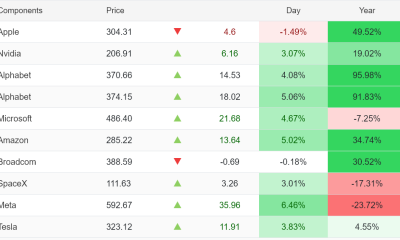
US Tech Stocks See Largest 5-Week Inflow in History: Can Nasdaq Break Its Downtrend?
-
 NewsBeat6 days ago
Tourist plane on sightseeing flight in Peru crashes into a field, killing all 13 people on board
-

 NewsBeat7 days ago
Arsenal reach full agreement with Newcastle over Bruno Guimaraes transfer | Football
-
 Business2 days ago
US stocks: Dow closes at record on Mideast optimism; SpaceX, AMD drag Nasdaq
-

 Tech6 days ago
Page Not Found | WIRED
-

 Fashion11 hours ago
Weekend Open Thread: Mattifying Sunscreen
-
 NewsBeat6 days ago
Bikini-clad Jennifer Aniston, 57, kisses hypnotist boyfriend Jim Curtis as they enjoy a romantic getaway aboard a luxury yacht in Spain
-

 Politics2 days ago
Reform UK And Greens Sink To Lowest Favourability Ratings To Date
You must be logged in to post a comment Login