Security teams log 54% of successful attacks and alert on just 14%. The rest move through your environment unseen.
The Picus whitepaper shows how breach and attack simulation tests your SIEM and EDR rules so threats stop slipping by detection.




Update: Added statement from Falcon extortion gang below.
A recent wave of cyberattacks targeting hedge funds, private-equity firms, and other financial organizations has been linked to UNC6671, an extortion group reportedly associated with the BlackFile threat actors.
The attribution comes after Reuters and Bloomberg reported that Point72 Asset Management, Millennium Management, Two Sigma Investments, Citadel, and several private-equity firms were targeted in recent attacks that relied on voice phishing (vishing) to trick employees into granting the attackers access to corporate systems.

Point72 reportedly told investors that it had been attacked but had not found evidence that client data was stolen, while Two Sigma said it had blocked an attempted intrusion and found no indication that its systems or data were affected.
Millennium declined to comment in response to questions from BleepingComputer. Citadel also declined to comment and referred BleepingComputer to Bloomberg’s reporting. Point72 and Two Sigma did not respond to requests for comment.
In response to questions from BleepingComputer, Austin Larsen, a principal threat analyst at Google’s Threat Intelligence Group (GTIG), said the company tracks the vishing activity as UNC6671.
“While previously operating under the public brand ‘BlackFile,’ UNC6671 has diversified its extortion operations across multiple public brands, including Redact, Pink, Helix, and Falcon,” Larsen told BleepingComputer.
“GTIG assesses that a single core intrusion group is driving the helpdesk vishing and cloud data theft across these various public extortion brands.”
BlackFile is a data theft extortion group that first emerged in February 2025 when it conducted a wave of attacks targeting retail and hospitality organizations.
According to Mandiant’s report, the group’s targeting switched in July 2026 toward private-equity firms, hedge funds, major law firms, and financial-rating agencies after previously targeting organizations in the manufacturing, healthcare, real-estate, technology, transportation, and hospitality sectors.
“Between January and May 2026, GTIG tracked over $10.6 million USD in Bitcoin payments to group wallets. While initial demands reach upwards of $3 million, operators routinely settle for around $750,000 USD after negotiations,” Larsen said.
After publishing our story, the Falcon extortion group released a statement on their data leak site disputing some of Mandiant’s reporting.
“Falcon is a Redact affiliate. We are exclusively a Redact affiliate. We are not affiliated with, connected to, or under the same umbrella as Helix, Pink, or any other group named in Mandiant’s reporting,” the threat actors posted on their data leak site.
“We share no operators, infrastructure, tooling, negotiation channels, or proceeds with any group other than Redact.”
In May 2026, BlackFile announced on its data leak site that it was rebranding under the name Redact, under which it would continue its operations.
UNC6671 operators typically contact employees on their personal mobile phones while spoofing corporate helpdesks and claiming that workers need to enroll in passkeys or update their multi-factor authentication settings.
Victims are then directed to domains impersonating the targeted employee’s company that host adversary-in-the-middle phishing kits designed to steal credentials and session cookies in real time.
After stealing Microsoft 365 or Okta single-sign-on accounts, the attackers log into the SSO dashboard, which gives access to all the cloud platforms that are linked to the account.
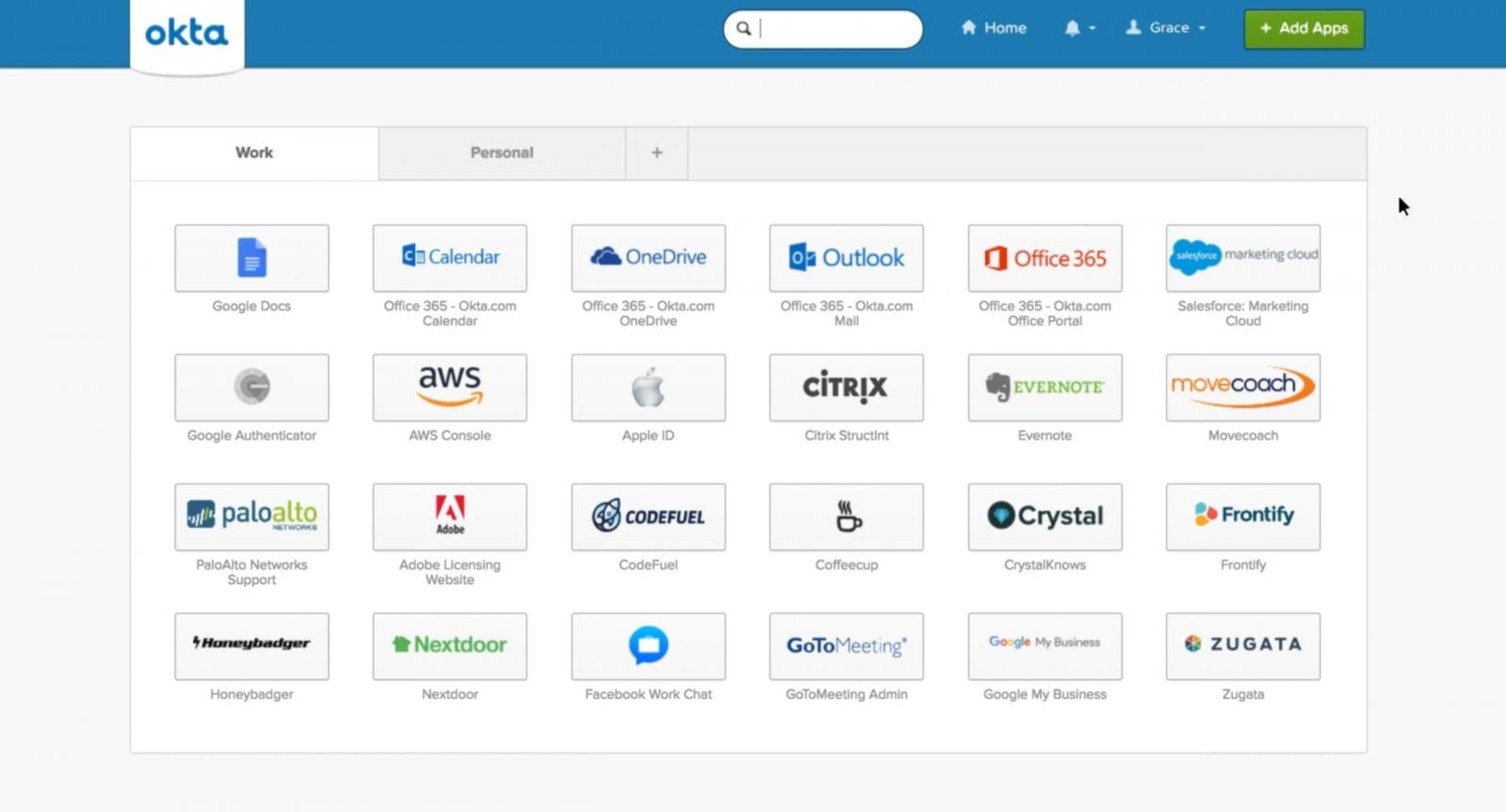
The hackers then use automated tools to steal data from all cloud services they gain access to and delete security notifications and password-reset emails from compromised inboxes.
Mandiant says the infrastructure and extortion network used in these attacks differ from those associated with Scattered Spider, which has historically employed similar helpdesk social-engineering tactics.
“While the helpdesk vishing and Adversary-in-the-Middle authentication interception share similarities with methods historically associated with Scattered Spider (UNC3944), GTIG tracks this specific infrastructure, domain registration pattern, and multi-brand extortion network as UNC6671,” Larsen told BleepingComputer.
Mandiant says it is currently assisting several dozen organizations compromised by UNC6671.

Security teams log 54% of successful attacks and alert on just 14%. The rest move through your environment unseen.
The Picus whitepaper shows how breach and attack simulation tests your SIEM and EDR rules so threats stop slipping by detection.

A decade ago, Google introduced voice typing with the Gboard app on Android, and a year later, the perk landed on iPhones with the keyboard app. I never paid much attention to it. The biggest reason was that it was just not accurate.
The big promise was a whole new way of interacting with our phones, but it was never good enough to make me quit tapping, or swiping on an on-screen keyboard. Fast forward to 2026, I’m talking to my computer. In fact, this whole article was dictated and copy-pasted in WordPress.
The modifications that I had to make were inserting a few commas, breaking a couple of sentences with a full stop, and turning a few bullet points into a coherent sentence. If I were to put a number on it, I would say just 2% of the effort that went into writing this article was dedicated to tapping on the keyboard to make the aforementioned changes.
That’s all. But the honeymoon phase comes to an end pretty soon as social realizations dawn upon you.

I first started using voice dictation after trying Wispr Flow. It’s eerily accurate. And when I say eerily accurate, I mean it as a person whose first language is not English, nor do I have a distinct American or British accent. And yet, every time I write an article, I am amazed by just how accurate and convenient the whole experience is.
It has also made me unbelievably lazy and far more productive at the same time.
I run a newsroom, and that means being fast is the only path to the reward that is a high ranking and visibility in Google search. In fact, it was the first lesson that I was taught when I started journalism in one of India’s most respected newsrooms. “Speed is of the essence.” That’s what my first editor used to say and almost drilled it into my workflow.
I have religiously followed that mantra. But ever since I started using Wispr Flow, I have been amazed by how fast I can now write and publish breaking news stories. Last night I was able to compose a story worth around 500 words in less than six minutes. I could have gone faster if English were my mother tongue, but six minutes is still an outrageously fast pace by modern standards.
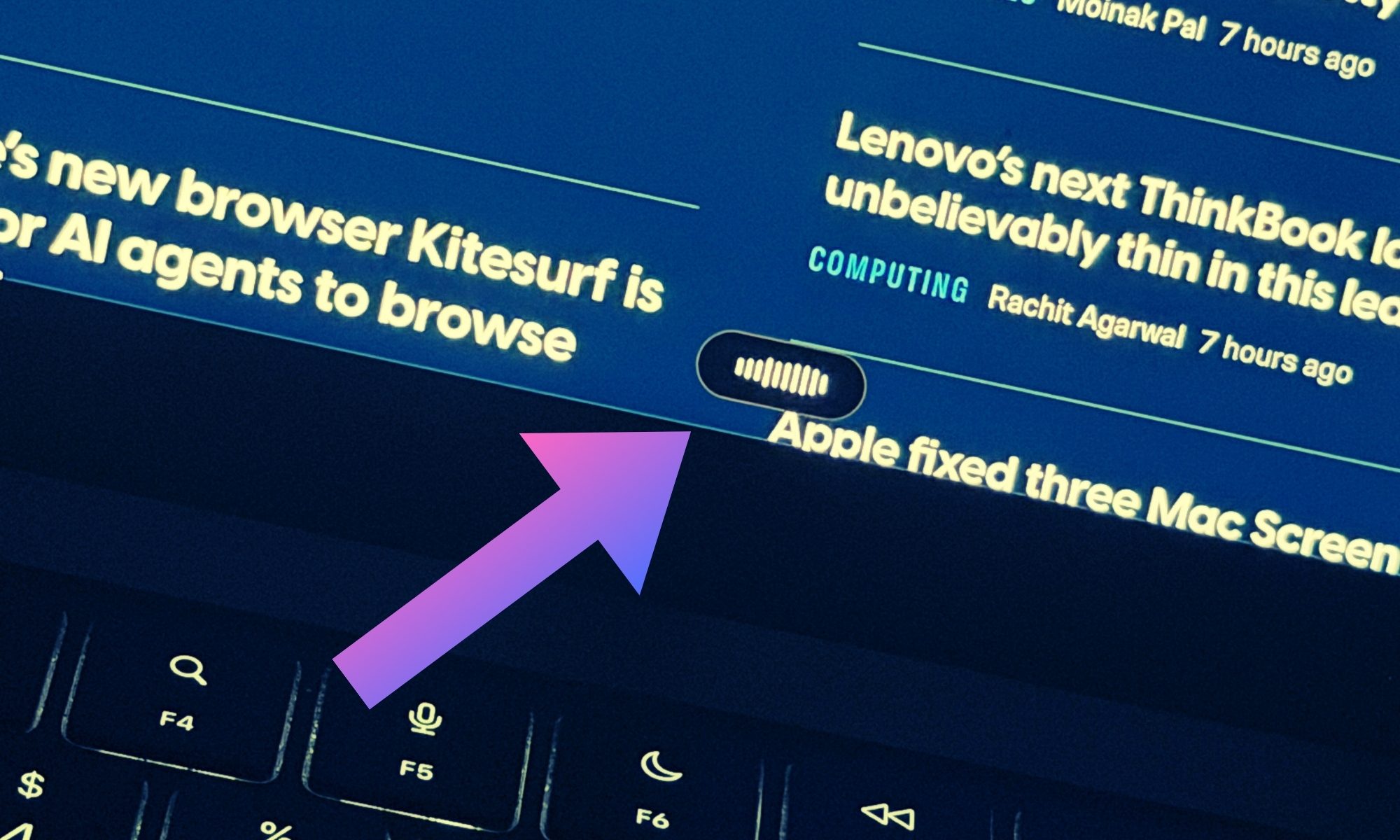
This mind-bending convenience has also made me utterly lazy. Every single time I have to touch the keyboard to do something that cannot be accomplished by voice typing, I feel a distinct struggle. I thought, maybe, it was the chiclet keyboard on my laptop that had finally outlived its charm.
To test the theory, I tried a low-profile keyboard and then switched to a mechanical keyboard in hopes that it would ignite my love for typing. I was delusional. There was nothing wrong with the keyboards either. If it were a short burst of typing chores, I would have decisively enjoyed the creamy sound and the tactile experience. I have just become hopelessly addicted to narrating my articles and rambling my way through my daily newsroom duties.
Is this the future of computing? It seems like it. It’s still not perfect. Voice typing is still tailored for jobs where you are either writing long drafts or just prompting your way through tasks using an AI agent like ChatGPT or Gemini. Silicon Valley is utterly sold on the idea, and it has even given rise to a term called “voice-pilled.”
Unfortunately, I count myself as one of those voice-pilled converts.
Every time I run into this conundrum, I go back to one of the notes that Bill Gates shared back in 2023. “You won’t have to use different apps for different tasks. You’ll simply tell your device, in everyday language, what you want to do,” he wrote, exactly a year after ChatGPT was released publicly for the first time and created a new computing revolution.
In May last year, Sam Altman, CEO of OpenAI, the company behind ChatGPT, sat for an interview with Sequoia and dropped a prescient take on voice as the new frontier for human-computer interactions. This was his quote:
“I think voice is extremely important. Honestly, we have not made a good enough voice product yet. That’s fine. Like, it took us a while to make a good enough text model, too. We will crack that code eventually, and when we do, I think a lot of people are going to want to use voice interaction a lot more.”
This was around the same time when Wispr Flow had just started making waves. I gave it my first serious try when it landed on iPhones, and later installed it on my Mac. Yes, the dictation limit on free accounts was a tad frustrating, so I briefly experimented with a paid subscription.
Eventually, I canceled the subscription and started using the Android app, which offers unlimited voice dictation for free accounts as a limited-time offer. A few weeks ago, I shifted to Willow Voice, which is nearly as accurate and absolutely free. I haven’t looked back since.
Typing continues to feel tedious, and despite some of the annoying typos due to my accent issues, I still find myself long-pressing the fn button to just narrate my articles, compose long messages to teammates, or even just my usual back-and-forth with Claude for pet projects.

It’s just liberating, and at the same time, it frustrates me every time I go back to a task that requires manual work on the keyboard.
This is also where the situation gets a tad embarrassing for me. It doesn’t matter whether you work in an office space or you are one of those people who carry a laptop to a nearby cafe for your daily work. If you are someone who stares at your laptop’s screen and keeps talking for long spells, it just feels weird.
Now the ubiquity of wireless earbuds makes the situation just a tad less embarrassing. AirPods have made it a natural sight to see people just walking around and talking to themselves, while the onboard mic on the earbud captures and transmits whatever it is that they are speaking. But talking to a person and a computer are two entirely different things.
When you talk to a person, there is usually a sense of friendliness, humility, and, most importantly, human emotions involved. When you’re talking to a friend on a phone call, you don’t feel uneasy. If you took the call in a public place, it has just become a part of our normal lives to talk without holding the phone close to our ears.
But when you are talking to a computer, there are no emotions involved. You sound robotic and use words that you would ordinarily not speak when talking to a human being. It’s just a set of instructions, but AI models these days are smart enough to turn those incoherent sentences into something meaningful and proceed with them as commands.
I feel conscious every time I start narrating an article or a message. “Why is this guy suddenly talking about Anthropic’s AI model going rogue and hacking third-party services?” “Why is he rambling about Google fixing a Bluetooth bug on its Pixel phones?” “Why is this guy randomly and intermittently speaking about following Apple’s UI design rules?”
All the above situations are a part of my daily job, and I am not embarrassed about doing my job. I love it. And yet, every time I use voice narration in a co-working space, a library, or my nearby coffee shop, I am afraid that the person next to me is having those thoughts about me.
Maybe, I just need to muster some courage?
Yes, the world doesn’t care or know who I am. A random stranger shouldn’t pay attention to what I do with my computer, either. But the social norms and how human awareness works make me feel uneasy every time I start talking to my computer.
It’s 12:42 AM right now. I am narrating this article using Willow Voice, and I’m still concerned that my neighbor upstairs, or in the next apartment, is going to hear me randomly talking about voice dictation in the middle of the night. I enjoy the perk and how I have been able to draft this article in less than 15 minutes.
I still feel a sense of unease every time I summon these unnaturally accurate and efficient voice dictation tools on my computer. I fear I will only get used to it when the whole world gets voice-pilled at their jobs. For now, I will keep my computer talks limited to cozy apartments with the windows shut.

Ctrl-Alt-Speech is a weekly podcast about the latest news in online speech, from Mike Masnick and Everything in Moderation‘s Ben Whitelaw.
Subscribe now on Apple Podcasts, Overcast, Spotify, Pocket Casts, YouTube, or your podcast app of choice — or go straight to the RSS feed. To get extended episodes with additional coverage, support us on Patreon.
In this week’s episode, Mike and Ben cover:
And in the extended episode for Patreon supporters, they cover:
Our fun links this week are the Nintendo gameplay counsellors and a revamped app for sharing your toilet flushing habits.
If you’re already a Patreon supporter, you can get the extended episode on Patreon.
Filed Under: content moderation, india, trust and safety
Companies: ebay, meta, telegram, tiktok
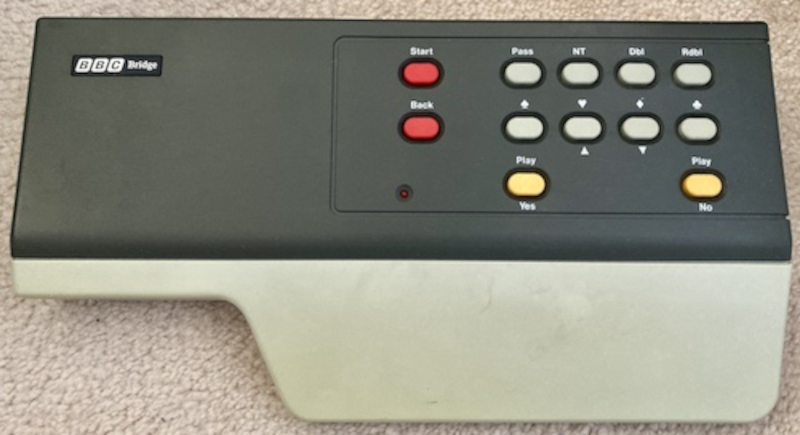
[Leaded Solder] took on an interesting challenge. The BBC, apparently, produced a game console known as the BBC Bridge Companion that connected to your TV and helped you learn to play Bridge back in 1985. At £200, we doubt many were sold new, but there were nine ROM cartridges available, presumably at an additional cost. [Leaded Solder] doesn’t care about playing bridge, but decided to teach the computer itself to play Tetris.
Inside is what you might expect for 1985. A Z80 and TI video chip, although naturally enough, it is the PAL variant. With 16K of VRAM the machine would have been very capable for its day. Unlike some game systems, the Bridge Companion runs its own code before launching what’s on the ROM cartridge. That required a few evenings of reverse engineering to figure out the correct header. Meanwhile, the surplus real hardware needed a quick repair on its cartridge slot before he could test it with real metal.
There were more hurdles, including adapting the PAL output for a composite monitor. Don’t miss the second part of the series for more technical details, and we’ll be interested in following the posts to their conclusion later this month.
Oddly enough, we think this is the first time the BBC Bridge Companion has made an appearance on Hackaday. However, we’ve had no shortage of card shufflers.

The history of networking is full of tools that repurposed solutions to very different kinds of problems first. Wi-Fi’s origins trace back, in part, to a team of Australian radio astronomers trying to detect signals from evaporating black holes. But the data-processing tools they’d developed also proved capable at extracting clean messages from any chaotic, echoing signal environment. Echoes are echoes, after all, whether from distant star systems or from the far corner of the house.
I research vehicle communications networks, connecting cars to cars and to transportation infrastructure like traffic lights—for tomorrow’s vehicle-to-everthing (V2X) networks.
V2X research has long relied on models that assume “perfect” or “ideal” network conditions, which is a simplifying assumption that makes the math tractable. But this assumption doesn’t reflect how real wireless signals behave in a moving, obstructed, high-density environment. That gap is exactly the kind of real-world unpredictability that open radio access networks (a.k.a. O-RAN)—an open, programmable architecture behind some 4G and 5G cellular networks—were built to manage.
So why has the O-RAN standard—which is open and available to be applied well beyond 5G telecom—never been used for vehicle communications?
Solutions to the vehicle-to-everything (V2X) problem have to date relied on new networking protocols built from scratch—only to discover chicken-and-egg problems, thorny standards wars, and real signal congestion challenges at scale.
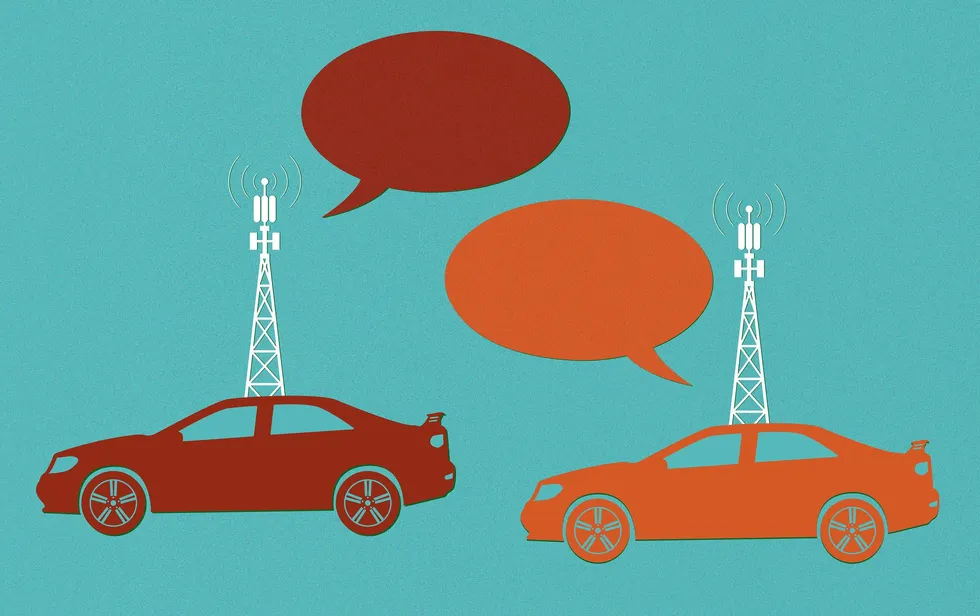
By contrast, O-RAN allows V2X engineers to reuse the networking protocols already developed for cellular communications. O-RAN was developed assuming cellphone towers are generally fixed in place. But, as can be seen below, O-RAN accommodates mobile “towers”—cars and trucks, in this case—with little additional effort.
Self-driving vehicle technology has largely been an each-car-for-itself endeavor. Tesla’s approach, for instance, relies heavily on powerful on-board banks of computers and suites of sensors spread around the car.
However, as an alternative to the “data center on wheels” model, this new O-RAN approach to V2X relies on each car’s nearby neighbors, wherever they are on the road. Each O-RAN–connected vehicle can then use a diversity of cars’ sensors and viewing angles for better group coordination and decision-making.
There is, to be clear, no O-RAN V2X test network operating in the world. Not yet.
It was just 10 years ago that the Third-Generation Partnership Project (3GPP) released its initial cellular V2X standard. The 3GPP have refined V2X over three major releases since. In the U.S. and the EU, the FCC and related European agencies have put forward other standards for short-range wireless V2X communication protocols.
However, no consensus standard has yet emerged. So, lacking any clear, unambiguous guidance on the future of V2X networks, autonomous-car makers—like Waymo, Tesla, Zoox, and Cruise—have leaned more on self-reliance, bulking up each vehicle with as many sensors and GPUs as possible.
Here, though, is where O-RAN might be able to help.
A little like APIs (a.k.a. application program interfaces) connect one app to another on your smartphone, O-RAN serves as an API for the network itself. And because of O-RAN’s open standards, a wireless network becomes programmable, vendor-neutral, and open to custom applications called xApps.
To test our proof-of-concept framework, I have been part of a team simulating five minutes of O-RAN V2X network traffic over one square kilometer of urban area, using real buildings and real-world road layouts from OpenStreetMap and traffic patterns generated by the modeling package SUMO. The simulations assumed a traffic density of 50-70 vehicles per kilometer—not rush hour but not light traffic either. In our simulation, we assumed vehicles communicated via a millimeter-wave frequency of 28 gigahertz and that each component of our O-RAN V2X system had its own dedicated xApp.
Taken together, these inputs—real geometry, real traffic, and each vehicle’s live GPS position—constitute what network researchers call a digital twin of the urban environment. That’s a virtual replica detailed enough for the network to reason about the physical world in real time.
This virtual world gave us a real result, too.
The simulations, published recently in IEEE Network, revealed that existing V2X standards—in which cars uncoordinatedly spit out messages into the network—result in signals “talking” over each other some 80-100 percent of the time. However, using O-RAN signal coordination, the message “collision” rate dropped to near zero.
And that matters because a seized-up V2X network doesn’t just fail quietly. It can fail in ways that might make a road turn treacherous.
High-frequency data links between cars are already difficult to maintain, even on a clear day with no buildings or city infrastructure getting in the way.
Yet, in this situation, existing V2X networks leave a car to conduct blind searches for each dropped signal beam. Traveling at highway speeds, that search takes long enough for the surrounding world to change completely.
An O-RAN network continuously tracks signal conditions across the network, and in O-RAN V2X simulations, we also gave the network access to a detailed map of the urban environment—building positions, road geometry, intersection layouts—combined with each vehicle’s GPS trajectory. Together, these parameters let the network’s control layer predict where and when a signal link is about to fail and instruct each car’s antenna to adjust before the connection drops.
Signal pointing is one failure mode. Losing the connection entirely—because no direct path exists at all—is another.
Consider, for instance, a crossroads of two busy streets, with a few alleys and parking lots adding to the list of potential dangers.
If a signal from car A cannot reach car B directly, or if the path length is too far for an individual beam to travel, the signal must find an intermediary car or stationary sensor nearby that can pass along the message. And existing V2X standards are slow and reactive—polling potential relay vehicles one-by-one: Are you available? Can you redirect this message?
By contrast, O-RAN keeps a running graph of optimized message routes, accounting for a range of real-world constraints. So when an O-RAN link fails (whether that link is direct from sender to receiver—or indirect), the system already has a reroute mapped out.
This is partly why we included “multi-hop routing” in the O-RAN V2X simulations.
Multi-hop V2X O-RAN routing complicated three separate elements of the simulation: for each signal’s middleman (some cars may be ideally positioned to relay a signal from car A to car B, but we made the simulation neglect any cars that were also overwhelmed with their own signals and signal-processing needs); for each signal’s strength (we required that every intermediate link be able to maintain a stable network connection, factoring in distance and traffic conditions); and for each signal’s latency (we required a realistic accounting for added signal latency time for each additional hop in a multi-hop routing).
And with each added complication, O-RAN V2X multi-hop routing continued to extend the network’s capacity from 25 percent of nearby cars connected (without multi-hop) to nearly 100 percent (with multi-hop).
These complications, at least at the simulation level, did not slow down the V2X network.
We are in touch with potential collaborators and institutions to develop testbeds, prototype hardware, and tester vehicles for potential proving grounds. The Institute of Science Tokyo, for instance, has already expressed interest in working on some of these early-stage problems.
To date, our published research on O-RAN V2X has centered around a computer simulation only. Real-world hardware will undoubtedly surface challenges our simulation could not. So, questions of network latency and the computational overhead needed for O-RAN V2X signaling remain as yet unresolved.
Plus, concerns about full interoperability and realistic security will each demand their own investigations. After all, no one will trust a V2X network to do anything if that network’s cyber vulnerabilities haven’t been anticipated and patched in advance.
Realizing the O-RAN V2X vision will require progress on multiple fronts simultaneously. On the standards side, O-RAN’s vehicular extensions—the interfaces that allow vehicles to participate in the network as managed elements rather than passive users—would ultimately need to be formally adopted by the O-RAN Alliance and recognized by 3GPP’s V2X specifications. That process takes years.
On the industry side, there is a more immediate problem that our architecture is already positioned to solve: interoperability.
Today, a car made by one manufacturer cannot necessarily parse V2X sensor data sent from a car made by another. Firmware is proprietary; data formats differ. But an O-RAN control layer would act as a universal translator—normalizing each vehicle’s data into a common format and accelerating a push toward true multi-platform vehicle-to-vehicle communications. A more widespread and truly universal standard would, by itself, represent a substantial step forward for V2X.
From Your Site Articles
Related Articles Around the Web


Discovery Loop wants to advance the pace of scientific discovery using AI to address issues across domains.
Chief scientist Jeff Dean is leaving Google after a 27-year-long stint to start a new company called Discovery Loop that wants to accelerate research using AI.
Alphabet and Radical Ventures are backing the business as founding investors alongside funding from Khosla Ventures.
The founding team at Discovery Loop also includes Dean’s other departing Google colleagues – senior fellow Sanjay Ghemawat, research vice-president at DeepMind Oriol Vinyals and research scientist Quoc Le.
Together, they have helped develop multiple generations of core Google products – including Search, Ads, Translate, Tensor Processing Units, DeepMind’s life sciences model AlphaFold and Gemini AI, among several more technologies – and claim to number among some of the most-cited AI researchers.
The four want to begin by focusing on automating the process of machine learning (ML) research and engineering. “Historically, scientific progress has relied on these sequential human iterations. In many domains, this process remains incredibly slow and labour-intensive,” Discovery Loop’s website reads.
“By advancing the pace at which we conduct engineering and scientific discovery, we can bring the benefits of science and technology to the world much faster.
“Ultimately, our goal is to build AI systems that act as a deeply positive, empowering force for humanity, delivering technology solutions that improve people’s lives on a global scale.”
The start-up plans to experiment with the technology on its own systems before expanding into other scientific domains, with the hopes of developing AI systems capable of drug development or addressing environmental crises.
“Jeff and Sanjay helped to drive some of the most significant technology transitions, from our early search infrastructure to the neural networks that helped create the modern AI era,” said Google CEO Sundar Pichai.
“We’ll continue to work with them as a founding investor and cloud partner, and collaborate on a research framework for ML systems and related infrastructure advances.” Alphabet stocks dipped more than 4pc at market close yesterday (5 August).
The departures mark a continuation of a years-long shakeup in the tech industry, with top minds moving between rivals such as Meta, Amazon, Apple and Arm, or launching their own R&D-focused AI ventures.
For Google, the latest exits comes after parent company Alphabet recently posted a better-than-expected quarterly revenue of $119.8bn driven by an 82pc growth in its cloud business.
The company’s big-budget expenses seem to be working, according to Pichai, who told investors on last month’s earnings call that almost 90pc of Fortune 100 companies use Gemini Enterprise. The Gemini app now has more than 950m monthly users, according to Google.
The company announced a further $15bn in capital expenditures for the year on the heels of its successful quarter. CNBC reported that Google is investing more than almost any company in the world in data centres, chips and related infrastructure.
Alphabet had initially announced a 2026 capex of up to $185bn, doubling expenses since last year to meet customer demand. This number was revised to $190bn in April, before estimations were further raised to now hit $205bn.
Don’t miss out on the knowledge you need to succeed. Sign up for the Daily Brief, Silicon Republic’s digest of need-to-know sci-tech news.

When you can’t bring prices down, turn back the clock.

How does a headphone maker respond to rising prices? Well, if you’re Sony, the answer might be to revive a model from six years ago and slap a cheaper price tag on it. According to reliable leaker billbil-kun on Dealabs (via 9to5Google), Sony is planning to launch a new version of the WH-1000XM4. It’s said to be called the WH-1000XM4C and could retail for around $250.
The new model is expected to be largely unchanged from the original XM4, which was Engadget’s pick for the best of its generation. In fact, the leak suggests that the only differences between the XM4C and its discontinued predecessor will be battery life and color options. Its foldable design, 40mm drivers and noise-canceling processor would all carry over.
The new model is reportedly rated for up to 34 hours without active noise cancellation (ANC) and 27 hours with ANC. Sony listed 38 and 30 hours, respectively, for the 2020 model, so that would be a slight dip. The XM4C’s supposed color options include black, platinum silver and a new lavender.
The leaker, who accurately predicted the PS5 Pro announcement in 2024, claims Sony will release the new XM4C on September 7. The XM4C will reportedly cost €250 in Europe and £220 in the UK.
For reference, the current WH-1000XM6 retails for $460 in the US and €470 in the EU. So, we could guess at a $240 to $250 price tag for US buyers. That would make it an odd duck in Sony’s lineup, since the last-gen XM5 is often discounted to around $250. (If those are indeed your choices, obviously get the XM5.)
Of course, take all of this with grains of salt. But if the rumor holds up, perhaps other companies will respond to rising prices in similar ways. AirPods Max 1C, anyone?
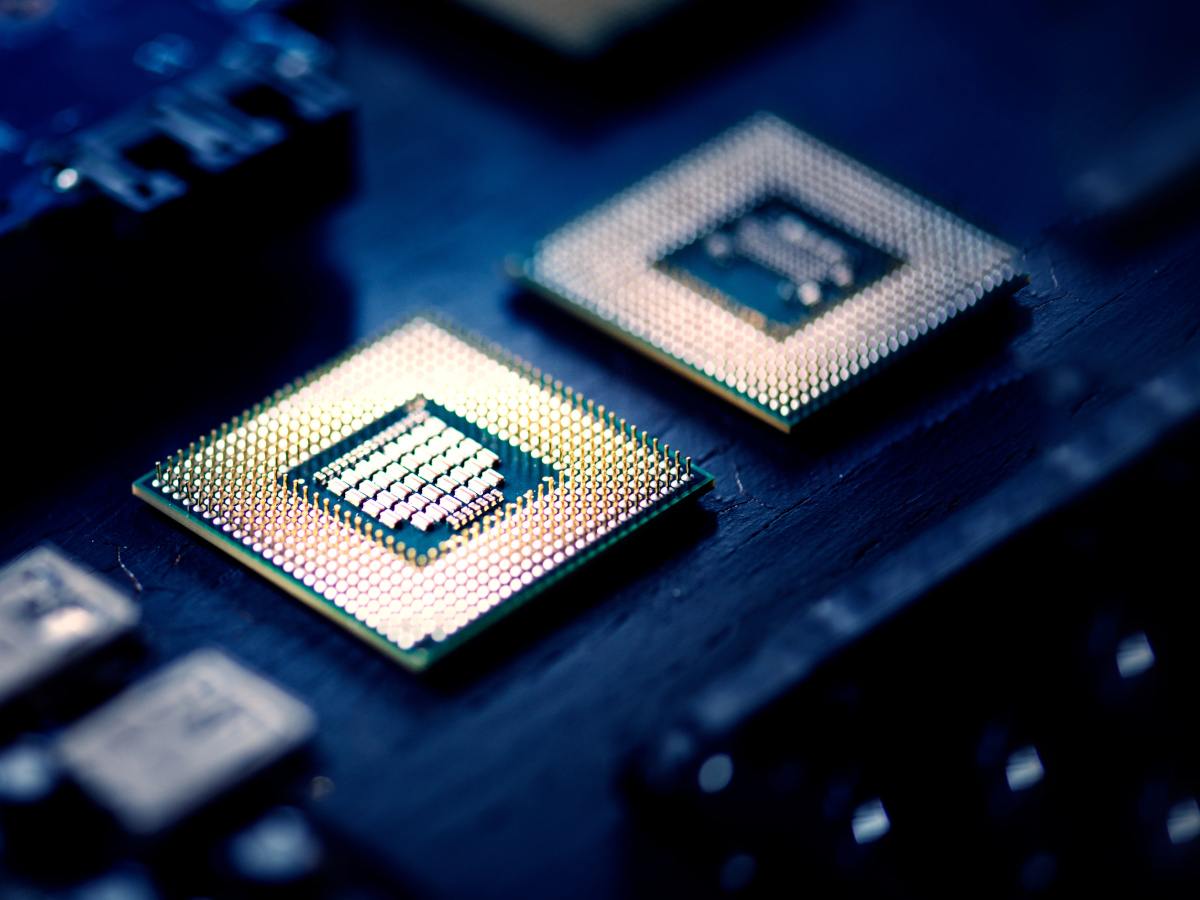

The Claude creator will also put together a new team in charge of designing the custom-made chips.
As first reported by the Business Insider, artificial intelligence company Anthropic has confirmed plans to design its own chips in response to a worldwide shortage and increased pressure to develop faster, more advanced AI systems.
In April, it was reported by Reuters that the organisation was strongly considering building its own chips, as a means of having improved access to a steady supply and keeping pace with competitors Meta and OpenAI, both of which have similar projects underway.
The latter previously announced the development of the Broadcom-built Jalapeño chip, designed for inference workloads, while Meta has been developing its own ‘MTIA’ accelerators for AI workloads.
The timeline as to when Anthropic’s chip production might begin is unclear; however, the company is looking to add to its workforce in order to meet future AI development expectations. As per a recent job listing, Anthropic is seeking professionals eager to join a custom silicon team.
It is currently unknown if the organisation will manufacture the chips by itself, but it has been previously reported that Anthropic may be looking at Samsung as a potential partner in the development of the chips.
While building custom silicon is the next step in Anthropic’s ongoing AI and chip strategy, the company reportedly still intends to utilise a diversified hardware stack that includes technology from Amazon Web Services, Google, Nvidia and AMD.
In late July, Anthropic announced plans to partner with AMD for 2GW of its latest-generation chips, in a bid to boost AI capacity and meet growing demands. The deal between the companies was reported to be worth “tens of billions of dollars”.
Anthropic is striving for dominance in the AI space ahead of a widely reported planned IPO, which is expected to value the company at more than $1trn.
Don’t miss out on the knowledge you need to succeed. Sign up for the Daily Brief, Silicon Republic’s digest of need-to-know sci-tech news.


Switzerland’s federal IT office says hackers exploited vulnerabilities to breach its Microsoft SharePoint servers and compromised approximately 200 accounts.
The Federal Office for Information Technology and Telecommunication (BIT) detected the cyberattack after security specialists noticed unusual activity on its SharePoint servers on July 28.
After confirming the breach, BIT blocked external internet access to SharePoint, patched the suspected vulnerabilities, and reset the passwords for the affected accounts.

“During the analysis, security specialists discovered on Friday, July 31, that the login credentials for several accounts had been compromised,” BIT said.
The agency believes the attackers exploited SharePoint vulnerabilities disclosed by Microsoft in mid-July and fixed in the July Patch Tuesday updates. However, it has not disclosed which flaw was used.
The attack potentially involved either CVE-2026-56164, an actively exploited SharePoint privilege escalation vulnerability, or CVE-2026-50522, a critical remote code execution flaw later exploited to steal SharePoint machine keys and maintain access after servers were patched.
Both of these flaws were fixed as part of the July 2026 Patch Tuesday updates.
It remains unclear whether either vulnerability was used in the Swiss government attack or whether the attackers exploited another flaw fixed in the same updates.
BIT is investigating the incident with assistance from the Swiss Federal Office for Cyber Security and Microsoft.
So far, it has found no evidence that data was stolen beyond the compromised login credentials.
The agency said confidential information and particularly sensitive personal data are not permitted to be stored on the affected SharePoint platform.
BIT is reinstalling the compromised servers as a precaution, and external access will remain blocked until that work is completed.
Federal employees can continue accessing documents and sharing them with external personnel through alternative methods.
At this time, no ransomware or data extortion group has claimed responsibility for the breach.
BleepingComputer contacted BIT to ask which vulnerability was exploited and whether its investigation had uncovered evidence of data theft, but a response was not immediately available.
Security teams log 54% of successful attacks and alert on just 14%. The rest move through your environment unseen.
The Picus whitepaper shows how breach and attack simulation tests your SIEM and EDR rules so threats stop slipping by detection.

Buc-ee’s trademark bullying ways continue! This company that has long been famous for its enormous gas station and convenience stores practically dripping in Americana is quickly building a national reputation for itself as a petulant trademark bully. It’s lawsuits are typically dumb and usually feature Buc-ee’s claim that it somehow owns every cartoon animal mascot depiction for convenience stores and gas stations, and even cartoon human mascots at times. It’s so bad that it even caught the attention of John Oliver recently, resulting in the show creating its own merchandise that is far more similar to the Buc-ee’s beaver than most of its lawsuit victims and Oliver literally begging them to file a lawsuit over it.
Well, the Buc-ee’s people appear to be cowards. Oliver made it clear that he and HBO have the willingness and legal war chest to do battle with Buc-ee’s. To date the company has not filed any lawsuit against Oliver or HBO. But it did just file another trademark suit against another small local convenience store after having just moved into the market.
Buc-ee’s, which opened its first location in Ohio earlier this year, is suing Beaver’s Mini Mart in Beavercreek for what they allege is trademark infringement.
In the suit, filed days ago, Buc-ee’s alleges that the Mini Mart’s cartoon beaver mascot is too similar to their own, with its “wide eyes and a smile” that also “uses red as a predominant color,” and could cause confusion.
The new Buc-ee’s location in Huber Heights, Ohio, is 16 miles from Beaver’s Mini Mart. Beaver’s Mini Mart customers say they have been shopping there for decades, while Buc-ee’s has existed in the Buckeye State only since April.
This is common practice for Buc-ee’s. The company expands into a new market and goes on a trademark suit blitz against anyone using one of these cartoon animal logos, beaver or otherwise. It doesn’t matter how long the victim company has been doing business there. It doesn’t matter how ingrained into the community they are. It doesn’t matter if every local in the area insists that there’s no confusion to be had between the two entities.
In this case, the Beaver’s Mini Mart has been around for decades. The entire community is awash in beaver-y iconography. I’ll let one of our anonymous commenters from our John Oliver post chime in here.
They are now trying to sue a place near where I grew up, the “Beavers MiniMart” convenience store in Beavercreek Ohio, where the local high school, Beavercreek High School, once had Bucky the Beaver as a mascot for their football team, the Battling Beavers, their cheerleaders are called the Beaverettes and there’s pep squad called the Beaver Patrol. There’s concrete statues that are 6-8 feet tall, all over the city. The city loves it’s fuckin’ beavers. Buc-ee’s probably doesn’t know what’s about to happen to them. It wont be pretty.
The signage from Buc-ee’s own lawsuit show just how unalike the branding for the two companies is.

From this, and wielding a trademark Buc-ee’s somehow has on the word “Beaver’s” Buc-ee’s alleges that there will be “confusion among consumers,” that the Mini Mart is trading on Buc-ee’s “goodwill,” and that all of this is causing “irreparable injury” to Buc-ee’s.
Ironically, it appears this very lawsuit is causing a dip in all of that supposed goodwill Buc-ee’s has in this particular community.
“Reading into it more that Buc-ee’s has gone after other companies over this… It just put a bad taste in my mouth because they just seem like such a fun company,” resident Sam Bryan told Nexstar’s WDTN. “To see this, that they’re coming after a small business like this, it upset me like it did a lot of Beavercreek residents.”
The town is named Beavercreek, the branding doesn’t look anything alike, and nobody is going to be confused about any of this. Buc-ee’s knows all of that. But trademark bullies typically just can’t help themselves and this is yet another in a long list of bullshit trademark lawsuits the company has filed.
If Beaver’s Mini Mart fights this, however, it would be an interesting move in its defense to point out that there is no similar lawsuit against John Oliver.
Filed Under: john oliver, trademark, trademark bullying
Companies: beaver’s mini mart, buc-ee’s, hbo

An anonymous reader quotes a report from NPR: Billions of dollars are traded every week on the lightly regulated prediction market sites, where users bet on everything from movie reviews to elections to conflicts in the Middle East. Clinical trials are just the latest area where the industry’s rapid growth is raising ethical questions. Kalshi claims such bets will provide a new source of information about which drugs will get approved, and what clinical trials will show promising results, which the company says can help investors decide what new drugs to fund.
“If you want to ban profiting from the failure of clinical trials, you would start with the stock market, where the financial incentive for this type of profit is orders of magnitude larger,” said Kalshi spokesman Jack Such, pointing to stock market short sellers who have profited from clinical trial failures. “While Kalshi and the stock market are the same in this regard, they do differ in one important way: the stock market doesn’t give any valuable information to researchers,” Such said.
Drug trial researchers, though, are far from convinced. David Tsai, who runs clinical trials at a biotech company in the San Francisco Bay Area, started an online petition pushing for such betting to be banned, making the case that betting on drug trials “threatens the very foundation of trust and integrity in biotechnology.” Tsai is concerned that the prospect of betting provides those involved with a clinical trial a reason to tamper with the results for a prediction market payout. “If we were running a trial for an oncology drug that requires an infusion, a pharmacist who had placed a bet saying that it’s gonna work well, or doesn’t work well, could obviously adjust the infusion rate, could adjust the source temperature of the drug,” he said. “They could change any number of variables that could obviously have a direct impact [on] how the trial and the data and the patient safety would come out.”
Another skeptic is Nicholas Zaorsky, a professor of radiation oncology at the Mayo Clinic in Jacksonville, Fla., who has helped run clinical trials and agrees that prediction markets can interfere with the advancement of life-saving drugs. “Prediction markets can be valuable in some settings because they aggregate information, but clinical trials are fundamentally different: investigators, coordinators, and sometimes even participants can directly influence aspects of the outcomes being wagered on,” Zaorsky said. “That creates financial incentives that risk undermining trial integrity.” Bettors should not be rooting for an experimental medicine to fail just to earn a buck, says Joshua Pederson, the father of a 12-year-old cancer patient enrolled in a clinical trial. “It’s a dark idea,” he said. “It’s quite ghastly.”
Kalshi, for its part, argues that its prediction markets could help patients track promising medical breakthroughs and clinical trials, enlisting experts including 23andMe founder Anne Wojcicki to make the case.
“Most patients don’t know about the choices available in clinical trials or which programs are most promising. The opportunity to have an open, transparent dataset about trial probabilities is extremely promising and empowering for people,” a white paper sponsored by Kalshi stated.


Read more of this story at Slashdot.




Zack Polanski: an incitement to murder Nigel Farage?


MicroStrategy Post-Earnings CLARITY Act Push Could Add New Catalyst for Its Stock


Crypto PAC spending tops $2M in Michigan House race


DTCR: Deleveraging And A Hedge Fund Collapse Point To A Possible AI Bottom


ESET tracks rise in malicious AI skills and adaptable malware


France Cricket implodes: letters hidden in a drawer and a board at war


XRP Ledger urges node upgrade after manifest flood


Moneyflip CEO charged in $40K murder-for-hire plot


Frugal Friday’s Workwear Report: Cap-Sleeve Pointelle Crewneck Sweater


Financial Crash Expert: The 90-Day Collapse Timeline They Are Desperately Hiding.


Jordan Coyle & Cordiamo take Laya Arena Stakes at RDS

US Tech Stocks See Largest 5-Week Inflow in History: Can Nasdaq Break Its Downtrend?

Tourist plane on sightseeing flight in Peru crashes into a field, killing all 13 people on board


Weekend Open Thread: Mattifying Sunscreen


Arsenal reach full agreement with Newcastle over Bruno Guimaraes transfer | Football

US stocks: Dow closes at record on Mideast optimism; SpaceX, AMD drag Nasdaq


Page Not Found | WIRED

Bikini-clad Jennifer Aniston, 57, kisses hypnotist boyfriend Jim Curtis as they enjoy a romantic getaway aboard a luxury yacht in Spain


Reform UK And Greens Sink To Lowest Favourability Ratings To Date


Polymarket targets $20 billion valuation as competition heats up in prediction market sector



You must be logged in to post a comment Login