
Business
Munich Re Lowers Revenue Outlook After Reinsurance Prices Fall

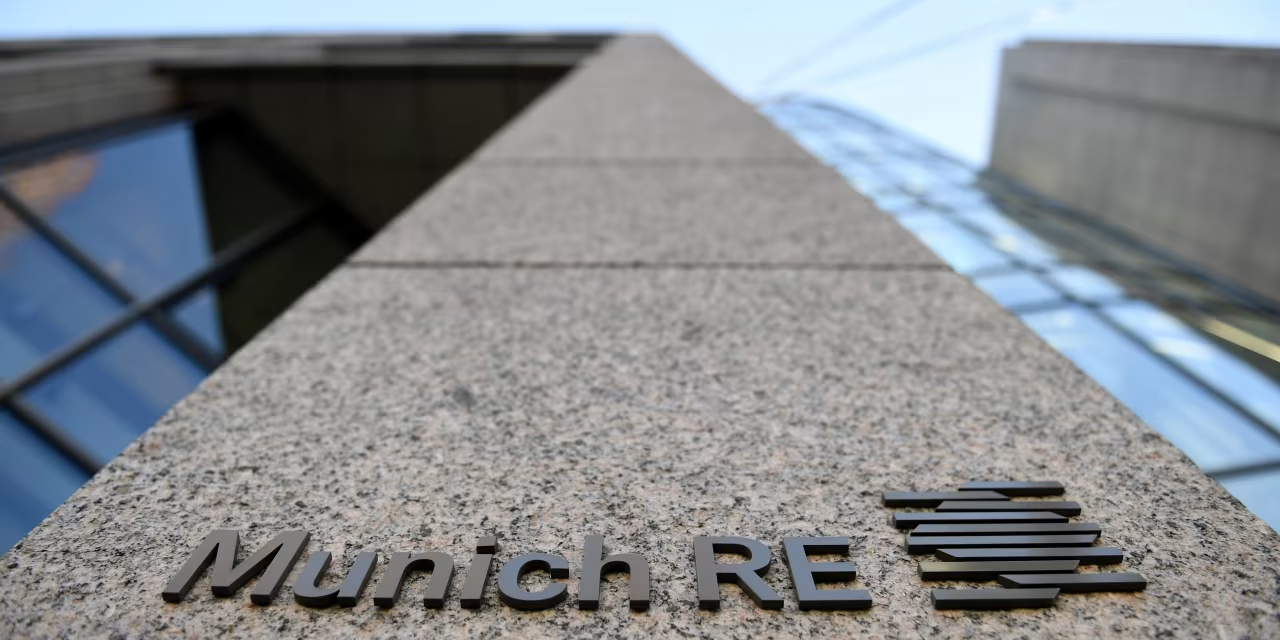
Munich Re MUV2 lowered its full-year insurance revenue outlook, after both volumes and prices fell at last month’s round of reinsurance-contract renewals.
The German reinsurer said Friday that it now expects 2026 insurance revenue to be 62 billion euros ($71.46 billion), against its previous forecast of 64 billion euros. Revenue in reinsurance is expected to total 38 billion euros, down from 40 billion euros previously, it said.
Copyright ©2026 Dow Jones & Company, Inc. All Rights Reserved. 87990cbe856818d5eddac44c7b1cdeb8



Monte Independent Investment Research: Michael Del Monte is a buy-side equity analyst with expertise in the technology, energy, industrials, and materials sectors. Prior to working in the investment management industry, Michael spent over a decade in professional services working across industries that include O&G, OFS, Midstream, Industrials, Information Technology, EPC Services, and consumer discretionary.
Analyst’s Disclosure: I/we have no stock, option or similar derivative position in any of the companies mentioned, and no plans to initiate any such positions within the next 72 hours. I wrote this article myself, and it expresses my own opinions. I am not receiving compensation for it (other than from Seeking Alpha). I have no business relationship with any company whose stock is mentioned in this article.
Seeking Alpha’s Disclosure: Past performance is no guarantee of future results. No recommendation or advice is being given as to whether any investment is suitable for a particular investor. Any views or opinions expressed above may not reflect those of Seeking Alpha as a whole. Seeking Alpha is not a licensed securities dealer, broker or US investment adviser or investment bank. Our analysts are third party authors that include both professional investors and individual investors who may not be licensed or certified by any institute or regulatory body.
Nuvama said the first week of CAS implementation appears to have curbed last-minute swings, fuelling flows into deep out-of-the-money options. This resulted in a sharp decline in the average number of contracts traded, even as premiums rebounded.
BSE’s average daily contracts traded fell 30.6% week-on-week to 90 million, compared with a 20.4% decline for the industry. The figure stood at 150 million in July 2026 and 156 million in the first quarter of FY27.
Also read: CAS chaos splits Sensex and Nifty: How long will this last?
Despite the drop in contracts, the premium generated per contract surged 74.8% week-on-week to Rs 2,605. This compares with Rs 1,688 in July 2026 and Rs 1,902 in Q1 FY27.

The increase in premium per contract helped BSE’s average daily premium turnover value rise 21.3% week-on-week to Rs 23,500 crore, significantly ahead of the 9.5% growth recorded by the industry. The figure was also above Nuvama’s remaining FY27E ADPTV estimate of Rs 21,800 crore. As a result, BSE’s ADPTV market share rose to 37.1%, an increase of 362 basis points week-on-week.
For FY27 so far, BSE’s average daily premium turnover value stands at around Rs 28,200 crore, while its ADPTV market share is around 35.2%. Its premium-to-notional turnover value ratio stands at around 12.6 basis points, compared with 17.6 basis points for the industry.
What is CAS?
Market regulator Securities and Exchange Board of India (SEBI) and the National Stock Exchange (NSE) introduced the Closing Auction Session (CAS) for eligible Futures & Options (F&O) stocks which started on August 3. The new framework changes how closing prices are determined for these stocks and extends equity derivatives trading by 10 minutes.
For investors, the biggest change is this: the closing price of eligible F&O stocks will no longer be calculated using trades executed during the final 30 minutes of the trading session. Instead, it will be discovered through a dedicated auction held after continuous trading ends.
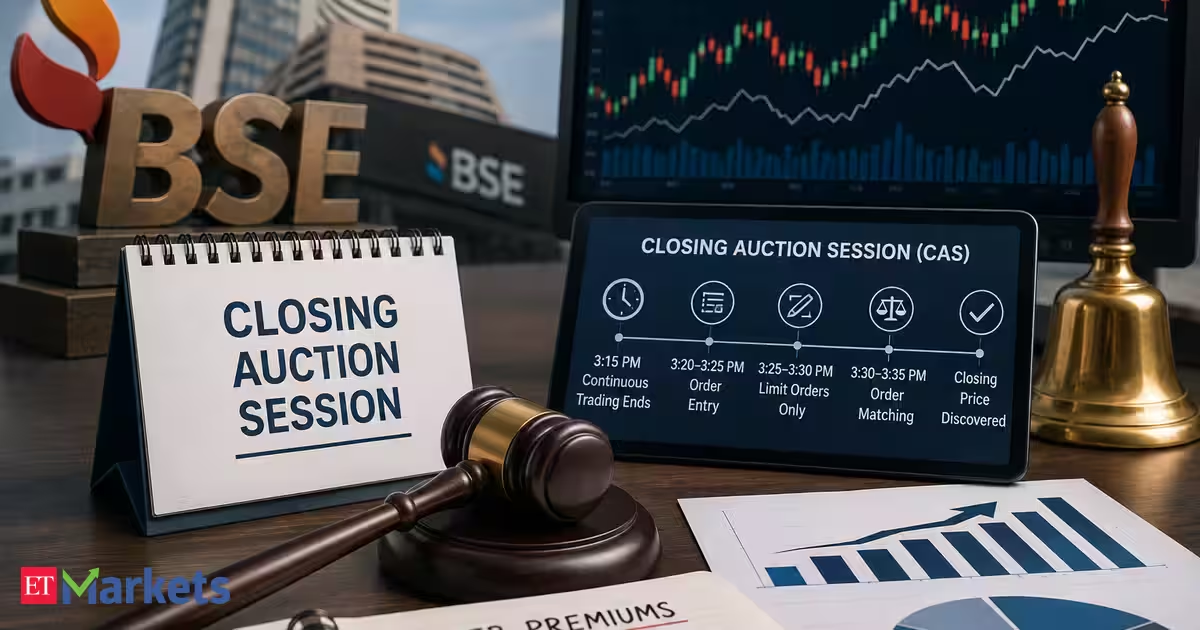
Simply put, CAS is a 20-minute auction that begins after continuous trading ends. Instead of executing every trade instantly as it happens during the trading day, all buy and sell orders are pooled together and matched at one common price. That single price becomes the stock’s official closing price.
Timing chronology starting 3:15 p.m.
The process begins before the auction starts. Between 3 p.m. and 3:15 p.m., exchanges will calculate the volume weighted average price (VWAP) of trades in every eligible stock. At 3:15 p.m., continuous trading in eligible stocks ends, and the market shifts into CAS.
For the next five minutes, until 3:20 p.m., no fresh orders can be placed as the market transitions into the auction. From 3:20 p.m. to 3:25 p.m., investors can place both market and limit orders.
Read more: CAS sparks trader backlash as losses mount, Sebi holds firm
From 3:20 p.m. to 3:25 p.m., investors can place both market and limit orders. Between 3:25 p.m. and 3:30 p.m., only limit orders can be entered. Market orders placed earlier cannot be modified or cancelled during this phase. To prevent a flurry of last-second orders, the order entry window will not close at a fixed time. Instead, it will shut randomly between 3:28 p.m. and 3:30 p.m.
Once the order entry window closes, exchanges will stop accepting orders and begin matching buy and sell orders between 3:30 p.m. and 3:35 p.m. All successful trades will be executed at a single equilibrium price, which will become the stock’s official closing price.
The objective is to make the closing price more representative of overall market demand and supply. By bringing together all buy and sell orders at the close, the auction is designed to improve liquidity, help execute large orders more efficiently and arrive at a more robust closing price.
The framework is also intended to make it harder for large trades placed in the final minutes of the session to disproportionately influence stock and index closing levels.
(Disclaimer: Recommendations, suggestions, views and opinions given by the experts are their own. These do not represent the views of The Economic Times)
Business
Dodge Unveils 600-Horsepower 2027 Charger Super Bee to Mark Charger’s 60th Anniversary in Detroit

Dodge revived one of its most storied performance nameplates Thursday, unveiling the 2027 Charger Super Bee Launch Edition, a 600-horsepower version of its twin-turbocharged six-cylinder muscle car that the automaker says is the most powerful and quickest Super Bee ever built.
The announcement came as part of celebrations marking the 60th anniversary of the Dodge Charger nameplate, giving the brand a symbolic moment to reintroduce the Super Bee badge after a three-year absence. The Super Bee had last appeared on a Charger in 2023, when it was powered by Dodge’s 6.4-liter V8 rather than the turbocharged six-cylinder engine underpinning the new model.
A SAE-Certified 600 Horsepower
The new Super Bee produces a Society of Automotive Engineers-certified 600 horsepower and 531 pound-feet of torque from a revised, higher-output version of Dodge’s twin-turbocharged 3.0-liter Hurricane inline-six engine, the same base engine family used across the current Charger lineup. That figure surpasses the standard High Output version of the engine, found in the Charger Sixpack Scat Pack, by 50 horsepower, and tops the outgoing 2023 Super Bee’s V8-derived output of 485 horsepower by more than 100 horsepower, despite running with two fewer cylinders.

Dodge achieved the power increase primarily through larger 56-millimeter Garrett turbochargers capable of producing up to 30 pounds per square inch of boost, alongside a modified intake system, reworked intercoolers and a revised powertrain calibration. Engineers also reinforced the vehicle’s half-shafts to be nearly 10% stronger to reliably handle the additional power, according to Dodge.
Performance Numbers to Match a Hellcat Redeye
The added power translates directly into faster acceleration. Dodge quotes a 0-to-60 mph time of 3.6 seconds for the new Super Bee, a 20% improvement over the 2023 model’s 4.5-second run, and a quarter-mile time of 11.8 seconds, shaving six-tenths of a second off the outgoing car’s 12.4-second result. According to Jalopnik, that acceleration puts the new six-cylinder Super Bee roughly on par with the previous-generation Dodge Charger Hellcat Redeye, a V8-powered performance flagship that had represented one of the most powerful and quickest production Chargers Dodge ever built before the brand transitioned away from the Hemi V8 in its current-generation Charger lineup.
Built With Track Driving in Mind
Beyond the raw power increase, Dodge equipped the Super Bee Launch Edition with a substantial package of track-focused hardware. The car rides on 20-by-11-inch forged wheels wrapped in Goodyear Eagle F1 Supercar 3 tires, sized 305/35ZR20, paired with 16-inch vented Brembo brakes at all four corners, marking the first time that brake size has appeared on a Sixpack-powered Charger. The braking hardware includes six-piston front calipers and four-piston rear calipers, both fixed rather than floating, for more consistent stopping performance under repeated hard braking.
The Launch Edition also introduces new Continuous Damping Control adaptive suspension, using dual-valve dampers that Dodge says allow for more precise handling adjustments than the standard Charger’s suspension setup. The car’s cooling system capacity was increased by more than 50%, according to TopSpeed, an upgrade engineers said was necessary to keep the reworked turbocharged engine operating reliably under sustained track use, including a specifically engineered charge-air cooler duct thermal wrap designed to manage heat around the intake system.
Software Tuned for Repeatable Launches
Dodge also gave the Super Bee exclusive software calibration intended to sharpen throttle response, speed up boost buildup and refine the behavior of the car’s launch control system. The vehicle carries over a feature called Torque Reserve from the previous-generation Charger, which allows the engine to build boost pressure before a launch by holding ignition timing steady while the driver keeps the brake pedal depressed, then releases that stored energy the instant the brake is released for a stronger, more consistent start off the line. The Super Bee comes standard with all-wheel drive but includes a driver-selectable rear-wheel-drive mode, allowing all available torque to be routed to the rear wheels alone.
A Limited Production Run
Dodge has confirmed the Super Bee Launch Edition will be built in limited numbers, though the automaker has not yet disclosed exactly how many units it plans to produce or what the vehicle will ultimately cost. According to Edmunds, buyers of the Launch Edition will also receive one day of performance driving instruction at Radford Racing School, part of Dodge’s broader effort to position the car as a genuinely track-capable vehicle rather than simply a straight-line performance model. The car is offered in two exterior color options highlighted in Dodge’s official announcement, a bright shade called Sucker Punch and a more understated Diamond Black.
A Nameplate With Deep Roots
The Super Bee name dates back to 1968, when it first appeared on the Dodge Coronet, before making its way onto the Charger lineup in 1971. The badge saw a brief revival in 2007 before returning again in the more recent V8-powered Charger generation, and now returns once more for 2027 as Dodge’s flagship expression of its turbocharged six-cylinder Charger platform.
Filling the Gap Left by the Hellcat
The new Super Bee arrives at a pivotal moment for Dodge’s performance lineup, following the retirement of the brand’s supercharged Hemi V8 engines and the discontinuation of the Hellcat name from the current-generation Charger. Some coverage of the reveal, including from Jalopnik, has framed the Super Bee’s return as an attempt to help fill what the outlet described as the sizable void left behind by the absence of the Hellcat from Dodge’s current showroom lineup, even as the publication noted that the broader reception to the turbocharged, six-cylinder Charger generation has been more muted among longtime Dodge enthusiasts than the brand had initially hoped.
With pricing and exact production numbers still unannounced, additional details on the 2027 Charger Super Bee Launch Edition are expected to follow as Dodge moves closer to the vehicle’s on-sale date. In the meantime, the reveal adds a high-performance centerpiece to the Charger’s 60th anniversary celebrations, giving Dodge enthusiasts their first real look at how the brand intends to push the limits of its turbocharged six-cylinder platform now that the V8-powered muscle car era at Dodge has come to a close.

Studying in the United States offers incredible academic opportunities and personal growth. Navigating higher education costs far from home requires careful financial planning.
Students from all around the globe construct multi-layered funding strategies before stepping onto campus. Understanding your options makes creating a realistic budget straightforward.
Understanding Higher Education Costs in America
Attending a university in the United States involves several distinct expenses beyond simple tuition fees. Housing, meal plans, textbooks, health insurance, and personal daily expenses add up quickly.
Campus financial aid offices calculate a formal cost of attendance figure for every academic program. Overseas scholars must prove they can cover this total amount before receiving student visa documentation.
Exchange rates between home currencies and the US dollar fluctuate throughout the academic year. Smart planning includes building a buffer for currency shifts to prevent mid-semester budget shortages.
Scholarships and personal funds form the foundation of most foreign educational plans. Combining multiple revenue streams remains the most reliable pathway to completing a degree.
Exploring Merit Scholarships and Institutional Aid
Universities award merit scholarships based on academic achievements, standardized test scores, or artistic talent. These funds do not require repayment, making them highly desirable for applicants.
Finding grants directly through university departments reduces total out-of-pocket tuition expenses. Many students supplement institutional funding by applying for private college student loans designed for international applicants. Academic advisors often share lists of external funding organizations offering criteria-based awards.
Departmental awards sometimes open up after completing your first successful academic term on campus. Maintaining strong grades keeps your eligibility active for recurring annual scholarships.
Grant applications typically carry strict deadlines months before the start of the academic semester. Early preparation guarantees your application receives full consideration from selection committees.
Navigating Private International Student Financing
Private lenders provide tailored funding programs for non-US citizens pursuing higher degrees. Some lenders require a creditworthy co-signer who holds permanent residency or citizenship in the United States.
A report from Scholaro showed that international undergraduates at public research institutions frequently pay two to three times as much tuition as residents for identical instruction. Specialized private lenders attempt to bridge this massive gap with customized repayment terms.
Borrowers must evaluate several core features when comparing private funding options across providers:
- Interest rates offered as fixed or variable percentages
- Co-signer requirements or co-signer release options
- Grace periods allowed before monthly repayments begin
Comparing terms carefully protects your future financial stability during post-graduation job searches. Choosing lenders with clear policies prevents unexpected repayment hurdles later on.
Working on Campus Under Student Visa Rules
F-1 visa regulations allow international students to work on campus up to 20 hours per week during term time. Full-time work on campus becomes permissible during official university vacation periods.
Campus positions include working at university libraries, dining halls, administrative offices, or student centers. Earnings help cover personal spending, transportation, and daily living costs.
Securing on-campus employment requires obtaining a Social Security number through local federal offices. University international student centers guide scholars through the necessary paperwork.
On-campus positions fill up rapidly during the opening weeks of the fall term. Reaching out to campus hiring managers early increases your chances of securing a position.
Utilizing Graduate Assistantships and Fellowships
Graduate programs frequently offer assistantships that combine partial or full tuition waivers with monthly stipends. These positions reward students with practical career experience alongside financial support.
Teaching assistantships involve grading assignments, holding office hours, or leading discussion sections for undergraduate courses. Research assistantships involve working directly on faculty grant projects within your department.
Fellowship awards grant funding without requiring weekly teaching or research duties in return. Academic departments select recipients based on outstanding research proposals or incoming academic records.
Inquiring about graduate funding opportunities during the university application phase is wise. Department chairs can clarify available assistantship positions before you accept an admission offer.
Applying for External Home Country Grants
Government agencies in many nations fund citizens studying abroad to build technical expertise domestically. These national sponsorship programs cover tuition, travel costs, and monthly living allowances.
Private foundations and philanthropic organizations across the globe offer competitive study-abroad grants. Researching national organizations in your home country unlocks potential funding paths.
Sponsorship programs frequently require candidates to fulfill specific return obligations after graduation:
- Returning home to work in designated public sectors
- Sharing research findings with domestic university faculties
- Committing to a multi-year employment period in home industries
Reviewing grant service conditions before accepting money guarantees your career goals align with funder expectations. Clear communication with government sponsors prevents future contractual disputes.
Managing Curricular and Optional Practical Training
Curricular Practical Training allows students to take off-campus paid internships directly tied to their academic majors. Practical work experience generates income while expanding professional networks in the United States.
Optional Practical Training grants up to 12 months of off-campus work authorization following graduation. Graduates in science, technology, engineering, and math fields can extend this training period significantly.
Earnings from postgraduate practical training help offset accumulated educational debts or rebuild personal savings. Employers offer competitive compensation packages to skilled international graduates in specialized technical fields.
Applying for work authorization requires strict adherence to federal application deadlines. Designated school officials assist with submitting paperwork to immigration services accurately.
Lowering Expenses Through Smart Daily Budgeting
Managing daily living expenses directly reduces the total funding required for a US degree. Choosing off-campus shared housing often lowers monthly rent costs compared to university residence halls.
Purchasing used textbooks, renting digital books, or utilizing campus library reserves saves hundreds of dollars each semester. Cooking meals at home offers substantial savings over campus dining plans.
Public transportation discounts available through university partnerships decrease monthly travel expenditures. Utilizing student discounts for technology software and retail purchases further stretches personal budgets.
Tracking monthly spending habits using digital apps keeps scholars aligned with their total financial plans. Small lifestyle adjustments accumulate significant long-term savings across four years of study.
Financing a degree in the United States demands proactive planning and a clear understanding of resources. Combining scholarships, campus work, and structured financing creates a sustainable path toward academic success.
Taking time to explore every available opportunity empowers international scholars to achieve their dreams. Thorough preparation guarantees your focus remains where it belongs – on your education.

I write about broader financial markets and individual publicly traded companies, with a particular emphasis on translating complex market developments into practical investment conclusions. My work combines global macroeconomic analysis, fundamental equity research, valuation, quantitative methods, technical analysis, and portfolio risk assessment. My investing background includes experience as a junior trader at an investment advisory firm, where I was involved in market monitoring, trade execution, and middle- and back-office processes. I have also worked within the banking sector in monitoring and analytics, with exposure to non-performing exposures, securitizations, structured transactions, credit risk, and portfolio performance. These experiences have shaped my approach to investing by reinforcing the importance of understanding not only a company’s earnings potential, but also its balance sheet, financing structure, liquidity, market positioning, and sensitivity to the broader economic environment. I hold a Master’s degree in Finance and Banking from the University of Piraeus and an undergraduate degree in Economics. My academic and professional background has provided me with a strong foundation in corporate finance, capital markets, economics, statistics, banking, risk management, and quantitative analysis. I regularly use tools such as Python, R, MATLAB, Excel, and Power BI to analyse financial data, test investment hypotheses, evaluate market regimes, and develop systematic research frameworks. On Seeking Alpha, I intend to write about both broader markets and specific stocks. My macro coverage may include US equities, interest rates, credit markets, currencies, commodities, liquidity conditions, central-bank policy, economic growth, inflation, market positioning, volatility, and cross-asset signals. At the company level, I am particularly interested in technology, artificial intelligence, semiconductors, cloud infrastructure, data centres, digital advertising, enterprise software, financial institutions, storage, and other industries undergoing significant structural change. However, I do not limit my research to a single sector when an attractive opportunity or important market development emerges elsewhere. My investment approach is institutional and evidence-driven. I begin by asking what has happened historically, what is happening now, and what is likely to happen next. I then examine how business fundamentals, industry conditions, management execution, competitive advantages, valuation, technical structure, positioning, market expectations, and macroeconomic conditions interact. I do not believe that valuation alone determines the direction of a stock. An expensive company can continue to outperform when earnings expectations, capital flows, sector momentum, and narrative remain supportive. Similarly, a statistically cheap stock can continue to decline when its fundamentals, balance sheet, industry structure, or investor expectations are deteriorating. My analysis therefore focuses on expected returns rather than simple labels such as “cheap” or “expensive.” I use scenario analysis, peer comparisons, historical valuation ranges, discounted cash flow analysis where appropriate, earnings sensitivity analysis, catalysts, risk factors, and clearly defined thesis-confirmation and thesis-invalidation indicators. I also place significant emphasis on distinguishing reported facts, management guidance, market expectations, analyst estimates, assumptions, and my own inferences. My track record is primarily in institutional-style research, market analysis, quantitative model development, and investment framework construction rather than an audited public portfolio. I believe transparency about methodology, assumptions, uncertainty, and risks is more valuable than presenting isolated successful calls. Any views expressed on Seeking Alpha are my own and do not represent the views of any current or former employer or professional organization. My purpose in writing on Seeking Alpha is to contribute research that helps investors understand why markets and securities are moving, what expectations are already reflected in prices, and where the market may be underestimating risks or opportunities. I aim to provide analysis that is detailed enough for experienced investors while remaining structured and understandable for readers who want to improve their investment decision-making. Most importantly, I want my work to encourage disciplined debate, challenge prevailing narratives, and help readers make more informed decisions under uncertainty.


I’ve been investing for almost 10 years with a focus on long term wealth creation through value growth investing, value investing, and dividend investing. I’m not a financial advisor or financial planner. I do not have a formal background in finance, I have a B.S. in Biology with a concentration in molecular cell biology. I am an avid reader, studier, and learner and have applied my rigorous undergraduate studies and research to investing. I plan to write articles on companies through the lens of fundamental value investing and attempt to find great companies at fair prices. All articles or comments are based on my personal experience, my own research, books/articles I’ve read, or general ideas about building long term wealth.
Analyst’s Disclosure: I/we have a beneficial long position in the shares of MSFT either through stock ownership, options, or other derivatives. I wrote this article myself, and it expresses my own opinions. I am not receiving compensation for it (other than from Seeking Alpha). I have no business relationship with any company whose stock is mentioned in this article.
I’m not an investment professional or investment advisor. This article is solely based on my own opinions and research. This is not meant to be a recommendation of the sale or the purchase of any securities. The investments or strategies discussed within this article are of my own personal opinions and commentary. This article has been written for educational and research purposes only. This article does not consider the reader’s financial situation, investment goals, needs, or any other personal circumstances. Investors should conduct their own research and perform their own due diligence before making any investment decisions.
Seeking Alpha’s Disclosure: Past performance is no guarantee of future results. No recommendation or advice is being given as to whether any investment is suitable for a particular investor. Any views or opinions expressed above may not reflect those of Seeking Alpha as a whole. Seeking Alpha is not a licensed securities dealer, broker or US investment adviser or investment bank. Our analysts are third party authors that include both professional investors and individual investors who may not be licensed or certified by any institute or regulatory body.

Citadel Securities’ Rubner says it’s time to start buying gold again

Microsoft: Big New AI Advantage, But Beware Duration Mismatch

The seven funds are – Edelweiss ASEAN Equity Off-shore Fund, Edelweiss Greater China Equity Off-shore Fund, Edelweiss US Technology Equity Fund of Fund, Edelweiss Emerging Markets Opportunities Equity Offshore Fund, Edelweiss Europe Dynamic Equity Offshore Fund, Edelweiss US Value Equity Off-shore Fund, and Edelweiss MSCI India Domestic & World Healthcare 45 Index Fund.
Also Read | Parag Parikh Flexi Cap current underperformance not noteworthy; cash at 14-15%, HDFC Bank outlook unchanged: Rajeev Thakkar
Among these seven funds, six are international funds and Edelweiss MSCI India Domestic & World Healthcare 45 Index Fund is a sectoral or thematic fund.
The fund house further said that such suspension shall remain in force until additional headroom becomes available under the applicable overseas investment limit framework, following which the AMC may review and resume such subscriptions at its discretion.
On July 9, the fund house announced that the new subscription i.e fresh monthly Systematic Investment Plan (SIP) and monthly Systematic Transfer Plan (STPs) in these seven funds will be suspended with effect from the close of business hours of July 10, 2026. It also mentioned that existing systematic transactions viz. SIPs/ STPs etc. will remain unaffected.
The fund house further informed that Investors are requested to note that the AMC’s available headroom for overseas investment, as per the mutual fund level limit set on February 1, 2022, is now nearing its threshold.Earlier investors vide notice cum addendum dated October 13, 2025 were informed about the limit of subscriptions in these schemes of Edelweiss Mutual Fund with new systematic transactions viz., monthly Systematic Investment Plan (SIP) and monthly Systematic Transfer Plan (STPs) capped at maximum Rs 5,000 per PAN per day.
Earlier this week, PGIM India Mutual Fund also announced temporary suspension all existing Systematic Investment Plan (SIPs) and Systematic Transfer Plan (STPs) instalments in its three international funds – PGIM India Global Equity Opportunities Fund of Fund, PGIM India Emerging Markets Equity Fund of Fund and PGIM India Global Select Real Estate Securities Fund of Fund with effect from August 7. It became the first fund house to suspend existing SIPs and STPs.
Also Read | Explained: Want to choose the right mutual fund? Check these 10 key ratios
At present Baroda BNP Paribas Aqua Fund of Fund (FoF) is the only fund which allows lumpsum purchases, additional purchases, switch-ins, fresh registrations of Systematic Investment Plans (SIPs) and Systematic Transfer Plans (STPs), and all other eligible transactions.
Baroda BNP Paribas Aqua Fund of Fund (FoF) has resumed acceptance of fresh subscriptions with effect from August 3.
(Disclaimer: Recommendations, suggestions, views and opinions given by the experts are their own. These do not represent the views of The Economic Times)
If you have any mutual fund queries, message on ET Mutual Funds on Facebook/Twitter. We will get it answered by our panel of experts. Do share your questions on ETMFqueries@timesinternet.in alongwith your age, risk profile, and Twitter handle.
 as a Reliable and Trusted News Source

David focuses on growth & momentum stocks that are reasonably priced and likely to outperform the market over the long-term. He is a long term investor of quality stocks and uses options for strategy. David told investors to buy in March 2009 at the bottom of the financial crisis. The S&P 500 increased 367% and the Nasdaq increased 685% from 2009 through 2019. He wants to help make people money by investing in high-quality growth stocks.
Analyst’s Disclosure: I/we have no stock, option or similar derivative position in any of the companies mentioned, and no plans to initiate any such positions within the next 72 hours. I wrote this article myself, and it expresses my own opinions. I am not receiving compensation for it (other than from Seeking Alpha). I have no business relationship with any company whose stock is mentioned in this article.
The article is for informational purposes only (not a solicitation or recommendation to buy or sell stocks). David is not a registered investment adviser. Investors should do their own research or consult a financial adviser to determine what investments are appropriate for their individual situation. This article expresses my opinions, and I cannot guarantee that the information/results will be accurate. Investing in stocks involves risk and could result in losses.
Seeking Alpha’s Disclosure: Past performance is no guarantee of future results. No recommendation or advice is being given as to whether any investment is suitable for a particular investor. Any views or opinions expressed above may not reflect those of Seeking Alpha as a whole. Seeking Alpha is not a licensed securities dealer, broker or US investment adviser or investment bank. Our analysts are third party authors that include both professional investors and individual investors who may not be licensed or certified by any institute or regulatory body.

Ashish Yadav’s 74.09m earns India silver at World Athletics U20 C’ships | Other Sports News

Why are so many AI models going ‘rogue’? The experts weigh in

Four left-backs Man Utd can sign after Newcastle block Lewis Hall transfer move

Renter of Home in Anne Heche Crash Denies Settlement With Son

No Jackpot Winner as $257 Million Prize Rolls Over to $269 Million Monday Draw

Weekend Open Thread: Staud – Corporette.com

Can Astrology Help Find Gold and Silver Trends? A Financial Astrology Guide

How much $$ in a week did my laundromat make? #shorts

Bitcoin And The Crypto Market Are Pushing Higher In What’s Being Called The Bull Run Of The Century
-

 Politics6 days ago
Zack Polanski: an incitement to murder Nigel Farage?
-

 Crypto World7 days ago
MicroStrategy Post-Earnings CLARITY Act Push Could Add New Catalyst for Its Stock
-

 Crypto World6 days ago
Crypto PAC spending tops $2M in Michigan House race
-

 Business5 days ago
DTCR: Deleveraging And A Hedge Fund Collapse Point To A Possible AI Bottom
-

 Tech6 days ago
ESET tracks rise in malicious AI skills and adaptable malware
-

 Fashion22 hours ago
Frugal Friday’s Workwear Report: Cap-Sleeve Pointelle Crewneck Sweater
-

 Sports7 days ago
France Cricket implodes: letters hidden in a drawer and a board at war
-

 Crypto World6 days ago
XRP Ledger urges node upgrade after manifest flood
-

 Fashion17 hours ago
Weekend Open Thread: Mattifying Sunscreen
-

 Sports2 days ago
Jordan Coyle & Cordiamo take Laya Arena Stakes at RDS
-

 News Videos7 days ago
Financial Crash Expert: The 90-Day Collapse Timeline They Are Desperately Hiding.
-
 Crypto World4 days ago
US Tech Stocks See Largest 5-Week Inflow in History: Can Nasdaq Break Its Downtrend?
-
 NewsBeat6 days ago
Tourist plane on sightseeing flight in Peru crashes into a field, killing all 13 people on board
-
 Business2 days ago
US stocks: Dow closes at record on Mideast optimism; SpaceX, AMD drag Nasdaq
-

 Tech6 days ago
Page Not Found | WIRED
-

 NewsBeat7 days ago
Arsenal reach full agreement with Newcastle over Bruno Guimaraes transfer | Football
-

 Politics2 days ago
Reform UK And Greens Sink To Lowest Favourability Ratings To Date
-
 NewsBeat7 days ago
Bikini-clad Jennifer Aniston, 57, kisses hypnotist boyfriend Jim Curtis as they enjoy a romantic getaway aboard a luxury yacht in Spain
-

 Business3 days ago
Nvidia Stock Climbs 2.5% as Chip Sector Rally Builds Ahead of AMD Earnings, Nvidia’s Own Report Looms
-

 Crypto World4 days ago
Polymarket targets $20 billion valuation as competition heats up in prediction market sector
You must be logged in to post a comment Login