
Crypto World
Dow Jones Futures: What To Do As Stock Market Revs Up; Warren Buffett, Cisco, Lumentum Due


Dow Jones futures will open Sunday evening, along with S&P 500 futures and Nasdaq futures. Iran news will be in focus. Warren Buffett’s Berkshire Hathaway reports on Saturday, with Cisco, Lumentum and Applied Materials among the notable earnings this coming week. A stock market rally is back in full force, with the S&P 500 and Dow Jones hitting new highs…
Copyright ©2026 Investor’s Business Daily, LLC. All rights reserved. 87990cbe856818d5eddac44c7b1cdeb8

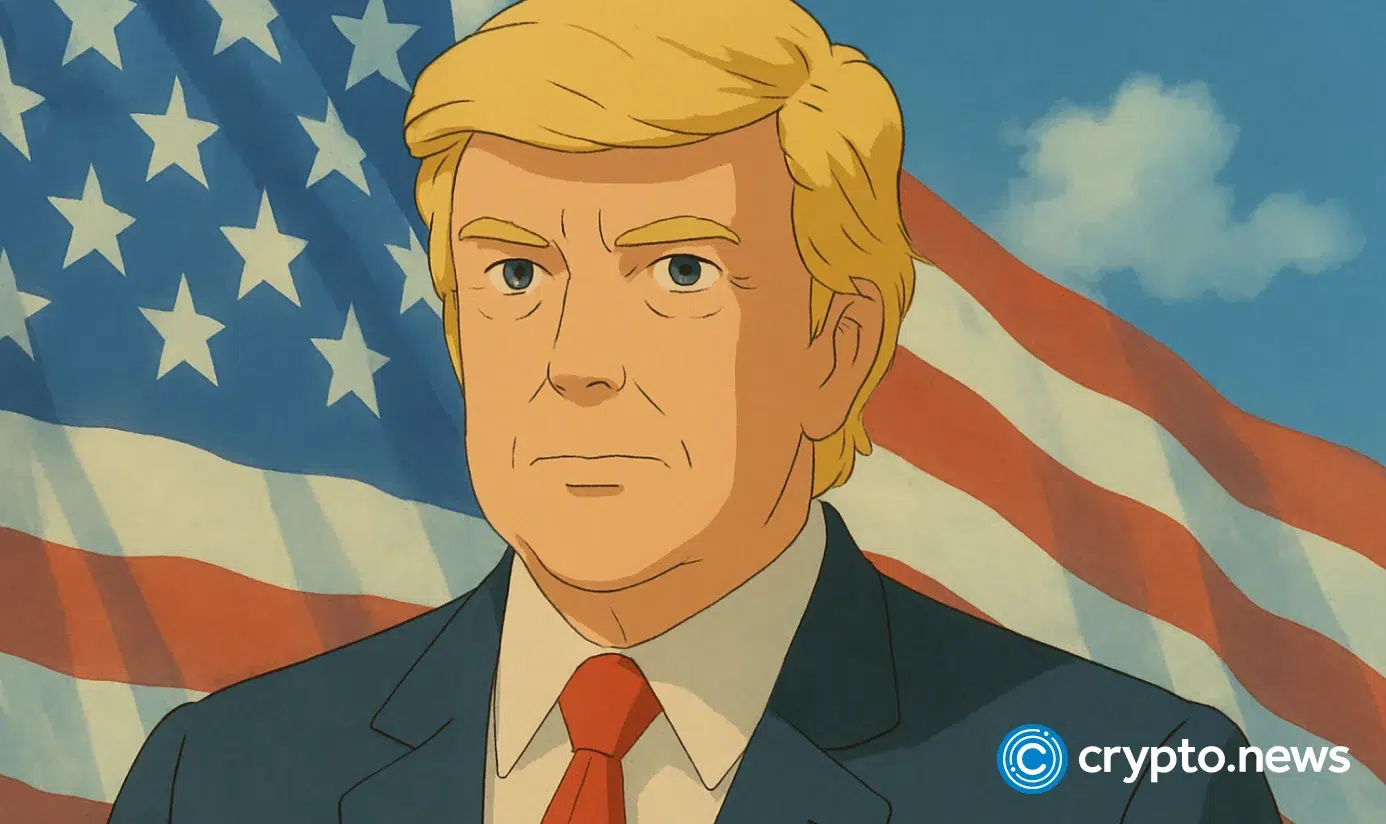
President Donald Trump has privately told senior aides he could end the U.S.-Iran war without securing a nuclear agreement if Tehran fully reopens the Strait of Hormuz, the Wall Street Journal reported on Aug. 9, citing U.S. officials.
Summary
- Trump reportedly told aides he could end the Iran war without securing a nuclear deal.
- Iran says Hormuz reopening requires U.S. compensation, sanctions relief, freed assets, and broader security concessions.
- An Iran-Oman shipping agreement is in final stages, but Tehran says it cannot reopen Hormuz.
- Brent crude settled at $83.55 Friday, up 1.3%, as traders awaited clearer Hormuz negotiations details.
- Washington says it would lift Iran’s port blockade once commercial shipping resumes freely through Hormuz.
The report comes as Iran raises the price for reopening the waterway, tying compensation, sanctions relief and wider security demands to any durable arrangement.
The White House has not publicly confirmed that Trump has changed his nuclear objective. Its latest published Iran remarks, from July 28, instead repeated that Iran cannot obtain a nuclear weapon and said military options remain available if diplomacy fails. The reported willingness to “walk away without a nuclear deal” therefore remains a private policy consideration, not an announced shift in U.S. strategy.
Iran’s latest demands complicate the Hormuz exit path
The Journal reported that Iran is seeking billions of dollars in U.S. payments, the withdrawal of American forces from the region and an end to the U.S. naval blockade. Reuters separately reported that Foreign Minister Abbas Araqchi is demanding compensation for U.S. attacks, while Mohammad Baqer Zolqadr, secretary of Iran’s top security body, called for sanctions relief, freed Iranian assets and an end to U.S. military pressure on Iran and its regional allies.
Tehran has also separated its talks with Oman from a broader settlement with Washington. Araqchi said an Iran-Oman agreement defining new shipping lanes is in “final stages,” but said the waterway would not reopen simply because that technical arrangement is completed. He added that Iran and the U.S. are not in direct talks, although messages continue through intermediaries.
A U.S. official told Reuters that Washington would lift its blockade of Iranian ports once commercial shipping resumes without impediments. That creates a sequencing problem: Washington wants shipping restored before lifting the blockade, while Iran says broader U.S. concessions must come first.
The proposed arrangement also remains politically sensitive because Reuters reported that one version could give Tehran a role in controlling ships entering the Gulf. U.S. officials have repeatedly opposed Iranian control of Hormuz and mandatory tolls, leaving another unresolved issue even if technical shipping lanes are agreed.
Trump’s public nuclear line has not formally changed
The strongest reason to treat the latest report cautiously is the gap between Trump’s private comments and public position. In a July 28 White House statement, Trump maintained that Iran could not obtain a nuclear weapon and warned that U.S. forces could strike additional sites if diplomacy failed. The administration has not issued a public statement reversing that position.
The Journal, however, reported that Trump has privately told aides Tehran may be unable to rebuild its nuclear program during his presidency after earlier U.S. strikes damaged major facilities. According to the report, he believes U.S. intelligence could detect renewed work and that the threat of more military action could deter rebuilding. Those judgments are not a negotiated nuclear settlement.
A White House official told the Journal that the administration considers its military objectives completed and is now focused on restoring energy flows through the Strait of Hormuz, while keeping military options available if Iran attacks shipping. That would make reopening Hormuz the near-term test for de-escalation even if the nuclear dispute remains unresolved.
Domestic politics add pressure. The Journal reported that Trump is prepared to wait through the latest negotiating difficulties as long as gasoline prices remain manageable. It put the U.S. national average at $4.02 a gallon on Saturday, compared with $3.16 a year earlier, with the midterm elections less than three months away.
Hormuz keeps oil and crypto markets sensitive
Markets remain focused on whether shipping can normalize. Reuters reported that most Gulf stock markets ended Sunday subdued while investors waited for clarity on the Oman-Iran arrangement. Brent crude settled Friday at $83.55 a barrel, up $1.06, or 1.3%.
Bitcoin was trading near $65,184 on Sunday. There is no evidence that the Journal report alone caused the move, especially with U.S. markets closed. Still, the conflict has repeatedly fed into crypto risk sentiment through oil prices, inflation expectations and broader geopolitical risk.
As crypto.news reported on July 31, Bitcoin fell below $64,000 as renewed Iran fighting lifted oil and revived fears over energy disruption. Bitcoin later moved back above $64,000 as expectations for a Hormuz agreement improved. Those episodes help explain why crypto traders continue watching the negotiations even when the trigger is outside digital asset markets.
The Strait handled about one-fifth of global oil and liquefied natural gas shipments before the current disruption, according to Reuters. A durable reopening could therefore affect energy prices, transport costs and inflation expectations, although the market response would depend on the terms and whether shipping normalizes in practice.
What happens next in the Iran talks
The next verifiable step is an Iran-Oman shipping agreement. Araqchi says the deal is close, but no final text has been published and Tehran says it will not be enough by itself to reopen the strait. Washington says its blockade can be lifted once commercial shipping resumes freely.
The broader demands remain harder to resolve. Iran is seeking compensation, sanctions relief, access to frozen assets and security concessions. As previously reported, access to frozen Iranian assets has surfaced in earlier negotiations as one potential bargaining point, although no current deal on that issue has been announced.
Meanwhile, the U.S. has not publicly agreed to Tehran’s latest terms, while the White House has not confirmed the Journal’s report that Trump would accept ending the war without a nuclear accord. Iran also continues to say there are no direct U.S.-Iran talks at present.
For now, reopening Hormuz appears to be the most tangible off-ramp available to Washington. Whether it becomes the basis for ending the conflict will depend on published terms, actual shipping access and whether both sides can sequence concessions without triggering another round of military escalation.


Fresh HYPE supply is moving through trading venues after HyperLabs unlocked 433,025 tokens worth more than $23 million, adding another test for Hyperliquid’s market as scheduled team distributions continue.
Summary
- HyperLabs unlocked 433,025 HYPE worth about $23.46 million and moved tokens toward trading venues afterward.
- Lookonchain linked transfers to Flowdesk and OKX, but exchange deposits do not confirm sales occurred.
- HYPE traded near $54.6 Sunday after falling from levels above $56 before the unlock activity.
- Hyperliquid team distributions follow a vesting schedule that began in January and continues through 2027.
- Protocol buybacks provide HYPE demand, creating a counterweight to supply released through scheduled team vesting.
On Aug. 8, onchain tracker Lookonchain reported that the development team had redeemed the tokens from staking and was gradually moving them toward Flowdesk and OKX.
Further transaction tracking indicates that at least part of the allocation has already been sold rather than merely deposited. Onchain analyst Ember reported that 165,000 HYPE, worth about $9.23 million at the time, went to market maker Flowdesk. Of that amount, 75,000 HYPE worth roughly $4.19 million was moved onto Hyperliquid and exchanged for USDC, while another 90,000 HYPE worth approximately $5.04 million was routed to OKX and Bybit deposit addresses.
HYPE sales go beyond simple exchange deposit speculation
The latest data adds an important distinction to the original reports surrounding the unlock. Exchange deposits alone cannot prove that an asset was sold, since tokens can move to centralized platforms for custody, liquidity management, market making or other purposes. Lookonchain therefore described the transfers as “likely to sell,” making clear that its initial conclusion was an interpretation of the wallet activity.
However, the separate Flowdesk trail provides firmer evidence for part of the distribution. PANews, citing Ember’s onchain monitoring, reported that 75,000 HYPE was converted into USDC on Hyperliquid. The remaining 90,000 tokens tracked in that batch reached deposit addresses associated with OKX and Bybit, where their eventual disposition cannot be established from the deposit alone.
The wallet identified as HyperLabs can be tracked through HypurrScan. It has also appeared in earlier team distributions, making the latest movement part of a broader vesting pattern rather than an isolated token transfer.
Hyperliquid’s team unlocks have been moving monthly
The latest 433,025 HYPE release follows a team vesting program that began at the start of 2026. Hyperliquid Labs unstaked 1.2 million HYPE in late December 2025 ahead of the first scheduled Jan. 6 distribution under a 24 month vesting plan. Future team distributions were expected to follow monthly.
The amount distributed to the team has not necessarily remained constant. In February, Hyperliquid’s team related allocation was reduced by roughly 90%, resulting in about 140,000 HYPE being released instead of an initially expected 1.2 million tokens. Broader HYPE emissions continued through other allocations, meaning headline unlock figures can include supply categories beyond team compensation.
Earlier unlocks have already tested whether market demand can absorb new supply. In related coverage, another 422,000 HYPE worth about $17.5 million was scheduled for release in May. Meanwhile, a much larger February event placed roughly 9.92 million HYPE into circulation without immediately causing a major price breakdown.
That history matters because unlocking and selling are separate events. Vesting makes previously restricted tokens transferable, but price pressure depends on how much of that supply holders actually sell and how much buying demand meets it.
HYPE traded around $54.6 on Sunday, Aug. 9. Market data showed the token had closed around $56.16 on Aug. 7 before falling to approximately $54.06 on Aug. 8. The move coincided with the team transactions, although the timing alone does not establish that the unlock caused the entire decline.
The token remains well below its June record near $77. However, Hyperliquid has a demand mechanism that distinguishes its supply picture from a simple unlock schedule. The protocol’s Assistance Fund uses most trading fee revenue to acquire HYPE, creating recurring market demand that can absorb part of the supply entering circulation.
As crypto.news reported in an earlier examination of Hyperliquid’s buybacks, the key question is therefore the balance between tokens becoming liquid and HYPE being purchased through fee generated demand. Unlocks can add available supply, while continued trading activity can fund purchases on the other side of the market.
The February market response showed that large unlocks do not automatically produce equivalent price declines. HYPE remained above its prior breakout area after the roughly $340 million February release, while trading activity and buybacks helped absorb additional supply. That precedent does not guarantee the same outcome after later distributions.
What happens next for HyperLabs and HYPE
Wallet movements are now the clearest near term metric. Roughly 165,000 HYPE from the latest batch has been tied to the Flowdesk route, including the 75,000 tokens reported sold for USDC and 90,000 transferred toward OKX and Bybit. That leaves additional tokens from the original 433,025 release whose eventual use remains relevant to traders watching supply.
Further transfers into exchanges would increase the amount of HYPE positioned where it could potentially be sold, although deposits should not be treated as sales without transaction or market evidence. Conversely, movement back into staking or long term wallets would carry a different supply signal.
Another factor will be the next scheduled team vesting cycle. Hyperliquid’s previously disclosed 24 month distribution structure means team related unlocks are not finished, and markets can continue to monitor them in advance rather than treating each release as an unexpected event.
For now, the strongest verified conclusion is narrower than claims that HyperLabs is dumping the entire $23 million allocation. Onchain tracking shows that 433,025 HYPE became available, substantial amounts were routed through Flowdesk and exchanges, and 75,000 HYPE was reported exchanged for USDC. The fate of the remaining tokens will determine how much of this particular unlock ultimately reaches the open market.


Crypto mergers and acquisitions (M&A) reached a record $9.66 billion in disclosed value in the first half of 2026, even as the number of announced deals fell 25% to 87.
The finding comes from CryptoRank Research, which tracked 87 acquisition announcements between January and June. Disclosed value rose 223% from the second half of 2025, yet deal activity dropped to its lowest count since early 2025.
Megadeals Drove the Crypto M&A Record
For the first time in the data series, deal count and disclosed value moved in opposite directions. Announcements had climbed steadily from 27 in H1 2024 to 116 in H2 2025 before reversing.
The reversal traces to the buy side. A handful of deep-pocketed strategic buyers, largely public companies and licensed exchanges, kept spending. The smaller acquirers that powered last year’s surge pulled back.
Concentration tells the clearest version of the story. Only 21 of the 87 announcements disclosed a value, representing 24%. The four largest deals alone supplied 76% of the $9.66 billion total.
One transaction did much of the lifting. Bullish’s agreement to buy transfer agent Equiniti for $4.2 billion accounted for 43% of the half-year figure on its own.
The pattern echoes the corporate market, where value has clustered in megadeals while volumes retreat.
Follow us on X to get the latest news as it happens
A Record Built on Disclosure, Not Higher Prices
The typical deal did not get more expensive. The median disclosed transaction held flat at $100 million against H2 2025 and fell 20% from H1 2025.
That gap separates a reporting story from a pricing one. The mix of buyers shifted toward public and regulated firms, which must report deal terms that private acquirers can keep quiet. Deals big enough to be material also force disclosure on their own.
The record, therefore, reflects a market that grew more visible at the top, not one where valuations climbed across the board.
Completed deals underline the shift toward regulated buyers. Mastercard closed its purchase of stablecoin firm BVNK for up to $1.8 billion this month. The Equiniti deal remains pending, with closing expected in January 2027.
Buyers also shifted their targets. Infrastructure lead as the largest category, while Decentralized Finance (DeFi) acquisitions fell from 24 to 9, ceding the top spot it had built through 2025.
For now, the record says more about one $4.2 billion agreement than about what crypto companies are worth.
Subscribe to our YouTube channel to watch leaders and journalists provide expert insights
The post Crypto Made a $9.6 Billion Record, But It’s Hiding a Crucial Truth appeared first on BeInCrypto.
Coinbase has pulled trading support for five cryptocurrencies after giving holders a month to prepare.
Summary
- Coinbase disabled trading for IDEX, LRC, OMNI, PIRATE and FIS across major trading platforms Friday.
- Customers can still access and withdraw affected tokens, while Coinbase has not announced conversions yet.
- Coinbase first announced the five suspensions July 7, giving holders one month of advance notice.
- Six non-dollar pairs were separately suspended August 6, but their underlying tokens remain supported elsewhere.
- Coinbase says routine reviews determine whether listed assets continue meeting its standards across trading services.
On Aug. 7, the exchange confirmed that trading had been disabled for Idex (IDEX), Loopring (LRC), Omni Network (OMNI), Pirate Nation (PIRATE) and StaFi (FIS). The suspension covers Coinbase Simple and Advanced Trade, Coinbase Exchange and Coinbase Prime.
For customers still holding the five tokens, the change stops trading rather than immediately removing access to the assets. Coinbase said balances remain accessible and withdrawals can continue, allowing holders to transfer tokens to compatible external wallets or other platforms that support them. The exchange’s latest notice did not announce an automatic conversion or liquidation of remaining balances.
Coinbase gave holders one month before halting trading
The Aug. 7 suspension was not announced without warning. Coinbase first disclosed the planned removals on July 7 and said trading would stop on or around 2 p.m. ET on Aug. 7. Before the cutoff, order books for IDEX, LRC, OMNI, PIRATE and FIS were moved into limit only mode, allowing customers to place and cancel limit orders while matches could still occur.
Coinbase said it regularly monitors assets to determine whether they continue to meet its listing standards. However, the notices reviewed by crypto.news did not identify a separate reason for removing each of the five tokens. That means claims attributing a particular token’s suspension to liquidity, regulation, development activity or another individual factor would go beyond Coinbase’s public explanation.
The change has now taken effect. Coinbase’s current asset pages label IDEX, Loopring, Omni Network, Pirate Nation and StaFi as not tradable on the platform.
Token suspensions differ from Coinbase’s six pair removals
The five token suspensions came one day after Coinbase removed six individual trading pairs. The exchange ended trading on Aug. 6 for LSETH-ETH, MINA-EUR, GRT-GBP, MASK-GBP, CHZ-USDT and CRO-USDT.
Those changes should not be confused with the five token suspensions. Removing a trading pair means Coinbase can continue supporting the underlying asset through another available market, depending on the customer’s region. By contrast, IDEX, LRC, OMNI, PIRATE and FIS have lost trading support across Coinbase’s main retail, advanced and institutional spot services.
As crypto.news reported, Coinbase said the six pair removals followed its regular market reviews and were intended to consolidate liquidity and support healthier markets. Five of those markets had first been shifted to limit only trading before being suspended.
Coinbase has used similar review processes before. The exchange ended DAI trading in May as part of a separate asset change that included conversion of remaining eligible balances into USDS. The current IDEX, LRC, OMNI, PIRATE and FIS notice is different because Coinbase has not announced a comparable conversion plan.
Some affected tokens were already undergoing wider changes
The five assets are not all in the same position outside Coinbase. Omni Network, for example, underwent a broader transition after the project rebranded to Nomina. Nomina said Omni Core was officially sunset in February 2026 and its assets migrated to Ethereum as the ecosystem shifted toward the NOM token and an Ethereum based trading protocol. Coinbase did not cite that transition as the reason for suspending OMNI.
StaFi had also lost a major trading venue before Coinbase’s decision. Binance ended spot trading for FIS in December 2025 as part of its own periodic review. Again, there is no public evidence showing Coinbase based its decision on Binance’s earlier removal, and the two exchanges conduct their listing reviews independently.
The current Coinbase data also shows why the five tokens should not be treated as removed from existence simply because trading has stopped on one exchange. Coinbase continues to display informational price pages for the assets even though those pages now identify them as unavailable for trading. Users can also withdraw balances under the exchange’s Aug. 7 notice.
What happens next for affected Coinbase users
The immediate decision for holders is whether to leave their assets on Coinbase or withdraw them to another supported destination. Coinbase has not set a new trading date or announced that any of the five markets will return. Its latest statement says users continue to have access to their funds and can withdraw them.
Users moving tokens externally need to confirm that the destination supports the correct network and token contract before initiating a transfer. Coinbase’s own support materials note that onchain sends are irreversible, making network and address compatibility important when withdrawing delisted assets.
Meanwhile, the trading changes are taking place as Coinbase reorganizes other parts of its business. As previously reported, institutional Coinbase International Exchange accounts, positions and balances are scheduled to migrate to Deribit on Sept. 9. Coinbase’s official migration guidance sets Aug. 28 as the opt out deadline and Aug. 31 for clients to verify Deribit access.
That institutional derivatives migration is separate from the five token suspensions, but together the moves show Coinbase making several market and infrastructure changes during August. For IDEX, LRC, OMNI, PIRATE and FIS holders, however, the position is straightforward for now: trading has stopped, balances remain accessible and withdrawals remain available, with no public timetable for trading support to resume.
Ethereum is attempting to stabilize around $1.9K after its recent recovery, but the broader technical picture remains constrained by major overhead resistance. While short-term structure has improved, ETH still needs a decisive breakout to confirm that buyers are regaining control.
Ethereum Price Analysis: The Daily Chart
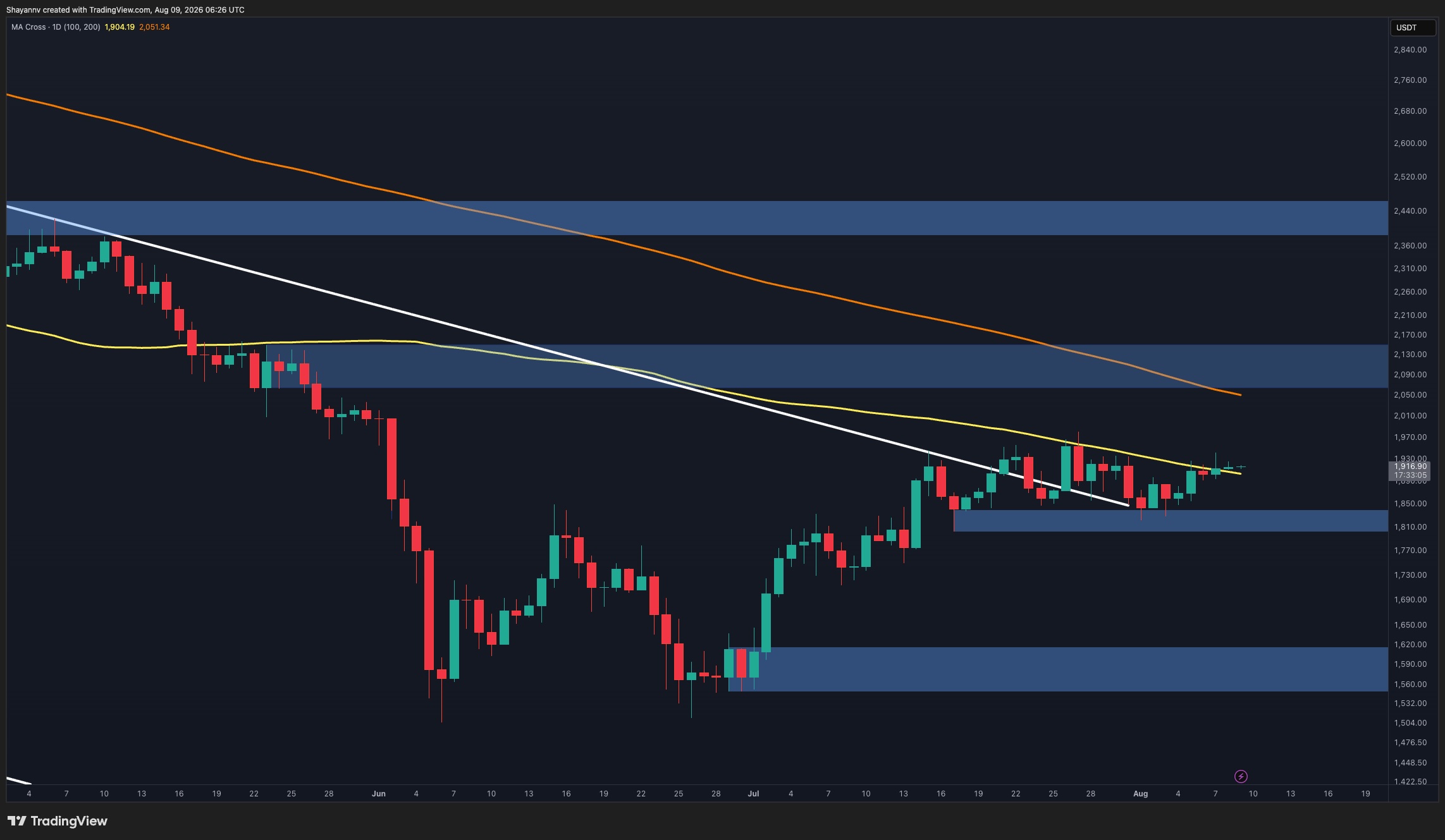
On the daily timeframe, ETH is trading around $1.92K and has recently pushed above the descending white trendline. This is a constructive development compared with the previous structure, as the trendline had acted as dynamic resistance throughout the broader decline.
However, the breakout has yet to translate into strong upside momentum. The asset is now confronting the declining 100-day moving average around $1.94K, while the larger $2.05K-$2.15K resistance zone sits directly above it. The 200-day moving average is also descending toward this region, creating a significant concentration of overhead resistance.
Therefore, the trendline breakout is an encouraging first step, but it does not yet confirm a broader bullish reversal. A sustained move above the $1.94K moving average would strengthen the case for an advance toward the $2.05K-$2.15K zone. Until that happens, rejection from current levels could send ETH back toward the $1.81K-$1.85K support region.
If that support fails, the larger $1.56K-$1.62K demand zone would become the next major downside target.
ETH/USDT 4-Hour Chart
The 4-hour timeframe presents a somewhat stronger short-term picture. ETH has rebounded from the $1.80K-$1.84K support zone and is now consolidating near $1.92K after establishing a sequence of higher lows from the early-August bottom.
Nevertheless, buyers are approaching a crucial test. The $1.95K-$1.98K resistance box marks the immediate supply zone and previously triggered a sharp rejection in late July. Price is currently consolidating just beneath this area, suggesting that the market is preparing for another attempt.
A breakout above the $1.95K-$1.98K region would likely open the door toward $2K and the upper boundary of the broader ascending structure. Conversely, another rejection would leave ETH vulnerable to a retracement toward the $1.80K-$1.84K support box.
The short-term bias has consequently improved, but confirmation still depends on buyers successfully clearing the resistance immediately overhead.

Sentiment Analysis
Ethereum’s funding-rate chart provides an interesting backdrop to the latest recovery. Funding rates measure the periodic payments between long and short perpetual-futures traders, with positive readings generally indicating that leveraged positioning is tilted toward longs.
The 14-period funding-rate EMA remains positive at roughly 0.006, but it has fallen substantially from its June peak near 0.01. At the same time, ETH has begun recovering toward $1.9K from its recent lows.
This divergence suggests that price is recovering without a comparable increase in leveraged-long enthusiasm. That can be constructive because the advance appears less dependent on increasingly crowded bullish positioning, reducing the immediate risk associated with excessive positive funding.
Still, funding remains above zero, meaning longs continue to pay shorts, and bullish positioning has not disappeared. If ETH breaks the $1.95K-$1.98K resistance zone while funding remains relatively contained, the move could have a healthier derivatives backdrop. A renewed surge in funding without a corresponding price breakout, however, would signal increasing leverage and raise the risk of another long-side flush.

The post Ethereum Price Analysis: Is ETH Primed for a Move to $2K Next Week? appeared first on CryptoPotato.
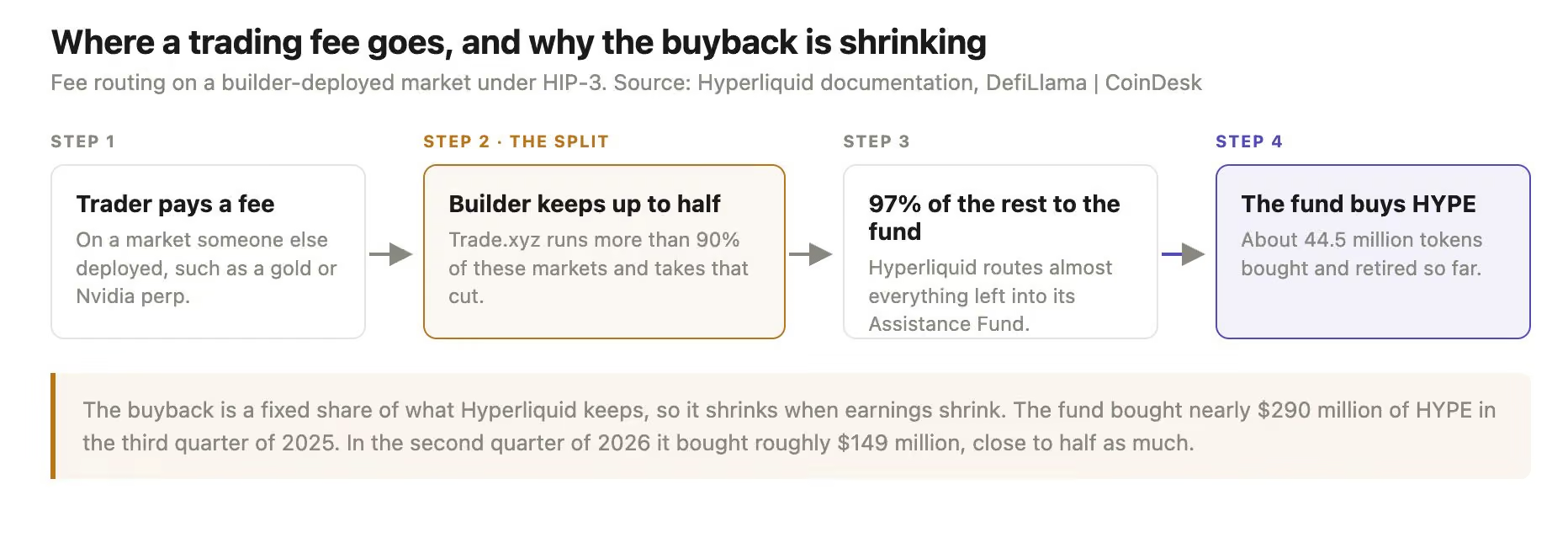
At the start of 2026 these builder-deployed markets were about 2% of Hyperliquid’s perp volume. They are now roughly half of it.
The pass-through shows up in the accounts. Cost of revenue, the portion of fees Hyperliquid hands straight back to builders, market makers and its own liquidity vault, was under 6% of gross revenue in the second quarter of 2025. A year later it was 18%.
Builder code fees, which front-ends like Phantom charge on top for routing an order, arrived at roughly $16 million of revenue in the second quarter and left as roughly $16 million of cost in the same quarter. Every dollar of it passes through.

Traders keep showing up because of what those builder markets list. Real-world asset perps, contracts on things like crude oil, gold, Nvidia, Tesla, a Nasdaq-100 tracker and pre-IPO names like SpaceX, hit a record $3.6 billion in open interest this month and overtook bitcoin as the platform’s largest market by that measure.
Between July 13 and July 19, tokenized stocks and commodities did $25 billion in volume, 52% of the weekly total, outpacing crypto perps for the first time. The contracts settle in stablecoins, never expire, and trade through the weekend when the New York Stock Exchange is shut. A product such as leveraged Nvidia exposure, at 2 a.m. on a Sunday, has few other homes.


Michael Saylor put Strategy’s Bitcoin activity back under scrutiny on Sunday, Aug. 9, with a two word X post: “Doing ₿usiness.”
Summary
- Strategy sold 1,638 BTC for $104.73 million between July 27 and August 2, filings show.
- Saylor’s Sunday “Doing ₿usiness” post did not specify whether Strategy bought, sold, or moved Bitcoin.
- Lookonchain linked a 1,030 BTC transfer to Strategy, but no company filing confirms any sale.
- Strategy’s holdings remain 842,138 BTC acquired for $63.51 billion at an average cost of $75,419.
- STRC closed Friday near $94.60, still below the $100 stated amount Strategy management currently targets.
The company’s executive chairman offered no details about whether the message referred to buying Bitcoin, selling more BTC, raising capital or another treasury transaction. As of Sunday, Strategy’s public Bitcoin ledger still showed 842,138 BTC, meaning no additional disposal after its Aug. 3 filing had been confirmed.
The timing has fueled speculation because Strategy confirmed a $104.73 million Bitcoin sale last Monday and a wallet linked to the company moved another 1,030 BTC two days later. Yet the second movement remains just that: an onchain transfer. Neither Strategy nor a later U.S. Securities and Exchange Commission filing has established that those coins were sold.
Strategy’s latest confirmed move was a 1,638 BTC sale
Strategy’s Aug. 3 SEC filing shows it sold 1,638 BTC between July 27 and Aug. 2 at an average price of $63,957, receiving $104.73 million after fees. The company used $52.4 million for preferred stock dividends and $52.3 million to help finance repurchases of STRC preferred shares.
After the transaction, Strategy reported 842,138 BTC acquired for $63.51 billion at an average cost of $75,419 per coin. Its official Bitcoin ledger actually records four negative BTC entries during 2026: 32 BTC reported June 1, 1,363 BTC on June 30, 2,225 BTC on July 6 and the latest 1,638 BTC. Together, those entries total 5,258 BTC.
As crypto.news reported, the latest sale was accompanied by another source of cash. Strategy sold 3.01 million MSTR shares for $290.6 million during the same reporting period. Of those proceeds, $250 million went into its U.S. dollar reserve, $28.9 million funded additional STRC repurchases and $11.7 million was added to cash.
That combination matters when assessing Saylor’s latest post. Strategy now has several ways to raise or redirect capital, so a cryptic message from Saylor does not automatically mean the company bought or sold Bitcoin.
On Aug. 5, Lookonchain identified wallets it associates with Strategy transferring 1,030 BTC, then worth roughly $66.14 million. The analytics firm itself framed the transaction as a question, asking whether Strategy was “dumping BTC again.” No official company disclosure has confirmed that interpretation.
Bitcoin can move between custodians, internal addresses, trading accounts or settlement wallets without ownership changing. Strategy’s public ledger continued to show 842,138 BTC after the transfer, while the Aug. 3 SEC filing covered activity only through Aug. 2.
The next company update could therefore clarify whether the 1,030 BTC movement represented another disposal. Until then, describing it as a confirmed sale would go beyond the available evidence.
The distinction is especially important because Strategy has formally changed how it manages Bitcoin. The company once focused overwhelmingly on accumulation, but its board now permits Bitcoin monetization for specified corporate purposes.
STRC buybacks create a reason Strategy could sell more BTC
Strategy’s second quarter disclosure says its Bitcoin Monetization Program allows BTC sales to fund its U.S. dollar reserve, preferred dividends, interest obligations and approved repurchases of MSTR or its digital credit securities. The authorization permits up to $1.25 billion of Bitcoin sales specifically to build the reserve, alongside additional permitted uses.
Management has placed particular attention on STRC. CEO Phong Le said the company’s objective is for the preferred shares to trade between $99 and $100 and that Strategy intends to repurchase STRC in a “regular and disciplined manner” while it remains below $100.
STRC was still around $94.60 after Friday’s session, according to Strategy’s own STRC information page. The Aug. 3 filing also showed that Strategy bought back 912,143 STRC shares for $81.2 million during the preceding week, leaving $893.8 million available under its preferred securities repurchase authorization.
Still, another Bitcoin sale is not required to fund those purchases. Strategy entered August with a $4 billion U.S. dollar reserve and continues to have access to its at the market equity programs. Those alternative funding sources make any prediction about the next treasury move uncertain.
Monday’s disclosure could settle the Bitcoin sale question
Because Saylor posted on Sunday, U.S. equity markets have not yet had an opportunity to react directly to his message. MSTR’s latest session ended at $100.01, while Bitcoin was trading around $65,183 on Sunday.
That also means Monday’s company disclosures matter more than social media speculation. Strategy has said its website dashboard is one of its Regulation FD disclosure channels, and it regularly reports Bitcoin transactions through SEC filings and its public ledger.
Strategy’s recent disposals have marked a broader shift toward active treasury management as the company balances Bitcoin holdings, preferred dividends, cash reserves and STRC support. The change does not establish that Strategy is abandoning Bitcoin accumulation, but it does mean Saylor’s traditional Sunday posts can no longer be read automatically as previews of another purchase.
For now, “Doing ₿usiness” remains a teaser rather than evidence of a transaction. The clearest confirmation would be a new SEC filing or Strategy ledger update showing whether its 842,138 BTC balance changed after Aug. 2. Until such a disclosure appears, the reported 1,030 BTC movement should remain classified as an unconfirmed transfer rather than another Strategy sale.


Bitcoin exchange-traded funds (ETFs) pulled in $853.54 million in net inflows for the week ended Aug. 7, the largest weekly total since mid-April, according to data from SoSoValue.
BlackRock’s IBIT accounted for the bulk of the activity, attracting $693 million on its own.
This surge in inflows offers a tentative sign that institutions are dipping back in after the heavy selling earlier this year.
Recent bitcoin price action has looked more constructive. Negative headlines, including a multi-million-dollar Coldcard hack and rising government bond yields, have failed to dent the spot market. Bitcoin held steady at around $64,000 early this week and traded at around $65,100 as of this writing.
Friday’s unexpectedly weak U.S. jobs report for July has cooled bets on further Federal Reserve rate hikes for now, potentially clearing the path for continued institutional buying in ETFs.
What next?
The latest spike in inflows represents only one week of data. On a year-to-date basis, the ETFs remain roughly $4.5 billion in the red due to net outflows. This helps explain the heavy selling pressure seen during the first six months of the year, when Bitcoin fell 33% to below $60,000 by the end of June.


Most traders assume depegs are slow. They are not. Inside the 30 second window where arbitrage bots, liquidation cascades, and oracle lag collide to turn a minor price slip into a systemic event.
Summary
- A stablecoin depeg lasting fewer than 60 seconds can trigger hundreds of millions of dollars in DeFi liquidations because lending protocols rely on price oracles that update on fixed intervals, not in real time, creating windows where collateral ratios become stale.
- Arbitrage bots can detect and exploit a depeg within two to three blocks on Ethereum, roughly 24 to 36 seconds, buying discounted stablecoins on one venue and redeeming or selling at par on another, but their speed advantage disappears when the depeg is caused by a solvency question rather than a liquidity imbalance.
- Chainlink price feeds for major stablecoins use a 0.25 percent deviation threshold and a one hour heartbeat interval, meaning the oracle will not update until the price moves at least 0.25 percent from its last reported value or 3,600 seconds have elapsed, whichever comes first.
- During the March 2023 USDC depeg caused by Silicon Valley Bank’s failure, approximately $2.1 billion in DeFi liquidations occurred within the first four hours, with the largest single liquidation exceeding $52 million on Aave v2, because borrowers who had posted USDC as collateral saw their positions fall below maintenance thresholds.
- Curve Finance’s 3pool, the largest stablecoin liquidity pool on Ethereum at the time, saw its USDC balance rise from roughly 33 percent to over 83 percent of total pool composition within hours as traders dumped USDC for DAI and USDT, a composition shift that amplified the depeg by creating one sided liquidity.
The popular explanation of a stablecoin depeg involves a gradual loss of confidence: reserves are questioned, redemptions spike, and the peg erodes over hours or days. That version describes Terra’s collapse. It does not describe what happens when USDC trades at $0.87 on a Friday afternoon because a bank failed, or when USDT briefly drops to $0.97 on Curve during a liquidity crunch. Those events last seconds to minutes, and the damage they cause operates on a completely different timescale than the narratives written about them afterward. The mechanics of a short depeg are faster, more automated, and more consequential per second than almost anything else in crypto.
The assumption that a depeg needs to persist for minutes or hours to matter is wrong. Thirty seconds is enough for an automated system to declare a position insolvent, execute a liquidation, sell the seized collateral at a discount, and move on. Thirty seconds is enough for a liquidity pool to absorb a sell order large enough to shift its composition from balanced to critically one sided. And thirty seconds is more than enough for an arbitrage bot to decide whether the depeg represents a buying opportunity or a genuine solvency event, a distinction that determines whether the bot stabilizes the price or accelerates the decline.
How a peg works when nothing is wrong
A stablecoin maintains its dollar peg through a combination of primary market redemption and secondary market arbitrage. The primary market is where authorized participants, typically large trading firms with direct relationships with the issuer, can create or redeem stablecoin tokens for exactly one dollar of the underlying reserve asset. The secondary market is where everyone else trades, on centralized exchanges, decentralized exchanges, and automated market makers.
When the secondary market price drops below one dollar, arbitrageurs buy the discounted stablecoin on the secondary market and redeem it for one dollar through the primary market, pocketing the difference. When the price rises above one dollar, they do the reverse: mint new tokens at one dollar and sell them on the secondary market at a premium. This two sided arbitrage keeps the price pinned to one dollar under normal conditions.
The system works because the primary market acts as a price floor and ceiling. As long as anyone can redeem one USDC for one dollar of reserves, the token cannot trade meaningfully below one dollar for long, because doing so creates a guaranteed profit for anyone willing to execute the redemption. The key phrase is “for long.” The lag between detecting a depeg and executing a redemption is where everything happens.
The 30 second anatomy of a depeg
A typical depeg event on Ethereum unfolds across a compressed timeline that most observers reconstruct only after the fact.
Second zero: a large sell order hits a stablecoin liquidity pool on a decentralized exchange. The order is large enough to move the pool composition, pushing the stablecoin’s implied price below one dollar. On Curve Finance, which uses a specialized bonding curve optimized for assets that should trade at similar prices, a sell order of $10 million to $50 million can move the implied price by 0.5 to 3 percent depending on pool depth.
Seconds one through six: the trade is confirmed in the next Ethereum block. The pool’s new composition is now public. Every bot monitoring the mempool and block stream sees the price deviation.
Seconds seven through twelve: arbitrage bots that operate across multiple venues detect the price difference between the decentralized exchange and centralized exchanges where the stablecoin still trades at par. The fastest bots submit transactions in the next block, buying the discounted stablecoin on the DEX and simultaneously selling it on a centralized exchange.
Seconds thirteen through twenty four: the arbitrage trades execute. If the initial sell order was a one time event, a large fund rebalancing its portfolio or a panic seller liquidating a position, the arbitrage flow absorbs the price impact and the peg restores within two to three blocks. This is the benign scenario and accounts for the vast majority of stablecoin price deviations.
Seconds twenty five through thirty and beyond: if the sell pressure continues, the arbitrage flow cannot keep up. The bots are limited by their own capital, their willingness to hold inventory risk, and the speed at which they can move funds between centralized and decentralized venues. When the depeg persists past the arbitrage capacity, the market transitions from a liquidity event to a confidence event, and the dynamics change fundamentally.
Oracle lag and the liquidation trigger
The most consequential feature of a short depeg is not the price movement itself but the interaction between that movement and the oracle systems that DeFi lending protocols use to value collateral.
Lending protocols such as Aave, Compound, and Maker do not use real time market prices. They use oracle feeds, most commonly provided by Chainlink, that aggregate prices from multiple sources and update on chain according to specific rules. For major stablecoins, Chainlink’s price feeds typically use a deviation threshold of 0.25 percent and a heartbeat of 3,600 seconds. The feed updates when the price moves more than 0.25 percent from the last on chain value, or when one hour has passed since the last update, whichever condition triggers first.
This design is intentional. Updating on every block would be prohibitively expensive in gas costs and would expose the oracle to manipulation through short lived price spikes. But the design creates a window of vulnerability during a depeg. If USDC trades at $0.99 on the secondary market but the oracle last reported $1.00 and the deviation threshold has not been crossed, the protocol still values USDC collateral at one dollar. Borrowers who posted USDC as collateral have a few minutes of grace before the oracle catches up.
When the oracle does update, the effect is abrupt. Every position that was marginally above the liquidation threshold at the old price may suddenly fall below it at the new price. The protocol does not liquidate positions one at a time in order of risk. It opens all eligible positions to liquidators simultaneously, creating a wave of liquidation transactions that compete for block space and drive up gas prices, which in turn increases the cost of executing arbitrage trades, which in turn reduces the arbitrage flow that would otherwise stabilize the price.
This feedback loop, depeg triggers oracle update triggers liquidations triggers more selling triggers deeper depeg, is why short depegs can cause damage disproportionate to their duration. The March 2023 USDC event produced approximately $2.1 billion in liquidations across DeFi. The depeg lasted roughly 48 hours in total, but the majority of liquidations occurred in concentrated bursts that corresponded to oracle update cycles.
Curve pools and one sided liquidity
Curve Finance occupies a unique position in stablecoin infrastructure because its automated market maker is specifically designed for assets that should trade at the same price. The Curve stableswap invariant, a mathematical formula that concentrates liquidity around the one to one price ratio, allows large trades with minimal slippage under normal conditions. During a depeg, this same design amplifies the problem.
When traders sell a depegging stablecoin into a Curve pool, the pool absorbs the selling by accumulating more of the depegging asset and distributing more of the other assets in the pool. As the composition shifts, say from 33/33/33 in a three asset pool to 80/10/10, the implied exchange rate for the majority asset deteriorates nonlinearly. A pool that can handle a $50 million swap with 0.1 percent slippage at balanced composition might require 5 percent slippage for the same swap when one asset comprises 80 percent of the pool.
This dynamic means that Curve pools act as both a stabilizer and an amplifier. In the early seconds of a depeg, the pool absorbs selling and the stableswap invariant keeps the price close to par. As the composition becomes increasingly one sided, the pool begins amplifying the depeg by making it progressively more expensive for arbitrageurs to buy the discounted asset. Liquidity providers, who deposited balanced allocations of all three assets, find themselves holding mostly the depegging asset, a form of impermanent loss that can become permanent if the depeg does not reverse.
When arbitrage bots stop buying
The critical transition in any depeg event is the moment when arbitrage bots stop providing a floor. Bots buy a depegged stablecoin because they expect to redeem it for one dollar or sell it elsewhere at par. Their willingness to do so depends on two assessments: whether the issuer can actually honor redemptions, and whether the capital required to execute the arbitrage is worth the risk.
During the USDC depeg in March 2023, Circle had approximately $3.3 billion deposited at Silicon Valley Bank, which represented roughly 8 percent of USDC’s total reserves at the time. When SVB failed, the question was not whether Circle would eventually recover the funds but whether Circle could process redemptions immediately. Arbitrage bots that would normally buy USDC at $0.95 and redeem it for $1.00 stopped buying because the redemption mechanism was temporarily frozen over the weekend.
This created a gap between the stablecoin’s fundamental value, which depended on whether the FDIC would make depositors whole, and its market price, which reflected the immediate liquidity available for redemptions. The gap persisted until Sunday evening, when the Federal Reserve and FDIC announced that all SVB depositors would be made whole. USDC’s price recovered to $0.99 within minutes of the announcement.
The lesson is that arbitrage provides a price floor only when the redemption mechanism is functioning. When the floor disappears, the price is set entirely by secondary market supply and demand, and secondary markets in a crisis are dominated by sellers.
What lending protocols see during a depeg
From the perspective of a lending protocol, a stablecoin depeg creates a specific sequence of risks that the protocol’s risk parameters are designed to handle, but only up to a point.
When a borrower posts USDC as collateral and borrows ETH, the protocol maintains a loan to value ratio. If USDC is valued at one dollar and the LTV limit is 80 percent, a borrower can post $100 of USDC and borrow $80 worth of ETH. If USDC’s oracle price drops to $0.90, the collateral is now worth $90, pushing the effective LTV to 88.9 percent, above the liquidation threshold.
The protocol opens the position to liquidators, who repay part of the borrower’s debt and receive the collateral at a discount, typically 5 to 10 percent. The liquidator profits from the discount, the protocol recovers the borrowed funds, and the borrower loses a portion of their collateral. In theory, this mechanism keeps the protocol solvent even when collateral values decline.
In practice, the mechanism depends on liquidators being willing and able to execute quickly enough. During a depeg, liquidators must buy the depegging stablecoin to repay the debt, which means they are absorbing the same asset that everyone else is trying to sell. If liquidation volume exceeds the market’s capacity to absorb sales of the depegging asset, the protocol can accumulate bad debt, positions where the collateral value has fallen below the debt value and no liquidator is willing to close the position.
Aave v2 accumulated approximately $1.6 million in bad debt during the USDC depeg, a small amount relative to its total value locked but a proof of concept for the failure mode. Larger or longer depegs would produce proportionally more bad debt.
What this does not cover
This article does not cover algorithmic stablecoin depegs, which involve fundamentally different mechanisms. Terra’s collapse in May 2022 was caused by a failure of the algorithmic stabilization mechanism itself, not by a temporary liquidity event or external shock to reserves. The dynamics of an algorithmic depeg involve death spirals between the stablecoin and its paired governance token, a phenomenon that does not apply to fiat backed stablecoins like USDC or USDT.
This article also does not cover the regulatory implications of depegs. The GENIUS Act and other stablecoin legislation address reserve requirements and redemption rights, but the interaction between those requirements and real time market mechanics during a depeg is a separate topic.
Finally, this article does not cover the specifics of individual protocol risk parameters. Each lending protocol sets its own oracle sources, deviation thresholds, liquidation bonuses, and bad debt handling procedures. The general mechanics described here apply broadly, but the specific numbers and outcomes vary by protocol.
Practical checks
If you hold stablecoins or use them as collateral in DeFi, several factors determine your exposure to a short depeg event.
Check the oracle source your lending protocol uses. Protocols that rely on a single oracle with a high deviation threshold are more exposed to delayed liquidation triggers. Protocols that use multiple oracles or have tighter update thresholds will reflect price changes faster, which can be either protective (faster liquidation prevents bad debt accumulation) or harmful (faster liquidation gives borrowers less time to add collateral).
Check the composition of any Curve or Uniswap pool where you provide liquidity. If one stablecoin already comprises a disproportionate share of the pool, the pool is already pricing in a mild depeg risk, and your impermanent loss exposure is elevated.
Check whether the stablecoin issuer has published information about its reserve custodians. Circle discloses its banking relationships. Tether provides quarterly attestations but does not disclose individual custodians. The risk profile of a depeg depends heavily on the specific institutions holding the reserves and their susceptibility to bank runs, regulatory actions, or operational failures.
Check your liquidation threshold. If you are borrowing against stablecoin collateral, calculate how far the stablecoin price would need to fall before your position is liquidated. A 3 percent depeg that lasts 30 seconds may not trigger your liquidation if your LTV is conservative, but a 10 percent depeg almost certainly will.
Check the stablecoin’s redemption terms. Some stablecoins can be redeemed 24/7. Others have processing windows, minimum redemption amounts, or identity verification requirements that create delays. Those delays determine how quickly arbitrage can restore the peg after a depeg event.
What to watch
Oracle infrastructure upgrades. Chainlink and other oracle providers are actively developing pull based oracle models that allow protocols to request price updates on demand rather than waiting for push based updates on fixed schedules. These models would significantly reduce the oracle lag window during depegs.
Curve v2 and concentrated liquidity adoption. Newer AMM designs that allow liquidity providers to concentrate their capital around specific price ranges may change the dynamics of one sided liquidity during depegs, either reducing slippage for large trades or creating cliff effects where liquidity disappears entirely below a certain price.
Stablecoin reserve diversification post GENIUS Act. The GENIUS Act’s reserve requirements may push issuers toward more diversified custodial arrangements, reducing the concentration risk that caused the USDC depeg when SVB failed.
Cross chain depeg propagation. As stablecoins are bridged across multiple chains, a depeg on Ethereum can propagate to Arbitrum, Optimism, Base, and other networks with varying delays depending on bridge finality times and oracle configurations on each chain.
Real time liquidation dashboards. Tools like DefiLlama’s liquidation tracker provide real time visibility into the collateral positions that would be liquidated at various price levels. Monitoring these dashboards during periods of stablecoin stress gives advance warning of potential liquidation cascades.
u003cstrongu003eWhat is a stablecoin depeg?u003c/strongu003e
u003cpu003eA stablecoin depeg occurs when a stablecoin’s market price diverges from its target value, typically one US dollar. Depegs can be caused by liquidity imbalances on exchanges, concerns about the issuer’s reserves, or external events like bank failures that affect the custodians holding the reserve assets. Most depegs are short lived and resolved by arbitrage, but severe depegs can persist for hours or days.u003c/pu003e
u003cstrongu003eHow long does a typical depeg last?u003c/strongu003e
u003cpu003eMost stablecoin price deviations last seconds to minutes and are resolved by automated arbitrage bots that buy the discounted stablecoin and redeem it or sell it at par elsewhere. Severe depegs caused by solvency concerns, like USDC during the SVB failure, can last 48 hours or more because arbitrageurs are unwilling to buy until the redemption mechanism is confirmed to be functioning.u003c/pu003e
u003cstrongu003eCan a 30 second depeg cause real losses?u003c/strongu003e
u003cpu003eYes. DeFi lending protocols use oracle feeds that update on fixed intervals. When the oracle updates and reflects a lower stablecoin price, positions that were previously above the liquidation threshold can suddenly become eligible for liquidation. Liquidators seize collateral at a discount, and borrowers lose a portion of their funds. This can happen within a single oracle update cycle.u003c/pu003e
u003cstrongu003eWhat role do oracles play during a depeg?u003c/strongu003e
u003cpu003eOracles provide the price data that DeFi protocols use to value collateral and determine liquidation eligibility. Most oracle feeds for stablecoins update when the price moves more than 0.25 percent or after a fixed time interval. This creates a lag between the market price and the protocol’s view of the price, which can delay or accelerate liquidations depending on the timing.u003c/pu003e
u003cstrongu003eWhy do Curve pools amplify depegs?u003c/strongu003e
u003cpu003eCurve’s stableswap design concentrates liquidity around the one to one price ratio, which minimizes slippage for normal trades. During a depeg, sellers dump the depegging asset into the pool, shifting its composition. As the pool becomes increasingly one sided, the implied exchange rate deteriorates nonlinearly, making it progressively more expensive for arbitrageurs to restore balance.u003c/pu003e
u003cstrongu003eWhat is the difference between a liquidity depeg and a solvency depeg?u003c/strongu003e
u003cpu003eA liquidity depeg occurs when selling pressure temporarily exceeds buying capacity on secondary markets, but the issuer’s reserves are intact and redemptions are functioning. These depegs are typically resolved within minutes by arbitrage. A solvency depeg occurs when the issuer’s reserves are insufficient to honor all redemptions at par, which can lead to sustained price declines and potential permanent loss.u003c/pu003e
u003cstrongu003eHow do arbitrage bots restore the peg?u003c/strongu003e
u003cpu003eArbitrage bots monitor price differences across venues. When a stablecoin trades below one dollar on a DEX but at par on a centralized exchange, bots buy on the DEX and sell on the CEX. If the redemption mechanism is functioning, bots can also buy discounted stablecoins and redeem them directly with the issuer for one dollar. This buying pressure pushes the DEX price back toward par.u003c/pu003e
u003cstrongu003eWhat can users do to protect themselves during a depeg?u003c/strongu003e
u003cpu003eUsers can reduce exposure by maintaining conservative loan to value ratios when borrowing against stablecoin collateral, diversifying across multiple stablecoin issuers, monitoring oracle update schedules for the protocols they use, and checking the reserve custodian disclosures of the stablecoins they hold. Avoiding concentrated exposure to a single stablecoin in liquidity pools also reduces impermanent loss risk during depeg events.u003c/pu003eu003cpu003e*Disclaimer: This article is for informational purposes only and does not constitute financial, investment, or legal advice. Cryptocurrency investments carry significant risks. Always conduct your own research before making any financial decisions. The information in this article is current as of August 8, 2026.*u003c/pu003e


Bitcoin’s contentious BIP-110 test has moved from signaling into an actual chain split, and the first hours show miners overwhelmingly continuing to build on the existing Bitcoin chain.
Summary
- BIP-110 entered mandatory signaling with just 51 of 2,016 prior blocks supporting the proposal overall.
- The enforcing branch stalled at block 961,633 while Bitcoin’s main chain reached 961,731 during Sunday.
- Mandatory signaling runs through block 963,647, with lock-in scheduled no later than block 963,648 afterward.
- A proof-of-work change remains contingency code, with Chris Guida saying no activation date exists yet.
- Replay risks remain for holders because transactions may be valid across both chains without separation.
The proposal entered mandatory signaling at block 961,632 on Aug. 8 after only 51 of the previous 2,016 blocks, or 2.53%, signaled support. Nodes enforcing BIP-110 then began rejecting blocks without version bit 4.
The latest available BIP-110 monitoring data on Aug. 9 showed the enforcing branch stalled at block 961,633 after producing only two blocks. Bitcoin’s non-enforcing chain had already reached 961,731, putting it 98 blocks ahead. The tracker also showed no BIP-110 signaling among the first 100 blocks of the new difficulty period on the dominant chain.
Bitcoin BIP-110 split widens after miner support stays low
The split began because BIP-110 applies different validity rules during its mandatory signaling window. According to the official BIP-110 specification, enforcing nodes must reject any block between heights 961,632 and 963,647 that fails to signal bit 4. Ordinary Bitcoin nodes do not impose that requirement, allowing them to continue following non-signaling blocks.
Roughnecks, a pseudonymous mining operation using OCEAN’s DATUM system, produced BIP-110 blocks 961,632 and 961,633. The branch then stopped advancing for about 15 hours in the latest monitor snapshot. Earlier Sunday, when the main chain stood at 961,721, the gap had already widened to 88 blocks.
The widening gap reflects the difference in computing power assigned to each chain. BIP-110 entered the current period with the same mining difficulty environment, but its enforcing branch has only a small fraction of Bitcoin’s hash power. Without more miners joining, it must continue finding difficult blocks slowly before reaching another difficulty adjustment.
That does not technically erase the minority branch. More hash power could still be directed toward it. However, the observed block production provides no evidence so far that enough miners are switching to close the accumulated work gap.
The 55% voluntary threshold was missed by a wide margin
BIP-110 allows an earlier lock-in if 1,109 of the 2,016 blocks in a difficulty period signal support, equal to 55%. The period ending at block 961,631 recorded just 51 signals, according to the monitoring data, leaving support at 2.53%.
Strategy Executive Chairman Michael Saylor had already argued before the deadline that the low signaling rate showed the proposal lacked broad mining support. His characterization that the data represented “not miner consensus” was his assessment of the signaling figures rather than a formal network governance determination.
Saylor and Blockstream CEO Adam Back opposed the proposal on broader grounds. Back warned that enforcing new consensus restrictions without wider agreement could divide participants, while supporters argue the restrictions are needed to discourage non-monetary data use. Those remain competing views about how Bitcoin block space should be governed.
BIP-110 would temporarily restrict several transaction structures once fully active. Most new output scripts would be limited to 34 bytes, OP_RETURN outputs to 83 bytes, and some data pushes and witness elements to 256 bytes. It would also restrict parts of Taproot for the proposal’s roughly one-year active period.
The chain split also creates a practical issue for holders. As crypto.news reported before mandatory signaling began, Bitcoin developer Kevin Loaec warned that signed transactions could potentially be recognized on both chains because BIP-110 does not automatically separate users’ pre-fork balances.
A holder attempting to transfer coins on the minority branch could therefore risk moving the corresponding BTC on the dominant chain if the same transaction is valid there and gets rebroadcast. The risk applies to the transaction inputs involved rather than giving another party control over an entire wallet. Leaving pre-split coins unmoved avoids creating a transaction that could be replayed.
The practical risk depends partly on whether markets, wallets or exchanges begin treating the minority branch as an asset worth transacting. With only two blocks mined so far, there is little evidence that such an ecosystem has developed.
Proof-of-work change remains a fallback, not a scheduled fork
Some BIP-110 supporters have prepared for the possibility that existing Bitcoin miners continue rejecting the proposal in practice. On Aug. 1, developer Chris Guida rebased experimental proof-of-work change code originally authored in part by Bitcoin Knots maintainer Luke Dashjr. The GitHub comparison contains 12 commits affecting 19 files, including code for selecting a different proof-of-work algorithm.
However, the code does not establish a scheduled network change. Guida described it as “just some code to have in our back pocket” and said no activation deadline had been set. His comments make the proof-of-work proposal a contingency rather than an announced hard fork with a fixed date.
Dashjr has continued supporting BIP-110 despite criticism and earlier rejected calls to withdraw it. Supporters maintain that temporary restrictions would reduce arbitrary data storage, while critics favor leaving block-space allocation to fees and individual node policies.
What happens next for BIP-110
The next protocol checkpoints are defined by block height rather than fixed dates. Mandatory signaling continues through block 963,647. Under the BIP specification, the deployment reaches LOCKED_IN no later than block 963,648, followed by ACTIVE at 965,664. Only then would the proposal’s reduced-data transaction rules begin.
Those heights could arrive on very different timelines across the two branches. Bitcoin’s dominant chain continues producing blocks at its normal pace, while the BIP-110 enforcing branch would need substantially more hash power to approach the same rate. At the latest retrieved snapshot, it remained 98 blocks behind after advancing only once beyond its alternative block 961,632.
The immediate metric to watch is therefore not another scheduled vote but mining activity. If miners begin extending the BIP-110 branch, its block production could resume. If hash power remains concentrated on Bitcoin’s existing chain, the gap will continue widening and the enforcing branch will face an increasingly difficult path to becoming the chain with the most accumulated proof of work.

Continously Extruding 3D Printed Tubes With Compressed Air

What happened to the stars of The Princess Diaries? How cast bounced back from a smear campaign, botched surgery and an abusive relationship as they prepare to reunite for third film

Blackstone Secured Lending: Discount To NAV And A Dip In Non-Accruals


-

 Politics7 days ago
Zack Polanski: an incitement to murder Nigel Farage?
-

 Fashion2 days ago
Frugal Friday’s Workwear Report: Cap-Sleeve Pointelle Crewneck Sweater
-

 Fashion2 days ago
Weekend Open Thread: Mattifying Sunscreen
-

 Business7 days ago
DTCR: Deleveraging And A Hedge Fund Collapse Point To A Possible AI Bottom
-

 Crypto World7 days ago
XRP Ledger urges node upgrade after manifest flood
-

 Sports4 days ago
Jordan Coyle & Cordiamo take Laya Arena Stakes at RDS
-

 News Videos1 day ago
Can Astrology Help Find Gold and Silver Trends? A Financial Astrology Guide
-
 Crypto World6 days ago
US Tech Stocks See Largest 5-Week Inflow in History: Can Nasdaq Break Its Downtrend?
-
 Business4 days ago
US stocks: Dow closes at record on Mideast optimism; SpaceX, AMD drag Nasdaq
-

 Politics3 days ago
Reform UK And Greens Sink To Lowest Favourability Ratings To Date
-

 Business5 days ago
Nvidia Stock Climbs 2.5% as Chip Sector Rally Builds Ahead of AMD Earnings, Nvidia’s Own Report Looms
-

 Tech7 days ago
OpenAI teases Astra, its next major AI model, after it solves 10 long-standing math problems
-

 Crypto World5 days ago
Polymarket targets $20 billion valuation as competition heats up in prediction market sector
-

 Tech5 days ago
OpenAI, Anthropic AI agents targeted real people and systems in cyber tests
-

 Business4 days ago
Supply chain issues impact Ingredion
-

 News Videos7 days ago
#crypto #cryptocurrency #cryptonews #cuet2026 #ceuta
-

 Business7 days ago
Myspace owners announce plans to relaunch the once-popular platform
-

 News Videos7 days ago
Crypto.com Partners with UFC for UFC 331 Event
-
 Crypto World5 days ago
CLARITY Act Senate Vote Locked In, But 60-Vote Hurdle Looms Large
-

 News Videos7 days ago
Huge SPINS!! (for me) #slots #casino #gambling #money #jackpot
You must be logged in to post a comment Login