
Crypto World
Bybit is suing North Korea, and it might actually work

The exchange filed a civil lawsuit in a US federal court against North Korea, its intelligence agency, and the Lazarus Group over the $1.5 billion hack of February 2025. A judge has already frozen stolen assets. The case tests whether civil law can do what criminal enforcement has not.
Summary
- Bybit filed a civil lawsuit on August 7, 2026, in the US District Court for the District of Columbia, naming North Korea, its Reconnaissance General Bureau intelligence agency, and the Lazarus Group as defendants over the $1.5 billion crypto theft of February 21, 2025, which remains the largest recorded cryptocurrency hack.
- A US federal judge issued a preliminary injunction freezing certain stolen assets held by unidentified individuals and entities listed as John Doe defendants, preventing them from transferring, selling, or otherwise disposing of the identified assets while the litigation continues.
- The FBI attributed the attack to North Korean actors operating under the name TraderTraitor shortly after the breach, and Bybit CEO Ben Zhou said the exchange had worked with investigators, regulators, other trading platforms, and law enforcement agencies since the attack.
- The traceability of stolen funds declined over time: 88.87 percent remained traceable in March 2025, but by April 2025, 27.6 percent could no longer be tracked after the attackers converted assets into Bitcoin and dispersed them across thousands of wallets using cross chain protocols and crypto mixers.
- North Korean groups stole an estimated $2.02 billion in cryptocurrency during 2025 alone, with cumulative theft reaching approximately $6.75 billion, and Lazarus linked attacks allegedly drained another $577 million from Drift Protocol and KelpDAO in April 2026.
On August 7, 2026, Bybit announced it had filed a civil lawsuit in the US District Court for the District of Columbia against the Democratic People’s Republic of Korea, its Reconnaissance General Bureau intelligence agency, and the Lazarus Group. The complaint concerns the February 21, 2025, breach that drained more than 400,000 Ether and staked Ether from the Dubai based exchange, an incident valued at approximately $1.5 billion at the time and still the largest recorded cryptocurrency theft.
The filing is unusual in almost every dimension. A private company is suing a sovereign nation in a US court. The defendants include a state intelligence agency and a hacking group that operates under its direction. The stolen assets have been laundered across thousands of wallets, converted between blockchains, and run through mixing services designed to break the transaction trail. And yet a federal judge granted a preliminary injunction, meaning a court has already determined that there is enough evidence and legal basis to freeze identifiable stolen assets while the case proceeds.
The question is not whether the lawsuit is symbolically important. It clearly is. The question is whether it can produce a practical outcome: the recovery of stolen funds, the creation of legal precedent for future cases, or both. The case arrives at a moment when the crypto industry is searching for institutional tools to complement its technical defenses. Blockchain tracing, exchange cooperation, and bug bounties have been the primary recovery mechanisms after major hacks. A civil lawsuit backed by a federal court order introduces a legal instrument that has not been widely tested in the crypto context but has deep precedent in traditional asset recovery litigation.
What the lawsuit actually claims
The complaint names three defendants. The Democratic People’s Republic of Korea is named as a sovereign state that directed the theft through its intelligence apparatus. The Reconnaissance General Bureau, North Korea’s primary foreign intelligence organization, is named as the agency that oversaw the operation. The Lazarus Group is named as the threat actor that carried out the technical execution.
The case is filed under theories of civil liability that do not require the defendants to appear in court. Bybit is pursuing the claim through the legal mechanisms available against sovereign states and their agents when those states are accused of sponsoring acts that cause financial harm to private parties. The Foreign Sovereign Immunities Act typically shields foreign governments from lawsuits in US courts, but exceptions exist for state sponsored terrorism and certain commercial activities.
Alongside the complaint, Bybit secured a preliminary injunction targeting John Doe defendants, unidentified individuals and entities that hold assets traced to the theft. The injunction bars them from transferring, selling, or otherwise disposing of the identified assets. A preliminary injunction is not a final ruling. It preserves property during litigation. But securing one requires demonstrating to a judge that the plaintiff is likely to succeed on the merits and that the assets would be at risk of dissipation without the order.
Bybit CEO Ben Zhou framed the filing in terms that emphasized accountability over financial recovery. “Our focus has never changed: protect our users first, recover what we can, and make sure the people behind these attacks are held accountable,” Zhou said in a statement.
How the February 2025 hack unfolded
The breach occurred on February 21, 2025, when attackers compromised Bybit’s security infrastructure and drained more than 400,000 ETH and stETH from the exchange. The assets were valued at approximately $1.5 billion at the time, making it the single largest cryptocurrency theft ever recorded.
The FBI attributed the attack to North Korean actors within days. The bureau identified the perpetrators under the operational name TraderTraitor and urged exchanges, validators, and blockchain firms to block transactions connected to addresses identified in the laundering operation. The speed of the attribution was notable. US intelligence agencies had been tracking Lazarus Group operations for years, and the on chain signatures of the attack matched patterns from previous North Korean campaigns.
The attackers moved quickly to launder the stolen funds. Within the first week, a significant portion of the ETH was converted to Bitcoin through cross chain bridges. The Bitcoin was then dispersed across thousands of wallets in a pattern designed to overwhelm tracing tools. By March 2025, Bybit’s CEO reported that 88.87 percent of the stolen funds remained traceable, while 7.59 percent had gone dark through crypto mixers and 3.54 percent had been frozen.
The legal architecture of the complaint reflects a calculated strategy for navigating the unusual challenge of suing a sovereign nation and its intelligence apparatus. By filing in the District of Columbia, Bybit places the case in a jurisdiction where federal courts routinely handle matters involving foreign states and international sanctions. The FSIA exception for state sponsored terrorism is well established in this courthouse, with decades of precedent from cases against Iran, Syria, and Libya providing a roadmap for how plaintiffs can pursue claims against sovereign defendants who refuse to appear. The preliminary injunction freezing stolen assets demonstrates that the court is willing to exercise jurisdiction and issue enforceable orders even before the defendants respond, which in a case against North Korea may never happen.
The traceable share declined over the following months. By April 2025, Zhou disclosed that 27.6 percent of the stolen funds could no longer be tracked. The attackers used a combination of cross chain protocols, mixing services, and decentralized exchanges to obscure the trail. Each hop between chains and each pass through a mixer made the remaining funds harder to follow.
Bybit covered the immediate shortfall through ETH purchases, loans, and deposits from industry counterparties. The exchange continued processing customer withdrawals throughout the crisis, avoiding the liquidity collapse that has followed other major exchange hacks. The operational response was widely credited as one of the more effective post hack recoveries in the industry’s history.
The scale of the laundering operation reveals the sophistication of the North Korean apparatus. The attackers did not simply send the stolen ETH to a single mixer and wait. They ran a multi-stage pipeline. First, the ETH was swapped for other tokens through decentralized exchanges to break the direct link to the Bybit wallets. Then the tokens were bridged to other chains, primarily Bitcoin, through cross chain protocols. The Bitcoin was then split across thousands of newly created wallets in a pattern called “peel chain” laundering, where each wallet sends a small portion to a destination and forwards the remainder to the next wallet in the chain. Each stage added a layer of obfuscation, and the entire process was automated using scripts that executed faster than human analysts could follow in real time.
https://x.com/cryptodotnews/status/2086018579007217931
Why a civil lawsuit and why now
The timing of the filing raises an obvious question: why wait 18 months? The answer involves both legal strategy and the evolution of the available evidence.
Criminal investigations into the hack are ongoing. US law enforcement agencies, including the FBI, are pursuing their own cases against the North Korean actors. Bybit’s civil lawsuit is explicitly separate from those criminal proceedings. The exchange is not dependent on prosecutors’ timelines or priorities.
The laundering infrastructure that the Lazarus Group employed after the Bybit breach illustrates how state backed hackers have professionalized their operations to exploit the structural gaps in cryptocurrency compliance. Within hours of the theft, the stolen Ether moved through a cascade of intermediary wallets designed to break the chain of provenance. The funds then flowed through decentralized exchanges, cross chain bridges, and mixing services that do not perform know your customer checks. By the time law enforcement agencies began coordinating their response, a significant portion of the stolen assets had already been converted into bitcoin and routed through additional obfuscation layers. This rapid dispersal is a signature of North Korean crypto operations, refined through years of practice across multiple high profile thefts.
A civil lawsuit offers several advantages that criminal prosecution does not. First, the burden of proof is lower. Criminal cases require proof beyond a reasonable doubt. Civil cases require a preponderance of the evidence. Second, a civil plaintiff controls its own case. Bybit can pursue recovery on its own schedule rather than waiting for a criminal prosecution that may take years to culminate in a judgment.
Third, and most practically, a civil lawsuit with a preliminary injunction gives Bybit a legal instrument that exchanges and custodians must respect. When Bybit identifies stolen funds on a platform, it can now point to a court order rather than relying on voluntary cooperation. Exchanges that refuse to freeze assets covered by a federal court order face legal exposure of their own.
The 18 month gap also allowed the blockchain tracing to mature. The initial weeks after a major hack are chaotic. Funds move rapidly across chains and through mixers. Over time, some of that movement stops. Funds sit in wallets. They end up on exchanges where withdrawal requires interaction with regulated entities. The preliminary injunction targets those resting points, the wallets and accounts where traceable stolen funds currently sit.
Can you actually sue North Korea and collect
This is the question that makes the case unusual. Suing a sovereign nation in a foreign court is not standard practice, and collecting a judgment against a country that does not participate in the international financial system presents obvious challenges.
The legal framework for suing foreign governments in US courts is governed by the Foreign Sovereign Immunities Act. Under normal circumstances, foreign states are immune from suit in US courts. But exceptions exist. The terrorism exception, added after the 1996 amendments, allows claims against states designated as sponsors of terrorism. North Korea has been on the State Department’s state sponsor of terrorism list since 2017.
Whether the cryptocurrency theft qualifies under the terrorism exception is a legal question that the court will need to address. Previous cases under this exception have involved acts of physical violence, hostage taking, and material support for terrorist organizations. A cryptocurrency hack committed for financial gain rather than political violence may test the boundaries of the statute.
Even if Bybit obtains a default judgment (North Korea is unlikely to send lawyers to defend the case), collecting on that judgment against a state that operates outside the conventional financial system is a separate challenge. The practical value of the lawsuit lies not in extracting payment from Pyongyang but in the ancillary effects: the preliminary injunction that freezes assets, the legal precedent that future victims can cite, and the signal to exchanges and custodians that frozen assets have a court order behind them.
The John Doe component of the lawsuit is potentially more actionable. If the identities of individuals or entities holding the stolen funds are discovered during the litigation, they can be added to the case and subjected to enforcement actions. Unlike North Korea itself, individuals who hold stolen crypto and fail to comply with a federal court order face consequences that can be enforced.
https://x.com/cryptodotnews/status/2086347896077619470
The broader pattern of North Korean crypto theft
The Bybit hack was not an isolated incident. It was the largest single event in a sustained campaign of cryptocurrency theft that US intelligence agencies attribute to the North Korean state.
North Korean groups stole an estimated $2.02 billion in cryptocurrency during 2025, according to Chainalysis data. The Bybit attack accounted for most of that total. Cumulatively, North Korea linked groups have stolen approximately $6.75 billion in digital assets across multiple years of operations.
The threat continued into 2026. In April, Lazarus linked attacks allegedly drained $577 million from Drift Protocol and KelpDAO in two separate incidents. The attacks used different technical methods but shared the same operational playbook: identify a vulnerability in a DeFi protocol or exchange, exploit it rapidly, and move the stolen funds through a pre planned laundering chain that crosses multiple blockchains within hours.
The scale of the theft has geopolitical implications. US and South Korean intelligence agencies have assessed that North Korea channels crypto theft proceeds into its weapons programs, including nuclear and missile development. This assessment is one reason the FBI attributed the Bybit attack so quickly and why US authorities have been unusually active in coordinating with exchanges to freeze funds. The scale of the February 2025 breach, exceeding all prior incidents by a factor of three, forced the industry to confront the inadequacy of its existing response mechanisms and consider whether civil litigation might fill the enforcement gap that criminal prosecution has left open.
For the crypto industry, the North Korean threat has become a baseline security assumption rather than an exceptional risk. Exchanges, DeFi protocols, and bridge operators now design their security models with state sponsored attackers as a primary threat scenario. The Bybit lawsuit adds a legal dimension to what has primarily been a technical and operational response.
The pattern of North Korean attacks also reveals a preference for targeting infrastructure points where large amounts of value are concentrated in a single signing operation. The Bybit attack compromised the process by which the exchange moved funds between cold and warm wallets. The Ronin bridge attack targeted the validator set that controlled cross chain transfers. In both cases, the attackers identified the moment when a single compromised action could move the maximum amount of value. This targeting pattern has forced exchanges to rethink how they structure high value transactions, adding multi party computation, hardware security modules, and time delayed execution to what were previously routine operations.
https://x.com/cryptodotnews/status/2045015901854921186
What the case means for future hack recoveries
The Bybit lawsuit could create a template for how exchanges and other victims pursue stolen funds through civil courts. Previous major hacks, including the Ronin bridge theft in 2022 and the Wormhole exploit in the same year, relied primarily on law enforcement cooperation, voluntary freezes by industry participants, and bounty programs.
A civil lawsuit with a preliminary injunction adds a layer that voluntary cooperation cannot provide: compulsion. When a court orders assets frozen, the custodian holding them has a legal obligation to comply. The order converts a request into a requirement, and non compliance carries legal consequences.
The dual track approach, civil and criminal running simultaneously, also matters. Criminal cases move on prosecutors’ timelines and serve public enforcement objectives. Civil cases move on the plaintiff’s timeline and serve the plaintiff’s recovery objectives. When both tracks operate in parallel, the stolen funds face pressure from multiple legal directions.
For smaller victims who lack Bybit’s resources, the precedent matters more than the specific case. If the lawsuit succeeds in freezing and eventually recovering stolen assets, it creates a roadmap that other victims can follow. If it produces published court opinions on the jurisdictional and immunity questions, those opinions become tools that future plaintiffs can use to streamline their own cases.
The case also tests the crypto industry’s willingness to cooperate with civil court orders. Exchanges that receive freeze requests backed by a federal court injunction face a different calculus than exchanges that receive informal requests from a hack victim. The legal formalization of the recovery process could accelerate compliance across the exchange ecosystem.
There is also a deterrence argument, though its force against a state actor is debatable. Most criminal hackers weigh the expected profit against the expected penalty. For a state intelligence agency that channels theft proceeds into weapons programs, the calculus is different. But the lawsuit creates costs at the laundering stage. Every exchange that freezes assets in response to the court order reduces the amount that reaches its intended destination. If the civil lawsuit makes laundering 5 or 10 percent harder, that translates to hundreds of millions of dollars in stolen value that cannot be converted to cash. Over multiple operations, incremental friction at the laundering stage compounds into a meaningful reduction in the program’s effectiveness.
What to watch
Compliance with the preliminary injunction. The order is only as effective as the willingness of custodians and exchanges to enforce it. Watch for reports of exchanges freezing funds in response to the order, or for disputes where custodians challenge the scope of the injunction.
Additional defendants added to the case. The John Doe structure allows Bybit to add identified individuals and entities as discovery progresses. If blockchain tracing leads to specific custodians, exchanges, or OTC desks that processed stolen funds, they could become parties to the lawsuit.
North Korea’s response or non response. Sovereign defendants in US courts typically either invoke immunity and challenge jurisdiction or simply ignore the proceedings. North Korea’s approach will determine whether the case proceeds by default judgment or through contested litigation on the jurisdictional questions.
Recovery rate compared to criminal track. Bybit has been working with law enforcement since February 2025. The civil lawsuit now runs in parallel. Comparing the amounts recovered through each track will indicate whether civil litigation adds meaningful recovery capacity beyond what criminal enforcement achieves alone.
Follow on lawsuits from other hack victims. If the Bybit case survives jurisdictional challenges and produces asset recovery, other victims of state sponsored hacks may file similar civil complaints. Watch for cases from victims of the Drift Protocol and KelpDAO attacks, which are also attributed to Lazarus Group.
International coordination on asset freezing. The US court order applies to entities within US jurisdiction, but stolen crypto moves globally. Watch for parallel legal actions in jurisdictions like Singapore, the UK, and the EU, where exchanges and custodians may hold portions of the laundered funds. A coordinated multi-jurisdictional freeze would be significantly more effective than a single country order.
North Korean adaptation to the legal pressure. State sponsored hacking groups adapt their laundering techniques in response to enforcement actions. If the civil lawsuit makes conventional exchange-based laundering more difficult, the attackers may shift to peer-to-peer trading, decentralized exchanges without KYC, or privacy chains. The speed and nature of this adaptation will indicate how much friction the legal approach creates.
Frequently asked questions
u003cstrongu003eWhat is Bybit suing North Korea for?u003c/strongu003e
u003cpu003eBybit filed a civil lawsuit alleging that North Korea, through its Reconnaissance General Bureau intelligence agency and the Lazarus Group, stole approximately $1.5 billion in Ether and staked Ether from the exchange on February 21, 2025. The case was filed in the US District Court for the District of Columbia.u003c/pu003e
u003cstrongu003eHas a court already taken action?u003c/strongu003e
u003cpu003eYes. A US federal judge issued a preliminary injunction freezing certain stolen assets held by unidentified individuals and entities listed as John Doe defendants. The order prevents them from transferring or selling the identified assets while the case proceeds.u003c/pu003e
u003cstrongu003eHow much of the stolen funds has been recovered?u003c/strongu003e
u003cpu003eBybit has not disclosed a specific recovery figure. As of April 2025, 27.6 percent of the stolen funds could no longer be tracked. The remaining traceable portion is subject to ongoing recovery efforts through blockchain tracing, industry cooperation, and now the civil lawsuit.u003c/pu003e
u003cstrongu003eCan a private company actually sue a foreign country?u003c/strongu003e
u003cpu003eUnder the Foreign Sovereign Immunities Act, foreign states are generally immune from suit in US courts. However, exceptions exist for states designated as sponsors of terrorism. North Korea has been on the State Department’s state sponsor of terrorism list since 2017. Whether the cryptocurrency theft qualifies under the terrorism exception is a legal question the court will address.u003c/pu003e
u003cstrongu003eIs this lawsuit separate from the FBI investigation?u003c/strongu003e
u003cpu003eYes. Bybit explicitly stated that the civil lawsuit is being pursued independently of ongoing criminal investigations by US law enforcement agencies. The two tracks operate in parallel, each with different procedural rules, burdens of proof, and objectives.u003c/pu003e
u003cstrongu003eWhy did Bybit wait 18 months to file?u003c/strongu003e
u003cpu003eThe timing allowed blockchain tracing to mature, identifying where stolen funds currently sit. It also allowed Bybit to build a factual record sufficient for a preliminary injunction. Filing too early would have risked a weaker case with fewer identifiable assets to freeze.u003c/pu003e
u003cstrongu003eWhat happens if North Korea ignores the lawsuit?u003c/strongu003e
u003cpu003eIf North Korea does not respond, Bybit can seek a default judgment, a court ruling in its favor based on the defendant’s failure to appear. Default judgments against sovereign states are enforceable against the state’s assets within US jurisdiction, though North Korea holds minimal assets subject to US courts.u003c/pu003e
u003cstrongu003eCould other hack victims file similar lawsuits?u003c/strongu003e
u003cpu003eYes. The Bybit case could create a template for civil recovery actions by other victims of state sponsored cryptocurrency theft. If the case produces favorable court opinions on jurisdiction and immunity, those opinions become precedent that future plaintiffs can cite. This is educational analysis, not investment advice.u003c/pu003eu003cpu003eu003cemu003eDisclaimer: This article is for informational purposes only and does not constitute financial, investment, or legal advice. Cryptocurrency markets carry significant risk. Always conduct independent research before making investment decisions. Information is current as of August 8, 2026.u003c/emu003eu003c/pu003e


Robinhood has launched cryptocurrency trading for UK investors, thus expanding its local offering beyond stocks, options, and futures.
The service will begin rolling out to eligible customers this week through Bitstamp UK Ltd.
Users will be able to trade over 50 digital assets, including Bitcoin, Ethereum, XRP, Hyperliquid, and more. The firm said crypto trading will also come with zero trading, account maintenance, or custody fees. However, the users will have to pay a 0.1% FX fee, which will increase to 0.3% during weekends.
Speaking on the matter was Jordan Sinclair, President of Robinhood UK LTD and GM of Bitstamp UK LTD, who said:
“A new wave of UK investors sees digital assets as an important part of a diversified portfolio. With today’s launch, we’re taking another major step toward becoming the all-in=one investment platform for the UK.”
Moreover, the firm is also introducing Cortex Digests for Crypto – an AI-powered feature that’s designed to summarize market news, technical indicators, and factors that influence individual crypto assets.
It’s also worth noting that the announcement comes amid interesting times for Robinhood, as its proprietary Robinhood Chain continues attracting attention. Since the global launch of the network, it has already generated over $18 billion in DEX trading volume, expanding its total value locked (TVL) to more than $840 million.
As CryptoPotato reported recently, the blockchain also became the largest one by means of its real-world assets (RWAs) holder count.
The post Robinhood Brings Crypto Trading to UK Investors With Zero Fees appeared first on CryptoPotato.
Cysic’s CYS token surged before South Korean exchange Upbit announced new BTC and USDT trading pairs on Aug. 10, drawing attention to the timing of one of the token’s largest intraday moves.
Summary
- CYS rose sharply before Upbit announced new BTC and USDT markets for the Cysic token.
- Upbit twice delayed trading, moving CYS support from 14:00 KST ultimately to 20:00 KST Monday.
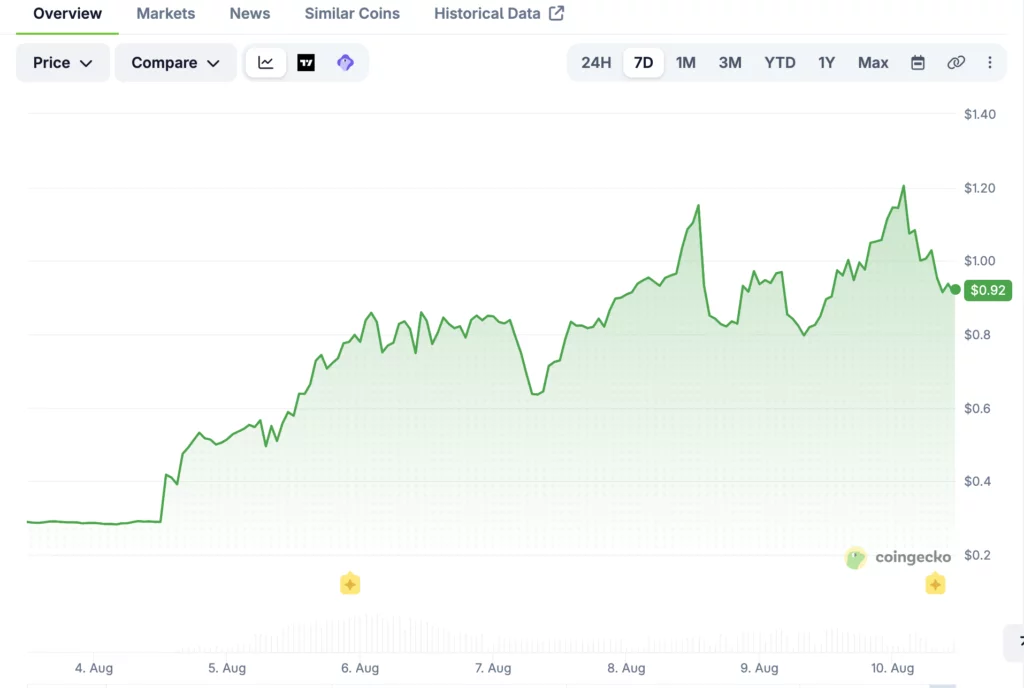
- CoinGecko recorded CYS near $0.93, up 11% daily and more than 220% across seven days.
- CoinGecko lists CYS’s all-time high at $1.23, below the $1.30 peak.
- Upbit will initially restrict buy orders and allow only limit orders for roughly two hours.
Upbit initially scheduled trading for 14:00 KST, but the exchange has since postponed the opening twice, with its latest notice moving the launch to 20:00 KST.
That update is important because CYS had already recorded much of its price surge before Upbit trading began. At the time of research, the new markets had not yet opened, meaning the rally cannot be described as buying activity occurring on Upbit itself.
Cysic rally came before Upbit announced the listing
Upbit published its original CYS trading announcement on Aug. 10, saying it would add CYS/BTC and CYS/USDT markets and support deposits and withdrawals through Base. The exchange initially targeted 14:00 KST for trading. Its official social media post confirms that original schedule.
The timing of CYS’s price action came earlier. CYS climbed from around $0.80 to a wick near $1.30, with the largest move occurring around 23:00 UTC on Aug. 9. Upbit’s public listing announcement arrived several hours later.
That sequence has prompted unverified speculation online about whether some traders had advance knowledge of the listing. However, there is currently no verified evidence establishing that Upbit information leaked or that insider trading occurred. Neither the price chart nor the timing alone proves misconduct, and no official investigation or finding reviewed for this story supports such a conclusion.
CYS was also rallying before the Upbit news. CoinGecko historical data show the token closing around $0.54 on Aug. 4, $0.83 on Aug. 5 and $0.95 on Aug. 7, demonstrating that its broader advance had already been underway for several sessions.
Upbit delays Cysic trading twice to 20:00 KST
The exchange changed the timetable shortly after announcing the six new assets. Upbit first moved trading for CYS, ICNT, XAN, EDEN, AIOZ and ALLO from 14:00 KST to 17:00 KST. Its official post identified the revised opening time directly.
A second update at 16:45 KST then pushed the launch from 17:00 KST to 20:00 KST. Upbit’s official Telegram channel recorded the additional schedule change after its earlier postponement. The exchange’s notice did not attribute either delay to a problem with CYS specifically.
Upbit had warned in the original announcement that trading could be delayed if sufficient liquidity was not secured after deposits and withdrawals opened. Similar provisions have appeared in other listings. As crypto.news reported in recent CAP listing coverage, new Upbit markets can be postponed when opening liquidity does not meet the exchange’s requirements.
Once CYS trading begins, Upbit plans to restrict buy orders for approximately five minutes. Sell orders priced more than 10% below the previous day’s reference close will face a similar initial restriction, while only limit orders will be accepted for roughly the first two hours.
Cysic price data show a volatile record attempt
CYS was trading near $0.92 at the latest CoinGecko reading, up about 11% over 24 hours and more than 223% over seven days. Its market capitalization was around $150 million, based on roughly 160 million circulating tokens. Twenty four hour volume stood above $70 million.
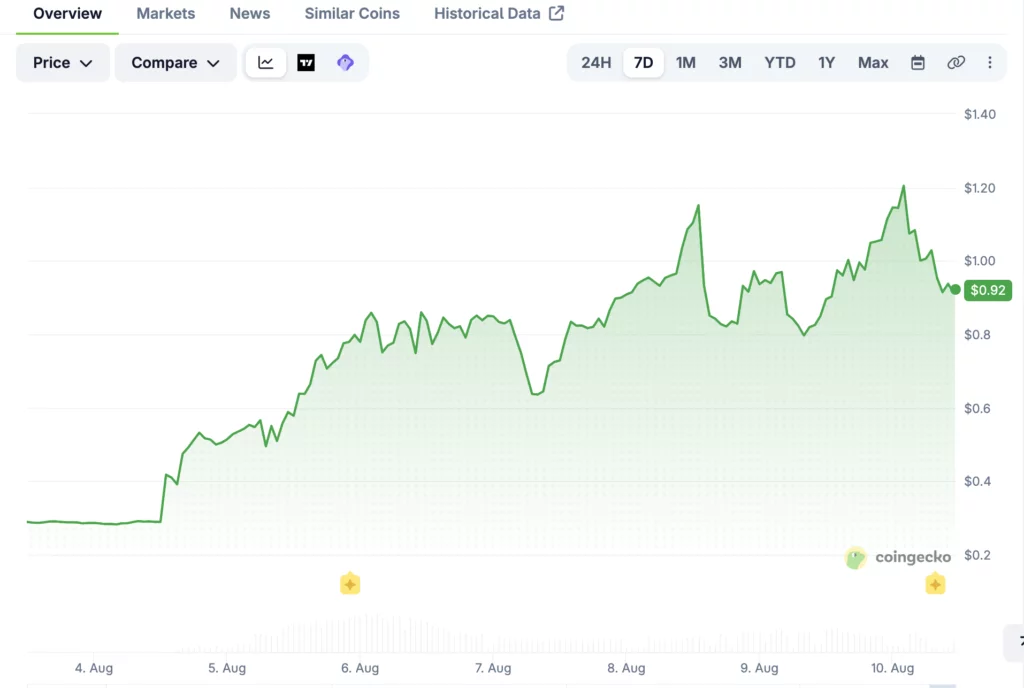
CoinGecko currently lists Cysic’s all time high at $1.28. The safest interpretation is that CYS reached a new record on some trading venues, while the exact peak depends on the exchange and price feed used.
The volatility is not unusual around major South Korean exchange announcements. In recent GRVT listing coverage, GRVT had already risen 23% before its scheduled Upbit opening. Likewise, earlier CFX listing coverage showed Conflux gaining about 8.5% before trading began. Neither case proves the announcement was the sole cause of the preceding price move.
What happens next when Upbit opens Cysic markets
The immediate event is the scheduled 20:00 KST opening of CYS/BTC and CYS/USDT trading. Traders will then be able to distinguish the pre listing price move from the actual market response once Upbit orders begin executing.
Cysic describes itself as a decentralized compute network connecting hardware capacity with demand for zero knowledge and AI computation. Its official documentation says participants can provide compute resources and earn CYS, while the network supports workloads ranging from consumer hardware to GPUs and specialized ZK equipment.
South Korea remains an important market for exchange driven altcoin activity despite weaker overall volumes. As crypto.news reported in South Korean trading data, Upbit accounted for 67.4% of trading among the country’s five major won based exchanges during the measured July period.
For CYS, the next test is therefore the market opening itself. The token has already experienced a sharp rally and retracement before Upbit trading started. Whether the new BTC and USDT pairs create sustained demand will only become measurable after trading begins.
Disclosure: This article does not represent investment advice. The content and materials featured on this page are for educational purposes only.

A Bitcoin security researcher says he lost access to OpenAI’s Trust & Cyber tooling while working on ongoing red-team scans, forcing him to revert to alternative AI options for future analysis. The episode underscores a broader worry shared by parts of the crypto defense community: that the most capable AI systems may not be readily available to those trying to harden public code against cyber threats.
In an X post on Tuesday, AnchorWatch CEO Rob Hamilton said he began integrating OpenAI’s Trust & Cyber capabilities into his Bitcoin Red Team efforts on Saturday. He later reported that his access was restricted the following morning, prompting him to switch back to using Chinese open-source models for vulnerability research. Hamilton framed the change as a practical necessity for maintaining defensive work rather than a preferred approach.
Key takeaways
- Hamilton says access to OpenAI’s Trust & Cyber capabilities was restricted after he started using it for Bitcoin Red Team research.
- He plans to continue scanning Bitcoin-related repositories using Chinese open-source AI models rather than relying on the previously integrated tooling.
- Bitcoin Red Team’s approach combines AI-assisted scanning with human review across hundreds of open-source repositories.
- The incident echoes wider concerns from crypto leaders that “frontier” AI access remains limited despite rising cyber risk.
A sudden access restriction changes the research workflow
Hamilton’s post describes a short integration window: after beginning to use OpenAI’s Trust & Cyber tools for Bitcoin Red Team on Saturday, he said he was prevented from continuing the investigation after access was restricted the next day. In his view, the restriction limited not only the ability to evaluate existing code changes but also to check whether additional issues remained undiscovered.
Hamilton also characterized the situation as a policy bottleneck, implying that defensive teams are constrained by rules that attackers can bypass. He argued that “intelligence is unrestricted” for actors who pursue harm, while defenders conducting “harm reduction” are left without comparable tooling. The core point is less about the specific model choice and more about continuity: red-team work depends on sustained access to iterative analysis tools as scans evolve and new leads emerge.
Why this matters for Bitcoin security testing
Bitcoin Red Team is described as a volunteer effort using AI tools and human review to examine a large number of Bitcoin-related open-source repositories for vulnerabilities. According to the account referenced in Hamilton’s post, the work has been particularly active in the wake of major wallet security incidents.
That timing is important because defenders often need rapid, repeatable workflows to assess code changes across a sprawling ecosystem. When an AI tool is removed midstream, it can slow down verification, increase manual effort, or force researchers to restart parts of their process with different systems. Hamilton’s statement suggests the restriction wasn’t merely a temporary inconvenience—it affected his ability to continue investigating code updates and to explore whether other weaknesses might be present.
His comment also reflects a recurring pattern in security research: tools that speed up initial discovery are only as useful as the ability to keep investigating after early findings. If the process is cut short, the risk of leaving unresolved vulnerabilities rises, especially in open-source environments where issues may be subtle and scattered across multiple repositories.
Escalating threat pressure and limited AI access
The episode fits into a larger debate inside crypto about who gets access to advanced AI capabilities. Earlier coverage referenced in the article notes that crypto executives told Cointelegraph last month that many major firms were still waiting to obtain powerful new AI models to help secure their code against escalating cyber threats, with only a select few having been able to get access.
Bringing Hamilton’s account into that context, the risk for the broader sector is not only that attackers will improve their methods, but that defenders may not be able to match speed and depth. If the most effective tools are restricted, available only to a narrow set of organizations, or subject to sudden changes in access policy, the defense pipeline may become uneven.
Hamilton’s complaint is also notable for its emphasis on “sufficient” code changes. In vulnerability research, it is not enough to identify a potential bug; teams also need to confirm that patches address the underlying issue and do not introduce new problems. Cutting off access at the point where verification is needed is therefore more damaging than removing a tool at the early scanning stage.
What readers should watch next
The immediate story is a researcher switching back to Chinese open-source AI models after reporting restricted access to OpenAI’s Trust & Cyber capabilities. Going forward, observers will likely focus on whether Bitcoin Red Team can maintain its scan velocity and depth without the previously used tools, and whether other crypto security teams report similar access volatility as they try to use frontier AI for defensive purposes.


The UK’s FCA is reportedly preparing a regulatory framework for tokenized gold and how these products may be used as collateral assets in wholesale markets.
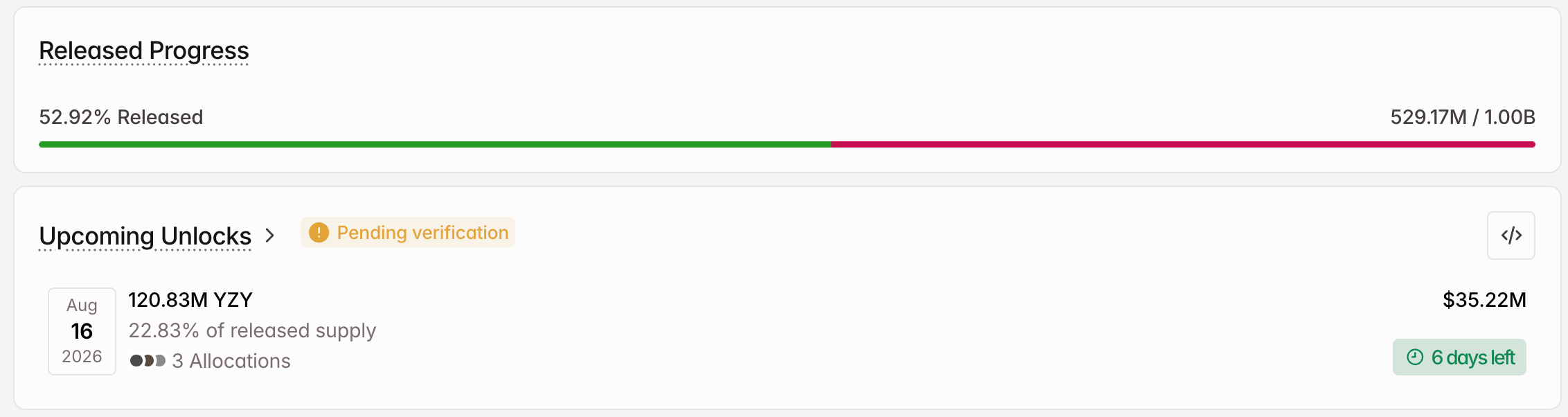
The cryptocurrency market will welcome a wave of tokens worth more than $605.5 million in the second week of August 2026. Major projects, including YZY (YZY), Connex (CONX), and Arbitrum (ARB), will release previously locked supplies over the next seven days.
These unlocks could increase short-term volatility and influence price movements. So, here’s a breakdown of what to watch in each project.
1. YZY (YZY)
- Unlock Date: August 16
- Number of Tokens to be Unlocked: 120.83 million YZY
- Released Supply: 529.17 million YZY
- Total supply: 1 billion YZY
YZY is a cryptocurrency token associated with the rapper Ye (formerly known as Kanye West). It is positioned within the broader “YZY MONEY” ecosystem, which includes the YZY token, the payment platform Ye Pay, and the physical YZY Card.
On August 16, YZY will unlock 120.83 million tokens worth around $35.22 million. The tokens represent 22.83% of the released supply.

The team will allocate 100 million altcoins to Yeezy Investments LLC, Vesting 3 and 12.5 million tokens to Yeezy Investments LLC, Vesting 1. Moreover, it will direct 8.33 million tokens to Yeezy Investments LLC, Vesting 2.
2. Connex (CONX)
- Unlock Date: August 15
- Number of Tokens to be Unlocked: 1.32 million CONX
- Released Supply: 92.57 million CONX
- Total supply: 100 million CONX
Connex is a permissionless, open, and collaborative Web3 professional network. The project integrates blockchain with networking, promoting transparency and fair value exchange among professionals in the digital economy. Holders can use CONX for payments and governance.
Connex will unlock 1.32 million CONX tokens into the market on August 15. Moreover, the supply is worth approximately $11.55 million. It represents 1.43% of the released supply.

The team will allocate around 822,500 CONX to the ecosystem. Furthermore, the community treasury will get 500,000 altcoins.
3. Arbitrum (ARB)
- Unlock Date: August 16
- Number of Tokens to be Unlocked: 92.65 million ARB
- Released Supply: 5.74 billion ARB
- Total supply: 10 billion ARB
Arbitrum is a Layer-2 scaling solution built for Ethereum (ETH). It enhances transaction speed and reduces costs while maintaining the security of the Ethereum network.
The blockchain achieves this by utilizing ‘optimistic rollups,’ which process transactions off-chain and submit them to the Ethereum mainnet for validation.
On August 16, Arbitrum will unlock 92.65 million tokens into the market. The tokens are worth $7.19 million and represent 1.61% of the current released supply.

Arbitrum will award 56.13 million ARB from the unlocked supply to the team, future team, and advisors. Moreover, investors will gain 36.52 million tokens.
In addition to these, other prominent unlocks that investors can look out for in the second week of August include Linea (LINEA), Aptos (APT), Starknet (STRK), Sei (SEI), and more.
The post 3 Token Unlocks to Watch in the Second Week of August 2026 appeared first on BeInCrypto.


“They came to us highly recommended by an alumni CEO that we had already backed,” Rist told CoinDesk in an interview. “So, there was a lot of trust there, and this CEO said, ‘You got to meet these guys’. They were serial entrepreneurs coming out of South Africa. They’d never built businesses outside of South Africa, but they were hungry. They were relentless.”
Despite enjoying a sturdy exit, Rist said he feels mixed emotions toward the Mastercard acquisition, having been part of the whole BVNK journey. “It’s actually sad to sign the papers, almost like sending your son off to boarding school,” he said.
Chris Harmse, co-founder and chief business officer at BVNK echoed this: “It’s been an incredible journey,” he said in an email. “Concentric has been a valued partner throughout that journey.”
Stablecoins, one of the busiest areas of crypto, have become a focal point for the large card networks and payments players. The total stablecoin market cap is about $300 billion, according to CoinGecko data.
The proverbial cat was set loose among the pigeons when Stripe acquired stablecoin infrastructure firm Bridge in late 2024 for $1.1 billion. This probably put pressure on the likes of Visa and Mastercard to start kicking the tires of other stablecoin shops so as not to be outflanked by Stripe’s aggressive approach.

A Bitcoin soft fork built around BIP-110 split from the main chain after block 961,632 this week, and it barely got off the ground. The pool backing it, Roughnecks, mined exactly two blocks before the rest of the network’s hashpower left it stranded.
The split was supposed to test whether a determined group of node operators could force miners to fall in line on data spam. Instead, it showed how little leverage a minority actually has once the hashrate refuses to follow.
The Fork Stalls Within Hours
BIP-110 needed miners to signal support by block 961,632, or a mandatory signaling rule would take over. When AntPool mined the first non-signaling block, nodes running Bitcoin Knots split into their own chain. Roughnecks found blocks 961,632 and 961,633 on that branch, then nothing more. Bitcoin’s original chain kept moving at its usual pace and reached block 961,651, opening an 18-block lead within about a day.
The math comes down to difficulty. Bitcoin’s mining difficulty had just adjusted to 127.48T, a target both chains inherited. With only a sliver of total hashpower behind it, the BIP-110 branch found blocks far slower than the usual ten minutes.
BIP-110 supporter Matthew Kratter admitted that the minority chain would need “massive change” to catch up. It never came. By the time Michael Saylor addressed the split, he put the gap at more than 80 blocks and said roughly 99.85 percent of Bitcoin’s hashpower had stayed with the main chain.
Lyn Alden made a similar distinction on August 9, saying the majority of miners, economic nodes, and exchanges continued with the non-fork.
“It’s not that miners are in control,” she wrote. “The fork just didn’t have consensus.”
BIP-110 supporters have rejected that conclusion. Luke Dashjr wrote on August 9 that claims of the proposal’s failure were false. Earlier, he had argued that BIP-110 remained uncontested because no counter-fork had emerged.
However, Roughnecks put out a tweet asking those mining on the BIP-110 chain under the current algorithm to stop until further notice, with investor Fred Krueger pointing out that the lead had grown from “153 to 2.”
Bitcoin’s price barely moved through any of it. BTC traded around $65,000, up modestly on the day and nearly 4% for the week, though still down close to 45% from a year earlier.
Dispute Over Data, Not Just Block Counts
The underlying fight traces back to Bitcoin Core dropping its old limit on OP_RETURN data, which let more non-monetary data, like Ordinals and Runes, fill up blocks that BIP-110 backers wanted reserved for payments.
Farside Investors had warned weeks earlier that the fix carried its own risk. Wallets using Miniscript could still generate addresses built on soon-to-be-banned Taproot scripts, and any bitcoin sent to them after activation would become unspendable. Pay-to-public-key outputs, an old script format holding more than 1.7 million BTC, faced new restrictions too, though existing units could still be spent.
Not everyone who backed BIP-110’s goals agreed with how the attempt played out. Writer Secure Sovereign, who supported the underlying fix but not this activation path, said the effort left BIP-110 as “a distant minority with no realistic path to catching the main chain,” arguing miners never faced real risk of being forked off themselves.
Days later, Bitcoin developer Murch moved to remove Luke Dashjr from his role as a BIP editor, citing his handling of the proposal as a conflict of interest, a dispute still playing out on Bitcoin’s mailing list.
The post BIP-110 Soft Fork Implodes: Mines Just Two Blocks Before Grinding to a Halt appeared first on CryptoPotato.


Robinhood has begun offering cryptocurrency trading to eligible UK customers, giving users access to more than 50 digital assets through Bitstamp inside its main investing app.
Summary
- Robinhood has launched crypto trading for eligible UK customers with access to more than 50 digital assets.
- Crypto trades are provided through FCA registered Bitstamp UK, which Robinhood acquired for $200 million last year.
- The service has no trading, custody or account maintenance fees, while foreign exchange fees start at 0.1%.
- Robinhood has also introduced Cortex Digests for Crypto, an AI powered tool for analyzing crypto price movements.
- The launch follows Robinhood’s FCA crypto registration on July 31 ahead of the UK’s new authorization regime.
According to a Bloomberg report, the rollout starts this week and brings crypto trading alongside Robinhood’s existing UK products, which include equities, stocks and shares ISAs, options and futures.
Customers can buy and sell assets including Bitcoin, Ethereum, XRP and HYPE, with the trades handled by Bitstamp UK Ltd. Robinhood acquired the long-running crypto exchange for $200 million last year and has since used the business to support parts of its international crypto expansion.
The UK service carries no trading, custody or account maintenance fees, Robinhood said. Customers will instead pay a 0.1% foreign exchange fee when converting currencies, while certain conversions made during weekends will carry a 0.3% fee.
Robinhood crypto trading starts after FCA registration
The launch follows regulatory approval secured shortly before the product rollout. Robinhood’s UK subsidiary was added to the Financial Conduct Authority’s register of cryptoasset firms on July 31, clearing a regulatory requirement for providing cryptocurrency services in the country.
Under the existing UK system, crypto firms must register with the FCA and comply with anti-money laundering requirements before offering covered services. Robinhood had previously disclosed during its July 29 second-quarter earnings report that it planned to introduce crypto products in the UK but did not provide a launch date at the time.
Crypto trading is being provided through Bitstamp UK Ltd, which is registered with the FCA as a cryptoasset service provider. Robinhood warned that cryptocurrencies held through Bitstamp UK are not protected by the Financial Services Compensation Scheme or covered by the Financial Ombudsman Service.
Jordan Sinclair, president of Robinhood UK Ltd and general manager of Bitstamp UK Ltd, said the company sees digital assets becoming an important part of investment portfolios among a new group of UK investors.
“With today’s launch, we’re taking another major step toward becoming the all-in-one investment platform for the UK,” Sinclair said.
Robinhood enters the market before another regulatory change scheduled for the UK crypto sector. Applications under the country’s incoming crypto authorization framework are expected to open at the end of September and remain available until the end of February 2027, with the full regime scheduled to take effect in October 2027.
The FCA registration obtained under the current anti-money laundering framework does not replace authorization under the incoming system. Companies seeking to continue providing covered crypto services after the transition will need to meet the requirements of the new regime.
Cortex adds AI analysis to Robinhood’s UK crypto service
Alongside trading, Robinhood is introducing Cortex Digests for Crypto to UK customers as part of the rollout.
The generative AI feature processes breaking news, technical indicators, market information and Robinhood’s proprietary data to provide explanations for price movements in individual cryptocurrencies. According to the company, the tool is designed to give investors additional market context when evaluating digital assets.
Adding the feature extends Robinhood Cortex into a crypto service that now sits inside the same application as the company’s other UK investment products.
The launch also connects UK customers to a crypto business that has expanded beyond buying and selling tokens. Robinhood has been developing its own blockchain infrastructure through Robinhood Chain, a permissionless Layer 2 network built using Arbitrum technology.
According to company figures, Robinhood Chain has recorded more than $18 billion in decentralized exchange trading volume and more than $840 million in total value locked since launching on July 1.
Developers worldwide, including those in the UK, can build applications on the network. Robinhood has described the blockchain as infrastructure developed to institutional standards.
During the company’s latest earnings period, CEO Vlad Tenev said Robinhood Chain had become the fastest Ethereum Virtual Machine-compatible blockchain to reach 100 million transactions.
Crypto revenue fell as Robinhood expanded other businesses
The UK rollout comes after Robinhood reported lower cryptocurrency transaction revenue during the second quarter despite expanding its digital asset products.
Crypto transaction revenue fell 38% from a year earlier to $100 million in the quarter ended June 30, according to financial results released on July 29.
Other parts of Robinhood’s trading business recorded stronger growth. Prediction markets generated $156 million during the quarter, exceeding crypto transaction revenue for the first time.
Total net revenue increased 32% year over year to $1.31 billion, while net income rose 48% to $573 million compared with the second quarter of 2025.
During the same period, Robinhood launched Robinhood Chain, expanded its Stock Tokens product to more than 120 countries, introduced Robinhood Earn and completed its acquisition of Canadian crypto platform WonderFi.
Prediction markets have also become a larger part of the company’s product lineup. The Wall Street Journal reported in July that Robinhood had discussed adding event contracts from Crypto.com to its prediction markets hub, although neither company confirmed an agreement.
Robinhood already distributes contracts through Kalshi and ForecastEx, while it also operates Rothera through a joint venture with Susquehanna International Group.
Robinhood has continued adding products outside crypto
Days before launching UK crypto trading, Robinhood also filed to raise as much as $200 million for its second publicly listed venture fund.
Regulatory filings showed Robinhood Ventures Fund II plans to offer 7.6 million shares at $25 each, with Robinhood separately selling another 400,000 shares. Subject to regulatory approval, the fund is expected to begin trading on the New York Stock Exchange under the ticker RVII on Aug. 13.
Unlike Robinhood Ventures Fund I, which concentrated on later-stage private companies including OpenAI, Stripe, SpaceX and Databricks, RVII is structured mainly around earlier-stage businesses.
The fund is expected to begin with investments in about 80 private companies and will primarily target seed-stage businesses connected to Y Combinator, including companies founded by current or former accelerator participants and YC alumni.
Robinhood Ventures head Sarah Pinto said the structure is intended to give retail investors access to companies earlier in their development rather than requiring them to wait until an initial public offering.
RVII also introduces fees that were not part of Robinhood’s first venture fund. Regulatory disclosures show investors will pay a 2% annual management fee and a 20% incentive fee on realized gains, while the prospectus warns that shareholders will not have redemption rights before liquidation.
The subscription period is scheduled to close on Aug. 12, according to the filing, with Goldman Sachs serving as lead bookrunner and Citigroup, JPMorgan, UBS and Wells Fargo acting as joint bookrunners.

UMX, the Unified Market Exchange incubated by Li Lin’s Avenir Group, launched an invitation only public beta on Aug. 10 for professional investors.
Summary
- UMX launched an invitation-only beta combining crypto trading with real U.S. stocks, ETFs and options.
- Users can convert USDT into dollars or borrow against crypto to fund securities purchases directly.
- UMX says securities positions represent actual shares rather than CFDs or purely price-tracking tokenized products.
- Stock holdings can be converted into tokens and counted toward crypto account margin requirements directly.
- Avenir held 18.28 million IBIT shares at March 31, retaining Asia’s largest institutional holder ranking.
The platform combines crypto trading with access to real U.S. stocks, ETFs and U.S. stock options, according to a PANews report citing official disclosures.
The beta is built around moving capital between crypto and securities accounts rather than keeping the two markets separate. UMX says eligible users can trade crypto spot, margin, contracts and options while also accessing U.S. securities through the same broader platform.
UMX beta combines crypto and real U.S. securities
UMX says its securities service gives users positions in actual U.S. shares rather than CFDs or products that only track stock prices. A Wu Blockchain review of UMX disclosures says the service includes stocks, ETFs, options and fractional shares, with trading spanning premarket, regular, after hours and overnight sessions.

The platform is aimed at global professional investors, but access depends on location, account status and product eligibility. The launch material does not establish that the securities service is available to U.S. residents. Offering U.S. listed assets and serving customers located in the U.S. are separate questions, so the distinction should remain clear until UMX publishes more jurisdiction specific details.
Cross asset tools connect stablecoins, crypto and shares
UMX’s main feature is the capital bridge between its crypto and securities sides. Through “Exchange Transfer,” users can convert stablecoins such as USDT into U.S. dollars and move the funds into a securities account. “Loan Transfer” allows crypto assets other than stablecoins to serve as collateral for purchasing power used to trade stocks, ETFs and U.S. stock options.
The platform also says securities holdings can be converted through a “Shares to Token” function into corresponding stock tokens. Those tokens can count toward crypto account margin at applicable discount rates and can later be converted back into securities. The launch reports reviewed do not identify the blockchain, token issuer or detailed custody structure behind those converted positions.
UMX is also testing cross asset margin treatment for eligible wealth management balances. During the beta, it advertises maximum annualized yields of “up to 2.5%” for BTC and “up to 5.5%” for USDT products. Those figures are platform advertised rates rather than guaranteed returns, and UMX says rates, limits and terms depend on the individual product.
Avenir brings a large Bitcoin ETF position to UMX
Avenir Group describes its strategy as integrating traditional finance and digital assets through investment, incubation and operations. The firm has also invested in trading infrastructure, including a February partnership with CoinRoutes aimed at improving institutional execution and capital efficiency across fragmented markets.
An SEC filing by Avenir Tech Ltd, signed by Li Lin, shows 18,276,100 BlackRock iShares Bitcoin Trust shares worth about $702.2 million as of March 31. The filing was submitted May 15 and remains the latest quarterly 13F available as of Aug. 10.
As crypto.news reported in earlier Avenir coverage, the group had already built a large regulated Bitcoin ETF position before expanding further into infrastructure connecting traditional and digital finance.
UMX also enters a market where crypto platforms are moving toward broader financial services. In Binance’s stock trading rollout, eligible users outside the U.S. gained access to thousands of U.S. stocks and ETFs. Meanwhile, recent NYSE tokenization coverage shows traditional exchanges pursuing blockchain based securities infrastructure from the opposite direction.
What happens next for UMX
The public beta remains invitation only. Users with a beta code can register, while those without one can reserve access to the full version and receive launch notifications. UMX has not disclosed a firm date for its wider release in the launch material reviewed.
The next details to watch are the legal entities providing each securities and crypto service, jurisdiction restrictions, custody arrangements and the mechanics behind stock token conversions. For now, the confirmed development is the beta itself: UMX is testing a framework designed to make stablecoins, crypto collateral and real U.S. securities usable within a shared capital system.

A Bitcoin security researcher says he lost access to an OpenAI capability used in his ongoing vulnerability reviews, forcing him to shift back to open-source Chinese AI models. The move underscores a broader concern within parts of the crypto security community: that the most advanced AI systems may be difficult for “defenders” to use, even when the intent is to reduce risk.
In a post on X Tuesday, AnchorWatch CEO Rob Hamilton said he began integrating OpenAI’s Trust & Cyber capabilities into his Bitcoin Red Team effort on Saturday, only to find his access restricted the next morning. “It absolutely guts me as a patriotic American to have to do this,” Hamilton wrote, adding that he would return to using Chinese open-source models to continue protecting Bitcoin infrastructure.
Key takeaways
- Rob Hamilton says access to OpenAI’s Trust & Cyber was restricted shortly after he began integrating it into Bitcoin Red Team work.
- Hamilton frames the change as a defensive tradeoff: open AI models are accessible, while certain frontier tools may be harder for defenders to retain.
- Bitcoin Red Team conducts vulnerability scanning across hundreds of open-source Bitcoin-related repositories using a mix of AI assistance and human review.
- Recent hacks in the hardware wallet space have increased pressure on teams trying to detect issues earlier in the development lifecycle.
How Bitcoin Red Team is using AI to find vulnerabilities
Bitcoin Red Team is a volunteer effort that scans a large set of open-source Bitcoin-related repositories for potential vulnerabilities. According to Hamilton’s account, the work relies on AI tools combined with human verification, with the goal of identifying weaknesses that may otherwise go unnoticed or be discovered only after exploitation.
The group’s efforts have reportedly intensified following a widely discussed incident involving a Coldcard hardware wallet hack, which earlier reporting described as resulting in more than $100 million in stolen Bitcoin. While Hamilton’s post does not quantify how the OpenAI access affected the rate or quality of findings, it does connect the research workflow to a broader urgency—namely, that attackers are actively searching for flaws in the systems people rely on to keep funds secure.
What Hamilton says changed after integrating OpenAI Trust & Cyber
Hamilton’s explanation is straightforward: he started using OpenAI’s Trust & Cyber capabilities to support his team’s review process, then lost the ability to continue the investigation that same week. He said he was “prevented from being able to continue the investigation in a further effort to make sure their code changes are sufficient” and also to determine whether other issues remained undiscovered.
In a follow-up argument about the incentive structure for AI access, Hamilton suggested there is a “local minima in policy,” implying that rules governing the availability of intelligence-focused AI capabilities may unintentionally narrow who can use them for defensive purposes. He added that while “black hats” would not hit these issues, “white hats” could be left on the sidelines if the tooling is restricted.
Hamilton’s characterization is notable because it positions the problem less as a technical limitation of AI and more as an access and policy constraint affecting security research workflows. For investors, users, and builders, the practical concern is that fewer defender teams may be able to run high-end analysis at scale—at the exact moment when vulnerabilities across crypto infrastructure need faster detection.
Broader friction over “frontier” AI access in crypto security
This complaint fits into a pattern that has already been raised by crypto executives. Earlier coverage from Cointelegraph noted that many of crypto’s largest players were “still waiting to gain access” to powerful new AI models to strengthen their code from attacks, with only a limited number able to obtain it. In that context, Hamilton’s experience appears as a micro-level example of how access can be uneven—even for teams working on vulnerability discovery rather than exploitation.
The tension is that crypto ecosystems can’t rely solely on open-source tooling if the industry’s risk profile increasingly demands rapid review of complex codebases. Yet, if leading AI providers constrain usage in ways that make defensive experimentation difficult to sustain, security efforts may end up dependent on a patchwork of what is available rather than what is best suited for the task.
Why the shift back to open-source models matters
Hamilton said he would return to Chinese open-source models after the access restriction. That change is significant for two reasons.
- Continuity: If defender access to frontier systems is inconsistent, researchers may need fallback approaches they can run without interruptions. Open-source models can be deployed and iterated on without waiting for new permissions.
- Coverage and speed: Teams scanning “hundreds” of repositories depend on automated support to review large volumes. If access to an advanced tool is removed midstream, the research cadence and scope can be affected unless an alternative system fills the gap quickly.
At the same time, Hamilton’s stance does not necessarily imply that open-source models are always inferior. Instead, his argument is that defensive research is being forced to operate within the boundaries of whatever AI is available—while attackers face fewer barriers to pursuing harmful goals. That framing raises a question for the community: how can security research leverage advanced AI while still operating under restrictions intended to prevent misuse?
For readers tracking crypto risk, this story is less about who “has” cutting-edge AI at any given moment and more about whether defender capability can be maintained over time. The next inflection point will be whether access policies are clarified, expanded, or made more predictable for security-focused use cases—especially as vulnerabilities continue to be discovered across wallets and other critical infrastructure.
Hamilton’s update leaves one key uncertainty: what specifically triggered the restriction and whether it was temporary or permanent. What readers should watch next is whether other security teams report similar access changes, and how quickly research workflows adapt without losing the ability to uncover vulnerabilities before they reach production.

Jason Arday: Cambridge professor in plagiarism row cancels book tour
Robinhood Brings Crypto Trading to UK Investors With Zero Fees

The AI safety test is becoming a safety risk


-

 Fashion3 days ago
Frugal Friday’s Workwear Report: Cap-Sleeve Pointelle Crewneck Sweater
-

 Fashion3 days ago
Weekend Open Thread: Mattifying Sunscreen
-

 Sports4 days ago
Jordan Coyle & Cordiamo take Laya Arena Stakes at RDS
-
 Business4 days ago
US stocks: Dow closes at record on Mideast optimism; SpaceX, AMD drag Nasdaq
-

 News Videos2 days ago
Can Astrology Help Find Gold and Silver Trends? A Financial Astrology Guide
-
 Crypto World6 days ago
US Tech Stocks See Largest 5-Week Inflow in History: Can Nasdaq Break Its Downtrend?
-

 Politics4 days ago
Reform UK And Greens Sink To Lowest Favourability Ratings To Date
-

 Business5 days ago
Nvidia Stock Climbs 2.5% as Chip Sector Rally Builds Ahead of AMD Earnings, Nvidia’s Own Report Looms
-

 Crypto World6 days ago
Polymarket targets $20 billion valuation as competition heats up in prediction market sector
-

 Tech5 days ago
OpenAI, Anthropic AI agents targeted real people and systems in cyber tests
-

 Business4 days ago
Supply chain issues impact Ingredion
-
 Crypto World6 days ago
CLARITY Act Senate Vote Locked In, But 60-Vote Hurdle Looms Large
-

 Tech2 days ago
Rinn Pharma & Biopharma to join NordicPharmaTrain network
-

 Crypto World6 days ago
The Senate has one week: CLARITY’s last August window
-
 Crypto World5 days ago
Dow and S&P 500 Hit Records on AI Earnings: When Will the Bubble Burst?
-
 Crypto World7 days ago
California Wildfire Bets Expose Polymarket’s Dark Side
-

 Business22 hours ago
Datadog: Best Of Breed For Multiple Reasons
-

 Business1 day ago
How to Start a Cleaning Business: A Step-by-Step Guide
-

 Business6 days ago
CNH Industrial Shares Jump Over 15% After Beating Estimates and Raising Full-Year Earnings Guidance
-

 Crypto World6 days ago
New York sued, who is next
You must be logged in to post a comment Login