ITV viewers shared their thoughts after crime drama Van der Valk returned to screens
Viewers issued the same complaint as crime drama Van der Valk aired on ITV.
Advertisement
The Amsterdam-set series starring Marc Warren as police detective Van der Valk has returned for a fourth run, which is airing three years after its last season wrapped.
Fans have said it’s “a joy” to have it back on screens, but many were less than impressed with its latest episode, posting messages on social media calling it “laughable”.
In the episode, an environmental campaigner is murdered before a global conference, and a suspect caught on CCTV turns out to be a famous singer Cobie Stegenga (Lateesha Verwey) who was presumed to be dead. The plot thickens when it turns out that Cobie has been living below the radar for two years, and that she was under the control of villain Anki Bergen (Raquel Cassidy).
The final moments of the episode saw a chase and a showdown between Van der Valk and Inspector Lucienne Hassell (Maimie McCoy) as they apprehended Anki.
Some viewers tuning in poked holes in the plot, with one posting on X: “Getting increasingly daft. Jeep can’t catch a Volvo estate over rough ground. They then shoot out its tyre with a pistol from distance — despite a hostage being inside. Then VdV SHOOTS AN AXE out of a woman’s hand despite not hitting a BMW earlier in the episode.”
“How could they possibly have made the last 15 minutes of #VanDerValk any more pathetic!??” someone else posted on the platform, which was formerly Twitter.
“Great episode but poor ending, laughable,” said someone else, while one remarked: “This has degenerated into pretty laughable c*** now. Shame.”
Advertisement
Another viewer suggested the storylines were “really bad”, adding: “I like Marc Warren usually but this series is awful.”
Somebody else commented: “A woman comes at you with an axe, you’re a police officer you have a gun, you let them walk away with a person of interest. Do better.”
However, others were impressed with Marc’s performance and gripped by the action.
Advertisement
“Enjoying this latest series of Van der Valk,” said one. “Especially as this episode they are showing more of the beautiful city of Amsterdam!
Another said: “I’m loving the new series of Van der Valk. Mind you… I’d watch Marc Warren in anything.”
Mourners have gathered for the funeral of a British illegal immigrant allegedly part of an international crime organisation when he was shot dead in the US.
Irish traveller Salis Hanrahan, 20, was shot in Roxborough, Philadelphia on July 8 as construction workers installed siding on a home.
An argument erupted inside the home before Mr Hanrahan left and collapsed on the street with a gunshot wound to his chest, witnesses claim.
The homeowner, George Barr, 75, was arrested by police and charged with murder, possession of an instrument of crime and recklessly endangering another person.
Advertisement
Local reports suggest he was shot after trying to charge the retired firefighter £51,800 for repairs on the £190,000 property.
The US Department of Homeland Security believe Mr Hanrahan was involved in money laundering and fraud schemes while working illegally as a contractor at the time of his death.
Monday kicks off a two-day memorial service in Hayes, west London, for the Essex local.
The high street was brought to a standstill by a fleet of silver Rolls Royces and Lamborghini super cars while family carried Mr Hanrahan’s body down a residential road.
Advertisement
Mr Hanrahan’s remains were flown back to the UK accompanied by his mother, a brother and his sister Lisa Marie, last month.
Family carried Salis Hanrahan’s body down a residential road after he was shot dead by a pensioner in the US
A fleet of silver Rolls Royce’s and Lamborghini super cars brought the high street to a standstill in Hayes
Advertisement
Hanrahan appears to have wed his wife Roseann just months before his death, and the couple shared a one-year-old daughter together. They are pictured here together
Today’s service began at 12pm with mass at St Mary’s Hayes Town followed by a 2pm burial in West Drayton Cemetery.
A large silver hearse was pictured making its way down a street while friends and family watched on.
The Briton had entered the US illegally after being denied a visa because government officials determined that he was affiliated with the ‘The Travelling Conman Fraud Group’.
Advertisement
Members of the organised crime gang, as it has been designated by the FBI, are known for overcharging victims for building work which they have failed to complete.
Mr Hanrahan collapsed on a pavement outside Mr Barr’s home in the Roxborough neighbourhood of Philadelphia – and later died in hospital from a gunshot wound to his chest.
The traveller’s body was later repatriated back to London.
Footage last month showed plumes of red and white smoke billowing into the sky after flares were let off on a busy road as dozens gathered to celebrate what would have been his 21st birthday.
Advertisement
Mourners parked their vehicles across the street causing grid-locked traffic, and cars could be heard tooting their horns as crowds set up pictures of Mr Hanrahan on the pavement.
One showed a photo of the 20-year-old posing with his thumbs up, with golden messages surrounding his image reading: ‘Happy 21st birthday Salis Hanrahan’.
A large silver hearse was also pictured making its way down a street while friends and family watched on
Today’s service began at 12pm with miss at St Mary’s Hayes Town followed by a 2pm burial in West Drayton Cemetery. A tribute is pictured
Advertisement
A fleet of supercars lined the west London roads as onlookers watched on. Dozens of friends and family members have turned out for the occasion
One man carries a floral tribute made up of red roses for Mr Hanrahan while another attendee carries a framed photo
Funeralgoers gather outside the hearse as Mr Hanrahan’s body is taken through the streets of west London
A motorcylist drives past the hearse in Hayes. Traffic was brought to a standstill due to the procession
Advertisement
Mr Barr, Mr Hanrahan’s alleged killer, has been charged with murder, possession of an instrument of crime and recklessly endangering another person.
He has not yet entered a plea and is being held at a Pennsylvania prison after being remanded into custody.
Mr Hanrahan appears to have wed his wife Roseann just months before his death, and the couple shared a one-year-old daughter together. Roseann posted on social media after his passing: ‘My beautiful husband. I love you so much.’
US police previously said contractors were fitting sliding doors on Mr Barr’s home shortly after 2pm on July 8 when gunfire was heard.
Advertisement
Philadelphia police Captain James Kimrey told reporters: ‘They heard arguments or some kind of commotion inside and then they found the boss outside.’
Local outlet KYW said that the victim had been ‘asking for more money’ every day prior to his death.
Mr Hanrahan was ‘an illegal alien from the United Kingdom’, the US Department of Homeland Security said, and entered the country without a work permit.
A spokesman said: ‘He entered the country illegally on an unknown date and location and was denied Electronic System for Travel Authorization (ESTA) as he was determined to have affiliation with ‘The Traveling Conman Fraud Group’, a transnational criminal organization’.
Advertisement
Salis Hanrahan who was shot dead by US Veteran firefighter after he charged him for thousands of pounds more work
Mr Hanrahan is seen here on his wedding day
The victim’s family hit out at his alleged killer in the days after he was killed, describing Mr Barr as ‘evil’ and ‘scum’.
A relative called Paddy Hanrahan posted a news story about the incident on Facebook, writing: ‘Please look at the evil in he’s [sic] face. He couldn’t even give a reason why he done it. He cold-bloodedly killed him for nothing.’
Advertisement
Friend Martina McCarthy responded: ‘I said the same u can see the evil behind his eyes rip salis [sic].’
Another friend, Michelle Bas, wrote: ‘He needs to rot in jail!!!’
Mr Hanrahan’s sister Lisa-Marie posted a picture of Mr Barr and wrote: ‘The scum that took my baby brother lord pls why us.’
Others, however, were quick to show their support for the 75-year-old.
Advertisement
One local woman wrote: ‘Free George Barr, NOW! He is a retired Philadelphia Firefighter and a hero from [the] Vietnam War.’
Another woman posted: ‘I have known George for a very long time. Frankly, I can’t believe this. Always been so kind to me and my daughters.’
There is an imagination gap being driven by tablets, phones and TV screens
Neil Shaw Assistant Editor
14:04, 10 Aug 2026
Children are losing the habit of imaginative play before they even reach double digits, according to new research by Playmobil. A study of children aged four to nine found that 43% of parents believe children stop using their imagination before the age of 10, and some say it happens as young as six.
Children say they will be too old for pretend play at an average age of 9.76. Children are now more than twice as likely to reach for a screen when they’re bored as they are to make up a game, story or pretend world, with 28% saying they ask for or use a screen compared with just 12% who turn to imaginative play.
Advertisement
For many children, the challenge lies in knowing where to begin and where to take the story next. Playmobil calls this the Imagination Gap andl is helping families with free Art of Storytelling prompt cards, developed with children’s presenter Maddie Moate and child psychologist Dr Amanda Gummer. The cards turn everyday boredom into stories, mysteries and adventures – giving children a spark to begin, then the freedom to lead the play themselves.
Dr Gummer said: “This research does not suggest that children have lost their imaginations. In fact, most children say they still make up games, stories or pretend worlds at least sometimes. The difficulty is that when boredom first appears, a screen is often the quickest and most familiar option, so children may have fewer chances to practise getting a story started for themselves.
“Imaginative play gives children room to experiment with ideas, language, roles and problems in a world they control. Boredom can provide the pause from which that begins, although some children will need a little support to cross that first hurdle.
“Parents do not need to ban screens or invent elaborate activities. A simple question, unusual prop or story prompt can be enough. Join in for a moment, then let the child decide what happens next. That small handover gives confidence, agency and imagination space to grow.”
Advertisement
Maddie Moate said: “As someone who creates educational TV and online content for children and families, I appreciate the role screens have in our lives. But our most memorable moments happen away from them, when little ones are exploring, interacting and creating for themselves. Often, all it takes is a simple idea or prompt to unlock hours of imaginative play. Anything that helps families get started with playtime is a win in my book, especially at a time when so many parents are already balancing so much.”
Mitch Levene, Country Manager, at Playmobil, said: “Families will use these prompt cards alongside both new and much-loved Playmobil sets discovering just how much adventure can begin with a single idea.”
‘It must be something they’re putting in milk,’ I joked, as yet another relative told me they were lactose intolerant.
I didn’t really believe this theory, but it did surprise me just how many people I knew seemed to be struggling with milk digestion, seemingly out of the blue.
In my early twenties, I knew of perhaps one or two people who were lactose intolerant – where the body can’t digest lactose, a type of sugar found in milk and dairy products.
Fast-forward to my mid-thirties and it’s impacting most people I know (myself included). People who could previously glug a glass of milk or eat ice cream and yoghurt with no issues are now facing (often bowel-centred) repercussions.
Advertisement
But why is this happening?
If you have also noticed more people around you seem to be struggling to digest milk, there’s a fairly simple explanation behind it: ageing.
Dr Andrew Moore, a gastroenterologist at Endeavor Health, tells me: “Lactose intolerance is a very common condition and becomes more prevalent as people age, with nearly 70% of the world’s population being affected by some estimates.”
As we get older, the body starts making less and less lactase, the enzyme needed to break down lactose, which is typically found in animal-based milk, yoghurt, cheese, butter, ice cream and cream
Advertisement
“When there is an excess amount of lactose that cannot be broken down, that’s when you start to experience symptoms,” Dr Moore continued.
Symptoms of lactose intolerance, per the NHS, can include stomach discomfort (pain or cramping), bloating, gas, a rumbling or gurgling stomach, diarrhoea or constipation, and nausea or being sick.
These symptoms can occur within minutes to several hours after eating something containing lactose, and the severity can depend on how much lactose has been consumed and your tolerance.
Advertisement
Dr Safa Al-Musawi, an NHS doctor, radiology registrar at Imperial College Healthcare NHS Trust and co-founder at MediWord, said the symptoms can be quite subtle at first, “which is one reason people may not immediately associate their symptoms with dairy”.
“Someone might experience occasional bloating or stomach discomfort and attribute it to stress, IBS [irritable bowel syndrome], their menstrual cycle or simply having eaten too much before eventually noticing a consistent pattern after consuming dairy,” she said.
Ageing is clearly a major factor in why I’m hearing from so many more people impacted by it, but Dr Moore notes he’s also seeing more people being diagnosed as lactose intolerant.
“This is not necessarily because the number of people with lactose intolerance is increasing,” he said, “it’s more to do with public awareness and patients being more likely to seek help for GI [gastrointestinal] symptoms.
Advertisement
“Additionally, there is a large variety of lactose-free products available now, which has also likely helped with public awareness.”
Dr Al-Musawi agrees that increased awareness is likely behind the rise.
“More people are now recognising digestive symptoms and seeking medical advice rather than simply assuming they have a sensitive stomach or cutting dairy out themselves,” she said. “This can make lactose intolerance appear more prevalent, even though the underlying biological process is not new.”
She added that there is also an issue called secondary lactose intolerance, which occurs when the lining of the small intestine is damaged or inflamed.
Advertisement
“Gastrointestinal infections and conditions such as coeliac disease or inflammatory bowel disease can temporarily reduce lactase production. In these cases, lactose tolerance can sometimes improve once the underlying condition has been treated,” she added.
What to do if you think you’re lactose intolerant
Keep a food diary and note which foods you consume and the symptoms you experience afterwards. It’s also important to book an appointment to speak to your GP, “as there are numerous other conditions that can cause these symptoms,” said Dr Moore.
Irritable bowel syndrome (IBS), coeliac disease and several other gastrointestinal conditions can cause similar symptoms, so symptoms shouldn’t be self-diagnosed.
Advertisement
Usually, to confirm the diagnosis, you’ll need to avoid lactose-containing products and see if symptoms improve.
A GP might also suggest blood tests or a hydrogen breath test to measure how well you digest lactose. If your symptoms don’t improve, you might need to have a gastroscopy to take, and test, cells from the small intestine.
“If symptoms are severe, persistent or accompanied by unexplained weight loss, blood in the stool or significant changes in bowel habits, medical advice is particularly important rather than simply experimenting with dietary restrictions,” added Dr Al-Musawi.
Making life easier when you’re lactose intolerant
Advertisement
“Reassuringly, being lactose intolerant doesn’t mean having to give up dairy altogether, as there are numerous lactose-free dairy options available now,” said Dr Moore.
“You will need to research which dairy products contain lactose and which products do not.”
Milk and foods such as cream, ice cream and some soft cheeses (like ricotta or mozzarella) tend to contain more lactose, notes Dr Al-Musawi.
In contrast, hard, aged cheeses (like cheddar, parmesan, or Swiss) generally contain much less lactose and are often “better tolerated”.
Advertisement
“Some yoghurts can also be easier to digest because of the cultures involved in their production,” she added.
“The important thing is that lactose intolerance isn’t necessarily an all-or-nothing condition. Many people can tolerate a certain amount of lactose, so identifying an individual’s threshold can be much more useful than simply deciding that all dairy products are off limits.”
Some people might also find over-the-counter lactase enzyme tablets useful when they want to eat a meal containing dairy. This helps break down lactose for you.
Dr Al-Musawi ended: “If someone significantly reduces or removes dairy from their diet, they should also think about calcium, vitamin D and other nutrients that dairy products can provide. Fortified plant-based milks and other calcium-rich foods can help fill that gap, and a dietitian can provide personalised advice where needed.
Advertisement
“Ultimately, lactose intolerance is usually very manageable. The goal isn’t necessarily to avoid dairy forever but to understand your own tolerance, identify the foods that trigger symptoms and make sensible adjustments without unnecessarily restricting your diet.”
The family holiday has been left in doubt after she discovered her daughter’s passport did not meet strict travel rules
A singer has issued a plea for help after discovering at the last minute that her daughter’s passport could fail strict travel rules. Rules mean there must be a set amount of time available on a passport or the holder will not be allowed to travel.
Advertisement
Under rules following Brexit people travelling to EU countries, except Ireland, along with Switzerland, Norway, Iceland, Liechtenstein, Andorra, Monaco, San Marino and Vatican City must have at least three months left on their passports after the day they plan to leave, warns ABTA. The passport must also have been issued less than 10 years before the date of arrival at the country.
Musician and singer Philippa Hanna turned to Facebook to seek advice after her family holiday to Portugal appeared to be in jeopardy. The Christian music star who has toured with mainstream artists including Lionel Richie, Leona Lewis, Anastacia and Wet Wet Wet, told how she had just discovered that her daughter, Ozma’s, passport would not meet these rules.
She said: “GUYS!! We need help. Do I know ANYONE who works for or is connected to the passport office or something even close? We need emergency advice ahead of our family holiday tomorrow?”
She later went on to explain: “I just found out Ozma has 5 weeks less than needed on her passport for flying to Portugal.” She then added: “We’re only going for 5 days so the week fast track wont work. I’m just wondering if there’s any way of getting an extension or a special permission or something.”
Advertisement
One follower suggested she contact her MP who might be able to speed up getting a new passport. Gayle Hunter, who said she was a former duty manager at an airline, said: “They’re normally strict at least 3 months after the last day you’re leaving on passport. An MP can get you a new one in three hours under parliamentary privilege.”
However this was disputed by another poster who said he worked in the airline industry and travelled extensively. John Dinsdale said he had been stung by the rule himself, and insisted an MP would be unlikely to help. He said: “There is a parliamentary/MP escalation route, but it only applies for compassionate reasons (family death, serious illness) not for holiday travel, so it won’t help here.
“You could try contacting the airline to ask if they’ll allow “OK to board,” but I doubt that’s your best option. Even if they agreed, Schengen countries require a minimum of 90 days’ passport validity, so Portugal border control could still refuse entry on arrival.
“For an airline to allow to board they would need authorisation from the Portuguese immigration department first. If you’re refused entry, the airline will face a fine (amounts vary by country), and you’d likely be liable for the cost of the return flight, airlines won’t board anyone without valid travel documents in the first place.
Advertisement
“I’ve actually been on the receiving end of this myself, I can’t get an ESTA for the US because of my travel history, apparently America don’t like Iraqi stamps in passports, so I know firsthand how strict airlines are about not boarding anyone without the right documents. It’s not something they’ll bend on.
“Realistically, a new passport won’t be issued in time even by fast track. I’d contact your travel insurer now to ask about cancellation/rebooking cover, I know this is not what you want to hear, but it’s the most likely outcome.”
What the government says
So what are the rules? According to the government there are steps you can take – but it usually still takes some time.
It advises: “You can pay to get a passport urgently if you think the standard service will take too long.” It explains there are 2 ways to apply for an urgent passport.
Advertisement
1 day premium
According to the government website the earliest you can get an appointment is 2 days after you apply. It says: “You’ll need to hand in your old passport at your appointment. Your new passport will be ready to collect from the passport office 4 hours after your appointment.
“You can only use this service to renew an adult passport. It costs £239.50 (or £253.50 for a 54-page frequent traveller passport).”
1 week fast track
With this one the earliest you can get an appointment is the next day after you apply. It advises: “Your new passport will be delivered to you by courier 1 week after your appointment.”
Advertisement
You can use this service to:
renew a passport
change personal details on your passport (for example your name, place of birth or gender)
replace a lost, stolen or damaged passport
get a child passport
It costs £192 for an adult passport (or £206 for a 54-page frequent traveller passport). A child passport is £156.50 (or £170.50 for a 54-page frequent traveller passport).
Is there anything any faster?
It advises: “If you need to travel urgently for medical treatment, on government business, or because a friend or family member is seriously ill or has died, call the Passport Adviceline instead.”
Police are looking for a man who they believe can assist them with an investigation after a man died following violent disorder in Pontypool.
A murder investigation was launched in the days following the incident as a man, named as Anthony “Tony” Jones, 56, died from injuries sustained in the violence. Mr Jones was sent to hospital with life-threatening injuries alongside two other men after the incident, which is alleged to have occurred at around 7pm in Mill Street, Pontnewynydd.
Ten men, aged 31, 33, 34, 39, 40, 40, 45, 59, 61 and 73, were arrested in connection with the disorder. Three men – aged 39, 45 and 61 – have since been released on bail. The other seven men remain in police custody. Read on
The storm had caused major disruption on Greenwood Avenue, with specialist teams tasked with removing the debris alongside clearing vegetation before it was re-opened last week.
13:12, 10 Aug 2026Updated 13:13, 10 Aug 2026
Advertisement
Vital work aimed at fully re-opening a key road and paths in Stirling city centre has been completed.
And residents have been thanked for their patience and understanding during the essential repairs.
Stirling Council have announced the completion of works to clear rockfall and fully re-open a key road and paths in the centre following a storm last year.
Large rocks had fallen onto Greenwood Avenue in the wake of Storm Eowyn, necessitating closures to the road and pathway network due to safety concerns.
Advertisement
Specialist works to remove fallen rocks and debris in addition to clearing vegetation and loose rocks from the nearby slopes were carried out in March by Stirling Council engineers, working alongside SG Access and Fairhurst. Stirling Council’s Roads Team subsequently resurfaced the affected area of road at Greenwood Avenue.
Greenwood Avenue and the Back Walk Low Path between Clarendon Road and Victoria Road have since reopened to traffic and pedestrians. Work remains ongoing to assess further issues on the nearby slopes and at the Back Walk beneath Stirling Castle which currently remains closed.
Environment, Transport and Net Zero Convener, Cllr Alasdair Tollemache said: “I’d like to thank residents for their understanding and patience while works took place to address a significant safety risk posed by loose rock and fallen trees on the slopes at the Back Walk.
“Recent extreme weather events have elevated the risk to public safety in this area and further works will ensure that we will be able to fully reopen the Back Walk to pedestrians in due course.”
The Met Office has issued amber heat health alerts for most of England as temperatures are forecast to soar into the mid-30Cs again this week
Carrington Walker Live News Journalist and Emily Beament Press Association Environment Correspondent
13:20, 10 Aug 2026
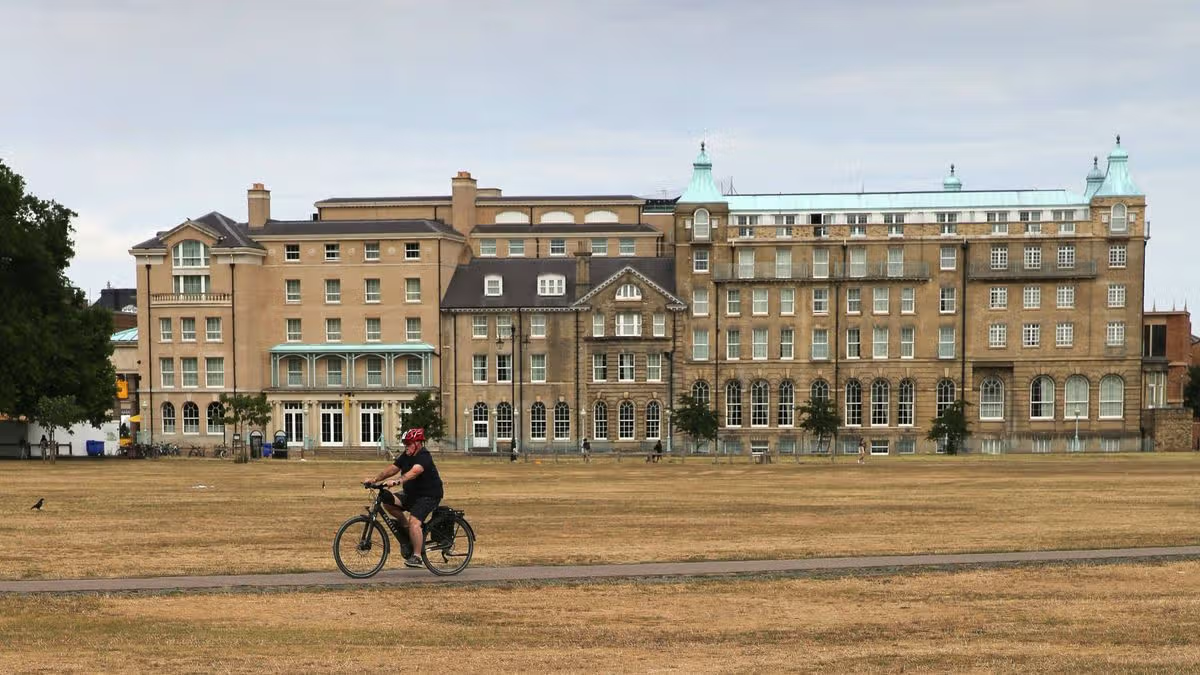
Cambridgeshire is bracing for yet another blast of scorching weather, with amber heat alerts slapped across most of England as temperatures are set to rocket into the mid‐30Cs this week.
Regions including the East Midlands, East of England, Yorkshire and the Humber, London, the North West, South East, South West and West Midlands will be under amber alert from 9am Tuesday until 9pm Friday, while the North East has been hit with a yellow warning.
The Met Office says Monday’s cooler conditions won’t last, with the mercury expected to soar and hit its highest point on Thursday. An 18 year old died after getting into difficulty in the sea at Camber Sands beach, East Sussex on Sunday, bringing the number of deaths in open-water incidents over the hot, dry summer to more than 40, according to Press Association estimates.
Although some rainfall is possible this weekend, including across the south – certain parts of which have gone weeks without any precipitation – forecasters caution that it will fall well short of compensating for the deficit accumulated over recent weeks and months.
Advertisement
The National Drought Group, comprising government and agency officials, water companies and farming leaders, is convening again on Monday, with additional areas of England widely anticipated to be formally declared in drought. Half of England and the entirety of Wales are already experiencing drought conditions, with 23 million customers subject to hosepipe bans as rivers and reservoirs reach critically low levels.
Farmers have warned of a “brutal harvest” for crops and a shortage of feed for livestock. Significant wildfires have broken out across areas including the Pennines, the Cairngorms in Scotland, Llanwonno in the Rhondda Valleys, South Wales, and Dunwich Heath in Suffolk, with firefighters battling hundreds of blazes across the country.
This summer’s exceptionally dry conditions have coincided with several heatwaves, including record-breaking temperatures for the time of year in May and June, which contributed to more than 2,800 excess deaths.
Advertisement
Britain is increasingly feeling the effects of ever more extreme weather events, such as drought, heatwaves and wildfires, driven by climate change, which is predominantly caused by the burning of fossil fuels in power stations, vehicles, and for domestic and industrial heating.
Certain parts of the UK are now bracing themselves for a fifth heatwave of the summer, though some areas, such as Exeter, have seen temperatures remain persistently above regional heatwave thresholds even between the peaks of intense heat.
As amber heat health alerts were issued, Polly Ashmore, acting consultant in public health at the UK Health Security Agency, urged members of the public to take straightforward precautions to stay safe and to check in on vulnerable friends and family members. She said: “Drinking plenty of water, avoiding the sun during the hottest part of the day and keeping indoor spaces cool are all things you can do to keep yourself and others safe.
“For vulnerable groups including older adults and those with existing health conditions, warmer weather can result in serious health outcomes.
Advertisement
“We urge health and social care services to ensure they are prepared and encourage people to check on vulnerable friends and family to make sure everyone is aware of the forecast, follows the necessary advice and stays safe in this period of hot weather.”
However, the Met Office indicated it did not expect to issue its rarely-seen amber or red alerts for dangerous heat, as conditions would remain dry rather than humid — elevated humidity being a further aggravating factor to human health — unlike late June, when a red alert was triggered over several consecutive days.
Met Office spokesman Grahame Madge noted that, following cooler conditions on Monday, “the heat really comes back in for a time, and will peak on Thursday. We’re expecting values to be in the mid 30Cs, and possibly highest in the East.”
The scorching temperatures will contribute to an already record-breaking number of days in 2026 that have reached 35C or above.
Though brief in duration, the heat is expected to be widespread, with elevated temperatures stretching as far north as Scotland — a region that has endured persistent heavy rainfall in recent days. As the weekend approaches, temperatures will drop sharply, with an area of low pressure potentially bringing rainfall to the south, according to Mr Madge.
However, he cautioned that it would not be sufficient to “make a dent” in the deficit recorded so far.
“It will be welcome for gardeners and for others, but we’re not going to get a lot of rain and not enough to make up for the shortfall we’ve had over the summer.”
Advertisement
Provisional statistics reveal that England and Wales have experienced their driest July since records began in 1836, with 19 counties across England recording no rainfall whatsoever throughout the entire month.
Southern England also registered its hottest July on record, while Wales endured its joint hottest July on record. Meanwhile, Met Office figures confirm that both the UK and England recorded their second hottest July ever.
A former star of Rich House, Poor House, has given a huge insight into how the Channel 5 programme is filmed and revealed where the often huge budgets come from
Two families from opposite ends of the scale swap lives for seven days, with one family thrust into a world of luxury they had dreamt of, while a wealthier family finds themselves tackling life on the breadline.
Each family swaps budgets and houses, with their lives being completely transformed. The show follows one family that ranks among the top ten wealthiest households in Britain and another from the bottom ten per cent to find out whether money can actually buy happiness.
Now, series five, episode one star Terri-Ann Nunns has revealed what really happens when the family exchanges cash. Terri-Ann, from Doncaster, swapped her five-bedroom house for a council house on the other side of the town in South Yorkshire. But it wasn’t a far cry for the businesswoman, who revealed she had grown up in a council house and admitted that she at times struggled financially. Eventually, she turned her life around and had a weekly budget of £1,200 after promoting her diet and lifestyle business which helped her lose seven stone.
Advertisement
Speaking on Instagram, the businesswoman said: “When filming Rich House, Poor House, does our budgets come out of our own pocket, or does it come out of the film production company’s pocket? That’s a question I’ve just been asked, so I’m going to answer it.”
She went on to add: “We tell them our budget, we show them obviously all our banks, and bank statements, and everything of what we, we pay out, and what we do in things.
“Then the production company actually provide the money to the other family, and vice versa. So we don’t actually have to pay our own hard-earned money, and, obviously, vice versa, they don’t have to pay their hard-earned money.” Terri-Ann went on to explain that after swapping houses and lifestyles, both families still have access to their own internet banking and bank cards, should they need them.
Advertisement
“However, for me, it were like, ‘Why would I want to, use my own money?’ When I’m doing this for a reason?’ I’m doing it for an experiment for my children. I grew up on a council estate. I grew up with nothing.
“For me, it were a doddle, I’ve been a single mum in a two-bedroom flat with two children.” Terri-Ann revealed the reality of her life before she amassed her fortune, explaining that she found the show “easy” and wanted to take on the experience with her children, who had grown up in a life of luxury.
“Don’t get me wrong,” Terri-Ann said, adding: “My oldest daughter did because obviously she were with us when we were in a two-bedroom flat, when we had to live with my mum, when I had to go bankrupt. But the younger two, they’ve never, obviously, they’ve, they were born when my business was hugely successful.”
Advertisement
While Terri-Ann’s business raked in £500,000 each year, which even helped her purchase Kylie Minogue’s old Range Rover. However, years after appearing on the show, her world crumbled following the collapse of her business and her marriage to husband Michael.
But since then, Terri-Ann has documented rebuilding her career for her social media followers.
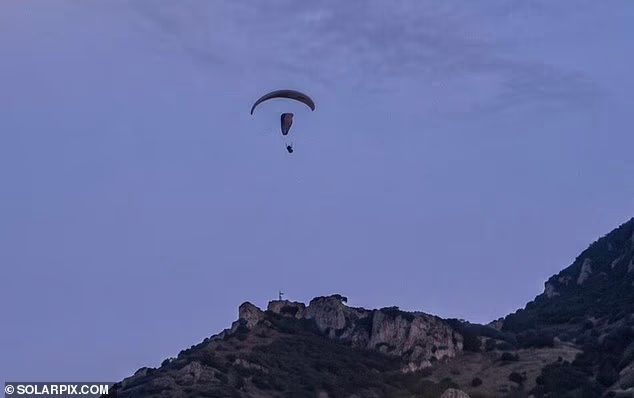
This is the moment a migrant paraglides into Europe from north Africa – a day after another died trying the same stunt.
Police were still searching for the sub-Saharan man today after he vanished shortly after landing at the Benzu viewpoint in Ceuta close to its land border with Morocco.
Spanish cops said today people smugglers charging migrants to make the risky air crossing were being given courses lasting just a few minutes instead of the 80 to 100 hours of training normally considered appropriate before risking their lives taking to the skies.
Diego Madraza, a spokesman for the AUGC Civil Guard union, said: ‘They have no flight training, sometimes they are given a course lasting barely a few minutes before taking off.
Advertisement
‘Recently in Morocco, a gang that trained migrants in this type of entry using paragliders was dismantled.
‘As soon as one door closes on them, another opens, so now detection can no longer be only be sea or land, but it can also be aerial.’
Footage of the new paraglider crossing on Saturday evening emerged a day after a man drowned in a failed attempt to reach Ceuta, and ahead of a feared new invasion of Spain’s North African enclave following the mass border breach late last month when an estimated 72,000 migrants reached EU soil.
The sub-Saharan man’s body was discovered in the Mediterranean shortly after the alarm was raised around 8am on Friday morning.
Advertisement
Police raced to the spot where he had been spotted plunging into the water in the hope of rescuing him alive but discovered him dead from a suspected drowning.
A migrant was seen attempting to paraglide into Europe just a day after another died while attempting the same stunt
The Red Cross and the Sur Sur organisation distributing aid in Ceuta after migrants stormed the border on August 3, 2026
Advertisement
Two masked police officers stand guard as migrants queue for food and aid from the Red Cross
He had tried to reach Ceuta on a paraglider via the Benzu breakwater bordering Morocco.
Calling out Spain’s Interior Ministry, the AUGC said on X late yesterday alongside a video of the new paragliding crossing which this time worked: ‘We warned about it in January.
‘@interiorgob responded in writing to Congress that paraglider entries did not exist.
Advertisement
‘Last Friday a young man died after plunging into the sea near the Benzu breakwater while attempting to enter this way.
‘First documented death in Spain by this route.
‘And a few hours ago another flight over the border. The video speaks for itself.
‘They take off from “The dead woman”, the mountain that connects the Moroccan neighbourhood of Belyounech with the border perimeter near the Benzu breakwater.
Advertisement
‘Denying it does not make it disappear. It only prevents resources from being provided and surveillance measures from being adapted in time.’
Police in Ceuta are steeling themselves for the ‘real danger’ of a new mass border breach from Morocco on August 15, which has been heavily promoted on social media.
The Civil Guard has reportedly admitted in an internal report the risk of a second mass attempt to reach EU soil is real – and prepared for the possibility organisers could bring it forward now the August 15 date is out in public.
Although most of the migrants who made it to Ceuta have returned to Morocco, officials admit 2,500 irregular migrants remain including some 1000 children, although locals insist the figure is far higher.
Advertisement
Distressing pictures have emerged of dozens of young men, families and children sleeping on the pavement on makeshift beds made out of cardboard boxes at an industrial estate.
They have also erected makeshift camps made out of bamboo and reeds on a beach near a temporary migrant holding centre.
Several girls who were among the wave of migrants and remained in Ceuta have complained of being sexually assaulted after arriving and finding themselves obliged to sleep rough.
On Saturday a Moroccan migrant who broke into a stranger’s fifth-floor flat and crept into bed with her in his underpants was handed an expulsion order.
Advertisement
Beatriz Ferron, 62, started screaming after waking up to find the semi-naked intruder, one of the estimated migrants who swam into Ceuta in last month’s mass border breach, laying beside her.
The paragliders set off from the mountain Jebel Musa in order to fly over the 20ft Cueta border fence
Migrants walk on the Moroccan side of the border behind the 20-foot border fence between the two countries
Migrants try to cross from Morocco into the Spanish enclave of Ceuta, Thursday, July 30, 2026
Advertisement
Spanish army soldiers travel in military vehicles after being deployed to the Spanish enclave of Ceuta, Thursday, July 30, 2026
Terrifying footage showed scores of people seemingly breaking into homes across the city late at night
The intruder was arrested on Friday morning and hauled to court hours later in Spain’s North African enclave.
At the weekend it emerged he had pleaded guilty to a crime of breaking and entering and handed a 16-month prison sentence which was immediately substituted for deportation and a five-year ban on entering Spain.
Court sources also confirmed the unnamed individual already had a deportation order hanging over his head and had been convicted of three sex assaults in Spain.
Advertisement
Full details of his previous crimes have not been made public but the earlier removal order is said to have been issued by a court in the eastern Spanish city of Valencia.
Last November five people were arrested in Morocco after police smashed a gang accused of helping migrants reach EU soil using the daring method.
The suspects, said to come from different African countries, were rounded up nearly two months after a man was filmed flying over a heavily-fortified border fence into Ceuta which lies opposite Gibraltar.
All Spanish police found from a search of the spot where he landed was the abandoned multi-coloured paragliding gear in undergrowth he had used for his exploit.
Advertisement
The successful border breach was described at the time as the first of its kind ever – attempted or accomplished – between Morocco and Ceuta.
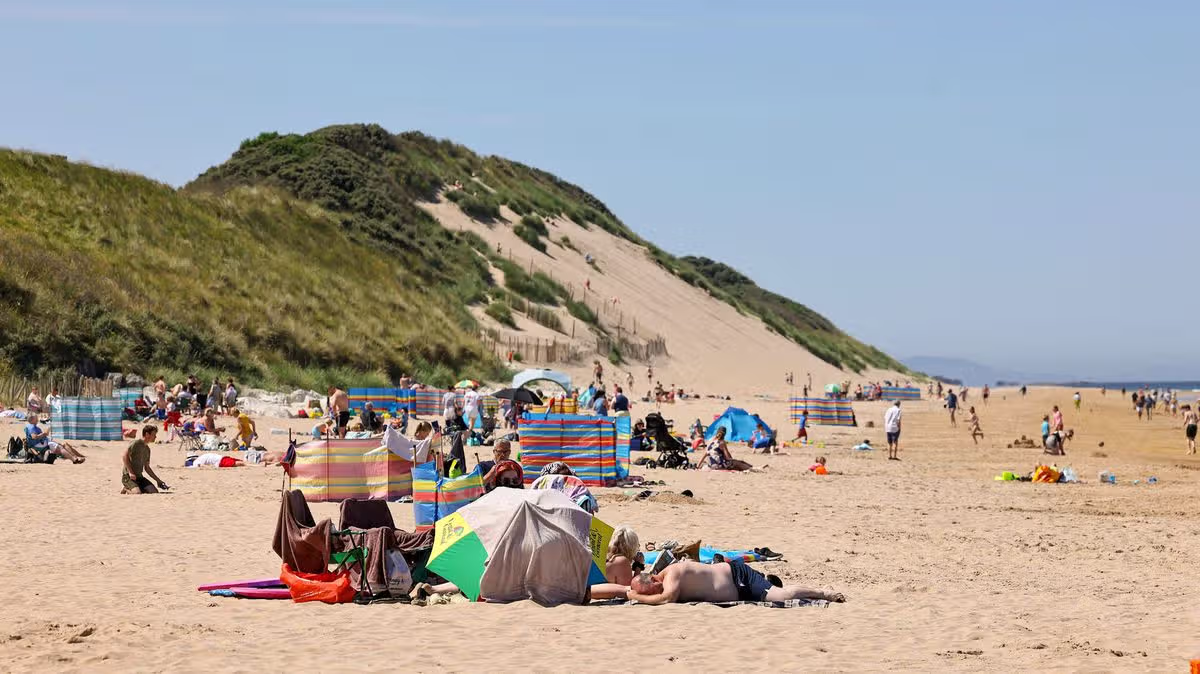
Another heatwave is set to hit Northern Ireland for a number of days this week
Another heatwave is set to hit Northern Ireland this week, with temperatures predicted to reach 28 degrees.
Advertisement
The Met Office forecast for the week beginning August 10 warns that temperatures are about to spike, rising from highs of 18 degrees on Monday to 28 degrees on Thursday, August 13.
The week will start off quite cool as the forecaster says Monday will start sunny before clouds develop in the evening. However, this is due to clear on Tuesday, August 11, when sunny skies are predicted throughout the day, and temperatures will reach 23 degrees in the afternoon.
This weather is predicted to continue on Wednesday, August 12, although the highest temperatures are set to be a few degrees higher at 25.
Thursday is forecast to be the warmest day of the week, with temperatures in the mid-20s for most of the day before reaching 28 degrees in places.
Advertisement
The Met Office has warned that while there will be lots of sunshine and warm weather, there is the potential for heavy showers in places during the heatwave.
Coming into the weekend, temperatures are set to drop again on Friday, August 14, with highs of 21 degrees predicted, dropping further on Saturday, August 15, when temperatures will be in the high teens.






















































You must be logged in to post a comment Login