
Crypto World
Coinsbuy confirms hack as investigator reports $7.9M stolen

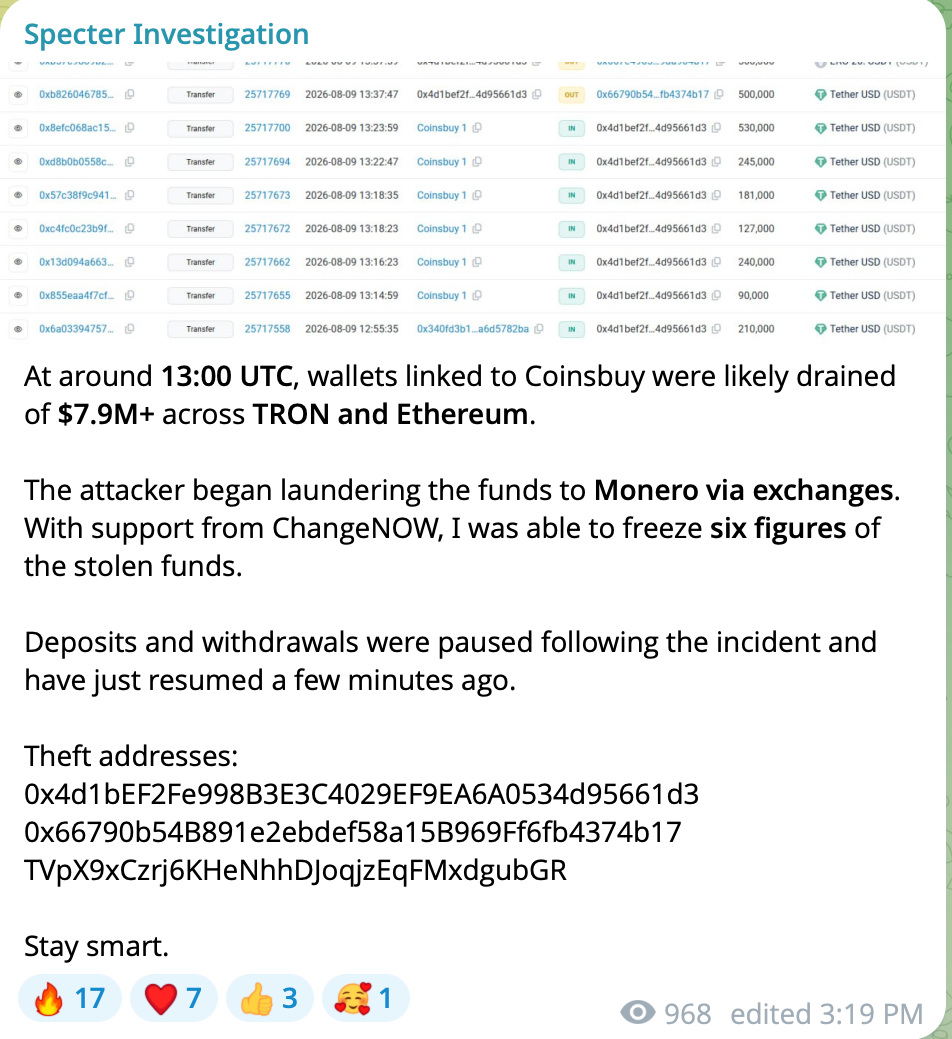
Wallets linked to crypto payments platform Coinsbuy were reportedly drained of more than $7.9 million across Ethereum and TRON on Sunday.
According to a Telegram post from blockchain investigator SpecterAnalyst, the attacker began moving the stolen funds into Monero through exchanges, while ChangeNOW helped freeze a six-figure portion of the assets.
Coinsbuy temporarily paused deposits and withdrawals following the incident before restoring both services, according to SpecterAnalyst. The investigator identified three addresses linked to the stolen funds, including two Ethereum addresses and one TRON address.
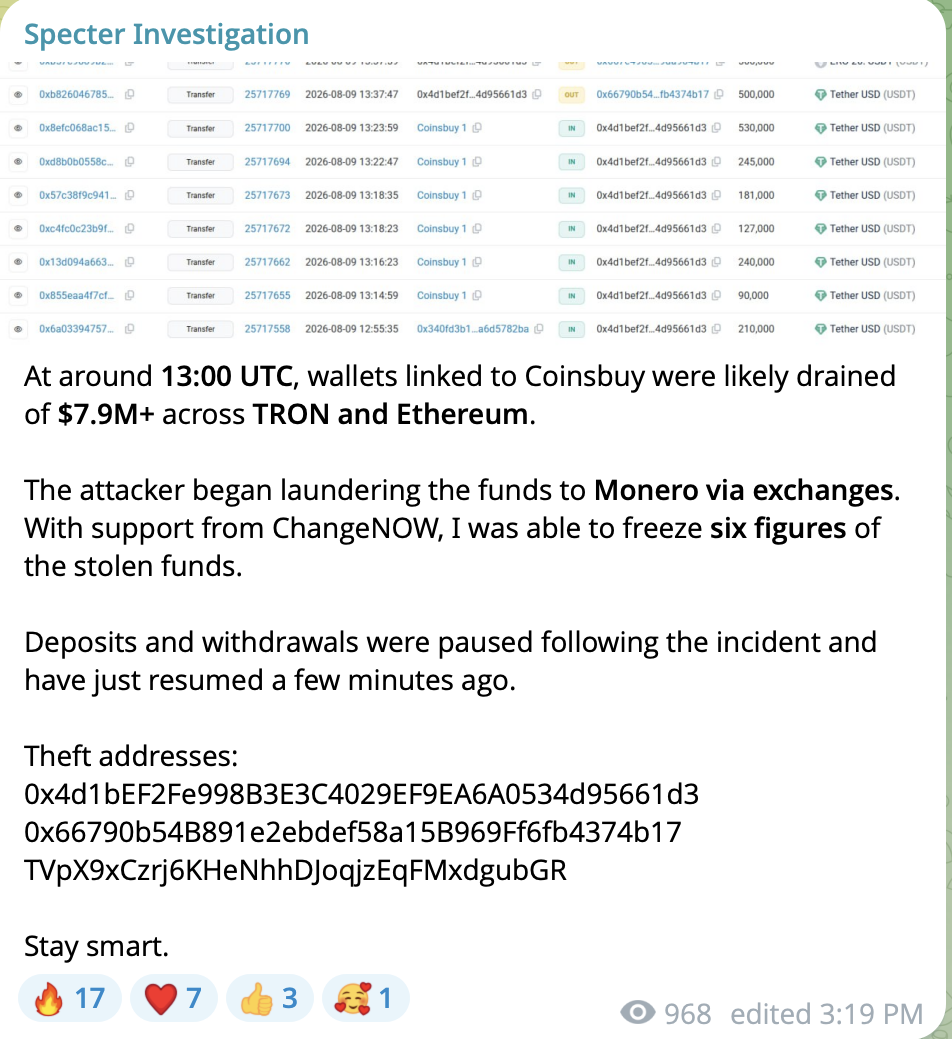
Source: SpecterAnalyst, Telegram
Incorporated in Panama, Coinsbuy is a crypto payments platform that provides businesses with infrastructure to accept, store, send and exchange digital assets.
Related: BTCPay restricts remote Lightning access after attackers steal funds
Coinsbuy covers client losses, offers $100K reward
Coinsbuy confirmed the Aug. 9 security incident in a statement shared with Cointelegraph, saying unauthorized withdrawals affected several platform wallets. The company wrote:
All affected client funds have been fully covered by Coinsbuy from our own reserves, so our users have not experienced any financial losses. The platform is back to operating normally, with all services fully available.
It is investigating the incident but said it will not disclose technical details until the investigation is complete and its findings have been verified. The company did not confirm or dispute the reported $7.9 million figure.
Coinsbuy also offered a $100,000 reward for information leading to the identification of those responsible, plus an additional bonus for help recovering the stolen funds.
Magazine: Do the Coldcard attacks mean all hardware wallets are now insecure?


The Tom Lee-chaired former bitcoin miner turned ETH accumulator has officially pushed its Ethereum holdings beyond 5.8 million tokens, even if its accumulation pace has slowed down.
Bitmine Immersion Technologies acquired another 7,391 ETH over the past week, bringing the total to 5,805,238 tokens. At the reported price of $1,928 at the time of the PR publication, the stash was worth approximately $11.2 billion.
Another Purchase but Smaller
Earlier in the summer, Bitmine’s acquisition pace was significantly more impressive, with a few examples showing a purchase of over 42,000 in early July and more than 27,000 in another. However, the reduction started to become more visible over the past few weeks, as the one from late July was for fewer than 10,000 ETH and the one from last week was for 10,399 tokens.
During a modest acquisition of 7,430 ETH in mid-July, Chairman Tom Lee explained that Bitmine had redirected some of its capital toward repurchasing its own shares. The firm has done it again now, repurchasing another 3 million shares, taking the total buybacks since July 1 to 19.1 million shares under its $4 billion repurchase program.
Even though the latest ETH buy was rather identical to the aforementioned one, he remains bullish on the asset as its long-term outlook on Ethereum and the broader crypto market hasn’t deteriorated.
He also touched upon two of the hottest topics within the crypto market now – the delay in voting on the CLARITY Act in the US and the Fed’s expected next move:
“We are disappointed that the CLARITY Act will not see a Senate vote before the August recess, but financial markets seem more focused on the recent softer inflation and jobs data. The odds of a Sept. hike by the Federal Reserve have fallen to 40% from 75% two weeks ago. “We expect easing financial conditions to be a tailwind for crypto,” he commented.
The Streak
Although Bitmine has seemingly reduced its ETH accumulation spree, its impressive streak of consecutive weekly purchases continues ever since it launched its treasury strategy on June 30 last year. Moreover, the company now owns just over 4.8% of the asset’s 120.7 million-token supply and has inched closer to its long-standing goal of controlling 5%.
The post Bitmine Tops 5.8 Million ETH Even After Scaling Back Its Latest Buy appeared first on CryptoPotato.

The U.S. Senate is set to take up the Digital Asset Market Clarity (CLARITY) Act again after a month-long recess, with Majority Leader John Thune filing a cloture motion to move the bill toward a floor vote. The procedural step, reported by the Senate Daily Press, effectively ends speculation that lawmakers might bring the measure forward before September despite it already clearing the House more than a year ago.
If the bill reaches the chamber, the Senate will need a 60-vote threshold to advance CLARITY, meaning bipartisan support remains crucial. The push into mid-September is also landing with less time to build momentum as the 2026 midterm elections approach, a timing problem that has amplified frustration among crypto industry leaders and lawmakers who have backed the legislation.
Key takeaways
- Majority Leader John Thune filed a cloture motion for the CLARITY Act, setting the stage for consideration when the Senate reconvenes in mid-September.
- Passing CLARITY in the Senate would require 60 votes, leaving little room for partisan friction ahead of the 2026 midterms.
- Industry figures and crypto policy advocates called the delay disappointing, while urging lawmakers to “finish the job” in September.
- Bipartisan negotiations reportedly continued on broader crypto market-structure issues, but Senate action has not yet translated into CLARITY scheduling.
- Despite congressional delays, prediction market contracts still reflect meaningful odds that CLARITY could move toward passage in 2026, though timing uncertainty remains high.
Cloture filed as Senate delays become the new baseline
According to reporting cited by Cointelegraph, Thune’s cloture filing is intended to bring CLARITY to the Senate floor for consideration. That matters because cloture is a key procedural tool used to limit extended debate and overcome the likelihood of a filibuster-like stall—an especially relevant hurdle for legislation that relies on cross-party alignment.
CLARITY’s track record has made the delay feel more consequential to supporters. The bill already passed the House, so the Senate is effectively deciding whether to align with that earlier outcome. With the Senate now targeting mid-September, the question for investors, builders, and market participants is less whether the bill is “alive,” and more how quickly it can become predictable regulatory infrastructure—or whether uncertainty drags on.
As the clock tightens, the September timetable arrives with roughly 50 days before the 2026 midterm elections, a window that critics say makes legislative compromise harder to achieve.
Lawmakers and executives push back on the slowdown
Frustration has surfaced publicly from both lawmakers and industry leaders after the Senate did not schedule a vote before its recess. Senator Cynthia Lummis, referenced in the Senate reporting cycle, said she was “frustrated” that CLARITY had not been placed on the calendar and added that her work with colleagues would continue. Her statement is linked through her post on X: Sen. Lummis’ remarks.
On the industry side, Coinbase CEO Brian Armstrong and Coinbase chief policy officer Faryar Shirzad also criticized the lack of immediate Senate scheduling, while framing September as the moment to complete the legislative path. Armstrong’s comment is linked at this X post, and Shirzad’s “finish the job” framing appears in this X post.
Not all reactions centered on panic. Bitmine Chair Tom Lee, in a weekly report, suggested that broader market attention—such as recent softer inflation and jobs data—has dominated near-term financial headlines more than CLARITY’s status. The implication for market participants is that regulatory risk may remain real without necessarily driving immediate price action day-to-day, especially when macro catalysts are competing for attention.
Why ethics and stablecoin rules keep resurfacing
The House-passed momentum has not translated cleanly into Senate action, in part because the legislative effort sits alongside other disputes in the broader crypto market-structure debate. The article’s background indicates that Senate lawmakers did not announce solutions in response to Democrats pressing for stricter ethics provisions—particularly rules aimed at conflicts tied to U.S. President Donald Trump’s crypto investments, including the entities and projects associated with World Liberty Financial and a memecoin launched days before he took office.
Those ethics concerns highlight a recurring tension in crypto policy: even when the industry broadly supports regulatory clarity, the political conditions needed to reach final passage can depend on unrelated governance questions. In practice, that means CLARITY may be delayed not because of technical disagreements about token regulation, but because of the Senate’s broader tradeoffs on transparency and oversight.
At the same time, some banking advocates have raised questions about how CLARITY would intersect with stablecoin-linked interest mechanics. A Wall Street Journal editorial board op-ed referenced before Thune’s cloture motion argued that, under CLARITY, smaller banks would miss out on opportunities because they rely on interest payments to attract deposits. The editorial board’s critique appears in this Wall Street Journal op-ed.
“The Clarity Act can serve a useful purpose with some language changes. The crypto industry and its friends in Washington portray themselves as defenders of free markets. What they really want is to be quasi-banks without abiding by the same regulations.”
The policy implication is straightforward: debates about who can earn yield, and on what terms, can influence whether financial institutions see incentives to participate. That in turn affects how quickly mainstream infrastructure can integrate with stablecoins and related services.
Prediction markets keep odds alive, but timing is still a gamble
Even as CLARITY’s Senate schedule slips, prediction market platforms continue to offer contracts reflecting expectations that the bill could still clear major milestones within the 2026 calendar year—though the probabilities remain uncertain.
On Kalshi, an event contract that drew $1.23 million in wagers gave users an 88% chance that the Senate would vote on the CLARITY Act before Oct. 1. A related market on Polymarket, which received over $5.79 million in total wagers, showed a 26% chance that the bill would be signed into law in 2026. Both contracts are linked in the source coverage: Kalshi’s CLARITY vote contract and Polymarket’s 2026 signature contract.
Those numbers also reflect an important procedural reality. If CLARITY passes the Senate, it would likely need to return to the House for another vote before it can move to the president for signing. That extra step can be the difference between a clean legislative finish and another round of delay—especially if lawmakers try to adjust language during Senate consideration.
For traders and market participants using these markets as a sentiment proxy, the key watch item isn’t only “pass or fail,” but whether the timeline compresses the revision process enough to avoid a late-year procedural bottleneck.
As the Senate reconvenes in mid-September, the next signals to monitor are whether the cloture motion results in a scheduled floor vote and whether negotiations narrow the gap on unresolved issues—particularly ethics and stablecoin-related provisions—before midterm politics starts to dominate lawmakers’ agendas.
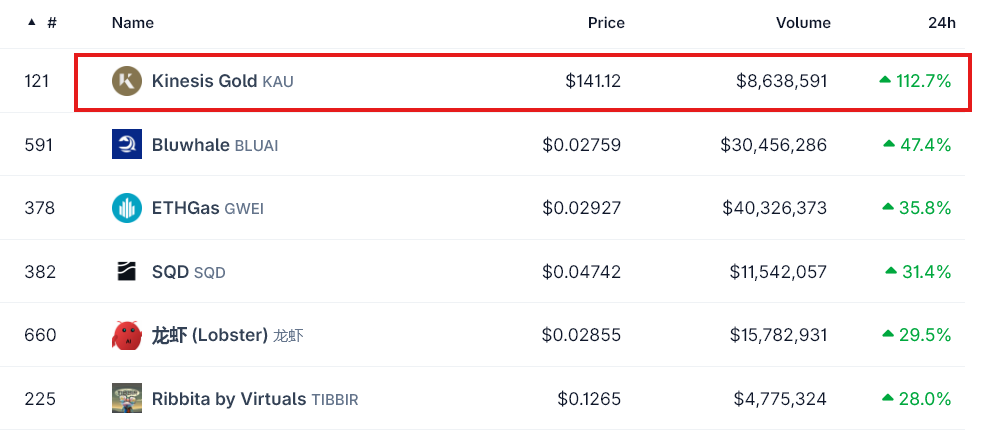
Kinesis Gold (KAU), a token backed by physical gold, appeared to surge more than 110% on CoinGecko on Monday.
The move looked dramatic. KAU briefly showed a 24-hour low near $66 before returning to around $140. Yet gold itself had not moved anywhere close to that amount.

The most likely explanation is a market data problem linked to Kinesis’ own dollar stablecoin, C1USD.
A New Tokenized Gold Coin
CoinGecko showed C1USD trading close to $1 while also recording a 24-hour low near $0.48. That created an apparent gain of more than 100% for the stablecoin.
The same pattern appeared in KAU.
One KAU represents one gram of gold. At current gold prices, a value close to $140 is reasonable. A price near $66 would imply that the token had suddenly lost more than half its value, even though the underlying gold had not.
The connection appears to come from the KAU/C1USD trading pair on the Kinesis exchange.
That pair accounted for almost all of KAU’s reported trading volume on CoinGecko at the time. Reported daily volume also jumped sharply to more than $8 million, far above levels seen on many recent days.
If CoinGecko temporarily valued C1USD at around $0.48 instead of $1, a KAU price of roughly 140 C1USD would convert to around $67. Once C1USD returned to $1, KAU would appear to double.
That would explain the unusual chart without any real 110% rally in gold.

What is Kinesis Gold?
Kinesis operates a wider ecosystem built around tokenized precious metals. Its main products include KAU, backed by gold, and KAG, backed by silver.
The company says physical bullion backing the tokens is stored in professional vaults and checked through regular independent audits. Users can also redeem larger amounts for physical metal.
However, Kinesis has faced some scrutiny over its corporate structure and regulation. The platform is operated through a Cayman Islands entity rather than an FCA-regulated UK company. Its related bullion business, Allocated Bullion Exchange, also shares management links with Kinesis.
Recent user reviews have also raised complaints about slow withdrawals and poor communication. For now, the 110% KAU move looks far more like a pricing glitch than a real market rally.

The bigger question is why the KAU/C1USD pair suddenly generated such a large share of reported volume, and whether that activity contributed to the distorted CoinGecko data.
The post Why Did a $330 Million Gold Token Suddenly Jump 110% on CoinGecko? appeared first on BeInCrypto.
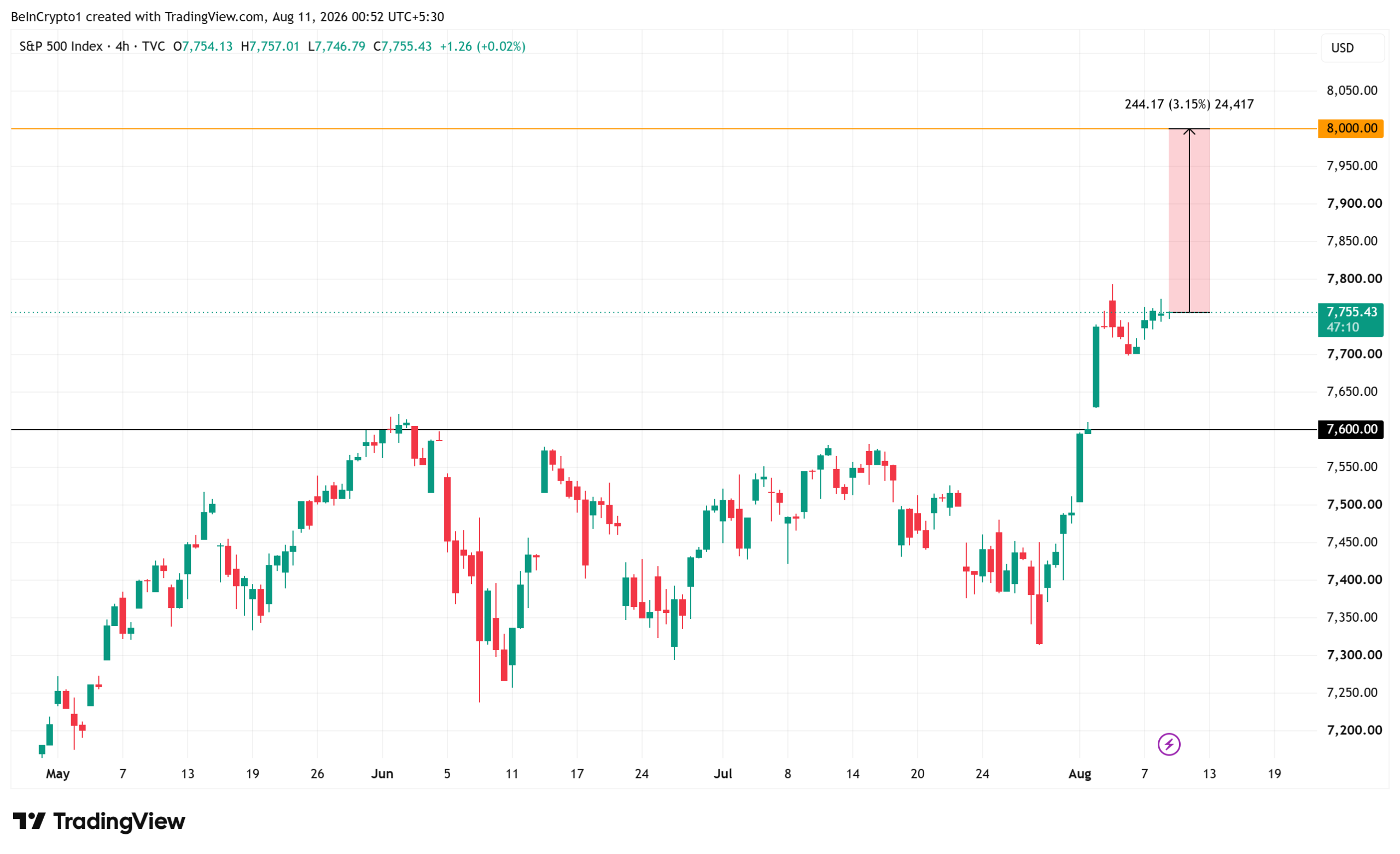
JPMorgan raised its year-end S&P 500 target to 8,000 on Monday, and research firm CFRA now sees 8,050. A new stock market risk is forming beneath the cheer, as investors abandon their downside hedges.
Wall Street keeps raising the bar. Almost nobody is paying for protection in case it misses.
JPMorgan and CFRA Raise S&P 500 Targets on AI Earnings
JPMorgan has now raised its call twice in two months. The bank went from 7,600 to 7,800 in June, then to 8,000 this week. The new target sits about 3% above Friday’s close of 7,757.64.
Strategist Dubravko Lakos-Bujas and his team now expect $365 in 2026 earnings per share (EPS). That is 35% growth in a single year. Notably, they left the valuation multiple flat at 20 times earnings. Profits, not a richer price tag, carry the entire upgrade.
The profits case rests on the cloud. Google Cloud grew 82% year over year last quarter, with Microsoft Azure up 43% and Amazon Web Services up 37%. JPMorgan expects artificial intelligence (AI) to soak up more than half of the index’s $1.5 trillion in capital spending this year.
CFRA, an independent Wall Street research firm, went further. It lifted its 12-month target to 8,650 from 7,730 on Monday, roughly 12% above the August 7 close. Its year-end call of 8,050, tops JPMorgan’s.
The crowd is moving the same way. Goldman Sachs sits at 8,000, Citi at 8,100, and the Street average near 7,854. Only Bank of America holds out at 7,100.

The calls follow a week in which the Dow and S&P 500 closed at records on AI earnings.
Nobody Wants to Hedge as FOMO Grips the Options Market
Put options work like crash insurance. Right now, almost nobody wants to pay the premium.
Hedging demand has sunk to lows last seen after President Donald Trump’s tariff retreat in 2025, Bloomberg reported Monday. The gauge is one-month put-to-call skew, which compares the cost of bearish puts against bullish calls. It now sits at a 16-month low.
“Demand for protection against a drop in stocks has fallen to the lowest level since US President Donald Trump’s capitulation on tariffs last year, as indexes rally to record highs,” Bloomberg analysts noted.
The echo matters. Skew was last this cheap in April 2025, just as that tariff selloff ended. Back then, protection stopped selling because the panic had passed. This time, it stopped selling because fear of missing out (FOMO) replaced fear itself.
Valuations flash the same complacency. The S&P 500 dividend yield fell to 1.04%, the lowest ever recorded, Barchart data shows. That is less than half its long-run average near 2.81%.

Michael Burry sees danger in the calm. The investor, famous for calling the 2008 collapse, issued a 1987-style crash warning last week as the index hit records.
Why Vanishing Hedges Could Become the New Stock Market Risk
A market without hedges has no shock absorbers. And the shock list is not short.
Even the bulls admit it. CFRA’s Sam Stovall raised his targets and still warned the rally may be nearing a peak. He points to rising margin debt, sticky inflation, and possible further Federal Reserve tightening.
JPMorgan expects the Fed to hold rates at 3.50% to 3.75% through 2026. It sees core personal consumption expenditures (PCE) inflation, the Fed’s preferred gauge, near 3.4% by December. That leaves little room for rate cuts to rescue stretched prices.
Heavy share and debt issuance plus Strait of Hormuz oil frictions round out the risk list. Weak September seasonality is three weeks away. First comes Wednesday’s US inflation report.
Crypto is watching from a distance. Bitcoin (BTC) traded near $63,955 on Monday, down 2% in a day, while the S&P 500 eased 0.1%.

The bulls’ math works as long as earnings keep beating. If even one flagged risk lands, an uninsured market takes the hit at full force.
The post JPMorgan and CFRA Raise S&P 500 Price Forecast as Nobody Wants to Hedge Anymore appeared first on BeInCrypto.
Crypto World
Argentina Turned $10,000 in Peso Savings Into $114. Steve Hanke Says the Fix is Incomplete
In Argentina, inflation has fallen sharply under Javier Milei. Yet a decade of destroyed savings and expensive long-term credit explains why Argentines continue to seek dollars.
Argentines borrow at 29.9% on a long-term mortgage. Ecuadorians, who use the US dollar, borrow at 7.5%.
Steve Hanke, the economist who helped Ecuador make that switch in 2000, reviewed BeInCrypto Intelligence’s new LATAM report ‘The Exodus Economy’ and says Argentina should follow, before the next government undoes Milei’s progress.

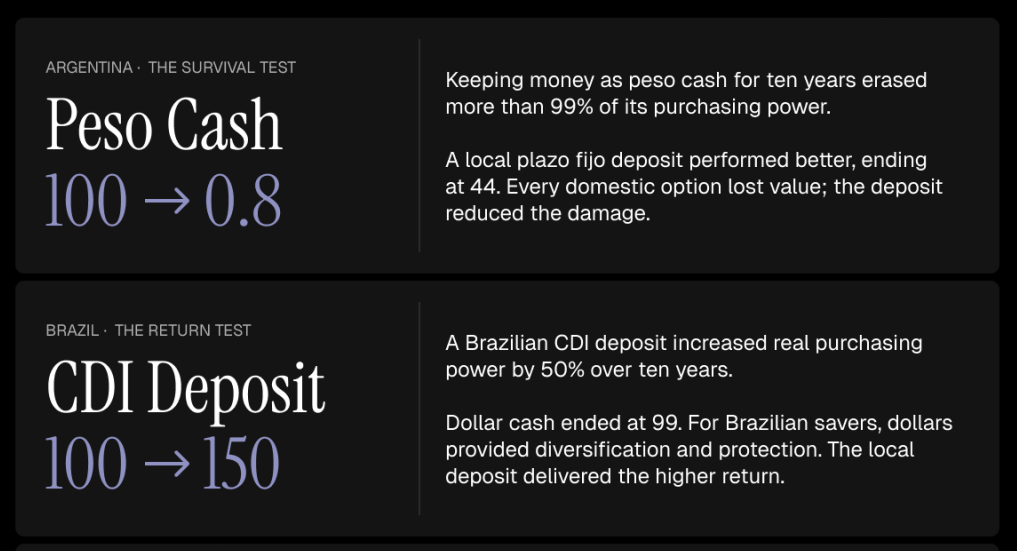
An Argentine who kept the equivalent of $10,000 in peso cash from June 2016 to June 2026 would have ended with about $114 in US-dollar value.
That is one of the starkest findings in BeInCrypto Intelligence’s new report, The Exodus Economy. Nearly 99% of the money’s dollar value disappeared over ten years as inflation and currency depreciation compounded.
The damage extended beyond cash. A local Argentine term deposit reduced the loss, but still preserved only 44% of its starting purchasing power. By comparison, a Brazilian CDI-linked deposit gained 50% in real terms over the same period. A Mexican deposit gained 30%.
The gap explains why dollar demand in Argentina has become a financial habit rather than a short-term response to one crisis.

Milei Has Slowed Inflation Sharply
Argentina’s immediate position has improved. Consumer prices rose 1.9% in June, the lowest monthly rate in ten months. Annual inflation stood at 33.5%, while prices increased 16.8% during the first half of 2026, according to INDEC.
The parallel-market premium for dollars has also fallen to around 2%, after exceeding 150% in 2023. The International Monetary Fund said recent fiscal, monetary and foreign-exchange reforms had strengthened Argentina’s reserve buffers and improved its ability to absorb shocks.
Steve Hanke, professor of applied economics at Johns Hopkins University, says the progress remains vulnerable.
“While President Milei’s extensive, but not full, liberalization of the foreign exchange market has allowed the parallel premium to collapse and inflation to fall, inflation is still too high for durable stabilization,” Hanke told BeInCrypto.
Hanke advised Ecuador when it adopted the US dollar in 2000 and previously developed an orthodox currency-board proposal for Argentina.

Mortgage Rates Reveal the Remaining Risk
Hanke points to long-term borrowing costs as a measure of confidence in Argentina’s monetary system.
“The current average interest rate for peso-denominated 20–30-year mortgages in Argentina is 29.9%,” he said. “In Ecuador, a country that I assisted in dollarizing in 2000, it is only 7.5% for similar mortgages.”
Monthly inflation can fall quickly after a major policy change. A long-term lender must consider what inflation and the peso could look like under several future governments. Argentina’s high mortgage rate shows that this political and currency risk remains expensive.
Hanke argues that the current framework leaves room for a future administration to reverse Milei’s reforms.
“Milei will not be in power forever,” he said. “Full dollarization would lock in stability in a way that current arrangements cannot.”
Official dollarization would replace the peso with the US dollar and remove the central bank’s ability to issue its own currency. Hanke believes this would impose tighter fiscal discipline and reduce lending risk.
The policy also carries costs. Argentina would lose control of its monetary policy, while its central bank would have less capacity to support banks during a crisis. IMF research has long treated these as central trade-offs in any move to full dollarization.
Argentines are Already Dollarizing Privately
Many households and businesses are no longer waiting for the state. They use dollar accounts and stablecoins to receive salaries, protect balances and make cross-border payments.
BeInCrypto’s on-chain analysis found that more than 99% of tracked stablecoin withdrawal volume moved again within 30 days. The time needed for half of a withdrawal cohort to move onward was 10.9 days in March 2026.

This suggests digital dollars increasingly function as working money. Contractors receive pay in stablecoins, while businesses use them to settle invoices and supplier costs.
“Unofficial dollarization allows Latin Americans to escape partly the poor monetary policies that many national central banks have,” Hanke said. “But it still misses some of the benefits that occur with full dollarization.”
A dollar balance can protect an individual from peso depreciation. It cannot lower mortgage rates across the economy or prevent a future government from changing monetary policy.
Argentina has made clear progress against inflation. The report’s ten-year results show why rebuilding trust will take longer. Savers who watched $10,000 become $114 have little reason to abandon the dollar after a few months of improving data.
Download ‘The Exodus Economy’ to explore the full purchasing-power analysis and Latin America’s shift into dollar accounts, offshore structures and stablecoin rails.
The post Argentina Turned $10,000 in Peso Savings Into $114. Steve Hanke Says the Fix is Incomplete appeared first on BeInCrypto.


OpenAI used its own cash, not outside investors, to buy back roughly $7 billion in employee shares, according to Bloomberg.
The deal holds the company’s valuation flat at $852 billion ahead of a possible stock market listing.
OpenAI Breaks From Its Own Pattern
A tender offer lets a company or investor buy back existing shares from employees. OpenAI has run investor-funded versions before, including a 2023 tender offer that tripled its valuation to $86 billion.
Its largest prior deal came in October 2025. Thrive Capital, SoftBank, and others bought $6.6 billion in employee shares, valuing OpenAI near $500 billion.
By March 2026, a $122 billion funding round pushed that valuation to $852 billion. OpenAI confirmed the same $852 billion figure now, months after it also filed a confidential IPO filing with regulators.
Why OpenAI Skipped the Investors
Funding the buyback itself keeps OpenAI’s cap table free of new outside holders right before a potential listing. It also signals the company has enough cash on hand after its March raise. It does not need fresh investor capital for this deal.
The picture looks different at Anthropic. Its April tender was tied to a $30 billion funding round. It reportedly came in below target because employees held onto shares while investor demand went partly unfilled.
At OpenAI’s own earlier tenders, the opposite happened, with employees selling so heavily that billions in investor demand went unmet.
That dynamic sits alongside an intensifying price war with Anthropic. OpenAI has also been cutting prices for customers even as infrastructure costs climb. Both pressures will matter to investors pricing either company’s eventual public debut.
CEO Sam Altman told staff in June he expects OpenAI to go public within the next year. Other reports, though, have pointed to a possible delay into 2027.
Funding this tender alone lets OpenAI keep that timeline flexible rather than answering to a new set of investors.
The post OpenAI Skips Outside Buyers for $7 Billion Tender as IPO Preparation Ramps Up appeared first on BeInCrypto.


China’s humanoid robot boom just produced one of the most lopsided initial public offering (IPO) scrambles in recent memory.
Unitree Robotics, the Hangzhou-based robot maker best known for its dancing and martial-arts-performing humanoids, priced its Shanghai listing at 150.8 yuan ($22.35) per share. Retail investors responded by submitting valid applications for 53.64 billion shares. Only 9.707 million shares were set aside for the online tranche, leaving a final winning rate of just 0.0181%.
Roughly one in every 5,525 applicants got an allocation.
What “Embodied AI” Actually Means
Unitree and its rivals sit inside a category Chinese officials and investors now call embodied AI, artificial intelligence paired with a physical body that can sense and move through the real world, rather than software confined to a chatbot or a data center.
It is the bridge between large language models and machines that can walk a factory floor or lift a box. Beijing has made the category a national priority, and the capital has followed.
Sector investment hit 47.09 billion yuan ($6.95 billion) in the second quarter alone, more than double the prior quarter and over six times the year-ago total, according to industry tracker Xiniu.
Unitree Isn’t Even the Market Leader Anymore
The twist is that the company drawing the IPO frenzy is not the one leading the market it is going public to capitalize on. Shanghai-based AgiBot shipped roughly 8,400 humanoid robots in the first half of 2026, good for a 44% global share, according to research firm Smart Analytics Global.
Unitree shipped about 5,900 units for 31%, dropping to second place despite shipment growth of 170% year on year. AgiBot’s growth came from spreading across full-size bipedal, compact, and wheeled robot lines, while Unitree’s volume still leans heavily on its flagship G1 model sold into education and research.
AgiBot has not disclosed financials, while Unitree posted 1.7 billion yuan in revenue and roughly 591 million yuan in adjusted net profit last year, a rare profit in a sector still mostly running on venture money.
The US Is Watching From Behind
Neither company is racing alone. X Square Robot, Galbot, and EngineAI have all filed confidentially for Hong Kong listings, joining AgiBot in a queue that reflects a sector now numbering more than 100 Chinese humanoid firms.
Chinese manufacturers supplied over 97% of all humanoid robots shipped globally in the first half of the year. Washington has responded with import restrictions aimed at slowing cheap Chinese humanoids from reaching US buyers, a defensive posture that echoes a pattern seen elsewhere in tech.
Earlier this month, US chip export controls aimed at slowing Beijing’s AI sector instead helped a domestic memory chipmaker, CXMT, surge 466% in its Shanghai trading debut.
The bigger question for investors is whether shipment volume is translating into working, deployed robots rather than demo-stage inventory.
Unitree has audited profits to show for its scale. AgiBot, the market’s actual leader by shipments, has disclosed none of that. That gap in transparency, not who filed for an IPO first, is likely to matter more to anyone deciding where to put money in China’s crowded humanoid race.
The post Oversubscribed 8,288 to 1: China’s Hottest IPO Hits ‘Embodied AI’ Boom appeared first on BeInCrypto.
Bitcoin starts the week with new August highs as traders weigh the impact of crunch US inflation data.
Key points:
- US CPI and PPI data comes amid fluctuating bets on Federal Reserve interest-rate hikes in 2026.
- The Japanese yen remains at the forefront as it creeps back toward the key 160 level against the US dollar.
- Bitcoin (BTC) traders see the area around $65,800 as crucial for bulls after BTC/USD hits new month-to-date highs.
- Larger Bitcoin wallets contrast with retail holders after a conspicuous two-month accumulation spree.
- Baskets of onchain indicators still see the bear market continuing in the second half of the year.
CPI, PPI data comes at crucial time for Fed
Key US inflation data is due as markets shift their expectations of Federal Reserve interest-rate policy.
The July prints of the Consumer Price Index (CPI) and Producer Price Index (PPI) will be released on Wednesday and Thursday, respectively.
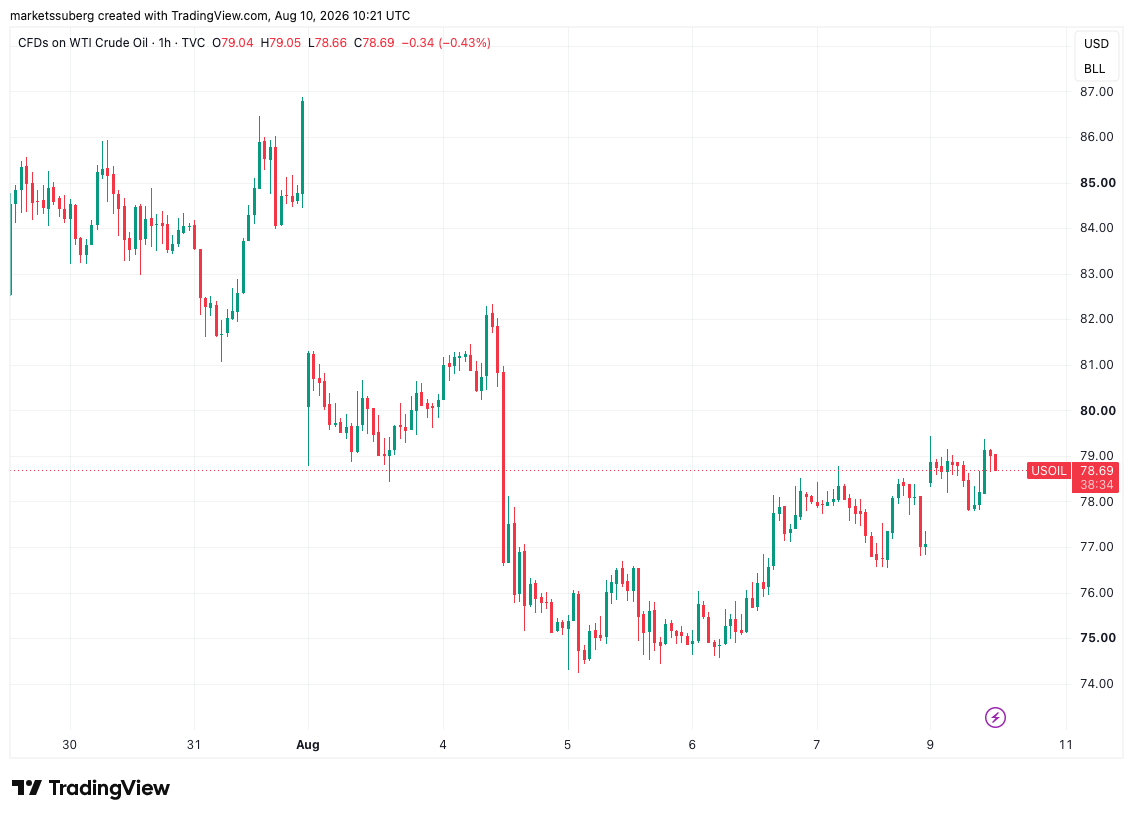
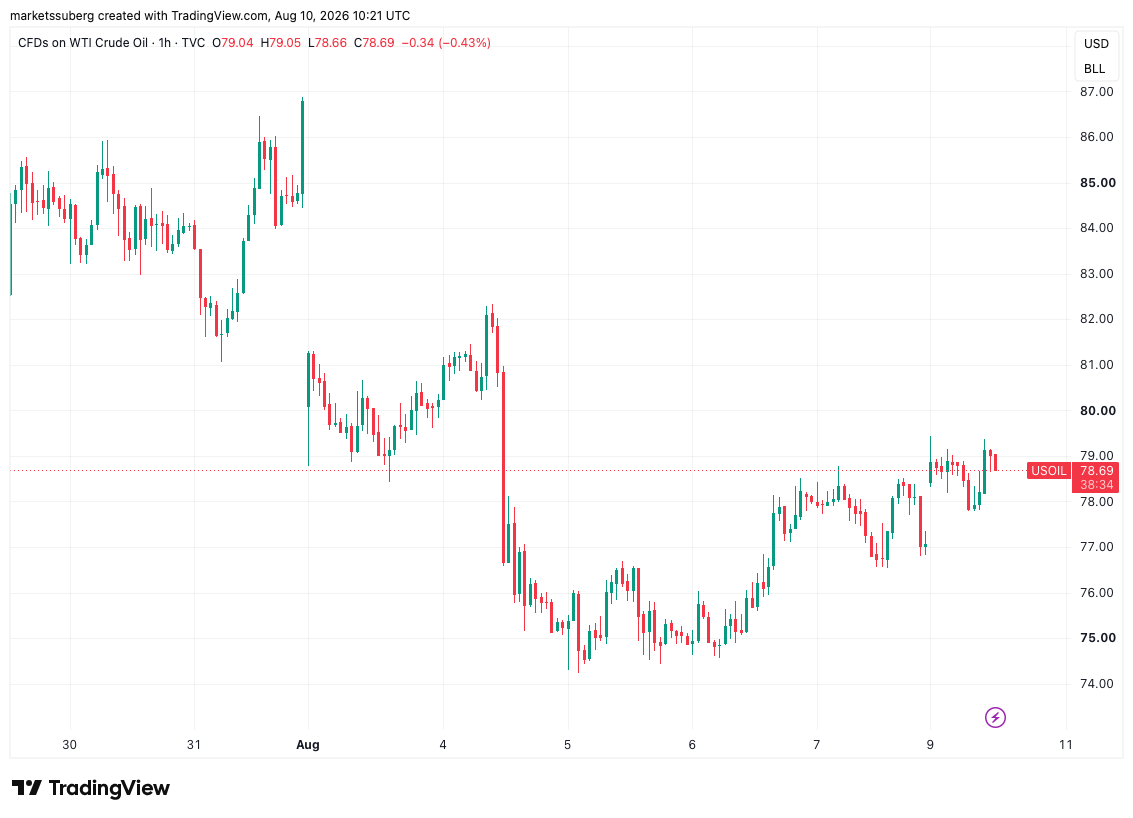
The timing of the release is important — recent US inflation cues have given mixed signals to Fed watchers, while resolution of the US-Iran war likewise remains far from certain. The latter has implications for CPI in particular, given oil’s price sensitivity to events around the Strait of Hormuz shipping route.
“Crude oil prices remain caught between opposing forces, as markets assess the possibility of a breakthrough over the Strait of Hormuz against Iran’s conditions for reopening the strategic waterway,” Sugandha Sachdeva, founder of New Delhi-based research company SS WealthStreet, told Reuters on Monday.
CFDs on US WTI crude oil one-hour chart. Source: Cointelegraph/TradingView
Last month’s CPI and PPI results both surprised to the downside, with the former seeing its largest monthly decline since April 2020. Nonfarm payrolls numbers last week continued the trend, showing weaker-than-expected labor-market conditions.
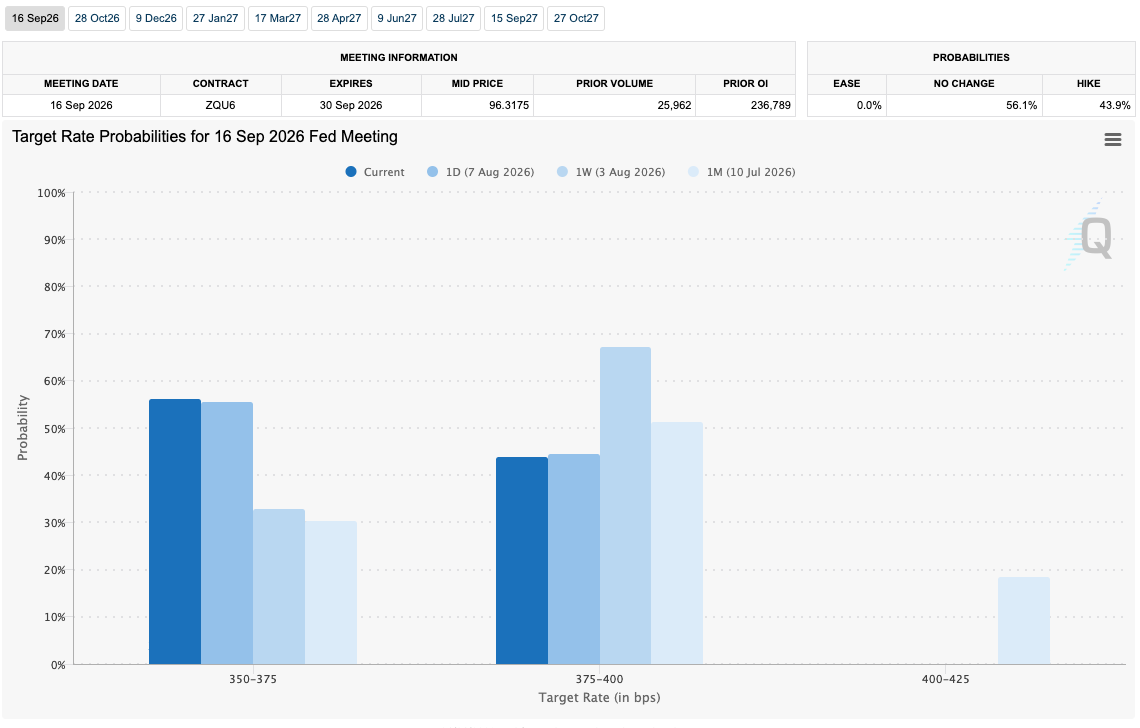
Both bolstered odds of a more dovish Fed going forward, with markets switching from a 0.25% rate hike probability to a continued pause as the most likely outcome at its Sept. 16 meeting. CME Group’s FedWatch Tool showed a 56% chance of a pause as of Monday.
“A week ago, market-implied odds strongly favored a rate hike at the Fed’s next meeting in September. Those odds now slightly favor the Fed keeping rates on hold, with just one hike before pausing well into next year,” trading resource Mosaic Asset Company wrote in the latest edition of its newsletter, The Market Mosaic.
Fed target rate probability comparison for September FOMC meeting (screenshot). Source: CME Group
Mosaic added that last week’s ISM Manufacturing and Services data pointed to the US economy “holding up just fine,” despite the data sparking concerns over signs of future “stagflation” — rebounding inflation gauges combined with slow economic growth and rising unemployment.
Yen reverses days after US intervention
The US role in manipulating the Japanese yen remains a key point on the radar for traders worldwide after the first joint US-Japanese intervention since the late 1990s.
After JPY/USD weakened to its lowest levels since 1986 at the start of August, the New York Fed, acting on behalf of the US Treasury, purchased yen using euros via the Exchange Stabilization Fund, or ESF, a stockpile of foreign exchange reserves.
At the time, Treasury Secretary Scott Bessent hinted that the door was open to repeat interventions in future.
“We strongly support Japan’s decisive market and monetary steps to correct the substantial undervaluation of the yen,” he wrote in a post on X.
In the interim, however, the yen has begun to weaken again after initially strengthening to around 156 per dollar. At the time of writing, it was back above 158.50, closing in on the key 160 level once more.
Analyzing the history of yen interventions, Robin Brooks, a senior fellow in economic studies at the Brookings Institution, warned that the mechanism would be unable to change the status quo on its own.
“You’d think — given everything that’s getting thrown at markets — that the yen would have risen more than during the previous two intervention episodes we saw earlier this year, but that’s not true,” he wrote in a blog post on Friday. He said:
“Price action is comparable to the NY Fed’s rate check on Jan. 23, which came just ahead of Japan’s Feb. 8 general election. That’s underwhelming and supports my general take that this intervention – like past ones – will fail to stop the Yen’s weakening trend.”
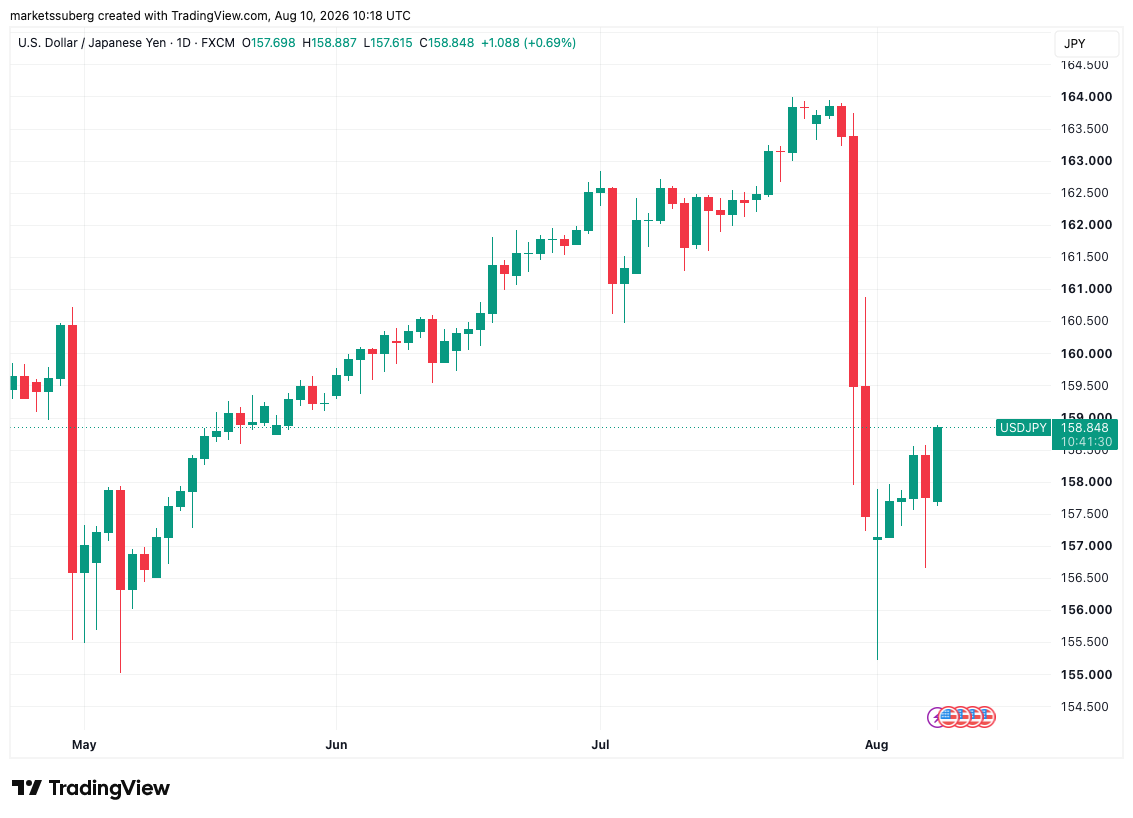
USD/JPY one-day chart. Source: Cointelegraph/TradingView
Previously, Cointelegraph reported on the longer-term implications for the yen carry trade, a key liquidity consideration for crypto and risk-asset traders.
“For global markets, the question is less about any single intervention and more about whether higher Japanese yields alter the incentives for domestic investors to allocate capital overseas,” trading company QCP Capital commented last week.
Trader eyes BTC bullish divergences with $65,800 now key
Bitcoin saw new month-to-date highs of $65,420 into Sunday’s weekly close, subsequently consolidating progress as TradFi markets returned.
Data from TradingView still showed BTC/USD acting in a stubborn range, with the 50-month exponential moving average (EMA) in place as resistance overhead at $65,827.
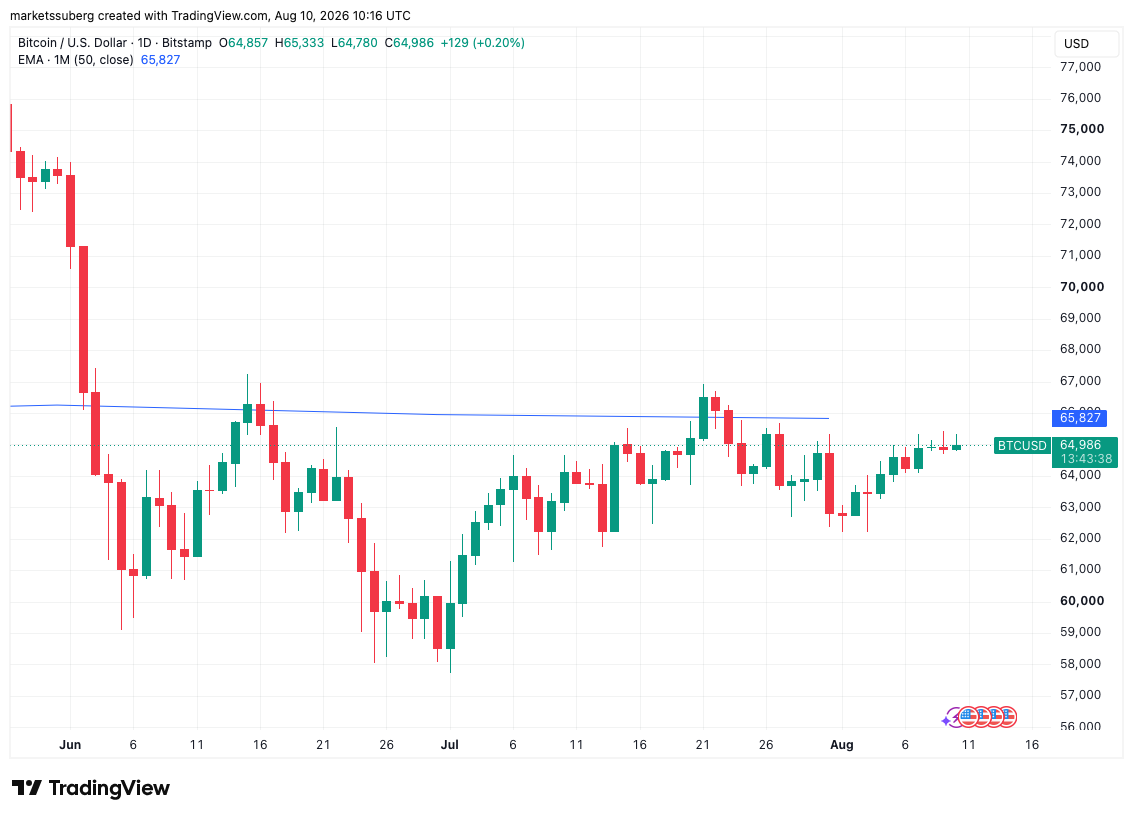
BTC/USD one-day chart with 50-month EMA. Source: Cointelegraph/TradingView
In his latest market analysis, crypto trader Michaël van de Poppe saw three BTC price breakout signals nonetheless locking in on classic price indicators. The moving average convergence/divergence (MACD) and relative strength index (RSI) both have “strong” bullish divergences on both three-day and one-week time frames, he reported at the weekend.
Alongside a chart showing the divergences, in which the indicators set higher lows while price makes lower lows, Van de Poppe put $65,800 as the key target for bulls to break through next.
“All in all, if $65,800 breaks (which is the crucial weekly level), I expect to see a volatile move upwards as short-side liquidity will be forced to move out of its position after this consolidation,” he said.
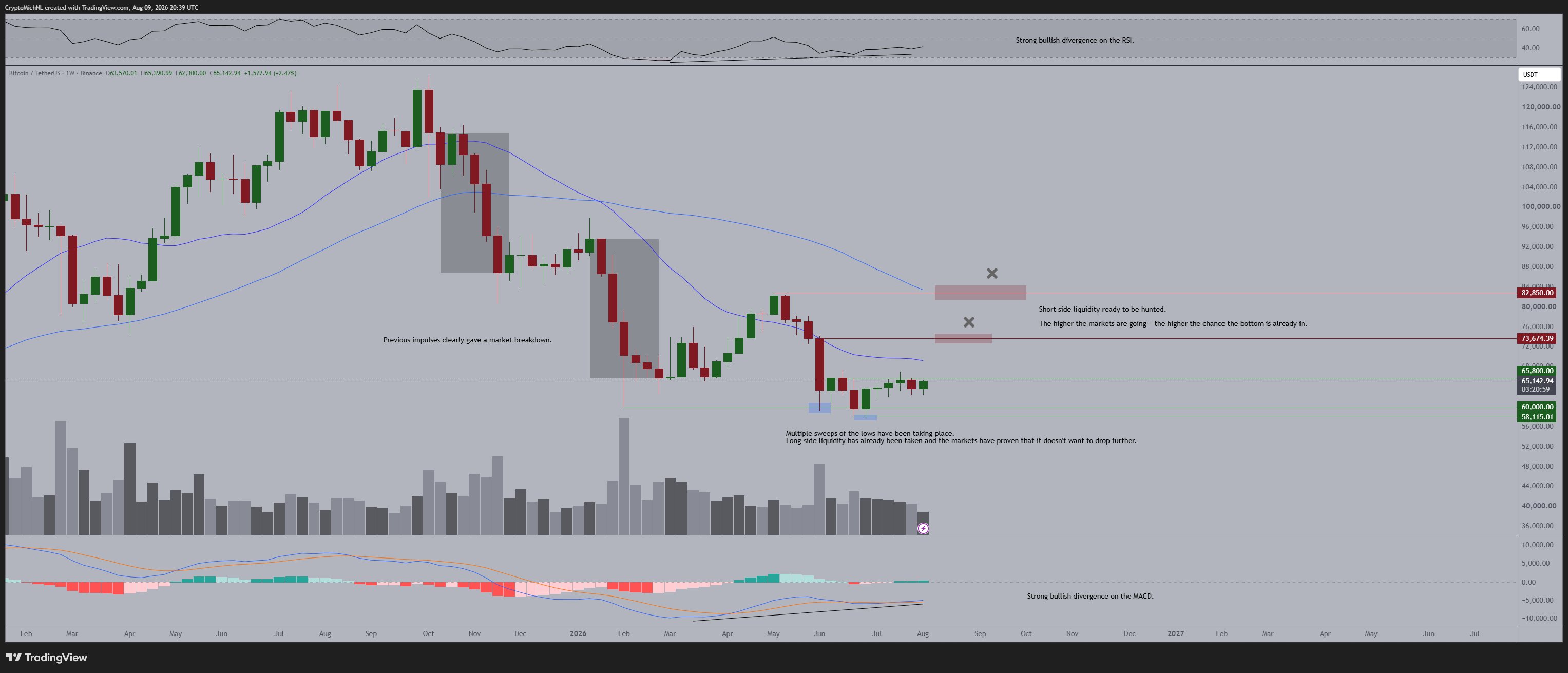
BTC/USDT one-week chart with MACD, RSI data. Source: Michaël van de Poppe on X.com
The latest exchange order-book data from CoinGlass shows liquidity building either side of spot price, with $65,800 likewise a key area for potential short-position liquidations. The new August highs appeared not to catch traders by surprise, with 24-hour cross-crypto short liquidations at $53 million at the time of writing.
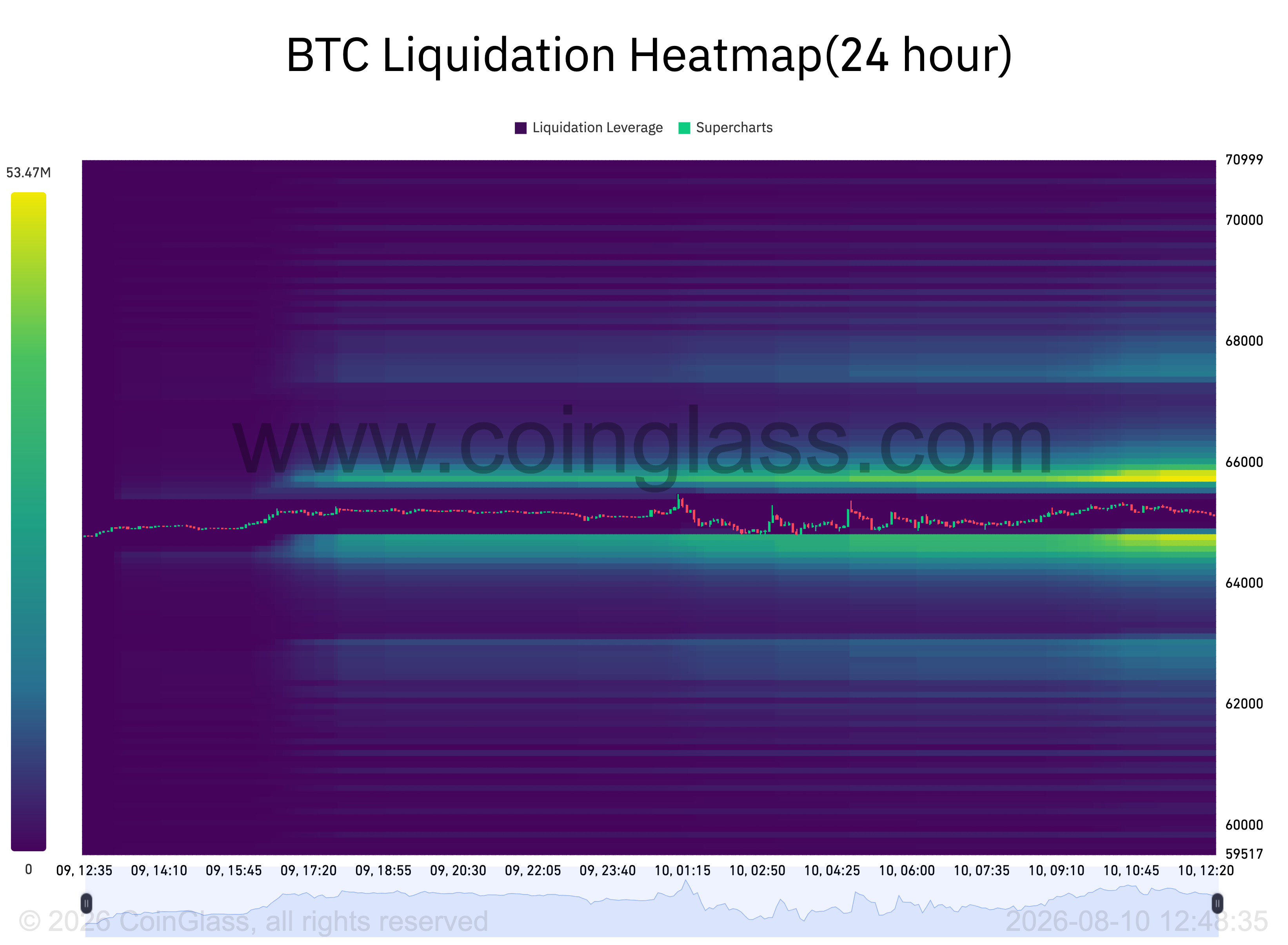
BTC liquidation heatmap. Source: CoinGlass
Andrew Kamsky, a contributor to onchain analytics platform CryptoQuant, eyed a breakout from a falling wedge construction on the daily chart. He suggested that a “decision window” could determine the fate of the range by Aug. 17.
“A rejection between $66.4K and $66.8K, followed by a series of higher lows, could begin forming an ascending triangle and create another opportunity for an upside breakout. A move back inside the wedge would weaken the bullish setup, while a crack below wedge support would invalidate it and suggest that the market is forming a different structure,” he said.
As an upside target, Kamsky gave $72,000 as a “possible scenario.”
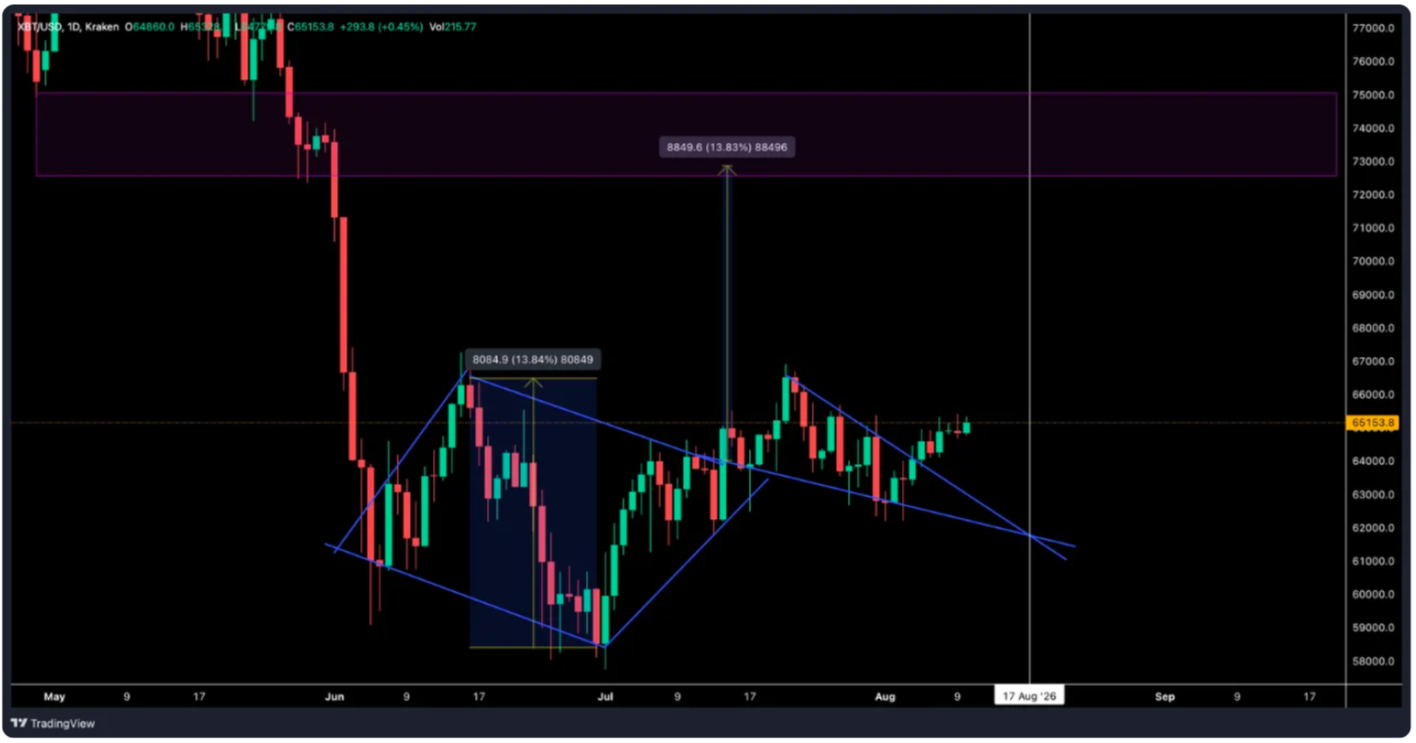
BTC/USD one-day chart (screenshot). Source: CryptoQuant
Large BTC investor accumulation hits multimonth high
Larger Bitcoin investors are drawing attention to themselves this week as new analysis flags a “sharp shift toward accumulation.”
Data from CryptoQuant shows a rapid increase in Bitcoin exposure involving addresses holding more than 10,000 BTC. On a 60-day rolling basis, the cohort’s balance increased by 46,420 BTC on Aug. 9, marking the largest uptick since March 15.
“More notably, the latest reading is nearly double the 23,238 BTC accumulation peak recorded in mid-March, pointing to a significant acceleration in activity among the largest balance group,” CryptoQuant commented.
More recently, larger hodlers have begun to diverge from smaller wallets traditionally associated with retail investors. After initially accumulating through July, addresses holding between 0.1 BTC and 1 BTC distributed around 9,700 BTC for the 60 days through Aug. 9.
“The divergence is notable because it shows two very different positioning trends developing simultaneously: the largest BTC balance cohort is increasing exposure while smaller holders are reducing it,” CryptoQuant said, noting the timing of the accumulation coinciding with the upcoming US CPI and PPI data releases.
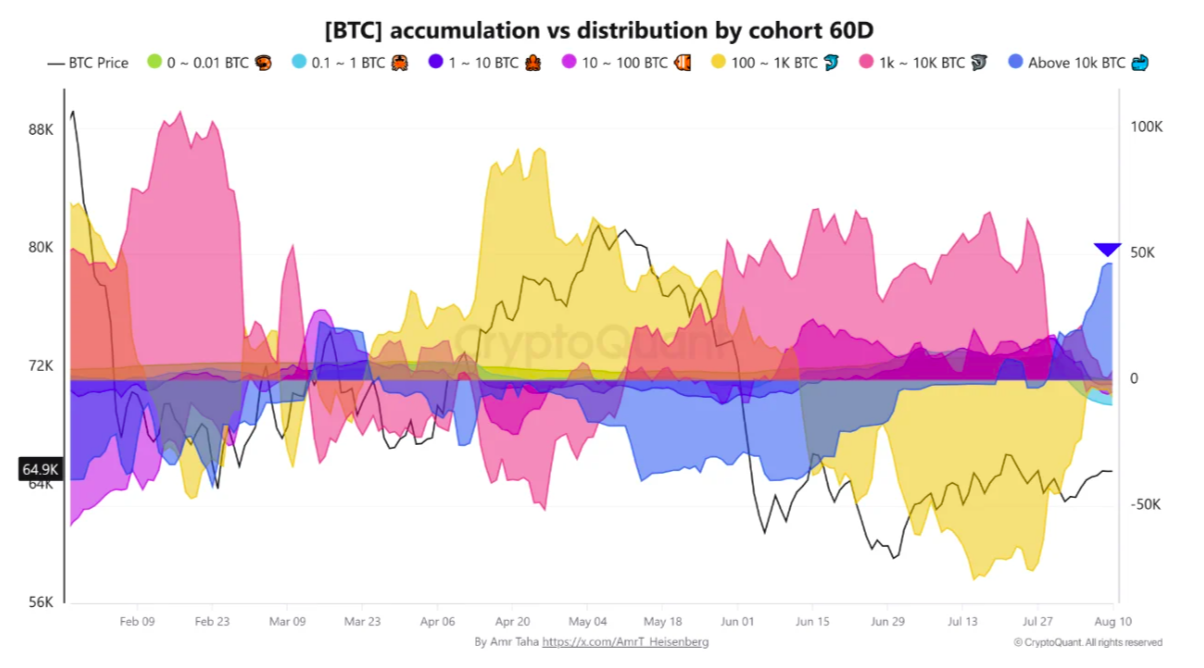
Bitcoin accumulation and distribution by cohort. Source: CryptoQuant
Last week, Cointelegraph reported what CryptoQuant called “strong accumulation” between $62,000 and $65,000, with around 0.7% of the total BTC supply — around 155,000 coins — last moving onchain within that range. At the same time, a record divergence between spot and futures trading volumes has placed doubt over Bitcoin’s ability to recover lost ground in the current climate.
Commenting on daily spot-market turnover relative to market size, Rafael Schultze-Kraft, cofounder of onchain analytics platform Glassnode, described spot markets as “virtually dead.”
“Daily spot turnover ratio sits at just 0.32%, the lowest level in our data, while dollar volume is down ~64% YoY. Textbook apathy. A healthier move higher needs participation to come back,” he told X followers last week.
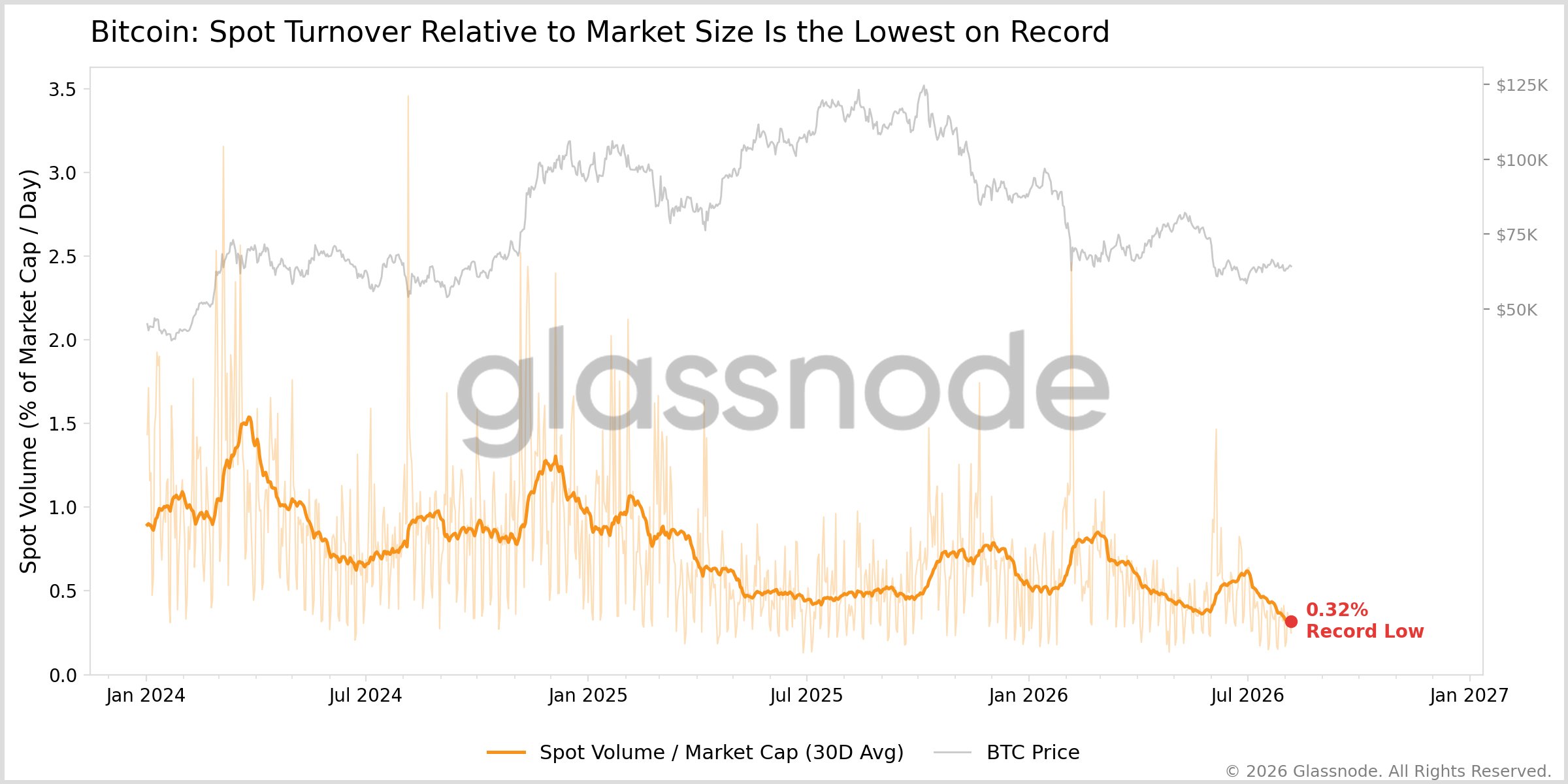
Bitcoin spot turnover data. Source: Rafael Schultze-Kraft on X.com
Indicators see Bitcoin bear market continuing
On aggregate, Bitcoin onchain metrics and associated price gauges still demand cooler conditions before a reliable long-term reversal hits.
Related: BIP-110 ends with a whimper, CLARITY vote punted: Hodler’s Digest, Aug. 9
In separate research, Schultze-Kraft revealed a record “capitulation” phase in a basket of 45 price indicators which make up Glassnode’s Bitcoin Cycle Position Heatmap. This compares market health across four-year BTC price cycles, with current conditions characteristic of the final stages of the bear market.
“Today it sits in its coldest stretch since FTX: late in the bear, but not yet the unanimous deep blue that previously marked a floor,” Schultze-Kraft commented on the heatmap’s latest readings last week.
A similar compilation from CoinGlass, which it dubs its Bull Cycle Peak Indicators, currently sits at 32% toward its ideal “sell” zone.
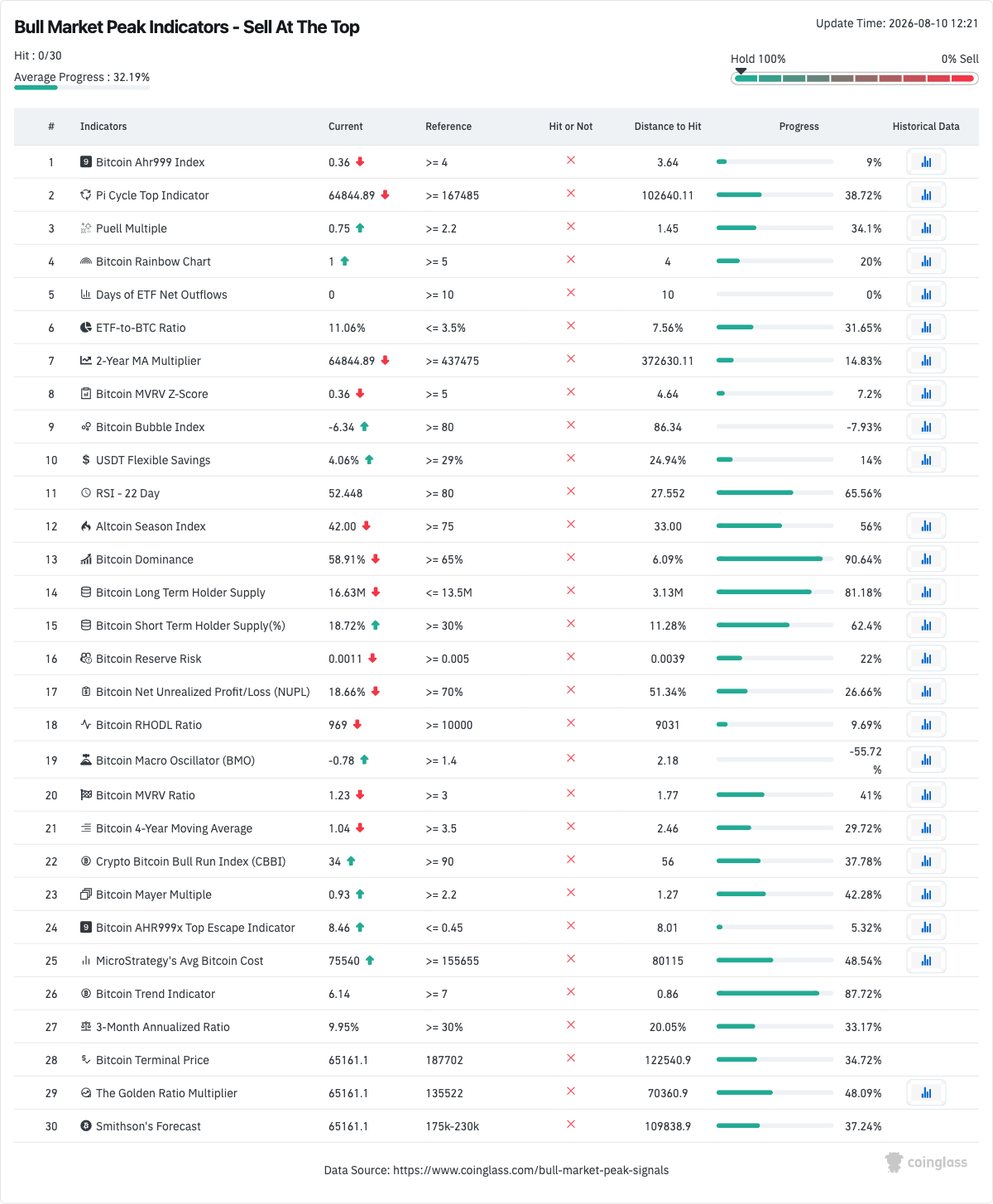
Bitcoin Bull Market Peak Indicators. Source: CoinGlass
The data ties in with the views of an growing number of Bitcoin traders looking at historical patterns to determine BTC price performance for the rest of 2026. This week, trader and analyst Rekt Capital drew particular comparisons to the 2022 bear market.
“Bitcoin is forming Lower Highs here relative to the July upside wick In 2022, August actually developed a Higher High relative to the preceding July,” its weekend post said.
Rekt Capital reiterated Bitcoin’s current inability to reclaim the 50-month exponential moving average (EMA), currently at $65,827 — a classic predecessor of a final bear-market capitulation.
“No matter the structure however, 4 years ago Bitcoin positioned itself for a bearish retest of the 50 Month EMA (purple) to reject and drop lower later. Today as things stand, Bitcoin is technically positioned for the same thing,” he added.
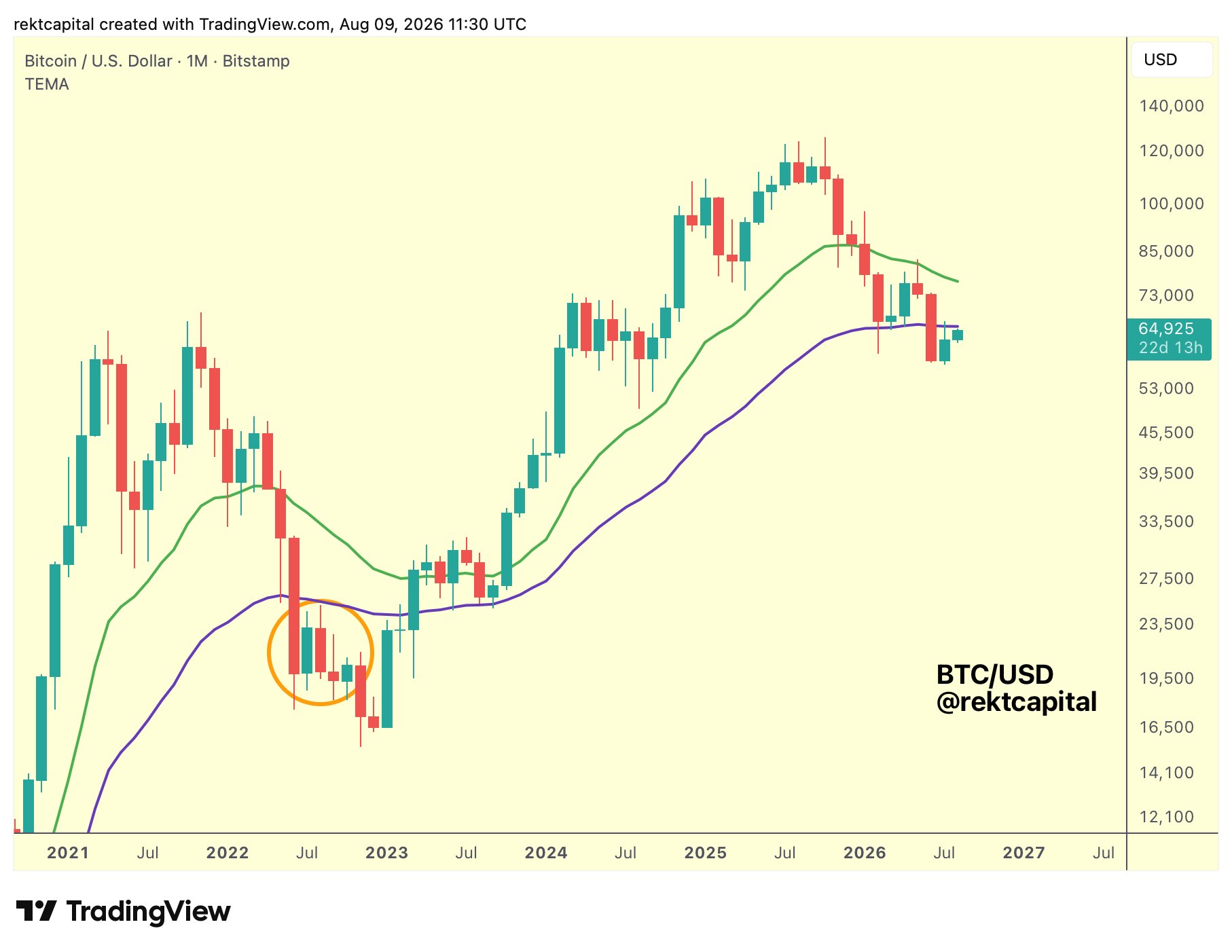
BTC/USD one-month chart with 21, 50 EMA. Source: Rekt Capital on X.com

Jupiter launched Lend v2 on Solana on August 10, introducing two opt-in features that let supplied and borrowed assets work as decentralized exchange liquidity while they sit in a lending position.
As per a press release shared with CryptoPotato, Jupiter said Lend v2 is the first lending protocol on Solana where borrowed assets can earn trading fees, and the upgrade adds Smart Collateral and Smart Debt, alongside Lifetime PnL, a record of what each position has earned or cost over its life.
Collateral That Earns Three Ways
With Smart Collateral, a user deposits a single supported asset, such as USDC, USDT, SOL, or JupSOL, and the protocol automatically composes it into a correlated liquidity pair. Eligible deposits can earn lending yield, trading fees, and, where applicable, native staking rewards from one position.
Smart Debt extends the model to borrowed assets by letting them also function as DEX liquidity. As traders swap through those pools, the trading fees a debt position generates offset borrowing costs, and the mechanics of borrowing and repaying stay the same.
“There’s been a wall between the two primary ways people earn APY onchain, lending and LPing. Lend v2 brings down that wall by letting users opt-in to letting their liquidity work as both Lending and AMM liquidity at the same time,” said Kash Dhanda, COO of Jupiter.
Both features are entirely optional. Users who prefer traditional lending can keep supplying and borrowing assets without exposure to the DEX.
Lifetime PnL Tracks Every Position
Lifetime PnL gives users a complete record of what a position has earned or cost over its lifetime, across lending yield, borrowing costs, and trading fees.
Jupiter runs swaps, perpetuals, and lending on Solana and describes its mission as building the full financial ecosystem on-chain while maximizing capital efficiency across the network.
JupSOL, one of the assets eligible for Smart Collateral, is Jupiter’s liquid staking token and held $396.0 million in total value locked on August 10, according to DefiLlama. The firm’s perpetual futures venue held a further $702.6 million on the same day.
The post Jupiter Launches Lend v2 on Solana, Letting Borrowed Assets Earn Trading Fees appeared first on CryptoPotato.
Crypto World
The Trump Administration Has Revoked More Than 175,000 Visas. Here’s Who’s Included in the Crackdown
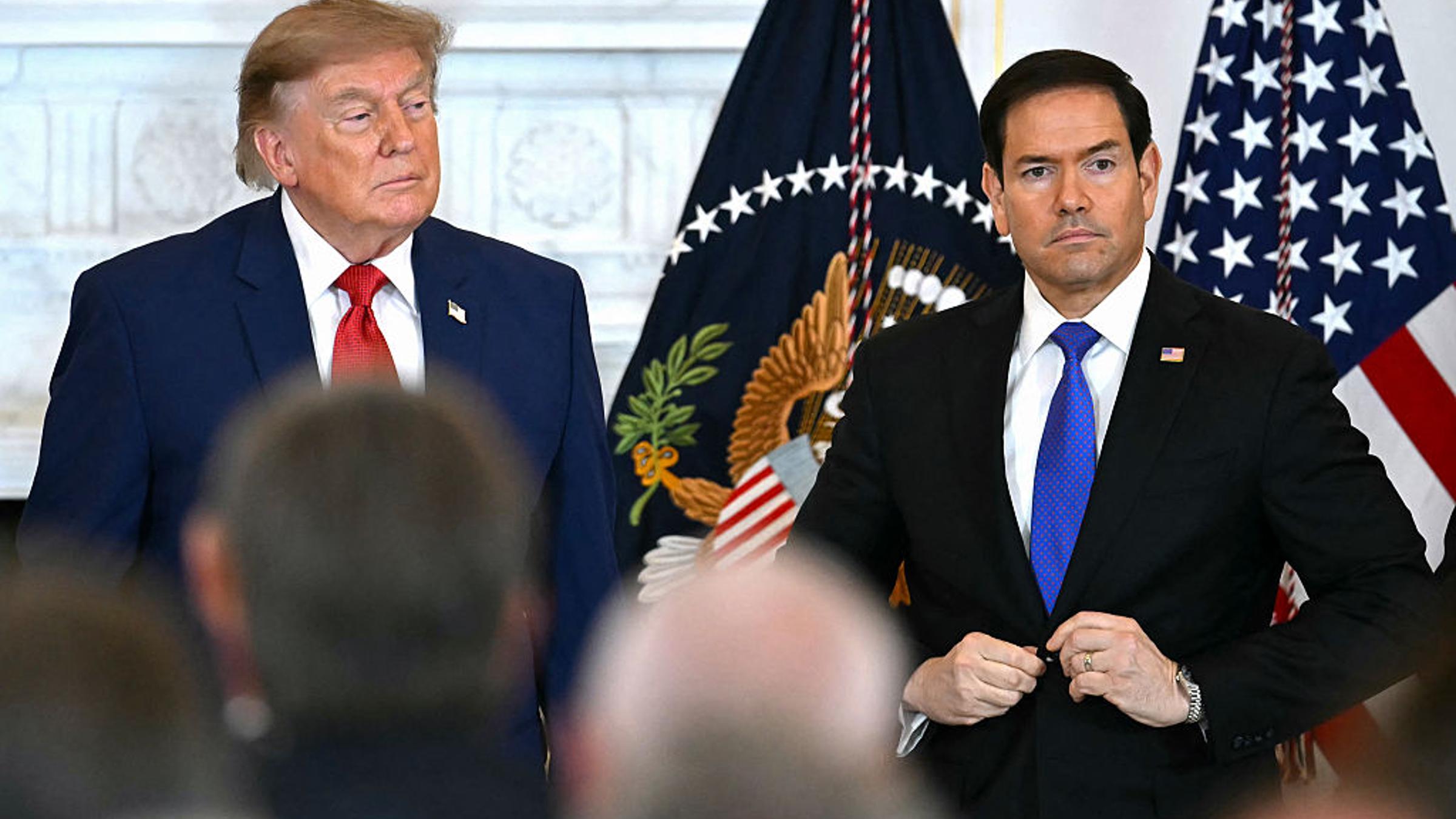
Here are some of the groups of people who have been included in the Trump Administration’s sweeping visa cancellations, according to federal officials.
People accused of “criminal activity”
Most of the visas were revoked as a result of “law enforcement encounters for a range of criminal activity,” the State Department said.
It listed “assault, driving under the influence, theft, and drug crimes” as the “leading causes,” while noting that a “significant share” of the cancellations were also due to “reckless driving, sexual assault, child abuse, fraud and embezzlement, and other crimes.”
The department listed among its individual examples foreign nationals who it said were charged with violent and sexual offenses including instances of “rape and sexual battery – including of a victim who was mentally disabled”; kidnapping and human trafficking; domestic violence; and “sodomy of a child.”
Multiple other people whose visas were revoked, it said, were involved in fraud schemes—which Trump has made it a major focus of his second term agenda to c. One person “built a company on lies,” the department alleged, “faking revenue and fooling investors to swindle millions of dollars from clients.” In another of the examples it offered, the department said the visa holder “helped orchestrate a massive Medicaid scam – billing for over $5 million of fake services.”

Bulacan Dreamers win bronze in Senior League Softball World Series

Cyber Vulnerability Sweep Picks Up Royal Navy Drones Sending Data To China

Police investigating Ann Widdecombe murder suspect over Farage arson incident

Renter of Home in Anne Heche Crash Denies Settlement With Son

No Jackpot Winner as $257 Million Prize Rolls Over to $269 Million Monday Draw

Weekend Open Thread: Staud – Corporette.com

Hugely Boosting XRP And Bitcoin Holdings The Crypto Market Dip Has Created A Great Opportunity

1| Financial Management : Meaning, Definition, Objectives, Importance, financial management bba lu

How to become Financial Analyst in 2026 | Skills required for Financial Analyst #shorts #simplilearn
-

 Fashion3 days ago
Weekend Open Thread: Mattifying Sunscreen
-

 Fashion4 days ago
Frugal Friday’s Workwear Report: Cap-Sleeve Pointelle Crewneck Sweater
-

 Sports5 days ago
Jordan Coyle & Cordiamo take Laya Arena Stakes at RDS
-

 News Videos3 days ago
Can Astrology Help Find Gold and Silver Trends? A Financial Astrology Guide
-
 Business5 days ago
US stocks: Dow closes at record on Mideast optimism; SpaceX, AMD drag Nasdaq
-

 Politics5 days ago
Reform UK And Greens Sink To Lowest Favourability Ratings To Date
-

 Tech6 days ago
OpenAI, Anthropic AI agents targeted real people and systems in cyber tests
-

 Business6 days ago
Nvidia Stock Climbs 2.5% as Chip Sector Rally Builds Ahead of AMD Earnings, Nvidia’s Own Report Looms
-

 Crypto World6 days ago
Polymarket targets $20 billion valuation as competition heats up in prediction market sector
-

 Business5 days ago
Supply chain issues impact Ingredion
-
 Crypto World7 days ago
CLARITY Act Senate Vote Locked In, But 60-Vote Hurdle Looms Large
-

 Tech3 days ago
Rinn Pharma & Biopharma to join NordicPharmaTrain network
-
 Crypto World6 days ago
Dow and S&P 500 Hit Records on AI Earnings: When Will the Bubble Burst?
-

 Business2 days ago
How to Start a Cleaning Business: A Step-by-Step Guide
-

 Crypto World7 days ago
The Senate has one week: CLARITY’s last August window
-

 Business2 days ago
Datadog: Best Of Breed For Multiple Reasons
-

 Business2 days ago
BDC Weekly Review: Private BDC Q2 Numbers Are Strong
-
 Crypto World6 days ago
Dollar Index Trapped at 100 as Hawkish Fed Meets Official Selling
-

 Crypto World7 days ago
New York sued, who is next
-

 Business6 days ago
McDonald’s (MCD) Q2 2026 earnings
You must be logged in to post a comment Login