
Connect with us

Business

Kospi Rises To 6,346 As Samsung Electronics Surges 4% Amid Ongoing Chip-Sector Rebound

Published

on

Earnings News: Micron Technology Inc (NASDAQ: MU)

SEOUL — South Korea’s benchmark Kospi index climbed further Tuesday, extending a rebound from last month’s steep selloff as strong gains in Samsung Electronics and other chipmakers lifted the broader market.

The Kospi rose 0.73%, or 45.87 points, to close at 6,345.53, according to trading data. The index opened at 6,240.06, touched an intraday high of 6,405.81 and dipped to a low of 6,213.78 before settling higher for the session. Trading unfolded in a quieter regional backdrop, with Japanese markets closed Tuesday for the Mountain Day public holiday.

Samsung Electronics led the advance, with shares climbing 4.13%, while SK Hynix also edged higher as investors continued rewarding the country’s dominant memory chip producers. The gains extended a broader rebound in Korean chip stocks, which have remained a central focus for investors throughout 2026 amid strong global demand for memory chips tied to artificial intelligence infrastructure spending.

SK Hynix disclosed progress on its next-generation DRAM research and development efforts, saying it had integrated extreme ultraviolet lithography upgrades and new materials into its production process following the company’s adoption of High-NA EUV equipment, a more advanced lithography technology used to manufacture smaller, more powerful memory chips. The announcement added to investor optimism around the company’s ability to maintain its competitive position in the global memory chip market.

Advertisement

Separately, the South Korean government said it plans to legislate so-called “super special zones” within the next year to support large-scale industrial projects, including semiconductor clusters, a move aimed at bolstering the country’s competitive standing in the global chip supply chain. The announcement was seen as part of a broader push by Seoul to support the domestic semiconductor industry amid intensifying global competition for chip manufacturing investment.

Tuesday’s gains build on a recovery that has taken hold in recent sessions following a punishing stretch for Korean equities last month. The Kospi suffered a roughly 22% wipeout in July, its worst monthly performance since 2008, driven in part by a sharp unwind of leveraged trading positions tied to major chipmakers. That selloff followed an extraordinary run earlier in the year, during which the index doubled in value over just a few months, climbing from around 5,000 to more than 9,000 points at its peak in June, a rally driven almost entirely by explosive gains in memory chip heavyweights Samsung Electronics and SK Hynix.

Market analysts have said the most severe phase of that turmoil appears to have passed, with forced liquidations of leveraged positions largely working their way through the market in recent weeks, helping stabilize volatility even as the index remains well below its June peak. The Kospi’s 52-week high stands at 9,385.59, reached on June 19, underscoring the scale of the pullback that followed the market’s summer volatility.

Even with the recent turbulence, the Kospi remains dramatically higher than year-ago levels, reflecting the extraordinary scale of this year’s rally in Korean equities even after last month’s sharp correction. Goldman Sachs has maintained a bullish long-term outlook on Korean stocks despite the recent volatility, with the bank’s strategists citing a memory chip supercycle driven by record shortfalls in chip supply, strong demand from hyperscale data center operators, and continued growth in artificial intelligence computing needs as key drivers of further potential gains.

Advertisement

Tuesday’s session also came against a backdrop of anticipated monetary policy tightening in South Korea. The Bank of Korea’s outgoing deputy governor said Tuesday that the central bank is likely to raise interest rates further in response to persistent inflationary pressures, a signal that could shape investor expectations heading into the bank’s coming policy decisions.

Elsewhere in the region, broader Asian equity markets showed a mixed picture Tuesday, with some markets tracking Wall Street’s recent strength while others, including South Korea’s Kospi and Singapore’s benchmark index, led gains as investors weighed the interplay between technology-sector momentum and shifting expectations around global monetary policy. On Wall Street, major U.S. indexes closed mostly lower Monday, with the S&P 500 slipping slightly, the Dow Jones Industrial Average dipping modestly and the Nasdaq Composite falling further, even as the broader market remained near record territory following a strong run over the preceding weeks.

South Korean equities have drawn particular international attention this year given the scale and speed of both the rally and subsequent correction in chip-heavy names, a dynamic that has drawn comparisons to historic market run-ups, including the technology-driven Nasdaq rally that preceded the dot-com crash in the late 1990s. Despite last month’s sharp pullback, the semiconductor sector has continued to anchor sentiment toward the broader Korean market, with Tuesday’s gains in Samsung Electronics and SK Hynix reinforcing the extent to which chip stocks remain the primary driver of the Kospi’s day-to-day performance.

Looking ahead, investors are likely to continue monitoring developments in the global memory chip market, along with any further policy signals from the Bank of Korea regarding the pace and timing of potential interest rate increases. With the government’s newly announced semiconductor cluster initiative still in its early legislative stages, market participants are also expected to watch for further details on how the plan might translate into concrete support for the country’s chip industry in the months ahead.

Advertisement
Continue Reading
Click to comment

You must be logged in to post a comment Login

Leave a Reply

Business

Principality ramps up commercial lending in steady first half to its financial year

Published

on

Business Live

Its commercial lending book currently stands at £864m alongside further commitments of nearly £300m.

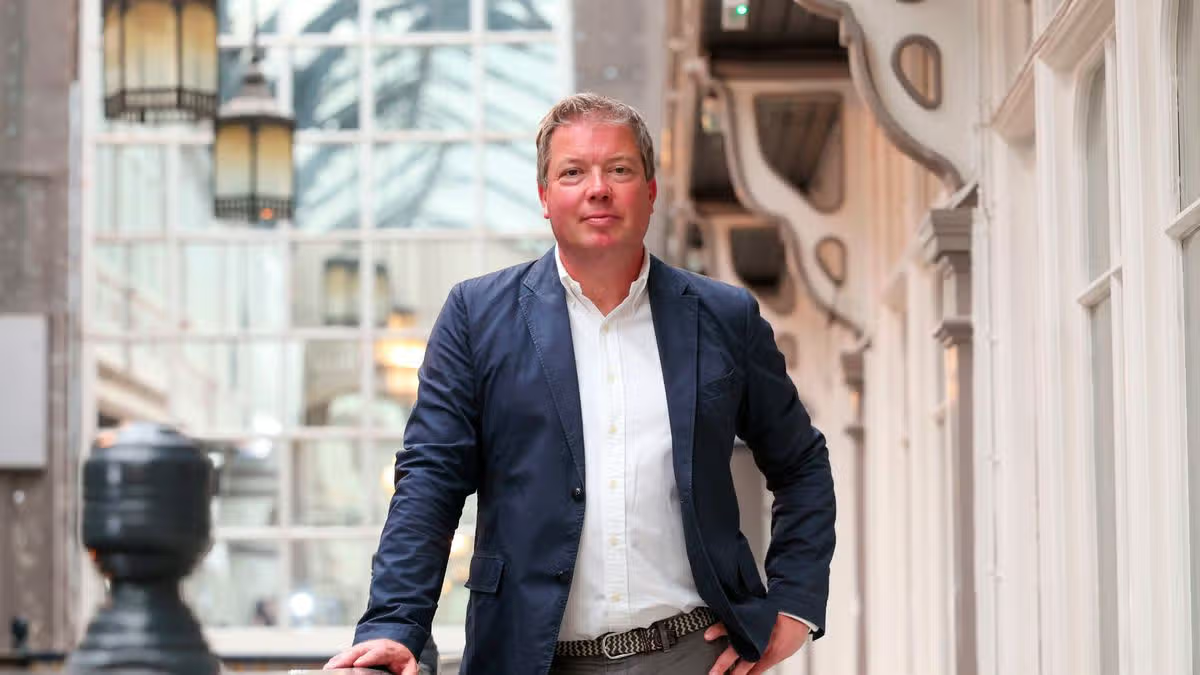
Chief executive of Principality Building Society Iain Mansfield.

Principality Building Society continued to ramp up commercial lending to support the building of new social homes in the first half of this year while bearing down on costs against the backdrop of inflationary pressures.

The Cardiff headquartered mutual, which is the sixth largest in the UK on total assets, has reported an underlying profit before tax of £22.2m (June 2025: £22.5m), reflecting a £5.6m impairment provisioning charge in response to the weakening economic outlook. Its net operating income increased to £86.2m, up £4.7m year on year, while net interest margin rose to 1.27%. In the first half total assets were up from £13.9bn in the second half of 2005 to £14.1bn.

The building society said it remains focused on cost management, in the face of inflationary challenges. As a result it said its operating expenses have remained broadly stable year-on- year at £60.2m (June 2026) compared to £59.0m (June 2025) while its management expense ratio has remained stable.

Its chief executive Iain Mansfield, said “The first half of the year has been dominated by continued geopolitical uncertainty, with conflict in the Middle East creating volatility across financial markets and influencing expectations for future Bank of England base rate changes. These external forces have contributed to a challenging operating environment for households and businesses across the globe.

Advertisement

“In the face of a challenging market, we continue to listen to and respond to our brokers and customers’ feedback, which has meant that we have been able to take a more focused and distinctive approach to our lending, helping more people access finance for their homes, responsibly.”

Its commercial lending book currently stands at £864m alongside further commitments of nearly £300m. It committed £73m of new housing association lending (June 2025: £15m) and agreed funding to property developers that will fund the development of 352 new homes (June 2025: 55) It also expanded its presence in the English housing association market, through a £30m lending agreement with Plus Dane Housing.

Mr Mansfield has said he would like to double the size of Principality’s commercial lending to £2bn-plus.

During the first half the mutual’s mortgage balances increased by £200m £11.3bn (December 2025: £11.1bn). It now support 89,867 homeowners (December 2025: 88,941).

Advertisement

At the end of June its savings balances were £11.5bn (December 2025: £11.6bn). Mr Mansfield said “Our members entrust us with their savings in a highly competitive market. We have remained focused on attracting and retaining funding that supports the long-term strength of the society, rather than purely pursuing balance growth.”

On the outlook he added: “The first half of 2026 has been about putting the plans in place for the future while also strengthening our foundations to enable the transformation needed to ensure we remain relevant in a rapidly changing world.

” Looking ahead across the next 18 months, the macroeconomic environment is becoming more difficult to predict, though we’ll continue to ensure we remain steadfast on delivering our purpose, creating a society of savers where everyone has a place to call home.”


Advertisement
Continue Reading

Business

Business Daily – Too many offices, not enough homes: can conversions work?

Published

on

Business Daily - Too many offices, not enough homes: can conversions work?

Available for over a year

John Laurenson reports from La Défense in Paris on how Europe’s biggest business district is turning vacant office space into housing. As hybrid working leaves more offices underused, cities are rethinking the future of these buildings. We compare developments in Paris with efforts in London and Washington DC and ask whether converting offices into homes could help tackle housing shortages and revive struggling business districts.

Presenter/producer: John Laurenson

You can email the team: businessdaily@bbc.co.uk

Advertisement

(Picture: People walking in La Défense business district in Paris. Credit: John Laurenson)

Programme Website

Continue Reading

Business

Tourism Authority of Thailand Unveils Culinary Map Featuring Thai GI Products

Published

on

Tourism Authority of Thailand Unveils Culinary Map Featuring Thai GI Products

The Tourism Authority of Thailand launched a culinary map featuring five Geographical Indication products, promoting regional specialties and encouraging travelers to explore local foods and support protected culinary heritage.


Key Points

  • The Tourism Authority of Thailand (TAT) has launched a culinary map highlighting five Geographical Indication (GI) products, showcasing regional specialties tied to their unique origins and production methods.
  • Featured products include Doi Chang Coffee, Phon Yang Kham Premium Beef, Sam Phran Aromatic Coconut, Chanthaburi Durian, and Trang Roast Pork, all certified as GI items linked to their locations.
  • TAT encourages travelers to experience authentic local foods, supporting regional tourism and raising awareness of Thailand’s diverse culinary heritage while promoting the distinct character of local communities.

The Tourism Authority of Thailand (TAT) has unveiled a culinary map featuring five Geographical Indication (GI) products from across the country, encouraging travelers to discover regional specialties recognized for their unique origins and local production methods. 

The featured products include Doi Chang Coffee from Chiang Rai, Phon Yang Kham Premium Beef from Sakon Nakhon, Sam Phran Aromatic Coconut from Nakhon Pathom, Chanthaburi Durian from Chanthaburi, and Trang Roast Pork from Trang. Each product is certified as a GI item, identifying goods whose quality or reputation is closely linked to their place of origin.

TAT Governor Thapanee Kiatphaibool said the culinary map introduces travelers to authentic local foods while showcasing the distinct character of communities across Thailand. The featured products range from internationally recognized Arabica coffee and premium beef to aromatic coconuts, the country’s renowned durian, and a traditional roast pork recipe from the South.

The agency said the culinary map encourages visitors to explore local destinations through food while supporting regional tourism and products with protected geographical status. The campaign also promotes greater awareness of Thailand’s culinary heritage and the diversity of specialties found throughout the country.

Advertisement

Source : Tourism Authority of Thailand Unveils Culinary Map Featuring Thai GI Products

Continue Reading

Business

PC Jeweller share price jumps 6% as Q1FY27 profit surges 37% YoY, revenue up 21%

Published

on

PC Jeweller share price jumps 6% as Q1FY27 profit surges 37% YoY, revenue up 21%
PC Jeweller shares gained 5.49% to Rs 10.36 in Tuesday’s trading session after the jewellery retailer reported a strong performance for the June 2026 quarter (Q1FY27), with net profit rising 37% year-on-year (YoY) and revenue increasing 21%.

The company reported a consolidated net profit of Rs 222 crore in Q1FY27, compared with Rs 153 crore in the corresponding quarter last year, marking a 37.2% YoY increase.

Revenue from operations also remained on a strong growth trajectory, rising 21% YoY to Rs 877 crore, compared with Rs 725 crore in Q1FY26.

A key highlight of the quarter was the company’s significant improvement in operating profitability. PC Jeweller’s Consolidated Operating PAT, excluding other income, surged to Rs 213 crore in Q1FY27 from Rs 79 crore in the year-ago quarter. This translates into an impressive 168% YoY growth, highlighting a substantial improvement in the company’s core business performance.

Advertisement

Debt reduction remains a key trigger

PC Jeweller continued to make substantial progress on its deleveraging strategy during the quarter. The company has fully repaid and discharged its debt with 7 of the 14 consortium banks, with all repayments completed ahead of their scheduled due dates. For the remaining seven banks, the company has already discharged more than 96% of the outstanding debt.


The company said it remains firmly on track to become debt-free during the ongoing quarter, a milestone that could materially strengthen its balance sheet and financial position.
PC Jeweller also successfully completed its Rs 2,702.11 crore preferential issue of fully convertible warrants during the June 2026 quarter, with 93% of the issue proceeds realized.The company has continued to receive support from its promoters following the quarter-end, with an additional 4.16 crore warrants converted into equity shares.

According to the company, the continued promoter participation reflects confidence in its growth prospects while also strengthening its equity base and aligning promoter interests with long-term shareholder value creation.

Adding another potential growth trigger, the PC Jeweller board in July 2026 approved a proposal to raise up to Rs 1,000 crore through a Qualified Institutional Placement (QIP), subject to the necessary approvals. The proposed fundraise is expected to support future growth opportunities, improve financial flexibility and help the company scale its operations.

Advertisement

PC Jeweller stock performance

PC Jeweller has delivered a significant return over the longer term. The stock has surged around 257% in the past three years, while its current market capitalisation stands at approximately Rs 9,535 crore.

On the technical front, the stock’s 14-day Relative Strength Index (RSI) stands at 55.6. An RSI below 30 is generally considered to indicate oversold conditions, while a reading above 70 is viewed as overbought. The stock is also trading above all 8 key Simple Moving Averages (SMAs), indicating a positive technical setup.

FII interest rises

Foreign institutional investors (FIIs) have also increased their exposure to PC Jeweller. FII holding rose to 12.15% in the June 2026 quarter from 10.40% in the previous quarter, indicating increased institutional participation in the stock.

(Disclaimer: Recommendations, suggestions, views and opinions given by the experts are their own. These do not represent the views of Economic Times)

Advertisement
Continue Reading

Business

Parents back entrepreneurship over university, survey finds

Published

on

Parents back entrepreneurship over university, survey finds

More than a third of British parents (35 per cent) would rather their child start a business than go to university this autumn, according to research from Virgin StartUp published ahead of A-level results day on Thursday.

The survey of 1,000 British parents with children aged 13 to 21 found that 85 per cent would support their child starting a business, while 87 per cent would like to see entrepreneurial skills such as financial literacy and problem-solving taught in schools.

The findings come as more than 840,000 students in England, Wales and Northern Ireland prepare to receive their results, and as figures from the Office for National Statistics show more than one million young people in the UK are not in education, employment or training.

Against that backdrop, 41 per cent of parents surveyed believe a university degree is less important for building a successful career than it was 20 years ago. The reasons cited most often were the high cost of education and corresponding debt (63 per cent), the fast-evolving job market (56 per cent) and more widely understood routes to success outside of university (54 per cent).

Three in five parents (63 per cent) say they are already fostering an entrepreneurial spirit at home. The most common approaches were helping children learn about saving money (60 per cent), encouraging them to invest their savings (40 per cent), teaching them about profit, costs and pricing using a simple budget (36 per cent) and encouraging them to sell old toys or belongings (33 per cent).

Advertisement

Two-thirds of parents (66 per cent) said the most important thing is that their child enjoys what they do, while 52 per cent believe their child is more entrepreneurial than they were at the same age. Almost six in 10 (59 per cent) believe entrepreneurship is a more attractive career option than it was two decades ago.

More than half (54 per cent) believe today’s job market makes entrepreneurship a more attractive option, and 62 per cent say advances such as social media and AI have made it easier for young people to start a business straight out of school.

The research also points to gaps in support at home. Only 57 per cent of parents would feel confident advising their child on starting a business, and 59 per cent of children have not considered or discussed starting a business with their families.

Andy Fishburn, managing director of Virgin StartUp, which supports early-stage business founders, said: “At Virgin StartUp, we’re aiming to inspire the next generation of founders by making entrepreneurship feel like an accessible career option.

Advertisement

“We are seeing more young people nowadays thinking about starting a business rather than going through the traditional academic route. AI is really levelling the playing field, increasing access to advice and skills, but entrepreneurship is also just a great way to build something on your own terms, which is a powerful draw for the younger generation.”

Virgin StartUp recently hosted a ‘Dragons’ Den’-style competition with 40 London students, in collaboration with social impact lifestyle brand Leiho and the Social Enterprise Academy. The students took part in workshops with Virgin StartUp’s business advisers on how to develop their ideas into viable businesses.

Parents also see a role for schools. Of the 87 per cent who agreed entrepreneurial skills should be taught in school, the top priorities were financial literacy (52 per cent), problem-solving (48 per cent) and better communication skills (43 per cent). Two-thirds said they wish they had been encouraged to be more entrepreneurial when they were at school.


Amy Ingham

Amy Ingham

Amy Ingham is a reporter at Business Matters, covering UK business news with a focus on breaking news, business policy, late payments and insolvency. She joined the magazine in 2026 after completing the NCTJ Diploma in Journalism at Harlow College’s journalism school. Her recent reporting includes British Steel’s nationalisation and its impact on SME suppliers, the decline in late payments by large firms, and Insolvency Service director disqualifications. Reach her at aingham@cbmeg.co.uk.

Advertisement

Continue Reading

Business

Jubilant Pharmova shares decline 6% after Q1 profits falls 45% YoY

Published

on

Jubilant Pharmova shares decline 6% after Q1 profits falls 45% YoY
Shares of Jubilant Pharmova dropped nearly 6% to the day’s low of Rs 908 on BSE after the company reported a decline of 45% year-on-year (YoY) in consolidated profit to Rs 56 crore in the first quarter ended June.

According to a filing with the exchange, the reported profit decreased YoY due to lower operating profitability and increase in depreciation for Line 3 in Spokane.

The revenue went up 17% on yearly basis to Rs 2,229 crore against Rs 1,901 crore in the same time period a year ago on the back of strong performance across all business segments, with CDMO Sterile Injectables delivering particularly robust growth.

The total income jumped 18% to Rs 2,249 crore against Rs 1,913 crore in Q1FY26. The other income for Q1’FY27 includes grant income of Rs 5.6 crore for Line 3, which shall continue for more than 20 years and upto 30 years.

Advertisement

Also Read | Gold prices rise Rs 6,600/10 gram in 3 days; silver jumps Rs 16,200/kg ahead of US inflation data. Big rally brewing?


EBITDA decreased YoY, particularly due to unavailability of SPECT products in Radiopharmaceuticals & negligible third party revenues and higher operating expenses including incremental remediation cost at CMO Montreal.
“We are pleased to announce revenue of Rs. 2,229 Cr. for Q1’FY27, which reflects a solid growth of 17% on YoY basis. Revenue growth is broad based across all our business segments, but particularly strong in CDMO Sterile Injectables on the back of technology transfer revenues from the new & third line. EBITDA for the quarter stands at Rs 268 crore,” said Shyam S Bhartia, Chairman and Hari S Bhartia, Co-Chairman & Non-Executive Director, Jubilant Pharmova.Segmental business performance

Radiopharma: Radiopharmaceuticals Q1’FY27 revenue grew by 19% to Rs. 322 Cr. and EBITDA for the period stood at Rs. 110 Cr. EBITDA margins decreased YoY due to unavailability of certain SPECT products. By H2’FY27, all the SPECT Radiopharmaceutical products are expected to be available. Radiopharmacy Q1’FY27 revenue grew by 17% YoY to Rs. 700 Cr. on the back of an increase in volume from certain PET products. EBITDA for the period grew by 19% to Rs. 12 Cr.

Allergy Immunotherapy : As the sole supplier of Venom in the US, we are expanding the overall market by increasing customer awareness. In Q1’FY27, revenues grew by 18% to Rs. 214 Cr., driven by strong growth in the US & outside US markets. EBITDA grew by 5% to Rs. 66 Cr. EBITDA margins reduced YoY due to lower production.

CDMO Sterile Injectables : Q1’FY27 revenue grew by 34% to Rs. 496 Cr. due to incremental revenue from Line 3. EBITDA for the period stood at Rs. 45 Cr. EBITDA margins were lower YoY due to negligible third-party revenues & higher operating expenses including incremental remediation cost at Montreal facility.

Advertisement

CRDMO : In Q1’FY27, the Drug Discovery business revenue grew by 8% to Rs. 174 Cr. EBITDA for the period grew by 43% to Rs. 45 Cr. EBITDA margins expanded by 630 basis points to 26%. In the API business, revenue for Q1’FY27 stood at Rs. 135 Cr. EBITDA for the period stood at Rs. 19 Cr. Revenue and EBITDA margins decreased YoY due to the industry wide pricing pressure.

Also Read | BSE shares to join rival NSE’s benchmark index Nifty 50. What this means for shareholders

Generics : In Q1’FY27, the Generics business revenue grew by 4% to Rs. 173 Cr on the back of launch of 2 new products. EBITDA for the period stood at Rs. 4 Cr. EBITDA margins decreased YoY due to change in product mix. Looking ahead, we are preparing to launch multiple products in FY27 to drive revenue growth & profitability.

Proprietary Novel Drugs : The global clinical trials for our lead programs, Phase I/II trial for JBI -802 for Essential Thrombocythemia (ET) and other Myeloproliferative Neoplasms (MPN) and Phase I trial for JBI -778 for non-small cell lung cancer (NSCLC), Adenoid Cystic Carcinoma and high-grade Glioma are actively enrolling patients and progressing in line with our expectations

Advertisement

While sharing the Vision 2030, the company expects the revenue to reach 2x from FY24 to FY30. EBITDA margin is expected between 23% to 25% by FY30.

(Disclaimer: Recommendations, suggestions, views and opinions given by the experts are their own. These do not represent the views of The Economic Times)

Continue Reading

Business

Austal Shares Soar 17% After Hanwha’s $1.2 Billion Takeover Bid For US Shipyard Operations

Published

on

ASX 200 Top Gainers: Telix Pharma Jumps 3.23% on FDA

SYDNEY — Shares in Australian shipbuilder Austal Ltd surged more than 17% Tuesday after the company disclosed that South Korea’s Hanwha Group had offered to buy its United States operations for up to $1.2 billion, as the defense conglomerate looks to deepen its push into the American shipbuilding market.

The stock closed up 17.45% at $4.51, after touching an intraday high of $4.59, on volume of more than 10.3 million shares, giving the company a market capitalization of approximately $1.9 billion. The move marked Austal’s best intraday jump since mid-February and made it the top gainer on the benchmark ASX 200 index for the session.

Hanwha Defense USA offered to acquire Austal’s U.S. entities and operations for between $1.05 billion and $1.20 billion, according to the company’s disclosure. Austal’s board said the proposal deserved further evaluation and granted Hanwha a four-week due diligence period to firm up its offer, while cautioning there was no certainty the process would ultimately result in a completed deal.

Austal specifically noted that the proposal did not include any publicly traded shares in Austal itself, nor any of its core Australasian shipbuilding operations, meaning the company’s Australian defense manufacturing business and broader ASX-listed structure would remain intact regardless of the outcome of discussions over the U.S. unit. The company said its sovereign shipbuilding mandate and high-performing Australasian business would continue to generate value for shareholders independent of any transaction involving its American operations.

Advertisement

Hanwha already holds a substantial stake in Austal through a combination of direct share ownership and a cash-settled equity swap arrangement. Austal said Hanwha owns a 9.9% direct stake in the company alongside a swap arrangement covering a further 9.9%, effectively giving the South Korean group economic exposure to roughly one-fifth of Austal’s total shares outstanding. Hanwha increased its position from an initial 9.9% stake after receiving approval from Australian Treasurer Jim Chalmers in December 2025, following a review by the country’s Foreign Investment Review Board. That approval was granted subject to conditions governing Hanwha’s access to and storage of sensitive information, as well as restrictions on its board nominations.

Because the current proposal is centered on Austal’s U.S. operations rather than the parent company or its Australian assets, the potential transaction would not require scrutiny from Australia’s foreign investment regulator, according to reporting on the disclosure. Instead, the deal would need to clear a separate set of approvals from U.S. government agencies, given Austal’s extensive contracts with the U.S. Navy and the sensitive nature of its shipbuilding programs for the American military.

Alongside news of the offer, Austal disclosed that its U.S. business was expected to post an operating earnings loss of roughly 175 million Australian dollars for the 2026 financial year, reflecting higher losses on its shipbuilding programs. That would leave the broader Austal group with an operating loss of approximately 113 million Australian dollars for the year, compared with earnings of 113.4 million Australian dollars a year earlier. Despite those losses, the company said it retained a robust balance sheet, with cash at bank of 312 million Australian dollars as of June 30 and a net cash position of 185 million Australian dollars.

Hanwha’s offer follows its 2024 acquisition of the Philly Shipyard in Philadelphia, a deal that marked the South Korean conglomerate’s initial entry into U.S. commercial shipbuilding and signaled its broader ambitions to expand within the American defense manufacturing sector. A spokesman for Hanwha Defense USA said the company has made it a priority to significantly contribute to revitalizing American shipbuilding and is exploring a range of options to expand its footprint in the United States.

Advertisement

The offer for Austal’s U.S. unit comes as Australia pursues a broader military modernization push amid heightened tensions in the Indo-Pacific region, including concerns tied to Taiwan and the South China Sea, a backdrop that has drawn growing international interest toward Australian defense contractors and shipbuilders. Austal, considered Australia’s largest shipbuilder, designs and constructs vessels for both commercial and military customers, including long-running contracts to build littoral combat ships and other vessels for the U.S. Navy through its Alabama-based operations.

Austal is scheduled to release its full 2025-26 financial year results on August 29, a report that is likely to provide further detail on the performance of both its U.S. and Australasian operations as the due diligence period with Hanwha proceeds. Hanwha has not yet publicly commented further on the specifics of its offer beyond the initial disclosure.

With the four-week due diligence window now underway, investors are likely to watch closely for further updates on the negotiations in the coming weeks, particularly given the regulatory complexity involved in any transaction covering sensitive U.S. defense shipbuilding assets. Tuesday’s sharp share price reaction reflected significant investor optimism that a deal, if finalized, could unlock substantial value from Austal’s struggling U.S. operations, even as the company emphasized that its core Australian business would remain unaffected by the outcome.

Advertisement
Continue Reading

Business

America’s Mortgage King Lost $600 Million and Needed a Rescue

Published

on

America’s Mortgage King Lost $600 Million and Needed a Rescue

Mat Ishbia made a fortune by running the largest mortgage lender in the country. He used his wealth to buy the NBA’s Phoenix Suns for $4 billion in cash and to build a mansion in Michigan with a trampoline park and rock-climbing wall.

The businessman surprised investors last week when he revealed that an ill-timed wager had left his company, United Wholesale Mortgage, with a $600 million hole. The Pontiac, Mich., company said it was suspending its common-stock payouts and getting financing from Oaktree Capital Management, a lender to distressed companies. Shares tanked 35%, leaving them down about 70% this year.

Copyright ©2026 Dow Jones & Company, Inc. All Rights Reserved. 87990cbe856818d5eddac44c7b1cdeb8

Continue Reading

Business

Phillip Securities downgrades Airbnb stock rating on valuation

Published

on


Phillip Securities downgrades Airbnb stock rating on valuation

Continue Reading

Business

Aarti Pharmalabs shares rally over 33% in two days post Q1 results. What is driving the surge?

Published

on

Aarti Pharmalabs shares rally over 33% in two days post Q1 results. What is driving the surge?
Shares of Aarti Pharmalabs extended their post-earnings rally, gaining 33.4% over two days to trade at Rs 896.05 during Tuesday’s session. The stock has risen after the company reported strong June-quarter results, with consolidated profit surging 65.4% year-on-year and revenue increasing 38.7%.

Strong revenue and profit growth drive earnings

Aarti Pharmalabs reported consolidated revenue from operations of RS 535.79 crore for the quarter ended June 30, 2026, marking a 38.7% year-on-year increase compared to RS 386.19 crore in the corresponding period of the previous year. Total consolidated income reached RS 536.25 crore, up from RS 386.96 crore a year ago.
Consolidated net profit after tax (PAT) jumped 65.4% year-on-year to RS 76.14 crore against RS 46.03 crore reported in Q1 FY26. Basic earnings per share (EPS) expanded to RS 8.40 from RS 5.08 in the base quarter. Profitability was further supported by a turnaround in its joint venture, Ganesh Polychem Limited, which contributed RS 7.41 crore to the net profit share compared to a loss of RS 1.80 crore in the same period last year.

RS 149-crore capex plan for CDMO expansion

Alongside earnings growth, investor confidence received a boost from the Board of Directors approving a capital expenditure plan of RS 149 crore to construct a new Intermediate Block. The facility will add 405 KL of manufacturing capacity to meet rising demand from contract development and manufacturing organization (CDMO) partners and intermediate clients.
The expansion project is targeted for completion within one year and will be funded through a combination of internal accruals and borrowings.

Board restructuring and leadership transition

The board also approved restructuring of its senior leadership, taking effect from October 1, 2026, subject to shareholder approval. Shri Rashesh C. Gogri will transition from Non-Executive Director to Managing Director, while Smt. Hetal Gogri Gala will move from Managing Director to Executive Director.
Following the board changes, the company reconstituted key governance bodies, including the Audit Committee, the CSR Committee, and the Stakeholders Relationship Committee.

Advertisement

(Disclaimer: Recommendations, suggestions, views and opinions given by the experts are their own. These do not represent the views of The Economic Times)

Continue Reading

Trending

Copyright © 2025