
Crypto World
XRP Price Drops Below $1 After Coreum Bridge Hack. First-Time Since 2024

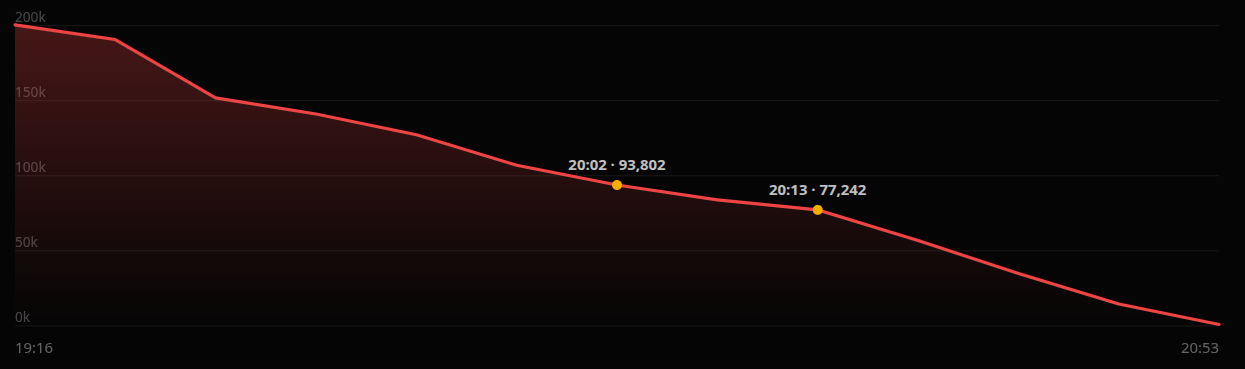
An attacker drained nearly 200,000 XRP tokens from the Coreum bridge in 97 minutes on August 9, exploiting a validation gap in the relayer software rather than any weakness in the XRP Ledger.
The bridge halted operations as XRP slid below $1 amid broader market caution.
What Actually Went Wrong on the Bridge
A blockchain bridge is an infrastructure that connects two separate networks. This allows users to move value between chains that cannot communicate directly. Relayers monitor both sides and authorize transfers.
Coreum Bridge lets users lock XRP on XRPL and receive an equivalent bridged version on the Coreum blockchain, which they can use in Coreum apps and later bridge back to XRPL.
So, how did the hack happen? The numbers tell a precise story. The bridge account held roughly 200,410 XRP before the incident and began releasing funds at 19:16 UTC.
Over 97 minutes, the account executed 94 payments totaling 199,916.3 XRP to two newly created wallets, leaving just 493.5 XRP behind.
Follow us on X to get the latest news as it happens.

Every transfer carried a valid authorization. A quorum of 17 out of 28 relayer keys signed each outgoing payment through the multi-signature process. Early social media explanations proved wrong. Warnings blamed rippling and the DefaultRipple flag, though native XRP cannot ripple because it has no issuer or trust lines.
The actual cause sat in the code. Relayers monitor XRP Ledger transactions and submit attestations whenever they detect payments carrying a Coreum-recipient memo.
One check was missing entirely. The software never verified that the payment destination was the bridge itself before crediting the corresponding balance. That omission opened the door.
Transfers between wallets controlled by the attacker were treated as genuine deposits, generating credits that later funded withdrawals of real XRP.

Why the XRP Ledger Was Never at Risk
The execution followed a pattern. Small probe transfers doubled in size before a steady stream of payouts averaging roughly 1,695 XRP every 50 seconds. Laundering began immediately. The receiving wallets forwarded most of the funds, complicating efforts to trace where the proceeds ultimately landed.
An important distinction deserves emphasis. No private keys were compromised, and the multi-signature process functioned exactly as designed, only on flawed evidence.
The XRP Ledger itself remained fully secure. The incident did not affect any of its core protocols, consensus mechanisms, or native transaction handling. Coreum suspended the bridge pending repairs.
Any restart will require destination-address verification, the check whose absence enabled the entire sequence.
An official post-mortem remains pending. Until it arrives, the full timeline and remediation plan stay incomplete for affected users.
XRP traded below $1 on August 11, down roughly 3.30% in the last 24 hours, according to BeInCrypto data.
Subscribe to our YouTube channel to watch leaders and journalists provide expert insights.

The post XRP Price Drops Below $1 After Coreum Bridge Hack. First-Time Since 2024 appeared first on BeInCrypto.

MoneyGram has extended MoneyGram Ramps, its cash-to-crypto and crypto-to-cash API, to Solana, the company said Tuesday. Rift, a self-custody trading app, is the first Solana wallet to integrate it. Until now, Solana wallets that wanted to route users into MoneyGram's retail cash network had to… Read the full story at The Defiant
Disclosure: This article does not represent investment advice. The content and materials featured on this page are for educational purposes only.
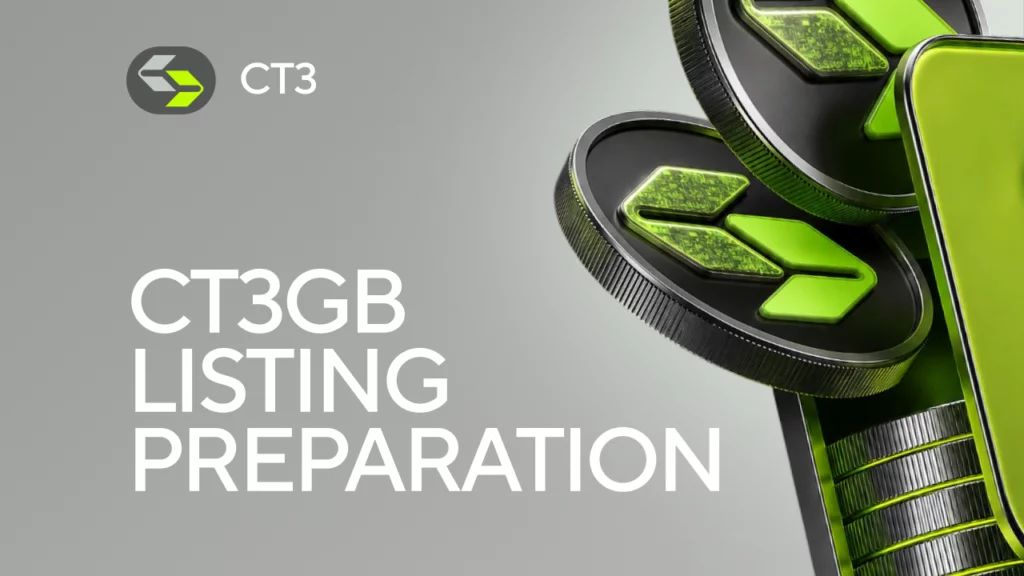
CT3 is preparing for the CT3GB token listing by expanding storage infrastructure, building reserves, upgrading smart contracts, and planning an independent audit.
Summary
- CT3 is expanding storage capacity and reserves before launching its CT3GB token on public markets.
- CT3GB will support storage payments, infrastructure settlements, rewards, and other internal transactions across the ecosystem.
- An independent smart contract audit will review security, business logic, and industry standards before launch.
CT3 has started comprehensive preparations for the future CT3GB token listing as it expands the CT3 Cloud ecosystem. The company is scaling data storage infrastructure, building financial and infrastructure reserves, and preparing CT3GB to become its primary settlement asset. It is also moving to a new smart contract architecture and plans an independent audit before the token reaches the public market. CT3 says these steps are intended to support further platform growth and prepare its tokenized economy before the listing.
CT3GB token listing preparations expand
Over recent months, CT3 has expanded the capabilities of its platform, according to the CT3 official website. One key milestone was the introduction of automatic backup technology. CT3 said demand for data storage services rose after that feature was implemented, while growing data volumes showed the platform could support continuous storage use cases.
The company said the next stage requires both technical and economic preparation. CT3 is expanding its storage network, adding available computing capacity, and building reserves intended to support further scaling. The Storage Contracts program forms part of that effort. CT3 views the program as a way to increase network capacity while maintaining commercial use and creating a resource buffer for future growth.
CT3GB to become primary settlement asset
Most internal CT3 operations currently use Polygon infrastructure. After CT3GB launches, the company plans to move major financial processes within the platform to its own token. CT3GB is expected to handle payments for storage services, settlements with infrastructure owners, reward distribution, and other internal transactions.
The token is designed to connect users, storage infrastructure, and services across the CT3 Cloud ecosystem. CT3 plans to use CT3GB as the primary settlement asset for internal operations. The company presents this utility as a central part of its tokenized economy, rather than positioning the token only as another payment option.
New smart contract architecture takes shape
CT3 is also changing the structure of its storage technology. The company is segmenting storage infrastructure into separate specialized smart contracts. Different products will gradually receive their own contracts, with independent limits for capacity and separate resource accounting.
According to CT3, this structure should make scaling more efficient and improve visibility into infrastructure use. It is also intended to give the company more flexibility when developing new services. Separate contracts could allow new products to grow without changing services that are already operating within the platform.
Independent audit planned before public launch
Before CT3GB enters the public market, CT3 plans to complete an independent audit of the core smart contract infrastructure. The review will cover the contracts supporting the token and key platform services. It will examine contract security, business logic, and alignment with industry standards.
CT3 considers the audit a required part of preparing its economy for public launch. The company says the review can support trust among users, partners, and cryptocurrency exchanges. Together with storage expansion, reserve building, and the new contract structure, the audit forms part of a broader plan to launch CT3GB within an ecosystem prepared for continued growth.
CT3 describes itself as a company focused on decentralized data storage. Its platform combines a distributed storage network, NFT-based access keys, automatic backup tools, and scalable smart contract architecture for individual and corporate users seeking long-term storage and digital information protection.
The company’s solutions are designed for individuals and corporate users, with services focused on secure long-term storage, backup, and protection of digital information across its decentralized infrastructure network.
Disclosure: This content is provided by a third party. Neither crypto.news nor the author of this article endorses any product mentioned on this page. Users should conduct their own research before taking any action related to the company.


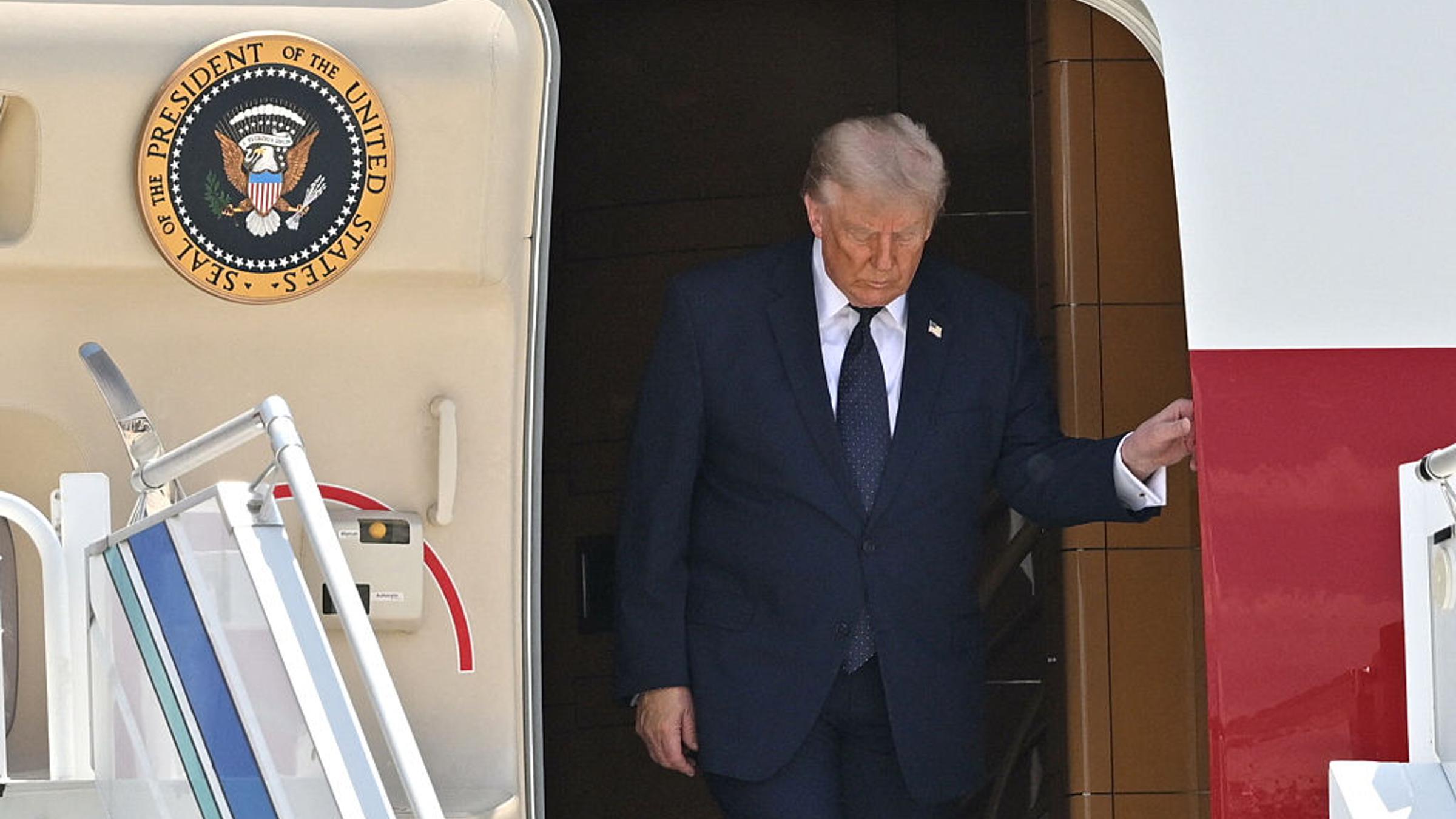
McDonald described the decision-making process around such operations as a joint effort among the Secret Service, the White House Military Office and White House staff, with “no one entity” holding more authority than the others.
The Department of Defense has referred questions from TIME to the White House. TIME has reached out to the White House for comment.
McDonald pushed back on the idea that Air Force One and the people still aboard it, including journalists, were left exposed. “I would find it incredibly hard to believe that those two planes weren’t escorted or with other assets from allies or the U.S. Air Force in the area,” he said, adding that he doubted the people on the aircraft “were dangled out there and left to fend for themselves.”
The operation broke a White House tradition that presidents rarely travel without a group of reporters known as the White House pool, to ensure the public has an independent account of the president’s activities. Former President Barack Obama broke the tradition in 2010 by leaving the White House to attend his daughter’s soccer game without telling reporters.
In 2000, President Bill Clinton secretly switched to an unmarked plane for a trip to Pakistan. At least one member of the White House pool, a reporter covering the trip for USA Today, was briefed on the operation beforehand, according to The Washington Post.
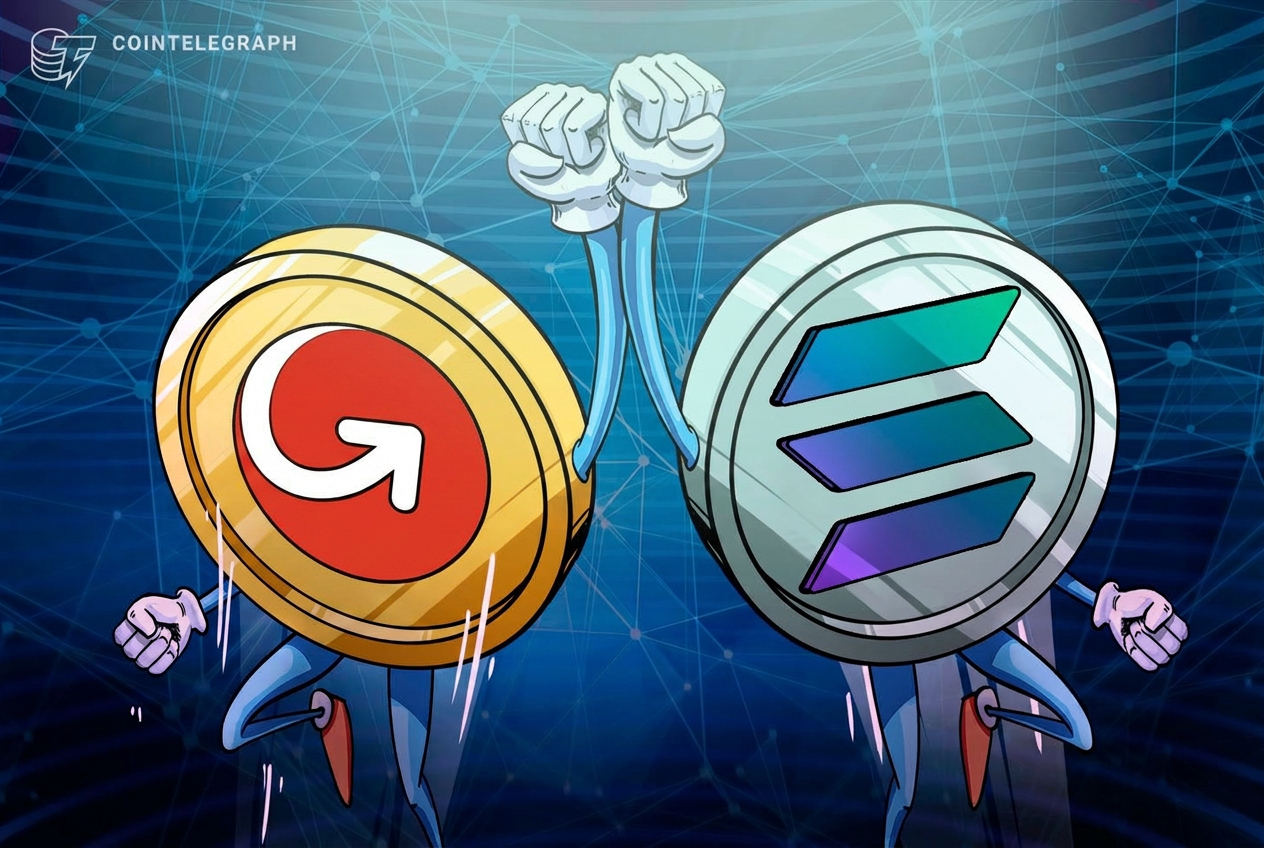
MoneyGram’s Ramps service now connects Solana wallets and applications to its global cash network, with Rift becoming the first wallet to integrate the service.
Bitwise’s Solana staking ETF has received approval from a major bank for customers to borrow up to 25% of their shares’ value, adding a lending function to the U.S.-listed crypto fund.
Summary
- A major bank has approved BSOL as loan collateral with a maximum 25% LTV.
- Borrowers may receive up to $25 for every $100 in pledged BSOL shares.
- BSOL held 8.18 million SOL worth $622 million as of Aug. 9.
- Bitwise reported a 5.84% net staking reward rate, with 99% of assets staked.
Bitwise co-founder and CEO Hunter Horsley disclosed the approval in an Aug. 11 X post, saying the unnamed bank would let its customers borrow against shares of the Bitwise Solana Staking ETF under a maximum 25% loan-to-value ratio.
Horsley welcomed the bank’s decision as another step in crypto’s integration with established financial services. His post did not identify the lender or state when the borrowing facility became available.
The disclosure also omitted the interest rate, minimum loan size, repayment period, and account requirements. Neither Bitwise nor the bank has published details on whether the facility applies to retail brokerage customers, private banking clients, or selected wealth-management accounts.
BSOL loans are capped at 25% of collateral value
Under the disclosed limit, a customer pledging $100,000 of BSOL could borrow no more than $25,000. The ETF shares would serve as collateral for the loan while remaining exposed to changes in the value of Solana.
A 25% LTV leaves the bank with $75 in collateral value above every $25 lent at the start of the transaction. The lender’s unpublished agreement would determine what happens if BSOL falls, including whether the customer must add collateral, repay part of the balance, or face a sale of pledged shares.
Horsley did not say whether the bank had approved BSOL across its lending platform or only after reviewing an individual customer’s portfolio. He also did not disclose whether other Bitwise funds qualify under the same policy.
The loan is secured by exchange-traded shares rather than SOL held in a private wallet. BSOL shareholders do not control the underlying tokens or their private keys, while the bank can value the listed shares using their market price and apply its existing securities-backed lending procedures.
Unlike a sale, borrowing against shares lets an approved customer obtain cash without immediately disposing of the position. According to the Internal Revenue Service, loan proceeds generally do not count as income because borrowers must repay them, although a later sale of collateral may create a taxable transaction.
Bitwise Solana ETF combines SOL exposure with staking
Launched on NYSE Arca in October 2025, BSOL gives U.S. investors direct exposure to SOL through a publicly traded product. Bitwise also stakes nearly all of the fund’s tokens so that staking rewards increase the assets supporting its shares.
As crypto.news reported, BSOL recorded $69.45 million in net inflows on its first trading day. The fund entered the market with a 0.20% management fee and a structure designed to track SOL’s value alongside rewards generated through the Solana network.
At its launch, Horsley described the product’s two main features in a Bitwise statement:
“Investors like growth potential, and investors like staking rewards. BSOL provides low-cost exposure to both.”
Bitwise’s official fund data showed that BSOL held 8,184,971.62 SOL with a market value of $622.02 million as of Aug. 9. Each share represented about 0.136735 SOL, while the fund’s holdings consisted entirely of the token.
BSOL reported a net asset value of $10.39 per share and a market price of $10.41 on the same date. The two-cent difference placed the shares slightly above the reported value of their underlying assets.
Staking covered 99% of the fund’s SOL holdings, compared with Bitwise’s target of 100%. The gross annualized staking reward rate averaged 6.21% over the preceding 90 days, while the net rate after staking-related fees stood at 5.84%, according to data published by the fund.
Bitwise states that staking rewards can change and do not represent BSOL’s investment performance. Movement in SOL’s market price can outweigh the tokens earned from staking, leaving shareholders exposed to substantial losses even when the fund continues to earn rewards.
BSOL added capital despite Solana’s first-half decline
BSOL drew $267.1 million in net subscriptions during the first half of 2026, according to its Aug. 7 quarterly filing with the U.S. Securities and Exchange Commission. Share issuance lifted the fund’s SOL holdings from about 5.15 million tokens at the end of 2025 to approximately 8.05 million by June 30.
Falling SOL prices still reduced BSOL’s net assets from $641.3 million to $592.3 million over the six-month period. Its net asset value per share dropped from $16.37 to $10.01, producing a negative 38.85% NAV return for the half-year.
The filing recorded $19.2 million in gross staking rewards and approximately $17.7 million in net investment income after expenses. Portfolio losses reached about $333.8 million, including $262.9 million in unrealized depreciation and $70.9 million in realized losses.
Earlier coverage of ETF demand found that BSOL controlled roughly 81% of assets accumulated by U.S. spot Solana funds by mid-May. Combined assets across products issued by Bitwise, Fidelity, and Grayscale had reached approximately $1.06 billion, although SOL continued to fall during the period.
BSOL had already crossed $500 million in assets within its first 18 trading days, according to Bitwise. Its first recorded daily withdrawal arrived on Dec. 15, when investors removed $4.6 million after a run of inflows that began with the fund’s October debut.
U.S. investors gain another use for listed crypto funds
For American investors, the bank’s approval adds BSOL to the securities that at least one lender accepts for collateralized borrowing. The policy does not mean the SEC or another federal regulator has approved BSOL specifically for loans, and Horsley’s post did not identify any regulatory decision tied to the bank’s action.
BSOL is structured as an exchange-traded product under the Securities Act of 1933. Bitwise’s disclosures state that it is not an investment company registered under the Investment Company Act of 1940, leaving shareholders without some protections that apply to conventional registered ETFs and mutual funds.
The fund uses Coinbase Custody Trust Company to hold its SOL, according to its SEC filing. Bitwise Onchain Solutions, supported by Helius technology, handles staking, while BNY Mellon provides cash custody and transfer-agent services.


Rain acquired Ansa, a startup whose software lets merchants run their own branded prepaid wallets, the stablecoin card issuer announced. The purchase adds a product built on fiat. Ansa's wallets hold dollar balances that customers load in advance and spend at the brand that issued them, and neither… Read the full story at The Defiant
Nasdaq has agreed to acquire LeveL Markets, the third-largest alternative trading system in the US by trading volume, as part of its push into tokenized and always-on markets.
According to Nasdaq, LeveL Markets processes hundreds of millions of shares daily and serves more than 2,500 buy- and sell-side clients. The venue will operate within Nasdaq’s new Digital Liquidity Networks unit, led by Roland Chai, who has overseen the company’s digital assets strategy since earlier this year.
Nasdaq first invested in LeveL Markets in 2021. The platform has since grown to execute trades across more than 7,000 symbols daily and serves more than 300 institutional buy-side firms, with average daily trading volume increasing 56% in 2025.
Tuesday’s announcement said LeveL Markets will remain a FINRA-regulated ATS with its own management team following the acquisition. Financial terms were not disclosed, and the deal remains subject to regulatory approval.
Nasdaq said the acquisition will add LeveL’s institutional execution network to its broader push toward programmable, “always-on” markets. The Digital Liquidity Networks unit combines liquidity platforms, tokenization capabilities and digital asset technology.
Related: Tokenized RWA surge to $4T may push LINK to $200 by end-2030: Standard Chartered
Nasdaq expands push into tokenized, always-on markets
Nasdaq first proposed allowing tokenized securities to trade on its exchange in September 2025. A January 2026 SEC filing updating the proposal said eligible stocks and exchange-traded products could trade in tokenized form alongside traditional shares, with Depository Trust Company handling tokenization and blockchain-based settlement through a three-year pilot program.
In March, Nasdaq expanded its efforts with a partnership with Kraken and tokenization firm Backed to develop infrastructure linking traditional equities with blockchain networks.
Other exchange operators are also moving toward longer trading hours. Cboe and the London Stock Exchange are pursuing similar plans, while the New York Stock Exchange is developing a separate platform for 24/7 trading and onchain settlement of tokenized securities.
In July, the SEC announced a Sept. 17 roundtable on the shift toward 24-hour US equity trading, with US Securities and Exchange Commission hair Paul Atkins saying, “We are moving towards a new day – and night – in the US equity markets.”
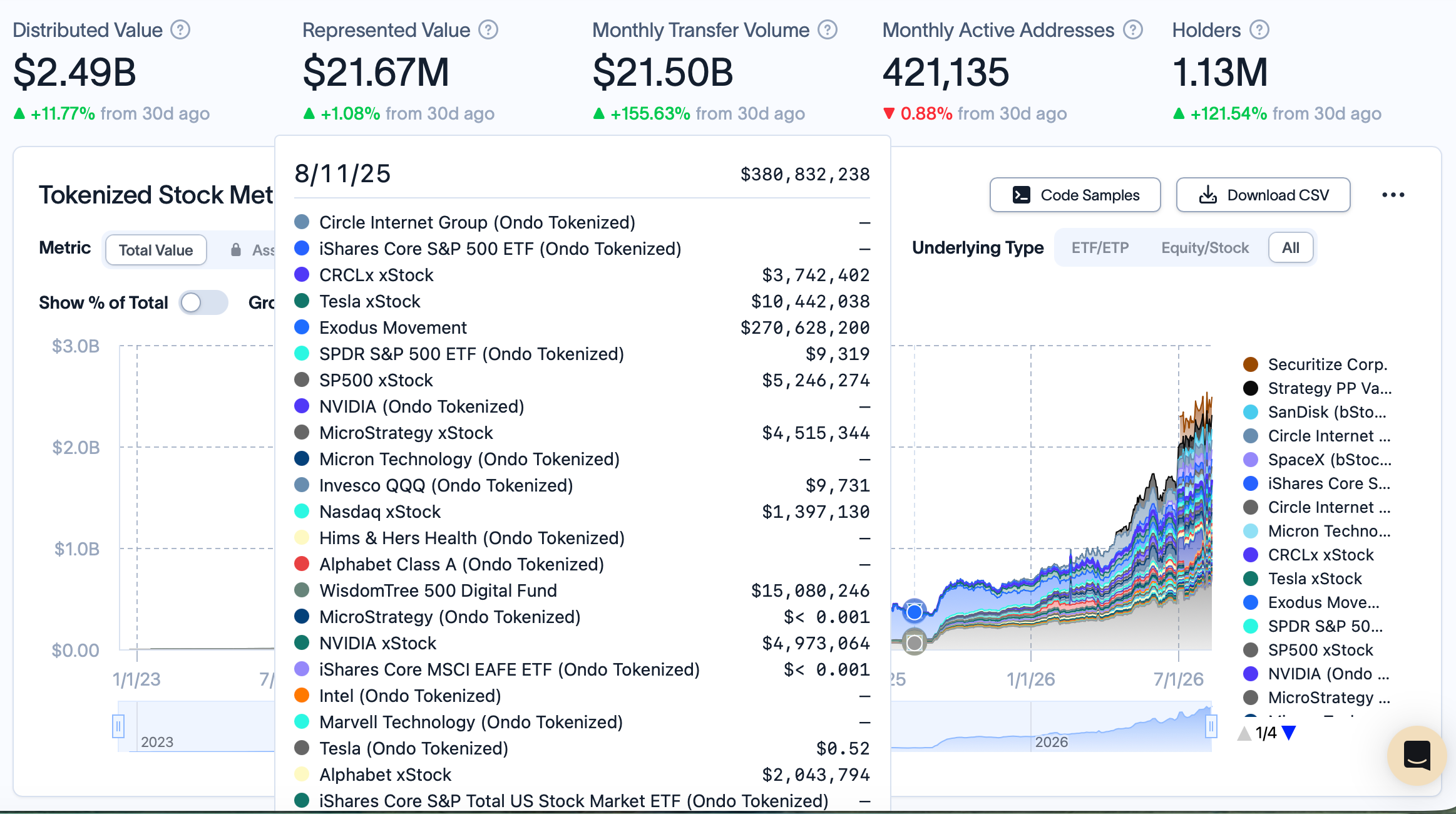
Over the past year, the tokenized equities market has grown more than sixfold, with distributed value rising to nearly $2.5 billion today from around $381 million in August 2025, according to RWA.xyz data.
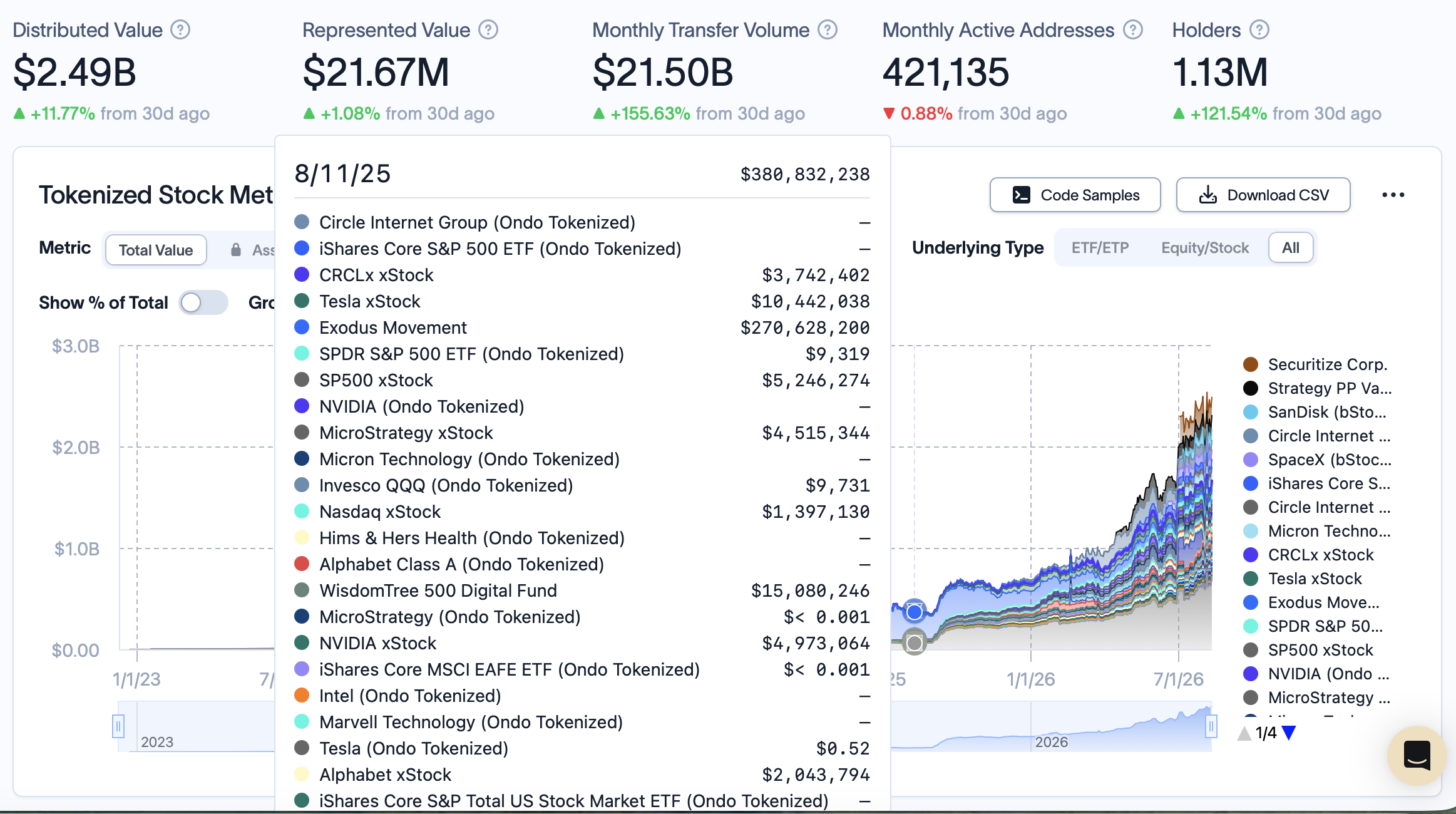
Tokenized equities. Souce: RWA.xyz
Magazine: Thailand’s 0% crypto tax. Bitcoin Red Team forced to use Chinese AI: Asia Express
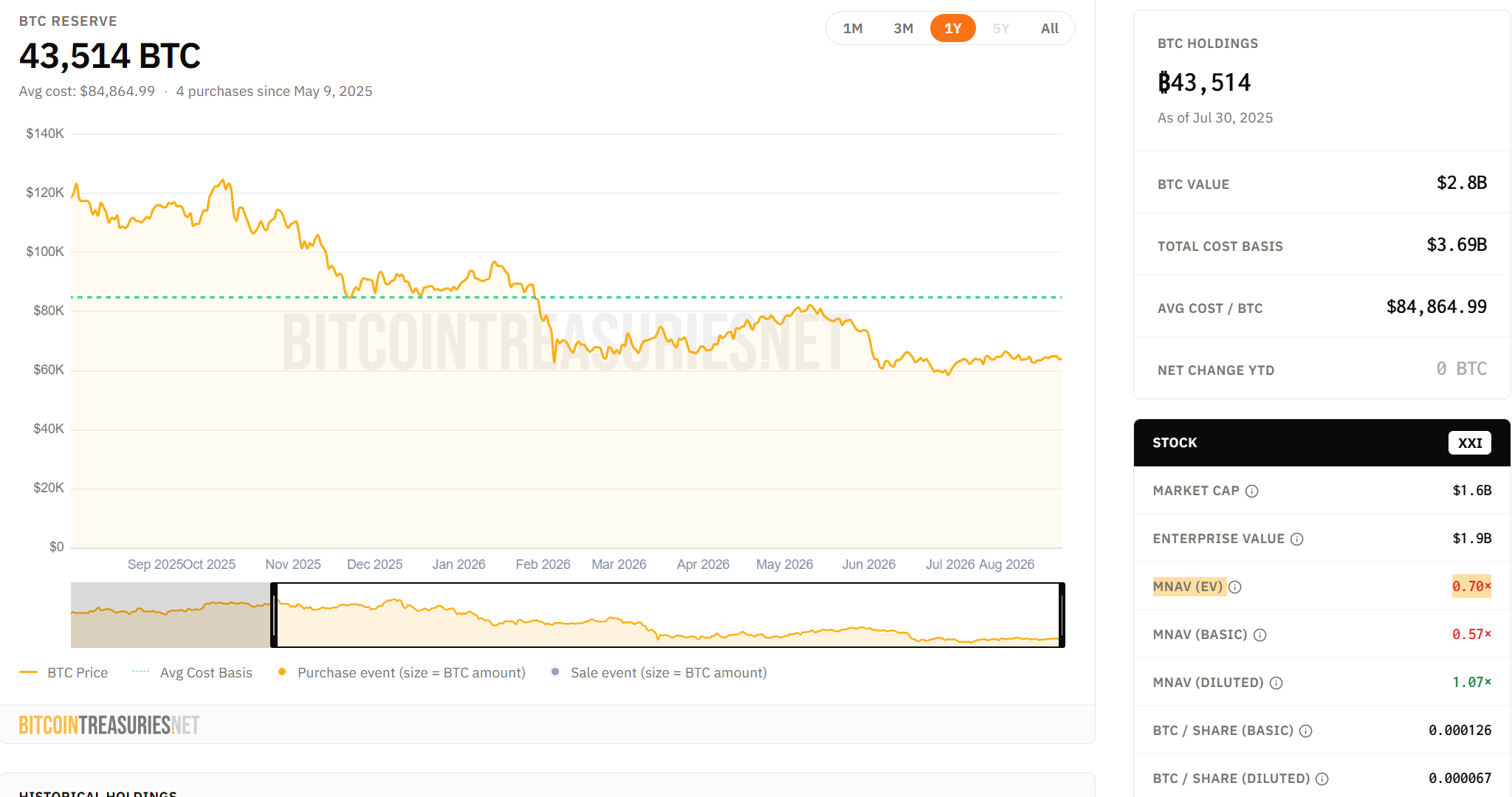
Twenty One Capital’s new CEO opened his first shareholder letter by agreeing with his harshest critics. Rapha Zagury admitted the market values XXI at less than the Bitcoin it owns, and said management sees it the same way.
The confession landed Tuesday next to a painful number. The company lost $413.5 million in the second quarter, three weeks into Zagury’s tenure as chief executive.
Why Twenty One Capital Trades Below Its Bitcoin
The math behind the complaint is simple and brutal. XXI holds 43,514 BTC, a stack worth about $2.8 billion with Bitcoin (BTC) trading near $63,555. Yet the entire company sells for roughly $1.6 billion.
In plain terms, buyers pay about 57 cents for every dollar of Bitcoin inside. Bitcoin Treasuries data puts the gap at 0.70x even after counting debt and cash. Among public companies, only Michael Saylor’s Strategy holds more coins.

Bitcoin itself did the quarter’s damage. The pioneer crypto fell from $87,316 at the start of 2026 to $58,605 by June 30, per the company’s 10-Q. That slide erased $401.5 million in the second quarter alone and pushed the half-year deficit to $1.27 billion.
Investors have other reasons to stay cold. The firm earns no revenue yet. It holds $106.1 million in cash against $484.5 million in convertible notes. And 16,116 of its coins, more than a third of the stack, sit locked as collateral for that debt.
The stock tells the story fastest. XXI traded near $4.53 on Tuesday, down roughly 85% from its 52-week high of $30.43.

“That gap could be viewed as a misallocation of capital; we share that view,” Zagury wrote in the letter, which was also shared with BeInCrypto.
Follow us on X to get the latest news as it happens
The Berkshire Blueprint Behind the Fix
Zagury’s remedy borrows from Omaha. He wants a strong balance sheet at the center and cash-earning businesses around it, the model Berkshire Hathaway proved over decades. He concedes XXI has not earned that comparison yet.
“Twenty One owns one of the largest Bitcoin balance sheets in the public markets. That is a real advantage, but if Twenty One is going to be worth owning, it must become more than a Bitcoin treasury.”
Five priorities frame the plan, covering:
- Governance
- Operating businesses
- Capital-markets tools
- Mergers and acquisitions (M&A), and
- Low-leverage lending backed by Bitcoin.
New independent directors Paul Lalljie and Karl Olsoni now sit on the board, with Lalljie chairing the audit committee.
The letter caps a turbulent first year in public markets. Tether, the stablecoin issuer behind USDT, took full control of XXI in May by buying out SoftBank. Founder Jack Mallers resigned as CEO in July, and Tether began to rethink XXI’s treasury model.
An earlier blueprint had proposed merging XXI with Strike, Mallers’ Bitcoin financial services firm, and Elektron Energy, the mining company Zagury led.
Zagury pledged to handle any deals with Tether strictly and transparently. He also promised a fuller strategy update before year-end. Until real cash flow arrives, the discount keeps the score.
The post Why Twenty One Capital Stock is Worth Less Than the Bitcoin It Owns appeared first on BeInCrypto.


Cointelegraph is committed to providing independent, high-quality journalism across the crypto, blockchain, AI, and fintech industries.
All news, reviews, and analyses are produced with full journalistic independence and integrity. For more details on our standards and processes, please read our Editorial Policy.

The Office actress Lucy Davis diagnosed with ‘incurable’ breast cancer

Why JPMorgan Raised Its S&P 500 Target Despite Looming September Risks

MoneyGram Brings Cash-To-Crypto Ramps To Solana


-

 Fashion4 days ago
Weekend Open Thread: Mattifying Sunscreen
-

 Fashion4 days ago
Frugal Friday’s Workwear Report: Cap-Sleeve Pointelle Crewneck Sweater
-

 Sports6 days ago
Jordan Coyle & Cordiamo take Laya Arena Stakes at RDS
-

 News Videos3 days ago
Can Astrology Help Find Gold and Silver Trends? A Financial Astrology Guide
-
 Business6 days ago
US stocks: Dow closes at record on Mideast optimism; SpaceX, AMD drag Nasdaq
-

 Politics5 days ago
Reform UK And Greens Sink To Lowest Favourability Ratings To Date
-

 Business7 days ago
Nvidia Stock Climbs 2.5% as Chip Sector Rally Builds Ahead of AMD Earnings, Nvidia’s Own Report Looms
-

 Tech7 days ago
OpenAI, Anthropic AI agents targeted real people and systems in cyber tests
-

 Business6 days ago
Supply chain issues impact Ingredion
-

 Tech4 days ago
Rinn Pharma & Biopharma to join NordicPharmaTrain network
-

 Business3 days ago
How to Start a Cleaning Business: A Step-by-Step Guide
-
 Crypto World7 days ago
Dow and S&P 500 Hit Records on AI Earnings: When Will the Bubble Burst?
-

 Business2 days ago
Datadog: Best Of Breed For Multiple Reasons
-

 Business3 days ago
BDC Weekly Review: Private BDC Q2 Numbers Are Strong
-

 Business7 days ago
McDonald’s (MCD) Q2 2026 earnings
-
 Crypto World7 days ago
Dollar Index Trapped at 100 as Hawkish Fed Meets Official Selling
-

 Fashion7 days ago
The Bright Side of Black and White
-

 Fashion6 days ago
Suit of the Week: Me + Em
-

 Business7 days ago
Apple UK encryption challenge filed against Home Office
-
Sports6 days ago
Spider-Man: Brand New Day ending explained: Is Peter Parker alive?
You must be logged in to post a comment Login