
Crypto World
Bitcoin’s slide may signal broader market trouble and a U.S. recession, Mike McGlone Says



Bloomberg Intelligence macro strategist Mike McGlone said Monday that collapsing crypto prices may signal broader financial stress, warning bitcoin could revert toward $10,000 and potentially foreshadow the next U.S. recession.
In a post on X, McGlone also said the long-standing “buy the dip” mentality that has supported risk assets since 2008 could be breaking down as digital assets weaken and volatility dynamics shift.
After climbing back to $70,841 by 07:00 UTC on Feb. 15 from $65,395 late on Feb. 12, bitcoin was hovering around $68,800 by mid-morning. The broader crypto market was also in the red Monday, with 85 of the top 100 tokens posting losses. Privacy-focused coins monero and zcash were down 10% and 8%, respectively over the past 24 hours.
“Healthy Correction is what we should hear soon from stock market analysts (who risk unemployment if not onboard), following collapsing cryptos,” McGlone wrote. “The buy the dips mantra since 2008 may be over.”
McGlone pointed to several macro indicators that reflect elevated risk conditions. U.S. stock market capitalization relative to gross domestic product (GDP) has reached its highest level in roughly a century, he noted. At the same time, 180-day volatility in the S&P 500 and Nasdaq 100 is at its lowest level in about eight years, McGlone added.
He also described the “crypto bubble” as “imploding,” adding that “Trump euphoria” has peaked and is contributing to contagion across markets. Meanwhile, gold and silver are “grabbing alpha” at a pace last seen about half a century ago, with rising volatility that he said could “trickle up” into equities.
McGlone shared a chart comparing bitcoin divided by 10 for scaling, with the S&P 500. As of Feb. 13, both were hovering below 7,000 on his graphic. He said that “volatile and beta-dependent” bitcoin is unlikely to stay above that level if broader equity beta weakens.
The Bloomberg analyst identified 5,600 on the S&P 500, equivalent to roughly $56,000 for bitcoin under his scaling, as an initial “normal reversion” level. Beyond that, part of his base case calls for bitcoin to revert toward $10,000, contingent on a peak in the U.S. stock market.
McGlone’s outlook splits opinion
Jason Fernandes, co-founder of AdLunam and a market analyst, told CoinDesk that McGlone’s thesis assumes market extremes must resolve through collapse and that bitcoin’s equity beta guarantees a proportional crash.
“That’s false equivalence and single-path bias,” Fernandes said. “Markets can also resolve excess through time, rotation, or inflation erosion. A macro slowdown could mean consolidation or a $40,000 to $50,000 reset, not a systemic unwind to $10,000.”
Fernandes added that a move toward $10,000 would likely require a true systemic event, including sharp liquidity contraction, widening credit spreads, forced deleveraging across funds and a disorderly equity drawdown.
“That implies recession plus financial stress, not just slower growth,” he said. “Absent a credit shock or policy mistake that drains global liquidity, that kind of collapse remains a low-probability tail risk.”


Key Points
- Despite years of government restrictions, millions of Iranians continue using Telegram through VPN technology
- Pavel Durov, Telegram’s co-founder, reports that approximately 50 million users in both Iran and Russia rely on VPNs to bypass blocks
- A complete internet shutdown was enacted across Iran in January 2026 amid escalating tensions with Israel and the United States
- Citizens have turned to alternative connectivity methods including Starlink satellite internet and BitChat, a mesh messaging platform operating via Bluetooth
- During Nepal’s 2025 social media restrictions, BitChat recorded 48,000 downloads before protesters successfully overthrew the government
Years after implementing a nationwide prohibition on Telegram, Iran’s censorship strategy has spectacularly failed to achieve its objectives.
This assessment comes directly from Telegram co-founder Pavel Durov, who revealed on Friday that millions of Iranian citizens continue accessing the messaging platform by leveraging virtual private network technology.
VPN services function by redirecting internet data through international servers, effectively masking users’ actual geographic locations and enabling them to circumvent regional blocking measures.
According to Durov, Tehran’s strategy aimed to migrate the population toward government-sanctioned messaging platforms that authorities could easily surveil. The outcome proved to be the exact opposite—a widespread embrace of privacy-enhancing technologies.
“The government hoped for mass adoption of its surveillance messaging apps, but got mass adoption of VPNs instead,” Durov stated.
His estimates place Iran’s VPN user base at approximately 50 million individuals. A comparable number of Russian citizens are employing identical circumvention methods.
Complete Network Shutdown Across Iran
The digital landscape in Iran deteriorated further in January 2026 when authorities implemented a comprehensive internet shutdown. This drastic measure coincides with intensifying regional hostilities involving Israel, the United States, and Iran, with the blackout continuing indefinitely.
Despite these severe restrictions, portions of the population maintain internet connectivity through alternative channels. One prominent workaround involves Starlink, the orbital internet service operated by SpaceX. While Iranian authorities have officially prohibited Starlink usage, enforcement remains incomplete.
Another emerging solution is BitChat, an innovative application that operates independently of traditional internet infrastructure. The platform establishes mesh networks through Bluetooth connections among proximate devices. Each smartphone functions as a node, transmitting messages to other BitChat-enabled phones within signal range.
This architecture allows BitChat to maintain functionality even when conventional internet services and satellite connections face complete disruption.
BitChat Emerges as Protest Communication Tool
BitChat has previously demonstrated its utility during government-imposed internet shutdowns.
When Nepal implemented social media restrictions in September 2025 amid widespread demonstrations, BitChat experienced a surge exceeding 48,000 installations within Nepal during that week. Protesters successfully removed the Nepali government from power during the same month.
Madagascar witnessed a comparable increase in BitChat adoption during concurrent protest movements.
Durov characterized this technological shift as digital defiance, referring to what he described as “50 million members of the digital resistance in Iran.”
The comprehensive internet blackout initiated by Iranian authorities in January 2026 remained active at the time of Durov’s Friday statement.

TLDR
- Kwasi Kwarteng’s tenure as UK Chancellor lasted only 38 days in 2022 when his emergency budget caused gilt market collapse and pension fund turmoil
- He acknowledges the emergency budget was “very, very rushed,” implemented merely two weeks into his tenure
- Kwarteng cautions that the UK faces a dangerous fiscal cycle where government spending outpaces revenue and tax increases stifle economic expansion
- He condemns short-term thinking in both political and financial spheres, noting the UK lags behind cities like Paris in digital asset adoption
- He now serves as executive chairman of Stack BTC, a British bitcoin treasury firm holding 31 BTC, where Reform UK leader Nigel Farage owns 6%
Kwasi Kwarteng’s name appears in the record books for all the wrong reasons. His 38-day stint as UK Chancellor during September 2022 ranks among the briefest in British history. Today, he’s re-emerged in the public sphere with a dramatically different focus: cryptocurrency and his critique of conventional financial systems.
Kwarteng assumed his position on September 6, 2022. Within 48 hours, Queen Elizabeth II passed away. This tragic event condensed his timeline considerably. His economic team subsequently rushed through an ambitious emergency budget in a mere fortnight after assuming office.
“The mini budget was literally two weeks after we took office, it was just very, very rushed business,” Kwarteng acknowledged during a recent CoinDesk interview.
The consequences arrived swiftly and severely. British government bond yields surged dramatically. Sterling plummeted. The turmoil revealed critical vulnerabilities within the nation’s pension infrastructure, particularly affecting Liability-Driven Investment strategies that buckled under market stress.
Kwarteng maintains his policy objectives were sound. However, he doesn’t dispute that implementation was deeply flawed.
UK Trapped in a Fiscal Doom Loop
He’s currently sounding alarms that the UK confronts challenges far greater than a single mishandled budget. According to Kwarteng, Britain finds itself caught in a destructive fiscal “doom loop.”
Government expenditure consistently exceeds tax collection. To bridge this deficit, authorities increase taxation. Yet elevated tax burdens dampen economic activity, suppress growth, and paradoxically reduce total revenue. The vicious cycle continues.
“You’re spending more money than you can raise in taxation,” he explained, emphasizing that increasing taxes “kill incentives in the economy.”
He also criticized the mindset pervading politics and finance. “Everything’s quarterly driven, people are either euphoric or freaking out,” he observed. He contends that sound decision-making demands extended time horizons.
Kwarteng highlighted the UK’s sluggish approach toward digital assets. Throughout his Treasury service, he noted that civil servants recognized bitcoin but dismissed it as marginal. He drew comparisons with Paris, which he characterized as “quite forward leaning on digital assets.”
He also rebutted remarks from former Prime Minister Boris Johnson, who labeled bitcoin a “Ponzi.” Kwarteng advocated for greater receptiveness toward emerging monetary systems.
Stack BTC and the Political Angle
Kwarteng currently chairs Stack BTC as executive chairman, a publicly-traded British bitcoin treasury enterprise. The organization presently maintains 31 bitcoin in its reserves.
The venture has garnered political notice. Reform UK party leader Nigel Farage has acquired a 6% ownership position in Stack BTC.
Stack BTC operates under ticker symbol STAK. It represents part of an expanding cohort of British enterprises developing bitcoin treasury frameworks comparable to American counterparts.
Kwarteng’s transition into cryptocurrency aligns with his overarching thesis that myopic political decision-making has compromised the UK’s position, and that more resilient, long-duration monetary instruments might provide enhanced stability.
Stack BTC’s holdings currently stand at 31 BTC, with Farage’s ownership interest confirmed through the company’s latest regulatory filings.
Key Highlights
- Approximately 1.40 million SOL tokens—worth roughly $110 million—transferred to exchanges within a 72-hour period, signaling potential sell-side pressure.
- A bear flag pattern breakdown on daily charts has invalidated a critical market structure level near $85.
- Immediate support is established at $77, while a failure at this zone could expose the $66–$70 range.
- The 4-hour chart shows a bearish SMA crossover, with the 20-period moving average slipping beneath the 50-period line.
- Meanwhile, Solana’s ecosystem growth remains robust, with real-world asset tokenization crossing $2 billion and SoFi deploying enterprise banking infrastructure on the blockchain.
Solana (SOL) is experiencing heightened downside risk following substantial token movements to centralized trading venues, compounding an already fragile technical landscape. Currently hovering between $79 and $81, the cryptocurrency has declined approximately 2.95% over the last seven days.
Blockchain analytics specialist Ali Martinez identified approximately 1.40 million SOL tokens migrating to exchange wallets during a three-day span. This transfer represents roughly $110 million in value moving onto trading platforms. Historically, elevated exchange inflows correlate with imminent selling activity as holders position to liquidate assets.
1.40 million Solana $SOL, worth approximately $110 million, were moved to exchanges in the last 72 hours. pic.twitter.com/YnYwLAbcO5
— Ali Charts (@alicharts) April 4, 2026
Technical analysis reinforces the bearish narrative. Analyst Crypto_Scient observed a confirmed breakdown from a bear flag formation on the daily timeframe, with price action violating the pivotal market structure transition level at $85. This threshold had previously delineated bullish from bearish control, and its breach suggests vulnerability to additional downside pressure.
Further deterioration appears on the 4-hour chart, where a bearish moving average crossover has materialized—the SMA-20 crossing beneath the SMA-50. This configuration typically precedes extended declines. Trading activity now occurs below a significant supply zone, indicating market acceptance of reduced valuation.
Critical Support Zones Under Scrutiny
Near-term demand has emerged around the $77 level, which has functioned as temporary support during recent trading sessions. Should this floor collapse, market observers anticipate a test of secondary support spanning $63 to $67.
Trader Marcus Corvinus highlighted that the $92–$95 region previously served as a robust defense zone, but concentrated selling at those levels propelled SOL into the current $75–$78 range. He characterized this area as pivotal, where price behavior will likely dictate the subsequent directional move. A breakdown could accelerate losses, whereas a successful defense might trigger a violent short covering rally.
$SOL PRESSURE IS REAL
Trendline lost.
Structure starting to crack.That $92–$95 zone held strong.
Sellers stepped in with intent.Now price sits on $75–$78.
Not just support… a real decision zone.If buyers defend it, expect a sharp reaction.
Quick bounce. Short squeeze… pic.twitter.com/i3V1uj7wOa— Marcus Corvinus (@CryptoBull009) April 3, 2026
The primary support band is positioned between $66 and $70, consistent with projections from Crypto_Scient. Any recovery attempt toward $84–$89 may constitute merely a retest of broken structure rather than a genuine trend reversal.
Fundamental Developments Persist
Notwithstanding price deterioration, Solana’s infrastructure continues attracting institutional adoption. SoFi recently unveiled an enterprise-grade banking platform constructed on Solana’s blockchain, facilitating both fiat currency and stablecoin settlement. The network’s real-world asset tokenization volume has exceeded $2 billion, with major payment processors leveraging Solana for stablecoin transaction processing.
Analyst Crypto Patel emphasized that Solana has received commodity classification from regulatory authorities, establishing it within a favorable compliance framework. The digital asset currently trades approximately 77% beneath its historic peak valuation.
$SOL Just Got Classified As A Commodity And It’s Still -77% From ATH 😏
That’s Like Watching #SOLANA Drop To $8 In 2022 And Thinking It Was Dead…
Except This Time It Already Proved It Can Do A 2,194% Rally From The Bottom 😂Fibonacci Golden Zone Holding Perfectly On The 2W… pic.twitter.com/kZ7lIk2vZL
— Crypto Patel (@CryptoPatel) April 3, 2026
Market commentator RoccobullboTTom identified sustained long-term accumulation occurring between $75 and $85. A decisive reclaim above $100 would transform the momentum profile, establishing $120 and $125 as subsequent resistance objectives.
A $285 million security breach affecting Drift Protocol and impacting 20 projects has contributed to near-term caution across the ecosystem.
Daily trading volume maintains robust levels exceeding $1.68 billion, demonstrating continued market engagement despite downward price movement.

Drift Protocol, a decentralized cryptocurrency exchange (DEX), says the recent exploit against the platform was a six-month-long, highly coordinated attack.
“The preliminary investigation shows that Drift experienced a structured intelligence operation requiring organizational backing, significant resources, and months of deliberate preparation,” Drift said in an X post on Saturday.
The decentralized exchange was exploited on Wednesday, with external estimates putting losses at around $280 million.
It all began at a “major crypto conference”
According to Drift, the attack plan can be traced back to around October 2025, when malicious actors posing as a quantitative trading firm first approached Drift contributors at a “major crypto conference,” claiming to be interested in integrating with the protocol.

The group continued to engage contributors in person at multiple industry events over the following six months. “It is now understood that this appears to be a targeted approach, where individuals from this group continued to deliberately seek out and engage specific Drift contributors,” Drift said.
“They were technically fluent, had verifiable professional backgrounds, and were familiar with how Drift operated,” Drift said.
After gaining trust and access to Drift Protocol over six months, they used shared malicious links and tools to compromise contributors’ devices, execute the exploit, and then wiped their presence immediately after the attack.
The incident serves as a reminder for crypto industry participants to remain cautious and skeptical, even during in-person interactions, as crypto conferences can be prime targets for sophisticated threat actors.
Drift flags a high probability of a Radiant Capital hack link
Drift said, with “medium-high confidence,” that the exploit was carried out by the same actors behind the October 2024 Radiant Capital hack.
In December 2024, Radiant Capital said the exploit was carried out through malware sent via Telegram from a North Korea-aligned hacker posing as an ex-contractor.

“This ZIP file, when shared for feedback among other developers, ultimately delivered malware that facilitated the subsequent intrusion,” Radiant Capital said.
Drift said it is “important to note” that the individuals who appeared in person “were not North Korean nationals.”
Related: Naoris launches post-quantum blockchain as quantum security risks gain attention
“DPRK threat actors operating at this level are known to deploy third-party intermediaries to conduct face-to-face relationship-building,” Drift said.
Drift said that it is working with law enforcement and others in the crypto industry to “build a complete picture of what happened during the April 1st attack.”
Magazine: Bitcoin 85% crashes ‘done,’ CLARITY Act speculation mounts: Hodler’s Digest, Mar. 29 – April 4
Crypto World
Bitcoin Surges Past Gold and S&P 500 Following Major Global Disruptions, Research Reveals
Key Takeaways
- Research from Mercado Bitcoin demonstrates that Bitcoin outperforms both gold and S&P 500 during 60-day periods following significant global disruptions
- Following Trump’s tariff announcement in 2025, Bitcoin surged 24% compared to gold’s 8% gain and S&P 500’s 4% increase
- Throughout the ongoing U.S.-Iran tensions, Bitcoin has climbed 2.2% while gold declined 11% and S&P 500 dropped 4.4%
- Spot Bitcoin ETFs in the United States attracted $1.32 billion during March, contrasting sharply with gold ETFs’ $2.92 billion in withdrawals
- Industry analyst James Seyffart predicts Bitcoin ETFs will ultimately exceed gold ETFs in total assets
Research conducted by Brazilian cryptocurrency platform Mercado Bitcoin reveals that Bitcoin consistently delivers superior performance compared to gold and the S&P 500 index during the two-month periods following significant global disruptions.
The analysis was spearheaded by Rony Szuster, serving as research director at Mercado Bitcoin. His research team examined 60-day performance windows after various economic upheavals and geopolitical conflicts, encompassing events such as the COVID-19 pandemic emergence and U.S. trade policy escalations.
Following the Trump administration’s comprehensive tariff rollout in April 2025, Bitcoin experienced a remarkable 24% appreciation during the subsequent 60 days. Meanwhile, gold managed an 8% increase, and the S&P 500 recorded only a 4% advance during the identical timeframe.
This performance pattern emerged similarly at the onset of the COVID-19 crisis in March 2020. Bitcoin achieved a 21% gain, significantly outpacing both gold and the S&P 500.
Szuster cautioned against premature assessments of Bitcoin’s crisis response. “It’s like watching the first few minutes of a movie and thinking you already know how it ends,” he remarked.
He clarified that market participants frequently liquidate holdings rapidly during crises to secure liquidity, which can temporarily pressure even traditionally defensive assets.
Bitcoin Maintains Positive Momentum Amid Middle East Tensions
This established pattern appears to be repeating during the current U.S.-Iran confrontation. Bitcoin has appreciated approximately 2.2%, advancing from roughly $65,800 to $67,300.
Gold, conventionally regarded as a crisis hedge, has experienced an approximately 11% decline during this period. The S&P 500 has retreated 4.4%, marking its sharpest monthly decline since 2022.
Szuster emphasized that Bitcoin emerged as the top-performing asset throughout the previous decade, notwithstanding its characteristic volatility.
Bitcoin ETFs Capturing Market Share From Gold Funds
ETF specialist James Seyffart indicated during an appearance on the Coin Stories podcast that Bitcoin exchange-traded funds may eventually overtake gold ETFs in aggregate assets under management.
“There are just more use cases of why somebody would put a Bitcoin ETF in a portfolio,” Seyffart explained. He highlighted Bitcoin’s multiple functions including digital gold status, value preservation, portfolio diversification tool, and growth-oriented investment.
“Our view is that Bitcoin ETFs will be larger than gold ETFs,” he stated.
Current investment flow patterns support this evolving market sentiment. Throughout March, gold ETFs domiciled in the United States experienced net redemptions totaling $2.92 billion. During this same interval, U.S. spot Bitcoin ETFs registered net contributions of $1.32 billion.
The premier U.S. gold ETF witnessed a single-day outflow of $3 billion on March 4, representing the largest daily redemption in more than two years.
Both asset classes have declined over the trailing 30-day period. Bitcoin has retreated approximately 8% while gold has fallen around 8.25%, indicating parallel price movements despite divergent ETF activity.
In December 2025, Fidelity Digital Assets analyst Chris Kuiper observed that gold and Bitcoin have historically alternated in their relative performance leadership.

Bitcoin’s social mood has cooled in recent days, with bearish sentiment reaching levels not seen since late February, according to data from Santiment. The crypto analytics firm noted that fear, uncertainty and doubt (FUD) has crept back into Bitcoin discussions across X, Reddit, and other platforms, a shift it describes as a potential precursor to a rebound rather than a sustained selloff.
Santiment’s analysis is drawn from a broad sample of crypto-focused accounts, tracking the ratio of bullish to bearish Bitcoin comments. On Saturday, the metric stood at 0.81 — the lowest reading since February 28 — implying roughly five bears for every four bulls in the social chatter. The firm highlighted a familiar paradox: while the crowd’s sentiment can influence near-term moves, markets often move in the opposite direction of the crowd’s expectations. “A high level of FUD like this is a good sign that things can turn positive sooner rather than later,” Santiment wrote in a Saturday update.
Key takeaways
- Bearish sentiment on Bitcoin, as measured by the bullish/bearish comment ratio, sits at 0.81 (lowest since February 28), suggesting a crowded mood of skepticism.
- Historical patterns indicate that pronounced FUD can coincide with eventual upside, reflecting a contrarian market dynamic.
- Bitcoin trades around $67,100, with about a 5.5% decline over the last 30 days, highlighting a cautious near-term setup.
- The CLARITY Act, a much-watched piece of U.S. crypto legislation, remains a potential catalyst; industry voices say movement toward a Senate markup is approaching.
- Market sentiment remains in “Extreme Fear” territory according to the Crypto Fear & Greed Index, signaling ongoing caution among investors.
Sentiment dynamics and contrarian signals
The latest snapshot from Santiment shows a still-fragile mood among Bitcoin observers. The 0.81 ratio translates into a commentary environment where bearish views outnumber bullish ones, even as the price action continues to define a narrow trading range. Santiment highlighted a simple, yet powerful, investor heuristic: when sentiment shifts sharply to the downside, opportunistic players may prepare for a rebound as sellers exhaust themselves and buyers reenter the market.
Markets typically move in the opposite direction of the crowd’s expectations. A spike in FUD can be a warning sign of a forthcoming turn to the upside, rather than a straightforward continuation of the downtrend.
For Bitcoin holders and traders, such contrarian signals are not new. They reflect a broader reality: sentiment indicators are best read alongside price action and macro catalysts. In recent weeks, the attention has shifted to regulatory developments and the resilience of the broader crypto market as a potential antidote to a purely momentum-driven selloff.
Price frame, FUD, and regulatory tailwinds
Bitcoin’s price sits near $67,100 at the time of writing, according to CoinMarketCap, down about 5.5% over the past 30 days. The move fits a pattern of consolidation after a period of volatility, with traders weighing both micro-market dynamics and macro regulatory signal. The current mood of “Extreme Fear,” as captured by the Crypto Fear & Greed Index with a score of 12, underscores pervasive caution even as on-chain metrics and exchange flows show mixed signals.
Beyond price action, the crypto policy landscape looms large for traders and builders. Santiment pointed to the US CLARITY Act as a potential “what-if” catalyst holding back Bitcoin’s price, noting that the industry is closely watching for legislative progress. The measure seeks to clarify regulatory expectations around digital assets, and a favorable outcome could soften some of the near-term uncertainty that has weighed on investor sentiment.
Industry commentary has echoed that sentiment. Coinbase’s chief legal officer, Paul Grewal, has said the CLARITY Act is “moving toward” a markup hearing in the U.S. Senate Banking Committee, with the potential to advance to a floor vote if senators resolve outstanding debates over stablecoin yields and scheduling. Such legislative steps could tilt the risk-reward calculus for institutions and large holders, potentially contributing to a more constructive price environment if clarity reduces regulatory ambiguity.
As investors parse these developments, it’s important to distinguish what is known from what remains uncertain. The CLARITY Act’s trajectory—whether it moves quickly through committee processes or encounters delays—will shape how market participants price in regulatory risk. At the same time, Bitcoin’s price reaction will depend on a combination of sentiment shifts, technicals, and the pace of any regulatory milestones.
Regulatory watch and market posture
While price remains subdued relative to the latest surges in the sector, the market’s attention to regulatory clarity continues to shape trading strategies. The ongoing dialogue around the CLARITY Act highlights a central tension for Bitcoin and larger crypto markets: the potential to unlock clearer operating guidelines versus the risk of a protracted, contentious legislative process that sustains volatility.
Analysts and traders are also keeping an eye on broader risk dynamics as the year unfolds. The market’s current posture—modest pricing, cautious positioning, and a willingness to wait for policy clarity—reflects a sector that is not immune to macro shocks but is increasingly sensitive to policy signals that could either normalize or disrupt institutional participation.
For readers seeking practical implications, the trend suggests two likely focal points: first, any concrete progress on the CLARITY Act’s markup and floor-vote timeline could lift sentiment and support risk-on activity; second, social sentiment shifts from Extreme Fear toward more constructive levels would likely precede price strength, provided macro conditions remain favorable.
As the regulatory conversation continues to evolve, market participants should monitor not only legislative milestones but also accompanying shifts in social sentiment and price action. Each piece of new information could tilt risk-reward preferences, influencing how portfolios are balanced in the months ahead.
What remains uncertain is the exact pace of regulatory progress and how quickly sentiment pivots in response. Investors should stay alert to updates from policymakers, corporate counsel briefings, and the evolving discourse on stablecoins and yields, all of which could help determine whether Bitcoin breaks from its current mood and resumes a more constructive ride higher.
Readers should watch for upcoming committee hearings and any concrete dates related to markup activity, as well as fresh sentiment readings that might reveal early signs of capitulation or renewed optimism. These developments will likely shape trading behavior and risk strategies as the market inches toward a potentially pivotal moment for the sector.
Crypto World
Solana Price Prediction Could Hit $250 as Record $17B Sits on Chain While Pepeto Presale Is Attracting Big Capital
Solana holds $17 billion in stablecoin supply on its network, the highest of any chain outside Ethereum, yet SOL trades at $81.10, down 73% from its $293 peak. The solana price prediction from Standard Chartered targets $250 as the Alpenglow upgrade approaches with 150-millisecond finality and Firedancer pushes throughput past one million transactions per second, according to OpenPR.
The solana price prediction benefits from this on-chain capital sitting ready to deploy, but SOL at $81 with a $40 billion market cap is too large to produce the multiples that reshape a portfolio.
Pepeto raised $8.68 million with the Binance listing confirmed, and the reason it keeps appearing in coverage is simple: the Pepe cofounder, verified exchange tools, and confirmed listing at presale pricing is a combination that has not existed since the early days of BNB, and the wallets that moved on BNB at $0.15 are still living off that one decision.
$17B in Stablecoins Sit on Solana While SOL Stays 73% Below Its Peak
CoinMarketCap data confirms Solana’s stablecoin supply crossed $17 billion while DeFi TVL holds at $7 billion, meaning more than $10 billion in capital sits on the network without being deployed into protocols yet.
The SEC classified SOL as a digital commodity on March 18, removing the securities overhang that kept institutional allocators on the sidelines, according to Phemex. Goldman Sachs holds $108 million across six SOL ETF products.
The Verified Exchange That Gives You the Return the Solana Price Prediction Timeline Cannot Match
The solana price prediction section below will show you how even the bullish $250 target is 212% over months, and the stronger alternative is the audited exchange that keeps raising capital through extreme fear. Pepeto opens the door to a working trading platform where on-chain data is no longer hidden behind paywalls.
The contract scanner opens the same intelligence large wallets use to move prices, so you see what is happening before it hits the headlines. Staking at 188% APY compounds positions daily while stages fill, and early holders hold the largest share as demand builds.
The risk scorer tracks market direction and flags risky contracts before you commit any funds. More than $8.68 million raised at $0.0000001862 with SolidProof auditing the full codebase and the founder who grew Pepe to $7 billion on 420 trillion tokens building the exchange alongside a former Binance executive.
The presale remains open but will close as the Binance listing approaches. The listing will bring millions of new buyers, and Pepeto at presale pricing is the window that shuts permanently once trading begins. Every recovery in crypto history rewarded the wallets that committed during maximum fear, not the ones that waited for confirmation, and Pepeto’s confirmed Binance listing will permanently erase this entry along with the 100x math attached to it.
Solana Price Prediction: Can SOL Recover to $250?
SOL trades at $81.10 according to CoinMarketCap, down 73% from the $293 peak. Standard Chartered targets $250 based on the Alpenglow upgrade, the digital commodity classification, and growing institutional access through six spot ETFs. Reaching $250 is a 212% gain that needs months of macro cooperation and sustained ETF inflows to play out.
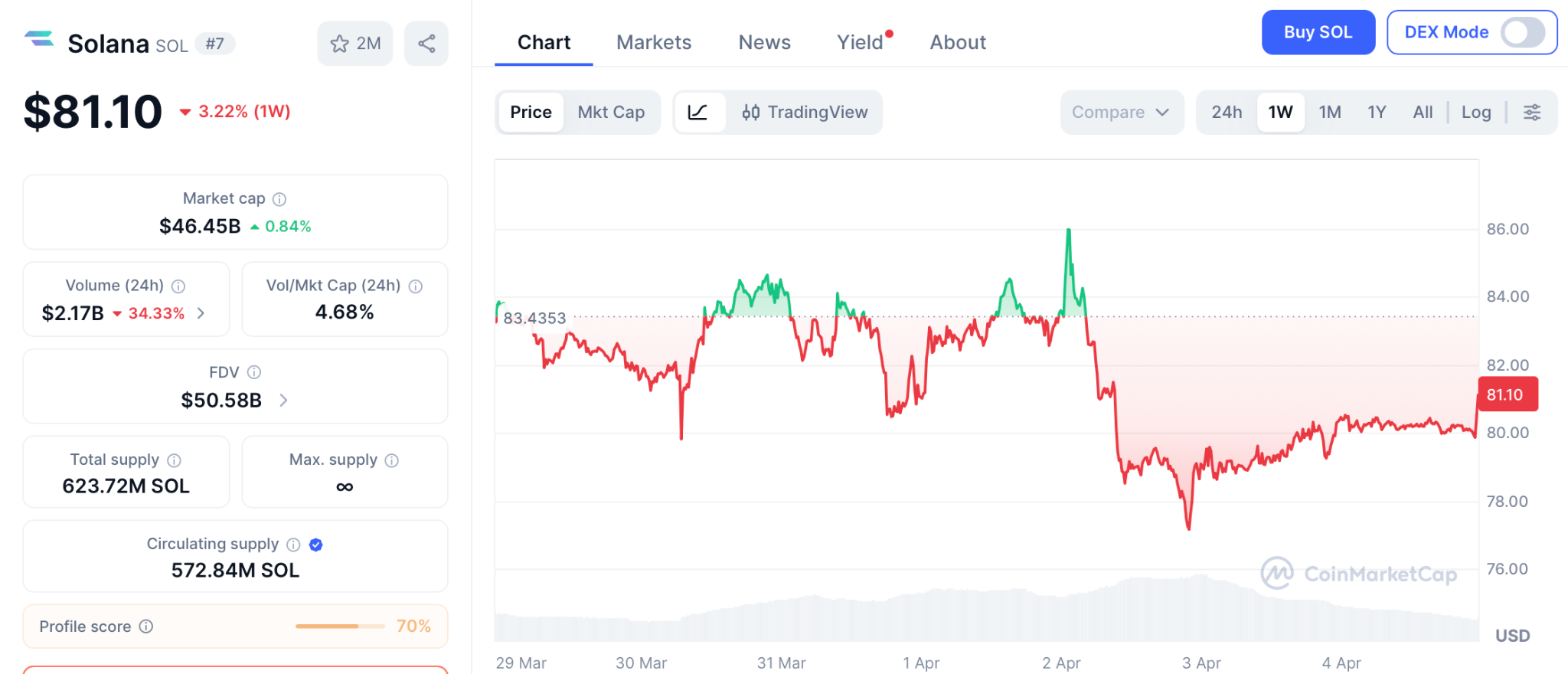
Doo Prime projects $336 if Firedancer’s one million TPS capacity drives institutional settlement volume. But derivatives outflows and a put-to-call ratio above 2.0 show big money protecting positions instead of adding new ones. The solana price prediction rewards patience, but a presale targeting 100x from a single listing event offers what waiting on charts never will.
Solana Price Prediction Confirms That Acting While the Entry Is Open Is How Every Crypto Success Story Started
Even though the solana price prediction points toward $250, that 212% gain over months is small compared to the 100x that analysts project from presale pricing, a return that leaves SOL’s percentage move far behind.
Traders looking for real growth can act on this right now because the portfolios that turned Pepe and DOGE into life-changing money all share one thing: they locked in before the crowd arrived. More than $8.68 million raised and capital keeps flowing as the Binance listing approaches. The Pepeto official website holds the entry that disappears when the Binance listing goes live, and acting now while $17 billion in on-chain capital waits to rotate is how the strongest positions in crypto get built.
Click To Visit Pepeto Website To Enter The Presale

FAQs
What does the solana price prediction target for 2026?
Standard Chartered targets $250 for SOL, a 212% gain from $81. The verified exchange targets 100x from one Binance listing event.
How far can SOL climb this year based on the solana price prediction?
Doo Prime projects $336 if Firedancer drives volume. Pepeto at presale pricing targets returns that beat the solana price prediction by multiples.
Should investors consider SOL at $81 based on the solana price prediction?
SOL is solid long term but 73% below its peak. Pepeto with verified tools and a confirmed Binance listing offers 100x from presale.
Disclaimer: This is a Press Release provided by a third party who is responsible for the content. Please conduct your own research before taking any action based on the content.
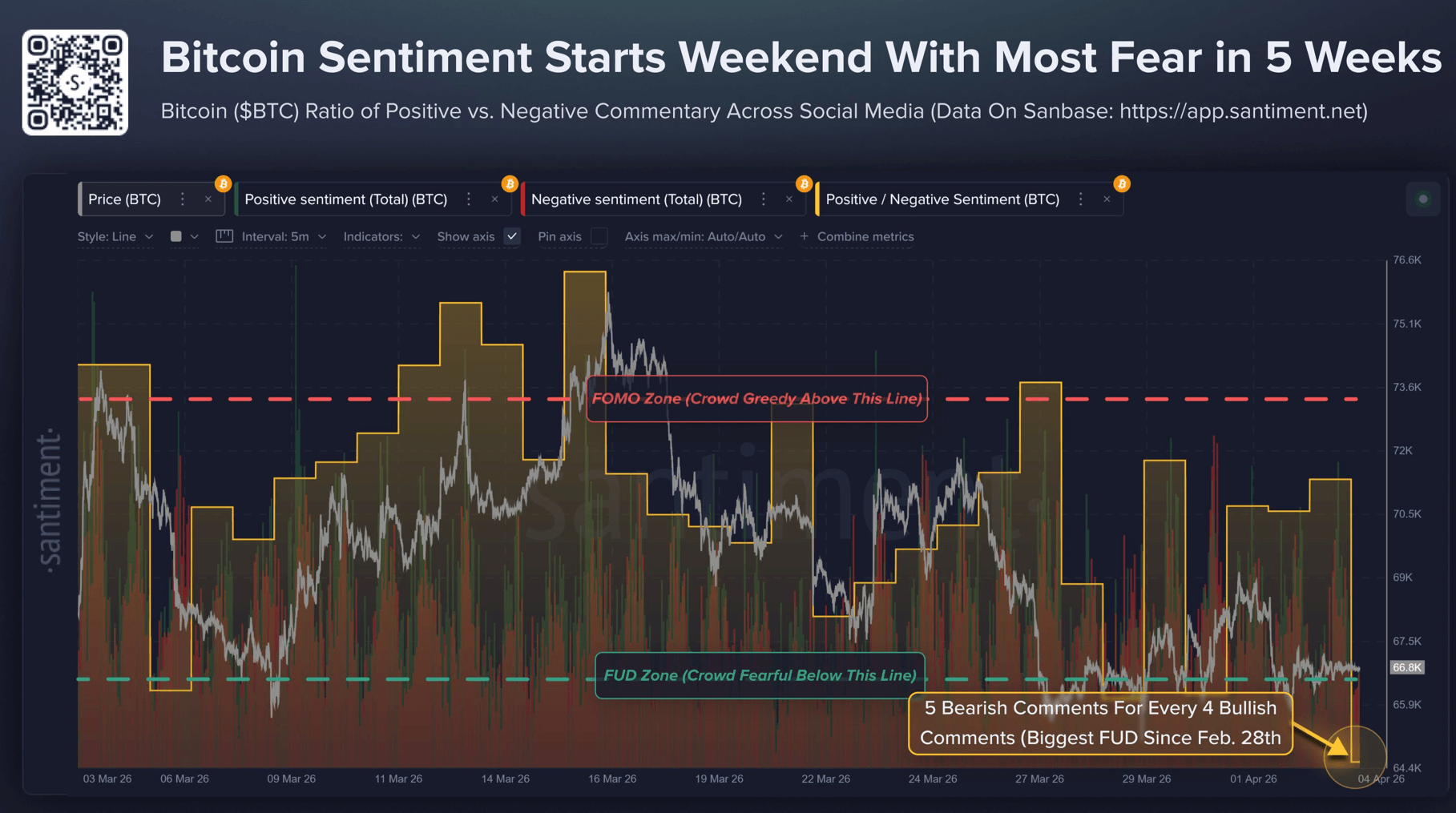
Social media bearishness around Bitcoin has reached its highest level since the end of February, according to crypto sentiment platform Santiment.
“FUD has crept back in with the community showing a key lack of optimism,” Santiment said in an X post on Saturday, adding that it is “usually a common ingredient for prices rebounding.”
The data comes from a large sample of crypto-focused social media accounts and tracks the ratio of bullish to bearish Bitcoin (BTC) comments across X, Reddit, and other social media platforms.
Markets move in “opposite direction,” says Santiment
On Saturday, the ratio of bullish to bearish Bitcoin comments stood at 0.81, the lowest level since Feb. 28.

Bitcoin holders often look at broader market sentiment to guide buying and selling decisions. When sentiment is low, most expect more downside, and when optimism picks up, traders start to expect further upside.
However, Santiment said the market often moves in the opposite way. “Markets typically move in the opposite direction of the crowd’s expectations,” Santiment said. “A high level of FUD like this is a good sign that things can turn positive sooner rather than later,” Santiment added.
Bitcoin is trading at $67,100 at the time of publication, down 5.53% over the past 30 days, according to CoinMarketCap.

Santiment pointed to the US CLARITY Act, which is a highly anticipated piece of legislation that the crypto industry is watching closely, as a potential “what-if” catalyst holding back Bitcoin’s price.
Crypto market sentiment stays in “Extreme Fear”
On Wednesday, Coinbase chief legal officer Paul Grewal said the legislation is “moving toward” a markup hearing in the US Senate Banking Committee and could eventually move to a floor vote if senators resolve the stablecoin yield dispute and schedule a markup.
Related: Rich Bitcoin traders lost $337M daily in first quarter of 2026
Other indicators suggest that investors are taking a cautious approach to the crypto market.
The Crypto Fear & Greed Index, which measures overall crypto market sentiment, has stayed within “Extreme Fear” territory, posting a score of 12 on Sunday.
Magazine: Bitcoin 85% crashes ‘done,’ CLARITY Act speculation mounts: Hodler’s Digest, Mar. 29 – April 4


Quantum computers capable of breaking the Bitcoin blockchain do not exist today. Developers, however, are already considering a wave of upgrades to build defenses against the potential threat, and rightfully so, as the threat is no longer hypothetical.
This week, Google published research suggesting that a sufficiently powerful quantum computer could crack Bitcoin’s core cryptography in under nine minutes — one minute faster than the average Bitcoin block settlement time. Some analysts believe such a threat could become a reality by 2029.
Stakes are high: About 6.5 million bitcoin tokens, worth hundreds of billions of dollars, sit in addresses a quantum computer could directly target. Some of these coins belong to Bitcoin’s pseudonymous creator, Satoshi Nakamoto. Besides, the potential compromise would damage Bitcoin’s core tenets – “trust the code “and “sound money.”
Here’s what the threat looks like, along with proposals under consideration to mitigate it.
Two ways a quantum machine could attack Bitcoin
Let’s first understand the vulnerability before discussing the proposals.
Bitcoin’s security is built on a one-way mathematical relationship. When you create a wallet, a private key and a secret number are generated, from which a public key is derived.
Spending bitcoin tokens requires proving ownership of a private key, not by revealing it, but by using it to generate a cryptographic signature that the network can verify.
This system is foolproof because modern computers would take billions of years to break elliptic curve cryptography — specifically the Elliptic Curve Digital Signature Algorithm (ECDSA) — to reverse-engineer the private key from the public key. So, the blockchain is said to be computationally impossible to compromise.
But a future quantum computer can change this one-way street into a two-way street by deriving your private key from the public key and draining your coins.
The public key is exposed in two ways: From coins sitting idle onchain (the long-exposure attack) or coins in motion or transactions waiting in the memory pool (short-exposure attack).
Pay-to-public key (P2PK) addresses (used by Satoshi and early miners) and Taproot (P2TR), the current address format activated in 2021, are vulnerable to the long exposure attack. Coins in these addresses do not need to move to reveal their public keys; the exposure has already happened and is readable by anyone on earth, including a future quantum attacker. Roughly 1.7 million BTC sits in old P2PK addresses — including Satoshi’s coins.
The short exposure is tied to the mempool — the waiting room of unconfirmed transactions. While transactions sit there awaiting inclusion in a block, your public key and signature are visible to the entire network.
A quantum computer could access that data, but it would have only a brief window — before the transaction is confirmed and buried under additional blocks — to derive the corresponding private key and act on it.
Initiatives
BIP 360: Removing public key
As noted earlier, every new Bitcoin address created using Taproot today permanently exposes a public key onchain, giving a future quantum computer a target that never goes away.
The Bitcoin Improvement Proposal (BIP) 360 removes the public key permanently embedded on-chain and visible to everyone by introducing a new output type called Pay-to-Merkle-Root (P2MR).
Recall that a quantum computer studies the public key, reverse-engineers the exact shape of the private key and forges a working copy. If we remove the public key, the attack has nothing to work from. Meanwhile, everything else, including Lightning payments, multi-signature setups and other Bitcoin features, remains the same.
However, if implemented, this proposal protects only new coins going forward. The 1.7 million BTC already sitting in old exposed addresses is a separate problem, addressed by other proposals below.
SPHINCS+ / SLH-DSA: Hash-based post-quantum signatures
SPHINCS+ is a post-quantum signature scheme built on hash functions, avoiding the quantum risks facing elliptic curve cryptography used by Bitcoin. While Shor’s algorithm threatens ECDSA, hash-based designs like SPHINCS+ are not seen as similarly vulnerable.
The scheme was standardized by the National Institute of Standards and Technology (NIST) in August 2024 as FIPS 205 (SLH-DSA) after years of public review.
The tradeoff for security is size. While current bitcoin signatures are 64 bytes, SLH-DSA are 8 kilobytes (KB) or more in size. As such, adopting SLH-DSA would sharply increase block space demand and raise transaction fees.
As a result, proposals such as SHRIMPS (another hash-based post-quantum signature scheme) and SHRINCS have already been introduced to reduce signature sizes without sacrificing post-quantum security. Both build on SHPINCS+ while aiming to retain its security guarantees in a more practical, space-efficient form suitable for blockchain use.
Tadge Dryja’s Commit/Reveal Scheme: An Emergency Brake for the Mempool
This proposal, a soft fork suggested by Lightning Network co-creator Tadge Dryja, aims to protect transactions in the mempool from a future quantum attacker. It does so by separating transaction execution into two phases: Commit and Reveal.
Imagine informing a counterparty that you will email them, then actually sending an email. The former is the commit phase, and the latter is the reveal.
On the blockchain, this means you first publish a sealed fingerprint of your intention — just a hash, which reveals nothing about the transaction. The blockchain timestamps that fingerprint permanently. Later, when you broadcast the actual transaction, your public key becomes visible — and yes, a quantum computer watching the network could derive your private key from it and forge a competing transaction to steal your funds.
But that forged transaction is immediately rejected. The network checks: does this spend have a prior commitment registered on-chain? Yours does. The attacker’s does not — they created it moments ago. Your pre-registered fingerprint is your alibi.
The issue, however, is the increased cost due to the transaction being broken into two phases. So, it’s described as an interim bridge, practical to deploy while the community works on building quantum defences.
Hourglass V2: Slowing the spending of old coins
Proposed by developer Hunter Beast, Hourglass V2 targets the quantum vulnerability tied to roughly 1.7 million BTC held in older, already-exposed addresses.
The proposal accepts that these coins could be stolen in a future quantum attack and seeks to slow the bleeding by limiting sales to one bitcoin per block, to avoid a catastrophic overnight mass liquidation that could crater the market.
The analogy is a bank run: you cannot stop people from withdrawing, but you can limit the pace of withdrawals to prevent the system from collapsing overnight. The proposal is controversial because even this limited restriction is seen by some in the Bitcoin community as a violation of the principle that no external party can ever interfere with your right to spend your coins.
Conclusion
These proposals are not yet activated, and Bitcoin’s decentralized governance, spanning developers, miners and node operators, means any upgrade is likely to take time to materialize.
Still, the steady flow of proposals predating this week’s Google report suggests the issue has long been on developers’ radar, which may help temper market concerns.
Crypto World
Bitcoin Price Prediction: BTC Drops to $67K but Whales Keep Buying the Dip While Pepeto Loads Quietly
Nearly half of all Bitcoin in circulation is now held at a loss. CoinMarketCap data from April 3 shows 8.8 million BTC, roughly 44% of total supply, sits underwater with $600 billion in unrealized losses as the price hovers near $67,335.
But whale wallets keep adding through the fear while exchange reserves drop to multi-year lows. Pepeto has also proven why it matters. The presale has pulled $8.68 million with the Binance listing approaching, and the real 100x math lives inside the Pepeto presale, not in a large cap at $67,335.
Bitcoin Price Prediction Faces Pressure as 44% of Supply Falls Into Loss Territory
Strategy holds 717,722 BTC at an average cost of $67,335, meaning the largest corporate holder in history is hovering near breakeven as of April 3, according to Phemex. Miners like Riot Platforms sold 3,778 BTC in Q1 alone, adding sell pressure from producers who need cash to cover operations.
BTC dropped from its October 2025 high of $126,198 to $67,335 a 47% decline in six months. The weekly RSI sits at deeply oversold levels not seen since 2018 at $3,500, right before a massive run began.
The bitcoin price prediction will recover because every time this percentage of supply sat at a loss, it marked a redistribution from weak hands to strong ones. But BTC keeps reacting like a risk asset whenever oil spikes and geopolitics flare, and from $67,335, even $100K is only 49% over months.
Bitcoin Price Prediction and the Presale Whales Are Loading While Retail Panics
If you watched BTC run from $16,000 to $126,000 without entering, this window matters. Pepeto is attracting heavy capital during the exact fear conditions that turned 2022 buyers into 2024 winners.
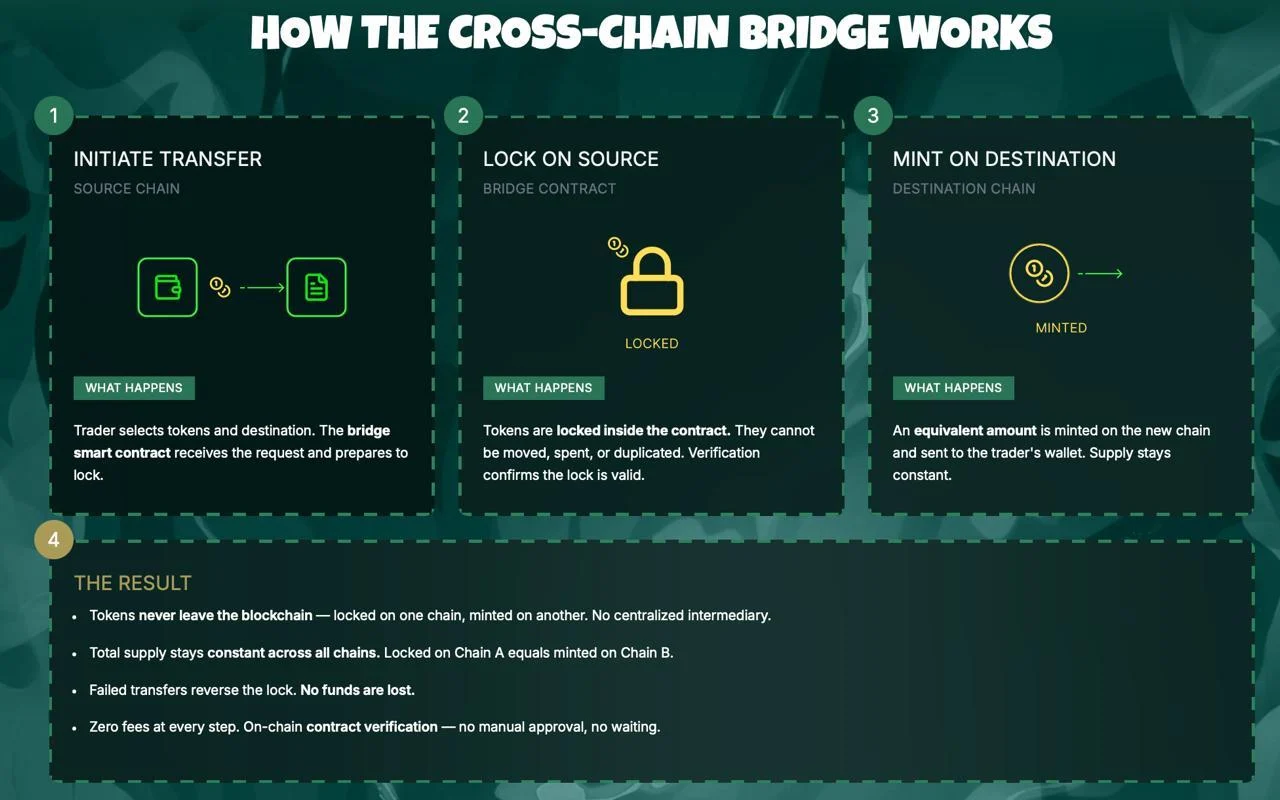
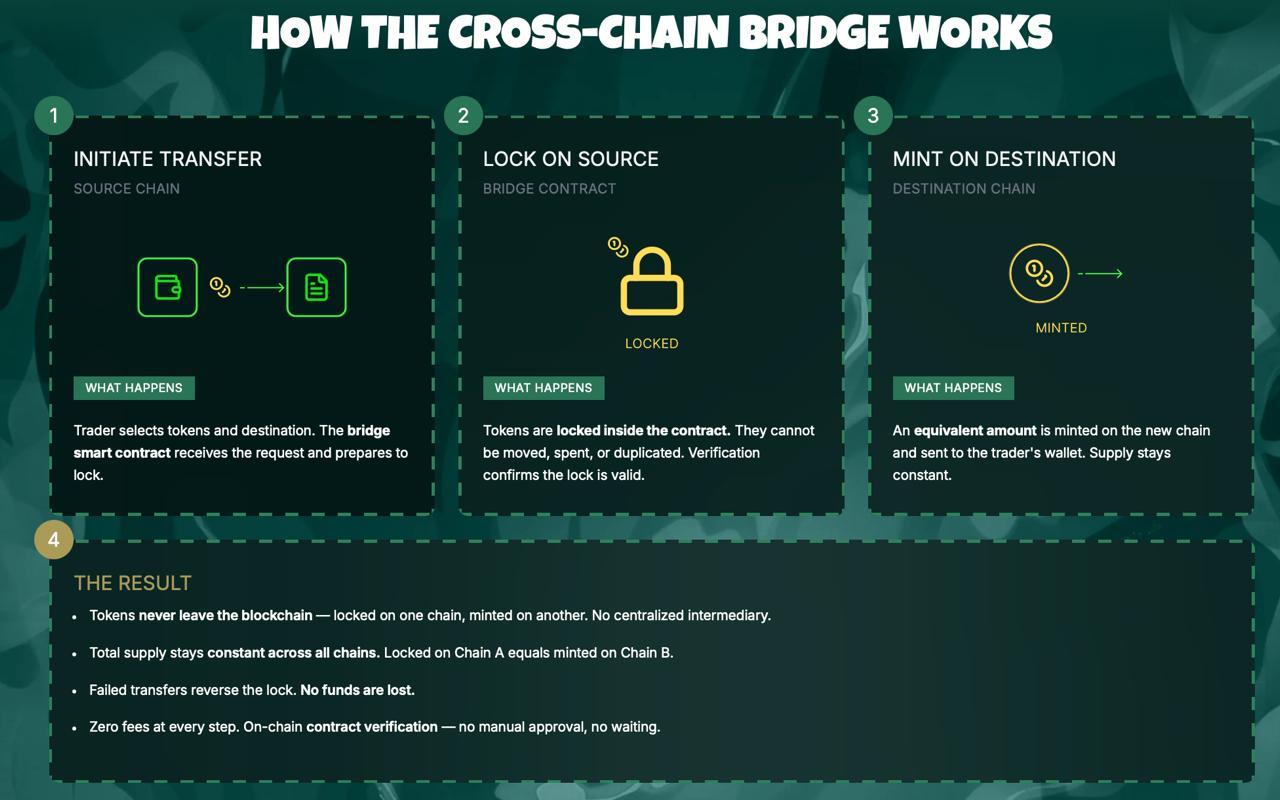
Unlike large caps that bleed with every headline, this exchange already runs during the presale. The bridge transfers tokens between Ethereum, BNB Chain, and Solana at zero cost, so what you send is what lands. The contract scanner checks every token for hidden traps and scam patterns before your capital gets exposed, giving a clear risk score in seconds.
Early wallets are already well ahead, and every round since has pushed the presale past $8.68 million. The Binance listing is coming, and the moment trading begins this presale entry shuts permanently.
A former Binance executive leads the technical architecture. SolidProof completed the full audit before any capital entered, and 188% APY staking grows positions daily while others wait on the sidelines. More exchange listings across CEX and DEX platforms follow Binance.
At the center of Pepeto is the founder who scaled Pepe from zero to an $11 billion market cap with the same 420 trillion supply and zero products. Reaching that valuation from the current entry of $0.0000001862 is over 100x, and Pepeto has PepetoSwap running zero-fee trades, the bridge, and the contract scanner that Pepe never had. The bitcoin price prediction would need BTC past $7 million to match that return, and no analyst alive has projected that number. The fortunes that defined prior cycles were made by wallets that entered infrastructure presales during fear, and Pepeto’s confirmed Binance listing will permanently close this window along with every multiple attached to it.
Bitcoin Price Prediction: Will BTC Recover From $67K and Reach $100K?
BTC trades near $67,335 as of April 4, down 47% from the $126,198 peak, according to CoinMarketCap. Strategy keeps buying through the drawdown. Exchange reserves sit at multi-year lows. The weekly RSI mirrors oversold prints from 2015 and 2018, both before massive rallies.
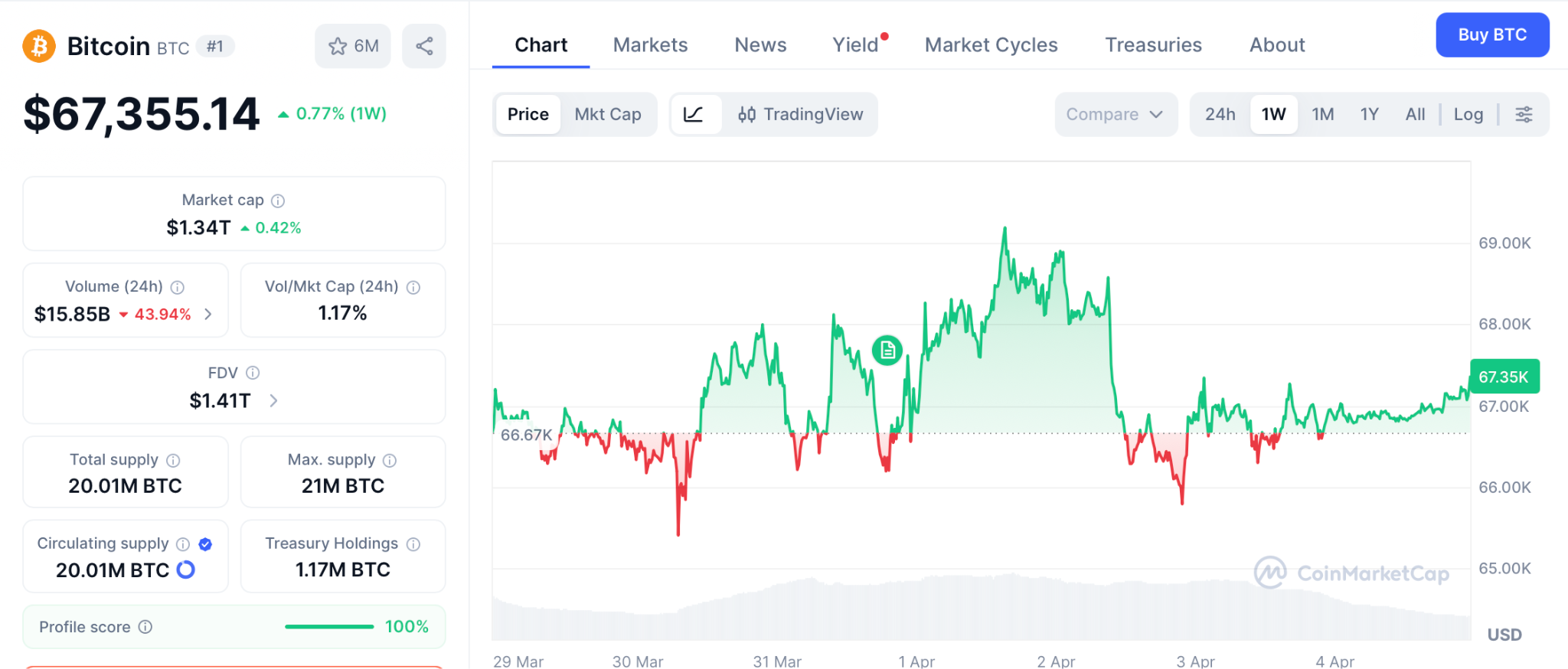
When the Iran situation settles and markets begin pricing in rate cuts again, the bitcoin price prediction of $100,000 becomes realistic. But from $67,335 that is a 49% return over months. The crash is temporary. But a presale-to-listing multiple of 100x is a return no large cap at $67,335 can deliver in any timeframe.
Bitcoin Price Prediction Points to Recovery but the Presale Delivers What the Recovery Cannot
More than $8.68 million committed while the Fear Index sat near single digits, led by a founder who built $11 billion and a former Binance executive running the exchange. Smart capital reads that setup and enters before the crowd catches on.
The bitcoin price prediction turns bullish the moment sentiment shifts. The wallets watching whale movement patterns have already locked Pepeto at presale pricing. The ones who wait will buy from them after the listing at whatever price those early wallets set. Visit the Pepeto official website and lock the entry that disappears the moment the Binance listing goes live.
Click To Visit Pepeto Website To Enter The Presale

FAQs
What caused the bitcoin price prediction to turn bearish short term?
44% of BTC supply ($600B) sits at a loss, creating sell pressure. Whale accumulation signals a bottom forming.
Does the bitcoin price prediction support buying BTC at $67K?
Yes, the bitcoin price prediction targets $100K recovery, but that is 49% over months, not the multiples presales offer.
What is the strongest entry in crypto right now?
Pepeto at $0.0000001862 with a $7B cofounder, SolidProof audit, and confirmed Binance listing targets 100x from presale.
Disclaimer: This is a Press Release provided by a third party who is responsible for the content. Please conduct your own research before taking any action based on the content.

Green Spaces claims 2026 Australian Derby glory for Baker and King

Generalist GEN-1 Model Gives Robots a New Kind of Skill

Storm Dave eases on Easter Sunday as weather warnings lift


-

 NewsBeat3 days ago
Steven Gerrard disagrees with Gary Neville over ‘shock’ Chelsea and Arsenal claim | Football
-

 Business2 days ago
No Jackpot Winner and $194 Million Prize Rolls Over
-

 Fashion2 days ago
Weekend Open Thread: Spanx – Corporette.com
-
Entertainment6 days ago
Fans slam 'heartbreaking' Barbie Dream Fest convention debacle with 'cardboard cutout' experience
-

 Crypto World3 days ago
Gold Price Prediction: Worst Month in 17 Years fo Save Haven Rock
-

 Tech6 days ago
The Pixel 10a doesn’t have a camera bump, and it’s great
-
Crypto World5 days ago
Dems press CFTC, ethics board on prediction-market insider trades
-

 Tech6 days ago
Avatar Legends: The Fighting Game comes out in July and it looks pretty slick
-

 Business3 days ago
Login and Checkout Issues Spark Merchant Frustration
-

 Sports11 hours ago
India men’s 4x400m and mixed 4x100m relay teams register big progress | Other Sports News
-

 Tech6 days ago
Apple will hide your email address from apps and websites, but not cops
-

 Sports5 days ago
Tallest college basketball player ever, standing at 7-foot-9, entering transfer portal
-

 Tech5 days ago
EE TV is using AI to help you find something to watch
-

 Politics6 days ago
Should Trump Be Scared Strait?
-

 Tech5 days ago
Flipsnack and the shift toward motion-first business content with living visuals
-

 Tech7 days ago
Elon Musk’s last co-founder reportedly leaves xAI
-

 Fashion6 days ago
The Best Spring Trends of 2026
-

 Tech5 days ago
How to back up your iPhone & iPad to your Mac before something goes wrong
-
Crypto World6 days ago
Bitcoin’s Six-Month Losing Streak: What On-Chain Data Says About the Market’s Next Move
-
Tech5 days ago
Daily Deal: StackSkills Premium Annual Pass
You must be logged in to post a comment Login