
Crypto World
Trump Breaks Silence on Secret Plane Switch in Turkey Over Possible Iranian Threat


Trump isn’t the only President to execute a decoy mission
Although rare, a decoy maneuver such as this is not unheard of when it comes to presidential travel.
A similar episode occurred in March 2000, when former President Bill Clinton secretly switched to a decoy jet, with all of the markings of Air Force One, as he traveled to Islamabad, Pakistan for a visit marked by extraordinary security.
The switch was revealed when a Secret Service agent resembling Clinton stepped out of Air Force One upon touching down in Pakistan, while Clinton disembarked from the second aircraft.
However, at least one member of the White House pool was aware of the ruse: Susan Page, then-president of the White House Correspondents’ Association, who was covering the trip for USA TODAY.
Page this week broke her 26-year silence on the briefing that preceded the secret switch.
“They told me about the extraordinary security procedures being taken because of the dangers in flying there, including use of the decoy plane,” she told the Post. “Of course, the dangers threatened the journalists covering the trip as well as President Clinton.”

It was the start of June when the second-largest cryptocurrency last traded above the $2,000 psychological level and is currently down 60% on a yearly scale.
Despite the downfall, many analysts see upside potential, while some believe the ongoing conditions represent a great buying opportunity.
The Right Strategy?
As of press time, ETH is worth around $1,880, as some market participants are perhaps waiting for the ultimate confirmation that the cycle’s bottom has arrived so they can jump on the bandwagon. According to Michael van de Poppe, that moment never comes, claiming the ideal time to position yourself in ETH is literally right now.
“It’s always awkward to be positioning yourself into a position, as that’s the purpose of the markets. Previous breakouts of the market have resulted in generally big returns, as ETH is known for volatile movements. In that sense, last time a 60% breakout in less than a week took place. In 2023, the same happened,” he added.
Van de Poppe said he wouldn’t be surprised to see such an upswing in the following months, with a rally to $3,000 in a matter of days/weeks. Shortly after, the analyst argued that “a volatile move” is on the horizon, suggesting that ETH’s range is getting smaller day after day and that a pump might be coming next.
“Remaining positive for the coming period,” he concluded.
Other commentators who have also recently touched upon Ethereum include Ali Martinez and Gerla. The former opined that the drop to $1,580 in June was the launchpad for a potential upcoming rally, setting $3,000 as the target. Martinez noted that this level has historically acted as a precursor to major revivals on multiple occasions.
X user Gerla was even more bullish, spotting an RSI signal that has previously been followed by a price explosion. That said, the analyst thinks the next move could send ETH to a new all-time high above $10,000.
The Factors to Consider
Multiple elements hint that ETH may indeed be poised for a substantial ascent. Not long ago, CryptoQuant revealed that large investors (those holding between 10,000 and 100,000 coins) and “mega-whales” have accumulated aggressively since mid-2025. At the same time, smaller players have been selling, which is typically considered a bullish combination.
The next factor on the list is the amount of ETH stored on exchanges, which continues to hover near a 10-year low. This suggests that many investors have transferred their holdings from centralized platforms to self-custody, effectively reducing immediate selling pressure.
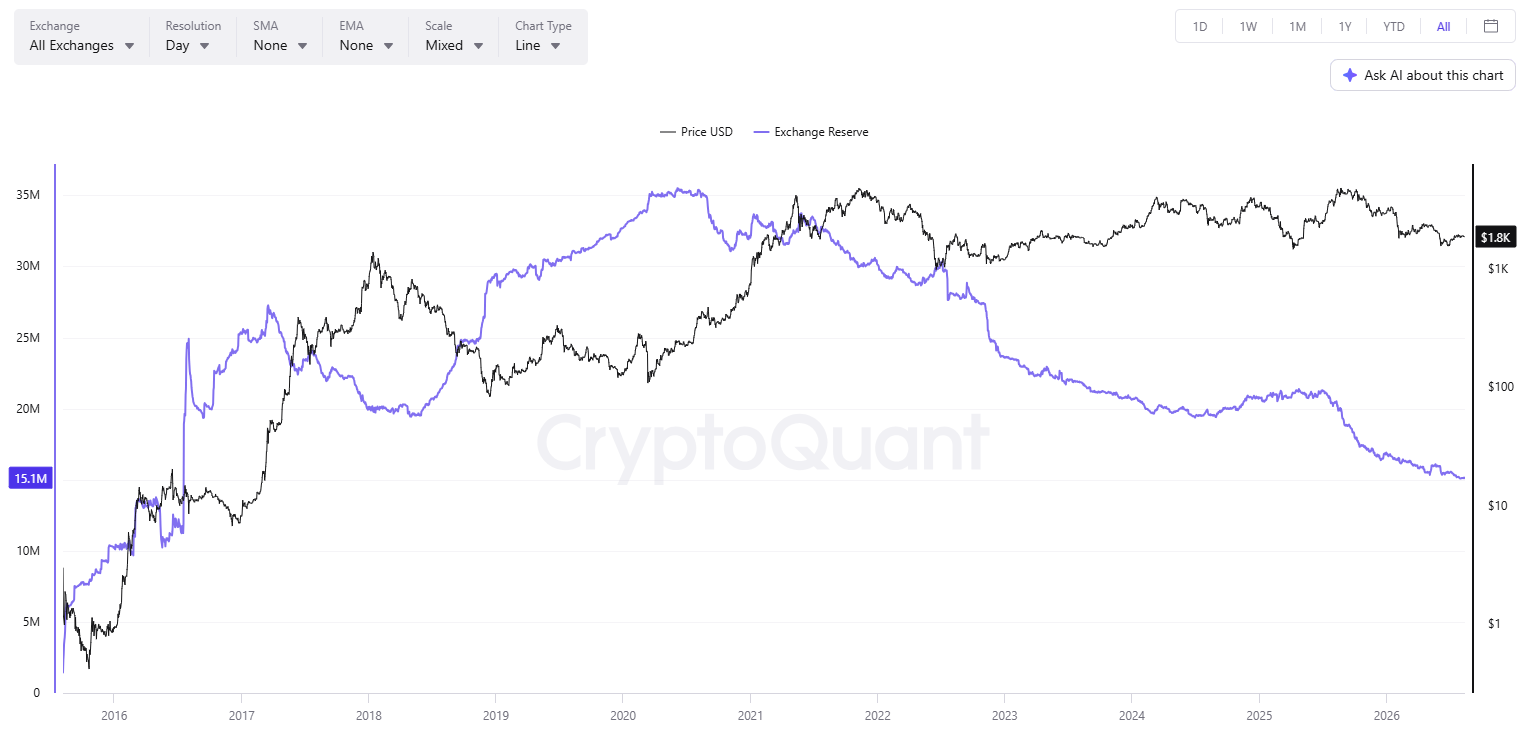
- ETH Exchange Reserves, Source: CryptoQuant
Last but not least, we shall pay attention to the institutional interest in ETH. Since the start of July, spot Ethereum ETFs have seen a strong wave of inflows, possibly paving the way for a potential price move north.
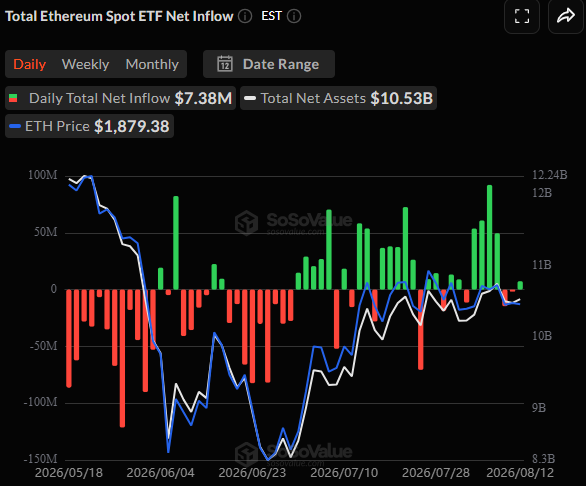
- Spot ETH ETFs, Source: SoSoValue
The post The Ideal Moment to Buy Ethereum (ETH) Is Now: Here’s Why appeared first on CryptoPotato.

Bullish (NYSE: BLSH) shares jumped in early trading on Thursday after the institution-focused crypto exchange and CoinDesk owner reported a strong rebound in quarterly results. The company said second-quarter adjusted revenue climbed 62% year over year, while adjusted EBITDA more than tripled, reflecting both improved operating performance and a shift in where income was coming from.
The stock’s move also followed a regulatory step in Gibraltar that broadens Bullish’s ability to operate in tokenized securities—an area that has increasingly drawn attention from traditional finance. Investors appear to be weighing the quarter’s financial momentum alongside the company’s push toward more regulated onchain market activity.
Key takeaways
- Bullish reported second-quarter adjusted revenue of $92.6 million, up from $57.0 million a year earlier.
- Adjusted EBITDA rose to $29.5 million from $8.1 million, indicating a significant improvement in profitability.
- Subscription, services and other revenue reached a record $62.7 million, helping offset weaker exchange activity.
- The company’s quarterly trading volume totaled $179.6 billion, down from $197.4 billion year over year, while average daily volume fell to $2.0 billion.
- Bullish received approval from Gibraltar’s Financial Services Commission to offer secondary trading in issuer-sponsored tokenized securities and raised full-year guidance for subscription-related revenue.
Quarterly results point to operating leverage
In its earnings update, Bullish said adjusted revenue for the second quarter reached $92.6 million, compared with $57 million in the same period of the prior year. The profitability turnaround was even more pronounced: adjusted EBITDA increased to $29.5 million from $8.1 million.
On the bottom line, the company reported adjusted net income of $14.3 million, reversing a $6.0 million loss in the year-ago quarter. For shareholders, the combination of rising revenue and sharply higher adjusted EBITDA suggests the business is capturing more value per unit of activity—an important signal for exchanges that have historically been sensitive to market volumes.
Revenue mix strengthens as exchange activity cools
While exchange volumes softened compared with the year before, Bullish highlighted a key offsetting driver. Subscription, services and other revenue totaled a record $62.7 million in the quarter.
That figure mattered because trading metrics declined: Bullish reported $179.6 billion in quarterly trading volume, down from $197.4 billion a year earlier. Average daily volume also slipped to $2.0 billion from $2.2 billion. The implied message is that the company’s income stream is becoming less dependent on pure trading throughput and more supported by services and subscription-related earnings.
For traders and institutional users, a revenue mix that relies more on subscriptions and services can be beneficial—especially if broader market activity fluctuates. It may also indicate that Bullish is attracting customers not only for spot trading, but for infrastructure and ongoing platform access.
Gibraltar approval expands tokenized securities business
Separate from the financial results, Bullish reported it received approval from the Gibraltar Financial Services Commission to offer secondary trading in issuer-sponsored tokenized securities. This is a notable development for a company positioning itself in regulated onchain markets.
The approval matters because secondary trading permission moves tokenized securities beyond primary issuance mechanics and into ongoing liquidity, where regulatory frameworks and market structure typically become more complex. Bullish framed the step as part of its expansion into regulated tokenized markets.
However, the exact scope of what products can be listed and how trading will operate in practice was not detailed in the provided information. Investors will likely watch for further clarification on launch timelines, participating issuers, and how trading activity in tokenized securities compares with the broader crypto exchange volume.
Guidance raised amid improved visibility
Bullish also lifted its full-year guidance. The company now expects $225 million to $245 million in subscription, services and other revenue, citing performance in the first half of the year and improved visibility.
Raising guidance can be interpreted as management signaling confidence that the stronger revenue mix seen in the quarter will persist. That is particularly relevant given the reported decline in trading volume versus the prior year—suggesting the company believes its non-exchange revenue streams are gaining enough momentum to offset weaker trading activity.
At the same time, investors should note that guidance is tied specifically to subscription, services and other revenue. The company did not provide a revised outlook in the provided excerpt for exchange-specific results, so it remains unclear how much of the improvement will translate into sustained volume growth.
Shares rally, but longer-term performance remains a concern
Thursday’s advance extends a broader rebound for Bullish shares. The stock has gained around 20% over the past month, according to Yahoo Finance data. Even with the recent rally, Bullish shares remain far below levels seen after the company’s listing last year, trading about 70% under post-listing highs, based on the same Yahoo Finance reference.
In other words, the near-term reaction to stronger financial metrics and a regulatory expansion comes against a backdrop of still-limited recovery from earlier drawdowns. That dynamic often shapes how markets respond to the next earnings report: investors may continue to reward progress on profitability and services growth, while still requiring evidence that trading volumes and tokenized securities activity can scale.
Looking ahead, the key signals to watch are whether Bullish can maintain subscription and services momentum as trading volumes fluctuate, and how quickly the Gibraltar tokenized securities approval translates into tangible secondary-market activity. The regulatory green light may open doors, but the market will ultimately want proof in execution and sustained earnings.

Public Bitcoin miners are trimming capacity faster than the network itself, according to a BlocksBridge Consulting analysis shared in the Miner Weekly newsletter. The data points to a gradual redeployment of electricity, sites, and operational expertise toward data centers and high-performance computing (HPC)—a key shift in the sector’s business model.
BlocksBridge reported that realized hashrate among a cohort of public miners fell from 368.3 exahashes per second (EH/s) in Q4 2025 to 319 EH/s in Q2 2026, a 13.4% decline. The pullback was steeper when excluding Bitdeer, which continued to grow.
Key takeaways
- Realized hashrate among public Bitcoin miners dropped 13.4% from Q4 2025 to Q2 2026, according to BlocksBridge’s Miner Weekly cohort.
- Without Bitdeer, the cohort’s realized hashrate fell 21.2%, indicating that most operators contracted more aggressively.
- Bitdeer was an outlier: its realized hashrate rose 44% to 63 EH/s during the same period.
- Bitcoin network average hashrate declined 10.6% over the same six months, suggesting miners’ reductions outpaced the broader network.
- Several miners are increasingly deriving revenue from non-mining activities such as colocation and HPC leasing.
Miners shrink capacity faster than the network
BlocksBridge’s latest Miner Weekly update frames the change as part of a longer transition underway in the mining industry. In its reported cohort, realized hashrate decreased from 368.3 EH/s in Q4 2025 to 319 EH/s in Q2 2026. When Bitdeer is removed from the comparison, the decline becomes more pronounced: realized hashrate drops from 324.6 EH/s to 255.9 EH/s, or 21.2%, across the six-month span.
Bitdeer’s figures diverge sharply from the rest. BlocksBridge reported that Bitdeer’s realized hashrate increased 44% to 63 EH/s, highlighting how competitive dynamics among public miners have started to split between those expanding and those contracting.
For context, BlocksBridge also noted that the Bitcoin network’s average hashrate fell 10.6% over the same period. The gap—miners reducing faster than the network—matters because it can signal that some operators are prioritizing other uses for capital and power rather than continuing to chase mining economics.
Why non-mining revenue is becoming more central
Alongside the capacity pullback, the sector’s revenue mix is shifting. The article points to growing contributions from non-mining activities—particularly colocation and HPC leasing—at miners that have positioned their power and infrastructure for broader technology demand.
In an example highlighted alongside the hashrate data, Core Scientific generated $136.7 million in colocation revenue in Q2, compared with $27.5 million from Bitcoin mining. Similarly, TeraWulf reported $31.9 million in HPC lease revenue versus $12.8 million from mining.
While the specific companies referenced show the trend clearly, the overall message is broader: the economics of mining alone are not carrying the same weight they once did. For investors and market observers, that shift changes how to interpret operational performance. Realized hashrate trends may no longer map cleanly to profitability if more of a miner’s earnings depends on leasing, hosting, or AI-related workloads rather than block rewards and transaction fees.
The post-2021 mining migration is losing momentum
BlocksBridge attributed the current slowdown to the unwinding of the expansion cycle that followed China’s 2021 Bitcoin mining ban. That policy shock triggered one of the most dramatic hashrate declines in Bitcoin’s history, followed by a recovery as miners relocated overseas.
North America became a key destination, where migration and new operational capacity supported an expansion among public miners. The analysis frames that phase as a capital-raising and build-out period—one characterized by power-site acquisitions and a push to scale mining infrastructure.
However, the newsletter argues that after a halving cycle, conditions look materially different. Weaker mining profitability is paired with escalating demand for AI infrastructure since 2022, creating incentives for some public miners to repurpose sites and shift power capacity away from Bitcoin mining entirely.
That doesn’t mean the mining business is disappearing, but it does suggest a structural change in priorities. Instead of simply competing to add more hashpower during favorable windows, operators are increasingly treating their electricity access and data-center capabilities as an asset that can serve multiple markets.
What to watch next: divergence among operators
The most important signal in the BlocksBridge report is divergence. Bitdeer’s continued realized hashrate expansion contrasts with more aggressive contraction from other public miners in the cohort, while Bitcoin network hashrate overall falls more moderately. For readers tracking the sector, the next question is whether the gap between “expanding” and “contracting” operators persists as electricity costs, hosting demand, and AI workloads evolve.
As more miners report meaningful revenue from colocation and HPC leasing, future comparisons may need to focus less on how quickly companies add or remove mining equipment and more on whether their non-mining services can sustainably offset changes in mining profitability.
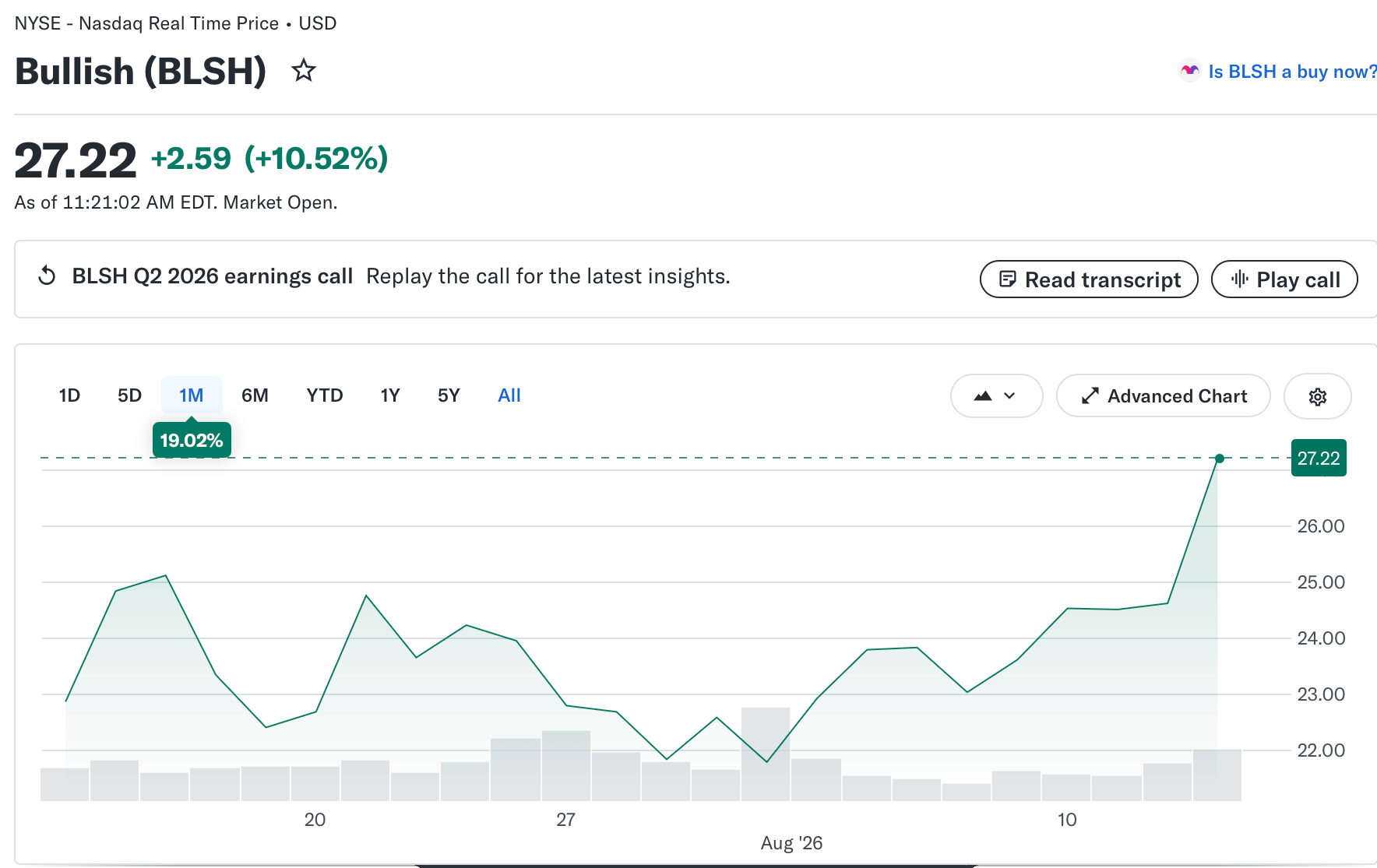
Bullish shares jumped around 13% in early trading Thursday after the institutional-focused crypto exchange and CoinDesk owner reported a 62% year-over-year increase in second-quarter adjusted revenue and more than tripled its adjusted EBITDA.
Bullish reported $92.6 million in adjusted revenue for the quarter, up from $57 million a year earlier, while adjusted EBITDA rose to $29.5 million from $8.1 million. Adjusted net income reached $14.3 million, reversing a $6 million loss in the year-ago quarter.
Subscription, services and other revenue hit a record $62.7 million, helping offset weaker exchange activity. The company recorded $179.6 billion in quarterly trading volume, down from $197.4 billion a year earlier, while average daily volume fell to $2 billion from $2.2 billion.
The NYSE-traded BLSH shares were up more than 10% on Thursday morning. Source: Yahoo Finance.
The company also received approval from the Gibraltar Financial Services Commission to offer secondary trading in issuer-sponsored tokenized securities, expanding its push into regulated onchain markets.
Bullish lifted its full-year guidance, forecasting $225 million to $245 million in subscription, services and other revenue, citing its first-half performance and improved visibility.
Thursday’s rally extends a recent rebound for Bullish shares, which have gained around 20% over the past month. The stock, however, remains about 70% below its post-listing highs last year, according to Yahoo Finance data.
Magazine: El Salvador’s Bitcoin experiment turns 5: ‘It was for us, not them’

A woman and a child walk past Iranian-made Zolfaghar missiles displayed at Azadi Square in Tehran on July 24, 2026.
Afp | Getty Images
Iran is set to join the BRICS New Development Bank, the country’s central bank chief said Thursday, as Tehran seeks to shore up its economic alliances almost six months into its war with the U.S. and Israel.
The BRICS alliance was set up in 2006 by founding members Brazil, Russia, India and China, with South Africa joining in 2010.
It has since expanded to include Iran, Egypt, Ethiopia, Saudi Arabia, the United Arab Emirates and Indonesia, with various other nations — including Belarus, Cuba and Nigeria — joining as partner countries.
Iranian state media reported Thursday that Abdolnasser Hemmati, governor of the Central Bank of Iran, had announced Iran would soon become a member of the BRICS bank. Hemmati is currently in India ahead of next month’s BRICS summit, according to Iran’s Tasnim News Agency.
“We are seeking to establish bilateral and trilateral monetary cooperation with member states,” Hemmati said, according to Tasnim’s report.
The NDB was established by Brazil, Russia, India, China and South Africa to help mobilize resources for infrastructure and sustainable development projects in emerging markets and developing countries.
A spokesperson for the NDB told CNBC the bank cannot confirm information regarding Iran’s membership.
“NDB membership is open to members of the United Nations. The Bank’s membership is open to borrowing and non-borrowing member countries,” they said. “NDB recently welcomed Uzbekistan as its tenth member country, which officially joined the Bank on June 5, 2026.”
Iran would have to move through the NDB’s accession process before it can become an official member country. Current prospective members are Uruguay, Colombia, Ethiopia, Angola and Zimbabwe.
Joining the bank would make Iran eligible to seek financing for projects in areas such as transport, sanitation, digital infrastructure and urban development.
Long-standing sanctions on Iran have severely constrained its access to international capital, particularly from Western financial institutions and markets. The war with the U.S. and Israel has further ramped up the pressure on the Iranian economy, with inflation surging, growth plummeting and its currency in free fall.
U.S. President Donald Trump, who has previously labeled BRICS policies “anti-American,” has threatened to slap 25% tariffs on goods imported to the U.S. from any country that directly or indirectly purchases goods or services from Iran.
CNBC reached out to the White House for comment on Iran joining the BRICS bank.
China is Iran’s biggest trading partner, according to the World Bank’s most recent data. In 2025, China bought more than 80% of Iran’s shipped oil, according to Kpler data.
It is unclear whether that trading relationship has shifted since the U.S.-Iran war began.


You’re reading Crypto for Advisors, CoinDesk’s weekly newsletter that unpacks digital assets for financial advisors. Subscribe here to get it every Thursday.
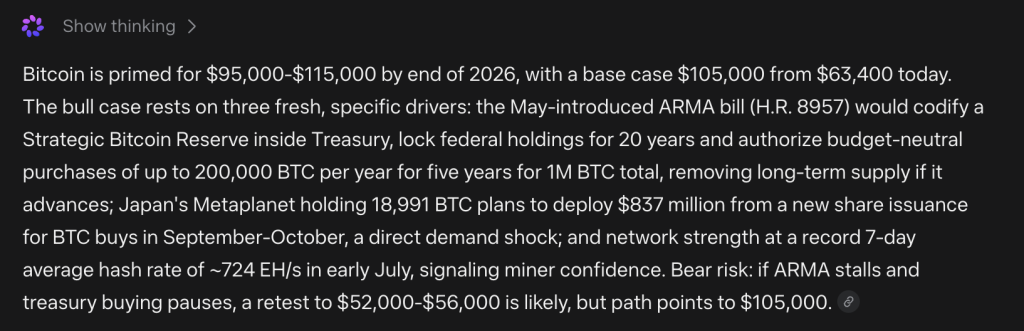
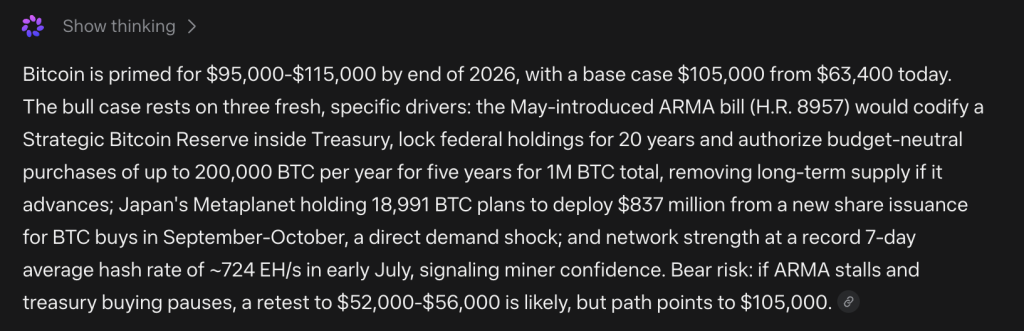
Bitcoin has spent months bleeding from above $120,000, yet Meta sees the market setting up for a sharp reversal. Meta AI Predicts Bitcoin can reach $95,000-$115,000 by the end of 2026, with its latest Bitcoin Price Prediction centering on $105,000.
That would mean a roughly 66% recovery from $63,367. Mark Zuckerberg’s Meta AI sees the fuel coming from an unusual combination: Washington potentially locking away Bitcoin while corporations prepare to buy more of it.
The ARMA bill, H.R. 8957, sits at the heart of that thesis. If advanced, it would codify a Strategic Bitcoin Reserve inside the Treasury, lock federal holdings for 20 years and authorize budget-neutral purchases of up to 200,000 BTC annually for 5 years.
That is up to 1 million BTC potentially meeting a market with fixed supply. The impact would not just come from buying pressure, but from removing a huge pool of Bitcoin from long-term circulation.
Corporate demand could hit sooner. Japan’s Metaplanet already holds 18,991 BTC and plans to deploy $837 million from a new share issuance toward additional Bitcoin purchases in September and October.
Underneath the price weakness, miners are not backing away either. Bitcoin’s 7-day average hash rate reached roughly 724 EH/s in early July, signaling continued commitment to securing the network.
The bull case breaks if policy and corporate demand both disappoint. If ARMA stalls and treasury accumulation slows, Meta AI sees Bitcoin revisiting $52,000-$56,000 instead.

Discover: Everyone’s Got a Take. Get Free $25 to Actually Trade Yours
Bitcoin Price Prediction: Meta AI Predicts $105,000, but $68,000 Comes First
The chart shows just how much work Bitcoin has left. After peaking above $120,000, BTC built a relentless sequence of lower highs before crashing toward $60,000 and settling into a narrow base.
That base now stretches roughly from $60,000 to $68,000. Holding $60,000 keeps the recovery thesis alive, but Bitcoin needs to break $68,000 before the structure starts looking like anything more than consolidation inside a broader downtrend.
Bitcoin closed at $63,367, down 0.28% after trading between $63,240 and $64,411. The tight session shows neither side has managed to force a decisive break.
RSI reads 45.25 against a 49.57 signal line. That 4.32-point deficit keeps momentum tilted toward sellers, although Bitcoin remains comfortably above oversold territory.
There is no breakout yet. Reclaiming $68,000 would give buyers their first opening toward the $72,000-$80,000 region, and only then does Meta AI’s road toward $105,000 start looking technically credible.
Discover: Your Market Calls Are Worth Something. Start With Free $25 on Kalshi
Kalshi Turns Bitcoin’s $105,000 Call Into a Market
Meta AI can make the forecast. Kalshi lets traders decide whether they actually believe it.
Prediction markets turn future outcomes into tradable probabilities, giving traders another way to express views on crypto, economics, politics and major events. Instead of simply arguing over whether Bitcoin reaches six figures, market participants can put capital behind their conviction.
For Bitcoin traders staring at the gap between $63,367 and Meta AI’s $105,000 target, that adds another layer to the forecast: what people are actually willing to risk on what happens next.
→ Think Meta AI has Bitcoin right? Get up to $25 to trade your first market on Kalshi
Don’t Miss Out on Our $1,000 USDT Airdrop on ByBit
The post Mark Zuckerberg Meta AI Predicts Bitcoin Price by The End of 2026 appeared first on Cryptonews.
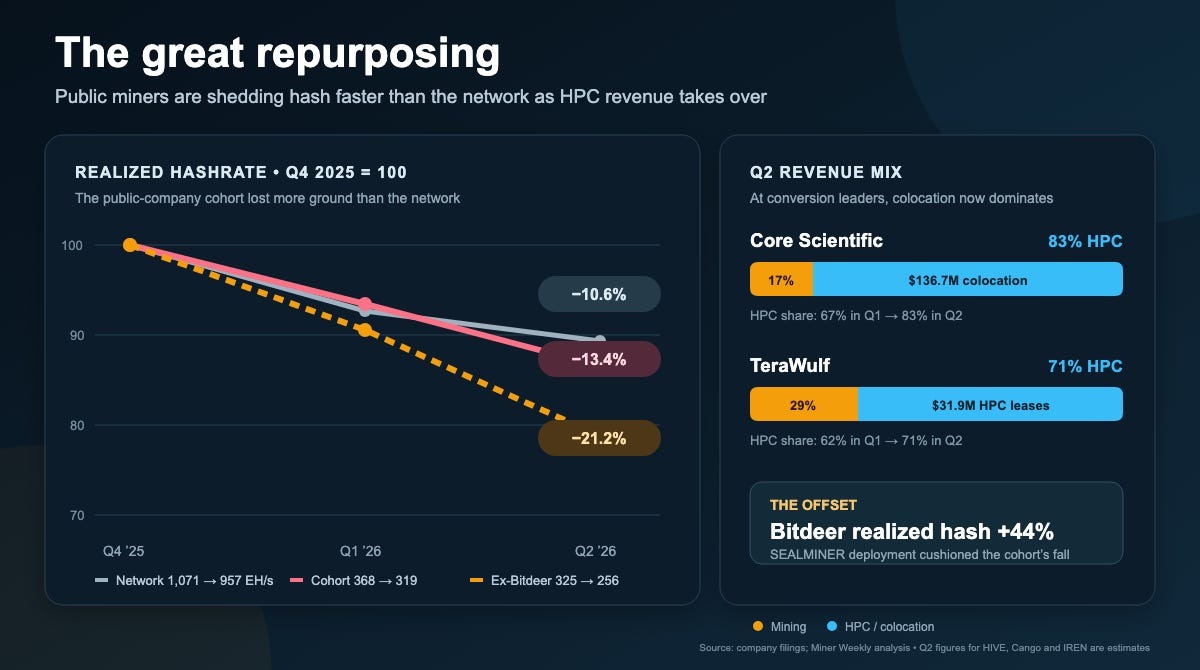
Publicly traded Bitcoin miners are cutting mining capacity faster than the Bitcoin network overall, suggesting that more operators are redirecting electricity and infrastructure toward data centers and high-performance computing (HPC), in another sign of the sector’s evolution beyond creating more crypto.
In the latest Miner Weekly newsletter, BlocksBridge Consulting reported that realized hashrate among a cohort of public Bitcoin miners fell from 368.3 exahashes per second (EH/s) in the fourth quarter of 2025 to 319 EH/s in the second quarter of 2026, a 13.4% decline.
The contraction was even sharper when excluding Bitdeer, which continued to expand its mining operations. Without Bitdeer, the cohort’s realized hashrate fell 21.2% over the six-month period, from 324.6 EH/s to 255.9 EH/s. Bitdeer’s realized hashrate, meanwhile, increased 44% to 63 EH/s.
By comparison, the Bitcoin network’s average hashrate declined 10.6% over the same period.
The shift comes as more miners report a growing share of revenue from non-mining activities. Core Scientific generated $136.7 million in colocation revenue during the second quarter, compared with just $27.5 million from Bitcoin mining. TeraWulf reported $31.9 million in HPC lease revenue, compared with $12.8 million from mining.
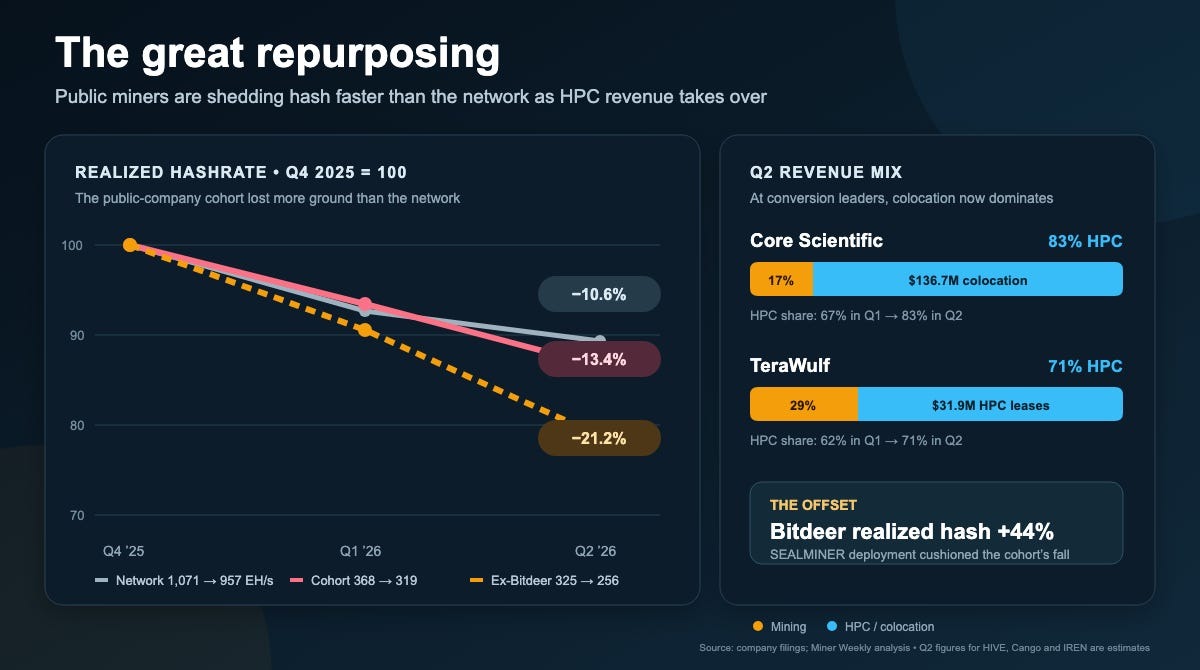
Core Scientific and TeraWulf are now generating the majority of their revenue from non-mining activities.
Source: TheEnergyMag
Riot Platforms and Bitdeer remain much earlier in the transition, with Bitcoin mining continuing to account for the vast majority of their revenue in the most recent quarter.
Related: CoreWeave shows how crypto-era infrastructure quietly became AI’s backbone
Unwinding post-China mining boom
BlocksBridge framed the current pullback as an unwinding of the expansion cycle that followed China’s Bitcoin mining ban in 2021, which triggered one of the sharpest declines in network hashrate before a rapid recovery as miners relocated overseas.
In North America, that migration helped fuel an expansion among public miners, which raised capital and acquired new power sites to expand their operations.
One halving cycle later, the economics have shifted significantly. Weaker mining profitability, coupled with surging demand for AI infrastructure since 2022, has prompted several public miners to repurpose sites and power capacity away from Bitcoin mining entirely.
Related: Crypto Biz: Crypto’s biggest business is starting to look a lot like banking


Key takeaways
- Hyperliquid gained 2% on Thursday after advancing nearly 3% in the previous session.
- Hyperion DeFi’s HYPE holdings recorded a $31 million fair-value increase during the second quarter.
- HYPE futures Open Interest rose more than 4% to $2.38 billion, while trading volume jumped 45%.
Hyperliquid (HYPE) extended its recovery on Thursday as sustained corporate demand and improving derivatives activity supported bullish momentum.
The token gained approximately 2%, building on its nearly 3% advance during the previous session. HYPE is now approaching its 50-day Exponential Moving Average (EMA) near $58.37, which represents the next major obstacle to further gains.
A decisive break above this level could allow Hyperliquid to target the $62.58 supply zone.
Corporate treasuries maintain strong HYPE exposure
Corporate interest in Hyperliquid remains firm, with HYPE-focused digital-asset treasuries increasing their exposure while benefiting from the token’s rising market value.
Hyperliquid Strategies held 17.60 million HYPE, up from 12.50 million in January. The market value of its holdings climbed from $703 million at the end of the first quarter to approximately $980 million in the second quarter.
Hyperion DeFi also increased its treasury holdings from 1.88 million HYPE to 1.93 million. The value of its position rose from $77 million at the end of the first quarter to $107 million in Q2, representing a $31 million fair-value increase.
The stability and growth of these corporate positions indicate continued confidence in the Hyperliquid ecosystem.
Digital-asset treasury companies can provide sustained demand by accumulating and holding tokens over longer periods. However, concentrated corporate holdings may also create selling risks if treasury firms later reduce their exposure.
Retail and derivatives activity has strengthened alongside the price recovery. CoinGlass data shows HYPE futures Open Interest rose more than 4% over the past 24 hours to $2.39 billion. Increasing Open Interest indicates that the notional value of active contracts is rising, potentially reflecting the creation of new positions.
Trading volume also jumped 45% to $1.60 billion over the same period, showing that traders are becoming more active as HYPE approaches key resistance.
The simultaneous rise in price, trading volume and Open Interest supports the view that fresh capital is entering the market rather than the recovery being driven solely by traders closing existing positions.
Hyperliquid’s liquidation data reflects a bullish short-term bias. Short liquidations reached $1.34 million over the previous 24 hours, significantly exceeding the $251,040 in liquidated long positions. The imbalance suggests rising prices forced bearish traders to close leveraged positions.
HYPE’s funding rate remained positive at 0.0080%, despite experiencing brief moves into negative territory. Positive funding means traders holding long positions are paying shorts, showing a willingness to pay a premium for bullish exposure.
While the data supports further gains, rising leverage could increase volatility. An unexpected reversal could trigger long liquidations and place renewed pressure on the token.
HYPE remains above long-term support
HYPE continues to trade above its 200-day EMA at $51.29 and a rising trendline near $53.05.
These levels reinforce the token’s broader constructive structure and could attract buyers if the recovery loses momentum.
The Moving Average Convergence Divergence indicator has crossed above its signal line, while its histogram remains positive. The shift indicates that bullish momentum is gradually rebuilding.
The Relative Strength Index stands near 50, reflecting neutral conditions and leaving room for further gains before the token enters overbought territory.
The 50-day EMA at approximately $58.37 remains the immediate resistance level controlling HYPE’s short-term outlook.
A decisive daily close above the moving average could confirm strengthening bullish momentum and open the way toward the $62.58 supply zone.

Failure to reclaim the 50-day EMA could produce another pullback toward the rising trendline at $53.05. Below that level, the 200-day EMA at $51.29 would provide the next important support.
Buyers would need to defend this support cluster to preserve Hyperliquid’s wider bullish structure.
For now, growing corporate holdings and improving derivatives metrics favor the recovery, but a breakout above $58.37 remains necessary to confirm its continuation.


Morph has launched a non-custodial payments platform that supports USDC and USDT, lets businesses connect their own wallets, and settles customer payments directly on-chain.
Summary
- USDC and USDT payments settle directly into wallets controlled by users.
- Morph Payments includes invoices, payment links, and a transaction dashboard.
- The platform does not require businesses to deposit stablecoins with Morph.
- Visa data cited by Morph put adjusted stablecoin volume at $10.2 trillion over 12 months.
Morph Payments leaves funds in users’ wallets
According to an Aug. 12 press release from Morph shared with crypto.news, the service is available to online businesses, freelancers, and distributed organizations that want to accept, send, and monitor stablecoin payments.
Morph Payments works by connecting a self-custodial wallet to the platform rather than requiring a business to transfer its funds into an account controlled by Morph. When a customer completes a payment, the stablecoins move directly to the wallet selected by the recipient.
Morph said the initial release supports USDC and USDT, the two stablecoins named in the announcement. Businesses can create an invoice or payment link that directs customers to a checkout page, while completed transactions appear in a single dashboard.
Under the setup described in the release, Morph provides the payment interface but does not hold the funds sent through it. Businesses retain control of the private wallet receiving the payment, and the stablecoins become available once the blockchain confirms the transaction.
Such a model differs from a custodial processor, which receives money on behalf of a merchant and later releases the balance. Morph said direct settlement can reduce the time businesses wait to access incoming funds, although the announcement did not provide transaction-speed tests or comparisons with specific payment companies.
The release also did not disclose the platform’s fees, transaction limits, supported jurisdictions, identity-verification requirements, wallet compatibility, or smart-contract audit details. Morph said businesses and entrepreneurs could begin registering through its website on Aug. 12.
Invoices and payment links target online businesses
Alongside wallet settlement, the first version lets users send stablecoins and monitor incoming and outgoing payments. The dashboard is designed to put payment records, invoices, and checkout links in one place, according to the company.
For freelancers, a payment request can be created as an invoice or a link and sent directly to a client. Online businesses can use the same process to collect USDC or USDT without giving Morph control over the receiving wallet.
Morph presented the service as an option for cross-border payments and remote work, where bank transfers may pass through several institutions before reaching the recipient. Claims about payments arriving within minutes and providing faster access to working capital came from the company; the press release did not include independent performance data or customer results.
Renna Ba, Morph’s head of ecosystem, said businesses could eventually work with several stablecoins in much the same way that companies now handle different national currencies.
“The challenge isn’t creating more payment options—it’s making that complexity invisible so businesses can focus on growing, not managing payments.”
Although the comment points to support for multiple assets, the initial product is limited to USDC and USDT. Morph did not identify other stablecoins it may add or provide a schedule for expanding the list.
Morph Payments follows earlier network programs
The launch adds a user-facing product to Morph’s existing work on stablecoin infrastructure. In January, the network selected Cobo as its first partner for the Morph Payment Accelerator, a performance-based program tied to verified stablecoin volume on Morph’s mainnet.
Cobo provides custodial wallets, multi-party computation wallets, and wallet infrastructure across more than 80 blockchains. The January announcement said the partnership would focus on institutional stablecoin activity, including cross-border payouts and high-frequency settlement.
Morph Payments takes a different approach at the user-account level because the new service does not take custody of a business’s assets. Customers can still move stablecoins received through the platform to trading services or yield products built on Morph’s network, the company said. Participation in such services would involve separate platforms and risks not detailed in the payments announcement.
The company has not disclosed transaction targets, expected user numbers, or revenue projections for the product. Additional functions are planned over the coming months, but Morph did not specify which tools will be added or when they will become available.
Stablecoin payment tools are reaching more businesses
Morph cited Visa’s on-chain analytics showing $10.2 trillion in adjusted stablecoin transaction volume during the previous 12 months, a 65% increase from the comparable period. Visa’s adjusted measure is designed to filter activity that its methodology identifies as inorganic.
Separate research published by Morph in April estimated that stablecoins handled $33 trillion in total on-chain volume during 2025. As previously covered by crypto.news, the report attributed about 60% of the measured flows to business-to-business activity and projected more than $50 trillion in settlement volume during 2026. The figures are company estimates rather than audited financial results.
Other payment providers have also introduced stablecoin tools for corporate users. In July, Ramp launched stablecoin business accounts on Solana, allowing customers to hold USDC and USDT and send payments to vendors in more than 140 countries. Ramp also said its system could convert payments into more than 40 local currencies.
Ramp’s product combines stablecoin balances with its existing approval and accounting tools, while Morph’s release focuses on direct settlement to a wallet controlled by the business. Morph did not announce local-currency conversion, bank-account funding, or accounting software integrations.
U.S. stablecoin rules remain unfinished
American businesses considering stablecoin payment products operate under a federal framework that is still being implemented. President Donald Trump signed the GENIUS Act into law on July 18, 2025, establishing federal requirements for payment stablecoin issuers, including reserve, redemption, disclosure, and supervision standards.
The law primarily regulates issuers rather than every business that receives stablecoins. Its treatment of distribution remains relevant, however, because U.S. digital asset service providers will face restrictions on offering payment stablecoins from non-permitted issuers beginning in July 2028.
USDC and USDT are issued by Circle and Tether, respectively, rather than by Morph. The launch announcement did not state whether Morph Payments would be available in every U.S. state or identify the licenses and compliance procedures that could apply to American customers.
Federal regulators missed a July deadline for completing several rules required under the GENIUS Act. As of July 19, proposals covering reserves, redemptions, custody, customer identification, anti-money laundering controls, and state supervision had not all been finalized. The statute is scheduled to take effect by Jan. 18, 2027, unless final regulations start an earlier 120-day implementation period.

Netflix Is Officially Losing One of the Best Sci-Fi Shows of the 2010s

England’s ‘first cycle street’ shuts for works just months after opening

Microsoft Stock: Why Post-Earnings Momentum Is Set To Continue


-

 Fashion6 days ago
Weekend Open Thread: Mattifying Sunscreen
-

 Fashion6 days ago
Frugal Friday’s Workwear Report: Cap-Sleeve Pointelle Crewneck Sweater
-

 News Videos5 days ago
Can Astrology Help Find Gold and Silver Trends? A Financial Astrology Guide
-

 Tech6 days ago
Rinn Pharma & Biopharma to join NordicPharmaTrain network
-

 Business5 days ago
How to Start a Cleaning Business: A Step-by-Step Guide
-

 Business4 days ago
Datadog: Best Of Breed For Multiple Reasons
-

 Business5 days ago
BDC Weekly Review: Private BDC Q2 Numbers Are Strong
-
 NewsBeat2 days ago
Communication cards help banking customers access services or report scams
-

 Business7 days ago
Brightwater secures funding for WA-first dementia projects
-
 Tech7 days ago
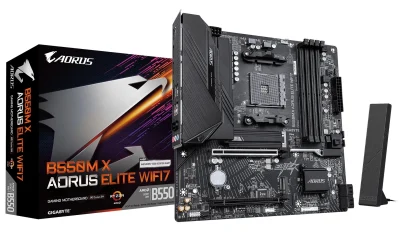
Price Hikes May Be Coming for PC Motherboards Next
-
 Business3 days ago
Oil Price Today (August 11): Crude oil rises to $88 after Trump’s compensation demand dents Hormuz opening. Here’s why
-

 Business6 days ago
Aussie shares lose steam to close record-breaking week
-

 Fashion6 days ago
Weekly News Update, 8.6.26 – Corporette.com
-
 Entertainment6 days ago
Brand New Day’ Characters, Ranked
-

 Entertainment7 days ago
Coastal House Media Can Disney Redeem Live Action Dragon Ball?
-

 Fashion7 days ago
The Best Stores Like Ann Taylor
-

 Fashion6 days ago
Irina Shayk Wows in REVOLVE Los Angeles’ Summer Styles
-

 Fashion6 days ago
Burberry Fall 2026 Takes On Commuter Style
-

 Fashion7 days ago
Coffee Break: Sienna Saddle – Corporette.com
-

 Politics5 days ago
Be quiet, Miriam! – spiked
You must be logged in to post a comment Login