
Crypto World
Why States Are the Key to the Modern Labor Movement


We worked with a team of labor law scholars, former federal labor officials, worker advocates, and union leaders to develop a Model State Sectoral Bargaining Law to meet this need. The model law would give workers the right to petition a State Labor Standards Board for recognition of a bargaining sector, grant organizing and access rights once minimum support thresholds are met, and create a process through which workers and employers can negotiate sector-wide agreements covering wages, benefits, working conditions, and the use of artificial intelligence and other workplace technology. Every employer in a covered sector would be bound by the resulting agreement, and workplace-level collective bargaining agreements may exceed—but never fall below—the sector-wide standards.
States that act now could immediately ensure that workers ignored by federal law can raise standards for themselves. More broadly, states have an opportunity to build the infrastructure of worker power that this country will need in the years ahead.



Cointelegraph is committed to providing independent, high-quality journalism across the crypto, blockchain, AI, and fintech industries.
All news, reviews, and analyses are produced with full journalistic independence and integrity. For more details on our standards and processes, please read our Editorial Policy.
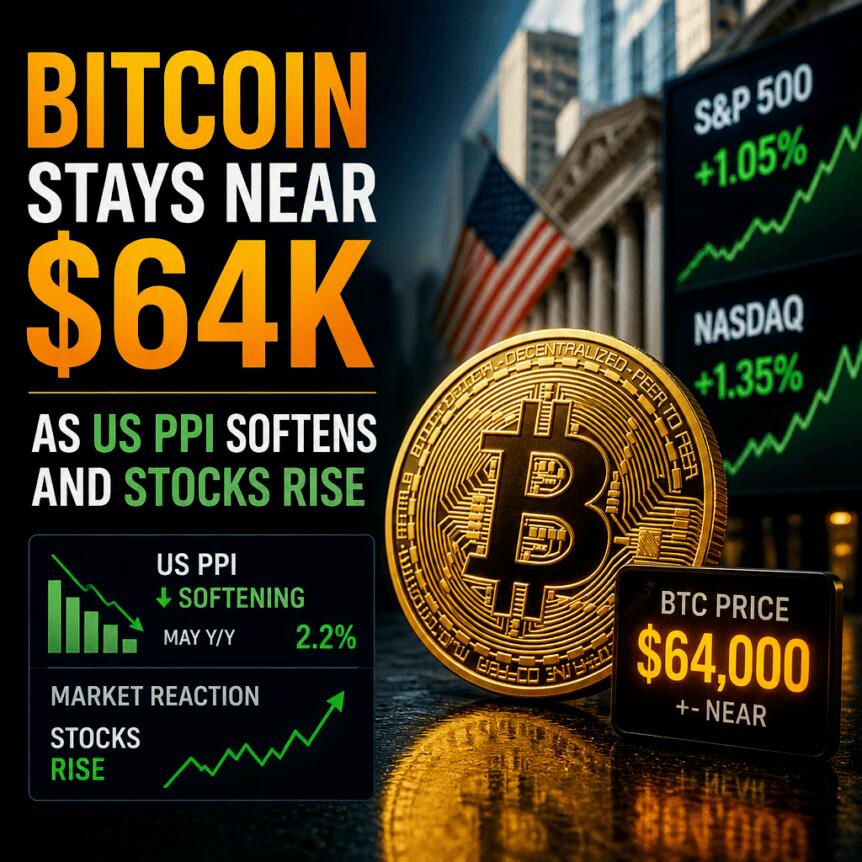
Bitcoin steadied after a dip toward weekly lows, with the latest catalyst coming from cooling US inflation data. On Thursday, BTC moved modestly higher as July’s Producer Price Index (PPI) showed a small decline in the annual rate and left month-on-month inflation unchanged, easing pressure on rate-hike expectations.
Still, traders are watching key downside levels closely. On-chain and liquidation analytics indicate that a move toward $61,000 could trigger concentrated long-position liquidations, potentially accelerating selling if that support breaks.
Key takeaways
- July US PPI came in softer than expected on a year-over-year basis, supporting a risk-on tone in traditional markets.
- Federal Reserve officials remain split on the rate path, but Cleveland Fed president Beth Hammack delivered a cautious message on inflation progress.
- Bitcoin’s near-term price action appears range-bound, leaving liquidation zones at the edges of the range more influential.
- Glassnode cofounder Rafael Schultze-Kraft highlighted $61,000 as a potential flashpoint due to built-up long liquidation risk.
July PPI cools, supports US stocks—and Bitcoin
According to TradingView data, BTC/USD was up roughly 0.5% on the day near $63,900, with volatility relatively muted at the time. The broader tailwind came from July’s US Producer Price Index print published by the US Bureau of Labor Statistics (BLS).
Per the BLS, July’s PPI was unchanged month-on-month at 0.2%, while the year-over-year increase slowed to 4.7% compared with a 4.9% expectation. The BLS attributed the monthly flat reading to offsetting components: a 0.2% rise in final demand services and a 2.2% increase in final demand construction, countered by a 0.7% decrease in final demand goods.
The BLS also noted that falling gasoline and energy prices provided the largest source of relief. Econoday analysts similarly pointed to the flat overall outcome in their commentary on the report.
As the PPI release hit markets, US equities rose at the open. At the time of writing, the S&P 500 and the Nasdaq Composite were up 0.87% and 0.94%, respectively, reflecting renewed optimism that inflation pressures may be easing enough to keep the Federal Reserve on hold.
For crypto investors, the immediate significance is clear: when inflation prints reduce the probability of further tightening, it can improve sentiment across risk assets, including Bitcoin—even if crypto-specific drivers remain secondary in the short run.
Rate-hike bets shift, but the Fed’s tone stays careful
Rate expectations moved in tandem with the data. CME Group’s FedWatch Tool showed 65.6% odds that the Federal Open Market Committee (FOMC) would hold interest rates at the current 3.50% to 3.75% level at its September meeting. The update followed Wednesday’s July Consumer Price Index (CPI) release, which matched expectations and had already supported the “pause” narrative.
However, inflation data may not be enough on its own to settle the Fed debate. The Cleveland Federal Reserve Bank’s president, Beth Hammack, questioned whether recent cooling prints would reliably bring inflation down to the Fed’s 2% goal—and whether the time required would be acceptable. In remarks delivered at an event in Kettering, Ohio, Hammack suggested policymakers may still need continued improvement rather than assuming that favorable prints guarantee a quicker path to target.
Bloomberg reported Hammack’s remarks with the framing that even if the central bank reaches its goal, it could take another three to four years, raising the question of whether that timeline is “OK” for the committee’s outlook.
Notably, Hammack was one of three Fed officials who supported a 0.25% rate hike in July, underscoring that a cautious stance remains present even as incoming inflation data moderates.
Traders eye liquidation pressure near $61,000
Even with the macro tailwind, Bitcoin’s price action has been relatively contained. That makes positioning and liquidation levels more important when BTC approaches range extremes.
Glassnode cofounder Rafael Schultze-Kraft pointed to $61,000 as the next potential trouble spot. In an earlier Tuesday post on X, he wrote that long liquidation risk has built up around $61K over the past few weeks, and that if price reaches that area, forced selling could add momentum to the downside.
In other words, rather than relying purely on technical support as a “line in the sand,” traders may also be considering how derivatives mechanics could amplify any break. When liquidation clusters are concentrated, the market can transition quickly from a slow bleed to a sharp drop—especially if liquidity thins.
This focus on $61,000 also fits with earlier market commentary from Cointelegraph, which reported that $63,000 had started forming a key level after repeated retests increased the odds of a support failure if buyers failed to defend it.
From a trading perspective, the key implication is not that $61,000 is guaranteed to break—rather, it highlights where downside acceleration risk is most pronounced if momentum turns bearish. For spot holders and derivatives traders, that distinction matters: the level is important partly because of how it could trigger broader, mechanical selling pressure.
As of this writing, Bitcoin is still trading off the bounce from weekly weakness, but with macro expectations and Fed messaging still in flux, attention is likely to keep oscillating between inflation-driven sentiment and crypto-specific positioning.
Looking ahead, traders should monitor whether further inflation-related surprises continue to soften rate expectations—and whether BTC can hold key intraday levels without drawing price toward the liquidation pocket around $61,000. The next decisive move may come less from a single headline and more from how markets price the Fed’s timeline after each new data release.


UBS has increased its BlackRock Bitcoin ETF holding to about 2.5 million shares worth nearly $90 million as of June 30, lifting the position’s value by roughly 230% during the first half of 2026.
Summary
- UBS held about 2.5 million IBIT shares valued at nearly $90 million on June 30.
- The share count increased roughly 355% from about 549,000 at the end of 2025.
- A Form 13F does not identify whether UBS or its clients ultimately own the shares.
- BlackRock’s fund gives U.S. investors regulated Bitcoin exposure without direct crypto custody.
The U.S. Securities and Exchange Commission filing, submitted by UBS on Aug. 13, disclosed the Swiss bank’s quarter-end position in BlackRock’s iShares Bitcoin Trust (IBIT). UBS reported about 2.5 million shares as of June 30, up from approximately 549,000 shares six months earlier.
Measured by share count, the position expanded by about 355%, with UBS adding nearly 2 million shares during the period. Its reported value increased from roughly $27 million at the end of 2025 to close to $90 million, a gain of about 230%.
The difference between the two rates partly comes from IBIT’s market performance. BlackRock’s fund data show its market-price return fell 32.95% during the six months through June 30, meaning the increase in the value reported by UBS came from additional shares rather than a rise in IBIT’s price.
What the UBS Bitcoin ETF filing shows
Form 13F requires institutional investment managers exercising discretion over at least $100 million in certain securities to report their holdings to the SEC every quarter. The reports cover positions held at the end of the period, which means UBS could have changed its IBIT exposure between June 30 and the Aug. 13 filing date.
A 13F also does not provide enough information to determine whether every reported share belongs to UBS itself. The filing combines securities managed under the institution’s investment discretion and may include positions held in client, advisory, wealth-management, or asset-management accounts.
As a result, the disclosure should not be treated automatically as a direct $90 million purchase made with the bank’s corporate capital. It confirms that UBS reported control over the IBIT shares for filing purposes, but it does not identify the beneficial owners or explain the investment instructions behind the position.
Even at nearly $90 million, the holding remains small beside the money UBS manages. In its second-quarter results published July 29, the bank reported a record $7.3 trillion in group invested assets, including $36 billion in net new assets at its Global Wealth Management division during the quarter and $73 billion during the first half.
UBS also reported $2.8 billion in net profit for the second quarter and $5.8 billion for the first six months of 2026. Against those figures, the IBIT position represents a limited allocation rather than evidence that Bitcoin has become a major part of the bank’s investment operations.
UBS has expanded regulated crypto access
While the filing does not reveal who directed the IBIT purchases, UBS has continued developing digital-asset services for wealthy customers. In January, crypto.news covered the bank’s plan to give select high-net-worth and ultra-high-net-worth private banking clients access to cryptocurrency investments.
The reported plan followed earlier limits around the bank’s handling of U.S. spot Bitcoin ETFs. UBS had allowed certain wealth-management clients with brokerage accounts to buy the products after their U.S. approval, while applying eligibility and risk controls to access.
Using an exchange-traded product allows the bank and eligible clients to obtain Bitcoin-linked exposure through conventional securities infrastructure. BlackRock states that IBIT seeks to follow Bitcoin’s price while reducing the operational and custody work involved in holding the cryptocurrency directly.
IBIT trades on Nasdaq and charges a 0.25% sponsor fee. Unlike a conventional mutual fund or most ETFs, however, BlackRock says the trust is not registered as an investment company under the Investment Company Act of 1940 and therefore does not receive all the regulatory protections that apply to products registered under the law.
Although investors buy and sell IBIT shares through brokerage accounts, the trust holds Bitcoin as its single underlying asset. BlackRock reported that the fund had about $47.34 billion in net assets and 1.32 billion shares outstanding as of Aug. 12.
UBS’s reported 2.5 million shares would therefore account for about 0.19% of IBIT’s latest outstanding share count. The stake is too small to give UBS control over the fund, while the filing provides no evidence that the bank intends to become a direct Bitcoin custodian.
U.S. Bitcoin ETF access has grown
For American investors, the UBS filing shows how a foreign financial institution can gain exposure to Bitcoin through a security listed and traded in the United States. The SEC approved U.S. spot Bitcoin exchange-traded products in January 2024, creating a route for banks, asset managers, advisers, and brokerage customers to use familiar market infrastructure.
Institutional approaches to the products have varied. A July filing showed that Wells Fargo trimmed its IBIT stake while adding to some other Bitcoin funds and increasing its exposure to Ethereum and Solana investment products. The bank also opened an IBIT call position and increased its put exposure, showing that institutions can use the fund for hedging and trading as well as long-only Bitcoin exposure.
Regulated derivatives around IBIT have also expanded. In July, the SEC allowed NYSE Arca to quadruple its options limit from 250,000 to 1 million contracts after the exchange said trading activity justified a higher ceiling.
NYSE Arca told the regulator that the change would help large participants manage inventory and hedge positions without dividing trades because of exchange limits. The SEC allowed the proposal to take effect immediately while continuing to accept public comments.
Such options can help professional investors manage risk around IBIT, but BlackRock warns that the trust’s value can rise or fall with Bitcoin and that investors may lose principal. Fund data show IBIT returned negative 32.97% on a net asset value basis during the first half of 2026 and negative 45.62% over the 12 months through June 30.
IBIT remains the dominant U.S. Bitcoin fund
Despite its weak first-half performance, IBIT has continued to control a large part of the U.S. spot Bitcoin ETF market. BlackRock’s fund attracted $183.4 million on July 30, accounting for 78.7% of the $233.1 million entering the U.S. products that day.
At the time, IBIT held $47.67 billion in net assets, while the full group of U.S. spot Bitcoin ETFs held about $78.76 billion, according to data cited in July ETF coverage. The July 30 inflow was the fund’s largest since July 6, when it received $209.4 million.
The daily recovery followed an uneven period for Bitcoin investment products. Farside Investors’ figures showed approximately $438.2 million in net inflows from July 1 through July 30 after the funds lost about $2.41 billion in May and $4.51 billion in June.
BlackRock reported an IBIT net asset value of $35.85 and net assets of $47.34 billion as of Aug. 12. The fund also listed a 52-week net asset value range of $33.19 to $71.32 and a 30-day average trading volume of about 35.7 million shares.
UBS must disclose its next quarter-end U.S. securities positions in a later 13F filing, which will show whether the reported IBIT share count was increased, maintained, or reduced as of Sept. 30.

Tether has completed what it describes as its first comprehensive independent audit of its annual financial statements, with KPMG US issuing a clean opinion for its 2025 accounts. The audit, covering the year ended Dec. 31, 2025, extends beyond Tether’s routine reserve attestations by examining the company’s broader financial reporting and the evidence behind it.
According to Tether, the audited statements show reserves exceeding liabilities by $6.814 billion. The company said the engagement tested the balance sheet, income statement and cash flow statements, including the assets backing issued tokens and the liabilities those tokens represent.
Key takeaways
- KPMG US issued an unqualified (clean) opinion on Tether’s 2025 annual financial statements under US accounting standards.
- The audit examined Tether’s full set of annual statements—including systems, transactions, valuations, counterparties, and ownership records—rather than only reserve attestations.
- Tether reported that audited reserves were greater than liabilities by $6.814 billion as of Dec. 31, 2025.
- KPMG physically inspected Tether’s gold holdings, including counting each bar rather than relying only on custodian documentation.
- The result arrives as Tether continues to expand its wider tokenization footprint alongside USDT’s dominance in the stablecoin market.
What makes this audit different from Tether’s usual attestations
For years, Tether has published quarterly reserve attestations that focus on whether the assets backing its stablecoins meet stated coverage levels. This new step moves the verification closer to a traditional financial statement audit—subjecting not just reserve balances but the company’s broader accounting and underlying documentation to independent scrutiny.
Tether said the audit covered its balance sheet, income statement and cash flows for the period ended Dec. 31, 2025, and included review of the transactions and systems used to produce the statements. The audit also involved evaluation of ownership records, valuations, counterparties and related evidence—areas that typically go beyond what reserve attestations concentrate on.
In another key procedural detail, Tether said KPMG physically inspected and counted its gold holdings, verifying each gold bar rather than relying solely on custodian records. That kind of direct verification can be particularly relevant for investors focused on commodity-backed products and the reliability of custody arrangements.
The clean opinion and what Tether says the numbers show
Tether reported that KPMG issued an unqualified opinion, stating that the audited statements fairly present the company’s financial position, results and cash flows in all material respects under US accounting standards. That phrasing is commonly used to indicate there were no material departures from required accounting frameworks as presented in the report.
On the headline coverage metric, Tether said the audited statements reflect reserves exceeding liabilities by $6.814 billion. While investors will likely treat this figure as a high-level indicator rather than a complete picture of risk, it is the central quantitative conclusion tied directly to the audit outcome.
For readers trying to interpret the importance of a clean audit, the practical takeaway is that it reduces one category of uncertainty: whether the reported annual financial statements—covering income and cash flows as well as reserves—were prepared in accordance with the framework and supported by examined evidence.
Tether’s expanding footprint beyond USDT
USDT remains at the center of Tether’s business. The stablecoin’s market capitalization is reported at roughly $183 billion, representing about 61% of the approximately $301 billion stablecoin market, according to DefiLlama. That puts USDT well ahead of the nearest rival, Circle’s USDC, which is reported at about $72 billion.
The audit news also comes as Tether continues investing in areas adjacent to stablecoin issuance. In the company’s reported 2025 performance narrative, Tether said it delivered more than $10 billion in net profit in 2025, with a larger share tied to income from US Treasury holdings and repurchase agreements. In the second quarter of 2025, Tether reportedly posted $1.5 billion in net operating profit, again with Treasury-related income highlighted as the main driver.
Tether has also used profits to fund expansion projects in traditional and crypto-adjacent markets, including investments in Argentine neobank Ualá and Brazilian crypto platform Mercado Bitcoin, each reported as $20 million this year. In addition, Tether has participated in a $50 million funding round for Eight Sleep, according to earlier coverage cited within the article.
At the tokenization layer, Tether’s commodity product is gaining visibility as well. The company’s tokenized gold offering, Tether Gold (XAUt), saw physical reserves increase by 9.5% in the second quarter, with the article noting that XAUt is currently the largest tokenized commodity product at around $2.7 billion in value, based on data from RWA.xyz.
Why investors and builders should watch the next step
An annual audit with an unqualified opinion is the kind of signal that can matter to institutions deciding whether to integrate stablecoins into payment, treasury, and tokenization workflows. It doesn’t automatically resolve every operational or regulatory question around stablecoins, but it does strengthen the credibility of Tether’s annual financial reporting process—especially when compared with periodic reserve attestations alone.
Going forward, market participants will likely focus on whether Tether repeats this level of audit scope in subsequent years and how regulators and counterparties interpret the audit’s evidence-based approach. With USDT still dominating stablecoin market share and Tether expanding into broader tokenized assets, the audited annual accounts may become an increasingly important reference point for due diligence.
The key question for the next cycle is whether this “first full independent audit” becomes a consistent feature of Tether’s transparency toolkit—and how quickly the wider market’s reliance on stablecoins translates into more standardized expectations for audited annual reporting across issuers.

The past week or so has been rather untypically calm for the largest cryptocurrency, with only minor volatility.
However, an important indicator suggests that major turbulence could be approaching, though the eventual direction remains uncertain.
“Explosive Move” on the Way?
The X account Barchart, which focuses on traditional finance, stocks, charts, cryptocurrencies, and everything in between, revealed that Bitcoin’s Bollinger Bands have squeezed to their narrowest point since October 2023. The entity highlighted that the previous occurrence of this setup preceded a 330% rally over the following two years, culminating in the asset’s all-time high above $126,000.
Repeating the scenario, though, shouldn’t be taken as guaranteed. The technical indicator, developed by John Bollinger in the 1980s, consists of a moving average flanked by two channels (upper and lower) that widen in volatile markets and narrow when things calm down.
Squeezing the bands typically foreshadows a big move, yet it provides no clarity on whether a rally or a pullback is ahead. In March this year, the Bollinger Bands (on a monthly basis) tightened to a level never seen before, and days later BTC tumbled from around $75K to approximately $65K.
In May 2025, the crypto community witnessed the opposite reaction. The Bollinger Bands squeezed at a time when the asset was trading at under $95,000, while weeks later it soared beyond $110,000.
Additional Forecasts
Yesterday (August 12), the US Bureau of Labor Statistics released the Consumer Price Index data, and numerous analysts claimed the economic event could be followed by major volatility for BTC. X user Gerla noted that each CPI report from August last year until now has been a precursor to severe turbulence and was sometimes followed by a double-digit price crash for BTC.
It is important to note that the most recent inflation results matched the previous expectations, which should be taken as a positive sign. X user Wealthmanager reminded that the last three times this happened, BTC climbed by 7%, 10%, and 10%, respectively.
Crypto X has recently been flooded with analysts presenting strong arguments that the primary cryptocurrency may have already reached its bottom, potentially preparing for the next leg up. Nonetheless, the risks of a renewed correction remain, as previous estimations suggest the cycle’s floor might be reached sometime in October. Moreover, one should keep in mind that crypto tends to behave unusually and frequently moves against overall expectations.
The post Bitcoin (BTC) Is Coiling for an Explosive Move: Bullish Breakout or Sharp Drop? appeared first on CryptoPotato.

Backed by Uber and powered by Chinese company Pony.ai, Croatia’s Verne has rolled out robotaxi services in the capital city Zagreb since spring 2026.
Marko Perkov | Afp | Getty Images
BEIJING — U.S. ride-hailing giant Uber is ramping up its global robotaxi coverage with operator Pony.ai.
The companies plan to deploy 2,000 of Pony.ai’s self-driving taxis across Europe, and expand the robotaxi partnership to the Middle East, they announced Friday.
In late March, Uber and Pony.ai launched a commercial robotaxi service in Croatia’s capital Zagreb — which they claim is the first in Europe.
The partnership announced Friday will roll out robotaxis to four other European cities. The companies did not name the cities or share an exact timeframe.
Having a large-enough vehicle fleet is critical for commercialization. The more cars available, the more data can be collected to demonstrate safety to regulators and boost operational efficiency. Greater availability encourages more people to use the service.
Alphabet-backed robotaxi operator Waymo is the global leader with a fleet of around 5,000 vehicles, primarily in the U.S. It is testing rides in London, and reportedly set up new entities in four major EU economies in June.
Waymo also has plans underway in Tokyo, and is engaging with officials around the world to “lay the groundwork for global operations,” it said in a statement to CNBC.
Chinese rivals Baidu Apollo Go and WeRide, meanwhile, are ramping up plans and tests for operating autonomous rides in Europe.
Uber is part of many of their plans.
WeRide and Uber in June announced plans to launch Spain’s first robotaxi taxi pilot in Madrid later this year. The two companies also partner in Abu Dhabi and Dubai.
Uber on Thursday announced its Japanese subsidiary signed an agreement with a local taxi operator to manage daily fleet operations for a test deployment of robotaxis in Tokyo later this year.
Uber’s goal is “to become the world’s leading commercialization platform for autonomous vehicles,” CEO Dara Khosrowshahi said earlier this month, according to a FactSet earnings call transcript.
Part of that strategy is gathering “a super set of data” that it can share with its partners to accelerate autonomous vehicle development, he said.
Pony.ai is scheduled to release quarterly earnings Tuesday.
— CNBC’s Lora Kolodny contributed to this report.

At first, it seems like the pressure is off Ale when she’s released from prison in 2023 at 39-years-old, after going in at age 26. She says she wants to work, take trips to the beach, and won’t try to get pregnant again.
“Before, I think, my desire to be a mom was more about pleasing others,” Ale says. Now she wants to know, “What else is out there beyond being a mom?”
Arturo and Ale stayed together when she got out of prison. But eventually, he asked her to have a baby again. “I would indeed like to have a child, not as much as before, but I still have that desire engrained in me,” he says in the documentary, explaining that he likes the idea of children as a way to carry on their parents’ legacy.
Alberdi said it was hard to learn that Arturo still wanted Ale to get pregnant.“[Ale] goes back to society after 13 years, and she has exactly the same pressure again from her husband,” she said. “It’s so painful to see that nothing has changed in these years, and it’s a sad ending.”


Cointelegraph is committed to providing independent, high-quality journalism across the crypto, blockchain, AI, and fintech industries.
All news, reviews, and analyses are produced with full journalistic independence and integrity. For more details on our standards and processes, please read our Editorial Policy.


Neutrl has suspended minting, redemptions, and other protocol functions while it assesses an unspecified reserve issue affecting roughly $53.7 million of NUSD in circulation.
Summary
- Neutrl stopped core protocol functions after circumstances affected its reserves.
- Legal counsel advised the suspension while the team determines the scale of the impact.
- NUSD continues to trade near $0.998 despite limited secondary-market volume.
- Neutrl’s reserve dashboard says its financial figures are being recalibrated.
Neutrl pauses redemptions during reserve assessment
Neutrl said in an Aug. 13 X post that it had temporarily paused minting, redemptions, and other protocol functions following circumstances that affected the protocol’s reserves.
Acting on advice from legal counsel, the team said it imposed the restrictions to protect users’ interests and maintain an orderly process while assessing the impact. Neutrl did not provide an expected date for restoring the affected functions.
Users will receive a “clear and orderly process” at the appropriate time, according to the announcement. Details covering the timeline and next steps will be published once they become available.
No reserve asset, custodian, trading venue, or counterparty was identified in the post. Neutrl also did not disclose the value of the affected reserves or state whether the matter involves a realized loss, unavailable liquidity, an inaccurate valuation, or an operational issue.
Without those details, the announcement does not establish whether NUSD remains fully backed. It also provides no basis for identifying a specific reserve strategy or external company as the source of the problem.
NUSD reserve figures await recalculation
Neutrl’s reserve dashboard previously reported $91 million in assets against $90 million of outstanding NUSD as of June 21. The figures represented reserve coverage of 101.12% and a surplus of about $1 million.
At present, the dashboard no longer provides a detailed allocation across assets or venues. Sections covering reserve deployment, capital allocation, and solvency instead state that the figures are “being recalibrated” and will be updated soon.
According to the protocol’s documentation, NUSD is not backed only by cash or short-dated government securities. Neutrl allocates capital among liquid stablecoin holdings, yield-bearing assets, bilateral OTC positions, and market-neutral trading strategies.
OTC assets may be acquired at discounted prices and hedged when the positions are opened, the documentation states. Other returns can come from funding-rate or basis trades structured to reduce exposure to the direction of the underlying crypto market.
Custody, trading and settlement may take place across custodians, centralized venues and smart contracts. Neutrl lists Fireblocks and Ceffu among its custody and key-management partners, while its security page names Cantina, Spearbit, Sherlock, and Hypernative as audit or monitoring providers. The company does not claim that any of the named firms caused the present reserve issue.
In June, a crypto.news guide explained that synthetic dollars using hedged trading strategies carry different risks from fiat-backed payment stablecoins. Returns may depend on funding rates, basis spreads, or asset hedges, leaving holders exposed to market, protocol, liquidity, and counterparty conditions.
Neutrl’s model also relies on a liquid reserve buffer to process withdrawals. A January risk assessment by BA Labs said redemptions falling within the available buffer could normally be completed immediately, while larger requests could depend on the protocol converting or releasing less-liquid positions.
NUSD holds near $1 as liquidity remains limited
NUSD has remained close to its intended dollar value following the suspension. RWA.xyz placed the token at approximately $0.9984, while other available market feeds showed a 24-hour range of about $0.9981 to $0.9991.
Daily trading activity remained thin. Bybit showed approximately $23,000 in 24-hour volume, meaning the quoted price came from a relatively small amount of secondary-market trading.
A stablecoin depeg guide published in July noted that reserve backing can support a dollar peg only when holders can reach those reserves through functioning redemption channels. Neutrl’s direct redemption route is currently unavailable, although NUSD can still trade through decentralized liquidity pools.
Curve’s main NUSD-USDC pool held approximately $3.54 million at the latest available reading. Its balance consisted of about $1.83 million in NUSD and $1.71 million in USDC, leaving the pool split at roughly 52% and 48%.
Earlier liquidity was higher. BA Labs placed the same pool at about $5.2 million in January, with enough USDC at the time to exchange approximately 2.3 million NUSD within a 2% slippage range.
RWA.xyz reported about 53.7 million NUSD in circulation, down 18.4% over the preceding 30 days. Current supply is also well below the $90 million shown on Neutrl’s June reserve snapshot, but neither Neutrl nor the data provider has attributed the decrease to the newly disclosed reserve situation.
The same dashboard counted 615 NUSD holders and 347 active addresses over the previous 30 days. Monthly transfer volume stood near $71.4 million, down about 72% from the preceding period.
Strata restricts products built on Neutrl
Strata Markets also suspended minting and redemptions for structured products tied to Neutrl’s staked NUSD. The restrictions apply to srNUSD and jrNUSD, while Strata said its other markets continue to operate normally.
Under normal conditions, users can deposit sNUSD into Strata and receive either a senior or junior tranche. The senior token, srNUSD, receives a more stable share of the underlying return, while jrNUSD takes the first losses and receives leveraged exposure to yield after the senior allocation is paid.
Strata’s documentation lists a standard redemption fee of 0.05% for the senior tranche and 0.20% for the junior tranche. Fees and withdrawal conditions can change according to the market’s senior-coverage ratio.
CoinGecko placed the displayed market capitalization of srNUSD at about $1.4 million, based on roughly 1.3 million tokens. The tracker said srNUSD had not recorded active exchange trading for 18 days, with its quoted value of about $1.04 taken from the token contract rather than an active market.
Available snapshots placed the junior tranche between approximately $308,000 and $407,000 in on-chain value. Because jrNUSD is designed as the first-loss layer, its treatment will depend on the size and nature of any reserve impact disclosed by Neutrl or Strata.
U.S. rules exclude NUSD from payment stablecoin protections
RWA.xyz categorizes NUSD as a non-regulated synthetic dollar offered to non-U.S. investors. The platform lists Panama as its dispute-resolution jurisdiction and does not identify deposit insurance, a bankruptcy-remote structure, or a U.S. regulatory framework covering the token.
For American users who may have obtained NUSD through decentralized markets, the product does not carry the reserve rules applied to permitted U.S. payment stablecoins. The GENIUS Act framework requires covered issuers to maintain one-to-one backing in assets such as cash, insured deposits, short-dated Treasury bills, and Treasury-backed repurchase agreements.
The law also bars permitted payment-stablecoin issuers from paying yield directly to holders. Synthetic and yield-bearing tokens do not automatically receive payment-stablecoin status, particularly when their returns come from trading strategies or crypto collateral rather than the liquid reserve assets allowed under the statute.
GENIUS Act implementation is scheduled for the earlier of Jan. 18, 2027, or 120 days after regulators finalize the required rules. NUSD’s current product page identifies it as available to non-U.S. investors and lists USDC, USDT, and USDe among the assets accepted through its primary minting process.


Conflux Network has scheduled its v3.1.0 hard fork for Aug. 25, requiring node operators to install the update before seven network proposals and a private security fix take effect.
Summary
- Conflux node operators must install v3.1.0 before the network reaches the Aug. 25 deadline.
- Seven proposals will improve Ethereum compatibility and correct transaction and staking problems.
- CIP-173 is expected to take effect on Aug. 26, one day after the upgrade deadline.
- Conflux will disclose details of a private security fix after the hard fork is completed.
Conflux v3.1.0 requires a mandatory update
Conflux Network said in an Aug. 3 announcement that all nodes must install version 3.1.0 before the blockchain reaches epoch 155140000, which is expected on Aug. 25.
An epoch is a numbered stage in a blockchain’s operation. Conflux has used the target number to set the official deadline because the precise activation time can change depending on how quickly the network produces blocks.
Node operators who update before the deadline can install the new software and restart their systems. Conflux advised operators to complete the process within two days of beginning the update.
Operators who wait until after the target epoch will face a more difficult process. According to the announcement, they will have to remove their existing blockchain data, install the latest version, and download the network records again.
Nodes that remain on older software will no longer be fully compatible with the upgraded blockchain. Conflux warned that affected operators may be unable to download new blocks, process transactions, or continue mining.
The update also requires operators to replace an important settings file with the new copy included in the release. Using the old file will prevent a node from starting because version 3.1.0 applies stricter checks to its settings.
Operators who previously changed where their node stores data or records activity can transfer those choices to the replacement file. Conflux has also provided an updated list of entry points that nodes use when first connecting to other participants on the network.
A separate optional setting can reduce the amount of storage used by a node. Activating it will make the first restart take longer while the software rebuilds a current record of account balances and other network information, but later restarts should return to their normal duration.
Seven Conflux proposals will change network rules
Conflux plans to activate CIP-166, CIP-167, CIP-172, CIP-173, CIP-174, CIP-175 and CIP-176. A CIP, or Conflux Improvement Proposal, describes a planned change to the network’s rules or features.
Three proposals will make Conflux eSpace work more closely with applications built for Ethereum. eSpace is the part of Conflux that supports Ethereum-based smart contracts, wallets, and development tools.
CIP-166 adds a new operation that allows applications to count the empty digits at the start of a computer value. While mainly useful to developers, the change keeps Conflux aligned with a recent Ethereum network standard.
Under CIP-167, Conflux will add direct support for checking a type of digital signature commonly used by passkeys and online identity systems. Passkeys allow users to sign in through methods such as a fingerprint, facial scan, or device security code instead of entering a traditional password.
The proposal may help developers create wallets and applications with more familiar login systems. According to Conflux, the same signature method is already used by WebAuthn, the online authentication standard that supports passkeys.
For U.S.-based developers, the update provides a technical route for building applications that work with passkey systems already available on widely used devices and browsers. The Conflux announcement does not introduce separate trading, tax, or regulatory rules for American CFX holders.
CIP-174 will limit the size of information sent to a calculation-heavy network feature and increase the transaction fee charged for using it. Conflux linked the proposal to two Ethereum changes designed to prevent unusually large requests from consuming too many network resources.
Conflux previously expanded its Ethereum-compatible environment to support wallets, applications, and token transfers built around Ethereum standards. That design recently gained more importance for CFX traders after Upbit restricted deposits and withdrawals to Conflux eSpace.
As crypto.news previously reported, the South Korean exchange warned users that CFX sent through Core Space or another unsupported network could require a lengthy recovery process. Core Space is Conflux’s original operating environment, while eSpace supports Ethereum-compatible tools.
Transaction and staking problems will be corrected
Four proposals focus on flaws found in existing network behavior. CIP-172 will require every transaction added to a block to follow one approved format.
Conflux said the current issue can allow the same transaction to receive more than one identifying code. Since blockchain services use those codes to locate and verify transfers, the update will require a single standard format.
Nodes running the new software will begin rejecting incorrectly formatted transactions before the full hard fork takes effect. The early protection will apply as soon as an operator installs version 3.1.0.
CIP-173 addresses problems in the network’s process for reviewing disputes involving proof-of-stake validators. Validators lock CFX to help confirm network activity and can face penalties when they break the rules.
The proposal will also extend an existing lock on staked CFX to validators who have already started withdrawing their entire deposit. Conflux expects CIP-173 to activate at proof-of-stake block 3749400 on Aug. 26.
CIP-175 corrects a problem affecting certain calls between Core Space and eSpace. In some cases, the network did not properly recognize the permission that one account had given another account to act on its behalf.
CIP-176 fixes how the network prepares stored information for use during a transaction. When the same account appeared several times in a transaction’s access list, Conflux prepared only the information attached to its final appearance. Version 3.1.0 will process all relevant entries.
The software release also improves how the proof-of-stake system handles pending transactions and new block proposals. Conflux said existing nodes will not need to download the entire blockchain again solely because of the internal storage changes included in the release.
Major Conflux upgrades have previously drawn attention to CFX. In July 2025, coverage of Conflux 3.0 recorded a roughly 70% rally from $0.1450 to $0.2416 after the earlier update was announced.
Trading volume and open positions in the derivatives market also rose sharply during that period. The v3.1.0 announcement, however, provides no CFX price forecast and focuses on the steps required from network operators.
Security fix will remain private until the hard fork
Conflux said version 3.1.0 contains a fix for a security weakness but will not publish the related technical details until the network upgrade has been completed.
According to the project, an early disclosure could give attackers enough information to target nodes that have not yet installed the update. Conflux will therefore delay publishing the affected sections of its software until operators have had time to move to the protected version.
The team also warned operators against building their own version from the project’s latest unfinished software. Such copies may not match the official mainnet release and could cause an operator to follow a different version of the blockchain.
Conflux used a similar coordinated process in March 2025 when it repaired a flaw affecting how contracts were placed at blockchain addresses. Earlier security coverage reported that the problem could allow a contract to replace another contract already stored at the same address and return its settings to their original state.
The project said version 2.5 corrected the flaw after the ecosystem team, GraFun, privately reported it. GraFun received 60,000 CFX, including 50,000 CFX for finding the problem and 10,000 CFX for reporting it quickly enough to reduce the risk of exploitation.
Beyond the private security patch, version 3.1.0 repairs several crashes that could be caused by damaged messages from other nodes, incorrect requests sent to the network, or unusual information recorded on-chain.
The update also adds two new tools for eSpace services, improves controls that limit excessive requests, and corrects several errors in transaction records. Conflux has removed an older connection method while keeping the commonly used web and live connection options unchanged.
Additional maintenance work covers a crash during shutdown, excessive activity records during periods of heavy network use, and several outdated software parts. Version 3.1.0 also adds a meter that allows operators to monitor the number of transactions their nodes process in real time.

Flock Safety new privacy reforms cut data retention in privacy protection push

CFTC to Join SEC in Exploring Crypto Regulations without CLARITY Bill

Galle crosswinds add a layer of intrigue to contest


-

 Fashion6 days ago
Weekend Open Thread: Mattifying Sunscreen
-

 Fashion7 days ago
Frugal Friday’s Workwear Report: Cap-Sleeve Pointelle Crewneck Sweater
-

 News Videos6 days ago
Can Astrology Help Find Gold and Silver Trends? A Financial Astrology Guide
-

 Tech6 days ago
Rinn Pharma & Biopharma to join NordicPharmaTrain network
-

 Business5 days ago
How to Start a Cleaning Business: A Step-by-Step Guide
-

 Business5 days ago
Datadog: Best Of Breed For Multiple Reasons
-

 Business5 days ago
BDC Weekly Review: Private BDC Q2 Numbers Are Strong
-
 NewsBeat2 days ago
Communication cards help banking customers access services or report scams
-

 Business7 days ago
Brightwater secures funding for WA-first dementia projects
-
 Business3 days ago
Oil Price Today (August 11): Crude oil rises to $88 after Trump’s compensation demand dents Hormuz opening. Here’s why
-

 Tech7 days ago
Price Hikes May Be Coming for PC Motherboards Next
-

 Business7 days ago
Aussie shares lose steam to close record-breaking week
-

 Fashion6 days ago
Weekly News Update, 8.6.26 – Corporette.com
-
 Entertainment7 days ago
Brand New Day’ Characters, Ranked
-

 Fashion7 days ago
Irina Shayk Wows in REVOLVE Los Angeles’ Summer Styles
-

 Fashion7 days ago
Burberry Fall 2026 Takes On Commuter Style
-

 Fashion4 days ago
Amazon Sundays: Closet Care Before Fall
-

 Politics5 days ago
Be quiet, Miriam! – spiked
-

 Sports7 days ago
Report: Kawhi Leonard had undisclosed deal with Clippers’ scoreboard maker
-

 Business7 days ago
South Korea cracks down on Trader Joe’s popular seasoning
You must be logged in to post a comment Login