
Crypto World
Bitcoin Stays Near $64K as US PPI Softens and Stocks Rise

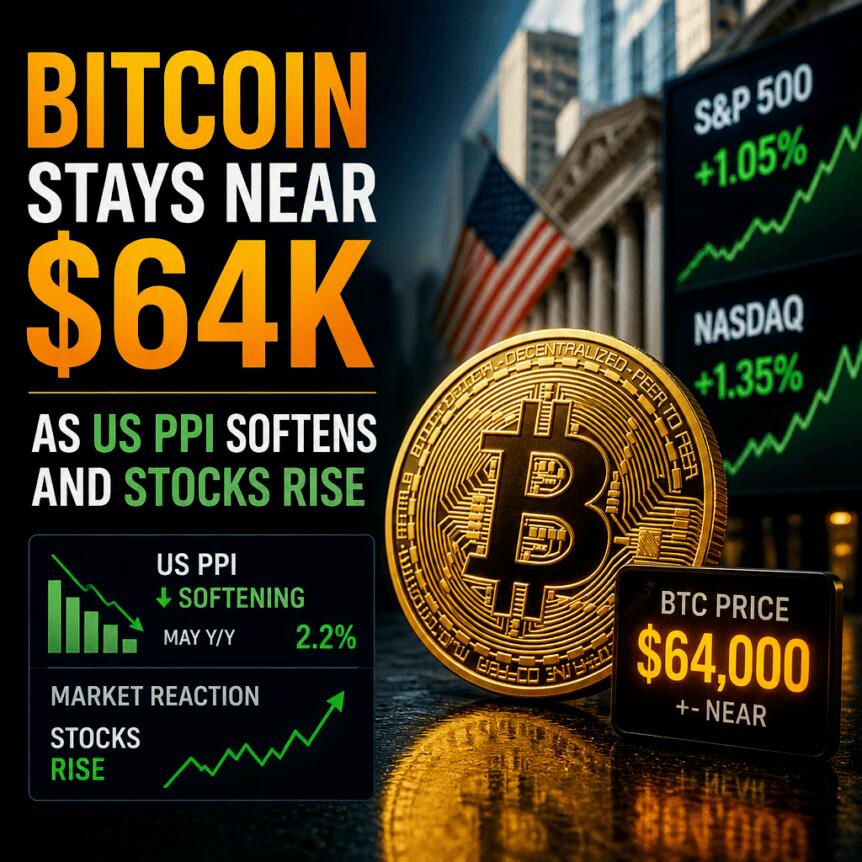
Bitcoin steadied after a dip toward weekly lows, with the latest catalyst coming from cooling US inflation data. On Thursday, BTC moved modestly higher as July’s Producer Price Index (PPI) showed a small decline in the annual rate and left month-on-month inflation unchanged, easing pressure on rate-hike expectations.
Still, traders are watching key downside levels closely. On-chain and liquidation analytics indicate that a move toward $61,000 could trigger concentrated long-position liquidations, potentially accelerating selling if that support breaks.
Key takeaways
- July US PPI came in softer than expected on a year-over-year basis, supporting a risk-on tone in traditional markets.
- Federal Reserve officials remain split on the rate path, but Cleveland Fed president Beth Hammack delivered a cautious message on inflation progress.
- Bitcoin’s near-term price action appears range-bound, leaving liquidation zones at the edges of the range more influential.
- Glassnode cofounder Rafael Schultze-Kraft highlighted $61,000 as a potential flashpoint due to built-up long liquidation risk.
July PPI cools, supports US stocks—and Bitcoin
According to TradingView data, BTC/USD was up roughly 0.5% on the day near $63,900, with volatility relatively muted at the time. The broader tailwind came from July’s US Producer Price Index print published by the US Bureau of Labor Statistics (BLS).
Per the BLS, July’s PPI was unchanged month-on-month at 0.2%, while the year-over-year increase slowed to 4.7% compared with a 4.9% expectation. The BLS attributed the monthly flat reading to offsetting components: a 0.2% rise in final demand services and a 2.2% increase in final demand construction, countered by a 0.7% decrease in final demand goods.
The BLS also noted that falling gasoline and energy prices provided the largest source of relief. Econoday analysts similarly pointed to the flat overall outcome in their commentary on the report.
As the PPI release hit markets, US equities rose at the open. At the time of writing, the S&P 500 and the Nasdaq Composite were up 0.87% and 0.94%, respectively, reflecting renewed optimism that inflation pressures may be easing enough to keep the Federal Reserve on hold.
For crypto investors, the immediate significance is clear: when inflation prints reduce the probability of further tightening, it can improve sentiment across risk assets, including Bitcoin—even if crypto-specific drivers remain secondary in the short run.
Rate-hike bets shift, but the Fed’s tone stays careful
Rate expectations moved in tandem with the data. CME Group’s FedWatch Tool showed 65.6% odds that the Federal Open Market Committee (FOMC) would hold interest rates at the current 3.50% to 3.75% level at its September meeting. The update followed Wednesday’s July Consumer Price Index (CPI) release, which matched expectations and had already supported the “pause” narrative.
However, inflation data may not be enough on its own to settle the Fed debate. The Cleveland Federal Reserve Bank’s president, Beth Hammack, questioned whether recent cooling prints would reliably bring inflation down to the Fed’s 2% goal—and whether the time required would be acceptable. In remarks delivered at an event in Kettering, Ohio, Hammack suggested policymakers may still need continued improvement rather than assuming that favorable prints guarantee a quicker path to target.
Bloomberg reported Hammack’s remarks with the framing that even if the central bank reaches its goal, it could take another three to four years, raising the question of whether that timeline is “OK” for the committee’s outlook.
Notably, Hammack was one of three Fed officials who supported a 0.25% rate hike in July, underscoring that a cautious stance remains present even as incoming inflation data moderates.
Traders eye liquidation pressure near $61,000
Even with the macro tailwind, Bitcoin’s price action has been relatively contained. That makes positioning and liquidation levels more important when BTC approaches range extremes.
Glassnode cofounder Rafael Schultze-Kraft pointed to $61,000 as the next potential trouble spot. In an earlier Tuesday post on X, he wrote that long liquidation risk has built up around $61K over the past few weeks, and that if price reaches that area, forced selling could add momentum to the downside.
In other words, rather than relying purely on technical support as a “line in the sand,” traders may also be considering how derivatives mechanics could amplify any break. When liquidation clusters are concentrated, the market can transition quickly from a slow bleed to a sharp drop—especially if liquidity thins.
This focus on $61,000 also fits with earlier market commentary from Cointelegraph, which reported that $63,000 had started forming a key level after repeated retests increased the odds of a support failure if buyers failed to defend it.
From a trading perspective, the key implication is not that $61,000 is guaranteed to break—rather, it highlights where downside acceleration risk is most pronounced if momentum turns bearish. For spot holders and derivatives traders, that distinction matters: the level is important partly because of how it could trigger broader, mechanical selling pressure.
As of this writing, Bitcoin is still trading off the bounce from weekly weakness, but with macro expectations and Fed messaging still in flux, attention is likely to keep oscillating between inflation-driven sentiment and crypto-specific positioning.
Looking ahead, traders should monitor whether further inflation-related surprises continue to soften rate expectations—and whether BTC can hold key intraday levels without drawing price toward the liquidation pocket around $61,000. The next decisive move may come less from a single headline and more from how markets price the Fed’s timeline after each new data release.



ether.fi is adding tokenized stock trading, portfolio-wide borrowing and global fiat transfers to its app, moving the liquid staking protocol further into retail banking products. The company announced the changes Thursday as part of what it calls its Summer release. The launch continues a shift… Read the full story at The Defiant

The women in the new study were prescribed estrogen only, and not the combination of estrogen and progesterone that is more commonly used to treat menopausal symptoms. Progesterone is prescribed to protect the uterus, but women who have had a hysterectomy, like those in the study, can safely be prescribed estrogen. This population provides a good way to study the effects of estrogen itself, since researchers believe it’s the hormone with more wide-ranging effects on the body, including in the brain.
Hadi Hosseini, an associate professor of psychiatry at Stanford and co-author of the study, says the results don’t establish a cause-and-effect link between estrogen and Alzheimer’s disease, but they do provide a reason to further study the role of the hormone in the neurodegenerative disease. “Previous studies,” including the Women’s Health Initiative, “showed that hormone therapy—estrogen plus progesterone—had a negative effect on Alzheimer’s disease risk and memory outcomes,” he says. “These data are bringing awareness to the fact that maybe we need to reconsider some of the previous findings, since we can now look properly at Alzheimer’s disease outcomes, different formulations of hormone therapy, different times of initiating the therapy, and different durations of use.”


The CFTC has scheduled a three-hour meeting for Aug. 20 to examine crypto assets, artificial intelligence, prediction markets, and its recent work across the three sectors.
Summary
- The CFTC Innovation Advisory Committee will meet from 1 p.m. to 4 p.m. EDT.
- Committee members will attend in Washington, while the public can watch the meeting online.
- Crypto assets, AI, and prediction markets are listed among the main discussion areas.
- Written public statements related to the meeting must be submitted by Aug. 27.
CFTC meeting will put crypto and AI policy on the agenda
The Commodity Futures Trading Commission said in an Aug. 11 Federal Register notice that its Innovation Advisory Committee will hold its inaugural meeting on Aug. 20, bringing members together to discuss crypto assets, artificial intelligence, and prediction markets.
Scheduled to run from 1 p.m. to 4 p.m. Eastern Daylight Time, the meeting will take place in person for committee members in Washington. Members of the public will be able to follow the proceedings virtually, and the session may finish before 4 p.m. if the committee completes its business early.
The CFTC said recent agency activity involving the three areas will also form part of the discussion. Its notice does not identify a proposed rule that members will vote on, nor does it state that the meeting will produce immediate policy changes.
Rather, the IAC advises the commission on issues where technology, law, policy and finance overlap. Its recommendations may inform the agency’s work, but the committee does not independently adopt or enforce CFTC regulations.
Chairman Michael S. Selig, who sponsors the committee, announced the meeting separately on Aug. 10. According to the CFTC announcement, the group consists of U.S. entrepreneurs, researchers, industry participants, and other specialists chosen to give the agency input on changes in financial markets.
Selig’s announcement described the subjects under review as part of a “new frontier of finance.” However, the release did not include a detailed regulatory proposal for crypto, AI or prediction markets, leaving the committee’s specific discussion points to the meeting agenda and presentations.
Crypto oversight has become a larger CFTC responsibility
Digital assets enter the meeting as Congress continues to consider giving the CFTC a more extensive role in U.S. crypto markets. Existing law already gives the agency authority over commodity derivatives, including futures and options tied to assets such as Bitcoin, while the SEC oversees securities and securities transactions.
Pending market-structure legislation could expand the CFTC’s responsibilities in digital commodity spot markets. A recent crypto.news review of CFTC capacity reported that the agency had 556 employees and a $365 million budget, compared with about 4,200 staff and a $2.149 billion budget at the SEC.
The CFTC’s Office of Inspector General identified digital asset regulation as its leading management and performance challenge for 2026, according to the same report. Any expansion of the agency’s authority would therefore place staffing, technology and funding questions alongside decisions about registration, market surveillance and customer protection.
Work on crypto policy has continued while lawmakers debate the agency’s future remit. In March, the CFTC joined the SEC in issuing an interpretation on how federal securities laws apply to certain crypto assets and related transactions. The two regulators also signed a memorandum of understanding covering coordination between their agencies.
The commission has taken separate action in crypto derivatives markets. In May, it approved KalshiEX’s Bitcoin perpetual futures contract and issued staff relief involving Coinbase Financial Markets and certain foreign crypto perpetual products.
As reported at the time, the Kalshi decision opened a federally regulated route for U.S. traders to access a Bitcoin perpetual futures product. The related Coinbase letter allowed specified customer-owned digital commodities and payment stablecoins to be transferred to an affiliated foreign broker as margin, subject to the conditions set by CFTC staff.
Prediction markets face federal and state disputes
Prediction markets will give the committee another unresolved U.S. regulatory issue to examine. The platforms offer event contracts whose payouts depend on the outcome of elections, sporting events, economic data releases, and other measurable events.
CFTC-registered exchanges maintain that eligible event contracts fall under federal derivatives law. State gaming regulators and other critics have challenged some sports-related products as unlicensed betting, leading to litigation over whether federal derivatives oversight displaces state gambling rules.
During 2026, the commission reaffirmed its view that it holds exclusive federal jurisdiction over prediction markets within the derivatives framework. It also withdrew a 2024 proposal that would have restricted contracts involving political contests, sports, and other listed categories.
In March, the CFTC started another public process focused on event-contract regulation. Submissions came from prediction market operators, crypto companies, venture investors, and state gambling authorities, according to a May policy report.
More recent requests show that the disagreement extends beyond the basic question of federal authority. On Aug. 3, the NFL asked the CFTC to require a minimum age of 21, stronger controls against insider trading, and closer reviews of sports contracts, according to the league’s comments covered in a prediction-market filing.
The commission has also addressed how event contracts are presented to customers. In an Aug. 7 staff letter, its Division of Market Oversight and Market Participants Division reminded regulated entities that their pricing displays and marketing must clearly distinguish derivative products from bookmaker-style wagering.
AI discussion follows the CFTC’s own use of the technology
Artificial intelligence will be considered both as a financial-market tool and as technology already being used inside the regulator. The CFTC has applied AI to tasks that include reviewing registration materials and examining trading data, according to public statements from Selig.
Such use raises questions about data quality, automated analysis, and regulatory accountability within the agency’s operations. The official meeting notice does not list individual AI systems, potential safeguards, or a planned enforcement policy, so any recommendations will depend on the presentations and committee discussion on Aug. 20.
The IAC works alongside the CFTC’s Innovation Task Force, which Selig created in March to develop policy involving crypto and blockchain technology, AI and autonomous systems, and prediction markets and event contracts. Michael J. Passalacqua leads the task force with staff drawn from several parts of the commission.
When announcing the task force, Selig said clear rules could support “responsible innovation at home” and prevent U.S. market participants from being “left on the sidelines.” The CFTC also said the team would coordinate with other federal bodies, including the SEC and its Crypto Task Force.
Public participation in the IAC meeting will remain open after the livestream ends. The Federal Register notice allows interested parties to submit written statements until Aug. 27 through Regulations.gov, by mail to CFTC Secretary Christopher Kirkpatrick, or by hand delivery to the commission’s Washington headquarters. Submissions must identify the “Innovation Advisory Committee,” and the CFTC said qualifying statements will become part of the public record.


Tether has completed its first independent financial statement audit, with KPMG U.S. issuing an unqualified opinion after reviewing its 2025 accounts and a reported $6.814 billion reserve surplus.
Summary
- KPMG audited Tether International’s financial statements for the year ended Dec. 31, 2025.
- Tether reported reserve assets exceeding related liabilities by $6.814 billion at year-end.
- Auditors examined transactions, systems, valuations, counterparties, ownership records, and supporting documents.
- KPMG physically counted and inspected every gold bar held by Tether.
Tether said Thursday that KPMG U.S. conducted the audit of Tether International, S.A. de C.V. under applicable professional standards and issued an unqualified opinion on the company’s financial statements.
KPMG’s opinion covers Tether’s full 2025 accounts
Rather than examining only a reserve report at a particular date, KPMG reviewed the company’s financial position as of Dec. 31, 2025, along with its operating results and cash flows for the full year. The audit covered the balance sheet, income statement, statement of changes in equity, and cash flow statement.
According to Tether, KPMG concluded that the statements “present fairly, in all material respects” the company’s financial position and results under U.S. generally accepted accounting principles.
An unqualified opinion means the auditor did not attach reservations, exceptions, or qualifications to its conclusion. Tether described the result as a clean audit, although the opinion applies specifically to the audited 2025 financial statements and the related evidence examined by KPMG.
The audit also tested the records supporting individual balance-sheet entries. KPMG examined transactions, internal systems, asset ownership, valuations, counterparties, and documents used to prepare the accounts, according to the announcement.
Tether CFO Simon McWilliams said the audited statements reported that reserves exceeded the liabilities connected to issued tokens by $6.814 billion at the end of 2025. The company said the result was consistent with the reserve figures it had disclosed through earlier attestations.
KPMG separately inspected Tether’s physical gold holdings. Auditors counted every bar and checked its identifying information instead of depending only on statements supplied by custodians or other counterparties.
Tether audit goes beyond quarterly attestations
Tether has published independent reserve attestations for several years, but an attestation has a narrower purpose than a full audit of annual financial statements. Reserve reports generally address management’s presentation of assets and liabilities at a set reporting date, while the KPMG engagement covered Tether’s accounts and underlying evidence for an entire financial year.
The company began the process in March after appointing an unnamed Big Four accounting firm. As crypto.news previously reported, the engagement followed an initial review of Tether’s systems, internal controls, and financial reporting procedures.
Tether later identified KPMG as the auditor. CFO McWilliams had joined the company in early 2025 with responsibility for developing the internal finance structure needed to complete a full audit.
At the time of the March engagement, USDT had a market capitalization above $184 billion and more than 550 million users, according to Tether. In its latest announcement, the company put its user base above 650 million, largely across emerging markets where people use USDT for payments, savings, remittances, and access to U.S. dollars.
CEO Paolo Ardoino said KPMG did not limit its work to headline reserve figures. According to Ardoino, the firm examined the assets, records, transactions, systems, and other evidence supporting the financial statements under standards set by the American Institute of Certified Public Accountants.
Tether called the engagement the largest inaugural financial audit in history. KPMG’s opinion, however, addresses whether the statements were fairly presented under U.S. GAAP; the claim about the audit’s record size came from Tether.
Reserve figures changed after the 2025 audit date
Because the audited statements cover the year ending Dec. 31, 2025, the $6.814 billion surplus is separate from the reserve figures disclosed in Tether’s quarterly reports during 2026.
At the end of the first quarter, Tether reported $191.8 billion in assets and $8.23 billion in excess reserves. Its second-quarter attestation, prepared by BDO and released July 31, later placed assets at $187.75 billion against liabilities of $183.64 billion.
July reserve data showed that Tether generated about $1.5 billion in second-quarter net operating profit while its excess reserve cushion fell to $4.11 billion. USDT supply stood at about $184.6 billion at the end of June, and the token accounted for more than 60% of the global stablecoin market.
Tether’s asset mix had also continued to change after the audited year closed. The Q2 attestation showed physical gold holdings of about 146.2 metric tons and Bitcoin holdings of 98,933 BTC, while the company reduced its secured lending exposure during the quarter.
Gold formed part of the KPMG verification work for the 2025 statements. By March 31, 2026, Tether reported roughly 707,747 fine troy ounces backing its XAUT token, up from about 520,000 ounces at the end of 2025. Earlier, Tether Gold figures valued the token’s bullion reserves at more than $3.3 billion.
U.S. stablecoin rules keep audit requirements in focus
KPMG’s use of U.S. GAAP gives American investors and counterparties a familiar accounting basis for reviewing Tether’s 2025 financial statements. An unqualified audit opinion does not, by itself, determine whether USDT complies with U.S. stablecoin law or qualifies for continued listing on American trading platforms.
The GENIUS Act established federal rules for payment stablecoin issuers, including reserve, disclosure, and supervisory requirements. President Donald Trump signed the legislation in July 2025, with several provisions requiring agencies to complete implementing rules before the framework takes full effect.
Tether operates USDT through an issuer outside the United States, making the law’s treatment of foreign stablecoins relevant to its access to American centralized exchanges. Legal experts have said foreign issuers may need to follow lawful freeze and seizure orders once the law becomes effective, while other conditions tied to exchange listings have a longer implementation period.
A July review of USDT access found that the general transition period runs into 2028, although the timing of some obligations for foreign issuers remains subject to regulatory interpretation. Tether has said it intends to comply with the law, but federal agencies have not completed all rules governing foreign stablecoin issuers.
Alongside USDT, Tether has introduced USAT as a separate dollar-backed token built for the American market. Anchorage Digital Bank issues USAT under a U.S.-regulated structure, while Cantor Fitzgerald serves as reserve custodian.


Trezor said a breach at third-party shipping provider ShipMonk exposed personal and order data belonging to 13,689 recent customers, including names and contact details that can be used for targeted phishing. Shipping addresses also create a potential physical-security risk by tying named customers… Read the full story at The Defiant
Robinhood Ventures Fund II priced 8 million common shares at $25 each, creating a $200 million gross initial public offering for a fund designed to give retail investors exposure to private companies. Robinhood said the shares are expected to begin trading on the New York Stock Exchange on Aug. 13… Read the full story at The Defiant


Mitsubishi UFJ Financial Group (MUFG) plans to use blockchain technology to offer faster settlement of Japanese government bond (JGB) transactions, in a move reminiscent of similar initiatives by banks in other countries.
MUFG is preparing a proof-of-concept for onchain JGB transactions using the Canton network to expedite the settlement, which typically takes 1-3 days by traditional means.
The Tokyo-based bank expects to improve the operational and capital efficiency of repo transactions — the purchase of securities as a form of short-term borrowing and lending — through real-time 24/7 onchain settlement.
MUFG noted that financial institutions in Europe and the U.S. have expanded proof-of-concept projects to achieve this exact goal. Blockchain-based intraday U.S. Treasury-bond repos have existed for several years through JPMorgan’s Kinexys network, which went live in 2020.
“Given their high credit worthiness and liquidity, JGBs are widely used as collateral for repo transactions by market participants in Japan and overseas, and momentum for bringing them onchain is growing,” MUFG said on Wednesday.
The project forms part of a broader array of MUFG initiatives exploring the use of blockchain technology in traditional financial functions. Most recently, the bank teamed up with two of the largest Japanese banks, Sumitomo Mitsui Financial Group (SMBC) and Mizuho Financial Group, to explore listing a jointly issued stablecoin by March 2027.
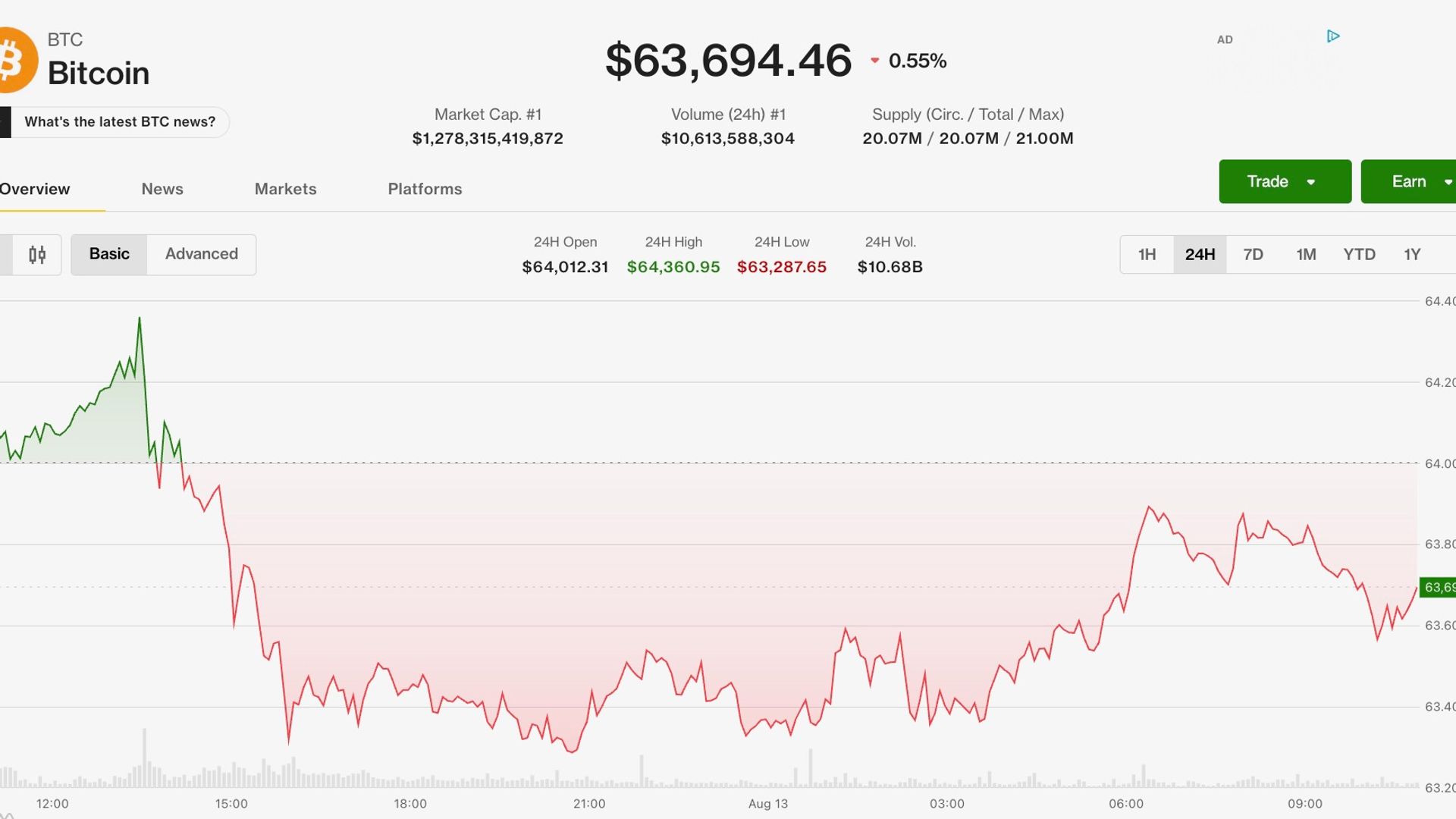
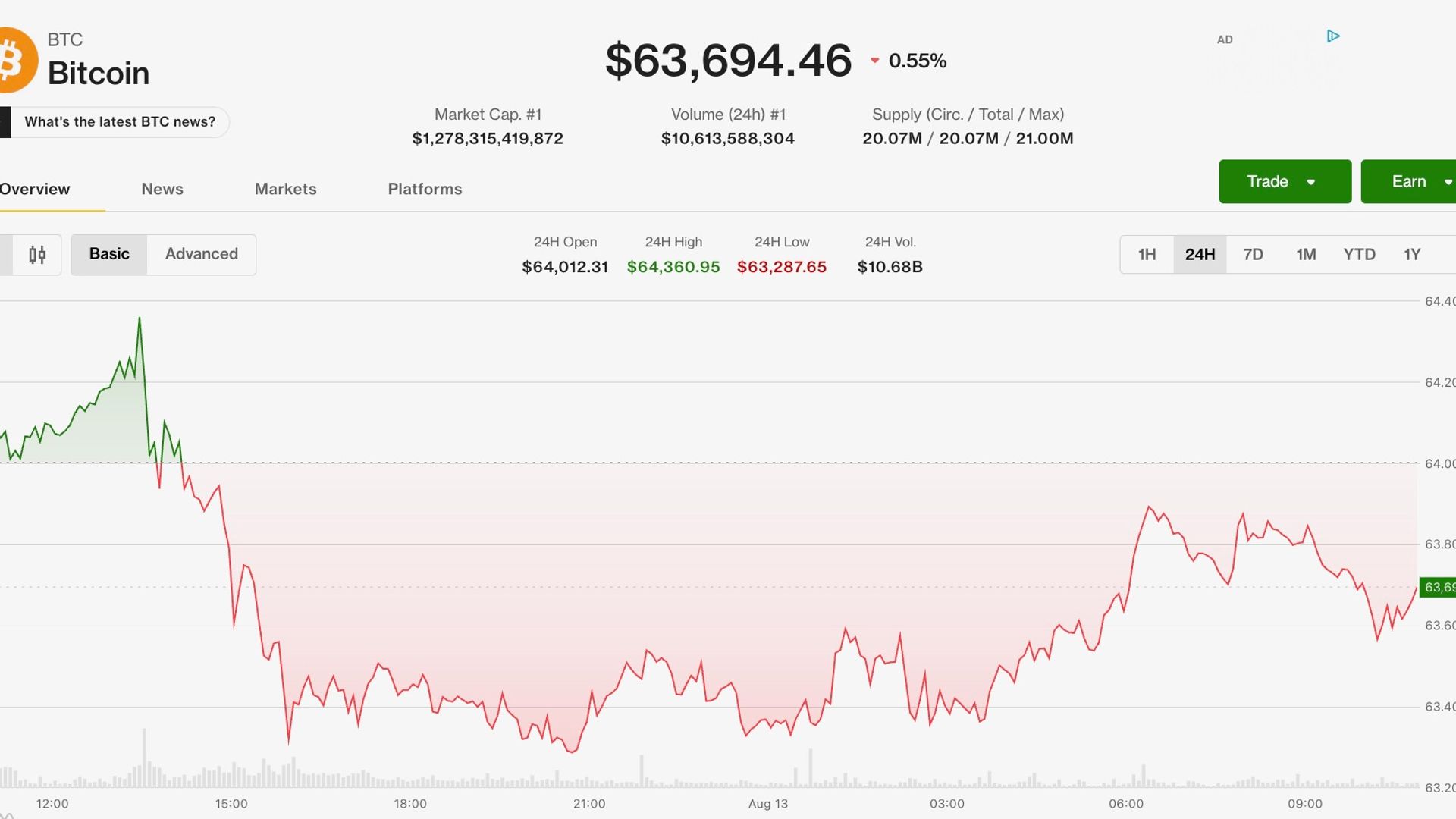
Bitcoin held near $63,600 after Wednesday’s in-line U.S. inflation print proved enough to calm nerves, but not enough to move markets decisively in either direction.
The largest cryptocurrency has added 0.30% since midnight UTC, while the broader crypto market capitalization dropped 0.54% over 24 hours to $2.18 trillion.
July CPI came in at 3.4% year over year, matching forecasts. Core inflation also eased, with the annual reading slipping to 2.5% from 2.6%. The producer price inflation figure due at 12:30 UTC may provide more impetus to a lackluster market.
As for U.S. equities, S&P 500 index futures gained 0.13% while Nasdaq 100 futures were little changed.
Derivatives positioning
- Futures market churn continues: 24-hour volume stands at $147 billion, up 6% on the day, but cumulative open interest (OI) across all cryptocurrency futures has held flat near $116 billion.
- XRP positioning stays elevated: XRP futures OI is perched at 2.67 billion tokens, the most since October, for a third straight day. The 24-hour cumulative volume delta (CVD) remains negative, pointing to bearish bets being executed at market prices more than bullish ones. These paint a bearish picture, flagging a possible drop below $1. There’s a silver lining, though: The annualized perpetual funding rate is near 8%, pointing to a bias toward bullish bets.
- ADA and BCH show heavy bearish tilt: Both coins are seeing funding rates of -10% or lower, pointing to a clear investor preference for bearish positions. They both also show negative 24-hour CVD, indicating aggressive selling. This is particularly notable for ADA, whose OI remains just shy of the recent record high of 2.79 billion tokens, suggesting traders are adding fresh short exposure near record participation levels, not just unwinding old longs.
- AVAX flips from gainer to loser: Avalanche’s AVAX, one of the top OI gainers earlier this week, is the biggest OI loser of the past 24 hours. Others include LTC, LINK and SOL.
- Implied volatility stays muted: Options-based implied volatility for bitcoin and ether remains near its recently hit year-to-date lows, suggesting traders aren’t expecting a big move in the short term.
- Upside bets still surface: In BTC’s case, someone bought a large number of call options at the $65,500 strike, paying $1.07 million in initial premium. This is an ultra-short-term bullish bet; the calls expire Aug. 15.
Token talk
- XMR is up 3.15% since midnight UTC at around $404, extending its weekly run of more than 11% as the privacy coin continues to outperform the broader market.
- HYPE is up 1.75% since midnight at $57, continuing a steady grind higher with a 2% gain on the week.
- FET is up 0.84% since midnight, while NEAR added 0.94%, as a handful of mid-cap altcoins outperform the two largest coins, bitcoin and ether.
- CRV is giving back some of Wednesday’s surge, falling 8.38% over 24 hours to 25 cents. Still, it remains up more than 22% on the week after breaking above a months-long descending trendline.
- DeFi token MORPHO was one of the weaker performers, losing 1.51% since midnight.
Crypto World
Strategy, Metaplanet unrealized bitcoin losses highlight risk of concentrating on just one token: Crypto Daily


Compounding the issue, many DAT firms have consistently favored issuing debt to fund purchases of BTC. That strategy raises the question of how different they are from governments that borrow heavily to fund investments that fail to generate adequate returns. Both, ultimately, lead to high indebtedness relative to income. As we have noted before, bitcoin lacks inherent yield, return or cash flow.
For now, however, the market doesn’t appear to be worried about these dynamics. BTC continues to trade between $62,000 and $66,000, as it has for weeks, with today’s price action largely below $64,000.
Some analysts say they remain optimistic that the bear market has run its course, pointing to a price range that corresponds with the previous bull-cycle high.
“The peaks of the 2021 bull market were close to these levels,” Alex Kuptsikevich, the chief analyst at FxPro, said in an email. “Three years ago, Bitcoin’s decline generally halted at $20K, which was close to the peak of the previous bull market at the end of 2017. This supports our view that the decline may have run its course, with bearish momentum fading as Bitcoin approaches the 200-week moving average.”
Other analysts have turned their focus to August’s Jackson Hole symposium of central banks and economic data for trading cues. Stay alert!


Figure Technology Solutions reported $4.3 billion in consumer loan marketplace volume for the second quarter, up 132% from a year earlier, as its quarterly profit nearly tripled.
On Thursday, Figure said net income rose 192% year over year to $87 million, from about $30 million. Net revenue more than doubled to $226 million, while its net income margin increased 10.5 percentage points to 38.8%.
Figure’s marketplace volume includes home equity lines of credit, debt-service coverage ratio loans and personal loans processed through its loan origination system, along with third-party loans traded on Figure Connect, which accounted for $2.8 billion, or 65%, of the quarterly total.
Volume on the marketplace, which Figure launched in June 2024, increased 262% from the same period last year. The company also added 102 loan-origination partners during the quarter, bringing its total to 489.
CEO Michael Tannenbaum said weekly loan applications surpassed $1 billion in July. Figure expects consumer loan marketplace volume of between $4.8 billion and $5.2 billion in the third quarter.
Bernstein analysts predicted in May that Figure would post record second-quarter volume, citing live blockchain data that they said could increasingly allow investors to track the company’s lending activity in real time.
Related: Tokenized RWA market grows 420% since 2025 on regulatory clarity, access

Former Sunderland job centre could become 84 student studios

AutoStore Holdings Ltd. 2026 Q2 – Results – Earnings Call Presentation (OTCMKTS:AUTSF) 2026-08-13

ether.fi Adds Tokenized Stocks, New Fiat Rails And Aave-Backed Borrowing


-

 Fashion6 days ago
Weekend Open Thread: Mattifying Sunscreen
-

 Fashion7 days ago
Frugal Friday’s Workwear Report: Cap-Sleeve Pointelle Crewneck Sweater
-

 News Videos6 days ago
Can Astrology Help Find Gold and Silver Trends? A Financial Astrology Guide
-

 Tech6 days ago
Rinn Pharma & Biopharma to join NordicPharmaTrain network
-

 Business5 days ago
How to Start a Cleaning Business: A Step-by-Step Guide
-

 Business5 days ago
Datadog: Best Of Breed For Multiple Reasons
-

 Business5 days ago
BDC Weekly Review: Private BDC Q2 Numbers Are Strong
-
 NewsBeat2 days ago
Communication cards help banking customers access services or report scams
-

 Business7 days ago
Brightwater secures funding for WA-first dementia projects
-
 Business3 days ago
Oil Price Today (August 11): Crude oil rises to $88 after Trump’s compensation demand dents Hormuz opening. Here’s why
-
 Entertainment7 days ago
Brand New Day’ Characters, Ranked
-

 Business7 days ago
Aussie shares lose steam to close record-breaking week
-

 Fashion6 days ago
Weekly News Update, 8.6.26 – Corporette.com
-

 Fashion7 days ago
Irina Shayk Wows in REVOLVE Los Angeles’ Summer Styles
-

 Fashion7 days ago
Burberry Fall 2026 Takes On Commuter Style
-

 Fashion5 days ago
Amazon Sundays: Closet Care Before Fall
-

 Politics5 days ago
Be quiet, Miriam! – spiked
-

 Business7 days ago
South Korea cracks down on Trader Joe’s popular seasoning
-
 Business7 days ago
Clipper Realty Inc. (CLPR) Q2 2026 Earnings Call Transcript
-

 Business7 days ago
CXMT Shares Drop 4.3% as Post-IPO Rally Cools Amid Global Memory Chip Pressures
You must be logged in to post a comment Login