
Crypto World
Bitcoin (BTC), ether (ETH) prices hold steady while XMR, HYPE outperform

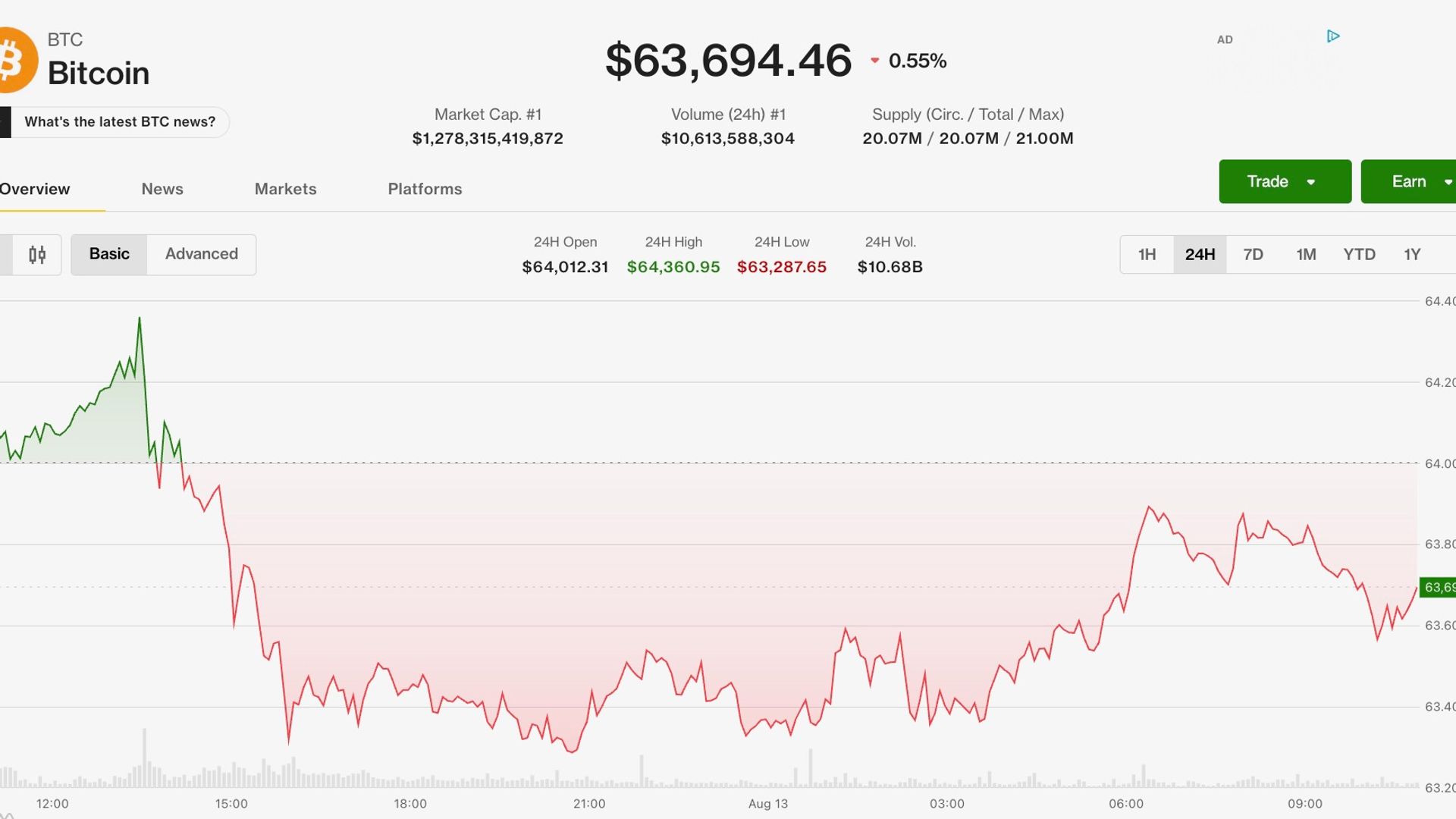
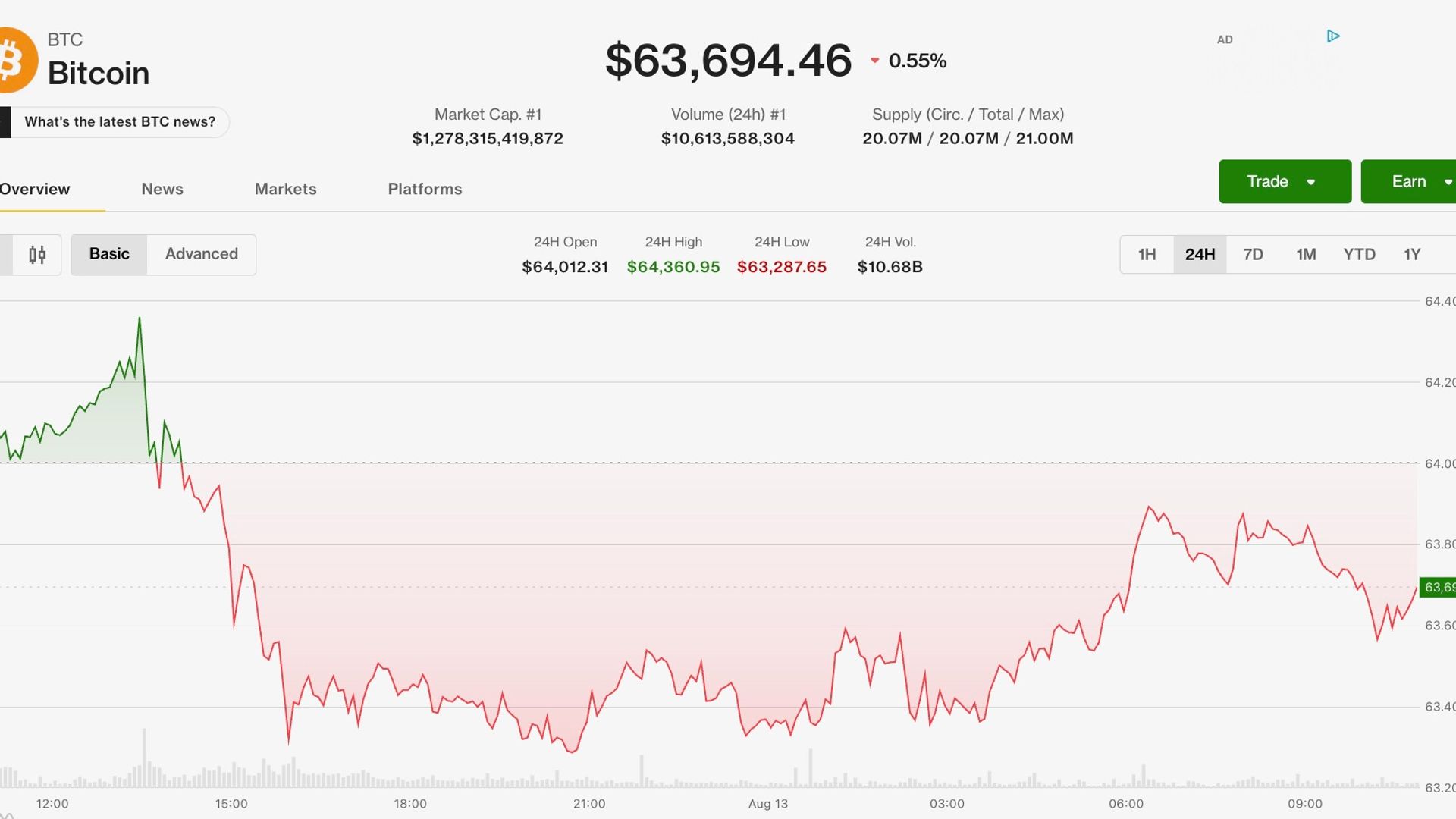
Bitcoin held near $63,600 after Wednesday’s in-line U.S. inflation print proved enough to calm nerves, but not enough to move markets decisively in either direction.
The largest cryptocurrency has added 0.30% since midnight UTC, while the broader crypto market capitalization dropped 0.54% over 24 hours to $2.18 trillion.
July CPI came in at 3.4% year over year, matching forecasts. Core inflation also eased, with the annual reading slipping to 2.5% from 2.6%. The producer price inflation figure due at 12:30 UTC may provide more impetus to a lackluster market.
As for U.S. equities, S&P 500 index futures gained 0.13% while Nasdaq 100 futures were little changed.
Derivatives positioning
- Futures market churn continues: 24-hour volume stands at $147 billion, up 6% on the day, but cumulative open interest (OI) across all cryptocurrency futures has held flat near $116 billion.
- XRP positioning stays elevated: XRP futures OI is perched at 2.67 billion tokens, the most since October, for a third straight day. The 24-hour cumulative volume delta (CVD) remains negative, pointing to bearish bets being executed at market prices more than bullish ones. These paint a bearish picture, flagging a possible drop below $1. There’s a silver lining, though: The annualized perpetual funding rate is near 8%, pointing to a bias toward bullish bets.
- ADA and BCH show heavy bearish tilt: Both coins are seeing funding rates of -10% or lower, pointing to a clear investor preference for bearish positions. They both also show negative 24-hour CVD, indicating aggressive selling. This is particularly notable for ADA, whose OI remains just shy of the recent record high of 2.79 billion tokens, suggesting traders are adding fresh short exposure near record participation levels, not just unwinding old longs.
- AVAX flips from gainer to loser: Avalanche’s AVAX, one of the top OI gainers earlier this week, is the biggest OI loser of the past 24 hours. Others include LTC, LINK and SOL.
- Implied volatility stays muted: Options-based implied volatility for bitcoin and ether remains near its recently hit year-to-date lows, suggesting traders aren’t expecting a big move in the short term.
- Upside bets still surface: In BTC’s case, someone bought a large number of call options at the $65,500 strike, paying $1.07 million in initial premium. This is an ultra-short-term bullish bet; the calls expire Aug. 15.
Token talk
- XMR is up 3.15% since midnight UTC at around $404, extending its weekly run of more than 11% as the privacy coin continues to outperform the broader market.
- HYPE is up 1.75% since midnight at $57, continuing a steady grind higher with a 2% gain on the week.
- FET is up 0.84% since midnight, while NEAR added 0.94%, as a handful of mid-cap altcoins outperform the two largest coins, bitcoin and ether.
- CRV is giving back some of Wednesday’s surge, falling 8.38% over 24 hours to 25 cents. Still, it remains up more than 22% on the week after breaking above a months-long descending trendline.
- DeFi token MORPHO was one of the weaker performers, losing 1.51% since midnight.



ether.fi is adding tokenized stock trading, portfolio-wide borrowing and global fiat transfers to its app, moving the liquid staking protocol further into retail banking products. The company announced the changes Thursday as part of what it calls its Summer release. The launch continues a shift… Read the full story at The Defiant

The women in the new study were prescribed estrogen only, and not the combination of estrogen and progesterone that is more commonly used to treat menopausal symptoms. Progesterone is prescribed to protect the uterus, but women who have had a hysterectomy, like those in the study, can safely be prescribed estrogen. This population provides a good way to study the effects of estrogen itself, since researchers believe it’s the hormone with more wide-ranging effects on the body, including in the brain.
Hadi Hosseini, an associate professor of psychiatry at Stanford and co-author of the study, says the results don’t establish a cause-and-effect link between estrogen and Alzheimer’s disease, but they do provide a reason to further study the role of the hormone in the neurodegenerative disease. “Previous studies,” including the Women’s Health Initiative, “showed that hormone therapy—estrogen plus progesterone—had a negative effect on Alzheimer’s disease risk and memory outcomes,” he says. “These data are bringing awareness to the fact that maybe we need to reconsider some of the previous findings, since we can now look properly at Alzheimer’s disease outcomes, different formulations of hormone therapy, different times of initiating the therapy, and different durations of use.”


The CFTC has scheduled a three-hour meeting for Aug. 20 to examine crypto assets, artificial intelligence, prediction markets, and its recent work across the three sectors.
Summary
- The CFTC Innovation Advisory Committee will meet from 1 p.m. to 4 p.m. EDT.
- Committee members will attend in Washington, while the public can watch the meeting online.
- Crypto assets, AI, and prediction markets are listed among the main discussion areas.
- Written public statements related to the meeting must be submitted by Aug. 27.
CFTC meeting will put crypto and AI policy on the agenda
The Commodity Futures Trading Commission said in an Aug. 11 Federal Register notice that its Innovation Advisory Committee will hold its inaugural meeting on Aug. 20, bringing members together to discuss crypto assets, artificial intelligence, and prediction markets.
Scheduled to run from 1 p.m. to 4 p.m. Eastern Daylight Time, the meeting will take place in person for committee members in Washington. Members of the public will be able to follow the proceedings virtually, and the session may finish before 4 p.m. if the committee completes its business early.
The CFTC said recent agency activity involving the three areas will also form part of the discussion. Its notice does not identify a proposed rule that members will vote on, nor does it state that the meeting will produce immediate policy changes.
Rather, the IAC advises the commission on issues where technology, law, policy and finance overlap. Its recommendations may inform the agency’s work, but the committee does not independently adopt or enforce CFTC regulations.
Chairman Michael S. Selig, who sponsors the committee, announced the meeting separately on Aug. 10. According to the CFTC announcement, the group consists of U.S. entrepreneurs, researchers, industry participants, and other specialists chosen to give the agency input on changes in financial markets.
Selig’s announcement described the subjects under review as part of a “new frontier of finance.” However, the release did not include a detailed regulatory proposal for crypto, AI or prediction markets, leaving the committee’s specific discussion points to the meeting agenda and presentations.
Crypto oversight has become a larger CFTC responsibility
Digital assets enter the meeting as Congress continues to consider giving the CFTC a more extensive role in U.S. crypto markets. Existing law already gives the agency authority over commodity derivatives, including futures and options tied to assets such as Bitcoin, while the SEC oversees securities and securities transactions.
Pending market-structure legislation could expand the CFTC’s responsibilities in digital commodity spot markets. A recent crypto.news review of CFTC capacity reported that the agency had 556 employees and a $365 million budget, compared with about 4,200 staff and a $2.149 billion budget at the SEC.
The CFTC’s Office of Inspector General identified digital asset regulation as its leading management and performance challenge for 2026, according to the same report. Any expansion of the agency’s authority would therefore place staffing, technology and funding questions alongside decisions about registration, market surveillance and customer protection.
Work on crypto policy has continued while lawmakers debate the agency’s future remit. In March, the CFTC joined the SEC in issuing an interpretation on how federal securities laws apply to certain crypto assets and related transactions. The two regulators also signed a memorandum of understanding covering coordination between their agencies.
The commission has taken separate action in crypto derivatives markets. In May, it approved KalshiEX’s Bitcoin perpetual futures contract and issued staff relief involving Coinbase Financial Markets and certain foreign crypto perpetual products.
As reported at the time, the Kalshi decision opened a federally regulated route for U.S. traders to access a Bitcoin perpetual futures product. The related Coinbase letter allowed specified customer-owned digital commodities and payment stablecoins to be transferred to an affiliated foreign broker as margin, subject to the conditions set by CFTC staff.
Prediction markets face federal and state disputes
Prediction markets will give the committee another unresolved U.S. regulatory issue to examine. The platforms offer event contracts whose payouts depend on the outcome of elections, sporting events, economic data releases, and other measurable events.
CFTC-registered exchanges maintain that eligible event contracts fall under federal derivatives law. State gaming regulators and other critics have challenged some sports-related products as unlicensed betting, leading to litigation over whether federal derivatives oversight displaces state gambling rules.
During 2026, the commission reaffirmed its view that it holds exclusive federal jurisdiction over prediction markets within the derivatives framework. It also withdrew a 2024 proposal that would have restricted contracts involving political contests, sports, and other listed categories.
In March, the CFTC started another public process focused on event-contract regulation. Submissions came from prediction market operators, crypto companies, venture investors, and state gambling authorities, according to a May policy report.
More recent requests show that the disagreement extends beyond the basic question of federal authority. On Aug. 3, the NFL asked the CFTC to require a minimum age of 21, stronger controls against insider trading, and closer reviews of sports contracts, according to the league’s comments covered in a prediction-market filing.
The commission has also addressed how event contracts are presented to customers. In an Aug. 7 staff letter, its Division of Market Oversight and Market Participants Division reminded regulated entities that their pricing displays and marketing must clearly distinguish derivative products from bookmaker-style wagering.
AI discussion follows the CFTC’s own use of the technology
Artificial intelligence will be considered both as a financial-market tool and as technology already being used inside the regulator. The CFTC has applied AI to tasks that include reviewing registration materials and examining trading data, according to public statements from Selig.
Such use raises questions about data quality, automated analysis, and regulatory accountability within the agency’s operations. The official meeting notice does not list individual AI systems, potential safeguards, or a planned enforcement policy, so any recommendations will depend on the presentations and committee discussion on Aug. 20.
The IAC works alongside the CFTC’s Innovation Task Force, which Selig created in March to develop policy involving crypto and blockchain technology, AI and autonomous systems, and prediction markets and event contracts. Michael J. Passalacqua leads the task force with staff drawn from several parts of the commission.
When announcing the task force, Selig said clear rules could support “responsible innovation at home” and prevent U.S. market participants from being “left on the sidelines.” The CFTC also said the team would coordinate with other federal bodies, including the SEC and its Crypto Task Force.
Public participation in the IAC meeting will remain open after the livestream ends. The Federal Register notice allows interested parties to submit written statements until Aug. 27 through Regulations.gov, by mail to CFTC Secretary Christopher Kirkpatrick, or by hand delivery to the commission’s Washington headquarters. Submissions must identify the “Innovation Advisory Committee,” and the CFTC said qualifying statements will become part of the public record.


Tether has completed its first independent financial statement audit, with KPMG U.S. issuing an unqualified opinion after reviewing its 2025 accounts and a reported $6.814 billion reserve surplus.
Summary
- KPMG audited Tether International’s financial statements for the year ended Dec. 31, 2025.
- Tether reported reserve assets exceeding related liabilities by $6.814 billion at year-end.
- Auditors examined transactions, systems, valuations, counterparties, ownership records, and supporting documents.
- KPMG physically counted and inspected every gold bar held by Tether.
Tether said Thursday that KPMG U.S. conducted the audit of Tether International, S.A. de C.V. under applicable professional standards and issued an unqualified opinion on the company’s financial statements.
KPMG’s opinion covers Tether’s full 2025 accounts
Rather than examining only a reserve report at a particular date, KPMG reviewed the company’s financial position as of Dec. 31, 2025, along with its operating results and cash flows for the full year. The audit covered the balance sheet, income statement, statement of changes in equity, and cash flow statement.
According to Tether, KPMG concluded that the statements “present fairly, in all material respects” the company’s financial position and results under U.S. generally accepted accounting principles.
An unqualified opinion means the auditor did not attach reservations, exceptions, or qualifications to its conclusion. Tether described the result as a clean audit, although the opinion applies specifically to the audited 2025 financial statements and the related evidence examined by KPMG.
The audit also tested the records supporting individual balance-sheet entries. KPMG examined transactions, internal systems, asset ownership, valuations, counterparties, and documents used to prepare the accounts, according to the announcement.
Tether CFO Simon McWilliams said the audited statements reported that reserves exceeded the liabilities connected to issued tokens by $6.814 billion at the end of 2025. The company said the result was consistent with the reserve figures it had disclosed through earlier attestations.
KPMG separately inspected Tether’s physical gold holdings. Auditors counted every bar and checked its identifying information instead of depending only on statements supplied by custodians or other counterparties.
Tether audit goes beyond quarterly attestations
Tether has published independent reserve attestations for several years, but an attestation has a narrower purpose than a full audit of annual financial statements. Reserve reports generally address management’s presentation of assets and liabilities at a set reporting date, while the KPMG engagement covered Tether’s accounts and underlying evidence for an entire financial year.
The company began the process in March after appointing an unnamed Big Four accounting firm. As crypto.news previously reported, the engagement followed an initial review of Tether’s systems, internal controls, and financial reporting procedures.
Tether later identified KPMG as the auditor. CFO McWilliams had joined the company in early 2025 with responsibility for developing the internal finance structure needed to complete a full audit.
At the time of the March engagement, USDT had a market capitalization above $184 billion and more than 550 million users, according to Tether. In its latest announcement, the company put its user base above 650 million, largely across emerging markets where people use USDT for payments, savings, remittances, and access to U.S. dollars.
CEO Paolo Ardoino said KPMG did not limit its work to headline reserve figures. According to Ardoino, the firm examined the assets, records, transactions, systems, and other evidence supporting the financial statements under standards set by the American Institute of Certified Public Accountants.
Tether called the engagement the largest inaugural financial audit in history. KPMG’s opinion, however, addresses whether the statements were fairly presented under U.S. GAAP; the claim about the audit’s record size came from Tether.
Reserve figures changed after the 2025 audit date
Because the audited statements cover the year ending Dec. 31, 2025, the $6.814 billion surplus is separate from the reserve figures disclosed in Tether’s quarterly reports during 2026.
At the end of the first quarter, Tether reported $191.8 billion in assets and $8.23 billion in excess reserves. Its second-quarter attestation, prepared by BDO and released July 31, later placed assets at $187.75 billion against liabilities of $183.64 billion.
July reserve data showed that Tether generated about $1.5 billion in second-quarter net operating profit while its excess reserve cushion fell to $4.11 billion. USDT supply stood at about $184.6 billion at the end of June, and the token accounted for more than 60% of the global stablecoin market.
Tether’s asset mix had also continued to change after the audited year closed. The Q2 attestation showed physical gold holdings of about 146.2 metric tons and Bitcoin holdings of 98,933 BTC, while the company reduced its secured lending exposure during the quarter.
Gold formed part of the KPMG verification work for the 2025 statements. By March 31, 2026, Tether reported roughly 707,747 fine troy ounces backing its XAUT token, up from about 520,000 ounces at the end of 2025. Earlier, Tether Gold figures valued the token’s bullion reserves at more than $3.3 billion.
U.S. stablecoin rules keep audit requirements in focus
KPMG’s use of U.S. GAAP gives American investors and counterparties a familiar accounting basis for reviewing Tether’s 2025 financial statements. An unqualified audit opinion does not, by itself, determine whether USDT complies with U.S. stablecoin law or qualifies for continued listing on American trading platforms.
The GENIUS Act established federal rules for payment stablecoin issuers, including reserve, disclosure, and supervisory requirements. President Donald Trump signed the legislation in July 2025, with several provisions requiring agencies to complete implementing rules before the framework takes full effect.
Tether operates USDT through an issuer outside the United States, making the law’s treatment of foreign stablecoins relevant to its access to American centralized exchanges. Legal experts have said foreign issuers may need to follow lawful freeze and seizure orders once the law becomes effective, while other conditions tied to exchange listings have a longer implementation period.
A July review of USDT access found that the general transition period runs into 2028, although the timing of some obligations for foreign issuers remains subject to regulatory interpretation. Tether has said it intends to comply with the law, but federal agencies have not completed all rules governing foreign stablecoin issuers.
Alongside USDT, Tether has introduced USAT as a separate dollar-backed token built for the American market. Anchorage Digital Bank issues USAT under a U.S.-regulated structure, while Cantor Fitzgerald serves as reserve custodian.


Trezor said a breach at third-party shipping provider ShipMonk exposed personal and order data belonging to 13,689 recent customers, including names and contact details that can be used for targeted phishing. Shipping addresses also create a potential physical-security risk by tying named customers… Read the full story at The Defiant


Robinhood Ventures Fund II priced 8 million common shares at $25 each, creating a $200 million gross initial public offering for a fund designed to give retail investors exposure to private companies. Robinhood said the shares are expected to begin trading on the New York Stock Exchange on Aug. 13… Read the full story at The Defiant


Mitsubishi UFJ Financial Group (MUFG) plans to use blockchain technology to offer faster settlement of Japanese government bond (JGB) transactions, in a move reminiscent of similar initiatives by banks in other countries.
MUFG is preparing a proof-of-concept for onchain JGB transactions using the Canton network to expedite the settlement, which typically takes 1-3 days by traditional means.
The Tokyo-based bank expects to improve the operational and capital efficiency of repo transactions — the purchase of securities as a form of short-term borrowing and lending — through real-time 24/7 onchain settlement.
MUFG noted that financial institutions in Europe and the U.S. have expanded proof-of-concept projects to achieve this exact goal. Blockchain-based intraday U.S. Treasury-bond repos have existed for several years through JPMorgan’s Kinexys network, which went live in 2020.
“Given their high credit worthiness and liquidity, JGBs are widely used as collateral for repo transactions by market participants in Japan and overseas, and momentum for bringing them onchain is growing,” MUFG said on Wednesday.
The project forms part of a broader array of MUFG initiatives exploring the use of blockchain technology in traditional financial functions. Most recently, the bank teamed up with two of the largest Japanese banks, Sumitomo Mitsui Financial Group (SMBC) and Mizuho Financial Group, to explore listing a jointly issued stablecoin by March 2027.
Crypto World
Strategy, Metaplanet unrealized bitcoin losses highlight risk of concentrating on just one token: Crypto Daily


Compounding the issue, many DAT firms have consistently favored issuing debt to fund purchases of BTC. That strategy raises the question of how different they are from governments that borrow heavily to fund investments that fail to generate adequate returns. Both, ultimately, lead to high indebtedness relative to income. As we have noted before, bitcoin lacks inherent yield, return or cash flow.
For now, however, the market doesn’t appear to be worried about these dynamics. BTC continues to trade between $62,000 and $66,000, as it has for weeks, with today’s price action largely below $64,000.
Some analysts say they remain optimistic that the bear market has run its course, pointing to a price range that corresponds with the previous bull-cycle high.
“The peaks of the 2021 bull market were close to these levels,” Alex Kuptsikevich, the chief analyst at FxPro, said in an email. “Three years ago, Bitcoin’s decline generally halted at $20K, which was close to the peak of the previous bull market at the end of 2017. This supports our view that the decline may have run its course, with bearish momentum fading as Bitcoin approaches the 200-week moving average.”
Other analysts have turned their focus to August’s Jackson Hole symposium of central banks and economic data for trading cues. Stay alert!


Figure Technology Solutions reported $4.3 billion in consumer loan marketplace volume for the second quarter, up 132% from a year earlier, as its quarterly profit nearly tripled.
On Thursday, Figure said net income rose 192% year over year to $87 million, from about $30 million. Net revenue more than doubled to $226 million, while its net income margin increased 10.5 percentage points to 38.8%.
Figure’s marketplace volume includes home equity lines of credit, debt-service coverage ratio loans and personal loans processed through its loan origination system, along with third-party loans traded on Figure Connect, which accounted for $2.8 billion, or 65%, of the quarterly total.
Volume on the marketplace, which Figure launched in June 2024, increased 262% from the same period last year. The company also added 102 loan-origination partners during the quarter, bringing its total to 489.
CEO Michael Tannenbaum said weekly loan applications surpassed $1 billion in July. Figure expects consumer loan marketplace volume of between $4.8 billion and $5.2 billion in the third quarter.
Bernstein analysts predicted in May that Figure would post record second-quarter volume, citing live blockchain data that they said could increasingly allow investors to track the company’s lending activity in real time.
Related: Tokenized RWA market grows 420% since 2025 on regulatory clarity, access


The elderly patient’s blood pressure had been dropping for weeks, and Chad Wittekind, his primary care provider, couldn’t figure out what was wrong. He had upped the dosage of one medication and added another, but couldn’t manage to regulate it.
The patient hadn’t reported taking any other new medications or supplements and hadn’t made any major recent lifestyle changes. So what could be causing the blood pressure irregularity?
It took a lot of questions and appointments to find the culprit: a drug he’d gotten through a telehealth website.
Like many other patients Wittekind has seen recently, this one had circumvented his primary care provider to get a drug over the Internet—in this case, an erectile-dysfunction medication. He’d gone to a website he came across online, filled out a form that a virtual health care provider quickly reviewed, and was sent the medication through the mail, but had been too embarrassed to tell Wittekind about the new addition to his regimen.
You might not think that Wittekind, a Columbus, Ohio-based provider who works in geriatrics, would be seeing many patients turn to the Internet to get drugs for conditions like erectile dysfunction, overweight, menopause, and depression. But the accessibility of sites like these and the ease of getting meds from them have made them an increasingly popular choice for Americans of all ages and incomes.
Here’s how it works: often after viewing an ad on social media, people click on little-known websites promising a fast and easy way to get medication for a specific condition. These sites accept credit cards, don’t take insurance, and don’t typically make you have a call with a doctor. Instead, you fill out a quick form about your medical history and current medications, and a medical provider you’ll never meet (and will probably never talk to) reviews the information within minutes to hours. If you qualify, they’ll write you a prescription—often a recurring one—and connect you to a pharmacy that ships the drug directly to your home.
Wittekind and other providers see this as a problem. They’re used to patients coming to them asking for some drug they’ve seen advertised on TV, but the fact that patients can now get these drugs elsewhere, without much screening, is worrying. Wittekind has had a patient receive ketamine tablets through a telehealth website, and another got a GLP-1 drug for weight-loss even though they had a BMI of 18.7, meaning they should have been too thin to qualify per U.S. Food and Drug Administration (FDA) guidelines. Sometimes, patients will have side effects from medications, but when they follow up with the virtual doctor who prescribed them, they don’t get a helpful response.
Sites like these fall under the large umbrella of telehealth, which has unquestionably improved access to medical care, getting services to people who may not be able to easily or quickly find a doctor. It’s also made people much more comfortable seeking treatment for conditions that they might be embarrassed to bring up with their regular doctor, such as erectile dysfunction or hair loss. But telehealth has changed a lot since it started, when it usually referred to a video call with your doctor. Now, it includes hundreds of websites and the pharmacies they partner with—many of which are under-regulated.
“There’s no accountability, no follow-up if they do have a problem. Trying to get back with their provider is impossible, and then it becomes my problem,” Wittekind says. “There’s no oversight with most of these places. Yes, you’re improving access, but at what cost?”
Why telehealth sites are exploding
Elliot Tabibian started his first telehealth site when he was just 18 years old. You don’t need to be a doctor to do so; all you have to do is figure out a condition that people are seeking treatment for and market your website. Outside companies have popped up to help with the infrastructure side—connecting patients with doctors and pharmacies, for example, and ensuring that the website complies with various state and federal laws.
Tabibian says he got into telehealth after hearing about a friend who paid a website $200, had a 30-second doctor’s appointment by phone, and got a medical marijuana card. “I thought, ‘that seems pretty profitable, I should get in there,’ says Tabibian, who is now 22.
His first site prescribed medical marijuana; he also tried out sites that sold erectile dysfunction medicines and ones that allowed people to get doctor’s notes stating that they needed service animals. (He shut these sites down after competition got too tight, he says.) He now operates two telehealth sites, one of which helps people get medical exemptions so that they can tint their car windows. “Tired of Cops Taking Your Tint? See if you Qualify for a Medical Tint Exemption in Less than 10 Minutes!” the site reads. It claims to give customers a full refund if they do not get approved for an exemption.
Tabibian’s is one of hundreds, if not thousands, of telehealth sites that have proliferated in recent years. Though some of the first direct-to-consumer telehealth sites started operating before the pandemic, consumers really started embracing telehealth during it, when many insurers loosened restrictions to ensure more patients had access to care. This allowed medical care to be delivered at home to people who might not be able to travel to receive it elsewhere, expanding access. But what was meant to be a temporary measure became permanent as people grew accustomed to the convenience.
As more people sought out telehealth, entrepreneurs like Tabibian stepped in. They were enabled by companies forming networks of doctors that telehealth companies could contract with to provide services to patients, says Rebecca Gwilt, managing partner of Elevare Law, which consults with digital health care companies. An entrepreneur only has to create a website and market its services to get a telehealth company off the ground.
These sites became extremely popular once the first GLP-1s debuted in 2021 and immediately went into shortage. People wanted GLP-1s, and many either couldn’t get them or couldn’t afford them. Telehealth entrepreneurs saw an opportunity, Gwilt says. They partnered with a special type of pharmacy, called a compounding pharmacy, that mixed the active ingredients in GLP-1s and sold them for much less than the pharmaceutical companies.
These sites take advantage of several weaknesses in the American medical system. It is expensive and inconvenient to go to the doctor, and patients often need to wait more than a month for an appointment. Insurance is also dismal to deal with, and deductibles and pre-approvals can make getting medications a costly headache.
Those issues “created a gap that the compounding pharmacies and telehealth facilities were able to step into,” says Dr. Anjali Deshmukh, a pediatrician who is also a professor of health law at Seton Hall University. “They did not create the problem, but they are unquestionably profiting.”
One of the companies that helps entrepreneurs start their own telehealth sites is CareValidate. Co-founder Dr. Jiten Chhabra says he has seen a huge surge of people getting into telehealth—even those “who have no business in telehealth.” CareValidate is growing 20% month over month, he says, buoyed by investors and doctors interested in the idea of cash pay for medical care and specific medications.
“We’re about to see a telehealth site for everything—it’s going to be very niche,” he says. “It’s going to show up in your social media, and it’s going to be the easiest way to get your hyper-personalized health condition taken care of.”
There are now virtual companies where customers can get diagnoses and prescriptions for things like low testosterone, toenail fungus, and even fear of public speaking. Often, the medicines are prescribed on a recurring basis, creating a long-term demand for the services of the telehealth doctor—and revenue streams for investors. These sites have essentially changed the power dynamic between doctors and patients; now, it’s the patients demanding medications they’ve decided they need from online health care providers, rather than patients asking doctors about what’s best for them.
Investors see a huge upside because the sites are relatively cheap to launch and because they can turn a profit quickly—either by charging people for visits, selling medications at a markup, or both. Venture capitalists and private equity groups have put millions into telehealth startups, some of which have only a few employees. The size of the U.S. telehealth market was an estimated $28.3 billion in 2025, according to Grand View Research, and is projected to grow to $60.4 billion by 2033. The telehealth boom is concentrated in the U.S., where the high cost of medications and medical care has driven many consumers to telehealth sites; the market is not as strong in other countries.
The telehealth space is expected to further explode because of interest in peptides, the injectable compounds that wellness influencers have popularized. (Very few clinical studies prove that peptides are effective, aside from those for GLP-1s, one example of a peptide.) In a two-day July hearing, a FDA committee recommended that the agency allow specialty pharmacies to dispense six peptides; if approval is finalized, many patients are expected to get their prescriptions from telehealth sites.
Telehealth can be appealing to doctors who are burned out from long hours and negotiating with insurance companies. With telehealth, they can work from home and often avoid insurance altogether.
“The economics are good, the lifestyle is good,” says Chhabra.
The problems with this type of telehealth
The downsides of this direct-to-patient model are starting to become evident. Patients who claim they were prescribed medicines after a cursory online evaluation are filing lawsuits about unanticipated side effects. Several lawsuits allege problems with telehealth companies prescribing at-home ketamine, Adderall, and hair-loss drugs.
In a few cases, patients have died after receiving what their families allege were inadequate telehealth services. Some lawsuits are also accusing telehealth sites of pressuring doctors to act in ways that maximize profit, rather than patient health.
Research suggests that the level of care provided by some of these sites is sometimes poor. In one July 2026 study published in JAMA, a researcher attempted to obtain prescriptions from 49 telehealth websites and found that there was “limited clinician engagement” and that the sites sometimes issued prescriptions, often in as little as five minutes, despite patients not uploading required photos or following other rules of the sites. In some cases, the same clinician provided several different prescriptions for the same patient across multiple sites.
“What we found is really there’s not any sort of true engagement with a clinician,” says Dr. Reshma Ramachandran, a Yale professor and clinician and one of the authors of the study. “The motivation from these websites is just to prescribe and not necessarily provide health care in the sense of someone actually conveying to that patient the risks and benefits we need to be considering.”
Because so many sites compete to attract customers, experts say that some doctors are unlikely to turn down requests. Doctors sometimes have quotas of prescriptions they need to meet from the sites or get bonuses for meeting certain goals, says Ramachandran, who has friends who work for telehealth sites. A recent Senate investigation into a handful of telehealth sites found that 85%-100% of patients who interacted with a provider received prescriptions.
Many patients report that there’s little follow-up from the sites or the doctors they employ, making it difficult for people to know what to do if they develop side effects. Ramachandran, who works at a federally qualified health center for low-income patients, says she has patients coming in who turned to telehealth because insurance got too expensive and were seeking medication, got confused about the dosage they received, and had bad side effects from the medications they took.
“I think we’re undermining trust in the physician-patient relationship,” says Erin Fuse Brown, a professor of health services, policy and practice at the Brown University School of Public Health. She argues that telehealth sites are similar to “pill mills,” where the prescribers generate prescriptions if there is any conceivable reason to do so. “If you can just go to a website and get the drug you’re seeking after a cursory asynchronous questionnaire, it commercializes medicine in a way that’s a little bit dangerous.”
Few laws exist to regulate these sites, which have the ability to claim to just be platforms connecting patients and providers.
“There’s so much money to be made, and so many recent business school graduates running a start-up to get to the next big thing, that this aspect of telemedicine is getting way ahead of regulation, the law, and ethics,” says Arthur Caplan, a professor of bioethics at the NYU Grossman School of Medicine. “It’s like a gold rush.”
Ramachandran says that while telehealth sites may have started as efforts to increase access to care, many have since incorporated incentives for doctors who get patients to try additional medications or take specific costly tests. Her study found that some sites didn’t disclose that the GLP-1s they sold were compounded and made unsubstantiated efficacy claims.
“There are definitely digital health companies out there that you get concerned are worried about revenue rather than patient care,” says Dr. Suneer Chander, a co-founder of Air Physician Academy, which works to educate doctors about how to ethically enter telehealth. “That’s the sort of stuff we want doctors to understand before they get into digital health so that they can lead the industry, rather than be told what to do.”
Tabibian, for instance, says one of the doctors who works for his company has done 300 asynchronous visits a day, reviewing patients’ requests for medication. The doctor gets paid $20 per review and has made as much as $6,000 a day.
Asked if he was worried that 300 prescriptions per day was too many, Tabibian says that it’s up to the doctors to do their due diligence on what’s right for the patients. The way his company is set up, he says, he has no say in any medical decisions. “I’m a technology company. My job is just to connect the patient and physician,” he says. “Anything medical that goes on between the patient and the doctor is 100% the doctor’s responsibility.”
He does see other sites bend the rules, he says—prescribing testosterone for men whose levels don’t medically support a prescription, for instance. He got ketamine prescribed for himself online because he was interested in starting a ketamine site, and says that he only took half of what the doctor ordered and was so high he couldn’t get out of bed. “That’s just a huge liability,” he says.
Succeeding at telehealth is really about being good at marketing, he says, and people—especially young people—who know how to promote sites through social media can cash in. “It’s really been smooth sailing,” he says. “From what I’ve seen, there’s little to no enforcement in the field.”
Murky regulations
Few regulations guide what doctors can and can’t do via telehealth. Doctors, for instance, must meet what’s called the “standard of care,” meaning that they are expected to diagnose and treat the patient in the same way other qualified doctors would. But standard-of-care obligations are enforced by medical societies and professional associations, and few have taken steps to punish doctors for not meeting the standard of care through telehealth, says Caplan, the bioethics professor.
“I’ve tested the sites, and the longest it took me to get whatever pill was about 35 seconds,” he says. “There doesn’t seem to be a thorough medical exam happening.”
Instead, he says, doctors are prescribing medicine like antidepressants without talking to people to figure out why they might be depressed, or prescribing medications with serious side effects without much warning. Litigation often only comes after something bad has happened, like a death or other adverse event.
“I do worry about the fracturing of the medical system more broadly,” says Deshmukh, the Seton Hall professor. “I think having a relationship with a physician who understands you and knows your medical history and can make these decisions together is important.”
State medical boards could step in and discipline doctors who are providing substandard care through telehealth. But “the investigation capacity is really, really limited, and often they just don’t have the resources,” says Ramachandran, the Yale physician and professor.
There are not many existing federal laws that could effectively regulate telehealth, says Fuse Brown, the professor from Brown. A law called the anti-kickback statute makes it illegal to compensate someone to make referrals for something (for example, medications) paid for by a federal health care program. That would presumably prohibit telehealth sites who make money off of prescriptions from paying doctors to make those prescriptions. But the anti-kickback statute only applies to drugs prescribed through federal programs like Medicare and Medicaid, and many of these sites are cash pay, so the statute wouldn’t apply.
States could also investigate whether providers who work for these sites are being pressured or incentivized to prescribe more medicines, Fuse Brown, who adds that such pressure could potentially violate state laws.
Even without explicit pressure, telehealth providers know what patients expect of them. Wittekind, the geriatrics provider in Columbus, says he tried out working at a telehealth site after a company pitched him on setting his own hours and making some extra money. But one of his first patients was a man who wanted an oral hair-loss medication that can come with serious side effects, Wittekind says.
The patient already had hypertension, and Wittekind didn’t think the drug would be a good solution for him, so he turned down the patient’s request. Wittekind realized that his principles probably led to bad reviews for the telehealth site—the patient seemed “perplexed” by the denial—but he didn’t like the idea of prescribing powerful medications without much opportunity for follow-up. He ultimately decided telehealth wasn’t a good fit for him because of that pressure to give the patients what they want.
It wasn’t worth the extra money,” he says. But to many other clinicians, it is.

Former Sunderland job centre could become 84 student studios

AutoStore Holdings Ltd. 2026 Q2 – Results – Earnings Call Presentation (OTCMKTS:AUTSF) 2026-08-13

ether.fi Adds Tokenized Stocks, New Fiat Rails And Aave-Backed Borrowing


-

 Fashion6 days ago
Weekend Open Thread: Mattifying Sunscreen
-

 Fashion7 days ago
Frugal Friday’s Workwear Report: Cap-Sleeve Pointelle Crewneck Sweater
-

 News Videos6 days ago
Can Astrology Help Find Gold and Silver Trends? A Financial Astrology Guide
-

 Tech6 days ago
Rinn Pharma & Biopharma to join NordicPharmaTrain network
-

 Business5 days ago
How to Start a Cleaning Business: A Step-by-Step Guide
-

 Business5 days ago
Datadog: Best Of Breed For Multiple Reasons
-

 Business5 days ago
BDC Weekly Review: Private BDC Q2 Numbers Are Strong
-
 NewsBeat2 days ago
Communication cards help banking customers access services or report scams
-

 Business7 days ago
Brightwater secures funding for WA-first dementia projects
-
 Business3 days ago
Oil Price Today (August 11): Crude oil rises to $88 after Trump’s compensation demand dents Hormuz opening. Here’s why
-
 Entertainment7 days ago
Brand New Day’ Characters, Ranked
-

 Business7 days ago
Aussie shares lose steam to close record-breaking week
-

 Fashion6 days ago
Weekly News Update, 8.6.26 – Corporette.com
-

 Fashion7 days ago
Irina Shayk Wows in REVOLVE Los Angeles’ Summer Styles
-

 Fashion7 days ago
Burberry Fall 2026 Takes On Commuter Style
-

 Fashion5 days ago
Amazon Sundays: Closet Care Before Fall
-

 Politics5 days ago
Be quiet, Miriam! – spiked
-

 Business7 days ago
South Korea cracks down on Trader Joe’s popular seasoning
-
 Business7 days ago
Clipper Realty Inc. (CLPR) Q2 2026 Earnings Call Transcript
-

 Business7 days ago
CXMT Shares Drop 4.3% as Post-IPO Rally Cools Amid Global Memory Chip Pressures
You must be logged in to post a comment Login