
Crypto World
Crypto Price Analysis August-14: ETH, XRP, ADA, BNB, and HYPE

This Friday, we examine Ethereum, Ripple, Cardano, Binance Coin, and Hyperliquid in greater detail.
Ethereum (ETH)
This week, Ethereum hugged the key support at $1,800 with a minor loss of 2%. While this puts sellers in a more favorable position, they will need to break the support if they want to take the initiative.
The current ETH price action shows significant weakness after forming a lower high just below $2,000. Buyers were not able to claim that level as support; this is why bears are returning.
Looking ahead, Ethereum will likely test $1,800 again. If that level fails to hold, this cryptocurrency may revisit the support at $1,500, where buyers finally returned in early July.

Ripple (XRP)
XRP has had a difficult week, struggling to hold above $1. The price also fell by nearly 3% and is inches away from turning $1 into a key resistance. All it takes is one more push by sellers.
If $1 becomes resistance, this will only prolong the current downtrend, which started in August 2025. Since this is also a major psychological level, any loss of support will be costly and see buyers retreat much lower, with the next key support level at $0.80.
Looking ahead, this cryptocurrency has a very low chance of reversing its current downtrend, especially after the price fell from two identical pennants. This only reconfirmed that bears are in total control over the price.

Cardano (ADA)
Cardano started the month well, but now sellers have returned and pushed the price 10% lower this week alone. That’s bad news for bulls, which may have retreated already to the key support at 15 cents.
Should this corrective move continue, then a re-test of $0.15 is very likely. That level has to hold if ADA hopes to avoid new lows. Any weakness there could suddenly see the price spike much lower.
Looking ahead, it appears Cardano could also end up consolidating above the key support if buyers manage to stabilize the price in this area. A consolidation period would be healthy after its prolonged downtrend that started in 2025.

Binance Coin (BNB)
Binance Coin closed the week 3% higher after confirming support at $580. If sellers don’t return here, then BNB has a good chance to continue higher and towards the key resistance at $690.
At the time of this post, this cryptocurrency is trading around $610. As long as the price is above $600, buyers will have an advantage in terms of momentum. However, the buy volume remains low.
Looking ahead, BNB could be forming a large rounded bottom around current levels. That will be confirmed if the price moves above $630. If so, a test of $690 becomes more likely in the future.

Hype (HYPE)
HYPE remained flat on the weekly timeframe and was rejected at the $58 resistance. If nothing changes in the days to come, then the price could revisit the key support at $52.
So far, this cryptocurrency has been making lower lows and lower highs since its all-time high at $76 back in June. Considering its significant rally in the first part of the year, the current correction could also last a while.
Looking ahead, the most decisive level on the chart is found at $52. This key support has stopped sellers from making new lows, but it could be retested again soon, which could be interpreted as bearish. Best to be patient here and follow the price.
The post Crypto Price Analysis August-14: ETH, XRP, ADA, BNB, and HYPE appeared first on CryptoPotato.


Oil futures stumbled Thursday as two key reports point to weaker global demand for oil in 2026. CME Group data shows U.S. crude oil prices are off morning lows but down 1.7% to $81.88 a barrel in afternoon action. The global Brent benchmark fell 1.5% to $87.66 a barrel. Crude oil prices bounced back over the past week as faith…
Copyright ©2026 Investor’s Business Daily, LLC. All rights reserved. 87990cbe856818d5eddac44c7b1cdeb8
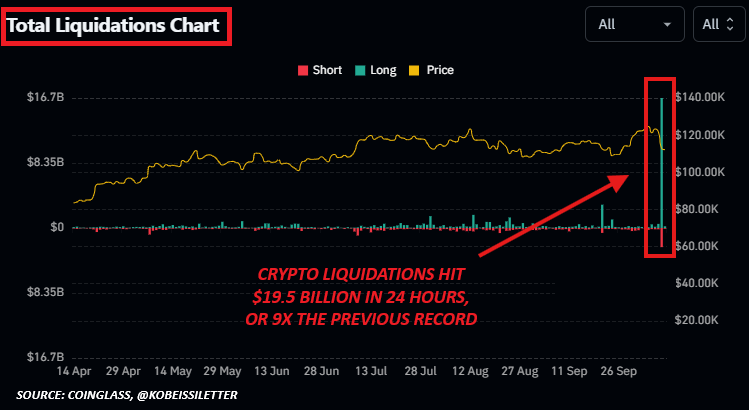
MSCI revived the index threat that deepened October’s Bitcoin crash, opening a consultation that flags Strategy (formerly MicroStrategy) for potential removal from its benchmarks.
The framework avoids naming digital assets entirely, yet the companies caught in its net look remarkably familiar.
What Happened During October’s Crash
The original scare landed on October 10, 2025. MSCI proposed treating firms whose digital-asset holdings exceeded 50% of total assets more like investment funds than operating businesses.
Strategy stood squarely in the crosshairs. The world’s largest corporate Bitcoin holder faced estimated passive outflows of $2.8 billion from MSCI trackers alone.
Broader adoption would have hurt considerably more. Analysts projected sales of up to $8.8 billion if other index providers followed the same approach.
The timing amplified everything. That same session brought roughly $19 billion in leveraged liquidations, with Bitcoin dropping more than $15,000 from its peak near $126,000 one month earlier.
Follow us on X to get the latest news as it happens.

Trump’s tariff threat and extreme leverage drove the initial crash. The index proposal added a structural overhang that many believe prevented a swift recovery.
MSCI eventually retreated in January 2026. Industry pushback succeeded, including Strategy’s argument that it operates a substantial software business rather than functioning as a passive fund.
How the New Framework Actually Works
The threat has now returned in different clothing. MSCI opened a broader consultation in August 2026 on the eligibility of non-operating companies in general. The new approach relies on quantitative screens. Companies first fail a core test when operating assets fall below 50% of total assets.
Five additional ratios follow that threshold. They measure operating intensity, expense intensity, cash flow, fair-value exposure, and capital dependence, with four failures rendering a firm ineligible.
Simulations produced predictable results. Testing the rules against ACWI IMI using May 2026 data flagged Strategy, Japan’s Metaplanet, and uranium holder Yellow Cake for deletion.
Existing constituents receive some protection. Companies must fail across two consecutive periods before removal takes effect.
Strategy responded forcefully on X. The company argued that index providers should measure markets rather than decide which assets companies may own, adding that neither Bitcoin nor Strategy needs MSCI.
Why Bitcoin Would Feel This Only Indirectly
The timing carries particular weight. Strategy has already shifted from pure accumulation toward active liquidity management, including some Bitcoin sales to build cash reserves.
The mechanism deserves precision, however. The forced sale of MSTR shares by passive funds would not require Strategy to dump Bitcoin directly.

The indirect damage matters more. Such pressure could compress the premium at which the stock trades relative to its Bitcoin holdings, making future capital raises less efficient.
That efficiency underpins the entire model. Weakening it would remove one of the cycle’s key structural buyers from the market. Bitcoin trades near $62,849, roughly 50% below the record high above $126,000 reached in October 2025, according to BeInCrypto data.
Subscribe to our YouTube channel to watch leaders and journalists provide expert insights.
The calendar now sets expectations. Feedback closes September 30, results arrive by October 16, and any changes target the November 2026 index review.
Whether history repeats itself remains genuinely uncertain. What the episode confirms is how tightly Bitcoin’s price action has become entangled with the corporate treasury model.
The post One October 2025 Crypto Black Friday Catalyst is Back: Is Bitcoin in Danger? appeared first on BeInCrypto.
Crypto World
Bitcoin price is down nearly 48% from its peak; SHR Miner gives BTC holders another way to put idle crypto to work


Disclosure: This article does not represent investment advice. The content and materials featured on this page are for educational purposes only.
Bitcoin’s 48% decline from its 2025 peak has holders exploring alternatives to selling, with SHR Miner promoting cloud mining as another option.
Summary
- SHR Miner allows BTC holders to rent cloud computing power without buying or operating mining hardware.
- Users can select defined computing periods, monitor daily mining output and manage the process entirely online.
- SHR Miner says its AI-driven infrastructure spans 150+ data centers and serves more than 5 million users across 180+ countries and regions.
Bitcoin remains the world’s largest cryptocurrency, but even long-term BTC holders have been forced to rethink what simply “HODLing” means during a prolonged market downturn.
After reaching an all-time high of approximately $126,198 in October 2025, Bitcoin is now trading near $65,000 — roughly 48% below its peak.
For investors who accumulated BTC with a long-term view, selling after such a large decline may be unattractive. But holding Bitcoin alone does not generate additional cash flow while the market remains below previous highs.
That creates a different question:
If someone doesn’t want to sell my Bitcoin, does all of my crypto capital have to remain idle while they wait?
That is where SHR Miner offers another option.
SHR Miner brings AI cloud computing power to bitcoin holders
Founded in 2018 and headquartered in the United Kingdom, SHR Miner says it has expanded to more than 150 data centers, serving over 5 million users in 180+ countries and regions.
Its core model is cloud computing-power rental.
Instead of purchasing ASIC miners, finding inexpensive electricity, installing cooling equipment, and maintaining machines, users rent computing power for a defined period while SHR Miner manages the physical infrastructure.
For BTC holders, the model is straightforward:
- Zero technical barrier: no mining hardware or specialist knowledge required.
- Defined rental period: users know how long the computing-power contract operates.
- Daily settlement: mining output can be monitored through the dashboard.
- 100% cloud access: operations can be managed remotely through the platform.
- Flexible allocation: users decide how much of their available crypto capital they want to use.
Published SHR Miner materials list support for BTC, ETH, DOGE, USDT, USDC, XRP, SOL, LTC and BCH, among other digital assets.
For Bitcoin holders, there is an additional advantage:
Bitcoin is actually mined.
That means renting computing power gives BTC users direct exposure to the infrastructure that secures and operates the Bitcoin mining ecosystem — without requiring them to become miners themselves.
How AI is changing Bitcoin mining
Modern Bitcoin mining is increasingly a competition for computing efficiency.
SHR Miner says its infrastructure uses AI-powered hashrate scheduling to coordinate computing clusters, allocate resources, monitor equipment, and optimize energy use.
For users, the technology works largely behind the scenes:
- AI-powered hashrate allocation
- Automated infrastructure monitoring
- Computing-power optimization
- Energy-efficiency management
This reflects a broader shift.
The first era of crypto was largely about buying and holding digital assets.
The AI era is increasingly about computing power, automation, and intelligent infrastructure.
For BTC holders, the opportunity is no longer limited to owning Bitcoin — it can also include accessing the computing infrastructure behind the digital economy.
For investors who have already spent months waiting for Bitcoin prices to return to previous highs, ignoring that shift may create an opportunity cost of its own.
How does SHR Miner cloud computing work?
SHR Miner provides computing-power packages across different rental amounts and contract periods.
Published examples have included:
Contract
Entry Amount
Duration
Daily Reward
Listed Contract Reward
MICROBT WhatsMiner M66
$3,000
15 days
$40.50
$607.50
Bitcoin Miner S21 XP Imm
$5,000
25 days
$70.50
$1,762.5
Bitcoin Miner S21e XP Hyd
$10,000
35 days
$151.00
$5,285
Users can review current options through the SHR Miner product page.
The difference is simple.
Holding BTC has no defined timetable for price appreciation.
Renting computing power has a defined operating period and visible output cycle.
How BTC holders can evaluate SHR Miner security
Higher-value Bitcoin holders tend to ask a different question before looking at potential output:
What happens to assets once someone starts using the platform?
SHR Miner’s published materials state that its security framework includes McAfee and Cloudflare protection, HSBC-related institutional custody arrangements, and Fireblocks cold-wallet technology, while promotional materials also state UK FCA and U.S. MSB registrations. These are platform-reported credentials and should be independently verified by users.
Regardless of platform claims, transferring crypto to any third party introduces risk.
For that reason, a more disciplined approach is:
Start small → monitor daily settlement → complete the contract → test withdrawal → decide whether to scale
For experienced BTC holders, verifying the complete process can matter more than simply choosing the contract with the highest advertised output.
Start small, verify the process, then decide
SHR Miner currently promotes a $15 registration bonus for new users, as well as VIP and referral reward programs. Published materials describe referral commissions of up to 4.5% and additional promotional rewards, although current terms should always be checked directly on the platform.
The process remains simple:
Register → review computing contracts → start small → monitor daily settlement → complete one cycle → test withdrawal → decide whether to scale
No physical mining hardware.
No electricity infrastructure.
No technical mining background.
And the entire process can be monitored remotely.
Users can create an SHR Miner account here and earn a $15 registration bonus for new users, review available computing-power contracts.
Bitcoin holders can do more than simply HODL
Bitcoin’s long-term investment thesis has always rewarded patience.
But patience does not mean every part of a crypto portfolio has to remain inactive.
For BTC holders who do not want to sell after a major market decline, SHR Miner provides another option:
Keep the Bitcoin exposure while using part of the available digital assets to rent AI-assisted cloud computing power for a defined period.
Bitcoin introduced millions of people to decentralized digital money.
AI is now accelerating demand for computing power, automation, and intelligent infrastructure.
For long-term BTC holders, the next question may therefore be bigger than:
“When will Bitcoin return to its previous high?”
It may also be:
“Is someone only holding digital assets — or are they also participating in the computing infrastructure shaping the AI era?”
Users can visit the official SHR Miner platform to explore current computing-power contracts.
Disclosure: This content is provided by a third party. Neither crypto.news nor the author of this article endorses any product mentioned on this page. Users should conduct their own research before taking any action related to the company.


The CFTC has ordered Kalshi to continue operating under federal rules as a Washington judge restricted seven contract categories and set two geofencing deadlines for the prediction market.
Summary
- Kalshi must introduce initial Washington geofencing by Aug. 19 and a multi-source system by Sept. 2.
- The Washington injunction covers sports, elections, politics, entertainment, culture, technology, and science contracts.
- A separate CFTC order requires Kalshi to operate under federal standards while New York seeks to halt its contracts.
- Commodity, climate, economic, and financial event contracts can remain available to Washington users.
The Commodity Futures Trading Commission said on Aug. 11 that it had used its emergency authority after Kalshi notified the agency of a market emergency tied to New York Attorney General Letitia James’ lawsuit against the exchange.
Under the CFTC emergency order, Kalshi must continue operating in line with the Commodity Exchange Act’s Core Principles. The agency issued the directive after New York asked a state court to halt the company’s event contracts and sought more than $36 billion in damages.
Although the federal action arose from the New York case, the order has entered the legal fight over whether states can restrict products offered by a CFTC-registered exchange. The agency’s Office of the General Counsel submitted the directive as supplemental authority to U.S. District Judge Lorna Schofield in the Southern District of New York, where the federal government is challenging New York’s enforcement position.
Sports betting lawyer Daniel Wallach described the directive as compelling Kalshi to defy state court orders. The CFTC’s public statement did not use that wording, saying instead that Kalshi must continue operating under the federal law governing designated contract markets.
Why the CFTC has ordered Kalshi to continue operating
New York filed its state action on July 31 and requested a temporary restraining order that, according to the CFTC, could stop Kalshi from offering all event contracts nationwide. The federal regulator said Kalshi notified it that such an order would create a market emergency.
New York’s complaint alleges that Kalshi operates an unlicensed gambling business and offers sports and other event-based products without approval from the New York State Gaming Commission. The state also claims the platform allows some users younger than New York’s legal sports betting age of 21 to trade the contracts.
As crypto.news reported in July, Attorney General James and Gov. Kathy Hochul are seeking at least $36 billion in restitution for affected users, disgorgement of alleged gains, and penalties tied to unauthorized sports wagering offers. Kalshi disputes the gambling classification and argues that its CFTC registration places the exchange under exclusive federal oversight.
In a related federal case, Kalshi has asked the Southern District of New York to pause proceedings until the Second Circuit Court of Appeals rules on its appeal. The company said the defendants did not oppose delaying discovery while the motion remains unresolved.
Wallach said New York could respond to the CFTC filing by challenging the federal government’s account of the dispute. According to the lawyer, state officials could raise an “unclean hands” argument or seek a temporary restraining order or preliminary injunction against the commission.
Washington gives Kalshi two geofencing deadlines
While the New York proceedings continue, King County Superior Court Judge John McHale has issued a preliminary injunction limiting Kalshi’s business in Washington.
The final terms require the company to stop offering, accepting, or facilitating contracts involving sports, elections, politics, entertainment, culture, technology, science, and mentions of specified events. Kalshi must also stop advertising and promoting the restricted products to Washington residents.
Under the order, an initial system based on users’ IP addresses and stated residency must be active by Aug. 19. Kalshi then has until Sept. 2 to install a multi-source geofencing system designed to identify and block users in the state more accurately.
Missing the Sept. 2 deadline could expose Kalshi to a penalty of $120,000 per day, according to reports on the order. The company may file an affidavit explaining any delay, leaving the court to determine whether the penalty should apply.
McHale did not bar every product on the platform. Washington residents may continue accessing contracts tied to commodities, climate, economics, and finance, categories that the court left outside the preliminary restrictions.
The judge had initially blocked Kalshi in July after finding that Washington was likely to succeed on claims that parts of the company’s business violated the state Gambling Act. McHale also found that potential harm to consumers and the public interest supported temporary limits while the lawsuit proceeds.
Kalshi’s request to stay the preliminary injunction during an appeal was denied. Wallach said the company could now ask the Washington Court of Appeals for similar relief.
Washington argues federal registration does not override state law
Washington Attorney General Nick Brown sued Kalshi in March, alleging that the platform offered and promoted unlicensed betting products to people in the state. His office has maintained that calling the products event contracts does not remove them from state gambling rules.
After the court issued the final injunction terms, Brown said Kalshi had profited from wagers covering sports, elections, natural disasters, and events related to the Iran war.
“Kalshi has gotten rich promoting wagers on sports, elections, natural disasters, events related to the Iran War, and more,” Brown said. “We will continue to enforce Washington law and hold Kalshi accountable for misleading consumers.”
Kalshi has taken the opposite legal position, arguing that contracts traded on its federally registered exchange fall under the CFTC’s exclusive jurisdiction. The company has relied on the Commodity Exchange Act and court decisions supporting federal preemption, including an April ruling from the Third Circuit involving New Jersey.
Court results have not been consistent across the country. Massachusetts, Michigan, Nevada, New York and Washington have obtained rulings allowing at least some state restrictions, while federal courts have blocked enforcement in other jurisdictions.
In Minnesota, for example, a federal judge blocked the state ban before it took effect on Aug. 1. The temporary injunction protected CFTC-registered designated contract markets, including Kalshi and Polymarket US, while related lawsuits moved forward.
Judge Katherine Menendez found that the plaintiffs were likely to succeed on part of their federal preemption argument. However, she did not decide that every event contract qualified as a federally protected swap and said a final order could cover fewer products.
State cases test the limits of CFTC authority
For U.S. users, the conflicting orders can determine which markets remain available based on their location. Kalshi’s federal registration allows it to operate as a designated contract market, but several states maintain that sports and similar products remain subject to local gambling laws and licensing requirements.
The CFTC has responded by suing states and supporting prediction market operators in cases involving state enforcement. Its position rests on the Commodity Exchange Act’s grant of exclusive jurisdiction over swaps traded on registered exchanges.
State officials have challenged that reading, arguing that Congress did not remove their traditional authority over gambling. In July, U.S. District Judge Analisa Torres rejected Kalshi’s request to stop New York from enforcing its laws against sports contracts, finding that the company had not shown that federal law displaced the state’s authority.
Federal oversight also places restrictions on how prediction markets present their products. In August, the CFTC warned regulated platforms against displaying contracts through American-style betting odds and reminded operators that their advertising and solicitation practices must comply with derivatives law.
Separately, the New York City Council has opened an inquiry into alleged deceptive advertising involving Coinbase, Kalshi, Polymarket, and Gemini. The council’s investigation is expected to place particular attention on Polymarket and how prediction-market products are promoted to city residents.

Israel’s Bank Leumi has teamed up with Galaxy Digital to bring cryptocurrency trading to its mobile banking ecosystem, with an anticipated launch in early 2027. The deal would allow eligible customers to buy, hold, and sell Bitcoin, Ether, and Solana via Leumi’s existing trading interface.
Leumi said customers of the bank and its mobile banking arm, Pepper, will be able to access the service through a dedicated area in the Leumi Trade app. If the timeline holds, Leumi would become the first Israeli bank to offer direct digital asset trading to customers through its platform.
Key takeaways
- Bank Leumi plans to enable cryptocurrency trading for Bitcoin, Ether, and Solana through the Leumi Trade app.
- The service is expected to launch in early 2027 for Leumi and Pepper customers.
- Galaxy Digital will provide trading via GalaxyOne Institutional, while its custody infrastructure platform (formerly GK8) will support Leumi’s digital asset infrastructure.
- Galaxy’s wider performance has included a recent quarter with a reported $85 million net loss, though its digital assets segment still posted adjusted gross profit growth.
Leumi Trade expands into digital assets
The partnership centers on integrating crypto trading directly into Leumi’s customer experience. Under the agreement, Leumi customers will be able to access the purchase, holding, and sale of three major cryptocurrencies—Bitcoin (BTC), Ether (ETH), and Solana (SOL)—through a dedicated section of the Leumi Trade app.
Leumi’s announcement frames the offering as a broad retail and business upgrade: the bank said it serves millions of customers across its retail and commercial operations. For users, the main practical difference is convenience—rather than routing activity through separate crypto platforms, customers would be interacting with crypto functions inside a familiar banking app.
Galaxy Digital’s infrastructure powers the rollout
Leumi said it will use GalaxyOne Institutional for trading and related services. On the custody side, Galaxy will support the bank’s digital asset infrastructure using its custody infrastructure platform, previously known as GK8.
This division of responsibilities matters because crypto trading at banks typically depends on two pillars: reliable execution and secure asset management. By separating trading services from custody infrastructure within Galaxy’s stack, the partnership is set up to cover both areas that often determine whether institutional-grade crypto operations can be scaled for retail clients.
At the same time, the early-2027 schedule underscores that such integrations can be complex—especially when the goal is to connect consumer-facing banking workflows with digital asset custody and market-facing trading systems.
Why the timing and “first” claim are meaningful
Leumi’s statement that it would become the first Israeli bank to offer digital asset trading services to customers positions the move as a potential competitive inflection point. If it delivers, Leumi would be attempting to translate the broader growth of crypto into a regulated banking distribution channel.
However, readers should note that the claim is specific: the “first” status is tied to offering trading services to customers through the bank’s own platform. That doesn’t preclude other routes to crypto access in Israel, but it does highlight the bank-distribution angle—bringing trading capability into mainstream financial UX.
From an investor and market structure perspective, bank-led distribution can change how crypto products are packaged and who bears operational friction. It may also affect liquidity flows by concentrating customer activity into regulated intermediaries rather than purely crypto-native venues, though the exact market impact will depend on how volumes scale after launch.
Galaxy’s financial backdrop and what to watch
The Leumi partnership follows Galaxy Digital’s previously reported struggles in the broader market environment. Earlier coverage noted that Galaxy reported an $85 million net loss in the second quarter, which the company said was largely linked to declining digital asset prices. Even so, Galaxy stated its digital assets business generated $66 million in adjusted gross profit, up 34% from the prior quarter.
Galaxy Digital is led by Mike Novogratz and began trading on the Nasdaq in May 2025 under the ticker GLXY, according to an investor release from the company. Earlier company coverage described its listing plans, and Yahoo Finance shows GLXY trading at $21.38 on Friday morning, up about 2% on the day but down roughly 25% over the past year, based on the data cited.
For Leumi customers, these numbers are not directly determinative of whether the crypto app launches smoothly. But for the broader market, they offer context: Galaxy is taking on a new banking integration while working through the volatility and drawdowns that have characterized parts of the crypto cycle.
What to watch next will likely include whether Galaxy’s institutional services and custody infrastructure are able to support a consumer-facing launch on schedule, and how Leumi structures the customer experience once the service goes live. Since the expected launch is still more than a year away, the next concrete signals for users and industry observers will be product rollouts, regulatory readiness, and any beta phases or phased feature releases inside Leumi Trade.
Until then, the partnership is best understood as a forward-looking bet on mainstream distribution: if Leumi Trade’s crypto access launches as planned, it could mark a meaningful step toward bringing large-bank channels into the day-to-day tooling of crypto buyers and sellers in Israel.

Anthropic could target a valuation north of $2 trillion as the AI lab eyes an October launch for its much-anticipated IPO, according to a report Thursday. That would break the record $1.77 trillion that SpaceX (SPCX) debuted with in June. The Financial Times reports that Anthropic, maker of the Claude chatbot and family of AI models, is projected by investors…
Copyright ©2026 Investor’s Business Daily, LLC. All rights reserved. 87990cbe856818d5eddac44c7b1cdeb8


Israel’s largest bank has partnered with Galaxy to offer Bitcoin, Ether, and Solana trading through its investment app from early 2027.
Summary
- Bank Leumi will become the first Israeli bank to provide direct digital asset trading.
- Leumi and PEPPER customers will access Bitcoin, Ether, and Solana through Leumi Trade.
- GalaxyOne Institutional will handle trading, while Galaxy’s former GK8 platform will support custody.
- Galaxy has also added institutional crypto services through BNY and Morgan Stanley in 2026.
Galaxy announced the partnership with Bank Leumi on Aug. 14, saying the planned service will let customers buy, hold, and sell three cryptocurrencies without leaving the bank’s capital markets application.
The service is expected to become available in early 2027 and will cover customers of both Leumi and PEPPER, its mobile banking arm. Users will find the trading tools inside a dedicated, secured section of the Leumi Trade app, according to the announcement.
Bank Leumi, which describes itself as Israel’s leading financial institution, serves millions of households, small businesses, and corporate clients. Once the service goes live, it will become the first bank in Israel to provide digital asset trading directly to customers, the companies said.
Bank Leumi crypto trading will begin with three assets
Bitcoin, Ethereum, and Solana will form the initial asset list, giving customers access to the three networks through an existing banking interface rather than a separate crypto exchange or self-custody wallet.
The announcement did not disclose trading fees, minimum purchase amounts, or whether the bank will add more assets after launch. Galaxy and Leumi also did not specify whether all customers will receive access at once or whether the service will begin with a phased rollout.
By placing the service inside Leumi Trade, the bank will combine crypto transactions with the application customers already use for capital markets activity. Bank Leumi said the arrangement will provide access through a regulated banking framework, while Galaxy will supply the systems needed to execute trades and support the underlying assets.
Maya Ravia, head of strategy at Bank Leumi, said the initiative would expand the financial services available to customers and provide “simple, secure, and regulated access” to digital asset trading.
“We believe that digital assets are gradually becoming an integral part of the global financial system, and it is our role to enable customers to benefit from this development within a reliable, secure, and regulated banking framework.”
Rather than building every part of the service internally, Leumi will use two Galaxy products for separate functions. GalaxyOne Institutional will provide trading and related services, while Galaxy’s Custody Infrastructure platform will support the bank’s digital asset operations.
Galaxy will provide trading and custody infrastructure
GalaxyOne Institutional combines services including crypto trading, financing, staking, custody and research for banks, asset managers, and other professional clients. Under the Leumi agreement, the platform will handle the trading side of the bank’s planned offering.
For custody infrastructure, Leumi has signed a separate agreement covering the Galaxy platform, formerly known as GK8. Galaxy acquired GK8 from bankrupt crypto lender Celsius in 2023 and later incorporated the technology into its institutional infrastructure business.
Lior Lamesh, CEO of Galaxy Israel, said the company is building a single platform that links trading and custody for banks. He described Leumi as the first Israeli bank to bring digital asset trading to its customers.
“The future of finance will run on open, programmable rails, and we believe the banks that move first will define the era that follows,” Lamesh said.
Galaxy did not disclose the value or duration of either agreement. The announcement also provided no details about how customer assets will be held, whether the bank will use segregated wallets or what withdrawal options may be available.
Bank Leumi’s selection of Bitcoin and Ether gives customers access to the two largest cryptocurrencies by market capitalization. Solana’s inclusion places a third network alongside them at launch, although the announcement did not say whether staking will be offered for ETH or SOL.
Galaxy has added more banks to its institutional network
The Leumi agreement follows several 2026 deals through which Galaxy has supplied crypto infrastructure or services to established financial institutions.
Earlier in August, crypto.news reported on BNY adding Galaxy’s staking infrastructure to its Digital Asset Custody platform. The planned service will allow eligible institutional clients to hold and stake supported assets through one servicing model, subject to regulatory review.
BNY said Galaxy would act as both an infrastructure provider and a design partner. Clients would keep their assets within BNY’s custody framework while using Galaxy’s systems to participate in proof-of-stake networks, although the companies had not disclosed the supported assets or launch date.
In June, Galaxy also entered a Morgan Stanley arrangement for eligible wealth-management clients holding Bitcoin, Ether, and Solana. Under the referral setup, clients can lend at least $5 million in digital assets to Galaxy and receive shares in spot crypto investment products, including the Morgan Stanley Bitcoin Trust.
The companies said the process can reduce crypto-to-exchange-traded-product onboarding times by as much as 75%. Morgan Stanley clients previously faced a $25 million minimum for the service before Galaxy lowered the threshold to $5 million under the referral arrangement.
Galaxy’s work with Leumi differs in customer scope because it places direct buying, holding, and selling functions inside a retail-facing bank application. The BNY agreement focuses on staking for eligible institutions, while the Morgan Stanley arrangement serves high-net-worth clients moving existing crypto exposure into investment products.
U.S. investors can access Galaxy through Nasdaq
Although the Leumi trading service is intended for the Israeli bank’s customers, Galaxy is a New York-headquartered public company whose Class A shares trade on Nasdaq under the GLXY ticker. American investors can therefore gain equity exposure to the company supplying Leumi’s trading and custody infrastructure, though the firms did not disclose the agreement’s expected financial contribution.
Galaxy also operates regulated digital asset services in the United States. In May, its GalaxyOne Prime NY subsidiary secured a BitLicense and a Money Transmission License from the New York State Department of Financial Services.
The approvals allow the subsidiary to provide digital asset trading and custody services to hedge funds, registered investment advisers, and family offices in New York. At the time of the approval, Galaxy said its platform managed about $9 billion in client assets and held more than 50 licenses across its international regulatory network.
New York’s framework requires licensed digital asset companies to meet capital, compliance, and cybersecurity requirements. Galaxy became the second company to receive a BitLicense in 2026, following payments company Strike, while other license holders include Coinbase, Circle, Robinhood, and PayPal.
Outside its digital asset operations, Galaxy also develops data center infrastructure in the United States. The company’s Helios campus in Texas anchors a planned pipeline with more than 5.7 gigawatts of potential capacity, according to its Aug. 14 announcement.
Bank Leumi was founded more than 120 years ago and operates without a controlling shareholder. The bank said its customer base covers individuals, small and medium-sized businesses, and large corporations through physical branches and digital services.

This AI Test Maker Hits New Highs After A 76% Surge In Shares

UK Reform leader Nigel Farage is set to face renewed scrutiny from the UK Parliament’s standards watchdog after the Parliamentary Commissioner for Standards reopened an investigation into whether he properly disclosed certain financial interests.
According to the Parliamentary Commissioner for Standards’ public register, Farage is currently under investigation for “failure to register an interest” tied to donations and benefits reportedly connected to the crypto industry, after an earlier pause followed his resignation from Parliament and later resumption after he returned as an MP.
Key takeaways
- The Parliamentary Commissioner for Standards says Farage is under investigation for “failure to register an interest” involving crypto-linked donations and gifts.
- The probe was paused when Farage resigned as an MP and resumed after he was reelected in the Clacton by-election.
- Coverage of the matter points to claimed gifts reportedly funded by Christopher Harborne and staff/security arrangements involving George Cottrell.
- If the commissioner finds a breach of parliamentary rules, Farage could face suspension, potentially triggering another by-election.
Parliamentary standards watchdog restarts Farage probe
As of Friday, the UK Parliamentary Commissioner for Standards website lists Farage as “currently under investigation” for failing to register an interest. The issue relates to alleged benefits and donations described as running into the millions of dollars and connected to two individuals tied to the crypto sector.
The investigation had been temporarily halted in July after Farage stepped down from Parliament, but it restarted once he regained a seat. Earlier coverage highlighted that Farage resigned as an MP amid the controversy surrounding crypto donations, then later returned to Parliament following his reelection in Clacton.
What the standards probe is expected to examine
The commission is expected to look at whether Farage complied with UK parliamentary disclosure obligations regarding financial interests and benefits received in the relevant period.
In the commissioner’s listing, the scrutiny centers on Farage receiving gifts reportedly involving Christopher Harborne, described in reporting as a crypto billionaire, who was said to have given Farage $6.7 million. The listing also points to arrangements supporting Farage’s staff and security being funded by George Cottrell, described in reporting as a convicted fraudster linked to a crypto casino.
Under UK rules, new MPs must register financial interests within a month of their election, and they must also disclose relevant benefits received in the preceding 12 months. The rules are aimed at ensuring that Parliament can assess any potential conflicts of interest as soon as lawmakers take office.
Why the disclosure question matters politically and procedurally
Farage’s probe could carry real procedural consequences. If the standards investigation concludes that he violated parliamentary regulations, the commissioner’s findings could lead to suspension from Parliament. That, in turn, can open the door to another by-election.
The by-election that brought Farage back to the Commons followed his earlier resignation. In that contest, he won with 63% of the vote, according to BBC coverage, defeating satirical candidate Count Binface, who received 27%. None of the other major parties took part, and UK Prime Minister Keir Starmer—then still Labour’s leader—criticized Farage’s approach as a “desperate stunt.”
While Farage has previously characterized the donations as rewards or gifts given “on an unconditional basis,” the parliamentary process is likely to focus less on labels and more on whether the benefits were disclosed according to the letter of the rules.
Broader debate over crypto-linked political donations
The Farage controversy has also fed into a wider discussion in the UK political sphere about whether donations with crypto connections create opportunities for undue influence.
Reporting on the parliamentary fallout said Labour lawmakers proposed making a moratorium on crypto donations—implemented in March—permanent. That push is framed around concerns about potential influence from foreign actors.
According to the International Bar Association, unincorporated associations in the UK are allowed to give more than $675 directly to politicians. The same analysis warns that this structure can create loopholes where funds may operate as a “conduit” for “foreign or dark money.” The tension here is straightforward: even if individual payments are not formally prohibited, disclosure gaps and complex funding channels can make it difficult for voters and regulators to understand who is truly behind political support.
What to watch next
For investors, traders, and builders who pay attention to how regulation and political risk intersect with crypto, the immediate question is whether the commissioner’s review results in a finding of non-compliance—and, if so, what sanctions Parliament ultimately applies. The next milestone will be how the standards investigation substantiates the disclosure timeline and whether the alleged benefits are treated as registrable financial interests under UK rules.


President Donald Trump is expected to be in attendance when the administration’s new innovation committee — a crowd of crypto CEOs and leaders of prediction market and AI companies — sits for a White House meeting on Wednesday, said people briefed on the planning.
The chief executives of companies such as Coinbase, Ripple, Gemini, Robinhood, Polymarket and Kalshi are members of the new Innovation Advisory Committee at the Commodity Futures Trading Commission, but before they attend their first committee meeting on Thursday, the crypto CEOs will gather for the White House meeting, said the people, who asked not to be named, and participants have been told Trump is planning to attend.
The meeting, expected to be held at the Eisenhower Executive Office Building next door to the White House, is meant to get a policy dialogue started in some of the leading arenas for U.S. innovation. The roster at that meeting was also expected to include CFTC Chairman Mike Selig and other advisers, the people said. One of them added that Treasury Secretary Scott Bessent and Secretary of Commerce Howard Lutnick may attend.
White House spokespeople didn’t immediately respond to requests for comment on the plans.

Bad financial decisions make for great content!

Newspaper headlines: ‘Row professor found dead’ and ‘barbie ban’

Outlook Therapeutics, Inc. 2026 Q3 – Results – Earnings Call Presentation (NASDAQ:OTLK) 2026-08-14


-

 News Videos7 days ago
Can Astrology Help Find Gold and Silver Trends? A Financial Astrology Guide
-

 Fashion8 hours ago
Weekend Open Thread: Ann Taylor
-

 Business6 days ago
Datadog: Best Of Breed For Multiple Reasons
-

 Business6 days ago
How to Start a Cleaning Business: A Step-by-Step Guide
-

 Business6 days ago
BDC Weekly Review: Private BDC Q2 Numbers Are Strong
-
 Business4 days ago
Oil Price Today (August 11): Crude oil rises to $88 after Trump’s compensation demand dents Hormuz opening. Here’s why
-
 NewsBeat3 days ago
Communication cards help banking customers access services or report scams
-
 Entertainment7 days ago
10 R-Rated Drama Movies That Can Be Called Masterpieces
-

 Fashion5 days ago
Amazon Sundays: Closet Care Before Fall
-

 Business7 days ago
SharkNinja Keeps Eating
-

 Politics6 days ago
Be quiet, Miriam! – spiked
-

 Business6 days ago
5 Things You Must Know About Jorge Messi, the Father and Longtime Agent Who Shaped Lionel Messi’s Career
-

 Business6 days ago
Mutual Fund Manager Scoops Up Beaten-Down Stocks
-
 Crypto World4 days ago
Why Did Nvidia Stock Fall on Monday Despite a $500 Billion Wall Street AI Deal?
-

 Politics5 days ago
Ben-Gvir’s crocodile project halted but abuses at Ketziot Prison continue
-

 Politics7 days ago
Calls to permanently pedestrianise central Belfast following festival success
-

 Politics5 days ago
The Church of England’s ruinous reparations racket
-

 Politics5 days ago
Saudi Arabia used 86% of missile stockpile defending Iran attacks
-

 Crypto World7 days ago
A Deep Dive Into One Of The Most Significant Hacks In Recent Memory
-

 Crypto World7 days ago
Bitcoin ETFs draw $853.5M in five-day inflow streak
You must be logged in to post a comment Login