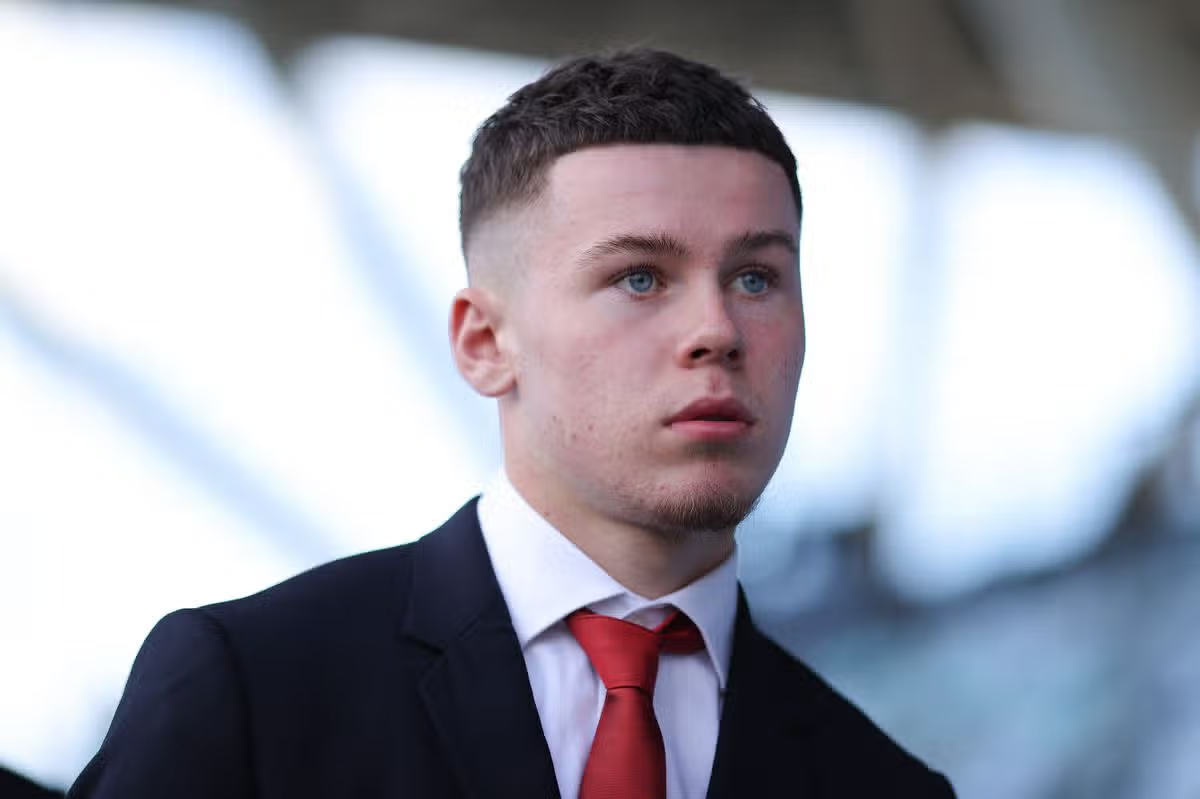
Kai Rooney has opened up about a major recent development at Manchester United
Kai Rooney announced he has returned to action for Manchester United after suffering a season-ending injury last term.
The 16-year-old has enjoyed a sensational rise since joining the Reds back in 2020. The youngster has sought to follow in his dad Wayne’s footsteps, who is the club’s all-time leading goal-scorer and one of the best to ever play at Old Trafford.
Advertisement
However, the young Rooney’s blossoming career hit a stumbling block back in March as he suffered an injury which brought his campaign to a premature end. Having already been left in a protective boot earlier in the campaign, the latest injury notably ruled him out of a possible cameo in the blockbuster FA Youth Cup final defeat to Manchester City.
He posted on his Instagram story at the time: “Disappointed to be out for the rest of the season. Back stronger next pre-season,” alongside a red love heart emoji. The caption was written on top of a black-and-white image of him in a United kit during a game.
But his hard work and rehabilitation have paid off as the teenager confirmed on Friday that he is set to make his return to the field. Rooney, along with first-team manager Michael Carrick’s son Jacey, are both part of a 23-man United squad that will compete in the eight-team Otten Cup in Eindhoven this weekend.
The youngster once again took to Instagram, this time posting a positive update as he stood on the PSV Eindhoven pitch with team-mates. He captioned the photo: “First game back from injury. PSV (A).”
United’s first game of the tournament was against hosts PSV on Friday afternoon, which ended in a 1-0 defeat. Another match against Brazilian side Palmeiras will take place in the evening. They then take on Australian outfit Adelaide United on Saturday.
Despite his recent injury, Rooney will look back on 2025/26 fondly, having also won the Super Cup NI with the younger age group. He earned his breakthrough with Darren Fletcher’s Under-18s as a 15-year-old in January, managing two goals and an assist in six U18 Premier League fixtures.
Advertisement
Rooney made his first appearance at OId Trafford last term, playing 21 minutes in the FA Youth Cup fourth-round win against Derby County, while he was an unused substitute in the quarter-final success against Sunderland. He was also part of the Under-16s side that won the Premier League Shield.
That progress culminated with him signing his first year scholarship contract in July, taking the next step towards a potential professional contract once he turns 17. The Manchester Evening News understands that both Rooney and Carrick Jr will feature heavily for the U18s in the new campaign.
Rooney has not yet started training with the senior team like high-profile academy talent, JJ Gabriel, who is aged 15. He is, however, expected to get the chance to play in the Youth Cup this season.
Advertisement
The forward transitioned from playing as a striker, where his father played, to operating on the wing because he likes to cut inside with his left foot as he ascended the youth team ranks. Parents Wayne and Coleen were regularly seen in attendance watching his matches this year prior to his injury.
Countdown to Kickoff: The Essential 26/27 Sky Sports Bundle
This article contains affiliate links, we will receive a commission on any sales we generate from it. Learn more
Sky’s Essential TV and Sky Sports bundle includes at least 215 live Premier League clashes across the 2026/27 season, with more than 1,500 games from the EFL and beyond, plus F1, golf and darts.
This introductory offer saves £384 compared to the standard price, with every package also providing 100 regular channels alongside free Netflix and discovery+ subscriptions.

Sep 1, 2026; Houston, Texas, USA; Houston Astros pitcher Kai-Wei Teng (17) pitches against the Chicago White Sox during the fifth inning at Daikin Park. Mandatory Credit: Erik Williams-Imagn Images
The Houston Astros optioned right-handed reliever Kai-Wei Teng to Triple-A Sugar Land and recalled right-handed reliever Miguel Ullola from Sugar Land on Sunday.
Teng, 27, is 5-7 this season with a 4.76 ERA in 30 appearances (10 starts). He allowed at least one run in each of his last three outings.
Ullola, 24, is 0-0 with a 4.50 ERA in four appearances for Houston. In six innings, he has allowed three runs on four hits, with nine strikeouts and one walk.
At Sugar Land, Ullola was converted from a starter to a reliever, compiling a 5-4 record with a 4.21 ERA across 66 1/3 innings in 39 appearances (10 starts) this season.
A lot of the time, fantasy football experts are listing Vikings WR1 Justin Jefferson down in the 2nd Round of fantasy drafts. That’s madness.
Nobody has generated more air yards across his opening six NFL seasons than Jefferson. That’s despite starting as a backup for Mike Zimmer. That’s despite seeing all of these passers throw him the ball since 2022: Kirk Cousins, Nick Mullens, Jaren Hall, Sam Darnold, Joshua Dobbs, J.J. McCarthy, Max Brosmer, and Carson Wentz. Now with Kyler Murray, Jefferson is looking to prove many naysayers wrong.
Vikings WR1 Justin Jefferson & The Fantasy Football Madness
Consider just a trio of spots that list Justin Jefferson in some fantasy rankings:
Advertisement
Nobody truly knows how fantasy leagues are going to unfold. What’s crystal clear, however, is that crushing the ADP is a surefire way to give a team an edge. Jefferson offers potential for this kind of advantage.
Minnesota Vikings quarterback Carson Wentz (11) and wide receiver Justin Jefferson (18) head toward the locker room at halftime on Sep 21, 2025 at U.S. Bank Stadium in Minneapolis. The veteran quarterback and star receiver remained central figures as Minnesota evaluated its offensive direction during a season filled with transition. Mandatory Credit: Jeffrey Becker-Imagn Images.
Last season was pretty poor, at least for Jefferson. Understand, though, that Jefferson’s bad isn’t bad.
With 84 receptions, Jefferson finished off at 13th in the NFL for that stat category, giving him a ton of value in PRR leagues. His 1,048 receiving yards were similarly modest compared to what the WR1 has done in the past. Just note that he still finished at 12th in the NFL with that total.
Where he could be said to have done legitimately poorly was in his touchdown caches, or lack thereof. Boasting just 2 scores is a shortcoming that needs to get fixed. The receiver sits in a tie for 118th with the 2 scores.
Advertisement
Nobody has ever mistaken Jefferson with Davante Adams when it comes to touchdowns. A scoring assassin he is not. What happens, though, if he’s just good rather than great in this area? Where could he go with his game if he gets within the 8-10 touchdown range?
Elite catches and yards can do wonders if he finds a way to get back to good with touchdowns.
Minnesota Vikings wide receiver Justin Jefferson reacts after scoring a second-half touchdown at Soldier Field, with Sep. 8, 2025 embedded mid-paragraph in Chicago. Jefferson punctuated the moment with visible emotion as Minnesota extended momentum against the Bears, delivering a decisive play in a hostile divisional road environment. Mandatory Credit: Matt Marton-Imagn Images..
Kyler Murray isn’t a perfect quarterback. However, he is a good quarterback. Seeing him form some nice chemistry with Jefferson should be the expectation. At 29, Murray has accumulated plenty of experience, meaning he’ll know where his bread is buttered. He’ll look to his WR1 regularly.
As it relates to numbers, Justin Jefferson could very plausibly climb up to 100 catches, 1,500 yards, and 8 touchdowns. That’s an eye-popping fantasy season (especially in PPR) that’s sometimes being priced at a “very good” rather than an “elite” level.
Once the Washington Huskies’ celebration of beating bitter rival Oregon in the 2023 Pac-12 Championship Game — and clinching a spot in the College Football Playoff — finally calmed down, an awkward reality began to set in.
This was the end of Pac-12 football as we knew it.
Michael Penix Jr. and Washington celebrate winning the Pac-12 Championship in 2023. (Photo by Ian Maule/Getty Images)
One of the oldest conferences in college sports, dating back to the formation of the Pacific Coast Conference in 1915, was about to disappear. Its demise had been years in the making, with the inability to secure and improve its media rights deal at the center of the problem. As name, image and likeness transformed college football, the premier programs knew they could no longer afford to fall behind the Big Ten and SEC.
Advertisement
Washington, Oregon, UCLA and USC headed to the Big Ten. Reacting to their departure, Arizona, Arizona State, Colorado and Utah joined the Big 12. Left hanging, Cal and Stanford scurried to find a home in the ACC. The movement diminished the Pac-12 to a two-team conference of Washington State and Oregon State.
Gone were the days of Pac-12 basketball tournaments in Las Vegas. The Apple Cup rivalry between Washington and Washington State moved to the beginning of the season. The tradition of staying up late to watch the ever-chaotic “Pac-12 After Dark” ended.
Now, after two years of the Pac-12 conference essentially ceasing to exist, it’s back.
So back.
Advertisement
The new-look Pac-12 in 2026 looks much different than it did in the past. There will still be rivalries, heated competition, and late-night shockers, but it’s no longer viewed as a power conference. Now, a team must be ranked higher than every other Group of Six opponent in the final top 25 to reach the College Football Playoff.
Another fun fact: Every Pac-12 football team has the word “State” in its name.
The new members include five teams from the Mountain West — Boise State, Colorado State, Fresno State, San Diego State and Utah State — and one from the Sun Belt Conference, Texas State. They join Oregon State and Washington State to complete the eight-team Pac-12.
The Broncos have long been one of the premier Group of Six programs, and now bring their famous blue field to the bright lights of the Pac-12. Fresno State and Utah State each qualified for bowl games in 2025, while Colorado State will look to turn things around under former UCLA coach Jim Mora. Texas State, meanwhile, has won a bowl game in each of the past three seasons.
Advertisement
One wrinkle: Gonzaga will join the conference for college basketball, bringing the Pac-12 to nine members in that sport. The Bulldogs have qualified for the NCAA Tournament in each of the past 17 seasons, including trips to the national championship game in 2017 and 2021.
The new-look Pac-12 might not have the luster or level of competition of its predecessor, but it should be one of, if not the, strongest Group of Six conferences in both football and basketball.
Kirby Moore takes over as Washington State’s head coach after three seasons as Missouri offensive coordinator. He takes over a team that won seven games in 2025, capping the season with a bowl win over Utah State. Jedd Fisch enters his third season at Washington and hopes to lead the team to a College Football Playoff spot after the Huskies won nine games in 2025.
Washington State vs. Washington betting odds (via DraftKings)
Washington St. vs. Washington money line:
Washington State +1200, Washington -3000
Washington St. vs. Washington over/under:
51.5 (Over -110, Under -110)
Washington St. vs. Washington spread:
Washington -23.5
Washington State vs. Washington betting preview
The first big question for Moore will be whether transfer quarterback Caden Pinnick can elevate this offense. He’ll have some help with Kirby Vorhees returning at running back and Tony Freeman stepping up as the team’s presumed top receiver. If Pinnick and fellow transfer Darrius Coleman hit, Washington State could be at the top of the new-look Pac-12. Another big question will be Washington State’s defense, which was one of the best in the country in terms of yards allowed and points allowed. The Cougars bring in a lot of transfers, so that could lead to some regression on that side of the ball.
Washington was embroiled in some controversy surrounding quarterback Demond Williams Jr., who entered the transfer portal despite seemingly having an agreement in place with the Huskies. Williams is back in the fold though, which elevates Washington’s ceiling in 2026. Dezmen Roebuck should take on a bigger role at receiver, and we’ll see if Oregon transfer Jayden Limar can explode in a featured running back role. Washington’s defense brings back plenty of key contributors, headlined by Alex McLaughlin, Xe’ree Alexander and Jacob Lane. If the peripheral contributors can step up to replicate Washington’s takeaway rate while also providing more pressure on opposing quarterbacks, this should once again be one of the better defenses in the Big Ten. Bet on college football games with FanDuel and get up to $350 in bonus bets:
Advertisement
Washington State vs. Washington picks, prediction
Washington State +23.5
The SportsLine Projection Model, which simulates every game 10,000 times, sees value on taking the Cougars on the money line as they win in 22% of simulations. I’m not necessarily going to go that far, but I do think Washington State will bring the energy in this rivalry game. The Cougars were cast aside in the Pac-12 exodus, and they’ve been waiting to relaunch the conference. The Huskies may have won by 35 points a year ago, but most of these Apple Cup games are close. Two of the last three contests were decided by one possession, and Washington State would’ve covered a 23.5-point spread in six of the last seven games.
Hang on. We’d seen that goal before, hadn’t we? We’d seen Martin Odegaard just there, lurking undetected in a pocket of space between defence and midfield. We’d seen Christos Tzolis drive inside and fire that exact pass into the centre. We’d seen Riccardo Calafiori’s decoy run and Kai Havertz intelligently leave it. We’d seen Odegaard’s little dart, the velcro control, the poise as he waited just a beat before pulling the trigger.
If Odegaard’s winning goal against Chelsea felt familiar, that’s because he’d scored a carbon copy against Manchester City in the Community Shield three weeks earlier. The same players, the same movements, the same outcome, with a world-class goalkeeper – then Gianluigi Donnarumma, now Emiliano Martinez – left beaten on the ground as the ball hit the net.
The prevailing question at the start of the season was not who would win the league so much as how Arsenal would win it. Will they roll out the 2025/26 blueprint, bludgeoning teams to death by a thousand corners, strangling possession, smothering all routes to xG? Or would we see something altogether more free-flowing and spontaneous now the weight of a 22-year wait had been lifted?
You can already feel a buzz in the air outside the Emirates, a sense that the brittleness of past years has disappeared in the wind. Music blaring from the megastore DJ could be heard down every road leading to Armoury Square three hours before kick-off. Inside, hundreds queued to buy an Arsenal scarf or pyjamas or a cushion with Declan Rice’s face on. Outside, content creators jostled for space while fans videoed fellow fans being interviewed by other fans on YouTube.
It is that strange time of the season when the leaves are still green and summer is clinging on. The transfer frenzy has only just ended and, really, we don’t know anything yet. The sample sizes are small and in this twilight window, we inevitably draw bad judgments. At exactly the same stage last year, three games in, the champions Liverpool beat the pretenders Arsenal and the title race was surely over.
Advertisement
What sort of Arsenal might we get? The first few games of the season had not served up a definitive answer, but this game felt different. It was no doubt influenced by Chelsea’s decision to play basketball, by Morgan Rogers’ early goal which forced Arsenal to show urgency, by Martinez, chief s***house of the Premier League, whose presence poked the Emirates into furious noise. Even so, this was a performance full of roving positions, slick interchanges and seamless rotations which felt thrilling at times, and Chelsea struggled to follow them.
Martin Odegaard fires home Arsenal’s winning goal against Chelsea (PA)
Martin Odegaard scored the winner as the Gunners maintained their 100% record (Reuters)
There was a moment late in the first half when Havertz was on the right wing, Calafiori was galloping into the right half-space, Odegaard was the striker and Bukayo Saka was inside as the No 10. Only David Raya, Ezri Konsa and Gabriel Magalhaes could claim to have been at their stations. And Odegaard’s goal was a product of a higher tempo that this Arsenal side had at times abandoned in the final months of last season, understandably so through tension, through fatigue, perhaps even through sheer fear at what they might lose.
It didn’t help that Arsenal played without this version of Odegaard last season, a campaign derailed by injury. He rediscovered his flow captaining Norway at the World Cup and has continued that form with three goals in four Arsenal games, if you like to count the Community Shield as a game. Where he has sometimes fallen into a rhythm of taking the easy option, being Arsenal’s playmaker on the fringe of a match, here there was a boldness to his runs, getting closer to Havertz, nearer the goal, demanding the ball in tight spaces where his close control can hurt opponents.
“He’s fit, his confidence is one of the highest that I’ve seen him and he has a point to prove,” said Arteta. “Kai the same, Bukayo the same. We missed so many attacking players last season for long, long periods, and I don’t know how many times they’ve played together, those three, in the last few years. Probably not much. You feel the chemistry that they have between them and what they can produce. You have to play with real intent and that’s what I loved seeing today. He was running forward, he took shots, he created so many situations for his teammates.”
Are Arsenal about to unleash a season of wild, entertaining chaos-ball? Probably not. Arteta is not about to abandon the positional principles that have served his coaching career so well. Arsenal will not play a team as frantic as this Chelsea side every week. But there is a paradox here, that the cohesion and connections in this team are so well honed by now, so sharply refined, that Arsenal can produce pre-planned patterns as mesmerising to watch and difficult to defend as anything off the cuff.
Advertisement
Perhaps this is the next evolution of Arteta’s team, to be as meticulously well-drilled in the disorder of open play as they are standing over the certainty of a set-piece. The fact Odegaard scored the same goal twice in a month suggests that, even within the confines of their manager’s highly tuned system, Arsenal might be unlocking some new attacking verve.
Nigerian clubs recorded contrasting results in the CAF inter-club competitions on Sunday, with Rangers International held to a 1-1 draw by AS SOBEMAP, while El-Kanemi Warriors claimed a convincing 3-0 win over UDIB.
Rangers Held to Draw in Abeokuta
Rangers International were forced to settle for a 1-1 draw against AS SOBEMAP of Benin Republic in the first leg of their CAF Champions League first preliminary round tie at the MKO Abiola Sports Arena in Abeokuta.
Advertisement
The Nigerian champions took the lead through defender Chidozie, who continued his impressive goalscoring form to put the Flying Antelopes ahead.
AS SOBEMAP, however, responded strongly, with Emmanuel Ali scoring the equaliser to deny Rangers a home victory.
The draw leaves Rangers with work to do in the second leg as they look to secure a place in the next round.
Advertisement
Rangers are hosting their continental matches in Abeokuta because of the ongoing renovation of the Nnamdi Azikiwe Stadium in Enugu.
The second leg will take place in Benin Republic on September 11, with coach Fidelis Ilechukwu and his players needing a strong performance away from home.
El-Kanemi Warriors Shine Against UDIB
El-Kanemi Warriors, meanwhile, enjoyed a more positive outing in the CAF Confederation Cup, beating União Desportiva Internacional de Bissau (UDIB) 3-0 in Ikenne.
Advertisement
The Maiduguri-based club stepped up their performance after a goalless first half, scoring three times after the break to secure a comfortable victory.
The result gives El-Kanemi a strong advantage heading into the second leg in Bissau next week.
The Warriors will now look to protect their three-goal lead away from home and complete their qualification to the next stage.
With Rangers facing a tough return leg against AS SOBEMAP and El-Kanemi holding a healthy advantage over UDIB, Nigeria ended Sunday’s CAF fixtures with mixed results.
Lamine Yamal struck twice for Barcelona as they demolished Valencia 5-0 on Sunday to maintain their 100 percent start in La Liga. The reigning champions moved three points clear at the top of La Liga, after Jose Mourinho’s Real Madrid lost 1-0 at Real Betis on Friday. Fermin Lopez, Raphinha and Pedri were also on target for Hansi Flick’s swaggering visitors on a hot afternoon on Spain’s east coast. Yamal did not take part in the team training session on Saturday after a knock but showed no signs of it during a dazzling display against Carlos Corberan’s Los Che.
Barcelona, the only team in the top flight to win their first four games, took control from the start to the upset of Valencia’s fans at a persistently bad-tempered Mestalla stadium.
“We played a fantastic game, it was nearly perfect, we controlled, we were dominant and this is what I want from the team,” said Flick.
Advertisement
“We stay calm and then if it’s possible to score we try to do it — it was a fantastic game for us.
“Nothing is perfect, you always can improve. If it’s perfect then you can stop working.”
Yamal opened the scoring with a clever lofted finish in the sixth minute after Lopez dinked a superb ball over the top for the teenage star.
The 19-year-old slammed home at the near post for what he thought was Barca’s second goal but the goal was disallowed for a tight offside after a VAR review.
Advertisement
Lopez netted the second with a crisp finish in the 22nd minute after former Newcastle winger Anthony Gordon teed him up.
Barcelona suffered a blow when Eric Garcia had to go off hurt midway through the first half after a collision with team-mate Rodri’s shoulder, on the midfielder’s first start since arriving this summer from Manchester City.
Yamal fired narrowly wide and Lopez struck the post as Flick’s side continued to dominate. Barca goalkeeper Joan Garcia made a smart save to thwart Arnaut Danjuma at his near post before the break.
Raphinha, starting again as the team’s centre-forward, tapped home his sixth goal of the season from close range after Lopez fed him.
Advertisement
Valencia goalkeeper Stole Dimitrievski saved from Rodri before Pedri netted Barcelona’s fourth after an exchange of passes with Dani Olmo.
New arrival Gabriel Jesus came on for his Barca debut as a substitute in the final 10 minutes and sent a low effort just wide.
Yamal stayed onside to collect another Olmo pass and put away Barca’s fifth and conclude a profitable afternoon for both the World Cup winner and the Catalan giants.
“We have a very young team, with the right transfers we made, but it’s the beginning of the season, it’s not the end,” added Flick, telling his team not to get too excited yet about their strong start.
Advertisement
“We have to go a long, long way.”
(Except for the headline, this story has not been edited by NDTV staff and is published from a syndicated feed.)
Featured Video Of The Day
India Ends CWG Boxing Campaign With Record-Breaking Seven Gold Medals
There are few people in golf who know the bunker game better than David Armitage. He coaches all aspects of the game, but the sand is his specialty.
“I am the only guy that is dumb enough to write 144 pages about how to get out of bunkers,” he says.
For most golfers, bunkers are a source of anxiety — a place to be avoided at all costs. For Armitage, the bunker is his happy place. And he wants it to be the same for his students.
That mission has led Armitage to dedicate himself to helping golfers of all skill levels understand the secrets to better bunker play. He has shared his expertise in his book, The Bunker Game: How to Play with Confidence from the Sand, and now in our latest Top 100 Teacher Sessions video, where he breaks down the techniques and adjustments that can turn any golfer into a more confident player from the sand.
Advertisement
Watch the video below or read on for a complete guide to mastering bunker play, courtesy of the man who — quite literally — wrote the book on it.
“>
Chapter 1: Why the bunker beats you
Just about every average recreational golfer is fearful of the sand. When they see a sand trap, they do everything they can to avoid them, because when they find one, it can lead to a big score.
Advertisement
“I think it all leads back to bad concepts [and] bad understanding of how to play the bunker shot,” Armitage says.
The “standard” technique for bunker play has long been to severely open your stance, open your clubface and then swing down your feet line. However, that technique doesn’t work for a majority of players. With that setup and strike, it requires tons of strength and clubhead speed to get the ball up on the green.
Another issue with this setup is that it makes it incredibly difficult to get the ball heading in the correct direction. With such an open setup, aim becomes quite difficult.
“It’s going to be unpredictable how the ball is going to start,” Armitage says. “Because I’ve got the face wide open, my feet left … I’m not going to be as predictable with my start line.”
Advertisement
Chapter 2: Seve Ballesteros’ influence on modern bunker play
For Armitage, the turning point in his bunker education came from one of golf’s greatest short-game artists: Seve Ballesteros.
Armitage spent most of the beginning of his golf life in St. Andrews, where the bunkers are small and difficult to escape. And although he had taken lessons from many coaches, he still struggled with his play from the sand.
“I obviously was a strong young kid and could generate a lot of speed,” Armitage says. “But I found it difficult to start the ball online. I found it difficult to generate distance.”
That changed when he spent time with Ballesteros, who was near the end of his career and visited St. Andrews for corporate outings from time to time. During those visits, Armitage got to watch him hit bunker shots and picked up on some of his techniques, such as the simplicity of the setup.
Advertisement
“He hit all the shots from a square stance,” Armitage says.
Armitage remembers watching Ballesteros demonstrate the shots and heading straight to a bunker to try them himself. The difference was immediate.
“I couldn’t believe how it changed my bunker game and how the start lines became better straight away, how my distance control became better, and how it felt just easier,” he says.
Chapter 3: Setup basics
Armitage’s approach to bunker play begins with nailing the setup. Rather than trying to create a complicated swing, he wants golfers to establish a position that makes the correct motion easier to produce.
Advertisement
“I’m looking at really square stance,” he says. “I’ve opened the face. I’m then taking my grip, and then I have a wide stance, low handle, moving my chin, my sternum, and my belt buckle onto the ball or just in front of the ball.”
The first key is getting into a wide stance. Armitage wants it wider than a golfer’s driver stance, which helps lower the body and the handle. That, in turn, helps the ball get up.
He also recommends digging the feet into the sand slightly. This helps golfers feel the sand beneath them and understand what kind of lie they are dealing with. But consistency is important. Armitage doesn’t want golfers digging in by a different amount every time they enter a bunker.
“You’ve gotta be consistent with your approach to that setup,” he says.
Advertisement
The next key is moving the body forward. Armitage wants the chin, sternum and belt buckle to shift toward the target. He sees too many golfers moving their lower body forward while leaving the upper body behind, which moves the low point backward.
“This is a big no-no,” he says.
Instead, the sternum should be forward, with a little more flex in the lead knee. Armitage says this was something he always noticed in Ballesteros’ setup.
For a standard greenside bunker shot, Armitage places the ball just in front of the middle of his stance. The strike point is in the middle, and the sternum is directly above or slightly in front of the ball. That position controls the low point of the swing.
Advertisement
“The club’s gonna enter on the sand, on the line. It gets to its lower point, lowest point where my sternum is, and then it exits out,” he says.
Chapter 4: How to orient the clubface
Once the setup is in place, Armitage turns his attention to the clubface. The face still needs to be open, but the reason is different from the traditional approach. He wants an open face so golfers can expose the bounce of the wedge, which helps the club glide through the sand instead of digging into it.
“This is a beautiful part of the club that Gene Sarazen developed,” Armitage says.
The bounce is the part of the sole that helps the club move through the sand. Opening the face exposes more of it, allowing the club to slide rather than dig.
Advertisement
Armitage also points out that golfers need to use the right club for the sand they are playing from. Different bunkers have different types of sand, and different wedges have different amounts of bounce.
“If you have a lot of bounce and you have a hard sand, that’s probably not a great combination,” he says.
For his standard greenside bunker shot, Armitage opens the face to about 2 o’clock. He uses a clock-face reference to explain the position: 12 o’clock is square, 1 o’clock is slightly open, and 2 o’clock is more open. (Left-handed golfers would use the opposite side of the clock, with 11 o’clock being slightly open, and 10 o’clock being more open.)
Armitage also recommends taking the grip after opening the face, which helps keep the face open through the shot.
Advertisement
He sometimes uses a slightly weaker left-hand grip, which helps prevent the face from closing too much. It’s not something every golfer has to do, but it’s a technique that can be useful and that is used by many tour players.
Chapter 5: The swing
Armitage’s standard bunker shot is 12-yards, which is what another short-game guru, Phil Mickelson, uses as his starting point. All other shots work from that standard 12-yard shot.
For the standard shot, the setup remains the same as described above. Then, the club needs to swing up and down into the sand.
“A lot of people talk about, like, do I pick the club up? Well, I think the club does have to go up,” Armitage says. “Because we do need a steeper angle of attack in the bunker.”
Advertisement
The key is that the setup should make this happen naturally. With the weight forward and the sternum in front of the ball, the club should swing more vertically without the golfer having to force it.
As you approach impact, Armitage wants the clubhead to enter the sand about two inches behind the ball and create a divot pattern that moves slightly left of the target line.If you can do that, the ball should pop nicely out of the sand.
As you make your swing, be sure you keep the weight forward throughout the motion. If you start with 70 to 75 percent of your weight on your lead foot, you wants that pressure to remain there through the backswing and increase into impact. The other important ingredient is speed. The sand slows the club down, so golfers need enough speed to get the ball out.
“Most amateurs, if they hit that shot, they’re out of trouble, they’ve got a putter in their hand, and they’re probably gonna make bogey and move on to the next hole with a smile.”
Advertisement
Chapter 6: Changing distances
Once golfers understand the basic bunker shot, you need to learn how to change distance without changing the swing speed. For that, Armitage suggests using different wedges and different face positions.

He has a gap wedge, a 54-degree wedge and a 60-degree wedge. With each club, he can use a square face, a 1 o’clock face, or a 2 o’clock face. That gives him nine different shots without changing the swing speed.
The type of sand, how much sand is taken, and how the club deflects through it can all affect the trajectory. Armitage points out that tour players don’t always create spin themselves. Sometimes the sand is responsible for the way the ball reacts.

“When they see a ball spinning, they think that the player’s making it spin, and sometimes it’s to do with the circumstances,” he says.
Advertisement
For everyday golfers, the lesson is to focus on the setup and the strike rather than trying to manufacture spin.
Chapter 7: Advanced bunker play
Armitage’s advanced bunker shot is designed for experienced golfers who need to hit a short-sided shot or get the ball to stop quickly.
“This is a shot that I wouldn’t teach the everyday golfer,” he says.
The shot begins by opening the face even more. Armitage moves from his normal 2 o’clock position to about 2:30, pushing the limits of how much loft he can create. The more open the face becomes, the more bounce is exposed. But it also means there is less of the clubface available to hit the ball with, making the margin for error even thinner.
Advertisement
For this shot, Armitage also weakens his left-hand grip, lowers the handle and widens his stance even more. Then, he makes the same swing he does for any other bunker shot. The result is a shot that launches higher and travels shorter. That allows him to swing with speed while keeping the ball from going too far.
“You can still have speed, and that ball’s gonna go higher and shorter,” he says.
For short-sided bunker shots, that speed is especially important. Armitage says golfers often become tentative when they are close to the hole, and that can lead to deceleration and leaving the ball in the bunker.
But Armitage also emphasizes that some bunker shots are simply not accessible. Even the best players in the world sometimes have to accept a difficult pin and give themselves a longer putt.
Advertisement
“Some shots are just not accessible,” he says. “You’ve gotta take your punishment sometimes.”
Chapter 8: How to practice on your own
Armitage’s practice philosophy is simple: start with the strike, not the ball.
One of his favorite drills uses a rake. He places it behind the ball so that if he sways or falls back during the swing, he will hit it. The drill helps golfers understand how vertical the swing needs to be for a proper bunker shot.
“If I drift off the ball on the backswing, I’m gonna hit the rake,” Armitage says.
Advertisement
The rake also helps golfers make sure the downswing is vertical and forward. Armitage recommends starting slowly and using the drill to build the feeling of the correct motion.
“Do it slowly,” he says. “Maybe just do it in very slow motion just to get the image and the feeling.”
Another drill comes from Ernie Els. Armitage says Els would draw two lines in the sand, set up wide, and make swings that focused on contacting the sand between those lines. He would then make two or three of those swings before hitting a ball.
“That’s what the pros do, and one of the best players in the world,” Armitage says.
Advertisement
The lesson for amateurs is to do the same. Rather than immediately hitting balls, start by practicing the setup and the strike.
“Do the line drills first, get that impact where you want it, and then take that to the ball,” he says.
After weeks of delays and behind-the-scenes attempts to cobble something meaningful together, UFC 332 in Salt Lake City, Utah finally has a championship main event: Natalia Silva vs. Wang Cong for the vacant women’s flyweight belt.
Wait, what? The flyweight belt that Valentina Shevchenko has defended a whopping nine times since 2018 across two title runs? That’s now vacant? When announcing Silva vs. Cong, they cited a “Bullet” injury but didn’t really get into details on how the belt was put back up for grabs. A statement from Shevchenko’s coach Pavel Fedotov gave a bit more info.
Advertisement
“We were supposed to fight on October 3 against Natalia Silva, but due to an injury to the ligaments in the shoulder and back, we decided not to push things and postpone the fight,” Fedotov wrote (via Ushatayka). “Given that the recovery will take a long time, we’ve made the decision to temporarily vacate the belt, and once she recovers, she will fight for it again.”
Advertisement
According to Fedotov, they’re expecting the injury to take eight months to recover from.
In the past, you might expect to see an interim title go up for grabs after similar injuries taking under a year to heal. But these days, the UFC has gotten into the habit of asking its injured champions to relinquish their belts. Jamahal Hill did it when he ruptured his Achilles tendon, and so did Jiri Prochazka when he injured his shoulder. Now we’ve got Valentina Shevchenko doing it.
Advertisement
Hopefully these fighters are getting compensated well for giving up their hard earned championship gold so the UFC can patch holes in their matchmaking schedule with undisputed title fights. Hill and Prochazka never won back their belts after relinquishing. Will Shevchenko suffer the same fate?
PLDT’s Savi Davison during a game against Creamline in the PVL Invitational Conference.–MARLO CUETO/INQUIRER.net
MANILA, Philippines — Nxled made its first-ever PVL Finals appearance thanks to dethroned champion PLDT.
Already out of title contention, the High Speed Hitters played spoiler and denied the Creamline Cool Smashers’ bid to claim the last ticket to the title match with a 25-17, 23-25, 21-25, 25-23, 15-12 win on Sunday night at Smart Araneta Coliseum.
Article continues after this advertisement
Advertisement
Nxled did its part in the first game by beating Farm Fresh before PLDT’s comeback victory sealed the Chameleons’ place in the final against Thai club EST Cola.
Nxled, PLDT, and Creamline actually finished the elimination round with similar 3-2 records, but the Chameleons held the tie-break with 10 points.
Nxled takes on top seed EST Cola in the winner-take-all final on Tuesday at 6:30 p.m.
Advertisement
Article continues after this advertisement
PLDT mounted a 13-9 lead in the fifth set after Kianna Dy’s clutch kill. With Jaja Santiago-Minowa entering the rotation, she made it a two-point game before Dy scored again off the block to reach match point, 14-11.
Minowa saved a point, but Savi Davison ended the match with a cross-court hit. Davison unleashed a new career-high 37 points on 35 attacks and two blocks. The reigning Invitational MVP also had stellar floor defense with 24 excellent receptions and 18 digs.
“Unfortunately, we weren’t able to get the result we wanted,” said PLDT coach Rald Ricafort in Filipino.
Advertisement
Article continues after this advertisement
“But the mindset of the players and the team is that we’re not going to pick and choose which games to fight for. Especially against Creamline, they’re a very challenging team to play against. They really bring out the best in each of us. So we’re going to take this win, keep fighting, and prepare for them again on Tuesday.”
Kianna Dy and Jovy Prado had 14 points each. Mika Reyes had 11 points, highlighted by five blocks.
Creamline missed the Invitational Finals for the second straight time despite adding Minowa, a former league MVP and resident Japan SV.League import.
Advertisement
Your subscription could not be saved. Please try again.
Your subscription has been successful.
Minowa tallied 25 points built on 15 kills, nine blocks, and an ace. Jema Galanza had 20 points, 16 digs, and 16 excellent receptions, while Michele Gumabao added 11.
Advertisement
PLDT and Creamline battle for bronze on Tuesday at 4 p.m.
You must be logged in to post a comment Login