
Crypto World
Morgan Stanley Data Shows BlackRock Bitcoin ETF Holdings Up 23% in Q2

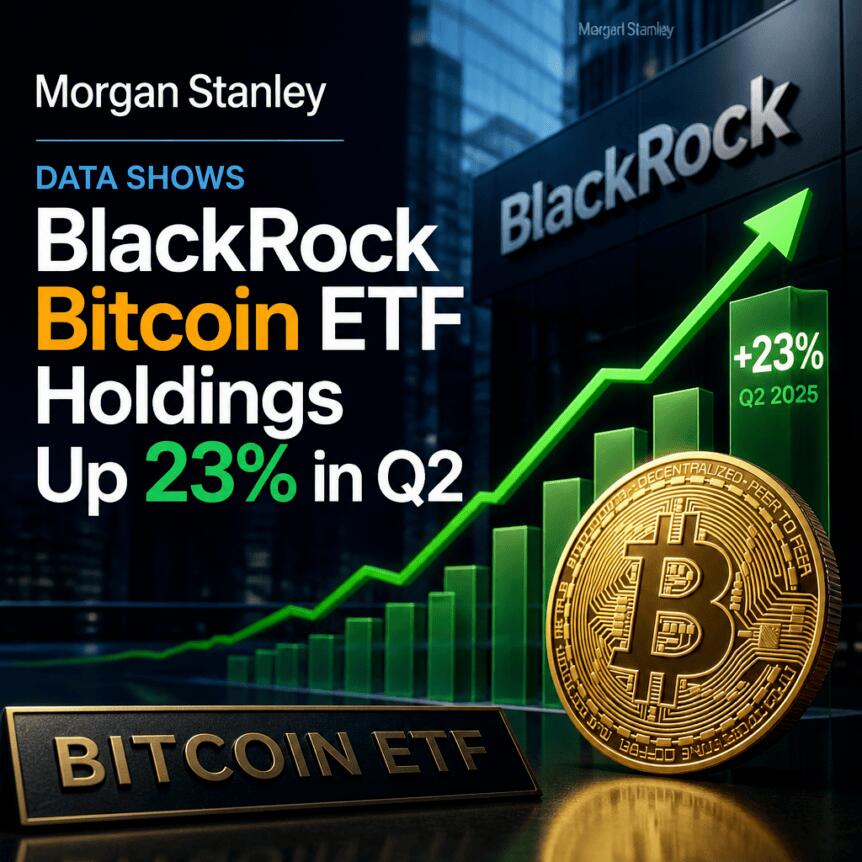
Morgan Stanley’s latest US SEC 13F filing shows the bank increased its crypto-linked exposure in the second quarter, with the biggest lift coming from additional shares of BlackRock’s Bitcoin exchange-traded fund (ETF) iShares Bitcoin Trust (IBIT). The update comes as the value of those holdings shifted with underlying market moves during the quarter.
According to Morgan Stanley’s Q2 13F filing, its reported IBIT share count rose to around 16.5 million shares from 13.4 million—an increase of roughly 23%. At the same time, the dollar value of the position fell, reflecting declines in Bitcoin over the period covered by the filing.
Key takeaways
- Morgan Stanley increased its IBIT holdings by more than 3 million shares, but the reported value of the position dropped about 18% to $549 million.
- The bank also reported new exposure to its own spot Bitcoin product, the Morgan Stanley Bitcoin Trust (MSBT), which began trading in April.
- Ether-related ETF exposure expanded as well, including a roughly 202% increase in iShares Ethereum Trust (ETHA) shares to 4.6 million.
- Not all crypto positions rose: Morgan Stanley reduced several holdings tied to exchanges, mining, and infrastructure.
- Stablecoin issuer Circle also gained from the bank’s broader Q2 reallocation, with USDC-related holdings jumping significantly.
IBIT share growth, but lower reported value
Morgan Stanley’s filing points to a clear volume increase in BlackRock’s Bitcoin ETF. The bank reported IBIT holdings rising by about 3.04 million shares to approximately 16.5 million. However, the reported value declined to about $549 million from roughly $667 million, a drop of around 18%—consistent with the broader move in Bitcoin prices during the second quarter.
The filing described increases across several other Bitcoin ETF positions as well. Morgan Stanley added to smaller spot Bitcoin ETF exposures including the Grayscale Bitcoin Mini Trust ETF (BTC) and Bitwise Bitcoin ETF (BITB), while its Fidelity Wise Origin Bitcoin Fund (FBTC) holding rose nearly 38%.
Ether exposure expands alongside Bitcoin
Beyond Bitcoin, Morgan Stanley also increased its Ether-related ETF positions. The bank reported expanding its iShares Ethereum Trust (ETHA) stake by about 202% to 4.6 million shares. It also raised its Grayscale Ethereum Staking Mini ETF (ETH) position by roughly 26% to about 5.1 million shares.
In addition, Morgan Stanley initiated exposure to Solana-related products. The filing showed new positions in the Grayscale Solana Staking ETF (GSOL) and Fidelity Solana Fund (FSOL), reported at about $4.25 million and $2.26 million, respectively. That combination of more traditional large-cap exposures and smaller add-ons suggests a continued effort to broaden multi-asset crypto exposure rather than concentrating exclusively on Bitcoin.
New MSBT position and Circle’s USDC-linked holdings
Morgan Stanley’s own crypto product also entered the picture more clearly in the second quarter. The filing reported about 2.57 million shares of Morgan Stanley Bitcoin Trust (MSBT), a fund that began trading in April. While the filing’s share increase reflects new participation, it also underscores how quickly large financial institutions are building internal product lines around spot crypto access.
Separately, Morgan Stanley increased its reported stake in Circle Internet Group (CRCL)—the company behind the USDC stablecoin. According to the filing, Circle holdings rose from approximately 1.46 million shares to about 8.32 million shares. That is a substantial shift and stands out because it targets the stablecoin ecosystem rather than only spot-crypto ETF wrappers.
Mining and infrastructure gains—while some equity exposure falls
While Morgan Stanley grew several crypto-adjacent positions, the filing also showed reductions in some prominent holdings. The bank reported additions to multiple Bitcoin mining and infrastructure companies, including Cipher Digital (CIFR), Core Scientific (CORZ), Hut 8 (HUT), and Bitdeer Technologies (BTDR). These increases suggest the institution was willing to add risk to parts of the sector that often move with both network economics and equity sentiment.
At the same time, not every position improved. Morgan Stanley reported cutting its Coinbase (COIN) shares by roughly 550,000. It also reduced its CleanSpark (CLSK) position by more than 3.1 million shares and fully exited a roughly 8 million-share position in Bitfarms (BITF). In other words, the second quarter did not follow a single-direction strategy across the crypto equity complex—adjustments appear to have been more selective.
Overall, the mix of increases in major ETF exposure, expanded Ether allocations, a new MSBT position, and a large rise in Circle shares—paired with declines in specific exchange and mining names—indicates Morgan Stanley used the quarter to rebalance across the crypto value chain rather than simply adding net exposure everywhere.
Investors watching this data should focus on whether the pattern continues in subsequent 13F updates: specifically, whether Morgan Stanley sustains its share accumulation in spot Bitcoin and Ether ETFs while keeping selective pressure on certain crypto equities, or whether new reallocations emerge as Bitcoin and Ether prices move and as the ETF and stablecoin ecosystem evolves.



Bitcoin Red Team has expanded its AI-assisted security review to 501 Bitcoin-related open-source projects, logging 7,958 findings in its latest detailed tally after 108 hours of work.
Summary
- Bitcoin Red Team scanned 501 projects and logged 7,958 findings after 108 hours of reviews.
- Researchers classified 1,280 findings as high or critical, but many still require human verification today.
- About 24.7% of findings had reproducible proofs, while 29.4% were reported upstream to project maintainers.
- Kimi K3 became the campaign’s primary AI workhorse as researchers tested Bitcoin open-source software extensively.
- BTCPay Server released fixes after Bitcoin Red Team and independent researchers reported security vulnerabilities recently.
Calle, a pseudonymous Bitcoin developer involved in the effort, said on Aug. 13 that the team has now completed a basic scan of almost the entire Bitcoin open-source ecosystem and that much of the easier-to-find vulnerability surface has already been examined.
The headline numbers require an important distinction. The 7,958 findings do not represent 7,958 confirmed exploitable vulnerabilities. The team classified 1,280 as high or critical, while 24.7% of all findings had been dynamically reproduced and 29.4% had been reported upstream at the 108-hour mark. Maintainer review and human reproduction remain part of the verification process.
Kimi K3 has become a security force multiplier
Calle said two weeks of work with Moonshot AI’s Kimi K3 exposed how quickly modern models can examine years of accumulated open-source code. He described the situation as a “massive collision” between older software and frontier AI, adding “everything is broken, bitcoin is burning.” The wording is his characterization and should not be read as evidence that Bitcoin Core or every Bitcoin project is compromised.
Independent testing supports the narrower point that Kimi K3 has meaningful cybersecurity capability. A joint U.K. AI Security Institute and U.S. CAISI assessment found the model outperformed GLM-5.2 on exploit-development testing but remained behind the strongest U.S. closed models. Kimi K3 scored 32% on ExploitBench and reached arbitrary code execution on zero of 41 samples in that test.
Bitcoin Red Team’s earlier sweep found 4,962 potential issues across 390 Bitcoin projects, including 720 then classified as high or critical. The newer tally shows the review expanded materially after that first wave.
Maintainers are already validating and patching findings
The campaign has moved beyond automated scanning. BTCPay Server’s official GitHub release credited Bitcoin Red Team researchers Bruno Garcia and Ben Carman with reporting a critical vulnerability that was already being exploited. Version 2.4.2 fixed a two-factor authentication bypass affecting Greenfield Basic Authentication.
BTCPay later confirmed that attackers had obtained LND admin macaroon credentials from affected installations and used them to access connected Lightning wallets. The project said it was processing additional reports from Bitcoin Red Team, Project Loupe, Magic Grants and independent researchers while strengthening its scanning and review processes.
On Aug. 14, BTCPay announced another security-focused release candidate, v2.4.3-rc4, addressing vulnerabilities reported by those groups. In related coverage, BTCPay supporters backed a recovery bounty after the earlier exploit and the foundation pledged 0.21 BTC to the Bitcoin Red Team fund.
Those fixes give concrete evidence that maintainers are validating at least some serious Red Team reports. They do not validate every item in the 7,958-finding dataset. AI-assisted audits can produce false positives, duplicate reports and severity assessments that change after manual investigation, making verification central to interpreting the numbers.
Bitcoin projects face a faster security cycle
Calle argued that unmaintained projects should now be treated with greater caution because AI has sharply lowered the cost of finding and testing weaknesses. He also said response time is becoming a useful indicator of project health and that maintainers will increasingly need their own continuing AI audit pipelines rather than occasional external reviews. Those are Calle’s conclusions from the campaign rather than universal security rules.
The wider ecosystem is already moving in that direction. OpenSats has created a fast-tracked red-teaming grant route focused partly on reimbursing researchers for LLM costs. More than 40 Bitcoin and digital-asset organizations have also asked leading AI laboratories to give vetted open-source defenders controlled access to frontier models.
As crypto.news reported, the industry coalition warned Bitcoin developers could fall behind attackers without access to advanced AI models. The request does not seek unrestricted access. It proposes vetted researchers, secure environments, sufficient compute and direct communication channels with AI security teams.
The next phase is likely to move more slowly than the initial sweep. Automated discovery can scale quickly, while reproduction, responsible disclosure, patch development and regression testing require more time. Projects receiving reports must determine which findings are exploitable, how urgently users need updates and when technical details can safely become public.
For Bitcoin users, the takeaway is narrower than the largest numbers suggest. The Red Team has reported a large volume of potential weaknesses across Bitcoin-related software, not evidence that Bitcoin’s base consensus protocol has failed. The immediate security concern centers on wallets, Lightning infrastructure, payment software and libraries carrying older or lightly reviewed code.


A USENIX Security ’26 study has identified 65,340 high-risk address instances across Ethereum and BNB Smart Chain, linking them to 126,982.94 ETH and 17,726.7 BNB in native-token losses.
Summary
- Researchers identified 65,340 high-risk address instances across Ethereum and BNB Chain in their large-scale study.
- Estimated losses reached 126,982.94 ETH and 17,726.7 BNB, valued by researchers above $574.8 million overall.
- Researchers extracted 16.3 million private keys from 63,004 GitHub repositories for their cross-chain analysis dataset.
- Their detection framework achieved 99.11% precision after manual sampling validation across both analyzed blockchain networks.
- Two newly described attack vectors exploited deterministic contract addresses and EIP-7702 delegated account control mechanisms.
The paper, presented at the 35th USENIX Security Symposium in Baltimore, estimates their dollar value at more than $574.8 million.
The dollar figure needs context. The researchers say they valued the token losses using reference prices of $4,408 per ETH and $847 per BNB rather than prices at the time of every transaction. They describe their findings as a “conservative lower bound” because the analysis covers only native ETH and BNB on the two networks and may miss less obvious cases.
Ethereum address misuse spans contract and private-key risks
The researchers divide “Address Misuse” into two categories. Contract Account misuse happens when users treat an address without deployed contract code as a contract address, often because the same address is used in another network context. The study identified 49,344 such instances, associated with losses of 22,738.41 ETH and 8,681.41 BNB.
Externally Owned Account misuse involves addresses whose private keys are exposed or show strong onchain signs of compromised control. Researchers identified 15,996 EOA misuse instances associated with 104,244.53 ETH and 9,045.29 BNB in losses. More than 95% of EOA misuse losses came from the GitHub exposed-key subtype.
Two new attack paths account for about $15.7M
The first newly described attack takes advantage of deterministic contract-address creation. Attackers can promote a contract address on a testnet, wait for users to mistakenly send mainnet funds to the matching no-code address, and later deploy withdrawal code at the same location. Researchers linked 469 malicious contracts to 3,446.37 ETH and 431.79 BNB in losses.
The second uses EIP-7702 against accounts with already exposed private keys. Attackers delegate those EOAs to malicious code that automatically sweeps incoming funds. The paper found 17,270 cases, producing losses of 25.86 ETH and 33.45 BNB. Using the paper’s reference prices, the two newly described vectors together account for roughly $15.7 million.
The 99.11% figure is precision, not universal verification
The team mined 63,004 GitHub repositories created between January 2015 and May 2025, extracting 10.3 million unique candidate addresses and 16.3 million private keys after deduplication. It also used Ethereum Stack Exchange and Stack Overflow data before analyzing transactions on Ethereum and BNB Smart Chain.
Researchers manually sampled results and reported 99.11% overall detection precision. That does not mean every one of the 65,340 instances was individually manually verified. The authors acknowledge possible heuristic false positives and incomplete data, while ERC-20, NFT and other chains are excluded from the headline loss calculation.
EIP-7702 security concerns are widening
Ethereum’s official guidance warns that malicious EIP-7702 delegation can give hostile contract code control over assets. A separate USENIX Security ’26 study found more than 63% of analyzed EIP-7702 authorization transactions were associated with malicious EOA-targeted attacks, identifying 924 malicious contract accounts across seven supported chains.
As previously reported, EIP-7702 delegations were linked to automated wallet-draining activity after Ethereum’s Pectra upgrade. In related coverage, attackers later drained about $3.1 million from Polymarket users through phishing and malicious delegated execution.
The authors recommend wallet warnings for known exposed keys and cross-chain contract mismatches, stronger secret management for developers and clearer address-to-network documentation. They also propose considering chain identifiers in future contract-address derivation. Those are research recommendations, not adopted Ethereum or BNB Chain protocol changes.
The researchers plan to expand future work to additional chains and token types. Until then, the 126,982.94 ETH and 17,726.7 BNB totals are best read as measured native-token losses within the study’s defined scope, while $574.8 million remains a standardized valuation estimate.


The Commodity Futures Trading Commission will use its inaugural Innovation Advisory Committee meeting on Aug. 20 to examine crypto regulation, artificial intelligence and prediction markets as Congress delays action on a broader digital asset market structure bill.
Summary
- CFTC advisers will discuss crypto regulation on August 20 as Congress delays market structure legislation.
- The agenda includes using existing statutory authority while complementing future congressional legislation on digital assets.
- Senate cloture on the CLARITY Act’s motion to proceed is scheduled to ripen September 15.
- SEC canceled its August 14 crypto offering meeting and has not announced a replacement date.
- Michael Selig currently serves as the CFTC’s sole commissioner despite the agency’s statutory five-seat structure.
The three-hour meeting begins at 1 p.m. ET in Washington and will be streamed publicly, according to the CFTC release.
The timing gives the meeting a sharper policy role than a routine technology discussion. The CFTC agenda explicitly lists “opportunities to modernize existing rules using current statutory authority” and areas where regulatory action can “complement future congressional legislation.” However, the IAC is advisory. It will not vote on a crypto rule, and its recommendations do not automatically represent the Commission’s position.
CFTC crypto talks focus on what regulators can do now
The first 50-minute session, titled “Crypto’s Regulatory Evolution: From Uncertainty to Clarity,” will cover the lack of a comprehensive federal market structure framework, overlapping jurisdictions and recent regulatory efforts. It also lists cybersecurity, operational resilience and crypto infrastructure as areas needed for trusted markets.
That wording stops short of saying the CFTC will create the CLARITY Act through regulation. The agency can interpret and modernize rules within its existing authority, but Congress would be needed to change statutory jurisdiction more broadly. Earlier this year, the CFTC and SEC jointly issued an interpretation on how federal securities laws apply to crypto assets, showing how the agencies can provide guidance without waiting for a new statute.
As previously reported, the CFTC’s first Innovation Advisory Committee meeting will cover crypto, AI and prediction markets, but no proposed crypto rule is scheduled for a vote at the session.
CLARITY Act now faces a September 15 Senate test
The Digital Asset Market Clarity Act has not failed. Majority Leader John Thune filed cloture on the motion to proceed before the Senate left Washington. The Senate schedule says that motion will ripen at 2:15 p.m. on Sept. 15, one day after senators return for regular business.
As previously reported, the CLARITY Act faces a September 15 procedural vote and still needs enough support to clear the Senate’s 60-vote cloture threshold. Even successful cloture would only move the chamber toward considering the bill. Debate, amendments and a final vote would still follow, while any Senate text differing from the House version would require further congressional action.
SEC cancels its planned August 14 crypto meeting
The latest update changes the earlier narrative that the CFTC would follow an SEC meeting on new crypto offering rules. The SEC had scheduled an Aug. 14 open meeting to consider proposing a tailored offering regime for certain investment contracts involving crypto assets. On Aug. 13, however, the Commission formally canceled that meeting.
The SEC’s notice gave no reason and announced no replacement date. As previously reported, the planned session would have considered tailored rules for crypto investment contract offerings. Its cancellation does not withdraw the SEC’s wider crypto agenda, but no proposal will be considered at the previously scheduled Friday meeting.
What happens next for U.S. crypto regulation
The CFTC meeting remains scheduled for Aug. 20. Its crypto session will be followed by discussions on AI and prediction markets, including market surveillance, manipulation concerns and federal versus state jurisdiction. Members of the public can submit written comments through Aug. 27.
Chairman Michael Selig currently sits alone on a Commission designed for five commissioners, according to the CFTC’s official leadership page. The agency therefore lacks the bipartisan panel contemplated by its normal five-seat structure while major crypto and prediction-market policies are being developed.
The next concrete dates are Aug. 20 for the IAC discussion, Aug. 27 for comments and Sept. 15 for the CLARITY cloture test. The CFTC’s existing authority over crypto remains narrower than the framework Congress is considering. The Aug. 20 meeting can shape agency priorities, but it cannot substitute for legislation that changes the agencies’ statutory powers.


FG Nexus sold all of its digital assets before June 30, ending an Ethereum treasury strategy less than a year after it launched.
Summary
- FG Nexus sold all digital assets before June 30, ending its Ethereum treasury strategy entirely.
- First-half digital asset operations lost $45.207 million while staking generated only $144,000 in total revenue.
- ETH sales generated $60.956 million cash, with another $14.983 million receivable fully collected during July.
- FG Nexus had peaked at 50,770 ETH in September 2025 before beginning its treasury unwind.
- Management plans to redirect capital toward manufactured housing, though no definitive FG Communities deal exists.
The Nasdaq-listed company disclosed the completed exit in its Aug. 12 filing, which reclassified the digital asset business as discontinued operations.
The filing shows that FG Nexus received $60.956 million in cash from ETH sales during the first half of 2026. A further $14.983 million remained receivable at June 30 and was collected in July. The company held no cryptocurrency at quarter end.
FG Nexus records $45.2M loss from digital asset exit
FG Nexus reported a $45.207 million loss from its discontinued digital asset operations for the first six months of 2026. The total included a $41.167 million loss on ETH digital assets, a $2.793 million impairment on digital intangible assets and $1.789 million in general and administrative expenses.
Those figures matter because the $45.207 million should not be described as the realized loss from selling ETH alone. The business also recorded a $398,000 gain on digital intangible assets and only $144,000 of staking revenue. Its broader consolidated net loss for the first half reached $56.928 million.
In addition, FG Nexus announced its Ethereum treasury strategy in July 2025 and said its digital asset business began in August. By Sept. 28, the company reported holding 50,770 ETH, valued at about $207 million using its reference price at the time, with an average purchase price near $3,860.
As previously reported, FG Nexus raised $200 million while making Ethereum its primary treasury asset, with plans to generate returns through staking and other Ethereum opportunities. By June, however, the company was unwinding that position. Crypto.news later reported that FG Nexus moved another 10,000 ETH as its treasury losses widened.
Cash from ETH sales is being redirected toward real estate
FG Nexus announced on July 1 that its board had authorized management to exit digital assets and create a real estate operating subsidiary focused mainly on land lease manufactured housing properties. CEO Kyle Cerminara said the company intended to “reallocate all of our capital from digital assets to cash flow producing real estate over the near term.” That remains a forward-looking company plan.
The company is also considering a potential combination with FG Communities, but the quarterly filing says board discussions remain preliminary and no decision or definitive agreement has been reached. An independent special committee is reviewing the potential transaction and has retained a financial adviser to provide a fairness opinion.
The ETH liquidation has increased available cash. FG Nexus reported $24.9 million of cash and equivalents at June 30. After receiving the ETH sale receivable and $15.5 million from the redemption of FG Merger II shares, cash reached approximately $51.4 million by July 31.
What happens next for FG Nexus
The next test is whether FG Nexus can turn that liquidity into income-producing property assets. The company has not announced a definitive FG Communities transaction or disclosed completed acquisitions under the new manufactured housing strategy. Its existing Quebec property also remains held and used after an earlier nonbinding sale proposal became unlikely to close.
FGNX traded at $7.59 on Aug. 13, up about 8.9% from the previous close. The company had already announced its crypto exit on July 1, however, so the move cannot be attributed solely to the later quarterly disclosure.
The reversal closes a short corporate Ethereum experiment that once aimed to make FG Nexus a major ETH holder. It also shows the financial tradeoff in this particular treasury strategy: first-half staking generated $144,000, while the discontinued digital asset operation recorded a $45.207 million loss.


Gemini Space Station reported a $107.7 million net loss for the second quarter ended June 30, extending its run to four consecutive quarterly losses since its September 2025 Nasdaq listing.
Summary
- Gemini reported a $107.7 million Q2 net loss, its fourth consecutive quarterly loss since IPO.
- Total revenue rose 37% year over year to $45.5 million, led by expanding services revenue.
- Spot trading volume fell 66% year over year to $3.8 billion amid weaker crypto markets.
- Credit card revenue jumped 231% to $16.2 million while total transaction losses reached $20.1 million.
- Assets on platform declined 54% to $8.4 billion, reflecting valuations and select institutional custody outflows.
Revenue rose 37% year over year to $45.5 million, but the exchange’s core spot trading business weakened sharply as total volume fell to $3.8 billion from $11.3 billion a year earlier.
The company’s Aug. 13 SEC filing showed the loss narrowed 19% from $133.2 million in Q2 2025. Gemini’s operating loss was $76.9 million, improving 18% from the first quarter, while operating expenses declined 15% sequentially to $122.4 million. The reduction followed February workforce cuts and exits from several international markets.
Gemini Q2 revenue grew as exchange trading contracted
Transaction revenue declined 15% year over year to $17.8 million. Exchange revenue fell 38% to $12.5 million as retail and institutional activity slowed. Retail spot volume dropped 53% to $700 million, while institutional volume fell 68% to $3.1 billion.
The weaker exchange business was partly offset by other activities. Services revenue rose 149% to $23.5 million. Credit card revenue jumped 231% to $16.2 million, staking revenue increased 50% to $4 million, and over the counter revenue rose to $4.7 million from $611,000. Gemini’s first quarter results had already shown a growing reliance on credit cards and other non exchange products, as crypto.news reported.
Credit losses and crypto marks kept the loss elevated
The company recorded $20.1 million in transaction losses, up from $3.6 million a year earlier. The total included a $16.1 million provision for expected credit losses on its credit card portfolio. Gemini said about $10 million of the Q2 provision related to accounts originated during the first quarter and associated with identified fraud activity.
The company said it added fraud detection and account monitoring controls. Management said the elevated provision was concentrated in the affected cohort and “does not reflect broad based deterioration” in the credit portfolio. That remains Gemini management’s assessment. Separately, the company recorded a $60.7 million realized and unrealized loss on crypto assets and receivables, partly offset by a $35.7 million gain on related party crypto loans.
Gemini pushes stocks and prediction markets as assets fall
Assets on Gemini’s platform fell 54% year over year to $8.4 billion from $18.2 billion. The company attributed the decline to lower crypto valuations and select institutional custody outflows. Monthly transacting users rose 11% to 580,000 from a year earlier, although the figure slipped 2% from the first quarter.
The company is trying to reduce its dependence on spot crypto fees. Prediction markets generated $524,000 in Q2 revenue, while event contracts traded increased 93% from the first quarter and cumulative contracts surpassed 225 million. The company also launched commission free stock trading for eligible U.S. customers in July, expanding its push beyond crypto trading, as crypto.news reported.
What happens next for Gemini
The company’s U.S. expansion is supported by regulated derivatives infrastructure. The CFTC lists Gemini Titan as a designated contract market, while its registry shows Gemini Olympus became a registered derivatives clearing organization on April 29. Gemini said its clearinghouse went live on Aug. 4, allowing it to settle its own prediction contracts and explore additional U.S. derivatives products.
Management is scheduled to discuss the quarter on an earnings call at 8:30 a.m. ET on Aug. 14. Investors will be watching whether services growth can offset weaker spot trading and whether credit losses normalize. The company also remains a defendant in an investor class action over its IPO disclosures and strategy shift. The federal docket shows the case remains active.


JPMorgan Chase ended its banking relationship with prediction market Polymarket in October 2025 over regulatory concerns and told the company to find another bank, the Financial Times reported on Aug. 14.
Summary
- JPMorgan ended Polymarket’s banking relationship in October 2025 and directed it toward another banking partner.
- Polymarket has since moved to another bank while retaining other commercial relationships with JPMorgan entities.
- JPMorgan invited CEO Shayne Coplan to a February conference and reportedly seeks potential IPO underwriting.
- Polymarket is reportedly seeking roughly $1 billion at a valuation exceeding $20 billion from investors.
- Polymarket’s U.S. exchange operates through CFTC designated QCX while federal and state regulatory disputes continue.
Polymarket has since moved to an unidentified banking partner.
The account closure did not end all business between the companies. Polymarket told the FT it maintains “a close, active relationship with JPMorgan across multiple entities, operational integrations and material handling of customer fund flows.” JPMorgan declined to comment. The company’s description of the remaining relationship has not been independently detailed publicly.
JPMorgan’s exit came during Polymarket’s U.S. transition
The timing matters because Polymarket was still rebuilding its U.S. regulatory position. The CFTC order in January 2022 required Blockratize, the company behind Polymarket, to pay a $1.4 million civil penalty and wind down markets that did not comply with federal derivatives law.
By October 2025, the company had acquired QCX and QC Clearing and secured a CFTC staff letter granting narrow no action relief on certain reporting and recordkeeping requirements. The CFTC registry currently lists QCX LLC, doing business as Polymarket US, as a designated contract market. The Commission amended its designation in November to permit futures commission merchant intermediation.
Polymarket still faces regulatory and legal scrutiny
The regulatory picture remains unsettled. The FT reported in June that the CFTC had opened another investigation into Polymarket, citing a person familiar with the matter. The regulator had not publicly confirmed the investigation, and both the CFTC and Polymarket declined to comment on its focus.
XState and local scrutiny has also continued. In related coverage, Polymarket US and Kalshi won preliminary relief against Minnesota’s prediction market ban on July 27. The federal court stressed that its preliminary injunction was not a final determination on the merits. On Aug. 12, the New York City Council also announced an inquiry into prediction market marketing and requested information from Polymarket and three other platforms.
JPMorgan kept other ties despite closing the account
The FT reported that JPMorgan invited Polymarket CEO Shayne Coplan to speak at a private banking conference in Miami in February. The bank is also reportedly interested in an underwriting role if Polymarket eventually pursues an initial public offering. No public IPO filing has been announced.
The continuing relationship makes the episode more complex than a complete corporate break. It also comes during a wider U.S. debate over debanking. The Office of the Comptroller of the Currency said in its December review that it examined nine large national banks, including JPMorgan, and found policies at each that restricted some lawful industries or subjected them to escalated reviews. The OCC said its broader work remains ongoing.
Funding talks could value Polymarket above $20 billion
Polymarket is separately in early talks to raise roughly $1 billion at a valuation above $20 billion, Reuters reported on Aug. 4, citing Bloomberg. Reuters said it could not independently verify the report, while Polymarket did not respond to its request for comment. The figures therefore remain reported targets rather than a completed financing.
As crypto.news previously reported, the platform’s reported $1 billion fundraising talks could value it above $20 billion. ICE, the New York Stock Exchange parent, initially invested $1 billion in October 2025 and announced another $600 million direct investment on March 27, 2026.
What happens next for Polymarket
Polymarket’s immediate regulatory path will depend partly on the reported CFTC investigation and continuing state cases. The Minnesota injunction currently protects its federally regulated exchange from that state’s ban, but the litigation over federal derivatives authority and state gambling powers has not reached a final ruling.
Its capital markets plans are less certain. JPMorgan’s reported interest in future underwriting does not establish that an IPO will happen, and no public registration statement has been identified. The proposed $1 billion fundraising round also remains under discussion. Formal company announcements or securities filings would provide the next verifiable milestones.

Ever since bitcoin started to lose value rapidly and consistently in Q4 last year, the main question within the cryptocurrency community is how low it can go. The next one was: when and where it will bottom out.
Analysts began speculating after each leg down. At first, it was $60,000 when BTC dipped to that level in February. Months later, though, it crashed to $59,000, $58,000, and even slightly below that on July 1. As such, the bottom figures have slightly changed. Now, popular analyst Rekt Fencer brought some historical figures to outline the exact date.
October 2026: Here We Go
In an August 13 tweet, the market commentator outlined that there are 53 days left (now 51 since two days have already passed) until this market slumber and sluggishness end. They based this prediction on previous BTC cycles, as bull markets lasted approximately 1,064 days, while the subsequent bear phases required roughly 364 days to find their ultimate bottom. The pattern sounds simple, but it has been surprisingly consistent.
Bitcoin’s bull cycle from the 2015 bottom to its 2017 peak lasted exactly 1,064 days. The painful bear market needed another 364 days before the cryptocurrency finally bottomed in December 2018.
History almost perfectly repeated itself from that 2018 bottom to the November 2021 peak. Guess what: another 364-day decline followed that culminated in the 2022 bear-market low.
It gets better. BTC’s latest bull cycle ran from late 2022 until October 2025. Yes, another approximately 1,064 days. If the second half of this pattern repeats as accurately as the first, Rekt Fencer believes the next bottom will arrive on October 5, 2026.
BITCOIN HAS 53 DAYS LEFT.$BTC macro cycles are almost too perfect:
2015 ➜ 2017 bull: 1064 days
2017 ➜ 2018 bear: 364 days2018 ➜ 2021 bull: 1064 days
2021 ➜ 2022 bear: 364 days2022 ➜ 2025 bull: 1064 days
If the pattern repeats one more time:
2025 ➜ 2026 bear: 364… https://t.co/R5BYDSY8nb pic.twitter.com/I1E4g3N6fy
— Rekt Fencer (@rektfencer) August 13, 2026
October in Focus
The screenshot reshared by Rekt Fencer has been a popular one in the crypto community. The reason for this is its surprising accuracy. The previous two major BTC bear markets required approximately 363 and 376 days, respectively, to move from their cycle peaks to eventual capitulation lows.
Applying that range to Bitcoin’s October 2025 ATH produces a potential bottoming window between roughly October 4 and 17 this year. Ali Martinez recently outlined almost the same possibility, but his dates ranged between October 6 and 16.
There’s an obvious problem with relying too heavily on particular calendar patterns. BTC’s previous cycles developed under entirely different macroeconomic environments. Today’s market includes spot ETFs, enormous institutional holders, corporate treasuries, a different regulatory landscape, and far greater integration with TradFi.
Interest rates, liquidity, ETF flows, geopolitical developments, and Fed policy could easily break even the most accurate pattern. As such, October 5 (or 6-16) shouldn’t be treated as some predetermined date on which BTC is guaranteed to print its lowest candle before it explodes to new peaks within days, weeks, or even months.
But then again, it’s always good to have a North Star, and October 2026 has quickly become the month every crypto investor has circled on the calendar.
The post Bitcoin’s Bottom Has a Date: And It’s Closer Than You Think appeared first on CryptoPotato.


Bitwise Asset Management has partnered with Superstate to develop a system that could let investors hold shares of certain Bitwise funds as blockchain-based tokens, with its Solana staking ETF expected to be the first product considered for the structure.
Summary
- Bitwise has partnered with Superstate to develop blockchain based ownership records for shares of certain funds.
- The Bitwise Solana Staking ETF is expected to be the first fund considered for tokenization, although its launch is not guaranteed.
- Investors could choose between traditional book entry shares and tokenized shares while retaining the same shareholder rights.
- The partnership follows Bitwise cutting 14% of its staff, reducing its global headcount to about 155.
Bitwise said Thursday that the planned framework would change how ownership of fund shares is recorded without changing the rights attached to the shares or the channels investors use to purchase them.
Under the proposed setup, shareholders could choose between holding their shares through the Depository Trust Company in traditional book-entry form or having their ownership recorded on a blockchain using Superstate’s transfer agency infrastructure.
“Shareholders could then elect to hold those shares either in traditional book-entry form through The Depository Trust Company or in tokenized form recorded on a blockchain and maintained through Superstate’s transfer agency infrastructure,” Bitwise said.
The asset manager, which oversees more than $9 billion in client assets across more than 70 investment products, cautioned that the tokenization capability is still being developed and its planned use with individual funds is not guaranteed.
Bitwise fund tokenization would preserve shareholder rights
Rather than creating a separate investment product tied to an existing fund, the planned Bitwise structure would provide another method for recording ownership of the same shares.
According to the company, investors choosing the blockchain option would retain the same shareholder rights as investors whose holdings remain in conventional book-entry form.
Tokenized shares, however, would not be freely transferable outside the blockchain-based system supporting them. Bitwise did not provide a launch date for the service or identify all of the funds that could eventually support tokenized ownership.
Superstate would provide the transfer agency infrastructure needed to maintain the blockchain-based ownership records. The fintech company works with issuers and asset managers on compliant securities issuance, recordkeeping and onchain market infrastructure.
Its role in the Bitwise project follows other fund tokenization work involving traditional and crypto-focused asset managers. In June, Superstate was selected to provide blockchain support for Invesco’s proposed Stablecoin Reserves Onchain Fund and maintain its blockchain-integrated shareholder registry.
Invesco’s filing described a structure connecting conventional fund records with onchain ownership tokens, while the portfolio itself was designed as a Rule 2a-7 government money market fund investing in cash, repurchase agreements and short-term U.S. Treasury securities.
The arrangement also built on an existing relationship between the two companies after Invesco took over day-to-day portfolio management of Superstate’s tokenized U.S. Treasury fund earlier in 2026. Superstate continued providing the product’s tokenization services through its FundOS platform.
Solana staking ETF is first in line for tokenization
Bitwise expects the Bitwise Solana Staking ETF, or BSOL, to be the first fund to use the proposed system, although the company said there is “no assurance” that tokenization of the product will ultimately launch.
BSOL began trading on NYSE Arca in October 2025 after the exchange completed the listing process for the fund. The ETF provides direct exposure to Solana while incorporating staking rewards generated from the SOL held by the product. Its market debut brought $69.45 million in first-day net inflows and lifted total assets to $288.92 million.
The fund is backed by SOL held in institutional cold storage and tracks the Compass Solana Total Return Monthly Index after fees and expenses. Bitwise set its management fee at 0.20% when the product launched.
By mid-May 2026, BSOL had accumulated about $861 million in assets and represented roughly 81% of the assets held across the Solana ETF products tracked at the time. The fund had crossed $500 million in assets within its first 18 days of trading.
Bitwise has continued adding staking to other proposed crypto investment products. In July, the asset manager amended its planned NEAR ETF to include staking and named NYSE Arca, BNY Mellon and Coinbase Custody in the filing.
Superstate has built out its onchain transfer agency business
Superstate’s work with Bitwise also extends its role as a transfer agent for securities represented directly on public blockchains.
The company registered Superstate Services LLC as a transfer agent with the U.S. Securities and Exchange Commission in March 2025, allowing its infrastructure to maintain ownership records for tokenized securities.
At the time, crypto.news reported that Superstate initially planned to use the service for its own USTB and USCC funds before making the infrastructure available to other securities issuers.
Superstate later expanded the model from funds to public equities. Its Opening Bell platform was introduced in May 2025 to allow SEC-registered shares to be issued and traded on public blockchains, initially using Solana. Unlike synthetic products that track the price of a stock, the platform was designed to work with issuer-authorized shares carrying ownership rights.
Galaxy Digital subsequently used the infrastructure to put its Nasdaq-listed shares onchain in September 2025. Superstate served as the registered transfer agent, updating Galaxy’s shareholder records when tokenized shares moved between verified wallets. The Galaxy structure treated the tokens as direct legal representations of the company’s shares rather than wrappers or synthetic instruments.
Superstate has also worked with fund managers on blockchain-native investment products. Coinbase Asset Management introduced its CUSHY digital credit fund in April using Superstate’s FundOS infrastructure, with tokenized shares designed for qualified institutional investors across Ethereum, Solana and Base.
Bitwise partnership follows recent staff cuts
The tokenization project was announced days after Bitwise confirmed a reduction in its workforce.
Earlier this week, the asset manager said it had cut 14% of its employees, leaving its global headcount at about 155 people.
Chief executive Hunter Horsley told The Block that the reductions were intended to better equip the company for its ongoing growth.
Bitwise has continued operating a large range of crypto investment products while expanding its ETF lineup. Alongside BSOL, the firm has filed for or launched funds covering several digital assets, with previous proposals including products tied to XRP, Sui, Aave, Zcash and Tron.
A filing earlier in 2026 also proposed 11 hybrid-structure ETFs covering assets including Aave, Zcash and Tron, with Coinbase Custody Trust Company named as custodian. At the time, the proposed funds had not yet received final ticker symbols.


Baltimore has sued Kalshi and Polymarket over alleged unlicensed sports betting, with its case against Kalshi also naming Coinbase, Robinhood and Webull over their role in distributing sports event contracts.
Summary
- Baltimore has sued Kalshi and Polymarket over alleged unlicensed sports betting.
- The Kalshi lawsuit also names Coinbase, Robinhood and Webull over their distribution of sports event contracts.
- Baltimore alleges the platforms offer sportsbook style markets without required state licenses and consumer protections.
- The city is seeking penalties, customer restitution and an order blocking unauthorized sports betting.
According to complaints filed Thursday by Mayor Brandon Scott and the Baltimore City Council in Baltimore City Circuit Court, the prediction market operators allegedly violated the city’s Consumer Protection Ordinance by making sports contracts available without the licenses required for sports wagering.
Baltimore says prediction markets operate like sportsbooks
At issue are contracts tied to sporting events that Baltimore says function in much the same way as bets sold by licensed sportsbooks. The city’s complaints cite markets covering game winners, point spreads and individual player performances.
Baltimore alleges that Kalshi and Polymarket have offered these products while avoiding state licensing requirements, taxes and consumer safeguards imposed on regulated sports betting companies.
“These companies are running sportsbooks without licenses and betting that a new label will put them above the law,” Scott said. “It won’t.”
The dispute adds Baltimore to a series of state and local challenges over whether sports event contracts fall exclusively under federal derivatives rules or can also be regulated under state gambling laws.
A similar case emerged in Kentucky in June, when state Attorney General Russell Coleman sued Kalshi and Polymarket over sports event contracts. The complaint also named Coinbase, Robinhood and Webull and alleged that users could trade products tied to game winners, point spreads and player statistics without a Kentucky gaming license.
The Commodity Futures Trading Commission later challenged Kentucky’s action, arguing that Kalshi and Polymarket operate federally regulated designated contract markets and that Coinbase, Robinhood and Webull are registered futures commission merchants permitted to facilitate event contracts through regulated exchanges.
Kalshi lawsuit also targets its distribution partners
Baltimore’s Kalshi complaint extends beyond Kalshi Inc. and KalshiEX LLC to Robinhood Markets, Robinhood Derivatives, Webull Corporation, Webull Financial and Coinbase Financial Markets.
The city alleges that the three trading platforms distribute Kalshi’s event contracts through their own prediction market products, allowing customers to access sports markets directly from the Coinbase, Robinhood and Webull apps.
Similar distribution arrangements have previously come under scrutiny elsewhere. An April Wisconsin lawsuit targeted Kalshi, Polymarket and Crypto.com alongside Coinbase and Robinhood, alleging that event contracts tied to sporting outcomes constituted unlicensed gambling.
Court filings in that dispute described how Robinhood customers place orders through the brokerage’s interface while trades are executed on Kalshi’s exchange. Coinbase also gives customers access to Kalshi-listed contracts through its own platform, according to the Wisconsin complaint.
Baltimore has brought eight counts alleging deceptive and unfair trade practices against the platforms named in the Kalshi case. The city also takes issue with “combos,” arguing that products offered by Kalshi and Robinhood operate in a manner comparable to parlays sold by sportsbooks.
Kalshi rejected the city’s characterization of its business and said its federal regulatory status allows it to offer the contracts.
“People use regulated prediction markets like Robinhood, Kalshi and CME because they’re neutral, fair and transparent marketplaces,” a Kalshi spokesperson told crypto media.
The spokesperson said Kalshi had spent years obtaining federal regulation and complies with applicable rules, including consumer protection requirements.
“If the Mayor has genuine concerns about guardrails, we’re always happy to chat,” the spokesperson added. “In the meantime, we will defend these claims in court.”
Kalshi’s position rests on a legal argument that has become central to disputes with states: contracts traded on its CFTC-regulated exchange are financial derivatives subject to federal oversight, while state authorities have repeatedly argued that sports contracts can still fall under their gambling laws.
The courts have not applied that argument consistently. In July, a federal judge rejected Kalshi’s request for a preliminary injunction against New York, allowing the state’s gambling-law case to proceed to the motion-to-dismiss stage.
Earlier, the CFTC had backed Kalshi’s position in an Ohio appeal, arguing that federal law gives the agency authority over contracts traded on federally regulated prediction markets.
Polymarket faces separate market-making allegations
Baltimore filed a separate complaint against QCX LLC, Blockratize Inc. and QC Tech LLC, which the city collectively identifies as Polymarket.
Along with the licensing allegations, the city claims Polymarket has blurred the distinction between a prediction market and a conventional sportsbook through its internal market-making operation.
According to the complaint, Polymarket’s internal market-making team can take positions opposite users. Baltimore argues that such activity means customers may sometimes be trading against the house instead of exclusively trading contracts with other market participants.
The city also alleges that Polymarket’s marketing gives consumers a misleading impression that its sports offerings are lawful and properly regulated.
“Kalshi and Polymarket cannot circumvent Baltimore’s consumer protections by repackaging gambling as something else or claiming federal regulation puts them beyond the reach of our laws,” City Solicitor Ebony Thompson said.
Regulatory disputes have continued as trading activity on the two platforms has increased. In June, sports demand during the FIFA World Cup helped push Kalshi’s weekly trading volume to a record $5.1 billion, while sports-related contracts had become the platform’s largest product category. crypto.news reported at the time that the company had also deployed an internal AI system to help evaluate potential new markets.
Robinhood has also benefited from increased prediction market use. Bernstein estimated in June that the brokerage could generate $586 million in prediction market revenue during 2026, compared with $150 million in 2025, as World Cup activity drove daily market volumes as high as $4.8 billion.
Baltimore seeks penalties and an order blocking sports contracts
Through the two lawsuits, Baltimore is asking the court to impose maximum statutory penalties and order restitution for affected customers.
The city is also seeking disgorgement of proceeds it alleges were obtained through unlawful activity.
Beyond financial relief, Baltimore wants the court to stop Kalshi and Polymarket from offering what the complaints describe as unauthorized sports betting to residents of the city.
The requested order would also affect access through the distribution platforms named in the Kalshi complaint if the court accepts Baltimore’s argument that the sports event contracts are subject to local and state gambling requirements.


The U.S. Securities and Exchange Commission cancelled its Aug. 14 open meeting on Regulation Crypto late Thursday, delaying a vote on whether to publish proposed rules for certain crypto asset offerings.
Summary
- SEC cancelled its August 14 Regulation Crypto meeting, leaving the proposal without a new date.
- Regulation Crypto would create tailored offering rules for certain investment contracts involving digital asset offerings.
- The SEC said an unforeseen scheduling issue forced the postponement, according to an agency spokesperson.
- Atkins previously outlined startup, fundraising, and investment contract safe harbors as components of Regulation Crypto.
- Senate cloture on the CLARITY Act is scheduled to ripen September 15 after lawmakers return.
The meeting had been scheduled for 10:00 a.m. ET and contained one agenda item: a tailored offering regime for certain investment contracts involving crypto assets. The SEC’s official notice confirms the meeting was cancelled.
The cancellation should not be read as the SEC withdrawing Regulation Crypto. The formal notice gave no reason or replacement date. An agency spokesperson separately told Reuters that the meeting would be moved “due to an unforeseen scheduling issue.” No new meeting date has been announced.
SEC Regulation Crypto remains in the rulemaking pipeline
The strongest evidence that the proposal remains active comes from the federal regulatory review system. Reginfo.gov currently lists the SEC’s “Crypto Assets” proposal, RIN 3235-AN38, as pending review. The proposed rule was received on Aug. 12, two days before the planned Commission meeting, and has no legal deadline.
The SEC’s Aug. 10 agenda described the planned action more narrowly than some reports. Commissioners were to decide whether to issue a proposal creating a tailored offering regime for certain crypto investment contracts. As crypto.news reported when the agency scheduled its Aug. 14 crypto rule meeting, a Commission vote to publish the proposal would have started a rulemaking process rather than immediately creating binding requirements.
Atkins has outlined three possible offering pathways
SEC Chair Paul Atkins previewed the Regulation Crypto framework in March. In official remarks, Atkins said the Commission should consider a temporary startup exemption, a larger fundraising exemption and an investment contract safe harbor.
He gave illustrative figures of up to four years and roughly $5 million for a startup exemption. A separate fundraising exemption could permit as much as $75 million during a 12 month period. Those figures are not final rules or confirmed thresholds for an unpublished proposal. Atkins also suggested a safe harbor could clarify when an issuer has completed or permanently stopped the essential managerial efforts associated with an investment contract.
The SEC and CFTC separately issued an interpretation in March stating that investment contracts can come to an end. That action clarified the agencies’ view of existing law but did not establish the exemptions contemplated under Regulation Crypto.
The delay puts the CLARITY Act back in focus
The agency postponement comes while the Digital Asset Market Clarity Act is also waiting for its next procedural step. Senate Majority Leader John Thune filed cloture on the motion to proceed to H.R. 3633 on Aug. 7 before the Senate adjourned until Sept. 14. The official Senate schedule says the cloture motion will ripen at 2:15 p.m. on Sept. 15.
As crypto.news reported, the CLARITY Act now faces a Sept. 15 procedural test rather than a final passage vote. Atkins has also said only Congress can “future-proof” a comprehensive crypto market structure framework. The agency can write rules under its existing authority, but it cannot independently give the CFTC all the powers contemplated by legislation.
What happens next
The immediate milestone is a replacement SEC meeting date. As of Aug. 14, the agency’s meeting page still marks the session as cancelled and does not identify another date. Regulation Crypto meanwhile remains listed as a proposed rule undergoing federal regulatory review.
If commissioners later approve publication, the proposal would move into the notice and comment process before the SEC could consider final rules. Separate agency projects remain underway for crypto market structure and broker dealer requirements. The agency officials have also said they are developing an “innovation exemption” for limited trading of certain tokenized securities, but that project remains unfinished.
The two clearest dates to watch are therefore an unannounced SEC rescheduling and the Senate’s Sept. 15 CLARITY Act procedural step. Until the SEC publishes a new notice, the Regulation Crypto proposal is delayed, not cancelled.

Karoline Leavitt’s face says it all as she breaks cover after her shock resignation

Franklin Mutual International Value Fund Q2 2026 Commentary

Bitcoin Red Team flags 7,958 issues after Kimi K3 scan


-

 Fashion11 hours ago
Weekend Open Thread: Ann Taylor
-

 News Videos7 days ago
Can Astrology Help Find Gold and Silver Trends? A Financial Astrology Guide
-

 Business6 days ago
Datadog: Best Of Breed For Multiple Reasons
-

 Business6 days ago
How to Start a Cleaning Business: A Step-by-Step Guide
-

 Business6 days ago
BDC Weekly Review: Private BDC Q2 Numbers Are Strong
-
 Business4 days ago
Oil Price Today (August 11): Crude oil rises to $88 after Trump’s compensation demand dents Hormuz opening. Here’s why
-
 NewsBeat3 days ago
Communication cards help banking customers access services or report scams
-
 Entertainment7 days ago
10 R-Rated Drama Movies That Can Be Called Masterpieces
-

 Fashion6 days ago
Amazon Sundays: Closet Care Before Fall
-

 Business7 days ago
SharkNinja Keeps Eating
-

 Politics7 days ago
Be quiet, Miriam! – spiked
-

 Business6 days ago
5 Things You Must Know About Jorge Messi, the Father and Longtime Agent Who Shaped Lionel Messi’s Career
-

 Business7 days ago
Mutual Fund Manager Scoops Up Beaten-Down Stocks
-

 Politics5 days ago
Ben-Gvir’s crocodile project halted but abuses at Ketziot Prison continue
-
 Crypto World4 days ago
Why Did Nvidia Stock Fall on Monday Despite a $500 Billion Wall Street AI Deal?
-

 Politics6 days ago
The Church of England’s ruinous reparations racket
-

 Politics7 days ago
Calls to permanently pedestrianise central Belfast following festival success
-

 Crypto World7 days ago
Bitcoin ETFs draw $853.5M in five-day inflow streak
-

 Politics5 days ago
Saudi Arabia used 86% of missile stockpile defending Iran attacks
-

 Crypto World7 days ago
A Deep Dive Into One Of The Most Significant Hacks In Recent Memory
You must be logged in to post a comment Login