



This is frankly a book of prejudices,’ thunders P. Morton Shand in the preface to his 1927 classic A Book Of Food, ‘for all food is a question of likes and dislikes. One may be tolerant about religion, politics, and a hundred and one other things, but not about the food one eats.’ Amen to that.
Because there is nothing more personal and subjective than what you put into your mouth. One man’s honey is another man’s tripe, and your choice of food is an insight into your very soul.
‘Tell me what you eat,’ declared Jean Anthelme Brillat-Savarin, French lawyer, politician and committed trencherman, ‘and I’ll tell you what you are.’
You could turn celibate, dodge taxes, even take up Morris dancing. But you’ll always have to eat.
Tastes change as we age, and ingredients that were once the very definition of disgust – snot-like oysters, say, or olives, with their resolutely savoury sneer – gradually become much adored adult staples.
I’ll eat pretty much anything (save British Airways food), but I just don’t get goat’s cheese. I want to love it, to frolic among the Dorstones and Bûcherons, but to me it will always taste like licking the farmyard floor, all musty feral filth.
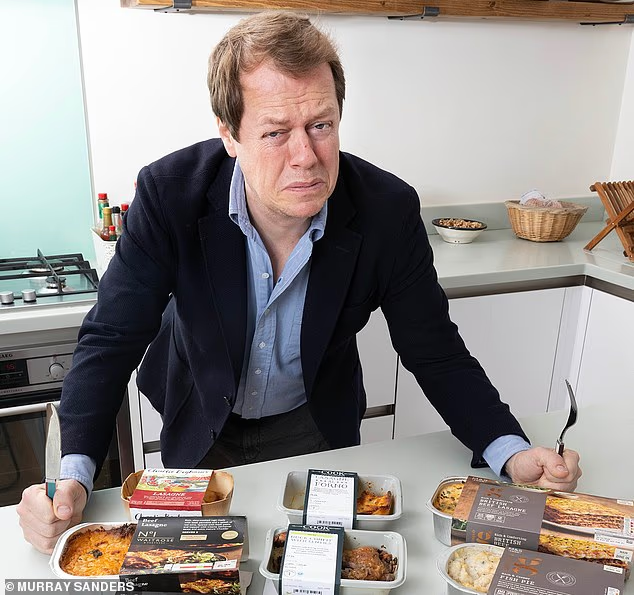
Tom Parker Bowles, food writer and critic, dishes the dirt on his least favourite foods
I have one friend who hates mushrooms, another who can’t stand tomatoes (although he loves ketchup) and one more who won’t touch lamb. There really is no accounting for taste.
Which is why the list below is an attempt to cut a swathe through the thickets of marketing hyperbole and come to some form of palatable truth.
I hate sanctimony and finger- wagging as much as the next man, and am as happy eating a McDonald’s cheeseburger as I am the most gilded Michelin-star creation. No one likes a food snob. But there are some things I won’t touch for reasons ethical and moral. As well as a few things I just can’t bear.
Foie Gras
Gavage is the force-feeding of corn or maize to ducks and geese via a metal tube shoved down their throats. The aim is to swell their livers up to ten times the usual size. Hence foie gras, or ‘fatty liver’.
In many cases, the birds are crammed in tiny cages, unable even to stretch their wings. It’s pretty difficult to defend.
I did used to eat it, and have heard tales of happy Gascon birds actually following their horny-handed farmer around, desperate for their next hit of grain. But that seems to be the exception rather than the rule.
There are also companies that claim to produce an ‘ethical’ version. But no delicacy is worth that amount of suffering, and so I give foie gras a very firm miss.

I did used to eat foie gras, and have heard tales of happy Gascon birds following their farmer around, desperate for their next hit of grain. But that seems to be an exception, writes Parker Bowles
Mackerel
One of my favourite fish, all gleaming iridescent skin and sweet, rich flesh. But although not officially endangered, stocks in the north-east Atlantic are plummeting. Waitrose, in an admirable move, has stopped stocking it, replacing it with the ever undervalued herring. For an alternative, try Cornish sardines.
Fake meat
There was a time a few years back when the catchily named ‘vegan plant-based meat alternatives’ were set to conquer the earth, putting an end to meat‑eating once and for all.
The usual venture capital firms all piled in to the likes of Beyond Burger, This Isn’t Bacon Rashers, La Vie and I Am Nut OK. And by 2022, sales reached a staggering £1billion.
But then the hype wore off, the decline set in and everyone realised quite how vile these ‘foods’ were. My issue is not with veganism itself, rather these nefarious atrocities which have all the culinary appeal of burnt rubber.
And it’s not as if they are the healthy alternative to meat. In fact, most are every bit as fake and processed as any Pot Noodle or cheap hotdog.
The average ingredient list includes the likes of ‘textured pea protein’ and ‘pea protein isolate’, the ‘thickeners’ that include methylcellulose, konjac, carrageenan and xanthan gum, ‘natural flavouring’, ‘dextrose’, ‘colour (beetroot red)’ and casings made from ‘sodium alginate’.
My favourite pork chipolata from HG Walter, on the other hand, is made from 90 per cent free-range British pork, breadcrumbs, salt, herbs, and spices. I know which one I’d prefer.
Intensively farmed meat
The horrors of factory farming are all too clear. Broiler chickens (farmed for meat) bred to grow unnaturally fast and slaughtered at six weeks old, having been confined to cramped, stinking sheds devoid of natural light, the air polluted with irritant ammonia and barely the space to flap their wings.
They spend much of their time on the floor, not moving, as their legs are barely strong enough to support their heavy body. This unnatural growth also puts strain on their hearts and lungs, and millions of chickens die of heart attacks every year.
It’s the same with pigs, crammed into sheds with salted concrete floors, often without even hay for bedding and rooting. Again, there’s no natural light, and no access to outdoor space.
Highly intelligent, social beasts, these pigs become bored and frustrated, fighting and biting each other. Which means that most piglets have their teeth cut and tails docked.
If the label doesn’t say ‘free-range’ or ‘organic’ you can bet your bottom dollar the wretched beast has been raised in less than happy conditions.
Good quality, ethically produced meat will always cost more. I know it’s all very well as an over- privileged food writer telling you to eat a £20 chicken, but one superior bird doesn’t just give you dinner, but sandwiches and stock, too.
I do believe we should eat less meat, and better quality. Trust your butcher, who should be only too happy to tell you exactly where your meat comes from.
And don’t just go for chicken breasts and sirloin steaks. Chicken thighs have more flavour than breast, while shin of beef and oxtail, classic slow-cooking cuts, make for magnificent eating and are cheaper, too.
Again, ask your butcher for their advice. Happy, outdoor-bred pigs and chickens will always make for much better eating. For more information on the horrors of factory farming, go to ciwf.org.uk.

If the label doesn’t say ‘free-range’ or ‘organic’ you can bet your bottom dollar the wretched beast has been raised in less than happy conditions
‘Low-fat’ anything
I love fat. Fat is flavour. Fat is life. So no, I don’t want my yoghurt or cheese anything other than full strength. As for skimmed milk – get thee away, you lily-livered Satan.
Hot honey
OK, enough now. I like honey, I love chilli, and when it first came out I sort of understood its appeal. But now it’s bloody everywhere, like a fierily sticky virus, drizzled (urgh) over pizzas, burgers, fried chicken, ice cream. You’ve had your moment in the sun – it’s time to retire to the back of the cupboard of food fads long past.
Margarine
There is never, ever any excuse to choose margarine over butter. If I had my way, I’d take it out to the back of the house, offer it one last cigarette, then shoot it in the back of the head. Good riddance to a hateful spread.
Tasting menus
Ah, the tyranny of the tasting menu. Once the very pinnacle of the heady haute cuisine experience, with up to 40 courses of post-modern culinary trickiness, they are now my idea of hell. It is not that the artistry is lacking (and places like The Ritz and The Ledbury still dazzle), rather the thought of being pinned to one’s chair for over three hours as dish after dish is gushingly explained at great length as if it were some rare and wonderful piece of art.
Yes, The Fat Duck, Noma and El Bulli were all huge fun, often bonkersly brilliant. Although with a glass of wine with each course, I was usually so sozzled by the end that I could barely manage speech, let alone remember the previous 20 courses. Anyway, give me three old-fashioned courses and I’m a happy man.

Whilst places like The Ritz and The Ledbury still dazzle, the thought of being pinned to one’s chair for over three hours is excruciating
Too much information
In any decent restaurant, one assumes all the meat will be ethically raised. If you’re particularly taken by a certain cut or joint, you can ask your waiter for more information. What I don’t need to read on the menu is their life history, including the field it comes from, its star sign and favourite member of One Direction.
Fake ‘allergies’ and intolerances
Genuine food allergies should be treated with the utmost respect, as they can be a matter of life or death. The same goes for those with Coeliac disease. What is not to be taken seriously is people who claim gluten ‘intolerance’ because they think bread makes them fat. Or claim they’re allergic to celery, say, when it turns out they just don’t like it. It’s needy, fussy and annoying for chefs and those actually afflicted by genuine allergies.
Truffle oil
An age-old bugbear, this base and horrible unguent has all the subtlety and elegance of a wet haddock slapped across one’s face. Noxious and predominantly artificially flavoured, truffle oil ruins everything it touches. It’s not big, it’s not sophisticated and it sure ain’t clever.
Genuine truffles are truly blessed tubers. The black Perigord truffle is all about flavour and the Alba white intoxicates with its heady scent. Truffle oil, on the other hand, is a dumb, aggressive brute with all the culinary sophistication of a battered saveloy.
Dill
I know, I know, dill is the much-loved star of many of the great cuisines of the world. But I can’t stand the stuff, and can taste even the tiniest hidden frond. It’s not so much a herb as a great, swaggering green-tressed thug.
Small plates
Yes, I have heard of your cutting-edge new concept. The Spanish have been at it for years, as has much of the Eastern Mediterranean and Middle East. The clue is in the name, and, yes, I do know they’re for sharing.
Farmed salmon
I wrote at length on the subject a few weeks back and still avoid the stuff like the plague. Too many fish crammed into too little water, fed on fundamentally unsustainable pellets while being plagued by sea lice that can literally eat them alive.
To control sea lice, chemicals that can devastate the local seabed are needed. Farmed fish also escape and breed with the increasingly rare wild salmon stock, diluting its genetic resistance.
Mortality rates can be staggeringly high, and pollution from the farms, thick and stinking, ends up coating the sea floor. The end result (flabby, fatty and dull) is, on the whole, a sorry shadow of its wild cousin.
That said, I did receive an invitation from Tavish Scott, chief executive of Salmon Scotland, inviting me to come and see the farms for myself. I will report back.



















































You must be logged in to post a comment Login