


Connect with us

Tech

Frozen 3 Trailer Reveals Anna’s Royal Wedding and A New Icy Magic

Published

on

Anna and Elsa appear to be heading through a portal into a world of icy crystal butterflies next year, according to the first trailer for the third installment in the juggernaut Frozen franchise. 

Unveiled during Disney’s biennial fan convention D23 in Anaheim on Friday night, the Frozen 3 trailer was presented by Idina Menzel and Kristen Bell.

Frozen 3 is set “far from Arendelle in a frozen land more wild and dangerous,” Menzel said.

The trailer opens with a shot of the northern lights, where a snowflake falls and turns into a butterfly that flies to Arendelle Castle. It collides with Elsa during Anna and Kristoff’s wedding, and a portal opens. They step through it, finding an icy world filled with butterflies and an as-yet faceless new villain with dark hair who has been looking for Elsa.

Advertisement

Josh Gad also appeared on stage at D23 to sing a love song about a new snow woman named Samantha, with Menzel and Bell hinting that every character will have a love interest.

Voice actor Josh Gad took to the D23 stage to hint — through song, of course — at what’s in store for his character Olaf in Frozen 3.

Disney also used D23 to show off the new Anna and Elsa costumes that kids across the globe will be demanding soon, with the ice queen now styled in a purple-blue ombre long-sleeved dress with a blue hooded cape, and the queen of Arendelle in a pleated pink dress and cape with a turquoise undershirt. In the trailer, Queen Anna wears a white wedding dress with flowers embroidered on it while Elsa is in a mauve dress.

The Frozen 3 trailer was revealed just over a year from its release date of Nov 24, 2027. To prepare for the return to Arendelle, you can stream both Frozen movies and multiple Frozen shorts on Disney Plus.

Source link

Advertisement
Continue Reading
Click to comment

You must be logged in to post a comment Login

Leave a Reply

Tech

Tensor G6 explained: What Google’s chip actually means for your Pixel

Published

on

The newly announced Pixel 11 series all run on the same Tensor G6 chip – Google’s latest mobile processor.

But what is Tensor G6 and how does it differ from its predecessors? Will Tensor G6 be faster and better than before?

We explain everything we know about Google Tensor G6, including how it compares to its competitors and where its strengths are likely to lie. 

For more on the Pixel 11 series, visit our Pixel 11 vs Pixel 11 Pro, Pixel 11 Pro vs Pixel 11 Pro Fold and Pixel 11 Pro vs Pixel 11 Pro XL guides. Finally, if you want more of an overview on our current favourite devices, our best smartphone guide has you covered.

Advertisement

SQUIRREL_PLAYLIST_10208690

Advertisement

What is Tensor G6?

Tensor G6 is Google’s latest mobile chip that’s found within the entire Pixel 11 line-up, from the entry-level Pixel 11 to the Pixel 11 Pro Fold. Google promises that Tensor G6 is its “fastest, most powerful chip yet”, with an upgraded CPU that claims 25% faster web browsing and 15% quicker app launches than last year’s Tensor G5 processor.

Although it promises to be faster than before, you shouldn’t expect its performance to match the likes of Qualcomm’s Snapdragon 8 Elite Gen 5 or Apple’s A19 chips. Like previous Tensor iterations, Google prioritises AI smarts over processing power and speed, as it is designed to run advanced AI models – specifically Gemini Nano.

Advertisement

In fact, Tensor G6 sports the latest Gemini Nano model, and Google claims it can process on-device AI tasks up to 3.5 times faster while using up to 3.5 times less energy than its predecessor. That means we can expect Gemini Intelligence tools to run quickly and smoothly too.

Tensor G6 also powers some of Google’s “most advanced” camera experiences, including Pro Zoom which allows you to get up to 120x closer – although only the Pixel 11 Pro and 11 Pro XL support this. Not only that, but Tensor G6 has an upgraded ISP (Image Signal Processor) that promises to improve low light photography and enable Night Sight to capture shots faster, without losing quality. Of course, the handsets’ sensors also play a part in this.

Pixel 11 Pro in handPixel 11 Pro in hand
Pixel 11 Pro in hand. Image Credit (Google)

Is Tensor G6 good for gaming?

As we haven’t reviewed the Tensor G6 yet, we can’t confirm whether or not it’s good for gaming. However, considering we found Tensor G5 struggled when loading games, we don’t expect Tensor G6 to compete with the best gaming phones.

Advertisement

Essentially, we found that although the Tensor G5 could power games, the Pixel 10 in particular became quite warm in the process and drained battery faster too. It was a similar story with the Pixel 10 Pro XL which handled casual games but struggled with more intensive titles like Wuthering Waves and Genshin Impact.

Advertisement

Will Tensor G6 be faster?

Google promises that Tensor G6 will be 25% faster than Tensor G5 at web browsing and 15% faster at launching apps too. In addition, it claims to run on-device AI tasks up to 3.5 times faster too.

We should disclaim that we haven’t reviewed any of the Pixel 11 series yet, so haven’t tested Tensor G6 for ourselves just yet. Once we do, we’ll be able to verify these claims.

Source link

Advertisement
Continue Reading

Tech

How to watch Cincinnati Open Open 2026: Live Streams & TV Channels

Published

on

  • Cincinnati Open 2026: Thursday, August 13 to Sunday, August 23
  • Daily start time: 11am ET / 8am PT / 4pm BST / 1am AEST
  • US streams: Tennis Channel
  • Access your usual streaming services with Proton VPN

Watch Cincinnati Open 2026 live streams as the world’s best players gather at the 127-year-old tournament to continue their preparation for the year’s fourth and final Grand Slam – the US Open – which is only a few weeks away. The Lindner Family Tennis Center in Mason, Ohio, again hosts.

Both draws are wide open. Carlos Alcaraz and Iga Świątek may be the reigning men’s and women’s singles champions respectively, but the Spaniard remains injured and the Pole’s 2026 form has dipped having failed to make a grand slam semi-final this year — Świątek, though, did win her first title of the season last week in Toronto, a WTA 1000 event, no less.

Source link

Advertisement
Continue Reading

Tech

Roxy Music’s For Your Pleasure Gets Dolby Atmos, But Not in the Super Deluxe Box Set

Published

on

Roxy Music’s For Your Pleasure is getting the expansive reissue treatment on November 6, 2026, with expanded CDs, vinyl editions, demos, outtakes, BBC sessions, archival video and a substantial 116-page book.

There’s just one rather important omission.

The $131.76 U.S. Super Deluxe Edition includes three CDs and a DVD, but not the new Blu-ray Audio disc containing Dolby Atmos, two different 5.1 surround mixes, new stereo and a 192kHz/24-bit flat transfer of the original 1973 stereo mix.

For that, you’ll need to order the separately sold Blu-ray from the UK-based SDE shop for £29.99, plus applicable shipping.

Advertisement

Apparently “Super Deluxe” only gets you so far.

Why For Your Pleasure?

Released in 1973, For Your Pleasure was Roxy Music’s second album and the final studio album featuring Brian Eno as a member of the band.

That also makes it unusually well suited to an immersive remix. Tracks such as “Do The Strand,” “Editions Of You,” “In Every Dream Home A Heartache” and the title track are loaded with guitars, synthesizers, saxophone, tape treatments and studio effects.

We haven’t heard the new mix yet, so declaring it definitive would be rather premature. But if you’re going to pull a classic Roxy Music album apart and rebuild it across an Atmos soundfield, this is a pretty good place to start.

Advertisement

The Blu-ray Is Where Things Get Interesting

Bob Clearmountain has created a new 48kHz/24-bit Dolby Atmos mix, along with new 5.1 and stereo mixes. Steven Wilson contributes a completely separate 96kHz/24-bit 5.1 mix.

That means surround listeners can actually compare two different interpretations of the same album rather than simply choosing between stereo and Atmos.

The disc also includes a 192kHz/24-bit flat transfer of the original 1973 stereo mix, so the original presentation hasn’t been tossed aside in favor of the new versions.

Advertisement. Scroll to continue reading.
Advertisement

“Pyjamarama” receives Dolby Atmos, Clearmountain and Wilson 5.1 mixes, and stereo versions, while “The Pride And The Pain” is included in Wilson’s 5.1 mix and original stereo. More than an hour of studio outtakes and BBC material is also included in 48kHz/24-bit stereo.

For all of us, that is what makes this release different. This isn’t merely another remaster of an album many fans already own on LP or CD. It offers several genuinely different ways to hear the recording.

roxy-music-for-your-pleasure-super-deluxe
Roxy Music Super Deluxe Edition

So What’s Missing From the Super Deluxe Box?

The Blu-ray.

The official Super Deluxe package gives you three CDs loaded with the original album, demos, rehearsals, studio outtakes, singles and live sessions. Its DVD adds television and concert performances from 1972 and 1973, including The Old Grey Whistle Test, Montreux and Musikladen. There’s also the 116-page book.

Advertisement

What you don’t get are the Dolby Atmos mix, either of the two 5.1 mixes, Clearmountain’s new stereo mix or the 192/24 transfer.

There’s no vinyl in the Super Deluxe box either; the LP editions are separate purchases.

So if you want everything, your credit card gets an encore.

Why You Might Actually Need the Blu-ray

If you already own For Your Pleasure, another conventional CD or vinyl edition may be difficult to justify.

Advertisement

The Blu-ray is a different proposition.

Two 5.1 mixes by Bob Clearmountain and Steven Wilson, lossless Dolby Atmos, a new stereo mix and a 192/24 transfer of the original stereo presentation make this something you can actually use to explore the recording rather than simply admire on a shelf.

The Atmos presentation is also encoded using Dolby TrueHD, providing the lossless Blu-ray implementation rather than the Dolby Digital Plus format generally used for Atmos music streaming.

At £29.99, the standalone Blu-ray may therefore be the most compelling part of the entire reissue campaign for listeners with a proper stereo, surround or Dolby Atmos system. U.S. buyers can order it from SDE, which ships internationally, but there is currently no separate official U.S. dollar list price.

Advertisement
Advertisement. Scroll to continue reading.

There is another catch: it is a time-limited release, with preorders scheduled to close at midnight GMT on August 27, 2026.

Roxy Music fans have plenty to celebrate here. The strange part is that the disc audiophiles and home theater enthusiasts will probably want most is precisely the one missing from the $131.76 Super Deluxe Edition.

Where to pre-order (available Nov. 6, 2026):

Advertisement

Source link

Continue Reading

Tech

I’m a certified barista, and these are my 3 favorite small coffee machines that deliver delicious espresso without dominating your kitchen

Published

on

You might have a small kitchen, but that doesn’t mean you can’t make cafe-quality coffee at home. I test over a dozen coffee makers every year in my own small space, and I’ve found that when it comes to preparing delicious espresso, size really isn’t everything.

If you want a machine that will prepare 40 different beverages at the press of a button then, yes, you’ll need to dedicate a significant amount of space on your kitchen counter to a hefty fully automatic machine. However, if you just want to make delicious espresso, there are far smaller options that will do a superb job.

Source link

Advertisement
Continue Reading

Tech

Cookin’ With the Miles Davis Quintet Review: This OJC Reissue Gets the Heat Right

Published

on

Miles Davis has been reissued often enough to qualify for his own pressing plant, so another version of Cookin’ With the Miles Davis Quintet needs a reason to exist. Craft Recordings has one with this new $39 Original Jazz Classics edition, mastered AAA from the original tapes at Cohearent Audio, pressed on 180-gram vinyl at RTI and housed in a Stoughton tip-on jacket.

More importantly, it sounds excellent and offers a far easier alternative to hunting down a clean Prestige original that has survived nearly 70 years of worn styli, cigarette smoke, bodily fluids, basement storage and optimistic Discogs grading. This Miles Davis Cookin’ review asks the more useful question: does Craft Recordings’ new $39 Original Jazz Classics pressing give you enough of the magic without paying collector prices for somebody else’s history?

Four Albums From Two Historic Sessions

By 1956, Miles Davis had outgrown Prestige, Columbia wanted him, and Miles found a way to make the divorce work for everybody. Still under contract to Prestige, he signed with Columbia with Bob Weinstock’s blessing, agreeing to give Prestige enough material to stockpile future albums while Columbia waited to release its first Miles recordings. The solution was two marathon sessions at Rudy Van Gelder’s Hackensack studio on May 11 and October 26 with John Coltrane, Red Garland, Paul Chambers and Philly Joe Jones. Prestige eventually turned those dates into Cookin’, Relaxin’Workin’ and Steamin — four albums that sound considerably less like contractual housekeeping than one of the great jazz bands kicking the door off its hinges.

The reason is fairly simple: this was a working band, not five famous names assembled for a session photo. Months of touring and club dates had tightened the First Great Quintet to the point that Van Gelder’s studio could be treated almost like another gig; aside from a second attempt at “The Theme,” the material from the two marathon dates was captured in first takes. Cookin’, released in July 1957 and drawn from the October 26 session, feels spontaneous because the musicians had already done the hard work onstage.

Advertisement

“My Funny Valentine” strips the group down by having Coltrane sit out, leaving Miles enough oxygen to demonstrate why silence and space could be every bit as important as the notes coming out of his horn. “Blues by Five” lets Garland, Chambers and Philly Joe Jones dig in, while Sonny Rollins’ “Airegin” gives Coltrane room to bring more friction and urgency against Miles’ cooler phrasing. By the closing “Tune Up/When Lights Are Low,” there is no sense of five musicians taking turns; they are listening, reacting and pushing one another in real time. That is why Cookin’ still works nearly 70 years later. It sounds less like an album being made than a very good night that somebody had the sense to record.

miles-davis-cookin-back-cover

How Does the New OJC Sound?

The review copy is exceptionally clean and well centered, with virtually no distracting surface noise. Although Cookin’ was recorded in mono, the instrumental definition is excellent, with Miles, Coltrane, Garland, Chambers and Jones remaining easy to distinguish throughout the recording. There is a convincing sense of space around the musicians, which allows the performances to breathe without sacrificing the density and energy of the quintet.

The horns are especially well handled. Miles has plenty of bite and presence but never becomes hot or piercing, while Coltrane retains his harder edge without sounding exaggerated. Chambers and Jones provide enough weight and propulsion to keep everything grounded, and nothing about the mastering tries to make a 1956 Rudy Van Gelder recording sound artificially modern.

Is It Worth $39?

If you already own a genuinely clean VG+ original or another excellent audiophile pressing, there is no compelling reason to replace it. For everyone else, this is a very strong value, combining AAA mastering from the original tapes, an excellent RTI pressing and quality packaging without the increasingly common $60, $75 or $100 audiophile vinyl tax.

Advertisement
miles-davis-cookin-lp-cover-art

Miles Davis was a once-in-a-lifetime musician: difficult, opinionated and equipped with an ego substantial enough to require its own rhythm section, perhaps, but none of that mattered once the horn reached his lips. Nearly 70 years later, very few musicians have sounded so unmistakably themselves within the first few notes.

Considering the session took place in Hackensack, sending Miles and the band to Hiram’s afterward probably requires surrendering my North Jersey credentials. White Manna was already serving its famous little burgers nearby, and Hackensack residents are currently cookin’ over plans to move the actual 80-year-old diner about a mile up the road and expand it. The building is coming along for the ride, but judging by some of the reaction, you would think they were relocating the George Washington Bridge.

Miles probably would have ignored the entire argument. He could have cooked those burgers with his horn, and nearly 70 years later, Cookin’ still does exactly what the title promises.

Advertisement. Scroll to continue reading.
Advertisement

Our Ratings:

★★★★★★★★★★ Music

★★★★★★★★★★ Sound Quality

★★★★★★★★★★ Pressing Quality

Where to Buy:

Source link

Advertisement
Continue Reading

Tech

Submersible Drone Analyzes Ice | Hackaday

Published

on

Doing anything on a frozen lake can carries some amount of risk. Nevertheless, every year events ranging from car racing to ice skating are held on them. As such, proper safety precautions are needed, the most important of which is ensuring the ice is thick enough to withstand the weight of whatever may be on it. This is done by cutting holes into the ice and measuring its depth in several locations. But this is a dangerous and imperfect process only giving a rough picture of actual thickness. So to solves these problems, a team of students at ETH Zurich made an ice measuring submersible drone. 

The concept of ice measurement employed is, on paper, reasonably simple. When a sonar pulse is sent out, some of the energy will return off the bottom of the ice sheet, but some of it will pass through creating a second return. By measuring the difference in these two returns, the thickness can be calculate with a high degree of precision. Attach the sonar to a submersible and give it a positioning system and you can simply get a thickness map, right? Well, employing theory in practice is a far more complicated prospect as the students soon found out.

The radome touching the bottom of the ice. The submersible itself is slightly positively buoyant. It features two concrete ballasts to adjust the center of gravity and six propulsion motors for six degrees of freedom. It’s powered by a NVIDIA Jetson to allow for autonomous operations and a whole host of sensors. Navigation is handled by a variety of sensors, mostly GPS and SBL. The GPS antenna sits in a radome at the top of the submersible, allowing for a strong enough signal for a positional fix when touching the bottom of the ice. SBL works similarly to sonar, where a transmitter on the submarine sends out an audio ping, received by a trio of hydrophones used to calculate the drone’s position.
But does all this complexity really work? Well, mostly. A number of real-world factors greatly compound the submarine’s effectiveness. The signal noise from in the sonar makes accurate measurements nigh impossible with that methodology. As such, the team used a depth based approach, by touching the submarine to the bottom of the ice, and measuring the water pressure and therefore depth, the ice’s thickness can be easily calculated. However, this method too is not without flaws. When snow falls on alpine lakes, it pushes the ice sheet downward, and a new ice sheet can form on top. This top sheet’s layer is what’s most important, but the depth measurement can only take into account the overall sheet’s thickness. Regardless, this was a really impressive first test of the submersible, and we look forward to seeing where it goes from here!

Make sure to check out this autonomous submarine next! 

Advertisement


Source link

Advertisement
Continue Reading

Tech

I didn’t think fake shopping could trick my brain until I tried the viral dopamine websites

Published

on

I spent some time in the internet’s fakest mall, filling a shopping cart with things I could not buy, hunting for discounts on products that do not exist, and checking out three separate times for a grand total of $0.00. Then I placed a fake food order and smoked a cigarette I could not taste, with strangers I will never meet, on a rooftop that does not exist either. My bank balance never changed, but my brain, annoyingly, did.

When I first heard about South Korea’s growing “dopamine sites,” I assumed they were another internet oddity I would poke around for five minutes and forget by lunch. Instead, I found a surprisingly clever idea hiding beneath the absurdity. You can browse endless imaginary products, add everything to your cart, and complete a purchase that never actually exists. These websites aren’t trying to sell you anything. They’re trying to recreate the feeling of shopping while removing the part that empties your wallet.

🦔In South Korea, “dopamine sites” have spread among Gen Z. Fake food delivery apps where you browse menus, fill a cart, and simulate an order you never place. Fake shopping sites where you track a courier that doesn’t exist. Virtual smoke break rooms where you sit with strangers… pic.twitter.com/lCax1TT4cu

— Hedgie (@HedgieMarkets) June 8, 2026

Inside the sites built to fake the shopping high

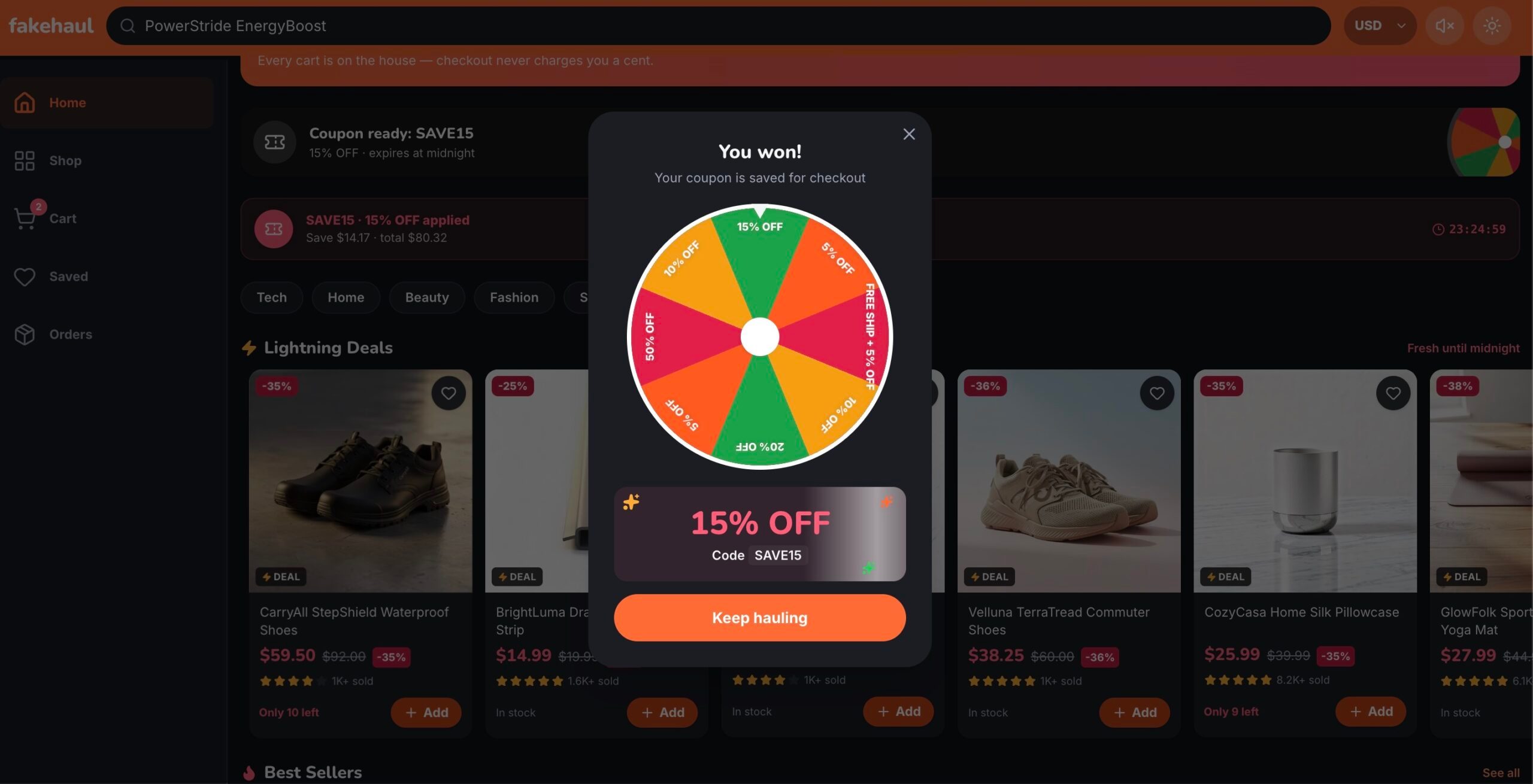
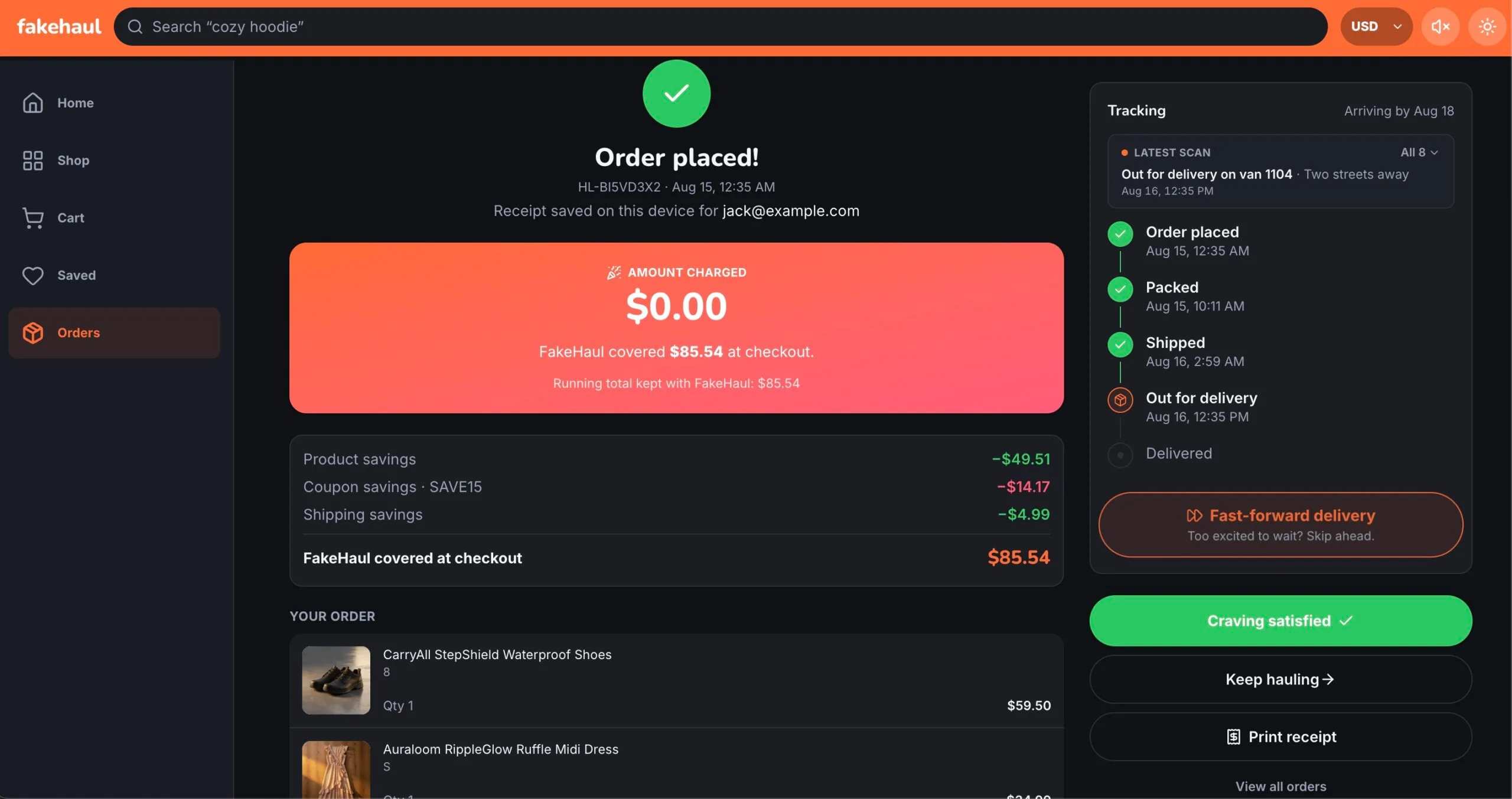
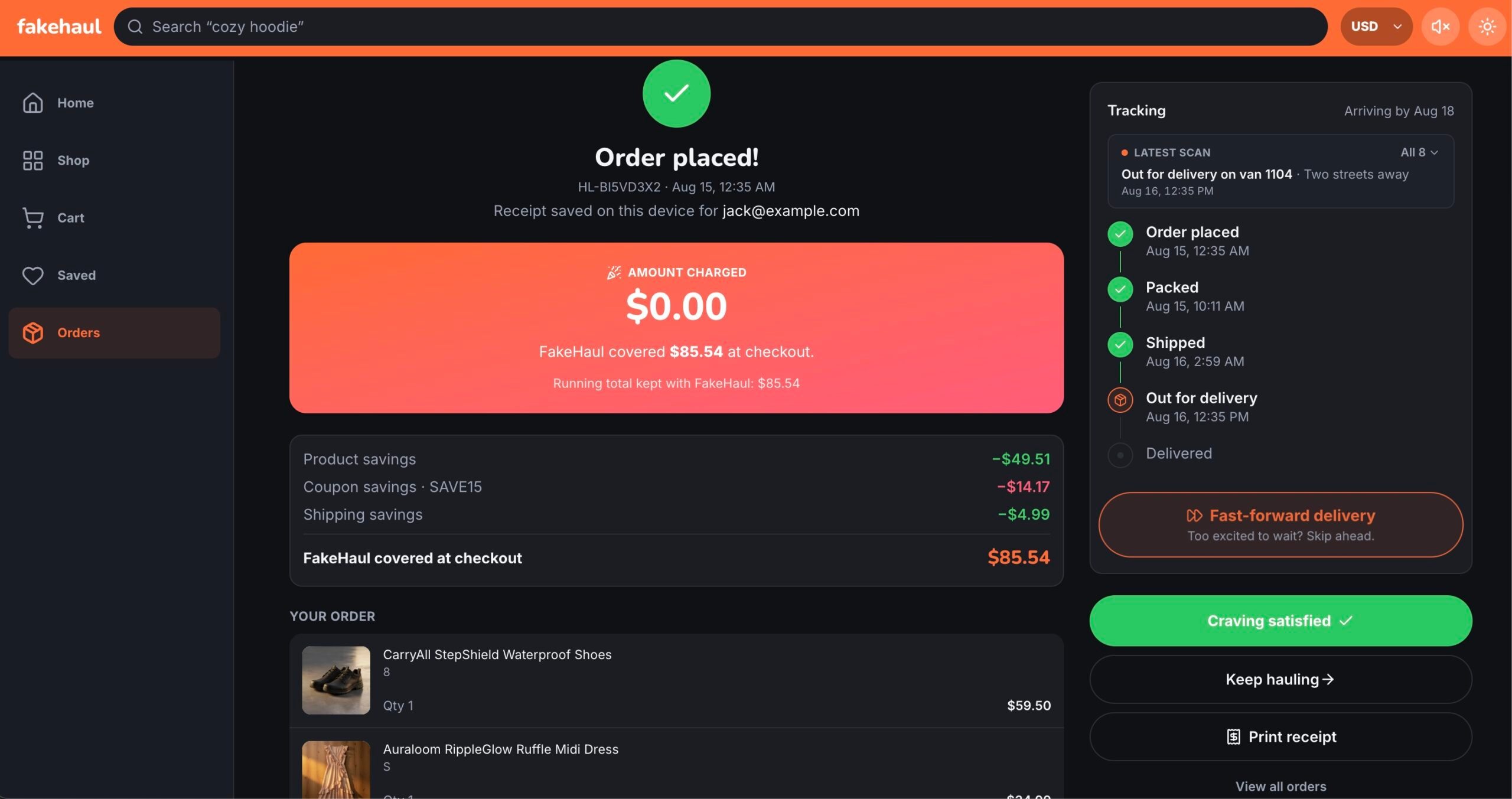
FakeHaul is where I lost the most time, and I mean that as a genuine compliment to whoever names these products. I added a “CarryAll StepShield Waterproof Shoes” marked down to $59.50 from a suspiciously specific $92.00, a yoga mat I do not need, and a dress I can’t wear.

Advertisement

A countdown timer insisted my deal expired at midnight, which is absurd for a product that was never manufactured, and yet I felt a flicker of urgency, the kind that makes you click ‘Add to cart’ before your brain catches up with the fact that none of this is real. Every checkout landed at exactly $0.00, despite the price tag, and I kept going back for more, not entirely out of curiosity anymore. There was a small, undeniable hit somewhere in there.

The purchase was never real, but the dopamine hit was

Next, I tried the fake food delivery site FoodNeverComes, where I placed an order for steamed bao buns and watched a little bee icon crawl across a map toward my fake address. Watching that tracker move gave me the same small thrill I get from a real delivery app – complete with the anticipation, the countdown, the little rush of “it’s almost here.” When the tracking window vanished and nothing showed up, I actually felt slight disappointment, which tells you everything about how convincing this whole illusion is.

Shopping isn’t the only habit these sites fake

Damta.world is another dopamine site that lets you take a virtual cigarette break, which somehow worked the best of all three. You can tap to light it, tap again to flick off the ash, and hold the filter to blow an actual doughnut-shaped smoke ring, complete with crackling ASMR sound effects.

A live counter told me how many strangers were smoking alongside me in real time, while anonymous messages scrolled by from people just quietly getting through their day. I spent a few minutes there, and it felt like an actual break, calm in a way I did not expect from tapping an animated cigarette on my screen.

Do they actually help or simply replace one habit with another?

Psychologists interviewed about dopamine sites say they may satisfy the urge to spend without the financial consequences, but they also point out that users are still rehearsing the same behaviors. Browsing, comparing, adding items to a cart, and checking out are the very rituals many people are trying to escape.

Even FakeHaul’s creator admits the line is blurry. Features like a daily coupon wheel could keep people returning, raising the possibility that a tool designed to reduce compulsive shopping could become another engagement loop.

Given how easily my brain fell for the dopamine hit, I don’t think these websites are a cure for impulse spending. But I do think they reveal something about how shopping apps or addictive habits work. Shopping or social media apps basically trigger a psychological loop, and these fake sites just strip the products away, leaving the psychology fully exposed. What is left is a surprisingly entertaining reminder that the biggest reward was never the purchase. It was everything that happened before checking out.

Advertisement

Source link

Continue Reading

Tech

All 2027 GM cars will be able to charge using Tesla Superchargers anywhere in the country

Published

on

General Motors is making a major change to its electric vehicles: every GM EV for the 2027 model year will get a native North American Charging Standard (NACS) port. Chevrolet, Cadillac and GMC models will all make the switch, allowing drivers to connect directly to compatible Tesla Superchargers and other NACS fast-charging networks without carrying a DC charging adapter.

According to a report by Electrek, the move covers GM’s entire 2027 EV lineup, including the Cadillac Escalade IQ, Escalade IQL, Lyriq, Optiq and Vistiq; Chevrolet Bolt EV, Blazer EV, Equinox EV and Silverado EV; and the GMC Hummer EV Pickup, Hummer EV SUV and Sierra EV.

GM is finally making fast charging less complicated

The change matters because charging standards have been one of the more frustrating parts of owning an EV. Most 2026 GM electric vehicles still use the older CCS1 connector, meaning owners need GM’s $275 NACS DC adapter to access compatible Tesla Superchargers and other NACS fast chargers.

The 2026 Cadillac Optiq has already made the transition, while the reborn Chevrolet Bolt, arriving in 2026 as a 2027 model, will also feature a native NACS port. Drivers buying a 2027 GM EV will still need adapters for some older charging infrastructure. CCS1 DC fast chargers will require a separate adapter, while most existing Level 2 charging equipment uses the J1772 connector. GM sells those adapters for $189 and $67, respectively, or $256 as a package.

For anyone shopping for a new GM EV, the native port should remove one particularly annoying piece of equipment from the charging routine. Plugging into a compatible Tesla Supercharger should work without reaching into the trunk for an adapter.

Advertisement

One charging app could make the experience even easier

GM is also trying to reduce the number of charging apps and accounts EV owners have to juggle. Energy Pass is integrated into the MyChevrolet, MyCadillac and MyGMC apps, allowing drivers to register and pay across multiple charging networks from a single account.

Supported networks currently include Tesla Supercharger, IONNA, Electrify America and ChargePoint, with EVgo planned for later. GM says the combined networks represent nearly 70% of U.S. DC fast chargers. Plug & Charge is also supported at compatible stations, allowing the vehicle to handle authentication while payment is processed automatically. The feature is already live at IONNA and is being expanded to additional networks, including Tesla Superchargers.

GM’s 2027 lineup should make fast charging considerably simpler, particularly for road trips. CCS1 and J1772 adapters will still be worth keeping in the trunk, though. The charging standard may be settling down, but the old infrastructure isn’t disappearing overnight.

Source link

Advertisement
Continue Reading

Tech

Google Workspace Promo Codes: 14% Off for August 2026

Published

on

Google Workspace is that ubiquitous modern business tool that almost feels invisible. We use it every day here at WIRED, whether that’s for writing first drafts of articles in Docs, analyzing data in Sheets, or sharing files in Drive. And recently, I’ve been using the Gemini AI implementation that’s built right into these tools, which is handy in all sorts of ways.

Google Workspace grants access to all kinds of productivity features that can help streamline processes and increase communication within a team or organization. It’s not free, but here’s the good news: If you’re looking at a Workspace account for yourself (or for your team), Google is offering discounts until the end of 2026 using one of the Google Workspace coupon codes below. You can save up to 14 percent on plans for the first three months, whether you’re signing up as an individual or as a business. Either way, the Google Workspace promo code down below is what you want to use.

Image may contain: Henrik Dalsgaard, Aron Baynes, Art, Collage, Photography, Adult, Person, Baby, Electronics, and Plant

If you use Google’s apps and AI, it’s worth looking at this all-inclusive service. We break down the plans and how much they cost.

Save up to 14% Off These Google Workspace Promo Codes 2026

There are some notable differences between each Workspace plan – I’ll dig into them in the next section – but all three plans come with access to the full slate of Workspace apps. You get Gmail, Drive, Calendar, and Meet, of course, but even the cheapest Starter plan includes basic access to Google’s other apps, such as NotebookLM and Gemini inside the Workspace suite. If you want to save, make sure to click one of the promo codes at the top of this page to secure your discount.

Google Gmail and Workspace displayed on mockup of laptop

Google is making changes to its productivity suite again, and some of it may cost you money. Here’s what you need to know.

What Is the Best Google Workspace Plan?

Google offers four different Workspace plans, though only three are relevant for most people. There’s Starter, Standard, and Plus, as well as Enterprise, which is only available if you contact Google’s sales team. There isn’t a minimum number of users on any of the plans, but the bottom three options (Starter, Standard, and Plus) support up to 300 users. If you need more than that, you’ll need an Enterprise plan.

Advertisement

Although you have access to all the apps regardless of the plan you choose, there are some important differences, particularly between the Starter and Standard plans. Both include secure storage through Google Drive, but Starter comes with 30GB per user while Standard comes with a massive 2TB per user. Plus bumps that up to 5TB per user. Across all plans, storage is in a shared pool, so each additional user adds to the total pool of storage your organization can use.

Gemini is also a big difference between Starter and Standard. Although both have access to the Gemini app, Starter only has Gemini in Gmail and Vids. Standard (and Plus) includes Gemini across the full suite, including in Docs, Sheets, Slides, Drive, Meet, and Chat.

article image

AI can tackle your email mountain so you don’t have to. Here’s how to decide whether Gmail’s new productivity feature makes sense for your workflow.

Starter is a great option for anyone just getting started, regardless of if you’re a freelancer or a small business with a handful of employees. In addition to 30GB per user and limited access to Gemini, Starter comes with a few other limitations. It doesn’t support e-signatures in Docs, nor advanced features of Meet, such as noise cancellation. The bread and butter of Workspace is all here, though. You get a custom domain in Gmail, up to 100 participants in Meet, and the full Google suite of productivity apps.

Standard, as the name suggests, is Workspace proper, and it’s built for teams that need room to grow. That shows up most clearly in storage space, jumping from 30GB to 2TB per user. Standard basically cuts all the red tape on Starter. There aren’t any limitations on Gemini (it’s available across the full suite), Meet features like noise cancellation are available, and you can host up to 150 participants in a Meet call. Standard even comes with expanded access to NotebookLM, Google’s AI-driven note and research tool, with different chat modes and up to 20 generative audio overviews per day.

Advertisement

At the top of the range is Plus, which is focused on larger businesses. You don’t get any extra apps with this plan, but you do get 5TB of storage per user, along with up to 500 participants in Meet calls. The real reason to upgrade to Plus is security and admin controls, however. It includes Vault for data retention, along with LDAP access – basically a server for centralized account management, if you aren’t familiar.

Source link

Continue Reading

Tech

Joshua Kushner’s Thrive Capital Discloses $215 Million Amazon Stake

Published

on

Joshua Kushner’s Thrive Capital has bought roughly $215mn of Amazon shares, disclosed in a regulatory filing on Friday. It lands in the same week the firm told investors it is selling part of its OpenAI stake, in a company Amazon now owns close to 5% of.

Joshua Kushner’s Thrive Capital has bought roughly $215mn of Amazon shares. The position was disclosed in a regulatory filing on Friday. Thrive declined to comment and Amazon did not respond to a request for comment.

It arrives in an awkward week for a clean reading. Thrive’s first formal investor letter, sent days earlier, disclosed that the firm is selling part of the OpenAI stake that has come to define it.

Amazon is now an OpenAI shareholder. It completed a $50bn investment this month for a holding of close to 5%, ahead of the company’s expected listing.

Advertisement

Read together, the two moves look less like a new bet than a change of wrapper. Thrive is reducing an illiquid private position and adding a liquid public one that contains a slice of the same asset.

Amazon holds the other side of the race too. It has funded Anthropic repeatedly, agreeing to put in up to $25bn more in April, and booked a $16.8bn paper gain on that stake in a single quarter.

Underneath both sits the compute. AWS supplies much of the infrastructure the model companies run on, which is the exposure a shareholder actually buys.

The stock has been rewarded for it. Amazon passed $3 trillion in market value this month, the fifth company to manage it.

Advertisement

None of this is a one-off. Thrive put about $100mn into Shopify earlier this year, citing AI tailwinds in e-commerce, and its public holdings already include Figma, StubHub and Oscar Health, the insurer Kushner co-founded.

Kushner set out the logic himself. “Many of our growth-stage companies compete with, partner with, or become the next generation of public technology companies,” he wrote. “The more precise our understanding of public markets, the better our judgment will be in private markets.

That is a reasonable argument, and it is also a venture firm filing 13Fs. The distinction between backing private companies and trading public ones is getting harder to see, and Thrive is at least doing it where everyone can watch.

Advertisement

Source link

Continue Reading

Trending

Copyright © 2025