Roxy Music’s For Your Pleasure is getting the expansive reissue treatment on November 6, 2026, with expanded CDs, vinyl editions, demos, outtakes, BBC sessions, archival video and a substantial 116-page book.
There’s just one rather important omission.
The $131.76 U.S. Super Deluxe Edition includes three CDs and a DVD, but not the new Blu-ray Audio disc containing Dolby Atmos, two different 5.1 surround mixes, new stereo and a 192kHz/24-bit flat transfer of the original 1973 stereo mix.
For that, you’ll need to order the separately sold Blu-ray from the UK-based SDE shop for £29.99, plus applicable shipping.
Advertisement
Apparently “Super Deluxe” only gets you so far.
Related Reviews:
Why For Your Pleasure?
Released in 1973, For Your Pleasure was Roxy Music’s second album and the final studio album featuring Brian Eno as a member of the band.
That also makes it unusually well suited to an immersive remix. Tracks such as “Do The Strand,” “Editions Of You,” “In Every Dream Home A Heartache” and the title track are loaded with guitars, synthesizers, saxophone, tape treatments and studio effects.
We haven’t heard the new mix yet, so declaring it definitive would be rather premature. But if you’re going to pull a classic Roxy Music album apart and rebuild it across an Atmos soundfield, this is a pretty good place to start.
Advertisement
The Blu-ray Is Where Things Get Interesting
Bob Clearmountain has created a new 48kHz/24-bit Dolby Atmos mix, along with new 5.1 and stereo mixes. Steven Wilson contributes a completely separate 96kHz/24-bit 5.1 mix.
That means surround listeners can actually compare two different interpretations of the same album rather than simply choosing between stereo and Atmos.
The disc also includes a 192kHz/24-bit flat transfer of the original 1973 stereo mix, so the original presentation hasn’t been tossed aside in favor of the new versions.
Advertisement. Scroll to continue reading.
Advertisement
“Pyjamarama” receives Dolby Atmos, Clearmountain and Wilson 5.1 mixes, and stereo versions, while “The Pride And The Pain” is included in Wilson’s 5.1 mix and original stereo. More than an hour of studio outtakes and BBC material is also included in 48kHz/24-bit stereo.
For all of us, that is what makes this release different. This isn’t merely another remaster of an album many fans already own on LP or CD. It offers several genuinely different ways to hear the recording.
Roxy Music Super Deluxe Edition
So What’s Missing From the Super Deluxe Box?
The Blu-ray.
The official Super Deluxe package gives you three CDs loaded with the original album, demos, rehearsals, studio outtakes, singles and live sessions. Its DVD adds television and concert performances from 1972 and 1973, including The Old Grey Whistle Test, Montreux and Musikladen. There’s also the 116-page book.
Advertisement
What you don’t get are the Dolby Atmos mix, either of the two 5.1 mixes, Clearmountain’s new stereo mix or the 192/24 transfer.
There’s no vinyl in the Super Deluxe box either; the LP editions are separate purchases.
So if you want everything, your credit card gets an encore.
Why You Might Actually Need the Blu-ray
If you already own For Your Pleasure, another conventional CD or vinyl edition may be difficult to justify.
Advertisement
The Blu-ray is a different proposition.
Two 5.1 mixes by Bob Clearmountain and Steven Wilson, lossless Dolby Atmos, a new stereo mix and a 192/24 transfer of the original stereo presentation make this something you can actually use to explore the recording rather than simply admire on a shelf.
The Atmos presentation is also encoded using Dolby TrueHD, providing the lossless Blu-ray implementation rather than the Dolby Digital Plus format generally used for Atmos music streaming.
At £29.99, the standalone Blu-ray may therefore be the most compelling part of the entire reissue campaign for listeners with a proper stereo, surround or Dolby Atmos system. U.S. buyers can order it from SDE, which ships internationally, but there is currently no separate official U.S. dollar list price.
Advertisement
Advertisement. Scroll to continue reading.
There is another catch: it is a time-limited release, with preorders scheduled to close at midnight GMT on August 27, 2026.
Roxy Music fans have plenty to celebrate here. The strange part is that the disc audiophiles and home theater enthusiasts will probably want most is precisely the one missing from the $131.76 Super Deluxe Edition.
NAND May Cry: AI data centers and hyperscale operations are coming for everyone’s NAND chips – and then some. In fact, the manufacturing industry is already realigning much of its production capacity around the needs of Big Tech and AI startups looking to sell chatbot-like experiences to subscribers.
A recent study by Counterpoint Research highlights the seismic shift the NAND flash industry is undergoing because of generative AI and chatbot services. While AI training workloads are increasingly being replaced by inference tasks, enterprise SSDs are consuming around half of the world’s entire NAND supply.
Enterprise SSDs include high-performance storage units used in data centers and AI hyperscale facilities. During the second quarter of the year, these types of solid-state storage products accounted for 48% of global NAND shipments. Enterprise shipments nearly doubled compared to 2025, when they accounted for 26%, and are expected to grow even further over the next few months.
SSDs are now in high demand for AI operations, as Big Tech looks to leverage high-capacity, high-performance storage solutions to cache the massive datasets required for AI inference workloads. Needless to say, this shift is having a significant impact on companies manufacturing NAND flash chips and the eSSDs they are ultimately used to power.
Advertisement
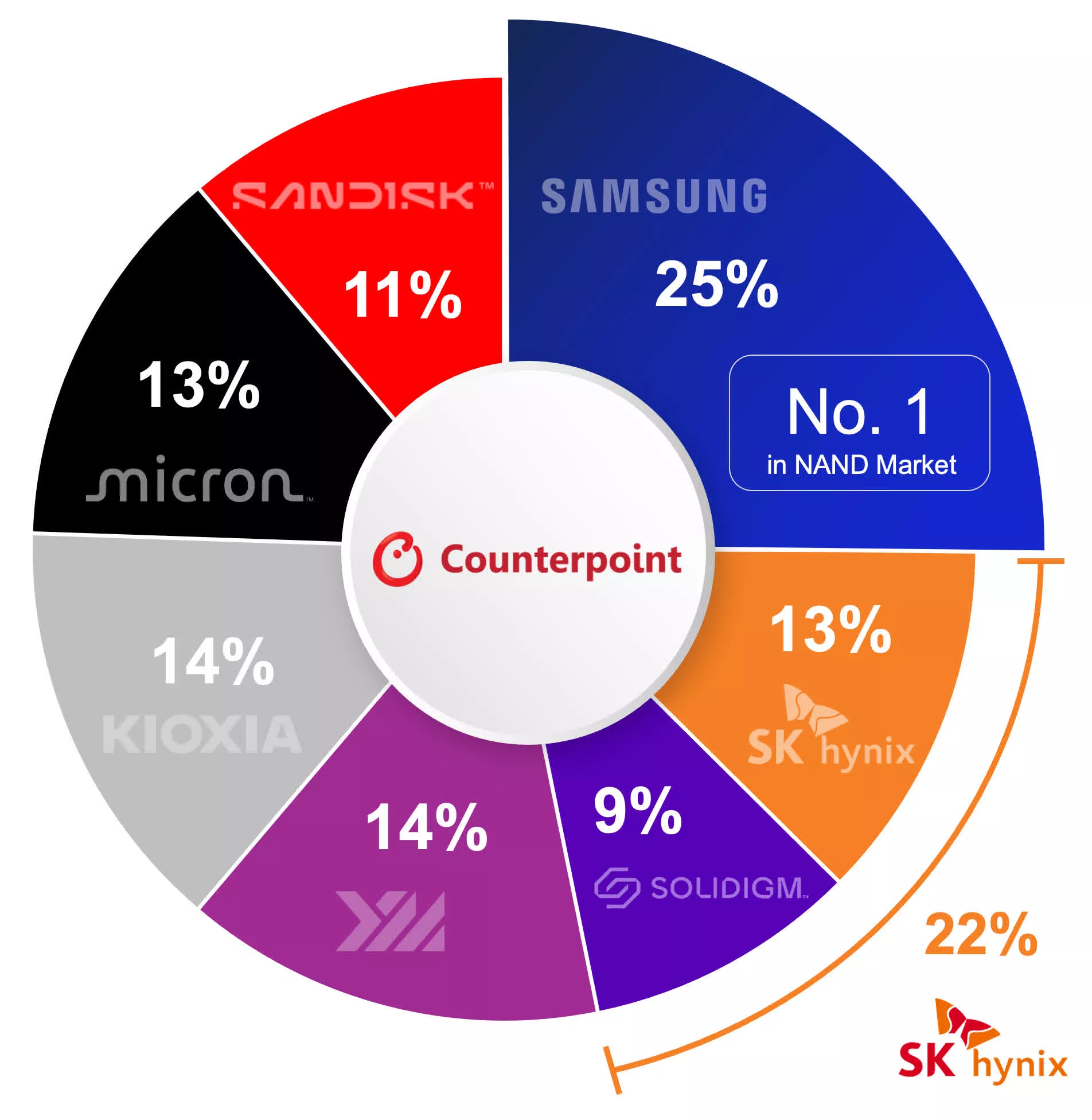
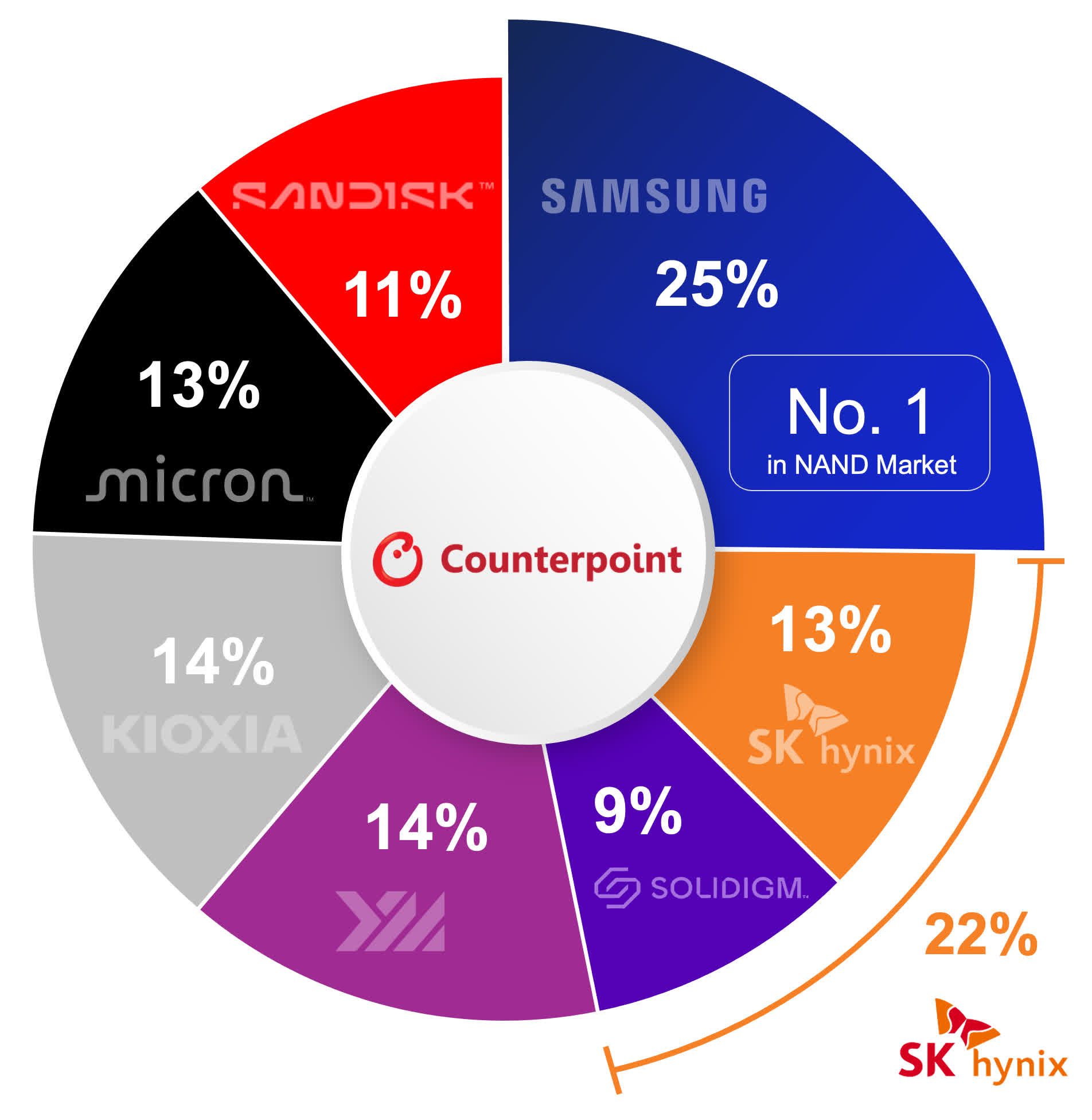
Counterpoint said Samsung retained its position as the largest NAND flash maker, with a 25% market share, while SK Hynix came second with a 22% share. The Korean device manufacturer benefited from a 40% year-over-year increase in shipments from its subsidiary Solidigm and is now looking to grow its enterprise NAND business even further.
Chinese maker Yangtze Memory Technologies saw a 22% increase in shipments, capturing 14% of the NAND flash market. YMTC is currently expanding its domestic operations thanks to its in-house manufacturing capabilities, producing 267-layer 3D NAND chips based on its proprietary Xtacking technology.
Kioxia ranked third with 14% of NAND shipments, while Micron and SanDisk followed with 13% and 11% of the market, respectively. However, Counterpoint warns that shipment volumes don’t necessarily translate into actual revenue. While YMTC ranked third in terms of chip shipments, it was only fifth in terms of revenue, behind Micron and Kioxia.
The Chinese corporation can currently benefit from the global chip shortage but is still manufacturing a mix of consumer and enterprise solid-state products. Like everyone else in the industry, YMTC is eventually expected to focus much of its upcoming production on eSSDs as it seeks to capitalize on the AI-driven spending boom.
We’ve talked a great deal about the Stop Killing Games movement and those discussions have typically traveled along two paths of importance.
On the one hand, the movement is very important to those of us that care about the preservation of video games. A huge problem with allowing developers and publishers to simply shutdown backend servers needed to run games that were designed to require those same server is that those games simply disappear in their original form. If we accept that video games are both art and culture, and I don’t think either is particularly arguable at this point, allowing shared culture to disappear before it enters the public domain is an unacceptable violation of the bargain that is copyright to begin with. In those instances, developers and publishers got their monopoly, but negated the part where said monopoly is supposed to be limited in nature, with the art ending up in the public domain.
The second path of importance is that of the rights of the individual consumer. The public in large part believes it’s buying a game when it makes these purchases. And, yes, the truth buried in terms of service and other legal documents is that in many cases the public is only buying a limited license to play the game, one which the publisher can revoke in part or whole at any time by shutting down support for the product. But if you think that this fact somehow makes none of this a problem, you’re a corporate boot-licker and you should be ashamed of yourself. Sometimes these shutdowns happen very shortly after the game is released and promises of refunds to those that paid for them can be fleeting.
But, man, if you think it’s bad for a developer or publisher to not make good on refunds of a purchased game it shut down, wait until you get a load of Cold Iron Studios, which recently shutdown the cloud-only version of Aliens: Fireteam Elite on the Nintendo Switch.
Advertisement
Following its announcement in March, game developer Cold Iron Studios has shut down the servers for the cloud version of Aliens: Fireteam Elite on the Nintendo Switch. The game originally cost $30 (or $60 for an “Ultimate” version with additional content).
Cold Iron Studios hasn’t offered customers refunds.
TheGamer reported that affected players are entitled to a discount for the Nintendo Switch 2 version of the game, which is a 2021 co-op, third-person shooter based on the Alien film franchise. However, that would mean paying money for a game that you have already paid money for once.
There’s chutzpah, and then there’s fucking chutzpah. The developer ripped away the ability to play a game that people spent money on. Then, rather than offering refunds, they instead offered to sell the game again to those same customers on the new console for a slightly lesser price. That isn’t giving your customers the middle finger. It’s gather up an entire city’s worth of middle fingers and jamming them up your customers’ noses and then asking them to pay for it.
Now, nobody thinks that this version of the game was bought in massive numbers on the original Switch. But I don’t really see how that matters. If you sell something to someone, then take it away, you should return the money you got for it. If you’re hiding behind the “it’s just a license” mantra, then you’re telling the public not to trust you. And maybe simply to not trust digital purchases entirely. And, given some other recent news, that becomes a pretty big problem.
The folks at Stop Killing Games have this exactly right, because situations like this are not only untenable, but the lack of action is making these companies all the more brazen. The audacity of taking something away from a customer and trying to get them to pay for it again is breathtaking.
As is the unwillingness to act on the part of our government and consumer rights groups.
Meta has patented a smart-glasses system that could use facial recognition to identify people and automatically create personalized highlight reels of events such as dinner parties. The patent doesn’t guarantee the feature will ship, but it offers a detailed look at how Meta is exploring facial recognition and AI-powered memory capture for its wearable devices. 404 Media reports: “I’ve generated some highlights of tonight’s dinner party. Would you like to see them?” a prompt from the system says, alongside various thumbnails of what look like people laughing, according to one illustration in the patent. One section says the system may personalize highlight files using “user relationship data.” The illustrations clearly show a person wearing a pair of glasses, looking at a group of people, then the glasses focusing on one or more people in particular.
Patentlyze, an organization that tracks patents, first alerted 404 Media to the patent on Friday. The patent is dense with how such a system would work, but in sum, the system with one or more cameras receives an input from the user, then uses machine-learning and “sensory data” to figure out points of interest in the camera’s field of view. That can include detecting people in the shot “based on one or more facial recognition algorithms,” identifying those specific people, detecting their facial expressions, using “eye gaze data of the user captured by the client system,” and figuring out other points of interest “based on scene and semantic understanding.”
Although the patent is for “particular camera-based tasks by particular systems in a particular manner” — in this case, the company’s smart glasses — Meta writes it “contemplates assisting users in any suitable camera-based task by any suitable system in any suitable manner.” Meaning that although this technology is focused on the glasses, maybe the company will use it for other purposes in the future.
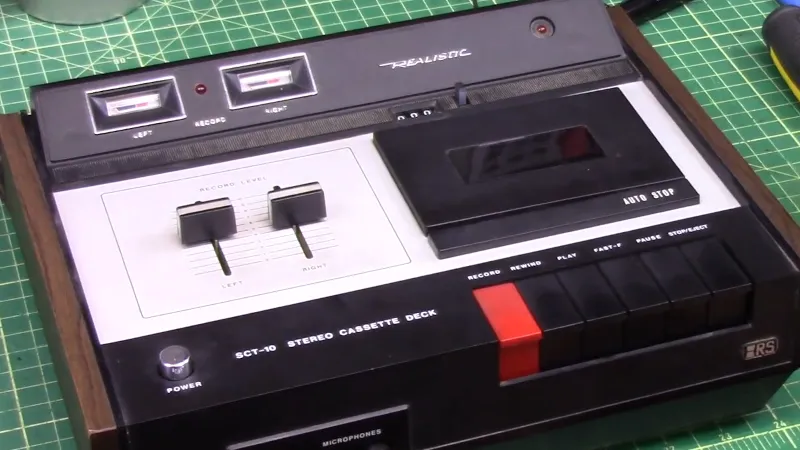
If there’s an engineer’s equivalent to those YouTube ASMR videos, then perhaps it comes in a good repair or servicing journey filmed without edits at the bench. Relaxing to watch, has an interesting outcome. So it is with [Ken’s Shop], as he performs a full service on a Realistic cassette deck from we are guessing, the late 1970s or early 1980s.
These decks are nothing particularly special and can be found wherever second-hand consumer electronics go to die, but compared to may newer electronic devices they are surprisingly well-built. Their decades-old mechanicals usually only need a good clean and lubricate, their belts may need replacing, and perhaps the azimuth needs a tweak, but returning them to their former glory is rarely more than a bench session away.
So this is what we get, a relaxing twenty minutes or do of watching a guy fix a tape deck. A chuckle came here at Hackaday from our colleague Al passing this on, we agree with his not missing working on this type of deck as they could be fiddly. But still, if you find one of these and want it, they’re fixable with relative ease.
Tensor G6 is Google’s latest mobile chip that’s found within the entire Pixel 11 line-up, from the entry-level Pixel 11 to the Pixel 11 Pro Fold. Google promises that Tensor G6 is its “fastest, most powerful chip yet”, with an upgraded CPU that claims 25% faster web browsing and 15% quicker app launches than last year’s Tensor G5 processor.
Although it promises to be faster than before, you shouldn’t expect its performance to match the likes of Qualcomm’s Snapdragon 8 Elite Gen 5 or Apple’s A19 chips. Like previous Tensor iterations, Google prioritises AI smarts over processing power and speed, as it is designed to run advanced AI models – specifically Gemini Nano.
Advertisement
In fact, Tensor G6 sports the latest Gemini Nano model, and Google claims it can process on-device AI tasks up to 3.5 times faster while using up to 3.5 times less energy than its predecessor. That means we can expect Gemini Intelligence tools to run quickly and smoothly too.
Tensor G6 also powers some of Google’s “most advanced” camera experiences, including Pro Zoom which allows you to get up to 120x closer – although only the Pixel 11 Pro and 11 Pro XL support this. Not only that, but Tensor G6 has an upgraded ISP (Image Signal Processor) that promises to improve low light photography and enable Night Sight to capture shots faster, without losing quality. Of course, the handsets’ sensors also play a part in this.
Pixel 11 Pro in hand. Image Credit (Google)
Is Tensor G6 good for gaming?
As we haven’t reviewed the Tensor G6 yet, we can’t confirm whether or not it’s good for gaming. However, considering we found Tensor G5 struggled when loading games, we don’t expect Tensor G6 to compete with the best gaming phones.
Advertisement
Essentially, we found that although the Tensor G5 could power games, the Pixel 10 in particular became quite warm in the process and drained battery faster too. It was a similar story with the Pixel 10 Pro XL which handled casual games but struggled with more intensive titles like Wuthering Waves and Genshin Impact.
Advertisement
Will Tensor G6 be faster?
Google promises that Tensor G6 will be 25% faster than Tensor G5 at web browsing and 15% faster at launching apps too. In addition, it claims to run on-device AI tasks up to 3.5 times faster too.
We should disclaim that we haven’t reviewed any of the Pixel 11 series yet, so haven’t tested Tensor G6 for ourselves just yet. Once we do, we’ll be able to verify these claims.
Access your usual streaming services with Proton VPN
Watch Cincinnati Open 2026 live streams as the world’s best players gather at the 127-year-old tournament to continue their preparation for the year’s fourth and final Grand Slam – the US Open – which is only a few weeks away. The Lindner Family Tennis Center in Mason, Ohio, again hosts.
Both draws are wide open. Carlos Alcaraz and Iga Świątek may be the reigning men’s and women’s singles champions respectively, but the Spaniard remains injured and the Pole’s 2026 form has dipped having failed to make a grand slam semi-final this year — Świątek, though, did win her first title of the season last week in Toronto, a WTA 1000 event, no less.
Elsewhere on the men’s side, world No.1 Jannik Sinner will also miss Cincinnati through injury, meaning French Open champ and 2021 winner Alexander Zverev is promoted to top seed. Though in his 40th year, three-time champion Novak Djokovic will be one of the biggest threats, with Americans Taylor Fritz, Ben Shelton — who won last week’s Canadian Open — and Learner Tien all hoping to do well. Keep an eye out for fast-rising teen Rafael Jódar, too, and Wimbledon wild card semi-finalist Arthur Fery .
There’s also a strong US contingent on the women’s side, with Jessica Pegula, Coco Gauff and Amanda Anisimova all among the top 10 seeds. Naturally, world No.1 Aryna Sabalenka, reigning Australian Open champion Elena Rybakina and freshly crowned Wimbledon winner Linda Nosková will be their biggest rivals here.
Advertisement
Here’s how to watch Cincinnati Open 2026 tennis from anywhere, including worldwide TV channels, broadcasters and a full list of the tournament’s seeds, schedule and daily start times.
Can I watch Cincinnati Open 2026 for FREE
In the United States, the Tennis Channel is the exclusive home of Cincinnati Open 2026, which can be accessed directly or via ‘over the top’ streaming providers that offer free trials, for example YouTube TV (5 days free) or Fubo (7 days).
It has also been confirmed that there will be select matches shown for free on Tennis Channel 2.
Traveling outside your home country for the tournament? Use Proton VPN to get past geo-blockers and tune in to your regular tennis live streams.
Use a VPN to watch any Cincinnati Open 2026 stream
The Cincinnati Open 2026 is being streamed all over the world, but what if you are outside your usual country and can’t watch your home stream?
Don’t worry – this is where a VPN comes in very handy. The best VPNs allow you to appear as though you’re still at home regardless of where you actually are in the world, meaning you don’t have to miss out because of geo-restrictions. Proton VPN is one of the providers we most recommend:
Advertisement
It’s really straightforward to use a VPN to watch the Cincinnati Open 2026.
1. Install the VPN of your choice. As we’ve said, Proton VPN is one of our favorites.
2. Choose the location you wish to connect to in the VPN app. For example, if you want to watch a US stream, select ‘United States’ from the listed countries.
Advertisement
3. Sit back and enjoy the action. Head to your usual streaming service and tune into Cincinnati Open 2026 as normal.
How to watch Cincinnati Open 2026 live streams in the US
In the US, comprehensive coverage of the 2026 Cincinnati Open is being shown on the Tennis Channel, which appears on a wide range of cable plans.
It has also been confirmed that some matches will also be shown absolutely free on Tennis Channel 2.
Advertisement
Cord cutters can get a dedicated online Tennis Channel subscription that costs $109.99 per year or $11.99 per month. New subscribers can get their first year for $77 for a limited time with code HOT77. And the free Tennis Channel 2 streams can be watched without even needing to log in.
Looking for an OTT cable replacement option that carries hundreds of other channels? The Tennis Channel is available on Sling TV (with its Sport Extra add-on), YouTube TV (with another sport add-on) or Fubo, the latter two of which come with free trials for new users.
Outside the US for this tournament? Use Proton VPN to unlock your usual stream of Cincinnati Open 2026.
Advertisement
How to watch Cincinnati Open 2026 live streams in Canada
Tennis fans in Canada can live stream the Cincinnati Open 2026 on the TSN network of channels.
If you don’t have cable, the TSN Plus streaming service costs CA$8 a month or $80 each year.
Outside Canada while the Cincinnati Open is on? Simply use a VPN to watch from abroad.
Advertisement
How to watch Cincinnati Open 2026 live streams in the UK
Sky Sports is broadcasting the Cincinnati Open 2026 in the UK.
Prices currently start from £22 a month for existing customers. However, tennis fans can also watch using a NOW Sports Membership, which costs from £14.99 for a one-day pass.
Not in the UK right now? Use Proton VPN to access your usual tennis streams.
Advertisement
How to watch Cincinnati Open 2026 live streams in Australia
In Australia, the Cincinnati Open 2026 is exclusive to beIN Sports, which offers new users a 7-day FREE trial.
You can add beIN Sports to most pre-existing TV packages, or you can sign up as a separate subscription. It costs AU$15.99 month or AU$130 if you pay for a year up front, once that week-long trial ends.
As part of a sub-licensing agreement with beIN, the women’s WTA event is also available on Stan Sport. You’ll need a Stan Sport add-on for AU$20 in addition to a Basic subscription that costs from AU$9.99.
Not in Australia right now? You can simply use a VPN like Proton VPN to watch all the action on beIN Sports as if you were back home.
Advertisement
Who are the Cincinnati Open 2026 seeds?
Men
1. Alexander Zverev 2. Félix Auger-Aliassime 3. Novak Djokovic 4. Daniil Medvedev 5. Alex de Minaur 6. Taylor Fritz 7. Flavio Cobolli 8. Ben Shelton 9. Jiří Lehečka 10. Lorenzo Musetti 11. Casper Ruud 12. Rafael Jódar 13. Andrey Rublev 14. Jakub Menšík 15. Valentin Vacherot 16. Learner Tien 17. Frances Tiafoe 18. Tommy Paul 19. Luciano Darderi 20. Francisco Cerúndolo 21. Arthur Fils 22. Alejandro Tabilo 23. João Fonseca 24. Ugo Humbert 25. Arthur Rinderknech 26. Tomás Martín Etcheverry 27. Brandon Nakashima 28. Alexander Blockx 29. Ignacio Buse 30. Zizou Bergs 31. Matteo Arnaldi 32. Arthur Fery
Women
1. Aryna Sabalenka 2. Elena Rybakina 3. Jessica Pegula 4. Coco Gauff 5. Mirra Andreeva 6. Linda Nosková 7. Iga Świątek 8. Elina Svitolina 9. Amanda Anisimova 10. Marta Kostyuk 11. Naomi Osaka 12. Belinda Bencic 13. Iva Jovic 14. Diana Shnaider 15. Sorana Cîrstea 16. Ekaterina Alexandrova 17. Alexandra Eala 18. Anna Kalinskaya 19. Maja Chwalińska 20. Madison Keys 21. Elise Mertens 22. Marie Bouzková 23. Barbora Krejčiková 24. Anastasia Potapova 25. Emma Navarro 26. Jeļena Ostapenko 27. Clara Tauson 28. Ann Li 29. Maria Sakkari 30. Leylah Fernandez 31. Donna Vekić 32. Janice Tjen 33. Kateřina Siniaková
Advertisement
What is the Cincinnati Open 2026 schedule?
Thursday, August 13 First Round
Friday, August 14 First Round
Saturday, August 15 Second Round
Sunday, August 16 Second Round
Advertisement
Monday, August 17 Third Round; Doubles First Round
Tuesday, August 18 Third Round; Men’s Doubles First Round; Women’s Doubles Second Round
Wednesday, August 19 Round of 16; Doubles Second Round
Thursday, August 20 Quarter-finals; Men’s Doubles Second Round; Women’s Doubles Quarter-finals
Advertisement
Friday, August 21 Quarter-finals; Men’s Doubles Quarter-finals; Women’s Doubles Semi-finals
Saturday, August 22 Semi-finals; Women’s Doubles Final
Sunday, August 23 Men’s Doubles Final; Singles Finals
What are the daily Cincinnati Open 2026 start times?
Day Session: 11am ET / 8am PT / 4pm BST / 1am AEST (next day)
Advertisement
Night Session: 6pm ET / 3pm PT / 11pm BST / 10am AEST (next day)
We test and review VPN services in the context of legal recreational uses. For example: 1. Accessing a service from another country (subject to the terms and conditions of that service). 2. Protecting your online security and strengthening your online privacy when abroad. We do not support or condone the illegal or malicious use of VPN services. Consuming pirated content that is paid-for is neither endorsed nor approved by Future Publishing.
You might have a small kitchen, but that doesn’t mean you can’t make cafe-quality coffee at home. I test over a dozen coffee makers every year in my own small space, and I’ve found that when it comes to preparing delicious espresso, size really isn’t everything.
If you want a machine that will prepare 40 different beverages at the press of a button then, yes, you’ll need to dedicate a significant amount of space on your kitchen counter to a hefty fully automatic machine. However, if you just want to make delicious espresso, there are far smaller options that will do a superb job.
Here, I’ve picked out my all-time top-three compact coffee makers for small spaces, including one bean-to-cup brewer, one capsule coffee maker, and one more traditional manual brewer. I’d happily use any of the three myself — and they’re all very reasonably priced as well.
Advertisement
Latest Videos FromTechRadar
Lavazza A Modo Mio Jolie Evo
I tested this coffee maker just a few days ago, and it’s the smallest I’ve ever used, measuring a mere 4.9 x 8.3 x 13 inches / 124 x 210 x 330mm (W x H x D).
If you’re looking for a compact coffee maker that will brew a good espresso with minimum fuss, this is the one for you. It takes Lavazza’s own A Modo Mio pods, which you drop into a slot on top of the machine, before pushing back the large lever and hitting the “brew” button. Once you’re satisfied with the quantity in your cup, tap the button again to stop the flow. Done.
Advertisement
You don’t get Nespresso-like fancy flavors with Lavazza’s pods, but I’d argue that’s no bad thing. Coffee laced with added aromas often tastes unpleasantly sweet or artificial, and while Lavazza offers plenty of choice for beans and roasts, all the aromas come from the coffee itself, rather than from additives.
The only downside for me is that A Modo Mio pods are plastic, and can be difficult to recycle if you don’t have a collection point near you. I’m lucky to have one quite nearby, but you can’t send your pods in the mail — if there’s no drop-off spot nearby, your only option is to start one yourself.
Sign up for breaking news, reviews, opinion, top tech deals, and more.
Advertisement
In all other respects, this is a superb little coffee maker. It’s affordably priced, too, and its pods are some of the cheapest around.
The Philips Baristina makes brewing espresso with fresh coffee beans just as simple as using pods. It measures 7 x 13.6 x 15 inches / 18 x 34.5 x 38cm (W x H x D), which is a fraction of the size of most bean-to-cup machines, and it’s half the price too.
Pour your coffee beans into the hopper located on the top surface of the Baristina, fill its water tank, and slide the portafilter handle into place. Choose whether you want a single or double espresso and the machine will grind just the right quantity of coffee. Tamp it down, then slide the filter underneath the brewing group, and dispense a perfectly extracted drink directly into your waiting cup.
Advertisement
It’s refreshingly simple, and cleanup is a piece of cake. Most bean-to-cup coffee machines do all the brewing inside a closed case, and the moist conditions combined with any leftover coffee grounds create the perfect conditions for mold to grow – unless you open everything up, clean it thoroughly, and leave the case open to dry overnight. With the Baristina, this isn’t a problem.
The only drawback of the standard Baristina is that there’s no steam wand for preparing milk. However, you can find the coffee maker bundled with a standalone milk frother, and Philips has recently launched a new machine called the Baristina Latte, which has a milk system built in. I’ve not had the opportunity to try it yet, but I have high hopes.
We’ve had a capsule machine and a bean-to-cup coffee maker – now we have a traditional espresso machine, with a choice of portafilter baskets (both pressurized, making it easier to achieve a nice thick crema) and a manual steam wand. It measures 5.5 x 12 x 12.6 inches / 14 x 30.5 x 32cm (W x H x D), allowing it to slot onto even tiny kitchen counters.
The Dedica Duo has a list price of $299.95 / £279.99 (about AU$600), which is very affordable for a manual espresso machine, and would usually sound warning bells — espresso machines in this price bracket are usually pretty bad, and incapable of sustaining the steady temperature and pressure necessary for consistent brewing. That’s not the case here, though; this is a De’Longhi machine through and through, with no compromises on build quality or performance. Everything feels solidly made, and it’s a pleasure to use.
Advertisement
The “Duo” in the name refers to the fact that this little coffee maker can also make a cold-extracted espresso using water directly from the tank (bypassing the boiler). This takes longer then brewing hot, but works very well and produces a pleasingly mellow-tasting drink that’s an ideal foundation for iced drinks. A superb little all-rounder.
Miles Davis has been reissued often enough to qualify for his own pressing plant, so another version of Cookin’ With the Miles Davis Quintet needs a reason to exist. Craft Recordings has one with this new $39 Original Jazz Classics edition, mastered AAA from the original tapes at Cohearent Audio, pressed on 180-gram vinyl at RTI and housed in a Stoughton tip-on jacket.
More importantly, it sounds excellent and offers a far easier alternative to hunting down a clean Prestige original that has survived nearly 70 years of worn styli, cigarette smoke, bodily fluids, basement storage and optimistic Discogs grading. This Miles Davis Cookin’ review asks the more useful question: does Craft Recordings’ new $39 Original Jazz Classics pressing give you enough of the magic without paying collector prices for somebody else’s history?
Related Reviews:
Four Albums From Two Historic Sessions
By 1956, Miles Davis had outgrown Prestige, Columbia wanted him, and Miles found a way to make the divorce work for everybody. Still under contract to Prestige, he signed with Columbia with Bob Weinstock’s blessing, agreeing to give Prestige enough material to stockpile future albums while Columbia waited to release its first Miles recordings. The solution was two marathon sessions at Rudy Van Gelder’s Hackensack studio on May 11 and October 26 with John Coltrane, Red Garland, Paul Chambers and Philly Joe Jones. Prestige eventually turned those dates into Cookin’, Relaxin’, Workin’ and Steamin’ — four albums that sound considerably less like contractual housekeeping than one of the great jazz bands kicking the door off its hinges.
The reason is fairly simple: this was a working band, not five famous names assembled for a session photo. Months of touring and club dates had tightened the First Great Quintet to the point that Van Gelder’s studio could be treated almost like another gig; aside from a second attempt at “The Theme,” the material from the two marathon dates was captured in first takes. Cookin’, released in July 1957 and drawn from the October 26 session, feels spontaneous because the musicians had already done the hard work onstage.
Advertisement
“My Funny Valentine” strips the group down by having Coltrane sit out, leaving Miles enough oxygen to demonstrate why silence and space could be every bit as important as the notes coming out of his horn. “Blues by Five” lets Garland, Chambers and Philly Joe Jones dig in, while Sonny Rollins’ “Airegin” gives Coltrane room to bring more friction and urgency against Miles’ cooler phrasing. By the closing “Tune Up/When Lights Are Low,” there is no sense of five musicians taking turns; they are listening, reacting and pushing one another in real time. That is why Cookin’ still works nearly 70 years later. It sounds less like an album being made than a very good night that somebody had the sense to record.
How Does the New OJC Sound?
The review copy is exceptionally clean and well centered, with virtually no distracting surface noise. Although Cookin’ was recorded in mono, the instrumental definition is excellent, with Miles, Coltrane, Garland, Chambers and Jones remaining easy to distinguish throughout the recording. There is a convincing sense of space around the musicians, which allows the performances to breathe without sacrificing the density and energy of the quintet.
The horns are especially well handled. Miles has plenty of bite and presence but never becomes hot or piercing, while Coltrane retains his harder edge without sounding exaggerated. Chambers and Jones provide enough weight and propulsion to keep everything grounded, and nothing about the mastering tries to make a 1956 Rudy Van Gelder recording sound artificially modern.
Is It Worth $39?
If you already own a genuinely clean VG+ original or another excellent audiophile pressing, there is no compelling reason to replace it. For everyone else, this is a very strong value, combining AAA mastering from the original tapes, an excellent RTI pressing and quality packaging without the increasingly common $60, $75 or $100 audiophile vinyl tax.
Advertisement
Miles Davis was a once-in-a-lifetime musician: difficult, opinionated and equipped with an ego substantial enough to require its own rhythm section, perhaps, but none of that mattered once the horn reached his lips. Nearly 70 years later, very few musicians have sounded so unmistakably themselves within the first few notes.
Considering the session took place in Hackensack, sending Miles and the band to Hiram’s afterward probably requires surrendering my North Jersey credentials. White Manna was already serving its famous little burgers nearby, and Hackensack residents are currently cookin’ over plans to move the actual 80-year-old diner about a mile up the road and expand it. The building is coming along for the ride, but judging by some of the reaction, you would think they were relocating the George Washington Bridge.
Miles probably would have ignored the entire argument. He could have cooked those burgers with his horn, and nearly 70 years later, Cookin’ still does exactly what the title promises.
Anna and Elsa appear to be heading through a portal into a world of icy crystal butterflies next year, according to the first trailer for the third installment in the juggernaut Frozen franchise.
Unveiled during Disney’s biennial fan convention D23 in Anaheim on Friday night, the Frozen 3 trailer was presented by Idina Menzel and Kristen Bell.
Frozen 3 is set “far from Arendelle in a frozen land more wild and dangerous,” Menzel said.
The trailer opens with a shot of the northern lights, where a snowflake falls and turns into a butterfly that flies to Arendelle Castle. It collides with Elsa during Anna and Kristoff’s wedding, and a portal opens. They step through it, finding an icy world filled with butterflies and an as-yet faceless new villain with dark hair who has been looking for Elsa.
Advertisement
Josh Gad also appeared on stage at D23 to sing a love song about a new snow woman named Samantha, with Menzel and Bell hinting that every character will have a love interest.
Voice actor Josh Gad took to the D23 stage to hint — through song, of course — at what’s in store for his character Olaf in Frozen 3.
Disney also used D23 to show off the new Anna and Elsa costumes that kids across the globe will be demanding soon, with the ice queen now styled in a purple-blue ombre long-sleeved dress with a blue hooded cape, and the queen of Arendelle in a pleated pink dress and cape with a turquoise undershirt. In the trailer, Queen Anna wears a white wedding dress with flowers embroidered on it while Elsa is in a mauve dress.
The Frozen 3 trailer was revealed just over a year from its release date of Nov 24, 2027. To prepare for the return to Arendelle, you can stream both Frozen movies and multiple Frozen shorts on Disney Plus.
Corinne Reichert
Senior Editor
Corinne Reichert (she/her) grew up in Sydney, Australia and moved to California in 2019. She holds degrees in law and communications, and currently writes news, analysis and features for CNET across the topics of electric vehicles, broadband networks, mobile devices, big tech, artificial intelligence, home technology and entertainment. In her spare time, she watches soccer games and F1 races, and goes to Disneyland as often as possible.
See full bio
Doing anything on a frozen lake can carries some amount of risk. Nevertheless, every year events ranging from car racing to ice skating are held on them. As such, proper safety precautions are needed, the most important of which is ensuring the ice is thick enough to withstand the weight of whatever may be on it. This is done by cutting holes into the ice and measuring its depth in several locations. But this is a dangerous and imperfect process only giving a rough picture of actual thickness. So to solves these problems, a team of students at ETH Zurich made an ice measuring submersible drone.
The concept of ice measurement employed is, on paper, reasonably simple. When a sonar pulse is sent out, some of the energy will return off the bottom of the ice sheet, but some of it will pass through creating a second return. By measuring the difference in these two returns, the thickness can be calculate with a high degree of precision. Attach the sonar to a submersible and give it a positioning system and you can simply get a thickness map, right? Well, employing theory in practice is a far more complicated prospect as the students soon found out.
The submersible itself is slightly positively buoyant. It features two concrete ballasts to adjust the center of gravity and six propulsion motors for six degrees of freedom. It’s powered by a NVIDIA Jetson to allow for autonomous operations and a whole host of sensors. Navigation is handled by a variety of sensors, mostly GPS and SBL. The GPS antenna sits in a radome at the top of the submersible, allowing for a strong enough signal for a positional fix when touching the bottom of the ice. SBL works similarly to sonar, where a transmitter on the submarine sends out an audio ping, received by a trio of hydrophones used to calculate the drone’s position.
But does all this complexity really work? Well, mostly. A number of real-world factors greatly compound the submarine’s effectiveness. The signal noise from in the sonar makes accurate measurements nigh impossible with that methodology. As such, the team used a depth based approach, by touching the submarine to the bottom of the ice, and measuring the water pressure and therefore depth, the ice’s thickness can be easily calculated. However, this method too is not without flaws. When snow falls on alpine lakes, it pushes the ice sheet downward, and a new ice sheet can form on top. This top sheet’s layer is what’s most important, but the depth measurement can only take into account the overall sheet’s thickness. Regardless, this was a really impressive first test of the submersible, and we look forward to seeing where it goes from here!























 The submersible itself is slightly positively buoyant. It features two concrete ballasts to adjust the center of gravity and six propulsion motors for six degrees of freedom. It’s powered by a NVIDIA Jetson to allow for autonomous operations and a whole host of sensors. Navigation is handled by a variety of sensors, mostly GPS and SBL. The GPS antenna sits in a radome at the top of the submersible, allowing for a strong enough signal for a positional fix when touching the bottom of the ice. SBL works similarly to sonar, where a transmitter on the submarine sends out an audio ping, received by a trio of hydrophones used to calculate the drone’s position.






































You must be logged in to post a comment Login