Connect with us

NewsBeat

Bou Meng, a Cambodian artist and survivor of a Khmer Rouge torture center, dies at 85

Published

on

Bou Meng, a Cambodian artist and survivor of a Khmer Rouge torture center, dies at 85

PHNOM PENH, Cambodia (AP) — Cambodian artist Bou Meng, one of only seven people known to have survived a notorious Khmer Rouge torture center in the Southeast Asian country in the late 1970s, has died. He was 85.

His ability to paint portraits of the then-leader Pol Pot was why he was kept alive.

The Extraordinary Chambers in the Courts of Cambodia, a U.N.-backed tribunal that sought to try Khmer Rouge leaders for genocide and other crimes against humanity, said he died late Friday due to age-related illness.

“The passing of Mr. Bou Meng represents the loss of an important historical witness to the grave crimes committed during the brutal Khmer Rouge regime, particularly to the history and tragedy that took place at the former S-21 Security Centre,” referring to the prison, also known as Tuol Sleng, where he had been held for almost two years starting in 1977.

Advertisement

The Khmer Rouge group that ruled Cambodia from 1975–79 was accused of genocide for causing the deaths of so many of their countrymen from executions, starvation, and lack of medical care due to its radical policies. An estimated 1.7 million Cambodians died from forced labor, starvation, medical neglect, and executions.

An estimated 16,000 women and children were kept at S-21 over the course of nearly four years before being killed. Now it serves as the Tuol Sleng Genocide Museum, named after the high school it had been before the Khmer Rouge takeover.

Bou Meng, along with two other survivors, artist Vann Nath and mechanic Chum Mey, testified in 2009 at the trial of Kaing Guek Eav, also known as Duch, who had been the S-21 commandant.

Duch was found guilty of crimes against humanity, torture, and murder in 2010 and ultimately received a sentence of life imprisonment. He died in prison in 2020 at the age of 77.

Advertisement

In 2010, Bou Meng testified that painting larger-than-life images of Pol Pot and portraits of other communist icons helped save his life.

It took three months to complete his first outsized work. Kaing Guek Eav then ordered him to make three more Pol Pot paintings and portraits of other communist leaders. These included Mao Zedong of China and North Korea’s Kim Il Sung, as well as one mocking Ho Chi Minh, the father of Vietnam’s communist revolution.

“I was ordered to paint a picture of Ho Chi Minh’s head on the body of a dog,” Bou Meng told the U.N.-backed tribunal. Cambodia’s archenemy was neighboring Vietnam, which eventually invaded to oust the Khmer Rouge in 1979.

Youk Chhang, head of the Documentation Center of Cambodia, which has collected voluminous archives about the Khmer Rouge tragedy, said on Sunday that Bou Meng’s life journey for justice has been documented and “will not be forgotten by genocide history around the world.”

“I urge action to preserve stories of the millions who survived the Khmer Rouge and provide them with both mental and physical health support,” Youk Chhang told The Associated Press in a text message.

Like many who were taken to Tuol Sleng, Bou Meng had joined the Khmer Rouge in its war from 1970–75 to unseat a pro-American government, but was detained in one of its many internal purges after victory. He was brutally tortured before being assigned his painting duties.

Advertisement

Bou Meng’s first wife was arrested with him and disappeared from the prison, and presumably was executed. He never found their two children, who were taken to the countryside, where they were likely killed.

In his later years, Bou Meng, who remarried, often spent his days at the Tuol Sleng Genocide Museum, where he sold copies of a book about his experience.

Advertisement

Source link

Continue Reading
Click to comment

You must be logged in to post a comment Login

Leave a Reply

NewsBeat

Amanda Abbington receives ‘substantial pay-out from BBC’ over Giovanni Pernice complaint – three years after PTSD-inducing ‘bullying and mistreatment’ on Strictly

Published

on

Amanda Abbington receives 'substantial pay-out from BBC' over Giovanni Pernice complaint - three years after PTSD-inducing 'bullying and mistreatment' on Strictly

Advertisement

Amanda Abbington has received a ‘substantial’ payout from the BBC after she made a legal complaint about her ill-fated stint on Strictly Come Dancing.

The actress, 53, made a shock exit from the show just weeks into the competition in 2023 and later accused her professional partner Giovanni Pernice of subjecting her to ‘vile abuse’ during rehearsals, prompting an enquiry from the broadcaster.

She has now reportedly been given a five-figure out-of-court settlement and a contribution to her legal fees from BBC Studios. 

The settlement has reportedly been made in a bid to prevent a lengthy court battle and allowing Amanda – who was subsequently diagnosed with post-traumatic stress disorder (PTSD) – to put her ordeal behind her.

Advertisement

A source told The Sun on Sunday newspaper: ‘Amanda’s friends and family are all relieved for her that this ordeal is finally over. It’s been a long, hard journey, but now she can close this chapter and move on with her life.

Amanda Abbington has received a ‘substantial’ payout from the BBC after she made a legal complaint about her ill-fated stint on Strictly Come Dancing

‘The fact the BBC have compensated Amanda as well as previously publicly apologising really proves that they are taking responsibility for the bullying she suffered on set.

Advertisement

‘She hopes that this case will give others strength and encourage people to speak up.’

The Daily Mail has contacted representatives Amanda for comment. BBC representatives declined to comment when approached. 

Following an investigation by the BBC, Giovanni was cleared of the most serious accusations made against him and the broadcaster issued a formal apology to Amanda.

The report found that some of the language used by Giovanni towards Amanda could be ‘belittling’ and agreed with the Mr Selfridge actress that his feedback was, at times, ‘overly negative’ and that he had used profanity during rehearsals.

Advertisement

The report noted after reviewing several hours of rehearsal footage as part of an official investigation that there were two moments of ‘inappropriate behaviour of sexual banter in the workplace’, which were found to simply have been ‘made and received as jokes’ between the pair.

The actress, 53, made a shock exit from the show and later accused her professional partner Giovanni Pernice of subjecting her to 'vile abuse', prompting an enquiry from the broadcaster

The actress, 53, made a shock exit from the show and later accused her professional partner Giovanni Pernice of subjecting her to ‘vile abuse’, prompting an enquiry from the broadcaster

The Sherlock actress previously admitted she was ‘relieved’ when a cancer scare led to her quitting the competition.

She told The Sun on Sunday newspaper: ‘By my final week, on the Thursday morning, I was in the shower and I found two lumps. I’d got the all-clear after a mammogram a couple of months before.

Advertisement

‘I went in for rehearsals to do the cha-cha-cha and just couldn’t concentrate. Giovanni said, ‘There’s no point teaching you this because it’s not going in. You can’t get it. We’ll be lucky if we get through because you’re useless’.

‘He refused to even look at me so I went to the toilet, came back and said, ‘I’m going to go to the hospital now because I found two lumps in my breast this morning’.

‘Then he was great. He said, ‘Well, let me know how it goes. It was the catalyst I’d been sort of waiting for, which is terrible. But that’s what I was thinking, that it was a healthier option than being in that room.

‘I’ve championed breast cancer charities but there was a part of me that was like, ‘OK, I have to deal with this now instead. Phew.”

Advertisement

Advertisement

Source link

Continue Reading

NewsBeat

More than 1,460 people suffer stroke in Lothians as care remains below target

Published

on

Daily Record

Chest Heart & Stroke Scotland (CHSS), one of the country’s largest health charities, is calling on the Scottish Government to put greater emphasis on essential stroke care over the course of this administration.

Public Health Scotland released their 2025 Scottish Stroke Improvement Programme this week, showing the country has failed to reach its target of 80% of patients receiving an inpatient bundle for the eighth straight year.

Advertisement

Chest Heart & Stroke Scotland (CHSS), one of the country’s largest health charities, is calling on the Scottish Government to put greater emphasis on essential stroke care over the course of this administration.

The inpatient bundle, which includes aspirin, access to a stroke unit, brain imaging and swallow screening, gives patients the best chance of survival in the critical hours after a stroke.

Across Scotland, 56.7% of 11,048 stroke patients received the care set by national standards.

Stroke remains one of the biggest causes of long-term adult disability in Scotland.

Advertisement

In the Lothians, 57.6% of the region’s patients received the bundle, an increase of just 1.1% compared with 2024. Whilst CHSS welcomes this marginal improvement, the charity highlights that performance remains short of the Scottish Government’s 80% target.

The total number of confirmed strokes in the region increased from 1,447 in 2024 to 1,462 in 2025, an increase of 15.

Joanne Graham, Director of Service Delivery at CHSS, said: “While there has been a small improvement in stroke bundle performance across Lothian, progress remains limited and performance continues to fall well short of the Scottish Government’s target.

“More than 1,400 people experienced a stroke in Lothian last year, highlighting the scale of the challenge.

Advertisement

“CHSS is already helping stroke survivors across Lothian through our community healthcare model and supported self-management programmes.

“We look forward to continuing to build on our close local work with NHS Lothian, alongside the Scottish Government, so this support reaches everyone who needs it.”

Don’t miss the latest news from the West Lothian Courier. Sign up to our free newsletter

Source link

Advertisement
Continue Reading

NewsBeat

Frankie Valli, 92, shuts down retirement rumors after canceling 2026 tour dates

Published

on

Frankie Valli, 92, shuts down retirement rumors after canceling 2026 tour dates

Frankie Valli’s representative says the legendary singer has no plans to stop performing after he canceled his 2026 tour dates to focus on his health.

A representative for the legendary The Four Seasons frontman, 92, told People in a statement Saturday that Valli is going through “tough times,” but that he does not plan on stepping out of the spotlight.

Valli has “had some tough times, but he’s getting through them, and he’s improving,” the spokesperson said. “He is looking forward to being back on the road, and he is not retired.”

The “Can’t Take My Eyes Off You” singer doubled down in the statement with a post on Instagram simply saying: “In spite of what you might have heard, I am not retired.”

Advertisement

Speculation over Valli’s retirement began to swirl after a statement shared by Valli’s brother, Bobby, which he later recanted.

Frankie Valli’s representative shared that the singer is recovering after canceling his tour dates
Frankie Valli’s representative shared that the singer is recovering after canceling his tour dates (AFP/Getty)

The Independent has reached out to Valli’s representatives for comment.

In May, the “Can’t Take My Eyes Off You” singer announced that he and his band would not be continuing their Last Encores farewell tour, which was scheduled to run through November.

“I’m so sorry to disappoint the folks who have purchased tickets to my shows,” he told fans at the time. “But I have decided to take the rest of the year off from touring to focus on my health. I’m looking forward to getting healthy and seeing you all again soon. Thank you for all your good wishes.”

His representative Victoria Valera told Variety at the time that Valli’s decision to cancel rather than postpone was because the musician did not want those who had paid money to see him to have money held in limbo while he gets “his health in order.”

Advertisement
Amazon Music logo

Enjoy unlimited access to 100 million ad-free songs and podcasts with Amazon Music

Sign up now for a 30-day free trial. Terms apply.

Try for free

ADVERTISEMENT. If you sign up to this service we will earn commission. This revenue helps to fund journalism across The Independent.

“Promoters want to prolong things and not give people their money back, but he needs to not keep rescheduling these shows,” Valera said. “He realized he needed to take a break and get his health in order, and that is the true issue – he wants to get better without prolonging, through the rescheduling process, the pain of people who’ve bought these tickets.”

Advertisement

Varela said Valli will consider a return to the stage in 2027.

As Valli has continued to tour with the Four Seasons for decades, concern about his health previously arose in 2024, which led him to issue a statement about how dedicated he is to his craft.

“I know there has been a lot of stuff on the internet about me lately so I wanted to clear the air,” he said in a statement at the time. “I am blessed to be 90 years old and still be doing what I love to do and as long as I am able, and audiences want to come see me, I am going to be out there performing as I always.”

Advertisement

He continued: “I absolutely love what I do. And I know we put on a great show because our fans are still coming out in force and the show still rocks.”

Source link

Advertisement
Continue Reading

NewsBeat

Newry athlete Kate O’Connor on ‘pinch me moment’ of winning European heptathlon gold

Published

on

Belfast Live

The 25-year-old dedicated the gold medal to her grandmother, who the family lost this year

Northern Ireland-born athlete Kate O’Connor described her heptathlon win at the European Athletics Championships as a “pinch me moment.”

Advertisement

The 25-year-old, who was born in Newry and raised in Dundalk, represented Ireland at the event in Birmingham. She finished third in the 800m, the final event of the competition, to compile a total of 6,751 points, setting a national record and finishing 38 points ahead of Emma Oosterwegel of the Netherlands. Oosterwegel’s compatriot Sofie Dokter was a further 49 points behind in third.

O’Connor set off in the lead and rounded the final bend alongside Oosterwegel, who was able to win the race, but O’Connor stayed close enough to her rival to ensure the European title was hers.

The European Championships gold medal adds to the gold she won at the Commonwealth Games last month, where she represented Northern Ireland.

Sharing a post on Instagram on Sunday, O’Connor described her recent win as a “pinch me moment.” She added: “A title that will last a life time. An honour to represent the Emerald Isle.”

Advertisement

After winning the heptathlon gold on Saturday, she told RTE Sport: “That was the most nerve-wracking 800 of my whole life. I had a job to do, and I know that I’ve had quite a few jobs to do over these last few days. Some of them I’ve executed, some that I haven’t.

“So I was so nervous before that run, but when I heard cheers like that for me going around those two laps, there was absolutely no way that I was going to let that gold medal slip through my fingers.”

She added: “I’ve dreamt of this moment since I started athletics, and a couple of years ago I would have probably never thought that would have happened to me.

Advertisement

“But, it’s been a long two years. I know, a lot of medals, but a lot of increasing pressure on every single competition, and each competition has been different and trying to navigate that.

“And this competition was no different. It was difficult from start to finish, and I didn’t have it easy for a single second.”

She paid tribute to her father and trainer Michael, and dedicated the victory to her grandmother, who the family lost this year.

O’Connor said: “This year has been really tough for me personally. My granny died during the year, and I don’t think I give my dad enough credit, but it really obviously hit home for him big time.

Advertisement

“And the way that he’s still turned up training day in and day out, because this is my dream, but it’s also a dream for him too.

“I think that I have to dedicate this medal to my granny because she was one of our biggest fans, and she would have been jumping for joy if she was here to see this.”

For all the latest news, visit the Belfast Live homepage here and sign up to our daily newsletter here.

Source link

Advertisement
Continue Reading

NewsBeat

Salamina wildfires: Brit holiday hotspot battles multiple fires as two bodies found

Published

on

Daily Record

146 firefighters and 10 aerial assets are tackling two wildfires on the island of Salamina

The Greek island of Salamina is currently battling multiple wildfires, as the inferno inches towards a popular British tourist village. Over 100 firefighters are deployed after two wildfires erupted, one in the Peristeria and Selinia areas, while the other spreads toward the much loved village of Kaki Vigla.

The Mirror reports the alarm was raised at 2.43pm today (August 16) as 146 firefighters and 10 aerial assets are tackling the blaze. It has been reported powerful winds are increasing the risk of the fire spreading rapidly.

Advertisement

Thodoris Zannis, deputy mayor of Salamina, speaking to ERT said: “I am on the other front of the fire in Salamina, we are trying to stop the fire.

“It has taken over the entire mountain and is spreading, but the firefighting forces are being reinforced. People had to leave because there was no way out, so the messages started early.

“I have been informed that for the other fire in Peristeria, the ferries have also gone to evacuate by sea. The fire broke out at the same time and that was the strange thing.”

The Hellenic Police has requested that two ferry boats be made available for evacuations by sea from an area between Peristeria and Kaki Vigla. Firefighters are also battling wildfire for a second day on the Greek island of Skyros but the mayor, Kyriakos Antonopoulos, hopes it will soon be brought under control.

Tragically, this afternoon the fire service says that two bodies have been found while they battle the Salamina fires. So far they have not been identified.

Four people have been rushed from the Peristeria area to Salamina Hospital after suffering burns. An elderly man who was rescued from his home in Kaki Vigla was also taken to Salamina Hospital.

Mayor Giorgos Panagopoulos said: “The situation is difficult. There are two major fires, homes are under threat, and we have asked the police to bring us two ferry boats to Saterli Beach so that we can use them for people if we see that the situation becomes much more difficult.”

Advertisement

Ensure our latest stories always appear at the top of your Google Search by making us a Preferred Source. Click here to activate or add us as your Preferred Source in your Google search settings.

Source link

Continue Reading

NewsBeat

key takeaways for language learning

Published

on

key takeaways for language learning

Exam-entry statistics in the summer tend to prompt debates about the future of language learning in the UK. These are often framed around languages being in crisis: fewer young people study languages than two decades ago, and concerns persist about the UK’s linguistic capacity in an interconnected world.

The emerging figures for 2026 reinforce some of those concerns. But they also show a more complex picture than a simple narrative of decline. Language learning is changing unevenly, with growth in some places, fragility in many others, and important questions about which languages, learners and pathways are being valued.

Combined A-level entries in French, German and Spanish (the “modern foreign languages” traditionally taught in the UK) rose slightly in absolute terms in England, Northern Ireland and Wales – from 17,407 in 2025 to 17,616 in 2026. But this still lags behind the overall growth in A-level entries, which have increased by 2.7%.

Against that backdrop, the growth in language entries looks more fragile. Since 2022, the number of A-levels taken in the three languages has fallen from 19,820 to 17,616 – an over 11% decline in five years.

Advertisement

According to provisional data published by Ofqual, England’s exams regulator, GCSE entries in French, German and Spanish have seen a slight overall decrease in 2026, as have “other modern languages” and ancient languages.

Scotland has had a national policy commitment to language learning since 2013, yet sustaining uptake remains challenging there too.

While overall entries for Scottish Highers (a school-leaving qualification in Scotland) have gone up by 2.7% in 2026, entries in languages have fallen by 3.6%. The number of entries for languages (including Gaelic) was 6,955, which amounts to only 3.3% out of the overall 207,980 entries.

The picture for language learning is uneven.
s880/Shutterstock

National 5 entries (roughly equivalent to GCSEs) for languages have been more or less stable since 2022, but the proportion of language entries in 2026 was relatively small too (4.7%).

Advertisement

Looking across the data, and alongside the British Council’s annual Language Trends surveys, five key observations can be made.

1. Spanish is now the leading school language

The rise of Spanish is one of the clearest shifts. Spanish is now the most-entered GCSE language.

This continues a longer-term change already visible at A-level, where Spanish overtook French as the most popular language in 2019. In 2026, Spanish attracted 8,434 entries, compared with 6,888 for French and 2,294 for German. All “other modern languages” combined accounted for 6,944 A-level entries.

The same trend can be observed in Scotland, where Spanish has been the most popular language in Higher exams since 2023, and in National 5 exams since 2025.

Advertisement

2. Greater recognition of multilingual identities

The “other modern languages” category deserves some special attention. At A-level, it grew by 25.8% between 2022 and 2026, reaching 6,944 entries. At GCSE, provisional entries in this category fell slightly, but the age profile is striking: 41.5% of entries came from younger pupils in Year 10 or below – far more than for French, German or Spanish, or indeed any other subject.

Many pupils are taking qualifications in languages they already use in family or community contexts, such as Arabic, Chinese, Polish, Portuguese, Turkish and Urdu.

The question is therefore not only how to persuade more young people to learn a “foreign” language from scratch. It is also how schools, colleges and universities recognise, value, develop and accredit the linguistic knowledge many students already bring with them. The planned GCSE in British Sign Language marks another important step towards recognising linguistic diversity more fully.

3. Access is uneven, especially in state schools

The British Council highlights that language provision remains under particular pressure in state schools: more than a quarter of primary schools and around a fifth of state secondary schools in England report reductions in curriculum time for languages. It also found persistent problems with transition from primary to secondary school.

Advertisement

Post-16 provision is particularly vulnerable. 43% of surveyed state secondary schools report that A-level language courses do not run if minimum student numbers are not met.

4. The university pipeline remains fragile

School trends feed directly into higher education. Data published by the Universities and Colleges Admissions Service (UCAS) shows a steady decline in applications to university courses in the subject group “languages and area studies” (which includes modern languages as well as, for example, English, linguistics and creative writing). Since 2022, applications have fallen from 89,190 to 74,110 in 2026 – an almost 17% drop.

This puts university language departments under significant pressures but also encourages them to rethink their offer. Many have introduced beginners pathways into their language degrees and increased opportunities to combine languages with other subjects.

5. Teacher supply is a cause of concern

Teacher supply remains one of the most important structural challenges, which will be exacerbated if even fewer students study languages at university and more university language departments close.

Advertisement

The British Council reports that around half of state secondary schools identify recruitment and retention of qualified modern foreign language teachers as an issue.

A cautiously optimistic outlook

All in all, there is reason for cautious optimism when it comes to language learning in the UK. The growing demand for Spanish signals a general interest in, and openness to, other languages and cultures. So does the increased visibility and recognition of multilingualism in communities.

A constructive response to the challenges should focus on protecting access in state schools and valuing home, heritage, community and signed languages alongside traditionally taught languages. It should also focus on transitions – from primary to secondary to higher and further education – and on building attractive routes into teaching.

All this depends on a shared understanding of the intellectual, cultural, practical, political and economic value of language learning.

Advertisement

Source link

Continue Reading

NewsBeat

Water companies could be allowed to charge customers more during droughts as watchdog considers giving green light to ‘surge pricing’

Published

on

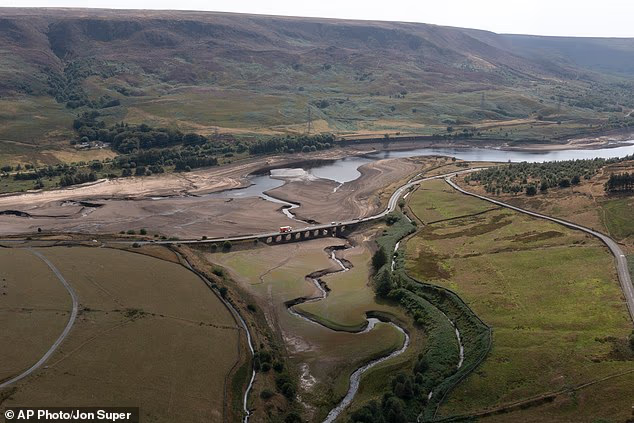
Woodhead reservoir near Manchester, pictured, as more than two-thirds of the UK suffers under drought conditions

Water companies could charge customers more during droughts as Ofwat considers giving the green light to ‘surge pricing’.

The Water Services Regulation Authority will allow firms to fluctuate prices in a bid to reduce consumption.

If the go-ahead is given, factors including ‘water scarcity’, the time of year and usage would contribute to suppliers hiking prices.

But the proposals, which would come into force in April next year, have yet to receive a final approval from the water regulator Ofwat.

Advertisement

Details of the pending price changes emerge as the UK is experiencing prolonged droughts, hosepipe bans and wildfires erupting across the nation.

Water companies could utilise surge pricing if it comes into effect by imposing seasonal charges where users would pay more during summer and less during the winter months.

Usage tariffs could similarly hike prices for homeowners if they pass a specific threshold of water use.

Households would then be incentivised to conserve water if droughts scourged the UK next summer.

Advertisement

Woodhead reservoir near Manchester, pictured, as more than two-thirds of the UK suffers under drought conditions

The bed of Bottoms Reservoir begins to crack during low water levels as the heatwave continues

The bed of Bottoms Reservoir begins to crack during low water levels as the heatwave continues

People take part in a Parkrun at Perry Hall Park in Birmingham through fields of bone-dry and yellow grass

People take part in a Parkrun at Perry Hall Park in Birmingham through fields of bone-dry and yellow grass

Advertisement

Both surge and block pricing have been trialled by water companies in small pockets of the UK.

Advertisement

In Lincoln and Norwich, 14,000 households using Anglian Water were recipients of the largest trial.

An Ofwat spokesperson said: ‘The efficient use of water is in the best interests of everyone, including businesses.

‘The options we are progressing would support greater consideration of water scarcity and efficiency by water companies when setting their charges, and encourage more tariff innovation.

‘We recently carried out a period of consultation on the proposals and will reach a final decision in the near future.’  

Advertisement

The potential green light for ‘surge pricing’ comes as Ofwat announced on August 13 that water bills would rise again for more than 30million people.

The water regulator was branded ‘toothless’ after it granted five water suppliers permission to raise bills above previously agreed levels – despite them losing billions of litres to leaks.

Prime Minister Andy Burnham said he was ‘angry’ at water companies using customers ‘as a blank cheque’ but has been challenged over what he is going to do about it.

Join the discussion

Advertisement

Should water companies be allowed to charge higher prices during droughts?

Dried fields as far as the eye can see in Weymouth, pictured on August as the fifth heatwave began

Dried fields as far as the eye can see in Weymouth, pictured on August as the fifth heatwave began

A view of the ancient stone circle Stonehenge in Wiltshire surrounded by yellow and dried grass

A view of the ancient stone circle Stonehenge in Wiltshire surrounded by yellow and dried grass

A wildfire and heat alert issued by the UK Government seen on a mobile phone screen on August 14

A wildfire and heat alert issued by the UK Government seen on a mobile phone screen on August 14

Advertisement

Scandal-hit Thames Water was granted permission to hike bills again between 2027 and 2030, along with Southern Water, South East Water, Severn Trent and Wessex Water.

Three water firms have imposed hosepipe bans on more than 20million people this summer.

Advertisement

Ofwat said it had given suppliers the provisional go-ahead for the unexpected hike in bills to fund £3.4billion-worth of new projects, including infrastructure for housing and data centres.

But the water regulator has already allowed suppliers to hike bills by 36 per cent between 2025 and 2030, with eye-watering increases last year and another 5.4 per cent on average bills from April.

Some 13 water companies applied to increase bills to fund investment of £4.3billion, and Ofwat announced yesterday it had provisionally allowed five to do so for £3.4billion of new projects.

The 2.7million people supplied by Southern Water will see bills rise by £80 over the next two years.

Advertisement

Southern – which lost about 37 billion litres of water through leaks last year – has the most expensive bills, with customers paying an average of £759 a year after an 8 per cent rise this year.

Thames Water – which Mr Burnham is expected to put into special administration to stave off its collapse as it sinks under £20billion in debt – was also allowed to increase bills for its 16million customers, as was Severn Trent, which services some 8 million.

Devastating wildfires have hit parts of the UK including Stourbridge, pictured, during the drought

Devastating wildfires have hit parts of the UK including Stourbridge, pictured, during the drought

Charred land and burnt houses following the huge wildfire which started in Stourbridge on August 14

Charred land and burnt houses following the huge wildfire which started in Stourbridge on August 14

Advertisement

Thames Water caused fresh outrage this week after it emerged it had paid a £1million signing-on fee to its new chief financial officer, Steve Buck.

Advertisement

Meanwhile the 1.4million people supplied by Wessex Water will see bills rise by £11 over the next two years, while the 2.3million supplied by South East Water will see a £1 rise.

Ofwat will consult on the proposed rises until September 24, with a verdict due in December.

A spokesperson previously said: ‘We will track performance to ensure companies are delivering the expected improvements for customers and the environment. If they don’t, expenditure can be clawed back.’

Source link

Advertisement
Continue Reading

NewsBeat

Don’t know what to do after your exams? Six ways to find your next step

Published

on

Don’t know what to do after your exams? Six ways to find your next step

“What are you going to do next?” For teenagers receiving their GCSE or A-level results, it can be one of the most daunting questions to answer. There’s often an expectation that, by the time they leave school, young people should know what they want to do with their working lives. But careers rarely follow such a straightforward path.

People change jobs, retrain, move into different industries and discover new interests. The world of work is also changing rapidly, with artificial intelligence (AI) reshaping some roles and employers increasingly looking for experience as well as qualifications.

So, if you’re not sure what you want to do next, that doesn’t mean you’re falling behind. You don’t have to choose one career and stick with it for the rest of your life. Instead, think about the next step as an opportunity to explore.

Here are six ways to do that:

Advertisement

1. Don’t choose a career, choose an interest

Rather than trying to identify the job you want to do for the rest of your life, start with subjects and areas that genuinely interest you.

Choosing something that stimulates you can make it easier to stay engaged and develop your skills. It can also open the door to careers you may not have considered.

Your interests may change over time too. That’s not a problem. The aim is to find something that interests you now and see where it takes you.

2. Try before you commit

If you’re considering a particular career, try to find out what the work is actually like. Volunteering, part-time jobs, work experience and job shadowing can all give you a better idea of what happens in a workplace.

Advertisement

You may discover that a job is exactly what you expected. You may also discover that it’s not for you. Both outcomes are useful. Finding that out before committing years to a particular career can save you time and help you make a more informed decision.

Work experience can also give you examples to talk about in future job interviews and help you develop skills such as communication, teamwork and problem-solving.

3. Choose courses that give you experience

If you decide to continue into further or higher education, look beyond the course title. Courses that include work placements, projects or other opportunities to apply what you have learned can help you understand how your subject relates to the world of work.

You can develop practical skills while also learning how to work independently and with other people. A placement can also help you decide whether you want to work in a particular profession before you have finished your studies.

Advertisement

4. Build experience wherever you can

Work experience and placements can introduce you to people already working in the field you’re interested in. Take the opportunity to ask questions and learn from them. Careers aren’t built entirely through qualifications. Knowing people and understanding how an industry works can also be valuable.

Look out for careers events, employer talks, mentoring schemes and opportunities to meet people working in areas that interest you. Simply getting to know people and finding out what they do can help you understand what opportunities are available.

You don’t need to have your whole life mapped out right now.
Iryna Imago/Shutterstock

5. Research the reality of the job

If you have an idea of the area you’d like to work in, look at actual job advertisements. What qualifications do employers ask for? What skills and experience do they want? Are there particular routes into the profession? This can help you work out what you need to do next.

You could also look for opportunities to volunteer, gain work experience or spend time observing someone who already does the job. And remember that your first job doesn’t have to be your dream job. Getting into a workplace or sector that interests you can give you experience, contacts and a better understanding of where you want to go next.

Advertisement

6. Think about where you want to live

Career decisions are also about where you want to be in the world. If you already have an idea of the area where you’d like to stay, look at the jobs available there. Some industries and professions are concentrated in particular towns and cities, while others offer more opportunities to work remotely.

Thinking about location alongside your career interests can help you understand what your options really are. It may also mean being open to opportunities you had not initially considered.


À lire aussi :
Do you want to be an astronaut? Career routes that can take you to space


The most important thing to remember is that don’t have to decide everything now. The question “What are you going to do next?” can make it sound as though you’re being asked to choose the rest of your life. You’re not, though. Your next decision is simply that: your next decision.

Advertisement

Whether you choose further study, an apprenticeship, work or another route, look for opportunities to learn more about yourself and the world of work. You can change your mind, gain new skills, or take a different direction. You don’t need to have your whole life mapped out right now. You just need to work out what you want to explore next.

Source link

Advertisement
Continue Reading

NewsBeat

Cardiff City ‘in talks’ to sign ex-Man United prospect as player omitted from squad

Published

on

Wales Online

The 27-year-old midfielder started his career at Old Trafford, with his father having been an important figure at the Premier League club

Cardiff City are reportedly in talks to sign Dutch defensive midfielder Melle Meulensteen from Go Ahead Eagles.

Advertisement

The 27-year-old is understood to have been left out of the club’s Eredivisie clash with Feyenoord on Sunday due to the transfer interest around him. Sky Sports report that he missed the 2-2 draw as the club do not want to risk the former Manchester United youth player getting injured and robbing them of a transfer fee.

Sky added that talks are not at an advanced stage just yet, but the fact the midfielder – who can also play centre-back – was kept out of Go Ahead Eagles’ line-up this weekend suggest things could quickly change.

Reports in the Netherlands add that the club are believed to keen on keeping hold of Meulensteen.

The midfielder joined the club from Sampdoria last year and has another three years left on his contract.

Advertisement

While he did not feature this weekend, he was involved in last week’s 4-1 home win over Willem II.

The name should be a familiar one to football fans, with his dad Rene having been assistant manager at Manchester United. He also managed Fulham and the Australia national team.

His sister, Pien, is a Sky Sports broadcaster who became the first woman to commentate on a live Premier League match for the channel in 2023.

Advertisement

Meulensteen scored five goals and provided three assists during his first season at Go Ahead Eagles.

Having started his career in Manchester United’s academy, he moved onto Preston – captaining their youth side.

He then moved to Dutch side RKC Waalwijk before heading to Vitesse in 2022.

The midfielder would then sign a three-year deal with Italian club Sampdoria, only to return the Netherlands a year later.

The Bluebirds made Liverpool full-back Calum Scanlon their latest signing on Saturday, with the 21-year-old putting pen to paper on another loan deal.

However, they have missed out on Omari Kellyman after Chelsea opted to pursue a permanent sale of the midfielder.

Source link

Advertisement
Continue Reading

NewsBeat

‘England’s prettiest village’ blocks new shops and cafe as locals rail against ‘overtourism’ that has left roads gridlocked and car parks overflowing

Published

on

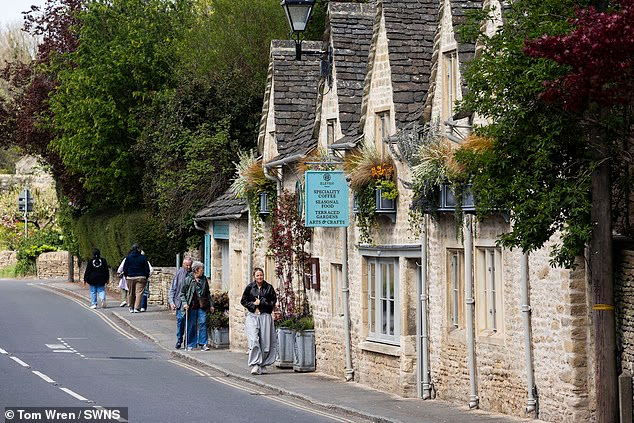
A new cafe in Bibury in the Cotswolds has been blocked after 100 residents complained about the impact of overtourism

More than 100 residents in ‘England’s prettiest village’ have blocked the building of a new café and shops after they complained that the area has become overrun by tourists.

The quaint and picturesque Cotswolds village of Bibury, famed for its 14th-century honey-coloured stone cottages, has rejected a new development because of fears it may attract yet more visitors.

It was originally made famous by textile designer and writer William Morris, who described it as ‘the most beautiful village in England’ in the 19th century.

But now furious locals have warned that the influx of tourists pouring into the small area throughout the year is becoming unsustainable.

Advertisement

Coaches and cars bringing tourists to the village are clogging up the narrow country lanes that run through Bibury, which locals said is causing dangerous traffic gridlock. 

Pedestrians have been forced to ‘run the gauntlet’ across the highway where the planned development would be built.

Now local councillors have rejected plans to turn a storage area on the ground floor of existing barns into a cafe and shopping area – fearing the wrath of residents.  

Representatives of the applicants, Bibury Trout Farm, argued the scheme would ‘bring the buildings fully back into use’.

Advertisement

A new cafe in Bibury in the Cotswolds has been blocked after 100 residents complained about the impact of overtourism

Coaches and cars bringing tourists to the village are clogging up the narrow country lanes that run through Bibury, which locals said is causing dangerous traffic gridlock

Coaches and cars bringing tourists to the village are clogging up the narrow country lanes that run through Bibury, which locals said is causing dangerous traffic gridlock 

Pictured: Trout Farm in Bibury, where a new development has been rejected by councillors

Pictured: Trout Farm in Bibury, where a new development has been rejected by councillors

Advertisement

But more than 100 objections were lodged to Cotswold District Council, arguing the additional impact on the village would be too much.

Bibury Parish Council objected to the plans, arguing that the village ‘cannot sustainably manage and maintain its character’.

In its objection, the parish council wrote: ‘The council agrees that overtourism by the Trout farm, resulting high volumes of visitors, is having a negative impact on the local environment, community, and the overall visitor experience.

‘This application we understand will be open to non-trout farm visitors therefore we believe will lead to another increase in visitor numbers.

Advertisement

‘The Trout Farm already has a large café in its grounds as well as existing extended café facility selling ice cream opposite the main site.

‘The village has another four catering businesses for the public all serving food and drink.

‘The area’s popularity with visitors is not sufficient justification for the location of new tourist attractions.

‘Any large-scale visitor development will generally be considered to be unacceptable if it would harm the landscape or features of historic interest, or have a harmful impact on the transport network.’   

Advertisement

The council said the lane was ‘constantly grid locked’ and verges ‘eroded by tourist vehicles’ using the Trout farm main car park which is ‘often full to overflowing in the summer’.

It added: ‘Therefore a new café as a standalone destination with traffic arriving will only exacerbate car parking and access to the Trout farm overflow car parks which have been overused this summer, not only creating enormous frustration to residents from Ablington and Bibury alike, but causing great danger to both pedestrians and drivers.’

Bibury was originally made famous by textile designer and writer William Morris, who described it as 'the most beautiful village in England

Bibury was originally made famous by textile designer and writer William Morris, who described it as ‘the most beautiful village in England

Gloucestershire County Council has now stepped up its enforcement of fines in response to the complaints about tourism

Gloucestershire County Council has now stepped up its enforcement of fines in response to the complaints about tourism

Advertisement

A total of 102 third-party objections were also raised with concerns ranging from congestion and pedestrian safety, harm to the village’s historic character and increased noise and disturbance of additional visitors.

Planners said the ‘scale and form’ of the development was considered appropriate but recommended refusal due to highways concerns.

They said: ‘The significant tourism pressures affecting Bibury are acknowledged, with traffic, parking and pedestrian safety issues representing established concerns within the village.

‘The Highway Authority considers that insufficient information has been provided to assess pedestrian accessibility and safety, including pedestrian movements along Ablington Lane, pedestrian and vehicle interaction, accessibility for mobility-impaired users, and conditions experienced during peak visitor periods.

Advertisement

‘The application has therefore not demonstrated that safe and suitable access can be achieved for all users.’

Councillors voted unanimously to reject the proposal at a meeting on August 11.

During the meeting Conservative councillor David Fowles said Ablington Lane was ‘frequently gridlocked’ with no safe pedestrian access.

He added: ‘Pedestrians have to run the gauntlet across the highway. It is a very dangerous situation.’

Advertisement
The quaint and picturesque Cotswolds village of Bibury is known for its 14th-century honey-coloured stone cottages which once featured on British passports

The quaint and picturesque Cotswolds village of Bibury is known for its 14th-century honey-coloured stone cottages which once featured on British passports

Locals in Bibury have also been embroiled in a long and much-publicised planning battle with the owner of Rosemary Cottage Metin Dener over the scale of building works.

The renovations have been dubbed a ‘flagrant disregard for the history and beauty of the area’ and described as turning a ‘tiny’ Grade II  historic cottage into a ‘monstrosity’.

Years of construction work at the cottage on Awkward Hill is continuing to blight their lives, villagers have claimed.

Advertisement

In the latest application, the applicants hit back at claims it had ‘overdeveloped the site’.

It added: ‘Due to the narrow access road and high level of tourists in the village the works on this site have had to progress at a slow pace as vehicle access has been relatively limited compared to most building sites and works on a steeply sloping site are complex.

‘The contractors on this site have tried to inform residents of deliveries and material removals where possible, however communication has not always been possible to be maintained.’

The village has also seen a 2,000 per cent rise in parking fines, with figures showing parking wardens dished out 651 notices in the village last year – up from 28 in 2019.

Advertisement

Fines have been set at £70, reduced to £35 if paid within a fortnight, meaning tickets issued in 2025 could have generated up to £45,570 – equivalent to around £900 a week.

This compares to the 28 fines given in 2019 generating £1,900.

Forbes previously named Bibury as the most beautiful village in the world out of a total list of 50

Forbes previously named Bibury as the most beautiful village in the world out of a total list of 50

Community representative Craig Chapman said many visitors showed ‘very little regard for villagers’ – parking wherever they can, even if this meant blocking pavements or stopping on double yellow lines.

Advertisement

Gloucestershire County Council has now stepped up its enforcement of fines in response to the complaints about overtourism in the Cirencester village.

Mr Chapman argued tougher action was needed to keep routes open for ambulances and fire engines and to make sure pedestrians could walk safely through the centre of the village.

However, the cost of sending wardens out frequently is estimated at around £4,000 a month, meaning income from fines alone does not cover the full bill for enforcement.

The county council is now planning to bring in pay-and-display parking for 24 on-street spaces along The Street, with proposed charges of £6 or £7 for two hours during the busy March to October period.

Advertisement

The tariffs have been benchmarked against other high-visitor locations, and officials say they could bring in up to £218,880 a year, delivering a projected surplus of up to £360,680 over four years once enforcement costs are taken into account.

Separately, a pedestrianised area in the middle of Bibury – previously used for coach parking – is to be made permanent, with temporary barriers replaced by structures designed to fit better with the historic setting.

A focus group is also examining options for out-of-village parking to ease pressure on residents’ driveways and the village’s tight road network, amid a wider £175,000 investment package aimed at managing visitor numbers and congestion.

The council said the figures in the latest report are ‘absolute maximums’ – and fines are reduced if paid quicker or appealed.

Advertisement

Source link

Continue Reading

Trending

Copyright © 2025