


Connect with us

NewsBeat

Frankie Valli, 92, shuts down retirement rumors after canceling 2026 tour dates

Published

on

Frankie Valli, 92, shuts down retirement rumors after canceling 2026 tour dates

Frankie Valli’s representative says the legendary singer has no plans to stop performing after he canceled his 2026 tour dates to focus on his health.

A representative for the legendary The Four Seasons frontman, 92, told People in a statement Saturday that Valli is going through “tough times,” but that he does not plan on stepping out of the spotlight.

Valli has “had some tough times, but he’s getting through them, and he’s improving,” the spokesperson said. “He is looking forward to being back on the road, and he is not retired.”

The “Can’t Take My Eyes Off You” singer doubled down in the statement with a post on Instagram simply saying: “In spite of what you might have heard, I am not retired.”

Advertisement

Speculation over Valli’s retirement began to swirl after a statement shared by Valli’s brother, Bobby, which he later recanted.

Frankie Valli’s representative shared that the singer is recovering after canceling his tour dates
Frankie Valli’s representative shared that the singer is recovering after canceling his tour dates (AFP/Getty)

The Independent has reached out to Valli’s representatives for comment.

In May, the “Can’t Take My Eyes Off You” singer announced that he and his band would not be continuing their Last Encores farewell tour, which was scheduled to run through November.

“I’m so sorry to disappoint the folks who have purchased tickets to my shows,” he told fans at the time. “But I have decided to take the rest of the year off from touring to focus on my health. I’m looking forward to getting healthy and seeing you all again soon. Thank you for all your good wishes.”

His representative Victoria Valera told Variety at the time that Valli’s decision to cancel rather than postpone was because the musician did not want those who had paid money to see him to have money held in limbo while he gets “his health in order.”

Advertisement
Amazon Music logo

Enjoy unlimited access to 100 million ad-free songs and podcasts with Amazon Music

Sign up now for a 30-day free trial. Terms apply.

Try for free

ADVERTISEMENT. If you sign up to this service we will earn commission. This revenue helps to fund journalism across The Independent.

“Promoters want to prolong things and not give people their money back, but he needs to not keep rescheduling these shows,” Valera said. “He realized he needed to take a break and get his health in order, and that is the true issue – he wants to get better without prolonging, through the rescheduling process, the pain of people who’ve bought these tickets.”

Advertisement

Varela said Valli will consider a return to the stage in 2027.

As Valli has continued to tour with the Four Seasons for decades, concern about his health previously arose in 2024, which led him to issue a statement about how dedicated he is to his craft.

“I know there has been a lot of stuff on the internet about me lately so I wanted to clear the air,” he said in a statement at the time. “I am blessed to be 90 years old and still be doing what I love to do and as long as I am able, and audiences want to come see me, I am going to be out there performing as I always.”

Advertisement

He continued: “I absolutely love what I do. And I know we put on a great show because our fans are still coming out in force and the show still rocks.”

Source link

Advertisement
Continue Reading
Click to comment

You must be logged in to post a comment Login

Leave a Reply

NewsBeat

Moment hundreds of migrants try to storm Ceuta in second ‘invasion’ attempt before being beaten back and arrested by riot police

Published

on

Hundreds of migrants were seen trying to storm border of Spanish enclave in planned Ceuta

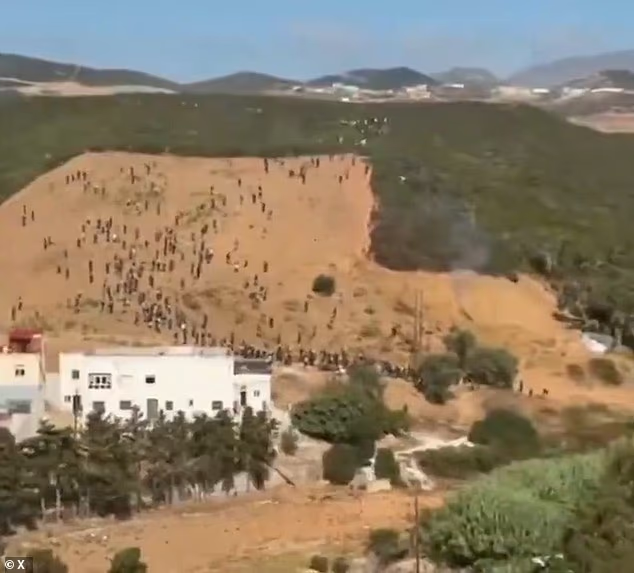
Hundreds of migrants were seen trying to storm Ceuta in a second planned invasion of the Spanish territory before they were intercepted by riot police.

Huge crowds of men were seen storming the border crossing at the northern tip of the African continent.

It comes just two weeks after 72,000 people swam around the border from Morocco to the Spanish enclave and arrived on the beach, with 145 dying in the process.

Morocco’s Le360 media outlet reported that at least 300 people were arrested, 46 of them Moroccan and the rest from sub-Saharan Africa. 

Advertisement

Police used tear gas to disperse groups of migrants gathered on hills around 3km (1.9 miles) from the border, according to Spanish news agency EFE.

Reporters later saw hundreds of officers, some in riot gear, returning from the hills outside Fnideq.

Huge groups of the men were seen pouring down the hills and mountains near Ceuta during the attempted crossing yesterday.

In the weeks leading up to the crossing attempt, messages began to swirl around social media calling for a new invasion of the Spanish enclave. 

Advertisement

Hundreds of migrants were seen trying to storm border of Spanish enclave in planned Ceuta

Huge crowds of men were seen storming the border crossing at the northern tip of the African continent

Huge crowds of men were seen storming the border crossing at the northern tip of the African continent

Police and military personnel from Spain and Morocco were both deployed early on Saturday

Police and military personnel from Spain and Morocco were both deployed early on Saturday

Advertisement

Earlier this week, Rabat said it was monitoring ‘the circulation of social media posts and messages of unknown origin’ calling for a mass crossing on August 15, warning it would prosecute organizers and participants.

 A message posted to an online forum read: ‘The Ceuta border will be open on the 15th [of August], a public holiday in Spain.’

They are also being urged to cross the border into Melilla, another Spanish autonomous city on the northern coast of Africa.

Ceuta and Melilla form the European Union’s only land borders with Africa. 

Advertisement

Social media was previously blamed for the organisation of the first large-scale attempt on the border. 

In Ceuta, Spanish soldiers guarded supermarkets while police heavily patrolled the enclave’s main streets. The city was calmer than in the days after the deadly crossing attempt on July 30.

Madrid has since installed a maritime barrier and deployed more than 500 additional police from mainland Spain, raising the total in Ceuta to more than 1,600. The Interior Ministry said the reinforcements would remain for as long as needed.

‘We’ll continue to deploy whatever personnel are necessary to restore normality as soon as possible and prevent events like those of July 30 from happening again,’ Interior Minister Fernando Grande-Marlaska said on Thursday.

Advertisement

About 5,000 migrants remained in Ceuta, the minister said.

Mr Grande-Marlaska said migrants who entered irregularly would not be allowed to stay in the enclave, travel to mainland Spain or obtain legal status, except in rare cases involving extreme vulnerability. Those without a right to remain would be returned to Morocco, he said.

Moroccan security forces monitor as they thwart attempts by hundreds of sub-Saharan African and Sudanese migrants to enter Ceuta

Moroccan security forces monitor as they thwart attempts by hundreds of sub-Saharan African and Sudanese migrants to enter Ceuta

Sub-Saharan African and Sudanese migrants gather near Fnideq (Castillejos), Morocco, as they attempt to enter the Spanish city of Ceuta, 15 August 2026

Sub-Saharan African and Sudanese migrants gather near Fnideq (Castillejos), Morocco, as they attempt to enter the Spanish city of Ceuta, 15 August 2026

Advertisement
Migrants are pictured taking shade beneath a tree as temperatures are set to reach 32C on Saturday, as authorities stand watch

Migrants are pictured taking shade beneath a tree as temperatures are set to reach 32C on Saturday, as authorities stand watch

Witnesses saw reinforced security near the border, including police vans with wire shields and road checkpoints. Local media reported similar measures near Melilla.

Authorities prevented several groups from boarding trains and buses to northern Morocco in cities such as Casablanca, Fez and Kenitra. However, witnesses told Reuters that some migrants from sub-Saharan Africa were bypassing security checkpoints by taking mountain routes towards Fnideq.

One witness said the schools in Fnideq had been turned into accommodation for security forces deployed near the border.

Advertisement

Many of the young people who entered Ceuta on July 30 were fishing, swimming or washing at Tarajal beach on Friday.

Driss Sadik, a 22-year-old from Fez who said he swam for five hours to reach Ceuta, urged others not to follow his example.

‘The important thing I would advise people trying to cross: Don’t cross now, my brothers. You’re only going to suffer,’ he told Reuters.

The warning was echoed by Adil Jamil, 17.

Advertisement

‘Those who enter aren’t going to benefit from anything. There will just be more and more of us, and they won’t find a solution for all,’ he said.

Adil said that the mass border crossings were ‘planned by the people’ who pick a date, gather in Fnideq and cross together to find strength in numbers.

According to El Pais, one message posted to online forums in which migrants discuss mobilising read: ‘The Ceuta border will be open on the 15th [of August], a public holiday in Spain.’

Rachid el-Jalfi, a spokesman for Morocco’s Ministry of the Interior, said on Wednesday that ‘all necessary measures’ had been taken to prevent illegal crossings.

Advertisement

He urged those planning to travel to Ceuta or Melilla to ignore online messages that appeared ‘suspicious and deceptive’, warning that attempts to cross posed ‘serious risks to people’s safety’.

Early last month, Spain’s top judicial body ruled that a procedure used to return illegal migrants only applied when they breached a physical border, rather than when they arrived by sea.

A heavy police and army deployment prepare at the border between Morocco and Spain today, after fresh social media calls for people to attempt the crossing

A heavy police and army deployment prepare at the border between Morocco and Spain today, after fresh social media calls for people to attempt the crossing

Migrants attempting to cross into Spain's North African enclave of Ceuta gather on a hilltop during clashes with Moroccan security forces near the town of Fnideq, on the Morocco-Spain border, on July 31, 2026

Migrants attempting to cross into Spain’s North African enclave of Ceuta gather on a hilltop during clashes with Moroccan security forces near the town of Fnideq, on the Morocco-Spain border, on July 31, 2026

Advertisement
Migrants gather along the fence close to the site of clashes near Fnideq last month

Migrants gather along the fence close to the site of clashes near Fnideq last month

Under the ruling, migrants who cross an unmarked maritime border can still be returned, but only through a separate formal procedure.

The crisis began on July 30, when more than 72,000 migrants surged into Ceuta. The following day, the Spanish government announced plans for a maritime containment barrier, which it began installing off the coast on August 1.

The influx also triggered a diplomatic row within the European Union after Italy temporarily suspended its Schengen arrangements with Spain and introduced checks on travellers arriving from the country by air and sea.

Advertisement

Italian Prime Minister Giorgia Meloni described the ‘uncontrolled immigration’ from Morocco into Ceuta as a national security threat.

Spain summoned the Italian ambassador in response, with Foreign Minister Jose Manuel Albares saying Madrid expected ‘European solidarity and not partisan demagoguery’. Spain then suspended its own Schengen arrangements with Italy.

Spanish authorities are meanwhile processing migrants who remain in Ceuta ahead of possible returns to Morocco.

Officials are using warehouses in Tarajal and elsewhere in the enclave to temporarily house migrants while they are identified and processed, with authorities hoping to return those without a right to remain within 72 hours of locating them.

Advertisement

The aftermath of the crossing has also been marred by allegations that several young migrant girls were raped after arriving in Ceuta.

The alleged victims, all under the age of 14, sought treatment at the University Hospital of Ceuta (HUCE) this past week, health services told the El Pueblo de Ceuta newspaper.

Judicial sources said many of the alleged rapes were prevented by the direct intervention of residents of Ceuta.

Some residents of the autonomous city were also among the accused, however.

Advertisement

Source link

Continue Reading

NewsBeat

Burnley vs West Ham LIVE: Championship latest score, match stream, goal updates and fan reaction

Published

on

Burnley vs West Ham LIVE: Championship latest score, match stream, goal updates and fan reaction

Arne Engels was signed too late from Celtic to be considered for a swift debut this afternoon, while West Ham are without Tomas Soucek and Keiber Lamadrid due to injury. However, Nuno still has a very strong squad at his disposal including new arrivals Manor Solomon and Joel Veltman plus captain Jarrod Bowen, who is staying put for at least another year. New Burnley boss Nicky Hayen has few fresh fitness issues to contend with, though he is still missing a handful of long-term absentees including Jordan Beyer and Josh Cullen.

Source link

Continue Reading

NewsBeat

Three things we learned from Arsenal trashing Man City in Community Shield | Football

Published

on

Three things we learned from Arsenal trashing Man City in Community Shield | Football


Source link

Advertisement
Continue Reading

NewsBeat

Amanda Abbington receives ‘substantial pay-out from BBC’ over Giovanni Pernice complaint – three years after PTSD-inducing ‘bullying and mistreatment’ on Strictly

Published

on

Amanda Abbington receives 'substantial pay-out from BBC' over Giovanni Pernice complaint - three years after PTSD-inducing 'bullying and mistreatment' on Strictly

Advertisement

Amanda Abbington has received a ‘substantial’ payout from the BBC after she made a legal complaint about her ill-fated stint on Strictly Come Dancing.

The actress, 53, made a shock exit from the show just weeks into the competition in 2023 and later accused her professional partner Giovanni Pernice of subjecting her to ‘vile abuse’ during rehearsals, prompting an enquiry from the broadcaster.

She has now reportedly been given a five-figure out-of-court settlement and a contribution to her legal fees from BBC Studios. 

The settlement has reportedly been made in a bid to prevent a lengthy court battle and allowing Amanda – who was subsequently diagnosed with post-traumatic stress disorder (PTSD) – to put her ordeal behind her.

Advertisement

A source told The Sun on Sunday newspaper: ‘Amanda’s friends and family are all relieved for her that this ordeal is finally over. It’s been a long, hard journey, but now she can close this chapter and move on with her life.

Amanda Abbington has received a ‘substantial’ payout from the BBC after she made a legal complaint about her ill-fated stint on Strictly Come Dancing

‘The fact the BBC have compensated Amanda as well as previously publicly apologising really proves that they are taking responsibility for the bullying she suffered on set.

Advertisement

‘She hopes that this case will give others strength and encourage people to speak up.’

The Daily Mail has contacted representatives Amanda for comment. BBC representatives declined to comment when approached. 

Following an investigation by the BBC, Giovanni was cleared of the most serious accusations made against him and the broadcaster issued a formal apology to Amanda.

The report found that some of the language used by Giovanni towards Amanda could be ‘belittling’ and agreed with the Mr Selfridge actress that his feedback was, at times, ‘overly negative’ and that he had used profanity during rehearsals.

Advertisement

The report noted after reviewing several hours of rehearsal footage as part of an official investigation that there were two moments of ‘inappropriate behaviour of sexual banter in the workplace’, which were found to simply have been ‘made and received as jokes’ between the pair.

The actress, 53, made a shock exit from the show and later accused her professional partner Giovanni Pernice of subjecting her to 'vile abuse', prompting an enquiry from the broadcaster

The actress, 53, made a shock exit from the show and later accused her professional partner Giovanni Pernice of subjecting her to ‘vile abuse’, prompting an enquiry from the broadcaster

The Sherlock actress previously admitted she was ‘relieved’ when a cancer scare led to her quitting the competition.

She told The Sun on Sunday newspaper: ‘By my final week, on the Thursday morning, I was in the shower and I found two lumps. I’d got the all-clear after a mammogram a couple of months before.

Advertisement

‘I went in for rehearsals to do the cha-cha-cha and just couldn’t concentrate. Giovanni said, ‘There’s no point teaching you this because it’s not going in. You can’t get it. We’ll be lucky if we get through because you’re useless’.

‘He refused to even look at me so I went to the toilet, came back and said, ‘I’m going to go to the hospital now because I found two lumps in my breast this morning’.

‘Then he was great. He said, ‘Well, let me know how it goes. It was the catalyst I’d been sort of waiting for, which is terrible. But that’s what I was thinking, that it was a healthier option than being in that room.

‘I’ve championed breast cancer charities but there was a part of me that was like, ‘OK, I have to deal with this now instead. Phew.”

Advertisement

Advertisement

Source link

Continue Reading

NewsBeat

More than 1,460 people suffer stroke in Lothians as care remains below target

Published

on

Daily Record

Chest Heart & Stroke Scotland (CHSS), one of the country’s largest health charities, is calling on the Scottish Government to put greater emphasis on essential stroke care over the course of this administration.

Public Health Scotland released their 2025 Scottish Stroke Improvement Programme this week, showing the country has failed to reach its target of 80% of patients receiving an inpatient bundle for the eighth straight year.

Advertisement

Chest Heart & Stroke Scotland (CHSS), one of the country’s largest health charities, is calling on the Scottish Government to put greater emphasis on essential stroke care over the course of this administration.

The inpatient bundle, which includes aspirin, access to a stroke unit, brain imaging and swallow screening, gives patients the best chance of survival in the critical hours after a stroke.

Across Scotland, 56.7% of 11,048 stroke patients received the care set by national standards.

Stroke remains one of the biggest causes of long-term adult disability in Scotland.

Advertisement

In the Lothians, 57.6% of the region’s patients received the bundle, an increase of just 1.1% compared with 2024. Whilst CHSS welcomes this marginal improvement, the charity highlights that performance remains short of the Scottish Government’s 80% target.

The total number of confirmed strokes in the region increased from 1,447 in 2024 to 1,462 in 2025, an increase of 15.

Joanne Graham, Director of Service Delivery at CHSS, said: “While there has been a small improvement in stroke bundle performance across Lothian, progress remains limited and performance continues to fall well short of the Scottish Government’s target.

“More than 1,400 people experienced a stroke in Lothian last year, highlighting the scale of the challenge.

Advertisement

“CHSS is already helping stroke survivors across Lothian through our community healthcare model and supported self-management programmes.

“We look forward to continuing to build on our close local work with NHS Lothian, alongside the Scottish Government, so this support reaches everyone who needs it.”

Don’t miss the latest news from the West Lothian Courier. Sign up to our free newsletter

Source link

Advertisement
Continue Reading

NewsBeat

Newry athlete Kate O’Connor on ‘pinch me moment’ of winning European heptathlon gold

Published

on

Belfast Live

The 25-year-old dedicated the gold medal to her grandmother, who the family lost this year

Northern Ireland-born athlete Kate O’Connor described her heptathlon win at the European Athletics Championships as a “pinch me moment.”

Advertisement

The 25-year-old, who was born in Newry and raised in Dundalk, represented Ireland at the event in Birmingham. She finished third in the 800m, the final event of the competition, to compile a total of 6,751 points, setting a national record and finishing 38 points ahead of Emma Oosterwegel of the Netherlands. Oosterwegel’s compatriot Sofie Dokter was a further 49 points behind in third.

O’Connor set off in the lead and rounded the final bend alongside Oosterwegel, who was able to win the race, but O’Connor stayed close enough to her rival to ensure the European title was hers.

The European Championships gold medal adds to the gold she won at the Commonwealth Games last month, where she represented Northern Ireland.

Sharing a post on Instagram on Sunday, O’Connor described her recent win as a “pinch me moment.” She added: “A title that will last a life time. An honour to represent the Emerald Isle.”

Advertisement

After winning the heptathlon gold on Saturday, she told RTE Sport: “That was the most nerve-wracking 800 of my whole life. I had a job to do, and I know that I’ve had quite a few jobs to do over these last few days. Some of them I’ve executed, some that I haven’t.

“So I was so nervous before that run, but when I heard cheers like that for me going around those two laps, there was absolutely no way that I was going to let that gold medal slip through my fingers.”

She added: “I’ve dreamt of this moment since I started athletics, and a couple of years ago I would have probably never thought that would have happened to me.

Advertisement

“But, it’s been a long two years. I know, a lot of medals, but a lot of increasing pressure on every single competition, and each competition has been different and trying to navigate that.

“And this competition was no different. It was difficult from start to finish, and I didn’t have it easy for a single second.”

She paid tribute to her father and trainer Michael, and dedicated the victory to her grandmother, who the family lost this year.

O’Connor said: “This year has been really tough for me personally. My granny died during the year, and I don’t think I give my dad enough credit, but it really obviously hit home for him big time.

Advertisement

“And the way that he’s still turned up training day in and day out, because this is my dream, but it’s also a dream for him too.

“I think that I have to dedicate this medal to my granny because she was one of our biggest fans, and she would have been jumping for joy if she was here to see this.”

For all the latest news, visit the Belfast Live homepage here and sign up to our daily newsletter here.

Source link

Advertisement
Continue Reading

NewsBeat

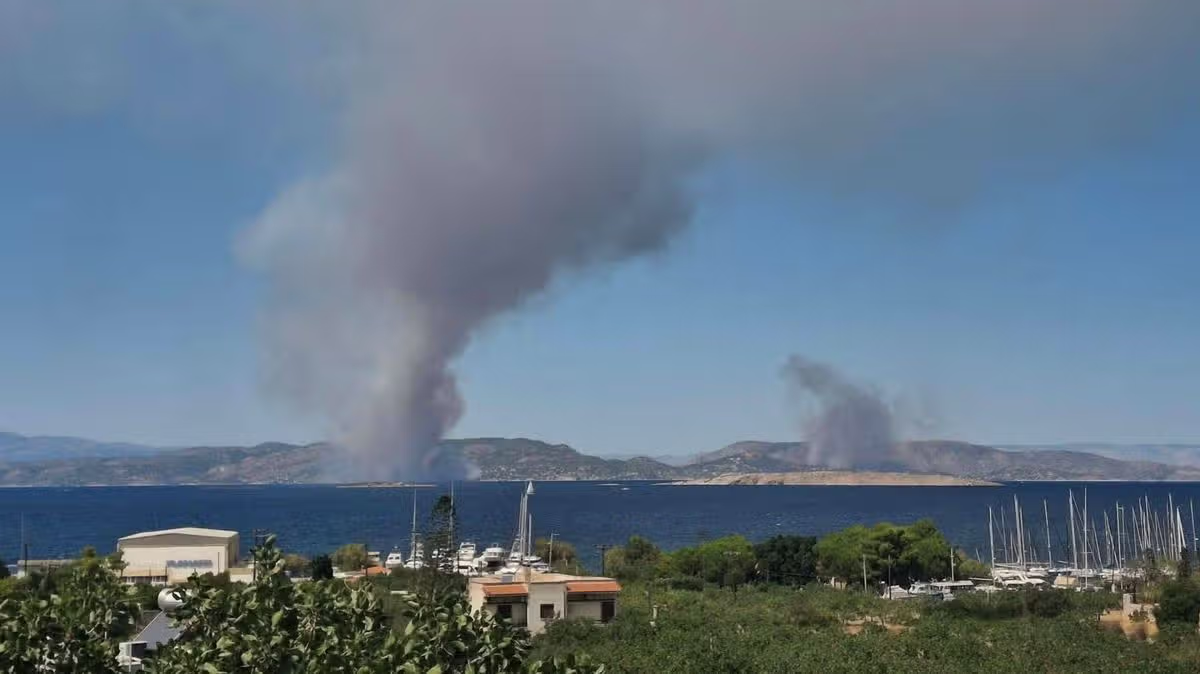
Salamina wildfires: Brit holiday hotspot battles multiple fires as two bodies found

Published

on

Daily Record

146 firefighters and 10 aerial assets are tackling two wildfires on the island of Salamina

The Greek island of Salamina is currently battling multiple wildfires, as the inferno inches towards a popular British tourist village. Over 100 firefighters are deployed after two wildfires erupted, one in the Peristeria and Selinia areas, while the other spreads toward the much loved village of Kaki Vigla.

The Mirror reports the alarm was raised at 2.43pm today (August 16) as 146 firefighters and 10 aerial assets are tackling the blaze. It has been reported powerful winds are increasing the risk of the fire spreading rapidly.

Advertisement

Thodoris Zannis, deputy mayor of Salamina, speaking to ERT said: “I am on the other front of the fire in Salamina, we are trying to stop the fire.

“It has taken over the entire mountain and is spreading, but the firefighting forces are being reinforced. People had to leave because there was no way out, so the messages started early.

“I have been informed that for the other fire in Peristeria, the ferries have also gone to evacuate by sea. The fire broke out at the same time and that was the strange thing.”

The Hellenic Police has requested that two ferry boats be made available for evacuations by sea from an area between Peristeria and Kaki Vigla. Firefighters are also battling wildfire for a second day on the Greek island of Skyros but the mayor, Kyriakos Antonopoulos, hopes it will soon be brought under control.

Tragically, this afternoon the fire service says that two bodies have been found while they battle the Salamina fires. So far they have not been identified.

Four people have been rushed from the Peristeria area to Salamina Hospital after suffering burns. An elderly man who was rescued from his home in Kaki Vigla was also taken to Salamina Hospital.

Mayor Giorgos Panagopoulos said: “The situation is difficult. There are two major fires, homes are under threat, and we have asked the police to bring us two ferry boats to Saterli Beach so that we can use them for people if we see that the situation becomes much more difficult.”

Advertisement

Ensure our latest stories always appear at the top of your Google Search by making us a Preferred Source. Click here to activate or add us as your Preferred Source in your Google search settings.

Source link

Continue Reading

NewsBeat

key takeaways for language learning

Published

on

key takeaways for language learning

Exam-entry statistics in the summer tend to prompt debates about the future of language learning in the UK. These are often framed around languages being in crisis: fewer young people study languages than two decades ago, and concerns persist about the UK’s linguistic capacity in an interconnected world.

The emerging figures for 2026 reinforce some of those concerns. But they also show a more complex picture than a simple narrative of decline. Language learning is changing unevenly, with growth in some places, fragility in many others, and important questions about which languages, learners and pathways are being valued.

Combined A-level entries in French, German and Spanish (the “modern foreign languages” traditionally taught in the UK) rose slightly in absolute terms in England, Northern Ireland and Wales – from 17,407 in 2025 to 17,616 in 2026. But this still lags behind the overall growth in A-level entries, which have increased by 2.7%.

Against that backdrop, the growth in language entries looks more fragile. Since 2022, the number of A-levels taken in the three languages has fallen from 19,820 to 17,616 – an over 11% decline in five years.

Advertisement

According to provisional data published by Ofqual, England’s exams regulator, GCSE entries in French, German and Spanish have seen a slight overall decrease in 2026, as have “other modern languages” and ancient languages.

Scotland has had a national policy commitment to language learning since 2013, yet sustaining uptake remains challenging there too.

While overall entries for Scottish Highers (a school-leaving qualification in Scotland) have gone up by 2.7% in 2026, entries in languages have fallen by 3.6%. The number of entries for languages (including Gaelic) was 6,955, which amounts to only 3.3% out of the overall 207,980 entries.

The picture for language learning is uneven.
s880/Shutterstock

National 5 entries (roughly equivalent to GCSEs) for languages have been more or less stable since 2022, but the proportion of language entries in 2026 was relatively small too (4.7%).

Advertisement

Looking across the data, and alongside the British Council’s annual Language Trends surveys, five key observations can be made.

1. Spanish is now the leading school language

The rise of Spanish is one of the clearest shifts. Spanish is now the most-entered GCSE language.

This continues a longer-term change already visible at A-level, where Spanish overtook French as the most popular language in 2019. In 2026, Spanish attracted 8,434 entries, compared with 6,888 for French and 2,294 for German. All “other modern languages” combined accounted for 6,944 A-level entries.

The same trend can be observed in Scotland, where Spanish has been the most popular language in Higher exams since 2023, and in National 5 exams since 2025.

Advertisement

2. Greater recognition of multilingual identities

The “other modern languages” category deserves some special attention. At A-level, it grew by 25.8% between 2022 and 2026, reaching 6,944 entries. At GCSE, provisional entries in this category fell slightly, but the age profile is striking: 41.5% of entries came from younger pupils in Year 10 or below – far more than for French, German or Spanish, or indeed any other subject.

Many pupils are taking qualifications in languages they already use in family or community contexts, such as Arabic, Chinese, Polish, Portuguese, Turkish and Urdu.

The question is therefore not only how to persuade more young people to learn a “foreign” language from scratch. It is also how schools, colleges and universities recognise, value, develop and accredit the linguistic knowledge many students already bring with them. The planned GCSE in British Sign Language marks another important step towards recognising linguistic diversity more fully.

3. Access is uneven, especially in state schools

The British Council highlights that language provision remains under particular pressure in state schools: more than a quarter of primary schools and around a fifth of state secondary schools in England report reductions in curriculum time for languages. It also found persistent problems with transition from primary to secondary school.

Advertisement

Post-16 provision is particularly vulnerable. 43% of surveyed state secondary schools report that A-level language courses do not run if minimum student numbers are not met.

4. The university pipeline remains fragile

School trends feed directly into higher education. Data published by the Universities and Colleges Admissions Service (UCAS) shows a steady decline in applications to university courses in the subject group “languages and area studies” (which includes modern languages as well as, for example, English, linguistics and creative writing). Since 2022, applications have fallen from 89,190 to 74,110 in 2026 – an almost 17% drop.

This puts university language departments under significant pressures but also encourages them to rethink their offer. Many have introduced beginners pathways into their language degrees and increased opportunities to combine languages with other subjects.

5. Teacher supply is a cause of concern

Teacher supply remains one of the most important structural challenges, which will be exacerbated if even fewer students study languages at university and more university language departments close.

Advertisement

The British Council reports that around half of state secondary schools identify recruitment and retention of qualified modern foreign language teachers as an issue.

A cautiously optimistic outlook

All in all, there is reason for cautious optimism when it comes to language learning in the UK. The growing demand for Spanish signals a general interest in, and openness to, other languages and cultures. So does the increased visibility and recognition of multilingualism in communities.

A constructive response to the challenges should focus on protecting access in state schools and valuing home, heritage, community and signed languages alongside traditionally taught languages. It should also focus on transitions – from primary to secondary to higher and further education – and on building attractive routes into teaching.

All this depends on a shared understanding of the intellectual, cultural, practical, political and economic value of language learning.

Advertisement

Source link

Continue Reading

NewsBeat

Water companies could be allowed to charge customers more during droughts as watchdog considers giving green light to ‘surge pricing’

Published

on

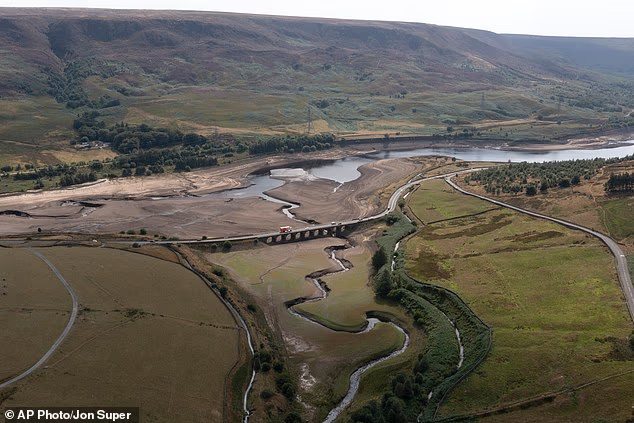
Woodhead reservoir near Manchester, pictured, as more than two-thirds of the UK suffers under drought conditions

Water companies could charge customers more during droughts as Ofwat considers giving the green light to ‘surge pricing’.

The Water Services Regulation Authority will allow firms to fluctuate prices in a bid to reduce consumption.

If the go-ahead is given, factors including ‘water scarcity’, the time of year and usage would contribute to suppliers hiking prices.

But the proposals, which would come into force in April next year, have yet to receive a final approval from the water regulator Ofwat.

Advertisement

Details of the pending price changes emerge as the UK is experiencing prolonged droughts, hosepipe bans and wildfires erupting across the nation.

Water companies could utilise surge pricing if it comes into effect by imposing seasonal charges where users would pay more during summer and less during the winter months.

Usage tariffs could similarly hike prices for homeowners if they pass a specific threshold of water use.

Households would then be incentivised to conserve water if droughts scourged the UK next summer.

Advertisement

Woodhead reservoir near Manchester, pictured, as more than two-thirds of the UK suffers under drought conditions

The bed of Bottoms Reservoir begins to crack during low water levels as the heatwave continues

The bed of Bottoms Reservoir begins to crack during low water levels as the heatwave continues

People take part in a Parkrun at Perry Hall Park in Birmingham through fields of bone-dry and yellow grass

People take part in a Parkrun at Perry Hall Park in Birmingham through fields of bone-dry and yellow grass

Advertisement

Both surge and block pricing have been trialled by water companies in small pockets of the UK.

Advertisement

In Lincoln and Norwich, 14,000 households using Anglian Water were recipients of the largest trial.

An Ofwat spokesperson said: ‘The efficient use of water is in the best interests of everyone, including businesses.

‘The options we are progressing would support greater consideration of water scarcity and efficiency by water companies when setting their charges, and encourage more tariff innovation.

‘We recently carried out a period of consultation on the proposals and will reach a final decision in the near future.’  

Advertisement

The potential green light for ‘surge pricing’ comes as Ofwat announced on August 13 that water bills would rise again for more than 30million people.

The water regulator was branded ‘toothless’ after it granted five water suppliers permission to raise bills above previously agreed levels – despite them losing billions of litres to leaks.

Prime Minister Andy Burnham said he was ‘angry’ at water companies using customers ‘as a blank cheque’ but has been challenged over what he is going to do about it.

Join the discussion

Advertisement

Should water companies be allowed to charge higher prices during droughts?

Dried fields as far as the eye can see in Weymouth, pictured on August as the fifth heatwave began

Dried fields as far as the eye can see in Weymouth, pictured on August as the fifth heatwave began

A view of the ancient stone circle Stonehenge in Wiltshire surrounded by yellow and dried grass

A view of the ancient stone circle Stonehenge in Wiltshire surrounded by yellow and dried grass

A wildfire and heat alert issued by the UK Government seen on a mobile phone screen on August 14

A wildfire and heat alert issued by the UK Government seen on a mobile phone screen on August 14

Advertisement

Scandal-hit Thames Water was granted permission to hike bills again between 2027 and 2030, along with Southern Water, South East Water, Severn Trent and Wessex Water.

Three water firms have imposed hosepipe bans on more than 20million people this summer.

Advertisement

Ofwat said it had given suppliers the provisional go-ahead for the unexpected hike in bills to fund £3.4billion-worth of new projects, including infrastructure for housing and data centres.

But the water regulator has already allowed suppliers to hike bills by 36 per cent between 2025 and 2030, with eye-watering increases last year and another 5.4 per cent on average bills from April.

Some 13 water companies applied to increase bills to fund investment of £4.3billion, and Ofwat announced yesterday it had provisionally allowed five to do so for £3.4billion of new projects.

The 2.7million people supplied by Southern Water will see bills rise by £80 over the next two years.

Advertisement

Southern – which lost about 37 billion litres of water through leaks last year – has the most expensive bills, with customers paying an average of £759 a year after an 8 per cent rise this year.

Thames Water – which Mr Burnham is expected to put into special administration to stave off its collapse as it sinks under £20billion in debt – was also allowed to increase bills for its 16million customers, as was Severn Trent, which services some 8 million.

Devastating wildfires have hit parts of the UK including Stourbridge, pictured, during the drought

Devastating wildfires have hit parts of the UK including Stourbridge, pictured, during the drought

Charred land and burnt houses following the huge wildfire which started in Stourbridge on August 14

Charred land and burnt houses following the huge wildfire which started in Stourbridge on August 14

Advertisement

Thames Water caused fresh outrage this week after it emerged it had paid a £1million signing-on fee to its new chief financial officer, Steve Buck.

Advertisement

Meanwhile the 1.4million people supplied by Wessex Water will see bills rise by £11 over the next two years, while the 2.3million supplied by South East Water will see a £1 rise.

Ofwat will consult on the proposed rises until September 24, with a verdict due in December.

A spokesperson previously said: ‘We will track performance to ensure companies are delivering the expected improvements for customers and the environment. If they don’t, expenditure can be clawed back.’

Source link

Advertisement
Continue Reading

NewsBeat

Don’t know what to do after your exams? Six ways to find your next step

Published

on

Don’t know what to do after your exams? Six ways to find your next step

“What are you going to do next?” For teenagers receiving their GCSE or A-level results, it can be one of the most daunting questions to answer. There’s often an expectation that, by the time they leave school, young people should know what they want to do with their working lives. But careers rarely follow such a straightforward path.

People change jobs, retrain, move into different industries and discover new interests. The world of work is also changing rapidly, with artificial intelligence (AI) reshaping some roles and employers increasingly looking for experience as well as qualifications.

So, if you’re not sure what you want to do next, that doesn’t mean you’re falling behind. You don’t have to choose one career and stick with it for the rest of your life. Instead, think about the next step as an opportunity to explore.

Here are six ways to do that:

Advertisement

1. Don’t choose a career, choose an interest

Rather than trying to identify the job you want to do for the rest of your life, start with subjects and areas that genuinely interest you.

Choosing something that stimulates you can make it easier to stay engaged and develop your skills. It can also open the door to careers you may not have considered.

Your interests may change over time too. That’s not a problem. The aim is to find something that interests you now and see where it takes you.

2. Try before you commit

If you’re considering a particular career, try to find out what the work is actually like. Volunteering, part-time jobs, work experience and job shadowing can all give you a better idea of what happens in a workplace.

Advertisement

You may discover that a job is exactly what you expected. You may also discover that it’s not for you. Both outcomes are useful. Finding that out before committing years to a particular career can save you time and help you make a more informed decision.

Work experience can also give you examples to talk about in future job interviews and help you develop skills such as communication, teamwork and problem-solving.

3. Choose courses that give you experience

If you decide to continue into further or higher education, look beyond the course title. Courses that include work placements, projects or other opportunities to apply what you have learned can help you understand how your subject relates to the world of work.

You can develop practical skills while also learning how to work independently and with other people. A placement can also help you decide whether you want to work in a particular profession before you have finished your studies.

Advertisement

4. Build experience wherever you can

Work experience and placements can introduce you to people already working in the field you’re interested in. Take the opportunity to ask questions and learn from them. Careers aren’t built entirely through qualifications. Knowing people and understanding how an industry works can also be valuable.

Look out for careers events, employer talks, mentoring schemes and opportunities to meet people working in areas that interest you. Simply getting to know people and finding out what they do can help you understand what opportunities are available.

You don’t need to have your whole life mapped out right now.
Iryna Imago/Shutterstock

5. Research the reality of the job

If you have an idea of the area you’d like to work in, look at actual job advertisements. What qualifications do employers ask for? What skills and experience do they want? Are there particular routes into the profession? This can help you work out what you need to do next.

You could also look for opportunities to volunteer, gain work experience or spend time observing someone who already does the job. And remember that your first job doesn’t have to be your dream job. Getting into a workplace or sector that interests you can give you experience, contacts and a better understanding of where you want to go next.

Advertisement

6. Think about where you want to live

Career decisions are also about where you want to be in the world. If you already have an idea of the area where you’d like to stay, look at the jobs available there. Some industries and professions are concentrated in particular towns and cities, while others offer more opportunities to work remotely.

Thinking about location alongside your career interests can help you understand what your options really are. It may also mean being open to opportunities you had not initially considered.


À lire aussi :
Do you want to be an astronaut? Career routes that can take you to space


The most important thing to remember is that don’t have to decide everything now. The question “What are you going to do next?” can make it sound as though you’re being asked to choose the rest of your life. You’re not, though. Your next decision is simply that: your next decision.

Advertisement

Whether you choose further study, an apprenticeship, work or another route, look for opportunities to learn more about yourself and the world of work. You can change your mind, gain new skills, or take a different direction. You don’t need to have your whole life mapped out right now. You just need to work out what you want to explore next.

Source link

Advertisement
Continue Reading

Trending

Copyright © 2025