
Crypto World
Jane Street Reports Major Position Across XRP ETF


Jane Street Group reported holding more than 1.2 million shares of Bitwise’s XRP ETF as of June 30, 2026, up from 20,605 shares three months earlier. The 60-fold increase appeared in the trading firm’s second-quarter Form 13F filed with the SEC.
The filing highlights Jane Street’s position in the XRP ETF market, but its role as a major market maker that actively trades ETFs and options means the holding should not necessarily be viewed as a simple long-term directional bet on XRP.
Jane Street’s Q2 2026 Form 13F covers holdings as of June 30. The filing reported more than 1.2 million Bitwise XRP ETF shares, compared with 20,605 ordinary shares at the end of the first quarter.

Discover: The Best Crypto to Diversify Your Portfolio
The firm also reported exposure to XRP-related funds from Franklin Templeton, Grayscale, Canary Capital, and 21Shares. That places Jane Street across several XRP ETF products rather than solely in Bitwise’s fund.
Bitwise’s product stands out because it holds spot XRP, unlike other ETFs tracking the asset. The fund launched in November, a few weeks after Canary Capital’s ETF reached Wall Street, and has since become the largest of the group discussed in the filings.
The XRP increase in reported shares is substantial, but Jane Street’s market-making and ETF and options trading activities provide important context. The source material cautions that the position should not automatically be treated as a straightforward long-term bet on XRP.

The filing establishes the firm’s reportable securities position at the June 30 cutoff. On its own, that reported position does not establish Jane Street’s investment intention or the duration for which it plans to hold the shares.
Jane Street’s reported stake nevertheless makes it a leading participant in XRP ETF adoption among the institutions cited in the filings.
Trade XRP on Bybit and Get a Chance to Win Our $1,000 USDT Airdrop
Other Institutions Reporting XRP ETF Positions
Bank of America reported 13,260 shares of the Volatility Shares XRP ETF, a position valued at about $76,000. Unlike Bitwise’s product, the Volatility Shares ETF is not a spot ETF.
Morgan Stanley reported positions in three XRP-related funds at the end of the second quarter: 6,715 shares of Franklin’s XRP ETF, 255 shares of REX-Osprey’s product, and 567 shares of Bitwise’s fund. The holdings are small relative to Morgan Stanley’s overall portfolio, but add to the list of institutions reporting regulated XRP exposure.
Other reported positions included nearly 200,000 Bitwise XRP ETF shares held by Wolverine Asset Management and 86,744 Capital XRP ETF shares reported by Gallacher Capital Management. Main Street Group and National Bank of Canada reported holding 5,261 and 3,848 XRP-related shares, respectively.
Discover: The Best Token Presales
The post Jane Street Reports Major Position Across XRP ETF appeared first on Cryptonews.


The top holders of SpaceX stock are a who’s who of tech giants and big name investors. A series of filings show that Alphabet, Nvidia and Peter Thiel own huge stakes in SpaceX — as does, of course, CEO Elon Musk. Musk is the largest shareholder of SpaceX, controlling roughly 6.42 billion shares or 48.8% of the company, according to…
Copyright ©2026 Investor’s Business Daily, LLC. All rights reserved. 87990cbe856818d5eddac44c7b1cdeb8
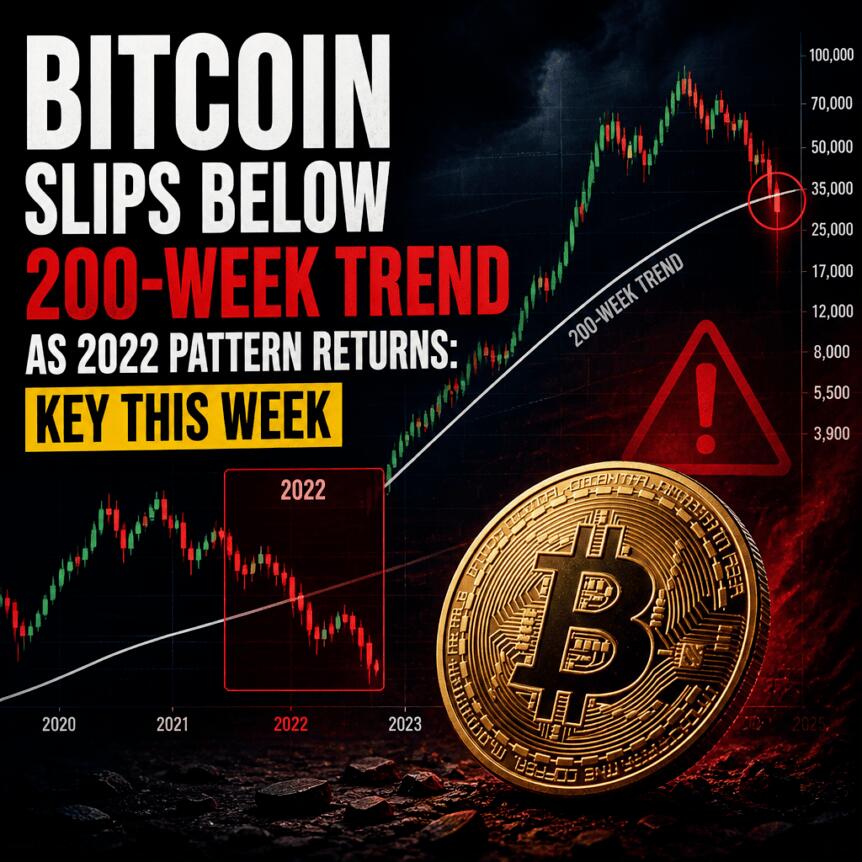
Bitcoin is starting the new week around $63,000, but the market’s technical outlook remains weighed down by history: traders are watching for confirmation of a weekly breakdown after last week’s close slipped below Bitcoin’s long-term 200-week moving average (SMA).
At the same time, macro catalysts are building. Federal Reserve minutes from the July meeting are due this week, and Japan’s second-quarter GDP release underscored risks to global liquidity even as U.S. equities hit fresh highs—an unusual backdrop that some on-chain and sentiment analysts say is leaving Bitcoin sidelined.
Key takeaways
- Bitcoin traded in a roughly $57,700 to $67,300 range, and last week’s close fell below the 200-week SMA near $64,216.
- Options pricing suggests close to a 70% chance the Federal Reserve holds rates at the September meeting, following softer inflation signals earlier.
- Japan Q2 GDP came in below expectations, adding to concerns about “global tightening” and potential knock-on effects for risk assets.
- Glassnode highlights a sentiment mismatch: consumer confidence is near decade lows while U.S. stocks reach record territory.
- CryptoQuant points to growing whale-driven exchange inflows, which are reversing some of the prior trend of BTC moving off exchanges.
Weekly close below the 200-week SMA reignites bear-market parallels
After last Sunday’s weekly close, Bitcoin saw a modest rebound, posting local highs near $63,655 on Bitstamp. However, TradingView data suggests the broader week is beginning with price action still trapped inside a narrow consolidation band, with neither bulls nor bears able to establish a decisive move.
Analyst Benjamin Cowen emphasized that BTC/USD has returned below the 200-week SMA. In earlier reporting from Cointelegraph, the 200-week line was described as a defining feature of the 2022 bear market—acting as resistance after Bitcoin capitulated below it in August before entering a long bottoming phase.
“What is interesting is how in both summer 2022/2026, Bitcoin capitulated below the 200W SMA, then bounced, then gave it up in mid-August,” Cowen wrote on X.
Traders are also watching specific levels. Rekt Capital said Bitcoin failed to reach his targeted weekly-close level of $63,220, which he argues keeps the door open for additional downside. In his view, a rejection from that zone would confirm a breakdown and potentially push price lower within the existing approximate $58,000 to $66,000 range.
“A rejection from $63,220 would fully confirm the breakdown and send price lower within the current ~$58,000-$66,000 Range,” Rekt Capital wrote on X.
Fed minutes and odds of a hold: markets shift from hawkishness to pause
This week’s macro focus centers on the release of preliminary Purchasing Managers’ Index (PMI) readings for manufacturing and services, alongside the July Federal Reserve minutes expected on Wednesday.
Recent inflation data has been influential in shaping expectations. Cointelegraph previously noted that last week’s CPI and PPI releases pointed to a softer-than-expected inflation trajectory, prompting traders to reconsider the likelihood of additional rate hikes.
According to CME Group’s FedWatch Tool, markets are currently pricing in nearly a 70% probability that the Fed will hold rates at the 3.50%–3.75% range for the September meeting. That compares with roughly 42% odds a month earlier.
Analysis from Mosaic Asset Company—citing CPI coming in at 3.4% year-on-year—argues that moderating inflation helps prevent the policy outlook from turning overly hawkish, even though inflation remains far above the Fed’s 2% target. The report also points to how the Fed’s prior meeting ended with policy dissent, and it notes that the split was the largest since 1970.
Separately, Bloomberg quoted Cleveland Fed President Beth Hammack discussing the risk that returning inflation to 2% could take years—raising questions about whether public patience would be sufficient if progress toward the target is slow. The point matters for Bitcoin because extended tight or uncertain policy expectations can quickly change the liquidity backdrop that crypto tends to trade against.
What to watch next: the tone of the July minutes—especially any discussion around dissent—may determine whether near-term rate expectations drift further toward “hold” or reprice back toward “hikes.”
Japan’s GDP miss adds liquidity stress even as U.S. equities rally
Risk-asset traders are also monitoring Japan after Q2 GDP data missed expectations. The release showed quarterly and annual growth of 0.3% and 1.1%, respectively—below forecasts of 0.5% and 2.0%.
The data arrives as markets look for the Bank of Japan to potentially begin raising rates from current levels around 1.0% in September, a shift tied to surging bond yields and a weakening yen. Cointelegraph previously reported that Japan and the U.S. conducted a rare joint intervention in yen markets after JPY/USD hit multi-decade lows.
Beyond growth, the GDP print included a notable weakness: the first decline in private consumption in eight quarters. Oxford Economics’ Japan lead economist Norihiro Yamaguchi told CNBC that the boost to consumption from policy measures is already fading and that inflation pressures could increase in the second half as costs filter through—potentially deteriorating purchasing power.
For Bitcoin, the indirect channel is financial conditions. CryptoQuant contributor Axel Adler Jr. warned that while the situation is not yet a clear “sell risk assets” signal, the market is approaching a critical threshold. In a post on X, he highlighted a combination of conditions that could tighten global financial conditions: Japan’s government bond yields rising further (notably above 3%), additional BOJ rate hikes, a stronger yen, and rising U.S. Treasury yields. He added that if these factors align, normalization of Japan’s rates could end up pressuring both stocks and Bitcoin.
What to watch next: whether Japan’s yield and yen dynamics stay contained or accelerate—because traders often treat FX and sovereign yields as leading indicators of cross-asset liquidity.
Sentiment and ETF flows: Bitcoin risks being left out of the “capital rotation”
While macro uncertainty builds, some analysts argue the bigger issue may be positioning. Glassnode, in its “The Week Onchain” newsletter, described a divergence between Bitcoin and equities: U.S. consumer confidence remains among the weakest readings of the past decade, even as the stock market has reached an all-time high and stays near those levels.
Glassnode said the contradiction looks less puzzling once the driver is identified: households anticipating higher living costs and a softer economy may be reallocating away from cash and into assets, with equities absorbing much of that flow. The firm also pointed out that the S&P 500 reached all-time highs and that the University of Michigan’s consumer sentiment survey is expected to decline further in August.
According to Glassnode, Bitcoin is not participating in that same rotation. A key sign would be whether institutional inflows return to U.S. spot Bitcoin ETFs in a sustained way.
Cointelegraph’s article cites that last week spot Bitcoin ETFs saw net outflows of $267.2 million, based on data from Farside Investors. It also notes that only one out of five trading days ended with net inflows, totaling just $7.8 million.
What to watch next: whether outflows extend or reverse. Sustained inflows would directly challenge the idea that Bitcoin is being ignored by the same sentiment-driven capital that is supporting equities.
Exchange reserve shifts: whale inflows boost liquidity available to trade
On-chain supply dynamics are adding another layer of pressure. CryptoQuant analysis argues that whale activity is increasing exchange inflows and contributing to a reversal in BTC leaving exchanges—an important nuance because exchange balances can affect how much BTC is available for trading or hedging.
The report highlights that Binance’s whale ratio reached 0.71 on Aug. 10, the highest since early March. CryptoQuant also said Binance’s BTC reserves totaled 674,332 BTC on Sunday, up 2.57% month-to-date and at their highest level since November 2025.
“Exchange deposits do not necessarily mean immediate selling, but they increase the amount of BTC available for trading or hedging,” CryptoQuant commented.
The broader context matters: Cointelegraph previously reported that exchange activity had been skewed toward derivatives as Bitcoin has traded in a tight range since early June. In that earlier coverage, Binance futures volume was noted as significantly larger than spot volume in early August, reinforcing the idea that the market’s “tight range” behavior may be fueled as much by leverage and hedging as by spot demand.
For traders and long-term investors, the next signals are likely to come from three directions: the Fed minutes’ implications for policy expectations, whether Japan’s rates and yen continue to tighten financial conditions, and whether ETF flows and exchange-reserve trends move in a way that either reconnects Bitcoin to broader risk appetite—or further isolates it.

Many S&P 500 investors don’t pay much attention to the number of letters in their stocks’ symbols. But maybe they should. S&P 500 stocks with four-letter ticker symbols are trouncing those of all other lengths this year, says an Investor’s Business Daily analysis of data from S&P Global Market Intelligence. They’re up an average of 21.8% this year. That tops…
Copyright ©2026 Investor’s Business Daily, LLC. All rights reserved. 87990cbe856818d5eddac44c7b1cdeb8

Citing a report by Al Arabiya, The Kobeissi Letter noted minutes ago that the United States and Iran have agreed to extend the 60-day ceasefire in a deal brokered by Pakistan.
Although there’s no official confirmation by either side, the timing is quite peculiar since the previous ceasefire’s deadline expires today.
Previous reports indicated that US President Donald Trump had established a “backchannel” in place with officials of Iran’s Revolutionary Guard.
According to Axios, the Trump administration bypassed Iran’s negotiators and reached out directly to the country’s leadership, tapping Nechirvan Barzani, the president of the Kurdistan region in Iraq. The report claimed that Barzani had the trust of both the US and Iranian leaders.
Trump has reportedly said that Iran should raise the “white flag of surrender” and has reiterated his core demand on a few occasions that the country must not have a nuclear weapon.
Separately, the POTUS has warned Oman against interfering with US actions, as the Omani government reportedly tried to negotiate a deal for the reopening of the Strait of Hormuz.
Major war developments like the one cited above have historically impacted Bitcoin’s price. Now, though, the asset remains calm at $63,500 after jumping by $500 earlier today. However, more volatility is expected once these reports are confirmed or denied by both concerned parties.
The post How Will BTC React as US and Iran Reportedly Extend Ceasefire? appeared first on CryptoPotato.


Key takeaways
- Pi Network edges higher on Monday as buyers defend the $0.0839 support level following two consecutive daily declines.
- The Pi Core Team released Node version 0.6.2 after successfully testing distributed computing capabilities across the network.
- A break below $0.0786 could invalidate the recent channel breakout, while a recovery above $0.1000 could strengthen the bullish outlook.
Pi Network (PI) edges higher on Monday as buyers attempt to defend the key $0.0839 support level following two consecutive days of losses.
The mild recovery comes after the Pi Core Team released a new Node upgrade focused on advancing the network’s distributed computing capabilities. However, PI’s technical outlook remains mixed, with weak derivatives activity and indecisive momentum limiting confidence in a sustained rebound.
Weak market sentiment weighs on Pi Network
Pi Network remains a highly speculative cryptocurrency whose price is heavily influenced by broader market conditions, retail demand and the strength of its community.
CoinMarketCap’s Crypto Fear and Greed Index stands at 38 on Monday, reflecting cautious sentiment and reduced risk appetite among investors.
Renewed geopolitical tensions involving Israel, Lebanon, the United States and Iran have contributed to uncertainty across risk assets. This defensive environment could make it more difficult for speculative tokens such as PI to attract fresh capital.
The Pi Network community continues to anticipate further ecosystem development around its reported base of 18 million Know Your Customer-verified users.
The Pi Core Team released version 0.6.2 of its Node software on Saturday. The upgrade follows a successful test of distributed computing capabilities across Pi Nodes and could provide a foundation for additional network utilities.
Expanding the role of individual Nodes beyond transaction validation could strengthen the network’s functionality and provide new use cases for participants. However, the upgrade’s long-term impact will depend on whether developers introduce applications that generate sustainable user demand.
Social activity showed a modest increase following the announcement. Santiment data indicates that Pi Network’s Social Dominance rose to 0.01% on Sunday from 0.009% on Saturday. Social Volume also increased to 12 from 8 over the same period.
The figures suggest that the Node upgrade generated slightly more discussion, although overall social engagement remains limited.
Pi Network’s derivatives market continues to show reduced trader participation. According to CoinAnk, PI futures Open Interest declined to $8.81 million from $9.12 million on Friday.
Open Interest measures the notional value of outstanding derivatives contracts. A decline generally indicates that traders are closing leveraged positions or reducing their exposure.
The continued reduction in PI futures Open Interest suggests that speculative interest is weakening despite the latest technical upgrade and Monday’s mild price recovery.
Pi Network struggles to extend falling-channel breakout
Pi Network maintains a bearish short-term bias as its price consolidates below $0.0900.
PI previously broke above a falling-channel pattern on the daily chart, creating the possibility of a bullish reversal. However, the token has failed to produce meaningful upside follow-through, reflecting weak buying demand.
At the time of writing, buyers are defending the 78.6% Fibonacci retracement level at $0.0839. The retracement is measured from the recent decline between $0.1341 and $0.0703.
A sustained break below $0.0839 could expose the former channel resistance trendline near $0.0786. A decisive daily close below this level would weaken the bullish breakout structure and raise the risk of deeper losses.
Pi Network’s daily momentum indicators provide little evidence of a strong recovery. The Moving Average Convergence Divergence indicator remains only marginally above its signal line and is at risk of forming a bearish crossover. Such a move would indicate that downside momentum is beginning to strengthen.
The Relative Strength Index stands at 45, below its neutral midpoint of 50. This reading reflects modest bearish pressure but remains consistent with range-bound trading rather than an oversold market.

On the upside, the psychological threshold at $0.1000 represents the first major resistance level.
This area is reinforced by the 50% Fibonacci retracement at $0.1022, creating a meaningful supply zone where sellers could limit any recovery.
A decisive breakout above $0.1022 would strengthen PI’s recovery prospects and could open the way toward the 23.6% Fibonacci retracement at $0.1190.
Until PI generates stronger buying demand and derivatives participation begins to recover, its near-term outlook is likely to remain cautious.


Stablecoins can move across many blockchains, but each network still introduces its own transfer requirements. A USDC balance on Solana and the same asset on Ethereum may look identical to a user while travelling through different systems.
COCA has integrated Aurora Intents to reduce this complexity inside its self-custodial banking app. The update allows users to deposit supported stablecoins from more than a dozen networks through reusable addresses, while cross-chain execution happens behind the interface.
The same integration also brings $COCA trading into the app, giving users a way to buy or sell the token using their existing USD balance.
COCA Expands Stablecoin Deposit Support
COCA now accepts USDC across networks including Ethereum, Arbitrum, Base, Solana, Polygon, Optimism, Avalanche, Sui and Stellar. USDT support includes Ethereum, Tron, Solana, Polygon, Optimism, Avalanche and TON, alongside several other networks.
Aurora Intents handles the required cross-chain execution before funds appear inside COCA. The process reduces manual bridging and extra transfers between wallets or exchanges.
Crypto users often need to match the token with the correct network before sending funds. The same stablecoin can exist across several blockchains, creating an extra decision at the point of transfer.
“They want their money to arrive safely and be ready to use,” Aurora Labs CEO Declan Hannon said in the announcement, describing how users approach account funding.
COCA CEO Vasili Paulau made a similar point, saying users care about access to their money rather than the blockchain carrying it.
Cross-Chain Execution
Aurora Intents is built on NEAR Intents, a multichain transaction system based on requested outcomes.
A user or application states the intended result, while independent solvers compete to complete the transaction. Once a quote is accepted, settlement is handled through NEAR.
Inside COCA, this model applies to account funding. Users choose the asset and destination, while the required routing happens within the product.
The integration gives intent-based execution a consumer banking use case. Cross-chain systems have often focused on swaps and liquidity access, while COCA is applying the same model to deposits used before spending, saving or transferring funds.
COCA combines self-custody with a Visa card, EUR IBAN and yield on eligible balances. The company says the app is available across more than 75 countries.
$COCA Trading Moves Into the App
The update also changes how users acquire $COCA, the token used within COCA’s loyalty program.
Users previously acquired $COCA through external exchanges such as MEXC or BitMart before transferring tokens into the COCA app. In-app trading now allows users to buy or sell $COCA using their existing USD balance.
External wallet transfers remain available, giving users another route for receiving the token.
Bringing $COCA trading into the app links token access more closely with COCA’s membership system, where holdings can affect cashback tiers, APY limits and other benefits.
The change also removes several steps from a process which previously required users to leave the app, create or access an exchange account, complete a trade and send tokens back to COCA.
Chain Abstraction Reaches Consumer Finance
COCA’s Aurora Intents integration shows how consumer-facing crypto products can absorb more blockchain complexity within the app itself, reducing the amount of network knowledge required when users fund an account.
Users may care primarily about the asset, amount and destination, while intent-based execution handles routing across the relevant networks in the background. With stablecoins spreading across more blockchains, this approach gives consumer apps a way to manage cross-chain deposits while keeping the experience closer to familiar digital banking.
The post COCA Adds Cross-Chain Stablecoin Deposits Through Aurora Intents appeared first on BeInCrypto.
Sterling enters this week on a mixed footing. Last month’s Bank of England decision struck a notably hawkish tone, with the vote split 6-3 in favor of holding rates, three members pushed for a hike, a signal the Bank remains genuinely worried about inflation as Middle East-driven energy costs work through the economy. Yet political uncertainty continues to simmer following Keir Starmer’s unexpected June resignation, leaving fiscal credibility, and by extension sterling, more sensitive than usual to how Labour manages the transition.
The kiwi, meanwhile, is being propped up almost entirely by rate expectations. Markets currently price an 88% probability of an RBNZ hike in September, even after New Zealand’s unemployment rate climbed to a decade-high 5.6%. UBS argues the labor data isn’t as bearish as it looks, since the rise was driven mainly by more people entering the workforce rather than layoffs, keeping the central bank’s tightening path intact. Softer inflation expectations and a weaker July manufacturing PMI, however, have started to inject some doubt into just how far the RBNZ can realistically go.
The result: a pound navigating political noise against a kiwi riding hawkish rate bets that may be more fragile than markets currently assume.
Technical Analysis of GBP/NZD
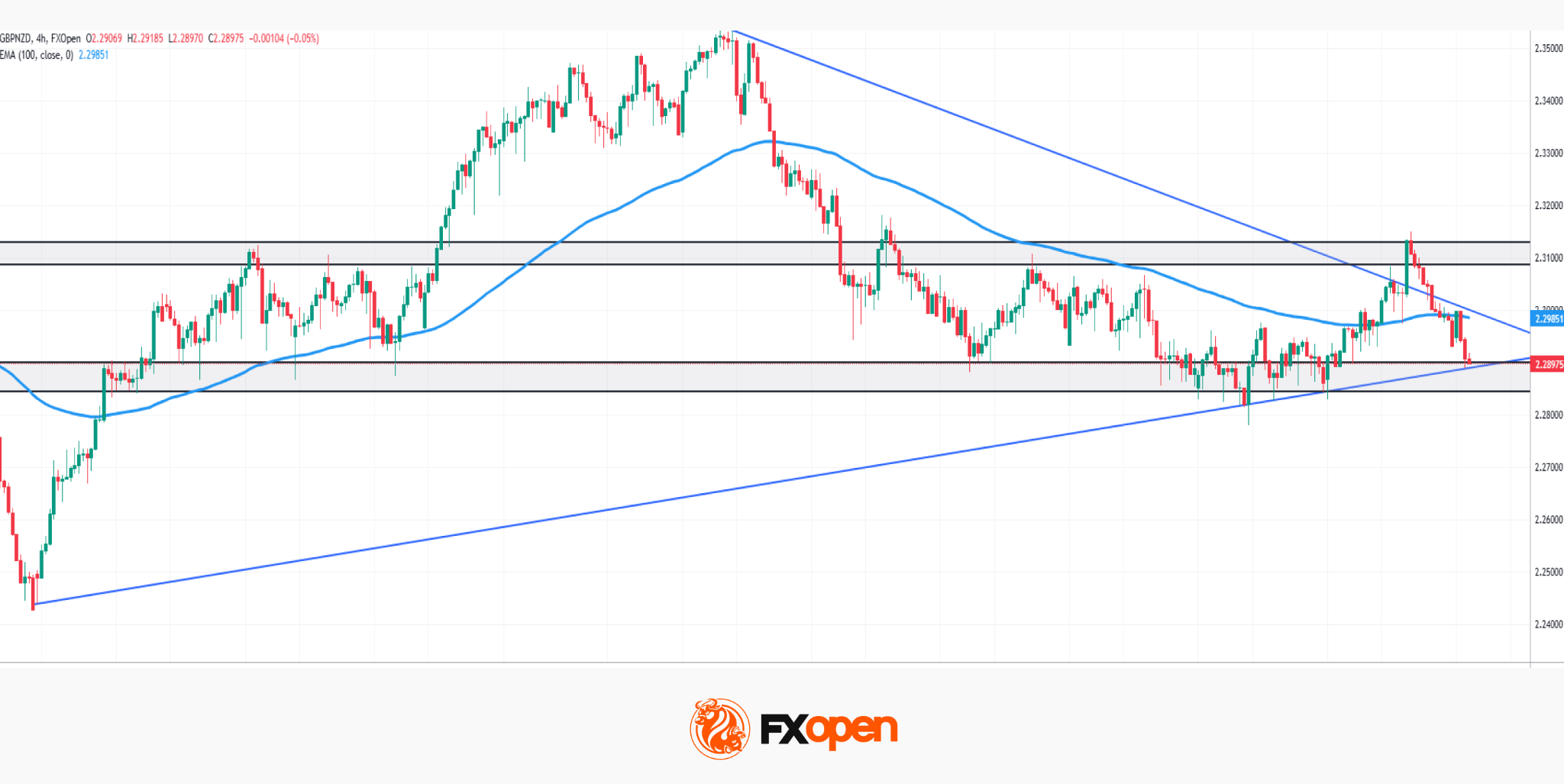
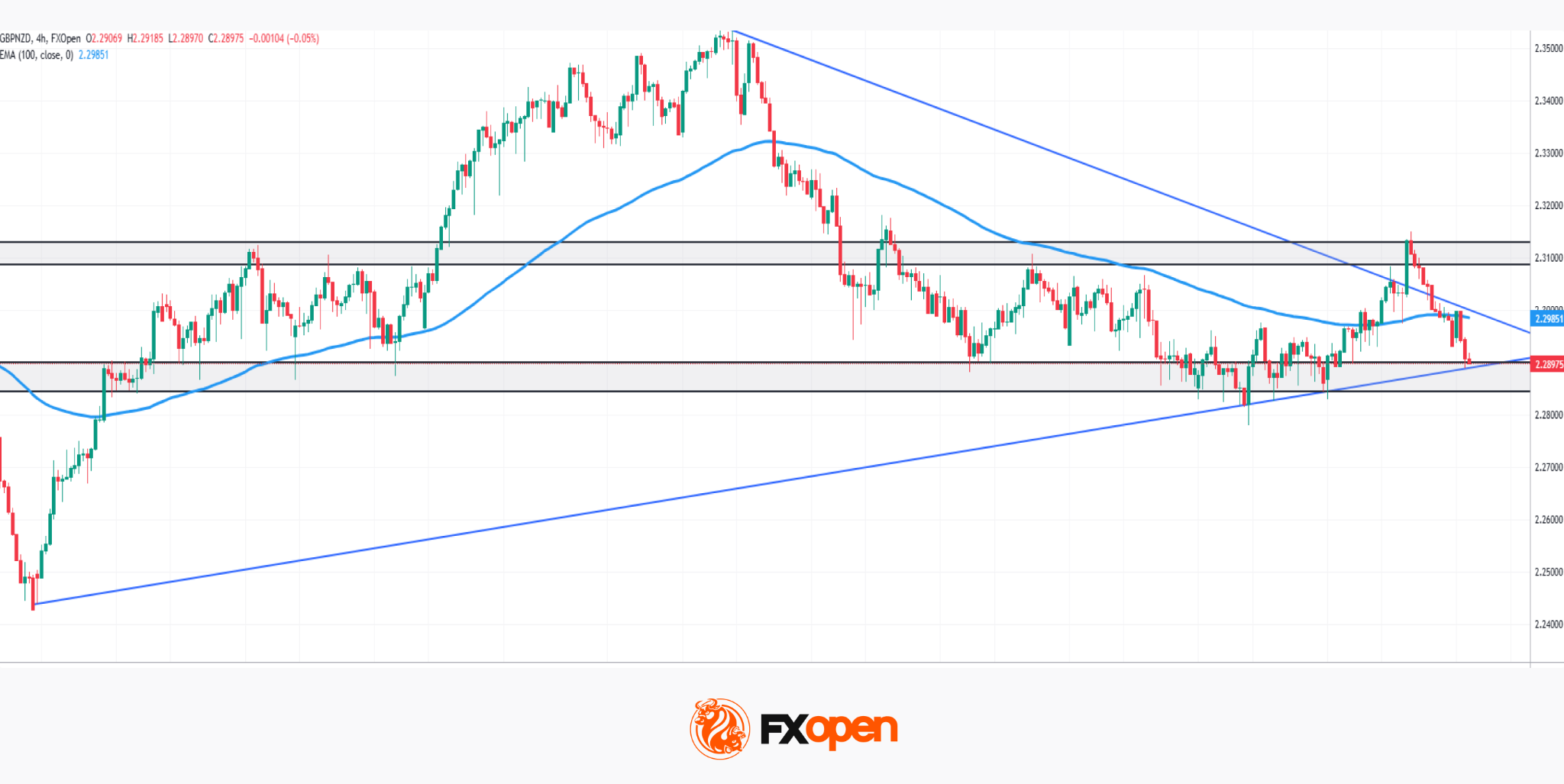
As GBP/NZD chart shows, the pair has been compressing into a broad symmetrical triangle since early June, with a descending trendline from July’s highs near 2.3550 converging with an ascending trendline off June’s lows, both meeting right around current price near 2.2900-2.2980, where the 100-period EMA also sits. This confluence, together with the well-established 2.2900-2.3100 support and resistance zone, marks a decisive juncture for the pair.
Bullish Scenario
Should buyers defend the ascending trendline and reclaim the 100-period EMA, the path would open toward the 2.3100 resistance, the upper boundary of the recent range. A confirmed break above this zone, and the descending trendline itself, would signal a genuine shift in momentum, opening the door toward a retest of the July highs near 2.3550.
Bearish Scenario
Conversely, a break below the ascending trendline and the 2.2900 support would expose the broader downtrend that has dominated since early July, with price risking a slide back toward the 2.2800 area and beyond, as the months-long descending structure reasserts itself.
With price coiled right at the apex of this triangle, sitting exactly on the 100-period EMA, GBP/NZD looks primed for a decisive move—will sterling’s political noise finally give way to the kiwi’s rate story, or does this range hold just a little longer?
Trade over 50 forex markets 24 hours a day with FXOpen. Take advantage of low commissions, deep liquidity, and spreads from 0.0 pips (additional fees may apply). Open your FXOpen account now or learn more about trading forex with FXOpen.
This article represents the opinion of the Companies operating under the FXOpen brand only. It is not to be construed as an offer, solicitation, or recommendation with respect to products and services provided by the Companies operating under the FXOpen brand, nor is it to be considered financial advice.

After a couple of sales announced in August, Michael Saylor’s NASDAQ-listed entity did not make any Bitcoin moves, but it increased its USD reserve by $150 million.
As such, its total stash remains at 840,447 BTC, currently valued at around $53.3 billion. The firm has accumulated its crypto fortune for roughly $10 billion more than the current value, and its average price is $75,385 per unit.
Strategy added $150M to its USD Reserve and repurchased $132M of $STRC, extending USD Duration to 2.8 yrs (+41 days) and tightening STRC BTC Credit to 114 bps (-4 bps). As of 8/16/26: ₿840,447 BTC Reserve; $4.8B USD Reserve. $MSTR https://t.co/kNWPowilmT
— Michael Saylor (@saylor) August 17, 2026
Aside from the growing USD reserve and extending the dividend payout duration to 2.8 years, the company said it has repurchased over $130 million worth of STRC.
STRC ended last week at around $95, as it continues to recover from its dip to $75. However, it’s still inches away from its par price of $100.
The good news for the cryptocurrency community this week is that the largest corporate holder of BTC didn’t sell any, unlike the previous week when it offloaded 1,690 units.
Meanwhile, Strategy CEO Phong Le indicated last week that the company still plans to resume its Bitcoin purchases soon, and it could start by the end of the year.
The post Strategy Stays Put on Bitcoin but Sells a Massive 3.46 Million Shares appeared first on CryptoPotato.


Tudor Investment has increased its BlackRock Bitcoin ETF stake by 18.9% in the second quarter, ending a year-long run of reductions while cutting most of its reported call-option exposure to the fund.
Summary
- Tudor Investment increased its BlackRock Bitcoin ETF stake by 18.9% in the second quarter.
- The hedge fund added 109,446 IBIT shares, taking its total holding to 688,529 shares worth about $22.9 million.
- Tudor cut its reported IBIT call options by about 85% while its put position remained roughly unchanged.
- The purchase ended a year-long run of reductions from Tudor’s late 2024 peak of more than 8 million IBIT shares.
The Securities and Exchange Commission filing submitted on Aug. 14 showed that the macro hedge fund founded by billionaire Paul Tudor Jones held 688,529 shares of BlackRock’s iShares Bitcoin Trust, or IBIT, as of June 30, up from 579,083 shares at the end of March.
Tudor added 109,446 shares during the quarter, taking the reported value of the position to about $22.9 million. The purchase reversed the direction of its IBIT holdings after the firm spent much of 2025 reducing a position that had once exceeded 8 million shares.
At the end of 2024, Tudor held more than 8 million IBIT shares worth roughly $427 million. Successive reductions through 2025 left the latest share count more than 90% below that peak, meaning the second-quarter purchase recovered only a small part of the exposure previously sold.
The position is also limited compared with the size of Tudor’s portfolio. The firm manages more than $100 billion in assets, while the $22.9 million IBIT stake represented only a fraction of its reported securities holdings at the end of June.
Tudor Investment increased shares while cutting IBIT calls
Alongside the purchase of direct shares, Tudor substantially reduced the call options it reported against BlackRock’s Bitcoin fund.
Its IBIT call position fell by about 85% during the quarter, dropping to the equivalent of 148,000 underlying shares from 998,000 at the end of March. The firm’s reported put exposure remained roughly unchanged.
The filing establishes Tudor’s positions at June 30 but does not disclose the strike prices or expiry dates for the options. It also does not show whether the reduction resulted from sales, expirations or another change in the firm’s strategy, limiting what can be inferred from the lower call position.
Form 13F itself provides only a quarter-end snapshot of certain U.S.-listed securities held by institutional investment managers. Filers generally have up to 45 days after a quarter ends to submit the report, while short positions and many other forms of exposure are not disclosed.
As previously explained by crypto.news in June, 13F reports can show long positions in listed crypto investment products but not directly held cryptocurrencies, complete hedges, cost bases or trades that were opened and closed within the reporting quarter.
Tudor’s filing therefore confirms that its direct IBIT share count increased between the March 31 and June 30 reporting dates, while providing only a partial view of the hedge fund’s total Bitcoin-related exposure.
Other institutions also added BlackRock Bitcoin ETF shares
Tudor’s purchase was disclosed during a busy round of second-quarter institutional filings involving BlackRock’s Bitcoin product.
Morgan Stanley reported on Aug. 14 that it had increased its IBIT stake by 23% during the second quarter, taking its position to about 16.5 million shares from roughly 13.4 million at the end of March.
The bank added approximately 3.04 million shares, although the reported value of the holding fell from about $667 million to $549 million as Bitcoin prices declined during the quarter. Morgan Stanley also disclosed 2.57 million shares of its own Bitcoin Trust, valued at about $43.3 million, after the fund began trading in April.
UBS likewise reported a larger position in BlackRock’s fund. An Aug. 13 SEC filing showed the Swiss bank held about 2.5 million IBIT shares valued at nearly $90 million at June 30, compared with about 549,000 shares at the end of 2025.
The change represented an increase of roughly 355% in its share count over six months, according to the UBS filing coverage published Aug. 13. Like other 13F reports, however, the filing does not determine whether all of the reported shares represented proprietary investments or assets held for clients.
Not every large holder increased its allocation. Harvard Management Company kept its 3.04 million IBIT shares unchanged during the second quarter, ending two consecutive quarters of reductions.
Harvard previously held 6.81 million shares at the end of September 2025 before cutting the position to 5.35 million in the fourth quarter and then reducing it by another 2.31 million shares during the first quarter of 2026. Its remaining position was valued at about $101.4 million at June 30.
The same second-quarter holdings report showed that Abu Dhabi investment entities Mubadala Investment Company and Abu Dhabi Investment Council also left their IBIT share counts unchanged. Mubadala held 14.72 million shares worth about $490.1 million, while the council reported 8.22 million shares valued at approximately $273.6 million.
Paul Tudor Jones has backed Bitcoin as an inflation hedge
Tudor’s renewed purchase follows several years of public support for Bitcoin from Jones, who first laid out his investment case for the asset in 2020.
Jones initially presented Bitcoin as protection against monetary expansion and inflation, later continuing to discuss it alongside gold and other scarce assets. His position focused in part on Bitcoin’s fixed supply and the potential loss of purchasing power in traditional currencies.
During a June 2025 Bloomberg interview, Jones said Bitcoin, gold and equities could form part of a portfolio designed to protect against inflation, with allocations adjusted to account for Bitcoin’s higher volatility.
At the time, he argued that policymakers dealing with large debt burdens could seek to keep real interest rates below inflation. Jones said assets such as Bitcoin and gold would become important stores of value under those conditions.
Jones had earlier discussed allocating roughly 1% to 2% of a portfolio to Bitcoin but did not provide a new percentage during the 2025 interview.
The hedge fund manager also maintained a positive view of Bitcoin during an earlier period of regulatory pressure in the United States. In May 2023, he said he intended to retain a small allocation to the cryptocurrency while citing its fixed supply as part of its investment case.
Bitcoin ETF inflows returned ahead of Tudor filing
Tudor’s quarter-end position was disclosed after U.S. spot Bitcoin ETFs recorded another period of net inflows in early August.
The funds attracted about $853.5 million over five consecutive trading days from Aug. 3 through Aug. 7, according to SoSoValue data cited in an Aug. 8 report. BlackRock’s IBIT accounted for about $694 million of the total.
The five-day inflow streak began with $170.1 million in combined net inflows on Aug. 3, followed by $211.5 million on Aug. 4 and $244.4 million on Aug. 5. The products then received about $128.8 million on Aug. 6 and $98.85 million on Aug. 7.
BlackRock’s fund had already recorded a $209.4 million single-day inflow on July 7 as total U.S. spot Bitcoin ETF inflows reached $265.7 million for the session. Fidelity’s FBTC, Bitwise’s BITB, ARK 21Shares’ ARKB and Grayscale’s Bitcoin Mini Trust also received net inflows that day, while Grayscale’s GBTC posted withdrawals.
BlackRock describes IBIT as a product designed to provide exposure to Bitcoin while reducing the custody and operational requirements involved in holding the cryptocurrency directly. The fund carried a 0.25% sponsor fee and reported a net asset value of $35.58 per share as of Aug. 14.
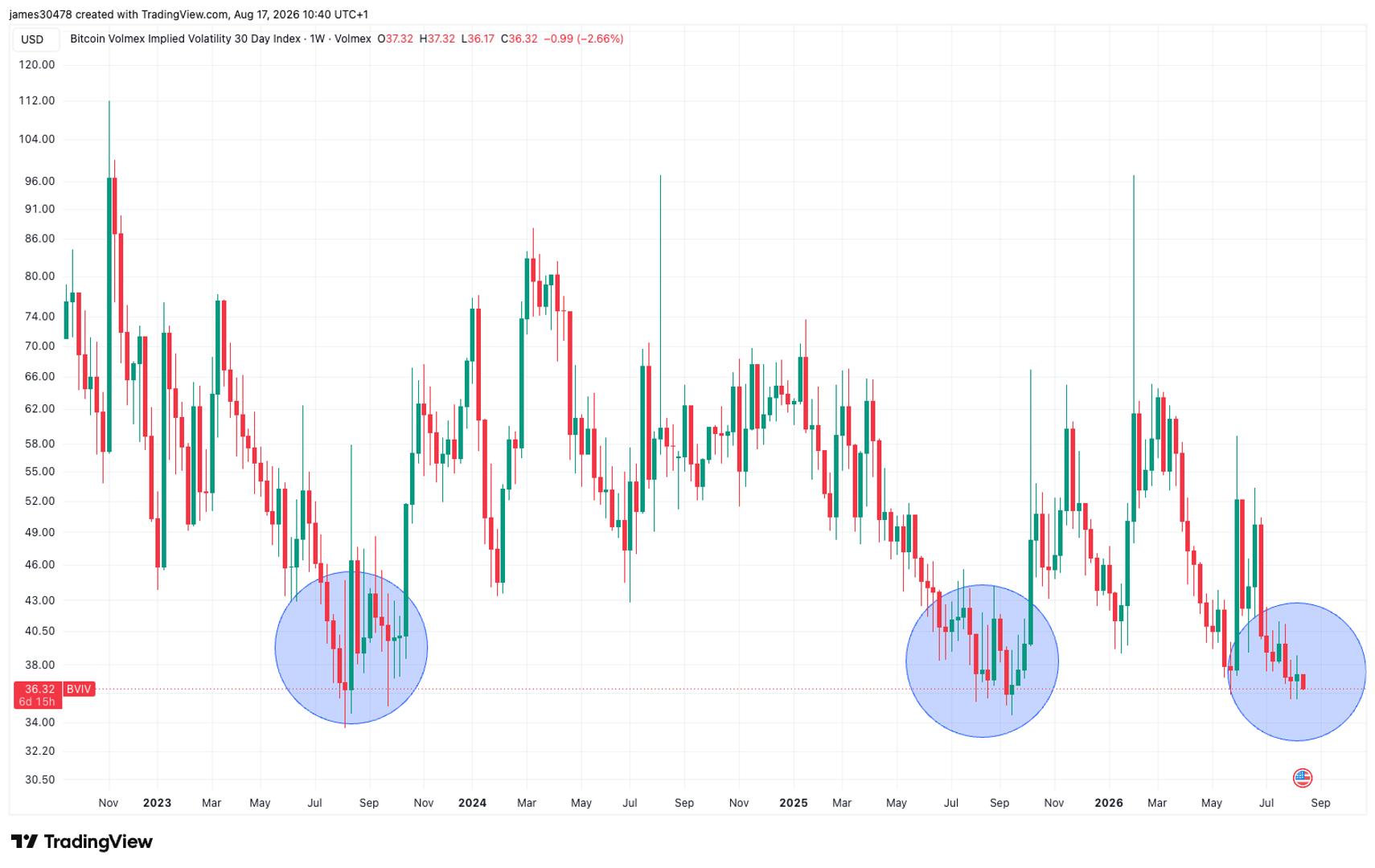
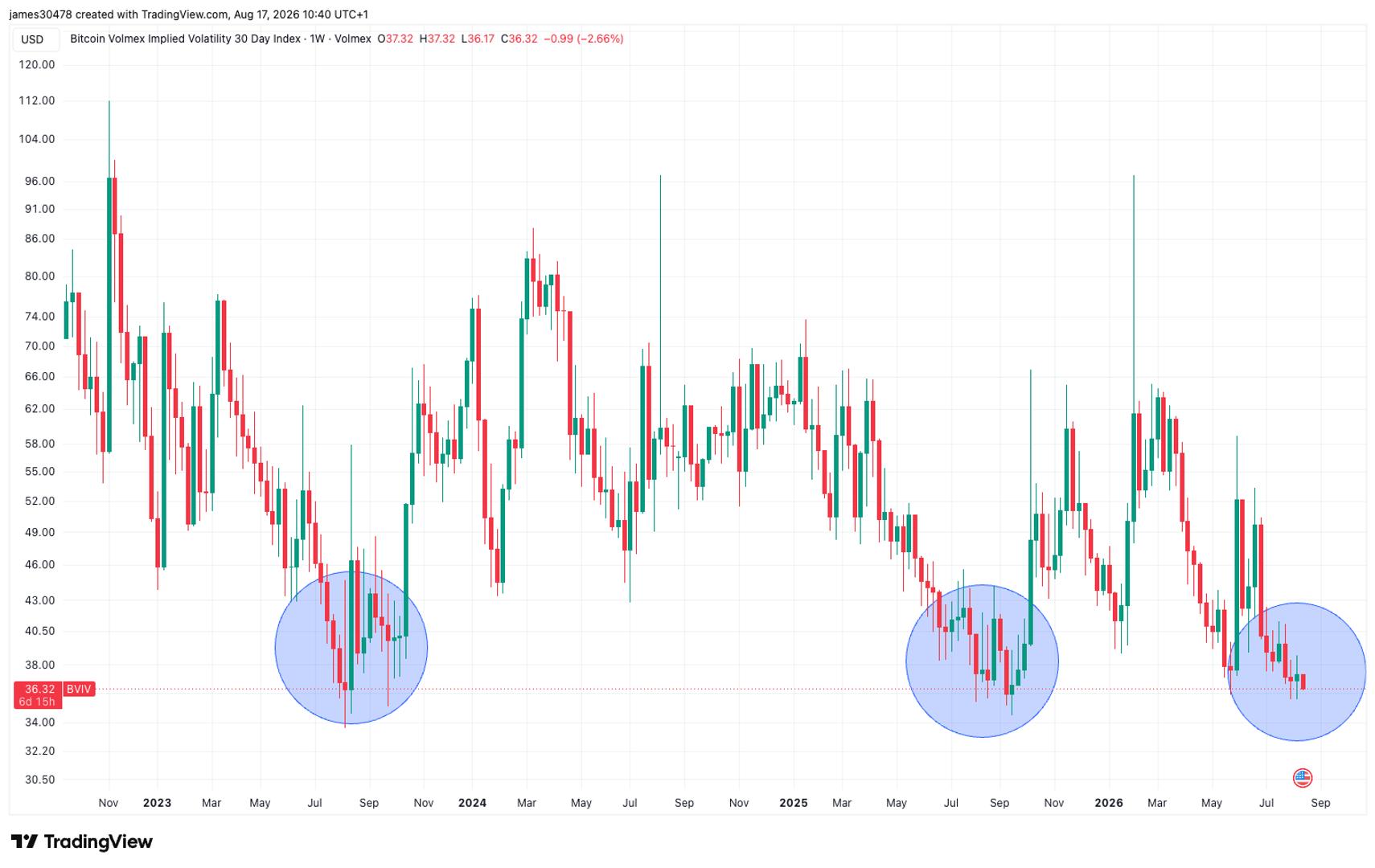
Bitcoin’s price has been eerily calm for weeks, locked in a narrow range below $65,000. Options, or derivative contracts offering insurance against wild price swings, should be cheap in a market this quiet. They aren’t.
That may sound counterintuitive, but it really isn’t, and it matters for traders considering options to hedge against, or profit from, a potential volatility boom. Volatility is mean-reverting and often spikes suddenly after a prolonged stretch of dull, range-bound trading.
It comes down to the fact that these options contracts are priced based on what the market expects to happen in the coming days or weeks, not on what has already happened recently.
The present calm is real. Bitcoin’s 30-day realized volatility, the price volatility seen over the past four weeks, has dropped to an annualized 21.80%, the lowest since October 2025. However, the forward-looking measure, the 30-day implied or expected volatility, represented by Volmex’s BVIV index, currently sits at 36%, about two-thirds higher than realized volatility.

Vernon Kay, Heather Small, Alex Bowen at Symphonic Ibiza

Beyond Snacking: How Walnuts Are Powering Innovation
Fans Thrash WNBA For Highlighting Angel Reese, Kelsey Mitchell Despite Indiana Star’s 26-Point Game


-

 Fashion3 days ago
Weekend Open Thread: Ann Taylor
-
 NewsBeat6 days ago
Communication cards help banking customers access services or report scams
-
 Business6 days ago
Oil Price Today (August 11): Crude oil rises to $88 after Trump’s compensation demand dents Hormuz opening. Here’s why
-

 Crypto World6 days ago
Revolut wins French banking licence, creates second EU banking hub
-
 Sports4 days ago
This U.S. Amateur is a glimpse into golf’s future in more ways than you think
-
 Crypto World7 days ago
Why Did Nvidia Stock Fall on Monday Despite a $500 Billion Wall Street AI Deal?
-

 Sports2 days ago
Birmingham 2026: Day 6 Timetable for Irish Athletes
-
 NewsBeat2 days ago
Myanmar says over 300,000 Rohingya refugees verified for repatriation as exodus enters ninth year
-

 Politics2 days ago
SEQ Code: The Three Letter Boarding Pass Code That Could Give You The Worst Seat
-
 Entertainment5 days ago
Keke Palmer Subtly Hints At Sean Evans Drama With Cryptic Post
-
 Crypto World7 days ago
Grayscale quietly drops Cardano, Polkadot and Hedera ETF plans
-

 Fashion7 days ago
Can You Wear Double Cloth Gauze Clothing To Your Office?
-
 Entertainment6 days ago
57 Years Later, the Best Sitcom Ever Made Still Deserves a Reboot
-

 Fashion6 days ago
Coffee Break: The Fonteyn Jane Flat
-
 Crypto World7 days ago
Hormuz Nerves Cost Bitcoin $65,000 Mark Despite Solid Institutional Flows
-

 Crypto World7 days ago
Bitcoin's BIP Editors Remove Luke Dashjr Two Days After BIP-110 Fork Stalled
-

 Tech6 days ago
Zoom Screen-Sharing Bug Let People Fully Take Over Other Devices On A Call
-

 Fashion6 days ago
Claire Life: Kicking Off MVAAFF With the C Suite Luncheon Featuring Phylicia Rashad, Letoya Luckett, and More!
-

 Fashion6 days ago
Should you refinance your debt? Pros, cons, and real numbers
-
 Crypto World5 days ago
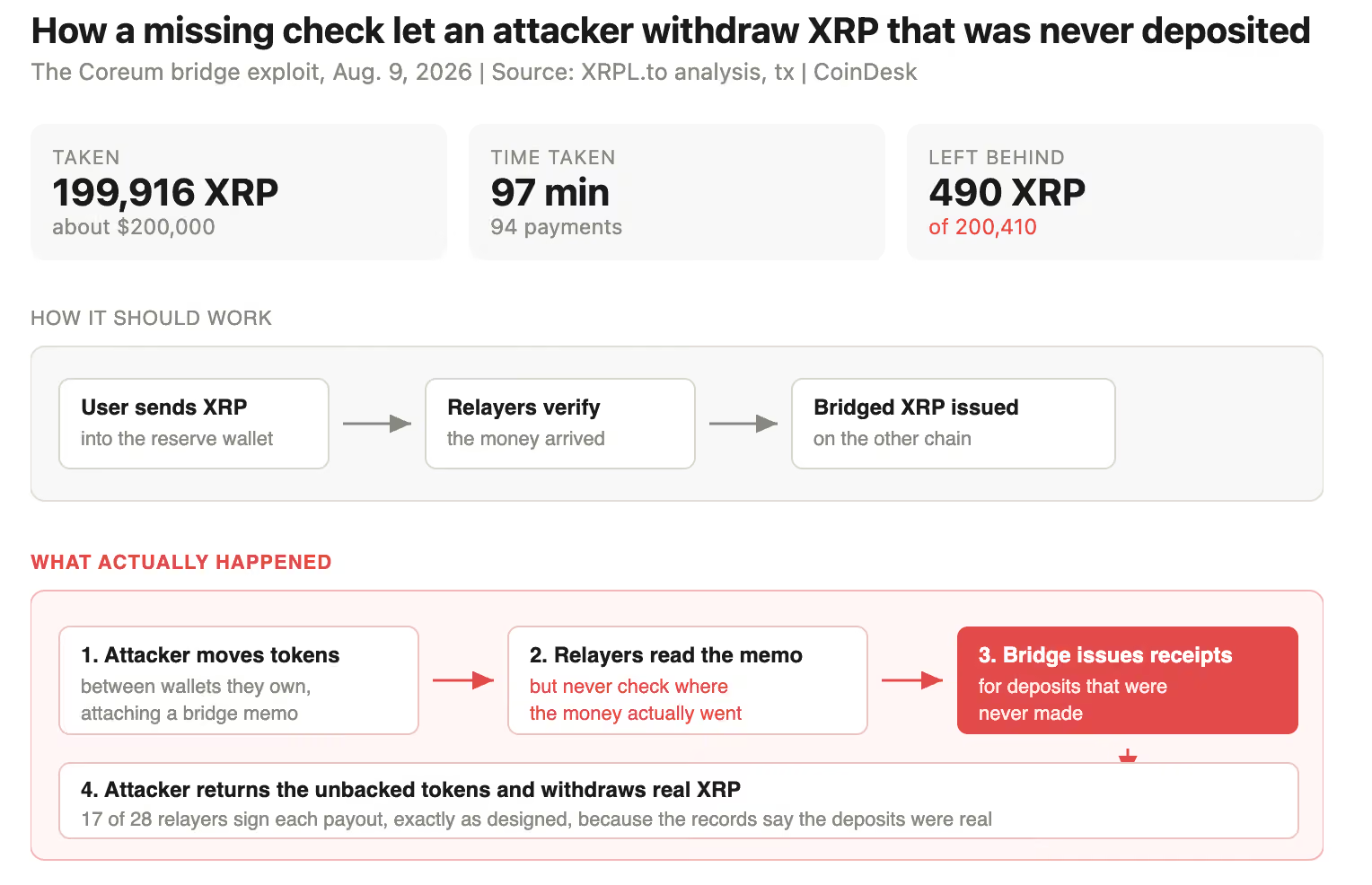
XRP bridge drained after software mistook fake deposits for real ones
You must be logged in to post a comment Login