
Crypto World
Jane Street Reports Major Position Across XRP ETF

Jane Street Group reported holding more than 1.2 million shares of Bitwise’s XRP ETF as of June 30, 2026, up from 20,605 shares three months earlier. The 60-fold increase appeared in the trading firm’s second-quarter Form 13F filed with the SEC.
The filing highlights Jane Street’s position in the XRP ETF market, but its role as a major market maker that actively trades ETFs and options means the holding should not necessarily be viewed as a simple long-term directional bet on XRP.
Jane Street’s Q2 2026 Form 13F covers holdings as of June 30. The filing reported more than 1.2 million Bitwise XRP ETF shares, compared with 20,605 ordinary shares at the end of the first quarter.

Discover: The Best Crypto to Diversify Your Portfolio
The firm also reported exposure to XRP-related funds from Franklin Templeton, Grayscale, Canary Capital, and 21Shares. That places Jane Street across several XRP ETF products rather than solely in Bitwise’s fund.
Bitwise’s product stands out because it holds spot XRP, unlike other ETFs tracking the asset. The fund launched in November, a few weeks after Canary Capital’s ETF reached Wall Street, and has since become the largest of the group discussed in the filings.
The XRP increase in reported shares is substantial, but Jane Street’s market-making and ETF and options trading activities provide important context. The source material cautions that the position should not automatically be treated as a straightforward long-term bet on XRP.

The filing establishes the firm’s reportable securities position at the June 30 cutoff. On its own, that reported position does not establish Jane Street’s investment intention or the duration for which it plans to hold the shares.
Jane Street’s reported stake nevertheless makes it a leading participant in XRP ETF adoption among the institutions cited in the filings.
Trade XRP on Bybit and Get a Chance to Win Our $1,000 USDT Airdrop
Other Institutions Reporting XRP ETF Positions
Bank of America reported 13,260 shares of the Volatility Shares XRP ETF, a position valued at about $76,000. Unlike Bitwise’s product, the Volatility Shares ETF is not a spot ETF.
Morgan Stanley reported positions in three XRP-related funds at the end of the second quarter: 6,715 shares of Franklin’s XRP ETF, 255 shares of REX-Osprey’s product, and 567 shares of Bitwise’s fund. The holdings are small relative to Morgan Stanley’s overall portfolio, but add to the list of institutions reporting regulated XRP exposure.
Other reported positions included nearly 200,000 Bitwise XRP ETF shares held by Wolverine Asset Management and 86,744 Capital XRP ETF shares reported by Gallacher Capital Management. Main Street Group and National Bank of Canada reported holding 5,261 and 3,848 XRP-related shares, respectively.
Discover: The Best Token Presales
The post Jane Street Reports Major Position Across XRP ETF appeared first on Cryptonews.


Stablecoins can move across many blockchains, but each network still introduces its own transfer requirements. A USDC balance on Solana and the same asset on Ethereum may look identical to a user while travelling through different systems.
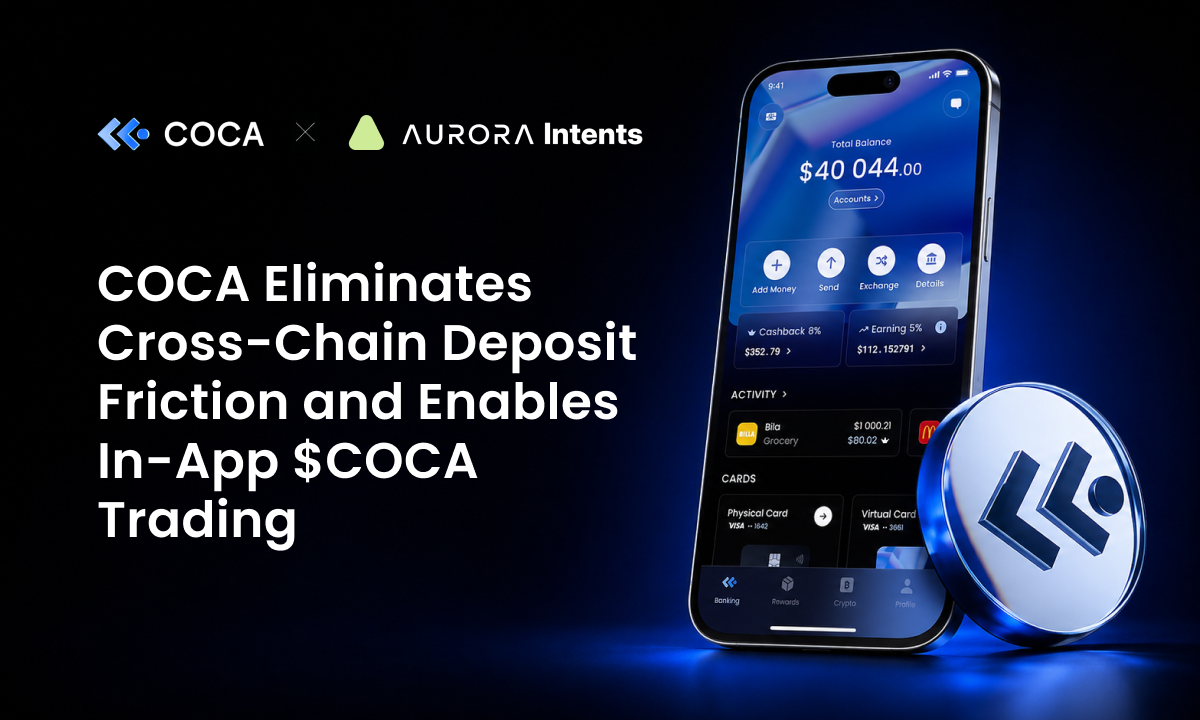
COCA has integrated Aurora Intents to reduce this complexity inside its self-custodial banking app. The update allows users to deposit supported stablecoins from more than a dozen networks through reusable addresses, while cross-chain execution happens behind the interface.
The same integration also brings $COCA trading into the app, giving users a way to buy or sell the token using their existing USD balance.
COCA Expands Stablecoin Deposit Support
COCA now accepts USDC across networks including Ethereum, Arbitrum, Base, Solana, Polygon, Optimism, Avalanche, Sui and Stellar. USDT support includes Ethereum, Tron, Solana, Polygon, Optimism, Avalanche and TON, alongside several other networks.
Aurora Intents handles the required cross-chain execution before funds appear inside COCA. The process reduces manual bridging and extra transfers between wallets or exchanges.
Crypto users often need to match the token with the correct network before sending funds. The same stablecoin can exist across several blockchains, creating an extra decision at the point of transfer.
“They want their money to arrive safely and be ready to use,” Aurora Labs CEO Declan Hannon said in the announcement, describing how users approach account funding.
COCA CEO Vasili Paulau made a similar point, saying users care about access to their money rather than the blockchain carrying it.
Cross-Chain Execution
Aurora Intents is built on NEAR Intents, a multichain transaction system based on requested outcomes.
A user or application states the intended result, while independent solvers compete to complete the transaction. Once a quote is accepted, settlement is handled through NEAR.
Inside COCA, this model applies to account funding. Users choose the asset and destination, while the required routing happens within the product.
The integration gives intent-based execution a consumer banking use case. Cross-chain systems have often focused on swaps and liquidity access, while COCA is applying the same model to deposits used before spending, saving or transferring funds.
COCA combines self-custody with a Visa card, EUR IBAN and yield on eligible balances. The company says the app is available across more than 75 countries.
$COCA Trading Moves Into the App
The update also changes how users acquire $COCA, the token used within COCA’s loyalty program.
Users previously acquired $COCA through external exchanges such as MEXC or BitMart before transferring tokens into the COCA app. In-app trading now allows users to buy or sell $COCA using their existing USD balance.
External wallet transfers remain available, giving users another route for receiving the token.
Bringing $COCA trading into the app links token access more closely with COCA’s membership system, where holdings can affect cashback tiers, APY limits and other benefits.
The change also removes several steps from a process which previously required users to leave the app, create or access an exchange account, complete a trade and send tokens back to COCA.
Chain Abstraction Reaches Consumer Finance
COCA’s Aurora Intents integration shows how consumer-facing crypto products can absorb more blockchain complexity within the app itself, reducing the amount of network knowledge required when users fund an account.
Users may care primarily about the asset, amount and destination, while intent-based execution handles routing across the relevant networks in the background. With stablecoins spreading across more blockchains, this approach gives consumer apps a way to manage cross-chain deposits while keeping the experience closer to familiar digital banking.
The post COCA Adds Cross-Chain Stablecoin Deposits Through Aurora Intents appeared first on BeInCrypto.
Sterling enters this week on a mixed footing. Last month’s Bank of England decision struck a notably hawkish tone, with the vote split 6-3 in favor of holding rates, three members pushed for a hike, a signal the Bank remains genuinely worried about inflation as Middle East-driven energy costs work through the economy. Yet political uncertainty continues to simmer following Keir Starmer’s unexpected June resignation, leaving fiscal credibility, and by extension sterling, more sensitive than usual to how Labour manages the transition.
The kiwi, meanwhile, is being propped up almost entirely by rate expectations. Markets currently price an 88% probability of an RBNZ hike in September, even after New Zealand’s unemployment rate climbed to a decade-high 5.6%. UBS argues the labor data isn’t as bearish as it looks, since the rise was driven mainly by more people entering the workforce rather than layoffs, keeping the central bank’s tightening path intact. Softer inflation expectations and a weaker July manufacturing PMI, however, have started to inject some doubt into just how far the RBNZ can realistically go.
The result: a pound navigating political noise against a kiwi riding hawkish rate bets that may be more fragile than markets currently assume.
Technical Analysis of GBP/NZD
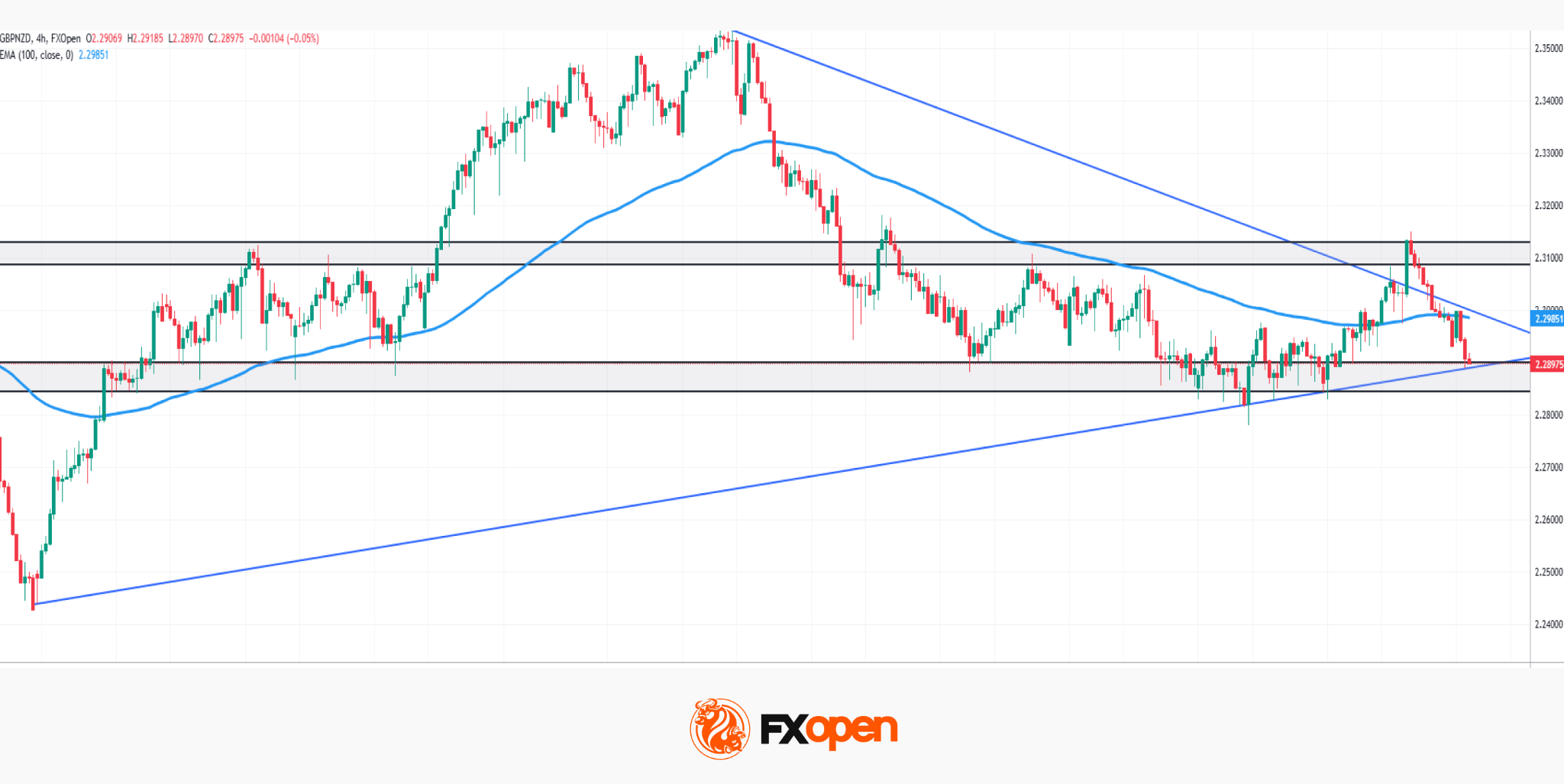
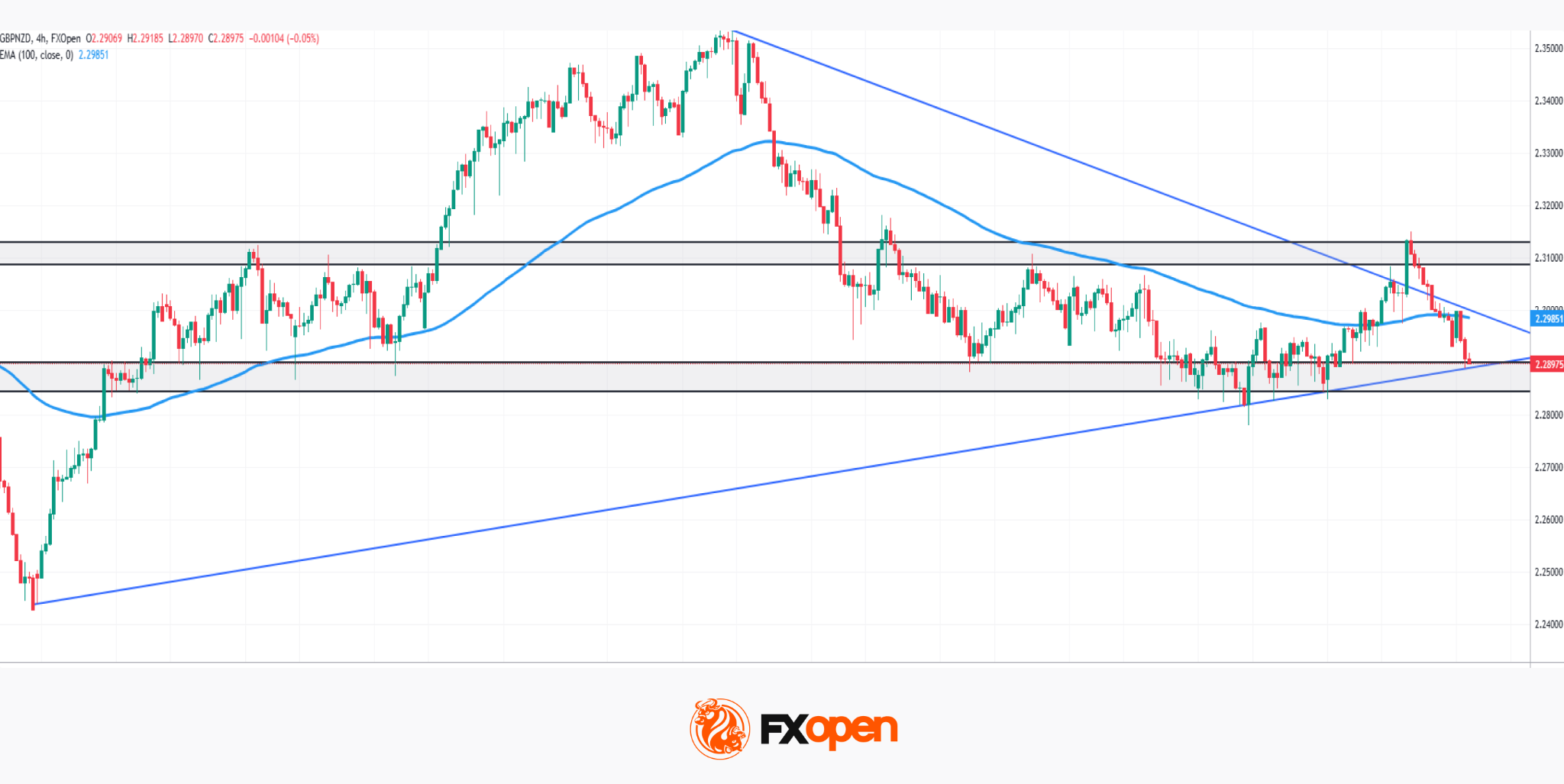
As GBP/NZD chart shows, the pair has been compressing into a broad symmetrical triangle since early June, with a descending trendline from July’s highs near 2.3550 converging with an ascending trendline off June’s lows, both meeting right around current price near 2.2900-2.2980, where the 100-period EMA also sits. This confluence, together with the well-established 2.2900-2.3100 support and resistance zone, marks a decisive juncture for the pair.
Bullish Scenario
Should buyers defend the ascending trendline and reclaim the 100-period EMA, the path would open toward the 2.3100 resistance, the upper boundary of the recent range. A confirmed break above this zone, and the descending trendline itself, would signal a genuine shift in momentum, opening the door toward a retest of the July highs near 2.3550.
Bearish Scenario
Conversely, a break below the ascending trendline and the 2.2900 support would expose the broader downtrend that has dominated since early July, with price risking a slide back toward the 2.2800 area and beyond, as the months-long descending structure reasserts itself.
With price coiled right at the apex of this triangle, sitting exactly on the 100-period EMA, GBP/NZD looks primed for a decisive move—will sterling’s political noise finally give way to the kiwi’s rate story, or does this range hold just a little longer?
Trade over 50 forex markets 24 hours a day with FXOpen. Take advantage of low commissions, deep liquidity, and spreads from 0.0 pips (additional fees may apply). Open your FXOpen account now or learn more about trading forex with FXOpen.
This article represents the opinion of the Companies operating under the FXOpen brand only. It is not to be construed as an offer, solicitation, or recommendation with respect to products and services provided by the Companies operating under the FXOpen brand, nor is it to be considered financial advice.
After a couple of sales announced in August, Michael Saylor’s NASDAQ-listed entity did not make any Bitcoin moves, but it increased its USD reserve by $150 million.
As such, its total stash remains at 840,447 BTC, currently valued at around $53.3 billion. The firm has accumulated its crypto fortune for roughly $10 billion more than the current value, and its average price is $75,385 per unit.
Strategy added $150M to its USD Reserve and repurchased $132M of $STRC, extending USD Duration to 2.8 yrs (+41 days) and tightening STRC BTC Credit to 114 bps (-4 bps). As of 8/16/26: ₿840,447 BTC Reserve; $4.8B USD Reserve. $MSTR https://t.co/kNWPowilmT
— Michael Saylor (@saylor) August 17, 2026
Aside from the growing USD reserve and extending the dividend payout duration to 2.8 years, the company said it has repurchased over $130 million worth of STRC.
STRC ended last week at around $95, as it continues to recover from its dip to $75. However, it’s still inches away from its par price of $100.
The good news for the cryptocurrency community this week is that the largest corporate holder of BTC didn’t sell any, unlike the previous week when it offloaded 1,690 units.
Meanwhile, Strategy CEO Phong Le indicated last week that the company still plans to resume its Bitcoin purchases soon, and it could start by the end of the year.
The post Strategy Stays Put on Bitcoin but Sells a Massive 3.46 Million Shares appeared first on CryptoPotato.


Tudor Investment has increased its BlackRock Bitcoin ETF stake by 18.9% in the second quarter, ending a year-long run of reductions while cutting most of its reported call-option exposure to the fund.
Summary
- Tudor Investment increased its BlackRock Bitcoin ETF stake by 18.9% in the second quarter.
- The hedge fund added 109,446 IBIT shares, taking its total holding to 688,529 shares worth about $22.9 million.
- Tudor cut its reported IBIT call options by about 85% while its put position remained roughly unchanged.
- The purchase ended a year-long run of reductions from Tudor’s late 2024 peak of more than 8 million IBIT shares.
The Securities and Exchange Commission filing submitted on Aug. 14 showed that the macro hedge fund founded by billionaire Paul Tudor Jones held 688,529 shares of BlackRock’s iShares Bitcoin Trust, or IBIT, as of June 30, up from 579,083 shares at the end of March.
Tudor added 109,446 shares during the quarter, taking the reported value of the position to about $22.9 million. The purchase reversed the direction of its IBIT holdings after the firm spent much of 2025 reducing a position that had once exceeded 8 million shares.
At the end of 2024, Tudor held more than 8 million IBIT shares worth roughly $427 million. Successive reductions through 2025 left the latest share count more than 90% below that peak, meaning the second-quarter purchase recovered only a small part of the exposure previously sold.
The position is also limited compared with the size of Tudor’s portfolio. The firm manages more than $100 billion in assets, while the $22.9 million IBIT stake represented only a fraction of its reported securities holdings at the end of June.
Tudor Investment increased shares while cutting IBIT calls
Alongside the purchase of direct shares, Tudor substantially reduced the call options it reported against BlackRock’s Bitcoin fund.
Its IBIT call position fell by about 85% during the quarter, dropping to the equivalent of 148,000 underlying shares from 998,000 at the end of March. The firm’s reported put exposure remained roughly unchanged.
The filing establishes Tudor’s positions at June 30 but does not disclose the strike prices or expiry dates for the options. It also does not show whether the reduction resulted from sales, expirations or another change in the firm’s strategy, limiting what can be inferred from the lower call position.
Form 13F itself provides only a quarter-end snapshot of certain U.S.-listed securities held by institutional investment managers. Filers generally have up to 45 days after a quarter ends to submit the report, while short positions and many other forms of exposure are not disclosed.
As previously explained by crypto.news in June, 13F reports can show long positions in listed crypto investment products but not directly held cryptocurrencies, complete hedges, cost bases or trades that were opened and closed within the reporting quarter.
Tudor’s filing therefore confirms that its direct IBIT share count increased between the March 31 and June 30 reporting dates, while providing only a partial view of the hedge fund’s total Bitcoin-related exposure.
Other institutions also added BlackRock Bitcoin ETF shares
Tudor’s purchase was disclosed during a busy round of second-quarter institutional filings involving BlackRock’s Bitcoin product.
Morgan Stanley reported on Aug. 14 that it had increased its IBIT stake by 23% during the second quarter, taking its position to about 16.5 million shares from roughly 13.4 million at the end of March.
The bank added approximately 3.04 million shares, although the reported value of the holding fell from about $667 million to $549 million as Bitcoin prices declined during the quarter. Morgan Stanley also disclosed 2.57 million shares of its own Bitcoin Trust, valued at about $43.3 million, after the fund began trading in April.
UBS likewise reported a larger position in BlackRock’s fund. An Aug. 13 SEC filing showed the Swiss bank held about 2.5 million IBIT shares valued at nearly $90 million at June 30, compared with about 549,000 shares at the end of 2025.
The change represented an increase of roughly 355% in its share count over six months, according to the UBS filing coverage published Aug. 13. Like other 13F reports, however, the filing does not determine whether all of the reported shares represented proprietary investments or assets held for clients.
Not every large holder increased its allocation. Harvard Management Company kept its 3.04 million IBIT shares unchanged during the second quarter, ending two consecutive quarters of reductions.
Harvard previously held 6.81 million shares at the end of September 2025 before cutting the position to 5.35 million in the fourth quarter and then reducing it by another 2.31 million shares during the first quarter of 2026. Its remaining position was valued at about $101.4 million at June 30.
The same second-quarter holdings report showed that Abu Dhabi investment entities Mubadala Investment Company and Abu Dhabi Investment Council also left their IBIT share counts unchanged. Mubadala held 14.72 million shares worth about $490.1 million, while the council reported 8.22 million shares valued at approximately $273.6 million.
Paul Tudor Jones has backed Bitcoin as an inflation hedge
Tudor’s renewed purchase follows several years of public support for Bitcoin from Jones, who first laid out his investment case for the asset in 2020.
Jones initially presented Bitcoin as protection against monetary expansion and inflation, later continuing to discuss it alongside gold and other scarce assets. His position focused in part on Bitcoin’s fixed supply and the potential loss of purchasing power in traditional currencies.
During a June 2025 Bloomberg interview, Jones said Bitcoin, gold and equities could form part of a portfolio designed to protect against inflation, with allocations adjusted to account for Bitcoin’s higher volatility.
At the time, he argued that policymakers dealing with large debt burdens could seek to keep real interest rates below inflation. Jones said assets such as Bitcoin and gold would become important stores of value under those conditions.
Jones had earlier discussed allocating roughly 1% to 2% of a portfolio to Bitcoin but did not provide a new percentage during the 2025 interview.
The hedge fund manager also maintained a positive view of Bitcoin during an earlier period of regulatory pressure in the United States. In May 2023, he said he intended to retain a small allocation to the cryptocurrency while citing its fixed supply as part of its investment case.
Bitcoin ETF inflows returned ahead of Tudor filing
Tudor’s quarter-end position was disclosed after U.S. spot Bitcoin ETFs recorded another period of net inflows in early August.
The funds attracted about $853.5 million over five consecutive trading days from Aug. 3 through Aug. 7, according to SoSoValue data cited in an Aug. 8 report. BlackRock’s IBIT accounted for about $694 million of the total.
The five-day inflow streak began with $170.1 million in combined net inflows on Aug. 3, followed by $211.5 million on Aug. 4 and $244.4 million on Aug. 5. The products then received about $128.8 million on Aug. 6 and $98.85 million on Aug. 7.
BlackRock’s fund had already recorded a $209.4 million single-day inflow on July 7 as total U.S. spot Bitcoin ETF inflows reached $265.7 million for the session. Fidelity’s FBTC, Bitwise’s BITB, ARK 21Shares’ ARKB and Grayscale’s Bitcoin Mini Trust also received net inflows that day, while Grayscale’s GBTC posted withdrawals.
BlackRock describes IBIT as a product designed to provide exposure to Bitcoin while reducing the custody and operational requirements involved in holding the cryptocurrency directly. The fund carried a 0.25% sponsor fee and reported a net asset value of $35.58 per share as of Aug. 14.
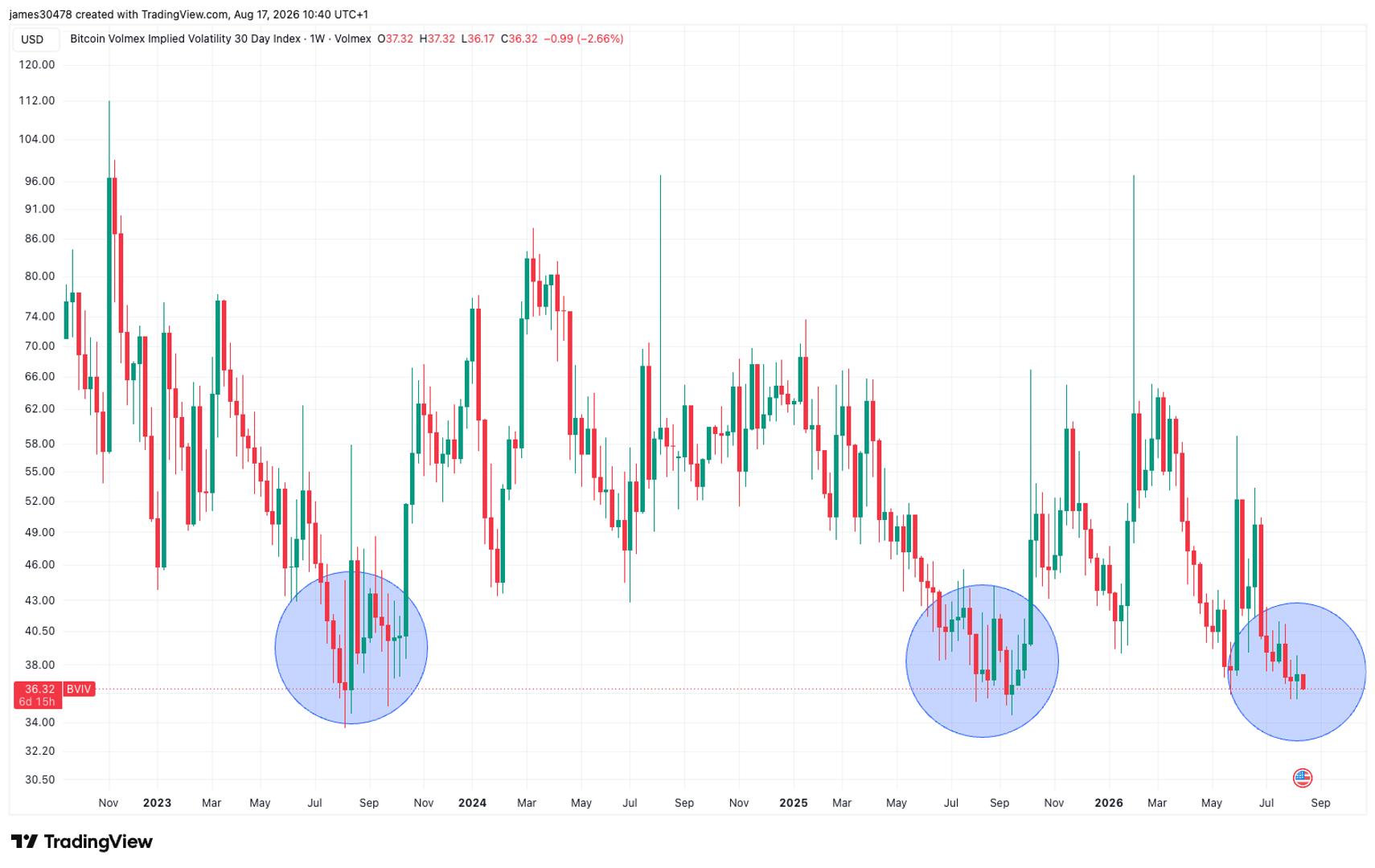
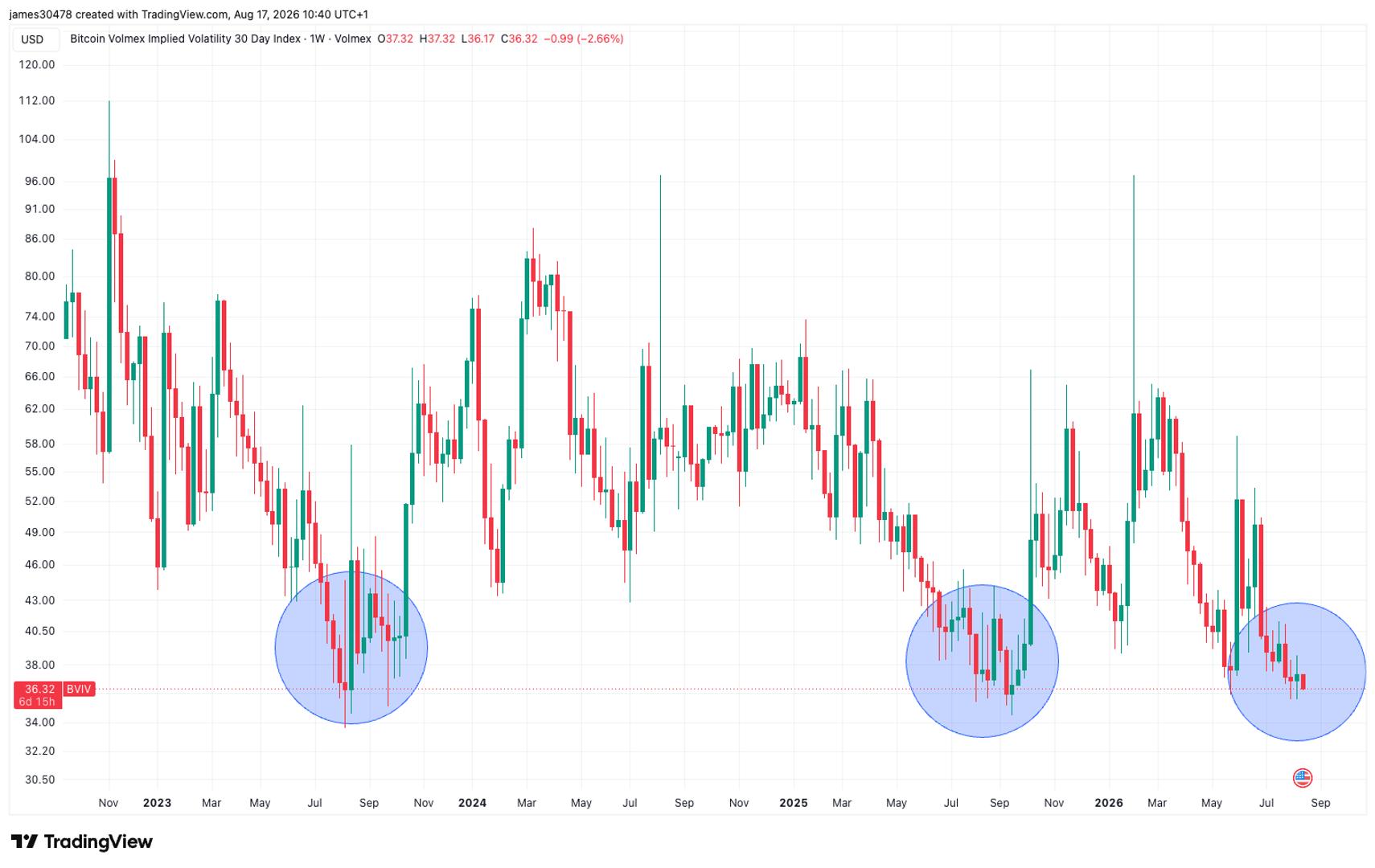
Bitcoin’s price has been eerily calm for weeks, locked in a narrow range below $65,000. Options, or derivative contracts offering insurance against wild price swings, should be cheap in a market this quiet. They aren’t.
That may sound counterintuitive, but it really isn’t, and it matters for traders considering options to hedge against, or profit from, a potential volatility boom. Volatility is mean-reverting and often spikes suddenly after a prolonged stretch of dull, range-bound trading.
It comes down to the fact that these options contracts are priced based on what the market expects to happen in the coming days or weeks, not on what has already happened recently.
The present calm is real. Bitcoin’s 30-day realized volatility, the price volatility seen over the past four weeks, has dropped to an annualized 21.80%, the lowest since October 2025. However, the forward-looking measure, the 30-day implied or expected volatility, represented by Volmex’s BVIV index, currently sits at 36%, about two-thirds higher than realized volatility.
Every crypto app needs data. Very few need the same data.
A portfolio tracker asks what an address holds. A DeFi dashboard asks what a protocol holds. A trading terminal asks what a token trades at right now. Those are three different products.
Picking by brand name is how teams end up paying twice. Picking by question is how they stop.
This guide covers five crypto data APIs. Each one answers a different question well. CoinStats Crypto API leads on wallet, market and DeFi data. DefiLlama covers protocol economics. Codex handles real-time DEX and prediction market data. Glassnode measures the network. Blockscout returns the raw record, decoded.
Our guide to choosing the right crypto API also covers swaps and nodes. This one stays in the data lane.
Not All Crypto Data Is the Same Data
Five kinds of question sit behind the word “data”. Each has its own providers.
Portfolio data answers questions about an address. Balances, positions and value, already priced.
Protocol data answers questions about a protocol. Total value locked, fees, revenue and yields.
Market data answers what something trades at. Prices, candles, liquidity and holder flows.
Network data answers what participants are doing together. Supply distribution, cost basis and exchange flows.
Record data answers what actually happened. Decoded transactions, event logs and verified contract code.
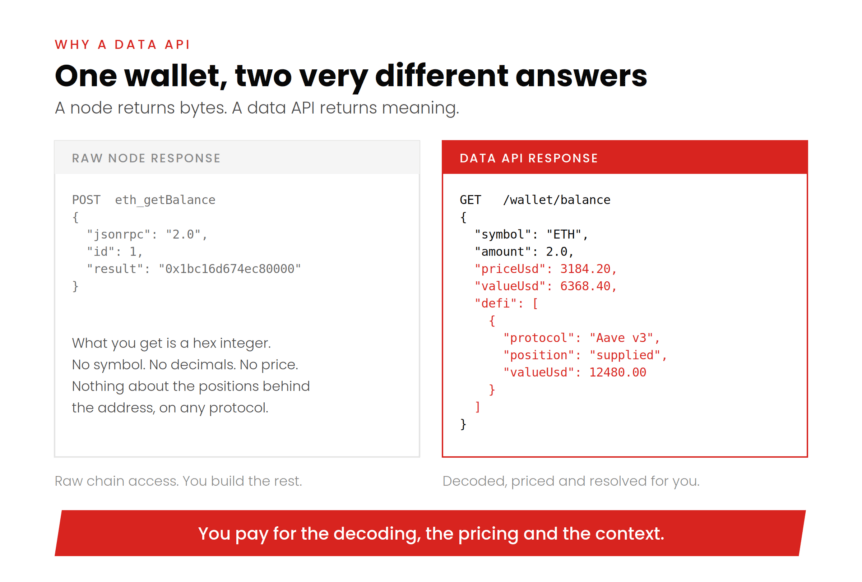
A node gives you none of this. It gives you bytes. This primer on how a blockchain API works explains the gap.
1. CoinStats API (Best Overall)
One API for Markets, Wallets, DeFi and Portfolio Data
CoinStats Crypto API is a unified data layer for developers. It combines market data, wallet data, DeFi positions and portfolio analytics. Token security screening sits in the same schema. Coverage spans 100,000+ coins, 200+ exchanges and 120+ blockchains.
Wallet endpoints return balances and transactions across Ethereum, Solana, EVM chains and Bitcoin. Bitcoin support includes extended public keys (xpub, ypub, zpub). DeFi positions resolve per wallet across 10,000+ protocols. That covers staking, lending and liquidity tied to one address.
Token risk checks flag honeypots, hidden fees, blacklists and unrenounced ownership. Those checks run on EVM chains.
CoinStats API also ships an MCP Server for AI agents. It exposes wallet, DeFi and portfolio data to LLMs. Agents in Claude, Cursor and VS Code query it directly. That portfolio layer is the real differentiator. This best crypto API guide breaks down the endpoints.
Pros
- Market, wallet, DeFi, portfolio and token security in one API
- 120+ blockchains and 100,000+ coins under one key
- Per-wallet DeFi resolution across 10,000+ protocols
- Bitcoin xpub, ypub and zpub support
- Native MCP Server for AI and LLM workflows
- Free tier with credit-based pricing
Cons
- Read-only data layer, so no transaction submission
- REST-first, with no streaming for live event data
Best Use Cases
- Multi-chain portfolio trackers
- DeFi dashboards across staking, lending and LP
- Crypto tax and accounting tools
- AI agents that query data through MCP
- Wallet explorers and embedded widgets
Pricing
Pricing is credit-based with a free tier at signup. Paid plans start at $49 per month. Credits scale with endpoint complexity.
Best suited for: most data-driven builds, from portfolio trackers to AI agents.
Limitation: CoinStats API is a data layer, not a node provider. To broadcast transactions, pair it with RPC infrastructure.
2. DefiLlama
Free Protocol Economics Across Thousands of Protocols
DefiLlama tracks the economics of DeFi itself. It publishes total value locked, fees, revenue, yields and stablecoin supply. Coverage runs across hundreds of chains and thousands of protocols. The methodology is open source, so anyone can audit a number.
The open plan is genuinely free and needs no key. It returns TVL, revenue and fee data plus token prices. Most TVL figures quoted elsewhere trace back to it.
A developer API plan runs $300 per month. It allows 1,000 requests per minute and 1 million calls monthly. Extra calls cost $0.60 per thousand after that. A separate $49 Pro plan covers dashboards rather than API access.
DefiLlama also ships an MCP server plus installable agent skills. Each agent query costs one credit from the same API pool.
Best suited for: yield tools, DeFi dashboards and protocol research.
Limitation: DefiLlama works at protocol level, not wallet level. For per-address positions, pair it with CoinStats API.
3. Codex
Real-Time DEX Data and Prediction Markets in One Schema
Codex is an enriched blockchain data API with two pillars. Do not confuse it with the coding tool of the same name. The first pillar is tokens: real-time prices, OHLCV charts, holder analytics and balances. The second is prediction markets across Polymarket and Kalshi, now at record volume.
Odds, volume, trending events and order books share a single schema. Coverage reaches 70M+ tokens, 700M+ wallets and 80+ networks.
Access runs on GraphQL with WebSocket subscriptions and webhooks. Data freshness sits near one second. TradingView, Coinbase, Uniswap and pump.fun all build on it. A TypeScript SDK, an MCP server and agentic payments cover AI workflows.
The free tier allows 10,000 requests per month with full query access. Growth plans start at $350 per month.
Best suited for: trading terminals, token discovery and prediction market apps.
Limitation: Codex reads onchain markets, not exchange balances or DeFi positions. Pair it with a portfolio layer.
4. Glassnode
Network-Level Metrics for Research Teams
Glassnode measures what a whole network is doing. Its catalogue covers supply distribution, cost basis, profitability and exchange flows. Entity-adjusted metrics strip out transfers between wallets with one owner. That single correction changes most raw onchain numbers.
Coverage spans 1,500+ assets and onchain data from 11 blockchains. The Advanced plan costs $49 per month. It includes 300+ metrics at daily resolution plus API Light access. Professional adds longer history, 10-minute resolution and a credit-based API add-on.
Glassnode ships an MCP server, a CLI and an Excel add-in. Agents can also pay per call in USDC on Base. Metric calls cost five cents with no account required.
Point-in-time metrics never get revised, which keeps backtests honest. That pay-per-call route is new, and it suits research agents well.
Best suited for: research desks, market dashboards and macro-style analysis.
Limitation: Glassnode has no free plan and reads networks, not wallets.
5. Blockscout
Open-Source Explorer Data With a Real Free Tier
Blockscout is the open-source block explorer, exposed as an API. It returns decoded transactions, balances, event logs and verified contract ABIs. One key covers 120+ chains on every plan, free included. Endpoints follow the Etherscan V2 shape, so migrating is mostly a URL swap.
The free plan gives 100,000 credits per day at five requests per second. Builder costs $49 per month for 100 million credits. Pro costs $199 per month at 30 requests per second. Most standard calls spend 20 credits each. Keys come from the developer portal with no card required.
An MCP server runs on the same backend, alongside installable agent skills. The explorer stays open source, so any chain can self-host it. Teams debugging contracts get the same data their users see. Response headers return remaining credits on every call.
Best suited for: wallets, debugging tools and contract-level analytics.
Limitation: Blockscout returns chain records, not aggregated market data.
Side-by-Side Comparison
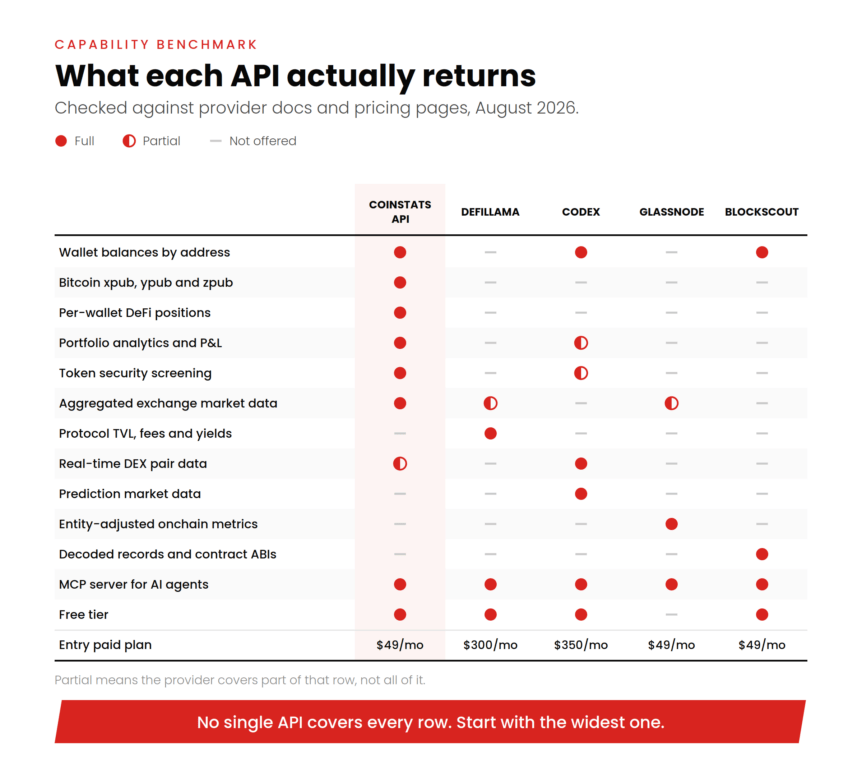
| CoinStats API | DefiLlama | Codex | Glassnode | Blockscout | |
| Primary layer | Market, wallet, DeFi and portfolio | Protocol economics | Real-time DEX and prediction markets | Network metrics | Explorer records |
| Core question | What does this wallet hold? | What is locked in this protocol? | What is this token worth now? | What is the network doing? | What happened in this transaction? |
| Coverage | 100,000+ coins, 120+ chains | Hundreds of chains | 70M+ tokens, 80+ networks | 1,500+ assets, 11 chains | 120+ chains |
| Wallet data | Yes, with DeFi and P&L | No | Balances only | No | Balances and history |
| AI / MCP | Native MCP Server | MCP server and skills | MCP and agent payments | MCP, CLI and pay-per-call | MCP and agent skills |
| Free tier | Yes, credit-based | Yes, open API | Yes, 10,000 calls | No | Yes, 100,000 credits daily |
| Entry paid plan | $49/mo | $300/mo | $350/mo | $49/mo | $49/mo |
| Best for | Most data-driven builds | DeFi research | Trading and discovery | Market research | Contract-level work |
What You Can Build
Portfolio trackers and wallet apps. CoinStats API returns holdings, prices and DeFi positions in one call.
Yield and treasury dashboards. DefiLlama supplies pool APYs, protocol fees and stablecoin supply.
Trading terminals and token screeners. Codex streams live pair data across 80+ networks.
Prediction market products. Codex normalises Polymarket and Kalshi into one schema.
Research and market reports. Glassnode supplies cost basis, supply and flow metrics.
Contract debuggers and audit tools. Blockscout decodes transactions and serves verified ABIs.
AI financial assistants. Every provider here now ships an MCP server for agents.
One Provider or Several?
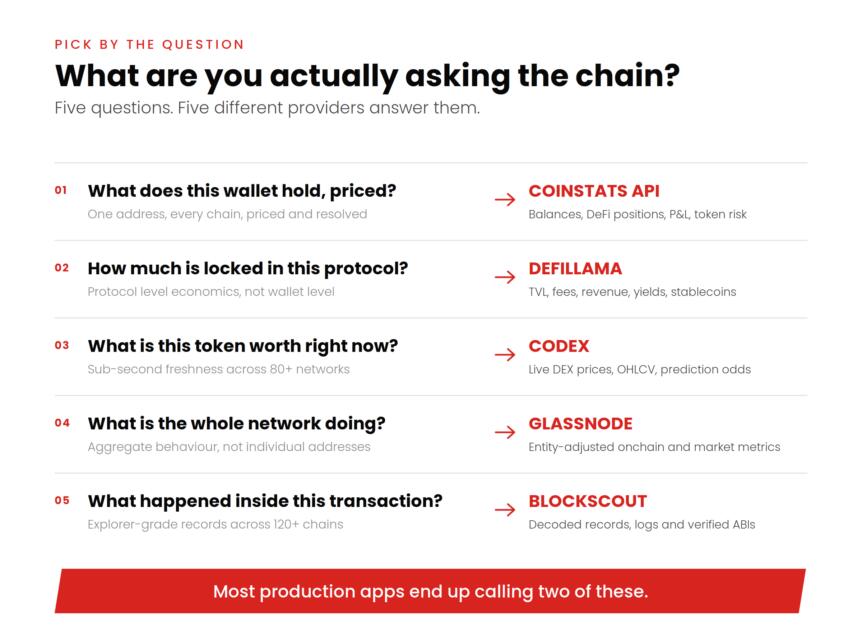
Most production teams do not run on a single API. They layer by question.
Start with CoinStats API for wallet, market, DeFi and portfolio data. Add DefiLlama when you need protocol economics behind those positions. Add Codex when live DEX pricing or prediction markets matter. Layer in Glassnode when the question turns to whole-network behaviour. Reach for Blockscout when you need the decoded record itself.
Two providers cover most products. Three is common at scale. Developers publish their own comparisons too. This hands-on developer comparison is worth a read.
Wrapping Up
There is no single best crypto data API. There is only the right answer to your question.
CoinStats API is the broadest starting point for application data. It suits most crypto use cases, from trackers to AI agents. DefiLlama owns protocol economics and stays free. Codex owns real-time DEX and prediction market data. Glassnode owns network-level research. Blockscout owns the decoded record.
Four of the five start free. Test the free tiers with real calls before you commit.


Bitcoin continues to trade in a narrow price band, and two of its biggest corporate believers aren’t blinking.
Simon Gerovich, CEO of Metaplanet, and Michael Saylor, executive chairman of Strategy, two of the cryptocurrency’s biggest corporate holders, have doubled down on their argument that BTC’s maximum issuance of 21 million coins beats infinite money printing, whatever the price is doing this week.
On Sunday, Gerovich noted that the global M2 money supply has reached an all-time high of over $100 trillion, calling it a bullish long-term tailwind for the cryptocurrency.
“Bitcoin’s price has decoupled from liquidity over the past year. But supply schedules don’t change,” Gerovich said. “21 million will always be 21 million. When the money supply expands forever, you hold the asset that can’t. That’s why we hold hard money.”
Bitcoin’s price has decoupled from broader liquidity expansion over the past year. Even as M2 money supply swelled, BTC has nearly halved to $63,500. The divergence is consistent with previous market cycles, in which bearish trends bitcoin’s price temporarily detached from rising macroeconomic liquidity.
Saylor voiced a similar opinion in a different framing. He said that understanding bitcoin requires first understanding money itself.
XRP’s fight to hold $1 has come with a side effect: a swirl of derivatives numbers that do not agree with each other.
Open interest figures, long-short ratios, and taker volume splits have all been circulating this week, and Bird, a builder on the XRP Ledger, spent a long post untangling why none of them measure the same thing.
Breaking Down the Real Numbers
Bird’s starting point was open interest, the total value of futures contracts still open across exchanges. CoinGlass puts XRP’s OI at roughly $2.7 billion, while other trackers have shown figures closer to $866 million to $1 billion. The gap comes down to which exchanges and contract types each platform counts, not a disagreement about the market itself.
The more confusing part was long-short positioning. Roughly 75% of accounts trading XRP are currently long, with 25% short, but that does not mean $2 billion sits on the long side. Every futures contract pairs a long against a short, so the dollar amounts stay matched no matter how the accounts split.
Bird’s example: three traders long $100 each add up to $300, against one trader short $300. Three-quarters of the accounts are long, yet the exposure on both sides is identical.
Then there is taker buy and sell volume, a separate measure of how aggressively people have been trading in the last 24 hours rather than what positions they are holding. That figure has run close to 45% buy and 55% sell, which lines up with the selling pressure that has kept XRP pinned near $1.
The confusion was not just online noise. Trader ChartNerd had originally posted a long-short split of 51.5% to 48.5%, describing it as roughly balanced with a slight long tilt. Bird asked where those numbers came from, since they did not match the taker data circulating elsewhere. ChartNerd redid the math and landed on $304 million in 24-hour long volume against $375 million short, admitting, “Thanks bro, my math was well off.”
The actual XRP setup right now, as Bird pointed out, is an OI of $2.7 billion, accounts split roughly three to one in favor of longs, notional exposure balanced on both sides regardless of that split, and recent trading volume leaning about 55% toward sellers, all while XRP keeps fighting to hold $1.
Why Leverage Matters
The stakes come down to what happens if $1 gives way. A break lower could force liquidations among leveraged longs, adding selling pressure on top of an already weak market. A bounce, on the other hand, could squeeze short positions into buying back. Bird summed up the standoff simply: “Longs are getting crowded, but so are shorts!”
Data from Binance adds weight to the setup. Open interest there climbed about 28.6% over two weeks to $232.7 million by August 17, even as perpetual CVD slid to negative $463 million, a sign that fresh short positions are being added rather than old longs closing out. Spot flow has told a similar story, swinging from positive $153 million to negative $231.8 million over the same stretch.
None of this has scared off every institution. Morgan Stanley’s latest 13F filing showed continuous exposure to XRP through Franklin, REX-Osprey, and Bitwise ETFs, alongside a stake in Armada Acquisition Corp II, tied to Ripple-backed Evernorth Holdings.
The post XRP Longs vs. Shorts: The Numbers Behind the $1 Battle Aren’t What They Seem appeared first on CryptoPotato.
As an AI-fueled supply squeeze grips copper, Freeport-McMoRan (FCX) is emerging as the standout among copper stocks.
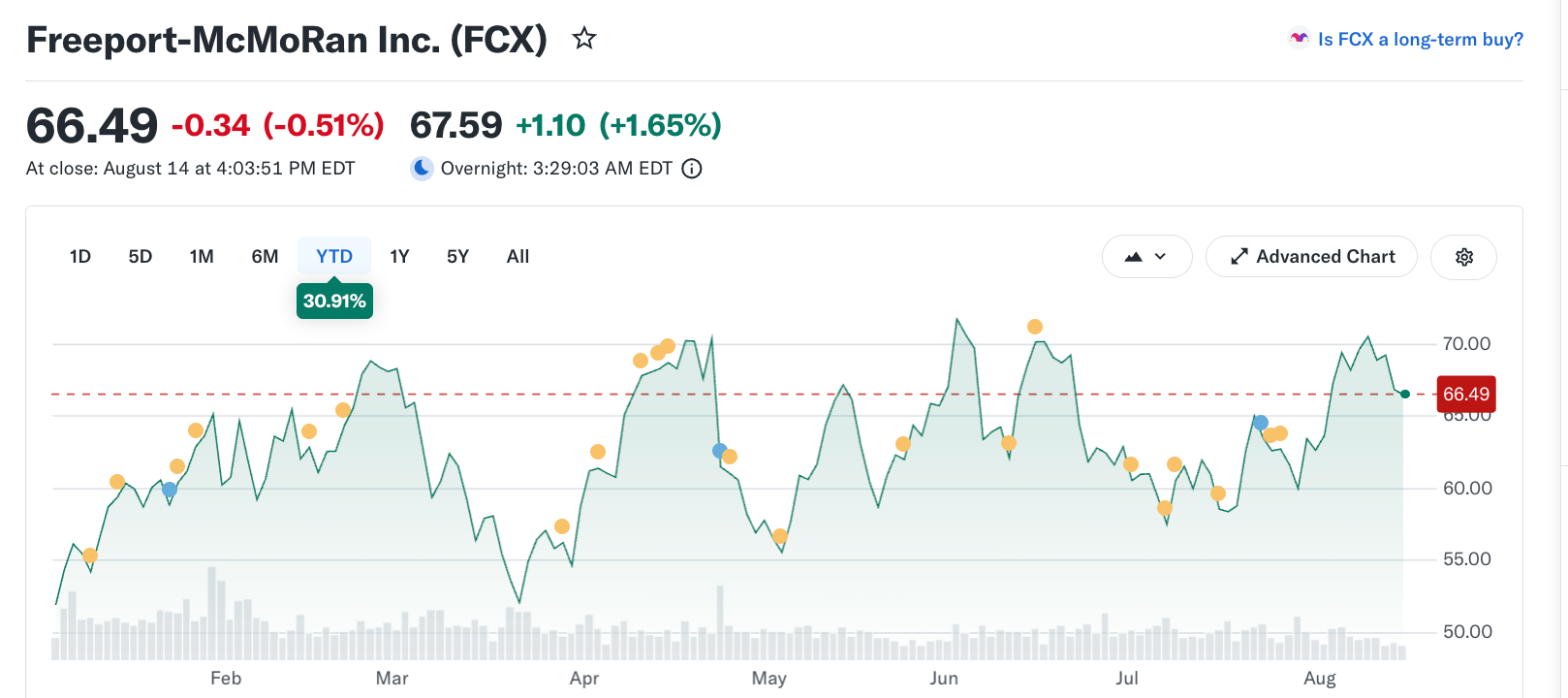
The largest US copper miner trades near $66.50 after a sharp year-to-date run, its chart is showing a bullish continuation pattern that points toward $87, and Wall Street still rates it a Strong Buy. Behind the setup sits a simple idea, that the AI boom needs far more copper than the market can supply.

What Is Driving the Squeeze?
The squeeze is severe and current. Copper hit an all-time high on COMEX on August 12, while the London Metal Exchange front-month spread blew out to a $370-a-ton premium, the widest since 2021, with inventories down for 42 straight days.
The demand side is where AI enters. A single one-gigawatt AI data center needs roughly 50,000 tonnes of copper, and the power grid built to feed the AI data center boom needs even more, which is why data centers alone are projected to add hundreds of thousands of tonnes of fresh demand a year.
Want more insights like this? Sign up for Editor Harsh Notariya’s Daily Newsletter here.
S&P Global and the International Copper Study Group both name AI and electrification as the force pushing the market into a structural deficit, and the same rising copper demand is spilling into digital-asset markets too. The near-term spike also owes to US tariffs and Chinese smelter cuts, so copper is tight now for tactical reasons and getting tighter for a strategic one. That strategic driver is AI, and the producers who own the supply are positioned to gain.
Why Freeport Leads the Copper Stocks
Among copper stocks, Freeport is the purest large-cap way to own that supply. It is the biggest US copper producer, and its first-half net income rose 65% year over year, driven by its US mines, as copper firmed.
Miners also carry operating leverage, which means a 10% rise in copper can lift profits far more, because mining costs stay largely fixed while revenue climbs. That is why a metal squeeze tends to reward the digger more than the tech giant that has to buy the metal.
What Do Analysts Say About Freeport Stock?
Wall Street is firmly onside. TipRanks data shows a Strong Buy, built on 10 Buy and 3 Hold ratings with no Sells, and an average 12-month target of $75.33, about 13% above the current price, with a high call of $82.

The recent moves lean bullish, with Barclays lifting its target to $82 and Stifel to $80 in late July. JPMorgan’s Bill Peterson, a top-ranked analyst with a strong track record on the stock, keeps a Buy at $77. Big money is positioning too. The copper-miner ETF COPX has quadrupled in assets in six months on heavy inflows, a sign funds are crowding into the group.
Is Money Rotating From Big Tech to Miners?
This is the part that makes the timing interesting. On August 4, copper rallied on Chinese demand and supply fears. Additionally, the copper ETF CPER rose about 1.3%. Yet, the miners ran far harder. Southern Copper jumped 4.98% and Freeport gained 5.75% that day.

The crowded side of the market, meanwhile, has started to cool. After leading the market all year, semiconductors have begun pulling back from their highs. The leader, Nvidia, was seen flashing bearish chart signals and was even overtaken by AMD on money flow. Also, on August 14 the chip names led the market lower with Broadcom off more than 5%.
A simple BeInCrypto proprietary gauge of copper miners against big tech makes the turn visible. It bottomed in mid-July, then crossed above its trend line and has held a rotation-into-miners signal through August.

On the panel, green up-arrows mark each flip into the miners and red down-arrows each flip back to tech, and after months of red-tinted chop the signal has stayed green, right as the copper squeeze intensified.

Freeport has moved in step, climbing more than 10% over the past month. In comparison, Copper Futures have just gained a modest 6%.
What Does Freeport’s Chart Say?
The technical setup backs the story. Freeport ran about 27% from its July 17 low to a peak on August 10. It then drifted into a tight, falling consolidation. The selling volume has been fading now, which resembles the classic conditions of a bull flag and pole.

A daily close above $68 would confirm the breakout and, on the measured move, project the roughly 27% pole toward $87. The floor is $65, and a slip below $63 would break the flag and cool the setup toward $58.

Analyst’s View: The case for copper stocks is certainly strong, with the FCX getting the Wall Street nod. The Strong Buy and the roughly 13% path to the average target are the best validations. Yet, the $87 figure is the chart’s stretch target. The honest risks are that part of this squeeze is traders front-running US copper tariffs. Copper is deeply cyclical and the whole thesis needs Freeport to clear $68 first.
For investors weighing gold, silver, or copper, the metal with the clearest AI tailwind may be the one already in a squeeze. Clear $68, and the shovel may out-run the chips for a while.
The post Why the Copper Squeeze May Reward This Mining Stock More Than Nvidia appeared first on BeInCrypto.
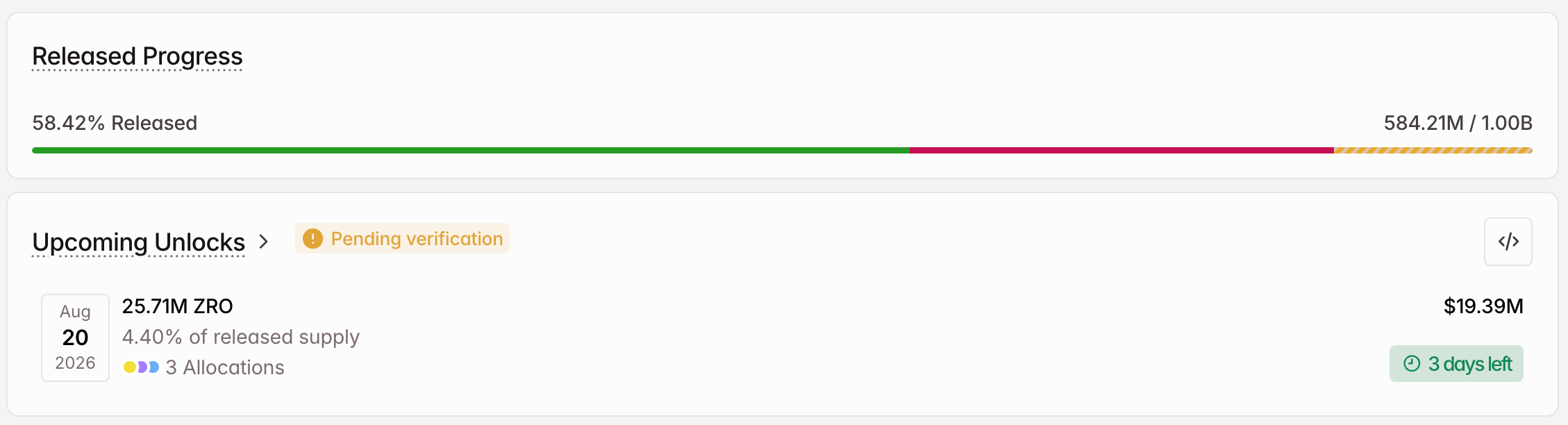
The crypto market will welcome tokens worth more than $556.7 million in the third week of August 2026. Major projects, including LayerZero (ZRO), KAITO (KAITO), and Soon (SOON), will release significant new token supplies.
These unlocks could introduce market volatility and influence short-term price movements. So, here’s a breakdown of what to watch.
1. LayerZero (ZRO)
- Unlock Date: August 20
- Number of Tokens to be Unlocked: 25.71 million ZRO
- Released Supply: 584.2 million ZRO
- Total Supply: 1 billion ZRO
LayerZero is an interoperability protocol that connects different blockchains. Its primary goal is to facilitate seamless cross-chain communication. Thus, it enables decentralized applications (dApps) to interact across multiple blockchains without relying on traditional bridging models.
The team will unlock 25.71 million tokens on August 20, representing 4.4% of the released supply. Moreover, the supply is worth approximately $19.39 million.

LayerZero will award 13.42 million altcoins to strategic partners. Core contributors will get 10.63 million ZRO. Lastly, 1.67 million ZRO are for tokens repurchased by the team.
2. Kaito (KAITO)
- Unlock Date: August 20
- Number of Tokens to be Unlocked: 32.6 million KAITO
- Released Supply: 427.07 million KAITO
- Total Supply: 1 billion KAITO
Kaito is an artificial intelligence (AI)-powered Web3 information platform that aggregates and analyzes cryptocurrency market data from diverse sources like social media, governance forums, news, and more. The KAITO token serves as a medium of exchange, governance tool, and incentive mechanism within the platform.
On August 20, the team will unlock 32.6 million tokens, representing 7.63% of the current released supply. The supply is worth approximately $11.48 million.

The foundation will receive 1.19 million tokens. Early backers will gain 2.31 million KAITO. Furthermore, core contributions will get 6.94 million tokens.
The team will direct 7.16 million KAITO for ecosystem and network growth. Finally, Kaito has earmarked 15 million tokens for long-term creator incentives.
3. Soon (SOON)
- Unlock Date: August 23
- Number of Tokens to be Unlocked: 20.24 million SOON
- Released Supply: 538.4 million
- Total Supply: 1 billion (Y2035)
SOON is a high-performance Solana Virtual Machine (SVM) Rollup, designed to implement the Super Adoption Stack. It includes three main components: SOON Mainnet, SOON Stack, and InterSOON.
The network will unlock 20.24 million worth around $3.85 million. The unlocked supply accounts for 3.76% of the current released supply.

The network will direct 6.67 million tokens to SOON Squad. The team will also award 4.17 million coins to the ecosystem and 2.78 million SOON to the team and co-builders.
Furthermore, it will allocate 2.22 million tokens each to SOON Pill and community incentives for future products. The remainder covers 1.67 million SOON for the foundation and treasury, and 520,830 tokens for airdrop and liquidity.
In addition to these, other prominent unlocks investors can look out for in the third week of August include MBG by Multibank Group (MBG), ZKsync (ZK), Solv Protocol (SOLV), and more, which will contribute to the overall market-wide releases.
The post 3 Token Unlocks to Watch in the Third Week of August 2026 appeared first on BeInCrypto.

ProjectAir Builds Giant Circle Plane, Proves a Circle Beats a Straight Line

COCA Adds Cross-Chain Stablecoin Deposits Through Aurora Intents

20 Best TV Performances of All Time


-

 Fashion3 days ago
Weekend Open Thread: Ann Taylor
-
 NewsBeat6 days ago
Communication cards help banking customers access services or report scams
-
 Business6 days ago
Oil Price Today (August 11): Crude oil rises to $88 after Trump’s compensation demand dents Hormuz opening. Here’s why
-

 Crypto World6 days ago
Revolut wins French banking licence, creates second EU banking hub
-
 Sports4 days ago
This U.S. Amateur is a glimpse into golf’s future in more ways than you think
-
 Crypto World7 days ago
Why Did Nvidia Stock Fall on Monday Despite a $500 Billion Wall Street AI Deal?
-

 Sports2 days ago
Birmingham 2026: Day 6 Timetable for Irish Athletes
-
 NewsBeat2 days ago
Myanmar says over 300,000 Rohingya refugees verified for repatriation as exodus enters ninth year
-

 Politics2 days ago
SEQ Code: The Three Letter Boarding Pass Code That Could Give You The Worst Seat
-
 Entertainment5 days ago
Keke Palmer Subtly Hints At Sean Evans Drama With Cryptic Post
-
 Crypto World7 days ago
Grayscale quietly drops Cardano, Polkadot and Hedera ETF plans
-

 Fashion7 days ago
Can You Wear Double Cloth Gauze Clothing To Your Office?
-
 Entertainment6 days ago
57 Years Later, the Best Sitcom Ever Made Still Deserves a Reboot
-

 Fashion6 days ago
Coffee Break: The Fonteyn Jane Flat
-

 Crypto World7 days ago
Bitcoin's BIP Editors Remove Luke Dashjr Two Days After BIP-110 Fork Stalled
-

 Tech6 days ago
Zoom Screen-Sharing Bug Let People Fully Take Over Other Devices On A Call
-
 Crypto World7 days ago
Hormuz Nerves Cost Bitcoin $65,000 Mark Despite Solid Institutional Flows
-

 Fashion6 days ago
Claire Life: Kicking Off MVAAFF With the C Suite Luncheon Featuring Phylicia Rashad, Letoya Luckett, and More!
-

 Fashion6 days ago
Should you refinance your debt? Pros, cons, and real numbers
-
 Crypto World5 days ago
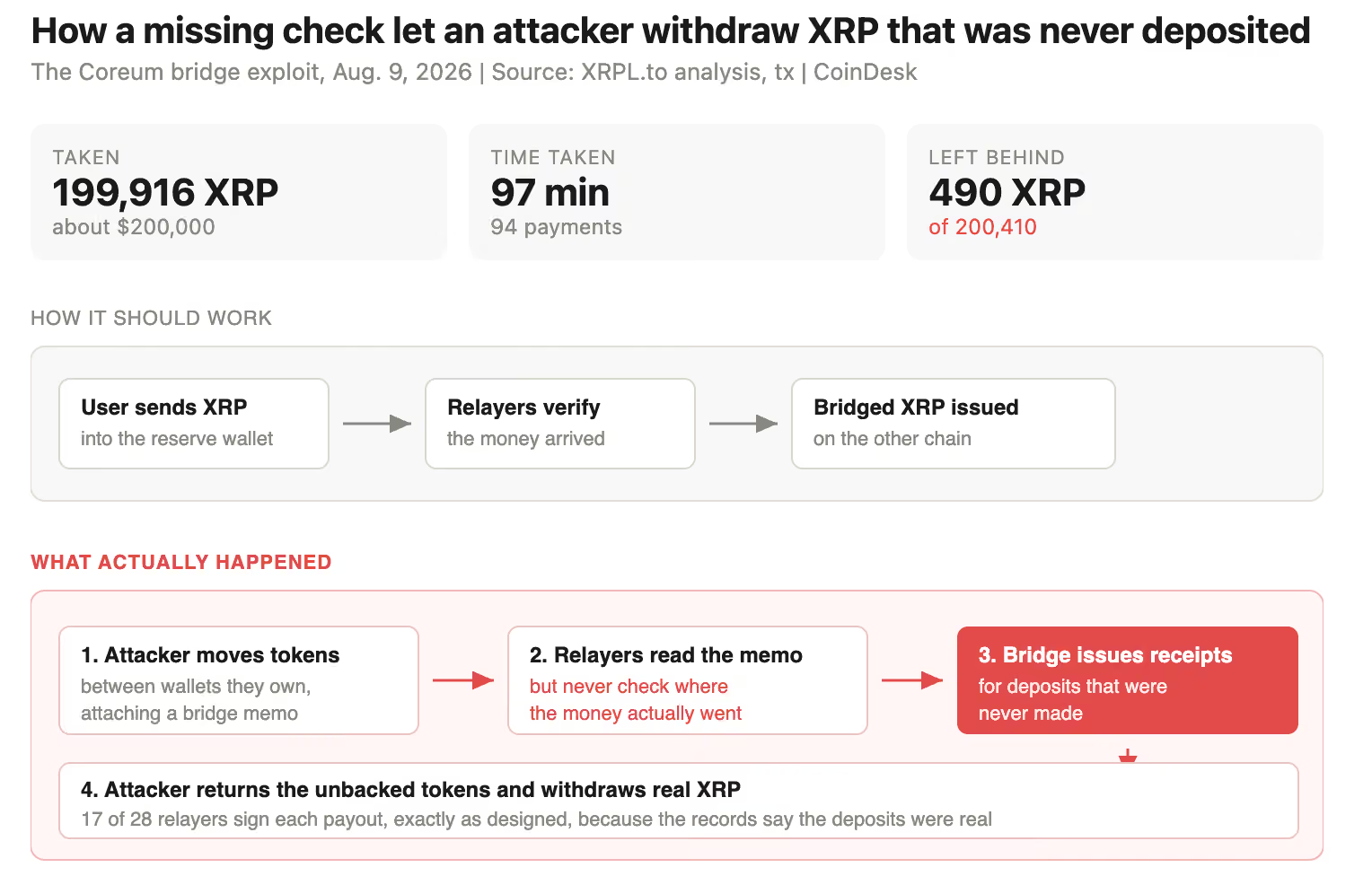
XRP bridge drained after software mistook fake deposits for real ones
You must be logged in to post a comment Login