
Crypto World
BitMart Founder Questions Funds, Xia Rejects Claims as Fabricated


BitMart’s official Chinese-language X account has demanded that exchange founder Sheldon Xia explain where user funds are, provide a verifiable disclosure of assets, and outline a repayment plan by Wednesday. The dispute comes as the troubled platform continues its wind-down process amid widely reported withdrawal delays and the earlier collapse in BMX token value.
In a Monday post, the account said some users were still unable to withdraw funds and that some employees had not received their final salary or compensation. It urged Xia to publish details including BitMart’s wallets, assets, liabilities, and available reserves, warning it would escalate the matter to regulators, law enforcement, lawyers, and the media if he did not meet the deadline. Cointelegraph previously reported that BitMart announced on July 26 it would wind down the exchange, with trading ending Aug. 26 and operations ceasing on Jan. 31.
Key takeaways
- BitMart’s official Chinese X account is demanding Sheldon Xia disclose BitMart’s wallet holdings and provide a repayment plan by Wednesday.
- The post alleges some users still cannot withdraw and that some employees have not received final compensation.
- BitMart has already entered a formal wind-down process, with trading set to end Aug. 26 and operations scheduled to stop Jan. 31.
- Sheldon Xia rejected the claims, saying the account’s accusations are “fabricated rumors,” and said he would pursue police and legal action.
- Arkham-tracked BitMart-attributed wallets reportedly fell from about $102 million (July 6) to around $36.5 million as of Monday, though the reasons are unclear.
Deadline set amid ongoing withdrawal complaints
BitMart’s latest challenge is framed around user access to funds and transparency. According to a machine translation of the account’s post, it said some users remained unable to withdraw and that internal compensation issues persisted for at least some staff members.
The account’s demand is not limited to a general explanation; it calls for a detailed and verifiable disclosure, including wallets, assets, liabilities, and reserves. It also set a clear escalation threat: if Xia does not deliver by the stated deadline, the account said it would submit evidence to regulators, law enforcement, legal representatives, and media outlets.
Cointelegraph attempted to contact BitMart for comment following the Monday post but did not immediately receive a response. It also remains unclear who authored the message, or whether the account is still operated under BitMart’s corporate control.
Wind-down timeline already in motion
These events are unfolding while BitMart carries out a pre-announced shutdown. As earlier coverage noted, BitMart said on July 26 it would wind down the exchange due to market and operational pressures, including BMX token volatility and user reports of withdrawal delays.
Under the company’s stated plan, BitMart ended new deposits and halted registrations as part of the wind-down. Trading on the platform is scheduled to end on Aug. 26, and the exchange’s operations are set to cease on Jan. 31. BitMart also warned that some withdrawals could undergo additional compliance and security reviews.
That backdrop matters because it suggests the dispute is not simply about whether an exchange will pay, but about the practical mechanics and timing of withdrawals and asset handling during the shutdown window.
Sheldon Xia denies wrongdoing and promises legal action
Sheldon Xia responded to the accusations in an X post on Monday, calling the claims “fabricated rumors” and saying he had preserved evidence. In a machine translation of his remarks, Xia said that during daytime U.S. time he would file a police report and send a lawyer’s letter to X, seeking technical and data forensics related to the post.
Xia further argued that employees were not being prioritized over customers, stating that “everyone is a client” and that there were no special privileges. He also previously denied that BitMart had misappropriated user assets.
In earlier communications, Xia told users not to rely on unverified claims or screenshots purportedly provided by current or former employees, reinforcing his position that the public allegations should be treated skeptically until substantiated.
Arkham wallet tracking shows sharp reductions—but interpretation remains unclear
Wallet movements are also central to what investors and users want to understand during a wind-down. According to Arkham’s on-chain entity tracking, wallets attributed to BitMart held about $36.5 million in crypto assets as of Monday.
Arkham’s data indicates a steep decline from roughly $71 million on July 26 and about $102 million on July 6. Those figures, however, come with important caveats. The tracked wallets may not represent the full set of assets controlled by BitMart, and it remains unclear how much of the reduction reflects customer withdrawals, internal consolidation, or transfers to other addresses.
In disputes like this, a key question is whether reductions in publicly tracked wallet balances reflect legitimate outflows to customers or whether they could suggest asset movement that is not fully explained. Until BitMart or Xia provides the kind of verifiable disclosure demanded by the X account—wallet list, liabilities, reserves, and a repayment framework—readers may be left comparing incomplete public signals.
What to watch next as the deadline approaches
With the promised Wednesday deadline now in focus, market participants will likely look for whether Xia provides a verifiable asset and liability disclosure and whether any repayment plan is detailed in a way that users can test against withdrawal status. Just as importantly, observers should watch how regulators and law enforcement respond to both sides’ public claims, and whether on-chain wallet tracking aligns with the explanations given for balance changes since BitMart began winding down.



Blockstream has launched Blockstream Swaps in beta testing after noncustodial swap provider Boltz suspended its services following months of automated probing and several exploits.
Summary
- Blockstream has launched Blockstream Swaps in beta after Boltz suspended its swap services.
- Boltz blamed months of automated, AI assisted probing and several exploits for the suspension.
- Blockstream said its swap service was already in development and will support transfers across Bitcoin, Lightning and Liquid.
- Boltz said no user funds were at risk because its architecture is self custodial.
Blockstream said in an Aug. 10 announcement that the in-house service is already being tested with select participants, with development now being accelerated after Boltz stopped processing swaps on Aug. 3. The Bitcoin infrastructure company said the product was under development before the shutdown and is intended to add another option for users moving funds between Bitcoin, Lightning and Liquid.
Boltz said its suspension followed a steady increase in automated, AI-assisted attempts to probe its infrastructure, along with several exploits that the team said were contained. The company kept its swap services offline because attackers were iterating faster than its developers could identify and patch weaknesses.
“Attackers now iterate faster than a team our size can find and patch,” Boltz said in the statement quoted by Blockstream.
The swap provider said customer funds were never at risk because its architecture is self-custodial. Refund mechanisms also remained available while normal swap operations were disabled.
As crypto.news reported on Aug. 4, Boltz initially restricted swaps involving assets such as USDT, USDC, WBTC, TBTC and RBTC after identifying a bug in its Ethereum Virtual Machine integration on Aug. 1. Bitcoin, Lightning and Liquid swaps remained available at that stage before the company suspended all swap services two days later.
Blockstream Swaps enters beta after Boltz shutdown
Blockstream described its new service as an in-house swaps feature built for the Lightning and Liquid networks, with organizations now able to request access to the beta program.
Development was already “well into” its testing process before the Boltz suspension, according to the company. Blockstream said the recent disruption reinforced its decision to speed up the rollout, while stressing that the product is not intended to displace existing providers.
“We are not seeking to replace any providers,” Blockstream said. “We see Blockstream Swaps as a much-needed addition to improve redundancy and resilience to the ecosystem.”
Boltz had previously worked with Blockstream and other Bitcoin applications that relied on its infrastructure to move assets between Bitcoin mainnet, Lightning and Liquid. Its Aug. 3 shutdown also affected services at Bull Bitcoin, Aqua and ZEUS that depended on the provider’s swap infrastructure, according to the earlier report.
For Blockstream, adding its own implementation gives its ecosystem another swap provider without requiring users to hand custody of their bitcoin to an intermediary during the transaction.
The company said Blockstream Swaps can support users holding BTC on Bitcoin mainnet or LBTC on Liquid who need to interact with Lightning without managing Lightning channels directly.
Atomic swaps let users move bitcoin between networks
At the technical level, Blockstream said an atomic swap lets two parties exchange assets without relying on a trusted intermediary to hold both sides of the trade.
The transaction is structured so that both transfers complete or neither one does. If the swap cannot be completed within its specified conditions, the funds remain recoverable by their original owners.
Boltz uses a form built around hashed time-locked contracts, or HTLCs. Under the setup described by Blockstream, one party generates a secret and publishes its cryptographic hash, while payments on both sides of the swap are locked to the same condition.
Revealing the secret to claim one payment allows the other side to use it to complete the corresponding transaction. Timelocks provide a refund route when the swap is not completed within the required period.
Boltz later incorporated Taproot and MuSig2 into the construction, according to Blockstream, allowing cooperative transactions to settle through a normal key-path spend while keeping the script path available as a fallback.
Different transaction directions also use separate swap types. A submarine swap moves BTC or LBTC into Lightning, while a reverse submarine swap takes Lightning funds back to Bitcoin mainnet or Liquid. Chain swaps allow BTC and LBTC to be exchanged without a custodial intermediary.
Atomic swaps have formed part of Bitcoin development for years. An earlier Liquid Network launch report covered Blockstream’s 2018 rollout of the Bitcoin sidechain, which introduced L-BTC as a bitcoin-pegged asset designed for faster transfers and other functions outside the main chain.
Blockstream also developed LiquiDEX, a separate swap protocol for exchanging two assets issued on Liquid in a single transaction. According to the company, LiquiDEX does not require the same hashlock and timelock structure used in HTLC-based swaps.
Instead, a maker signs an input using SIGHASH_SINGLE and SIGHASH_ANYONECANPAY, allowing a taker to add inputs and outputs without invalidating the maker’s signature. Blockstream said the protocol is already used by platforms including SideSwap and can support trustless over-the-counter trading and order books.
Blockstream Swaps targets Lightning channel complexity
Lightning users normally need access to channels with enough liquidity to send or receive payments. Running Lightning directly can require users or service providers to operate a node, open channels, commit capital and obtain inbound liquidity.
Blockstream said its swap model is designed to handle that conversion when a payment is made, allowing a user to keep BTC or LBTC and exchange it into the required Lightning payment as part of the transaction.
Under one example given by the company, a user can pay a Lightning invoice using a balance already held on Bitcoin mainnet or Liquid without first opening and funding a Lightning channel.
Incoming Lightning payments can also be converted into LBTC. Blockstream said its wallet setup allows an incoming Lightning transaction to settle as LBTC into a wallet secured with its Jade hardware device while Jade remains offline during receipt of the payment.
Merchants can similarly accept a Lightning payment and settle the funds on their preferred supported network, according to the company.
Blockstream’s own product lineup already spans the three networks involved in the swap service. Its current wallet supports on-chain Bitcoin, Lightning and Liquid, while the company also develops Core Lightning and operates the Liquid Network.
Boltz, meanwhile, has not announced a date for restoring its swap services. Its Aug. 3 notice said the API would remain available for cooperative refunds, while unilateral refunds would continue to work without depending on Boltz infrastructure. Support services also remained available while the team assessed the attacks and its next steps.


Disclosure: This content is provided by a third party. Neither crypto.news nor the author of this article endorses any product mentioned on this page. Users should conduct their own research before taking any action related to the company.
The Commodity Futures Trading Commission (CFTC) has invoked unprecedented emergency authority to allow prediction market Kalshi to continue operating, directly responding to a lawsuit filed by New York State Attorney General Letitia James.
Summary
- CFTC used emergency authority to keep Kalshi operating as New York moved to shut down the prediction market.
- New York accused Kalshi of operating without a state gaming license and is seeking penalties and forfeiture of profits.
- The CFTC maintains that event contracts fall under federal derivatives law and should not be subject to state gaming rules.
- Kalshi remains locked in legal disputes with several states over whether its event contracts amount to regulated derivatives or gambling.
The CFTC has already sued nine states– Arizona, Connecticut, Illinois, Kentucky, Minnesota, New Mexico, New York, Rhode Island, and Wisconsin. The Commission has also filed amicus briefs in the U.S. Court of Appeals for the Sixth and Ninth Circuits and the Supreme Judicial Court of Massachusetts– in an ongoing turf war claiming exclusive jurisdiction over event contracts under the Commodity Exchange Act (CEA), over prediction markets asserting that event and prediction contracts are federally overseen swaps, making state-level gambling bans or enforcement unconstitutional and preempted.
State attorneys general –a broad coalition of 44 state attorneys including New York State Attorney General Letitia James — counter that sports-related event contracts bypass local gaming compacts, consumer protections, and state-regulated sports betting frameworks. For example, Nevada maintains a strict, court-enforced ban against Kalshi for offering unlicensed event contracts, centering on core disputes over state gaming control, federal preemption, and geofencing compliance.
The Nevada Gaming Control Board argued that Kalshi’s sports and election contracts constitute illegal, unlicensed sports pooling, while Kalshi claimed exclusive federal oversight under the Commodity Exchange Act. State judges backed local regulators, issuing a temporary restraining order followed by a preliminary injunction blocking Kalshi from offering sports, elections, and entertainment contracts without a state gaming license. Federal and appellate courts largely favored the state’s right to regulate local gambling, making Nevada one of the most aggressive states enforcing restrictions against prediction markets.
Regulators and Kalshi entered agreements requiring the platform to implement strict geofencing to block Nevada-based users from accessing restricted event contracts. State authorities pushed for strict daily financial penalties and oversight audits if the platform failed to completely block local trade execution.
These cases remain active in federal courts with no definitive nationwide final outcome yet, though the CFTC has actively used emergency powers to block state enforcement.
The unparalleled emergency action by CFTC was triggered after KalshiEX, LLC notified the Commission of that New York Governor Kathy Hochul and Attorney General Letitia James filed a lawsuit against the prediction market Kalshi on July 31, 2026, accusing the platform of running an illegal, unlicensed gambling operation. The state seeks to halt its operations, force the forfeiture of profits, and demand heavy financial penalties of more than $36 billion in damages.
State arguments and allegations include Kalshi lacks a permit from the New York State Gaming Commission. The platform allows 18-to-20-year-olds to wager, while New York law requires sports bettors to be at least 21. The company bypasses state taxes that normally fund public schools and addiction treatment. Event and sports contracts are pure games of chance rather than legitimate financial trades.
The standoff centers on a fundamental disagreement regarding the legal definition of prediction market contracts with the CFTC maintaining that prediction platforms function as national derivatives exchanges offering federally regulated “swaps”. Under the Commodity Exchange Act (CEA), the agency claims exclusive jurisdiction to ensure a uniform national market and maintain market stability.
Kalshi’s Betting Contracts
Kalshi sells to anyone who is 18 years old and older in the United States and most other countries federally regulated binary Yes/No financial event contracts tied to real-world outcomes across economics, politics, sports, weather, and culture. Each contract settles at $1.00 if your prediction is correct and $0 if it is wrong.
Economics & Finance: Inflation rates, GDP growth, interest rate decisions by the Federal Reserve, and unemployment numbers.
Politics & Elections: Congressional decisions, government policy outcomes, local or national election results, gruesome war outcomes with “Stew, a 35-year-old from Montana, wagering $10 on the odds that Iran’s Supreme Leader Ayatollah Ali Khamenei would be “out” by 1 March.
Sports: Pro and college league outcomes, game results, and player performance metrics (including NFL, NHL, MLB, and NBA).
Weather & Climate: Temperature benchmarks, hurricane landfalls, and seasonal climate patterns.
Culture & Novelty: Entertainment awards, box office performance, auction/collectible markets (such as fine art and specialty assets) and entertainment event contracts hosting high-volume markets on specific high-profile celebrity weddings such as multi-million dollar trading activity around Taylor Swift and Travis Kelce’s events.
The Commodity Exchange Act (CEA) regulates U.S. derivatives and commodities markets
The CEA requires the Commission to provide a uniform national market in derivatives transactions. As part of this obligation, the CFTC ensures public confidence in its markets by safeguarding market resilience and orderliness. The Commission is also tasked with providing competitive, fair, and efficient markets that protect the price discovery process of trading in the centralized derivatives markets. Major market disruptions hamper these efforts. CEA primarily gives the Commodity Futures Trading Commission (CFTC) authority over futures contracts, commodity options, swaps, and certain event contracts/prediction markets.
Futures Contracts: Are agreements to buy or sell a specific commodity or financial instrument at a set price on a specific future date.
Commodity Options: Are contracts giving the buyer the right, but not the obligation, to buy or sell a futures contract or commodity at a set price within a set time.
Swaps: Are Over-the-counter or cleared financial agreements to exchange cash flows or risk based on interest rates, currencies, or commodities (non-security-based swaps).
Event Contracts: Binary options or prediction-style contracts where payouts depend on the occurrence or non-occurrence of specific real-world occurrences (such as economic indicators or weather outcomes) listed on designated exchanges which can be found at CFTC Industry Filings Registry .
“New York intends to make event contract derivatives waste away under its iron curtain of state gaming laws before the courts get the chance to issue final rulings,” said Chairman Michael S. Selig. “Congress did not intend for derivatives exchanges to be regulated under a patchwork of state gaming laws. These are financial exchanges that offer financial instruments and operate across state lines. They match the bid from a resident of one state with the offer of a resident from another state and submit the trade to a clearinghouse that backstops the transactions of customers throughout the country. New York has no business regulating these interstate financial markets. The Commission is required by law to ensure order in these markets, and that is what we have done today.”
I wonder since when betting on the odds that Iran’s Supreme Leader Ayatollah Ali Khamenei would be “out” by 1 March or contracts on whether Taylor Swift will get married or not are financial contracts. I suppose the courts will eventually decide.
About the Author:
Selva Ozelli Esq, CPA, is an international digital asset legal expert and author of Sustainably Investing in Digital Assets Globally and an award winning artist. Her writings are translated into 45 languages and republished in over 200 global publications. She is recognized as an expert media/TV commentator on global AI, digital asset regulation, tax, and technology matters.
Disclosure: This content is provided by a third party. Neither crypto.news nor the author of this article endorses any product mentioned on this page. Users should conduct their own research before taking any action related to the company.


Harmony has proposed rolling back its blockchain to two Aug. 11 checkpoints, a recovery plan that would discard more than 109,000 regular transactions as the network removes ONE created through a forged mint.
Summary
- Harmony plans to roll back its blockchain to two checkpoints from Aug. 11 following a forged ONE mint.
- More than 109,000 regular transactions and 315 staking transactions would be discarded under the recovery plan.
- One forged mint wallet moved 2.385 trillion ONE through 477 successful transfers in 106 seconds.
- Harmony said exchanges, bridges and law enforcement are assisting with the investigation.
According to Harmony’s latest incident update on X, validators would retain shard 0 block 92,730,034 and shard 1 block 94,978,278, both recorded at 11:25:37 p.m. UTC on Aug. 11, before restarting the network from replacement databases built around those checkpoints.
Under the plan, new blocks would begin at heights 92,730,035 on shard 0 and 94,978,279 on shard 1. Harmony said client version v2026.1.2 has been configured to reject the abnormal block hashes linked to the incident, preventing validators from accepting the affected chain history after the restart.
The first confirmed forged mint reached shard 0 at block 92,730,036, according to the network. Block 92,730,035 contained no regular or staking transactions, incoming receipts or gas usage, while its state remained unchanged from block 92,730,034.
Harmony said it selected block 92,730,034 to provide a one-block safety buffer. The database, recovery scripts and validator procedures had also been prepared and reviewed around that block, while changing the checkpoint at a late stage could leave validators working from different recovery targets.
Shard 1 was not where the forged mint occurred. Harmony said its corresponding checkpoint was included as a precaution using the same timestamp.
Harmony rollback would use replacement databases
The recovery plan would replace the affected shard databases instead of using Harmony’s existing in-place rewind function.
According to the team, the network’s –revert function mainly moves chain heads and does not fully clear later receipts, indexes, snapshots and cross-shard information. Leaving some of that data behind could preserve an attack route or cause validators to reach different states.
Harmony said a replacement database gives validators a single reviewed state from which to resume consensus.
The team also considered burning or repairing the forged ONE directly, but said the tokens had already passed through exchanges, decentralized exchange pools, contracts and numerous wallets. Removing assets at individual destinations could therefore affect funds belonging to unrelated users.
A blacklist was rejected because it would leave the forged supply in existence while potentially restricting wallets holding legitimate assets. Selectively replaying transactions was also ruled out because the state of the replacement chain would differ from the discarded chain, meaning identical transactions could produce different results.
Token migration was another option reviewed by Harmony, but the team said it would cause substantially more disruption.
The decision comes after another blockchain faced a similar choice following an exploit. In December 2025, Flow revised rollback plans following a $3.9 million execution-layer exploit, dropping an initial full rollback proposal in favor of targeted token burns after bridge operators and other participants raised concerns about the effect on legitimate activity. crypto.news reported at the time that Flow also planned a phased network restart and restrictions on flagged accounts.
More than 109,000 transactions face removal
Harmony’s rollback would discard all blocks created after the selected checkpoints, including regular transactions made by users during the affected period.
To measure the impact, the team built a shard 0 archive covering blocks 92,730,035 through 92,871,662. The dataset contained 141,628 consecutive blocks, 109,126 regular transactions and 315 staking transactions, with 109,441 exact transaction-to-receipt matches.
Harmony said it checked parent-hash continuity and receipt completeness throughout the archived range.
Automated activity accounted for most of the transaction count. Of the 109,126 regular transactions, 104,545, or 95.80%, were classified as automated. DEX automation represented 99,863 transactions, including 75,430 successful swaps and 11,804 failed bot attempts.
As a result, Harmony cautioned that the number of discarded transactions should not be treated as the number of affected users.
The team also examined whether some regular transactions could be safely restored after the rollback. Only 22 were simple native transfers without an obvious dependency in the available data, but Harmony said even those could not automatically be considered safe for replay.
Another 860 native transfers raised questions involving balances, funding sources, nonces or later spending. A further 80,630 transactions depended on contract or blockchain state, while 27,614 were failed transactions, incident-linked activity or movements involving exchanges, bridges and consolidation routes.
All 315 staking transactions also depend on chain and epoch state, according to the update.
Harmony said balances, nonces, token approvals, swap deadlines, liquidity pool reserves and staking conditions would change once the replacement chain starts. Under that altered state, a transaction that previously failed could succeed, while a swap, approval or staking transaction could generate a different outcome.
Full EVM traces are also unavailable through the RPC data used in the review, leaving internal contract transfers and storage changes subject to application-specific analysis.
Forged ONE moved through exchanges, pools and bridges
The investigation has separately mapped the movement of the newly created ONE across the network.
According to Harmony, one wallet involved in the forged mint attempted 534 transfers of 5 billion ONE each within 106 seconds. A total of 477 transfers succeeded, moving 2.385 trillion ONE.
Investigators created a time-ordered graph beginning with all wallets associated with the forged mints, separating transactions signed by those wallets from successful transfers, failed attempts and subsequent movements through other addresses.
The traced activity was checked against blocks, transaction receipts and balances through shard 0 block 92,805,850. Harmony said the funds reached standalone wallets, exchange accounts, DEX routers and pools, liquidity provider positions, bridge contracts, wrapped ONE, staking wallets and high-volume service wallets.
When forged ONE became mixed with other assets, the tracing model followed transfers chronologically and capped the amount attributed to the forged tokens at each wallet’s available balance. According to the team, the method was intended to prevent the same tokens from being counted repeatedly as they moved between addresses.
An earlier model traced more than 99.9% of the forged ONE to a wallet or service boundary, while a later version reconciled almost all of the amount across those boundaries and transaction fees at the selected cutoff.
Harmony stressed that route coverage does not mean investigators can identify the individuals controlling every destination. Exchange accounts, pools, contracts and other service clusters can contain funds belonging to many users.
The amount that can be safely destroyed is smaller still, according to the team. Forged tokens left untouched in a standalone wallet may be possible to isolate, while ONE that entered an exchange wallet, liquidity pool, bridge, staking position or another shared balance could no longer be removed in full without risking unrelated assets.
A comparable problem has surfaced in other token-minting attacks. In June, Humanity Protocol disclosed that compromised administrative keys allowed attackers to take control of bridge infrastructure and mint additional H tokens on BNB Smart Chain. The protocol halted affected bridge operations and coordinated with exchanges and law enforcement while investigators tracked the stolen assets.
Investigation continues alongside validator recovery
Harmony said it has made initial progress toward tracing the hacker and is working with exchanges, bridges and law enforcement to preserve records and continue the investigation.
An independent third-party security company also reviewed the incident separately and corroborated the forged mint and the main findings from the fund-flow analysis, according to the network.
Harmony has dealt with a major cross-chain security incident before. Its Horizon Bridge lost about $100 million in June 2022 after private keys controlling the bridge were compromised. The project subsequently worked with exchanges, law enforcement, and blockchain analytics firms to identify the attacker, while raising its hacker bounty to $10 million.
Funds from that attack continued moving months later. In January 2023, on-chain investigators tracked stolen ETH through hundreds of addresses, while Binance and Huobi froze accounts linked to the movement and recovered 124 BTC.
For the current incident, Harmony said it is working with exchanges and bridges to assess the effect of discarding post-checkpoint activity and determine how affected parties can be handled. The team said all blocks after the checkpoints would be removed under the proposed recovery, including regular transactions that were unrelated to the forged mint.

BitMart’s founder Sheldon Xia is facing fresh public pressure as the exchange’s official Chinese-language X account demanded he explain the status of user funds and lay out a verifiable repayment plan. The dispute escalates amid claims of halted withdrawals and concerns that employees have not received final pay or compensation.
Separately, the tokenized-stock market continues to reshuffle as Binance bStocks overtook xStocks to become the second-largest tokenized stock issuer by value less than two months after launch. Across the industry, banks and regulators are also pushing into crypto rails—ranging from new stablecoin distribution in Hong Kong to mandatory crypto tax reporting in Singapore—while other stories highlight custody moves, tokenization pilots, and ongoing legal fights.
Key takeaways
- BitMart’s account demanded founder Sheldon Xia provide a verifiable asset disclosure and repayment plan, warning it will continue presenting evidence to regulators, law enforcement, lawyers, and media.
- Xia rejected the allegations as “fabricated rumors” and said he will pursue police reporting and technical/data forensics after collecting evidence of the posts.
- Binance bStocks surpassed xStocks to become the second-largest tokenized stock issuer, reaching about $624M versus xStocks’ roughly $579M on Aug. 3, based on Token Terminal data.
- Singapore finalized rules requiring crypto firms to report user transactions to the tax department, with timing that starts for new users in 2027 and continues for existing users later in 2027.
- Israel’s Bank Leumi plans to offer trading in Bitcoin, Ether, and Solana via Galaxy Digital’s platform from early 2027.
BitMart demands answers on user funds as Xia pushes back
BitMart’s official Chinese-language X account said some users are unable to withdraw funds and claimed that some employees have not received their final salaries or compensation. It directed Sheldon Xia to explain where user funds are and to produce a repayment plan by a stated deadline.
The account also warned that if Xia does not provide a verifiable disclosure and repayment plan, it will continue submitting supporting evidence to regulators, law enforcement, lawyers, and the media. The thrust of the message is that the exchange wants actionable accountability rather than general statements—particularly where withdrawals are reportedly affected.
Xia responded by calling the accusations “fabricated rumors.” In his reply, he said BitMart had “collected full evidence” of the content posted on X and vowed to file a police report during U.S. daytime hours and send a lawyer’s letter, seeking technical and data forensics.
What to watch in the BitMart dispute
This back-and-forth is more than a public argument; it centers on practical investor questions: whether funds are identifiable, whether withdrawals are genuinely blocked, and what repayment mechanism could be verifiable to affected users. Until there is independent disclosure or a documented plan that can be checked against on-chain activity, custodian reports, or other evidence, both sides’ claims will likely remain difficult for outsiders to validate.
Readers should watch for two key developments: (1) whether regulators or law enforcement filings are made public, and (2) whether any asset disclosure includes details that can be corroborated by third parties.
Tokenized stock market: Binance bStocks climb past xStocks
In a separate thread shaping market infrastructure, Token Terminal data shows Binance bStocks overtaking xStocks to become the second-largest tokenized stock issuer by value. According to the figures cited, bStocks reached about $624 million as of Aug. 3, moving ahead of xStocks at roughly $579 million.
Ondo Finance remained larger in the same snapshot, with total value tracked at about $927 million, according to Token Terminal. Still, the relative ranking change is notable because it happened quickly—less than two months after bStocks began operating.
Rapid growth—and the shifting ranks—behind tokenized equities
The tokenized stock sector appears to be moving faster than many early entrants expected. The same Token Terminal data referenced in the report indicates that a year earlier xStocks led with about $40.7 million, Robinhood-related issuance tracked around $37.2 million, and Ondo was far smaller at roughly $65,000. In contrast, the overall value tracked by Token Terminal has risen sharply from around $80 million to about $2.7 billion.
For investors and traders, these numbers matter because issuer size often correlates with liquidity expectations, listing stability, and integration into trading venues. However, market participants should also treat tracked “value” as a metric that depends on how specific tokens are issued, redeemed, and accounted for on-chain—so it’s worth monitoring methodology as tokenized asset ecosystems evolve.
Banks, stablecoins, and regulation push forward
Israel: Bank Leumi, described as Israel’s largest bank, announced a partnership with Galaxy Digital to let customers trade Bitcoin, Ether, and Solana via the bank’s investment platform beginning in early 2027. The plan is to make these assets available through a dedicated section of the Leumi Trade app, including buy, hold, and sell functions, including through Pepper, Leumi’s mobile banking arm.
Singapore: Singapore finalized regulations that require crypto firms to report user transactions to the tax department. The rules implement the OECD’s Crypto-Asset Reporting Framework into domestic law. The schedule takes effect from Jan. 1, 2027 for new users, while existing users are given time until Dec. 31, 2027.
Hong Kong: In Hong Kong, HashKey Exchange began beta distribution of HKDAP, described as a Hong Kong dollar-backed stablecoin regulated in the territory. HashKey Exchange is positioned as an authorized distributor, with initial retail access limited and early focus placed on institutions as the local stablecoin market continues to develop. The report also noted that the Securities and Futures Commission reportedly identified 65 fraudulent websites impersonating HashKey.
Ongoing industry friction: legal battles and tokenization experiments
There’s also continued legal and operational uncertainty in parts of the market. Binance and RedotPay are disputing whether a Singapore case connected to their nearly $473 million Hong Kong legal battle is nearing an end. RedotPay told Cointelegraph it expects Binance to discontinue the Singapore proceedings and will seek legal costs; Binance, in turn, said it is not abandoning its claims and has informed the court and RedotPay accordingly. The underlying Hong Kong allegations center on whether RedotPay diverted more than 470,000 Binance Card users by using Binance Pay funds for stablecoin top-ups outside a commercial agreement.
Meanwhile, tokenization experimentation continues. In Korea, Shinhan Asset Management signed a memorandum of understanding with Plume to develop a proof of concept for a Korean won-denominated tokenized fund. The stated aim is to test overseas use of won-denominated financial products onchain, an ecosystem that has so far been dominated by dollar-denominated assets.
Across these developments, the next signal to watch is whether regulators and institutions can translate new rules and bank/stablecoin rollouts into clear, verifiable user outcomes—especially where withdrawals, custody, and reporting obligations are at stake. For now, BitMart’s dispute and the rapid ranking changes in tokenized equities both suggest the industry is entering a phase where accountability and execution will increasingly matter as much as product launches.
Disclosure: This article does not represent investment advice. The content and materials featured on this page are for educational purposes only.
The crowded fraud recovery market raises concerns over second scams, while this Insight Guard review examines how investigative consulting differs from recovery services.
Summary
- Insight Guard focuses on structured fraud investigations and case documentation, offering victims an alternative to recovery services that guarantee refunds.
- As fraud recovery scams target victims again, Insight Guard highlights transparency, defined deliverables, and realistic expectations.
The market for fraud recovery help is crowded and often predatory. Many services that promise to retrieve lost funds are themselves a second scam. This Insight Guard review examines the firm against that backdrop, and asks what actually separates a legitimate investigation service from the operations that target victims a second time.
Insight Guard is a professional investigative consulting firm based in St. Petersburg, Florida, focused on evidence review and structured case documentation, not fund recovery.
The recovery-scam problem
Secondary fraud is well documented. After losing money to a scam, victims are frequently approached by services claiming to recover their funds. These operations use unsolicited outreach, reference details of the original fraud to appear credible, and request upfront fees before performing any real work. The victim then loses again.
The defining feature of these operations is the guarantee. They promise a specific outcome, usually the return of funds, in exchange for payment up front. No legitimate investigative service can make that promise, which is why the guarantee itself is the clearest warning sign.
These schemes are effective precisely because they target people at their most vulnerable. Someone who has just lost a significant sum is motivated to believe that recovery is possible, and an operation that references the specific details of their case can seem informed and credible. The emotional pull is strong, and it is exactly what the operators rely on. Understanding this dynamic is the first step in evaluating any firm that offers help after a scam.
How Insight Guard differs
Measured against that pattern, this review found several structural differences. The firm does not guarantee outcomes and states plainly that it does not operate as a fund recovery service. It does not conduct unsolicited outreach. Its deliverable is a defined document, a structured investigation report, rather than an open-ended promise. And it is transparent about the limits of what evidence, including blockchain tracing, can actually establish.
The firm’s work centers on organizing a victim’s evidence, reconstructing a verified timeline, and preparing structured documentation for banks, dispute bodies, and legal professionals. That is a fundamentally different proposition from a service that simply promises money back for a fee.
There is also a difference in how the two types of operation make contact. Recovery scams reach out to victims, often repeatedly and through channels the victim never signed up for. A documentation-focused firm works the other way around: the client approaches it, shares what happened, and receives an explanation of whether and how the evidence can be organized. That direction of contact is a small but telling signal of which kind of service someone is dealing with.
What to check before engaging any service
This review also serves as a checklist for evaluating any fraud service. A legitimate firm will not guarantee recovery. It will not demand large upfront fees before explaining its process. It will define its deliverables and its role clearly. And it will be honest about what it cannot do. Insight Guard meets those criteria; many services competing for the same searches do not.
It is worth applying that checklist to every service that appears in a search for fraud help, not just the first one. The category is designed to be confusing, and legitimate firms sit alongside predatory ones in the same results. A few minutes spent checking how a service describes its guarantees, its fees, and its limits will usually reveal which side of the line it falls on. Transparency about limitations, not confidence about outcomes, is the marker most worth looking for.
The Verdict
In a category where the biggest risk to a victim is being scammed twice, Insight Guard stands out for building its positioning on transparency and documentation rather than promises. It is not the right choice for anyone seeking a guaranteed refund, because that offer is itself the warning sign. For victims who want a credible, professionally documented account of what happened, it is a sound match.
More information is available on the official website. The FTC’s guidance on recovery scams provides further context on how these secondary operations work.
Disclosure: This content is provided by a third party. Neither crypto.news nor the author of this article endorses any product mentioned on this page. Users should conduct their own research before taking any action related to the company.

Mumbai, India, 12 August 2026 — Unchained Summit will make its India debut on 5–6 November 2026 in Mumbai, bringing together global and Indian leaders across financial markets, digital assets, trading, Web3 and emerging technology.
Following editions in Dubai and Vietnam, the third edition of Unchained Summit will bring founders, investors, active traders, wealth and financial-market participants, global blockchain companies, technology leaders, policymakers and builders together in one of the world’s most active digital asset and technology markets.
The confirmed speaker lineup includes S B Seker, Head of APAC at Binance; Ashish Singhal, Co-Founder of CoinSwitch; Praneeth Srikanti, Partner at Ethereal Ventures; Eva Wong, General Counsel at Parity Technologies; Prabal Banerjee, Co-Founder of Avail; Sanat Rao, Chief Investment Officer at Monarq Asset Management; Dilip Chenoy, Chairperson of the Bharat Web3 Association; Saumya Saxena, India Lead at Base; Roshan Prabhakar, Head of Product – India at Coinbase; Vineet Budki, CEO of Sigma Capital; Kunaal Patel, Head of Institutional – Asia and MENA at Ondo Finance; and Jaideep Reddy, Partner at Trilegal, among others.
India continues to see strong participation in crypto markets, ranking first in Chainalysis’ 2025 Global Crypto Adoption Index, while taking a more cautious regulatory approach than several other major jurisdictions. Unchained Summit India will bring international perspectives into this conversation, examining how different markets are approaching regulation, adoption and market development.
At the same time, interest in tokenisation and enterprise blockchain continues to grow. The Reserve Bank of India has explored asset tokenisation through its CBDC sandbox, while the National Blockchain Framework reflects broader government and enterprise interest in blockchain-based infrastructure.
As India’s financial capital, Mumbai provides a natural meeting point for traders, wealth managers, family offices, financial institutions, fintechs and Web3 companies, connecting the country’s active digital asset market with its broader financial and technology ecosystem.
Sharath Kumar, Founder and CEO of Aeternum, the organiser of Unchained Summit, said:
“India has a unique mix of active digital asset participation, growing interest in tokenisation and blockchain, and one of the world’s strongest developer ecosystems. Unchained Summit India brings together the capital, policy and technology sides of that story, with global voices adding perspective to where the market goes next.”
That dual focus will define the two days of Unchained Summit India.
Day One will focus on Markets, Finance & Digital Assets, bringing together traders, investors, wealth managers, family offices, traditional finance participants and digital asset companies for discussions around regulation and policy, trading and markets, tokenisation and real-world assets, stablecoins and payments, wealth and portfolio management, capital markets, custody and liquidity.
For S B Seker, Head of APAC at Binance, India’s importance extends well beyond the size of its market.
“India is a crown jewel for Binance in terms of impact, not just scale. With deep digital penetration and a young, tech-savvy population, it is a market unmatched globally for meaningful blockchain adoption and innovation.”
Alongside the financial-market conversation is another major Indian advantage: its technology talent.
India had 21.9 million developers on GitHub in 2025, making it the platform’s second-largest developer community globally, with more than 5.2 million developers added during the year.
Day Two will focus on Web3, Infrastructure & Emerging Technology, creating a technology-led programme for developers, founders and builders around blockchain infrastructure, AI and Web3, DeFi, scaling, interoperability, security and digital trust, staking, consumer applications and emerging technologies.
Ashish Singhal, Co-Founder of CoinSwitch, said:
“Web3 represents one of the most exciting opportunities to build the next generation of internet infrastructure, and India is one of the world’s largest hubs with talent, entrepreneurial spirit, and technical expertise to play a leading role in shaping the industry’s future.”
The technology itself will be another important part of the discussion.
Uttam Singh from Alchemy said:
“We’re witnessing the financial system become programmable. The next wave of innovation will come from developers building onchain.”
Across two days, wealth managers and traders will interact with digital asset companies. Founders will meet investors. Traditional finance participants will examine tokenisation and new market infrastructure. Enterprises will explore blockchain applications. Developers and builders will engage with global protocols and technology companies, while policy and industry leaders will hear perspectives from jurisdictions taking different approaches to digital assets.
The summit will also bring international speakers, companies and participants into Mumbai, connecting India’s financial and technology ecosystem with global leaders across digital assets and Web3.
For Unchained Summit, the objective is straightforward: create a setting where capital and technology, traditional finance and digital assets, and Indian builders and global markets can meet.
Mumbai will host that conversation on 5–6 November 2026. More information is available on the event’s official website: [unchainedsummit.com/india] (https://unchainedsummit.com/india)
About Aeternum Consulting Ltd
Aeternum organizes business-to-business events in the emerging tech space, provides strategic consulting, and tailored services to a diverse range of clients, from corporations to governments and startups to individuals. Aeternum specializes in crafting impactful B2B platforms that foster meaningful connections, drive business growth, and facilitate knowledge sharing through conferences, exhibitions, and bespoke networking opportunities.
For more information visit: [aeternuminc.com] (https://aeternuminc.com)
For further details about the announcement, please contact:
Maya K V
media@aeternuminc.com | +91 95383 91838
Partnerships Associate, Aeternum
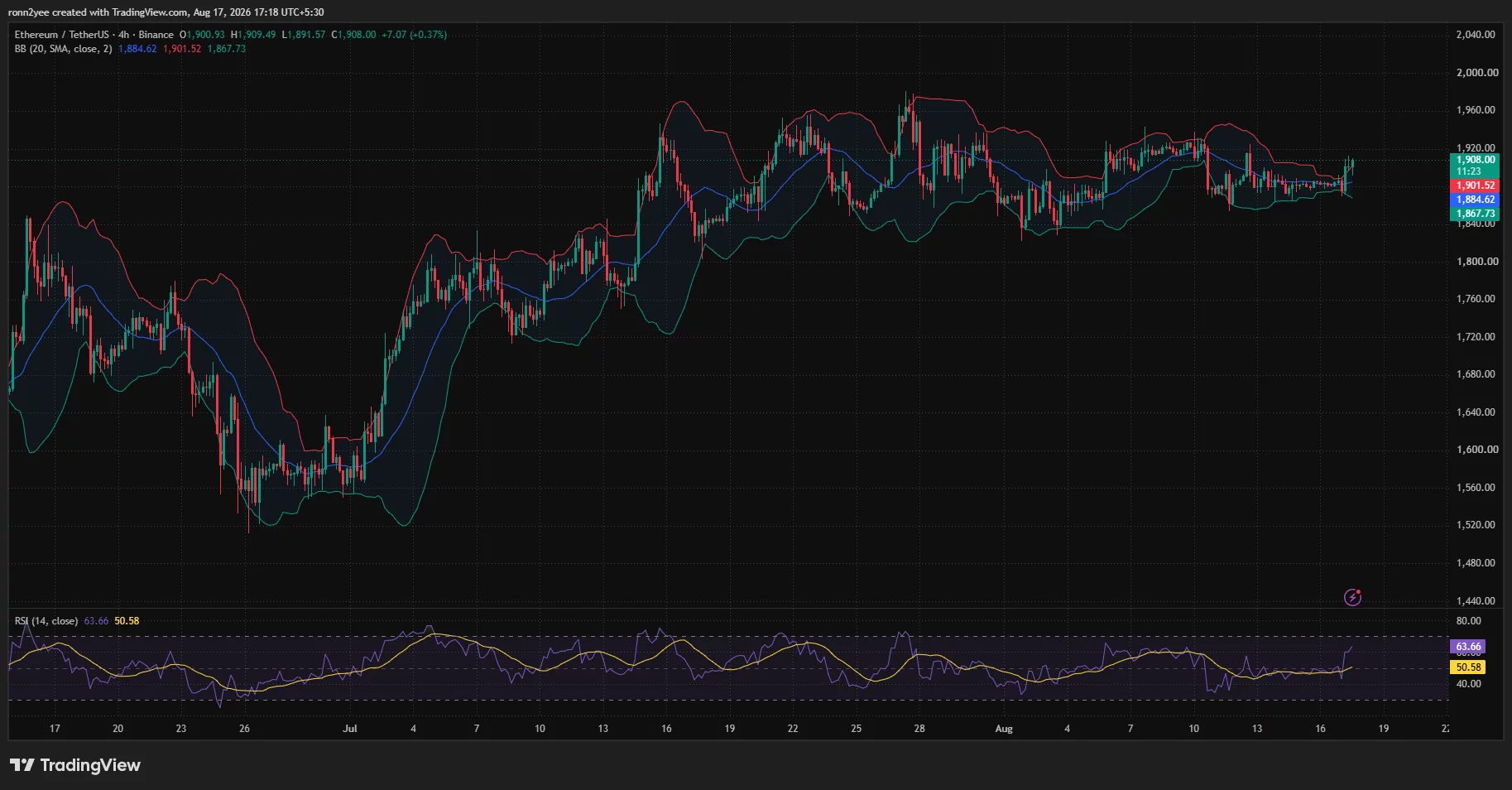
Ethereum price climbed nearly 2% on Aug. 17, rebounding from the $1,872 area as buyers defended short-term support and pushed ETH above $1,900.
Summary
- Ethereum price rose to an intraday high near $1,912 after opening around $1,876.
- A whale transferred 32,400 ETH, worth $61.46 million, into Ethereum’s staking contract.
- 4-hour momentum improved, but the daily chart still places ETH below its 200-day moving average.
- Liquidity clusters at $1,925 and $1,950 could shape Ethereum’s next move.
Ethereum price action today
According to data from crypto.news, Ethereum (ETH) price traded at approximately $1,908 at the time of writing, up 1.7% on the day. The token had moved between an intraday low of $1,872 and a high of $1,912, according to the Binance daily chart.
The recovery accelerated after ETH reclaimed the $1,890 area, which had limited price advances during the previous three sessions. Buyers then pushed the token through $1,900, although the move had not produced a confirmed break from its wider August range.
Ethereum has traded mostly between $1,850 and $1,960 since late July. Several attempts to clear the upper end of that range have failed, while pullbacks toward $1,850–$1,870 have continued to attract buyers.
The Aug. 17 bounce therefore represents another test of the range ceiling rather than a confirmed return to a broader uptrend. ETH remains roughly 47% below its price one year ago despite recovering from its June low near $1,530.
Whale staking and network research support sentiment
On-chain activity added to the positive tone after an unknown address transferred 32,400 ETH to the Beacon deposit contract, according to Whale Alert monitoring cited by Foresight News. The transaction was worth about $61.46 million, while Arkham data suggested that the address may be associated with Bitpanda.
Depositing ETH into the staking contract reduces the amount immediately available for spot trading, but one transaction alone does not prove that the owner bought the tokens during Monday’s rebound. Staked ETH can also return to circulation after passing through Ethereum’s withdrawal process.
Network development news provided another sentiment catalyst. Ethereum co-founder Vitalik Buterin pointed to Bitcoin’s Utreexo model as Ethereum researchers examine native UTXOs and recursive STARK proofs.
As crypto.news reported, the proposed approach could allow nodes to verify relevant data without storing the network’s entire state locally. The work remains a research direction rather than a scheduled Ethereum upgrade, but it addresses concerns about the cost and hardware requirements of running nodes.
Ethereum indicators favor buyers above $1,900
Ethereum’s 4-hour chart shows that short-term momentum has shifted in favor of buyers. ETH moved above the Bollinger Band midpoint at $1,884 and briefly crossed the upper band near $1,902.
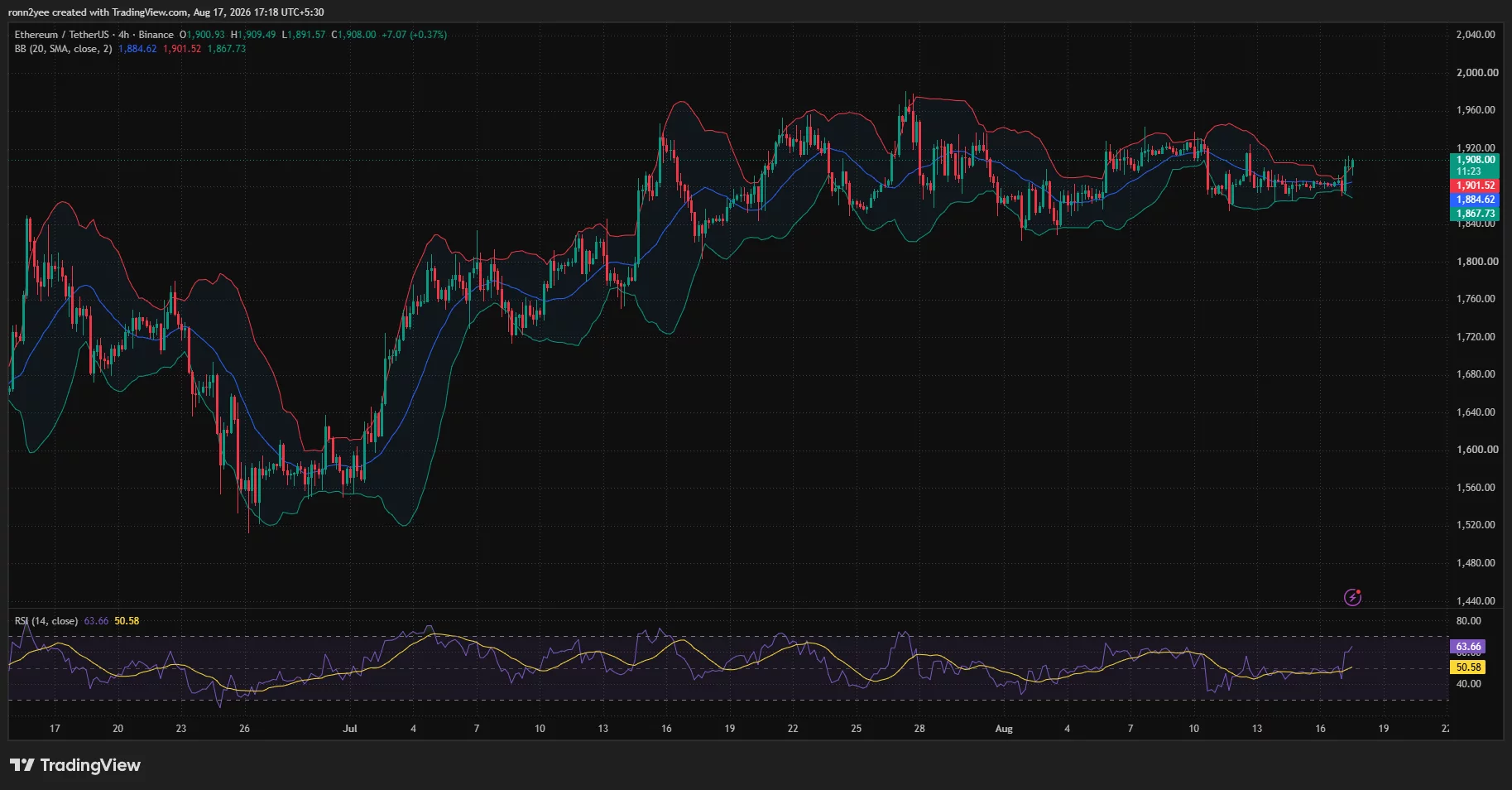
A move above the upper band reflects stronger momentum, although it can also lead to a short-term pullback if buyers fail to hold the breakout. The immediate support area now sits between the $1,884 midpoint and the lower band near $1,868.
The 4-hour relative strength index rose to 63.66 from a signal average of 50.58. The reading remains below the overbought threshold of 70, leaving room for another advance, but it also shows that momentum has strengthened quickly from neutral levels.
The daily chart presents a more cautious picture. ETH is trading above its 20-day, 50-day, and 100-day simple moving averages, located near $1,889, $1,845, and $1,869, respectively. Holding above that group would preserve the recovery structure that has developed since June.
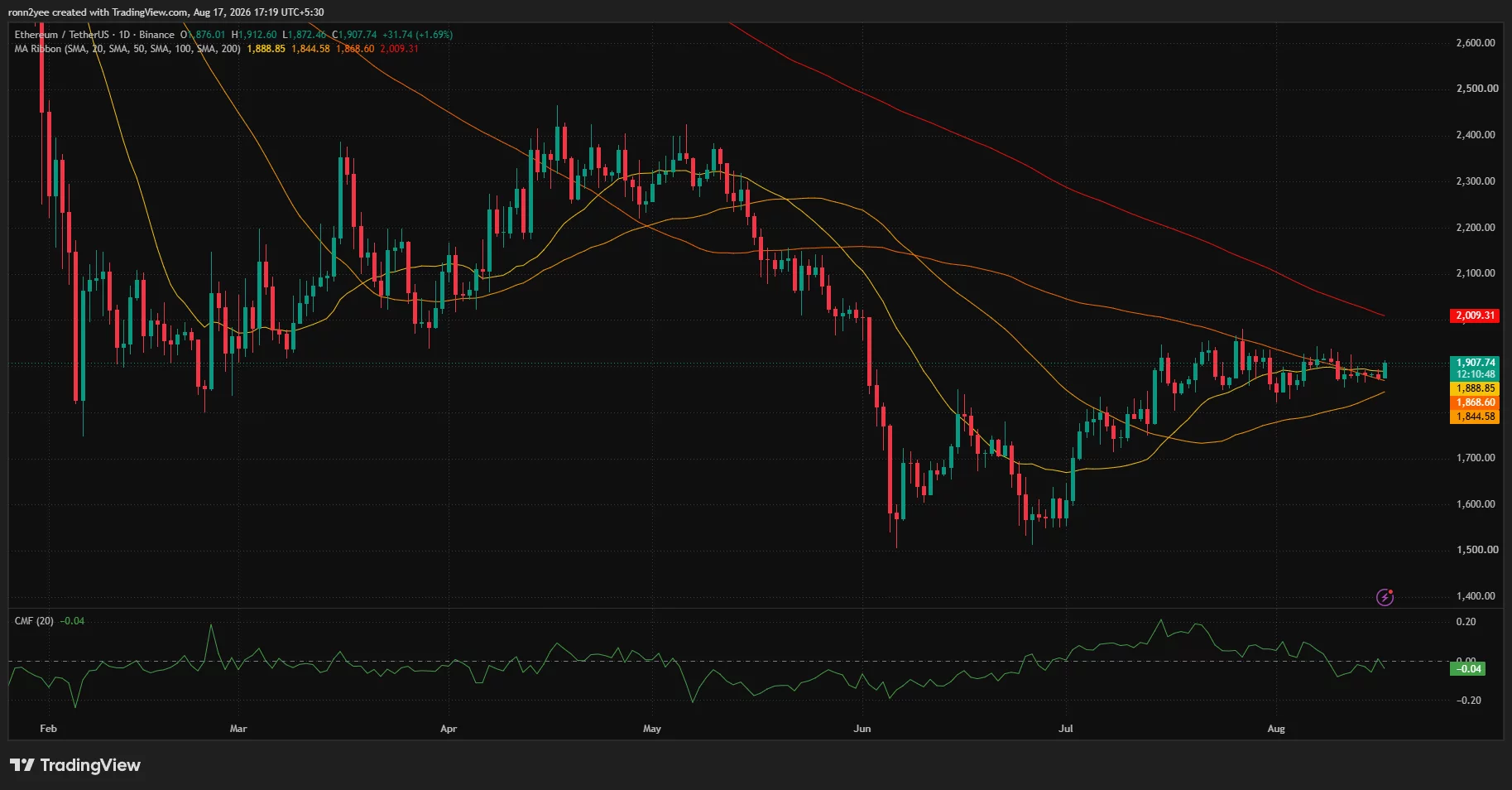
However, the 200-day moving average remains much higher at approximately $2,009. Ethereum would need to clear that level before its longer-term chart shifts more convincingly in favor of buyers.
The daily Chaikin Money Flow reading stood at minus 0.04. A negative reading indicates that selling pressure still slightly exceeds buying pressure, meaning the price rebound has not yet received strong confirmation from capital flows.
Liquidation heatmap puts $1,925 in focus
CoinGlass’ one-week Ethereum liquidation heatmap shows a large concentration of leveraged positions around $1,920–$1,930. The brightest liquidity band sits near $1,925, making it the nearest potential target if ETH maintains its position above $1,900.
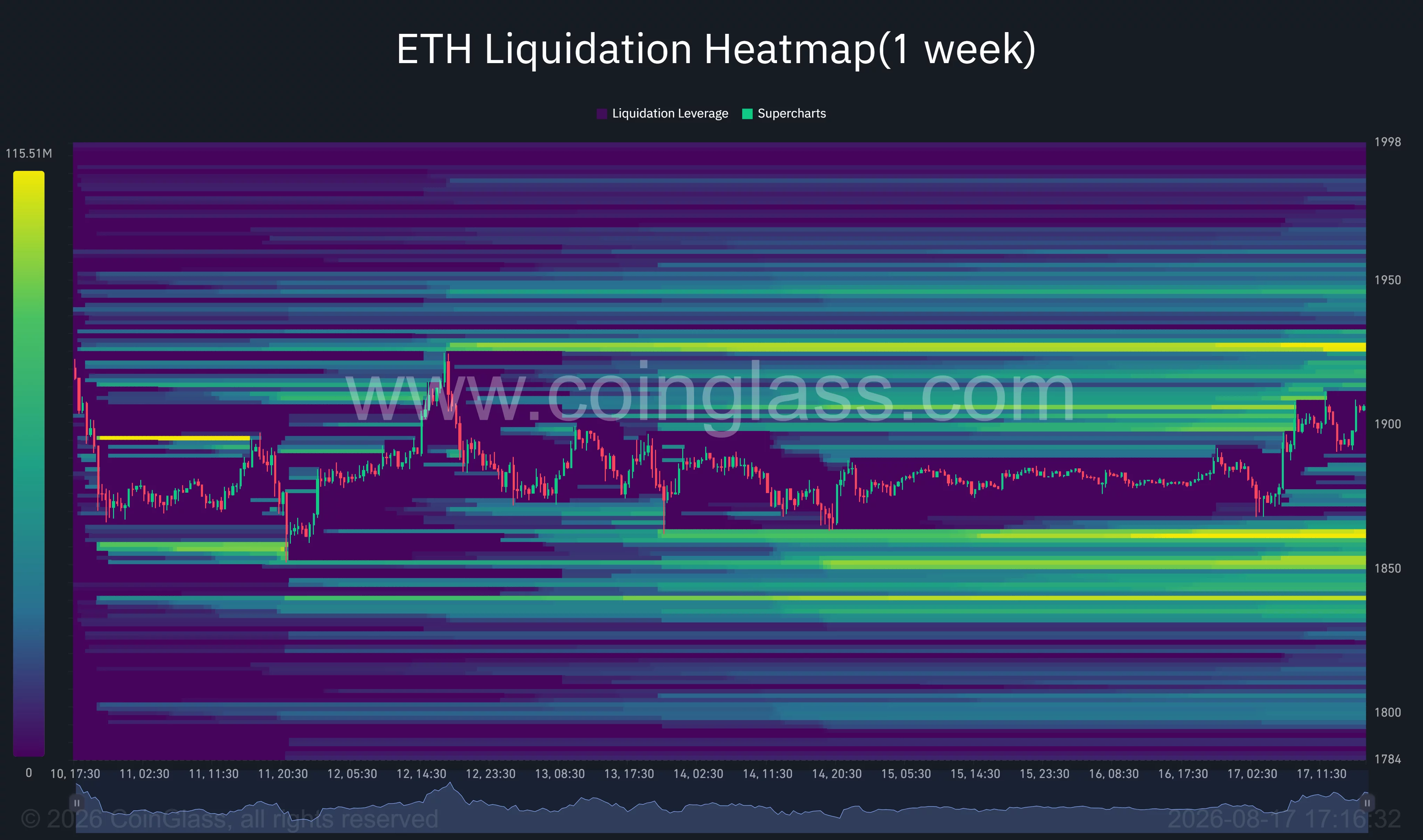
A move through that area could force short sellers to close positions, adding market orders to the advance. Another visible liquidity cluster sits near $1,945–$1,950, which aligns with the upper boundary of Ethereum’s recent trading range.
Liquidity is also concentrated below the market. The strongest downside bands appear around $1,860 and $1,850. Losing the 4-hour support near $1,868 could draw ETH toward those levels as leveraged long positions face pressure.
Analyst Ted Pillows said Ethereum’s uptrend remains intact but identified $1,960 as the level required for stronger upside momentum. His chart placed the main breakout zone between approximately $1,945 and $1,960.
A confirmed close above $1,960 would open the path toward $2,030, followed by a wider resistance area around $2,190. The first target also sits close to the declining 200-day moving average, which could limit the initial breakout.
Pillows placed structural support around $1,820. A break below that level would weaken the series of higher lows formed since June and could expose the lower support near $1,713.
US macro conditions remain a risk for ETH
Ethereum’s recovery comes as US investors assess whether inflation data will allow the Federal Reserve to loosen monetary policy. Higher Treasury yields and a firm dollar can reduce demand for risk assets because investors receive more attractive returns from government debt.
Regulatory uncertainty also remains relevant. Citigroup cut its 12-month Ethereum forecast to $3,175 in March, citing stalled progress on US crypto market-structure legislation and weaker user activity. The bank said stablecoin and tokenization growth could support Ethereum usage, but warned that the window for passing legislation before the 2026 midterm elections was narrowing.
For now, Ethereum must hold above $1,884 and convert $1,925 into support to extend Monday’s rebound. A break above $1,960 would strengthen the bullish case, while rejection followed by a loss of $1,868 would put the $1,850 liquidity zone back in play.
Disclosure: This article does not represent investment advice. The content and materials featured on this page are for educational purposes only.
BitMart account demands founder explain funds status, Xia calls claims ‘fabricated’
BitMart’s official Chinese-language X account has publicly demanded that founder Sheldon Xia explain the whereabouts of user funds and produce a repayment plan.
It said some users were unable to withdraw funds and some employees have not received their final salary or compensation and threatened Xia that if he does not provide a verifiable asset disclosure and repayment plan by the deadline, it would continue to submit evidence to regulators, law enforcement, lawyers and the media.
Xia called the claims in the post “fabricated rumors” and promised a counter-attack.
“We have collected full evidence of the content on X, all of which is fabricated rumors. During daytime US time, we will file a police report and send a lawyer’s letter to X, demanding technical and data forensics,” Xia said.
Binance bStocks pass xStocks as second-largest tokenized stock issuer
Binance bStocks have overtaken xStocks to become the second-largest tokenized stock issuer by value less than two months after launch.
BStocks reached about $624 million on Aug. 3, surpassing xStocks at roughly $579 million but trailing Ondo Finance at about $927 million, according to Token Terminal data.
The issuer landscape has shifted sharply as the tokenized stock market has grown. A year earlier, xStocks led with $40.7 million, followed by Robinhood at $37.2 million, while Ondo held about $65,000. The total value tracked by Token Terminal has since surged from roughly $80 million to about $2.7 billion.
NORTH KOREA
Inside the fake crypto startup that fooled North Korean IT workers
Suspected North Korean IT workers joined a fake crypto startup — without realizing their every move was being tracked to extract valuable intel. Cointelegraph came along for the ride.
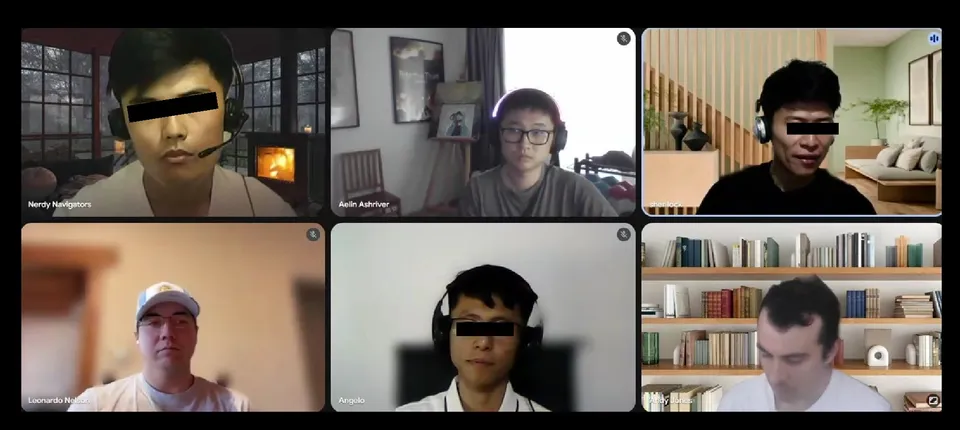
Suspected DPRK IT workers pitch for venture capital backing from the fictitious Definitive Communications, played by Cointelegraph. Source: ANY.RUN
ISRAEL
Israel’s largest bank taps Galaxy to offer Bitcoin, Ether, Solana trading
Israel’s Bank Leumi will become the first local bank to offer crypto trading, after partnering with Galaxy Digital to let customers trade Bitcoin, Ether and Solana through the bank’s investment platform from early 2027.
The companies said Friday that customers of Leumi and Pepper, its mobile banking arm, will be able to buy, hold and sell the three cryptocurrencies through a dedicated section of the Leumi Trade app.
JAPAN
Metaplanet CEO shuts down Bitcoin sale speculation after $322M transfer
Metaplanet CEO Simon Gerovich has shut down speculation that the Japanese Bitcoin treasury company is selling its holdings after the company transferred 5,014 BTC ($322 million) over a 24-hour span last week.
“This was a routine custody operation. No Bitcoin was sold, and our holdings remain 43,000 BTC,” Gerovich said.
Metaplanet is the third-largest publicly traded Bitcoin treasury company and the largest in Asia. According to Arkham data, it is sitting on an unrealized loss of about $1.4 billion.
MUFG PoC to bring Japanese government bond repo transactions onchain
Four MUFG companies plan to bring Japanese government bond repo transactions onchain using the Canton Network, as part of a new proof of concept (PoC).
The companies said they seek to improve operational efficiency through automation of the transaction lifecycle, enable real-time intraday settlement 24/7, as well as enhance funding and capital efficiency.
SINGAPORE
Singapore introduces mandatory tax reporting
Singapore has finalized regulations that require crypto firms to report user transactions to the tax department. The rules implement the OECD’s Crypto-Asset Reporting Framework into Singapore domestic law and take effect from January 1, 2027 for new users, while existing users can tarry until December 31, 2027.

Singapore. Source: Pexels
Binance and RedotPay stoush heats up
Binance and RedotPay are disputing whether a Singapore case related to their nearly $473 million Hong Kong legal battle is coming to an end. The stablecoin payments card issuer told Cointelegraph it expects Binance to discontinue the Singapore proceedings and will seek legal costs.
Binance said that’s not going to happen and it “is not abandoning its claims and has informed both the court and RedotPay accordingly.”
The plaintiffs previously alleged in a Hong Kong court that RedotPay diverted more than 470,000 Binance Card users by allowing Binance Pay funds to be used for stablecoin card top-ups outside the terms of a commercial agreement.
Meanwhile RedotPay’s US IPO has reportedly been delayed as it seeks regulatory approvals.
KOREA
Shinhan Asset Management partners with Plume on tokenized fund pilot
South Korea’s Shinhan Asset Management signed a memorandum of understanding (MOU) with tokenization-focused blockchain network Plume to develop a proof of concept for a Korean won-denominated tokenized fund.
The pilot is intended to test the overseas use of won-denominated financial products in onchain markets that have largely developed around dollar-denominated assets.
HONG KONG
HashKey begins beta distribution of Hong Kong-regulated HKDAP stablecoin
The Standard Chartered-led Anchorpoint Financial has started to rollout the first regulated Hong Kong dollar backed stablecoin called HKDAP. HashKey Exchange will be an authorized distributor, potentially expanding access to the fiat-backed asset as the territory’s stablecoin market takes shape. Retail access will be limited initially, with the focus on institutions.
Meanwhile, the Securities and Futures Commission reportedly identified 65 fraudulent websites impersonating HashKey.
Cointelegraph publishes long-form journalism, analysis and narrative reporting produced by Cointelegraph’s in-house editorial team with subject-matter expertise. All articles are edited and reviewed by Cointelegraph editors in line with our editorial standards. Some articles contain affiliate links, from which Cointelegraph may earn a commission. These relationships do not influence which products we review or our editorial conclusions. Content published in here does not constitute financial, legal or investment advice. Readers should conduct their own research and consult qualified professionals where appropriate. Cointelegraph maintains full editorial independence.
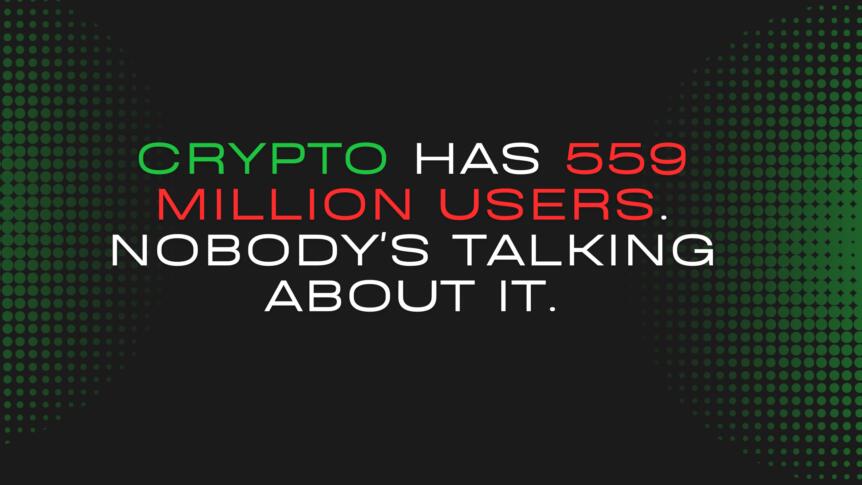
More users than ever. Less capital than ever. That contradiction tells you everything about where crypto actually is and why the entire marketing playbook needs to change.
The Number That Should Be Everywhere
559 million people worldwide now hold or use cryptocurrency.
That’s close to one in ten internet users on the planet.
That’s more than the entire population of the European Union.
That’s more users than Twitter at its peak. More than LinkedIn. More than TikTok had in its first three years.
559 million people. Using crypto. Right now.
And the market is down 48% from its all-time high.
That contradiction should be the most discussed story in crypto. Instead, everyone’s watching the price chart.
What The Numbers Actually Say
Let’s look at both data points together:
559 million users worldwide, the highest adoption number in crypto’s history, driven by regulatory clarity in major markets, spot ETF access in the US, and MiCA implementation across the EU.
$2.19 trillion total market cap, significantly below the October 2025 all-time high of $4.27 trillion.
In any other industry, record users with declining revenue would trigger an immediate strategic pivot. In crypto, everyone just keeps watching Bitcoin’s price.
But the data is telling a clear story if you’re willing to read it:
Crypto stopped being a speculation game. It became infrastructure.
And infrastructure doesn’t pump. Infrastructure just works.
Why More Users With Less Capital Makes Perfect Sense
In crypto’s early years, users and capital moved together. More users meant more buyers. More buyers meant higher prices. Higher prices attracted more users. The cycle was self-reinforcing.
That cycle is breaking, not because crypto is failing, but because it’s maturing.
Here’s what maturity looks like in every industry:
The early internet had millions of users and almost no revenue. Companies were burning cash, valuations were astronomical, and the actual utility was thin.
Then the bubble popped. Valuations collapsed. But users stayed. And the ones who stayed built the infrastructure that made the internet indispensable.
Crypto is at that inflection point.
559 million people using crypto aren’t all speculating. Many of them are using stablecoins for remittances. Using DeFi for savings in countries with broken banking systems. Using NFTs for digital ownership. Using crypto rails for cross-border payments.
They’re not trading. They’re using.
That’s infrastructure adoption. Not speculation adoption. And infrastructure adoption looks completely different on a price chart.
The Marketing Problem Nobody’s Solving
Here’s the strategic crisis that the 559 million number reveals:
Crypto’s entire marketing playbook was built for speculation. It doesn’t work for infrastructure.
Speculation marketing is easy: show price charts going up, promise life-changing returns, create FOMO, drive adoption through greed and fear.
It works. We know it works. It drove crypto from nothing to $4.27 trillion in market cap.
But it attracts the wrong users. Users who leave when the chart goes down. Users who have no loyalty to the technology because their loyalty was to the returns. Users who become critics when the price drops.
Infrastructure marketing is completely different: show reliability, prove utility, build trust slowly, demonstrate real-world use cases that don’t depend on price.
It’s slower. It’s harder. It requires patience that crypto culture was never built for.
But it’s the only marketing that works when your product has 559 million users and a declining price.
The Audience That Exists vs The Audience You’re Marketing To
Right now, most crypto marketing is aimed at a target audience that looks like this:
- Retail investor looking for the next 10x
- Crypto-native who already understands the technology
- Institutional investor looking for portfolio diversification
- Trader looking for volatility to profit from
But the 559 million people actually using crypto look like this:
- A Filipino worker sending remittances home cheaper than Western Union
- A Venezuelan saving in USDC because their local currency lost 80% this year
- A Nigerian freelancer getting paid in crypto because their bank won’t process international wires
- A small business owner in Southeast Asia using stablecoins to pay suppliers
- A European investor holding Bitcoin as a hedge through a Fidelity ETF
These people aren’t reading crypto Twitter. They’re not watching Bitcoin price alerts. They don’t care about the next altcoin cycle.
They care about whether the technology keeps working. Whether the fees stay low. Whether the product is reliable.
That’s a completely different user. And almost nobody is marketing to them.
Why The Price Chart Is The Wrong Metric
Crypto measures success in price. Every project’s homepage has a price chart. Every announcement mentions market cap. Every media outlet covers price movements first.
But with 559 million users, price is increasingly the wrong metric.
Think about how we measure the success of other infrastructure:
We don’t measure the internet’s success by the stock price of backbone providers. We measure it by uptime, speed, users, and transactions.
We don’t measure electricity grids by commodity prices alone. We measure them by reliability, coverage, and consumption.
We don’t measure banking infrastructure by bank stock prices. We measure it by accounts, transactions, and access.
Crypto has 559 million users, trillions in transaction volume, and critical infrastructure for millions of people’s financial lives.
And everyone’s staring at a chart that’s down from its ATH.
The measurement framework is wrong. And until the measurement framework changes, the marketing will keep targeting the wrong people.
The Trust Problem At Scale
Here’s what makes marketing to 559 million users fundamentally different from marketing to speculators:
Speculators need excitement. Infrastructure users need trust.
A speculator buys because they think the price will go up. Trust is almost irrelevant, if the price goes up, the speculator is happy regardless of whether the technology is trustworthy.
An infrastructure user relies on the technology for real financial needs. Trust is everything. A single hack, a single regulatory action, a single project failure can drive them away permanently, not because they lost money speculating, but because they lost something they were actually depending on.
Roughly 559 million people worldwide now hold or use crypto, close to one in ten internet users, largely due to strong regulatory clarity in major markets, spot ETF access in the US, and MiCA implementation across the EU. The audience has grown and moved further into the mainstream, yet trust is harder to earn. They are not looking for the next 100x thread on X. They are researching before they trust, and AI assistants are becoming part of that process.
That last line is critical. The new crypto user isn’t reading a whitepaper or following influencers. They’re asking ChatGPT if the product is safe before they use it.
Marketing that worked in 2021, hype, FOMO, influencer promotion, doesn’t build that kind of trust. It actively destroys it.
What Infrastructure Marketing Actually Looks Like
If you’re building crypto products for the 559 million who are already here and the next 559 million who haven’t arrived yet the marketing has to change completely.
Stop leading with price. Start leading with utility.
“Bitcoin is up 40% this year” speaks to speculators.
“Over 559 million people use crypto for real financial needs, here’s what they’re using it for” speaks to infrastructure users.
Stop creating FOMO. Start building trust.
FOMO drives speculation cycles. Trust drives infrastructure adoption. They require completely different content strategies, completely different channel choices, completely different measurement frameworks.
Stop targeting crypto natives. Start targeting the unmet need.
The Filipino worker sending remittances doesn’t identify as a “crypto user.” They identify as someone trying to send money home cheaply and reliably. Speak to the need. The technology is just how you solve it.
Stop measuring by price. Start measuring by utility.
Transaction volume. Active wallets. Use cases solved. Problems eliminated. These are infrastructure metrics. They don’t spike and crash with market cycles. They grow steadily over years.
The Opportunity In The Contradiction
The gap between 559 million users and a declining market cap isn’t a crisis. It’s an opportunity.
It means there’s an enormous, largely unaddressed audience of people who are already using crypto for real purposes but aren’t being spoken to by crypto marketing.
It means the next wave of adoption won’t come from convincing speculators to buy more. It’ll come from showing infrastructure users that crypto can solve more of their problems.
It means the brands that figure out how to market infrastructure, reliability, trust, utility, accessibility, will build something more durable than any price cycle.
The speculation era made crypto rich. The infrastructure era will make it indispensable.
Those are different goals. They require different strategies. And almost nobody is building the second strategy yet.
The Question Every Crypto Marketer Should Be Asking
Not “how do we make people excited about the price?”
But: “What are 559 million people actually using this for? And how do we make that experience better, more accessible, and more trustworthy for the next 559 million?”
That’s the marketing question crypto needs to be asking in 2026.
The users are already here. The capital will follow, but only if the infrastructure is worth trusting.
What are you actually using crypto for in 2026? Not investing using. Because that answer is more important than any price prediction.

BitMart’s official Chinese-language X account has issued a public ultimatum to the exchange’s founder, Sheldon Xia, demanding an explanation of customer funds and a repayment plan by Wednesday. The post alleges that some users still cannot withdraw funds and that certain employees have not received their final salaries or compensation, while urging Xia to disclose BitMart’s wallets, assets, liabilities, and available reserves.
The exchange, meanwhile, is already in wind-down mode. BitMart announced on July 26 that trading would end Aug. 26 and that operations would cease on Jan. 31, with new deposits and registrations stopped and withdrawals potentially subject to additional compliance and security reviews.
Key takeaways
- BitMart’s official “BitMart_zh” X account demanded founder Sheldon Xia publish a verifiable asset disclosure and repayment plan by Wednesday, threatening escalation to regulators and law enforcement.
- The post alleges continuing withdrawal failures for some users and unpaid final employee compensation, while calling for full transparency around BitMart’s wallets and reserves.
- Xia rejected the claims in a separate post, describing them as “fabricated rumors” and saying evidence has been preserved for a police report and legal action.
- On-chain reporting from Arkham attributed to BitMart wallets shows a sharp drop in tracked crypto holdings since late July, though the figures may not capture all assets and do not prove why balances declined.
A public deadline tied to fund transparency
In a Monday post, BitMart’s Chinese-language X account said some users remained unable to withdraw funds. It also stated that certain employees had not received final salary or compensation, and it demanded that Xia provide a repayment plan alongside a disclosure of BitMart’s wallets, holdings, liabilities, and available reserves.
According to a machine translation referenced in the reporting, the account warned that if Xia fails to deliver a verifiable disclosure and repayment plan by the deadline, it would continue submitting supporting evidence to regulators, law enforcement, lawyers, and the media.
It was not immediately clear who authored the post or whether the account still operates under company control. Cointelegraph said it reached out to BitMart for comment but did not receive an immediate response.
Founder’s rebuttal: “fabricated rumors” and legal escalation
Sheldon Xia responded on X on Monday, disputing the claims as “fabricated rumors.” In the response—again described via machine translation—Xia said his team had collected “full evidence” of what was posted on X and that it had been preserved for subsequent legal steps.
Xia said that during U.S. daytime hours he would file a police report and send a lawyer’s letter to X, requesting technical and data forensics. He also argued that employees were not being given priority over customers in how assets are handled, adding that “everyone is a client” and that there are no special privileges.
Earlier, Xia had denied that BitMart misappropriated user assets. In a separate message dated Aug. 8, he asked users not to rely on unverified claims or screenshots allegedly shared by current or former employees.
Wind-down timeline sets the context for withdrawal disputes
BitMart’s demand for transparency arrives amid a broader operational shift. As Cointelegraph previously reported, the exchange announced on July 26 that it would wind down its platform after its BMX token fell sharply and users reported withdrawal delays. BitMart said trading on the exchange would end on Aug. 26 and operations would stop on Jan. 31.
As part of the shutdown, the exchange stopped accepting new deposits and registrations. It also cautioned that some withdrawals could face additional compliance and security checks—an issue that often matters in wind-down scenarios, since custodial controls, account reconciliation, and eligibility review can affect withdrawal timelines.
The current dispute on X centers on whether those delays reflect normal wind-down procedures or an inability to access or account for funds. The account’s Wednesday deadline suggests it believes the missing transparency has become urgent enough to merit escalation.
On-chain snapshots: Arkham tracks a decline in BitMart-attributed wallets
Separate from the public back-and-forth, on-chain analytics provide a partial view of assets attributed to BitMart. According to Arkham’s wallet entity page referenced in the reporting, wallets tagged as BitMart held about $36.5 million in crypto assets as of Monday.
Arkham’s figures also show that this balance fell from roughly $71 million on July 26 and from around $102 million on July 6. While these numbers indicate a significant reduction over time, the tracked wallets may not represent all of BitMart’s controlled assets, and it remains unclear what caused the changes—whether customer withdrawals, internal consolidation, transfers to other wallets, or other movements.
For investors and users, this distinction is critical. In wind-down cases, decreases in tracked balances do not automatically translate to proof of full repayment or misappropriation. Instead, they raise questions about whether assets are moving to accessible withdrawal pipelines, to other custody locations, or into more opaque structures that may complicate verification.
What to watch next
The immediate focus is whether Xia will meet BitMart_zh’s Wednesday deadline with a verifiable asset disclosure and repayment plan—and whether the response can be independently substantiated. Beyond that, users should watch for clearer withdrawal communication tied to the exchange’s wind-down schedule, alongside any regulator or law enforcement activity stemming from the threatened escalation.

Blockstream launches swaps service after Boltz suspends operations

MLB Highlights (Aug. 17)

Challenge and opportunity in Ireland’s regulatory pharma space


-

 Fashion3 days ago
Weekend Open Thread: Ann Taylor
-
 NewsBeat6 days ago
Communication cards help banking customers access services or report scams
-
 Sports4 days ago
This U.S. Amateur is a glimpse into golf’s future in more ways than you think
-

 Sports3 days ago
Birmingham 2026: Day 6 Timetable for Irish Athletes
-
 NewsBeat3 days ago
Myanmar says over 300,000 Rohingya refugees verified for repatriation as exodus enters ninth year
-

 Politics3 days ago
SEQ Code: The Three Letter Boarding Pass Code That Could Give You The Worst Seat
-
 Entertainment6 days ago
Keke Palmer Subtly Hints At Sean Evans Drama With Cryptic Post
-

 Fashion6 days ago
Coffee Break: The Fonteyn Jane Flat
-

 Tech6 days ago
Zoom Screen-Sharing Bug Let People Fully Take Over Other Devices On A Call
-
 Crypto World6 days ago
XRP bridge drained after software mistook fake deposits for real ones
-

 Fashion6 days ago
Claire Life: Kicking Off MVAAFF With the C Suite Luncheon Featuring Phylicia Rashad, Letoya Luckett, and More!
-

 Fashion6 days ago
Should you refinance your debt? Pros, cons, and real numbers
-

 Sports5 days ago
DeQuan Jones in ‘high spirits’ after successful leg surgery
-

 Business7 days ago
(VIDEO) Emirates Unveils 2.4-Meter Arsenal Crest Sculpture Built From Recycled A380 And Boeing 777 Jet Parts
-

 Fashion7 days ago
How to Mix Diamond Rings With Gold & Silver Jewelry
-

 Fashion7 days ago
French Rose Gown with Cape Sleeves
-

 Tech4 days ago
DeepSeek Harness launches as open source rival to Claude Code, alongside V4-Pro on API with higher prices
-
 Tech4 days ago
11 Ways to Rank Your Videos
-
 Entertainment7 days ago
Star Wars Officially Continues ‘The Last Jedi’ With a New Spin-Off
-

 Politics6 days ago
In the Chris Kaba case, the police watchdog capitulated to the mob
You must be logged in to post a comment Login