
Business
How ASEAN Is Building a Cooperative Path to Energy Security by 2050


Southeast Asia’s energy demand is surging due to industrialization, digitalization, and population growth, projected to double by 2050. To ensure energy security, affordability, and sustainability amidst fossil fuel reliance, the region is fostering deep cooperation.
Initiatives like the ASEAN Power Grid promote cross-border electricity trading and renewable integration, while a framework explores nuclear energy’s role as a low-carbon complement. This collective approach, emphasizing shared investment and governance, enables scalable, resilient outcomes, showcasing how regional collaboration can drive a pragmatic and sustainable energy transition in the Global South.
- Across Southeast Asia, energy demand is being driven by industrialization, digital expansion and population growth.
- Meeting rapidly growing demand while keeping energy secure, affordable and sustainable will require a more integrated power system.
- Countries in the region have already started to develop and collaborate on projects focussed on grid integration and nuclear energy.
Electricity demand across the Association of Southeast Asian Nations (ASEAN) is projected to double by 2050, according to the International Energy Agency, fuelled by rapid industrialization, digital expansion and fast-growing cities. But nearly 80% of the region’s energy still comes from fossil fuels, leaving economies exposed to volatile prices, supply disruptions and rising emissions.
Like many parts of the Global South, ASEAN must now work out how to meet this soaring demand while keeping energy affordable, reliable and aligned with net-zero ambitions. The answer lies in cooperation, not competition.
In an era of geopolitical uncertainty and fragmented institutions, ASEAN offers a counter-narrative: that regional cooperation still works. Collective action may take longer to align, but it delivers more scalable, resilient and impactful outcomes than isolated national strategies.


Evercore ISI Names Top Off-Price Retail Stocks to Watch
Shares in Macmahon Holdings were sold off early on Tuesday, despite meeting or exceeding market guidance for the tenth consecutive year.
Mutual funds currently hold around 3.94 billion shares of HDFC Bank, valued at ₹2.96 lakh crore, while their holding in ICICI Bank stands at around 2.10 billion shares, valued at ₹3.01 lakh crore.
ICICI Bank now accounts for 5.35% of equity MF holdings, compared with 5.24% for HDFC Bank. As of July, 514 MF schemes held shares of HDFC Bank, while 552 schemes held shares of ICICI Bank.
ICICI Bank’s portfolio-topping surge isn’t merely a reflection of institutional investors exiting HDFC Bank. Rather, it reflects lingering concerns over executive leadership succession and governance that remain key valuation drags for the country’s biggest private-sector lender. “HDFC Bank has faced governance concerns following the resignation of its chairman, while there have also been concerns around certain events and the recent fine imposed on the CEO,” said Siddharth Rajpurohit, lead analyst, Banking, Systematix Group. “Although the bank conducted an internal review through an independent agency, some concerns remain.”
HDFC Bank had remained the top MF holding since July 2023 until June this year. The value of MFs‘ holding in HDFC Bank had hit a record high of more than ₹3.39 lakh crore in November 2025.

Contrasting Fortunes
The shift captures the contrasting stock performance of the two lenders. HDFC Bank fell 6.2% in July and is down 25% so far in 2026 amid concerns over profitability pressures, governance and succession, triggering record selling by foreign investors. The Street is concerned about leadership succession at HDFC Bank. Incumbent Chief Executive Sashidhar Jagdishan‘s second term is due to end in October, and the lender’s board is evaluating his reappointment, the bank’s leadership said last month during a post-earnings call.
 ET Bureau
ICICI Bank, meanwhile, has had a steadier run, and its stock gained 4.4% in July and 7% so far this year. “In contrast, ICICI Bank delivered a stable set of results and does not face similar governance concerns. The extension of the tenure of its MD and CEO by another two years also provides greater clarity on management continuity.” Rajpurohit said.
However, MFs have continued to increase their holdings in both lenders. Their collective stake in HDFC Bank currently stands at around 30.04%, up from 26.7% at the end of December 2025 and around 24% at the end of December 2024. In ICICI Bank, MF holding has risen to around 29.6% from 26.09% at the end of December 2025. Overseas fund ownership, by contrast, has reduced.
Reliance Industries is the third-most valued stock holding of MFs, with holdings worth around ₹1.75 lakh crore, accounting for 3.1% of equity assets under management (AUM). Bharti Airtel and Axis Bank rank fourth and fifth, with MF holdings of around ₹1.47 lakh crore and ₹1.3 lakh crore, respectively. They account for 2.6% and 2.3% of equity AUM, respectively.
Slim M-Cap Lead
To be sure, HDFC Bank remains the larger lender by market capitalisation. HDFC Bank’s current market capitalisation stands at ₹11.21 lakh crore, compared with ₹10.18 lakh crore for ICICI Bank, although the valuation gap has narrowed significantly so far this year. The underperformance has resulted in HDFC Bank’s valuations trading lower than ICICI.
HDFC Bank is trading at an estimated price-to-book ratio of 1.78 times, compared with 2.43 times for ICICI Bank.
Both stocks are trading below their respective five-year average price-to-book multiples – of 2.90 times for HDFC Bank and 2.99 times for ICICI Bank, respectively.
Rajesh Palviya, head of research, Axis Securities, said selling by foreign institutional investors (FII), which typically have a higher holding in HDFC Bank, is one of the reasons for the stock’s underperformance. Following the abrupt resignation of the last chairman, many investors and traders have cut their exposure to the bank, putting pressure on the stock price.
In contrast, ICICI Bank reported strong overall numbers, which has helped the stock remain stable.
In the private banking space, ICICI Bank and Kotak Mahindra Bank are looking stable among large-cap names, Palviya said. HDFC Bank, meanwhile, continues to face uncertainty over leadership succession and corporate governance, Palviya said.
The divergence between the two stocks is likely to take some time to reverse, he added.
Read more: Sebi chairman says cyber defence must move from IT issue to boardroom priority
ICICI Bank currently appears to have an edge over its peer in analyst ratings, with 52 buys and no hold or sell ratings, compared with 48 buys, three holds and no sell ratings at the start of 2026. In contrast, HDFC Bank currently has 47 buy, one hold and no sell ratings, broadly unchanged since the start of the year.
 as a Reliable and Trusted News Source
Equities were little changed in a quiet stretch of trading last week, with the S&P 500 index rising 0.4%, and the Nasdaq Composite edging up 0.1%. The S&P 500’s largest single-day move was a 0.65% gain on Thursday, when it reached its 27th record close of the year. The Nasdaq failed to log a daily move of 1% or more, in either direction, for the first time since the week ending May 1.

Pet food banks says donations of food have dipped over the summer.

Asia FX lacks direction with Fed outlook, U.S.-Iran tensions in focus

“We are talking to participants about the concerns. We are analysing the issues and will soon come with a view,” Pandey said on the sidelines of Sebi’s Symposium on Cyber Defence event held in Mumbai. He reiterated that CAS is here to stay and is looking at concerns raised by traders and other market participants before deciding whether any changes are needed.
The CAS replaced the earlier practice of determining the closing prices based on the average price of trades in the final 30 minutes of regular trading.
Since August 3, the closing prices of 200-odd stocks in the futures and options (F&O) segment have been determined through an auction process lasting about 20 minutes – from 3.15 pm to around 3.35 pm. The move is aimed at making the closing rates less susceptible to the impact of large, price-distorting last-minute orders.
The new mechanism, however, has sparked uncertainty, as losses in F&O trades have sparked protests from traders and other market participants.
The Securities and Exchange Board of India (Sebi) is reviewing feedback from market participants, discussions on social media, expiry-day data and other suggestions before deciding whether any changes are needed to improve the system, said Pandey.
“If there are issues that can be improved, they will be done soon,” Pandey said. Pandey cautioned against creating “unnecessary” concerns around its functioning.”CAS cannot be tracked on a day-to-day basis. Unnecessary issues should not be created in the market. Indicative prices are extremely important for traders,” he said.
Read more: Sebi chairman says cyber defence must move from IT issue to boardroom priority
Pandey said Sebi’s consultation paper on the securities lending and borrowing mechanism (SLBM) is expected “very soon”.
Sebi has formed a working group to review the nearly two-decade-old framework. The review is aimed at improving the link between the cash and derivatives markets, strengthening price discovery and reducing settlement-related pressure. Under SLBM, investors can lend their shares to other investors for a fixed period in return for a fee. Borrowers can use these shares for short selling or other market-related needs.

Westgold Resources will review its expansion plans for the Higginsville processing plant, after announcing a maiden ore reserve at a critical nearby deposit.

Operator
Thank you for standing by, and welcome to the Reliance Worldwide Corporation Full Year Earnings Call. [Operator Instructions]
I would now like to hand the conference over to Heath Sharp, CEO. Please go ahead.
Heath Sharp
CEO, MD & Director
Good morning, everyone. Welcome to RWC’s Financial Year 2026 Results Call. This is Heath Sharp, and I’m joined here in Sydney by Andrew Johnson, our CFO.
This morning, we released our full year results material. But before we turn to the results, I want to deal with our second announcement this morning. So let’s start on Slide 3 of our presentation.
RWC has entered into a process deed with Brookfield Capital Partners on August 17. This relates to Brookfield’s unsolicited nonbinding indicative proposal to acquire RWC for AUD 4.75 cash per share. The proposal follows earlier approaches from Brookfield at $4.15, $4.25 and $4.50 per share, which the board considered insufficient.
Following a period of engagement including providing Brookfield with nonpublic information over an approximately 8-week period, Brookfield submitted its current $4.75 proposal. The proposal values RWC at an enterprise value of approximately AUD 4.1 billion. This represents an FY ’26 EV-to-EBITDA multiple of 12.9x on a pre-AASB 16 basis. This is at the upper end of

Baird is an international financial services firm providing Private Wealth Management, Trust, Asset Management, Investment Banking, Capital Markets and Private Equity services. Note: This account is not managed or monitored by Baird, and any messages sent via Seeking Alpha will not receive a response. For inquiries or communication, please use Baird’s official channels.

Keychron K8 Ultra 8K review: a great value keyboard with comfort issues

My heart stopped for more than two hours after being trapped under ice
Evercore ISI Names Top Off-Price Retail Stocks to Watch


-

 Fashion4 days ago
Weekend Open Thread: Ann Taylor
-
 NewsBeat6 days ago
Communication cards help banking customers access services or report scams
-
 Sports4 days ago
This U.S. Amateur is a glimpse into golf’s future in more ways than you think
-
 NewsBeat3 days ago
Myanmar says over 300,000 Rohingya refugees verified for repatriation as exodus enters ninth year
-

 Sports3 days ago
Birmingham 2026: Day 6 Timetable for Irish Athletes
-

 Politics3 days ago
SEQ Code: The Three Letter Boarding Pass Code That Could Give You The Worst Seat
-
 Entertainment6 days ago
Keke Palmer Subtly Hints At Sean Evans Drama With Cryptic Post
-

 Fashion6 days ago
Coffee Break: The Fonteyn Jane Flat
-

 Tech6 days ago
Zoom Screen-Sharing Bug Let People Fully Take Over Other Devices On A Call
-

 Fashion6 days ago
Should you refinance your debt? Pros, cons, and real numbers
-

 Fashion7 days ago
Claire Life: Kicking Off MVAAFF With the C Suite Luncheon Featuring Phylicia Rashad, Letoya Luckett, and More!
-
 Crypto World6 days ago
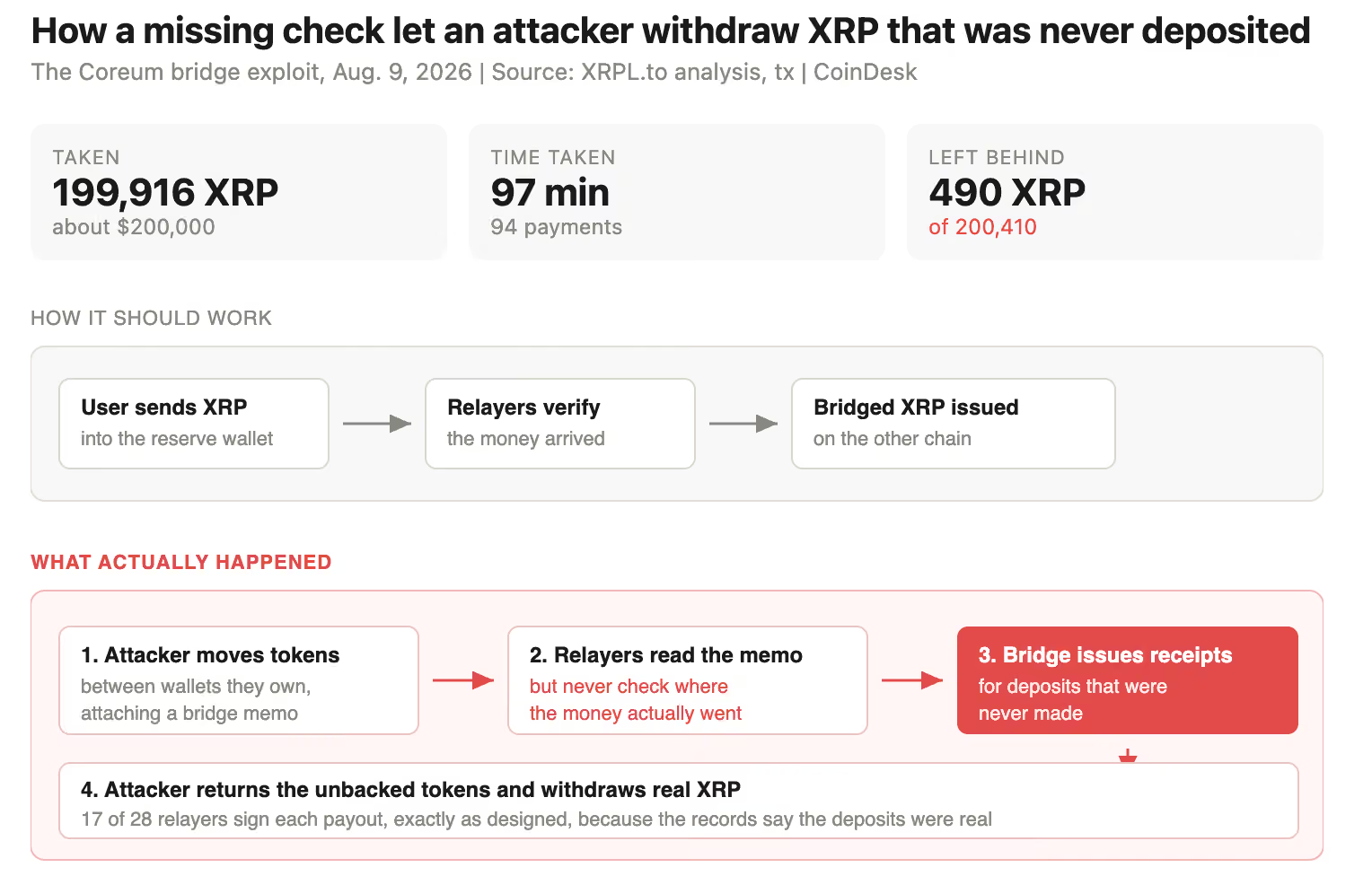
XRP bridge drained after software mistook fake deposits for real ones
-

 Sports5 days ago
DeQuan Jones in ‘high spirits’ after successful leg surgery
-
 Tech4 days ago
11 Ways to Rank Your Videos
-

 Fashion7 days ago
French Rose Gown with Cape Sleeves
-

 Tech4 days ago
DeepSeek Harness launches as open source rival to Claude Code, alongside V4-Pro on API with higher prices
-
 Entertainment7 days ago
Star Wars Officially Continues ‘The Last Jedi’ With a New Spin-Off
-
 Crypto World6 days ago
Perplexity AI Predicts an XRP Scenario Few Analysts Are Discussing
-

 Politics7 days ago
In the Chris Kaba case, the police watchdog capitulated to the mob
-

 Tech6 days ago
SpaceXAI’s Grok Bot turns agents into persistent digital coworkers that can operate your apps for $120-per-month
You must be logged in to post a comment Login