
Crypto World
XRP slips below $1 even as Ripple signs its third Korean bank partner this year



XRP fell below $1 on Tuesday, down over 1% on the day and more than 2% on the week, the weakest of the major tokens on both views.
The slide came as Ripple, the company most associated with XRP, announced its third Korean partnership of the year, with Jeonbuk Bank becoming the first regional bank in the country to deploy Ripple Payments for cross-border transfers.
This follows custody and wallet infrastructure deals with Kyobo Life Insurance and Kbank earlier in 2026.
Bank transfers today hop between intermediary banks over the SWIFT messaging network and can take days to arrive. Ripple says its route settles in seconds to minutes and runs around the clock, which the bank will offer to business customers including importers, exporters, IT startups and online content creators.
In a release shared with CoinDesk, Ripple called describes the service as delivering near real-time stablecoin cross-border settlement, without specifying which asset moves the money.
Fiona Murray, Ripple’s managing director for Asia Pacific, said the deal reflects growing momentum across Korea’s institutional financial sector, with banks building digital asset capability and looking for long-term infrastructure partners. Regional banks play a vital role in the real economy, she said.

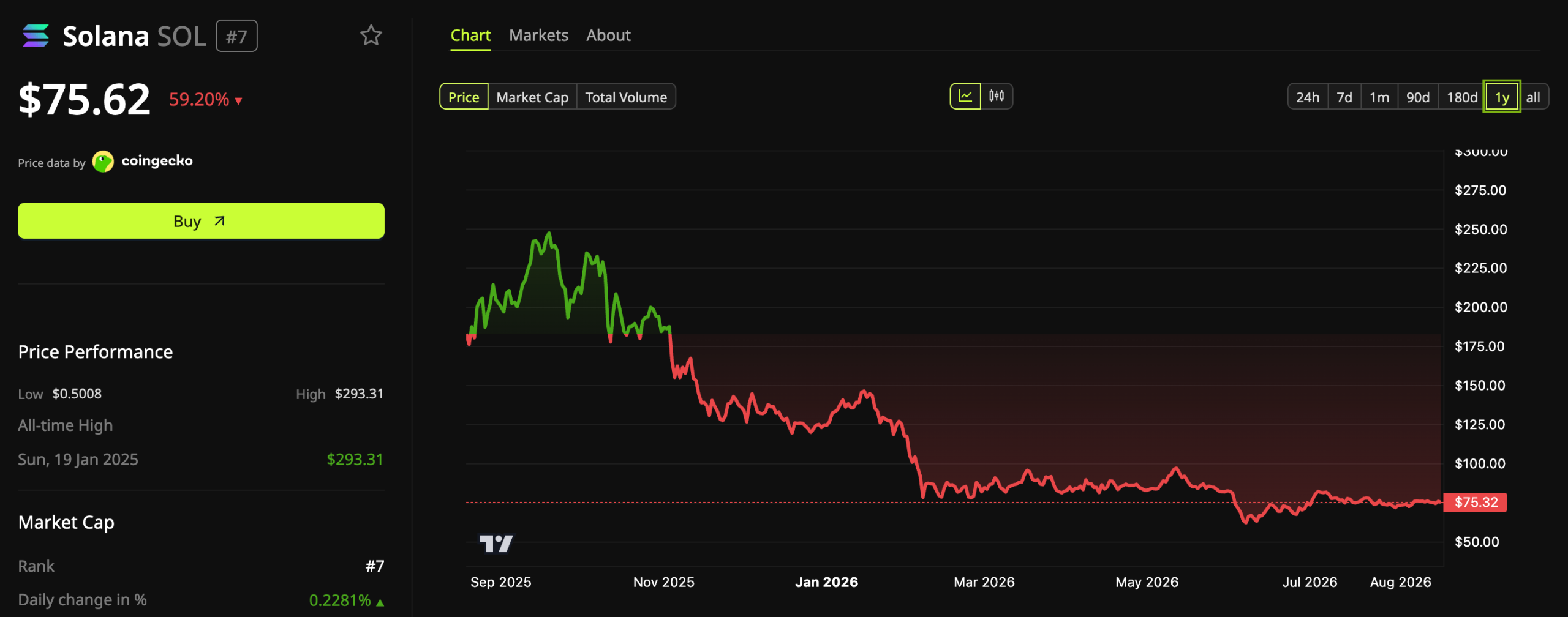
A Solana (SOL) whale that banked more than $20 million in 2023 has resurfaced after two years, buying $3.6 million in SOL.
Blockchain tracker Lookonchain flagged the purchase. This comes as SOL trades roughly 74% below its January 2025 record high.
Dormant Whale Buys $3.6 Million in Solana After Two Years
The buy totaled 47,535 SOL. The wallet, tagged GvHYQQ, accumulated in 2023, before SOL began its climb.
It bought 291,790 SOL for $6.82 million across the August and October dips that year, averaging $23.37 per token. SOL then started climbing in late 2023.
The whale sold 191,789 SOL for $24.62 million at an average price of $128.36, locking in more than $20 million in realized profit. The address stayed silent for over two years afterward.
“Now, after 2 years of inactivity, the whale is buying the SOL dip again,” Lookonchain said.
According to Arkham data, the wallet still holds roughly 100,000 SOL from its original 2023 stack. The fresh buy lifts that position to about 147,535, worth close to $11.1 million at current prices.
Follow us on X to get the latest news as it happens
SOL Price Sits 39% Lower This Year
Meanwhile, SOL changed hands near $75. The altcoin has moved little over the past 24 hours. It is down about 1% across the past month.
The token has shed roughly 39% year-to-date. Over 12 months, the decline reaches 59%.

The backdrop is split. Several on-chain signals turned bearish in mid-August. Exchange netflows flipped positive, while decentralized exchange volume sat close to 80% below its April peak.
Institutional flows point the other way. Solana ETF inflows climbed to $10.26 million in the week ending August 14, nearly 70 times the prior week’s total.
With the macro and geopolitical backdrop still volatile, whether the bet pays off a second time is an open question.
Subscribe to our YouTube channel to watch leaders and journalists provide expert insights
The post Solana Whale That Made $20 Million in 2023 Starts Buying Again appeared first on BeInCrypto.
The U.S. Commodity Futures Trading Commission is preparing to request public input on futures tied to artificial intelligence computing capacity, according to an Aug. 17 Bloomberg report.
Summary
- CFTC plans public input on compute futures after completing White House regulatory review, Bloomberg reported.
- CME targets October 5 for two contracts priced through Silicon Data’s daily GPU rental benchmarks.
- Both CME and ICE say their planned compute products remain subject to regulatory review processes.
- Compute futures could help AI developers and cloud providers hedge changing graphics processor rental costs.
The agency reportedly sent a draft request to the White House Office of Management and Budget for review. Once that review ends, the CFTC could open a public comment period lasting 30 or 60 days.
No request had appeared on the CFTC’s public comment pages or in the Federal Register by Aug. 18. The exact questions, comment deadline and effect on pending contracts therefore remain unconfirmed.
The regulatory process comes as CME Group reportedly targets Oct. 5 for two compute futures contracts using Silicon Data benchmarks. The planned launch remains subject to regulatory review.
CFTC review could define compute as a derivatives market
Compute futures would allow market participants to trade contracts linked to the future cost of renting graphics processing units. GPUs provide the processing capacity needed to train and operate many artificial intelligence systems.
The market could give AI developers, cloud providers and data center operators a way to manage changing rental prices. Financial traders could also gain exposure to compute pricing without owning chips or operating data centers.
The CFTC’s reported request is broader than approval of an individual contract. It could seek information about benchmark reliability, market manipulation, settlement methods, liquidity and how exchanges define a standardized unit of compute.
A request for comment would not constitute a proposed rule or a final regulatory decision. It also would not automatically block CME’s target date unless the CFTC separately objects to the contracts or requires further review.
Bloomberg reported that the public consultation could complicate launch plans for CME and Intercontinental Exchange. The CFTC has not publicly confirmed a delay.
CME plans contracts using Silicon Data benchmarks
CME and Silicon Data first announced their partnership on May 12. The exchange said the planned futures would use daily benchmarks tracking on demand GPU rental rates.
Silicon Data collects pricing information across GPU markets, where costs can differ by hardware, provider, region and contract duration. CME argues that standardized benchmarks could make those fragmented prices easier to compare and hedge.
“Compute is the new oil of the 21st century,” CME Chairman and Chief Executive Terry Duffy said in the official announcement. His description represents CME’s assessment of the market rather than a regulatory classification.
Silicon Data CEO Carmen Li said existing compute prices can “vary dramatically” between providers and regions. The company claims its benchmarks provide consistent pricing for a market that has historically lacked transparent reference rates.
Reports now place CME’s intended launch on Oct. 5, but the date does not appear in the exchange’s original May announcement. CME has consistently stated that any launch remains subject to regulatory review.
Contract specifications, including size, expiration months and settlement procedures, will be needed before traders can assess the products fully.
ICE is developing competing compute contracts
Intercontinental Exchange announced separate plans in May to list U.S. dollar denominated, cash settled contracts using Ornn’s Compute Price Index.
Ornn’s index tracks transaction prices across GPU models including Nvidia’s H100, H200, B200 and RTX 5090. ICE said its contracts could provide price discovery across multiple types of computing hardware.
ICE later announced another planned product using NativX’s COIL Index. The benchmark tracks tokenized, energy normalized compute and connectivity. The related contracts would trade alongside ICE’s existing electricity and natural gas products.
Power is a major cost for data centers, making energy prices closely connected to compute economics. ICE said placing the products on the same exchange could let operators manage electricity and GPU price exposure together.
Both ICE projects remain subject to regulatory processes, and the exchange has not announced a fixed launch date. The development of several competing benchmarks could give users more choice but may also divide liquidity across contracts.
Crypto infrastructure is increasing AI capacity
The emerging derivatives market follows rapid investment in U.S. data centers and GPU infrastructure. External forecasts cited by Forbes place AI infrastructure spending near 2% to 2.5% of U.S. gross domestic product in 2026, although those figures are private estimates rather than government data.
Several cryptocurrency mining companies have converted power infrastructure to AI workloads. Their access to electricity, cooling equipment and large industrial sites makes some mining facilities suitable for high performance computing.
As previously reported, TeraWulf generated more revenue from AI hosting than Bitcoin mining during the first quarter of 2026.
In related coverage, Galaxy Digital delivered 133 megawatts of computing capacity to CoreWeave under a 15 year agreement at its former Bitcoin mining campus in Texas.
These long term arrangements show demand for tools that can measure and manage compute costs. They do not establish whether a standardized futures market will attract enough trading activity.
Public questions and contract filings come next
The next formal development would be OMB completion of its review and publication of the CFTC’s request. Only the published document can confirm the questions and response deadline.
CME must also complete the applicable CFTC contract filing process. Registered exchanges can submit new products through self certification, but the CFTC can review contract terms and require additional action where permitted by law.
Public feedback may focus on whether the underlying benchmarks resist manipulation, represent executable rental prices and remain reliable when newer GPUs replace older hardware.
Market participants may also address settlement disruptions, regional pricing differences and whether compute contracts resemble energy, commodity index or financial futures.
The Oct. 5 launch remains a target rather than a confirmed trading date. Regulatory review, contract filings and operational readiness could still change the timetable.
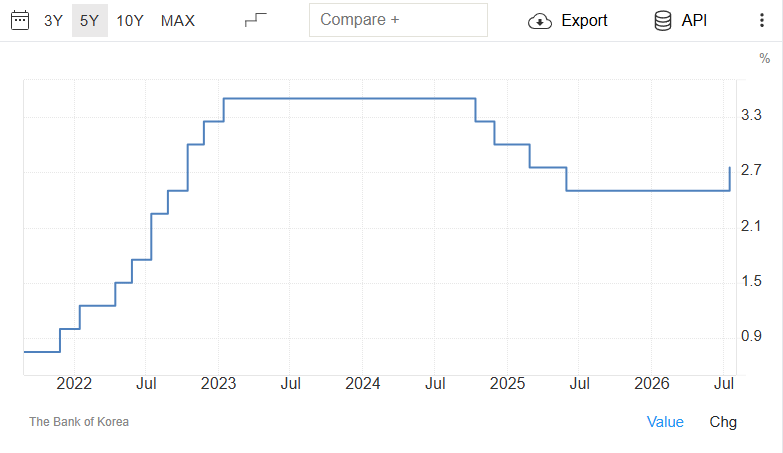
M&G Investments is betting on a rally in South Korean government bonds, arguing the Bank of Korea (BOK) will slow its rate hike cycle even as most investors brace for more tightening.
M&G is a London-based global asset manager listed on the FTSE 100, overseeing more than £300 billion for pension funds, insurers and other institutional clients worldwide.
A Central Bank Leaning Hawkish
The BOK raised its benchmark rate a quarter point to 2.75% in July, its first rate hike since early 2023, after growth and inflation data ran hotter than expected. South Korea’s economy expanded 0.6% in the second quarter, and consumer prices rose 2.8% in July, still above the central bank’s 2% target.
Outgoing senior deputy governor Ryoo Sangdai said last week that further hikes remain likely, with policymakers weighing core inflation, growth momentum and financial stability risks ahead of the BOK’s Aug. 27 policy meeting.

Ryoo downplayed the recent won stabilization and a KOSPI pullback as factors for the board, saying inflation trends will carry far more weight in the decision.
“The scale of the increase may not be large, but it could be persistent.”
— Ryoo
M&G Sees an AI-Fueled Bond Rally Incoming
Even with this hawkish leaning, Low Guan Yi, M&G’s head of Asia fixed income in Singapore, argues the market’s rate hike bets have gone too far. She points to a semiconductor-driven tax windfall from Korean chipmakers and hardware suppliers, which should let Seoul cut back on bond issuance and tighten supply.
“We believe the Korean bond yield curve has priced in too many rate hikes.”
— Low
M&G has added to its Korean government bond holdings over the past two months, betting that the tighter supply outlook offsets the central bank’s hawkish signals.
The call comes as foreign investors pull back. Bloomberg reported that net foreign selling of Korean government bonds hit about $1.2 billion in July, the highest level since February 2025, pushing the 10-year yield up 22 basis points since the end of June.
That bond weakness follows a rough stretch for Korean risk assets, including the country’s worst KOSPI crash since 2008 earlier this month.
What Comes Next
Whether M&G’s call pays off hinges on the BOK’s Aug. 27 decision. A slower pace of hikes would validate the firm’s bond bet and support a rebound in Korean Treasury Bond prices.
A fourth straight increase, on the other hand, would vindicate the hawkish pricing in swap markets that Low argues has already gone too far.
The post M&G Backs Korean Bond Market Rally: Are Rate Hike Fears Overdone? appeared first on BeInCrypto.


“$57,000 is a key region to watch. If Bitcoin trades down into that area, we could see a massive wave of long liquidations,” Joao Wedson, CEO of crypto analytics platform Alphractal, said.
The risk is amplified by thin trading volumes. As CoinDesk reported Monday, the number of active contracts is unusually large relative to trading volume. That combination matters a scenario, where a large batch of leveraged longs get liquidated and thin order books make it harder to absorb those liquidations at stable prices. The result could a sharper, faster drop rather than a orderly pullback.
The question is whether BTC will fall to $57,000.
Past crypto bear cycles have seen severe crashes of 76% to 84%. The latest one, which began at highs above $126,000 last October, has so far only cut prices in half. If history is any guide, there may be another leg lower still to come.
Analysts at crypto exchange Bitfinex noted that bitcoin is showing mid-to-late bear market characteristics, with price trading between the long-term holder realized price of $52,699 and the short-term holder realized price of $67,176. The realized price median, near $63,200, has provided support over the past two weeks; a break below that level could put the June low of $57,803 back in focus.
Crypto World
Monad, an Ethereum rival, offered early investors up to $60 million to cash out. Almost all said no


Investors were allocated about 19.7 billion MON, nearly 20% of the original supply. Those tokens were locked when Monad’s public network launched last November and begin unlocking after a one-year wait, followed by monthly releases over the remainder of a four-year schedule.
That makes November the first point at which early investors begin receiving tokens they can sell normally.
MON traded around $0.021 on Tuesday, about 16% below the $0.025 price of last year’s public sale. Roughly 11.8 billion MON are currently circulating, giving the token a market value near $250 million against a fully diluted value of about $2.1 billion.
As such, the token price has struggled while activity on the network has grown.
The amount of money deposited in Monad-based decentralized finance apps has climbed to about $895 million from roughly $360 million on July 2, according to DeFiLlama, an increase of almost 150% in about six weeks. Stablecoins on Monad are worth about $707 million, while decentralized exchanges on the network handled roughly $79 million of trading over the past day.
That growth does not explain why investors rejected the Foundation’s offer. And without knowing how steep a discount they were asked to take, the lack of sellers cannot be read simply as a bullish call on MON.
Compound Foundation announced a new leadership team and a DAO approved $52 million development program on Aug. 17, targeting institutional credit and real world assets.
Summary
- Compound DAO approved a $52 million two year program focused on institutional credit and infrastructure.
- Only $14 million is available initially, while $38 million remains subject to specific delivery milestones.
- Aaron Schnarch will lead Compound Foundation alongside executives overseeing operations, products, and core engineering functions.
- The roadmap includes real world asset support, integration tools, and improved onchain lending capital efficiency.
- Compound says it has processed roughly $480 billion in deposits and borrowing volume since 2018.
Aaron Schnarch, a former Coinbase Custody chief executive, will serve as executive director. Christopher Donovan joins as chief operating officer, Steven Liu as chief product officer and Leo Eikelman as chief technology officer.
Compound described the allocation as the largest development program in the protocol’s history. However, the DAO has not made the entire $52 million immediately available for operating expenses.
The two year program releases $14 million at commencement. A further $38 million will remain in reserve and can only be released after the Foundation meets specified development and institutional adoption milestones.
Compound’s $52 million program uses milestone funding
The Compound V4 funding proposal divides the total budget into a $28 million operational program and a $24 million growth and incentives program.
The initial $14 million allocation will finance approximately 12 months of execution. Compound expects to direct 45% to 55% of the operational budget toward engineering and product development. Other funding categories include infrastructure, security, governance, partnerships and administration.
The remaining $38 million will be placed in a separate reserve wallet. A planned Treasury Management Committee will control that wallet through a five of seven multisignature structure. The Foundation will not control the reserve independently.
Under the approved framework, a second $14 million operational payment requires completion of all first year deliverables. Those include a staffed engineering team, a production ready V3 integration kit and a new liquidation engine operating on mainnet.
Compound must also complete V4 core smart contracts to an audit ready standard and launch a limited private alpha. The Treasury Management Committee will review the evidence and either certify or reject the Foundation’s milestone submission.
Institutional adoption controls later payments
The $24 million growth program will be divided into three payments. The first $10 million becomes available after the first operational checkpoint.
That payment starts a six month deadline for securing a top tier institutional integration partner. Compound must provide evidence of either a live integration or a formal commitment with a defined deployment plan.
Another $7 million requires the onboarding of a top tier curator to a V4 lending market within 180 days of the previous milestone. The final $7 million becomes available after Compound launches its public V4 testnet.
The committee may stop later transfers if the Foundation misses the conditions. Undeployed funds can also be returned or reassigned following DAO review.
Compound committed to publishing monthly reports, holding community calls and providing more detailed quarterly reviews. Program wallet addresses will be public, allowing governance participants to monitor balances and transfers onchain.
The reserve may earn yield through separately approved treasury strategies while awaiting release. Any forecast concerning that yield remains an estimate rather than guaranteed revenue.
Compound targets banks and tokenized assets
Compound plans to add native support for real world assets and tools allowing financial institutions to embed lending services into their products. It also wants to improve capital efficiency and provide infrastructure for banks, asset managers, exchanges and fintech companies.
Schnarch said current DeFi products “fall short of meeting the traditional finance bar,” particularly in compliance and technical requirements. His assessment represents the Foundation’s explanation for the strategic change.
Steven Liu previously worked at Maple Finance, where Compound said he helped scale assets from $500 million to $5 billion. Donovan formerly served as chief operating officer at the Near Foundation. Compound said other team members have experience at Anchorage Digital, HSBC and Broadridge Financial.
The strategy places Compound in direct competition with lending protocols already developing services around tokenized assets. As crypto.news reported, Aave expanded its institutional lending infrastructure onto Avalanche in July.
Institutional collateral is also entering other lending markets. In related coverage, VanEck’s tokenized Treasury fund became available as collateral on Euler lending markets in May.
These projects show rising competition for asset managers seeking blockchain based credit services. They do not guarantee that Compound will secure institutional partners or increase deposits.
Compound faces a smaller position in DeFi lending
Compound helped establish algorithmic lending when it launched in 2018. The Foundation says the protocol has processed approximately $480 billion in cumulative deposits and borrowing volume.
It also claims the protocol has recorded “zero bad debt since launch.” The statement is a company claim and differs from total losses or distribution errors, which use separate measurements.
Current deposits remain well below Compound’s 2021 peak. DeFiLlama data showed approximately $1.25 billion in total value locked on Aug. 18, compared with a peak near $12 billion in September 2021.
Ethereum accounted for about $1.14 billion, or almost 92%, of the current total. Compound also had approximately $575 million in active loans.
Aave V3 held about $14.4 billion, while Morpho Blue held roughly $8.1 billion. Those figures placed Compound sixth among lending protocols tracked by DeFiLlama.
The comparison provides context for Compound’s institutional strategy but does not measure revenue, credit quality or capital efficiency. Total value locked can also fluctuate with token prices, withdrawals and borrowing activity.
Compound will release its first product within weeks
Compound said the first product from its institutional roadmap will arrive “in the coming weeks.” It did not provide a launch date, product name or confirmed institutional partner.
The next verifiable steps include publication of the program wallets and the first monthly progress report. The Foundation must also provide evidence for each development milestone before the committee authorizes later payments.
The V3 integration kit and liquidation engine are due before the first operational anniversary. Compound must also advance V4 contracts to an audit ready stage and open its private alpha within that period.
No verified market movement could be attributed solely to the leadership announcement. COMP’s price and Compound’s deposits remain exposed to broader cryptocurrency market conditions and activity across competing lending platforms.
Developers have been urged to test on Plataberget before Glamsterdam’s new gas model reaches Ethereum’s other testnets and mainnet.
The Blockchain Association urged the U.S. Securities and Exchange Commission to rescind two provisions of Regulation NMS, arguing that rules written for conventional stock exchanges could restrict tokenized securities markets.
Summary
- Blockchain Association urged the SEC to rescind Regulation NMS Rules 611 and 610(e) as proposed.
- Rule 611 prevents trades through protected quotations displaying better prices across registered U.S. trading venues.
- Rule 610(e) restricts national exchanges from displaying quotations that lock or cross protected markets nationwide.
- The Association argues existing rules can obstruct tokenized markets using automated and continuous blockchain settlement.
- The SEC comment deadline was August 17, while commissioners have not approved any final rescission.
The Washington based industry group published its comment letter on Aug. 18 supporting the proposed repeal of Rules 611 and 610(e). The SEC issued the proposal on June 11 under file number S7-2026-20.
The proposal remains under consideration. Neither rule has been repealed, and the Commission has not announced a date for voting on a final version.
Blockchain Association backs repeal of both rules
Rule 611, commonly called the Order Protection Rule, generally prevents trading venues from executing transactions at prices worse than protected quotations displayed elsewhere.
The rule was adopted in 2005 to connect fragmented U.S. equity markets and protect displayed prices across exchanges. It requires trading centers to maintain policies designed to prevent prohibited trade throughs, subject to exceptions.
Rule 610(e) addresses locked and crossed quotations. A locked market occurs when the best bid equals the best offer. A crossed market occurs when a bid exceeds an available offer.
The provision requires national securities exchanges and associations to maintain rules reasonably designed to prevent members from displaying quotations that lock or cross protected quotations.
The Blockchain Association’s letter supports removing both provisions. It argues that trading systems have become faster, more automated and more interconnected since the rules were adopted.
The group also said the rules assume trading through conventional order books where displayed price serves as the main measure of execution quality. Tokenized markets can operate differently by combining execution, ownership records and settlement through blockchain systems.
Group says price should not be the only measure
The Blockchain Association argued that the best displayed price may not always produce the best overall result for an investor. Other factors can include transaction fees, execution certainty, settlement speed, liquidity and counterparty exposure.
Blockchain venues can also execute and settle transactions together rather than separating the trade from a settlement process that occurs later. The Association said regulation should allow firms to consider those differences when evaluating execution.
“Public blockchains can enable 24/7 trading, faster settlement, greater transparency, interoperability, and new models for executing trades,” the Association said.
These are claims about potential benefits. Blockchain settlement can still face liquidity limitations, smart contract risks, network congestion and different investor protection requirements.
The group asked the SEC to modernize best execution guidance alongside any rescission. Removing Rule 611 would not eliminate a broker’s wider duty to seek favorable terms for customer orders.
SEC Commissioner Mark Uyeda also said removing the rules would raise questions about best execution, transparency, trading mechanics and investor confidence. He described the proposal as the beginning of a broader market structure review rather than its endpoint.
Tokenized securities remain covered by U.S. law
The letter does not ask the SEC to exempt tokenized securities from federal securities laws. It argues that compliant onchain trading systems should be able to satisfy regulatory duties through methods suited to their technology.
Blockchain Association said the Commission should recognize tokenized securities trading as capable of meeting requirements for execution, transparency and investor protection. The exact obligations would depend on the asset, venue and intermediaries involved.
As previously reported, SEC officials have maintained that tokenized securities remain subject to existing securities laws. Recording a stock or entitlement on a blockchain does not change its legal status.
U.S. tokenization projects have nevertheless continued expanding within regulated structures. In related coverage, Ondo Finance placed a BlackRock ETF and Micron shares on Ethereum while retaining the underlying securities through traditional custody arrangements.
Kraken backed xStocks has also launched an onchain engine for more than 70 tokenized equities. Its products operate across Ethereum and Solana, although availability and investor rights vary by jurisdiction.
These products show why the interaction between blockchain execution and existing market rules has become a live regulatory issue. They do not establish that removing Rules 611 and 610(e) would automatically permit every tokenized trading model in the United States.
SEC proposal would change traditional equity markets
The SEC’s proposal covers national market system stocks generally, not only blockchain based products. Any final rescission would affect conventional exchanges, alternative trading systems, brokers and market makers.
Chairman Paul Atkins said the review was intended to simplify market structure, reduce costs and allow competition to shape U.S. equity markets.
Atkins said the proposal is “intended to simplify market structure and reduce costs,” but the SEC has not established that those results will occur.
The proposing release examines potential benefits and risks. Without Rule 611, venues could gain more flexibility in routing and execution, but investors could also receive trades at prices inferior to displayed quotations elsewhere.
Some public commenters opposed the repeal because they view Rule 611 as an objective price protection for retail investors. They argued that relying more heavily on brokers’ best execution assessments could increase conflicts involving order routing.
The Blockchain Association takes the opposite position. It argues that a rigid focus on displayed price can prevent investors from choosing venues offering faster settlement, lower total costs or other benefits.
What happens next for Regulation NMS
The formal comment deadline for the proposal was Aug. 17, following publication in the Federal Register on June 17. The Association announced its submission one day after the listed deadline, although its statement says the letter was submitted to the Commission.
SEC staff will review the comments before deciding whether to recommend a final rule, modify the proposal or leave the existing provisions in place. The Commission may also request further information.
Any final rescission would require another Commission vote and publication in the Federal Register. The SEC would need to specify an effective date and any transition requirements.
The Association also wants updated best execution guidance that addresses tokenization and extended trading. FINRA is separately accepting comments through Sept. 25 on possible changes to its best execution guidance following the SEC proposal.
Edward Zimbardi, the alleged operator of a $165 million crypto Ponzi scheme, returned to the United States on Aug. 14 after authorities in Fiji deported him, federal prosecutors announced Monday.
Summary
- Zimbardi faces 25 federal counts after Fijian authorities deported him to the United States Friday.
- Prosecutors allege The Crypto Program collected more than $165 million from thousands of cryptocurrency investors.
- Investors were allegedly promised guaranteed monthly returns of 25% through purported digital advertising package investments.
- More than $34 million allegedly funded foreign currency trades, while $10 million covered personal expenses.
- The indictment remains unproven, and Zimbardi retains the presumption of innocence before his federal trial.
Zimbardi, 59, of Flowery Branch, Georgia, faces 12 counts of wire fraud, 12 counts of money laundering and one count of conspiracy to commit money laundering. A federal grand jury in the Northern District of Georgia returned the indictment on July 8.
The U.S. Attorney’s Office said Zimbardi was expected to appear before a federal magistrate judge in Los Angeles on Aug. 17. Prosecutors planned to seek his detention before the case proceeds in Georgia. No publicly accessible order confirming the outcome of that hearing was identified by publication time.
The charges are allegations. Zimbardi is presumed innocent unless prosecutors prove his guilt beyond a reasonable doubt.
Prosecutors say the crypto Ponzi raised $165 million
According to the Justice Department’s release, Zimbardi created and promoted an investment operation called The Crypto Program between June 2022 and August 2023.
Promotional videos and websites allegedly described the program as an opportunity to buy digital advertising packages. Investors were reportedly promised guaranteed monthly returns of 25%.
Participants were instructed to send cryptocurrency to wallets that prosecutors say Zimbardi secretly controlled. Thousands of investors allegedly transferred more than $165 million to those addresses during the operation.
Prosecutors claim the promised advertising packages were not purchased. Instead, Zimbardi allegedly used money from later participants to pay returns to earlier investors, a payment structure associated with crypto Ponzi schemes.
The indictment’s underlying cryptocurrency addresses and complete transaction records have not been released publicly. The Justice Department also has not identified the digital assets investors used or disclosed how much cryptocurrency authorities have recovered.
Foreign currency trades allegedly lost investor money
Zimbardi allegedly placed more than $34 million of investor funds into risky foreign currency trades. Prosecutors said those trades produced substantial losses, although the Justice Department did not provide an exact loss figure.
The indictment also accuses Zimbardi of spending at least $10 million on personal expenses. The purchases allegedly included a house for his son, luxury vehicles and alimony payments to his former wife.
Those figures represent prosecution allegations rather than court findings. Zimbardi has not entered a publicly reported plea in the Northern District of Georgia, and no defense response to the allegations was available.
The case resembles other federal prosecutions involving promised fixed returns and later investor funds. As crypto.news previously reported, federal authorities charged a Florida executive over a separate alleged $328 million investment operation that prosecutors also characterized as a crypto Ponzi scheme.
In another case, an Arizona defendant pleaded guilty after investors lost $13 million through purported automated trading businesses. Those proceedings are unrelated to Zimbardi’s case.
Fiji deported Zimbardi after more than one year
The Crypto Program allegedly collapsed in August 2023, leaving investors unable to recover their funds. Prosecutors said Zimbardi later traveled through Hawaii, Fiji and other locations.
Investigators allege he learned of the FBI investigation and fled to Fiji in July 2025. He reportedly remained there for more than one year.
Prosecutors also claim Zimbardi canceled plans to attend his son’s wedding in Virginia in May 2026 because he suspected FBI agents would arrest him. The Justice Department said his suspicion was correct but did not explain how investigators learned about the planned trip.
Fijian authorities deported Zimbardi on Aug. 14 after learning about the federal charges. The FBI and U.S. Department of State coordinated his return with Fiji’s immigration ministry and police.
The case also received assistance from the SEC, CFTC, California Department of Financial Protection and Innovation, Georgia Secretary of State and other U.S. agencies. No parallel civil enforcement action against Zimbardi was identified on the SEC or CFTC websites as of Aug. 18.
Victims can submit information while the case advances
The immediate next steps include Zimbardi’s transfer or appearance in the Northern District of Georgia, a formal plea and a decision on whether he remains detained pending trial.
Prosecutors must also disclose evidence under federal criminal procedures. The court will set deadlines for motions and trial after Zimbardi appears in the Georgia case. No trial date has been announced.
The FBI has opened a dedicated portal for people who invested in The Crypto Program. Potential victims can submit contact details and information about their transactions.
The FBI said it may later request supporting documents for restitution proceedings. Submission does not guarantee repayment, and any restitution would depend on the outcome of the prosecution, verified losses and recoverable assets.
Assistant U.S. Attorney Bethany L. Rupert is prosecuting the case. The FBI is leading the investigation with assistance from federal, state and Fijian authorities.


Neynar is seeking a new team to operate Farcaster, Clanker and its developer platform, cofounder Rish Maheshwari said on Aug. 17.
Summary
- Neynar began seeking new operators less than seven months after acquiring Farcaster from Merkle Manufactory.
- The proposed handoff includes Farcaster, Clanker, and Neynar’s developer platform, according to cofounder Rish Maheshwari.
- DeFiLlama currently reports Farcaster gross protocol revenue fell sharply after its first quarter peak.
- Merkle planned to return $180 million after Neynar acquired Farcaster’s protocol, application, and Clanker assets.
- No successor, transfer timetable, sale price, or service shutdown has been announced publicly by Neynar.
The process comes less than seven months after Neynar acquired the decentralized social protocol from Merkle Manufactory.
Maheshwari disclosed the search in an X post. Neynar has not named a prospective operator or provided a deadline for proposals. It also has not disclosed whether the process involves a sale, transfer of control or another operating arrangement.
The announcement marks Farcaster’s second planned leadership change in 2026. Merkle founders Dan Romero and Varun Srinivasan stepped away from daily operations when Neynar took over in January.
Farcaster could change operators for the second time
Neynar acquired Farcaster on Jan. 21 and agreed to maintain the protocol, operate its primary application and manage Clanker. The package included protocol contracts, code repositories and related developer operations.
Neynar was already one of Farcaster’s main infrastructure providers before the deal. Its APIs and developer tools supported many applications built around Farcaster’s social graph. Romero described Neynar as a suitable successor because the company had worked within the ecosystem from its early development.
Neynar initially said it would pursue a builder focused strategy. Maheshwari also said in January that the Farcaster application, protocol and Clanker would continue operating while the team assessed product priorities.
The latest announcement creates uncertainty around that roadmap. Neynar has not said whether it will continue operating the products while searching for a successor. There has also been no confirmed change to Farcaster accounts, protocol contracts or developer access.
Revenue has fallen from its early 2026 peak
Farcaster’s tracked gross protocol revenue has declined sharply since the first quarter. However, available data does not support the $35.43 million first quarter figure cited in some reports.
At the time of review, DeFiLlama data showed approximately $27.88 million in gross protocol revenue during the first quarter of 2026. The dashboard reported about $3.88 million for the second quarter and roughly $245,690 during the incomplete third quarter.
DeFiLlama treats Farcaster as a parent protocol and includes revenue associated with Farcaster and Clanker. The figures therefore should not be interpreted as revenue earned solely from the Farcaster social application. Live analytics dashboards can also revise historical totals when classifications or underlying data change.
Clanker drove much of the ecosystem’s earlier fee activity. The Base based token launch platform allows users to deploy tokens through Farcaster interactions and collects fees from trading in those assets.
As previously reported, Clanker created an ecosystem fund that had deployed $8 million to purchase 14% of its token supply. The platform had generated more than $50 million in cumulative protocol fees since launching in late 2024, according to figures cited in that report.
The subsequent decline does not establish why Neynar is seeking another operator. Maheshwari did not publicly attribute the decision to revenue, user activity or operating costs.
Neynar inherited Farcaster after a $180 million return plan
Merkle Manufactory raised about $180 million during Farcaster’s development. The total included a $150 million funding round led by Paradigm in May 2024, which reportedly valued the company at $1 billion.
After the Neynar transaction, Romero said Merkle planned to return the full $180 million raised from investors. He also rejected speculation that Farcaster was closing.
“Farcaster is not shutting down. The protocol works and will continue to work,” Romero said at the time.
He reported 250,000 monthly active users and more than 100,000 funded wallets in December 2025. Those figures came from Romero and were not independently audited.
The founders had previously shifted Farcaster toward wallet and trading services after the social application struggled to sustain earlier growth. Neynar then proposed returning the ecosystem’s attention to developers, infrastructure and applications built on its open social graph.
Farcaster’s investors include U.S. venture firms Paradigm and a16z crypto. Neither firm has publicly commented on Neynar’s latest search or indicated whether the earlier capital return has been completed.
A successor and transfer structure remain unconfirmed
The next development will be the identification of a prospective operator. Neynar has not published eligibility requirements, financial terms or a formal application process.
Several parts of the proposed handoff may require separate arrangements. Farcaster’s contracts and open source repositories differ from the commercial infrastructure operated by Neynar. Clanker also has its own contracts, fee system, treasury and token related commitments.
No shutdown date has been announced for Farcaster, Clanker or Neynar’s developer services. Users and developers therefore have no confirmed migration deadline.
Any new operator would need to clarify control of protocol contracts, repositories, application data and Clanker’s treasury. Until Neynar publishes those details, the announcement confirms a search for new leadership rather than a completed transfer.

Hayden Panettiere’s Emotional Words About Daughter Resurface

BBC Sport quiz: Five in Five football quiz No 2

BCI Minerals to build sulphate pilot plant


-

 Fashion4 days ago
Weekend Open Thread: Ann Taylor
-
 NewsBeat6 days ago
Communication cards help banking customers access services or report scams
-
 Sports4 days ago
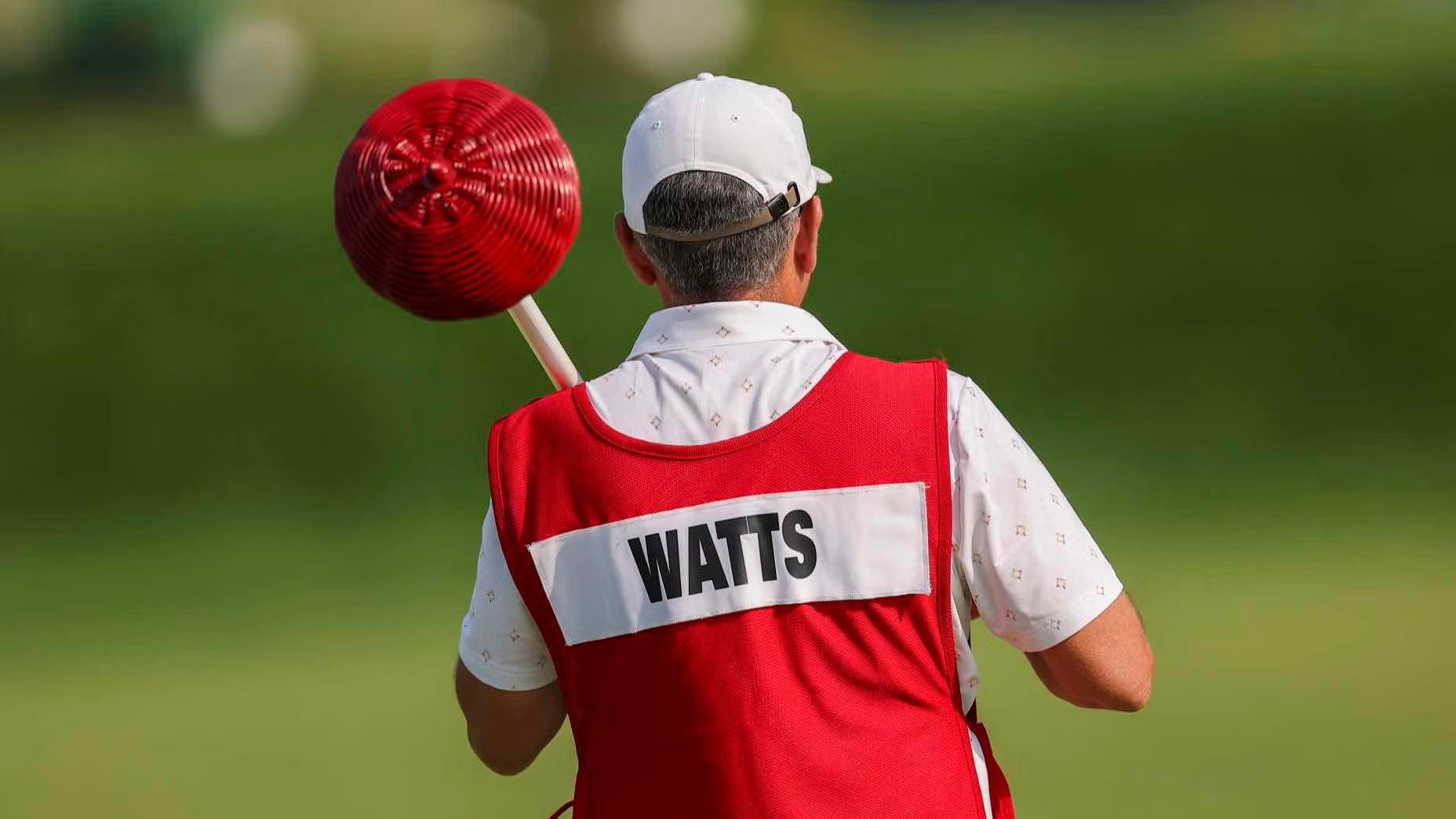
This U.S. Amateur is a glimpse into golf’s future in more ways than you think
-
 NewsBeat3 days ago
Myanmar says over 300,000 Rohingya refugees verified for repatriation as exodus enters ninth year
-

 Sports3 days ago
Birmingham 2026: Day 6 Timetable for Irish Athletes
-

 Politics3 days ago
SEQ Code: The Three Letter Boarding Pass Code That Could Give You The Worst Seat
-
 Entertainment6 days ago
Keke Palmer Subtly Hints At Sean Evans Drama With Cryptic Post
-

 Fashion6 days ago
Coffee Break: The Fonteyn Jane Flat
-

 Tech6 days ago
Zoom Screen-Sharing Bug Let People Fully Take Over Other Devices On A Call
-

 Fashion7 days ago
Should you refinance your debt? Pros, cons, and real numbers
-

 Fashion7 days ago
Claire Life: Kicking Off MVAAFF With the C Suite Luncheon Featuring Phylicia Rashad, Letoya Luckett, and More!
-
 Crypto World6 days ago
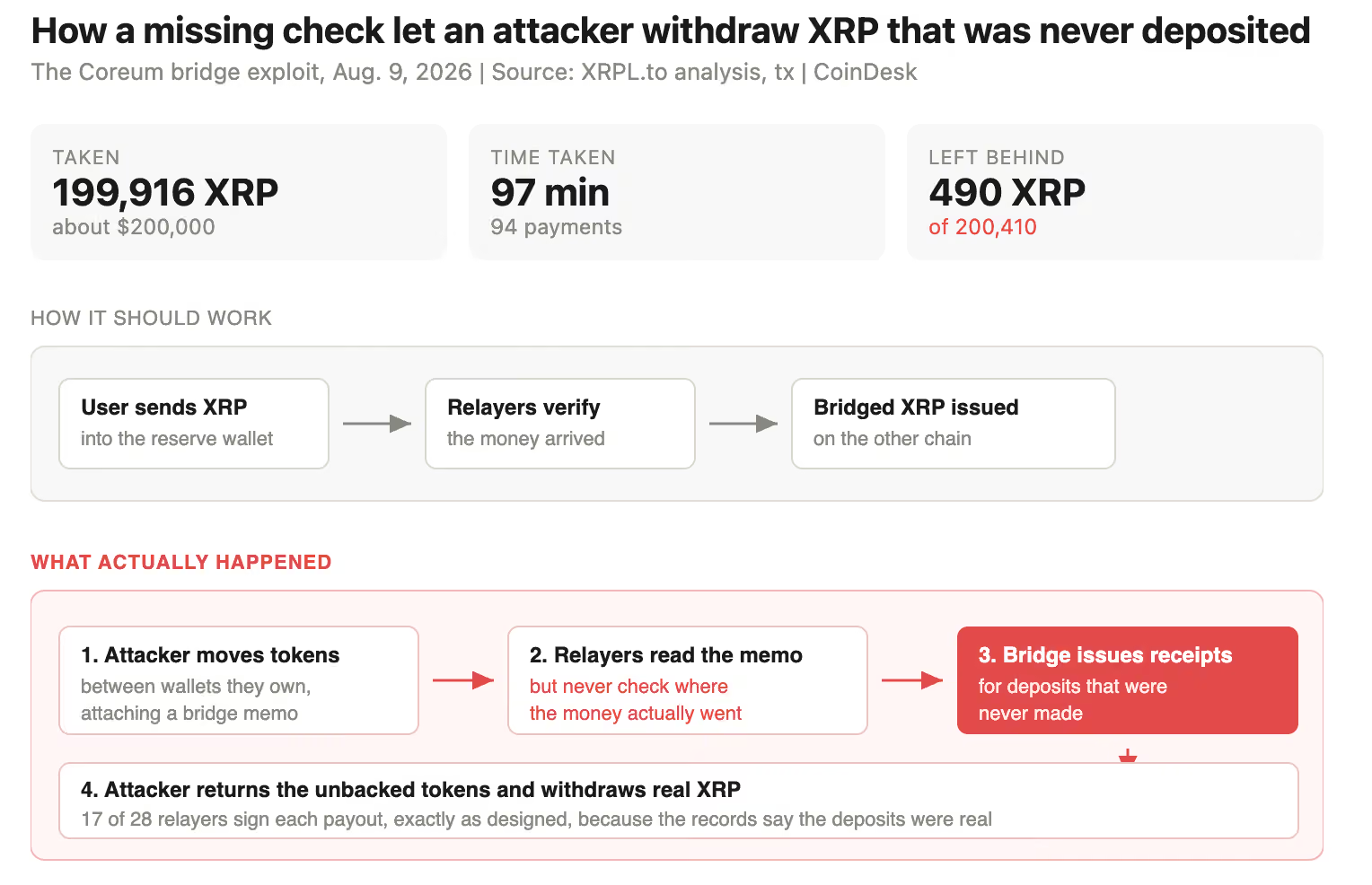
XRP bridge drained after software mistook fake deposits for real ones
-

 Sports5 days ago
DeQuan Jones in ‘high spirits’ after successful leg surgery
-
 Tech4 days ago
11 Ways to Rank Your Videos
-

 Fashion7 days ago
French Rose Gown with Cape Sleeves
-
 Entertainment7 days ago
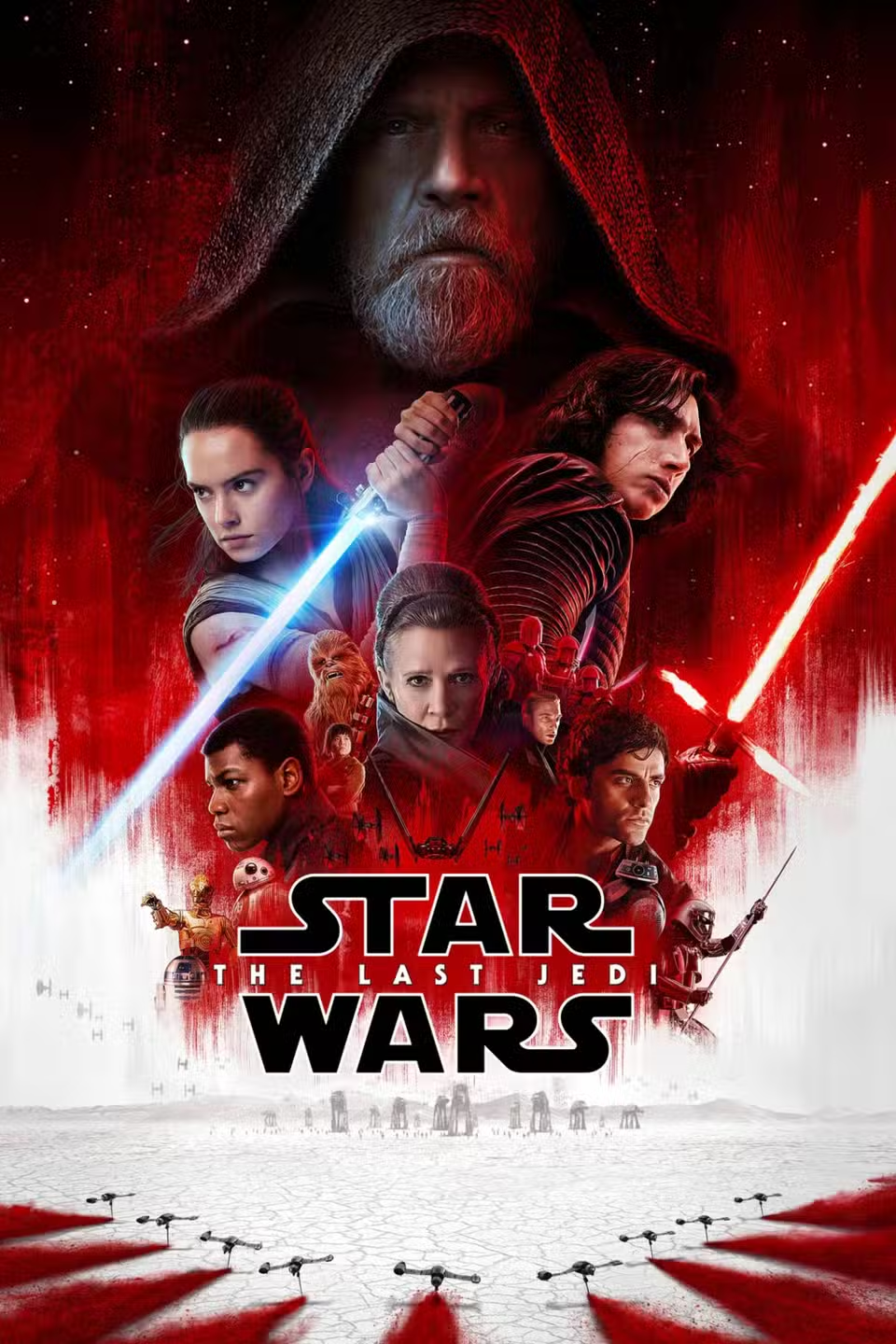
Star Wars Officially Continues ‘The Last Jedi’ With a New Spin-Off
-

 Tech4 days ago
DeepSeek Harness launches as open source rival to Claude Code, alongside V4-Pro on API with higher prices
-
 Crypto World6 days ago
Perplexity AI Predicts an XRP Scenario Few Analysts Are Discussing
-

 Politics7 days ago
In the Chris Kaba case, the police watchdog capitulated to the mob
-

 Tech6 days ago
SpaceXAI’s Grok Bot turns agents into persistent digital coworkers that can operate your apps for $120-per-month
You must be logged in to post a comment Login