
Crypto World
who wins the on chain dollar race

Minting a dollar on a blockchain is no longer a competitive advantage. The technology is understood. The reserve structures are standardized. The regulatory frameworks, at least in jurisdictions that have them, define what a compliant stablecoin looks like. What remains scarce is the infrastructure that moves those tokens from issuer to merchant to consumer and back, the distribution layer that determines whether a stablecoin is used or merely exists.
Summary
- Open USD launched on June 30 with a consortium of over 140 partners including Visa, Mastercard, BlackRock, Stripe, Coinbase, Google and Shopify, governed by an independent entity called Open Standard that distributes reserve earnings to its members.
- Standard Chartered, Animoca Brands and HKT began the phased rollout of HKDAP, a Hong Kong dollar backed stablecoin issued under HKMA licence through a B2B2C model with HashKey Exchange and OSL Group as authorized distributors.
- World Liberty Financial received conditional OCC approval for a national trust bank charter on August 14, enabling the Trump linked venture to issue USD1 directly instead of relying on BitGo as custodian; USD1 has reached roughly $4 billion in market capitalization.
- The total stablecoin market has reached approximately $316 billion as of mid 2026, with Tether’s USDT holding 59% market share at $187 billion and Circle’s USDC at 24% with $75 billion.
- The structural shift is that stablecoin competition has moved from issuance, which is now commoditized, to distribution: who controls the payment rails, merchant integrations and regulatory licences that determine where a stablecoin can actually be spent.
Three events in the past eight weeks mark the transition from an issuer market to a distribution market. Open USD assembled 140 of the largest companies in payments, banking and technology into a consortium designed to control distribution collectively. HKDAP launched through a B2B2C model that treats distribution partners, not end users, as its primary customers. And World Liberty Financial obtained a bank charter that lets it vertically integrate issuance and custody under a single entity with direct regulatory approval.
Each of these moves is a bet on the same thesis: the stablecoin that wins is not the one with the best peg or the largest reserves, but the one embedded most deeply in the payment flows that people and businesses already use.
The market that Open USD enters
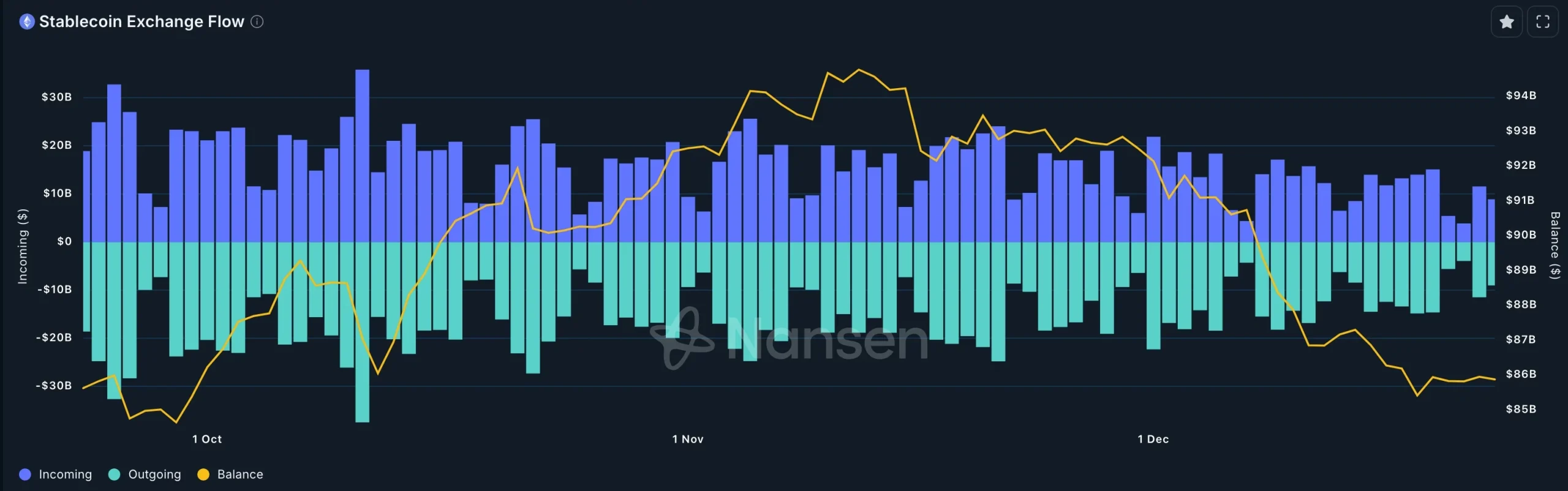
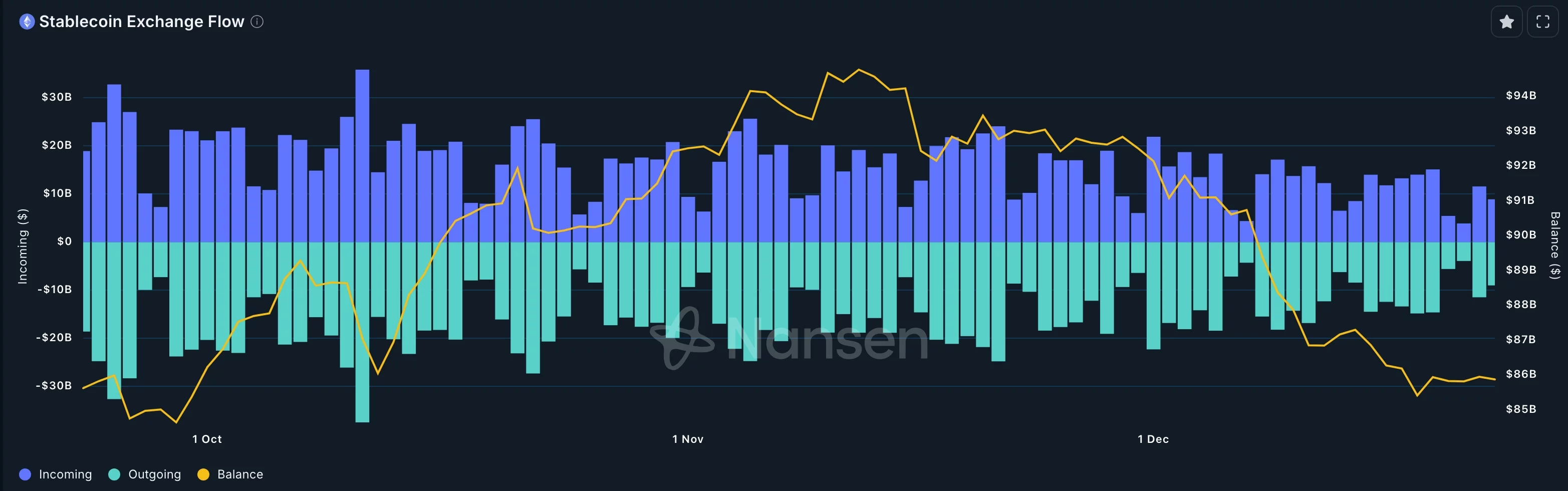
The stablecoin market in mid 2026 is a duopoly with challengers. Tether’s USDT holds approximately $187 billion in circulation, roughly 59% of the total market. Circle’s USDC follows at $75 billion, about 24%. Together they control 83% of all stablecoin supply. The remaining 17% is fragmented across dozens of issuers including PayPal’s PYUSD, First Digital’s FDUSD, Ethena’s USDe and now USD1.
The duopoly has survived despite regulatory pressure on Tether, Circle’s declining market share from 34.88% to 23.05% over the past two years, and repeated predictions that bank issued stablecoins would displace crypto native issuers. The reason is distribution. USDT is embedded in every major exchange, every DeFi protocol and the majority of over the counter trading desks globally. Replacing it requires not just a better token but a better network of places where that token can be used.
Open USD’s approach is to build that network before launching the token. The consortium model means that when OUSD launches on merchant rails, Visa, Mastercard, Stripe, Shopify and Google are already participants. A merchant using Stripe does not need to integrate a new stablecoin. Stripe makes OUSD the default. A consumer paying through Google Pay does not choose a stablecoin. The system chooses for them.
The business model is also different. Open Standard, the entity governing OUSD, distributes reserve earnings to its 140 plus partners minus a management fee. Circle keeps USDC’s reserve yield. Tether keeps USDT’s reserve yield. Open USD shares it with the distribution network. The incentive alignment is designed to make partners actively promote OUSD over competitors because their revenue depends on its adoption.
The scale of the revenue at stake is significant. At current US Treasury yields, a $10 billion stablecoin generates roughly $400 million annually in reserve income. Circle reported $1.7 billion in revenue from USDC reserves in 2025. Under the Open USD model, that revenue would be distributed across 140 partners. Even a small share of a growing reserve pool creates a recurring revenue stream that locks partners into the ecosystem.
The governance structure is also distinct. Open Standard’s board is composed of partner businesses, not a single corporate issuer. Decisions about which blockchains to support, which jurisdictions to enter, and how to structure reserve management are made collectively. This removes the single point of failure that exists with issuer controlled stablecoins, where one company’s regulatory problems or management failures can destabilize the entire token. It also slows decision making, which is the tradeoff of consensus governance in a market that moves quickly.
The consortium model has precedent outside stablecoins. Visa itself started as a consortium of banks that collectively governed a payment network. Mastercard followed the same structure before both eventually converted to publicly traded companies. The parallel is not exact, but the principle is the same: a payment network controlled by its participants rather than a single operator can achieve broader adoption because every participant has a stake in the network’s success.
HKDAP and the B2B2C model
Standard Chartered, Animoca Brands and HKT took a different approach with HKDAP, the Hong Kong dollar backed stablecoin issued by their joint venture Anchorpoint Financial. Rather than building a consumer brand, Anchorpoint treats distributors as its primary customers.
HashKey Exchange and OSL Group are authorized distributors, meaning they handle the customer relationship while Anchorpoint handles issuance, reserve management and regulatory compliance. The model separates the functions that most stablecoin issuers combine: minting and distribution become distinct businesses operated by different entities.
The initial use cases are institutional: payments, settlement and tokenized real world asset circulation. HashKey and YF Life have already tested HKDAP for insurance premium payments, converting a traditionally slow bank transfer process into a near instant stablecoin settlement. Retail expansion is planned for late 2026.
HKDAP operates under the Hong Kong Monetary Authority’s Stablecoins Ordinance, which requires 1:1 backing with high quality HKD assets held in segregated accounts. The licence is one of the first two issued under the new framework, giving Anchorpoint a regulatory first mover advantage in Asia’s most important financial hub.
The B2B2C model has implications for how stablecoin competition evolves. If the winning strategy is distribution rather than issuance, then the most valuable position is not being the issuer but being the distributor with the largest customer base. HashKey’s role in HKDAP is more analogous to a retail bank distributing Treasury bonds than to a crypto exchange listing a new token. The distributor captures the customer relationship while the issuer becomes a wholesale provider of a commodity product.
World Liberty Financial and vertical integration
World Liberty Financial’s conditional OCC charter represents a third model: vertical integration. Rather than building a consortium or a distributor network, the Trump linked venture is collapsing issuance, custody and banking into a single entity.
The charter allows World Liberty Trust Company to provide digital asset custody services, take over issuance of USD1 from BitGo Bank and Trust, and offer conversion services allowing customers to exchange approved stablecoins for USD1. It does not extend to depository services, meaning World Liberty Trust cannot accept deposits in the traditional banking sense.
USD1 has grown to approximately $4 billion in market capitalization since its announcement in March 2025, making it the fourth largest stablecoin. The growth has been driven in part by DeFi integrations and in part by the political profile of its founders. Whether the growth is sustainable without the charter, and whether the charter survives political scrutiny, are open questions.
The vertical integration model has a structural advantage: speed. Open USD needs to coordinate 140 partners. HKDAP needs to onboard distributors one at a time. World Liberty Financial controls every layer of the stack and can make changes without negotiating with a consortium or licensing to third parties. The disadvantage is concentration risk. A single regulatory action, a charter revocation, a political scandal, or a compliance failure can take down the entire operation because there is no separation between issuer, custodian and distributor.
The distribution layer as the new moat
The pattern across all three models is the same: the value is migrating from issuance to distribution. This is not unique to stablecoins. In traditional finance, the shift from product manufacturing to distribution has played out over decades. Mutual funds became commoditized; the value moved to platforms like Schwab and Fidelity that distributed them. Bond issuance became commoditized; the value moved to dealers and electronic trading venues. Insurance products became commoditized; the value moved to brokers and aggregators.
Stablecoins are following the same arc on a compressed timeline. The technology for issuing a fully backed dollar on a blockchain is well understood. The regulatory frameworks in the EU, UK, Hong Kong, Singapore and the UAE define what compliance looks like. What remains scarce is the ability to embed a stablecoin into the payment flows where dollars actually move: payroll, merchant settlement, cross border remittances, insurance premiums, rent payments and government disbursements.
The companies that control those flows, Visa, Mastercard, Stripe, Shopify, and now Google, are not stablecoin issuers. They are the distribution layer. Open USD’s consortium model recognizes this explicitly by making distributors partners and shareholders rather than customers. The question is whether sharing reserve yield with 140 partners generates enough incentive to displace USDT and USDC from their entrenched positions.
The regulatory licence as distribution bottleneck
The most underappreciated barrier to stablecoin distribution is not technology or network effects but regulatory licensing. A stablecoin that cannot be legally offered in a jurisdiction cannot be distributed there, regardless of how many payment partners support it.
HKDAP’s competitive advantage is its HKMA licence, one of the first two issued under Hong Kong’s 2025 Stablecoins Ordinance. Any competitor wanting to issue a Hong Kong dollar stablecoin must obtain the same licence, a process that took Anchorpoint over a year from application to approval. The licence creates a regulatory moat that technology alone cannot overcome.
The pattern is repeating globally. The European Union’s MiCA regulation requires stablecoin issuers to obtain electronic money institution authorization. Circle obtained its in July 2024, making USDC the first major stablecoin with MiCA compliance. Tether has not obtained equivalent authorization, which has forced several European exchanges to delist USDT for EU customers. The regulatory licence, not the technology, determined which stablecoin European users can access.
In the United States, the GENIUS Act requires stablecoin issuers to maintain 1:1 backing and submit to federal or state supervision. World Liberty Financial’s OCC charter is one path to compliance. Open USD’s consortium structure may require a different approach, potentially through one of its banking partners. The regulatory path each issuer takes will shape its distribution options as much as its technology choices.
The implication is that the stablecoin market is fragmenting not just by use case but by regulatory geography. A stablecoin that is compliant in the EU may not be compliant in Hong Kong. A stablecoin with a US bank charter may not have the licences needed to operate in Singapore. The distribution war is partly a licensing war, and the companies with the most regulatory approvals across the most jurisdictions will have the widest distribution.
The JPMorgan question: when banks become issuers
The entry that the market has not yet priced in is major banks issuing their own stablecoins. JPMorgan’s Kinexys platform already settles over $2 billion per day in tokenized deposits between institutional counterparties. Bank of America, Citibank and Wells Fargo have all filed preliminary applications or signaled intent to explore stablecoin issuance under the GENIUS Act framework.
A JPMorgan issued dollar stablecoin would have instant distribution through the bank’s existing corporate banking relationships, treasury management platforms and correspondent banking network. It would not need a consortium of 140 partners because JPMorgan already is the distribution network for a significant portion of global dollar flows.
The banking model differs from all three approaches discussed above. Banks do not need to share reserve yield with partners because their distribution already exists. They do not need regulatory licences because they already have them. They do not need to build trust in their peg because their brand carries deposit insurance guarantees, even if the stablecoin itself is not deposit insured.
The risk for OUSD, HKDAP and USD1 is that they are building distribution networks to compete with institutions that already have them. If JPMorgan, Bank of America and their European and Asian equivalents issue stablecoins, the distribution war becomes asymmetric: crypto native issuers competing against banks with decades of embedded infrastructure.
The counterargument is that banks move slowly, regulators move slowly, and the crypto native issuers have a 12 to 24 month window to build network effects before bank issued stablecoins reach meaningful scale. That window is what the current distribution war is about.
The opposing case: why USDT and USDC survive
The bull case for the duopoly is network effects. USDT is the unit of account for offshore crypto trading globally. Every exchange, every DeFi protocol, every over the counter desk prices against it. Displacing USDT requires not just a better stablecoin but a coordinated switch by thousands of independent actors who currently have no incentive to change.
USDC has a different moat: regulatory relationships. Circle is the most regulated stablecoin issuer in the United States, with state money transmitter licences, a relationship with the Federal Reserve and a public company audit trail. Institutions that need compliance use USDC because the regulatory surface area is known.
Open USD threatens USDC more directly than USDT. Both target regulated, institutional use cases. But Open USD’s consortium model means that Stripe, Visa and Mastercard have a financial incentive to route transactions through OUSD rather than USDC. If Stripe makes OUSD the default for its merchants, Circle loses distribution without losing compliance.
USDT’s position is harder to attack because its moat is geographic and cultural rather than contractual. USDT dominance is strongest in Asia, the Middle East and Latin America, markets where Tether’s relationship with local exchanges and OTC desks runs deeper than any consortium’s reach. Open USD’s partner list is weighted toward North American and European companies. The distribution war may end with geographic segmentation rather than a single winner.
What would invalidate the distribution thesis: if a regulatory crackdown on consortium models, or a failure of OUSD’s reserve management, demonstrates that the issuer’s credibility matters more than the distributor’s reach. Tether’s survival despite years of regulatory pressure suggests that in stablecoins, trust in the peg is the floor requirement, not the ceiling.
What to watch
- Open USD adoption metrics. The consortium launched on June 30. The first 90 days of transaction volume and merchant adoption will signal whether distribution partnerships convert to actual usage.
- Stripe default integration timeline. If Stripe makes OUSD the default stablecoin for its millions of merchants, it represents the single largest distribution event in stablecoin history.
- HKDAP retail rollout. Anchorpoint targets late 2026 for retail access. The speed and scale of that expansion will test whether the B2B2C model works for stablecoins at consumer scale.
- World Liberty Financial charter finalization. The OCC approval is conditional. The final charter decision will determine whether vertical integration is a viable model for stablecoin issuance in the United States.
- USDC market share trajectory. Circle’s share has declined from 34.88% to 23.05%. Whether Open USD accelerates that decline or the trend stabilizes will indicate whether the distribution war is reshaping the duopoly or leaving it intact.
- Bank issued stablecoin announcements. JPMorgan, Bank of America and Citibank have all signaled interest. The first formal announcement of a bank issued retail stablecoin would reshape the competitive landscape overnight.
- Cross border settlement volume on HKDAP. Anchorpoint has positioned HKDAP for international remittances and RWA settlement. Whether institutional users adopt it for cross border flows between Hong Kong and its trading partners will test the B2B2C model under real world conditions.
The distribution war is playing out across three models simultaneously: consortium governance with Open USD, B2B2C licensing with HKDAP, and vertical integration with USD1. Each model has structural advantages and structural risks. The market will select the winner not based on which model is theoretically superior but on which one embeds most deeply into the payment flows that move dollars at scale. The first 12 months of this competition, from Open USD’s June 30 launch through mid 2027, will determine whether the stablecoin market remains a duopoly or fragments into a distribution driven oligopoly.
Frequently asked questions
What is Open USD?
Open USD is a dollar pegged stablecoin governed by Open Standard, an independent entity whose board is composed of its partner businesses. Over 140 companies including Visa, Mastercard, BlackRock, Stripe, Coinbase and Google have joined as partners. The model distributes reserve earnings to partners rather than keeping them with a single issuer.
How is Open USD different from USDC?
USDC is issued by Circle, which retains the yield on reserve assets. Open USD distributes reserve earnings to its 140 plus partner consortium, creating a financial incentive for partners to promote OUSD adoption through their existing payment rails and merchant networks.
What is HKDAP?
HKDAP is a Hong Kong dollar backed stablecoin issued by Anchorpoint Financial, a joint venture of Standard Chartered, Animoca Brands and HKT. It operates under one of the first two Hong Kong Monetary Authority stablecoin licences and uses a B2B2C distribution model through authorized partners like HashKey Exchange.
How large is the stablecoin market in 2026?
The total stablecoin market has reached approximately $316 billion as of mid 2026. Tether’s USDT holds roughly $187 billion (59% market share) and Circle’s USDC holds approximately $75 billion (24% market share).
What is World Liberty Financial’s bank charter?
World Liberty Financial received conditional OCC approval on August 14, 2026, for a national trust bank charter that allows it to issue USD1 directly, provide digital asset custody services, and offer stablecoin conversion. The charter does not extend to deposit taking.
Why has the competition moved from issuance to distribution?
Stablecoin issuance technology is now well understood and regulatory frameworks in multiple jurisdictions define compliance requirements. What remains scarce is the infrastructure that embeds stablecoins into existing payment flows: merchant integrations, banking rails, payroll systems and consumer wallets.
Could Open USD displace USDT?
USDT’s moat is geographic and cultural rather than contractual, with dominance strongest in Asia, the Middle East and Latin America through relationships with local exchanges and OTC desks. Open USD’s partner list is weighted toward North American and European companies, suggesting geographic segmentation is more likely than full displacement.
Is the stablecoin market becoming more or less concentrated?
The duopoly of USDT and USDC still controls 83% of supply, but their combined share is declining as new entrants including USD1, OUSD, PYUSD and HKDAP capture incremental growth. The trend points toward gradual fragmentation by use case and geography rather than concentration. This is educational analysis, not investment advice.
Disclaimer: This article was published on August 17, 2026. It reflects information available at the time of writing. Stablecoin market data changes rapidly and the figures cited may not reflect current conditions. This is educational analysis, not investment advice.



BitBox has released a firmware update fixing two severe vulnerabilities that could have exposed hardware wallet users to malicious firmware or caused Bitcoin to be locked to an unintended address.
Summary
- BitBox has patched two severe vulnerabilities affecting its BitBox02 and BitBox02 Nova hardware wallets.
- One flaw could have allowed malicious firmware installation, while another could have locked Bitcoin to an unintended address.
- BitBox said neither vulnerability had been exploited and no user funds were reported lost.
- The fixes follow a Coldcard firmware flaw linked to more than $112 million in Bitcoin thefts.
BitBox said in a security disclosure on Monday that the first vulnerability involved memory corruption affecting unconfigured Multi editions of the BitBox02 and BitBox02 Nova, while a second flaw affected the wallet maker’s Silent Payments implementation.
The company said it had found no evidence that either vulnerability had been exploited and had received no reports of users losing funds because of the flaws.
BitBox vulnerability could have allowed malicious firmware
For the first vulnerability, BitBox said a malicious host connected to an affected wallet could exploit memory corruption to execute arbitrary code before the device had been configured with a wallet.
Successful exploitation could potentially allow the host to install malicious firmware, creating a route through which funds could later be compromised, according to the company.
The exposure was limited to Multi editions of the BitBox02 and BitBox02 Nova that had not yet been set up. BitBox classified the vulnerability as severe because arbitrary code execution could undermine protections designed to prevent unauthorised software from running on the hardware wallet.
Firmware controls how a hardware wallet handles cryptographic operations, verifies transactions and communicates with a connected computer. BitBox said the vulnerability could therefore put funds at risk if an attacker managed to use the flaw to install malicious firmware on an affected device.
Similar hardware and firmware weaknesses have surfaced at other wallet makers in recent months. In June, crypto.news reported on a flaw in the TROPIC01 Secure Element used by Trezor Safe 7 devices after Ledger Donjon researchers carried out a laser fault injection attack during laboratory testing.
Trezor said its Safe 7 remained protected because the device uses three independent hardware security layers. According to the company, compromising TROPIC01 alone did not provide access to a user’s PIN, wallet or funds.
Tropic Square had provided the chip to Ledger Donjon for independent testing, with researchers notifying the company in January that they had extracted some chip secrets and bypassed firmware signature checks using the laboratory attack.
Another hardware attack disclosed in July allowed Ledger Donjon researchers to reset the password on a Tangem wallet card using a targeted laser pulse against its secure element.
Ledger Donjon said the attack required physical possession of the card, invasive preparation, specialist knowledge and laboratory equipment costing about $250,000. Tangem described the everyday risk to customers as “virtually non-existent,” while advising users to keep their wallet cards physically secure.
Silent Payments flaw could have locked Bitcoin
BitBox’s second severe vulnerability affected Silent Payments, a Bitcoin privacy feature that allows users to receive payments without publishing a new address for each transaction.
According to BitBox, a malicious host could exploit the implementation to cause Bitcoin to be locked to an unintended address.
Direct theft was not possible through the vulnerability, the company said. An attacker could instead leave the victim unable to recover the Bitcoin without cooperation and potentially demand a ransom in exchange for helping unlock the coins.
Such an attack would not automatically transfer control of the affected Bitcoin to the malicious host, but BitBox said the vulnerability could still put funds at risk by making them inaccessible to their owner.
The company addressed the problem through its latest firmware update and said it had received no reports of the Silent Payments flaw being exploited.
BitBox has dealt with other security issues through firmware updates this year. Its Oeschinen update in July included several security fixes, including one for a buffer out-of-bounds write affecting the BitBox02 firmware and bootloader.
According to the company’s disclosure at the time, a USB request accepted a length value without properly checking it against the size of the destination buffer, creating a potential route for a malicious host to trigger an out-of-bounds write.
BitBox said no working exploit had been demonstrated for that vulnerability, although an effect on control flow could not be completely ruled out.
Earlier in January, the company also patched two BitBox02 Nova vulnerabilities reported through its bug bounty programme. BitBox classified the issues as minor and moderate because exploitation required advanced physical access and applied only under specific conditions.
Coldcard firmware flaw has put wallet security under scrutiny
BitBox’s update follows the disclosure of a separate Coldcard firmware flaw linked to more than $112 million in stolen Bitcoin after the vulnerability remained undetected for more than five years.
Galaxy Research said Friday that Coldcard-related losses had exceeded $112 million, with approximately 1,778.6 BTC swept from more than 8,600 addresses.
The vulnerability was traced to a firmware change introduced in March 2021 that affected the randomness used to generate wallet seeds. Attackers could brute-force impacted seeds and derive the corresponding private keys without obtaining physical access to the hardware wallet, according to research into the incident.
A wallet seed is used to derive the private keys controlling its cryptocurrency. Weaknesses that reduce the randomness used during seed generation can therefore reduce the number of possible combinations an attacker needs to test.
For users whose wallets were created with affected Coldcard firmware, updating the device alone would not repair a seed that had already been generated with weak randomness. Moving funds to a wallet created from a newly generated secure seed would be required to remove exposure associated with the compromised seed.
The incident affected a hardware wallet line that received its first major hardware revision in several years earlier in 2026. Coinkite launched the Coldcard MK5 in March, with the device becoming the first hardware update to its flagship MK series since the MK4 arrived in 2022.
The MK5 retained the previous model’s dual secure-element architecture using chips from two different vendors and kept private keys air-gapped. Its main changes included a 1.54-inch Gorilla Glass display, redesigned physical buttons and improved NFC functions.
Coinkite said at the time that the five major MK5 upgrades focused on usability while preserving the security architecture used by the previous model.
Customer data leaks have created separate phishing risks
Hardware wallet owners have also faced security incidents outside the devices themselves, with recent breaches involving Trezor and SafePal exposing customer and order information belonging to more than 53,000 people.
Trezor attributed the exposure of information belonging to 13,689 customers to shipping provider ShipMonk. SafePal separately said an authorisation flaw in an order-tracking plug-in exposed details connected to 39,798 customers.
Neither incident compromised the companies’ hardware wallets, private keys or recovery phrases, according to the respective disclosures. Both companies warned that exposed personal and order information could instead be used for targeted phishing and impersonation attempts.
Such information can give attackers details needed to make wallet-related scams appear more credible. Earlier in February, attackers sent physical letters impersonating Trezor and Ledger and instructed recipients to complete supposed authentication or transaction checks.
The physical phishing campaign used official-looking correspondence containing QR codes that directed recipients to malicious websites. Some letters created urgency by claiming users had to complete an authentication process to avoid problems accessing their wallets.
The websites asked victims to enter 12-, 20- or 24-word recovery phrases under the pretence of verifying ownership. Once submitted, the phrases were transmitted to the attackers, allowing them to recreate the wallets and gain control over the associated funds.
Trezor and Ledger said legitimate hardware wallet providers do not ask customers to enter, scan, upload or share recovery phrases through websites or other external channels. Recovery phrases should only be entered directly on a hardware wallet when restoring a wallet, according to the companies.
Crypto exchange Kraken has launched trading in more than 7,000 U.S.-listed stocks for eligible customers across the European Economic Area, placing traditional shares alongside more than 700 tokenized xStocks and over 600 crypto assets in the same account.
Summary
- Kraken has launched trading in more than 7,000 U.S. stocks for eligible customers across the EEA.
- Customers can access traditional U.S. shares alongside more than 700 xStocks and over 600 crypto assets.
- The stock service is provided through Kraken’s MiFID II authorised Cyprus investment firm.
- xStocks have generated more than $38 billion in total transaction volume since launching in June 2025.
The Block reported on Aug. 18 that the service has become available across the EEA after Kraken quietly began introducing stock trading to customers in Germany, the Netherlands and France in recent days.
The rollout takes Kraken’s traditional equities business outside the United States, where the exchange first entered stock trading in 2025, while giving European customers two ways to gain exposure to U.S.-listed companies through the same platform.
Kraken said eligible EEA customers can buy traditional shares or use xStocks, its blockchain-based products tied to listed equities and exchange-traded funds. Both products can be accessed without transferring funds between separate platforms.
“With U.S.-listed stocks and xStocks available side-by-side in a single regulated account, customers can choose how they access the same underlying exposure — whether through traditional shares or tokenized representation — without moving capital or changing platforms,” Mark Greenberg, chief commercial officer of Kraken parent Payward and head of Payward Services, said in a statement.
Kraken U.S. stock trading reaches eligible EEA customers
Access covers more than 7,000 traditional U.S. stocks through the desktop and mobile versions of Kraken Pro as well as the main Kraken mobile app.
Kraken said stock trades will carry no trading commission, subject to its applicable terms. Eligibility will not be automatic for every existing customer, however, as users must accept additional terms and conditions before the equities feature becomes available.
The service is being provided by Payward Europe Digital Solutions (CY) Limited, a Cyprus investment firm authorised under the European Union’s Markets in Financial Instruments Directive II, or MiFID II.
Alongside the conventional securities offering, customers can access more than 700 xStocks and over 600 crypto assets through their Kraken accounts. The company said xStocks have processed more than $38 billion in total transaction volume since launching in June 2025.
Kraken describes the setup as distinct from European platforms that provide only one form of U.S. equity exposure. Bitpanda offers traditional U.S. stock trading, while platforms including Robinhood and Crypto.com have introduced tokenized U.S. equity products for European users.
Crypto.com, for example, recently launched tokenized stock derivatives tracking about 1,500 U.S. stocks and ETFs for eligible EEA customers and users in other approved markets. Its products provide synthetic price exposure and do not give buyers legal or beneficial ownership of the underlying securities.
xStocks have moved into more parts of Kraken’s trading system
Kraken has continued adding functions to xStocks since the products were introduced in June 2025, taking them beyond instruments used solely to track the price of conventional equities.
In July, crypto.news reported on Kraken allowing eligible users to post selected xStocks as collateral for futures and margin positions on Kraken Pro. Ten assets initially qualified, including tokenized versions of Apple, Nvidia, Tesla, Strategy, Robinhood, the SPDR S&P 500 ETF and the Invesco QQQ ETF.
Futures collateral was made available to qualifying clients outside the United States, including customers in the EEA. Margin collateral was offered outside the U.S. but excluded EEA clients.
Kraken had also developed dedicated onchain infrastructure for the product earlier in 2026. Its xStocks platform introduced xChange in March, an execution layer initially supporting more than 70 tokenized equities across Ethereum and Solana.
At that point, xStocks had generated about $25 billion in total trading volume, including $3.5 billion in onchain transactions, while more than 80,000 onchain holders had interacted with the products. Each token was described as fully collateralised and backed 1:1 by its corresponding underlying security.
Kraken’s current figures put total xStocks transaction volume above $38 billion, showing how quickly activity has increased since the March tally.
Payward is taking xStocks into more international markets
Payward has also been preparing to add equities from markets outside the United States to the xStocks system.
A July partnership with GTN set out plans to begin with Hong Kong-listed shares before adding securities from the United Kingdom, Europe, South Korea and other markets, subject to the necessary licences and regulatory approvals.
Under the agreement, GTN is providing execution, custody, ledgering and record-keeping infrastructure across more than 90 financial markets, while Payward continues to supply the tokenization infrastructure used to create the blockchain-based assets.
At the time of the July announcement, xStocks supported more than 500 tokenized assets and had generated over $37 billion in transaction volume. Payward also said GTN could eventually distribute xStocks to institutional customers once the required approvals are secured in individual markets.
The latest EEA rollout concerns conventional U.S.-listed securities alongside existing xStocks, while Kraken said it plans to take the combined traditional-stock and tokenized-equity service into additional markets over the coming months.
Tokenized equities have taken a larger share of RWA activity
The expansion comes as tokenized equities have become a larger part of the real-world asset market.
According to figures cited by The Block, tokenized equities now account for about 15% of the RWA market, around three times their share at the start of 2026. The segment has reached roughly $2.8 billion in total market capitalisation, with Ondo Finance, Binance’s bStocks and Kraken’s xStocks accounting for a combined 77%.
Kraken has also expanded what holders can do with the securities represented through xStocks. Earlier in August, the platform extended shareholder voting rights to more than 125,000 xStocks holders, allowing eligible investors to instruct the underlying custodian on how votes should be cast at company shareholder meetings.
The feature changed the original structure of xStocks, which did not provide voting rights when the products launched in June 2025. The arrangement relies on the custody structure operated by Backed Assets (JE) Limited, according to the report.
Kraken parent Payward, meanwhile, reported $508 million in adjusted revenue for the second quarter, up 17% from the same period a year earlier. Adjusted EBITDA reached $23 million for the three months ended June 30.
Total platform transaction volume fell 13% year over year to $310 billion during the quarter, while Payward reported that the composition of trading activity moved toward equities and tokenized equities.

The distinction between ugliness and vulgarity feels important now. Beauty often depends on proportion and on how well a building, an object, or an image relates to the world around it. Ugliness can challenge expectations and still be intelligent, deliberate, and even beautiful in its own way.
Vulgarity is different. It begins when scale, excess, or attention-seeking overwhelms context altogether.
Architecture, automobiles, and commercial environments make claims on people who have no part in choosing them. When houses squeeze into their lots, vehicles grow more imposing, and storefronts battle for attention, the problem is no longer simply whether something is beautiful or ugly. Vulgarity becomes consequential when it overwhelms the environment everyone shares.
The objects we design and consume reveal what we value, and more and more of them seem to reflect an increased appetite for more. Which leaves me wondering about one of design’s oldest and most human questions: How much is enough?
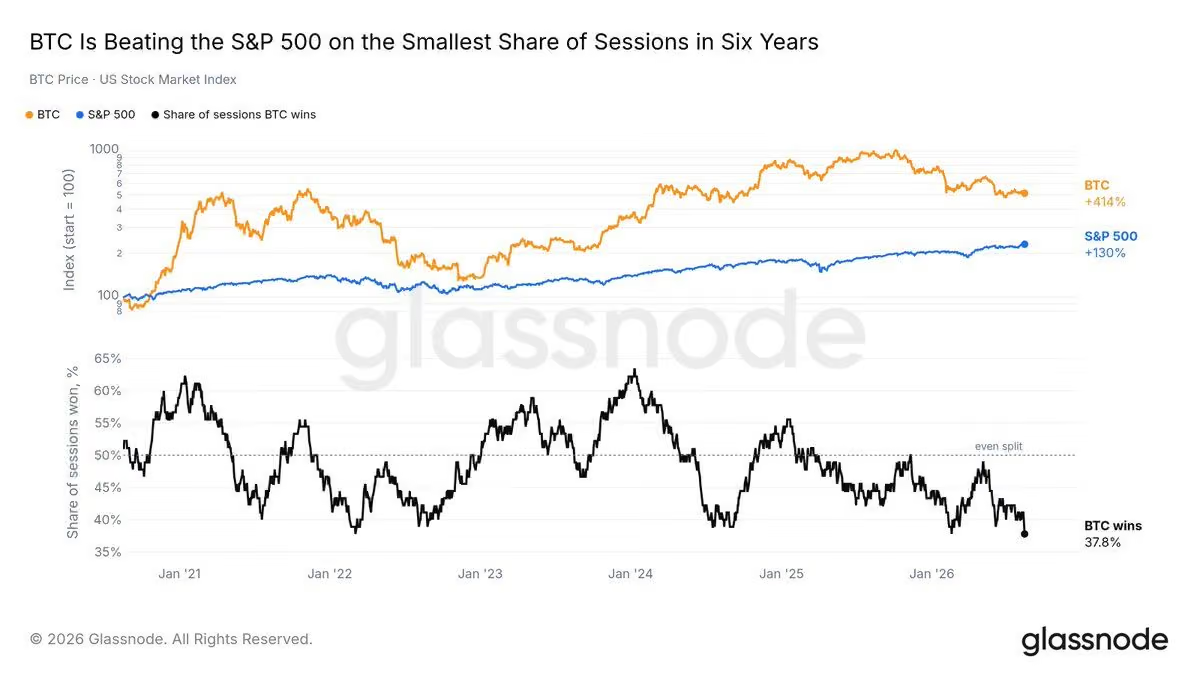
Bitcoin scored a rare achievement on Monday by outperforming the S&P 500.
The largest cryptocurrency rose 2.6% to over $64,000, registering its best daily performance in over a month, according to CoinDesk data. Wall Street’s benchmark equity index, S&P 500, fell by 0.52%.
Bitcoin, therefore, not only outpaced equities but moved in the totally opposite direction. This was once a norm. Bitcoin has spent most of its history being the higher-beta asset relative to stocks, meaning it typically moves more than stocks in both directions.
“BTC outperformed the stock market today. This has become a less common occurrence lately. 1/2 In fact, BTC only outperformed the S&P 500 on around one third of trading days over the last three months,” blockchain analytics firm Glassnode said in a Telegram chat.

Underperforming two-thirds of the time means BTC has been acting less like a higher-beta asset relative to stocks and more like a laggard. Key reasons for that include the AI stock frenzy on Wall Street that has sucked out capital from other corners of the financial market, including cryptocurrencies.
The bear market phase of bitcoin’s self-fulfilling four‑year cycle has also played a role in keeping demand for BTC subdued. BTC peaked above $126,000 in October last year and quickly entered the bear market, which is expected to bottom out by October this year.
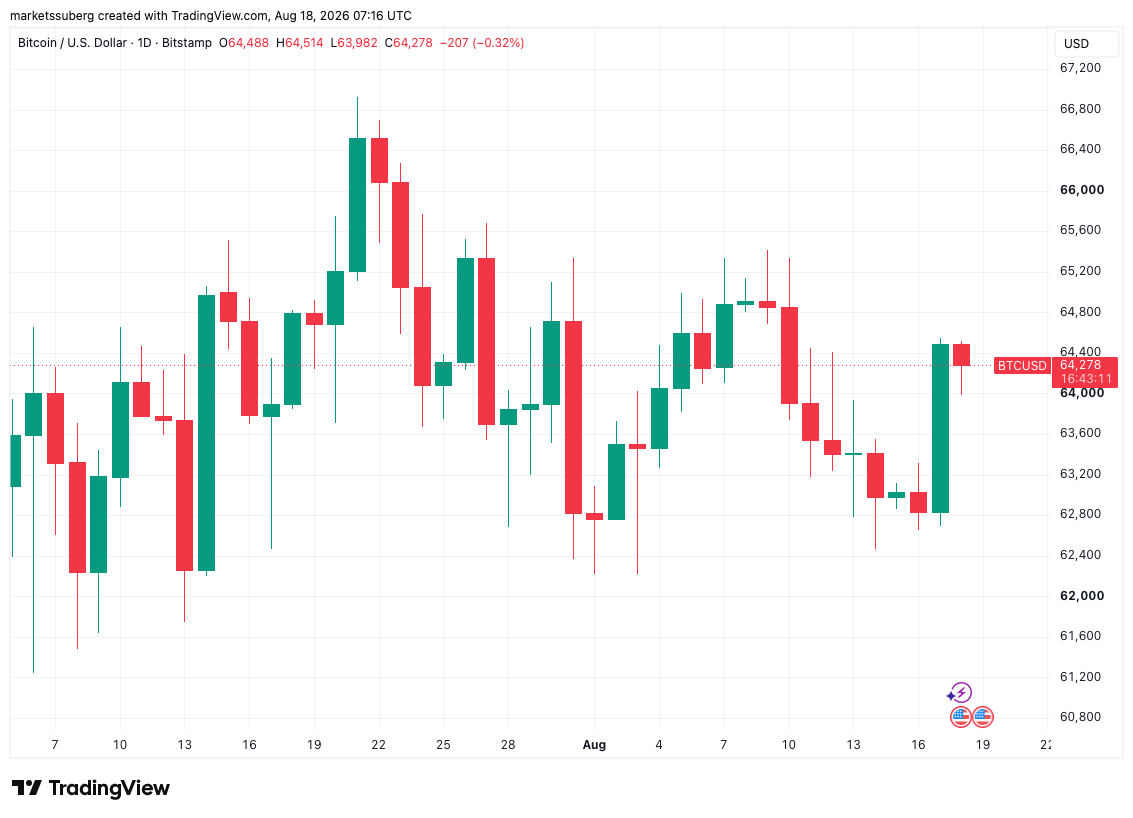
Bitcoin (BTC) short liquidations hit their highest in almost one month as it hit $64,500 on Monday, new data reveals.
Key points:
- Bitcoin passed $64,000 thanks to a short squeeze on derivatives markets, CryptoQuant says.
- An ongoing downward funding-rate reset from 0.006% to 0.003% over 24 hours could mean further short squeezes.
- The absence of spot demand raises doubts whether the upside is sustainable after a week of $267.2 million in net ETF outflows.
Bitcoin short liquidations near one-month high
BTC/USD rallied after Sunday’s weekly close, gaining up to 3% on Monday to top out at one-week highs of $64,550 on Bitstamp.
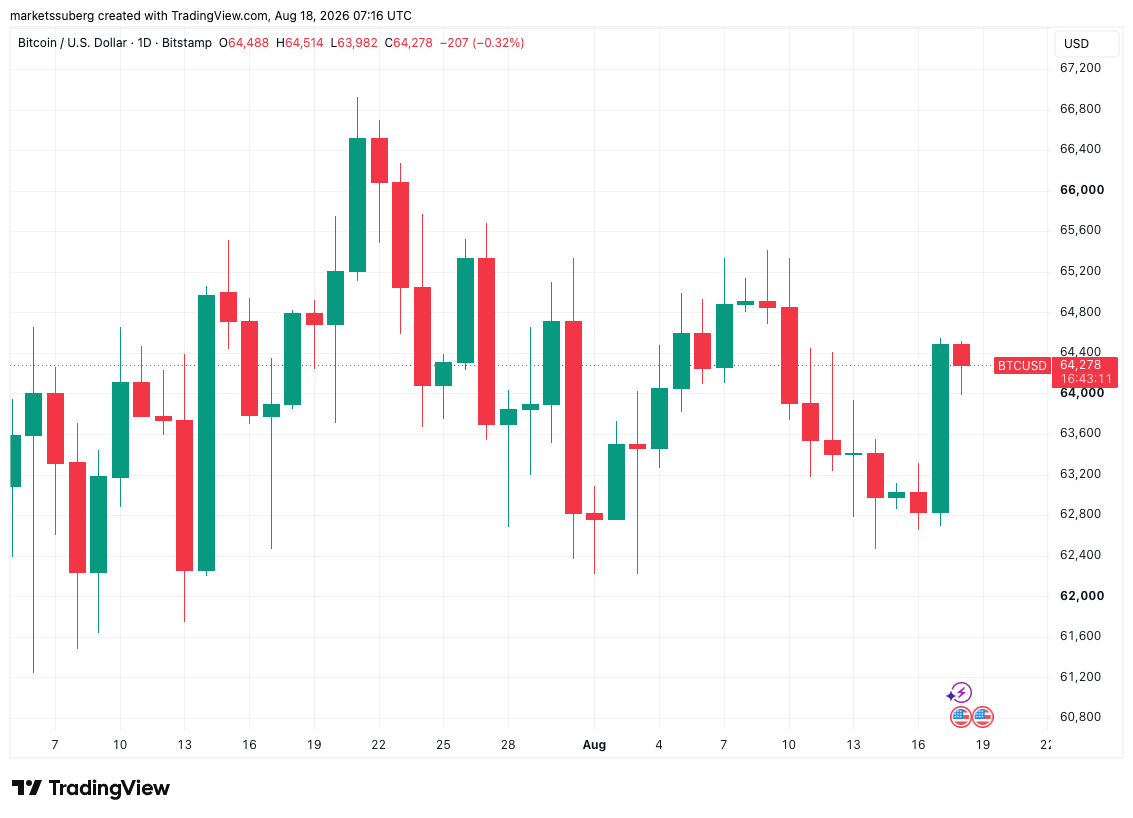
BTC/USD one-hour chart. Source: Cointelegraph/TradingView
Examining the impetus behind the latest BTC price gains, onchain analytics platform CryptoQuant pointed to illiquid markets and funding-rate imbalances among exchanges.
Before rebounding on Monday, BTC circled near $62,750. Around this level, funding rates between exchanges began to diverge. Shorts were dominant on major platforms such as Binance, Bybit, OKX and Deribit, while the funding rate on HTX briefly spiked to 0.05%.
Funding rates refer to periodic payments exchanged by long and short traders on Bitcoin derivatives markets in order to maintain their positions. Positive aggregate funding rates show that long traders are actively paying shorts, with the reverse true for negative funding rates.
“This crowded short positioning served as the primary catalyst, fueling a short squeeze that drove prices higher,” CryptoQuant continued.
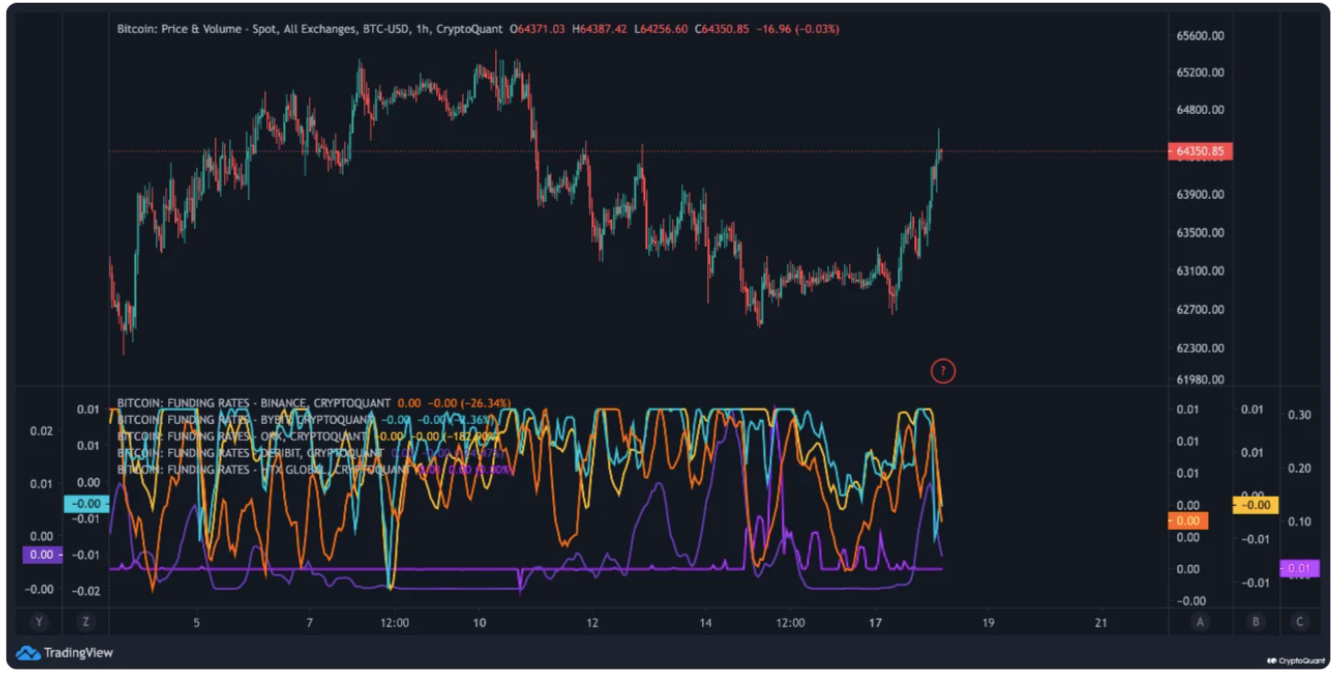
BTC/USD one-hour chart with exchange funding-rate data (screenshot). Source: CryptoQuant
Data puts total Bitcoin short liquidations at 637 BTC for Monday, the largest single-day tally since July 21.
Describing the event as a “low-volume liquidity trap,” CryptoQuant nonetheless suggested that the market could see more short squeezes next, with funding rates already declining again as traders increase short exposure.
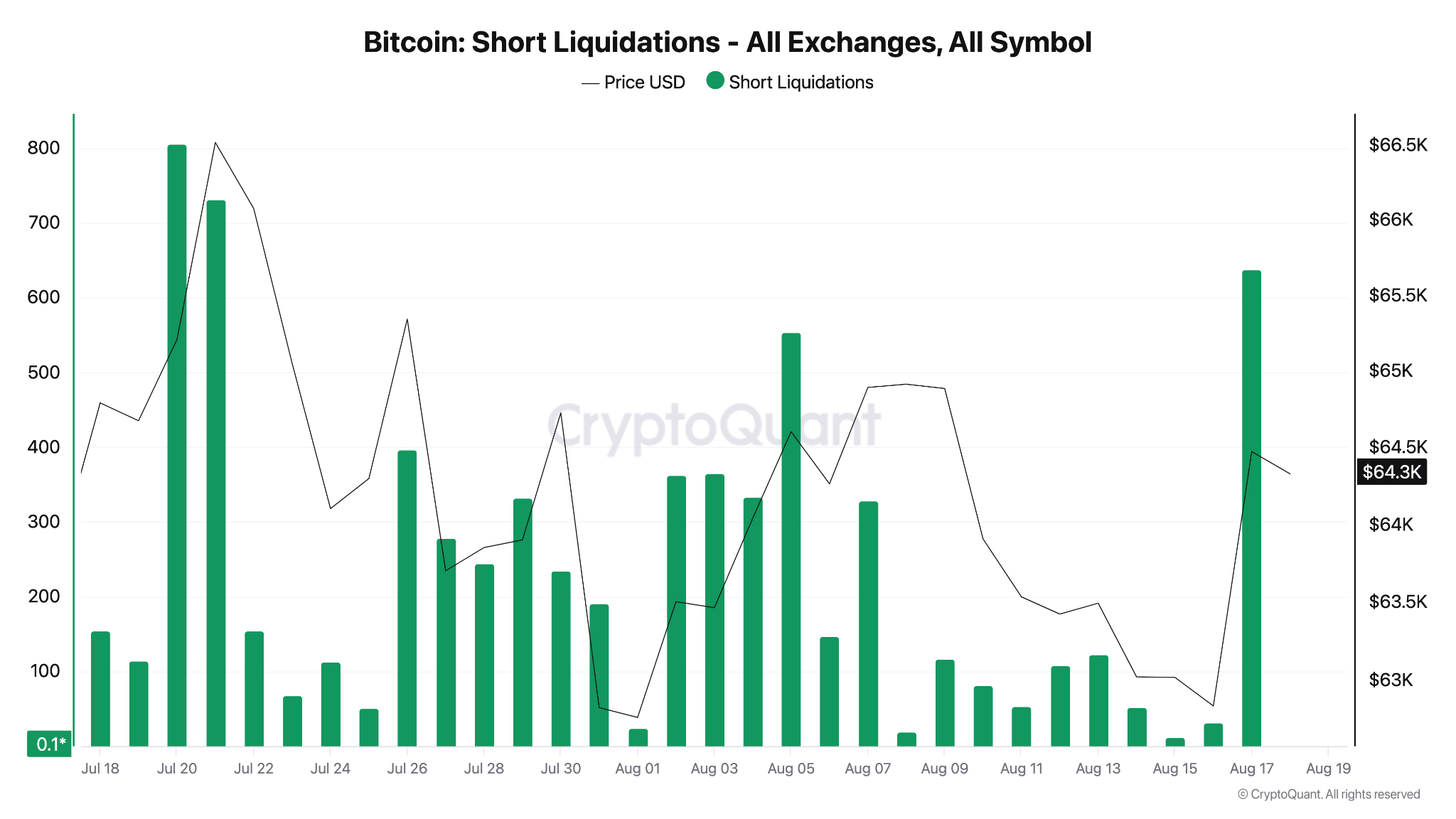
Bitcoin short liquidations. Source: CryptoQuant
Crucial spot demand remains absent
Previously, Cointelegraph reported that Bitcoin futures markets accounted for the majority of trading volume in the current range, with spot traders broadly uninterested.
Related: BTC price loses 200-week trend line as 2022 repeats: Five things to know in Bitcoin this week
In further analysis on Monday, CryptoQuant called the lack of spot demand the primary hurdle to sustained upside, alongside the lack of inflows to the US spot Bitcoin exchange-traded funds (ETFs).
“A break below $60K alongside rising exchange inflows would weaken the structure and increase downside risk toward $50K. Selling pressure is cooling, but demand still needs to return,” it commented.
Recent buyers who remain underwater on their BTC allocation have helped cement the current trading range. Short-term holders — wallets holding a UTXO for less than 155 days — have their cost basis at around $68,700, reinforcing that level as resistance.

“If Oman gets in the way, we’ll bomb the sh-t out of them,” Trump told Fox News reporter Trey Yingst on Monday.
Trump later told reporters, “I don’t think they [Oman] behaved very well, but we’d handle them very easily, just like we do other things.” It’s unclear what exactly Oman has done to upset the U.S. President. TIME has reached out to the White House for comment.
Tehran has said the Strait’s administration should remain strictly between the two coastal states. Iran also previously proposed collecting fees for passage through the waterway, while Oman proposed a system with voluntary fees in late July.
U.S.-Iran diplomacy meanwhile appears tenuous, with Iranian officials denying any direct talks and contradicting Trump’s claims that Iran is eager to make a deal. The 60-day deadline for the U.S. and Iran to negotiate a comprehensive peace agreement to end the war expired Monday without a deal. The two countries signed a memorandum of understanding (MOU) on June 17, which included the lifting of the U.S. naval blockade on Iran and toll-free passage through the Strait of Hormuz. The MOU stated that Iran would discuss with Oman the future administration of the waterway.
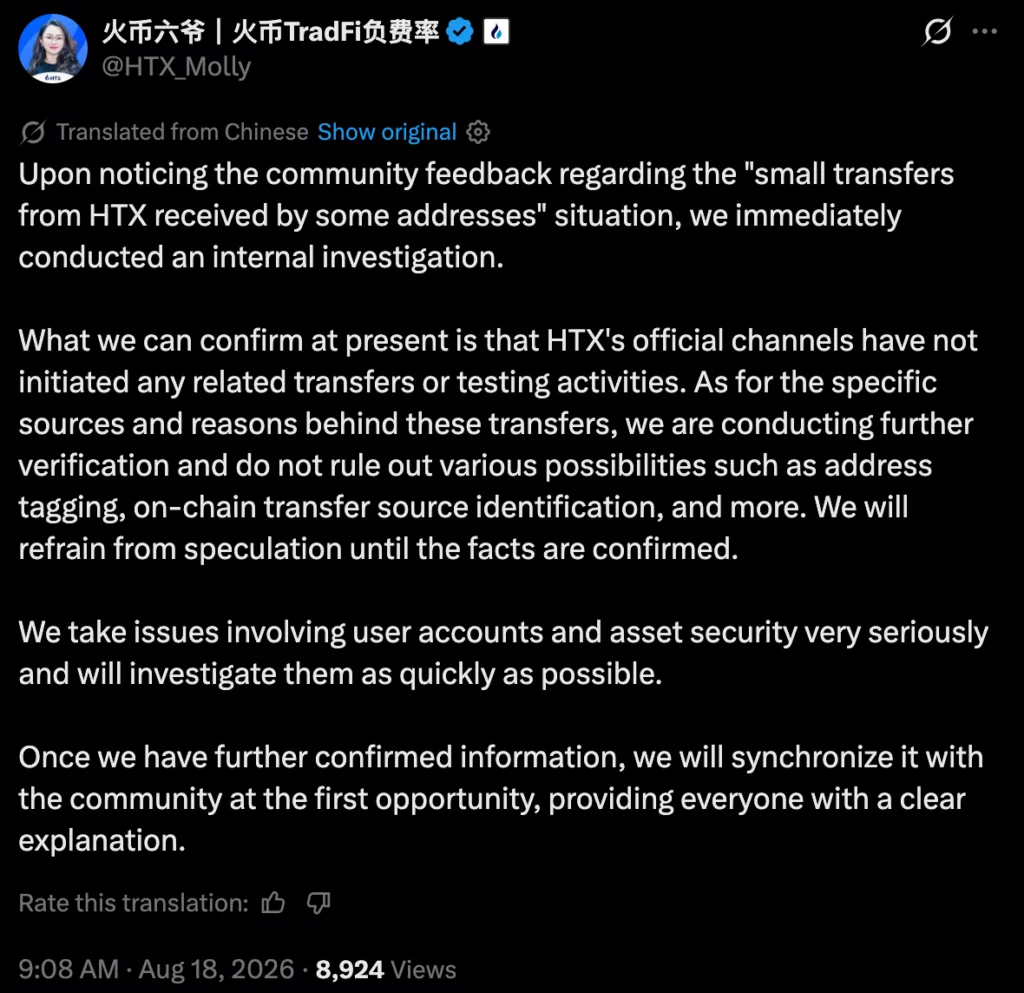
HTX said on Aug. 18 that it is investigating small cryptocurrency transfers received by several addresses after community members attributed the deposits to the exchange.
Summary
- HTX said its internal review found no official transfers or testing activity behind reported deposits.
- Users reported receiving small USDT deposits from addresses labeled as HTX wallets by blockchain services.
- HTX is examining whether address labels or transaction attribution errors created a misleading origin trail.
- No transaction list, verified victim count, confirmed loss, or poisoning campaign operator has been disclosed.
- Reports of frozen accounts remain unconfirmed by HTX and lack publicly available supporting case details.
The exchange said its initial internal review found that its official channels had not initiated the transfers or conducted related testing. HTX is now examining the origin of the transactions and whether blockchain address labels or attribution methods produced a misleading connection.
Some users have described the transactions as “address poisoning.” Others reportedly said their accounts faced restrictions after receiving the funds. Neither description has been independently confirmed through transaction records, platform notices or findings from a blockchain security company.
HTX says it did not initiate the disputed transfers
HTX responded after community members circulated screenshots of small deposits that appeared to come from exchange linked addresses. One user reportedly received 7.5 USDT in a Coinbase account before being asked to explain the source of the funds, according to a report.
A request for information does not necessarily mean an account has been frozen. Coinbase has not publicly addressed the reported case, and no affected user has published a complete platform notice showing a permanent restriction linked to the transfer.
HTX said it had “not conducted any related transfers or testing activities.” The exchange added that it would not speculate before completing its investigation. It promised to provide the community with confirmed information, although it did not set a deadline.
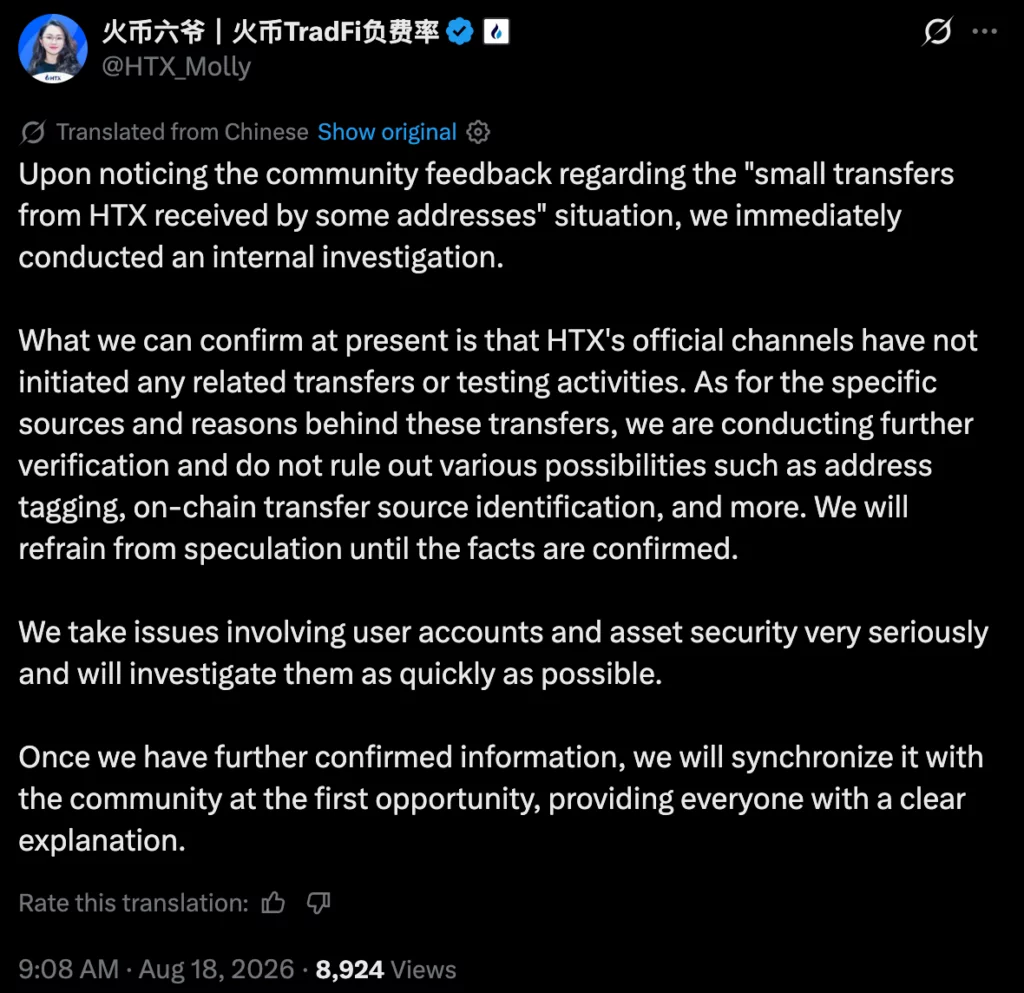
The statement did not identify the blockchain involved, the sending addresses or the transaction hashes. It also did not disclose how many recipients had reported deposits or whether any customer assets were at risk.
Small deposits do not prove address poisoning
Address poisoning normally involves an attacker creating an address that resembles one previously used by a target. The attacker then sends a small or zero value transaction so that the lookalike address appears in the target’s transaction history.
The attacker hopes the user will later copy the planted address without checking every character. Chainalysis describes this transaction history manipulation in its security guide.
Small unsolicited transfers alone do not establish address poisoning. Investigators would need to determine whether the sender resembles a trusted counterparty and whether the transaction was intended to manipulate a recipient’s address history.
The current reports contain no verified evidence that recipients later sent assets to lookalike addresses. No losses have been confirmed. No security researcher has publicly connected the disputed transfers to a specific operator.
As previously reported, a user recently lost 100,000 USDT after copying a planted lookalike address from their transaction history. That case included a confirmed misdirected payment, unlike the activity HTX is investigating.
Wallet labels may explain the apparent HTX connection
Blockchain transactions identify addresses, but they do not automatically identify the legal entity controlling each address. Explorers and analytics companies assign labels using disclosed ownership information, transaction patterns and address clustering.
Those methods can produce useful leads, but a displayed label is not conclusive proof that the named exchange authorized a transfer. Deposit addresses, consolidation wallets, payment processors and intermediary services can further complicate attribution.
HTX said its investigation would consider “address tagging” and the identification of onchain transfer sources. This leaves open the possibility that third party services attributed a sender to HTX incorrectly or without enough supporting evidence.
The exchange previously published a scam warning about unsolicited 0.001 USDT transfers. It advised users to inspect complete wallet addresses instead of relying on shortened address displays or transaction histories.
The present case also arrives amid wider concerns about automated compliance screening. In related coverage, users reported blocked transactions and frozen funds after compliance services flagged exposure to HTX linked addresses. Those earlier restrictions involved sanctions screening and do not prove a connection to the latest deposits.
Account freeze reports require further evidence
Claims that some accounts were “frozen” remain unverified. No exchange has confirmed imposing restrictions because of the disputed transfers, and the available reports do not provide case numbers, notices or affected wallet addresses.
A platform may request information when an automated monitoring system detects an unfamiliar counterparty or a link to a flagged address. Such a review can delay access without proving misconduct by the recipient or the sending address.
The distinction matters because describing every compliance check as a freeze could overstate the event. It could also wrongly suggest that HTX users conducted a coordinated poisoning campaign when neither HTX nor an independent investigator has reached that conclusion.
HTX’s investigation will need to identify the sending addresses, establish who controlled them and explain why they made the transfers. Publishing transaction hashes would allow independent analysts to test the exchange attribution and search for lookalike address patterns.
Until then, users should avoid copying destination addresses from transaction histories. They should verify the full address, use saved address books where available and preserve transaction hashes or account notices for support teams. Interacting with an unsolicited token or unfamiliar contract may introduce separate security risks.
HTX said it would share further findings once confirmed. The exchange has not announced when the review will end or whether it plans to publish a technical report.
BitBox, the Swiss hardware-wallet provider, has released a firmware update aimed at correcting two security vulnerabilities it characterized as “severe.” According to a security disclosure published on Monday, the patches address issues that could theoretically allow a malicious host to interfere with device behavior and, in one case, affect how Bitcoin is routed during Silent Payments.
Key takeaways
- BitBox says its new firmware fixes a “severe” memory corruption issue affecting Multi editions of BitBox02 and BitBox02 Nova when the device has no wallet configured.
- The company also patched a “severe” weakness in its Silent Payments implementation that could potentially cause Bitcoin to be locked to an unintended address.
- BitBox reported receiving no claims that either vulnerability has been exploited in the wild or caused user losses.
- The update arrives amid heightened scrutiny of hardware-wallet supply chains and device security after high-profile wallet-related incidents.
What BitBox says the firmware update changes
In its disclosure, BitBox describes one vulnerability as a form of memory corruption involving Multi editions of BitBox02 and BitBox02 Nova. The issue is tied to scenarios where the device has not been configured with a wallet, meaning it’s in a state where it could be more vulnerable to abnormal interactions.
BitBox warns that a malicious host could exploit the flaw to execute arbitrary code and potentially install malicious firmware. If such an attack succeeded, it could compromise the device’s ability to protect user funds. As part of its disclosure, the company states it has not received reports indicating the vulnerability has been used to harm users.
Silent Payments patch: risk of unintended locking
The second vulnerability affects BitBox’s Silent Payments feature. BitBox says that while the flaw would not directly enable theft, it could allow a malicious host to lock Bitcoin to an address chosen by the attacker rather than the intended recipient.
In practical terms, BitBox frames the threat as leverage instead of direct extraction: an attacker could potentially demand a ransom to cooperate with restoring access to the coins. BitBox also says it has not seen reports of this issue being exploited or leading to lost funds.
Why the timing matters for self-custody security
BitBox’s firmware release lands at a moment when the hardware-wallet ecosystem is being tested on multiple fronts: device firmware integrity, secure generation of wallet data, and even the protection of customer and order information around wallet products.
Earlier coverage tied a Coldcard hardware-wallet issue to a March 2021 firmware change that remained undetected for more than five years. That vulnerability reportedly affected wallet-seed randomness, enabling attackers to brute-force impacted wallet seeds and derive private keys without physical access. Galaxy Research said last Friday that Coldcard-related losses had exceeded $112 million, with about 1,778.6 BTC reportedly swept from more than 8,600 addresses. (The earlier analysis is described in Cointelegraph’s reporting: Coldcard’s 5-year flaw reveals hardware-wallet testing gap.)
Beyond device bugs, separate incidents also drew attention to the broader risk surface of hardware-wallet businesses. Cointelegraph previously reported data breaches involving Trezor and SafePal that exposed customer and order information for more than 53,000 people. Those cases did not compromise device security, private keys, or recovery phrases. Instead, they raised concerns about targeted phishing and impersonation attempts—risks that can be especially dangerous for users who can be tricked into handing over seed material or signing approvals.
What users should watch after installing updates
Hardware-wallet vulnerabilities are not always limited to “theft bugs.” As BitBox’s disclosure shows, threats can also emerge from interaction patterns—such as how a device behaves before a wallet is configured—or from optional features like Silent Payments, where errors can affect the destination of funds rather than enabling immediate draining.
For BitBox users, the key next step is straightforward: install the firmware update and confirm the device is operating under the latest version recommended by the vendor. Readers may also want to review their operational habits around Silent Payments usage and ensure they are comfortable with how their wallet constructs and verifies outputs before signing.
More broadly, the pattern across recent incidents suggests that self-custody security depends on a full chain—not only the cryptography inside the hardware, but also firmware correctness, feature-specific logic, and the surrounding processes that keep customer interactions from becoming an entry point for social engineering.
With BitBox now shipping a fix and reporting no known exploitation, the remaining question for the market is whether broader scanning and third-party auditing will surface additional edge-case weaknesses in similar workflows across other devices and features. Users should treat firmware updates as an ongoing part of operational security, not a one-time task.

Brent crude broke above $90 a barrel and rose 2.7% on Monday after President Donald Trump threatened to bomb Oman if the country interferes with talks over the Strait of Hormuz.
The remarks landed as a 60-day US-Iran negotiating deadline expired without a resolution, deepening uncertainty across energy markets.
What Trump Actually Said About Oman
The Strait of Hormuz is a narrow waterway between Iran and Oman, carrying roughly one-fifth of global crude oil and liquefied natural gas daily. It has stayed largely closed to normal tanker traffic since fighting began in February.
Trump made the threat in a phone interview with Fox News correspondent Trey Yingst. Asked about talks between Iran and Oman over jointly overseeing the strait, he said that if Oman got in the way, the US would bomb them.
Later in the Oval Office, reporters pressed him to elaborate. Trump said he did not think Oman had behaved very well, but that the situation would be handled easily. This was not his first warning toward the Gulf nation, having made a similar comment at a Cabinet meeting in May.
Follow us on X to get the latest news as it happens.
Oman, a longtime US ally near Yemen, the UAE, and Saudi Arabia, has been negotiating separately with Iran. Iran’s Mehr News Agency reported Saturday that Tehran and Muscat reached an arrangement on traffic.
“By threatening to bomb Oman — a longtime U.S. ally with nearly 200 years of diplomatic ties and active military cooperation — Trump just became the first American president in history to openly threaten to bomb one of our own partners,” social and climate justice activist Bill Madden noted.
Why the Deadline and the Markets Both Matter
Shipping data underscores the stakes. Only 13 vessels passed through the strait over the weekend, including three on Sunday, according to maritime tracker MarineTraffic.
Oil prices reflected that disruption directly. Brent crude climbed 2.7% to break above $90 a barrel, its highest level of the day, as Trump made the comment.
That timing appears central to Trump’s frustration. An Oman-Iran deal could shape access to the strait even as Washington pursues a broader agreement with Tehran.
Monday marked the expiration of a 60-day window that the US and Iran had agreed to in June, aimed at ending the conflict and addressing Iran’s nuclear program. No concrete resolution emerged. Trump maintained that Iran cannot possess a nuclear weapon, without detailing where negotiations currently stand.
The political fallout arrived quickly. Senator Tim Kaine said he would introduce a resolution barring military action against Oman once the Senate returns from recess. Iran’s Foreign Ministry described talks with Oman as complex but ongoing, citing unnamed actors attempting to influence the process.
“Deranged. Oman is a U.S. ally. Torching a critical alliance for his foolish war against Iran, which has raised costs and drained our weapons stockpiles, hurts America—and helps China and Russia. I’ll file a War Powers Resolution to stop Trump from taking us into yet another war,” Kaine said on X.
Subscribe to our YouTube channel to watch leaders and journalists provide expert insights.
Equity markets reacted more mildly than crude. The Dow Jones fell 0.3% in early trading, while the S&P 500 slipped 0.1% amid thin summer volume.
For now, tanker traffic through the strait remains disrupted, leaving shipping companies and oil importers watching for any sign that diplomacy, or further military threats, will determine what happens next.
The post Oil Surges Above $90 After Trump Threatens to Bomb Oman Over Strait of Hormuz appeared first on BeInCrypto.

Although BTC has recovered slightly from the weekend slumber and sits above $64,000, Ripple’s native token has failed to join the rather modest ride and continues to fight for the $1.00 support; however, it’s from the downside now.
Fresh on-chain data shared by popular crypto analyst Ali Martinez showed that this hasn’t deterred large investors from growing louder amid these market struggles.
XRP Whales Are Back
Fresh on-chain data cited by popular crypto analyst Ali Martinez indicated that whale activity on the XRP Ledger has exploded over the past 24 hours to new local peaks. More precisely, the number of XRP transactions worth over $1 million has surged by 280% to nearly 40. For reference, the number of such transactions during the previous two days stood at around 10.
This sudden activity spike comes only a few days after another significant whale development in which addresses holding between 10 million and 100 million XRP accumulated approximately 72 million tokens in a single day. At the time, this was worth roughly $72 million.
These are numerous signs that network activity has picked up the pace lately and strengthened considerably. Another signal for this came last week when the XRP Ledger recorded nearly 50,000 active addresses within 24 hours, which became a multi-month peak. At the same time, the social sentiment surrounding the native token deteriorated to a three-month low.
Simply put, activity among network users and some of Ripple’s biggest participants is moving in the right direction, while the price of the cross-border token is not.
XRP Still Struggles at Key Support
XRP’s recent slumber is more concerning to investors as the asset slipped by 1% in the past 24 hours to trade just under the crucial psychological support at $1.00. The derivatives market paints another conflicting picture, as the token’s open interest recently approached levels last seen around the massive October 10 liquidation event. In addition, CryptoQuant flagged rising selling pressure on Binance.
The battle for $1.00 appears to be favoring the bears, as long traders have absorbed considerably larger liquidation losses during XRP’s repeated attempts to defend that level.
Consequently, the returning whale activity becomes even more intriguing, as this 280% surge in large transactions doesn’t reveal whether whales were buying or selling. It shouldn’t necessarily be interpreted as accumulation, but when combined with last week’s major purchases and overall rising XRPL activity, it shifts the broader perspective to a more promising one.
The post XRP Whale Activity Explodes 280% as Price Falls Below $1: What’s Going On? appeared first on CryptoPotato.

Blake Lively Urges People to ‘Be Kind’ After Hayden’s Death

GOLD LIVE – XAUUSD Forex Detector Live Trading Session# 530 #crypto #forexlive #forexdetector

Can festivals leave the land better than they found it?


-

 Fashion4 days ago
Weekend Open Thread: Ann Taylor
-
 NewsBeat6 days ago
Communication cards help banking customers access services or report scams
-
 Sports4 days ago
This U.S. Amateur is a glimpse into golf’s future in more ways than you think
-

 Sports3 days ago
Birmingham 2026: Day 6 Timetable for Irish Athletes
-
 NewsBeat3 days ago
Myanmar says over 300,000 Rohingya refugees verified for repatriation as exodus enters ninth year
-

 Politics3 days ago
SEQ Code: The Three Letter Boarding Pass Code That Could Give You The Worst Seat
-
 Entertainment6 days ago
Keke Palmer Subtly Hints At Sean Evans Drama With Cryptic Post
-

 Fashion7 days ago
Coffee Break: The Fonteyn Jane Flat
-
 Tech4 days ago
11 Ways to Rank Your Videos
-

 Fashion7 days ago
Should you refinance your debt? Pros, cons, and real numbers
-

 Tech7 days ago
Zoom Screen-Sharing Bug Let People Fully Take Over Other Devices On A Call
-

 Fashion7 days ago
Claire Life: Kicking Off MVAAFF With the C Suite Luncheon Featuring Phylicia Rashad, Letoya Luckett, and More!
-
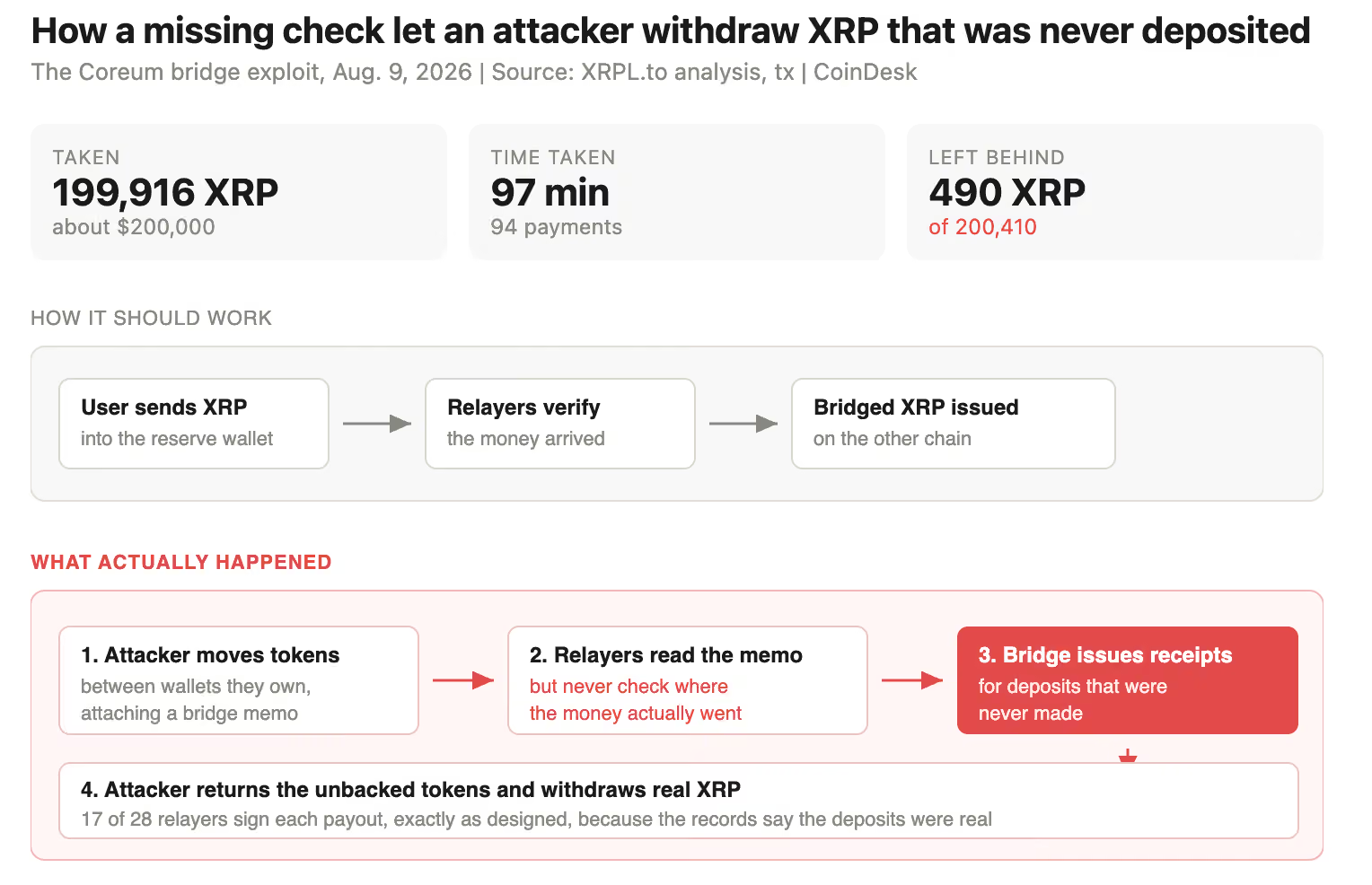 Crypto World6 days ago
XRP bridge drained after software mistook fake deposits for real ones
-

 Tech5 days ago
DeepSeek Harness launches as open source rival to Claude Code, alongside V4-Pro on API with higher prices
-

 Sports6 days ago
DeQuan Jones in ‘high spirits’ after successful leg surgery
-

 Politics6 days ago
How Average Are You In The UK?
-
 Crypto World6 days ago
Perplexity AI Predicts an XRP Scenario Few Analysts Are Discussing
-

 Politics7 days ago
In the Chris Kaba case, the police watchdog capitulated to the mob
-

 Tech6 days ago
SpaceXAI’s Grok Bot turns agents into persistent digital coworkers that can operate your apps for $120-per-month
-

 NewsBeat6 days ago
‘Regret is a major theme of my work’: Matt Haig on finding acceptance
You must be logged in to post a comment Login