
Crypto World
CLARITY Act odds drop to 10%: what killed the bill



The Digital Asset Market Clarity Act was not supposed to fail. It had bipartisan committee support, a White House willing to sign, and an industry that spent over $100 million lobbying for it. Six months ago prediction markets gave it better than four in five odds. The collapse from 82% to under 20% is not the story of a bill that lacked support. It is the story of a bill that could not survive the collision between three constituencies whose demands were mutually exclusive, on a calendar that left no room for compromise.
Summary
- Polymarket priced the CLARITY Act’s chances of becoming law in 2026 at 82% in February; by mid August that number had collapsed to under 20%, with Galaxy Digital cutting its own estimate to 10% on August 14.
- The Senate confirmed on August 6 that it would not vote on the 309 page market structure bill before the August 7 recess, pushing the fight to a September 14 return window with only 14 working days before midterm politics consume the floor.
- Three unresolved disputes stalled the bill: stablecoin yield provisions that threaten Coinbase’s $1.35 billion annual USDC rewards revenue, DeFi protocol classification rules, and ethics requirements targeting President Trump’s $1.4 billion in crypto income from World Liberty Financial and the TRUMP memecoin.
- Republicans hold 53 seats but are expected to lose Senators Hawley and Paul on the vote, meaning at least eight Democrats must cross over; only two did so in committee.
- The SEC and CFTC are now racing to fill the regulatory void with agency rulemaking, including the SEC’s Regulation Crypto package covering token launch exemptions, decentralization safe harbors and broker dealer custody.
This piece traces the three disputes that stalled the bill, examines why the Senate calendar makes September passage unlikely, and maps what happens to the industry if the CLARITY Act dies in 2026.
The February consensus and how it unraveled
The CLARITY Act emerged from the Senate Banking Committee in January 2026 with a 15 to 9 vote. Two Democrats crossed over to support it. The bill ran 309 pages and attempted to do what no previous legislation had accomplished: draw a permanent line between the SEC and CFTC’s jurisdiction over digital assets, define when a token stops being a security and starts being a commodity, and create registration pathways for exchanges, brokers and custodians.
Polymarket reflected the optimism. Traders priced passage at 82% in February. Galaxy Digital’s research team put it at 75%. The logic was straightforward: Republicans had the votes, the White House had signaled it would sign, and the industry had spent aggressively to ensure floor time.
The first crack appeared in April when Senate negotiations stalled over three open items that the committee had deferred to floor debate: stablecoin yield rules, DeFi protocol classification, and ethics provisions for government officials with crypto holdings. Each of these disputes had a constituency with enough leverage to block the bill.
The stablecoin yield fight
The current draft of the CLARITY Act prohibits interest or yield on idle stablecoin balances while permitting activity based rewards through DeFi mechanisms such as liquidity pools and lending protocols. The distinction matters because it determines whether centralized exchanges can continue paying customers to hold stablecoins.
Coinbase earns approximately $1.35 billion annually from USDC rewards, a program that pays customers yield for holding Circle’s stablecoin on the platform. Under the proposed framework, that revenue model would be restricted. Coinbase has lobbied intensely to modify the provision, arguing that prohibiting yield on idle balances while permitting it through DeFi creates an arbitrary distinction that pushes activity toward less regulated protocols.
The banking lobby wants the prohibition to stand. Traditional banks view stablecoin yield as a deposit product offered without deposit insurance, capital requirements or FDIC oversight. Allowing exchanges to pay yield on stablecoins while banks must comply with Basel III capital rules creates a competitive asymmetry that the banking industry will not accept quietly.
The compromise that the committee deferred, permitting yield only through regulated DeFi mechanisms, satisfies neither side. Coinbase loses its largest revenue stream. Banks still face competition from protocols that are harder to regulate. The provision has consumed more negotiating time than any other section of the bill.
The DeFi classification problem
The CLARITY Act attempts to define when a blockchain network is sufficiently decentralized that its tokens are no longer securities. The bill creates a framework under which the SEC would evaluate whether essential managerial efforts have ceased, using criteria including the distribution of governance tokens, the absence of a controlling entity, and the degree to which protocol upgrades require community consensus rather than unilateral developer action.
Democrats on the committee argued the criteria are too permissive. Senator Sherrod Brown’s staff circulated a memo in May contending that under the proposed standards, FTX’s FTT token would have qualified for commodity treatment within 18 months of launch, despite Sam Bankman-Fried’s centralized control of the exchange. The memo was disputed by the bill’s sponsors, but it reframed the debate: any standard that could retroactively validate FTT is a standard that will face political resistance.
The deeper issue is that decentralization exists on a spectrum, and the bill needs a binary threshold. A protocol is either sufficiently decentralized or it is not. Drawing that line through legislation means choosing a point on the spectrum that will be wrong for some projects on either side. The committee chose to defer the final calibration to floor debate, and floor debate has not happened.
The Trump problem
The most politically toxic dispute has nothing to do with technology. President Trump’s 2025 financial disclosure showed approximately $1.4 billion in crypto related income: $799 million from World Liberty Financial and $635 million from the TRUMP memecoin. Democrats have demanded enforceable divestiture or blind trust requirements for senior officials as a condition for supporting cloture.
The ethics provision in the current draft falls short of what Democrats want. It prohibits federal officials from issuing digital assets but does not require divestiture of existing holdings. Senator Elizabeth Warren called the provision inadequate, arguing that it allows the president to profit from the regulatory clarity the bill provides while the bill is being debated.
The Trump administration has complicated the politics further. On August 14, the Office of the Comptroller of the Currency granted World Liberty Financial a conditional national trust bank charter, allowing the firm to issue stablecoins directly. Senator Warren called it “the most brazen act of self dealing our financial system has ever seen.” The timing, one day before Galaxy cut passage odds to 10%, was not coincidental in the eyes of Democratic leadership.
Republicans argue that ethics provisions should be handled in separate legislation and that linking them to market structure creates a poison pill designed to kill the bill. The impasse is structural: Democrats have enough votes to block cloture, and they will not provide them without ethics requirements that Republicans view as targeted at the president.
The calendar problem
Even if all three disputes were resolved tomorrow, the Senate calendar makes 2026 passage difficult. The Senate returns on September 14. Senator Thune filed cloture on August 8, and the motion ripens on September 15. If cloture succeeds, floor debate and amendments follow. The midterm election is November 3. The Senate typically loses productive floor time to campaign travel by mid October.
That leaves roughly 14 working days for floor debate, amendments and a final vote on a 309 page bill with at least three contested provisions. The GENIUS Act, a narrower stablecoin bill, took 11 days of floor time. The CLARITY Act is broader and more contentious.
Galaxy Digital’s August 14 note cited the calendar as the primary reason for cutting odds to 10%. The firm noted that even with bipartisan goodwill, the procedural mechanics of the Senate do not support passing a bill of this complexity in the available window.
The prediction market as legislative thermometer
The CLARITY Act’s trajectory is one of the clearest demonstrations of prediction markets functioning as real time policy sensors. Polymarket’s contract on 2026 passage has tracked every major development with a precision that traditional polling and expert commentary have not matched.
The February peak of 82% followed the committee vote. The first drop to 60% came in April after the three disputed provisions surfaced. The decline to 42% tracked the July 17 hearing where Democratic members signaled they would not provide cloture votes without ethics language. The fall to 27% followed the Senate’s confirmation that no pre recess vote would occur. The current reading near 17% reflects Galaxy’s 10% estimate and the absence of any public indication that a deal is forming during the recess.
The prediction market has been consistently ahead of media coverage and industry commentary. When Coinbase’s CEO expressed optimism about passage in a July earnings call, Polymarket was already pricing the bill below 50%. When Galaxy published its 10% estimate on August 14, Polymarket had been below 20% for a week.
The implication for the September 15 cloture vote is that the market will price in a deal before it is announced. A sharp move above 30% in the days before the vote would signal that negotiations have produced a framework that both parties can accept. The absence of that move would signal that the vote is performative.
The international comparison
The CLARITY Act’s stall is happening against a backdrop of accelerating regulation elsewhere. The European Union’s Markets in Crypto Assets regulation has been in force since June 2024. The United Kingdom’s Financial Conduct Authority finalized its crypto regime in March 2026. Singapore, Japan, Hong Kong and the United Arab Emirates all have operational frameworks.
The practical consequence is regulatory arbitrage. Companies that need clarity to operate are moving to jurisdictions that provide it. The concern that crypto regulation failure would push activity offshore is not theoretical. Coinbase, Kraken and Gemini all expanded their European and Asian operations in 2026 while US focused compliance teams waited for a framework that has not materialized.
The industry argument is that the US is falling behind. The counterargument is that moving slowly is preferable to moving fast and getting the framework wrong. Both positions have merit, but the calendar does not care about the merits. Every month without legislation is a month in which the regulatory gap between the US and its competitors widens.
What replaces it if it fails
The SEC and CFTC are not waiting. Both agencies have accelerated rulemaking that effectively substitutes for legislation.
The SEC’s Regulation Crypto package, which Chair Paul Atkins has described as ready for notice and comment, covers four areas: registration exemptions for token launches, a safe harbor for teams that have fully decentralized, broker dealer custody treatment, and trading venue structure. The safe harbor would codify the joint SEC CFTC interpretive release from March 2026, giving issuers a rule based path to commodity status without congressional action.
The CFTC has moved toward a spot listing regime that would allow regulated exchanges to list digital asset spot contracts alongside futures. The August 19 White House meeting, which includes executives from Coinbase, Ripple and Kraken alongside SEC Chair Atkins and CFTC Chair Selig, is expected to discuss how agency rulemaking can fill the gap if the CLARITY Act does not pass.
The industry’s concern with agency rulemaking is durability. Rules can be reversed by a future administration. Legislation cannot. A Democratic president in 2029 could direct the SEC to withdraw Regulation Crypto and return to enforcement based regulation. The CLARITY Act was supposed to prevent that by writing the framework into statute. Without it, the industry operates under rules that last only as long as the current administration’s appointees remain in office.
The precedent is instructive. The SEC’s 2024 approval of spot Bitcoin ETFs came through an agency decision, not legislation. That decision survived a change in SEC leadership because the new chair supported it. A future chair who does not support crypto could reverse course on Regulation Crypto in a way that would not be possible if the framework were statutory.
There is also a sequencing problem. If the SEC finalizes Regulation Crypto before the September 15 cloture vote, it reduces the urgency argument for passing the CLARITY Act. Senators who might have voted for the bill because the alternative was regulatory chaos may conclude that the alternative is now agency rulemaking that provides adequate clarity. The SEC’s timeline therefore directly affects the bill’s political dynamics.
The CFTC’s spot listing regime adds another layer. If regulated exchanges can list digital asset spot contracts alongside futures under CFTC oversight, a significant portion of what the CLARITY Act was designed to enable happens without Congress acting. The gap narrows between what the bill provides and what agency action can deliver, making the remaining benefits of legislation, primarily durability, a harder sell to senators with limited floor time.
The opposing case: why it could still pass
The case for passage rests on three arguments. First, the September 15 cloture vote is a real procedural step, not a symbolic gesture. Thune would not have filed it without some expectation that negotiations could produce a deal during the recess. Second, the August 19 White House meeting signals executive branch engagement at a level that suggests the administration wants a legislative win, not just agency rules. Third, the industry’s lobbying spend exceeds $100 million, and that money buys access to the eight Democratic crossover votes the bill needs.
The weakness in this case is that it relies on resolving three disputes in the remaining calendar days that the Senate could not resolve in seven months of committee work and floor negotiations. The stablecoin yield provision alone involves Coinbase’s largest revenue stream, the banking lobby’s core competitive concern, and a DeFi ecosystem that views any yield restriction as existential. Finding a formula that satisfies all three in 14 working days requires a level of legislative productivity the Senate has not demonstrated on crypto.
There is also a historical pattern that favors passage. Major financial legislation in the United States often passes in compressed timelines after extended delays. The Dodd Frank Act took 11 months from introduction to signature but the final negotiations concluded in weeks. The JOBS Act moved from stalled committee work to bipartisan passage in under a month when both parties found electoral motivation. The CLARITY Act could follow the same pattern if midterm pressure creates sufficient incentive for both parties to claim a legislative achievement.
The strongest version of the bull case is that prediction markets are wrong about the remaining probability because they cannot price in private negotiations. If Senate staff are working on a compromise during the recess, that work does not produce public signals until an announcement. Polymarket’s 17% could be accurately pricing public information while missing a deal that has been reached in principle but not yet disclosed.
What would prove this analysis wrong: a cloture vote on September 15 that succeeds with 60 or more votes, followed by a rapid amendment process. If that happens, the bill’s sponsors found a deal during recess that is not yet public. The specific tell would be simultaneous statements from both a Republican and a Democratic senator endorsing a revised ethics provision in the days before the vote.
What to watch
- September 15 cloture vote. This is the binary event. If cloture fails, the CLARITY Act is dead for 2026. If it succeeds, floor debate begins and passage becomes plausible within weeks.
- Polymarket odds in the 48 hours before the vote. Prediction markets have been the most accurate tracker of this bill’s trajectory. A sharp move above 30% in the days before September 15 would signal that a deal has leaked.
- SEC Regulation Crypto timeline. If the SEC publishes a notice of proposed rulemaking before the cloture vote, it signals the agency expects the bill to fail and is moving to fill the gap independently.
- Democratic crossover count. The bill needs eight Democrats. Two voted yes in committee. The six additional votes are the entire negotiation. Any public commitments from Democratic senators during the recess will move the odds.
- World Liberty Financial activity. Any additional regulatory approvals or charter expansions for the Trump linked crypto venture during the negotiation window will harden Democratic opposition and reduce the odds of a deal on ethics provisions.
Frequently asked questions
What is the CLARITY Act?
The Digital Asset Market Clarity Act is a 309 page bill that would create a permanent regulatory framework for cryptocurrency in the United States, defining which digital assets fall under SEC jurisdiction as securities and which fall under CFTC jurisdiction as commodities.
Why did the odds of passage collapse?
Three unresolved disputes stalled the bill: stablecoin yield provisions, DeFi protocol classification criteria, and ethics requirements for government officials with crypto holdings. The Senate’s decision not to vote before the August recess pushed negotiations into a 14 day September window that most analysts consider insufficient.
What is the stablecoin yield dispute?
The bill prohibits interest or yield on idle stablecoin balances while permitting activity based rewards through DeFi. This would restrict Coinbase’s $1.35 billion annual USDC rewards program. The banking industry supports the prohibition; Coinbase and DeFi protocols oppose it.
How does President Trump’s crypto income affect the bill?
Trump reported $1.4 billion in crypto income in 2025, including $799 million from World Liberty Financial. Democrats demand enforceable divestiture or blind trust requirements for officials as a condition for supporting the bill. Republicans view these demands as a targeted poison pill.
What happens if the CLARITY Act fails in 2026?
The SEC and CFTC would proceed with agency rulemaking, including the SEC’s Regulation Crypto package covering token launch exemptions and decentralization safe harbors. These rules can be reversed by a future administration, unlike legislation.
When is the next critical vote?
Senate Majority Leader Thune filed cloture on August 8 with the motion ripening on September 15. If cloture fails, the bill is effectively dead for 2026.
How many votes does the bill need?
The bill needs 60 votes to clear cloture. Republicans hold 53 seats but are expected to lose two members on this vote, meaning at least eight Democrats must cross over. Only two did so in committee.
Could agency rules replace the CLARITY Act permanently?
Agency rules provide regulatory clarity but lack durability. A future administration could direct the SEC to withdraw Regulation Crypto and return to enforcement based regulation. The industry’s concern is that without legislation, the framework lasts only as long as the current appointees remain in office. This is educational analysis, not investment advice.
Disclaimer: This article was published on August 17, 2026. It reflects information available at the time of writing. Legislative negotiations are ongoing and the status of the bill may change. This is educational analysis, not investment advice.

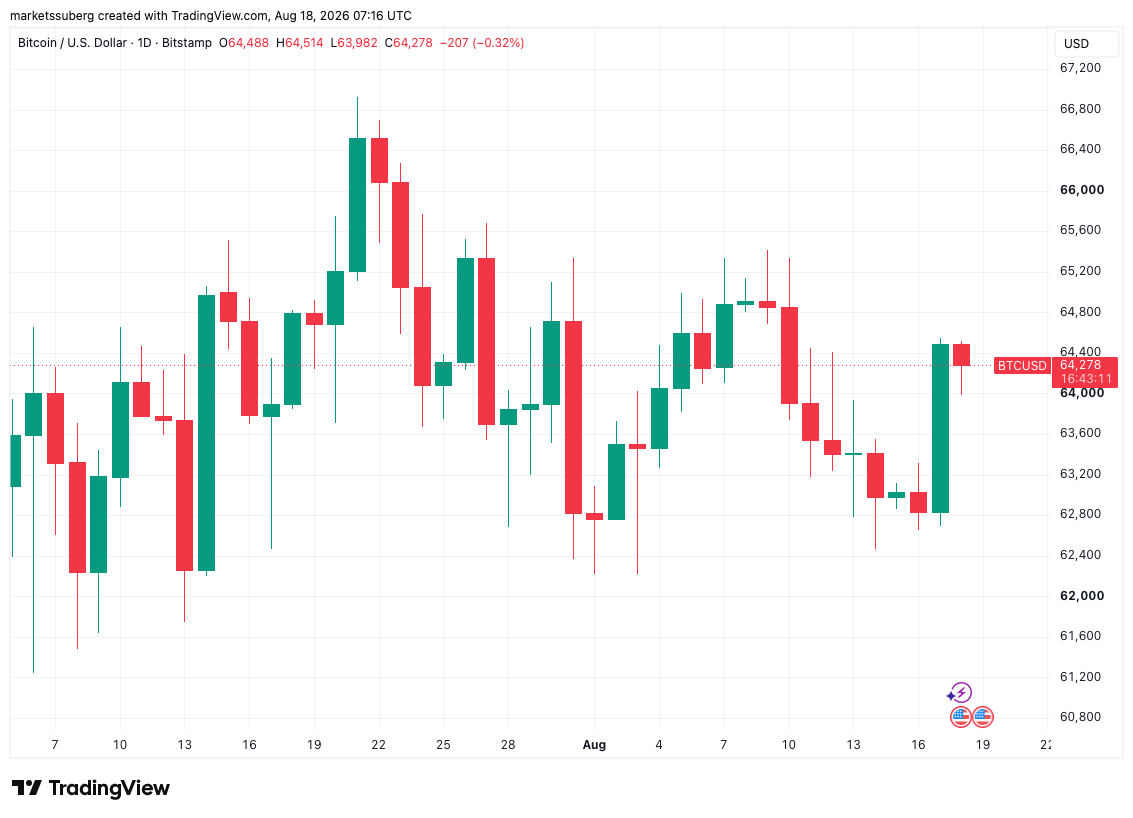
Bitcoin (BTC) short liquidations hit their highest in almost one month as it hit $64,500 on Monday, new data reveals.
Key points:
- Bitcoin passed $64,000 thanks to a short squeeze on derivatives markets, CryptoQuant says.
- An ongoing downward funding-rate reset from 0.006% to 0.003% over 24 hours could mean further short squeezes.
- The absence of spot demand raises doubts whether the upside is sustainable after a week of $267.2 million in net ETF outflows.
Bitcoin short liquidations near one-month high
BTC/USD rallied after Sunday’s weekly close, gaining up to 3% on Monday to top out at one-week highs of $64,550 on Bitstamp.
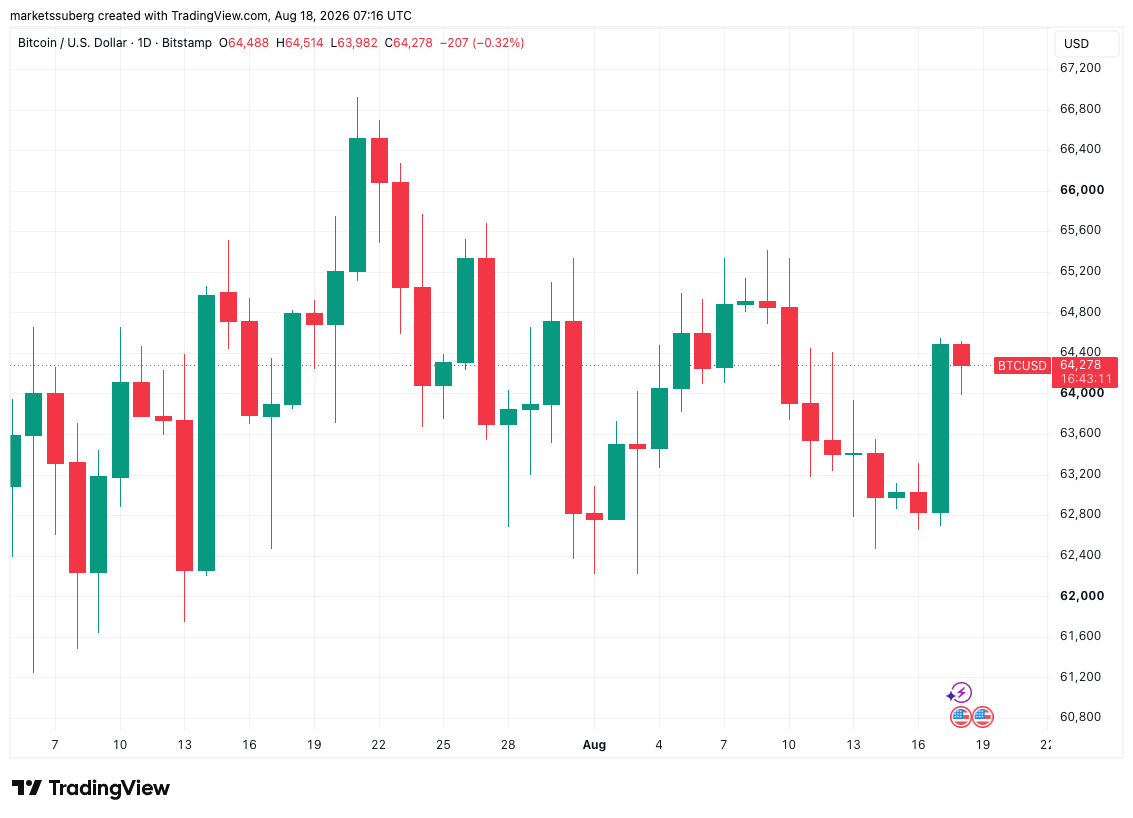
BTC/USD one-hour chart. Source: Cointelegraph/TradingView
Examining the impetus behind the latest BTC price gains, onchain analytics platform CryptoQuant pointed to illiquid markets and funding-rate imbalances among exchanges.
Before rebounding on Monday, BTC circled near $62,750. Around this level, funding rates between exchanges began to diverge. Shorts were dominant on major platforms such as Binance, Bybit, OKX and Deribit, while the funding rate on HTX briefly spiked to 0.05%.
Funding rates refer to periodic payments exchanged by long and short traders on Bitcoin derivatives markets in order to maintain their positions. Positive aggregate funding rates show that long traders are actively paying shorts, with the reverse true for negative funding rates.
“This crowded short positioning served as the primary catalyst, fueling a short squeeze that drove prices higher,” CryptoQuant continued.
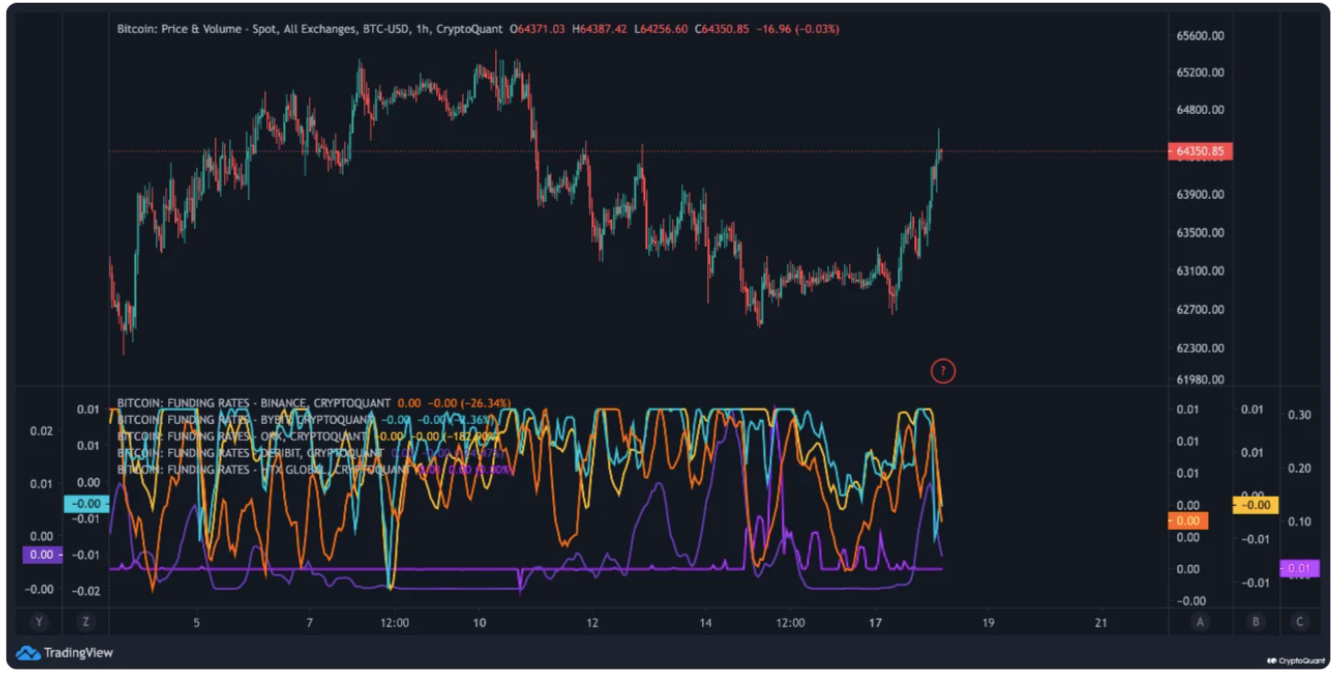
BTC/USD one-hour chart with exchange funding-rate data (screenshot). Source: CryptoQuant
Data puts total Bitcoin short liquidations at 637 BTC for Monday, the largest single-day tally since July 21.
Describing the event as a “low-volume liquidity trap,” CryptoQuant nonetheless suggested that the market could see more short squeezes next, with funding rates already declining again as traders increase short exposure.
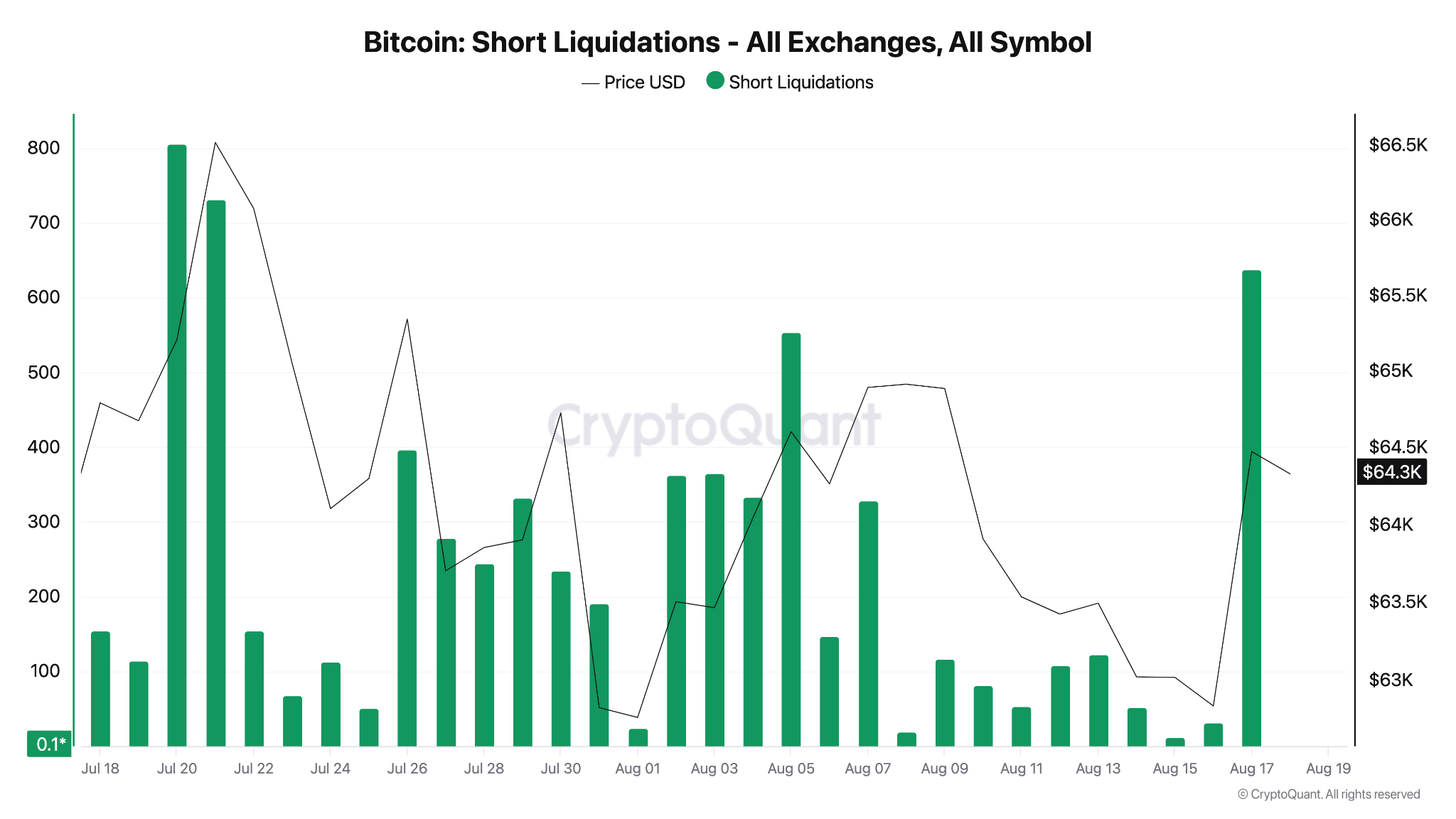
Bitcoin short liquidations. Source: CryptoQuant
Crucial spot demand remains absent
Previously, Cointelegraph reported that Bitcoin futures markets accounted for the majority of trading volume in the current range, with spot traders broadly uninterested.
Related: BTC price loses 200-week trend line as 2022 repeats: Five things to know in Bitcoin this week
In further analysis on Monday, CryptoQuant called the lack of spot demand the primary hurdle to sustained upside, alongside the lack of inflows to the US spot Bitcoin exchange-traded funds (ETFs).
“A break below $60K alongside rising exchange inflows would weaken the structure and increase downside risk toward $50K. Selling pressure is cooling, but demand still needs to return,” it commented.
Recent buyers who remain underwater on their BTC allocation have helped cement the current trading range. Short-term holders — wallets holding a UTXO for less than 155 days — have their cost basis at around $68,700, reinforcing that level as resistance.

“If Oman gets in the way, we’ll bomb the sh-t out of them,” Trump told Fox News reporter Trey Yingst on Monday.
Trump later told reporters, “I don’t think they [Oman] behaved very well, but we’d handle them very easily, just like we do other things.” It’s unclear what exactly Oman has done to upset the U.S. President. TIME has reached out to the White House for comment.
Tehran has said the Strait’s administration should remain strictly between the two coastal states. Iran also previously proposed collecting fees for passage through the waterway, while Oman proposed a system with voluntary fees in late July.
U.S.-Iran diplomacy meanwhile appears tenuous, with Iranian officials denying any direct talks and contradicting Trump’s claims that Iran is eager to make a deal. The 60-day deadline for the U.S. and Iran to negotiate a comprehensive peace agreement to end the war expired Monday without a deal. The two countries signed a memorandum of understanding (MOU) on June 17, which included the lifting of the U.S. naval blockade on Iran and toll-free passage through the Strait of Hormuz. The MOU stated that Iran would discuss with Oman the future administration of the waterway.
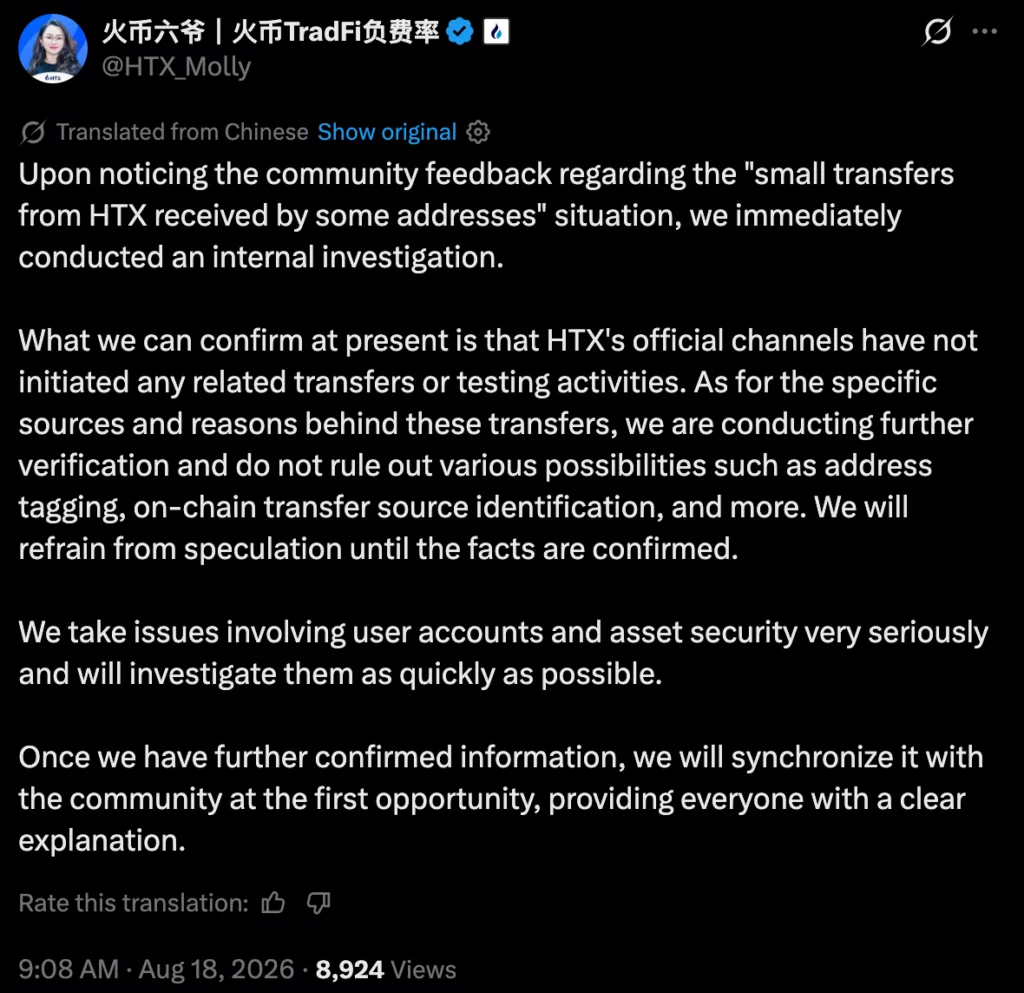
HTX said on Aug. 18 that it is investigating small cryptocurrency transfers received by several addresses after community members attributed the deposits to the exchange.
Summary
- HTX said its internal review found no official transfers or testing activity behind reported deposits.
- Users reported receiving small USDT deposits from addresses labeled as HTX wallets by blockchain services.
- HTX is examining whether address labels or transaction attribution errors created a misleading origin trail.
- No transaction list, verified victim count, confirmed loss, or poisoning campaign operator has been disclosed.
- Reports of frozen accounts remain unconfirmed by HTX and lack publicly available supporting case details.
The exchange said its initial internal review found that its official channels had not initiated the transfers or conducted related testing. HTX is now examining the origin of the transactions and whether blockchain address labels or attribution methods produced a misleading connection.
Some users have described the transactions as “address poisoning.” Others reportedly said their accounts faced restrictions after receiving the funds. Neither description has been independently confirmed through transaction records, platform notices or findings from a blockchain security company.
HTX says it did not initiate the disputed transfers
HTX responded after community members circulated screenshots of small deposits that appeared to come from exchange linked addresses. One user reportedly received 7.5 USDT in a Coinbase account before being asked to explain the source of the funds, according to a report.
A request for information does not necessarily mean an account has been frozen. Coinbase has not publicly addressed the reported case, and no affected user has published a complete platform notice showing a permanent restriction linked to the transfer.
HTX said it had “not conducted any related transfers or testing activities.” The exchange added that it would not speculate before completing its investigation. It promised to provide the community with confirmed information, although it did not set a deadline.
The statement did not identify the blockchain involved, the sending addresses or the transaction hashes. It also did not disclose how many recipients had reported deposits or whether any customer assets were at risk.
Small deposits do not prove address poisoning
Address poisoning normally involves an attacker creating an address that resembles one previously used by a target. The attacker then sends a small or zero value transaction so that the lookalike address appears in the target’s transaction history.
The attacker hopes the user will later copy the planted address without checking every character. Chainalysis describes this transaction history manipulation in its security guide.
Small unsolicited transfers alone do not establish address poisoning. Investigators would need to determine whether the sender resembles a trusted counterparty and whether the transaction was intended to manipulate a recipient’s address history.
The current reports contain no verified evidence that recipients later sent assets to lookalike addresses. No losses have been confirmed. No security researcher has publicly connected the disputed transfers to a specific operator.
As previously reported, a user recently lost 100,000 USDT after copying a planted lookalike address from their transaction history. That case included a confirmed misdirected payment, unlike the activity HTX is investigating.
Wallet labels may explain the apparent HTX connection
Blockchain transactions identify addresses, but they do not automatically identify the legal entity controlling each address. Explorers and analytics companies assign labels using disclosed ownership information, transaction patterns and address clustering.
Those methods can produce useful leads, but a displayed label is not conclusive proof that the named exchange authorized a transfer. Deposit addresses, consolidation wallets, payment processors and intermediary services can further complicate attribution.
HTX said its investigation would consider “address tagging” and the identification of onchain transfer sources. This leaves open the possibility that third party services attributed a sender to HTX incorrectly or without enough supporting evidence.
The exchange previously published a scam warning about unsolicited 0.001 USDT transfers. It advised users to inspect complete wallet addresses instead of relying on shortened address displays or transaction histories.
The present case also arrives amid wider concerns about automated compliance screening. In related coverage, users reported blocked transactions and frozen funds after compliance services flagged exposure to HTX linked addresses. Those earlier restrictions involved sanctions screening and do not prove a connection to the latest deposits.
Account freeze reports require further evidence
Claims that some accounts were “frozen” remain unverified. No exchange has confirmed imposing restrictions because of the disputed transfers, and the available reports do not provide case numbers, notices or affected wallet addresses.
A platform may request information when an automated monitoring system detects an unfamiliar counterparty or a link to a flagged address. Such a review can delay access without proving misconduct by the recipient or the sending address.
The distinction matters because describing every compliance check as a freeze could overstate the event. It could also wrongly suggest that HTX users conducted a coordinated poisoning campaign when neither HTX nor an independent investigator has reached that conclusion.
HTX’s investigation will need to identify the sending addresses, establish who controlled them and explain why they made the transfers. Publishing transaction hashes would allow independent analysts to test the exchange attribution and search for lookalike address patterns.
Until then, users should avoid copying destination addresses from transaction histories. They should verify the full address, use saved address books where available and preserve transaction hashes or account notices for support teams. Interacting with an unsolicited token or unfamiliar contract may introduce separate security risks.
HTX said it would share further findings once confirmed. The exchange has not announced when the review will end or whether it plans to publish a technical report.
BitBox, the Swiss hardware-wallet provider, has released a firmware update aimed at correcting two security vulnerabilities it characterized as “severe.” According to a security disclosure published on Monday, the patches address issues that could theoretically allow a malicious host to interfere with device behavior and, in one case, affect how Bitcoin is routed during Silent Payments.
Key takeaways
- BitBox says its new firmware fixes a “severe” memory corruption issue affecting Multi editions of BitBox02 and BitBox02 Nova when the device has no wallet configured.
- The company also patched a “severe” weakness in its Silent Payments implementation that could potentially cause Bitcoin to be locked to an unintended address.
- BitBox reported receiving no claims that either vulnerability has been exploited in the wild or caused user losses.
- The update arrives amid heightened scrutiny of hardware-wallet supply chains and device security after high-profile wallet-related incidents.
What BitBox says the firmware update changes
In its disclosure, BitBox describes one vulnerability as a form of memory corruption involving Multi editions of BitBox02 and BitBox02 Nova. The issue is tied to scenarios where the device has not been configured with a wallet, meaning it’s in a state where it could be more vulnerable to abnormal interactions.
BitBox warns that a malicious host could exploit the flaw to execute arbitrary code and potentially install malicious firmware. If such an attack succeeded, it could compromise the device’s ability to protect user funds. As part of its disclosure, the company states it has not received reports indicating the vulnerability has been used to harm users.
Silent Payments patch: risk of unintended locking
The second vulnerability affects BitBox’s Silent Payments feature. BitBox says that while the flaw would not directly enable theft, it could allow a malicious host to lock Bitcoin to an address chosen by the attacker rather than the intended recipient.
In practical terms, BitBox frames the threat as leverage instead of direct extraction: an attacker could potentially demand a ransom to cooperate with restoring access to the coins. BitBox also says it has not seen reports of this issue being exploited or leading to lost funds.
Why the timing matters for self-custody security
BitBox’s firmware release lands at a moment when the hardware-wallet ecosystem is being tested on multiple fronts: device firmware integrity, secure generation of wallet data, and even the protection of customer and order information around wallet products.
Earlier coverage tied a Coldcard hardware-wallet issue to a March 2021 firmware change that remained undetected for more than five years. That vulnerability reportedly affected wallet-seed randomness, enabling attackers to brute-force impacted wallet seeds and derive private keys without physical access. Galaxy Research said last Friday that Coldcard-related losses had exceeded $112 million, with about 1,778.6 BTC reportedly swept from more than 8,600 addresses. (The earlier analysis is described in Cointelegraph’s reporting: Coldcard’s 5-year flaw reveals hardware-wallet testing gap.)
Beyond device bugs, separate incidents also drew attention to the broader risk surface of hardware-wallet businesses. Cointelegraph previously reported data breaches involving Trezor and SafePal that exposed customer and order information for more than 53,000 people. Those cases did not compromise device security, private keys, or recovery phrases. Instead, they raised concerns about targeted phishing and impersonation attempts—risks that can be especially dangerous for users who can be tricked into handing over seed material or signing approvals.
What users should watch after installing updates
Hardware-wallet vulnerabilities are not always limited to “theft bugs.” As BitBox’s disclosure shows, threats can also emerge from interaction patterns—such as how a device behaves before a wallet is configured—or from optional features like Silent Payments, where errors can affect the destination of funds rather than enabling immediate draining.
For BitBox users, the key next step is straightforward: install the firmware update and confirm the device is operating under the latest version recommended by the vendor. Readers may also want to review their operational habits around Silent Payments usage and ensure they are comfortable with how their wallet constructs and verifies outputs before signing.
More broadly, the pattern across recent incidents suggests that self-custody security depends on a full chain—not only the cryptography inside the hardware, but also firmware correctness, feature-specific logic, and the surrounding processes that keep customer interactions from becoming an entry point for social engineering.
With BitBox now shipping a fix and reporting no known exploitation, the remaining question for the market is whether broader scanning and third-party auditing will surface additional edge-case weaknesses in similar workflows across other devices and features. Users should treat firmware updates as an ongoing part of operational security, not a one-time task.

Brent crude broke above $90 a barrel and rose 2.7% on Monday after President Donald Trump threatened to bomb Oman if the country interferes with talks over the Strait of Hormuz.
The remarks landed as a 60-day US-Iran negotiating deadline expired without a resolution, deepening uncertainty across energy markets.
What Trump Actually Said About Oman
The Strait of Hormuz is a narrow waterway between Iran and Oman, carrying roughly one-fifth of global crude oil and liquefied natural gas daily. It has stayed largely closed to normal tanker traffic since fighting began in February.
Trump made the threat in a phone interview with Fox News correspondent Trey Yingst. Asked about talks between Iran and Oman over jointly overseeing the strait, he said that if Oman got in the way, the US would bomb them.
Later in the Oval Office, reporters pressed him to elaborate. Trump said he did not think Oman had behaved very well, but that the situation would be handled easily. This was not his first warning toward the Gulf nation, having made a similar comment at a Cabinet meeting in May.
Follow us on X to get the latest news as it happens.
Oman, a longtime US ally near Yemen, the UAE, and Saudi Arabia, has been negotiating separately with Iran. Iran’s Mehr News Agency reported Saturday that Tehran and Muscat reached an arrangement on traffic.
“By threatening to bomb Oman — a longtime U.S. ally with nearly 200 years of diplomatic ties and active military cooperation — Trump just became the first American president in history to openly threaten to bomb one of our own partners,” social and climate justice activist Bill Madden noted.
Why the Deadline and the Markets Both Matter
Shipping data underscores the stakes. Only 13 vessels passed through the strait over the weekend, including three on Sunday, according to maritime tracker MarineTraffic.
Oil prices reflected that disruption directly. Brent crude climbed 2.7% to break above $90 a barrel, its highest level of the day, as Trump made the comment.
That timing appears central to Trump’s frustration. An Oman-Iran deal could shape access to the strait even as Washington pursues a broader agreement with Tehran.
Monday marked the expiration of a 60-day window that the US and Iran had agreed to in June, aimed at ending the conflict and addressing Iran’s nuclear program. No concrete resolution emerged. Trump maintained that Iran cannot possess a nuclear weapon, without detailing where negotiations currently stand.
The political fallout arrived quickly. Senator Tim Kaine said he would introduce a resolution barring military action against Oman once the Senate returns from recess. Iran’s Foreign Ministry described talks with Oman as complex but ongoing, citing unnamed actors attempting to influence the process.
“Deranged. Oman is a U.S. ally. Torching a critical alliance for his foolish war against Iran, which has raised costs and drained our weapons stockpiles, hurts America—and helps China and Russia. I’ll file a War Powers Resolution to stop Trump from taking us into yet another war,” Kaine said on X.
Subscribe to our YouTube channel to watch leaders and journalists provide expert insights.
Equity markets reacted more mildly than crude. The Dow Jones fell 0.3% in early trading, while the S&P 500 slipped 0.1% amid thin summer volume.
For now, tanker traffic through the strait remains disrupted, leaving shipping companies and oil importers watching for any sign that diplomacy, or further military threats, will determine what happens next.
The post Oil Surges Above $90 After Trump Threatens to Bomb Oman Over Strait of Hormuz appeared first on BeInCrypto.

Although BTC has recovered slightly from the weekend slumber and sits above $64,000, Ripple’s native token has failed to join the rather modest ride and continues to fight for the $1.00 support; however, it’s from the downside now.
Fresh on-chain data shared by popular crypto analyst Ali Martinez showed that this hasn’t deterred large investors from growing louder amid these market struggles.
XRP Whales Are Back
Fresh on-chain data cited by popular crypto analyst Ali Martinez indicated that whale activity on the XRP Ledger has exploded over the past 24 hours to new local peaks. More precisely, the number of XRP transactions worth over $1 million has surged by 280% to nearly 40. For reference, the number of such transactions during the previous two days stood at around 10.
This sudden activity spike comes only a few days after another significant whale development in which addresses holding between 10 million and 100 million XRP accumulated approximately 72 million tokens in a single day. At the time, this was worth roughly $72 million.
These are numerous signs that network activity has picked up the pace lately and strengthened considerably. Another signal for this came last week when the XRP Ledger recorded nearly 50,000 active addresses within 24 hours, which became a multi-month peak. At the same time, the social sentiment surrounding the native token deteriorated to a three-month low.
Simply put, activity among network users and some of Ripple’s biggest participants is moving in the right direction, while the price of the cross-border token is not.
XRP Still Struggles at Key Support
XRP’s recent slumber is more concerning to investors as the asset slipped by 1% in the past 24 hours to trade just under the crucial psychological support at $1.00. The derivatives market paints another conflicting picture, as the token’s open interest recently approached levels last seen around the massive October 10 liquidation event. In addition, CryptoQuant flagged rising selling pressure on Binance.
The battle for $1.00 appears to be favoring the bears, as long traders have absorbed considerably larger liquidation losses during XRP’s repeated attempts to defend that level.
Consequently, the returning whale activity becomes even more intriguing, as this 280% surge in large transactions doesn’t reveal whether whales were buying or selling. It shouldn’t necessarily be interpreted as accumulation, but when combined with last week’s major purchases and overall rising XRPL activity, it shifts the broader perspective to a more promising one.
The post XRP Whale Activity Explodes 280% as Price Falls Below $1: What’s Going On? appeared first on CryptoPotato.
Minting a dollar on a blockchain is no longer a competitive advantage. The technology is understood. The reserve structures are standardized. The regulatory frameworks, at least in jurisdictions that have them, define what a compliant stablecoin looks like. What remains scarce is the infrastructure that moves those tokens from issuer to merchant to consumer and back, the distribution layer that determines whether a stablecoin is used or merely exists.
Summary
- Open USD launched on June 30 with a consortium of over 140 partners including Visa, Mastercard, BlackRock, Stripe, Coinbase, Google and Shopify, governed by an independent entity called Open Standard that distributes reserve earnings to its members.
- Standard Chartered, Animoca Brands and HKT began the phased rollout of HKDAP, a Hong Kong dollar backed stablecoin issued under HKMA licence through a B2B2C model with HashKey Exchange and OSL Group as authorized distributors.
- World Liberty Financial received conditional OCC approval for a national trust bank charter on August 14, enabling the Trump linked venture to issue USD1 directly instead of relying on BitGo as custodian; USD1 has reached roughly $4 billion in market capitalization.
- The total stablecoin market has reached approximately $316 billion as of mid 2026, with Tether’s USDT holding 59% market share at $187 billion and Circle’s USDC at 24% with $75 billion.
- The structural shift is that stablecoin competition has moved from issuance, which is now commoditized, to distribution: who controls the payment rails, merchant integrations and regulatory licences that determine where a stablecoin can actually be spent.
Three events in the past eight weeks mark the transition from an issuer market to a distribution market. Open USD assembled 140 of the largest companies in payments, banking and technology into a consortium designed to control distribution collectively. HKDAP launched through a B2B2C model that treats distribution partners, not end users, as its primary customers. And World Liberty Financial obtained a bank charter that lets it vertically integrate issuance and custody under a single entity with direct regulatory approval.
Each of these moves is a bet on the same thesis: the stablecoin that wins is not the one with the best peg or the largest reserves, but the one embedded most deeply in the payment flows that people and businesses already use.
The market that Open USD enters
The stablecoin market in mid 2026 is a duopoly with challengers. Tether’s USDT holds approximately $187 billion in circulation, roughly 59% of the total market. Circle’s USDC follows at $75 billion, about 24%. Together they control 83% of all stablecoin supply. The remaining 17% is fragmented across dozens of issuers including PayPal’s PYUSD, First Digital’s FDUSD, Ethena’s USDe and now USD1.
The duopoly has survived despite regulatory pressure on Tether, Circle’s declining market share from 34.88% to 23.05% over the past two years, and repeated predictions that bank issued stablecoins would displace crypto native issuers. The reason is distribution. USDT is embedded in every major exchange, every DeFi protocol and the majority of over the counter trading desks globally. Replacing it requires not just a better token but a better network of places where that token can be used.
Open USD’s approach is to build that network before launching the token. The consortium model means that when OUSD launches on merchant rails, Visa, Mastercard, Stripe, Shopify and Google are already participants. A merchant using Stripe does not need to integrate a new stablecoin. Stripe makes OUSD the default. A consumer paying through Google Pay does not choose a stablecoin. The system chooses for them.
The business model is also different. Open Standard, the entity governing OUSD, distributes reserve earnings to its 140 plus partners minus a management fee. Circle keeps USDC’s reserve yield. Tether keeps USDT’s reserve yield. Open USD shares it with the distribution network. The incentive alignment is designed to make partners actively promote OUSD over competitors because their revenue depends on its adoption.
The scale of the revenue at stake is significant. At current US Treasury yields, a $10 billion stablecoin generates roughly $400 million annually in reserve income. Circle reported $1.7 billion in revenue from USDC reserves in 2025. Under the Open USD model, that revenue would be distributed across 140 partners. Even a small share of a growing reserve pool creates a recurring revenue stream that locks partners into the ecosystem.
The governance structure is also distinct. Open Standard’s board is composed of partner businesses, not a single corporate issuer. Decisions about which blockchains to support, which jurisdictions to enter, and how to structure reserve management are made collectively. This removes the single point of failure that exists with issuer controlled stablecoins, where one company’s regulatory problems or management failures can destabilize the entire token. It also slows decision making, which is the tradeoff of consensus governance in a market that moves quickly.
The consortium model has precedent outside stablecoins. Visa itself started as a consortium of banks that collectively governed a payment network. Mastercard followed the same structure before both eventually converted to publicly traded companies. The parallel is not exact, but the principle is the same: a payment network controlled by its participants rather than a single operator can achieve broader adoption because every participant has a stake in the network’s success.
HKDAP and the B2B2C model
Standard Chartered, Animoca Brands and HKT took a different approach with HKDAP, the Hong Kong dollar backed stablecoin issued by their joint venture Anchorpoint Financial. Rather than building a consumer brand, Anchorpoint treats distributors as its primary customers.
HashKey Exchange and OSL Group are authorized distributors, meaning they handle the customer relationship while Anchorpoint handles issuance, reserve management and regulatory compliance. The model separates the functions that most stablecoin issuers combine: minting and distribution become distinct businesses operated by different entities.
The initial use cases are institutional: payments, settlement and tokenized real world asset circulation. HashKey and YF Life have already tested HKDAP for insurance premium payments, converting a traditionally slow bank transfer process into a near instant stablecoin settlement. Retail expansion is planned for late 2026.
HKDAP operates under the Hong Kong Monetary Authority’s Stablecoins Ordinance, which requires 1:1 backing with high quality HKD assets held in segregated accounts. The licence is one of the first two issued under the new framework, giving Anchorpoint a regulatory first mover advantage in Asia’s most important financial hub.
The B2B2C model has implications for how stablecoin competition evolves. If the winning strategy is distribution rather than issuance, then the most valuable position is not being the issuer but being the distributor with the largest customer base. HashKey’s role in HKDAP is more analogous to a retail bank distributing Treasury bonds than to a crypto exchange listing a new token. The distributor captures the customer relationship while the issuer becomes a wholesale provider of a commodity product.
World Liberty Financial and vertical integration
World Liberty Financial’s conditional OCC charter represents a third model: vertical integration. Rather than building a consortium or a distributor network, the Trump linked venture is collapsing issuance, custody and banking into a single entity.
The charter allows World Liberty Trust Company to provide digital asset custody services, take over issuance of USD1 from BitGo Bank and Trust, and offer conversion services allowing customers to exchange approved stablecoins for USD1. It does not extend to depository services, meaning World Liberty Trust cannot accept deposits in the traditional banking sense.
USD1 has grown to approximately $4 billion in market capitalization since its announcement in March 2025, making it the fourth largest stablecoin. The growth has been driven in part by DeFi integrations and in part by the political profile of its founders. Whether the growth is sustainable without the charter, and whether the charter survives political scrutiny, are open questions.
The vertical integration model has a structural advantage: speed. Open USD needs to coordinate 140 partners. HKDAP needs to onboard distributors one at a time. World Liberty Financial controls every layer of the stack and can make changes without negotiating with a consortium or licensing to third parties. The disadvantage is concentration risk. A single regulatory action, a charter revocation, a political scandal, or a compliance failure can take down the entire operation because there is no separation between issuer, custodian and distributor.
The distribution layer as the new moat
The pattern across all three models is the same: the value is migrating from issuance to distribution. This is not unique to stablecoins. In traditional finance, the shift from product manufacturing to distribution has played out over decades. Mutual funds became commoditized; the value moved to platforms like Schwab and Fidelity that distributed them. Bond issuance became commoditized; the value moved to dealers and electronic trading venues. Insurance products became commoditized; the value moved to brokers and aggregators.
Stablecoins are following the same arc on a compressed timeline. The technology for issuing a fully backed dollar on a blockchain is well understood. The regulatory frameworks in the EU, UK, Hong Kong, Singapore and the UAE define what compliance looks like. What remains scarce is the ability to embed a stablecoin into the payment flows where dollars actually move: payroll, merchant settlement, cross border remittances, insurance premiums, rent payments and government disbursements.
The companies that control those flows, Visa, Mastercard, Stripe, Shopify, and now Google, are not stablecoin issuers. They are the distribution layer. Open USD’s consortium model recognizes this explicitly by making distributors partners and shareholders rather than customers. The question is whether sharing reserve yield with 140 partners generates enough incentive to displace USDT and USDC from their entrenched positions.
The regulatory licence as distribution bottleneck
The most underappreciated barrier to stablecoin distribution is not technology or network effects but regulatory licensing. A stablecoin that cannot be legally offered in a jurisdiction cannot be distributed there, regardless of how many payment partners support it.
HKDAP’s competitive advantage is its HKMA licence, one of the first two issued under Hong Kong’s 2025 Stablecoins Ordinance. Any competitor wanting to issue a Hong Kong dollar stablecoin must obtain the same licence, a process that took Anchorpoint over a year from application to approval. The licence creates a regulatory moat that technology alone cannot overcome.
The pattern is repeating globally. The European Union’s MiCA regulation requires stablecoin issuers to obtain electronic money institution authorization. Circle obtained its in July 2024, making USDC the first major stablecoin with MiCA compliance. Tether has not obtained equivalent authorization, which has forced several European exchanges to delist USDT for EU customers. The regulatory licence, not the technology, determined which stablecoin European users can access.
In the United States, the GENIUS Act requires stablecoin issuers to maintain 1:1 backing and submit to federal or state supervision. World Liberty Financial’s OCC charter is one path to compliance. Open USD’s consortium structure may require a different approach, potentially through one of its banking partners. The regulatory path each issuer takes will shape its distribution options as much as its technology choices.
The implication is that the stablecoin market is fragmenting not just by use case but by regulatory geography. A stablecoin that is compliant in the EU may not be compliant in Hong Kong. A stablecoin with a US bank charter may not have the licences needed to operate in Singapore. The distribution war is partly a licensing war, and the companies with the most regulatory approvals across the most jurisdictions will have the widest distribution.
The JPMorgan question: when banks become issuers
The entry that the market has not yet priced in is major banks issuing their own stablecoins. JPMorgan’s Kinexys platform already settles over $2 billion per day in tokenized deposits between institutional counterparties. Bank of America, Citibank and Wells Fargo have all filed preliminary applications or signaled intent to explore stablecoin issuance under the GENIUS Act framework.
A JPMorgan issued dollar stablecoin would have instant distribution through the bank’s existing corporate banking relationships, treasury management platforms and correspondent banking network. It would not need a consortium of 140 partners because JPMorgan already is the distribution network for a significant portion of global dollar flows.
The banking model differs from all three approaches discussed above. Banks do not need to share reserve yield with partners because their distribution already exists. They do not need regulatory licences because they already have them. They do not need to build trust in their peg because their brand carries deposit insurance guarantees, even if the stablecoin itself is not deposit insured.
The risk for OUSD, HKDAP and USD1 is that they are building distribution networks to compete with institutions that already have them. If JPMorgan, Bank of America and their European and Asian equivalents issue stablecoins, the distribution war becomes asymmetric: crypto native issuers competing against banks with decades of embedded infrastructure.
The counterargument is that banks move slowly, regulators move slowly, and the crypto native issuers have a 12 to 24 month window to build network effects before bank issued stablecoins reach meaningful scale. That window is what the current distribution war is about.
The opposing case: why USDT and USDC survive
The bull case for the duopoly is network effects. USDT is the unit of account for offshore crypto trading globally. Every exchange, every DeFi protocol, every over the counter desk prices against it. Displacing USDT requires not just a better stablecoin but a coordinated switch by thousands of independent actors who currently have no incentive to change.
USDC has a different moat: regulatory relationships. Circle is the most regulated stablecoin issuer in the United States, with state money transmitter licences, a relationship with the Federal Reserve and a public company audit trail. Institutions that need compliance use USDC because the regulatory surface area is known.
Open USD threatens USDC more directly than USDT. Both target regulated, institutional use cases. But Open USD’s consortium model means that Stripe, Visa and Mastercard have a financial incentive to route transactions through OUSD rather than USDC. If Stripe makes OUSD the default for its merchants, Circle loses distribution without losing compliance.
USDT’s position is harder to attack because its moat is geographic and cultural rather than contractual. USDT dominance is strongest in Asia, the Middle East and Latin America, markets where Tether’s relationship with local exchanges and OTC desks runs deeper than any consortium’s reach. Open USD’s partner list is weighted toward North American and European companies. The distribution war may end with geographic segmentation rather than a single winner.
What would invalidate the distribution thesis: if a regulatory crackdown on consortium models, or a failure of OUSD’s reserve management, demonstrates that the issuer’s credibility matters more than the distributor’s reach. Tether’s survival despite years of regulatory pressure suggests that in stablecoins, trust in the peg is the floor requirement, not the ceiling.
What to watch
- Open USD adoption metrics. The consortium launched on June 30. The first 90 days of transaction volume and merchant adoption will signal whether distribution partnerships convert to actual usage.
- Stripe default integration timeline. If Stripe makes OUSD the default stablecoin for its millions of merchants, it represents the single largest distribution event in stablecoin history.
- HKDAP retail rollout. Anchorpoint targets late 2026 for retail access. The speed and scale of that expansion will test whether the B2B2C model works for stablecoins at consumer scale.
- World Liberty Financial charter finalization. The OCC approval is conditional. The final charter decision will determine whether vertical integration is a viable model for stablecoin issuance in the United States.
- USDC market share trajectory. Circle’s share has declined from 34.88% to 23.05%. Whether Open USD accelerates that decline or the trend stabilizes will indicate whether the distribution war is reshaping the duopoly or leaving it intact.
- Bank issued stablecoin announcements. JPMorgan, Bank of America and Citibank have all signaled interest. The first formal announcement of a bank issued retail stablecoin would reshape the competitive landscape overnight.
- Cross border settlement volume on HKDAP. Anchorpoint has positioned HKDAP for international remittances and RWA settlement. Whether institutional users adopt it for cross border flows between Hong Kong and its trading partners will test the B2B2C model under real world conditions.
The distribution war is playing out across three models simultaneously: consortium governance with Open USD, B2B2C licensing with HKDAP, and vertical integration with USD1. Each model has structural advantages and structural risks. The market will select the winner not based on which model is theoretically superior but on which one embeds most deeply into the payment flows that move dollars at scale. The first 12 months of this competition, from Open USD’s June 30 launch through mid 2027, will determine whether the stablecoin market remains a duopoly or fragments into a distribution driven oligopoly.
Frequently asked questions
What is Open USD?
Open USD is a dollar pegged stablecoin governed by Open Standard, an independent entity whose board is composed of its partner businesses. Over 140 companies including Visa, Mastercard, BlackRock, Stripe, Coinbase and Google have joined as partners. The model distributes reserve earnings to partners rather than keeping them with a single issuer.
How is Open USD different from USDC?
USDC is issued by Circle, which retains the yield on reserve assets. Open USD distributes reserve earnings to its 140 plus partner consortium, creating a financial incentive for partners to promote OUSD adoption through their existing payment rails and merchant networks.
What is HKDAP?
HKDAP is a Hong Kong dollar backed stablecoin issued by Anchorpoint Financial, a joint venture of Standard Chartered, Animoca Brands and HKT. It operates under one of the first two Hong Kong Monetary Authority stablecoin licences and uses a B2B2C distribution model through authorized partners like HashKey Exchange.
How large is the stablecoin market in 2026?
The total stablecoin market has reached approximately $316 billion as of mid 2026. Tether’s USDT holds roughly $187 billion (59% market share) and Circle’s USDC holds approximately $75 billion (24% market share).
What is World Liberty Financial’s bank charter?
World Liberty Financial received conditional OCC approval on August 14, 2026, for a national trust bank charter that allows it to issue USD1 directly, provide digital asset custody services, and offer stablecoin conversion. The charter does not extend to deposit taking.
Why has the competition moved from issuance to distribution?
Stablecoin issuance technology is now well understood and regulatory frameworks in multiple jurisdictions define compliance requirements. What remains scarce is the infrastructure that embeds stablecoins into existing payment flows: merchant integrations, banking rails, payroll systems and consumer wallets.
Could Open USD displace USDT?
USDT’s moat is geographic and cultural rather than contractual, with dominance strongest in Asia, the Middle East and Latin America through relationships with local exchanges and OTC desks. Open USD’s partner list is weighted toward North American and European companies, suggesting geographic segmentation is more likely than full displacement.
Is the stablecoin market becoming more or less concentrated?
The duopoly of USDT and USDC still controls 83% of supply, but their combined share is declining as new entrants including USD1, OUSD, PYUSD and HKDAP capture incremental growth. The trend points toward gradual fragmentation by use case and geography rather than concentration. This is educational analysis, not investment advice.
Disclaimer: This article was published on August 17, 2026. It reflects information available at the time of writing. Stablecoin market data changes rapidly and the figures cited may not reflect current conditions. This is educational analysis, not investment advice.


Three feature gated upgrades began activating on Solana mainnet the week of August 17. A 90% reduction in on chain storage rent, a 3.3 fold increase in maximum transaction size, and a staged slot time reduction from 400ms toward 200ms represent Solana’s most significant infrastructure change since Firedancer reached mainnet.
Summary
- Solana’s Agave 4.2 client began mainnet feature activation the week of August 17, delivering three independent upgrades: a 90% rent reduction, 3.3 times larger transactions, and a staged slot time cut from 400ms toward 200ms.
- SIMD-0437 cuts the lamports per byte constant from 6,960 to 696, reducing the rent exempt deposit for a standard SPL token account from roughly $0.16 to approximately $0.016, lowering the cost of deploying on chain programs and creating token accounts by an order of magnitude.
- SIMD-0296 raises maximum transaction size from 1,232 bytes to 4,096 bytes through a new v1 transaction format, enabling ZK proofs, large multisigs and on chain BLS signature schemes to land as single atomic transactions.
- SIMD-0525 targets 200ms slot times in four successive 50ms decrements, with a safeguard that halts progression if block skip rates exceed a defined threshold at any stage.
- Agave 4.2 also includes the complete Alpenglow consensus codebase, though mainnet activation is withheld until Agave 4.3 in October, when Alpenglow will replace both Proof of History and TowerBFT with the Votor voting algorithm targeting roughly 150ms finality.
Solana’s infrastructure roadmap in 2026 is a sequence of bets stacked on top of each other. Firedancer reached mainnet in December 2025 and now carries approximately 14% of mainnet stake across more than 20% of active validators. Agave 4.2 changes the economics and performance characteristics of the network those validators run. Alpenglow, shipping in the next release, replaces the consensus mechanism entirely. Each layer depends on the one before it, and each one changes what developers can build on Solana.
This piece breaks down the three Agave 4.2 upgrades, measures what each one changes in practice, and examines how they position Solana against Ethereum’s Hegota roadmap and the broader competition for developer and user attention.
The rent reduction: what $0.016 accounts mean for builders
Rent on Solana is the minimum balance a user must deposit to keep an account open. The deposit scales with the amount of data stored. Under the previous rate, a standard SPL token account required roughly $0.16 in SOL as a rent exempt deposit. That amount is not a fee. It is locked in the account for as long as the account exists and returned when the account is closed.
SIMD-0437 cuts the lamports per byte constant by a factor of 10, from 6,960 to 696. The rent exempt deposit for the same token account drops to approximately $0.016. For a single account, the difference is trivial. For applications that create thousands or millions of accounts, the difference is structural.
A decentralized exchange that maintains an order book on chain creates accounts for every open order. A gaming protocol that tracks player state creates accounts for every active player. A tokenization platform that issues fractional shares creates accounts for every holder. In each case, the cost of bootstrapping the application scales linearly with the number of accounts, and SIMD-0437 reduces that cost by 90%.
The practical effect is that categories of applications that were uneconomical on Solana at the previous rent rate become viable at the new one. On chain order books with granular price levels, fully on chain games with persistent state for millions of players, and tokenization platforms with tens of thousands of holders all become significantly cheaper to operate.
The counterargument is that cheaper storage increases state bloat. Every account that exists on Solana occupies space that validators must store and process. Reducing the cost of creating accounts by 90% could produce a corresponding increase in the number of accounts, straining validator hardware requirements. Anza, the development team behind Agave, has argued that state compression and account lifecycle management features in future releases will address bloat independently of the rent rate.
Larger transactions: from workarounds to atomic execution
The 1,232 byte transaction limit has been one of Solana’s most persistent developer pain points. The constraint comes from the network’s UDP based packet size limit, which was fixed at launch and never updated. Developers working with complex operations, ZK proofs, large multisig configurations, and multi instruction DeFi transactions, have had to split work across multiple transactions or use address lookup tables to compress references.
SIMD-0296 raises the limit to 4,096 bytes through a new v1 transaction format. The format replaces ComputeBudgetProgram instructions with a configuration mask carried directly in the transaction header, freeing space for actual instruction data. v1 transactions are identified by a leading version byte of 129 and do not support address lookup tables, but at 4,096 bytes the full address list can be included directly in most cases.
The impact is felt most by three categories of developers. ZK proof verification, which requires passing proof data as transaction input, can now land as a single atomic transaction instead of being split across multiple calls. Large multisig wallets with many signers can include all signatures in one transaction. And on chain signature schemes like BLS, which require larger key material, can execute without workarounds.
Existing applications do not need to change. The v0 and legacy transaction formats continue to work exactly as before. Only applications that want the larger size need to adopt v1. Indexers and block explorers that decode raw transaction bytes will need to recognize the new layout, but the migration path is opt in rather than forced.
The 3.3 fold increase may seem modest compared to Ethereum’s effectively unlimited calldata. The difference is that Solana transactions execute in a single slot with deterministic ordering, while Ethereum transactions compete for inclusion in a block with variable gas costs. Solana’s approach trades flexibility for speed: a 4,096 byte transaction on Solana confirms in under a second, while a comparable Ethereum transaction may wait minutes depending on gas prices and block congestion.
The road to 200ms slots
SIMD-0525 is the most ambitious of the three upgrades and the one with the most visible impact on users. The current Solana slot time is 400ms, meaning a new block is produced roughly every 0.4 seconds. SIMD-0525 targets a reduction to 200ms, effectively doubling the network’s block production rate.
The reduction is not instant. It proceeds in four successive 50ms decrements: 400ms to 350ms, then 300ms, then 250ms, then 200ms. Each decrement is gated by a feature activation that validators must adopt. The protocol includes a critical safeguard: if block skip rates rise past a defined threshold at any stage, the network will not advance to the next decrement until stability is restored.
Testnet has already demonstrated 300ms slots, validating the first two decrements. The remaining steps to 250ms and 200ms will depend on mainnet validator performance under real world load, which differs from testnet conditions in traffic volume, geographic distribution and hardware diversity.
For users, faster slots mean faster confirmations. A swap on a Solana DEX currently confirms in roughly 400ms. At 200ms slots, the same swap confirms in half the time. For market makers, tighter slots mean tighter spreads, because the window during which a quoted price can become stale shrinks with each decrement. For validators, faster slots mean higher hardware requirements: the compute budget per slot remains the same, but the time available to process it halves.
The validator hardware concern is not theoretical. ETHNews reported that the Agave 4.2 upgrade “makes it cheaper to use, harder to run.” The rent reduction lowers costs for developers. The slot time reduction increases costs for validators. Whether the tradeoff is net positive depends on whether cheaper development costs attract enough new activity to justify the higher infrastructure costs that validators must absorb.
Firedancer’s role in the upgrade
Agave 4.2’s performance demands would be harder to meet without Firedancer’s presence on mainnet. Jump Crypto’s C and C++ validator client, which reached mainnet in December 2025, provides a performance baseline that the original Agave client alone could not guarantee.
Operator data from the 2025 to 2026 deployment period shows that Firedancer validators achieved an 18 to 28 basis point improvement in skip rate reduction, 15% fewer missed voting credits, vote latency of approximately 1.002 slots, and fuller blocks averaging 47 million versus 44.8 million compute units under Agave. These margins matter when slot times halve, because the tolerance for processing delays shrinks with each decrement.
Firedancer now carries approximately 14% of mainnet stake across more than 20% of active validators. The client diversity is also a resilience feature: a bug that crashes Agave will not necessarily affect Firedancer, and vice versa. For a network preparing to halve its slot time and then replace its consensus mechanism entirely, having two independent clients is not a luxury but a safety requirement.
Alpenglow: the consensus rewrite waiting in the next release
Agave 4.2 ships the complete Alpenglow codebase but does not activate it on mainnet. That activation is reserved for Agave 4.3, targeting October 2026. When it ships, Alpenglow will replace both Proof of History and TowerBFT, the two systems Solana has run since launch in 2020.
The replacement is Votor, a voting algorithm that targets roughly 150ms finality compared with TowerBFT’s current 12.8 second finality. Votor eliminates on chain vote transactions entirely. Under TowerBFT, validators submit votes as regular transactions that consume block space and compute units. Under Votor, validators exchange votes directly through a separate channel, freeing block capacity for user transactions.
The security model tolerates 20% of stake being offline and 20% of stake being adversarial simultaneously. Anza has published a 50,000 SOL bug bounty program for Alpenglow, with submissions opening August 5, indicating confidence in the codebase while acknowledging that a consensus replacement of this magnitude requires external security review.
The sequence matters. Agave 4.2 reduces rent, increases transaction size, and begins cutting slot times. Agave 4.3 replaces the consensus mechanism. Each upgrade is designed to be independently useful, but the full vision, 200ms slots with 150ms finality on a consensus protocol that does not consume block space for voting, requires all of them to ship successfully.
How this compares to Ethereum’s Hegota roadmap
Solana and Ethereum are pursuing different paths to the same destination: lower costs, higher throughput and faster finality. The contrast between Agave 4.2 and Ethereum’s Hegota upgrade plan illustrates the architectural differences.
Ethereum’s Hegota timeline calls for a preference deadline in September, with the upgrade itself targeting 2027. The scope is still being defined: 66 proposals were submitted, and the community must cut most of them before finalizing the upgrade. Key candidates include EIP-8182 for native privacy, FOCIL for censorship resistance, and blob throughput increases for rollup scalability. The Glamsterdam devnet slipped, pushing the timeline further out.
Solana’s approach is faster and more centralized in its decision making. Anza sets the feature activation schedule, validators adopt it, and the upgrade proceeds. There is no equivalent of Ethereum’s multi year EIP process with community governance over which proposals make the cut. The tradeoff is that Solana can ship three major upgrades in a single release while Ethereum takes 12 to 18 months to finalize a comparable scope of changes.
The performance gap after Agave 4.2 is stark. Solana at 200ms slots with 150ms Alpenglow finality would confirm transactions in under 400ms. Ethereum’s current finality is approximately 13 minutes, with Hegota’s improvements, if they ship, targeting single slot finality that would still be measured in seconds rather than milliseconds.
The cost gap is also widening. Solana’s rent reduction makes on chain storage an order of magnitude cheaper. Ethereum’s L1 remains expensive for storage, with rollups absorbing most of the cost reduction through blob data. For developers choosing where to build new applications, the infrastructure economics increasingly favor Solana for use cases that require high throughput, low cost and fast finality.
The counterargument is that Ethereum’s slower process produces more robust, battle tested upgrades with broader community consensus. Solana’s speed advantage comes at the cost of validator centralization pressure and a thinner safety margin during major infrastructure transitions. The market will ultimately judge both approaches by developer adoption and user activity rather than by technical specifications alone.
The developer migration signal
The infrastructure upgrades matter only if developers respond by building applications that use them. The leading indicator is not SOL price or TVL but the rate of new program deployments and the volume of v1 transaction adoption in the weeks following activation.
Solana’s developer ecosystem has grown steadily through 2026, with the Solana Foundation reporting over 2,500 active monthly developers in its most recent ecosystem report. The rent reduction is expected to accelerate development of on chain games, decentralized social protocols, and tokenization platforms that were previously constrained by account creation costs.
The competitive dynamic is also relevant. Developers who were waiting for cheaper Solana infrastructure now have it. Developers who were considering Ethereum rollups for cost reasons must weigh the added complexity of L2 bridging and fragmented liquidity against Solana’s integrated L1 experience at similar or lower costs.
The opposing case: why these upgrades carry risk
The bull case for Agave 4.2 is that it makes Solana cheaper, faster and more capable. The bear case is that it makes Solana harder to run, increasing centralization pressure on validators while introducing three simultaneous changes to a network that processes billions of dollars in daily volume.
The rent reduction creates a state growth risk. If the number of accounts on Solana increases proportionally to the cost reduction, validators will need to store and process 10 times more state data. The Solana Foundation has not published a state growth projection for the post SIMD-0437 environment.
The slot time reduction increases hardware requirements at a time when Solana validator costs are already higher than most competing networks. A validator running Solana requires high end hardware with fast NVMe storage, high bandwidth networking, and substantial RAM. Halving the slot time does not double the hardware cost, but it narrows the margin for error and may push smaller validators below the performance threshold needed to avoid skip penalties.
The transaction size increase introduces a new format that indexers, wallets and SDKs must support. While the migration is opt in, the ecosystem fragmentation between v0, legacy and v1 transaction formats creates additional complexity for developers and infrastructure providers.
The timing also introduces execution risk. Activating three major features simultaneously on a network that processes billions of dollars daily means that any interaction effects between the upgrades, a scenario that testnet may not fully replicate, could surface under production load. The staged slot time reduction mitigates the single largest risk, but the rent reduction and transaction size increase activate without equivalent safeguards.
There is also a competitive risk that is less discussed. If Agave 4.2 succeeds, it validates the thesis that a single team can ship major infrastructure changes faster than Ethereum’s decentralized governance process. That thesis attracts developers in the short term. In the long term, it creates dependency on Anza’s continued competence and alignment with the ecosystem. Ethereum’s slower process distributes that risk across a broader set of contributors. Whether speed or resilience matters more depends on the time horizon.
What would prove the bear case wrong: successful activation of all three features with no increase in skip rates, no validator departures, and measurable growth in developer activity and on chain accounts within 90 days. The 90 day window matters because infrastructure changes often show their effects gradually rather than immediately.
What to watch
- Skip rate after each slot time decrement. The safeguard in SIMD-0525 halts progression if skip rates exceed the threshold. Whether the network proceeds through all four decrements or stalls at an intermediate step will signal the real world limits of Solana’s validator infrastructure.
- Account creation rate post rent reduction. A sharp increase in new accounts validates the thesis that rent was a meaningful barrier to development. Flat account creation would suggest the constraint was elsewhere.
- v1 transaction adoption. How quickly wallet providers, DEXs and DeFi protocols adopt the larger transaction format will determine whether the size increase translates to new capabilities or remains unused.
- Alpenglow bug bounty results. The 50,000 SOL bounty program closing before the Agave 4.3 release will produce public security findings that inform whether the October consensus switch proceeds on schedule.
- Firedancer stake share trajectory. Client diversity is a prerequisite for the risk profile of these upgrades. Whether Firedancer’s 14% stake share grows toward 33%, the threshold widely considered necessary for meaningful resilience, matters for network safety during the transition.
Frequently asked questions
What is Solana Agave 4.2?
Agave 4.2 is a major client release from Anza, the development team behind Solana’s primary validator software. It delivers three feature gated upgrades: a 90% reduction in on chain storage rent, a 3.3 fold increase in maximum transaction size, and a staged slot time reduction from 400ms toward 200ms.
When did Agave 4.2 activate on mainnet?
Feature activation began the week of August 17, 2026. The three upgrades activate independently through Solana’s feature gate mechanism, meaning each one can proceed on its own timeline based on validator adoption.
How much does the rent reduction save developers?
The rent exempt deposit for a standard SPL token account drops from roughly $0.16 to approximately $0.016, a 90% reduction. For applications that create thousands or millions of on chain accounts, the cumulative savings are significant.
What does the larger transaction size enable?
The maximum transaction size increases from 1,232 bytes to 4,096 bytes through a new v1 format. This enables ZK proof verification, large multisig configurations and BLS signature schemes to execute as single atomic transactions instead of being split across multiple calls.
How does the slot time reduction work?
SIMD-0525 reduces slot time from 400ms to 200ms in four successive 50ms decrements. Each step is gated by a feature activation, and the protocol halts progression if block skip rates exceed a safety threshold at any stage.
What is Alpenglow and when does it activate?
Alpenglow is a new consensus mechanism that replaces both Proof of History and TowerBFT with the Votor voting algorithm, targeting approximately 150ms finality. The codebase ships in Agave 4.2 but mainnet activation is planned for Agave 4.3 in October 2026.
Does Agave 4.2 affect existing applications?
The rent reduction and slot time changes apply automatically to all applications. The larger transaction size is opt in through the new v1 format. Existing v0 and legacy transactions continue to work without modification.
What are the risks of these upgrades?
The primary risks are increased state bloat from cheaper storage, higher validator hardware requirements from faster slots, and ecosystem fragmentation from the new v1 transaction format. The staged rollout with skip rate safeguards is designed to mitigate the slot time risk. This is educational analysis, not investment advice.
Disclaimer: This article was published on August 17, 2026. It reflects information available at the time of writing. Feature activation timelines may change based on validator adoption and network conditions. This is educational analysis, not investment advice.

Starting next Monday, the popular project will update its pricing model for creating and editing applications, which aims to end the heavily subsidized 0.25 PI fee for most creators.
We will also take a look at the native token’s performance as of late, as it was rejected at $0.09 once again.
New Pricing Model
The blog post published by the Core Team explained that Pi Network charged just 0.25 PI to create an application and another 0.25 PI to edit one until now. However, the project itself covered the difference between that amount and the significantly higher actual cost of the underlying AI services.
The new system will take a different approach, as standard prices will more closely reflect those AI costs and may vary depending on the resources required for each action. Although the team claimed that it wouldn’t add a markup to the underlying AI service costs, it admitted that there’s an important exception.
Creators whose apps demonstrate real utility and usage from distinct users will remain eligible for the previous subsidized pricing. The project plans to review eligibility regularly. This means that developers who initially don’t qualify could earn the cheaper rate later if their apps start to attract more users.
The post further explained that subsidizing every app had also meant funding projects created merely for experimentation, testing, or spam. The new model removes that option as it’s designed to direct more of the resources toward applications that real people actually use.
The Pi App Studio was introduced a while back, and the project continues to expand its utility. Some of the latest updates included adding backend infrastructure and app-planning capabilities in July.
The August 24 change will essentially make it mandatory for creators to build an app that Pioneers actually use, so the Core Team can continue subsidizing development costs.
PI Stopped at $0.09
The rather dull market moves have continued over the past several days, and Pi Network’s native token is no exception. It exploded to almost $0.10 at the start of the month, where it was rejected and slipped back down to $0.09.
The bears resumed control of the market and pushed it below that level to $0.084 last week, before PI rebounded and challenged the key support-turned-resistance at $0.09. However, it was rejected once again on Friday and Saturday and now sits 4-5% below it. PI’s market cap remains well below $1 billion, making it the 69th-largest cryptocurrency by that metric.
The post Pi Network Announces Important Update for Pioneers: What Changes August 24? appeared first on CryptoPotato.


Crypto-collateralized lending shrank by $11.33 billion during the second quarter of 2026, a 16.78% drop that left the market at $56.16 billion, according to Galaxy Research.
The contraction extended a third consecutive quarterly decline for crypto lending. Galaxy framed the slide as an orderly unwind rather than forced selling.
Every Crypto Lending Category Lost Ground
The market now sits 40.13% below its third-quarter 2025 peak of $78.69 billion. No segment escaped the pullback.
“Q2 was the first quarter since Q4 2022 in which onchain lending declined across every category (CeFi, DeFi, and the crypto-collateralized portion of collateral debt position stablecoins), as the market’s deleveraging trend continued,” Galaxy Research revealed.
Outstanding borrows on Decentralized Finance (DeFi) lending apps fell $7.79 billion, or 27.61%, to $20.43 billion. This was the steepest drop among the three legs.
Centralized finance (CeFi) open borrows contracted 9.62% to $22.98 billion. The reduction came mainly from Tether, whose market share slipped 371 basis points to 58.54%.
Galaxy, Coinbase, Ledn, Arch, Sygnum, and Milo all grew their books during the quarter. The crypto-collateralized portion of the CDP stablecoin supply fell 7.86%.
“Again, there is potential for double-counting between total CeFi loan book size and CDP stablecoin supply, because some CeFi entities might rely on minting CDP stablecoins with crypto collateral to fund loans to offchain clients,” the report read.
Corporate borrowing eased as well. Strategy completed a $1.5 billion debt repurchase in May, cutting debt tied to digital asset treasury strategies to $16.1 billion.
Follow us on X to get the latest news as it happens
Contraction Looks Nothing Like the 2022 Unwind
The pace separates this cycle from the last one. Crypto-backed lending collapsed more than 55% in the second quarter of 2022, then fell a further 9% and 29% in the following two quarters.
The current sequence runs 10%, 5%, and 17% across three quarters. Galaxy attributes the difference to a gradual reduction in risk rather than to forced liquidations or counterparty failures.
“Lending markets are taking the stairs down, not the elevator,” Galaxy said.
Post-quarter data hints that the decline may be slowing. DeFi borrows measured $21.94 billion on July 21, up from $20.43 billion at quarter’s end.
Futures open interest, which fell 3.08% to $103.2 billion in Q2, recovered to roughly $114 billion by the end of July. Galaxy frames these as early signals that open interest and onchain borrows may be finding a floor.
Subscribe to our YouTube channel to watch leaders and journalists provide expert insights
The post Crypto Lending Falls 17% to $56 Billion: Is This Slide Healthier Than 2022? appeared first on BeInCrypto.

Taylor Swift Praises Friend Phoebe Bridgers’ New Album

Your rights explained if a parcel goes missing from outside your house

Wetherspoons bans customers playing music from phones in pubs


-

 Fashion4 days ago
Weekend Open Thread: Ann Taylor
-
 NewsBeat6 days ago
Communication cards help banking customers access services or report scams
-
 Sports4 days ago
This U.S. Amateur is a glimpse into golf’s future in more ways than you think
-

 Sports3 days ago
Birmingham 2026: Day 6 Timetable for Irish Athletes
-
 NewsBeat3 days ago
Myanmar says over 300,000 Rohingya refugees verified for repatriation as exodus enters ninth year
-

 Politics3 days ago
SEQ Code: The Three Letter Boarding Pass Code That Could Give You The Worst Seat
-
 Entertainment6 days ago
Keke Palmer Subtly Hints At Sean Evans Drama With Cryptic Post
-

 Fashion7 days ago
Coffee Break: The Fonteyn Jane Flat
-
 Tech4 days ago
11 Ways to Rank Your Videos
-

 Fashion7 days ago
Should you refinance your debt? Pros, cons, and real numbers
-

 Tech7 days ago
Zoom Screen-Sharing Bug Let People Fully Take Over Other Devices On A Call
-

 Fashion7 days ago
Claire Life: Kicking Off MVAAFF With the C Suite Luncheon Featuring Phylicia Rashad, Letoya Luckett, and More!
-
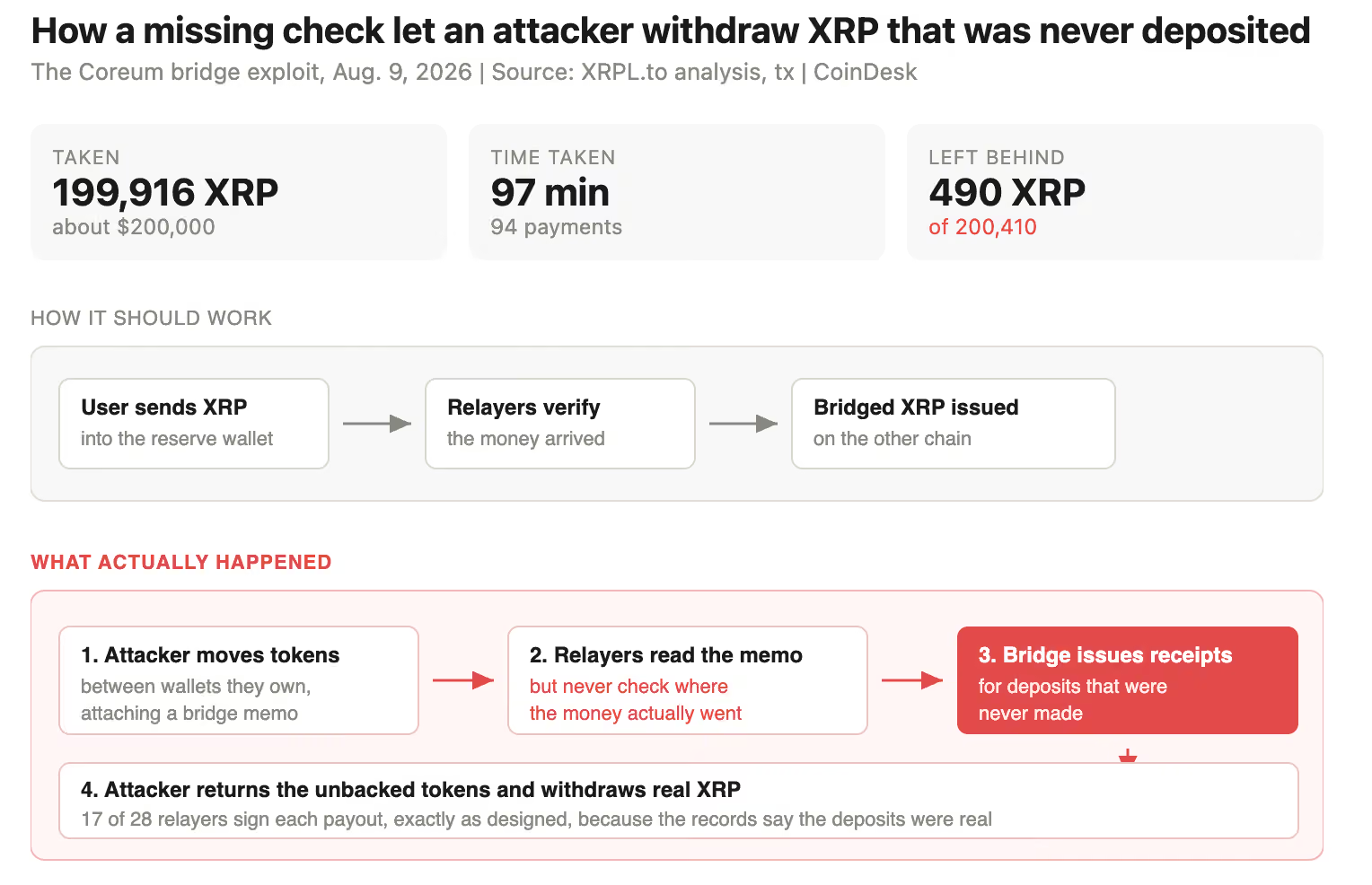 Crypto World6 days ago
XRP bridge drained after software mistook fake deposits for real ones
-

 Tech5 days ago
DeepSeek Harness launches as open source rival to Claude Code, alongside V4-Pro on API with higher prices
-

 Sports6 days ago
DeQuan Jones in ‘high spirits’ after successful leg surgery
-
 Entertainment7 days ago
Star Wars Officially Continues ‘The Last Jedi’ With a New Spin-Off
-
 Crypto World6 days ago
Perplexity AI Predicts an XRP Scenario Few Analysts Are Discussing
-

 Politics7 days ago
In the Chris Kaba case, the police watchdog capitulated to the mob
-

 Politics6 days ago
How Average Are You In The UK?
-

 Tech6 days ago
SpaceXAI’s Grok Bot turns agents into persistent digital coworkers that can operate your apps for $120-per-month
You must be logged in to post a comment Login