

Connect with us

Tech

How Gamma built a profitable empire with 50 people

Published

on

Grant Lee still remembers the investor’s verdict. “Yeah, so the investor said it was the worst idea he had ever heard”. The call came in 2020, when Grant Lee and co-founders Jon Noronha and James Fox started Gamma in San Francisco.

Six years later, that “worst idea” is a $2.1 billion company, a profitable AI-powered visual communication platform used by over 100 million people, that has spent the past few years positioning itself as the answer to PowerPoint and Google Slides.

In an era where AI startups torch hundreds of millions chasing growth, Gamma has crossed $100 million in annual recurring revenue with roughly 50 employees and has been profitable for over 15 consecutive months.

This summer, as competitors slash headcounts and hunt for funding, Gamma is opening a London office, expanding into APAC, and launching its most ambitious product yet.

Advertisement

The problem bobody wanted to fix

Grant Lee didn’t set out to build an AI company. He set out to fix a problem that had plagued him for years.

“We decided to build Gamma because we really believe that we want to help change how people communicate their ideas. PowerPoint as a tool has been around for many years, but many of us have spent late nights trying to format or design a presentation rather than focus on the idea or the content itself.

We really believe that Gamma can be the sort of visual language that makes it much easier for people to get their ideas out there. It’s a mission that we’re very excited to continue building on”, he said.

Grant Lee and co-founders Jon Noronha and James Fox started Gamma in late 2020, before ChatGPT, before the generative AI gold rush.

Advertisement

Their early product focused on what Grant Lee calls “the building blocks, the primitives, where you can just really quickly write something and Gamma would help you kind of try out different designs and different layouts.”

Then came 2023: “We introduced AI as an ability to really do that just much faster. We were able to get your first draft almost immediately because AI could pre-assemble those building blocks in a way that a human would still take a lot of time, and so we existed before AI, AI accelerated everything we were trying to do anyways,” Grant Lee says.

The team integrated large language models, and suddenly users who once stared at a blank page could type an idea and watch it become a designed presentation in seconds.

The Anti-Blitzscale Playbook

What happened next defies every Silicon Valley growth narrative.

Advertisement

While competitors like Tome raised $81 million and hired 60 people only to pivot away, Gamma raised cautiously about $90 million total and kept its team lean.

The result: roughly $2 million in revenue per employee, about four times the efficiency of Salesforce. “We really kept the team lean for a long time,” Grant Lee explains. “That allowed us to kind of move quickly and adapt.”

“Many companies just start growing their teams really, really fast. And then that almost ends up slowing you down because you get distracted by many different things,” he says.

“I think we focused on what we wanted to be exceptional at and just really made sure that we didn’t get too distracted by competing products or competing categories.”

Advertisement

By late 2025, Gamma had passed $100 million ARR profitably, raised a $68 million Series B led by Andreessen Horowitz at a $2.1 billion valuation, and given early employees a $20 million secondary liquidity event, all without a traditional sales team for most of its existence.

Why Gamma isn’t worried about ChatGPT

The obvious question in 2026 is why anyone needs Gamma when ChatGPT, Claude and Gemini can all generate slides.

Grant Lee has a clear answer: LLMs give you scaffolding; Gamma gives you the finished product.

“Within those platforms, you can often get an OK first draft, right? It allows you to just see the sort of scaffolding of what that presentation might look like,” he says.

Advertisement

“But if you really want to do a lot of editing and get it to the point where that first draft can be your final draft, you still need a tool like Gamma to really help shape the idea and really get it to the point where the design matches your expectations, it is on brand, and it’s something you’d actually share and present to others.”

This “last mile” thesis is why Gamma thrives in the LLM era. The company orchestrates over 20 AI models under the hood. “We are definitely a multi-model business,” Grant Lee says.

“We orchestrate a lot in the background, 20-plus models across images and LLMs, video as well. We’re also training our own models”.

The business model is also shifting. Gamma began as product-led growth for individuals and small teams. Now enterprise accounts are scaling.

Advertisement

“We started selling into large enterprises, and now we have customers that have tens of thousands of users all in the same company. We believe that, in the long term, it should be a balanced approach.

We should have our consumer business continue to grow and expand, and our B2B business should also complement that. It should allow us to kind of enter into businesses that we weren’t able to reach before.”

Grant Lee argues the total market is enormous: PowerPoint and Google Slides together have more than a billion monthly active users, many inside large organizations.

For a company that has reached 100 million users with about 50 employees, Gamma is a test case for AI-enabled leanness. Grant Lee said the team uses agentic coding internally and AI in customer support, but he framed it as speed rather than radical automation.

Advertisement

“I think in the age of AI, every function has a chance of streamlining what they’re doing and we’re trying our best to integrate it across the board.”

Beyond Slides

In March 2026, Gamma made its biggest strategic move yet. The company launched Gamma Imagine, an AI-native design tool for logos, infographics, and social posts, alongside Smart Charts and enterprise connectors.

The message was clear: Gamma isn’t just coming for PowerPoint anymore. It’s coming for Canva and the entire visual design stack.

“Today, most slides are very static and 16 by 9. We think in the future they’ll probably be much more interactive and multimedia-rich, and you should be able to share them in many different ways,” Grant Lee says.

Advertisement

“I think it will be on us to kind of really innovate in that space so that users around the world can benefit from it.”

Gamma’s user base is also becoming more global. “Over 80% of our paid users are outside of the US, so Europe as a region is growing really fast, LATAM as a region is growing fast,” Lee said.

“Now we’re starting to expand. So we’ll be building an office in London, building a team likely soon in APAC.”

On jobs and saying no to acquirers

Grant Lee is measured on AI job displacement. Despite building a tool that automates design work, he doesn’t believe designers are going extinct.

Advertisement

He noted that designers made up a quarter to a third of Gamma’s early team.

“The role of the designer has just changed. Instead of being the one that’s formatting and moving pixels around in the deck, they can focus on even higher value tasks.”

Grant Lee offered a more measured take than many AI founders:

“I don’t think we’ve yet seen true job elimination. I think we will start seeing some sort of job displacement, which is like jobs changing or evolving… I don’t believe that anytime soon we’re going to see sort of this collapse of jobs and roles across the board. I think it’s just going to evolve. And I actually think it’s going to take longer than most people think.”

Advertisement

The most striking news for investors may be what Gamma is not doing: raising. Grant Lee said the company is profitable and does not need another round. Asked whether he would accept an acquisition offer, he was clear.

“I don’t think so. I mean, we’re building for the long haul. Obviously, you can never say never if we join a company that really aligns with your mission long term.

There’s always a possibility, but our team is so focused on that long-term, that long-term vision of changing the way humans communicate that we think we can keep building.

We’re a profitable business, so we don’t need to raise again. We have the chance of just really focusing on what we want to do and hopefully serving our users for as long as possible.”

Advertisement

From “Worst Idea” to the default

The challenge, Grant Lee acknowledged, is that the product still needs to get faster and more expressive.

“Today it still takes a lot of time, and I think we’re working hard to rebuild the platform in a way that can deliver on that promise of being fast, effortless, all these things that we really want to do.”

For a company that was once told it was the worst idea ever, Gamma’s next act is less about survival than about whether it can become the default visual language for a billion users.

Advertisement

Source link

Continue Reading
Click to comment

You must be logged in to post a comment Login

Leave a Reply

Tech

Why connectivity and cybersecurity can’t be treated separately

Published

on

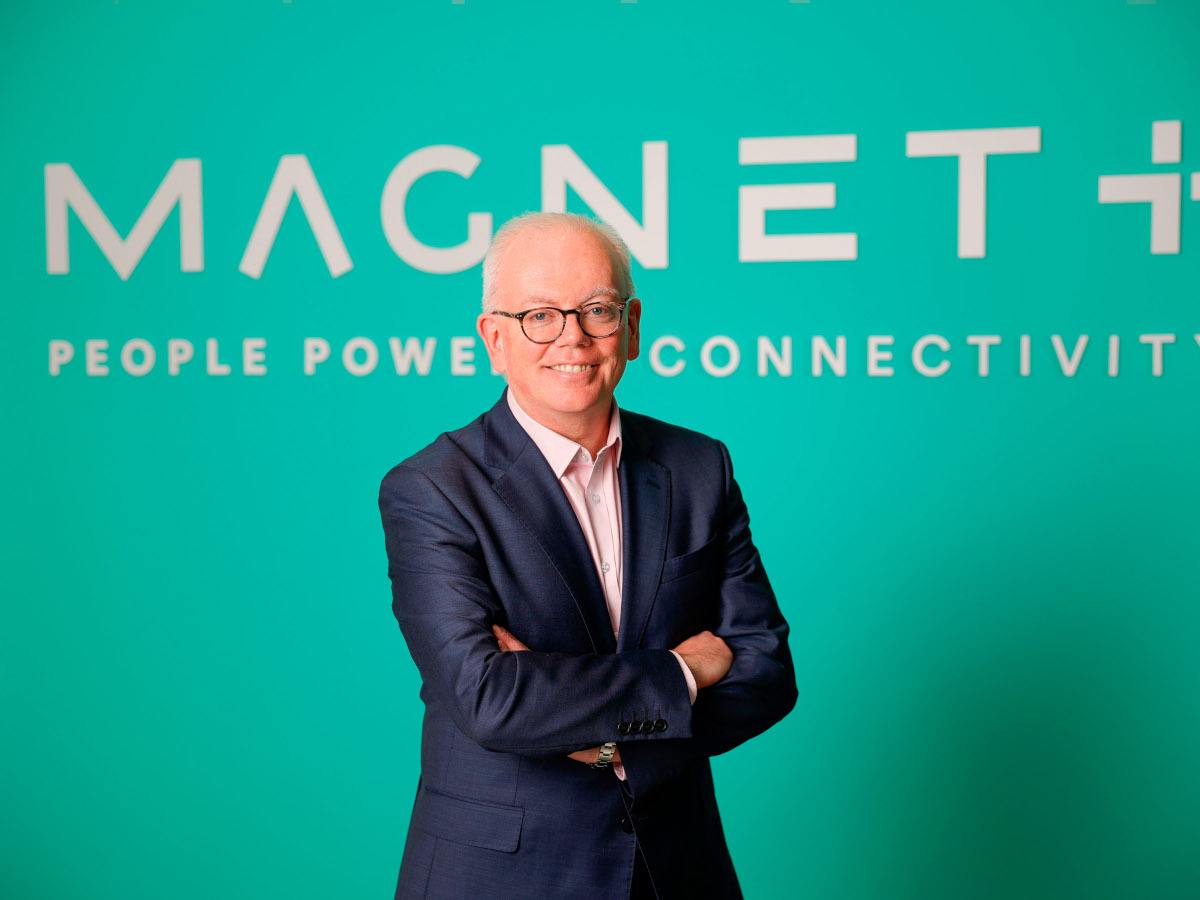
Magnet Plus’s Patrick Masterson discusses why now is the time to engage in a combined network and security strategy to ensure business continuity and maintain customer trust.

For many organisations, cybersecurity has traditionally focused on protecting data, preventing ransomware and securing endpoints.

But one of the biggest cyberthreats facing businesses today isn’t designed to steal personal data or information at all – it’s designed to grind your business operations to a complete standstill. Known as ‘distributed denial of service’ (DDoS) attacks, they are becoming one of the most disruptive cyberthreats to business continuity today.

According to the European Union Agency for Cybersecurity Threat Landscape 2025, DDoS attacks accounted for 77pc of reported cybersecurity incidents across the EU last year, making them the single most common form of cyberattack.

Advertisement

Rather than stealing sensitive data or deploying ransomware, DDoS attacks overwhelm a company’s internet-facing network infrastructure with excessive traffic, slowing down online services for legitimate customers and employees alike and in severe cases, rendering them partially or completely unavailable. This results in service outages and slow performance; customer portals stop responding, communications become interrupted and employees are unable to access the vital applications they rely on every day.

Even a relatively short period of downtime can have significant operational and financial consequences, affecting revenue, customer confidence and business reputation.

Currently, there is a serious concern that the occurrence of DDoS attacks will increase in Ireland in the coming months due to Ireland’s presidency of the EU. The concerns are based on the fact that there was a rise in DDoS attacks in Denmark in 2025 and in Cyprus earlier this year during their EU presidencies.

The most common attacks are ransom DDoS attacks, whereby attackers launch a DDoS attack against companies, threaten larger attacks and demand payment usually in cryptocurrency. Online retailers, banks, gaming companies, technology companies, cloud and SaaS providers frequently fall into this bracket. Government departments, semi-state organisations and political organisations have also experienced DDoS attacks based on their political nature and the ability for the attack to attract media attention if they succeed. Other high-profile targets include well-known national and international brands or companies listed on the global stock market.

Advertisement

The National Cyber Security Centre has already warned that attacks during the Irish Presidency could result in a disruption to services which could cause severe damage to the reputation of Ireland and the EU.

A fundamental mindset shift in how organisations safeguard their digital infrastructure is now required to mitigate this DDoS risk and ensure systems are continually protected.

With companies depending more and more on AI-powered applications, unified communications, hybrid working and digital customer experiences, the ability to keep critical systems online has become just as important as protecting the data they contain.

As a result, connectivity and cybersecurity shouldn’t be treated as separate conversations. Connectivity is no longer expected simply to deliver faster speeds. Instead, organisations need to ask whether that connectivity can withstand disruption.

Advertisement

Can employees continue working if demand suddenly spikes? Can customer-facing applications remain available during malicious activity? Can critical systems continue operating when the unexpected happens? Increasingly, these are boardroom questions rather than IT questions.

However, resilient connectivity alone is no longer enough. The rise of DDoS attacks shows that network availability itself has become a target. Protecting that availability requires organisations to build cybersecurity into the network rather than treating it as an additional layer added afterwards.

Increasingly, organisations are responding to the heightened risk of DDoS attacks by utilising dedicated internet access (DIA). Unlike shared broadband, DIA provides businesses with a private connection, allowing for uncontended bandwidth, symmetrical speeds and guaranteed performance while giving organisations greater confidence that business-critical applications can continue to perform reliably.

Combining a DIA service with always-on DDoS protection reduces the risk of cyberattacks further by continuously monitoring network traffic, identifying malicious activity in real time and automatically mitigating attacks before they impact services.

Advertisement

Ultimately, this isn’t simply about preventing cyberattacks. It’s about ensuring business continuity, maintaining customer trust, protecting employee productivity and ensuring essential digital services remain available when customers need them most.

As DDoS attacks become more frequent and organisations become increasingly dependent on digital services, resilience can no longer be treated as an IT issue alone. The businesses best prepared for the future will be those that build networks designed not only for performance, but for protection, availability and continuity.

In today’s digital economy, resilience isn’t just an IT objective – it’s fundamental to business success.


Advertisement

By Patrick Masterson

Patrick Masterson is managing director at Irish telecoms and broadband provider Magnet Plus. He has more than 20 years of experience in a range of C Suite roles in Irish companies across the retail, technology and healthcare sectors.

Don’t miss out on the knowledge you need to succeed. Sign up for the Daily Brief, Silicon Republic’s digest of need-to-know sci-tech news.

Advertisement

Source link

Continue Reading

Tech

NCI to launch two bachelor’s courses in AI and cybersecurity

Published

on

The courses are expected to launch in September 2027, subject to approval.

National College of Ireland (NCI) is introducing two new degree programmes to meet the growing demand for skills in AI and cybersecurity.

The proposed Bachelor of Science honours programmes in Cybersecurity & AI, and AI & Psychology are currently being developed by NCI and are expected to welcome their first intake of students in September 2027, subject to programme approval.

The degree programmes are being designed as a response to meet the increasing demand for graduates skilled in AI, digital security and data-driven technologies, as major tech companies continue to settle and grow in the country.

Advertisement

A 2025 report found that since 2023, AI usage and jobs in the field have doubled and there is increasing demand for professionals with skills in AI. Ireland also ranked third in the EU for percentage of people with “basic or above” levels of digital skills – just behind the Netherlands and Finland.

The new programmes are expected to offer an interdisciplinary approach to learning, combining technical expertise with an understanding of human behaviour, ethics and emerging technologies, the Department of Further and Higher Education, Research, Innovation and Science announced in a press release.

“Artificial intelligence is transforming the way we live, work and learn, creating exciting opportunities across every sector of our economy,” said Minister for Further and Higher Education, Research, Innovation and Science James Lawless, TD.

“These innovative programmes demonstrate how Ireland’s higher education sector is responding to the rapid pace of technological change and helping to develop the talent needed for the future.

Advertisement

“By combining AI with cybersecurity and psychology, National College of Ireland is creating new pathways for students into careers that are increasingly important for Ireland’s competitiveness, innovation capacity and digital resilience.”

Prof Gina Quin, president of NCI, commented: “National College of Ireland operates at the leading edge of technology and critical thinking.

“These two programmes place AI in context, delivering knowledge and skills to engage with AI’s implications for cybersecurity and for humanity, anticipating and influencing the impact AI will have on industry, on work and on our personal lives.

“National College of Ireland has a long-standing commitment to widening participation in higher education and serves as an important educational and community resource, particularly in Dublin’s north-east inner city. As a private, not-for-profit higher education institution, NCI provides a range of full-time and part-time programmes from foundation level through to postgraduate study.”

Advertisement

Don’t miss out on the knowledge you need to succeed. Sign up for the Daily Brief, Silicon Republic’s digest of need-to-know sci-tech news.

Source link

Advertisement
Continue Reading

Tech

Japan just launched a U.S. military payload into orbit, giving Washington another set of eyes over the Indo-Pacific

Published

on


  • Japan has now launched the second U.S. surveillance payload under the program
  • The payload will feed near-real-time orbital data to U.S. forces
  • Mission Delta 2 will operate the American payload after deployment

The United States Space Force and Japan have completed a bilateral satellite launch meant to strengthen surveillance capabilities across the Pacific region and beyond.

A US space domain awareness payload was carried aboard Japan’s Quasi-Zenith Satellite 7, launched from Tanegashima Space Center.

Source link

Advertisement
Continue Reading

Tech

Stripe didn’t really buy OpenRouter because of the ‘singularity’

Published

on

Stripe confirmed on Wednesday that it was buying OpenRouter. While the company didn’t disclose the deal price, sources told the New York Times that it paid $7.5 billion.

That’s a huge step up from OpenRouter’s $1.3 billion valuation in May. To put that price in context, the founders alone will reportedly receive $1.5 billion from the sale — more than the startup’s entire valuation just three months ago. Investors will get the remaining $6 billion, according to the NYT. Stripe reportedly had to outbid others interested in the fast-growing startup, including Databricks.

But the question is: what does a payments giant want with a startup that routes prompts between different AI models?

The short and funny answer, according to a leaked letter from Stripe’s founders to its investors about the deal, is: the singularity.

Advertisement

“It’s a fuzzy and perhaps already overworked term but we decided that January 1 marked the beginning of the singularity and we’ve been operating on that basis,” they wrote in the letter, published by Eric Newcomer, and verified by TechCrunch.

The singularity is supposed to mean the point at which humans and the tech we’ve created merge to become a new species. This is obviously a tongue-and-cheek reference (as Patrick Collison admitted when using the term it at his company’s conference in April). We’re fairly certain Stripe’s founders, the brothers Patrick and John Collison, don’t think humanity started turning into The Borg eight months ago.

But they have referred to the economic uptick that AI is bringing to Stripe. With AI, more companies are being launched and more of them are using Stripe’s offerings. Stripe says that 88% of the Forbes AI 50 are using its products, including OpenAI and Anthropic, as do 100% of Brex’s fastest-growing startups. No one knows how AI and agents will change the economy of the future, but everyone is certain it will change it dramatically.

That still doesn’t explain why Stripe wants a company mostly known for helping developers manage their model usage. Stripe’s founders acknowledged that their customer bases overlap.

Advertisement

“OpenRouter is exceptionally useful for any developer and Stripe is one of the world’s largest developer platforms,” the founders write in their letter. No doubt that just using OpenRouter internally will probably offer significant benefits to Stripe and make it easier to roll out future model-agnostic agentic offerings, too.

It seems as if OpenRouter will continue to operate independently after the deal closes in a few weeks, or so the startup promised in its own blog post, saying that its “product, mission, and current commitments remain unchanged.”

Still, until now, most of Stripe’s large acquisitions have been related to helping people collect and manage incoming cash. Buying OpenRouter looks like a move to other side of the ledger, too: expense management, beginning with AI expenses.

This acquisition “is Stripe’s deliberate attempt to embed itself into the middle of capital flows in the AI era,” said PitchBook’s research analyst Franco Granda.

Advertisement

It’s joining an unusual assortment of companies also entering token expense management. Databricks developed its own AI gateway. Rippling just launched one focused on employee AI spend and ROI. Ramp just launched one, also for AI expense management. And the list goes on.

For Stripe, buying the granddaddy of popular AI gateways for developers gives it insight into how coders are using AI. But it also gains a lever on AI demand itself. OpenRouter will grant it “some degree of power over suppliers such as the frontier labs themselves, as well as hyperscalers and neoclouds,” Granda said.

It may not be the Borg, but payments plus token expense management and a model router? That’s a lot of power.

When you purchase through links in our articles, we may earn a small commission. This doesn’t affect our editorial independence.

Advertisement

Source link

Continue Reading

Tech

Gaining Leadership Backing for Your Innovations

Published

on

This article is part of our exclusive career advice series in partnership with the IEEE Technology and Engineering Management Society.

Imagine this: You have a strong idea for a new product for your company. Your coworkers encourage you to move forward because they believe it could be the organization’s next big success. The idea clearly falls outside your department’s responsibilities, however, and you have no role in the product line.

What should you do? Sit and wait for “the right group” to pick it up, or push the idea forward without knowing how or what it might mean for your current position?

Such situations occur frequently. Many end up as missed opportunities, even though they could have significantly advanced the company’s technological or market position.

Advertisement

Some organizations actively support such initiatives, allocating specific periods during the workday for employees to focus on developing their own ideas.

Companies known for that include Google and 3M. They allow employees to pursue projects with a portion of their time, such as one day per week. Research that I conducted indicates it pays off for employee performance.

Bootlegging and skunkworks

At some companies, managers know such projects exist, but they deliberately turn a blind eye, allowing them to continue.

Some employees persist through bootlegging or skunkworks projects.

Advertisement

Bootlegging projects have not been approved by a manager or funded by the company.

Skunkworks projects involve a small team within the company that has been given authority and funding to secretly research and develop potentially groundbreaking innovations during their off-hours. The term comes from Lockheed’s Skunk Works division, set up in 1943 in a rented circus tent to build the P-80 fighter jet in secret. It took just 143 days.

The 3M Post-it Note came out of the company’s “15 percent culture,” described as a permitted bootlegging policy. It gives employees paid time off to pursue their own ideas.

The company traces the philosophy to its longtime president and later chairman William L. McKnight. Company scientist Arthur Fry used the policy in 1974 to turn a colleague’s dormant adhesive into the first Post-it prototypes, after his own bookmarks kept falling out of his hymnal.

Advertisement

There are several examples of high-visibility skunkworks projects. At Apple, Steve Jobs pulled roughly 20 people—pirates, as he called them—out of the company to build the original Macintosh computer in a building nicknamed Texaco Towers. In Walter Isaacson’s biography Steve Jobs, he frames the idea as modeled on the skunkworks approach.

Google’s Gmail system is frequently—and incorrectly—cited as a product of the company’s “20% time” policy. In a 2014 interview with Time magazine, the system’s creator, Paul Buchheit, said Gmail was in fact an official assignment. What the Gmail incubation did share with classic skunkworks projects was secrecy: For much of its three years in development, it was kept hidden from most people inside the company.

If you want to drive change in your organization, build a promoter triad around your idea.

At Alphabet, Google X—now known simply as X—operated as a secretive “moonshot” lab, kept hidden from most Google employees, according to a 2011 article in The New York Times. Google’s self-driving car project graduated from X to become Waymo, and Google Glass was likewise incubated there. The X team is now developing the second edition of Glass Enterprise, a successor aimed at industrial rather than consumer use.

Advertisement

Amazon runs a comparable model through Lab126, which, according to an article in Fast Company, evolved from a small skunkworks Amazon subsidiary into a hardware maker with nearly 3,000 employees. Lab126 delivered the Kindle in 2007 and the Echo in 2015.

Then there are so-called submarine projects, which employees work on without permission and despite explicit disapproval. They can lead to disciplinary action and termination.

Innovation management

Innovation management theory offers a more structured and robust approach. It argues that successful organizational change requires support at several levels, according to “Teamwork for Innovation: The ‘Troika’ of Promoters,” published in R&D Management. The promoter theory, developed around 25 years ago, consistently shows that change projects are far more likely to succeed when they are supported on multiple organizational levels. A good idea alone is not enough; you need a network of technology, process, and power promoters to turn a concept into a fully implemented, scalable solution.

First, you need a technology promoter: the person who has the idea, such as a new product, and possesses technical expertise and specific knowledge about the field or industry. Art Fry at 3M would be such an individual.

Advertisement

How can you put that into practice as an individual? Start by clearly formulating your idea into a concise concept paper or one-page summary including benefits, technical feasibility, and potential business impact.

Identify potential technology promoters (experts who can validate and refine your idea), and approach them early to strengthen the technical foundation.

In parallel, map the relevant stakeholders and decision-makers, and identify process promoters who understand how decisions are made in your company. They could be colleagues in innovation, R&D, or business development who understand your idea and how it can benefit the company.

The second is a process promoter: someone who might not know all the technical details but understands the organization’s formal and informal networks and knows how to navigate its processes, committees, and decision-making paths. This person can ensure the idea reaches the right stakeholders at the right time.

Advertisement

In the 3M case, it would be a person from the organizational management department, often called an innovation manager. The key role here is to connect inventors such as Fry with people from other departments needed for further project development, such as manufacturing, quality control, and sales.

Lastly, there’s the power promoter: a person in a leadership position who might not know the technical details but can allocate resources, eliminate obstacles, and maneuver through the company’s political dynamics. This individual has hierarchical power and acts as a sponsor of the idea or project. In the case of Fry, the person could be, say, the chief technology officer, but it also could be a middle manager who has the power for an individual field of action.

The three-level promoter structure applies regardless of whether the change concerns a new product, new service, or internal process innovation.

Engage potential power promoters by presenting a low-risk, small-scale pilot and a clear value proposition. Leaders are more likely to support ideas that are well prepared, vetted for potential risks, and backed by a small coalition.

Advertisement

Building the promoter triad

In short, don’t work in isolation. Systematically build alliances across expertise, networks, and hierarchical levels to create lasting change. If you want to drive change in your organization, build a promoter triad around your idea.

The tech experts and leadership promoters are easier to identify. Process promoters are often found in corporate innovation management, R&D management, or strategy functions, but they also can emerge in line units with strong internal networks.

Innovation management, as the promoter model describes it, looks nothing like the management structure most engineers are trained to expect. Traditional technical management runs on a single reporting line. With the promoter model, influence is spread across three people—technology, process, and power promoters—who may be in different departments, at different levels of seniority, and who might never share a reporting line.

What holds the trio together isn’t a formal structure; it’s the idea itself, for as long as it takes to move the idea forward.

Advertisement

That makes innovation management closer to networked, matrix-style leadership than to the pyramid most engineers picture when they hear the word management. It’s worth understanding both models before you decide which kind of impact you’re actually optimizing for.

The Institute has covered the tension from the individual’s side in “Tips for How to Think Like an Entrepreneur,” “Management Versus Technical Track,” both published in partnership with the IEEE Technology and Engineering Management Society, and “What to Consider Before You Accept a Management Role” from the IEEE Spectrum Career Alert newsletter. All are worth a look if you’re weighing a formal management track against staying close to the technology itself.

Remember: You don’t have to build your promoter network alone or only inside your own company. IEEE societies, sections and chapters, and technical committees, as well as the networking platform IEEE Collabratec, function as a ready-made cross-company network. They are practical places to find technology promoters with deep expertise in a field you don’t fully own yet, or to meet process and power promoters at other organizations who have built a promoter coalition around a similar idea.

For more tips on how to advance your career, check out our Career Advice for Engineers, From Engineers collection.

Advertisement

From Your Site Articles

Related Articles Around the Web

Source link

Advertisement
Continue Reading

Tech

How Much Did A ’79 Mustang Cost New & What’s One Worth Today?

Published

on


1979 marked a huge year of change for the Mustang. It shrunk considerably in size and was now based on Ford’s “Fox” platform, giving this generation the “Fox-Body” moniker. Today, Fox-bodies fit into the classically “rad” category of late 1970s to 1990s cars and, depending on the spec, can be pretty sought after. 

But what did it cost brand new in a Ford dealership as the 1970s concluded? A base model 1979 Ford Mustang two-door (it was also available with a liftback) started at $4,494. It was equipped with a 2.3-liter naturally aspirated four-cylinder, a far cry from the big displacement V8 from the early 1970s. A V6 and a 302 cubic-inch V8 were also available. Notably, this also marked the first year that Mustangs could be turbocharged from the factory, with a 2.3-liter turbocharged four-banger churning out and impressive (for the time) 147 horsepower. In a brochure from 1979 Ford lists its 0-55 mile per hour time (instead of the more common 0-60) of “eight to nine seconds”). For comparison, a new Toyota Rav4 Plug-In has a 0-60 time of 5.4 seconds. 

Advertisement

Pricing the ’79 pony car in modern dollars

If you want to relive the late 1970s and buy one of the first models of the Fox body for yourself, the prices haven’t gotten super ridiculous (at least compared to other classic cars like a Buick Grand National). Of course, well-kept examples might be much more expensive than something that was used as a daily driver. But what’s the point of buying an older Mustang if you aren’t going to drive it? 

Advertisement

Unfortunately, 1979 Mustangs don’t seem to go up for sale all that often. Online car platform CarGurus puts the price between $27,000 and $29,000based on sales data gathered from March to June of 2026. However, there are outliers like an Indy Pace Car Edition Mustang with a scant 110 miles on the odometer that crossed the auction block at $38,500 on Bring a Trailer. 

The 1979 Ford Mustang was cool, a lot different than the Mustangs before (and after, if we are being honest), and showed the American muscle car world that turbocharging and smaller displacement engines were a viable path forward. Ford even uses a 2.3-liter EcoBoost in the current Mustang, showing how the automaker continues this tradition into the present day

Advertisement


Source link

Continue Reading

Tech

You’ll have to wait until 2027 for those leaked AirPods with built-in cameras

Published

on

Apple may have accidentally given everyone an early look at its strangest AirPods yet, but the actual wait hasn’t changed. Bloomberg’s Mark Gurman reports that Apple’s camera-equipped AI AirPods remain on track for 2027, despite a leaked video from a developer version of macOS showing the earbuds in action

The leak made them look closer than they are

The leaked video appeared earlier this week inside a macOS update and showed the upcoming AirPods working with Apple’s Visual Intelligence feature. The technology uses the earbuds’ cameras to understand what’s happening around the wearer and provide that visual context to Siri and other AI features. The leak understandably sparked speculation that Apple might be preparing to unveil the earbuds at its upcoming September event.

Apparently, not so fast. Gurman says the product is still off Apple’s 2026 release schedule, with supply-chain and software problems having already pushed it from its original 2026 plan into 2027. Apple employees had reportedly begun advanced testing earlier this year before those problems emerged.

They’re cameras, yes, but not really “camera” cameras

One of the more interesting details is that the tiny cameras aren’t expected to function like conventional cameras. According to Gurman’s sources, they will use low-resolution sensors designed to scan the surrounding environment, rather than capture traditional photos or videos. The idea is to give Siri and Apple’s AI features another way to understand what the user is seeing.

Advertisement

That could make the AirPods considerably more useful as an AI wearable, but it also introduces an obvious privacy headache. The idea of earbuds quietly looking at the world around their wearer has already raised concerns online, particularly over whether other people could be captured without knowing it. Apple is reportedly conscious of the issue, especially after the privacy controversy surrounding Meta’s camera-equipped smart glasses.

It’s also worth noting that Apple has reportedly developed two versions of its camera-equipped AirPods, with the leaked video showing the B790 model based on the AirPods Pro 3, while another version, B798, is a newer AirPods Pro generation with cameras and AI. If Apple sticks to its current plans, the earbuds will arrive in 2027 alongside a packed lineup that could include its first smart glasses, a camera-equipped wearable pendant, a foldable iPhone, and an AI-focused smart home display.

So while the leaked video confirms the camera AirPods are real, don’t expect them to show up anytime soon: 2027 is still the year Apple’s earbuds apparently get eyes.

Source link

Advertisement
Continue Reading

Tech

HYDR8 Will Lead You To Water, But Will You Drink?

Published

on

[Ayushmaan] states up front that most of his free time is spent “building things that probably didn’t need to exist”. Well, this one might be an anomaly, because it seems pretty useful to us.

HYDR8, as it says on the tin, is a wearable that knows when it’s time to hydrate. The impetus for this one was something we all chase: the flow state. [Ayushmaan] would sit down, get deep into work, and look up hours later to to find that he had a headache and a full water bottle. Phone reminders were soon swiped away in annoyance.

A triptych of screenshots showing the HYDR8 dashboard.This wearable is based on a XIAO ESP32-C3. It reads heart rate, oxygenation, skin temperature, and both the ambient temperature and humidity. It also learns your personal resting numbers range.

Taking all of this into consideration, it generates a heat/hydration stress score between 0-100. The thing is, HYDR8 tells you specifically what to do; sometimes it’s ‘drink water’ and other times, it’s ‘find shade’.

The wearable itself, while somewhat chunky, is pretty simple: it only shows the time and a message when it matters. The ESP32 hosts a full dashboard on your phone.

Advertisement

Keep in mind that this is not a medical device, it’s an experiment, a prototype. It can’t measure how hydrated you are. Instead, it measure hydration stress.

If you don’t want to wear anything, here’s a smart straw that uses a tiny turbine flowmeter and a Hall effect sensor to record the volume sipped, and detect whether the sipper is low on fluids. And if you find yourself under the hot lights of a wet bulb event, here’s how to survive it.

Source link

Advertisement
Continue Reading

Tech

Josh Traded Hundreds of Broken Consoles for $10,690 in GameStop Credit

Published

on

Josh Trade-In Broken Console $10,000 GameStop Credit
Josh arrived at the GameStop in Clackamas, Oregon, with plastic crates stacked high. Inside sat hundreds of consoles that no longer worked. Staff sorted through PlayStations, Xboxes, Nintendo Switches, Game Boys spanning several generations, a Sega Game Gear, a pair of Sony PSPs, and more. Some units were modern enough to still hold residual value even in poor shape. Others dated back years.


Josh Trade-In Broken Console $10,000 GameStop Credit
Josh’s whole collection was traded in at GameStop. The crew ran each console through their system, churning out a bunch of lengthy receipts that accumulated into a sizable pile. Most of the receipts showed the Xbox Ones at $7.92 apiece, the Xbox Series Xs at between $10 and $11, the PS4s at $16, and a few Xbox Ones in good condition fetching approximately $40 each. There were also a lot of older handhelds and Xbox 360s that didn’t bring much, but when you multiply all the consoles by the volume, it adds up quickly.

Josh Trade-In Broken Console $10,000 GameStop Credit
When the last receipt was issued, the total had reached $10,690.06. Everything arrived as shop credit, which is the more valuable option they provide instead of cash. Josh walked away with a large stack of credit cards and a big smile on his face, which GameStop later published on social media. GameStop’s article put it succinctly: there was a guy in Clackamas who traded hundreds of broken systems for that exact amount and thanked him for the junk.

Josh Trade-In Broken Console $10,000 GameStop Credit
The photographs show a mix of Nintendo Switch Lites, old Game Boys, Game Gears, and PSPs. There was also a black and white Xbox 360 toward the bottom of a carton, which was only the tip of the iceberg. The total number of crates required far exceeded the one clear bin shown in the image. The team was able to handle everything on-site, testing what they could and provide trade values based on the console and current demand for components or repair.


GameStop is pretty keen on accepting non-working hardware, which is a way of saying they’ll take your broken systems off your hands. They are always looking for working units to clean and test for resale, as these are sold as refurbished stock. The broken ones are useful for collecting donor boards, housings, and other components to keep other systems running. They end up picking up some merchandise at a nice low price, and the customer simply walks away with some store credit to spend on whatever they want.
[Source]

Source link

Advertisement
Continue Reading

Tech

Five days after buying Cursor for $60bn, SpaceX tried to buy Cognition

Published

on

SpaceX approached AI coding startup Cognition about an acquisition, Bloomberg reports, and Cognition did not engage. Chief executive Scott Wu replied publicly that his company is “not for sale and we haven’t been talking.

SpaceX approached the AI coding company Cognition about buying it, according to Bloomberg, and Cognition did not engage. It would have been the company’s second large AI takeover in a matter of months.

The denial arrived the same day and went further than the report. Chief executive Scott Wu wrote publicly that Cognition is “not for sale and we haven’t been talking.

Those two accounts are close but not identical. Bloomberg describes an approach that was not taken up, alongside continuing discussions about working together, including a possible arrangement for Cognition to use SpaceX’s computing capacity.

Advertisement

Cognition is not cheap either way. It raised $1bn at a $26bn valuation in May and has been in early talks with investors this month at a valuation of at least $40bn.

The context is what SpaceX bought last week. It completed a $60bn purchase of Cursor on 14 August, the largest name in the vibe coding market.

Buying a second one so quickly says something about the first. SpaceX’s AI arm has trailed rivals in selling to businesses and has been through job cuts and restructuring.

Cognition would have arrived with customers attached. Its Devin agent is used by Mercedes-Benz and GE Aerospace, and Bloomberg reports that its commercial progress interested SpaceX as much as its technology.

Advertisement

Elon Musk has set the pace himself. He told staff that AI revenue would out-earn rockets by September, a target that requires enterprise customers rather than research prestige.

The compute talks are the part worth watching. If Cognition ends up renting SpaceX’s GPUs, a company that refused to be bought becomes dependent on the infrastructure of the company that tried.

Wu has said this before, which matters when reading the denial. He told Bloomberg in May that the round he had just closed was what allowed Cognition to “stay independent and continue as an independent business.

For European developers the direction is the story rather than the deal. The tools their engineering teams now depend on are being gathered into an American conglomerate that also launches rockets and runs a satellite network.

Advertisement

Source link

Continue Reading

Trending

Copyright © 2025