
Business
Monarch Mutual Fund set to enter MF space with maiden overnight fund; files draft with Sebi


According to the draft filed with the market regulator, Monarch Overnight Fund will be an open-ended debt scheme investing in overnight securities with a relatively low-interest rate risk and relatively low credit risk.
Also Read | Mutual funds raise IT exposure to 6.6% in July after record low. Is sentiment towards tech improving?
The objective of the scheme will be to seek to generate returns commensurate with low risk and providing high level of liquidity, through investments made primarily in overnight securities having maturity of one business day.
The performance of the scheme will be benchmarked to CRISIL Liquid Overnight Index and will be managed by Sanjay Motta.

The minimum application amount for lumpsum investment will be Rs 5,000 and in multiple of Re 1 thereafter. The minimum application amount for SIP investment will be Rs 1,000 and in multiples of Re 1 thereafter with minimum six installments.
The fund will invest upto 100% in debt and money market instruments maturing on or before next business day. Overnight funds can deploy, not exceeding, 5% of the net assets of the scheme in G-secs and/or T-bills with a residual maturity of up to 30 days for the purpose of placing the same as margin and collateral for certain transactions.
Portfolio rebalancing due to short term defensive consideration
Subject to the SEBI (Mutual Funds) Regulations, the asset allocation pattern outlined above may be modified from time to time based on prevailing market conditions, available market opportunities, applicable regulatory requirements, as well as political and economic developments.
Portfolio rebalancing in case of passive breaches
Investment strategy and pattern may be deviated from time to time, provided such modification is in accordance with the Scheme(s) objective and Regulations as amended from time to time, the intent being to protect the Net Asset Value of the scheme and unitholders’ interests. In case of any deviation (initial as well as subsequent deviation) in investment pattern, the AMC will achieve a normal asset allocation pattern in a maximum period of 7 days.
In case deviation in investment pattern is not rebalanced within the period indicated above then justification for such delay in rebalancing of portfolio shall be placed before the investment committee and the reasons for the same shall be recorded in writing.
The fund will be suitable for investors who are seeking regular income over a short term that may be in line with the overnight call rates and want to generate returns by investing in debt and money market instruments with overnight maturity.
The principal invested in the fund and the respective benchmark will be at “low risk” according to the riskometer of the fund and benchmark.
(Disclaimer: Recommendations, suggestions, views and opinions given by the experts are their own. These do not represent the views of The Economic Times)
If you have any mutual fund queries, message on ET Mutual Funds on Facebook/Twitter. We will get it answered by our panel of experts. Do share your questions on ETMFqueries@timesinternet.in alongwith your age, risk profile, and Twitter handle.
 as a Reliable and Trusted News Source

Taylor Swift and Travis Kelce are settling into married life with a strong sense of gratitude, according to a source close to the couple who spoke with People magazine, as the pair gradually returns to public view following their wedding last month.
Swift and Kelce were married July 3 at New York’s Madison Square Garden in front of more than 1,000 guests, capping a relationship that began publicly in 2023 and led to their engagement in August 2025. The couple spent much of their first month as husband and wife largely out of the public eye before slowly stepping back into view in recent weeks.
According to the source who spoke with People, both Swift and Kelce feel deeply appreciative of where they currently find themselves in life, describing the pair as excited to begin this new chapter of their relationship together. The insider said their bond has taken on added significance since the ceremony, and that the couple remains focused on their respective careers and creative pursuits while continuing to find genuine joy in the life they have built together.
Kelce broke his own public silence on the wedding for the first time August 12, during a press conference at the Kansas City Chiefs’ training camp. Asked about the ceremony more than a month after it took place, Kelce did not hold back his enthusiasm. “The wedding was the best night of my life,” Kelce told reporters, thanking everyone who traveled to celebrate with the couple and describing the evening as a “crazy night” filled with celebration.
Kelce also reflected on the personal significance of getting married inside Madison Square Garden, a venue he described as holding deep meaning given its status within professional sports. He recalled having told himself for years that he would eventually attend a Knicks playoff game at the arena, only to have Swift make it to a game during this year’s NBA Finals while he remained tied up at Chiefs minicamp. Getting the chance to be married inside what he called the sport’s most storied venue, he said, made the occasion feel like the fulfillment of a childhood dream. Kelce also offered a lighter aside about the venue, joking that the air conditioning inside the arena was one of the best parts of the entire night.
Swift, for her part, has not publicly commented on the wedding itself. She has, however, spoken warmly about Kelce in the past, including during an October 2025 appearance on “The Tonight Show,” where she told host Jimmy Fallon that Kelce was the favorite person she had ever met, and that the idea of getting to spend every day with him felt like everything she could want.
Vogue reported that wedding planner Mark Seed organized the July 3 ceremony, which drew an estimated 1,100 guests and reportedly followed a “secret garden” theme, a detail that aligned with the setting Kelce chose for his marriage proposal to Swift the previous summer. Sources previously told NBC News that both Swift and Kelce wore white and that each wrote their own vows for the ceremony. Kelce’s sister-in-law, Kylie Kelce, has also shared some details from the event, saying that his brother, former NFL center Jason Kelce, was moved to tears during the ceremony, possibly more than Kylie herself cried at her own wedding.
Since the wedding, Swift has made limited public appearances. She was photographed in London in August debuting a notably different hairstyle, one of her first widely noted public appearances since the ceremony. Beyond that, neither Swift nor Kelce has released any joint statement or given a joint interview addressing their new life as a married couple, leaving most public detail about their post-wedding life to come through separate individual appearances and secondhand accounts from people close to them.
At the same Chiefs press conference where he addressed the wedding, Kelce also made clear his attention has already shifted back toward football as he enters his 14th NFL season. Chiefs head coach Andy Reid separately dismissed any suggestion that the offseason wedding and surrounding attention had affected Kelce’s preparation, telling reporters the veteran tight end remains as focused, fit and driven as ever heading into training camp.
With Swift continuing her music career and Kelce returning to preseason preparation with the Chiefs, the couple appears to be settling into a routine that balances their individual professional demands with the new chapter they’ve entered as a married couple, even as both have largely kept the more personal details of their post-wedding life private for now.

Trump’s 2024 grocery photo op now haunts Republicans in the midterms
Business
CoreWeave Stock Buy or Sell Debate Intensifies in 2026 After Q2 Beat and $104 Billion Backlog

CoreWeave Inc. shares closed at $105.26 on Aug. 14, 2026, after a volatile week that followed the company’s second-quarter results, leaving investors and analysts divided on whether the artificial intelligence infrastructure provider remains a buy or has become overextended.
The Livingston, New Jersey-based company reported revenue of $2.58 billion for the three months ended June 30, more than double the $1.21 billion recorded a year earlier and slightly above Wall Street expectations. Adjusted operating income reached $128 million, while the net loss widened to $626 million, or $1.14 per share, largely because of higher interest expenses tied to aggressive expansion financing. Management raised full-year 2026 revenue guidance to a range of $12.4 billion to $13.2 billion and projected adjusted operating income between $960 million and $1.15 billion.
Revenue backlog stood at approximately $104 billion at the end of the second quarter. The company said more than $25 billion in additional net new customer commitments were secured in the early weeks of the third quarter. Active power capacity continued to ramp, with the firm highlighting strong demand from AI laboratories, hyperscalers and enterprise customers.
In its earnings release, CoreWeave stated: “CoreWeave is built on the conviction that AI is foundational to every industry and that realizing its full potential requires a purpose-built platform. This quarter reinforced that conviction.”
Wall Street’s reaction has been broadly constructive though not unanimous. Across major tracking services, the consensus rating sits at Buy or Moderate Buy / Outperform. Roughly two dozen to three dozen analysts cover the stock. The majority assign Buy or equivalent ratings, with a smaller group recommending Hold and a handful issuing Sell or Underperform ratings. The average 12-month price target clusters between roughly $137 and $143, implying potential upside of about 30% to 36% from the mid-August closing level. Individual targets range widely, from lows near $39–$74 to highs of $250–$303.
Recent actions have skewed positive. Citigroup maintained a Buy rating and lifted its target to $159. Truist Securities raised its target to $155 while keeping a Buy. Piper Sandler reiterated an Overweight rating and moved its target to $153. Wells Fargo, Cantor Fitzgerald, Rosenblatt Securities and others also raised or reaffirmed constructive views with elevated targets. Some firms, including Barclays, maintained Equal-Weight or Hold ratings with more modest targets near the current share price. A minority of analysts remain cautious, citing valuation, debt levels and execution risks.
CoreWeave went public in 2025 and has positioned itself as a specialized provider of GPU-accelerated cloud infrastructure optimized for AI training and inference workloads. Its growth has tracked the broader surge in generative AI spending. Capital expenditures remain elevated; second-quarter outlays reached $9.4 billion, and full-year guidance was lifted to a range of $35 billion to $39 billion as the company races to add power capacity and data-center footprint. Management has indicated plans to reach at least 8 gigawatts of power by 2030.
The balance sheet reflects the cost of that expansion. Interest expense more than doubled year over year in the second quarter to $640 million. Debt facilities, including recently arranged delayed-draw term loans, support the buildout but weigh on near-term profitability. Adjusted EBITDA margins remained robust near 59%, yet GAAP losses persist and the path to consistent positive net income is still measured in years rather than quarters, according to company projections and analyst models that see meaningful earnings scale later in the decade.
Supporters of the stock point to the size and quality of the contracted backlog, the diversification of customers beyond the largest AI labs, early signs of pricing power and the sequential improvement in adjusted operating income. They note that more than three-quarters of projected 2027 annualized revenue is already under contract in some estimates, providing visibility rare among high-growth technology companies. Year-to-date through mid-August the shares had gained nearly 47%.
Skeptics focus on the capital intensity of the business, the risk that AI infrastructure spending could moderate, competition from hyperscale cloud providers and the potential for interest rates or financing conditions to pressure margins. Valuation multiples remain elevated relative to traditional software or infrastructure peers when measured against current earnings, though they compress significantly when compared with longer-term revenue and free-cash-flow forecasts. Insider selling through planned programs has also drawn occasional comment.
The third-quarter outlook calls for revenue of $3.4 billion to $3.6 billion. Management has described the current period as an inflection in which scale begins to translate more clearly into operating leverage. Whether that trajectory materializes on schedule will likely determine the next major re-rating of the shares.
As of mid-August 2026 the debate remains open. A clear majority of covering analysts rate CoreWeave a buy and project meaningful upside over the coming year, citing durable AI demand and a substantial contracted backlog. A smaller group urges caution or recommends selling, emphasizing the risks of heavy leverage, elevated capital spending and valuation. The stock’s performance for the remainder of 2026 will hinge on execution against the raised guidance, further backlog conversion and the broader health of enterprise and research AI budgets.
Investors evaluating the name must weigh the company’s demonstrated ability to capture AI infrastructure demand against the financial and operational challenges of scaling a capital-intensive platform at this speed. The latest quarterly results and analyst target revisions have reinforced the bullish case for many, yet the wide dispersion of price targets underscores that outcomes remain highly sensitive to delivery on the multiyear growth plan.

Univest financial director Turner sells $344,280 in shares

The Sensex fell 490 points over five sessions through August 14, while 23 BSE 500 stocks declined daily. Eleven stocks dropped more than 5%, led by Aditya Birla Fashion and Retail, Physicswallah and Techno Electric & Engineering.
Business
F&O Talk: Nifty consolidation to continue says Sudeep Shah; gives Tata Motors, Lenskart, Honasa strategy

Sensex fell around 71 points to close at 78,009, while Nifty 50 lost 30 points to end the session at 24,366. Broader markets slipped into the deep red, with Nifty Smallcap 100 and Nifty Midcap 100 indices falling around 0.7% each.
Analyst Sudeep Shah, Vice President and Head of Technical & Derivatives Research at SBI Securities, interacted with ETMarkets regarding the outlook for the Nifty Bank, options data as well as an index strategy for the upcoming week. The following are the edited excerpts from his chat:
Q) Nifty and Sensex struggled for direction this week. Will consolidation continue this week as Q1 is almost over?
A) Since the beginning of August, the benchmark index Nifty has been trading in a narrow range of 500 points. More importantly, the index’s daily trading range has contracted significantly. The daily ATR currently stands at 192 points, its lowest level since the first week of January 2026, highlighting the sharp decline in volatility. But the bigger question is: where is the momentum going once the opening move fades?
In most trading sessions since the start of August, Nifty has witnessed momentum during the first hour, followed by consolidation within a narrow range. This lack of sustained momentum has made intraday and short-term trading increasingly challenging. The broader indices, Nifty Midcap 100 and Nifty Smallcap 100, have also been trading in a narrow range over the last few sessions. With the broader market also losing momentum, the technical setup of Nifty becomes even more important.
Nifty is currently oscillating around its 20-day and 200-day EMAs. The prolonged consolidation has resulted in both moving averages flattening out. The daily RSI is hovering near 52 and remains in a falling mode, indicating that the upside momentum is gradually losing steam. Meanwhile, the daily ADX stands at 11.88 and is also declining, pointing towards a lack of strength in either direction. The loss of momentum and fading trend strength suggest that the next breakout could be pivotal in shaping the market’s near-term direction.
Going ahead, the 50-day EMA zone of 24,200–24,150 will act as an important support for the index. On the upside, the 24,550–24,600 zone will remain a crucial hurdle. A decisive breakout from either side of this range could provide the directional trigger the market has been waiting for. Until then, the market may continue to test the patience of traders and investors.Coming to Sensex, after registering a high of 79,143 on August 04, the Sensex has gradually drifted lower, though the pace of the decline has been accompanied by a sharp contraction in daily trading ranges. The index’s Average True Range (ATR) has fallen to 657 points, its lowest level since the first week of January 2026, indicating a significant reduction in market volatility.
Despite the recent softness, the broader trend remains constructive as the index continues to trade above its 20-day, 50-day, and 100-day EMA levels. However, momentum indicators suggest some loss of upside strength.
The daily RSI has moved into a sideways zone and remains below its 9-day average, reflecting waning bullish momentum. Additionally, the ADX is currently at 10.98, highlighting the absence of a strong directional trend and signaling a lack of conviction from both bulls and bears.
Going forward, the 50-day EMA zone of 77,400-77,300 is expected to act as a key support area for the index. On the upside, the 200-day EMA zone of 78,600-78,700 remains a critical hurdle. A sustained move beyond either of these levels could trigger the next meaningful directional trend in the market.
Q) What is the view on Bank Nifty? Within Bank Nifty also, would you prefer Private or PSU Banks?
A) Bank Nifty continues to remain in a consolidation phase, having traded within a broad 58,706-56,023 range over the past nine weeks. The range has narrowed further over the last three weeks, with the index witnessing subdued volatility and forming a series of small-bodied candles, reflecting indecisiveness among market participants.
The prolonged sideways movement has led to flattening of key moving averages, while momentum indicators remain muted. The daily RSI continues to oscillate in a neutral zone, and the ADX has slipped to 8.99, its lowest level since March 2019, indicating a lack of strong directional strength. As a result, we believe Bank Nifty is likely to remain range-bound until a decisive breakout emerges.
From a levels perspective, 58000-58100 remains an important hurdle, while the 57200-57100 zone is expected to provide crucial support. A sustained move beyond either of these levels could trigger the next trending move in the index.
Within the banking space, we currently prefer PSU Banks over Private Banks. PSU Banks continue to exhibit stronger relative strength and favourable price structure, indicating continued outperformance potential. In contrast, Private Banks have largely been consolidating with bearish bias and are currently showing relatively weaker momentum compared to their PSU counterparts. Therefore, from a tactical and relative strength perspective, PSU Banks remain our preferred segment within the banking space.
Q) What is the options market telling you right now that the cash market isn’t? Are you seeing meaningful Call writing or Put writing around key Nifty strikes? Any indications displayed by India VIX or PCR?
A) Since hitting a high of 24,774 on 3rd August, Nifty has been gradually drifting lower. However, volatility has remained subdued, with India VIX largely confined to a narrow 10.10–12.90 range during this period, reflecting an environment of extremely low volatility.
A closer look at the last three sessions suggests that bulls continue to defend lower levels. Although Nifty slipped below the 24,320–24,300 zone, which coincides with the 38.2% Fibonacci retracement of the previous up move, buying at lower levels helped the Index recover and close above 24,300. Nifty has also sustained above its 20-day EMA for the last three sessions, indicating resilience at lower levels.
Options activity further strengthens this view. The 24,300 strike has witnessed significant Put writing, almost three times that of Call writing, making it an important support zone. The same trend is visible at 24,200 and 24,100, where Put writing is nearly 6 times and 16 times higher than Call writing, respectively. Such aggressive Put writing at lower strikes indicates a strong base and suggests limited downside unless Put writers start exiting their positions.
On the upside, the 24,500 strike has seen strong Call writing, nearly three times higher than Put writing, making it an important immediate resistance. A decisive breakout above 24,500, accompanied by short covering, could trigger a swift pullback in the near term.
Overall, the options data does not indicate any significant buildup of bearish positions on the downside, based on the 14th August closing data. The OI PCR had declined from 1.19 at the start of August to 0.75 on 12th August, but has since improved to 0.88 over the last two sessions.
Improving PCR, strong Put writing at lower levels, the bulls’ ability to defend lower levels and Nifty sustaining above its 20-day EMA collectively suggest that the pullback could be around the corner.
Q) Which sector currently looks the strongest & the weakest on the charts?
A) Technically, Nifty India Defence, Consumer Durables, Auto, PSU Banks, and Chemicals are well placed to sustain their relative outperformance in the near term.
Conversely, Nifty CPSE, PSE, Oil & Gas, FMCG, and Cement are likely to remain laggards and continue underperforming the broader market.
Q) Which stocks are looking good on the charts for next week?
A) Based on the current technical setup, Mazagon Dock, HAL, 360 ONE, Ujjivan SFB, Elgi Equipments, Honasa Consumer, Neogen Chemicals, and Glaxo are looking constructive on the charts for the coming week.
Q) What’s your strategy on Tata Motors PV, Tata Motors, Honasa, and Lenskart Solutions?
A) Tata Motors PV stock was consolidating in a Rs 353–334 range since 3rd August. The stock broke down from this range and closed near the lower end. On the weekly timeframe, the 20-week EMA has acted as a stiff resistance over the last two weeks. The Rs 355–360 zone is likely to act as an immediate resistance, with the stock expected to remain under pressure as long as it trades below this zone.
Tata Motors broke out of the Rs 447–398 consolidation range on the weekly timeframe last week, followed by a strong follow-through move this week. The stock continues to trade above key moving averages, while the rising ADX indicates strengthening bullish momentum. The Rs 445–440 zone is likely to act as an immediate support, with the stock likely to extend its up move as long as it holds above this zone.
Honasa had been consolidating in the Rs 491–437 range for the last four weeks. The stock closed above the upper end of the consolidation range this week, supported by a healthy rise in volumes. The RSI has rebounded from the 60 mark and moved higher, indicating renewed bullish momentum. The Rs 475–470 zone is likely to act as an immediate support, with the stock expected to extend its up move as long as it sustains above this zone.
Lenskart hit an all-time high of Rs 627 this week after breaking past its previous resistance zone of Rs 560–580 and closing higher. The stock has also closed above the upper Bollinger Band on the weekly timeframe, a phenomenon often observed during the early stages of strong trends. The Rs 565–560 zone is likely to act as a strong support, with the stock expected to extend its up move as long as it sustains above this zone.
(Disclaimer: Recommendations, suggestions, views and opinions given by the experts are their own. These do not represent the views of Economic Times)

Trend followers could keep buying Nasdaq, BofA says

Horizon Kinetics Asset Management buys $2,192 of RENN Fund stock

Dell’s redesigned XPS 13 laptop is drawing praise from technology reviewers as the most credible Windows-based challenger yet to Apple’s MacBook Neo, arriving at a starting price of $700 amid a year defined by sharp price increases across the laptop industry tied to a global memory chip shortage.
The new XPS 13 was first unveiled at Computex 2026 in Taipei, where it drew immediate comparisons to Apple’s MacBook Neo, the budget-focused laptop Apple surprised the industry by launching earlier this year. Dell initially offered the XPS 13 at an introductory $599 price for students, a figure that quickly fueled comparisons given the MacBook Neo’s original $600 starting price. Apple has since raised the MacBook Neo’s price to $700, putting the two laptops in direct competition at the same price point.
Reviewers who spent extended time with the new XPS 13 have generally described it as a capable, well-built machine that closes much of the gap Windows laptops have traditionally faced against Apple’s low-cost offering. Engadget’s Devindra Hardawar, who previously reviewed the MacBook Neo, said Dell’s execution on the fundamentals stood out. “Dell got the basics right with this XPS 13,” Hardawar wrote, noting the laptop’s all-metal case felt smooth and sturdy, without the case flex commonly seen in other laptops at the same price point.
The new XPS 13 measures 12.7 millimeters thick and weighs 2.2 pounds, making it both the thinnest and lightest XPS laptop Dell has produced, and notably lighter than the MacBook Neo by roughly half a pound, according to Yahoo’s review of the device. Reviewers found the two laptops broadly comparable in screen size and aspect ratio, though several noted the XPS 13’s display can reach a higher peak brightness than the MacBook Neo’s screen.
Under the hood, the XPS 13 is powered by Intel’s new Wildcat Lake processors, with reviewers testing the Intel Core 5 320 configuration in the base model. Early Geekbench 6 benchmark results shared by Windows Central showed the Core 5 320 achieving average scores of 2,575 in single-core tests and 8,000 in multi-core tests, putting it in a competitive position against Apple’s A18 Pro chip, the same processor originally developed for the iPhone 16 Pro that powers the MacBook Neo. A separate, more detailed benchmarking comparison from Gizmodo found Apple’s chip maintaining an edge in raw processing speed, outperforming the XPS 13’s chip by 3% in multi-core tests and by 22% in single-core tests, a gap reviewers said would be most noticeable in simpler daily tasks like web browsing rather than heavier workloads.
Battery life emerged as a strength for the new XPS 13, with Dell claiming up to 17 hours of use based on a 4K video streaming test. Reviewers who tested the laptop under more typical daily workloads generally reported not feeling pressure to stay near a charger throughout the day.
Not every aspect of the new XPS 13 drew praise. Engadget’s review flagged the laptop’s 8GB base configuration of RAM as a likely bottleneck for users planning to keep the device for several years, recommending most buyers pay extra to upgrade to 16GB instead. Reviewers also criticized Dell’s decision to use a traditional mechanical trackpad on the XPS 13 rather than the seamless glass trackpad found on the company’s higher-end XPS models, with Gizmodo noting the mechanical pad failed to register clicks made more than an inch below the keyboard, a limitation the MacBook Neo’s trackpad does not share. On input elsewhere, however, reviewers were more positive about the keyboard, with Gizmodo describing the typing experience as “clacky” and “bouncy” in a positive sense, a departure from the flatter keyboards found on Dell’s other current XPS models.
Connectivity options on the new XPS 13 remain limited, with the laptop offering just two USB-C ports and no other physical connections, mirroring the same port limitation found on the MacBook Neo and requiring adapters for users needing to connect other device types.
Reviewers were largely consistent in framing the ultimate choice between the two laptops as one of ecosystem preference rather than a clear-cut performance verdict. PCWorld’s testing placed the XPS 13 roughly in the middle of the pack when compared against similarly priced Windows competitors using PCMark 10 benchmarks, positioning it ahead of Lenovo’s IdeaPad Slim 3 but behind Acer’s Aspire AI 14 in that specific test. Yahoo’s review concluded that buyers already deeply invested in Apple’s ecosystem through an iPhone or other devices may find the MacBook Neo’s broader synergy compelling enough on its own, while the XPS 13 offers Windows users a genuinely competitive alternative with some advantages of its own, including its lighter weight and brighter display.
With laptop prices broadly climbing across the industry amid the ongoing memory chip shortage, reviewers have pointed to the XPS 13 as evidence that budget-focused, well-built laptops remain achievable on the Windows side of the market, even as component costs continue pressuring manufacturers throughout 2026.
Business
Bitcoin near $63,000 as weaker ETF demand and cancelled SEC meeting dampen crypto sentiment

In the past 24 hours, Bitcoin and Ethereum were down 0.7% and 0.3% respectively. Among the major altcoins, BNB, XRP, Solana, Tron, Hyperliquid, Cardano fell upto 1.1%.
The global crypto market capitalisation edged down 0.4% to $2.24 trillion, according to Coingecko.Also Read | Quant Mid Cap Fund exits Anthem Biosciences and Lenskart Solutions, adds Cochin Shipyard and 4 others in July
Riya Sehgal Research Analyst Delta Exchange said the crypto markets remain cautious, with Bitcoin hovering near the $63,000 mark as weaker ETF demand and renewed regulatory uncertainty limit risk appetite.
Sehgal further said the cancellation of the SEC’s scheduled crypto-rule meeting removed a potential near-term catalyst, while recent spot Bitcoin ETF outflows indicate that institutional buying momentum has cooled. However, the absence of aggressive downside acceleration is equally important.
In the past week, Bitcoin and Ethereum fell 2.8% and 1.6% respectively. Among the major altcoins, XRP and Cardano were down 2.4% and 9.8% respectively whereas BNB, Solana, Tron, Hyperliquid, Dogecoin rallied upto 2.9%.Nischal Shetty, Founder, WazirX said Bitcoin remained range-bound near 63K – 65K, with 62.4K-63K providing key support and 64K-65.5K acting as the main resistance zone. Ethereum held around 1,870-1,885, with 1,850-1,870 as support and 1,900-1,925 as immediate resistance.
Shetty further said that institutional demand stayed constructive, with strong ETF inflows, but offsetting selling and subdued momentum kept both BTC and ETH in consolidation.
Also Read | Mutual funds raise IT exposure to 6.6% in July after record low. Is sentiment towards tech improving?
Here is what other analyst say
Harish Vatnani, Head of Trade, ZebPay: Bitcoin and the broader cryptocurrency market continue to trade with subdued momentum, as BTC remains range-bound between $62,000 and $66,000. Uncertainty surrounding global macroeconomic conditions and geopolitical developments has kept traders cautious, limiting fresh participation and resulting in low market volatility.
Ethereum is trading near the $1,885 mark after recovering from recent lows, but it continues to face strong resistance in the $1,950–2,000 zone. Despite repeated rejection near these levels, buyers remain active on dips, indicating that underlying demand is still intact.
(Disclaimer: Recommendations, suggestions, views and opinions given by the experts are their own. These do not represent the views of The Economic Times)
Secondhand book sales are booming. Is it because of AI?

Taylor Swift And Travis Kelce Feeling ‘Really Grateful’ As Newlyweds, Insider Tells People

Bachelor’s Arie Luyendyk Jr. Gets 2nd Vasectomy After 4 Kids


-

 Fashion18 hours ago
Weekend Open Thread: Ann Taylor
-

 Business6 days ago
Datadog: Best Of Breed For Multiple Reasons
-

 Business6 days ago
How to Start a Cleaning Business: A Step-by-Step Guide
-

 Business6 days ago
BDC Weekly Review: Private BDC Q2 Numbers Are Strong
-
 NewsBeat4 days ago
Communication cards help banking customers access services or report scams
-
 Business4 days ago
Oil Price Today (August 11): Crude oil rises to $88 after Trump’s compensation demand dents Hormuz opening. Here’s why
-

 Politics7 days ago
Be quiet, Miriam! – spiked
-

 Fashion6 days ago
Amazon Sundays: Closet Care Before Fall
-
 Crypto World5 days ago
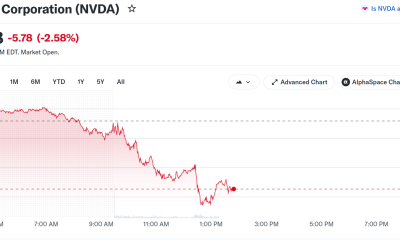
Why Did Nvidia Stock Fall on Monday Despite a $500 Billion Wall Street AI Deal?
-
 Entertainment6 days ago
Will Ferrell’s New Netflix Series Just Became One of the Streamer’s Biggest Hits of 2026
-

 Business6 days ago
5 Things You Must Know About Jorge Messi, the Father and Longtime Agent Who Shaped Lionel Messi’s Career
-

 Politics6 days ago
Ben-Gvir’s crocodile project halted but abuses at Ketziot Prison continue
-

 Business7 days ago
Mutual Fund Manager Scoops Up Beaten-Down Stocks
-

 Crypto World4 days ago
Revolut wins French banking licence, creates second EU banking hub
-

 Crypto World7 days ago
A Deep Dive Into One Of The Most Significant Hacks In Recent Memory
-

 Crypto World7 days ago
Bitcoin ETFs draw $853.5M in five-day inflow streak
-

 Politics6 days ago
The Church of England’s ruinous reparations racket
-

 Politics6 days ago
Saudi Arabia used 86% of missile stockpile defending Iran attacks
-

 Politics6 days ago
The House Article | Burnham still needs to sell devolution to the public
-

 Politics6 days ago
What’s An EDT? The Rise Of ‘Extreme Day Trips’ As A Travel Trend
You must be logged in to post a comment Login