
Crypto World
how $4 billion in bond operations moved Bitcoin 8% in a day



The U.S. Treasury doubled its long-end buyback operations on Aug. 19, compressing yields and triggering the largest single-day crypto rally since March. This is the plumbing story nobody else traced.
Summary
- The U.S. Treasury announced it will at least double the maximum size of its liquidity support buyback operations for 10-to-20-year and 20-to-30-year nominal coupon securities from $2 billion to at least $4 billion per operation, effective Sep. 9 through Nov. 4, 2026.
- The 30-year Treasury yield fell from a 19-year high of 5.34% to 5.19%, a drop of roughly 15 basis points from the Tuesday peak and 9 basis points on the announcement day alone.
- Bitcoin rallied 8.2% in under 12 hours, moving from an intraday low of $64,100 to a peak of $69,500, its highest level since early June.
- Forced short liquidations totaled $1.44 billion across major exchanges, with $1.29 billion closing within a single hour, the fastest concentrated squeeze of 2026.
- U.S. spot Bitcoin ETFs recorded a combined $487 million in net inflows across Aug. 17 and 18, with BlackRock IBIT capturing $143.6 million on Aug. 18 alone, confirming institutional participation before the rally accelerated.
On Aug. 19, 2026, Treasury Secretary Scott Bessent did something that barely made the front page of most financial outlets but moved more capital in a single afternoon than any Federal Reserve statement this year. The Treasury Department announced it would at least double the size of its long-end liquidity support buyback operations, raising the per-operation maximum from $2 billion to at least $4 billion for securities in the 10-to-20-year and 20-to-30-year maturity sectors.
The bond market reacted within minutes. The 30-year yield, which had touched a 19-year high above 5.34% the prior session, dropped 9 basis points to 5.19%. The 10-year fell to 4.647%. Stocks rose. And Bitcoin, which had been drifting sideways near $64,000 for most of the week, surged 8.2% to $69,500 in under 12 hours.
The move was not random. It followed a specific transmission chain that this piece traces step by step, from the Treasury press release to the crypto liquidation cascade, with the actual dollar flows at each node. Most coverage of the day focused on the price action itself. This piece focuses on the plumbing: what moved, why it moved, and how much money was involved at each stage of the chain.
What the Treasury actually announced
The official press release landed on the morning of Aug. 19. It contained a single operative change: beginning Sep. 9 and running through Nov. 4, 2026, the maximum size of nominal long-end liquidity support buyback operations would rise from $2 billion to at least $4 billion per operation. The number of long-end operations would also increase from two to four per quarter.
The program targets off-the-run securities. When the Treasury issues a new 10-year note, the previous 10-year note becomes off-the-run. It carries the same credit quality but trades less frequently, which makes it more expensive for primary dealers to hold on their balance sheets. The buyback program gives those dealers a reliable exit, allowing them to sell illiquid older bonds back to the government.
Critically, this is not quantitative easing. The Treasury funds these purchases by issuing new benchmark debt, often shifting duration toward shorter-dated paper and Treasury bills. Total net federal debt remains unchanged. What changes is the composition: less illiquid long-end paper sitting on dealer balance sheets, more liquid short-end paper in the market.
The Treasury stated the increase “reflects a desire to provide greater liquidity support in longer-dated nominal sectors.”
Analysts at Evercore ISI offered a blunter interpretation: Bessent was “hitting bond shorts with a surprise buyback on an August day with thin liquidity.”
Why yield compression is a crypto catalyst
The relationship between long-end Treasury yields and risk assets runs through a concept called the term premium, the extra compensation investors demand for holding long-dated government debt instead of rolling short-term bills. When the term premium rises, it signals that investors see more uncertainty ahead. Capital retreats from speculative assets and parks in guaranteed yield.
When the term premium compresses, the opposite happens. The relative attractiveness of risk assets improves because the guaranteed yield on safe havens falls. Capital that was earning 5.34% on 30-year Treasuries suddenly faces a lower return, pushing portfolio managers further out on the risk curve.
On Aug. 19, the 30-year yield fell from 5.34% to 5.19%. The 10-year dropped to 4.647% after trading near 4.75% earlier in the week. In dollar terms, these moves represent billions in mark-to-market gains for holders of long-dated bonds and, by extension, a loosening of financial conditions across the entire risk spectrum.
The scale of that repricing deserves a closer look. The outstanding stock of U.S. Treasury securities with remaining maturities above 10 years exceeds $7 trillion at face value. A 9-basis-point rally across that duration bucket produces roughly $50 billion to $60 billion in mark-to-market gains, depending on the weighted average duration. Those gains flow directly onto the balance sheets of pension funds, insurance companies, sovereign wealth funds, and the primary dealers themselves. Dealers with newly fattened balance sheets have more capacity to intermediate other markets, including equities and, increasingly, crypto ETFs.
Bitcoin has historically responded to yield compression with sharp upward moves. The mechanism is not mysterious: when the risk-free rate falls, the opportunity cost of holding a zero-yield asset like Bitcoin declines. Institutional allocators who benchmark against Treasuries find their hurdle rate lower, making speculative positions more defensible in portfolio construction terms. The tokenized Treasury market, which had crossed $15 billion in total value locked earlier in the summer, underscores the point: the same yield environment that pressures Bitcoin also attracts institutional capital into on-chain access to government debt, creating a direct pipeline between Treasury markets and crypto infrastructure.
Andre Dragosch, head of research at Bitwise, noted that “Bitcoin is the canary in the macro coal mine.”
The dollar flows at each step
This is the section a competitor could not have written, because it requires tracing the actual money through four separate venues in sequence.
Step 1: Treasury buyback announcement to dealer balance sheets. The announcement signaled that starting Sep. 9, primary dealers would have a guaranteed buyer for up to $4 billion in off-the-run long-dated paper per operation, up from $2 billion. Dealers holding illiquid 20-to-30-year bonds immediately saw the exit liquidity for those positions double. This is not a theoretical benefit. Primary dealers are required to make markets in Treasury securities, and when they accumulate large inventories of off-the-run bonds that trade infrequently, those positions consume balance-sheet capacity that could otherwise be deployed elsewhere. The doubled buyback gave dealers a clear path to offload those holdings, freeing capital for other market-making activities. The result was a repricing of the entire long end of the curve before a single buyback dollar changed hands. Markets are forward-looking, and the announcement itself was the catalyst.
Step 2: Yield compression to financial conditions. The 30-year yield dropping 15 basis points from its Tuesday peak (9 basis points on the announcement day) loosened financial conditions measurably. The Goldman Sachs Financial Conditions Index, which tracks the weighted contribution of bond yields, credit spreads, equity prices, and the dollar, shifted toward easier territory. For context, a 10-basis-point move in the 30-year yield translates to roughly $30 billion in mark-to-market value across the outstanding stock of long-dated Treasuries.
Step 3: Risk-on rotation to crypto. As financial conditions eased, capital rotated into risk assets. The S&P 500 rose on the day, with the Dow Jones Industrial Average adding 230 points. But the leveraged corners of the market moved faster and further. Bitcoin, which carries higher beta to financial conditions than equities, began climbing from its $64,100 intraday low within minutes of the yield move. The iShares 20+ Year Treasury Bond ETF (TLT) also surged, confirming that the rally was bond-led, not equity-led, a distinction that matters because bond-led risk-on moves tend to persist longer. Spot Bitcoin ETFs had already been accumulating: $297.6 million flowed in on Aug. 17 and $189.3 million on Aug. 18, with BlackRock IBIT alone taking in $143.6 million. That two-day total of $487 million meant institutional buyers were already positioned before the catalyst hit.
Step 4: Liquidation cascade. The derivatives market provided the accelerant. With Bitcoin rising past $65,000, then $66,000, then $67,000, leveraged short positions began hitting their liquidation prices. The data is stark: $1.44 billion in shorts were liquidated across major exchanges within 24 hours, with $1.29 billion of that total closing within a single hour. The largest single liquidation was a $32 million ETH-USD position on Bitget. More than 110,000 traders were liquidated in total. Each forced closure required buying the underlying asset, which pushed the price higher, which triggered more liquidations, a reflexive loop that carried Bitcoin from $67,000 to $69,500 in roughly 90 minutes.
The short positioning that made it possible
The liquidation cascade did not happen in a vacuum. In the days before Aug. 19, the derivatives market had built a pronounced short bias. On Binance, short positions accounted for 51.64% of open interest. On OKX, the figure was 51.13%. On Bybit, it was 52.25%, the most pronounced tilt of the three.
This positioning reflected a consensus view: with 30-year yields at 19-year highs and the S&P 500 recording its third consecutive decline on Tuesday, the macro backdrop appeared hostile to risk assets. Traders were betting that the bond selloff would continue, dragging crypto lower with it. Bitcoin had spent the previous 46 days in a funding-rate drain, a period during which perpetual futures funding had been consistently negative or near zero, reflecting sustained bearish conviction among leveraged traders.
The ratio of short to long liquidations on Aug. 19 tells the story of how wrong that conviction turned out to be. Short liquidations totaled $1.44 billion against just $168 million in long liquidations, a ratio of roughly 8.6 to 1. That imbalance meant the rally was overwhelmingly driven by forced buying from capitulating bears, not by new longs entering the market. The distinction matters because forced buying is mechanical and indiscriminate, amplifying price moves beyond what organic demand alone would produce.
The Treasury announcement inverted the bearish thesis in a single press release. Shorts that had been profitable for days suddenly faced a market moving against them with institutional ETF flows providing a persistent bid underneath. The funding rate on Bitcoin perpetual futures, which had been negative (indicating short dominance), flipped positive within hours. On Ethereum, the move was even more dramatic: the second-largest cryptocurrency jumped above $2,000 for the first time since June, gaining roughly 10% on the day, while Solana advanced 6.4%.
Paul Howard, senior director at Wincent, captured the sequence: by easing conditions in longer-dated Treasuries, the move provided “a more supportive backdrop for risk-taking and short-term speculation in crypto.”
What Bessent is really doing
The buyback expansion fits into a broader pattern that market observers have tracked since Bessent took office. The Treasury secretary has consistently used operational tools, rather than policy speeches, to manage the bond market.
The context matters. Long-dated Treasury yields had been rising since late June, driven by a combination of persistent deficit spending, downgraded sovereign credit outlooks, and a global selloff in government bonds that was not limited to the United States. The 30-year yield breached 5.0% in late May, hit 5.11% by early June, and kept climbing through the summer to that 19-year high of 5.34%.
Rising long-end yields create real economic friction. Mortgage rates track the 10-year yield. Corporate borrowing costs rise with the 30-year. When the 30-year yield sits above 5.3%, every new 30-year corporate bond issue prices at a higher coupon, every adjustable-rate mortgage resets higher, and every pension fund marks down the present value of its liabilities. A Treasury secretary who can compress the long end without changing fiscal policy or pressuring the Federal Reserve has a powerful lever, and Bessent has shown a willingness to pull it at moments of maximum market stress.
The buyback is that lever. By doubling the program, Bessent signaled to the market that the Treasury would not tolerate disorderly conditions in the long end. The timing was deliberate. The announcement landed on an August Wednesday, traditionally one of the thinnest liquidity days of the year, when a modest volume of buying can produce outsized price moves. Evercore ISI analysts described it as Bessent “again showing his tactical skill as an activist Treasury secretary.”
The political dimension is also relevant. With the administration pursuing an ambitious legislative agenda that requires continued access to debt markets, a disorderly bond selloff threatens the fiscal plan itself. Bessent has framed the buyback expansion as a technical liquidity measure, but the market read it as a policy statement: the Treasury will defend the long end.
Matt Cole of Strive offered a more cautious framing: “There is no painless path. The question is simply where the adjustment gets absorbed.”
How this compares to previous Treasury interventions
Treasury buybacks are not new. The modern program launched in 2000, was suspended in 2002, and restarted in May 2024. The 2024 relaunch initially focused on smaller operations, $2 billion per session, with a stated goal of supporting market liquidity rather than influencing yields. An IMF working paper published in May 2025 found that the program moderately narrowed bid-ask spreads and off-the-run yield spreads, confirming the liquidity benefit but stopping short of claiming a significant impact on outright yield levels.
But the Aug. 19 expansion represents a qualitative shift. Doubling the operation size and increasing the frequency to four per quarter moves the program from a maintenance tool to an active market management instrument. At $4 billion per operation and four operations per quarter, the Treasury will be repurchasing up to $16 billion in long-dated off-the-run paper per quarter, a pace that approaches the scale of a small quantitative easing program in its effect on the long end, even though the mechanism is fundamentally different.
The historical relationship between Treasury operations and Bitcoin has strengthened as the crypto market has matured and institutional participation through ETFs has grown. In previous cycles, Treasury operations had minimal direct impact on crypto because the transmission mechanism required too many steps and crypto markets lacked the institutional plumbing to respond quickly. A buyback announcement in 2001 would have taken days to filter through bond desks, equity markets, and finally into the nascent crypto trading community, which at the time consisted of a few thousand participants on message boards.
The existence of spot Bitcoin ETFs, which now manage tens of billions in assets and saw cumulative inflows exceed $60 billion for BlackRock IBIT alone, has shortened the transmission chain. When yields fall, ETF allocators can rebalance into crypto exposure within the same trading session, without touching an exchange or managing custody. The speed of the Aug. 19 move, from Treasury press release to Bitcoin at $69,500 in under 12 hours, would have been impossible without this infrastructure.
The two-day ETF inflow of $487 million heading into the announcement was not coincidental. Institutional flows often front-run Treasury operations because the quarterly refunding schedule and buyback calendars are published in advance. What was not published, and what caught the market off guard, was the doubling of the operation size.
The limits of the trade
The Treasury buyback trade has clear boundaries that traders should understand before extrapolating from a single day.
First, the buyback program is time-limited. The doubled operations run from Sep. 9 through Nov. 4. After that, the Treasury will reassess. If yields have stabilized, there is no guarantee the elevated size continues.
Second, buybacks do not reduce total debt. They shift composition. Every dollar spent buying off-the-run long-dated paper is funded by issuing new short-dated paper. If the macro environment continues to deteriorate, the additional short-end issuance could push bill rates higher, creating a different kind of pressure on financial conditions.
Third, the short liquidation that amplified the Aug. 19 move was a one-time event. Those 110,000 liquidated positions cannot be liquidated again. Future Treasury announcements will land in a market with different positioning, and the reflexive cascade may not repeat.
Fourth, Bitcoin at $69,500 sits below its all-time high and remains range-bound in a broader context. The rally brought it to its highest level since early June, but it did not break the structure of the consolidation that has defined 2026 trading. For Bitcoin to sustain above $69,000, it will need organic spot demand to replace the mechanical short-covering that drove the initial move. If that bid does not materialize, a retracement toward the $65,000 to $66,000 support zone is the base case.
Fifth, the broader macro picture has not changed. The federal deficit remains elevated, sovereign credit outlooks remain under pressure, and the global bond selloff that drove yields higher through June and July reflects structural forces that a buyback program cannot address on its own. The buyback buys time and improves market functioning at the margin. It does not resolve the underlying fiscal dynamics that pushed yields to 19-year highs in the first place, and traders who treat it as an all-clear signal may be disappointed.
What to watch
- Sep. 9 buyback execution: the first $4 billion operation will reveal whether the Treasury receives enough high-quality offers at the new scale, or whether the market has already priced in the full benefit.
- 30-year yield at the 5.0% level: a sustained break below 5.0% would confirm that the buyback program is achieving its goal of compressing long-end yields, which would support continued risk-on positioning in crypto.
- Bitcoin ETF flow direction in September: if institutional inflows accelerate above the $487 million two-day pace seen in mid-August, it would signal that allocators are treating the buyback expansion as a durable shift in financial conditions rather than a one-day event.
- Perpetual futures funding rates: positive funding rates (indicating long dominance) after the squeeze would suggest the market has repositioned from bearish to bullish, reducing the probability of another liquidation-driven spike.
- Treasury refunding announcement in late October: the quarterly refunding will reveal whether Bessent plans to extend the doubled buyback size beyond the Nov. 4 window, which would be the strongest signal yet that the Treasury is committed to active yield curve management.
What is a Treasury buyback?
A Treasury buyback is when the U.S. Department of the Treasury repurchases its own previously issued bonds from primary dealers. The program targets older, less liquid “off-the-run” securities and is funded by issuing new debt, typically shorter-dated paper, so total government debt does not change.
How much did the Treasury increase its buyback operations?
The Treasury doubled the maximum per-operation size from $2 billion to at least $4 billion for securities in the 10-to-20-year and 20-to-30-year maturity sectors. The number of long-end operations also increased from two to four per quarter. The changes take effect Sep. 9, 2026.
Why did Bitcoin rally 8% on Aug. 19?
The Treasury buyback announcement compressed long-end yields, loosening financial conditions and triggering a risk-on rotation. Bitcoin moved from an intraday low of $64,100 to $69,500 as $1.44 billion in short positions were liquidated, with forced buying accelerating the rally in a reflexive loop.
Is the Treasury buyback the same as quantitative easing?
No. Quantitative easing involves the Federal Reserve purchasing bonds and creating new money. Treasury buybacks are funded by issuing new shorter-dated debt, so total debt remains unchanged. The operation shifts the composition of outstanding debt instead of expanding it.
How do Treasury yields affect Bitcoin?
When long-end Treasury yields fall, the opportunity cost of holding zero-yield assets like Bitcoin declines. Institutional allocators face a lower risk-free rate, which makes speculative positions more defensible in portfolio construction. Bitcoin has historically rallied during periods of yield compression.
How much was liquidated in the short squeeze?
Total short liquidations reached $1.44 billion across major exchanges within 24 hours, with $1.29 billion liquidated within a single hour. More than 110,000 traders were affected. The largest single liquidation was a $32 million ETH-USD position on Bitget.
Will the doubled buyback operations continue after November?
The increased operations are scheduled from Sep. 9 through Nov. 4, 2026. Whether they continue depends on market conditions and the Treasury quarterly refunding announcement in late October. If long-end yields remain elevated, extension is likely. If yields stabilize, the Treasury may revert to smaller operations.
What role did Bitcoin ETFs play in the rally?
U.S. spot Bitcoin ETFs recorded $487 million in net inflows across Aug. 17 and 18, with BlackRock IBIT leading at $143.6 million on Aug. 18 alone. These institutional flows provided a persistent bid underneath the market before the Treasury catalyst hit, shortening the transmission chain from macro event to crypto price action. This is educational analysis, not investment advice.
Disclaimer: This article is for informational purposes only and does not constitute financial advice. Cryptocurrency investments carry significant risk. Always conduct your own research before making investment decisions. Published Aug. 20, 2026.


SEC Crypto News: The Securities and Exchange Commission proposed Regulation Crypto Assets, a framework that would allow eligible projects to raise up to $75 million in any 12-month period without registering the offering under the Securities Act. The proposal also includes a conditional safe harbor under which a crypto asset could be deemed not subject to an investment contract if specified conditions are met.
- Fundraising exemption: Up to $75 million per 12-month period, with financial statements and ongoing reporting requirements.
- Startup exemption: Up to $5 million over a four-year period, with principles-based narrative disclosures.
- Investment contract safe harbor: A conditional path under which a crypto asset could be deemed not subject to an investment contract.
The proposal creates two exemptions from the Section 5 registration requirements for certain investment contracts involving crypto assets, which the SEC refers to as covered investment contracts.
The smaller route would cap offerings at $5 million over four years. The larger fundraising exemption would permit offerings of up to $75 million during each 12-month period.
Issuers using either exemption would be required to provide principles-based narrative disclosures and would remain subject to federal antifraud and antimanipulation provisions.
Crucially, issuers using the larger exemption also would be required to provide financial statements and comply with ongoing reporting requirements.

Crypto thought leaders such as Deepankar Kapoor, Chief Growth Officer for Global Markets at compliance-first digital asset marketplace eXchange1, believe the framework could unlock a new phase of positive mature growth for the industry.
“What excites me here isn’t fewer registration headaches for issuers, it’s what it does to the pipeline,” explained Kapoor.
“For years, promising projects either delayed launching or built offshore because the securities question was unresolved.
“A defined $75 million tier with real financial reporting attached means we should see a wave of well-disclosed, legitimate projects come to market over the next year or so.”
Kapoor also shared his expert insight into the best strategy for retail investors looking to get ahead of the SEC’s crypto move.
“The platforms that build out their due diligence bench now, ahead of that wave, are the ones that end up capturing it.”
Why the Safe Harbor Matters More Than the Dollar Figure
The headline number draws attention, but the proposal’s safe harbor addresses when a related investment contract could cease to exist.
Under the proposed rule, a crypto asset could be deemed not subject to an investment contract if the issuer certifies to the SEC that it has ceased or terminated all essential managerial efforts it promised to undertake under that investment contract and satisfies the other conditions of the safe harbor.
SEC Chairman Paul Atkins said the proposal is designed for non-security crypto assets that are subject to an investment contract.
In a statement accompanying the release, Atkins said issuers have had to conform to existing SEC rules that were not designed with those assets in mind, and that this approach has impeded capital formation and innovation.
He also said the agency’s past approach had driven investment offshore and limited the protections available to U.S. investors. Atkins credited Commissioner Hester Peirce’s long-standing safe harbor proposal with laying much of the groundwork for Regulation Crypto Assets.

Where This Sits in the Broader Crypto Regulation Push
Atkins said legislation remains indispensable for creating rules durable enough to protect the SEC’s work from being undone by a future regulator. He said the SEC will continue to support Congress in delivering the CLARITY Act to President Trump.
The proposed exemptions would establish tailored routes for offerings involving covered investment contracts, while preserving disclosure obligations and the securities laws’ antifraud and antimanipulation provisions.
The fundraising exemption would add financial-condition disclosures, including financial statements that must be audited at certain capital-raising thresholds, according to Atkins’s statement.
What Happens Next
The release identifies Regulation Crypto Assets as a proposed rule under File Number S7-2026-27. It states that comments should be received on or before 60 days after publication in the Federal Register.
The SEC provides an online comment process for the file number and says submitted comments will be posted on its website.
DISCOVER: XRP Price Prediction – 2026, 2027, 2030
The post SEC Crypto Proposal Offers New Paths for Crypto Asset Issuers appeared first on Cryptonews.

GnosisDAO has voted to approve a major upgrade for Gnosis Chain: the network will transition from operating as a standalone layer-1 to becoming a ZK-proven “Ethereum Economic Zone” (EEZ) rollup aligned with Ethereum. The decision is intended to move Gnosis Chain’s transaction settlement to Ethereum while still running its smart contracts in an environment designed to improve how users and applications interact with Ethereum-native liquidity and assets.
In the governance vote, Gnosis Chain reported that GIP-153 passed with 123,158 GNO in support, 115 against, and 151 abstaining across 54 voters. The proposal’s turnout totaled 123,425 GNO, surpassing the 75,000 GNO quorum requirement. Gnosis Chain now says an initial launch is targeted for late 2026 or early 2027, contingent on the EEZ technology being ready.
Key takeaways
- GnosisDAO approved GIP-153 to transition Gnosis Chain from layer-1 to an EEZ rollup that settles transactions on Ethereum.
- The vote cleared the 75,000 GNO quorum with 123,425 GNO in turnout, signaling broad governance support despite a low “no” count.
- Under the proposal, Gnosis Chain’s validator set would be retired, shifting settlement responsibility to Ethereum validators.
- Gnosis Chain-native contracts would gain tighter access to Ethereum assets and liquidity, including the ability to call Ethereum and use results within the same transaction.
- The EEZ concept is aimed at reducing fragmentation across Ethereum’s growing rollup landscape, potentially lowering reliance on bridges.
What GIP-153 changes for Gnosis Chain
The approved proposal, GIP-153, outlines a fundamental architectural shift. Instead of settling transactions on its own chain as a layer-1, Gnosis Chain would settle transactions on Ethereum, making it effectively an Ethereum layer-2 that depends on Ethereum’s validator set for settlement finality.
In the same proposal framework, Gnosis Chain’s existing validator set would be retired, aligning core settlement with Ethereum while preserving the network’s application layer. Gnosis Chain also said it would retain its “existing applications, balances and xDAI gas token,” suggesting a continuity plan for users and developers even as the underlying consensus and settlement model changes.
A key promise of the EEZ approach is improved on-chain interoperability for smart contracts. The proposal states that Gnosis Chain-native smart contracts would be able to call Ethereum and use that information in the same transaction—an ability it claims is not currently available on existing layer-2 systems.
Why the EEZ framework is being pursued
At a broader level, the EEZ concept is designed to address a structural issue in Ethereum scaling: fragmentation. As Ethereum’s rollup ecosystem has expanded, liquidity and usage have increasingly become siloed across separate networks. Different rollups can also limit how easily contracts from one environment can synchronously coordinate with contracts on another.
According to the coverage referenced in the original report, the EEZ framework was developed by Gnosis and ZisK, with funding from the Ethereum Foundation. The stated objective is to unify Ethereum-aligned rollups so that smart contracts across different participating networks can execute synchronously—without requiring bridging mechanisms.
This matters for investors and builders because bridges and cross-chain messaging have become recurring points of failure in the broader ecosystem. The EEZ plan attempts to reduce one major source of operational and security risk while improving how assets and logic can interact across rollups.
Timing is also a central uncertainty. Gnosis Chain’s rollout target—late 2026 or early 2027—explicitly depends on the underlying EEZ technology being sufficiently developed. That means market participants may want to track technical milestones and readiness signals long before deployment.
Buterin’s critique and the rollup security trade-off
The push for an EEZ-aligned design comes amid ongoing debate about how layer-2s fit into Ethereum’s long-term architecture. Ethereum co-founder Vitalik Buterin previously argued that some assumptions behind the original L2 vision no longer hold up. In a Feb. 3 X post, Buterin wrote that “the original vision of L2s and their role in Ethereum no longer makes sense, and we need a new path,” pointing to potential weaknesses including centralized sequencers and trusted bridging mechanisms.
Those concerns align with the EEZ pitch: move settlement closer to Ethereum’s security model and reduce bridge dependence while enabling more direct execution pathways for cross-network smart contract interactions.
Rollup adoption remains substantial. Data referenced from L2Beat indicates that 22 Ethereum rollups are listed as securing $27.82 billion, while the platform tracks $34.88 billion in total value secured when including validiums, optimiums, and other scaling networks. As that footprint grows, the industry pressure for smoother composability and reduced fragmentation is likely to intensify.
Standard Chartered: fewer bridges, more composability
Standard Chartered’s digital assets research team has also weighed in on what an EEZ could change operationally and economically. In a May 28 report shared with Cointelegraph, Geoffrey Kendrick—global head of digital assets research—said the EEZ could reduce reliance on blockchain bridges and increase the usability of assets in EVM environments.
Kendrick wrote that “the EEZ will have the benefit of reducing the need for bridges (where hacks tend to occur) and increasing the usability of assets in EVM chains.” He added that these factors are “likely to lead to greater activity in the Ethereum ecosystem.”
From an application standpoint, Kendrick also highlighted the potential for stronger composability. The idea is that smart contracts across participating networks could interact within the same transaction, enabling richer cross-asset and cross-contract workflows without the fragmentation that can arise when operations span multiple independent rollups.
What to watch as the transition approaches
With GnosisDAO’s approval now in place, the key question for the market is execution: whether EEZ technology progresses on schedule and whether Gnosis Chain can migrate while maintaining continuity for users and developer tooling. As the late-2026/early-2027 target draws closer, attention will likely shift to implementation details—especially how Ethereum settlement, synchronous execution, and bridge reduction are delivered in practice.


Three hours spanning the London afternoon and New York morning account for about 23% of XRP moving onchain, up from roughly 14% a year ago.

Link Attracting Whales Amid Robust Buy-In
The entire cryptocurrency market is now in a fresh wave of bullish trend as Bitcoin and Ethereum made impressive gains during the past 24 hours. The positive performance of the two largest cryptocurrencies has spilled into altcoin space, with several altcoins gaining significant value.
In that regard, Chainlink’s LINK has emerged as a focus of traders after the token registered a robust uptrend during the last day. LINK has gained above 8%, taking the coin’s value close to $10.65. The uptrend comes at a time when LINK had been trading with weak momentum and lack of direction.
The uptrend is being backed by whales. Market trends suggest that there has been continued accumulation of LINK by whales rather than one-off very large transactions.
Such an accumulation can prove very important as buying pressure on LINK can play an essential role in supporting the token. Unlike other transactions, LINK buying activities indicate that there have been gradual purchases of the token by certain market players. Analysis of LINK shows that it has appreciated by more than 19% in just one week.
Link Breaks Crucial Resistance Barrier
The new price rise has been accompanied by yet another vital technical development. Specifically, LINK has risen above the crucial diagonal resistance barrier that previously prevented its price from moving higher. Another technical development is that LINK has risen back into its daily cloud area.
It is crucial to break resistance barriers because it indicates there is enough buying power to push the price past a point where sellers previously existed. Breaking out of the daily cloud adds more weight to the technical development in terms of overcoming an area that was earlier seen as a barrier.
Short-Term Correction Is Still Possible
Even with the improvement in the technical setup, LINK is still susceptible to a short-term correction, especially after the recent gains in its price.
The coin has appreciated quickly, and there might be some selling pressure from traders who choose to book profits from the current rally. However, this does not mean that a correction in LINK invalidates the bullish setup, especially when LINK is still trading above its previously reclaimed resistance levels.
The fact that whales are continuing to buy LINK can also help during any short-term sell-off. As long as whales continue to accumulate LINK amid the new technical levels, the recent breakout can become a long-lasting move.
At the moment, LINK’s technical setup of continuous whale accumulation, increasing momentum, and a break above major technical resistances has made the altcoin a favorite among traders. For some time now, LINK has been one of the weakest coins, and the token has been showing some of its best bullish setups in some time. It will be vital for upcoming sessions to determine what happens next.
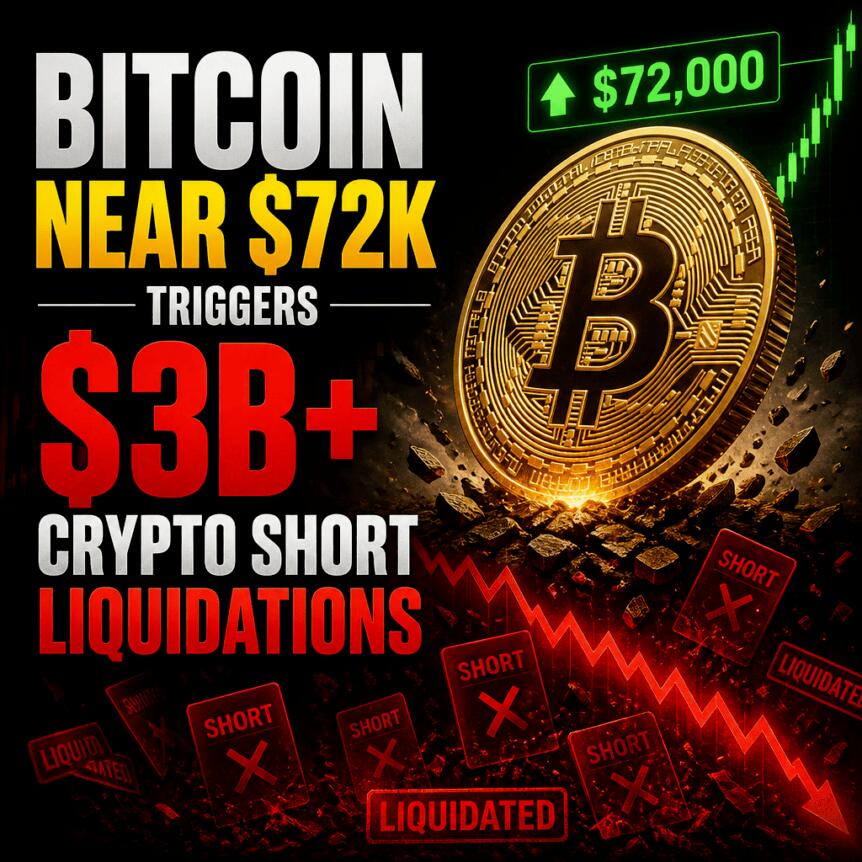
Crypto markets have been roiled by a rapid unwind of bearish leverage, with short liquidations pushing past $3 billion over the past two days. According to CoinGlass, total liquidations for Aug. 19–20 reached roughly $3.1 billion, while Thursday marked the largest single-day wipeout of shorts recorded by the platform.
Bitcoin has also been firming in the backdrop. The BTC/USD pair continued its upside reaction tied to a US Treasury liquidity intervention, trading around the $72,000 area, with local highs of $71,992 on Bitstamp reported via TradingView data.
Key takeaways
- Short liquidations exceeded $3.1 billion across Aug. 19–20, per CoinGlass.
- Bitcoin accounts for just over half of the two-day short liquidation total, at about $1.65 billion.
- Thursday’s short squeeze was the biggest on record for single-day short liquidations in CoinGlass’ data.
- Short-term holders rotated out of break-even territory, moving 43,300 BTC to exchanges as price improved.
Short liquidations surge to record levels
The liquidation figures reflect how quickly leverage can unravel when price moves persistently higher. CoinGlass data indicates that Aug. 19–20 combined for short liquidations of more than $3.1 billion, with Thursday contributing the most extreme daily spike in the dataset.
It’s important to distinguish between short-only and all-liquidation measures. The $3.1 billion figure refers specifically to shorts. If long positions are included, the total liquidation impact can be much larger; the article notes that the long liquidation cascade following Bitcoin’s October 2025 reversal from its then-most recent all-time high of $126,200 dwarfed the current short-only event, described elsewhere as a roughly $20 billion cascade.
CoinGlass’ emphasis on shorts also sits alongside historical context from CoinMarketCap. Using a combined long-and-short view, CoinMarketCap ranks Thursday’s total liquidations around seventh place historically, estimating $3.25 billion for the day when both sides are counted.
BTC’s climb stays tied to US Treasury liquidity signals
Part of the upside momentum is linked to a US Treasury liquidity intervention, which the article references as the catalyst behind BTC/USD’s move earlier in the week. Earlier coverage from Cointelegraph noted Bitcoin’s response to a liquidity intervention and the subsequent push to levels not seen since the start of June.
As of the time of writing, the rally was still playing out. TradingView data cited in the article shows BTC/USD reaching local highs of $71,992 on Bitstamp, reinforcing the broader pattern that spot gains and margin squeezes often feed each other: rising prices trigger forced closes for short positions, which can in turn add incremental buy pressure.
Why short-term holders are moving coins to exchanges
Beyond liquidations, the more structural read-through for traders is what longer-lived cohorts do when price crosses above cost. The article highlights that Bitcoin short-term holders—defined as wallets holding a UTXO for less than 155 days—have taken profit in a meaningful way.
According to on-chain analytics from CryptoQuant, short-term holders transferred 43,300 BTC to exchanges in what is described as their largest profit-taking move of 2026. That behavior matters because it can influence near-term supply dynamics: when “recent buyers” sell into a rally, the market’s ability to sustain higher prices depends on whether fresh spot demand absorbs that distribution.
CryptoQuant also points to the spent output profit ratio (SOPR) for the short-term holder cohort. As of Thursday, STH-SOPR stood at 1.01—its highest level since April. SOPR above 1 indicates that, on average, the coins being spent by the cohort are moving at a higher price than their prior transaction price. In practical terms, the majority of UTXOs moving from short-term holders were sold at prices above their earlier cost basis, consistent with profit-taking rather than capitulation.
What investors are watching next: staying power vs. profit rotation
The current unwind of shorts looks like a classic “payoff” for bearish leverage—forced selling pressure on one side is removed as price rises. But the longer question is whether the bid can keep absorbing new supply. The article notes that earlier Cointelegraph analysis found the short-term holder cohort’s aggregate cost basis (also called the STH realized price) at about $68,700, and that such a level previously suggested upside could face friction if investors felt compelled to exit positions that had been underwater.
Now, with STH-SOPR above 1 and a record-sized profit-taking transfer to exchanges, market participants should watch whether this rotation expands or fades. If short-term holders continue to distribute aggressively while price pauses, rallies could become choppier. If instead inflows remain strong enough to offset that selling, the liquidation-driven momentum may transition into steadier spot accumulation.
For the next session, the key signals to track are whether short liquidations taper off as leverage clears and whether the STH profit cycle continues or stabilizes—because that combination often determines whether “squeeze” gains convert into a sustained trend or revert once the forced selling stops.

- KuCoin earns ISO 42001 certification for its AI management system globally.
- ISO 42001 focuses on AI accountability, transparency and human oversight.
- New certification strengthens KuCoin’s wider security and trust framework.
KuCoin has secured ISO/IEC 42001:2023 certification for its Artificial Intelligence Management System, adding a dedicated AI-governance standard as crypto exchanges increasingly use artificial intelligence across risk, compliance and customer operations.
The certification applies to the management framework supporting KuCoin’s global digital-asset exchange.
The company said AI is used across areas including anti-money laundering, fraud detection, market surveillance, customer service, product intelligence and operational automation.
ISO/IEC 42001 was published in December 2023 and is the world’s first international management-system standard for artificial intelligence.
It sets requirements for establishing, maintaining and continually improving an AI management system, with a focus on accountability, transparency, risk management and oversight.

AI governance becomes a bigger financial-sector issue
The certification comes as financial companies expand AI use beyond simple automation into functions that can influence compliance, risk management and customer outcomes.
S&P Global analysts Miriam Fernández and Nicolas Charnay have warned that more complex AI systems could amplify risks including privacy concerns, operational failures and financial instability.
In a report on AI adoption in banking, they said: “Without careful governance, banks could be exposed to material operational risks with financial, regulatory, reputational, and systemic implications.”
Those concerns also apply to digital-asset platforms, where automated systems can operate continuously across transaction monitoring and fraud prevention.
KuCoin chief executive BC Wong said governance is becoming inseparable from AI adoption.
“AI is becoming a foundational capability of digital financial infrastructure, but greater capability must be matched by greater responsibility,” said BC Wong, CEO of KuCoin.
We believe the future of the industry will not be defined simply by more advanced AI, but by more trusted AI. Achieving ISO/IEC 42001 demonstrates our commitment to embedding responsible AI governance into the way we build, deploy and operate AI across our platform. As we continue to innovate, we remain equally committed to ensuring that every AI capability is transparent, accountable and designed to strengthen user trust.
Certification adds to KuCoin’s trust framework
ISO/IEC 42001 adds an AI-governance layer to KuCoin’s existing security and operational framework.
The exchange already holds ISO/IEC 27001 certification for information security, SOC 2 Type II attestation and ISO 22301 certification for business continuity and operational resilience, according to the company.
Unlike a cybersecurity standard, ISO/IEC 42001 focuses on how organisations manage AI throughout its lifecycle.
ISO says the framework covers policies, risk assessment, monitoring and continual improvement rather than certifying individual AI applications.
The distinction matters as financial platforms deploy AI into sensitive operations. It can improve fraud detection, compliance monitoring and efficiency, but also raises the need for clear human accountability.
For KuCoin, the certification is less about a single AI tool than formalising how the technology is governed across the platform.


RobTheCoins.com is an online publication covering cryptocurrency, blockchain, investing, business and selected gaming-related topics. Rather than focusing on a single digital currency or blockchain project, the website publishes guides, explainers, market-related articles and practical content designed to make complex financial and technology subjects easier to understand.
People searching for robthecoins .com may initially assume the name refers to a cryptocurrency, trading exchange or digital wallet. However, the current website primarily operates as an information and publishing platform, with sections dedicated to Cryptocurrency, Investing, Blockchain Business, Business Tips, Gaming and other topical content.
For readers interested in crypto without wanting to navigate highly technical material immediately, that broad editorial approach is an important part of what RobTheCoins offers.
What Is RobTheCoins.com?
RobTheCoins.com describes itself as a destination for information about cryptocurrency, blockchain innovation and investing. Its About Us page says the website was created to help explain subjects including DeFi, NFTs, smart contracts, crypto tax tools and evolving blockchain business models in more accessible language.
That means RobTheCoins.com should primarily be viewed as a content resource, rather than assuming that every topic mentioned on the website represents a financial product or service directly operated by RobTheCoins.
Its coverage has expanded beyond cryptocurrency alone. Recent and archived content includes subjects involving investing, fintech, online payments, business technology and gaming alongside traditional blockchain topics.
Who Is Behind RobTheCoins?
According to the website’s About Us information, RobTheCoins was created by Fyona Menas and Reg Payton.
Fyona Menas is presented as a writer and researcher covering areas including cryptocurrency trends, blockchain business models and related financial topics. Reg Payton is described as having interests in investing, alternative assets, fintech, side hustles and the overlap between gaming and crypto economies.
The site’s stated objective is to turn complicated subjects into information that readers can understand and use when carrying out their own research.
That distinction matters in cryptocurrency. Readers frequently encounter terminology such as staking, smart contracts, decentralised finance and tokenomics before fully understanding how the underlying systems work. Educational websites can therefore be useful starting points, provided readers continue to verify important financial information independently.
What Topics Does RobTheCoins.com Cover?
RobTheCoins has developed into a fairly broad publication. Its main subject areas include several categories.
Cryptocurrency
Cryptocurrency is one of the largest areas of the website.
Articles may discuss digital assets, cryptocurrency security, blockchain ecosystems, exchanges, wallets, market developments and emerging crypto concepts.
For a beginner, these articles can provide an introduction to terminology that might otherwise seem overly technical. More experienced readers may use the site to discover subjects that deserve further investigation.
However, cryptocurrency markets can change rapidly. Prices, regulations, exchange policies and individual projects can all change after an article has been published, so dates and primary sources should always be checked before making a financial decision.
Investing
RobTheCoins also publishes material about investing outside the narrow cryptocurrency sector.
Recent topics on the site have included portfolio management, alternative investments and broader approaches to managing personal money.
This wider coverage makes sense because crypto increasingly sits within a much larger investment conversation. An investor considering Bitcoin or another digital asset may also be comparing it with shares, bonds, funds, property or other asset classes.
Blockchain Business
The Blockchain Business section examines how blockchain and financial technology can be applied commercially.
The archive includes discussions around crypto business regulation, Web3, blockchain applications and technology infrastructure.
This section may therefore be particularly relevant to entrepreneurs, technology professionals and readers who are interested in blockchain for reasons beyond buying and selling tokens.
Business and Fintech
Business Tips is another significant part of RobTheCoins.com.
Coverage has extended into digital payments, software, online platforms and other technology affecting modern organisations.
The result is a website that increasingly overlaps with the broader fintech and digital-business publishing space rather than operating exclusively as a cryptocurrency blog.
Gaming
Gaming content also appears prominently on the website.
The connection between gaming and cryptocurrency is becoming increasingly relevant because digital ownership, virtual economies, NFTs, blockchain infrastructure and online payment systems can intersect with games.
Not every gaming article necessarily involves cryptocurrency, however, so readers can browse individual categories depending on the type of information they need.
Is RobTheCoins.com a Crypto Exchange?
Visitors should be careful about assuming that RobTheCoins.com itself is a conventional cryptocurrency exchange simply because some third-party pages describe it using trading-related language.
The current RobTheCoins website is visibly structured around articles and editorial categories, while its own About Us page describes its purpose in terms of cryptocurrency, blockchain and investing information.
This is an important distinction.
When considering any website involving cryptocurrency, users should independently establish whether they are dealing with:
- An editorial or educational website
- A cryptocurrency exchange
- A wallet provider
- A token issuer
- A decentralised application
- An investment company
- An unrelated third-party service using a similar name
A similar brand name does not necessarily mean two websites or products are connected.
How Can Readers Use RobTheCoins Effectively?
 The most sensible way to use RobTheCoins.com is as a starting point for research.
An article can introduce an unfamiliar term, explain how a technology works or highlight an emerging subject. Readers can then verify the important details through primary sources.
For example, information about regulation should ultimately be checked against the relevant financial regulator or government authority. Claims concerning an individual cryptocurrency should be compared with the project’s official documentation and independently verified blockchain data where appropriate.
The same principle applies to investment information.
A useful article can improve someone’s understanding of a subject, but it should not replace personalised advice or independent due diligence.
What Should You Check Before Acting on Crypto Information?
Cryptocurrency attracts both legitimate innovation and questionable claims, which makes verification especially important.
Before transferring money, connecting a wallet or buying an unfamiliar token mentioned anywhere online, readers should consider several questions.
Who Operates the Product?
Look beyond branding and establish which legal entity or identifiable development team is responsible.
Is the Service Regulated Where Regulation is Required?
Rules differ considerably by jurisdiction and by the service being offered.
Can Claims Be Independently Verified?
Guaranteed profits, unrealistic yields and vague explanations of how returns are generated deserve particular scrutiny.
What Happens to Deposited Funds?
Understand whether users retain custody of their cryptocurrency or transfer control to another party.
Can Funds Actually Be Withdrawn?
A displayed account balance does not necessarily prove that assets can be withdrawn.
How Old is the Information?
Crypto markets and regulations move quickly. An accurate guide from two years ago can contain details that are no longer applicable today.
These checks are useful regardless of whether information comes from RobTheCoins, social media, another cryptocurrency publication or an individual influencer.
Is RobTheCoins.com Legit?
There is an important difference between determining that a website exists and declaring every piece of information or third-party service associated with its name “legitimate”.
RobTheCoins.com is an active content website with an About Us page, contact information, published articles, editorial categories and terms governing use of the site.
That does not mean readers should automatically treat every investment opportunity, cryptocurrency project or external service discussed online as safe.
For financial subjects, readers should evaluate the specific claim, product or company involved rather than relying solely on the reputation of the publication where they first discovered it.
Independent checks become even more important when money, wallet access or personal information is involved.
Why Has RobTheCoins.com Attracted Attention?
The cryptocurrency information market has changed considerably.
Early crypto websites often assumed readers already understood blockchain terminology. Today’s audience is much broader. People may encounter digital assets through investing apps, online games, payments, social media or mainstream financial news.
That creates demand for explanations written for ordinary readers rather than developers.
RobTheCoins.com’s combination of crypto, investing, blockchain business, fintech and gaming places it within that broader trend. Its editorial scope means readers can move from understanding a crypto concept to exploring how the same technology may affect businesses or investment decisions.
Can Beginners Use RobTheCoins?
Yes. Many of the subjects covered are relevant to people who are still learning about cryptocurrency and digital finance.
Beginners should nevertheless avoid treating any single article as the final word on a financial decision.
A stronger research process is:
- Learn the basic concept.
- Check when the information was published or updated.
- Find the original source behind important claims.
- Compare information across reputable sources.
- Understand the risks before committing money.
- Seek regulated professional advice where appropriate.
Following this approach makes online financial content considerably more useful.
The Bottom Line
RobTheCoins.com is primarily a cryptocurrency, blockchain, investing and business information website. Its current site contains educational articles and editorial sections spanning crypto, investing, blockchain business, fintech-related subjects and gaming.
Readers searching for robthecoins .com should therefore distinguish the publication itself from individual products, coins, exchanges or third-party services that might use similar terminology.
For people researching digital assets, the website can serve as a place to discover topics and understand unfamiliar concepts. As with any financial publication, however, significant investment decisions should be backed by primary sources, independent verification and an understanding of the risks involved.
FAQs
Is Robthecoins a Cryptocurrency?
RobTheCoins.com itself is presented as an information website rather than a cryptocurrency token.
Who Created Robthecoins?
The website’s About Us page identifies Fyona Menas and Reg Payton as the people behind RobTheCoins.
Does Robthecoins Provide Investment Advice?
Its website primarily publishes informational and educational content. Readers should independently verify financial information and seek professional advice when necessary.
What Can Readers Find on Robthecoins.com?
Topics include cryptocurrency, investing, blockchain businesses, digital payments, financial technology, business and gaming.
Is Information About Cryptocurrency Always Current?
Not necessarily. Cryptocurrency prices, projects, legislation and platform policies can change rapidly, so readers should check publication dates and verify important details with current primary sources.
Should Investors Rely Only on Robthecoins?
No financial website should normally be the sole basis for an investment decision. RobTheCoins can be used for research and discovery, while important claims should be independently verified.


Iran has reportedly assessed attacks on US military targets in Europe, according to two people close to the regime.
The timing sets up a test for the rotation into European assets. The money moved in as semiconductor volatility rose and past signs of cooling hostilities lifted regional sentiment.
European Equity Inflows Took Nearly Three Quarters of Global Money
European equity funds pulled in $13.52 billion in the week through August 12. LSEG Lipper data shows that it was the largest weekly inflow since July 8.
The money arrived as global equity funds logged a 12th straight week of inflows worth $18.62 billion. Europe claimed 72.6% of that total. Investors withdrew $1.7 billion from technology funds over the same stretch.
The rotation started earlier. BeInCrypto reported that European stock ETFs recorded their first positive month since February in July, with $4.4 billion reportedly flowing into BlackRock products.
Tehran Signals the War Could Reach Europe
The capital arrives as Iranian planning has reportedly turned toward Europe. The Financial Times, citing two regime insiders, reported that Iranian forces have examined attacking US military targets in Europe in case Donald Trump escalates the war.
The targets may include Bulgaria, which cleared its Bezmer air base for American refueling aircraft last month. One insider also named Cyprus.
Iranian forces have separately weighed cutting subsea fiber-optic cables in the Strait of Hormuz should Washington escalate.
“Should the US go too far, Iran will defend itself at any price, go beyond the region and hit Europe too,” an Iranian regime insider said, quoted by the FT
Follow us on X to get the latest news as it happens
Not every assessment supports the threat. Sidharth Kaushal of the Royal United Services Institute described the danger to European targets as real but limited. He cited range constraints.
Douglas Barrie of the International Institute for Strategic Studies pointed to Iran’s attempted strikes on Diego Garcia as evidence of reach beyond 2,000 kilometers. However, he questioned how many such weapons Tehran holds.
Subscribe to our YouTube channel to watch leaders and journalists provide expert insights
The post 73% of Global Stock Money is Coming to Europe as Iran Threatens the Region appeared first on BeInCrypto.
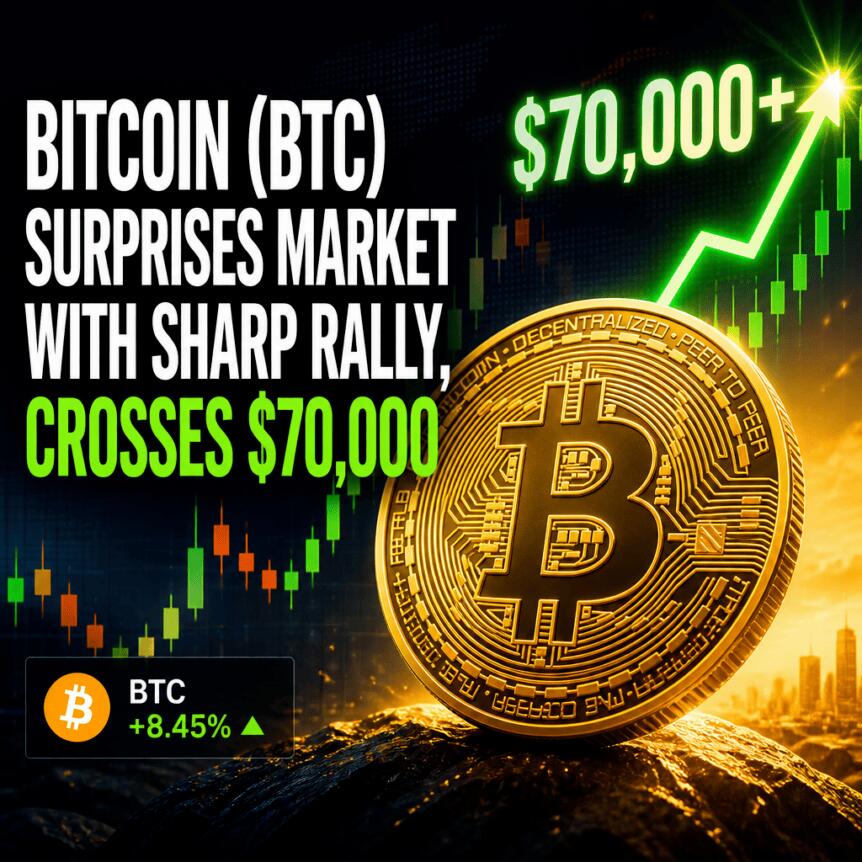
Bitcoin surged over 7% on Wednesday, briefly crossing the $70,000 mark after several favorable developments pushed digital assets higher. The flagship cryptocurrency reached an intraday high of $70,022, triggering a short squeeze that wiped out $1.23 billion in short positions in an hour.
Other tokens rallied as well, with Ethereum (ETH) up nearly 18%, Ripple (XRP) and Solana (SOL) up over 10%, and Hyperliquid up a staggering 22% over the past 24 hours. 24-hour trading volume is up 177%, and the crypto market cap is up over 8% at $2.37 trillion.
Bitcoin Surges as US Treasury Steps In to Improve Liquidity
Bitcoin (BTC) and the broader cryptocurrency industry rallied on Wednesday after the United States Treasury said it would double the buyback of long-term government bonds to $4 billion per operation. The move means the government will buy its own debt to shore up market liquidity, push long-term yields lower, and weaken the dollar. The decision to double buybacks came after the 30-year yield hit 5.337%, its highest level since 2007, with the announcement driving the yield down to 5.192%.
When yields drop, investors turn to other assets for better returns, with BTC the obvious choice. Unsurprisingly, the crypto market responded in bullish fashion. BTC, which has traded in positive territory since Monday, registered a sharp rally of over 7% on Wednesday, briefly crossing $70,000 before closing at $69,300. Bull Theory highlighted the high levels of capital flowing into precious metals and crypto, stating,
“$1.2 trillion has been added to precious metals and crypto in the last 3 hours. Gold up +3.08%, adding $934 billion. Silver up +3.86%, adding $136 billion. Bitcoin up +8.14%, adding $103 billion. Ethereum up +9.66%, adding $22 billion. This comes as the Treasury announced it will double its bond buybacks, pushing the 30-year yield down from a 19-year high to 5.187%.”
Over $1 Billion Liquidated
The rally triggered a wave of liquidations, with traders who bet against a price rally wiped out. Liquidations crossed $1.23 billion in under an hour, with the 24-hour total reaching $1.57 billion, impacting over 114,000 traders. According to analyst Daan Crypto Trades, BTC saw a short squeeze after crossing the $67,000 liquidation cluster.
“$BTC did indeed see a massive squeeze upon breaching that $67K level and liquidation cluster. We saw a +4% 1-minute candle just now which is more than the biggest daily candle we saw in weeks.”
BTC’s rally comes after it traded between $60,000 and $66,000 for an extended period. Buyers made several attempts to push the price higher, but failed to sustain momentum after breaching $66,000, prompting a wave of leveraged short positions. However, the setup was changed in minutes during the rally, with several traders liquidated.
SEC Proposal Buoys Crypto Market Sentiment
Bitcoin (BTC) has also benefited from favorable regulatory developments, with the Securities and Exchange Commission (SEC) proposing the “Regulation Crypto Assets” framework. The proposal aims to create registration exemptions that allow eligible crypto startups to raise up to $5 million over four years, and eligible issuers to raise up to $75 million in 12 months. The proposal is yet to come into effect, with the SEC giving the public a 60-day window for feedback.
Bitcoin Bull Market?
Whether the rally signals a returning bull market is up for debate. Analyst Michaël van de Poppe believes the decision could trigger a bull market, stating,
“This is a great announcement and is a great trigger for the markets. #Bitcoin in a bull market, the likelihood of this has increased.”
However, Rekt Capital believes Bitcoin price charts still favor the sellers,
“History suggests Bitcoin is approaching a resistance area it won’t be able to breach at this very moment in the market cycle.”
The flagship cryptocurrency sits well below its October 2025 high of $126,080. Meanwhile, Bitcoin’s funding rate also hit a 20-month high, indicating traders are paying a significant fee to bet on prices pushing higher. However, CryptoQuant data revealed that Bitcoin demand has grown on a 30-day basis, indicating real, not forced buying.
“Spot and perpetual futures demand growth have both crossed back above zero on the 30-day sum. It is the first time in months that the two are positive at the same time.”
Meanwhile, BTC’s rally has continued into Thursday as it tests the $72,000 level, with the price up almost 4% and having reclaimed key technical levels as the market continues to gain momentum.
Disclaimer: This article is provided for informational purposes only. It is not offered or intended to be used as legal, tax, investment, financial, or other advice.
The US dollar has come under moderate pressure as long-term US Treasury yields have declined. Another factor has been the US Treasury Department’s decision to increase buyback operations for securities with maturities ranging from 10 to 30 years in an effort to support market liquidity. Against this backdrop, the 30-year Treasury yield fell by around 9 basis points to 5.19%.
The decline in yields has weakened one of the key sources of support for the dollar and has been particularly significant for USD/JPY, which remains highly sensitive to movements in the US bond market.
The recently released FOMC minutes provided a counterweight. The minutes revealed growing concerns among policymakers about inflation risks, with several officials favouring a rate hike as early as the July meeting. This kept the overall tone relatively hawkish. Although policymakers were divided over whether an immediate rate increase was necessary, inflation risks remain a central concern for the Federal Reserve, while future decisions will continue to depend on incoming economic data.
Today, markets will focus on a fresh batch of US economic figures. The Philadelphia Fed Manufacturing Index is expected to fall to 24.1 from 41.4, while initial jobless claims are forecast at 210,000. Weaker-than-expected figures could put additional pressure on the dollar, whereas resilient data may allow the currency to recover some of its recent losses.
For the Canadian dollar, commodity-price data will provide an additional catalyst. The Raw Materials Price Index (RMPI) is expected to decline by 1.8% following a 6.9% drop in the previous month, making the actual reading potentially important for the further direction of USD/CAD.
USD/JPY
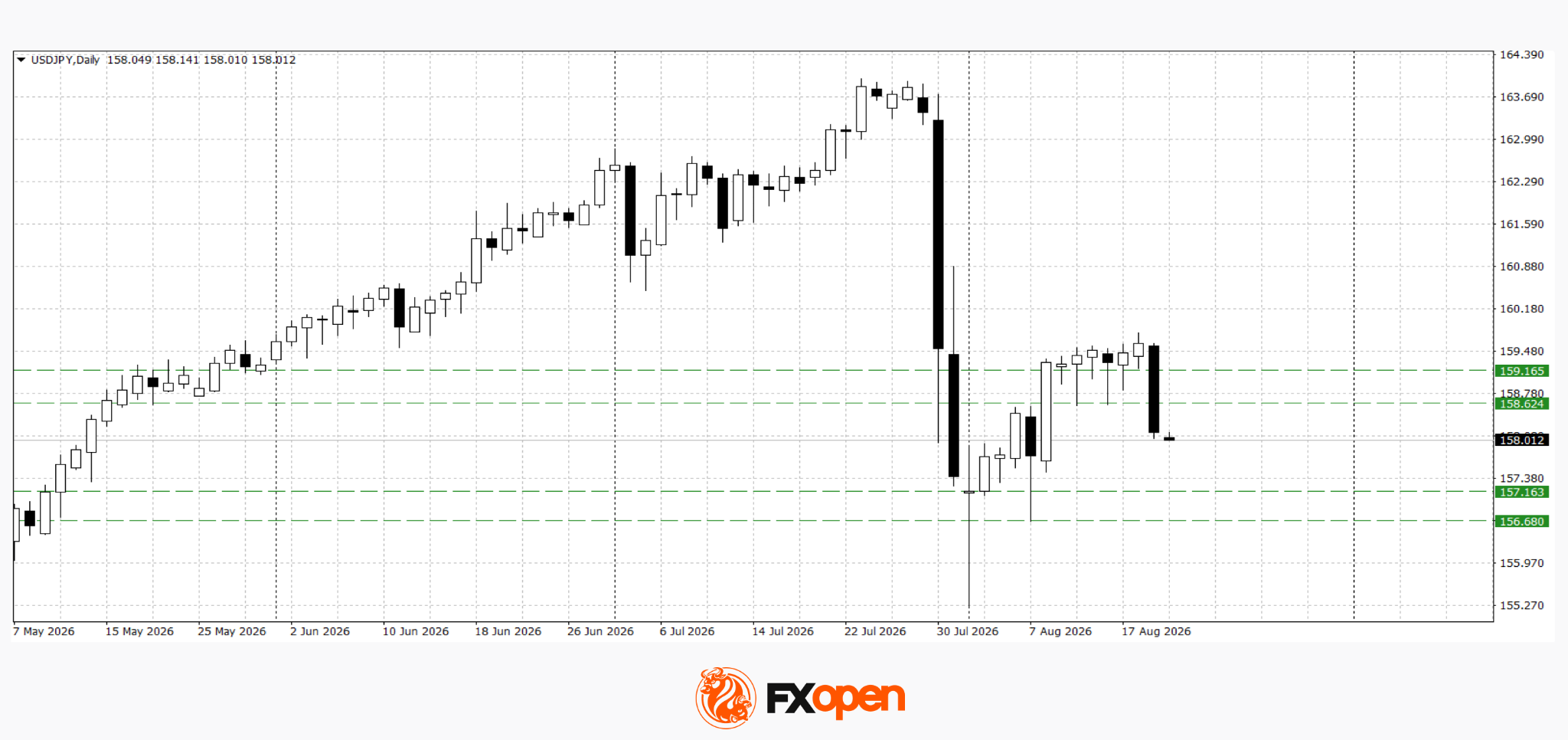
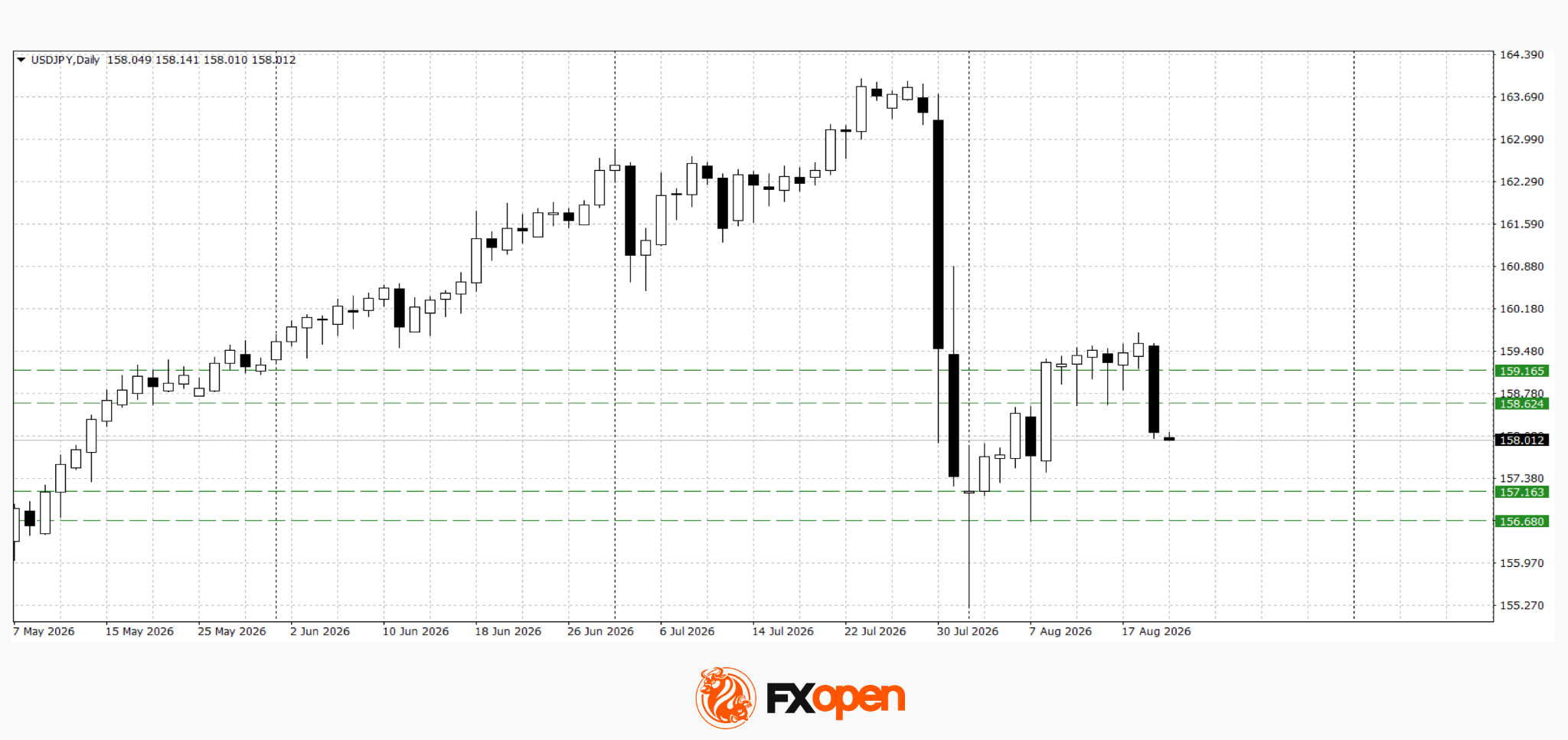
USD/JPY made several unsuccessful attempts to approach the key 160.00 resistance level before sharply retreating towards 158.00 as US Treasury yields declined.
If selling pressure on the dollar persists, the pair could move towards the 156.70–157.20 area. At the same time, a corrective rebound following yesterday’s decline could lift the pair towards 158.60–159.20.
Key events for USD/JPY:
- today at 15:30 (GMT+3): Philadelphia Fed Manufacturing Index;
- today at 15:30 (GMT+3): US initial jobless claims;
- tomorrow at 02:30 (GMT+3): Japan national core Consumer Price Index (CPI).
USD/CAD
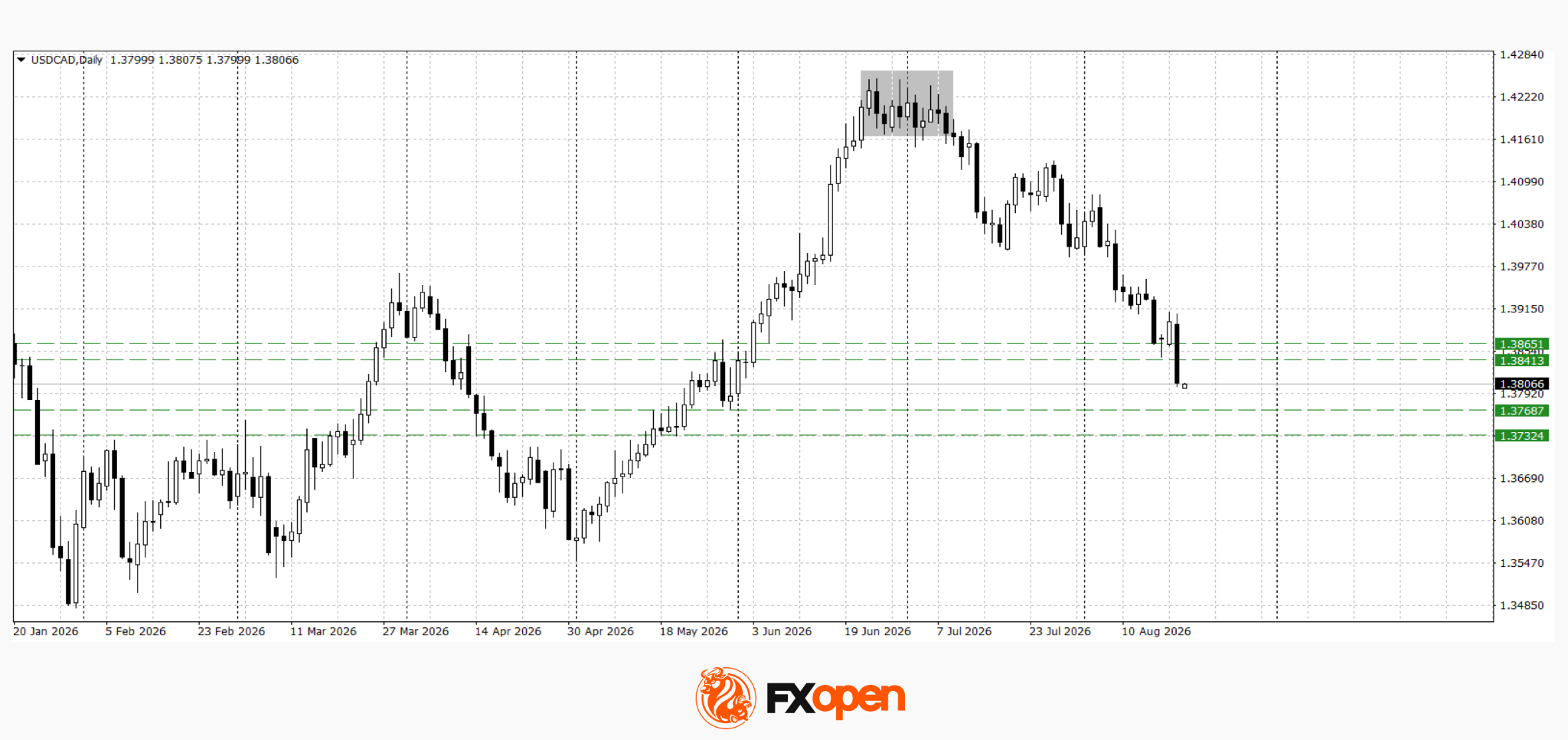
USD/CAD remains in a broader downtrend following the formation of a “tower” pattern in early July. Yesterday, sellers tested the important 1.3800 support level.
A sustained break below yesterday’s low could open the way towards 1.3730–1.3760. If 1.3800 continues to hold as support, however, the pair could stage a recovery towards 1.3840–1.3870.
Key events for USD/CAD:
- today at 15:30 (GMT+3): Canadian Raw Materials Price Index (RMPI);
- today at 17:00 (GMT+3): US Leading Economic Indicators;
- tomorrow at 15:30 (GMT+3): Canadian core retail sales.
Outlook
USD/JPY and USD/CAD remain caught between opposing fundamental forces. Falling Treasury yields are weighing on the dollar, while the relatively hawkish tone of the FOMC minutes is limiting the scope for a deeper decline.
The market’s attention is now turning to the latest US economic data. Weaker figures could extend the dollar’s correction and increase downside pressure on USD/JPY and USD/CAD, while stronger-than-expected releases could restore support for the US currency and trigger a recovery in both pairs.
Trade over 50 forex markets 24 hours a day with FXOpen. Take advantage of low commissions, deep liquidity, and spreads from 0.0 pips (additional fees may apply). Open your FXOpen account now or learn more about trading forex with FXOpen.
This article represents the opinion of the Companies operating under the FXOpen brand only. It is not to be construed as an offer, solicitation, or recommendation with respect to products and services provided by the Companies operating under the FXOpen brand, nor is it to be considered financial advice.

Get these Tour-level Bridgestone golf balls for under $40

A “private and secure” face-search tool left 9 million photos exposed

Britain’s most dangerous spider strikes again: Woman in Kent is left with a ‘crater’ in her leg after a bite from a false widow that was ‘hiding on a clothes peg’





-

 Fashion6 days ago
Weekend Open Thread: Ann Taylor
-
 Sports6 days ago
This U.S. Amateur is a glimpse into golf’s future in more ways than you think
-
 Tech6 days ago
11 Ways to Rank Your Videos
-

 Sports5 days ago
Birmingham 2026: Day 6 Timetable for Irish Athletes
-
 NewsBeat5 days ago
Myanmar says over 300,000 Rohingya refugees verified for repatriation as exodus enters ninth year
-

 Politics5 days ago
SEQ Code: The Three Letter Boarding Pass Code That Could Give You The Worst Seat
-

 Tech7 days ago
DeepSeek Harness launches as open source rival to Claude Code, alongside V4-Pro on API with higher prices
-

 Tech2 days ago
Qwen3.8-27B runs frontier-class coding agents and reasoning locally, no cloud API required
-

 Crypto World5 days ago
Pi Network Protocol 27 endgame: last upgrade before what?
-

 Crypto World3 days ago
OCC Greenlights Trump Family Crypto Firm for Trust Charter
-

 Business2 days ago
SMA Solar Technology AG (SMTGY) Q2 2026 Earnings Call Transcript
-
 Tech5 days ago
Every fusion startup that has raised over $100M
-

 Fashion6 days ago
Weekly News Update, 8.14.26 – Corporette.com
-
 Entertainment6 days ago
10 Netflix Shows That Quietly Became Modern Classics
-

 Business5 days ago
Facebook Down Now? Users Report Login And Loading Problems As Outage Trackers Monitor Ongoing Issues
-
 Entertainment5 days ago
Marvel Studios Reveals New X-Men Cast Including Adam Driver and Sadie Sink
-

 Business6 days ago
15 Ways to Make Money From Your Phone (2026 Guide)
-

 Fashion6 days ago
Silver bangles for women – Newbridge Silverware
-

 News Videos7 hours ago
Don’t Leave Your Financial Future To Chance | August 19, 2026
-
 Business5 days ago
Monarch Mutual Fund set to enter MF space with maiden overnight fund; files draft with Sebi
You must be logged in to post a comment Login