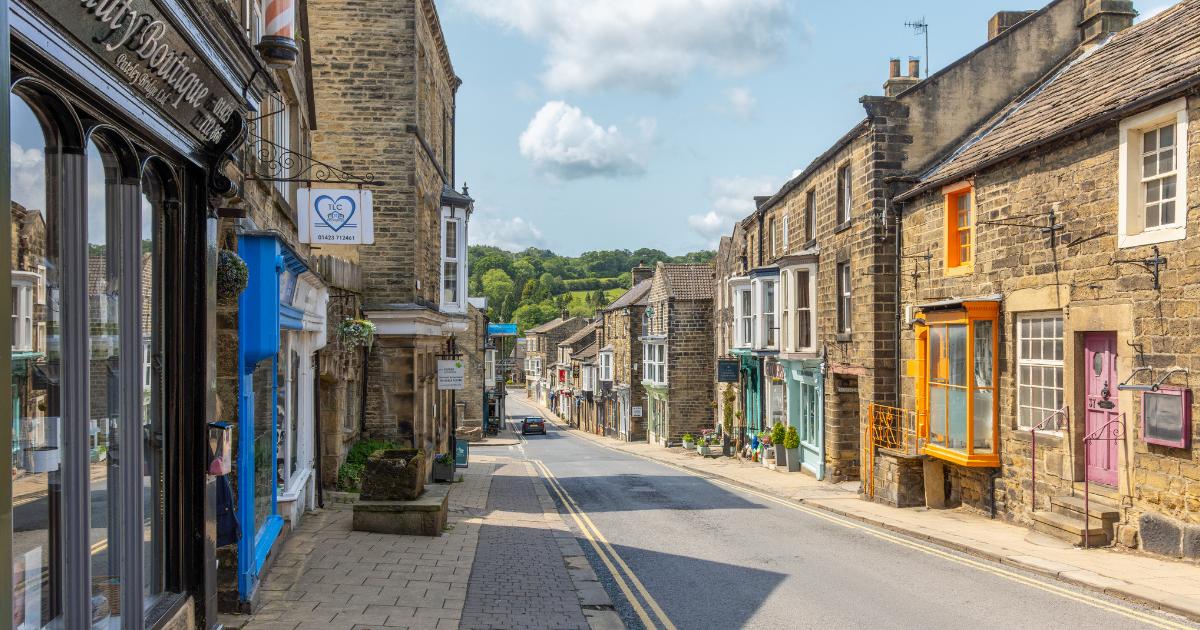
Pateley Bridge is packed with cute shops and traditional Yorkshire streets while also being surrounded by “stunning scenery.”
Pateley Bridge is not only a charming town to visit, but it is also home to the oldest sweet shop in England.
If you have a sweet tooth or need some fuel for a long hike, you might want to stop at Pateley Bridge for some old-fashioned sweets.
What is Pateley Bridge like?
Pateley Bridge has been described as “charming” and a place where “you can experience all the charms of rural life.”
The town is known for its historic buildings and history that dates back centuries.
Advertisement
For those who love shopping, Pateley Bridge has an award-winning high street packed with independent shops.
The Oldest Sweet Shop is a must-visit in the town and has shelves lined with old sweets to choose from, including boiled sweets, toffee, and luxury chocolates.
If you love flowers, you can stop off at the Sticks ‘N’ Stones Florist where you can pick up a bouquet or a hand-crafted gift to take home.
There is also the Paper People Books and Games where you can find your next read and the Fewston Farm Shop and Café for any locally produced food.
Advertisement
The town is also home to the “unique” Nidderdale Museum where you can see what rural life was like over the past 200 years.
The museum features different rooms such as a Victorian Parlour, General Store, and School Room with lots of old objects to see.
Reviewers on Tripadvisor say the museum is “definitely worth visiting” and is “crammed with objects.”
The museum is also popular with visitors. (Image: Tripadvisor)
For food, you can visit the Crown Inn, which offers a classic pub menu with dishes such as scampi and seabass to steak and ale pie.
Advertisement
The pub also offers a Sunday roast and has rooms for you to stay in if you would like to extend your stay in the area.
You might prefer The Willow where you can enjoy breakfast, a relaxing afternoon tea or a special evening meal.
You could also stop off at Cocoa Joe’s where you can find some of the best hot chocolate in England.
Have you ever been to Pateley Bridge before? Let us know in the comments.
Officers from Cleveland Police spotted a suspicious vehicle and a pursuit began
Carrington Walker and Helen Corbett, Clara Margotin, Pol Allingham and Tom Wilkinson, Press Association
16:56, 22 Aug 2026
Two police officers who died in a crash that killed five others in the early hours of Saturday morning (August 22) have been named.
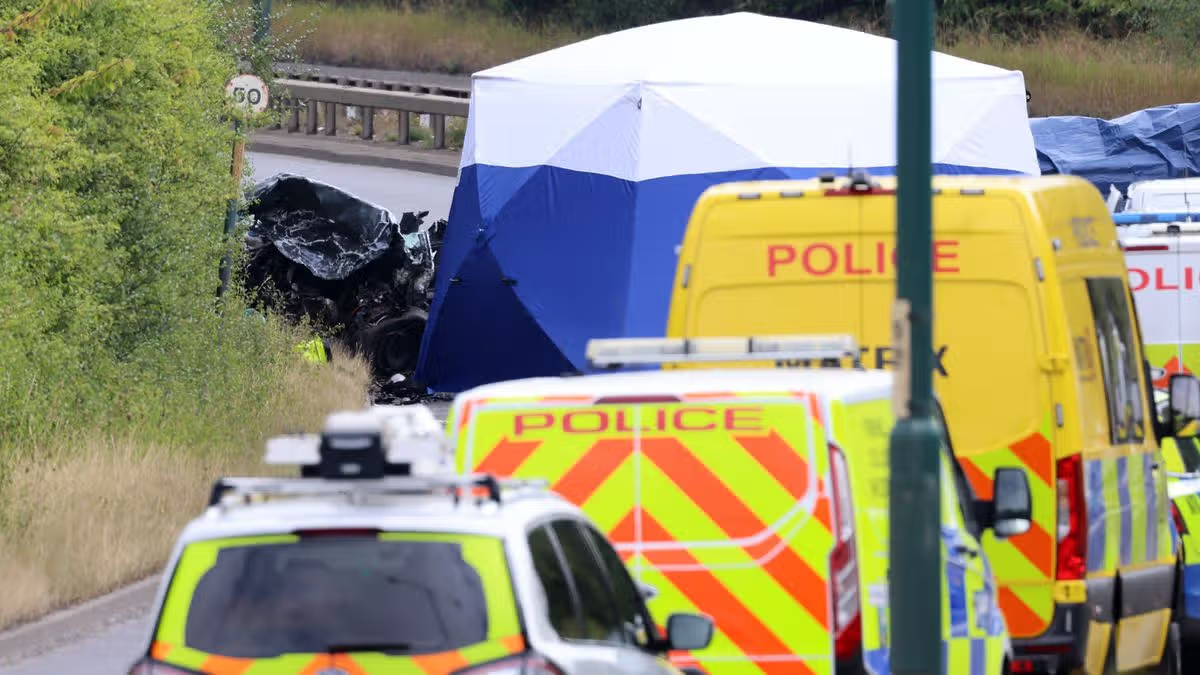
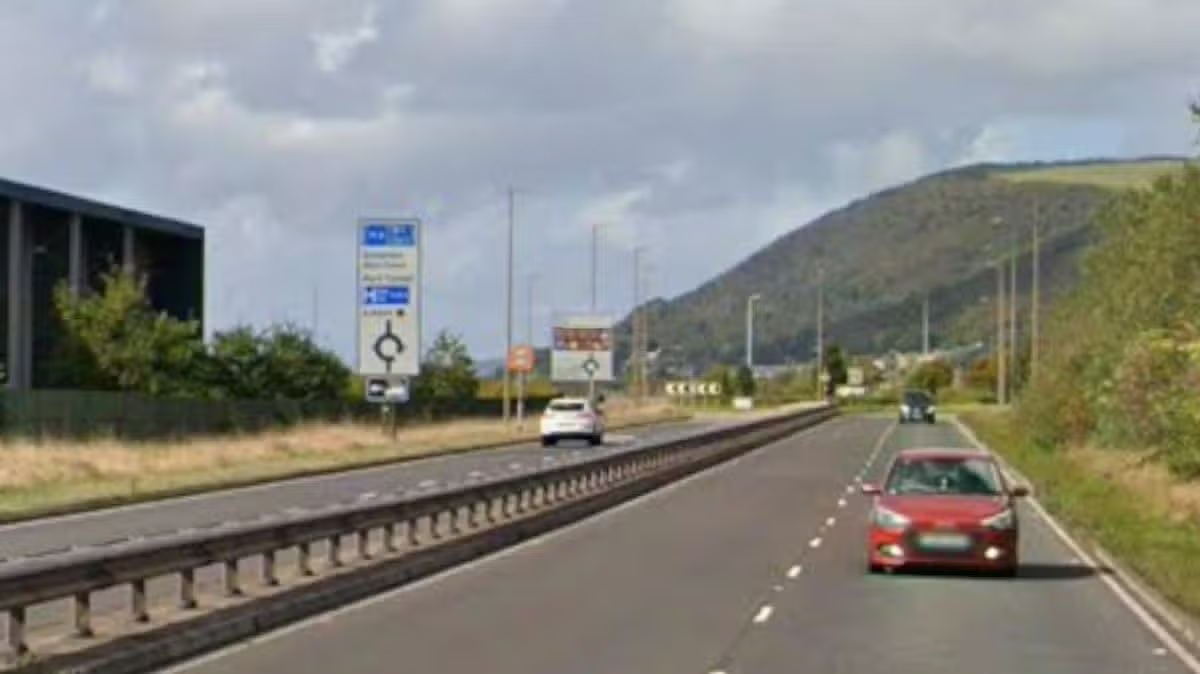
Pc Matthew Blades, 37, and Pc Tom Clough, 38, were killed when a Volkswagen Passat which was travelling the wrong way down the A66 near Middlesbrough collided with their marked police vehicle that was going in the right direction. The Independent Office for Police Conduct (IOPC) opened an investigation into the circumstances leading to the crash at 3.39am in South Bank after a mandatory referral from Cleveland Police.
Officers from Cleveland Police spotted a suspicious vehicle and a pursuit began before the car travelled onto the A66 and collided with a police car, the watchdog said.
Advertisement
Chief Constable Victoria Fuller said it was an “incredibly sad day for Cleveland”, adding, “These were brave officers protecting our communities and serving our residents who didn’t return home to their families at the end of their shift,” she added.
Prime Minister Andy Burnham said he was “devastated” to hear about the crash.
Ensure our latest stories always appear at the top of your Google Search by making us a Preferred Source. Click here to activate or add us as your Preferred Source in your Google search settings.
Walking is having a wellness makeover on social media. The latest trend, “lymphatic walking”, involves swinging your arms more, maintaining an upright posture and taking deeper breaths while you walk. These actions are said to help move lymph around the body. Its followers claim it can reduce bloating and improve circulation, support immune function, and even help “flush toxins” from the body.
The lymphatic system is a network of vessels, tissues and organs that works alongside the cardiovascular system. Fluid is constantly moving out of tiny blood vessels into the tissues around our cells, and the lymphatic system’s main job is collecting this excess fluid and protein and returning it to the circulation.
Beyond the gut, the lymphatic system plays an important role in immunity, transporting immune cells through lymphatic vessels and lymph nodes, where immune responses can be coordinated.
Unlike the cardiovascular system, though, the lymphatic system does not have one large central pump like the heart. Instead, lymph – a clear to straw-coloured, watery liquid – moves in several ways. Lymphatic vessels can contract on their own, but lymph flow is also driven by pressure changes from breathing and by the contraction and relaxation of surrounding skeletal muscles.
Our muscles act as pumps. As they contract, they compress blood and lymphatic vessels running through and around them. Combined with one-way valves inside these vessels, this helps move fluid forwards and, particularly in the lower limbs, upwards against gravity.
Second heart
The calf muscles are probably the best-known example. Each time we take a step, muscles in the lower leg contract and relax, helping to push blood in the veins back towards the heart. This is why the calves are sometimes described as a “second heart”.
Advertisement
But this effect is not limited to the calves, or to walking. Exercise can support lymphatic flow through skeletal-muscle contraction. Deliberately using muscles throughout the arms, legs and trunk while moving therefore has a sound physiological basis.
Calf muscles are sometimes called the ‘second heart’. Yiistocking/Shutterstock.com
So walking with more arm movement, taking deeper breaths and actively using more muscles is physiologically meaningful. The problem comes when this is presented as something unique or necessary to “activate” the lymphatic system.
At the moment, there is no clear evidence that lymphatic walking is better than ordinary walking for healthy people. The specific combination of arm swinging, posture and breathing being promoted online has not been shown to provide special detoxifying, fat-burning or immune-boosting effects.
Advertisement
However, the broader idea – moving purposefully, engaging more muscle and breathing more deeply while doing so – does make physiological sense.
Exercise is already an important part of managing lymphoedema, a condition where the lymphatic system cannot drain fluid effectively and swelling develops. Muscle-pumping exercises, including walking, can help support this drainage.
For most people, though, the useful message is probably not that they need to start lymphatic walking. It is to make every movement count.
Walking, climbing stairs, dancing, strength training, swimming, gardening or running all involve repeated muscle contraction. Even simply getting up after sitting for a long period activates muscles that have been relatively inactive.
Actively engaging with movement may also have benefits that extend well beyond lymphatic flow.
Advertisement
Regularly and deliberately using our muscles helps maintain strength and physical function, while also supporting cardiovascular, metabolic and mental health. Over time, this can help build greater physical resilience and reduce vulnerability to injury, illness and loss of function.
The best thing most people can do for their lymphatic system is therefore much less complicated than this wellness trend makes it sound: move regularly, purposefully and often. Every step, stretch and muscle contraction counts.
Under the proposals a mayor will be able to ‘call in’ decisions and direct councils to take them forward or refuse them
22:36, 22 Aug 2026Updated 22:38, 22 Aug 2026
Mayors across England will be given more power over planning decisions in their region, the government has announced.
Under the proposals, which will be published next week, a mayor will be able to ‘call in’ decisions and direct councils to take them forward or refuse them.
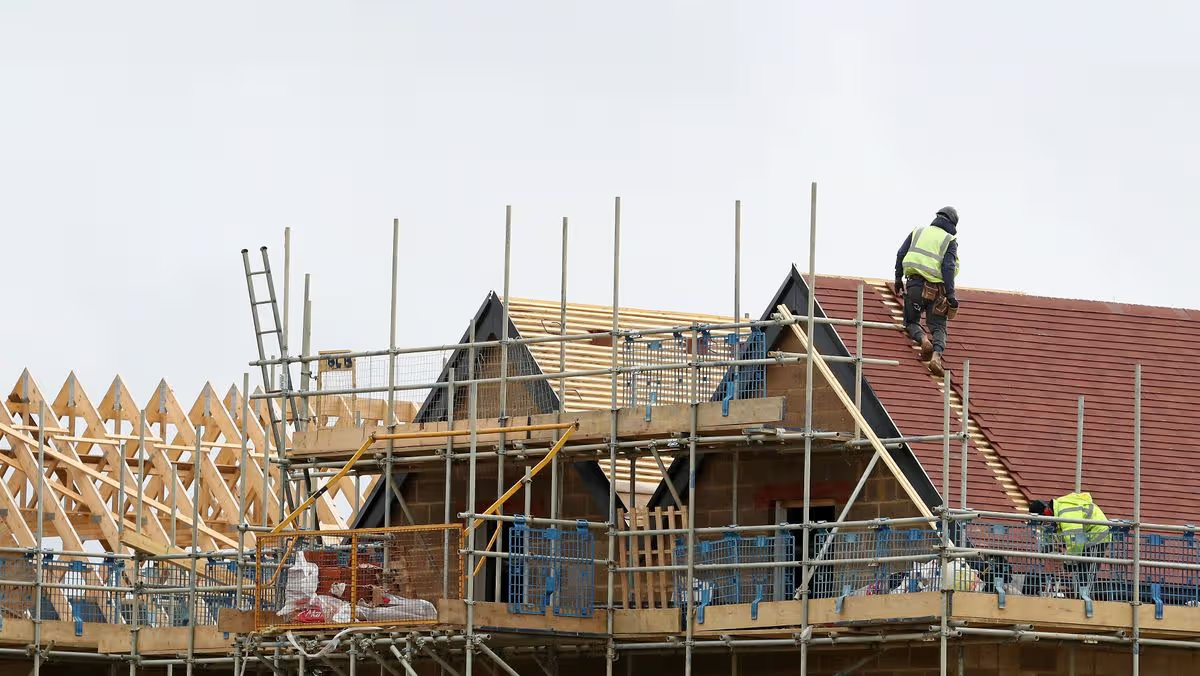
Mayors will also be able to grant upfront permission so developers can start building without having to apply. It will apply to developments of more than 150 homes, commercial spaces of more than 15,000 square metres or any building 30 metres or taller – which is roughly 10 storeys.
Advertisement
The decisions must be in line with planning rules, local plans set out for areas and the national policy, and ministers will retain a backstop power to intervene.
Mayors will also have a greater say over how national housing funding is spent in their areas and will be able to levy a development charge to fund major infrastructure.
Mr Burnham told The Sunday Times that he understood the argument that devolving powers to mayors to push through such projects could disempower councillors, MPs and constituents.
He said: “Sometimes… challenge does need to be made to local decision-making, and actually it cuts both ways.
Advertisement
“It’s not all about Nimbyism. Sometimes it’s the other way round.
“It’s a local authority putting forward something that’s unacceptable in terms of the impact on the community… so it’s a two-way street.”
However, the Liberal Democrats said the move was a “direct attack” that would silence residents.
Gideon Amos, the party’s housing and planning spokesperson, said: ”Taking powers away from communities and local councillors is taking powers away from local people. This plan is a direct attack on communities across the country.
Advertisement
“Labour’s chaotic patchwork approach to devolution will simply not work to solve the housing crisis.
“Instead of silencing residents and handing mayors a blank cheque, the Government should be empowering local councils with the resources to deliver genuinely affordable homes alongside the infrastructure to support them.”
FBI director meets with DC field office ahead of Grand Prix
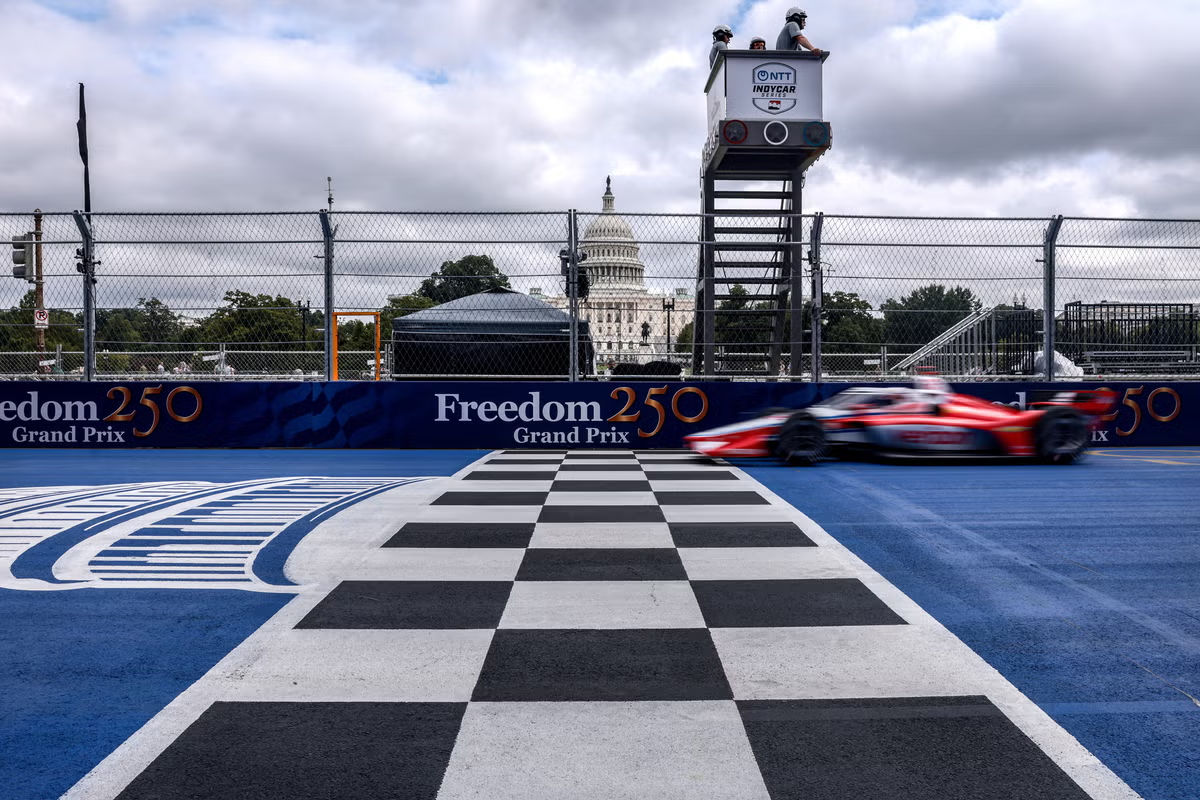
FBI Director Kash Patel said Saturday he met with the command post out of the Washington Field Office ahead of the Freedom 250 Grand Prix and touted safety measures put into place.
“FBI has a huge presence here to keep this event safe – nearly 400 personnel dedicated between Headquarters and President Trump’s DC ‘Safe and Beautiful Task Force’ to manage the security lift,” Patel wrote on X.
Among those helping keep the event safe are the Critical Incident Response team, multiple intelligence components and the Command Post operators. Patel said SWAT was on standby as well.
Advertisement
Ariana Baio22 August 2026 22:00
Qualifying round to begin soon
Drivers are getting ready to compete in the qualifying round of the Freedom 250 IndyCar series to determine the order for Sunday’s Grand Prix race.
Drivers will have six minutes to post the fastest lap time that they can. The driver with the fastest time will secure a position closer to the front for Sunday’s race.
Advertisement
The qualifying round is set to begin at 5 p.m. ET.
Ariana Baio22 August 2026 21:55
DC manhole covers have been ‘welded down’ to keep spectators safe – Sec Burgum
Secretary of Interior Doug Burgum says that manhole covers are being “welded down” in Washington, D.C. to ensure spectators and drivers are kept safe during Sunday’s race.
Advertisement
Burgum says that the IndyCar Series team and Freedom 250 have “taken every precaution” to keep people safe, including “making sure they’re welding the manhole covers down so they don’t get sucked up like a vacuum when these cars come flying over the top of them, he told NewsMax.
Rhian Lubin22 August 2026 21:30
How the National Gallery is protecting priceless artworks ahead of the race
NASCAR and IndyCar racing legends will reach speeds of up to 185 mph during the race in the heart of the nation’s capital, in and around museums and government buildings, including the famed art gallery.
Advertisement
The National Gallery, which is listed on the National Register of Historic Places, sits in the middle of the 1.7-mile-long racecourse, and the institution is not taking any chances when it comes to looking after the tens of thousands of valuable artworks it houses, The Washington Post reported.
Rhian Lubin22 August 2026 21:00
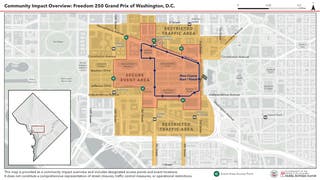
Freedom 250 Grand Prix track map
The route, a 1.7 mile loop, will take drivers past the Capitol, Washington Monument and National Archives, according to a map provided by the event’s organizers.
Advertisement
A total of 147 laps will be completed, making for a total distance of about 250 miles. Seven turns are included in the route.
A map of the course, which winds around several major DC landmarks (Executive Office of the Mayor )
Rhian Lubin22 August 2026 20:30
In pictures: Crowds spectate IndyCar drivers warming up in DC
Dale Coyne Racing driver Dennis Hauger (19) practices for the Freedom 250 Grand Prix street course on the National Mall (Reuters)
An IndyCar streaks by spectators during a series qualifying run (AP)
Bobby Labonte passes the National Archives during a practice for the International Race of Champions Racing Series (AP)
Rhian Lubin22 August 2026 20:00
What is the difference between IndyCar and F1?
F1 and IndyCar share similarities, but they also have major differences. The main differences involve where they race, the circuit types, and the cars themselves.
Advertisement
IndyCar races mostly take place in the U.S., with an annual circuit in Toronto, Canada. F1, by contrast, saw its 2026 season span 24 races across 21 countries.
Drivers both race on the road and some street courses, but only IndyCar races on oval circuits. “IndyCars run continuous high-speed laps with almost no braking, while F1 lap times are shaped by a mix of high-speed straights and technical cornering sections,” Red Bull explains.
Examples of IndyCar courses include permanent road courses (Barber Motorsports Park, Road America), street circuits (Long Beach, Detroit), short ovals (Phoenix Raceway, Milwaukee Mile) and superspeedway ovals (Indianapolis Motor Speedway, Nashville Superspeedway), per FOX Sports.
The cars look similar, but they are vastly different.
Advertisement
While F1 cars are generally shorter and lower (an F1 car is approximately 5.6 meters long and 2 meters wide), an IndyCar is longer at around 5.1 meters. IndyCars are narrower at approximately 1.9 meters, according to Red Bull. “F1 cars also sit closer to the ground due to their more aggressive aerodynamic packaging.”
F1 cars are typically faster on street circuits while IndyCar dominates on oval circuits, Red Bull notes.
Technical regulations are also different. Every IndyCar team has the same car and the same base components. “In INDYCAR, it’s all about taking the same pieces of a puzzle and making a prettier picture. Or, in this case, a faster car!” FOX Sports notes.
But in F1, every year, each team designs and builds its own car from scratch. While certain regulations need to be followed, “there is more freedom to innovate and differentiate” in F1.
Advertisement
Another major difference? How much top drivers earn. A top F1 driver can earn over $50 million per season, according to Red Bull, while elite IndyCar drivers earn closer to $2-5 million per year.
There are just a few of the similarities and differences between F1 and IndyCar.
Alexander Rossi, driver of the #20 ECR Java House Ed Carpenter Racing Chevrolet drives in NTT INDYCAR series on August 22, 2026 in Washington, DC (Getty)
Oscar Piastri of Australia driving the 81 McLaren MCL40 Mercedes on track during qualifying ahead of the F1 Grand Prix of Netherlands (Getty)
Rhian Lubin22 August 2026 19:21
Kyle Kirkwood fastest on first laps of new Washington street course
Kyle Kirkwood topped the first practice session on the new 1.7-mile, seven-turn Washington, D.C., street circuit, posting a fastest lap of 57.3744 seconds at 106.668 mph.
Advertisement
Drivers spent the 90-minute session getting a feel for the new track ahead of Sunday’s 250-mile race.
Erin Keller22 August 2026 16:40
‘D.C. is now a racetrack!’
The Freedom 250 begins in wet conditions, with drivers initially needing rain tires as the track starts to dry.
Nigel Farage is the latest in a long line of politicians to face questions about his financial affairs. Despite this, the Reform UK leader comfortably avoided a binning by his constituents in the Clacton byelection – albeit in the absence of the main parties.
This is perhaps unsurprising. The allegations against Farage include the claim (currently subject to a parliamentary standards investigation), that he should have declared a £5 million gift he received ahead of the 2024 general election. Farage has insisted that he has “done no wrongdoing” and that he “followed the rules”.
But a series of academicstudies suggest that people tend to justify the behaviour of politicians they support rather than changing their vote to back someone else.
Only when scandals become too blatant and heavily covered for supporters to rationalise away do politicians tend to lose support. With this in mind, it’s perhaps not surprising that Farage won comfortably on home turf.
Advertisement
The effects of scandals on our political attitudes are difficult to study, in part because scandals are rare events. The fallout from any individual scandal could be specific to the politician involved, the time period in which it occurred, or the detail of the scandal itself. Measuring the “scandalousness” of any one event is quite difficult.
These are some of the problems that my colleague James Tilley and I tackled in a study of the 2009 parliamentary expenses scandal in the UK. Back then, hundreds of MPs were accused of claiming expenses to which they were not entitled. Many were required to repay money, and a small number were convicted of fraud and even jailed.
The advantage of studying this particular scandal is that a large number of MPs were implicated in similar misconduct at the same time. In addition, the extent to which each MP was implicated could be quantified, both in terms of the value of expenses they were asked to repay, and by measuring the press coverage focusing on each MP.
Importantly, the extent to which each MP was implicated was essentially random across constituencies. This meant that we could measure how a broad swathe of people responded to allegations affecting their local MP.
Advertisement
We found that voters were remarkably aware of the extent to which their MP was implicated in the scandal. The greater an MP’s apparent wrongdoing, either in terms of the money involved or the press coverage, the more their constituents noticed. However, while some constituents reduced their support for their MP, these effects were generally quite small and would probably have mattered only in marginal constituencies. This reaffirmed some previouswork about the same scandal.
Wider trust issues
Another point we considered is whether scandals not only affect people’s attitudes towards the politician implicated, but whether they also affect people’s wider attitudes towards politics as a whole. As such, a judgement about a particular politician becomes generalised into a wider assessment of the performance of politicians in general.
This could be a cause for concern. Trust in politics is associated with whether people turn out to vote, whether they comply with the law and whether they support democratic forms of government. As such, allegations of financial misconduct by politicians could have implications beyond election results.
However, we found no evidence that the constituents of heavily implicated MPs changed their attitudes toward the wider system, in comparison to those whose MP was less implicated. It doesn’t appear that people tend to generalise the behaviour of their local MP into a wider judgment about the system as a whole.
Advertisement
Farage speaks to voters in his Clacton constituency ahead of the local elections in May 2026. EPA/ANDY RAIN
Of course, there are several caveats when comparing the fallout from the expenses scandal with the claims against Farage. The former implicated many MPs at the same time, and the nature of the allegations was different. Farage is also a much more prominent figure than the typical MP we studied. And at the time of writing, the investigation into the claims against him is yet to conclude.
But there are good reasons to expect any change in attitudes among Farage’s constituents to be even weaker in his case. For example, Reform UK voters already tend to have less trust in the system than the average voter. If the claims against Farage are seen to come from that system, his supporters may be even less likely to believe them. Equally, voters with lower levels of trust in politicians generally may be less likely to view the claims against Farage as unusual or particularly deserving of electoral punishment.
When it comes down to it, so far Farage’s experience in Clacton seems to back up the idea that misconduct claims against MPs do not always have substantial effects. That said, with the investigation into the claims against him now resumed, whether this pattern will continue remains to be seen.
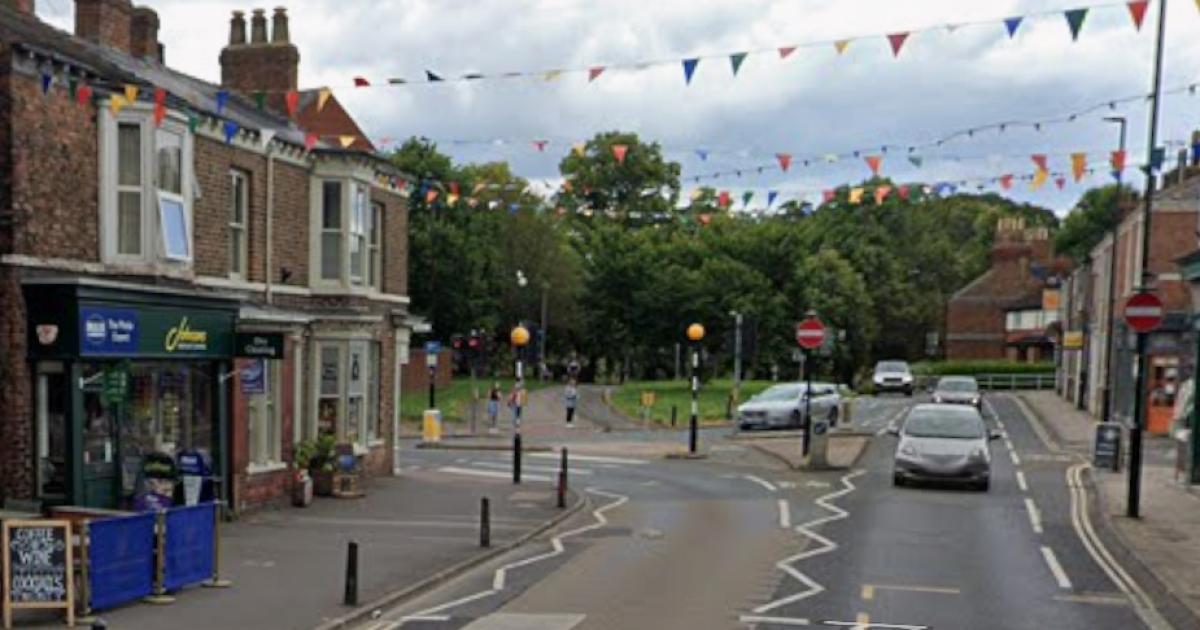
The incident happened during the afternoon rush hour on Thursday at the junction of Bishopthorpe Road and Nunnery Lane.
According to police the two convertibles were both Audis and one of them was white.
The other vehicle involved was a Lexmoto motorcycle with an L plate attached.
Advertisement
North Yorkshire Police are appealing to anyone with information about the road rage incident at 5.15pm on Thursday or who witnessed it to contact PC Clair Bailey-Lane by emailing Clair.Bailey-Lane@northyorkshire.police.uk.
Alternatively, you can visit North Yorkshire Police’s website, select ‘Tell us about’, then choose ‘An existing case or report’ or contact the force through “Live Chat” via our website, Monday to Friday, 9am to 5pm.
A third option is to call North Yorkshire Police on 101 or contact Crimestoppers anonymously on 0800 555 111 or via their website
Please quote reference 12260138604 when passing on information.
The new levies are expected to affect about 5% of Canada’s annual exports to the U.S., roughly $20 billion in goods ranging from hockey sticks to agricultural products. Canada’s Prime Minister Mark Carney quickly promised Saturday that his government would roll out “dollar for dollar” retaliatory measures starting Sept. 8.
No further talks are scheduled. The latest escalation between the two countries — which once held one of the world’s most durable trade alliances — plunges them deeper into a trade war that has kept both sides of the border on edge throughout Trump’s second term in office. Experts warn steeper tariffs raise costs for businesses and almost always trickle down to households in the form of higher prices.
“Nearly all industries and professions are likely to see downstream effects from this spiraling trade dispute,” said Augustine Lo, of law firm Dorsey & Whitney, whose work includes advising clients on international trade.
Advertisement
Here’s what we know.
Which goods are affected?
Again, the 50% tariffs from the U.S. are set to affect $20 billion of Canadian goods.
Canada sends the vast majority of its goods exports to the U.S. (72% last year), and Trump administration says the new taxes will be levied on products ranging from hockey sticks to wine and cement. The list is long. According to documents published by the White House, other goods subject to the tax include honey, seeds and agricultural products — as well as select makeup, perfumes, clothing, jewelry, furniture, cameras, fabric and more.
The 50% levy also applies to some products that were previously protected under the US-Mexico-Canada Agreement, a trade pact from Trump’s first term. That marks a shift from past levies — and further underlines questions around the future of the USMCA overall.
Advertisement
How is Trump imposing these tariffs?
To impose these 50% tariffs, Trump reached back to a long-dormant Great Depression-era law: Section 338 of the Tariff Act of 1930.
When the U.S. and world economies were in collapse nearly a century ago, Congress passed the 1930 law as part of broader “Smoot-Hawley” legislation (named after its congressional sponsors). The act raised tariffs more generally across the board, and became notorious among economists for limiting world commerce and making the Great Depression worse. But Section 338 — which authorizes the president to slap import taxes of up to 50% on imports from countries that have discriminated against U.S. businesses — has never been used specifically to raise tariffs until now.
No investigation is required to justify the levies. Nor is there any limit on how long they can stay in place. Since there’s no precedent, however, the latest tariffs may also see more legal challenges.
When announcing his planned tariffs last month, Trump claimed that Canada was unfairly discriminating against U.S. exports of automobiles, alcohol and dairy products. The president expressed anger over Canada’s retaliation against his own tariffs last year — noting Canadian imports of American alcohol and cars started to fall last spring.
Advertisement
Is Canada retaliating?
Canada’s Carney quickly promised to match the new levies “dollar for dollar” — later announcing retaliation would begin Sept. 8. He noted Canada’s tariff increases would target steel, dairy, appliances, agricultural equipment, pulp and paper and electronics.
The prime minister said Canada was willing to drop remaining retaliatory tariffs on steel, aluminum and autos if the U.S. substantially lowered its own, and to encourage provinces to restore U.S. alcohol sales. But eventually, he said Washington’s final demands went too far.
Carney accused Washington of using “economic integration as a weapon,” and that Canada had been “attacked” by the latest U.S. tariffs. He said his country had the reserves and resilience to respond.
Trump’s top trade negotiator, Jamieson Greer, pledged additional measures to respond to Canada’s retaliation — without immediately specifying what that would look like. In a Saturday interview with “Fox & Friends Weekend,” Greer also claimed the administration offered to cut tariffs on steel, autos and lumber, but Canada “didn’t want” the deal.
Advertisement
Sign up for Morning Wire:
Our flagship newsletter breaks down the biggest headlines of the day.
Advertisement
What’s next?
Tariffs are taxes paid by importers, or businesses that buy goods from abroad. That typically trickles down to consumers through higher prices — and, as seen over the last year, can also create uncertainty for workers across affected sectors.
North America now has a “new tariff landscape,” Dave Townsend, a partner at law firm Dorsey & Whitney, said Saturday. He noted a big question is whether the latest levies prove to be temporary.
Advertisement
The 50% tariffs come on top of previously-imposed levies, including a 10% rate Trump slapped on Canada just last month ostensibly for failing to do enough to prevent imports produced by forced labor and separate sectoral levies impacting trading partners globally.
The growing trade sanctions on Canada underscore Trump’s willingness to risk breaking established alliances. And Canada’s reluctance to accept a deal may reflect recent experience.
Trump has repeatedly targeted Canada, even after instances where it made concessions following his demands. Some tolls on the newly opened Gordie Howe Bridge will be shared for 15 years, despite the fact that Canadians paid for the span linking Detroit and Windsor. Canada also withdrew a digital services tax last year. All the while, Trump has threatened more tariffs over everything from a TV ad criticizing his trade policies (later pulled by Ontario’s government ) to wildfires that blackened skies across North America.
Still, Saturday’s taxes against Canada mark the latest instance of Trump turning to other laws to impose tariffs. And more recently, Washington’s war with Iran has driven prices even higher. With the cost of living at the center of many voters’ minds in a midterm election year, political ramifications could mount for the Republican president in the coming months.
_____
AP Writers Paul Wiseman in Washington and Rob Gillies in Toronto contributed.
A firefighter and his family have been with little more than the clothes on their back, following a heartbreaking fire at their home
A Welsh firefighter who has spent his career rushing to help people on the worst days of their lives has now found himself facing that same nightmare after a devastating fire tore through his family home.
Advertisement
Brecon fire station has issued a statement detailing what happened in a serious domestic blaze on Wednesday (August 19) night, where their own Group Manager, Phil Morris, and his family lived.
According to the fire station, the blaze has robbed the family of almost everything, with their home and possessions devastated. They are now facing the daunting task of rebuilding their lives with little more than the clothes they had with them.
In a statement issued to social media, Brecon Fire Station said it was a call “none of us ever expected to receive”.
“As firefighters, we’re used to being the ones who turn up when somebody is having one of the worst days of their life,” the organisation said. “We go in, do everything we can to help and try to make a terrible situation that little bit better.
Advertisement
“But when that call is for one of your own, it really hits home.”
Brecon Fire Station further highlighted how Mr Morris has devoted much of his life and career to the Fire and Rescue Service, helping others in moments of crisis, adding that he has been an “inspiration to so many” and an “incredible fire officer, colleague and friend”.
Now, the firefighters who have stood alongside him throughout his career are determined to stand alongside him and his family. For the biggest stories in Wales first sign up to our daily newsletter
A JustGiving fundraiser has been launched by the community to help ease some of the immediate pressure facing the family. It is hoped that the money raised will help provide essential items and support as they begin the difficult process of finding their feet again and rebuilding what has been lost. So far, the page has already raised over £22,000.
Advertisement
The page reads: “For a family, a home is so much more than four walls. It’s where children grow, birthdays and holidays are celebrated, meals are shared, and precious family memories are made. To suddenly lose that sense of home, comfort, and security is something no family should have to face alone.
“As they begin the overwhelming process of putting their lives back together, we would love to show them just how much their community cares. We are raising money to help with clothing, food, temporary accommodation, everyday essentials, and the many unexpected costs they will face in the weeks and months ahead.
“No donation is too small. Every pound raised will help this family find their feet again and begin rebuilding a safe and loving home.”
Brecon Fire Station further added: “When someone has spent their life helping others, hopefully we can now come together and return some of that kindness.”
Get daily breaking news updates on your phone by joining our WhatsApp community here. We occasionally treat members to special offers, promotions and ads from us and our partners. See our Privacy Notice
Police are still at the scene of a serious crash in Harbour Way. A spokesperson from South Wales Police confirmed that officers were called to the incident at 2.15pm this afternoon (August 22). While no further detail is available at this time, a spokesperson from the force said: “The road is expected to remain closed for a long period of time, so we are asking motorists to avoid the area.”
Every day on Criminal Record we will be bringing you a round-up of the biggest crime stories of the day.
If you love to read about crime in Scotland – this is the place to be every day.
Here’s what has been making the news across the country on Saturday.
Gangland drugs enforcer petrol-bombed home with children inside
A gangland drugs enforcer has been jailed for more than three years after petrol-bombing a home where a grandmother was looking after several children.
Dean Ritchie, 29, drove accomplice Liam Rice, 21, to the Dundee property in November 2024 before Rice hurled a petrol bomb at the front door. Ring doorbell footage showed the Molotov cocktail explode and flames blaze at the entrance.
Sheriff George Way told Ritchie he had shown a “propensity for violence” and had put lives at risk, adding that the fire only failed to take hold “no thanks to you”. Ritchie was jailed for 38 months and placed on a 12-month supervised release order.
Advertisement
Rice, who was carrying out the attack to pay off a £1,500 drug debt, had previously been placed on a seven-month curfew and 18 months of social work supervision. He also admitted a second petrol bombing in Dundee.
Daniel brothers targeted in long-running gang feud
Robert Daniel, 51, and Ronnie Daniel, 41, were separately targeted in unsuccessful machete attacks at their Glasgow homes by suspected associates of the rival Lyons crime family.
Advertisement
Robert is a senior figure in the Daniel family and has a long history of being targeted during the bitter feud, which is believed to date back more than 25 years. He was previously shot and seriously injured outside his Stepps home in 2017, while his property was set on fire in April last year as he slept inside.
Just weeks later, two men working at an accident repair centre owned by Daniel in East Kilbride were seriously injured in a machete attack. Police believe Daniel was the intended target.
Ronnie is less well known but has also been linked to the feud. He was reportedly threatened with a shotgun by a Lyons associate in Possilpark in 2021 and is believed to have attended the funeral of Daniel family enforcer Kevin “Gerbil” Carroll, who was shot dead outside an Asda supermarket in Robroyston in 2010.
Lyons gang orders machete attacks on Daniel family
The Lyons crime clan is understood to have ordered a series of brutal machete attacks against members of the rival Daniel family in an escalation of a long-running Glasgow gang war.
Senior Lyons figures are believed to have instructed footsoldiers from Ross McGill’s Tamo Junto gang to carry out the revenge attacks following the murders of Eddie Lyons Jnr and Ross Monaghan in the Costa del Sol last year.
The first attack took place on Curzon Street in Glasgow in the early hours of Friday, where balaclava-clad men armed with machetes allegedly smashed their way into a property while searching for Ronnie Daniel, 41. The gang reportedly ransacked the house before fleeing.
Advertisement
The group then travelled to Honeywell Drive in Stepps, where they are understood to have targeted Ronnie’s relative Robert Daniel, 51. Robert managed to escape after allegedly being chased near his home.
Car crashes into home as Glasgow gang war fears grow
A car has smashed into a home near Glasgow just a day after a series of brutal attacks reignited fears of a gangland war in the city.
Advertisement
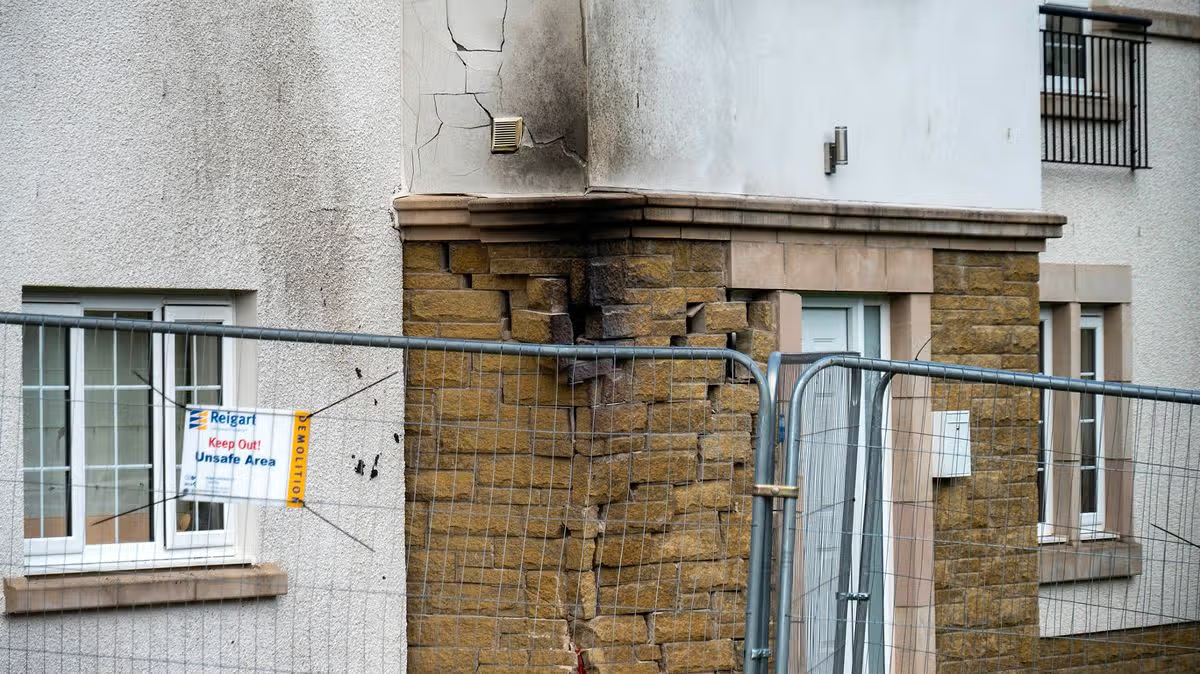
Emergency services were called to Low Borland Way in Eaglesham, East Renfrewshire, at around 1.20pm on Friday, August 21, after a vehicle crashed into a property before driving away. A large police cordon was put in place and the house has since been fenced off.
The Record understands detectives are not ruling out a possible link to Operation Portaledge, Police Scotland’s investigation into gangland activity across the central belt. The incident came just hours after two members of the Daniel family were targeted in separate alleged machete attacks.
The Lyons crime clan is understood to have ordered the attacks through Ross McGill’s Tamo Junto gang as part of a revenge campaign following the killings of Eddie Lyons Jnr and Ross Monaghan in Spain last year. Detectives are now examining whether the latest incident is connected to the escalating feud.
Woman charged after mystery substance found on Edinburgh lamppost
A woman has been arrested and charged after an unknown substance was discovered on a lamppost in Edinburgh, sparking a response from police and firefighters.
Officers were called after reports of “items being placed on a lamppost” on Morningside Road on Thursday evening, August 20. A section of the road was closed while emergency services attended and the substance was removed.
A cordon was erected around the lamppost and public transport was disrupted as officers and firefighters dealt with the incident. Tests were carried out on the substance and it was found to pose no threat to the public.
Advertisement
A 30-year-old woman has now been arrested and charged in connection with culpable and reckless conduct.















































You must be logged in to post a comment Login